Back to blog
Crypto Basics

Bear Trap - What It Is and How To Identify It?

Learn all about the bear trap trading, including what it is, how it works, and how to spot it in the market.
Token Metrics Team
7 Minutes
Want Smarter Crypto Picks—Free?
See unbiased Token Metrics Ratings for BTC, ETH, and top alts.
Thank you! Your submission has been received!
Oops! Something went wrong while submitting the form.
 No credit card | 1-click unsubscribe

As traders, we all want to achieve the best possible results when it comes to making profits. But, in reality, markets can be unpredictable, and trends can reverse at any time. 

This is where analyzing trading patterns come into play. One such pattern is the bear trap, which is designed to take advantage of price movements. This is a situation where the market appears to be heading in one direction, only to suddenly reverse and move in the opposite direction.

In this article, we'll take a closer look at the bear trap, how it works, how to identify it with examples and most importantly, how you can avoid falling into it.

What is a Bear Trap?

A bear trap occurs when the market appears to be entering a downward trend, and traders start selling their assets to avoid losses. However, instead of continuing to decline, the market suddenly reverses and begins to rise again, trapping the bearish traders who sold their assets in anticipation of a further drop.

One of the main reasons why bear traps occur is due to market manipulation by large players such as institutional investors or hedge funds. They can create a false sense of bearish sentiment by selling large quantities of a particular asset, which causes smaller traders to panic and start selling as well.

Once these smaller traders have sold their assets, the large players can then start buying them back at a lower price, which drives up the market price and causes the bearish traders to incur significant losses.

How Does Bear Trap Work?

A bear trap is created when traders deliberately sell large volumes of a particular asset in order to push the price of that asset down. This creates a false impression of the market declining, leading other traders to believe that the asset is losing value and to sell their positions.

Once the price of the asset reaches a certain low point, the traders who created the bear trap begin to buy up large volumes of the asset at the artificially low price, thereby increasing demand and driving the price back up.

Here are some of the ways that bear traps work:

  1. False Signals - Traders create fake signals to suggest that the market is going to drop. These signals may include a sudden increase in selling volume or a sharp drop in prices. The purpose of these signals is to convince investors to sell their assets, which in turn drives the price even lower.
  2. Spread FUD - Fear, uncertainty, and doubt (FUD) are common tactics used by traders to create a bearish market. Traders will spread rumors or news stories that suggest that the market is about to crash, causing investors to panic and sell their assets.
  3. Sell-Off - Traders initiate a massive sell-off of a particular asset, causing its price to plummet. This creates a domino effect, as other investors begin to panic and sell their assets as well, leading to a significant drop in the market's overall value.
  4. Short Selling - Traders can also use short selling to initiate a bear trap. In short selling, a trader borrows assets from another investor and then sells them at the current market price. The trader then waits for the price to drop before buying the assets back at a lower price, returning them to the original owner and pocketing the difference.

A bear trap is a manipulative tactic used by traders to make a profit by artificially creating a downward trend in the market. Investors should be aware of these tactics to avoid falling prey to a bear trap.

How to Identify a Bear Trap?

Identifying a bear trap is not always easy, but there are some key indicators to look out for. Firstly, if the market appears to be moving in a particular direction for an extended period, it's important to be cautious as this may be a sign of manipulation.

Another indicator to look out for is a sudden and unexpected shift in market sentiment. If the market suddenly starts to move in the opposite direction to what was expected, it's important to be cautious and assess the situation carefully.

Bear Trap Chart

Let's take a look at the chart for a better understanding of how a bear trap works. In the chart, the price of an asset had been steadily rising, but then suddenly dipped below a trend line that acted as support. This made it look like the support would be broken and that the price would continue to fall. However, within the same time period, the price went back up and continued to rise. 

Image Resource - www.makeuseof.com

Traders who acted too quickly and sold their shares, when the price broke the trend line would have been "bear-trapped," as the price quickly rose again, and they missed out on potential profits. 

On the other hand, traders who waited for the price to close outside of the trend line and make a retest would have been able to avoid the bear trap and make a profitable trade. 

Example of a Bear Trap

One real-life example of a bear trap in the crypto market occurred in May 2021, when the price of Bitcoin dropped from its all-time high of nearly $65,000 to around $30,000. Many investors sold their Bitcoin at this point, fearing that the market would continue to decline. 

However, Bitcoin's price rebounded to nearly $40,000 just a few weeks later, trapping those who sold out of the market and missing out on potential profits. This is a classic example of how a bear trap can occur in the crypto market, as fear and uncertainty can lead to hasty decisions that result in missed opportunities.

How to Avoid Falling into a Bear Trap?

Avoiding a bear trap requires a combination of vigilance, patience, and discipline. Firstly, it's important to conduct thorough research and analysis before making any trading decisions. 

This will help you to identify potential risks and opportunities and make informed decisions based on data and evidence rather than emotions. It's also important to have a solid trading plan in place and stick to it, even in the face of market volatility. This will help you to avoid impulsive decisions that can lead to losses. 

Another key strategy for avoiding bear traps is to monitor the actions of large players in the market. By keeping an eye on institutional investors and hedge funds, you can gain insights into market sentiment and potentially identify manipulation before it affects your trades.

Difference Between Bear Trap and Bull Trap

As an investor, it's important to be aware of the potential pitfalls that can come with trading in the market. Two common traps that investors may fall into are bear traps and bull traps. 

Here are some pointers to help you differentiate between a bear trap and a bull trap:

1. A bear trap is a situation where prices are expected to continue to fall, and investors sell their positions to avoid further losses. However, the market then unexpectedly rebounds, trapping these investors and causing them to miss out on potential gains. On the other hand, a bull trap is a situation where investors anticipate a market upswing and buy in, only for prices to fall, resulting in losses.

2. In a bear trap, investors tend to be overly pessimistic and sell their positions too early. This can lead to missed opportunities for profits. In contrast, in a bull trap, investors tend to be overly optimistic and buy in too early, resulting in losses as the market dips.

3. Bear traps are more common in bearish markets, where the overall trend is downwards. Bull traps are more common in bullish markets, where the overall trend is upwards.

4. In a bear trap, the market may rebound due to unexpected positive news or a sudden surge in demand. In a bull trap, the market may drop due to negative news or a sudden decrease in demand.

5. Bear traps tend to occur when investors are driven by fear and panic, while bull traps tend to occur when investors are driven by greed and optimism.

Conclusion

In summary, bear traps can be devastating for traders who are caught on the wrong side of the market. However, with careful research, analysis, and monitoring, it's possible to avoid falling into these traps and making profitable trades. 

By remaining vigilant and disciplined, traders can navigate even the most challenging market conditions and achieve success in their trading endeavors.

Disclaimer

The information provided on this website does not constitute investment advice, financial advice, trading advice, or any other sort of advice and you should not treat any of the website's content as such.

Token Metrics does not recommend that any cryptocurrency should be bought, sold, or held by you. Do conduct your own due diligence and consult your financial advisor before making any investment decisions.

Build Smarter Crypto Apps &
AI Agents in Minutes, Not Months
Real-time prices, trading signals, and on-chain insights all from one powerful API.
Grab a Free API Key
About Token Metrics
Token Metrics: AI-powered crypto research and ratings platform. We help investors make smarter decisions with unbiased Token Metrics Ratings, on-chain analytics, and editor-curated “Top 10” guides. Our platform distills thousands of data points into clear scores, trends, and alerts you can act on.
30 Employees
analysts, data scientists, and crypto engineers
Daily Briefings
concise market insights and “Top Picks”
Transparent & Compliant
Sponsored ≠ Ratings; research remains independent
Want Smarter Crypto Picks—Free?
See unbiased Token Metrics Ratings for BTC, ETH, and top alts.
Thank you! Your submission has been received!
Oops! Something went wrong while submitting the form.
 No credit card | 1-click unsubscribe
Token Metrics Team
Token Metrics Team

Recent Posts

Research

Best Crypto Media Outlets (2025)

Sam Monac
7 min

Why Crypto Media Outlets Matter in September 2025

If you trade, build, or invest in digital assets, your edge starts with information. The PRIMARY_KEYWORD—“best crypto media outlets”—are the publishers and platforms that break market-moving stories, explain complex narratives, and surface on-chain trends fast enough to act. In one line: A crypto media outlet is a specialized publisher that reports, analyzes, and contextualizes digital-asset markets and technology for investors and builders.
This guide is for retail traders, crypto-native professionals, and institutions comparing crypto news websites and blockchain news sites to build a trustworthy daily stack. We synthesized public info from official publisher pages and cross-checked coverage breadth, depth, and consistency. Below, you’ll find concise picks, a decision guide by use case, and a practical checklist so you can choose confidently.

How We Picked (Methodology & Scoring)

  • Scale & reach (30%): publishing cadence, breadth of coverage across assets/sectors, market relevance.

  • Security & integrity (25%): disclosures, editorial standards, conflicts-handling, reputation.

  • Coverage depth (15%): investigative work, explainers, data/indices, multimedia (podcasts/video).

  • Costs & access (15%): free vs. paid offerings, newsletter value, archives, tools.

  • User experience (10%): site speed, navigation, categorization, mobile experience.

  • Support (5%): newsletters, alerts, community channels.

We relied on official sites, about/trust pages, product pages, and disclosures; we used widely cited market datasets (e.g., CoinGecko/Kaiko/CCData) only to sanity-check scale claims. Last updated September 2025.

Top 10 Crypto Media Outlets in September 2025

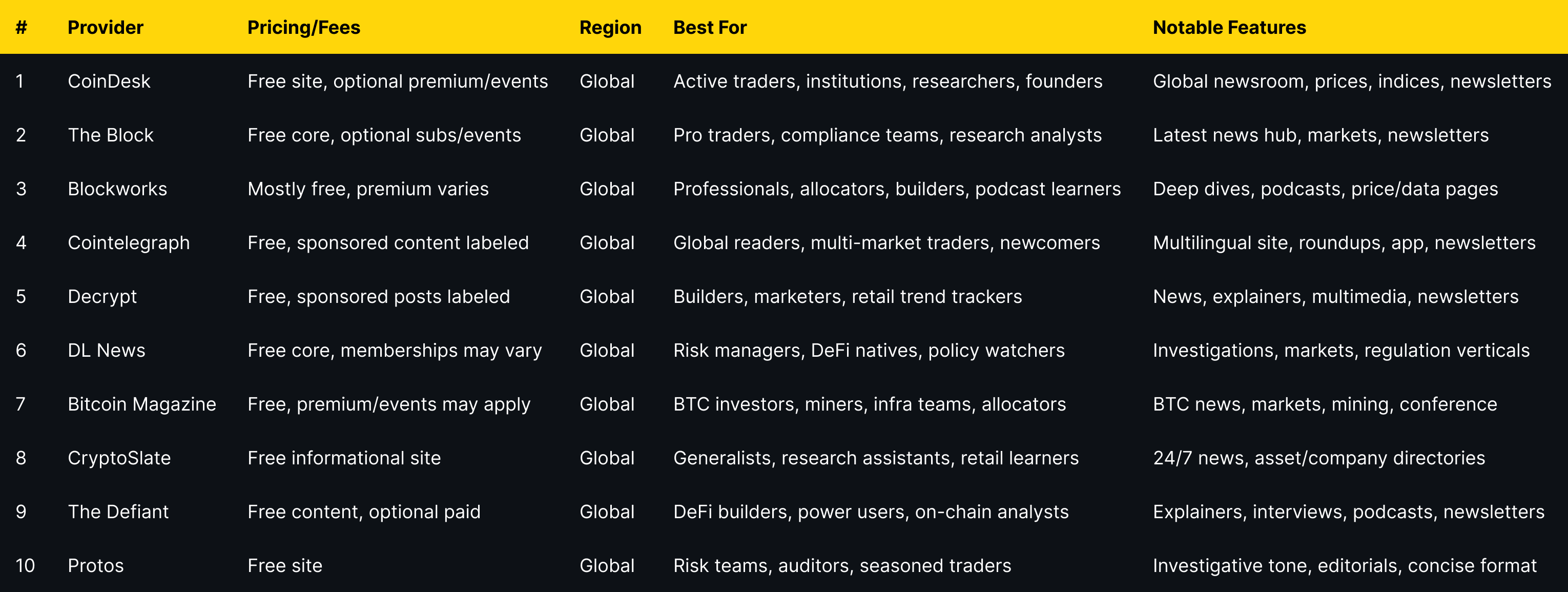
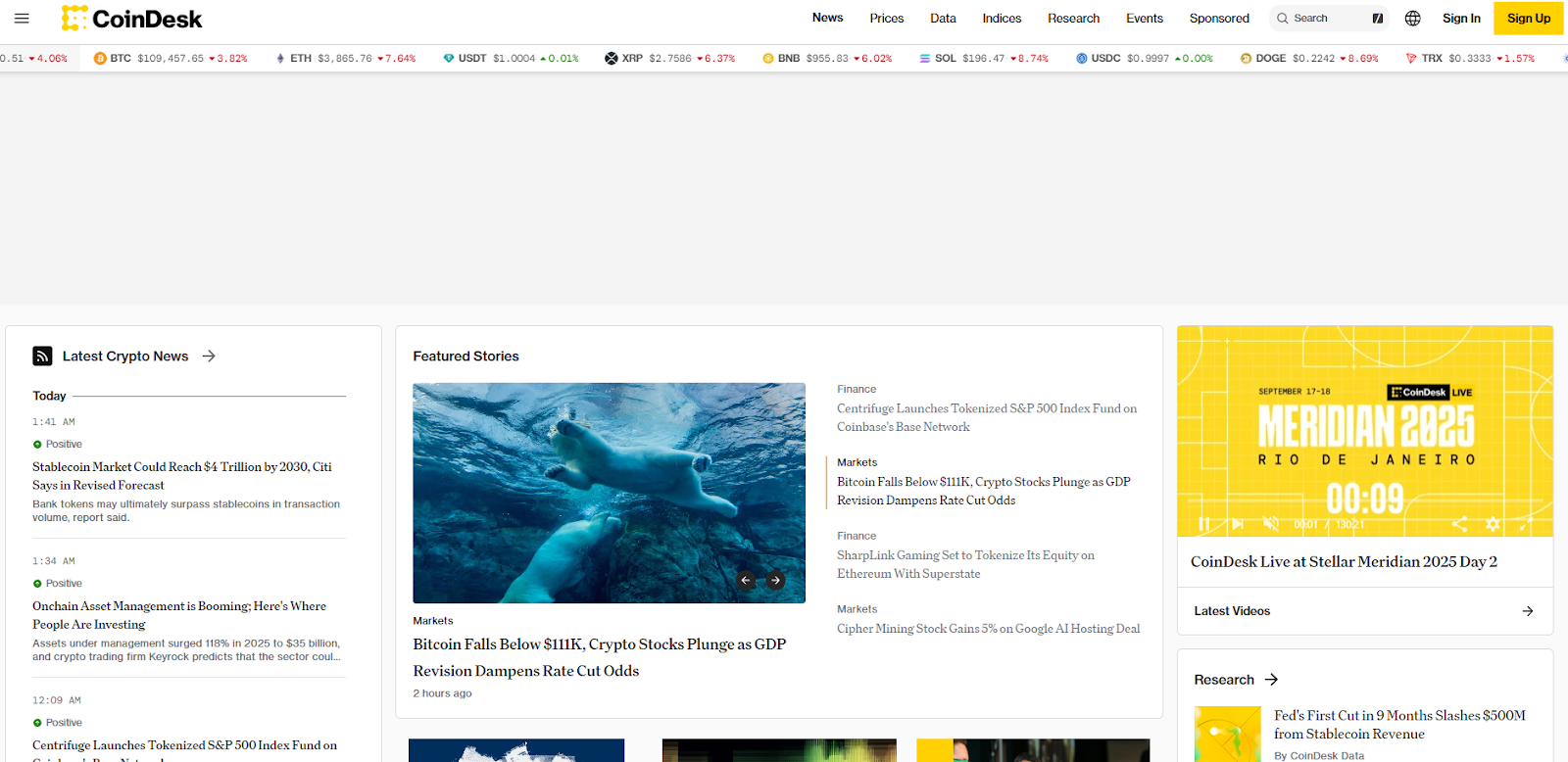
1. CoinDesk — Best for market-wide coverage & benchmarks

  • Why Use It: Longstanding leader with high-volume daily reporting across markets, policy, and tech. Its indices arm adds a data-backed lens that helps translate headlines into benchmark context.

  • Best For: Active traders, institutions, researchers, founders.

  • Notable Features: Newsroom with global scope; real-time prices; CoinDesk Indices benchmarks; newsletters & events.

  • Consider If: You want one primary feed that balances speed with breadth.

  • Regions: Global

  • Fees Notes: Free site; optional premium/event products.

  • Alternatives: The Block, Blockworks

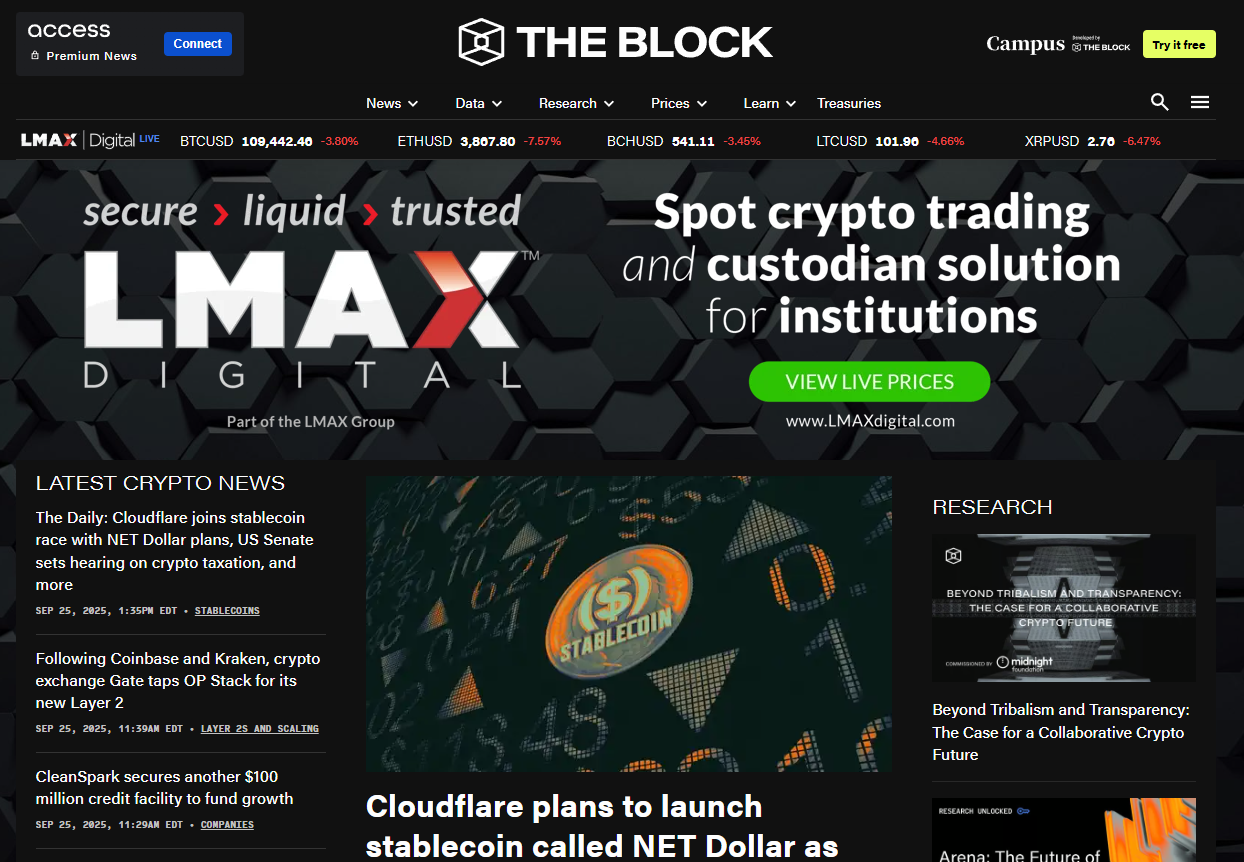
2. The Block — Best for market and policy scoops

  • Why Use It: Known for quick market and regulatory coverage with a professional tone, plus companion price pages. It’s a strong second screen for intraday context and breaking items.

  • Best For: Pro traders, compliance teams, venture & research analysts.

  • Notable Features: Latest-crypto-news hub; market sections; newsletters; headlines geared to execution decisions.

  • Consider If: You want fast, concise reporting that’s easy to scan during volatile sessions.

  • Regions: Global

  • Fees Notes: Free core content; optional subscriptions/events.

  • Alternatives: CoinDesk, DL News

3. Blockworks — Best for pro-grade analysis & podcasts

  • Why Use It: Bridges media and markets with insightful explainers, a strong podcast lineup, and clean price/data pages—useful for macro-to-micro synthesis.

  • Best For: Professionals, allocators, builders, podcast-first learners.

  • Notable Features: Deep-dive articles; daily/weekly shows; conference heritage; tidy category navigation; coin price pages.

  • Consider If: You prefer long-form insights and audio alongside headlines.

  • Regions: Global

  • Fees Notes: Mostly free; premium experiences may vary.

  • Alternatives: CoinDesk, The Defiant

4. Cointelegraph — Best for global/multilingual news flow

  • Why Use It: Large, global newsroom with multi-language publishing and consistent cadence across Bitcoin, Ethereum, DeFi, NFTs, and regulation.

  • Best For: Global audiences, multi-market traders, newcomers seeking regular updates.

  • Notable Features: Multilingual site; daily roundups; app; newsletters; opinion/education content.

  • Consider If: You want wide geographic and thematic coverage in one destination.

  • Regions: Global

  • Fees Notes: Free site; branded content clearly labeled.

  • Alternatives: Decrypt, CryptoSlate

5. Decrypt — Best for culture-meets-crypto storytelling

  • Why Use It: Combines markets and tech with culture, gaming, and emerging tech angles—useful to understand adoption narratives, UX shifts, and mainstream crossovers.

  • Best For: Builders, marketers, retail investors tracking user-facing trends.

  • Notable Features: News + explainers; multimedia; creator/vertical experimentation; active newsletters.

  • Consider If: You value context on how crypto meets consumer internet and media.

  • Regions: Global

  • Fees Notes: Free site; sponsored posts labeled.

  • Alternatives: Cointelegraph, Blockworks

6. DL News — Best for investigations & DeFi/regulation depth

  • Why Use It: Independent outlet with a reputation for original reporting on markets, DeFi, and policy. A strong pick when you need more than a headline.

  • Best For: Risk managers, DeFi natives, legal & policy watchers.

  • Notable Features: Investigations; markets/regulation verticals; newsletters; in-depth articles.

  • Consider If: You want rigorous follow-through on complex stories.

  • Regions: Global

  • Fees Notes: Free core content; memberships may vary.

  • Alternatives: The Defiant, Protos

7. Bitcoin Magazine — Best for Bitcoin-only depth

  • Why Use It: OG Bitcoin publication with dedicated coverage of BTC markets, mining, policy, and culture; ideal as a specialized complement to broader feeds.

  • Best For: Bitcoin investors, miners, infra teams, macro allocators watching BTC cycles.

  • Notable Features: News & analysis; mining/market sections; conference heritage; op-eds from BTC experts.

  • Consider If: You want focused BTC-first reporting without altcoin noise.

  • Regions: Global

  • Fees Notes: Free site; premium/events may apply.

  • Alternatives: CoinDesk, Cointelegraph

8. CryptoSlate — Best for directory-style context + news

  • Why Use It: Combines daily news with handy project/company directories and market pages, making it a useful jumping-off point when researching unfamiliar tickers.

  • Best For: Generalists, research assistants, retail learners.

  • Notable Features: News 24/7; asset/company directories; insights sections; categories by chain and sector.

  • Consider If: You like to pivot from headlines to directories for quick diligence.

  • Regions: Global

  • Fees Notes: Free informational site.

  • Alternatives: Cointelegraph, Decrypt

9. The Defiant — Best for DeFi-native explainers & interviews

  • Why Use It: DeFi-first outlet with explainers, newsletters, and podcasts/videos that decode protocols, tokenomics, and governance for practitioners.

  • Best For: DeFi builders, power users, on-chain analysts.

  • Notable Features: News; interviews; education; strong newsletter cadence; multimedia formats.

  • Consider If: You want builder-grade clarity on DeFi narratives.

  • Regions: Global

  • Fees Notes: Free content; optional paid products may appear.

  • Alternatives: DL News, Blockworks

10. Protos — Best for skeptical takes & accountability reporting

  • Why Use It: Delivers clear, skeptical, “cut-through-the-noise” reporting—useful as a counterbalance to hype cycles and for accountability coverage.

  • Best For: Risk teams, auditors, seasoned traders who value contrarian perspectives.

  • Notable Features: Investigative tone; editorials; market-moving tidbits; concise format.

  • Consider If: You want a critical lens alongside bullish feeds.

  • Regions: Global

  • Fees Notes: Free site.

  • Alternatives: DL News, The Block

Decision Guide: Best By Use Case

  • One primary daily feed: CoinDesk

  • Fast policy/market scoops: The Block

  • Pro-grade audio + analysis: Blockworks

  • Global/multilingual coverage: Cointelegraph

  • Consumer/culture angles: Decrypt

  • Investigations & DeFi policy: DL News

  • Bitcoin-only depth: Bitcoin Magazine

  • Headlines with directories: CryptoSlate

  • DeFi explainers & interviews: The Defiant

  • Skeptical/forensic lens: Protos

How to Choose the Right Crypto Media Outlet (Checklist)

  • Region & language: Does it serve your market and preferred language(s)?

  • Coverage fit: Generalist vs. Bitcoin-only vs. DeFi-native.

  • Depth: Are there explainers, investigations, indices, or data to go beyond headlines?

  • Access & costs: Free vs. paid tiers; newsletter value; RSS/alerts.

  • UX & speed: Mobile performance, category navigation, price pages.

  • Integrity: Disclosures, labeled sponsored content, clear editorial standards.

  • Support/community: Podcasts, newsletter cadence, socials.

  • Red flags: Vague sourcing; unlabeled ads; sensational claims without links.

Use Token Metrics With Any Crypto Media Outlet

Pair trusted news with quant and AI to act with conviction:

  • AI Ratings to screen narratives and assets quickly.
  • Narrative Detection to spot momentum in sectors (L2s, RWA, DeFi).

  • Portfolio Optimization to size bets with risk constraints.

  • Alerts & Signals to time entries/exits as headlines hit.

Workflow: Research → Shortlist → Execute with your chosen venue → Monitor via TM alerts.


Primary CTA: Start free trial

Security & Compliance Tips

  • Enable 2FA on all publisher and newsletter logins to protect account access.

  • Treat media as input, not instruction—cross-check with official project docs and disclosures.

  • Keep a research journal: link sources, note dates, and log what changed your mind.

  • Separate ad/sponsored content from editorial and verify claims before acting.

  • Use wallet hygiene and a risk budget when headlines tempt FOMO.

This article is for research/education, not financial advice.

Beginner Mistakes to Avoid

  • Relying on a single outlet; diversify your media stack.

  • Confusing sponsored posts with editorial.

  • Acting on headlines without checking primary sources/on-chain data.

  • Ignoring regional policy context that changes risk.

  • Chasing every narrative without a portfolio plan.

FAQs

What is a crypto media outlet?
A publisher focused on digital-asset markets and technology—covering news, analysis, and explainers for traders, investors, and builders. Many also offer newsletters, podcasts, and events.

How many outlets should I follow daily?
Two to three complementary sources usually balance speed and depth (e.g., one generalist, one investigative/DeFi, one podcast). Add specialized feeds (e.g., Bitcoin-only) as needed.

Are paid crypto news subscriptions worth it?
They can be if you use the added depth (investigations, research notes, data). For most traders, a free stack plus one targeted premium product is sufficient.

Which outlet is best for U.S. regulatory coverage?
Generalists like CoinDesk and The Block cover U.S. policy closely; DL News and The Defiant provide strong DeFi/regulation analysis. Cross-check with official agency releases.

Where can I get crypto news in multiple languages?
Cointelegraph runs multilingual editions and apps; several outlets offer newsletters and region-specific writers. Verify language availability and local relevance.

Do these sites move markets?
Major scoops, enforcement actions, or exchange/security stories can move prices, especially in thin-liquidity hours. Use alerts and confirm via official disclosures.

Conclusion + Related Reads

The “best” outlet depends on your role and the decisions you make. If you need one primary feed, start with CoinDesk; add The Block for scoops and Blockworks for pro-grade audio. Layer DL News/The Defiant for DeFi and Bitcoin Magazine for BTC focus. As always, pair news with structured research and disciplined risk.
Related Reads:

  • Best Cryptocurrency Exchanges 2025

  • Top Derivatives Platforms 2025

  • Top Institutional Custody Providers 2025

‍

Research

Leading Metaverse Platforms (2025)

Sam Monac
5 min

Why Metaverse Platforms Matter in September 2025

The metaverse has evolved from hype to practical utility: brands, creators, and gamers now use metaverse platforms to host events, build persistent worlds, and monetize experiences. In one line: a metaverse platform is a shared, real-time 3D world or network of worlds where users can create, socialize, and sometimes own digital assets. In 2025, this matters because cross-platform tooling (web/mobile/VR), better creator economics, and cleaner wallet flows are making virtual worlds useful—not just novel. Whether you’re a creator monetizing UGC, a brand running virtual activations, or a gamer seeking interoperable avatars and items, this guide compares the leaders and helps you pick the right fit. Secondary focus areas include web3 metaverse ownership models, virtual worlds with events/tools, and NFT avatars where relevant.

How We Picked (Methodology & Scoring)

  • Liquidity (30%): Active user activity, creator economy health, and tradable asset depth for worlds/items.

  • Security (25%): Platform transparency, custody/ownership model, documentation, audits, and brand safeguards.

  • Coverage (15%): Breadth of supported devices (web/mobile/XR), toolchains (Unity, SDKs), and asset standards.

  • Costs (15%): Fees on mints, marketplace trades, land, or subscriptions; fair creator revenue splits.

  • UX (10%): Onboarding, performance, no-code tools, creator pipelines.

  • Support (5%): Docs, community, and partner success resources.

Data sources: official product/docs pages, security/transparency pages, and (for cross-checks) widely cited market datasets. Last updated September 2025.

Top 10 Metaverse Platforms in September 2025

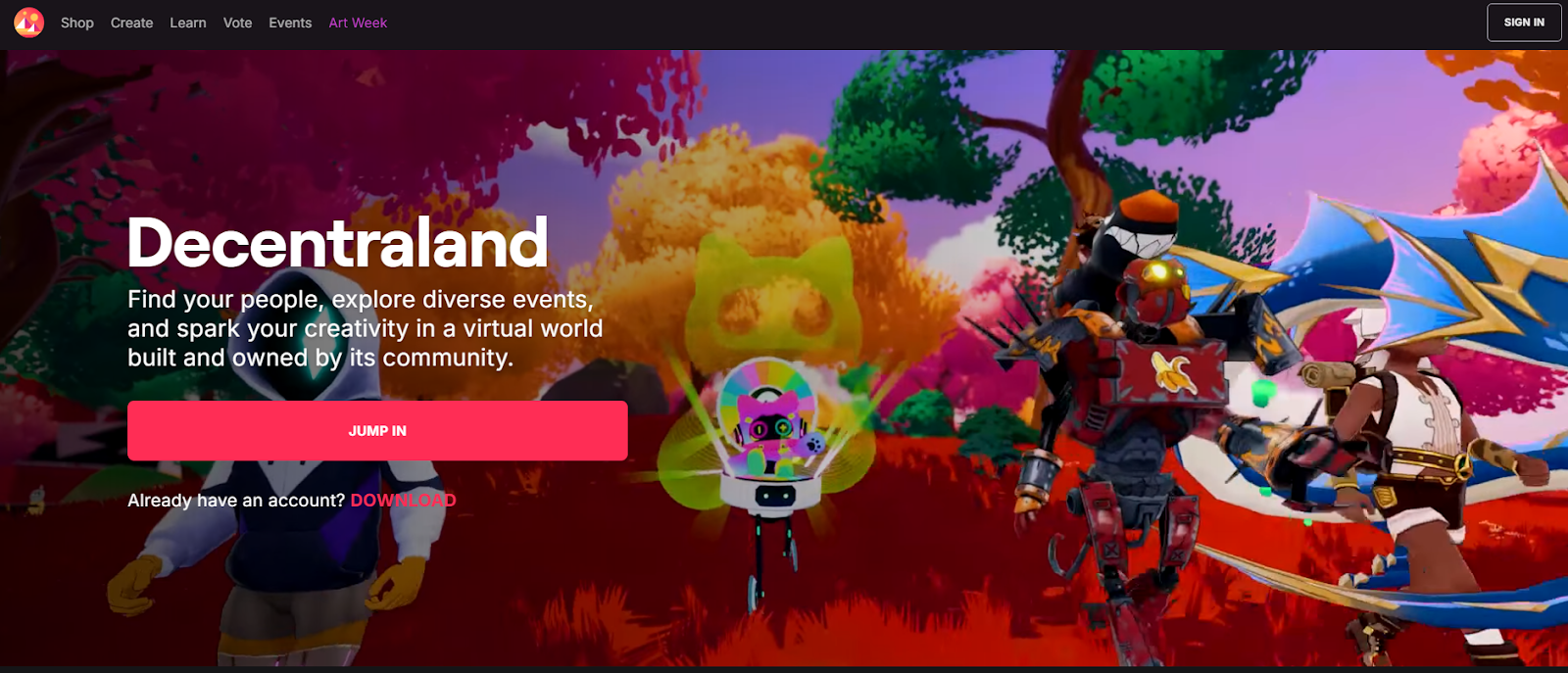
1. Decentraland — Best for open, browser-based social worlds

  • Why Use It: One of the earliest browser-native 3D virtual worlds with user-owned land and a strong events culture (conferences, fashion, art). DAO-governed features and open tooling make it a steady choice for brand activations and community hubs. Decentraland

  • Best For: Web-first events; brand galleries; creator storefronts; DAO communities.

  • Notable Features: Land & wearables as NFTs; events calendar; builder & SDK; DAO governance. Decentraland

  • Fees/Notes: Marketplace fees on assets vary; gas applies for on-chain actions.

  • Regions: Global (browser-based).

  • Consider If: You want open standards and long-running community tooling over cutting-edge graphics.

  • Alternatives: The Sandbox, Spatial.

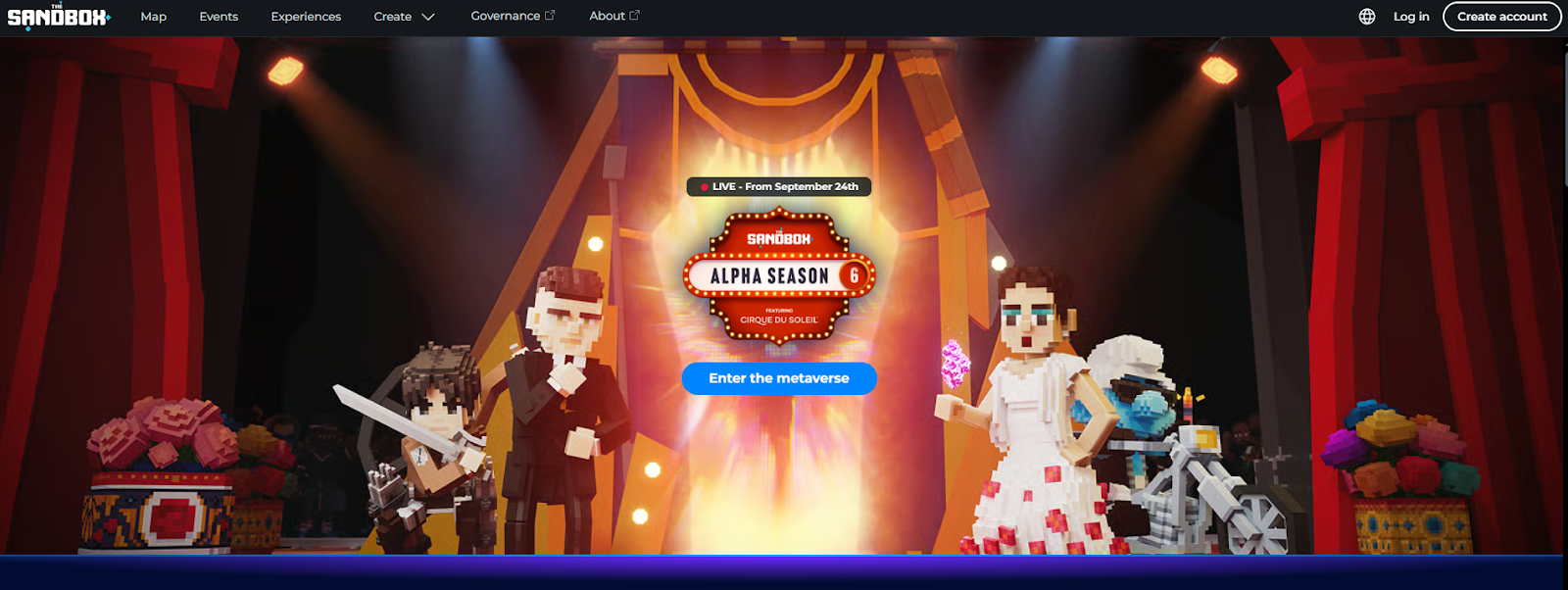
2. The Sandbox — Best for branded IP and UGC game experiences

  • Why Use It: A UGC-driven game world with heavy brand participation and seasonal campaigns that reward play and creation. Strong toolchain (VoxEdit, Game Maker) and high-profile partnerships attract mainstream audiences. The Sandbox+2Vogue Business+2

  • Best For: Brands/IP holders; creators building mini-games; seasonal events.

  • Notable Features: No-code Game Maker; avatar collections; brand hubs; seasonal reward pools. The Sandbox+1

  • Fees/Notes: Asset and land marketplace fees; seasonal reward structures.

  • Regions: Global.

  • Consider If: You want strong IP gravity and structured events more than fully open worldbuilding.

  • Alternatives: Decentraland, Upland.

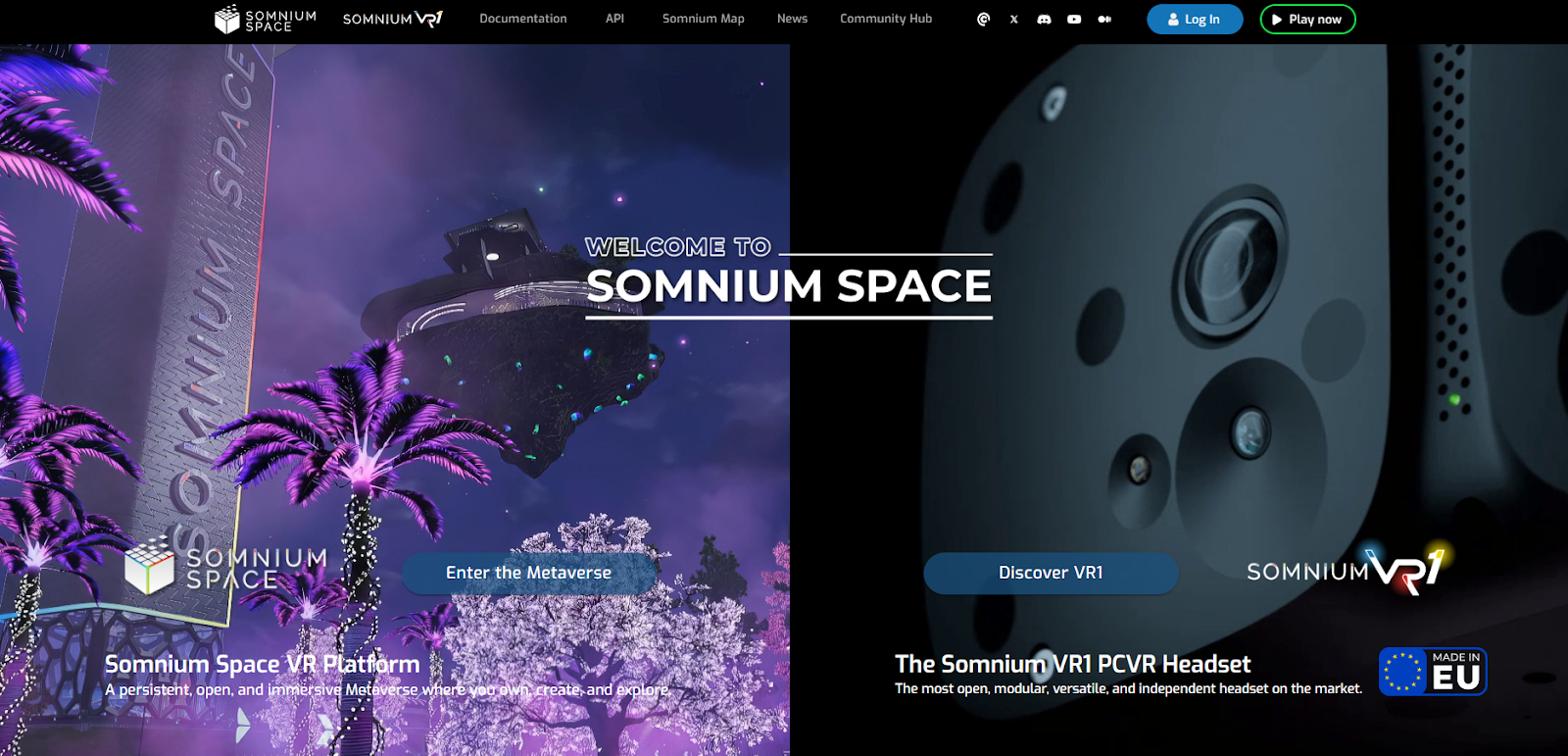
3. Somnium Space — Best for immersive VR worldbuilding

  • Why Use It: A persistent, open VR metaverse with land ownership and deep creator tools—great for immersive meetups, galleries, and simulations. Hardware initiatives (e.g., VR1) signal a VR-first roadmap. somniumspace.com+2somniumspace.com+2

  • Best For: VR-native communities; immersive events; simulation builds.

  • Notable Features: Persistent VR world; land & parcels; robust creator/SDK docs; hardware ecosystem. somniumspace.com+1

  • Fees/Notes: Marketplace and gas fees apply for on-chain assets.

  • Regions: Global.

  • Consider If: VR performance and hardware availability fit your audience.

  • Alternatives: Spatial, Mona.

4. Voxels — Best for lightweight, linkable spaces

  • Why Use It: A voxel-style world (formerly Cryptovoxels) known for easy, link-and-share parcels, fast event setups, and a strong indie creator scene. Great for galleries and casual meetups. Voxels+1

  • Best For: NFT galleries; indie events; rapid prototyping.

  • Notable Features: Parcels & islands; simple building; events; browser-friendly access. Voxels

  • Fees/Notes: Asset/parcel markets with variable fees; gas for on-chain actions.

  • Regions: Global.

  • Consider If: You prefer simplicity over realism and AAA graphics.

  • Alternatives: Hyperfy, Oncyber.

5. Spatial — Best for cross-device events and no-code worlds

  • Why Use It: Polished, cross-platform creation: publish to web, mobile, and XR; strong no-code templates plus a Unity SDK for advanced teams. Used by creators, educators, and brands for scalable events. Spatial+1

  • Best For: Brand activations; classrooms & training; cross-device showcases.

  • Notable Features: No-code world templates; Unity SDK; web/mobile/XR publishing; multiplayer. Spatial

  • Fees/Notes: Freemium with paid tiers/features; no crypto requirement to start.

  • Regions: Global.

  • Consider If: You want frictionless onboarding and device coverage without mandatory wallets.

  • Alternatives: Mona, Somnium Space.

6. Mona (Monaverse) — Best for high-fidelity art worlds

  • Why Use It: Curated, visually striking worlds favored by digital artists and institutions; interoperable assets and creator-forward tools make it ideal for exhibitions and premium experiences. monaverse.com+1

  • Best For: Galleries & museums; premium showcases; art-led communities.

  • Notable Features: High-fidelity scenes; curated drops; creator tools; marketplace. monaverse.com

  • Fees/Notes: Marketplace fees for assets; gas where applicable.

  • Regions: Global.

  • Consider If: You prioritize aesthetics and curation over mass-market gamification.

  • Alternatives: Spatial, Oncyber.

7. Oncyber — Best for instant NFT galleries & creator “multiverses”

  • Why Use It: Easiest way to spin up personal worlds/galleries that showcase NFTs, with simple hosting and sharable links; now expanding creator tools (Studio) for interactive spaces. oncyber.io+1

  • Best For: Artists/collectors; quick showcases; brand micro-experiences.

  • Notable Features: One-click galleries; wallet connect; customizable spaces; creator studio. oncyber.io

  • Fees/Notes: Free to start; marketplace/transaction fees where applicable.

  • Regions: Global.

  • Consider If: You need speed and simplicity, not complex game loops.

  • Alternatives: Voxels, Mona.

8. Nifty Island — Best for creator-led islands & social play

  • Why Use It: A free-to-play social game world where communities build islands, run quests, and bring compatible NFTs in-world; expanding UGC features and events. Nifty Island+1

  • Best For: Streamers & communities; UGC map makers; social gaming guilds.

  • Notable Features: Island builder; quests; NFT avatar/item support; leaderboards. Nifty Island+1

  • Fees/Notes: Free to play; optional marketplace economy.

  • Regions: Global.

  • Consider If: You want a fun, social loop with creator progression over real-estate speculation.

  • Alternatives: Worldwide Webb, The Sandbox.

9. Upland — Best for real-world-mapped city building

  • Why Use It: A city-builder mapped to real-world geographies, emphasizing digital property, development, and an open economy—popular with strategy players and brand pop-ups. Upland

  • Best For: Property flippers; city sim fans; brand tie-ins tied to real locations.

  • Notable Features: Real-world maps; property trading; dev APIs; avatar integrations. Upland

  • Fees/Notes: Marketplace fees; token/withdrawal rules vary by region.

  • Regions: Global (availability varies).

  • Consider If: You want geo-tied gameplay and an economy centered on property.

  • Alternatives: The Sandbox, Decentraland.

10. Otherside — Best for large-scale, interoperable metaRPGs

  • Why Use It: Yuga Labs’ metaRPG in development aims for massive, real-time multiplayer with NFT interoperability—suited to large communities seeking events and game loops at scale. otherside.xyz+1

  • Best For: Big communities; interoperable avatar projects; large-scale events.

  • Notable Features: MetaRPG vision; NFT-native design; real-time massive sessions. otherside.xyz

  • Fees/Notes: Economy details evolving; expect on-chain transactions for assets.

  • Regions: Global (under development; access windows vary).

  • Consider If: You’re comfortable with active development and staged releases.

  • Alternatives: Nifty Island, The Sandbox.

Decision Guide: Best By Use Case

  • Regulated/corporate events, low friction: Spatial

  • Open web3 land & wearables: Decentraland

  • Brand/IP campaigns & UGC seasons: The Sandbox

  • High-fidelity art exhibitions: Mona

  • VR-native immersion: Somnium Space

  • Instant NFT galleries: Oncyber

  • Social UGC gameplay: Nifty Island

  • Geo-tied city building/economy: Upland

  • Massive interoperable metaRPG (developing): Otherside

  • Lightweight, link-and-share worlds: Voxels

How to Choose the Right Metaverse Platform (Checklist)

  • Confirm region/eligibility (and any content or cash-out restrictions).

  • Match your use case: events vs. galleries vs. UGC games vs. VR immersion.

  • Check device coverage (web, mobile, XR) and tooling (no-code, Unity/SDK).

  • Review ownership/custody of assets; does it require a wallet?

  • Compare costs: land, mints, marketplace fees, subscriptions.

  • Evaluate performance & UX for your target hardware and connection speeds.

  • Look for support/docs and active community channels.

  • Red flags: locked ecosystems with poor export options; unclear TOS on IP/royalties.

Use Token Metrics With Any Metaverse Platform

  • AI Ratings to screen tokens and ecosystems tied to these platforms.
  • Narrative Detection to spot momentum in metaverse, gaming, and creator-economy sectors.

  • Portfolio Optimization to balance exposure across platform tokens and gaming assets.

  • Alerts & Signals to monitor entries/exits as narratives evolve.
    Workflow: Research on Token Metrics → Select a platform/asset → Execute in your chosen world → Monitor with alerts.


Primary CTA: Start free trial

Security & Compliance Tips

  • Enable 2FA on marketplaces/accounts; safeguard seed phrases if using wallets.

  • Separate hot vs. cold storage for valuable assets; use hardware wallets where appropriate.

  • Follow KYC/AML rules on fiat on-/off-ramps and regional restrictions.

  • Use official clients/links only; beware spoofed mints and fake airdrops.

  • For events/UGC, implement moderation and IP policies before going live.

This article is for research/education, not financial advice.

Beginner Mistakes to Avoid

  • Buying land/assets before validating actual foot traffic or event needs.

  • Ignoring device compatibility (mobile/XR) for your audience.

  • Underestimating build time—even “no-code” worlds need iteration.

  • Skipping wallet safety and permissions review.

  • Chasing hype without checking fees and creator revenue splits.

FAQs

What is a metaverse platform?
A shared, persistent 3D environment where users can create, socialize, and sometimes own assets (via wallets/NFTs). Some focus on events and galleries; others on UGC games or VR immersion.

Do I need crypto to use these platforms?
Not always. Spatial and some worlds allow non-crypto onboarding. Web3-native platforms often require wallets for asset ownership and trading.

Which platform is best for branded events?
The Sandbox (IP partnerships, seasons) and Spatial (cross-device ease) are top picks; Decentraland also hosts large community events.

What about VR?
Somnium Space is VR-first; Spatial also supports XR publishing. Confirm device lists and performance requirements.

Are assets portable across worlds?
Interoperability is improving (avatars, file formats), but true portability varies. Always check import/export support and license terms.

How do these platforms make money?
Typically via land sales, marketplace fees, subscriptions, or seasonal passes/rewards. Review fee pages and terms before committing.

What risks should I consider?
Platform changes, token volatility, phishing, and evolving terms. Start small, use official links, and secure wallets.

Conclusion + Related Reads

If you’re brand-led or IP-driven, start with The Sandbox or Spatial. For open web3 communities and DAO-style governance, consider Decentraland. Creators seeking premium visuals may prefer Mona, while Somnium Space fits VR die-hards. Social UGC gamers can thrive on Nifty Island; geo-builders on Upland; galleries on Oncyber; lightweight events on Voxels; and large NFT communities should watch Otherside as it develops.

Related Reads:

  • Best Cryptocurrency Exchanges 2025

  • Top Derivatives Platforms 2025

  • Top Institutional Custody Providers 2025

Sources & Update Notes

We validated claims on official product/docs pages and public platform documentation, and cross-checked positioning with widely cited datasets when needed. Updated September 2025; we’ll refresh as platforms ship major features or change terms.

Otherside — Home, Yuga overview. otherside.xyz+1

NFTs

Best NFT Marketplaces (2025)

Sam Monac
7 min

Why NFT Marketplaces Matter in September 2025

NFT marketplaces are where collectors buy, sell, and mint digital assets across Ethereum, Bitcoin Ordinals, Solana, and gaming-focused L2s. If you’re researching the best NFT marketplaces to use right now, this guide ranks the leaders for liquidity, security, fees, and user experience—so you can move from research to purchase with confidence. The short answer: choose a regulated venue for fiat on-ramps and beginner safety, a pro venue for depth and tools, or a chain-specialist for the collections you care about. We cover cross-chain players (ETH, SOL, BTC), creator-centric platforms, and gaming ecosystems. Secondary searches like “NFT marketplace fees,” “Bitcoin Ordinals marketplace,” and “where to buy NFTs” are woven in naturally—without fluff.

How We Picked (Methodology & Scoring)

  • Liquidity (30%): Active buyers/sellers, depth across top collections, and cross-chain coverage.

  • Security (25%): Venue track record, custody options, proof-of-reserves (where relevant), scams countermeasures, fee/royalty transparency.

  • Coverage (15%): Chains (ETH/BTC/SOL/Immutable, etc.), creator tools, launchpads, aggregators.

  • Costs (15%): Marketplace fees, gas impact, royalty handling, promos.

  • UX (10%): Speed, analytics, mobile, bulk/sweep tools.

  • Support (5%): Docs, help centers, known regional constraints.

We used official product pages, docs/help centers, security/fee pages and cross-checked directional volume trends with widely cited market datasets. We link only to official provider sites in this article. Last updated September 2025.

Top 10 NFT Marketplaces in September 2025

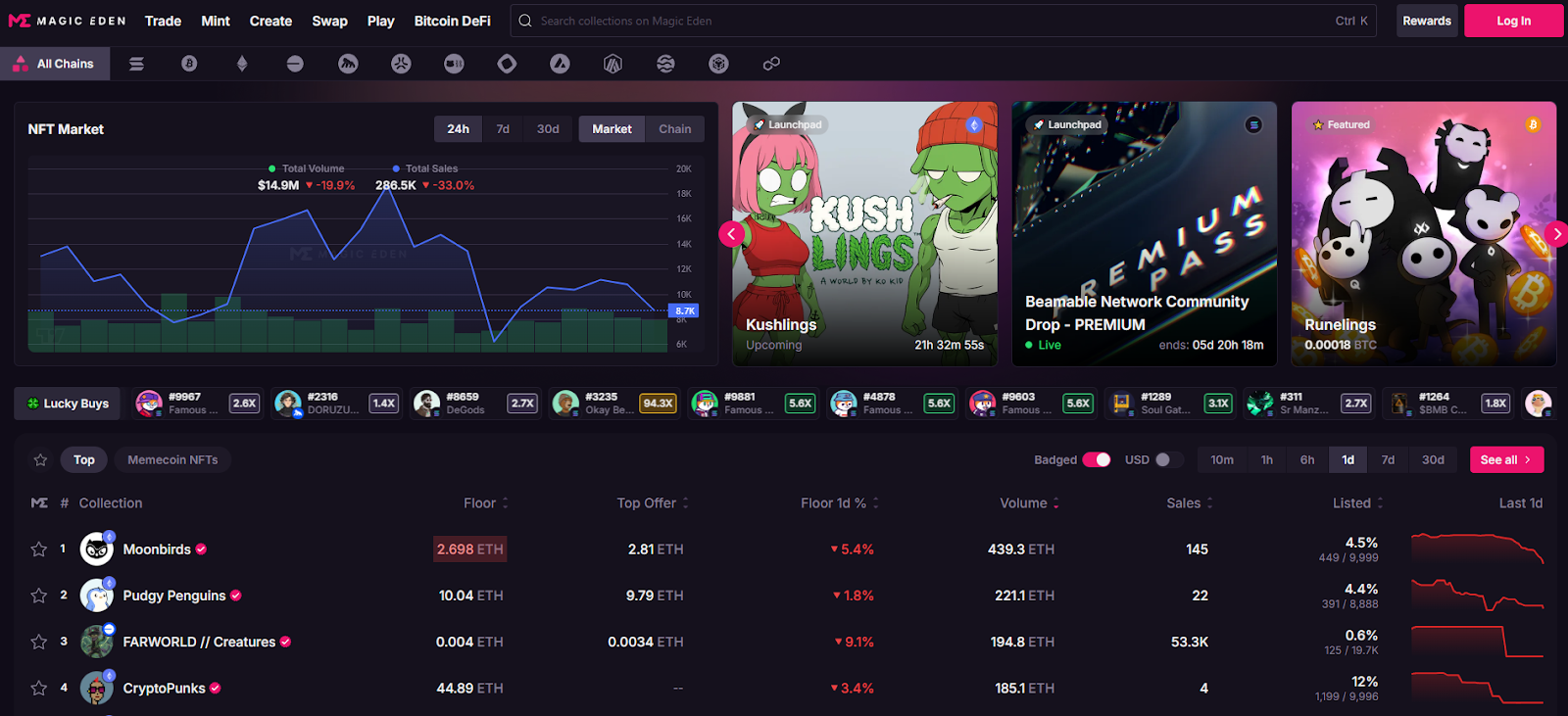
1. Magic Eden — Best for cross-chain collectors (ETH, SOL, BTC & more)

Why Use It: Magic Eden has evolved into a true cross-chain hub spanning Solana, Bitcoin Ordinals, Ethereum, Base and more, with robust discovery, analytics, and aggregation so you don’t miss listings. Fees are competitive and clearly documented, and Ordinals/SOL support is best-in-class for traders and creators. Best For: Cross-chain collectors, Ordinals buyers, SOL natives, launchpad users.
Notable Features: Aggregated listings; trait-level offers; launchpad; cross-chain swap/bridge learning; pro charts/analytics. Consider If: You want BTC/SOL liquidity with low friction; note differing fees per chain. Alternatives: Blur (ETH pro), Tensor (SOL pro).

Regions: Global • Fees Notes: 2% on BTC/SOL; 0.5% on many EVM trades (creator royalties optional per metadata).

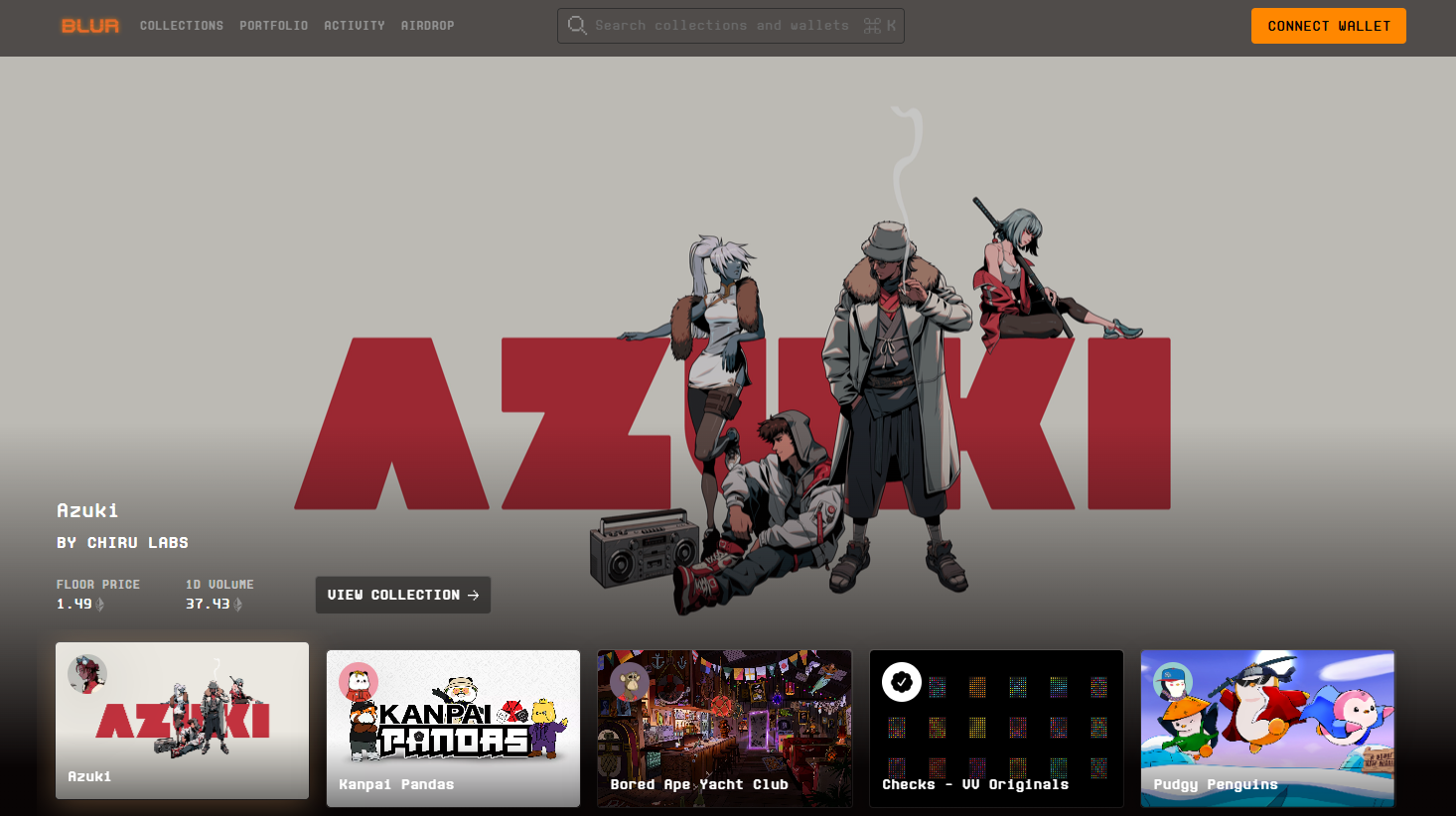
2. Blur — Best for pro ETH traders (zero marketplace fees)

Why Use It: Blur is built for speed, depth, and sweeps. It aggregates multiple markets, offers advanced portfolio analytics, and historically charges 0% marketplace fees—popular with high-frequency traders. Rewards seasons have reinforced liquidity. Best For: Power users, arbitrage/sweep traders, analytics-driven collectors.
Notable Features: Multi-market sweep; fast reveals/snipes; portfolio tools; rewards. Consider If: You prioritize pro tools and incentives over hand-holding UX.
Alternatives: OpenSea (broad audience), Magic Eden (cross-chain).

Regions: Global • Fees Notes: 0% marketplace fee shown on site; royalties subject to collection rules.

3. OpenSea — Best for mainstream access & breadth

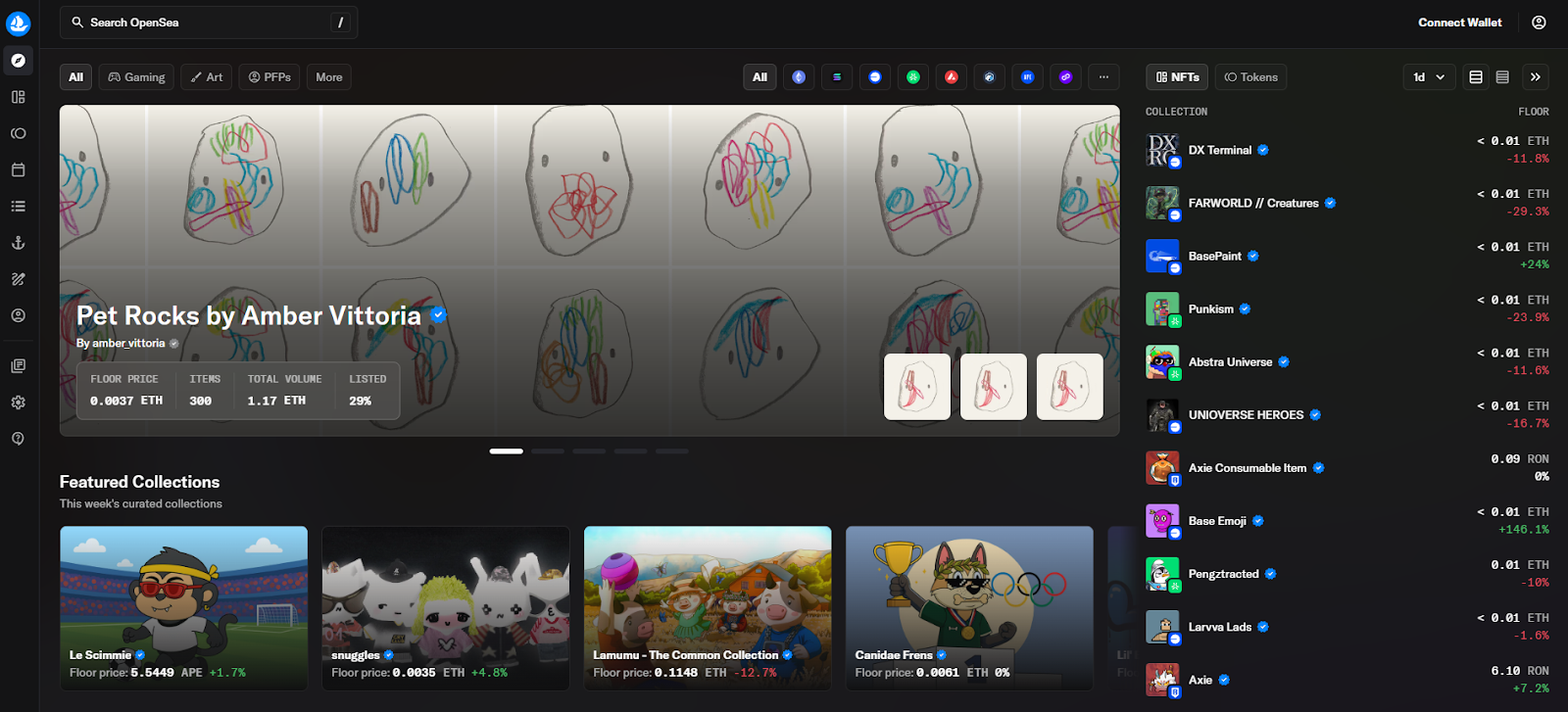
Why Use It: The OG multi-chain marketplace with onboarding guides, wide wallet support, and large catalog coverage. OpenSea’s “OS2” revamp and recent fee policy updates keep it relevant for mainstream collectors who want familiar UX plus broad discovery. Best For: Newcomers, multi-chain browsing, casual collectors.
Notable Features: Wide collection breadth; OpenSea Pro aggregator; flexible royalties; clear TOS around third-party/gas fees. Consider If: You want broadest brand recognition; be aware fees may change. Alternatives: Blur (pro ETH), Rarible (community markets).

Regions: Global (note U.S. regulatory headlines under review). Fees Notes: Reported trading fee currently ~1% as of mid-Sept 2025; creator earnings and gas are separate.

4. Tensor — Best for pro Solana traders

Why Use It: Tensor is the Solana power-user venue with enforced-royalty logic, maker/taker clarity, and pro-grade bidding/escrow. Fast UI, Solana-native depth, and creator tools make it the advanced SOL choice. Best For: SOL traders, market-makers, bid/AMM-style flows.
Notable Features: 0% maker / ~2% taker; enforced royalties paid by taker; shared escrow; price-lock mechanics highlighted in community docs. Consider If: You want pro tools on Solana; fees differ from Magic Eden. Alternatives: Magic Eden (SOL/BTC/ETH), Hyperspace (agg).

Regions: Global • Fees Notes: 2% taker / 0% maker; royalties per collection rules

5. OKX NFT Marketplace — Best for multi-chain aggregation + Ordinals

Why Use It: OKX’s NFT market integrates with the OKX Web3 Wallet, aggregates across chains, and caters to Bitcoin Ordinals buyers with an active marketplace. Docs highlight multi-chain support and low listing costs. Note potential restrictions for U.S. residents. Best For: Multi-chain deal-hunters, Ordinals explorers, exchange users.
Notable Features: Aggregation; OKX Wallet; BTC/SOL/Polygon support; zero listing fees per help docs. Consider If: You’re outside the U.S. or comfortable with exchange-affiliated wallets. Alternatives: Magic Eden (multi-chain), Kraken NFT (U.S. friendly).

Regions: Global (U.S. access limited) • Fees Notes: Zero listing fee; trading fees vary by venue/collection.

6. Kraken NFT — Best for U.S. compliance + zero gas on trades

Why Use It: Kraken’s marketplace emphasizes security, compliance, and a simple experience with zero gas fees on trades (you pay network gas only when moving NFTs in/out). Great for U.S. users who prefer a regulated exchange brand. Best For: U.S. collectors, beginners, compliance-first buyers.
Notable Features: Zero gas on trades; creator earnings support; fiat rails via the exchange. Consider If: You prioritize regulated UX over max liquidity.
Alternatives: OpenSea (breadth), OKX NFT (aggregation).

Regions: US/EU • Fees Notes: No gas on trades; royalties and marketplace fees vary by collection.

7. Rarible — Best for community marketplaces & no-code storefronts

Why Use It: Rarible lets projects spin up branded marketplaces with custom fee routing (even 0%), while the main Rarible front-end serves multi-chain listings. Transparent fee schedules and community tooling appeal to creators and DAOs. Best For: Creators/DAOs launching branded stores; community traders.
Notable Features: No-code community marketplace builder; regressive fee schedule on main site; ETH/Polygon support. Consider If: You want custom fees/branding or to route fees to a treasury. Alternatives: Zora (creator mints), Foundation (curated art).

Regions: Global • Fees Notes: Regressive service fees on main Rarible; community markets can set fees to 0%.

8. Zora — Best for creator-friendly mints & social coins

Why Use It: Zora powers on-chain mints with a simple flow and a small protocol mint fee that’s partially shared with creators and referrers, and it now layers social “content coins.” Great for artists who prioritize distribution and rewards over secondary-market depth. Best For: Artists, indie studios, open editions, mint-first strategies.
Notable Features: One-click minting; protocol rewards; Base/L2 focus; social posting with coins. Consider If: You value creator economics; secondary liquidity may be thinner than pro venues.
Alternatives: Rarible (community stores), Foundation (curation).

Regions: Global • Fees Notes: Typical mint fee ~0.000777 ETH; reward splits for creators/referrals per docs.

9. Gamma.io — Best for Bitcoin Ordinals creators & no-code launchpads

Why Use It: Gamma focuses on Ordinals with no-code launchpads and a clean flow for inscribing and trading on Bitcoin. If you want exposure to BTC-native art and collections, Gamma is a friendly on-ramp. Best For: Ordinals creators/collectors, BTC-first communities.
Notable Features: No-code minting; Ordinals marketplace; education hub. Consider If: You want BTC exposure vs EVM/SOL liquidity; check fee line items. Alternatives: Magic Eden (BTC), UniSat (wallet+market).

Regions: Global • Fees Notes: Commission on mints/sales; see support article.

10. TokenTrove — Best for Immutable (IMX/zkEVM) gaming assets

Why Use It: TokenTrove is a top marketplace in the Immutable gaming ecosystem with stacked listings, strong filters, and price history—ideal for trading in-game items like Gods Unchained, Illuvium, and more. It plugs into Immutable’s global order book and fee model. Best For: Web3 gamers, IMX/zkEVM collectors, low-gas trades.
Notable Features: Immutable integration; curated gaming collections; alerts; charts. Consider If: You mainly collect gaming assets and want L2 speed with predictable fees.
Alternatives: OKX (aggregation), Sphere/AtomicHub (IMX partners).

Regions: Global • Fees Notes: Immutable protocol fee ~2% to buyer + marketplace maker/taker fees vary by venue.

Decision Guide: Best By Use Case

  • Regulated U.S. access & zero gas on trades: Kraken NFT.
  • Global liquidity + cross-chain coverage (BTC/SOL/ETH): Magic Eden.
  • Pro ETH tools & zero marketplace fees: Blur.
  • Pro Solana depth & maker/taker clarity: Tensor.
  • Bitcoin Ordinals creators & no-code launch: Gamma.io.
  • Gaming items on Immutable: TokenTrove.

  • Community marketplaces (custom fees/branding): Rarible.
  • Creator-first minting + rewards: Zora.

How to Choose the Right NFT Marketplace (Checklist)

  • Region & eligibility: Are you U.S.-based or restricted? (OKX may limit U.S. users.)
  • Collection coverage & chain: ETH/SOL/BTC/IMX? Go where your target collections trade.

  • Liquidity & tools: Depth, sweep/bulk bids, analytics, trait offers.

  • Fees/royalties: Marketplace fee, royalty policy, and gas impact per chain.
  • Security & custody: Exchange-custodied vs self-custody; wallet best practices.

  • Support & docs: Clear fee pages, dispute and help centers.

  • Red flags: Opaque fee changes, poor communication, or region-blocked access when depositing/withdrawing.

Use Token Metrics With Any NFT Marketplace

  • AI Ratings: Screen collections/coins surrounding NFT ecosystems.
  • Narrative Detection: Spot momentum across chains (Ordinals, gaming L2s).

  • Portfolio Optimization: Balance exposure to NFTs/tokens linked to marketplaces.

  • Alerts & Signals: Track entries/exits and on-chain flows.
    Workflow: Research on TM → Pick marketplace above → Execute buys/mints → Monitor with TM alerts.

 Primary CTA: Start free trial

Security & Compliance Tips

  • Enable 2FA and protect seed phrases; prefer hardware wallets for valuable assets.

  • Understand custody: exchange-custodied (simpler) vs self-custody (control).

  • Complete KYC/AML where required; mind regional restrictions.

  • Verify collection royalties and contract addresses to avoid fakes.

  • Practice wallet hygiene: revoke stale approvals; separate hot/cold wallets.

This article is for research/education, not financial advice.

Beginner Mistakes to Avoid

  • Ignoring fees (marketplace + gas + royalties) that change effective prices.
  • Buying unverified collections or wrong contract addresses.

  • Using one wallet for everything; don’t mix hot/cold funds.

  • Skipping region checks (e.g., U.S. access on some exchange-run markets).
  • Over-relying on hype without checking liquidity and historical sales.

FAQs

What is an NFT marketplace?
An NFT marketplace is a platform where users mint, buy, and sell NFTs (digital assets recorded on a blockchain). Marketplaces handle listings, bids, and transfers—often across multiple chains like ETH, BTC, or SOL.

Which NFT marketplace has the lowest fees?
Blur advertises 0% marketplace fees on ETH; Magic Eden lists 0.5% on many EVM trades and ~2% on SOL/BTC; Tensor uses 0% maker/2% taker. Always factor gas and royalties.

What’s best for Bitcoin Ordinals?
Magic Eden and Gamma are strong choices; UniSat’s wallet integrates with a marketplace as well. Pick based on fees and tooling.

What about U.S.-friendly options?
Kraken NFT is positioned for U.S. users with zero gas on trades. Check any exchange venue’s regional policy before funding.

Are royalties mandatory?
Policies vary: some venues enforce royalties (e.g., Tensor enforces per collection); others make royalties optional. Review each collection’s page and marketplace rules.

Do I still pay gas?
Yes, on most chains. Some custodial venues remove gas on trades but charge gas when you deposit/withdraw.

Conclusion + Related Reads

If you want cross-chain liquidity and discovery, start with Magic Eden. For pro ETH execution, Blur leads; for pro SOL, choose Tensor. U.S. newcomers who value compliance and predictability should consider Kraken NFT. Gaming collectors on Immutable can lean on TokenTrove.
Related Reads:

  • Best Cryptocurrency Exchanges 2025

  • Top Derivatives Platforms 2025

  • Top Institutional Custody Providers 2025

Choose from Platinum, Gold, and Silver packages
Reach with 25–30% open rates and 0.5–1% CTR
Craft your own custom ad—from banners to tailored copy
Perfect for Crypto Exchanges, SaaS Tools, DeFi, and AI Products