

Back to blog
Crypto Basics

What is BscScan and How Does it Work?

Discover the inner workings of BscScan and how it serves as an essential tool for monitoring Binance Smart Chain transactions and assets in this guide.
S. Vishwa
11 Minutes
Want Smarter Crypto Picks—Free?
See unbiased Token Metrics Ratings for BTC, ETH, and top alts.
Thank you! Your submission has been received!
Oops! Something went wrong while submitting the form.
 No credit card | 1-click unsubscribe

Click here to buy Cryptocurrencies from Gate.io

Blockchain technology has revolutionized the world of finance and decentralized applications. As the popularity of cryptocurrencies grows, so does the need for reliable tools to navigate and explore different blockchain networks. 

BscScan is a tool designed explicitly for the Binance Smart Chain (BSC). In this comprehensive guide, we will delve into the intricacies of BscScan, its functionalities, and how to make the most of this powerful blockchain explorer.

What is BscScan?

BscScan is the premier blockchain explorer for the Binance Smart Chain (BSC), developed by the same team responsible for creating Etherscan. Launched in 2020, BSC has rapidly gained popularity as a scalable and efficient blockchain network for decentralized applications and digital assets. 

BscScan provides users with a comprehensive view of the BSC ecosystem, allowing them to explore wallet addresses, track transactions, verify intelligent contracts, and analyze token data.

As a blockchain explorer, BscScan acts as a search engine for the BSC network, providing real-time information about transactions, blocks, addresses, and smart contracts. 

It offers a user-friendly interface that makes navigating and extracting valuable insights from the BSC blockchain accessible. Whether you are a developer, investor, or blockchain enthusiast, BscScan is an indispensable tool for interacting with the BSC network.

Understanding BscScan's Features

Real-Time Transaction Tracking

One of the core functionalities of BscScan is its ability to track transactions on the Binance Smart Chain in real time. By entering the transaction hash or wallet address, users can retrieve detailed information about a specific transaction, including the transaction amount, date, block number, balances, transaction fees, and status. 

This feature is handy for individuals who want to monitor the progress of their transactions or verify the authenticity of a particular transaction on the BSC network.

Exploring Wallet Addresses

BscScan allows users to explore wallet addresses on the Binance Smart Chain, providing a comprehensive overview of transaction history, token balances, and other relevant information. 

Users can access details such as BNB balance, BEP-20 token holdings, transaction data, and more by entering a wallet address into the search bar. 

This feature enables users to gain insights into the activity of specific wallets and track the movement of digital assets on the BSC network.

Smart Contract Verification

Smart contracts are an integral part of the Binance Smart Chain ecosystem, enabling the creation and execution of decentralized applications. 

BscScan offers an intelligent contract verification feature, allowing users to verify the authenticity and integrity of smart contracts deployed on the BSC network. 

By comparing the compiled code of a smart contract with the code running on the blockchain, users can ensure that the contract functions as intended and mitigate the risk of potential vulnerabilities or malicious activities.

Token Tracking and Analysis

BscScan allows users to track and analyze tokens on the Binance Smart Chain. Users can access information about the top BEP-20 tokens, including prices, volume, market capitalization, number of holders, and cross-chain compatibility. 

Additionally, BscScan supports ERC-721 and ERC-1155 tokens, making it possible to explore and track non-fungible tokens (NFTs) on the BSC network. 

This feature is invaluable for investors and traders looking to stay updated on the performance and trends of different tokens within the BSC ecosystem.

Gas Price Monitoring

Gas fees are essential to any blockchain network, including Binance Smart Chain. BscScan offers a gas price monitoring feature, allowing users to view real-time information about gas fees on the BSC network. 

By monitoring gas prices, users can make informed decisions about transaction fees and navigate the network efficiently. This feature is handy during periods of high network congestion when gas fees tend to fluctuate.

Using BscScan: Step-by-Step Guide

BscScan provides a user-friendly interface that makes it easy for users to navigate and extract valuable information from the Binance Smart Chain. In this step-by-step guide, we will walk you through using BscScan's key features.
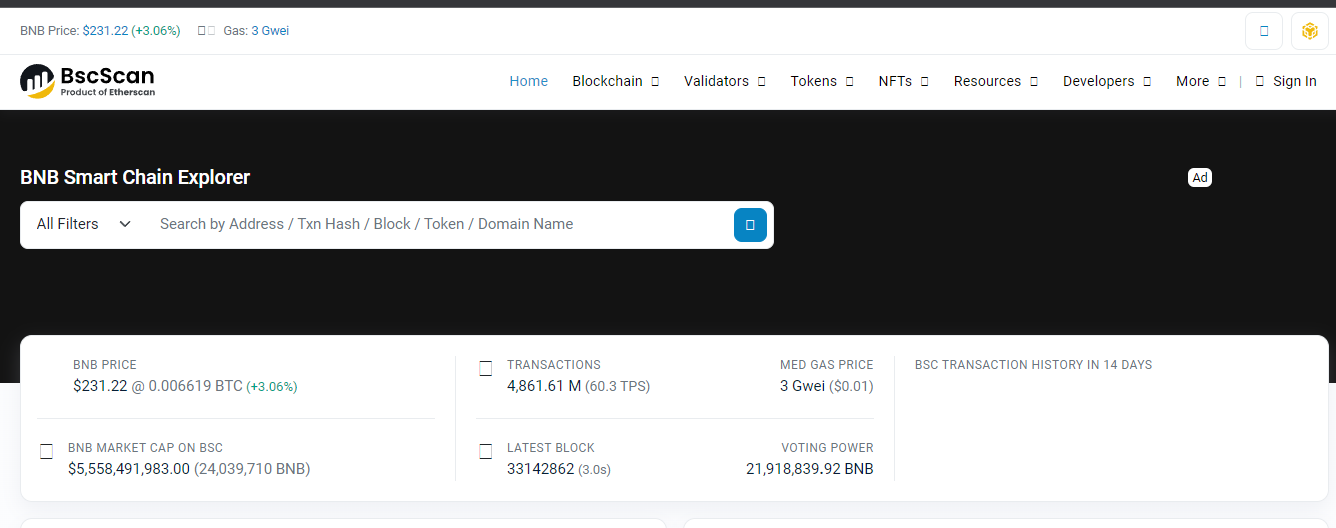
BscScan

Checking Transactions on BscScan

  • Visit the BscScan website at bscscan.com.
  • In the search bar at the top of the page, enter the transaction hash or wallet address you want to investigate.
  • BscScan will query its database and display detailed information about the transaction, including the transaction amount, date, block number, balances, transaction fees, and status.
  • Take note of the transaction status, which can be pending, successful, or failed. This information will help you determine the progress and outcome of the transaction.
  • You can also explore additional details about the transaction by clicking on specific sections, such as the sender's address, recipient's address, or transaction hash.

Exploring Wallet Addresses

  • On the BscScan homepage, locate the search bar at the top of the page.
  • Enter the wallet address that you want to explore and press Enter or click the search icon.
  • BscScan will provide an overview of the wallet address, including the BNB balance and the balances of any BEP-20 tokens held in the wallet.
  • Scroll down to view the transaction history associated with the wallet address, including incoming and outgoing transactions.
  • You can click on individual transactions to access more detailed information, such as the transaction hash, block number, and transaction fee.

Verifying Smart Contracts

  • Navigate to the BscScan website and locate the "Verify Contract" section.
  • Enter the smart contract address that you want to verify.
  • Select the appropriate compiler type and open-source license type.
  • Copy and paste the Solidity contract code into the designated field.
  • Enable optimization by selecting "Yes" in the optimization dropdown menu if applicable.
  • Click the "Verify and Publish" button to initiate the contract verification process.
  • BscScan will compare the submitted code with the code running on the BSC network and provide a verification result indicating whether the contract code matches.

Tracking Tokens on BscScan

  • Access the BscScan website and navigate to the "Tokens" section.
  • Explore the top BEP-20 tokens listed on BscScan, including their prices, volume, market capitalization, and number of holders.
  • Use the search bar to find specific tokens by their contract address or token symbol.
  • Click on individual tokens for more detailed information, such as the token's contract address, token holders, transaction history, and related smart contracts.
  • BscScan also supports ERC-721 and ERC-1155 tokens, allowing users to explore and track non-fungible tokens (NFTs) on the BSC network.

Monitoring Gas Prices

  • Visit the BscScan website and locate the "Gas Tracker" section.
  • Monitor the average gas price displayed on the page.
  • Check the block size and average utilization to understand the current network congestion.
  • Scroll down to view the BSC network's top gas guzzlers and spenders.
  • Use this information to make informed decisions about gas fees and optimize your transactions on the Binance Smart Chain.

Click here to buy Cryptocurrencies from Gate.io

BscScan vs. Etherscan: Key Differences

While BscScan and Etherscan share similarities as blockchain explorers, the two platforms have some key differences. Here are the main distinctions:

  • Supported Wallets: BscScan supports a limited number of wallets (e.g., MetaMask, TrustWallet) compared to Etherscan, which supports a broader range of wallets.
  • Features: Etherscan has the advantage of offering Blockchain APIs and Crypto APIs, providing developers with more advanced functionalities for interacting with the Ethereum blockchain.
  • Focus: BscScan is designed explicitly for the Binance Smart Chain, while Etherscan caters to the Ethereum network. Each explorer prioritizes features and data relevant to its respective blockchain.

BscScan and Etherscan are reputable and reliable explorers, offering valuable insights into their respective blockchain networks.

BscScan Alternatives

While BscScan is the leading blockchain explorer for the Binance Smart Chain, several alternative explorers are available for users. Here are a few notable options:

  • Binance Chain Explorer: Developed directly by Binance, this explorer provides information about blocks, transactions, wallet balances, and BNB metadata. It is available both as a web and mobile application.
  • BitQuery Explorer: BitQuery is a comprehensive explorer that supports multiple blockchains, including Binance Smart Chain. It offers advanced search and analytics capabilities for developers and researchers.
  • Binance Explorer: Binance also provides its explorer for the Binance Smart Chain, offering similar functionalities to BscScan. It is a reliable alternative for users seeking a different interface or additional features.

These alternatives provide users with different interfaces and functionalities, allowing them to choose the explorer that best suits their needs.

Is BscScan Safe?

As a leading blockchain explorer, BscScan is developed by the same team behind Etherscan, which has established a strong reputation in the blockchain community. 

BscScan is safe to use, as it does not require a connection to your BSC wallet and cannot access or acquire your funds. However, it is essential to exercise caution and verify that you are using the official BscScan website (bscscan.com) to avoid potential phishing attempts. 

Always double-check the URL and ensure that you are on the correct website before entering any sensitive information.

Is BscScan Compatible with NFTs?

Yes, BscScan is fully compatible with non-fungible tokens (NFTs). Like Ethereum, the Binance Smart Chain hosts various NFT projects, taking advantage of its lower fees and higher efficiency. 

Users can track their NFTs on BscScan using the transaction hash, NFT intelligent contract address, or wallet address. However, it is essential to note that BscScan does not display the artwork contained within an NFT. 

Users must connect to a compatible marketplace or service provider supporting the specific NFT token standard to view the artwork.

Frequently Asked Questions

Q1. How to check if liquidity is locked on BscScan?

To determine if liquidity is locked for a specific token on BscScan, you can follow these steps:

  • Go to the BscScan website and navigate to the "Tokens" section.
  • Search for the token by its contract address or token symbol.
  • Scroll down to the "Transfers" section and click on the transaction hash associated with the liquidity addition.
  • Check if the liquidity pool tokens or a burn address were sent to the development wallet.
  • Verify that the development wallet does not hold any liquidity pool tokens or check if they have been transferred to a burn address.

Q2. Can BscScan be used for other blockchain networks?

No, BscScan is designed explicitly for the Binance Smart Chain and cannot be used to explore other blockchain networks. Each blockchain has its dedicated explorer, such as Etherscan for Ethereum or Blockchain for Bitcoin

If you need to explore a different blockchain, using the corresponding blockchain explorer for accurate and relevant information is recommended.

Q3. What are the advantages of using BscScan for yield farming?

BscScan offers several advantages for users engaged in yield farming on the Binance Smart Chain:

  • Access the latest yield farming opportunities through the "Yield Farms List" feature.
  • Detailed information about different farms, including their locations and how they work.
  • The ability to track your yield farming activities, including the tokens you have staked and the rewards you have earned.
  • Lower transaction fees compared to alternative platforms like Ethereum, making yield farming on BSC more cost-effective.

Q4. Can I revoke token approvals using BscScan?

Yes, BscScan provides the "Token Approval Checker" tool that allows users to review and revoke token approvals for decentralized applications (DApps).

Connecting your wallet to BscScan and using the Token Approval Checker lets you see which DApps can access your tokens and revoke their permissions if desired. This feature gives users more control over their token holdings and helps ensure the security of their assets.

Q5. How does BscScan ensure contract verification?

BscScan's contract verification process involves comparing the source code of a smart contract with the compiled code running on the Binance Smart Chain. 

This process ensures that the code deployed on the blockchain matches the source code provided by the developer. 

BscScan's verification process enhances transparency and security by allowing users to verify intelligent contracts' functionality and integrity independently.

Q6. What are the risks of using BscScan?

While BscScan is a reputable and reliable blockchain explorer, some risks are associated with using any online tool. It is essential to be cautious and follow best security practices when using BscScan or any other blockchain explorer:

  • Ensure you use the official BscScan website (bscscan.com) to avoid phishing attempts.
  • Double-check the URL and ensure that you are on the correct website before entering any sensitive information.
  • Be wary of fake or malicious contracts, tokens, or DApps. Always conduct thorough research and due diligence before interacting with unknown projects.
  • Keep your personal information and wallet details secure. Avoid sharing sensitive information with unknown individuals or platforms.

Q7. How can I contribute to the BscScan community?

If you are interested in contributing to the BscScan community, there are several ways to get involved:

  • Participate in discussions on the BscScan forums or social media channels.
  • Report any bugs or issues you encounter using BscScan to the development team.
  • Provide feedback and suggestions for improving the platform's features and user experience.
  • Contribute to the BscScan open-source project on GitHub if you have programming skills.

Your contributions can help enhance the functionality and usability of BscScan for the entire Binance Smart Chain community.

Conclusion

BscScan is a powerful and essential tool for navigating the Binance Smart Chain ecosystem. Whether you are an investor, developer, or blockchain enthusiast, BscScan provides valuable insights into the BSC network's transactions, smart contracts, tokens, and gas prices. 

By leveraging BscScan's features, you can make more informed decisions, track your investments, and ensure the security of your digital assets. Explore BscScan today and unlock the full potential of the Binance Smart Chain.

Disclaimer

The information provided on this website does not constitute investment advice, financial advice, trading advice, or any other advice, and you should not treat any of the website's content as such.

Token Metrics does not recommend that any cryptocurrency should be bought, sold, or held by you. Conduct your due diligence and consult your financial advisor before making investment decisions.

Click here to buy Cryptocurrencies from Gate.io

Build Smarter Crypto Apps &
AI Agents in Minutes, Not Months
Real-time prices, trading signals, and on-chain insights all from one powerful API.
Grab a Free API Key
About Token Metrics
Token Metrics: AI-powered crypto research and ratings platform. We help investors make smarter decisions with unbiased Token Metrics Ratings, on-chain analytics, and editor-curated “Top 10” guides. Our platform distills thousands of data points into clear scores, trends, and alerts you can act on.
30 Employees
analysts, data scientists, and crypto engineers
Daily Briefings
concise market insights and “Top Picks”
Transparent & Compliant
Sponsored ≠ Ratings; research remains independent
Want Smarter Crypto Picks—Free?
See unbiased Token Metrics Ratings for BTC, ETH, and top alts.
Thank you! Your submission has been received!
Oops! Something went wrong while submitting the form.
 No credit card | 1-click unsubscribe
Token Metrics Team
Token Metrics Team

Recent Posts

NFTs

Minting NFTs - What is it and How to Mint an NFT?

Marcus K
8 Minutes

Whether you're a digital artist, an entrepreneur, or simply someone fascinated by the blockchain industry, understanding NFTs and how to create, or 'mint' them, has become increasingly important.

The notion of minting NFTs is creating ripples in various sectors, leading to a proliferation of digital artworks, virtual real estate, and more. However, it can be quite overwhelming to navigate this new, intricate landscape without a guide.

What exactly does minting mean? How can one mint an NFT? How can this process lead to the creation of a unique digital asset? These questions might seem daunting, but fret not! 

This article is a comprehensive guide to the ins and outs of NFT minting, giving you the tools you need to dive into this revolution with confidence.

Understanding NFTs and Minting

What are NFTs?

NFTs are singular digital assets represented as tokens on a blockchain. Unlike typical cryptocurrencies such as Bitcoin or Ethereum, NFTs aren't exchangeable with other tokens—they are unique, and they exist in isolation. 

Each NFT comprises distinctive information or characteristics that make them diverse, which can take the form of art pieces, music files, or even virtual real estate.

What is Minting?

Minting refers to the act of generating an NFT on a blockchain. It is similar to creating or publishing a piece of content, but in this scenario, you are posting it on a blockchain. 

Minting changes a digital file from your computer into a piece of data on a blockchain network, forging a unique digital asset—a Non-Fungible Token.

How does NFT Minting Work?

The main procedure of NFT minting involves uploading a digital file onto a blockchain. This file could be any digital object—your original artwork, a memorable video, a gripping song, or even an eBook. 

When you upload this digital file onto a blockchain through a platform that supports NFT creation, it becomes an NFT. 

This action is referred to as "minting." The blockchain keeps track of the specifics of the NFT, including ownership details and the unique properties of the digital item, ensuring its origin and traceability. Every NFT minted has a unique identity, setting it apart from every other token, making it "non-fungible."

How to Mint an NFT? - Step by Step Process

Minting NFTs is a simple process. While it might seem daunting at first, it is quite straightforward once you grasp the basics. Here is a step-by-step guide:

1. Prepare Your Digital Asset - Before you mint an NFT, you first need to create a digital asset. This asset can be anything digital—an image, a song, a piece of code, a video, or even a tweet. 

Remember, the more unique and original your creation, the higher the chances of it standing out in the crowded NFT marketplace.

2. Choose the Right Blockchain - After creating your digital asset, the next step is to select the blockchain you want to mint your NFT on. 

Ethereum has been the most popular choice for NFT creators due to its advanced smart contract functionality and widespread use. 

However, other blockchains like Binance Smart Chain, Flow, or Tezos also support NFTs and could offer lower transaction fees.

3. Select an NFT Marketplace - Choose an NFT marketplace that supports the blockchain you've selected. Some popular NFT marketplaces include OpenSea, Rarible, and Mintable for Ethereum; and NBA Top Shot for Flow. 

Each platform has a different user base and different features, so do your research to find the best fit for your NFT.

4. Mint Your NFT - The minting process varies slightly depending on the platform, but generally, you'll need to upload your digital asset, add details (like the name, description, and attributes), set a price, and finally, mint the NFT. Minting will require gas fees (for Ethereum) or equivalent transaction costs in other blockchains.

What Creators Should Do After Minting an NFT?

Once a creator has minted an NFT, they've just begun their journey. After successfully minting, it's crucial to focus on promotion and networking. 

Share your work on social media platforms, participate in online forums related to digital art and NFTs, and attend virtual or physical events if possible. 

Networking with other creators, buyers, and enthusiasts in the NFT space can help creators gain visibility and build a solid reputation. 

Moreover, creators should also consider joining artist collaborations or projects, as these can provide additional exposure and foster relationships within the community.

What are the Benefits of Minting an NFT?

NFTs' charm lies in their capability to authenticate digital assets on the blockchain. For creators, minting NFTs allows them to sell their work directly to customers, bypassing traditional intermediaries and keeping a larger chunk of the profits. 

It also opens up the possibility of earning royalties each time the NFT is resold in the future. For buyers and collectors, NFTs ensure they are buying original, authenticated works. 

Additionally, NFTs can be perceived as a form of investment, with the potential for substantial returns if the value of the NFT appreciates over time.

Can You Mint an NFT for Free?

In most cases, the answer is no. Minting an NFT requires computational resources to validate and record the transaction on a blockchain, which incurs a cost known as a "gas fee" on networks like Ethereum. 

However, some newer platforms and blockchains are investigating ways to decrease these costs or shift them elsewhere to make it easier for creators to mint NFTs. 

While minting itself might not be free, the potential return from selling an NFT could significantly outweigh the initial cost.

Is it Worth Minting an NFT in 2023?

Whether minting an NFT in 2023 is worth it or not depends on a range of factors, including the creator's goals, the uniqueness and appeal of the digital asset, and the current market demand for NFTs. 

As the NFT market continues to evolve, creators have more chances than ever to profit from their digital content. However, competition has also risen, making it crucial to create standout content. 

Regarding market trends, NFTs continue to maintain their allure, particularly as more sectors like gaming, music, and virtual real estate explore their applications. Therefore, with the right strategy and careful planning, minting an NFT in 2023 could indeed be worth it.

Also Read - Are NFTs Dead? - Complete Analysis

Future Outlook of NFTs and Minting

The future of NFT minting is packed with opportunities. The process is expected to become more user-friendly as technical barriers diminish, allowing a broader range of creators to venture into the NFT landscape. 

Many industry experts anticipate an expansion of NFT categories, with potential applications in sectors like gaming, real estate, and fashion. 

The environmental impact of minting NFTs, a current area of concern, is likely to decrease as more sustainable blockchain technologies are adopted. 

Legal and regulatory advancements could provide better security for creators and boost buyer confidence, stimulating demand for minted NFTs. 

Finally, NFTs are likely to revolutionize community building and fan engagement, offering artists innovative ways to connect with their audience.

Frequently asked questions

Q1. How long does it take to mint an NFT?

The duration can vary based on network congestion, but usually, it can take from a few minutes to a couple of hours.

Q2. Can anyone mint an NFT?

Yes, anyone with a digital asset and a blockchain wallet can mint an NFT on a supported platform.

Q3. Can I mint physical art as an NFT?

Physical art can be digitized (e.g., by scanning or photographing) and then minted as an NFT.

Q4. Can I sell an NFT on different marketplaces?

Yes, you can list your NFTs on any marketplace that supports the blockchain your NFT is minted on.

Q5. What happens if I lose my wallet where my NFTs are stored?

Losing access to your wallet means losing your NFTs. It's crucial to secure and back up your wallet keys.

Q6. Can I mint an NFT on multiple blockchains?

While you can mint the same asset on different blockchains, each minted NFT will have its unique blockchain record.

Q7. Can I edit an NFT after minting it?

Once an NFT is minted, the data on the blockchain cannot be altered. You'll need to mint a new NFT for changes.

Q8. What's the gas fee in NFT minting?

Gas fee is a small transaction cost paid to miners on blockchain networks like Ethereum for processing your NFT minting.

Conclusion

In the bustling realm of digital assets, NFT minting stands as a beacon of innovation, granting creators the power to authenticate their digital creations on the blockchain. 

Though seemingly intricate, the process unravels its complexities when one comprehends the essential steps involved. 

The trajectory of NFT minting indicates a future teeming with potential, inviting artists, collectors, and enthusiasts to participate in a ceaselessly evolving landscape. 

Disclaimer

The information provided on this website does not constitute investment advice, financial advice, trading advice, or any other sort of advice and you should not treat any of the website's content as such.

Token Metrics does not recommend that any cryptocurrency should be bought, sold, or held by you. Do conduct your own due diligence and consult your financial advisor before making any investment decisions.

Crypto Basics

What are Stablecoins? - The Ultimate Guide for Beginners

S. Vishwa
6 Minutes

In the dynamic world of cryptocurrencies, change is the only constant. The value of Bitcoin, the largest and most well-known cryptocurrency, often rides a roller-coaster, skyrocketing one moment and nose-diving the next. 

Amidst such turbulence, Stablecoins emerge as a beacon of stability. These distinctive cryptocurrencies are meticulously designed to counter extreme price swings by anchoring their value to a reserve of stable assets, typically a fiat currency such as the US dollar.

But what exactly are Stablecoins, and why are they so crucial in the cryptocurrency ecosystem? Let's explore this in detail in our ultimate guide.

What are Stablecoins?

Stablecoins are a type of cryptocurrency that are designed to maintain a stable value relative to a specific asset or a pool of assets. They can be pegged to a currency like the US dollar or to a commodity's price such as gold. 

The primary purpose of Stablecoins is to bridge the gap between the traditional financial system and cryptocurrencies. 

They offer the best of both worlds – the speed, privacy, and accessibility of cryptocurrencies, and the reliable, stable value of traditional currencies.

How do Stablecoins Work?

Stablecoins derive their stability from the reserve of assets they are pegged to. These reserves can include fiat currencies, other cryptocurrencies, or commodities like gold. 

There are three main types of Stablecoins, each distinguished by the type of asset reserve they're pegged to.

Fiat-Collateralized Stablecoins: These Stablecoins are backed by fiat currencies at a 1:1 ratio. For every Stablecoin issued, there's an equivalent amount of fiat currency kept in reserve. This offers high stability but requires trust in the central authority managing the reserve.

Crypto-Collateralized Stablecoins: These are backed by other cryptocurrencies. Since cryptocurrencies are volatile, these Stablecoins are over-collateralized, meaning the total value of collateral is significantly higher than the value of Stablecoins issued. This buffer ensures that the Stablecoins value remains stable.

Non-Collateralized Stablecoins: These Stablecoins aren't backed by any reserve. Instead, they employ algorithms to manage the supply of the coin, much like a central bank manages the supply of fiat currency.

Why are Stablecoins Important?

Stablecoins are critical for several reasons:

Reduced Volatility: Stablecoins offer an escape from the wild swings of the crypto market without exiting the ecosystem entirely.

Crypto Transactions: They facilitate transactions in the crypto world, making it easier to trade on exchanges without converting to fiat currencies.

Stability in DeFi: Stablecoins form the backbone of the burgeoning DeFi (Decentralized Finance) sector, facilitating loans, interest-earning platforms, and more.

Global Transfers: Stablecoins enable fast and cheap global transfers, especially where local banking systems are inefficient.

List of Best and Popular Stablecoins

As of 2023, several Stablecoins have risen to prominence due to their stability, security, and usability. Here's a look at the top 5:

Tether (USDT): Tether remains the most widely used Stablecoin, primarily used in cryptocurrency exchanges for trading and hedging.

USD Coin (USDC): As a fully audited, transparent, and secure Stablecoin, USDC has gained significant trust in the crypto community.

DAI: Unlike most Stablecoins, DAI is not backed by fiat but by Ethereum-based assets. Its decentralized nature has made it a favorite in the DeFi sector.

Binance USD (BUSD): Launched by one of the biggest crypto exchanges, Binance, BUSD has quickly risen to prominence.

TerraUSD (UST): An algorithmic Stablecoin, UST has seen significant growth due to its use in the Terra ecosystem, particularly for yield farming.

Also Read - USDT vs USDC - An in-depth Comparison

Stablecoins and Crypto Regulation

Stablecoins have been a topic of regulatory discussions worldwide. On one hand, they represent a way for the public to access digital currencies without extreme volatility. 

On the other hand, the lack of a centralized authority and potential for misuse have raised regulatory eyebrows.

In response, some governments are exploring the creation of Central Bank Digital Currencies (CBDCs) to provide state-backed stable digital currencies. 

The crypto regulatory landscape for Stablecoins is thus evolving and is expected to shape their future significantly.

Risks and Rewards

Stablecoins offer numerous benefits, such as facilitating crypto transactions, providing an escape from crypto volatility, and acting as a crucial cog in the DeFi wheel. They are also excellent tools for cross-border transfers and remittances.

However, Stablecoins are not without risks. These include the volatility of collateral for crypto-backed Stablecoins, trust in the issuers for fiat-backed Stablecoins, and regulatory risks. Moreover, algorithmic Stablecoins are still experimental and can face issues in maintaining their pegs.

Future Outlook of Stablecoins

As we look to the future, Stablecoins are poised to play a crucial role in shaping the digital economy.

They will likely serve as the backbone of the global DeFi ecosystem, enabling efficient, decentralized, and non-custodial financial services. 

Moreover, Stablecoins could pave the way for programmable money, changing how we interact with financial systems fundamentally.

As technology advances and more people embrace digital currencies, Stablecoins might become increasingly commonplace, acting as a widely accepted and trusted means of exchange in the digital world.

Frequently Asked Questions

Q1. Can a Stablecoin lose its peg?

Yes, a Stablecoin can lose its peg if its value diverges from the asset it's pegged to. This usually happens due to market dynamics, like sudden demand changes or issues with the underlying collateral. However, most Stablecoin issuers implement mechanisms to restore the peg in such situations.

Q2. How are Stablecoins created or issued?

Stablecoins are typically issued by organizations or protocols when users deposit the requisite collateral. For fiat-collateralized Stablecoins, users deposit fiat currency with the issuer. For crypto-collateralized ones, users lock up crypto assets in a smart contract.

Q3. Can Stablecoins earn interest?

Yes, some DeFi platforms allow users to earn interest on their Stablecoins. This is done by lending your Stablecoins to others through the platform, who pay interest on their loans.

Q4. How can I buy Stablecoins?

Stablecoins can be purchased on a majority of cryptocurrency exchanges. Some platforms also allow direct purchase of Stablecoins with fiat currency.

Q5. What is a CBDC and how is it different from Stablecoins?

CBDC, or Central Bank Digital Currency, is a type of digital currency issued by a country's central bank. While it shares some similarities with Stablecoins, a CBDC is fully regulated and operates under the country's monetary policy. It's essentially a digital form of the country's fiat currency.

Q6. Can Stablecoins be used for remittances?

Yes, due to their stability and global accessibility, Stablecoins are an excellent option for cross-border transfers and remittances. They offer a way to move money internationally quickly and with relatively low fees.

Q7. Are Stablecoins secure?

While the blockchain technology underlying Stablecoins is generally secure, there can be risks. These include smart contract bugs for crypto-collateralized Stablecoins, and security of the reserves for fiat-collateralized Stablecoins. It's essential to use reputable Stablecoins and platforms.

Q8. Are all Stablecoins pegged to the US dollar?

While many Stablecoins are pegged to the US dollar, not all are. Some Stablecoins are pegged to other currencies like the Euro or commodities like gold. Others use a basket of assets for their peg.

Conclusion

Stablecoins represent a vital bridge between traditional finance and the burgeoning world of crypto. They combine the stability of fiat currencies with the advantages of cryptocurrencies, driving innovation in the financial sector.

While there are challenges to overcome, including regulatory hurdles and issues of trust and transparency, the future of Stablecoins seems bright. 

As we continue to march towards a more digital economy, Stablecoins may very well be a cornerstone of this new world.

Disclaimer

The information provided on this website does not constitute investment advice, financial advice, trading advice, or any other sort of advice and you should not treat any of the website's content as such.

Token Metrics does not recommend that any cryptocurrency should be bought, sold, or held by you. Do conduct your own due diligence and consult your financial advisor before making any investment decisions.

Crypto Basics

Proof of Work vs Proof of Stake - Key Differences and Similarities

Sumit Meghani
8 Minutes

When delving into the fascinating world of cryptocurrencies, two key concepts often come into the discussion: Proof of Work (PoW) and Proof of Stake (PoS). 

These are consensus algorithms, which are critical to understand because they drive the functionality and security of many cryptocurrencies. But what are the similarities and differences between the two? 

This comprehensive guide aims to give you a detailed understanding of PoW and PoS, key differences, similarities, benefits, drawbacks, and their impact on the cryptocurrency landscape.

PoW and PoS Overview

Let’s understand Proof of Work and Proof of Stake by shedding light on their fundamental principles and highlighting their significance in the world of decentralized systems.

What is Proof of Work (PoW)?

Proof of Work is a consensus algorithm that was first introduced by Bitcoin, the original cryptocurrency. 

In PoW, miners compete to solve complex mathematical puzzles, with the first one to solve the puzzle being awarded the right to add a new block to the blockchain. 

This process, known as mining, is resource-intensive and requires considerable computational power and energy.

What is Proof of Stake (PoS)?

Proof of Stake, on the other hand, is a newer consensus algorithm that addresses some of the limitations of PoW. 

In a PoS system, the creator of a new block is chosen in a deterministic way, based on their 'stake' or wealth in the cryptocurrency. 

In essence, those with more coins have a higher chance of being selected to add the next block. PoS consumes less energy and is often seen as a greener alternative to PoW.

Proof of Work vs Proof of Stake - Key Differences

Energy Consumption - The most significant difference between PoW and PoS is their energy consumption. 

PoW requires significant computational resources to solve the complex mathematical puzzles, resulting in high energy consumption. Bitcoin, the most popular PoW cryptocurrency, has been criticized for its carbon footprint.

On the contrary, PoS systems don't require energy-intensive calculations, making them more environmentally friendly. They depend on the stakeholder's proportion of coins, not their ability to solve puzzles.

Security - In a PoW system, launching a 51% attack (gaining control of more than half of the network's mining power) is costly due to the requirement for high computational power. Hence, it provides robust security.

In a PoS system, executing a 51% attack means owning 51% of all the coins, which is financially impractical in most cases. 

However, it might be vulnerable to "nothing-at-stake" attacks, where validators could vote for multiple blockchain histories without consequences.

Reward System - In PoW, miners are rewarded with new coins (block reward) and transaction fees for their effort in solving the puzzle.

In PoS, validators aren't rewarded with new coins but receive the transaction fees as their incentive. This difference leads to lower inflation in PoS-based cryptocurrencies.

Proof of Work and Proof of Stake - Similarities

Despite their differences, PoW and PoS share some common characteristics:

Blockchain Integrity - Both PoW and PoS are designed to maintain blockchain integrity. They ensure that all transactions are verified and added to the blockchain in a way that prevents double-spending and maintains the decentralized nature of the system.

Role in Cryptocurrencies - PoW and PoS are integral to the functioning of cryptocurrencies. They are used in the creation of new blocks and the validation of transactions, contributing to the overall operation of a cryptocurrency.

Pros and Cons

These are the pros and cons of proof of work and proof of stake.

Proof of Work vs Proof of Stake
Image Source - https://www.techtarget.com/whatis/feature/Proof-of-work-vs-proof-of-stake-Whats-the-difference

The Impact of PoW and PoS on the Crypto Landscape

As the original consensus algorithm, PoW has contributed to the decentralization and security that are synonymous with cryptocurrencies. 

It is used by many major cryptocurrencies, including Bitcoin and Ethereum (though Ethereum is transitioning to PoS). PoS, though newer, has gained popularity due to its energy efficiency and lower entry barriers. 

It's favored by newer cryptocurrencies like Polkadot and Cardano, and Ethereum 2.0 will also be adopting this consensus algorithm. The choice between PoW and PoS depends largely on the priorities of the cryptocurrency. 

If the emphasis is on maximum security and decentralization, PoW could be the better option. If energy efficiency and scalability are prioritized, PoS may be preferred.

PoW or PoS - Future Outlook

Looking ahead, both Proof of Work (PoW) and Proof of Stake (PoS) will continue to have a significant impact on the future of cryptocurrencies. 

With PoW, we'll likely see further development of technologies aimed at making mining more energy-efficient. It's expected that the ongoing debate over PoW's environmental impact will drive innovation in 'green' mining solutions.

PoS, on the other hand, has a bright future, especially as it has become the go-to choice for newer cryptocurrencies seeking to address environmental and scalability issues. 

The eagerly anticipated upgrade of Ethereum to Ethereum 2.0, which involves transitioning from PoW to PoS, is an indicator of a growing trend towards stake-based systems.

However, the evolution of the crypto industry doesn't stop here. There is a rise in innovative consensus algorithms like Proof of Authority (PoA), Proof of Capacity (PoC), and Delegated Proof of Stake (DPoS), which offer alternative approaches to achieving consensus and maintaining network security.

Frequently Asked Questions

Q1. What is a consensus algorithm in the context of cryptocurrency?

A consensus algorithm is a method used in blockchain networks to achieve agreement, or consensus, about the state of the blockchain data among all network nodes. It ensures all transactions are valid and prevents double-spending.

Q2. Why is Proof of Work criticized for its environmental impact?

Proof of Work (PoW) requires miners to use powerful computers to solve complex mathematical problems, which consume a significant amount of electricity. 

This high energy consumption and the associated carbon footprint have led to environmental concerns.

Q3. Why is Proof of Stake considered more energy-efficient than Proof of Work?

In Proof of Stake (PoS), the creation of a new block is based on the stake or wealth of a user in the cryptocurrency, rather than on solving a mathematical puzzle as in PoW. This process requires less computational power, making PoS more energy-efficient.

Q4. What is a 51% attack, and how do PoW and PoS protect against it?

A 51% attack occurs when a single entity gains control of more than half of the computational power in a PoW network or the total amount of cryptocurrency in a PoS network. 

In PoW, achieving this control is often expensive and impractical, making it secure. In PoS, owning 51% of the cryptocurrency is also financially impractical, providing protection against such attacks.

Q5. What are some popular cryptocurrencies that use PoW?

Bitcoin and Ethereum (currently transitioning to PoS with Ethereum 2.0) are the most well-known cryptocurrencies that use PoW.

Q6. What are some popular cryptocurrencies that use PoS?

Cardano, Polkadot, and Binance Coin are examples of popular PoS-based cryptocurrencies. Ethereum 2.0 will also use PoS once fully launched.

Q7. What is Ethereum 2.0, and why is it transitioning from PoW to PoS?

Ethereum 2.0 is an upgrade to the Ethereum network. It's transitioning from PoW to PoS to address scalability and environmental concerns associated with PoW. 

The PoS model in Ethereum 2.0 is also expected to provide better security and economic incentives for participants.

Q8. Are there other consensus mechanisms besides PoW and PoS?

Yes, there are many other consensus mechanisms, such as Delegated Proof of Stake (DPoS), Proof of Authority (PoA), and Proof of Capacity (PoC), each having its own strengths and weaknesses and being suitable for different use-cases.

Q9. Which is better, Proof of Stake or Proof of Work?

Whether PoS or PoW is better depends on the specific goals of a blockchain. PoW offers proven security but requires substantial energy. PoS is more energy-efficient and scalable, but it's less tested.

Q10. Why is Proof of Work considered safer than Proof of Stake?

PoW's safety comes from its extensive testing, especially with Bitcoin. It discourages attacks due to the high computational costs. PoS is less tested and critics argue it could lead to a concentration of wealth and power.

Conclusion

In the dynamic landscape of cryptocurrencies, both Proof of Work and Proof of Stake play pivotal roles. While they have their respective pros and cons, their end goal is the same: maintaining the integrity and security of the blockchain. 

As we move forward, it's plausible to see more innovative consensus mechanisms that further refine these principles, addressing both the environmental concerns of PoW and potential security vulnerabilities in PoS.

By understanding the differences and similarities between PoW and PoS, you're now equipped with the knowledge to make informed decisions in your cryptocurrency journey. 

Whether you choose to invest in a PoW or PoS-based crypto asset, remember that it’s essential to research and understand the underlying technology and principles.

Disclaimer

The information provided on this website does not constitute investment advice, financial advice, trading advice, or any other sort of advice and you should not treat any of the website's content as such.

Token Metrics does not recommend that any cryptocurrency should be bought, sold, or held by you. Do conduct your own due diligence and consult your financial advisor before making any investment decisions.

Choose from Platinum, Gold, and Silver packages
Reach with 25–30% open rates and 0.5–1% CTR
Craft your own custom ad—from banners to tailored copy
Perfect for Crypto Exchanges, SaaS Tools, DeFi, and AI Products

