

Back to blog
Crypto Basics

What is BscScan and How Does it Work?

Discover the inner workings of BscScan and how it serves as an essential tool for monitoring Binance Smart Chain transactions and assets in this guide.
S. Vishwa
11 Minutes
Want Smarter Crypto Picks—Free?
See unbiased Token Metrics Ratings for BTC, ETH, and top alts.
Thank you! Your submission has been received!
Oops! Something went wrong while submitting the form.
 No credit card | 1-click unsubscribe

Click here to buy Cryptocurrencies from Gate.io

Blockchain technology has revolutionized the world of finance and decentralized applications. As the popularity of cryptocurrencies grows, so does the need for reliable tools to navigate and explore different blockchain networks. 

BscScan is a tool designed explicitly for the Binance Smart Chain (BSC). In this comprehensive guide, we will delve into the intricacies of BscScan, its functionalities, and how to make the most of this powerful blockchain explorer.

What is BscScan?

BscScan is the premier blockchain explorer for the Binance Smart Chain (BSC), developed by the same team responsible for creating Etherscan. Launched in 2020, BSC has rapidly gained popularity as a scalable and efficient blockchain network for decentralized applications and digital assets. 

BscScan provides users with a comprehensive view of the BSC ecosystem, allowing them to explore wallet addresses, track transactions, verify intelligent contracts, and analyze token data.

As a blockchain explorer, BscScan acts as a search engine for the BSC network, providing real-time information about transactions, blocks, addresses, and smart contracts. 

It offers a user-friendly interface that makes navigating and extracting valuable insights from the BSC blockchain accessible. Whether you are a developer, investor, or blockchain enthusiast, BscScan is an indispensable tool for interacting with the BSC network.

Understanding BscScan's Features

Real-Time Transaction Tracking

One of the core functionalities of BscScan is its ability to track transactions on the Binance Smart Chain in real time. By entering the transaction hash or wallet address, users can retrieve detailed information about a specific transaction, including the transaction amount, date, block number, balances, transaction fees, and status. 

This feature is handy for individuals who want to monitor the progress of their transactions or verify the authenticity of a particular transaction on the BSC network.

Exploring Wallet Addresses

BscScan allows users to explore wallet addresses on the Binance Smart Chain, providing a comprehensive overview of transaction history, token balances, and other relevant information. 

Users can access details such as BNB balance, BEP-20 token holdings, transaction data, and more by entering a wallet address into the search bar. 

This feature enables users to gain insights into the activity of specific wallets and track the movement of digital assets on the BSC network.

Smart Contract Verification

Smart contracts are an integral part of the Binance Smart Chain ecosystem, enabling the creation and execution of decentralized applications. 

BscScan offers an intelligent contract verification feature, allowing users to verify the authenticity and integrity of smart contracts deployed on the BSC network. 

By comparing the compiled code of a smart contract with the code running on the blockchain, users can ensure that the contract functions as intended and mitigate the risk of potential vulnerabilities or malicious activities.

Token Tracking and Analysis

BscScan allows users to track and analyze tokens on the Binance Smart Chain. Users can access information about the top BEP-20 tokens, including prices, volume, market capitalization, number of holders, and cross-chain compatibility. 

Additionally, BscScan supports ERC-721 and ERC-1155 tokens, making it possible to explore and track non-fungible tokens (NFTs) on the BSC network. 

This feature is invaluable for investors and traders looking to stay updated on the performance and trends of different tokens within the BSC ecosystem.

Gas Price Monitoring

Gas fees are essential to any blockchain network, including Binance Smart Chain. BscScan offers a gas price monitoring feature, allowing users to view real-time information about gas fees on the BSC network. 

By monitoring gas prices, users can make informed decisions about transaction fees and navigate the network efficiently. This feature is handy during periods of high network congestion when gas fees tend to fluctuate.

Using BscScan: Step-by-Step Guide

BscScan provides a user-friendly interface that makes it easy for users to navigate and extract valuable information from the Binance Smart Chain. In this step-by-step guide, we will walk you through using BscScan's key features.
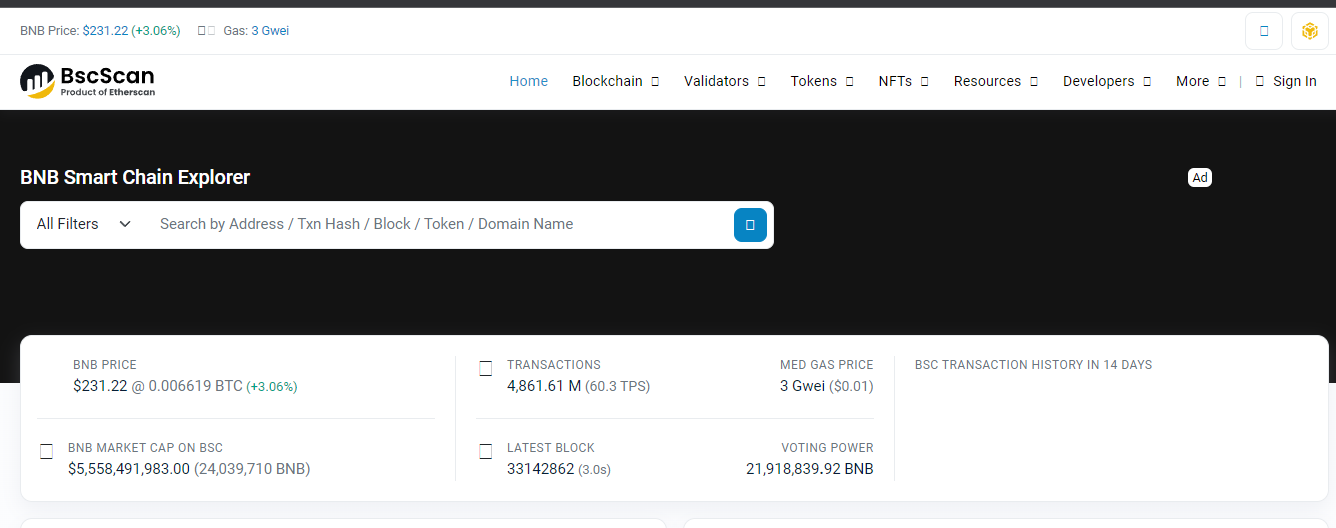
BscScan

Checking Transactions on BscScan

  • Visit the BscScan website at bscscan.com.
  • In the search bar at the top of the page, enter the transaction hash or wallet address you want to investigate.
  • BscScan will query its database and display detailed information about the transaction, including the transaction amount, date, block number, balances, transaction fees, and status.
  • Take note of the transaction status, which can be pending, successful, or failed. This information will help you determine the progress and outcome of the transaction.
  • You can also explore additional details about the transaction by clicking on specific sections, such as the sender's address, recipient's address, or transaction hash.

Exploring Wallet Addresses

  • On the BscScan homepage, locate the search bar at the top of the page.
  • Enter the wallet address that you want to explore and press Enter or click the search icon.
  • BscScan will provide an overview of the wallet address, including the BNB balance and the balances of any BEP-20 tokens held in the wallet.
  • Scroll down to view the transaction history associated with the wallet address, including incoming and outgoing transactions.
  • You can click on individual transactions to access more detailed information, such as the transaction hash, block number, and transaction fee.

Verifying Smart Contracts

  • Navigate to the BscScan website and locate the "Verify Contract" section.
  • Enter the smart contract address that you want to verify.
  • Select the appropriate compiler type and open-source license type.
  • Copy and paste the Solidity contract code into the designated field.
  • Enable optimization by selecting "Yes" in the optimization dropdown menu if applicable.
  • Click the "Verify and Publish" button to initiate the contract verification process.
  • BscScan will compare the submitted code with the code running on the BSC network and provide a verification result indicating whether the contract code matches.

Tracking Tokens on BscScan

  • Access the BscScan website and navigate to the "Tokens" section.
  • Explore the top BEP-20 tokens listed on BscScan, including their prices, volume, market capitalization, and number of holders.
  • Use the search bar to find specific tokens by their contract address or token symbol.
  • Click on individual tokens for more detailed information, such as the token's contract address, token holders, transaction history, and related smart contracts.
  • BscScan also supports ERC-721 and ERC-1155 tokens, allowing users to explore and track non-fungible tokens (NFTs) on the BSC network.

Monitoring Gas Prices

  • Visit the BscScan website and locate the "Gas Tracker" section.
  • Monitor the average gas price displayed on the page.
  • Check the block size and average utilization to understand the current network congestion.
  • Scroll down to view the BSC network's top gas guzzlers and spenders.
  • Use this information to make informed decisions about gas fees and optimize your transactions on the Binance Smart Chain.

Click here to buy Cryptocurrencies from Gate.io

BscScan vs. Etherscan: Key Differences

While BscScan and Etherscan share similarities as blockchain explorers, the two platforms have some key differences. Here are the main distinctions:

  • Supported Wallets: BscScan supports a limited number of wallets (e.g., MetaMask, TrustWallet) compared to Etherscan, which supports a broader range of wallets.
  • Features: Etherscan has the advantage of offering Blockchain APIs and Crypto APIs, providing developers with more advanced functionalities for interacting with the Ethereum blockchain.
  • Focus: BscScan is designed explicitly for the Binance Smart Chain, while Etherscan caters to the Ethereum network. Each explorer prioritizes features and data relevant to its respective blockchain.

BscScan and Etherscan are reputable and reliable explorers, offering valuable insights into their respective blockchain networks.

BscScan Alternatives

While BscScan is the leading blockchain explorer for the Binance Smart Chain, several alternative explorers are available for users. Here are a few notable options:

  • Binance Chain Explorer: Developed directly by Binance, this explorer provides information about blocks, transactions, wallet balances, and BNB metadata. It is available both as a web and mobile application.
  • BitQuery Explorer: BitQuery is a comprehensive explorer that supports multiple blockchains, including Binance Smart Chain. It offers advanced search and analytics capabilities for developers and researchers.
  • Binance Explorer: Binance also provides its explorer for the Binance Smart Chain, offering similar functionalities to BscScan. It is a reliable alternative for users seeking a different interface or additional features.

These alternatives provide users with different interfaces and functionalities, allowing them to choose the explorer that best suits their needs.

Is BscScan Safe?

As a leading blockchain explorer, BscScan is developed by the same team behind Etherscan, which has established a strong reputation in the blockchain community. 

BscScan is safe to use, as it does not require a connection to your BSC wallet and cannot access or acquire your funds. However, it is essential to exercise caution and verify that you are using the official BscScan website (bscscan.com) to avoid potential phishing attempts. 

Always double-check the URL and ensure that you are on the correct website before entering any sensitive information.

Is BscScan Compatible with NFTs?

Yes, BscScan is fully compatible with non-fungible tokens (NFTs). Like Ethereum, the Binance Smart Chain hosts various NFT projects, taking advantage of its lower fees and higher efficiency. 

Users can track their NFTs on BscScan using the transaction hash, NFT intelligent contract address, or wallet address. However, it is essential to note that BscScan does not display the artwork contained within an NFT. 

Users must connect to a compatible marketplace or service provider supporting the specific NFT token standard to view the artwork.

Frequently Asked Questions

Q1. How to check if liquidity is locked on BscScan?

To determine if liquidity is locked for a specific token on BscScan, you can follow these steps:

  • Go to the BscScan website and navigate to the "Tokens" section.
  • Search for the token by its contract address or token symbol.
  • Scroll down to the "Transfers" section and click on the transaction hash associated with the liquidity addition.
  • Check if the liquidity pool tokens or a burn address were sent to the development wallet.
  • Verify that the development wallet does not hold any liquidity pool tokens or check if they have been transferred to a burn address.

Q2. Can BscScan be used for other blockchain networks?

No, BscScan is designed explicitly for the Binance Smart Chain and cannot be used to explore other blockchain networks. Each blockchain has its dedicated explorer, such as Etherscan for Ethereum or Blockchain for Bitcoin. 

If you need to explore a different blockchain, using the corresponding blockchain explorer for accurate and relevant information is recommended.

Q3. What are the advantages of using BscScan for yield farming?

BscScan offers several advantages for users engaged in yield farming on the Binance Smart Chain:

  • Access the latest yield farming opportunities through the "Yield Farms List" feature.
  • Detailed information about different farms, including their locations and how they work.
  • The ability to track your yield farming activities, including the tokens you have staked and the rewards you have earned.
  • Lower transaction fees compared to alternative platforms like Ethereum, making yield farming on BSC more cost-effective.

Q4. Can I revoke token approvals using BscScan?

Yes, BscScan provides the "Token Approval Checker" tool that allows users to review and revoke token approvals for decentralized applications (DApps).

Connecting your wallet to BscScan and using the Token Approval Checker lets you see which DApps can access your tokens and revoke their permissions if desired. This feature gives users more control over their token holdings and helps ensure the security of their assets.

Q5. How does BscScan ensure contract verification?

BscScan's contract verification process involves comparing the source code of a smart contract with the compiled code running on the Binance Smart Chain. 

This process ensures that the code deployed on the blockchain matches the source code provided by the developer. 

BscScan's verification process enhances transparency and security by allowing users to verify intelligent contracts' functionality and integrity independently.

Q6. What are the risks of using BscScan?

While BscScan is a reputable and reliable blockchain explorer, some risks are associated with using any online tool. It is essential to be cautious and follow best security practices when using BscScan or any other blockchain explorer:

  • Ensure you use the official BscScan website (bscscan.com) to avoid phishing attempts.
  • Double-check the URL and ensure that you are on the correct website before entering any sensitive information.
  • Be wary of fake or malicious contracts, tokens, or DApps. Always conduct thorough research and due diligence before interacting with unknown projects.
  • Keep your personal information and wallet details secure. Avoid sharing sensitive information with unknown individuals or platforms.

Q7. How can I contribute to the BscScan community?

If you are interested in contributing to the BscScan community, there are several ways to get involved:

  • Participate in discussions on the BscScan forums or social media channels.
  • Report any bugs or issues you encounter using BscScan to the development team.
  • Provide feedback and suggestions for improving the platform's features and user experience.
  • Contribute to the BscScan open-source project on GitHub if you have programming skills.

Your contributions can help enhance the functionality and usability of BscScan for the entire Binance Smart Chain community.

Conclusion

BscScan is a powerful and essential tool for navigating the Binance Smart Chain ecosystem. Whether you are an investor, developer, or blockchain enthusiast, BscScan provides valuable insights into the BSC network's transactions, smart contracts, tokens, and gas prices. 

By leveraging BscScan's features, you can make more informed decisions, track your investments, and ensure the security of your digital assets. Explore BscScan today and unlock the full potential of the Binance Smart Chain.

Disclaimer

The information provided on this website does not constitute investment advice, financial advice, trading advice, or any other advice, and you should not treat any of the website's content as such.

Token Metrics does not recommend that any cryptocurrency should be bought, sold, or held by you. Conduct your due diligence and consult your financial advisor before making investment decisions.

Click here to buy Cryptocurrencies from Gate.io

Build Smarter Crypto Apps &
AI Agents in Minutes, Not Months
Real-time prices, trading signals, and on-chain insights all from one powerful API.
Grab a Free API Key
About Token Metrics
Token Metrics: AI-powered crypto research and ratings platform. We help investors make smarter decisions with unbiased Token Metrics Ratings, on-chain analytics, and editor-curated “Top 10” guides. Our platform distills thousands of data points into clear scores, trends, and alerts you can act on.
30 Employees
analysts, data scientists, and crypto engineers
Daily Briefings
concise market insights and “Top Picks”
Transparent & Compliant
Sponsored ≠ Ratings; research remains independent
Want Smarter Crypto Picks—Free?
See unbiased Token Metrics Ratings for BTC, ETH, and top alts.
Thank you! Your submission has been received!
Oops! Something went wrong while submitting the form.
 No credit card | 1-click unsubscribe
Token Metrics Team
Token Metrics Team

Recent Posts

Crypto Basics

What is Crypto Yield Farming and How it Works?

Token Metrics Team
6 minutes

In this guide, we will answer what crypto yield farming is and how to do it.

Yield farming is a revolutionary way of earning passive income through cryptocurrency investments. It is a relatively new concept and has gained much attention in the crypto world. Yield farming involves using your cryptocurrency assets and taking advantage of lending platforms, decentralized finance protocols, and staking pools to generate incentives for interest payments, rewards, and capital gains. 

In this descriptive guide to crypto yield farming, you'll learn about the different types of yield farming, the rewards available, and the associated risks. You can earn passive income through yield farming with the right strategies and knowledge. So, let's dive right in and learn about crypto yield farming.

What is Crypto Yield Farming?

‍‍Yield farming is a process of using your cryptocurrency assets to generate incentives in the form of:

  • Interest payments, 
  • Rewards, and 
  • Capital gains. 

In other words, it is a form of passive income from cryptocurrency assets. Yield farming can also be considered a strategic investment strategy that allows you to earn income from your idle assets by lending them to other users. This process is similar to how people earn income from their savings accounts. 

These idle assets that you can stake can be your:

  • Computer's processing power
  • A certain amount of coins from your portfolio, or 
  • A certain amount of tokens from your portfolio. 

But how is this beneficial to you? 

Benefits of Yield Farming

Yield farming offers a wide range of benefits for both individuals and businesses. 

  • For individuals, yield farming can be a great way to earn extra income. It can help you diversify your crypto portfolio and hedge against some of the risks associated with investing in cryptocurrencies by generating extra income from your idle assets. This is why they call it an excellent way to earn passive income, which is one of the core benefits of cryptocurrency. 
  • For businesses, yield farming can help you expand your customer base and increase revenue. You can earn income by lending your idle assets while helping people earn interest and build their crypto portfolios. Although yield farming was once primarily used by mining operations, it can now be done by individuals, organizations, and other entities that are involved with cryptocurrency.

How Does Yield Farming Work in Real-time?‍‍

So, what do you need to do to get started with yield farming?

To begin with, the yield farmers will need to deposit their coins or tokens into decentralized applications or dApps of their choice for the following: 

  • Crypto trading 
  • Lending, or 
  • Borrowing. 

A few examples of dApps include crypto wallets, DEXs, decentralized social media, and more. Since these investors enhance the liquidity in their chosen dApp, they're referred to as liquidity providers. The crypto that yields farmers' deposits into DeFi protocols gets locked into autonomous smart contracts.

Types of Yield Farming

There are three types of yield farming - lending, providing liquidity, and staking. 

Lending refers to lending your idle cryptocurrency assets to earn interest payments. You are generating revenue through interest payments when you lend your cryptocurrency assets. This process is similar to how people earn interest from their savings accounts. 

Providing liquidity to decentralized apps for traders to trade on can also generate you fees. However, keep in mind that there exists impermanent loss in the process.

Staking refers to lending your coins to earn rewards through coins and staking fees. You are generating revenue through rewards and staking fees when you stake your coins. Rewards can come in the form of coins, tokens, or other types of digital assets. You are lending your coins to earn rewards.

Types of Rewards Available

Rewards are the incentives earned when you lend idle coins and cryptocurrencies to earn interest payments and generate passive income. There are many different rewards available to those who participate in yield farming. Some include interest payments, votes, staking rewards, and airdrops. 

Interest payments: This is the primary reward generated by yield farming. Interest payments are generated when you lend idle coins and cryptocurrencies to other participants. 

Votes: This refers to the ability to vote on certain network issues. 

Staking rewards are rewards generated by staking crypto assets for a certain period. 

Airdrops: This refers to the free crypto coins and tokens resulting from participating in a certain network or blockchain project.

Is Yield Farming Safe and Profitable?

Now that you know the benefits of yield farming, it's also important to know the risks. This is because no investment is risk-free, and the same is true for yield farming. When you decide to earn income from yield farming, you must consider the risks associated with it. Some risks associated with yield farming include network, liquidity, counterparty, and regulatory risks. 

Network risk refers to the risk associated with the security of the network/blockchain and its ability to function as expected. 

Liquidity risk is associated with the ability to liquidate your assets when you need them. 

Counterparty risk refers to the risk associated with the ability of the person/entity with whom you have the contract to fulfill the obligations. 

Regulatory risk is the risk associated with the ability of the government to enact new laws that can affect your earnings.

Smart contract risk is the risk associated with the probability of smart contracts getting hacked due to a bug or backdoor.

That said, there are definitely risks involved that you need to be aware of.

Strategies for Yield Farming

There are many strategies you can use for yield farming. Some of them include lending your idle assets to earn interest payments, staking your coins to earn rewards, and using different DAFs to generate passive income.

Lending your idle assets: This is one of the most common ways to earn income through yield farming. You can use your idle assets, such as your computer's processing power, to lend them to others who need them. 

Staking your coins: This is another popular way to generate passive income through yield farming. You can lend your coins to earn rewards. 

Using different DAFs: This refers to the use of decentralized autonomous funds that can generate passive income.

What's Next for Yield Farming?

Yield farming is a dynamic space that tends to change quickly; it often requires vigilance and time for farmers to cull out the best possible strategies. However, for someone who can manage it, yield farming will be highly profitable in 2023, even in the bearish market.  

That said, yield farming is significantly risky with rug pulls, hacks, impermanent loss, etc.

So, choosing your battle is important before getting into the ring. 

Platforms for Yield Farming

Many different types of yield farming platforms are available for you to use.

You can use these platforms to take advantage of your idle assets to generate income through interest payments and rewards.

Some popular yield farming platforms include Yearn Finance, Lido, and Liquity.

The Bottom Line

Yield farming is a revolutionary way of earning passive income through cryptocurrency investments. It involves using your cryptocurrency assets to take advantage of lending platforms, decentralized finance protocols, and staking pools to generate incentives in interest payments, rewards, and capital gains. While lucrative, it can be a riskier investment depending on the platform you go for and the type of yield you are generating.

Crypto Basics

What is XRP (Ripple) Crypto - A Comprehensive Guide

Token Metrics Team
7 minutes

BUY XRP FROM MEXC!

Cryptocurrencies have quickly become an important part of the global financial system, allowing users to make secure, low-cost transactions without needing a bank or other financial institution. One of the most popular and well-known cryptocurrencies is XRP (Ripple), a digital asset designed specifically for payments, remittances, and other forms of financial transactions. 

In this beginner’s guide to XRP, we'll look at how this cryptocurrency works, its benefits, and how it differs from other digital assets. We'll also discuss the process for buying and selling XRP and some potential issues that users need to be aware of. Whether you're new to cryptocurrency or just looking to learn more about XRP, this guide should provide a comprehensive overview of this digital asset and its potential uses.

What Is XRP (Ripple)?

XRP/Ripple is a blockchain network and digital token created to facilitate low-cost, secure, and fast international payments. Unlike other cryptocurrencies, XRP was designed from the beginning to be used for these financial transactions instead of a more general purpose like Bitcoin, Ethereum, and Litecoin. 

XRP can transfer money across borders quickly and with extremely low fees, making it ideal for banks, payment providers, and other financial institutions. XRP can complete these transfers quickly due to its use of a consensus protocol that allows it to confirm transactions within just 4 seconds. 

The XRP token is used to pay network fees for these transfers and is also used by financial service providers as a source of liquidity for cross-border payments. However, the XRP token is not required to use the Ripple network.

Benefits of Using XRP

There are many benefits to using XRP, including:

  • Low fees
  • Fast transaction times
  • High scalability
  • A large network of liquidity providers. 

These benefits make it an ideal choice for banks and other financial institutions that need to process international payments quickly and cheaply. Individuals can also use XRP to make international transfers, but they'll need to purchase the asset before doing so. XRP has advantages over other cryptocurrencies, including Bitcoin, as it was designed specifically for financial transactions. ‍

"Ripple can process almost 1500 transactions per second, compared to Ethereum's 21 and Bitcoin's 7."

How does an XRP Transaction Work?

To send money from one person to another, the sender must create a transaction sent to the network and verify. This process also involves creating an "offer" where the sender specifies the amount of XRP and the network fee. Once completed, the sender's wallet submits the transaction to the network and the fee. 

The network then forwards the transaction to one of the XRP "liquidity providers," who will purchase the amount of XRP specified by the sender and release it to the receiver of the transaction. These liquidity providers hold large amounts of XRP and sell it to other users. After the transaction has been verified by the network and the fee paid, the receiver will receive the money in his or her account.

How to Buy and Sell XRP?

Anyone with access to internet can purchase XRP and store it in a digital wallet. However, some exchanges require users to undergo a verification process before they can begin trading. In addition, most exchanges charge a small trading fee for each transaction, which can add up if you buy and sell frequently. 

Once you've obtained XRP, you can store it in a digital wallet, allowing you to access it from anywhere and providing you with control over the private keys.

Various wallets are available for storing digital assets, including hardware and paper wallets.

Potential Issues with XRP

Like all cryptocurrencies, XRP has potential network risk and governance issues. The community has debated these issues since XRP was first created, but they still need to be resolved.

XRP has a large network of validators that are responsible for verifying transactions. However, the network is centralized, which means it is vulnerable to a single point of failure. If the validators decide to act maliciously, they may be able to prevent other transactions from being verified or even reverse transactions that have already been approved.

XRP vs. Other Cryptocurrencies

XRP is different from most other cryptocurrencies because it was created specifically for financial transactions. This means that Ripple can process almost 1500 transactions per second, compared to Ethereum's 21 and Bitcoin's 7. XRP differs from other digital assets because it is not mined like other cryptocurrencies.

XRP Price History Over The Years

Ripple's token, XRP, became available in 2013 when the company conducted its first fundraising round. Following this initial coin offering (ICO), the price of XRP remained relatively low for several years, with the coin's price dropping below $0.01 in 2016.

However, XRP saw a significant spike in value in 2017, increasing by more than 36,000%. Since then, the price has fluctuated, but it has remained relatively high, and at the time of writing, the price of XRP stands at just under $0.50.

XRP Mining

Unlike other cryptocurrencies, Ripple was not designed to be mined like Bitcoin and Ethereum. Ripple's creators created 100 billion XRP tokens at the start of the project and distributed them to investors.

However, new XRP tokens are added to the network every few months through a process known as "escrow," where the network creates enough tokens to provide liquidity to the global financial system.

XRP Wallets

Some of the best XRP wallets you can use to store your coins in include:

  • Ledger
  • Trezor
  • Coinbase
  • Binance
  • Kraken

Top Exchanges To Buy XRP

Now that you know what XRP is, you can simply create your account in any of the exchange platforms below, complete your KYC and instantly buy your XRP tokens.

  • Binance
  • Kraken
  • Huobi
  • Bitfinex
  • eToro

Is XRP a Good Investment?

Owing to the technical analysis of the XRP, it is expected to reach a minimum price of $0.54 and a maximum of $0.64. Hence, the average trading price at $0.56. Experts believe that this crypto asset has great potential in terms of growing in value.

Having said that, it is always suggested for you to do your own research before arriving at a decision.

The Future of XRP

Ripple aims to create a global network of financial institutions and payment providers that use XRP for cross-border payments. If this vision is achieved, Ripple's cryptocurrency could become one of the world's most widely used digital assets, with billons of dollars flowing through the network daily.

There are some challenges that Ripple will have to overcome to achieve this goal. For example, Ripple needs to expand its network to include more financial institutions while convincing them to use XRP instead of their existing payment networks. 

The Bottom Line

Ripple has streamlined the process of global payment network while providing a useful service for existing financial institutions. Although there is also uncertainty about whether the XRP token should remain centralized or if it should be decentralized, it is one of the coins to keep an eye on. 

Disclaimer

The information provided on this website does not constitute investment/trading/financial advice and you should not treat any of the website’s content as such. Token Metrics does not recommend that any cryptocurrency should be bought, sold, or held by you.

Do conduct your own due diligence and consult your financial advisor before making any investment decisions. We only offer comprehensive information which may change over time.

Crypto Basics

What is Polkadot (DOT) Crypto and Is It a Good Investment?

Token Metrics Team
8 minutes

Polkadot is an innovative, interoperable blockchain network that has the potential to revolutionize the crypto industry. It is the brainchild of Dr. Gavin Wood, one of the co-founders of Ethereum.

Polkadot provides a platform for different blockchains to interact with each other, enabling the exchange of data and assets between them.

With its scalability, robust security features, and cross-chain compatibility, Polkadot is quickly becoming one of the most popular networks for developers and users. This comprehensive guide will provide an overview of the Polkadot network and its features and a look at some of the projects built on the platform. From its scalability to its security and interoperability, this guide will cover the basics of Polkadot and why it is revolutionizing the blockchain industry.

History of the Polkadot Network

‍The Polkadot network is a scalable, interoperable blockchain network designed to connect numerous blockchain networks and facilitate data and asset transfer between them. It was proposed by Gavin Wood, one of the co-founders of Ethereum, and was funded by a successful ICO in 2017. 

The network is powered by a native token known as DOT, which governs the network and exchanges data between chains.

Polkadot is unique in that it is designed to be "hack-proof", due to its implementation of a "democratic" consensus mechanism. While a small number of miners control other blockchain networks, Polkadot's consensus is controlled by a large pool of validators who are democratically elected by users of the network. This ensures that no one party can completely control the network, making it resistant to cyber-attacks.

Polkadot's Scalability

One of the biggest issues affecting the blockchain industry is scalability. Networks like Ethereum can only process 15 transactions per second, which is far from sufficient for mass adoption. If a blockchain network hopes to be used by large corporations and governments, a low transaction capacity is a huge barrier to entry.

Polkadot uses a unique relay chain system to solve the scalability problem. The relay chain system acts as a bridge between different blockchains, allowing them to connect to each other. The chains are controlled by validators who process transactions for chains they are not a part of. 

This allows for transactions on the Polkadot network to be processed by a network of blockchains instead of one single blockchain. This allows for a significant increase in transaction capacity, with one estimate showing 200,000 transactions per second.

The Security Benefits Of Polkadot

Polkadot is committed to providing secure, stable blockchain networks that are not susceptible to cyber attacks. To achieve this, Polkadot uses a unique governance model that allows a large pool of validators to secure the network against attacks.

‍Any party can become a validator on the network by staking DOT tokens. Validators are then rewarded for their work by being paid a portion of DOT token fees generated by the network. 

Validators have a lot of power on the Polkadot network and are responsible for:

  • Confirming transactions
  • Producing blocks
  • Processing cross-chain communication, and 
  • Governing the network. 

If a validator behaves maliciously on the network, the network can punish them by reducing their reward or completely removing them from the network.

Polkadot's Interoperability

One of the biggest problems facing blockchain networks is interoperability. Blockchains cannot communicate with each other, which is a significant barrier to the implementation of blockchain technology on a large scale. Polkadot uses a unique system known as the relay chain to enable cross-chain communication between different networks. 

For example, let's say that a business wants to move funds from a corporate blockchain network to a public blockchain network for the purpose of trading digital assets. Currently, there is no way for these blockchains to communicate with each other, which makes the process extremely difficult and expensive.

With Polkadot's relay chain, the funds are sent from one blockchain to the relay chain; then they are sent to the other blockchain. The relay chain allows blockchain networks to communicate with each other and exchange data, removing the interoperability barrier.

Projects Built on Polkadot

Polkadot has a handful of projects being built on its network. Acala is one such project.

Acala is the ultimate DeFi solution, providing a secure and scalable blockchain platform built on Polkadot, along with a variety of cross-chain financial tools. Users can trade, borrow, provide liquidity, access staking derivatives, and earn high-interest returns on their digital assets. Compatible with Ethereum and optimized for DeFi, Acala's all-in-one network offers endless possibilities for decentralized finance.

How to Buy Polkadot Crypto?

To buy Polkadot’s token, follow these 3-simple steps:

1. Select a Cryptocurrency Exchange

If you’re new to investing in cryptocurrency, you’ll have to open an account with a cryptocurrency exchange. If you’re deciding between exchanges, pay attention to the platform’s security features, account minimums and added fees. Eg: Binance, Coinbase, Kraken

2. Submit Your Polkadot Order

Once you get an exchange account, you can fund it by either linking your bank account or entering your debit card information. Some exchanges allow you to use a credit card, but think twice before using credit as it might charge excess fees. When you’re ready to purchase Polkadot, use the ticker symbol—DOT—and enter the amount you want to invest, such as $50 or $100.

3. Store Your Polkadot

Whenever you buy cryptocurrencies, you have to handle storage on your own. Properly storing your investment is essential to ensure you keep your tokens safe. There are several storage options:

Hard Wallet: A hard wallet resembles a flash drive or USB drive. It’s a small, physical device that plugs into your computer or laptop and stores your private and personal crypto keys. They are considered “cold” because they aren’t connected to the internet or a network when not actively in use.

Paper Wallet: This form of storage is less popular than it used to be but can be a viable storage option. With a paper wallet, you write down keys or apps to download a QR code. If you lose it, you can recover your cryptocurrencies.

Software Wallet: Software wallets are apps or programs you can download to manage your cryptocurrencies electronically. Because they’re connected to the internet and networks, they’re less secure, but they make it easy to trade your holdings.

Crypto Exchanges: Some cryptocurrency exchanges, such as Coinbase, has built-in storage and store cryptocurrencies on your behalf. But relying on an exchange for storage can be risky, and you may want to consider other solutions for long-term storage.

Is Polkadot A Good Investment?

Although Polkadot might experience a bearish 2023, this indeed can be the right time to invest. Because, In 2021, Polkadot concreted its worth to potential traders and investors with apparent proof.

How?

Polkadot has actually kept its promise as the DOT token went on to hit an all-time high along with ranking well among the crypto peers in 2021. Despite a market crash or a price drop, Polkadot is still estimated to be in the profit zone. 

To cut it short, crypto prediction experts suggest that 2023 is the ideal time to buy DOT tokens, yet, it’s suggestible to do your own research and analysis before you make the call.

Future Of Polkadot Crypto

Polkadot is a fairly young asset of the crypto world,  but it saw a great surge in its popularity among cryptocurrencies in 2021 and 2022. Experts project that Polkadot's position would rise over time and confront other high-ranking cryptos like Ethereum.

Polkadot’s big aspect is its interoperability with various independent blockchains. Interoperability is a broad term used in the crypto space to describe the process of interacting between two or more different blockchains.

Although many networks share similar concepts, Polkadot is the only platform that makes this vision a reality, as it is the first solution that can achieve significantly high interoperability.

The Bottom Line

The Polkadot network aims to be the internet of blockchains by allowing different blockchain networks to connect with each other and exchange data. With its scalable network, robust security features, and cross-chain compatibility, Polkadot is quickly becoming one of the most popular networks for developers and users.

With the implementation of the relay chain, Polkadot is positioning itself as the first truly interoperable blockchain network and a game-changer in the blockchain industry.

Choose from Platinum, Gold, and Silver packages
Reach with 25–30% open rates and 0.5–1% CTR
Craft your own custom ad—from banners to tailored copy
Perfect for Crypto Exchanges, SaaS Tools, DeFi, and AI Products

