Back to blog
Research

From Stocks to Crypto Indices: A Traditional Investor's Guide to Digital Asset Allocation with Token Metrics

Explore how disciplined, traditional investors can leverage Token Metrics AI indices to thoughtfully diversify into crypto, minimize risk, and maximize growth with proven wealth strategies adapted for digital assets.
Token Metrics Team
14 min read
Want Smarter Crypto Picks—Free?
See unbiased Token Metrics Ratings for BTC, ETH, and top alts.
Thank you! Your submission has been received!
Oops! Something went wrong while submitting the form.
 No credit card | 1-click unsubscribe

If you've spent years building wealth through stocks, bonds, and mutual funds, cryptocurrency can seem alien and intimidating. The volatility, technical jargon, and stories of overnight millionaires mixed with devastating losses create skepticism among disciplined traditional investors.

Yet ignoring cryptocurrency entirely means missing one of the most significant wealth creation opportunities of our generation. The key isn't abandoning proven investment principles—it's applying them to a new asset class through vehicles designed for sophisticated investors like you.

Token Metrics AI Indices bridge the gap between traditional finance and cryptocurrency by offering:

  • Index-based exposure similar to stock market ETFs
  • Professional management resembling mutual funds
  • Diversification principles you already understand
  • Risk management frameworks familiar from traditional portfolios

This guide helps traditional investors transition into cryptocurrency thoughtfully, comparing familiar concepts to crypto equivalents, explaining portfolio allocation strategies, addressing tax considerations, and building crypto exposure using time-tested investment principles.

Understanding Crypto Indices Through Traditional Finance Lens

The easiest way to understand crypto indices is through comparison with traditional investment vehicles you already know.

  • Crypto indices function like stock market ETFs - diversified, automatically rebalanced portfolios
  • AI-driven token selection resembles active management and smart beta strategies
  • Diversification and correlation principles work identically in crypto
  • Risk-adjusted returns are measured using the same metrics (Sharpe ratio, drawdowns, volatility)

Crypto Indices Are Like Stock Market ETFs

Just as the S&P 500 ETF provides diversified exposure to 500 large US companies without selecting individual stocks, Token Metrics indices provide diversified exposure to carefully selected cryptocurrencies without picking individual tokens.

The SPY ETF tracks the S&P 500 automatically rebalancing as companies enter or exit the index. Token Metrics indices similarly track AI-selected portfolios, automatically rebalancing as market conditions change and new opportunities emerge.

Traditional index funds charge expense ratios—typically 0.03-0.50% annually. Token Metrics operates on a subscription model providing access to multiple indices and analytical tools for one fee, similar to premium investment research services.

AI-Driven Selection Resembles Active Management

While crypto indices use passive indexing methodology, the underlying token selection employs active management principles. This hybrid approach resembles smart beta ETFs in traditional markets—systematic strategies using quantitative factors to outperform market-cap-weighted approaches.

Token Metrics' AI analyzes fundamental metrics, technical indicators, and on-chain data to identify undervalued tokens with strong prospects. This process mirrors how active stock fund managers screen for quality companies, strong earnings, and attractive valuations—but executed algorithmically at scale across thousands of cryptocurrencies.

Diversification Works the Same Way

Portfolio theory applies equally to crypto. Diversification reduces unsystematic risk by spreading exposure across multiple assets. If one stock in your portfolio falls 50%, it impacts your total portfolio proportionally to its weighting. The same principle protects crypto index investors when individual tokens underperform.

Correlation matters identically. Diversification provides maximum benefit when assets don't move in lockstep. Token Metrics indices intentionally diversify across different blockchain ecosystems, use cases, and market capitalizations to reduce correlation and smooth returns.

Risk-Adjusted Returns Follow Same Metrics

Sharpe ratios, maximum drawdowns, and volatility measurements apply to crypto just as they do to stocks. Professional investors don't evaluate returns in isolation—they assess returns relative to risk taken.

Token Metrics indices target superior risk-adjusted returns through the same principles traditional managers use—systematic analysis, disciplined rebalancing, and professional risk management. The asset class differs but investment principles remain constant.

Translating Your Stock Market Experience to Crypto

Your traditional investing experience provides valuable foundation for crypto success.

  • Fundamental Analysis: Stock investors evaluate revenue, profit margins, and competitive advantages. Crypto analysis examines transaction volume, technology advantages, team quality, and market opportunity using different terminology but similar principles. Token Metrics' AI systematically evaluates these factors like quantitative stock strategies.
  • Technical Analysis: Support, resistance, moving averages, and momentum indicators function identically for cryptocurrencies. Your technical analysis skills transfer directly to crypto markets.
  • Portfolio Construction: Asset allocation, rebalancing, and diversification principles apply universally. Cryptocurrency's low correlation to traditional assets makes it valuable for diversification even at small allocations.
  • Market Cycles: Bull markets, bear markets, and consolidation occur in crypto like stocks. Your experience navigating market downturns prepared you for crypto volatility—the magnitude differs but psychological challenges remain similar.

Portfolio Allocation: How Much Crypto Should Traditional Investors Hold?

Determining appropriate cryptocurrency allocation requires balancing growth potential against volatility tolerance and time horizon.

  • Conservative (1-5%): For investors approaching retirement or with low risk tolerance
  • Moderate (5-15%): For mid-career professionals with 10-20 year horizons
  • Aggressive (15-30%): For younger investors with long time horizons and high risk tolerance

Conservative Allocation (1-5%)

Investors approaching retirement or with low risk tolerance should limit crypto exposure to 1-5% of total portfolio. This provides meaningful participation in crypto's growth without risking financial security.

At this allocation level, even if crypto suffers 80% decline, your total portfolio drops only 0.8-4%—uncomfortable but manageable. Conversely, if crypto appreciates 300%, your portfolio gains 3-15%—meaningful upside from small allocation.

Focus exclusively on Token Metrics' conservative indices emphasizing Bitcoin, Ethereum, and fundamentally strong large-cap tokens. This minimizes volatility while maintaining crypto exposure.

Moderate Allocation (5-15%)

Mid-career professionals with 10-20 year investment horizons can embrace 5-15% crypto allocation. This provides substantial exposure to crypto's growth potential while maintaining predominantly traditional portfolio structure.

Balanced Token Metrics indices suit this allocation level, combining established cryptocurrencies with growth-oriented mid-cap tokens. The diversification and professional management limit volatility compared to individual token selection.

At 10% allocation, your portfolio's overall volatility increases modestly—perhaps from 12% to 14% standard deviation annually. This marginal volatility increase brings meaningful return enhancement potential.

Aggressive Allocation (15-30%)

Younger investors with long time horizons and high risk tolerance can allocate 15-30% to cryptocurrency. At these levels, crypto significantly influences total portfolio performance, requiring comfort with substantial volatility.

Mix conservative and aggressive Token Metrics indices providing both stability and growth potential. Even aggressive allocations benefit from some downside protection through conservative index components.

Understand that 25% crypto allocation could create 20% portfolio swings during extreme market conditions. Only embrace this allocation if you can tolerate such volatility without panic selling.

Implementation Through Dollar-Cost Averaging

Regardless of target allocation, implement gradually through dollar-cost averaging over 6-12 months. This reduces timing risk and allows psychological adjustment to crypto's volatility.

If targeting 10% crypto allocation with $500,000 portfolio, invest $50,000 total. Rather than investing all at once, invest $4,167 monthly for 12 months. This systematic approach removes emotion and smooths entry prices.

Tax Considerations: What Traditional Investors Must Know

Cryptocurrency taxation differs from stocks in important ways. Understanding these differences prevents costly mistakes.

  • Capital gains taxes apply to crypto, with added complexity for crypto-to-crypto trades
  • Tax-loss harvesting currently works more flexibly without wash sale rules
  • Retirement accounts (IRAs, 401ks) offer tax-advantaged crypto investing options
  • Detailed record keeping is essential for every transaction

Capital Gains Apply But With Complexity

Like stocks, cryptocurrencies trigger capital gains taxes when sold for profit. Long-term capital gains rates (held over one year) provide tax advantages versus short-term rates, just as with stocks.

However, crypto-to-crypto trades—exchanging one token for another—trigger taxable events even though you haven't converted to dollars. This differs from stocks where exchanging one stock for another within retirement accounts doesn't trigger taxes.

Token Metrics indices involve periodic rebalancing requiring crypto-to-crypto trades. Each rebalancing transaction creates potential taxable events. Track all transactions meticulously for tax reporting.

Tax-Loss Harvesting Works Differently

Stock investors use tax-loss harvesting to offset gains with losses, subject to wash sale rules preventing you from repurchasing identical securities within 30 days.

Cryptocurrency currently isn't subject to wash sale rules, allowing more aggressive tax-loss harvesting. You could sell a token at loss for tax purposes and immediately repurchase it. However, proposed legislation may extend wash sale rules to crypto—consult tax professionals before relying on this strategy.

Retirement Account Considerations

Some custodians now allow cryptocurrency holdings in retirement accounts (IRAs, 401ks), providing tax-advantaged growth similar to stock investments in these accounts.

Holding crypto indices in traditional IRAs defers taxes until withdrawal. Roth IRAs allow tax-free growth. These vehicles eliminate concerns about rebalancing transactions creating taxable events, making them ideal for crypto index investing.

Research self-directed IRA providers supporting cryptocurrency if interested in tax-advantaged crypto investing. Not all custodians offer this option yet.

Record Keeping Requirements

Cryptocurrency requires more detailed record keeping than stocks. Every transaction—purchases, sales, trades, rebalancing—needs documentation including dates, amounts, prices, and transaction types.

Token Metrics provides transaction tracking helping maintain records for tax reporting. Use this data or export to cryptocurrency tax software like CoinTracker or TokenTax simplifying annual tax preparation.

Risk Management: Applying Traditional Principles to Crypto

Your experience managing risk in traditional portfolios translates directly to crypto with some adjustments:

  • Position sizing and diversification prevent concentration risk
  • Systematic rebalancing enforces buy-low, sell-high discipline
  • Correlation monitoring maintains appropriate portfolio risk
  • Stress testing prepares you for extreme scenarios

Position Sizing Matters More

Individual stock positions typically represent 2-5% of diversified portfolios. Individual crypto positions in Token Metrics indices follow similar sizing—no single token dominates portfolio, limiting concentration risk.

This disciplined position sizing prevents the common crypto investor mistake of betting everything on one or two tokens. Diversification reduces volatility and protects against catastrophic single-asset failures.

Rebalancing Discipline Applies Equally

Traditional investors rebalance portfolios periodically—perhaps quarterly or annually—to maintain target allocations. Token Metrics indices rebalance dynamically based on market conditions and AI analysis.

This systematic rebalancing forces "buy low, sell high" discipline. When tokens appreciate substantially, the AI takes profits. When tokens decline but fundamentals remain strong, the AI accumulates at lower prices. Emotional investors do the opposite—buying high and selling low.

Correlation Monitoring Remains Important

Traditional portfolios balance stocks, bonds, and other assets with low correlation. Monitor how your crypto allocation correlates with traditional holdings.

During certain periods, crypto moves independently from stocks providing diversification benefits. During other periods—like March 2020—correlations spike as all risk assets decline together. Understanding these dynamics helps maintain appropriate total portfolio risk.

Stress Testing Your Allocation

Before committing to crypto allocation, stress test how your total portfolio would perform in various scenarios. If crypto fell 80% while stocks fell 50% (like March 2020), would you maintain discipline?

Running these mental simulations before investing prevents panic selling during actual market stress. Decide now what actions you'd take during severe downturns rather than making emotional decisions in the moment.

Transitioning Gradually: A Practical Timeline

Don't rush into crypto. Traditional investors benefit from gradual, measured transitions respecting both opportunity and risk.

  • Months 1-2: Education phase - learn without investing
  • Months 3-4: Planning phase - set allocation targets and open accounts
  • Months 5-6: Initial implementation - begin dollar-cost averaging
  • Months 7-12: Scale to target allocation - reach full position size

Month 1-2: Education Phase

Spend your first two months learning without investing. Open Token Metrics account and explore the platform. Read educational resources about blockchain technology, cryptocurrency fundamentals, and market dynamics. Review index compositions and historical performance.

This education phase builds knowledge foundation supporting confident decision-making. Resist pressure to invest immediately—markets will still exist after you've learned properly.

Month 3-4: Planning Phase

Determine your target crypto allocation based on age, risk tolerance, and financial goals. Decide which Token Metrics indices align with your objectives. Calculate dollar amounts for initial investment and ongoing dollar-cost averaging.

Open cryptocurrency exchange account and complete verification. Link bank account for funding transfers. Set up two-factor authentication and security measures.

Month 5-6: Initial Implementation

Begin dollar-cost averaging into chosen indices. Start with smaller amounts building confidence before committing larger capital. Experience the volatility firsthand with manageable position sizes.

Monitor your emotional reactions. Are you comfortable with price swings? Does crypto allocation interfere with sleep or create anxiety? These early experiences inform whether your planned allocation truly matches your risk tolerance.

Month 7-12: Scale to Target Allocation

Gradually increase crypto positions toward target allocation. Continue dollar-cost averaging throughout this period. As positions grow, implement hardware wallet security if comfortable with technical requirements.

By month 12, reach your target allocation and transition from accumulation to maintenance mode. Conduct quarterly reviews but otherwise maintain hands-off approach trusting Token Metrics' professional management.

Conclusion: Bridging Two Investment Worlds

Traditional investing and cryptocurrency aren't opposing philosophies—they're complementary approaches to wealth building. Your decades of stock market experience provide valuable foundation for crypto success when applied thoughtfully through appropriate vehicles.

Token Metrics AI Indices allow traditional investors to embrace cryptocurrency without abandoning proven principles. Diversification, risk management, systematic analysis, and disciplined rebalancing work equally well across all asset classes.

The opportunity cost of ignoring cryptocurrency grows daily. Markets that seemed irrational five years ago have matured into trillion-dollar ecosystems attracting institutional capital and regulatory clarity. By the time crypto becomes "safe" enough for all traditional investors, exceptional returns will have moderated toward market averages.

Your advantage as an experienced investor is recognizing emerging opportunities while managing risk appropriately. You didn't achieve investment success through reckless speculation—you succeeded through disciplined, strategic allocation across diverse assets.

Apply those same principles to cryptocurrency through Token Metrics indices. Start small, scale gradually, maintain discipline, and let professional management and systematic diversification work in your favor.

The bridge between traditional finance and cryptocurrency exists—Token Metrics built it specifically for sophisticated investors like you. Cross it confidently knowing your time-tested investment principles remain your most valuable guide.

Start your 7-day free trial today and discover how traditional investment wisdom translates perfectly to cryptocurrency success through professionally managed AI indices.

Build Smarter Crypto Apps &
AI Agents in Minutes, Not Months
Real-time prices, trading signals, and on-chain insights all from one powerful API.
Grab a Free API Key
About Token Metrics
Token Metrics: AI-powered crypto research and ratings platform. We help investors make smarter decisions with unbiased Token Metrics Ratings, on-chain analytics, and editor-curated “Top 10” guides. Our platform distills thousands of data points into clear scores, trends, and alerts you can act on.
30 Employees
analysts, data scientists, and crypto engineers
Daily Briefings
concise market insights and “Top Picks”
Transparent & Compliant
Sponsored ≠ Ratings; research remains independent
Want Smarter Crypto Picks—Free?
See unbiased Token Metrics Ratings for BTC, ETH, and top alts.
Thank you! Your submission has been received!
Oops! Something went wrong while submitting the form.
 No credit card | 1-click unsubscribe
Token Metrics Team
Token Metrics Team

Recent Posts

Research

Best Crypto Payment Processors for Merchants (2025)

Sam Monac
5 min

Why crypto payment processors for merchants Matter in September 2025

If you sell online (or in-store) and want to accept Bitcoin or stablecoins, choosing the best crypto payment processors can lower costs, expand global reach, and reduce chargeback risk. In one line: a crypto payment processor lets merchants accept digital assets at checkout and settle in crypto or fiat while handling pricing, invoicing, and compliance basics.

In 2025, stablecoin rails and Lightning are improving speed and costs, while major gateways add plugins for Shopify, WooCommerce, and custom APIs. This guide is for startups and enterprises comparing fees, settlement options, asset coverage, and regional availability. We blend live docs research with practical fit notes so you can pick confidently and ship faster.

How We Picked (Methodology & Scoring)

  • Liquidity (30%): breadth of supported assets/rails (BTC, stablecoins, Lightning), reliability of conversion/settlement.
  • Security (25%): custody model, key management options, certifications, and clear incident/disclosure pages.
  • Coverage (15%): e-commerce plugins, API maturity, payouts, and fiat-settlement choices.
  • Costs (15%): transparent processing fees, conversion/payout costs.
  • UX (10%): checkout speed, invoicing, reporting, and developer experience.
  • Support (5%): docs quality, SLA, enterprise support.

Data sources: official product/docs, pricing/security pages, and (for cross-checks only) widely cited market datasets. Last updated September 2025.

Top 10 crypto payment processors for merchants in September 2025

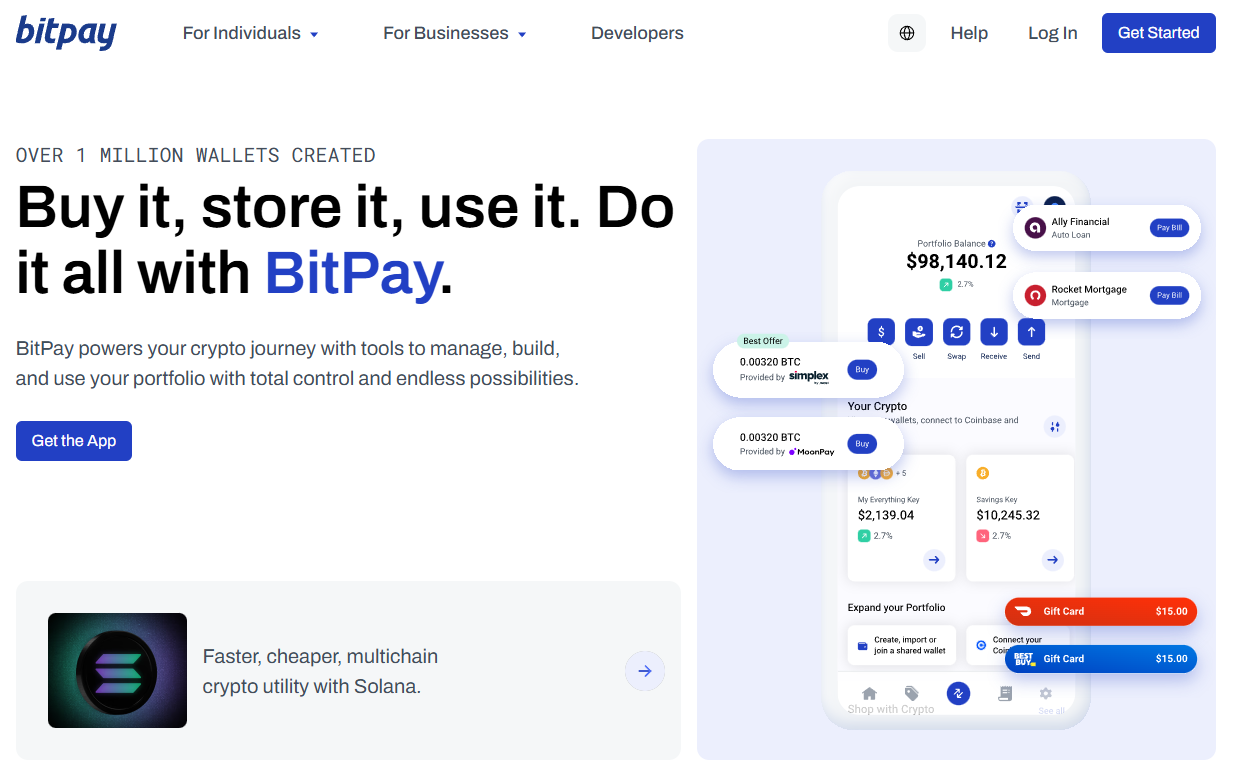
1. BitPay — Best for mature U.S. merchants wanting stable operations

  • Why Use It: One of the longest-running crypto processors with robust invoicing, refunds, accounting exports, and fiat settlement. Tiered pricing and clear policies suit compliance-sensitive teams.
  • Best For: U.S./EU retailers, subscriptions, digital goods, B2B invoices.
  • Notable Features: Branded checkout links; partial/full refunds; mass payouts; settlement in multiple currencies; stablecoin support.
  • Consider If: You want predictable fees and traditional support over maximum coin variety.
  • Fees/Regions: Tiered 1–2% + $0.25 per transaction; extensive global reach.
  • Alternatives: Coinbase Commerce, CoinGate.

2. Coinbase Commerce — Best for simple USDC/crypto checkout with fiat-style reporting

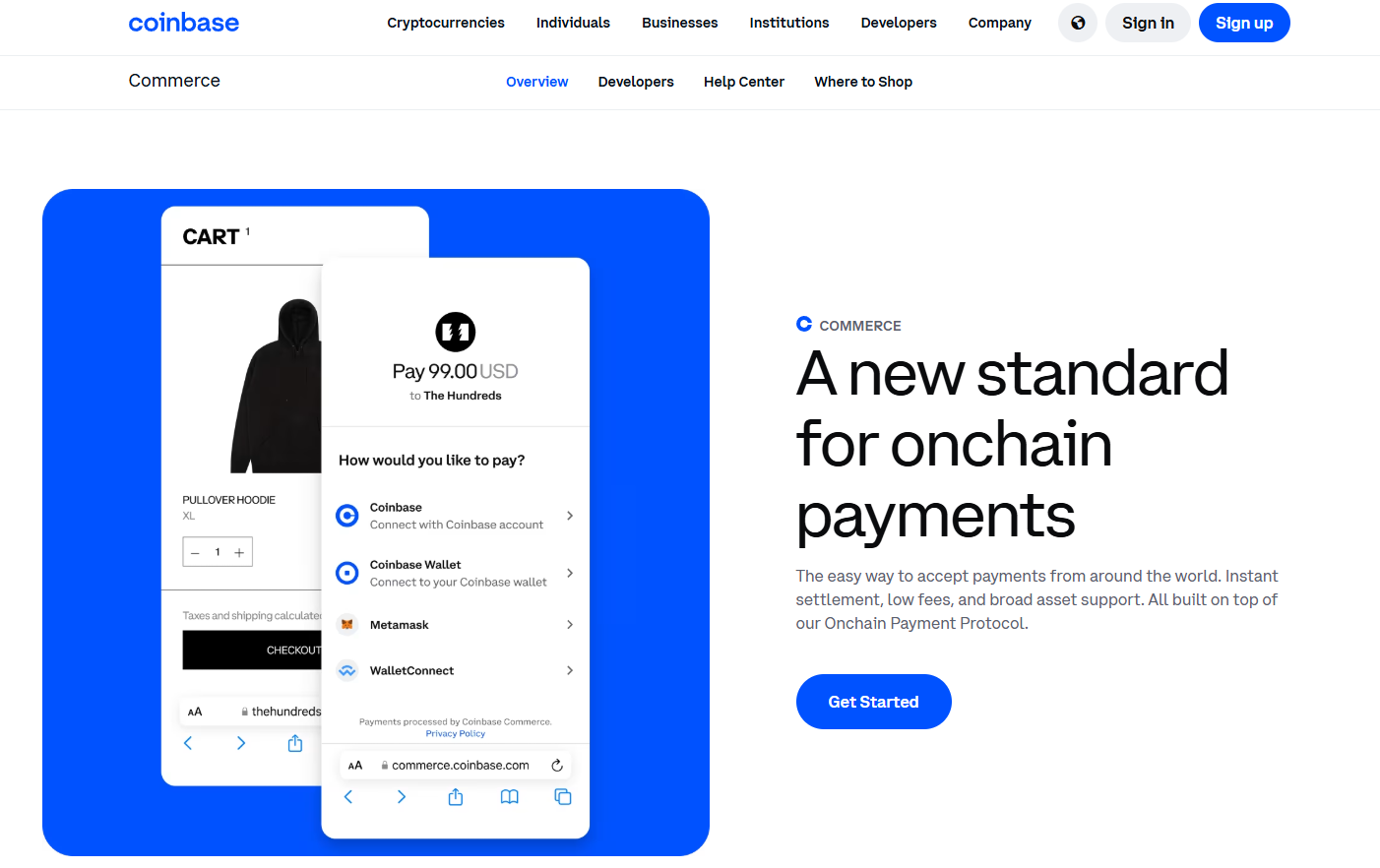
  • Why Use It: Clean merchant dashboard, simple payment links, and an onchain payment protocol with automatic conversions; integrates neatly with Coinbase ecosystem and USDC flows.
  • Best For: SaaS, creators, and startups already using Coinbase.
  • Notable Features: Payment links; ecommerce plugins; onchain protocol migration; automatic fee display and reporting.
  • Consider If: You want a recognizable brand and 1% flat pricing.
  • Fees/Regions: 1% processing fee; broad availability (jurisdictional limits may apply).
  • Alternatives: BitPay, Crypto.com Pay.

3. CoinGate — Best for multi-coin coverage and EU-friendly payouts

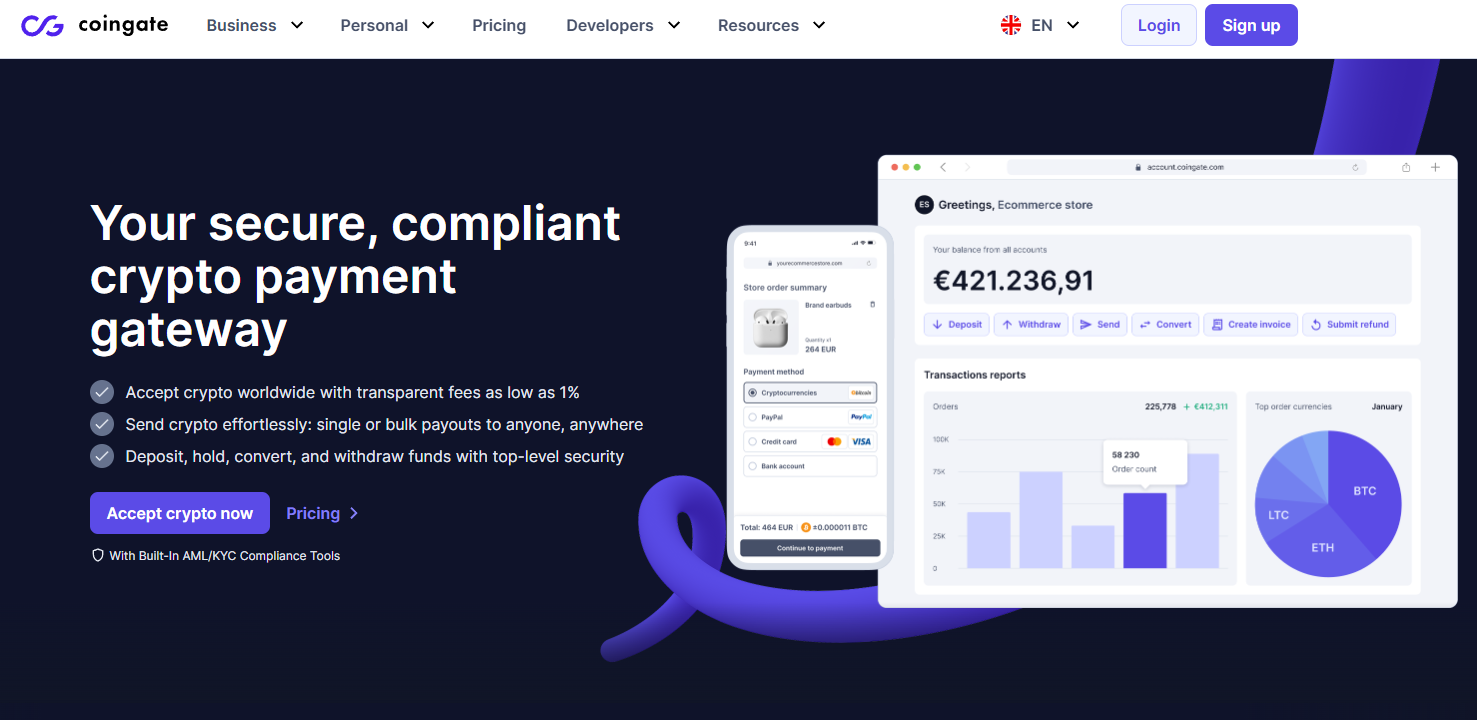
  • Why Use It: Transparent pricing and solid plugin coverage (WooCommerce, OpenCart, etc.) with weekly settlements and crypto payouts.
  • Best For: EU merchants, hosting/VPNs, and globally distributed ecommerce.
  • Notable Features: 1% processing; refunds in crypto; payouts with/without conversion; accepts customers from 180+ countries.
  • Consider If: You need flexible payouts and many altcoins.
  • Fees/Regions: 1% processing; additional small fees for certain payout types; EU/Global.‍
  • Alternatives: CoinPayments, NOWPayments.

4. CoinPayments — Best for plugins and long-tail altcoin acceptance

  • Why Use It: A veteran gateway with broad coin support and deep ecommerce integrations (BigCommerce, WooCommerce). Good for merchants courting crypto-native audiences.
  • Best For: Online stores, marketplaces, gaming.
  • Notable Features: Auto-conversion between coins; extensive plugin library; merchant tools and invoicing.
  • Consider If: You want low, flat pricing across many assets.
  • Fees/Regions: 0.5% processing (plus network fees); Global.
  • Alternatives: CoinGate, NOWPayments.

5. NOWPayments — Best for lowest advertised base rate with auto-conversion

  • Why Use It: Simple setup, broad coin list, and clear fee tiers—great for testing crypto checkout with minimal overhead.
  • Best For: SMB ecommerce, content creators, charities.
  • Notable Features: 300+ coins; donations/PoS widgets; subscriptions; mass payouts; auto-conversion.
  • Consider If: You value quick launch and wide asset coverage.
  • Fees/Regions: 0.5% monocurrency; 1% with conversion (excl. network fees); Global.
  • Alternatives: CoinPayments, CoinGate.

6. OpenNode — Best for Bitcoin + Lightning with fiat conversion

  • Why Use It: Lightning-native processing for low fees and instant settlement, with optional auto-conversion to local currency to avoid BTC volatility.
  • Best For: High-volume BTC checkouts, gaming, and emerging markets needing fast micro-payments.
  • Notable Features: Hosted checkout; API; automatic conversion; bank settlements; PoS.‍
  • Consider If: You prioritize Lightning speed and simple, transparent pricing.‍
  • Fees/Regions: 1% transaction fee; supports many currencies and countries; Global
  • ‍Alternatives: Lightspark, BTCPay Server (self-hosted).

7. Lightspark — Best enterprise Lightning infrastructure

  • Why Use It: Enterprise-grade Lightning with AI-assisted routing, flexible custody models, and SLA-style support—ideal for platforms embedding realtime payments.
  • Best For: Fintechs, exchanges, marketplaces, and PSPs embedding Bitcoin/Lightning.
  • Notable Features: Managed nodes; Predict routing; UMA support; role-based access; audit-ready reporting.
  • Consider If: You need predictable Lightning performance at scale.
  • Fees/Regions: Starter 0.50%; Enterprise 0.30–0.15% with volume tiers; Global.
  • Alternatives: OpenNode, Coinbase Commerce (non-Lightning).

8. Crypto.com Pay — Best for ecosystem reach and co-marketing

  • Why Use It: Merchant app + plugins, catalog placement, and cash settlement with zero crypto price risk claims; strong brand for consumer trust.
  • Best For: Retail, entertainment, and brands wanting exposure to Crypto.com’s user base.
  • Notable Features: API & plugins (Shopify/WooCommerce); recurring for app users; in-store app acceptance; security certifications displayed.
  • Consider If: You want marketing reach alongside payments.
  • Fees/Regions: Availability and settlement options vary by jurisdiction; “300M+ USD processed per annum” marketing stat on site.
  • Alternatives: Coinbase Commerce, BitPay.

9. TripleA — Best for compliance-first global merchants (MAS-licensed)

  • Why Use It: Singapore-based gateway emphasizing licensing and compliance (MAS Major Payment Institution), with global acceptance and fiat settlement.
  • Best For: Regulated industries, cross-border ecommerce, APAC reach.
  • Notable Features: Merchant APIs; ecommerce plugins; settlement to bank accounts; multi-asset support.
  • Consider If: Licensing and audits matter more than long-tail altcoins.
  • Fees/Regions: Pricing by quote; Licensed in Singapore; Global coverage.
  • Alternatives: BitPay, CoinGate.

10. Alchemy Pay — Best hybrid fiat-crypto acceptance with wide country reach

  • Why Use It: Hybrid rails (on/off-ramp + crypto payments) covering 173 countries, with fiat settlement and SDKs for web/app flows; active U.S. licensing expansion.
  • Best For: Global ecommerce, super-apps, and platforms needing both purchase and checkout rails.
  • Notable Features: Checkout SDK; QR/wallet payments; off-ramp payouts; partner integrations.
  • Consider If: You want one vendor for ramps + crypto acceptance.
  • Fees/Regions: Pricing via sales; jurisdictional variability noted; Global/APAC focus with growing U.S. coverage.
  • Alternatives: Crypto.com Pay, Coinbase Commerce.

Decision Guide: Best By Use Case

  • Regulated U.S./EU brands: BitPay, TripleA, Coinbase Commerce.
  • Global altcoin coverage: CoinPayments, CoinGate, NOWPayments.
  • Lightning/micropayments: OpenNode, Lightspark.
  • Ecosystem reach/co-marketing: Crypto.com Pay.‍
  • All-in-one ramps + acceptance: Alchemy Pay.‍
  • Simple 1% flat fee and easy links: Coinbase Commerce.

How to Choose the Right crypto payment processors for merchants (Checklist)

  • Confirm regional eligibility and licensing (e.g., U.S., EU, APAC).
  • Compare processing + conversion + payout fees (not just headline rates).
  • Decide on settlement (crypto vs. fiat) and supported currencies.
  • Check plugin coverage (Shopify, WooCommerce) and API maturity.
  • Review security posture (custody model, certifications, disclosures).
  • Validate support/SLA and refund workflows.
  • Red flags: vague fees, no docs/status page, or unclear settlement policies.

Use Token Metrics With Any crypto payment processors for merchants

  • AI Ratings: screen coins and chains your customers actually use.
  • Narrative Detection: spot momentum (e.g., stablecoin or Lightning surges).
  • Portfolio Optimization: model treasury exposure if you keep a crypto balance.
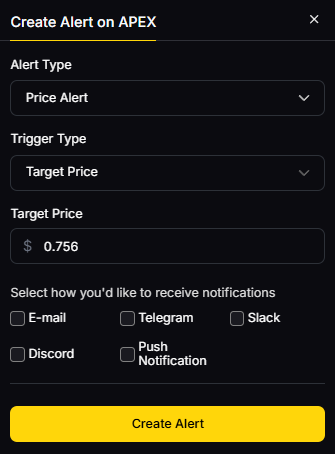
  • Alerts & Signals: monitor market moves that affect checkout conversions.

Workflow: Research in TM → Pick a processor → Go live → Monitor with alerts.

‍Start free trial

Security & Compliance Tips

  • Enable 2FA and role-based access on the merchant dashboard.
  • Choose custody/settlement that fits your risk (self-custody vs. managed, fiat vs. crypto).
  • Follow KYC/AML and tax rules in each operating region.
  • For RFQ/OTC conversions, document rates/partners.
  • Keep wallet hygiene (whitelists, limited hot-wallet balances).

This article is for research/education, not financial advice.

Beginner Mistakes to Avoid

  • Chasing the lowest “headline rate” while ignoring conversion/payout fees.
  • Forgetting to test refunds, partial payments, and expired invoices.
  • Launching without clear settlement currency and payout timing.
  • Relying on a single chain/asset when your audience uses others.
  • Ignoring jurisdictional limitations and licensing disclosures.

FAQs

What is a crypto payment processor for merchants?
A service that lets businesses accept digital assets (e.g., BTC, USDC) and settle in crypto or fiat while handling pricing, invoicing, and basic compliance/reporting.

Are crypto fees lower than card fees?
Often yes—many gateways list ~0.5–1% base rates, though network and conversion/payout fees can apply. Compare total effective cost per order.

Can I receive USD/EUR instead of crypto?
Most processors offer instant conversion and fiat settlement to bank accounts in supported regions. Check your vendor’s settlement currencies and schedules.

Which is best for Lightning or micro-payments?
OpenNode and Lightspark are built around Lightning for instant, low-cost payments, with enterprise options and APIs.

Is self-hosting a gateway possible?
Yes—projects like BTCPay Server exist for technical teams, but managed gateways reduce operational burden and add fiat settlement options.

Conclusion + Related Reads

Merchants should match checkout rails to customer demand: go BitPay/Coinbase Commerce for simplicity and brand trust, CoinGate/CoinPayments/NOWPayments for broad asset coverage, OpenNode/Lightspark for Lightning speed, and Alchemy Pay/Crypto.com Pay for hybrid rails and reach. Test fees and settlement with a pilot, then scale.

Research

Best Hardware Wallets for Security (2025)

Sam Monac
5 min

Why Hardware Wallets Matter in September 2025

If you hold crypto, your keys are everything—and the best hardware wallets still offer the strongest defense against malware, phishing, and exchange failures. A hardware wallet is a dedicated, offline signing device that stores private keys and authorizes transactions without exposing secrets to the internet. In 2025, rising on-chain activity and more sophisticated wallet-drainer attacks make physical key management table stakes for both retail and pros.

This guide is for investors, traders, and builders who want maximum security without killing usability. We compare leading devices across security architecture, open-source posture, coin coverage, UX, and ecosystem readiness—so you can match the right wallet to your risk profile and stack. Secondary considerations include “crypto hardware wallet” setup flows, “cold wallet” signing paths, and “secure crypto wallet” recovery options.

How We Picked (Methodology & Scoring)

  • Liquidity (30%) → Practical access to ecosystems: native apps, partner integrations, staking/buy features, and compatibility with third-party wallets.
  • Security (25%) → Secure elements, open-source/ reproducible builds, air-gapped flows (QR/PSBT), anti-exfiltration, audits, and recovery design.
  • Coverage (15%) → Supported chains and tokens (BTC, ETH/L2s, EVM, Solana, etc.).
  • Costs (15%) → Device price and any ongoing subscription/feature fees.
  • UX (10%) → Screen size, inputs, mobile/Bluetooth, onboarding, backups.
  • Support (5%) → Docs, firmware cadence, and customer support options.

We relied on official product and security pages, device docs, and transparency notes, using third-party market datasets only for cross-checks (no third-party links in body). Last updated September 2025.

Top 10 Hardware Wallets for Security in September 2025

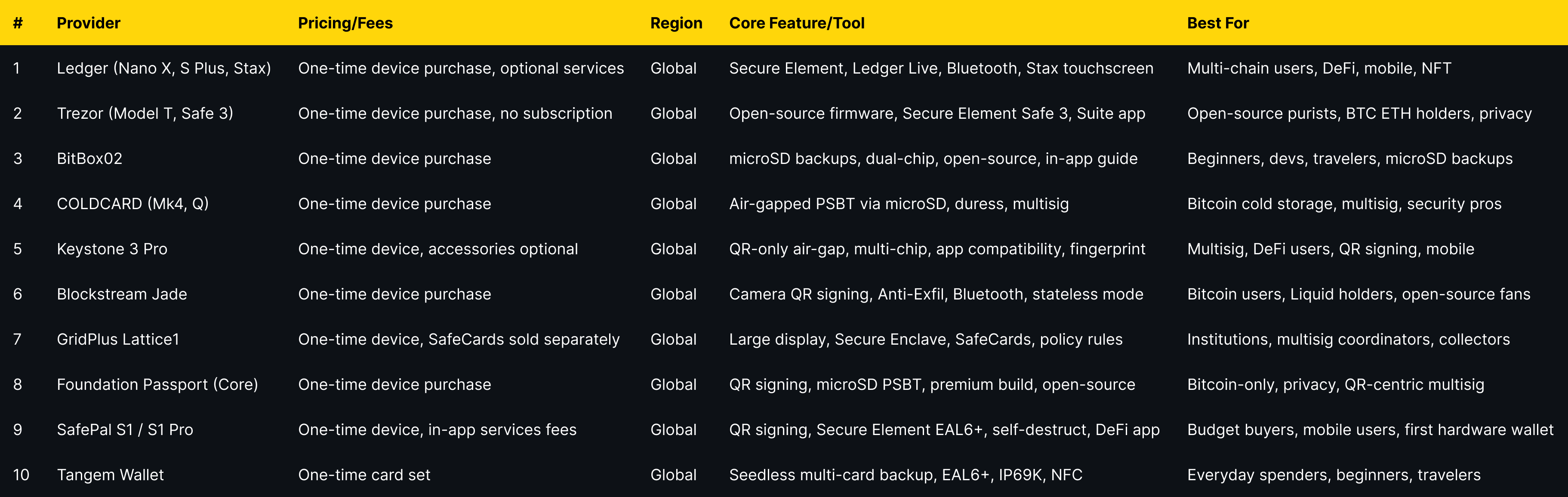
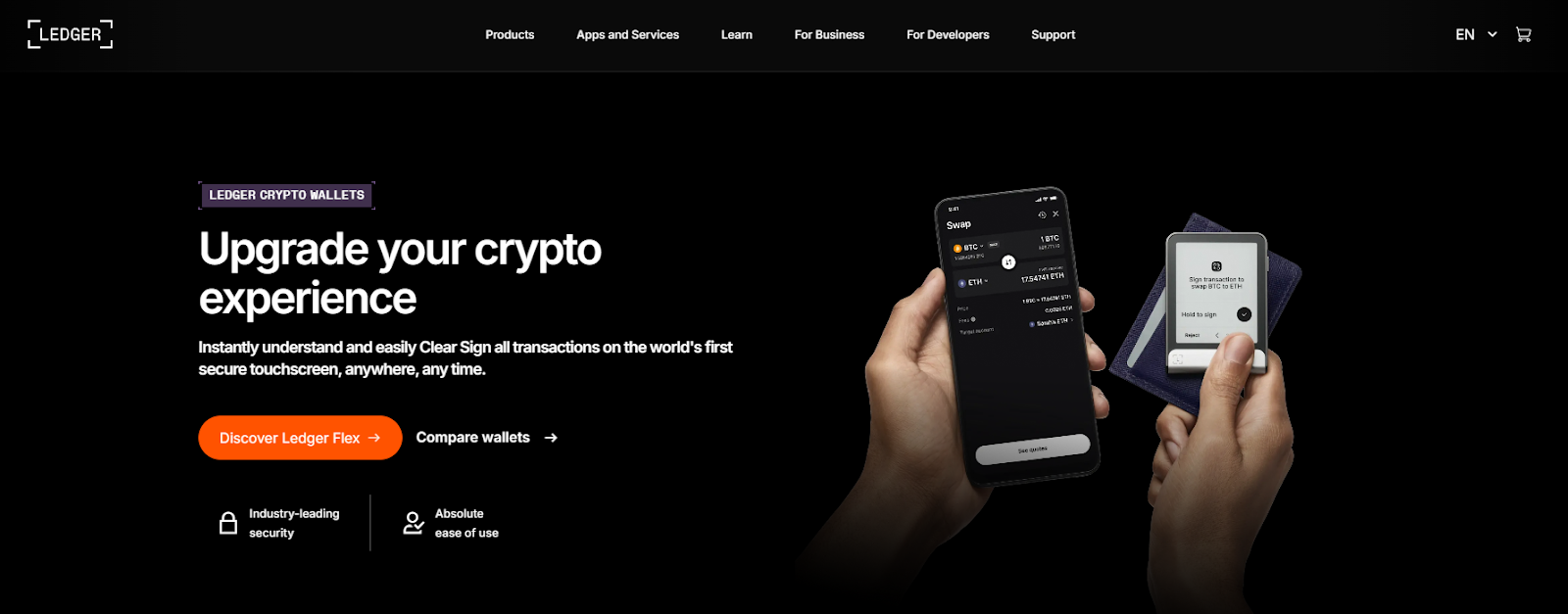
1. Ledger (Nano X • Nano S Plus • Stax) — Best for broad ecosystem + Secure Element

  • Why Use It: Ledger pairs a Secure Element (CC EAL5+/EAL6+) with its BOLOS OS and a polished Ledger Live app for buy/swap/stake and 3rd-party wallet support. It’s the most ubiquitous stack, which means better app integrations and an easy path from cold storage to dApps when you need it.
  • Best For: Multi-chain users, DeFi dabblers, mobile-first holders, NFT collectors.
  • Notable Features: Secure Element, Ledger Live ecosystem, Bluetooth (Nano X), Stax E Ink touchscreen, optional Recover, 50+ wallet integrations.
  • Consider If: You prefer fully open-source firmware elsewhere.
  • Alternatives: Trezor, BitBox02
  • Regions: Global
  • Fees Notes: One-time device purchase; optional services may have fees.

2. Trezor (Model T • Safe 3) — Best open-source experience

  • Why Use It: Trezor prioritizes open-source firmware, transparent security docs, and a clean desktop suite. The Safe 3 adds a Secure Element while keeping passphrase and on-device confirmations simple enough for new users.
  • Best For: Open-source purists, long-term BTC/ETH holders, privacy-minded users.
  • Notable Features: Trezor Suite, passphrase, open-source firmware, Secure Element (Safe 3), Bitcoin-only variant available.
  • Consider If: You need Bluetooth/mobile-first; consider Ledger or Jade.
  • Alternatives: Ledger, BitBox02
  • Regions: Global
  • Fees Notes: One-time device purchase; no subscription.

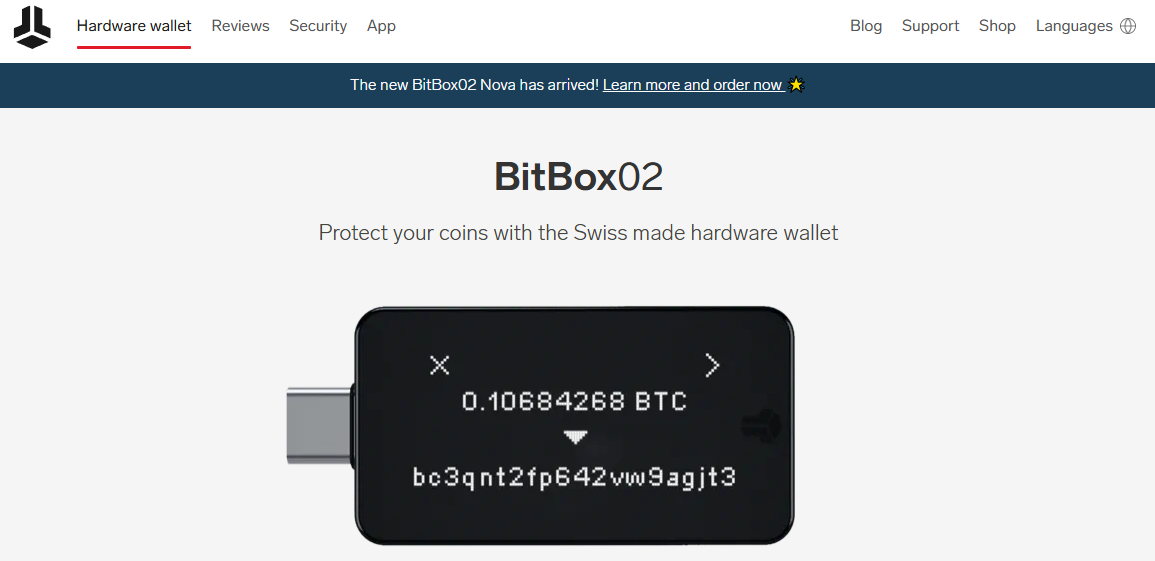
3. BitBox02 (Shift Crypto) — Best for microSD backups + minimalism

  • Why Use It: Swiss-built, open-source, and elegantly simple, BitBox02 uses a secure chip plus epoxy potting and a microSD for fast, offline backups. It’s a great blend of transparent design and sane UX.
  • Best For: Beginners who want a short setup, devs who value open code, travelers who like microSD backups.
  • Notable Features: microSD backup/restore, dual-chip with secure element, open-source, in-app guide.
  • Consider If: You need QR signing; look at Keystone or Passport.
  • Alternatives: Trezor, Keystone
  • Regions: Global
  • Fees Notes: One-time device purchase.

4. COLDCARD (Mk4 / Q) — Best for Bitcoin-only, air-gapped PSBT

  • Why Use It: Long favored by security maximalists, Coldcard is designed for fully air-gapped, PSBT-first workflows. Duress/tamper PINs, seed scrambling, and reproducible builds make it a fortress for BTC savings.‍‍
  • Best For: Long-term Bitcoin cold storage, multisig operators, security pros.‍
  • Notable Features: True air-gapped via MicroSD, PSBT (BIP174), anti-tamper features, duress/multisig tooling.‍
  • Consider If: You need altcoins; choose Ledger, Trezor, or BitBox02.‍
  • Alternatives: Passport, Jade‍
  • Regions: Global‍
  • Fees Notes: One-time device purchase.

5. Keystone 3 Pro — Best for QR signing across many chains

  • Why Use It: Keystone focuses on fully air-gapped QR workflows—no USB, Bluetooth, Wi-Fi, or NFC—plus Shamir backups and strong multisig support. The 3 Pro adds three security chips and tight compatibility with leading wallet apps.
  • Best For: Multisig setups, DeFi users who prefer QR signing, mobile users.
  • Notable Features: QR-only air-gap, multi-chip architecture, wide app compatibility, fingerprint unlock, large screen.
  • Consider If: You want a huge desktop screen (see Lattice1).
  • Alternatives: Passport, Jade
  • Regions: Global
  • Fees Notes: One-time device purchase; optional accessories.

6. Blockstream Jade (Classic / Plus) — Best affordable open-source (Bitcoin & Liquid)

  • Why Use It: Jade is open-source with optional air-gapped camera signing, Anti-Exfil, and a friendly app. It’s a strong value pick for Bitcoiners who still want modern conveniences like Bluetooth and battery power.
  • Best For: Bitcoin users, Liquid asset holders, open-source fans.
  • Notable Features: Camera for QR, air-gapped transactions, Anti-Exfil, Bluetooth, optional stateless mode.
  • Consider If: You want more chains; consider Ledger/Trezor.
  • Alternatives: COLDCARD, Passport
  • Regions: Global
  • Fees Notes: One-time device purchase.

7. GridPlus Lattice1 — Best for big screen review & SafeCards

  • Why Use It: A 5" touchscreen and SafeCards make policy controls and multi-wallet management feel enterprise-grade. The Secure Enclave and card model are great for households, teams, or power users who hate “blind signing.”
  • Best For: Institutions, multisig coordinators, collectors with many addresses.
  • Notable Features: Large display, Secure Enclave, SafeCards for key portability/limits, policy rules, robust desktop UX.
  • Consider If: You want ultra-portable or budget under $150.
  • Alternatives: Ledger Stax, Keystone
  • Regions: Global
  • Fees Notes: One-time device purchase; SafeCards sold separately.

8. Foundation Passport (Core) — Best for QR + Bitcoin privacy flows

  • Why Use It: Passport emphasizes QR signing, clean UX, and Bitcoin-only focus. Thoughtful hardware (camera, microSD) and transparent docs make it a favorite for air-gapped, privacy-first workflows.
  • Best For: Bitcoin-only users, privacy fans, QR-centric multisig.
  • Notable Features: QR signing, microSD for firmware/PSBT, premium build, open-source ethos.
  • Consider If: You need altcoins/EVM—choose Ledger or Keystone.
  • Alternatives: COLDCARD, Jade
  • Regions: Global
  • Fees Notes: One-time device purchase.

9. SafePal S1 / S1 Pro — Best budget air-gapped option

  • Why Use It: SafePal delivers QR-based, fully air-gapped signing with a Secure Element (CC EAL6+) at a very accessible price point, plus a companion app for swaps and DeFi. Great for newcomers who still want true offline signing.
  • Best For: Budget buyers, mobile users, “first hardware wallet.”
  • Notable Features: QR signing, Secure Element (EAL6+), self-destruct/anti-tamper, rich app integrations.
  • Consider If: You prefer fully open-source firmware (see Trezor/BitBox/Jade).
  • Alternatives: Tangem, Ledger Nano S Plus
  • Regions: Global
  • Fees Notes: One-time device purchase; in-app services may incur fees.

10. Tangem Wallet (2- or 3-card set) — Best card-based, seedless recovery model

  • Why Use It: Tangem uses NFC cards with an EAL6+ secure chip and a 25-year warranty, removing seed phrases in favor of multi-card backups. Tap-to-sign is intuitive, and the rugged, battery-free design suits travel and daily carry.
  • Best For: Everyday spenders, beginners who fear seed phrases, travelers.
  • Notable Features: Seedless multi-card backup, EAL6+ chip, IP69K-rated durability, NFC tap-to-sign, long warranty.
  • Consider If: You want a traditional BIP39 seed and broad third-party wallet support.
  • Alternatives: SafePal S1, Keystone
  • Regions: Global
  • Fees Notes: One-time card set; no charging required.

Decision Guide: Best By Use Case

  • Broad multi-chain + best ecosystem: Ledger
  • Fully open-source first: Trezor, BitBox02, Blockstream Jade
  • Bitcoin-only vaulting: COLDCARD, Passport, Jade
  • QR / air-gapped multisig: Keystone, Passport, Jade
  • Large screen & team workflows: GridPlus Lattice1
  • Budget under $100 (often): SafePal S1, Jade (promos), Trezor Safe 3
  • Seedless, card-based: Tangem
  • Mobile/Bluetooth convenience: Ledger Nano X, Jade

How to Choose the Right Hardware Wallet (Checklist)

  • Confirm security model: Secure Element, open-source, air-gap/QR, PSBT.
  • Match coverage to your assets (BTC-only vs multi-chain/EVM/Solana).
  • Check ecosystem access: companion app, 3rd-party wallet support.
  • Weigh UX: screen size, buttons/touch, Bluetooth, mobile pairing.
  • Review recovery: BIP39/Shamir vs seedless cards; where you’ll store backups.
  • Validate firmware cadence and support.
  • Red flags: blind-signing unclear data; closed update channels; no documented security page.

Use Token Metrics With Any Hardware Wallet

Turn cold storage into a smarter strategy:

  • AI Ratings to screen tokens you plan to hold.
  • Narrative Detection to catch momentum early.
  • Portfolio Optimization to size positions and balance risk.
  • Alerts & Signals to monitor entries/exits—without moving your keys.

Workflow: Research on Token Metrics → Pick assets → Acquire & secure with your wallet → Track performance + alerts.

Start free trial

Security & Compliance Tips

  • Enable PIN + passphrase (where supported) and store backups offline.
  • Prefer air-gapped/QR or PSBT flows for high-value moves.
  • Verify addresses and amounts on-device; avoid blind signing.
  • Keep firmware up to date; download only from official sources.
  • Separate daily hot spending from long-term cold storage.

This article is for research/education, not financial advice.

Beginner Mistakes to Avoid

  • Keeping the only seed phrase in a single location.
  • Re-using the same device for testnets and main funds.
  • Blind-signing smart-contract approvals you don’t understand.
  • Leaving device uninitialized/unpinned in a desk drawer.
  • Buying from unofficial marketplaces or “pre-set up” resellers.

FAQs

What is a hardware wallet?
A hardware wallet is a physical device that stores private keys and authorizes transactions offline, reducing exposure to malware and phishing compared to software wallets.

Do I need a hardware wallet if I use a centralized exchange?
If an exchange is hacked or freezes withdrawals, you can lose access. A hardware wallet lets you self-custody, so you control keys and recovery—many users keep long-term holdings in cold storage and only move funds when needed.

Is a Secure Element required?
Not required, but many devices use a CC EAL5+/EAL6+ Secure Element to resist physical extraction. Open-source firmware and verifiable builds also matter—evaluate the whole model, not just one spec.

What’s the difference between air-gapped QR and USB/Bluetooth?
QR/PSBT keeps signing data offline via camera or microSD. USB/Bluetooth devices can still be safe if the secret keys never leave the secure chip and screens verify data—choose the flow you’ll actually use correctly.

Can I use one wallet for multiple chains?
Yes—multi-chain devices (e.g., Ledger, Trezor, Keystone) support many networks. Bitcoin-focused devices (COLDCARD, Passport, Jade) prioritize BTC security and workflows.

How often should I rotate or back up?
Back up at setup, test recovery once, and review backups quarterly. Rotate seeds if you suspect exposure, or after major life changes.

Conclusion + Related Reads

If you want the widest ecosystem, Ledger is tough to beat. Prefer open-source? Trezor or BitBox02 are excellent defaults. For Bitcoin vaulting, COLDCARD, Jade, or Passport shine. Need team or household management? Lattice1. Budget-friendly air-gap? SafePal. Seedless and ultra-portable? Tangem.
Pick a model you’ll use correctly—then let Token Metrics guide what goes inside it.

Research

Top Institutional Custody Providers (2025)

Sam Monac
5 min

Why Institutional Crypto Custody Providers Matter in September 2025

Institutional custody is the backbone of professional digital-asset operations. The right institutional custody provider can safeguard private keys, segregate client assets, streamline settlement, and enable workflows like staking, financing, and governance. In one sentence: an institutional crypto custodian is a regulated organization that safekeeps private keys and operationalizes secure asset movements for professional clients. In 2025, rising ETF inflows, tokenization pilots, and on-chain settlement networks make safe storage and compliant operations non-negotiable. This guide is for funds, treasuries, brokers, and corporates evaluating digital asset custody partners across the US, EU, and APAC. We compare security posture, regulatory status (e.g., qualified custodian where applicable), asset coverage, fees, and enterprise UX—so you can shortlist fast and execute confidently.

How We Picked (Methodology & Scoring)

  • Liquidity (30%): Depth/venues connected, settlement rails, prime/brokerage adjacency.
  • Security (25%): Key management (HSM/MPC), offline segregation, audits/SOC reports, insurance disclosures.
  • Coverage (15%): Supported assets (BTC/ETH + long tail), staking, tokenized products.
  • Costs (15%): Transparent billing, AUC bps tiers, network fee handling, minimums.
  • UX (10%): Console quality, policy controls, APIs, reporting.
  • Support (5%): White-glove ops, SLAs, incident response, onboarding speed.

Data sources: Official product/docs, trust/security pages, regulatory/licensing pages, and custodian legal/fee disclosures. Market size/sentiment cross-checked with widely cited datasets; we did not link third parties in-body.

Last updated September 2025.

Top 10 Institutional Crypto Custody Providers in September 2025

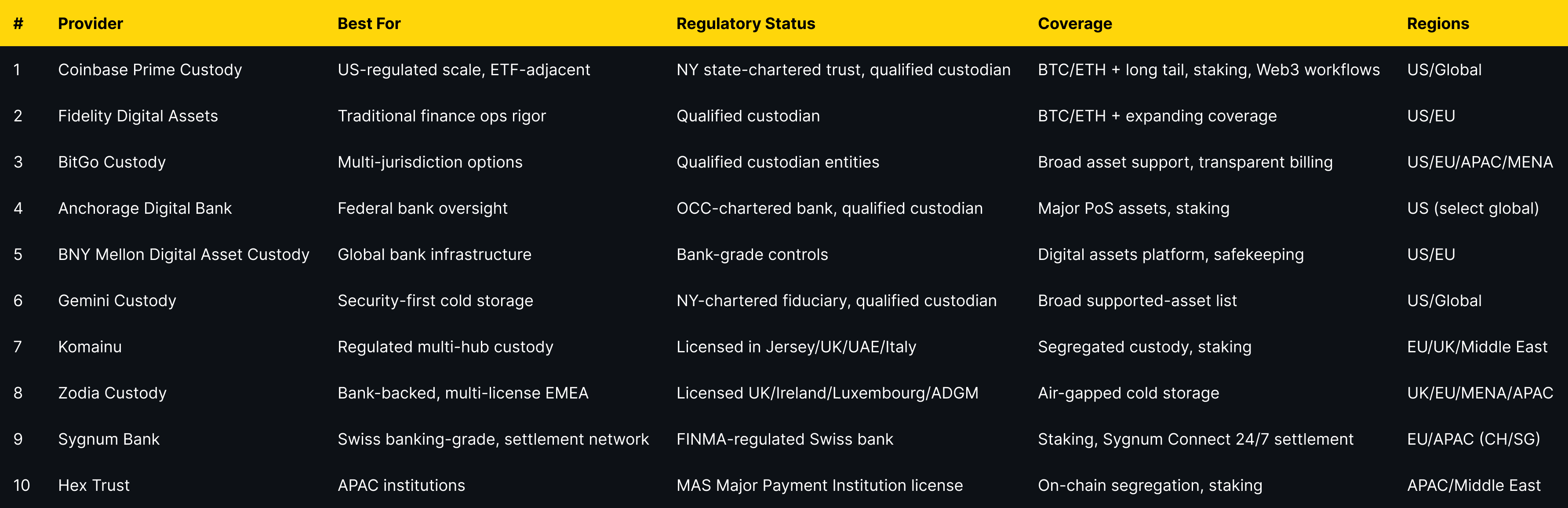
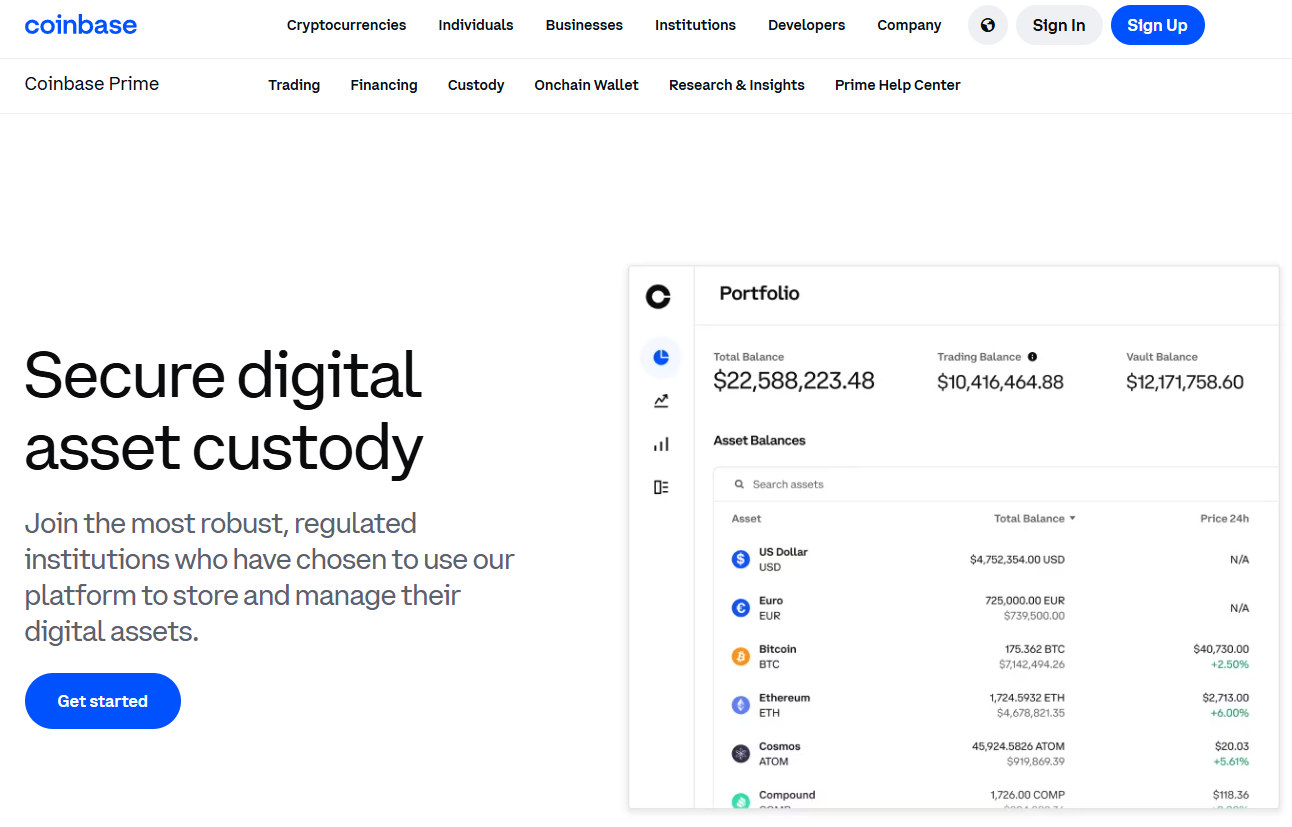
1. Coinbase Prime Custody — Best for US-regulated scale

Why Use It: Coinbase Custody Trust Company is a NY state-chartered trust and qualified custodian, integrated with Prime trading, staking, and Web3 workflows. Institutions get segregated cold storage, SOC 1/2 audits, and policy-driven approvals within a mature prime stack.
‍Best For: US managers, ETF service providers, funds/treasuries that need deep liquidity + custody.
‍
Notable Features:

  • Qualified custodian (NY Banking Law) with SOC 1/2 audits
  • Vault architecture + policy engine; Prime integration
  • Staking and governance support via custody workflows.

‍Consider If: You want a single pane for execution and custody with US regulatory clarity.
‍Alternatives: Fidelity Digital Assets, BitGo
‍Fees/Notes: Enterprise bps on AUC; network fees pass-through.
Regions: US/Global (eligibility varies).

2. Fidelity Digital Assets — Best for traditional finance ops rigor

Why Use It: A division of Fidelity with an integrated custody + execution stack designed for institutions, offering cold-storage execution without moving assets and traditional operational governance.
‍Best For: Asset managers, pensions, corporates seeking a blue-chip brand and conservative controls.
Notable Features:

  • Integrated custody + multi-venue execution
  • Operational governance and reporting ethos from TradFi
  • Institutional research and coverage expansion.

‍Consider If: You prioritize a legacy financial brand with institutional processes.
‍Alternatives: BNY Mellon, Coinbase Prime
‍Fees/Notes: Bespoke enterprise pricing.
Regions: US/EU (eligibility varies).

3. BitGo Custody — Best for multi-jurisdiction options

Why Use It: BitGo operates qualified custody entities with coverage across North America, EMEA, and APAC, plus robust policy controls and detailed billing methodology for AUC.
‍Best For: Funds, market makers, and enterprises needing global entity flexibility.
Notable Features:

  • Qualified custodian entities; segregated wallets
  • Rich policy tooling and operational controls
  • Transparent AUC billing methodology (bps)

‍Consider If: You need multi-region setup or bespoke operational segregation.
Alternatives: Komainu, Zodia Custody
Fees/Notes: Tiered AUC bps; bespoke network ops.
‍Regions: US/EU/APAC/MENA.

4. Anchorage Digital Bank — Best for federal bank oversight

Why Use It: The only crypto-native bank with an OCC charter in the US; a qualified custodian with staking and governance alongside institutional custody.
‍Best For: US institutions that want bank-level oversight and crypto-native tech.

‍Notable Features:

  • OCC-chartered bank; qualified custodian
  • Staking across major PoS assets
  • Institutional console + policy workflows

‍Consider If: You need federal oversight and staking inside custody.
Alternatives: Coinbase Prime Custody, Fidelity Digital Assets
Fees/Notes: Enterprise pricing; staking terms by asset.
Regions: US (select global clients).

5. BNY Mellon Digital Asset Custody — Best for global bank infrastructure

Why Use It: America’s oldest bank runs an institutional Digital Assets Platform for safekeeping and on-chain services, built on its global custody foundation—ideal for asset-servicing integrations.
‍Best For: Asset servicers, traditional funds, and banks needing large-scale controls.
Notable Features:

  • Integrated platform for safekeeping/servicing
  • Bank-grade controls and lifecycle tooling
  • Enterprise reporting and governance

‍Consider If: You prefer a global bank custodian with mature ops.
Alternatives: Fidelity Digital Assets, Sygnum Bank
Fees/Notes: Custom; bank service bundles.
Regions: US/EU (eligibility varies).

6. Gemini Custody — Best for security-first cold storage

Why Use It: Gemini Trust Company is a NY-chartered fiduciary and qualified custodian with air-gapped cold storage, role-based governance, and SOC reports—plus optional insurance coverage for certain assets.
‍Best For: Managers and corporates prioritizing conservative cold storage.
‍Notable Features:

  • Qualified custodian; segregated cold storage
  • Role-based governance and biometric access
  • Broad supported-asset list

‍Consider If: You need straightforward custody without bundled trading.
Alternatives: BitGo, Coinbase Prime Custody
Fees/Notes: Tailored plans; network fees apply.
Regions: US/Global (eligibility varies).

7. Komainu — Best for regulated multi-hub custody (Jersey/UK/UAE/EU)

Why Use It: Nomura-backed Komainu operates regulated custody with segregation and staking, supported by licenses/registrations across Jersey, the UAE (Dubai VARA), the UK, and Italy—useful for cross-border institutions.
‍Best For: Institutions needing EMEA/Middle East optionality and staking within custody.
‍Notable Features:

  • Regulated, segregated custody
  • Institutional staking from custody
  • Governance & audit frameworks

‍Consider If: You require multi-jurisdiction regulatory coverage.
‍Alternatives: Zodia Custody, BitGo
‍Fees/Notes: Enterprise pricing on request.
‍Regions: EU/UK/Middle East (global eligibility varies).

8. Zodia Custody — Best for bank-backed, multi-license EMEA coverage

Why Use It: Backed by Standard Chartered, Zodia provides institutional custody with air-gapped cold storage, standardized controls, and licensing/registrations across the UK, Ireland, Luxembourg, and Abu Dhabi (ADGM).

‍Best For: Asset managers and treasuries seeking bank-affiliated custody in EMEA.
Notable Features:

  • Air-gapped cold storage & policy controls
  • Multi-region regulatory permissions (EMEA/MENA)
  • Institutional onboarding and reporting

‍Consider If: You want bank-backed governance and EU/Middle East reach.
‍Alternatives: Komainu, BNY Mellon
‍Fees/Notes: Custom pricing.
‍Regions: UK/EU/MENA/APAC (per license/authorization).

9. Sygnum Bank — Best for Swiss banking-grade custody + settlement network

Why Use It: FINMA-regulated Swiss bank providing off-balance-sheet crypto custody, staking, and Sygnum Connect—a 24/7 instant settlement network for fiat, crypto, and stablecoins.

‍Best For: EU/Asia institutions valuing Swiss regulation and bank-grade controls.

Notable Features:

  • Off-balance-sheet, ring-fenced custody
  • Staking from custody and asset risk framework
  • Instant multi-asset settlement (Sygnum Connect)

‍Consider If: You want Swiss regulatory assurances + 24/7 settlement.
Alternatives: AMINA Bank, BNY Mellon
Fes/Notes: AUC bps; see price list. Regions: EU/APAC (CH/SG).

10. Hex Trust — Best for APAC institutions with MAS-licensed stack

Why Use It: A fully licensed APAC custodian offering on-chain segregation, role-segregated workflows, staking, and—in 2025—obtained a MAS Major Payment Institution license to offer DPT services in Singapore, rounding out custody + settlement.
‍Best For: Funds, foundations, and corporates across Hong Kong, Singapore, and the Middle East.

Notable Features:

  • On-chain segregated accounts; auditability
  • Policy controls with granular sub-accounts
  • Staking & integrated markets services ‍

Consider If: You want APAC-native licensing and operational depth.
Alternatives: Sygnum Bank, Komainu
Fees/Notes: Enterprise pricing; insurance program noted. Regions: APAC/Middle East (licensing dependent).

Decision Guide: Best By Use Case

  • US-regulated & ETF-adjacent: Coinbase Prime Custody; Anchorage Digital Bank; Fidelity Digital Assets.
  • Bank-backed in EMEA: BNY Mellon; Zodia Custody.
  • Multi-jurisdiction flexibility: BitGo; Komainu.
  • Swiss banking model: Sygnum Bank (and consider AMINA Bank).
  • APAC-first compliance: Hex Trust.
  • Cold-storage emphasis with simple pricing: Gemini Custody.

How to Choose the Right Institutional Custody Provider (Checklist)

  • Regulatory fit: Qualified custodian or bank charter where required by your advisors/LPAs.
  • Asset coverage: BTC/ETH + the specific long-tail tokens or staking assets you need.
  • Operational controls: Policy rules, role segregation, whitelists, hardware/MPC key security.
  • Settlement & liquidity: RFQ/OTC rails, prime integration, or instant networks.
  • Fees: AUC bps, network fee handling, staking commissions, onboarding costs.‍
  • Reporting & audit: SOC attestations, proof of segregated ownership, audit trails.‍
  • Support: 24/7 ops desk, SLAs, incident processes.
    Red flags: Commingled wallets, unclear ownership/legal structure, limited disclosures.

Use Token Metrics With Any Custodian

  • AI Ratings: Screen assets with on-chain + quant scores to narrow to high-conviction picks.
  • Narrative Detection: Identify sector momentum early (L2s, RWAs, staking).

  • Portfolio Optimization: Balance risk/return before you allocate from custody.

  • Alerts & Signals: Monitor entries/exits and risk while assets stay safekept.

‍Workflow (1–4): Research in Token Metrics → Select assets → Execute via your custodian’s trading rails/prime broker → Monitor with TM alerts.


Start free trial

Security & Compliance Tips

  • Enforce hardware/MPC key ceremonies and multi-person approvals.
  • Use role-segregated policies and allowlisting for withdrawals.
  • Align KYC/AML and travel-rule workflows with fund docs and auditors.
  • Document staking/airdrop entitlements and slashing risk treatment.
  • Keep treasury cold storage separate from hot routing wallets.

This article is for research/education, not financial advice.

Beginner Mistakes to Avoid

  • Picking a non-qualified entity when your mandate requires a qualified custodian.
  • Underestimating operational lift (approvals, whitelists, reporting).
  • Ignoring region-specific licensing/eligibility limitations.
  • Focusing only on fees without evaluating security controls.
  • Mixing trading and custody without strong policy separation.

FAQs

What is a qualified custodian in crypto?
A qualified custodian is a regulated entity (e.g., trust company or bank) authorized to hold client assets with segregation and audited controls, often required for investment advisers. Look for clear disclosures, SOC reports, and trust/bank charters on official pages.

Do I need a qualified custodian for my fund?
Many US advisers and institutions require qualified custody under their compliance frameworks; your legal counsel should confirm. When in doubt, choose a trust/bank chartered provider with documented segregation and audits.

Which providers support staking from custody?
Anchorage, Coinbase Prime, Komainu, Sygnum, and Hex Trust offer staking workflows from custody (asset lists vary). Confirm asset-by-asset support and commissions.

How are fees structured?
Most providers price custody in annualized basis points (bps) on average assets under custody; some publish methodologies or fee schedules. Network fees are usually passed through.

Can I keep assets off-exchange and still trade?
Yes—prime/custody integrations and instant-settlement networks let you trade while keeping keys in custody, reducing counterparty risk. Examples include Coinbase Prime and Sygnum Connect.

Are there regional restrictions I should know about?
Licensing/availability varies (e.g., Hex Trust operates under MAS MPI in Singapore; Zodia holds permissions across UK/EU/ADGM). Always confirm eligibility for your entity and region.

Conclusion + Related Reads

If you operate in the US with strict compliance needs, start with Coinbase Prime, Fidelity, or Anchorage. For bank-backed EMEA coverage, look to BNY Mellon or Zodia. For Swiss banking controls and instant settlement, Sygnum stands out; in APAC, Hex Trust offers strong licensing and workflows. BitGo and Komainu excel when you need multi-jurisdiction flexibility.

Choose from Platinum, Gold, and Silver packages
Reach with 25–30% open rates and 0.5–1% CTR
Craft your own custom ad—from banners to tailored copy
Perfect for Crypto Exchanges, SaaS Tools, DeFi, and AI Products