Back to blog
Research

Top On and Off-Ramp Providers (Fiat to Crypto) 2025

Compare the best crypto on/off-ramp providers for 2025—coverage, costs, and compliance. Pick the right ramp for your region and rails.
Sam Monac
5 min
Want Smarter Crypto Picks—Free?
See unbiased Token Metrics Ratings for BTC, ETH, and top alts.
Thank you! Your submission has been received!
Oops! Something went wrong while submitting the form.
 No credit card | 1-click unsubscribe

Why Fiat ↔ Crypto On/Off-Ramps Matter in September 2025

Getting money into and out of crypto should be fast, safe, and compliant. In 2025, wallets, dapps, exchanges, and fintechs increasingly rely on crypto on/off-ramp providers to convert fiat to tokens and cash back out to bank rails—all without forcing users to bounce between apps. Definition: an on-ramp lets users buy crypto with fiat; an off-ramp lets them sell crypto back to fiat and withdraw to bank accounts or cards. This guide is for product leaders, devs, and advanced users comparing coverage, fees, and risk controls across global options. We score providers on liquidity, security, asset/market coverage, costs, UX, and support, then recommend the best fits by use case. Secondary angles we considered: fiat to crypto onramp, crypto off-ramp, and common flows like “buy crypto with bank transfer.”

How We Picked (Methodology & Scoring)

  • Liquidity (30%) – depth, uptime, and quote quality across assets/fiat rails.

  • Security (25%) – audits, certifications, KYC/AML controls, trust center disclosures.

  • Coverage (15%) – supported countries, payment methods, off-ramp payout rails.

  • Costs (15%) – transparent fees/spreads; promos (e.g., USDC zero-fee tiers).

  • UX (10%) – speed (KYC/settlement), embeddable widgets, developer docs.

  • Support (5%) – docs, SLAs, live support, incident comms.

Data sources: official product/docs and security pages; licensing and disclosures; limited cross-checks with widely cited market datasets. We only link to official provider sites in this article. Last updated September 2025.
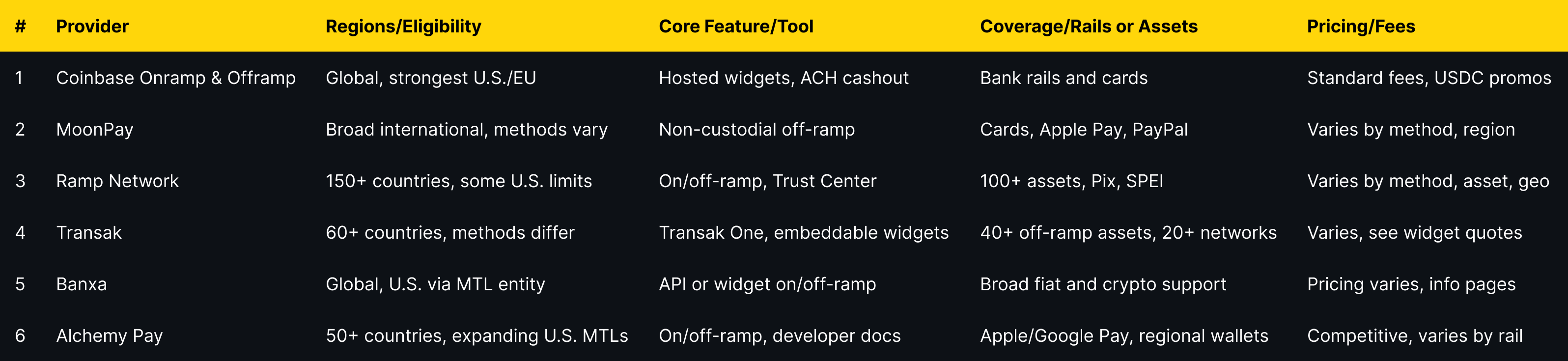
Top 10 Fiat ↔ Crypto On/Off-Ramp Providers in September 2025

1. Coinbase Onramp & Offramp — Best for USDC flows & regulated U.S./EU coverage
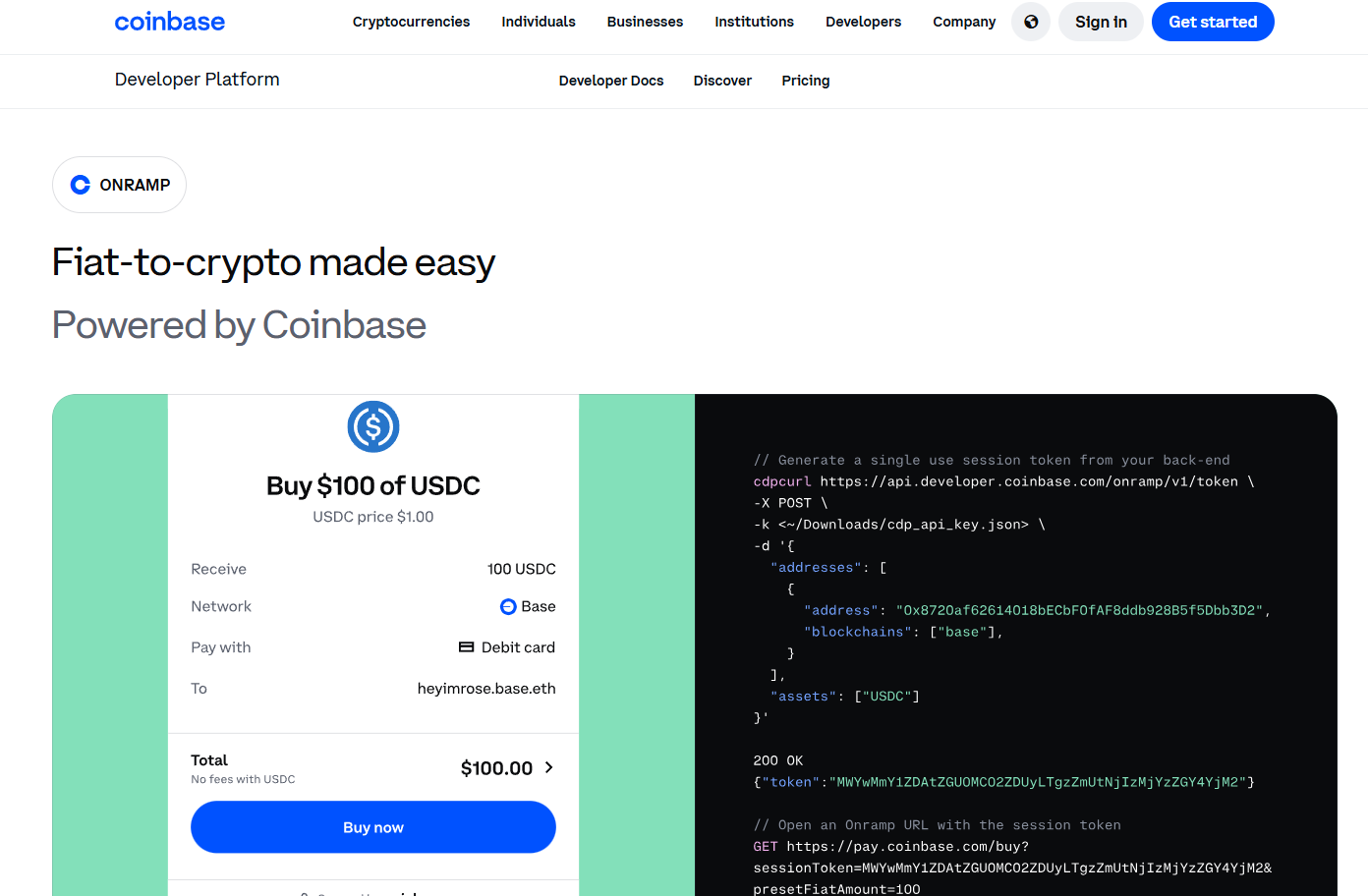
  • Why Use It: Coinbase’s hosted Onramp and Offramp APIs let you embed buy/sell with bank rails and cards, including ACH cashouts, inside your app. Select apps can access zero-fee USDC onramp/offramp promotions and free USDC on Base. Coinbase+2Coinbase+2

  • Best For: U.S./EU wallets & dapps, consumer fintechs, apps prioritizing compliance.

  • Notable Features: hosted widgets; guest checkout for US (no account up to limits); ACH cashout; strong docs & SDKs. Coinbase Developer Docs

  • Fees Notes: Standard fees vary by method; USDC promos may apply. Coinbase

  • Regions: Global reach with strongest support in U.S./EU; method availability varies. Coinbase Developer Docs

  • Consider If: You need a turnkey, regulated option with ACH off-ramp.

  • Alternatives: MoonPay, Ramp Network.

2. MoonPay — Best for non-custodial UX & card coverage
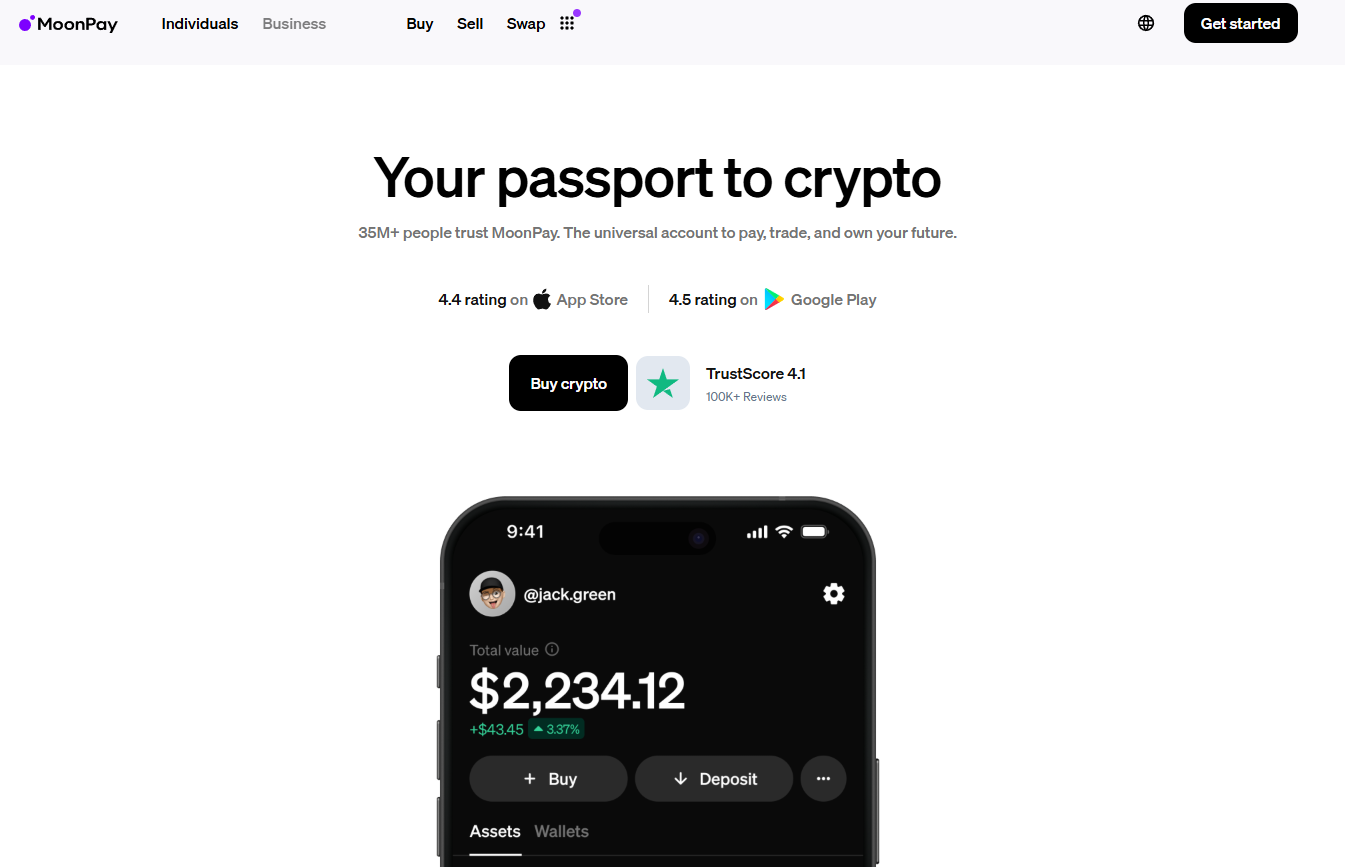
  • Why Use It: MoonPay offers fast card/Apple Pay/PayPal buys and a non-custodial off-ramp, letting users sell crypto while keeping control of keys. Good fit for wallets and NFT apps that want an embedded flow. MoonPay+1

  • Best For: Self-custody wallets, NFT marketplaces, global card-first audiences.

  • Notable Features: Onramp + off-ramp; non-custodial design; quick card settlement. MoonPay+1

  • Fees Notes: Varies by payment method and region.

  • Regions: Broad international availability; local method support varies.

  • Consider If: You want non-custodial off-ramp with strong card acceptance.

  • Alternatives: Transak, Banxa.

3. Ramp Network — Best for global coverage + fast KYC
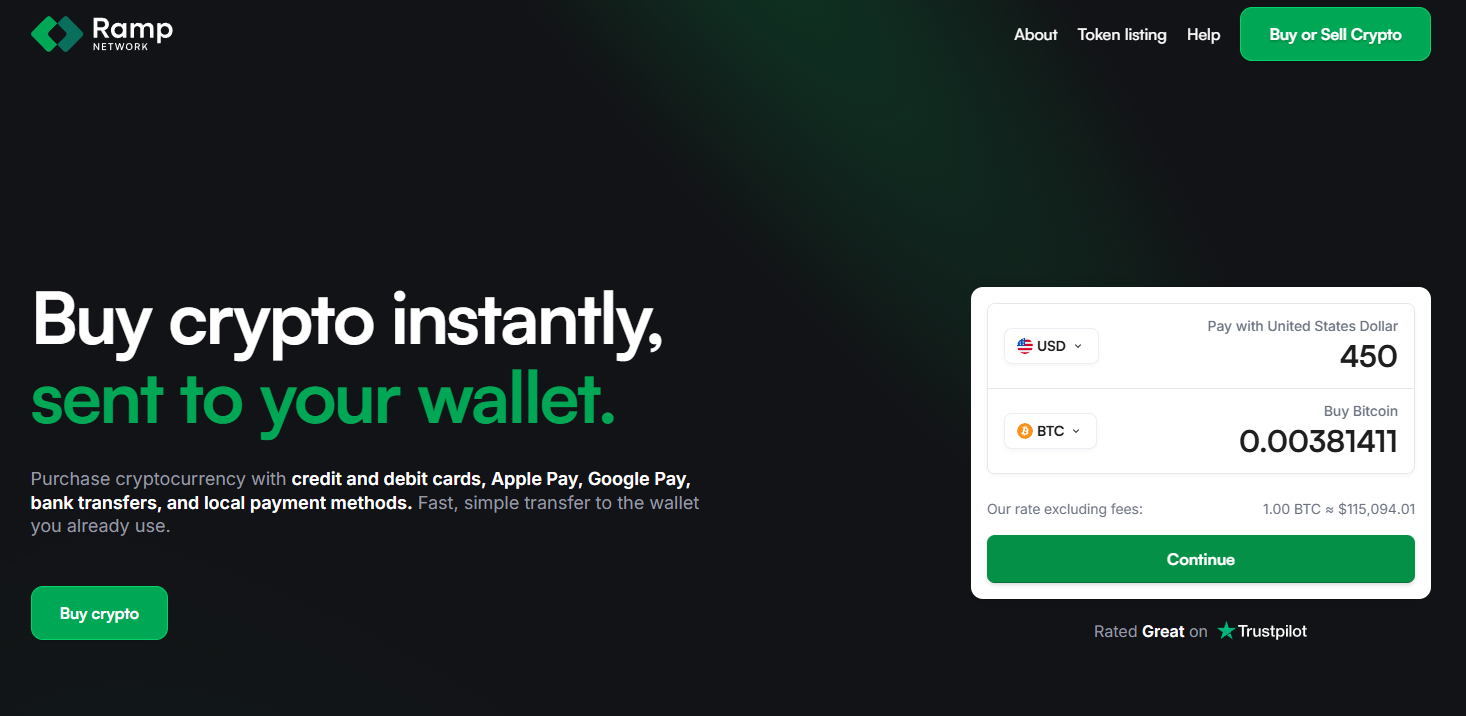
  • Why Use It: Ramp supports 100+ assets and multiple local rails (cards, bank transfers, Pix, SPEI) with fast, document-free KYC in eligible markets and SOC/ISO certifications published via its Trust Center. rampnetwork.com+2ramp.network+2

  • Best For: Wallets/dapps needing wide country coverage and quick onboarding.

  • Notable Features: On & off-ramp; 100+ assets; local rails incl. Pix & SPEI payouts; strong security disclosures. ramp.network+1

  • Fees Notes: Vary by method, asset, and geography.

  • Regions: 150+ countries; some U.S. states support on-ramp only (no off-ramp). support.rampnetwork.com

  • Consider If: You want breadth plus local rails in LATAM/EU.

  • Alternatives: Transak, Alchemy Pay.

4. Transak — Best for developer tooling & hybrid use cases

  • Why Use It: Transak offers on/off-ramp coverage (40+ off-ramp assets across 20+ networks) with over 64+ supported countries and Transak One to let users fund complex actions (e.g., stake/bridge) from fiat in one flow. Transak Docs+2Transak+2

  • Best For: Developers needing a broad, configurable integration; DeFi apps.

  • Notable Features: Off-ramp to bank; multi-network coverage; business (corporate) on/off-ramp; embeddable widgets. Transak+1

  • Fees Notes: Vary by method; see widget quotes.

  • Regions: 60+ countries; payment methods differ by market. Transak

  • Consider If: You need both retail and corporate on/off-ramp options.

  • Alternatives: Ramp Network, Banxa.

5. Banxa — Best for compliance-heavy enterprise & deep licensing

  • Why Use It: Banxa emphasizes regulated operations with published USA MTL and global license lists, plus enterprise-grade AML/CTF and security disclosures. Strong for partners who need extensive compliance artifacts. Banxa+2Banxa+2

  • Best For: Enterprises, wallets, and exchanges with strict compliance needs.

  • Notable Features: On/off-ramp via API/widget; broad fiat/crypto support; license/AML pages; developer SDKs. Banxa+1

  • Fees Notes: Pricing varies; transparent info pages provided. Banxa

  • Regions: Global (entity-specific); U.S. coverage via MTL entity; details in license PDFs. Banxa

  • Consider If: Your risk/compliance teams require detailed attestations.

  • Alternatives: Zero Hash, Transak.

6. Alchemy Pay — Best for emerging markets & alternative wallets

  • Why Use It: Alchemy Pay bridges fiat and crypto with on/off-ramp across 50+ countries (and expanding), focusing on emerging markets and a wide range of local wallets/payments. It’s actively growing U.S. coverage via new MTLs (e.g., Arizona, South Carolina). docs+2alchemypay.org+2

  • Best For: Dapps targeting emerging markets; global apps needing local wallets.

  • Notable Features: On/off-ramp; Apple/Google Pay & regional wallets; developer docs; business flows. alchemypay.org

  • Fees Notes: Competitive, vary by payment rail.

  • Regions: Global (check country list); growing U.S. state coverage via MTLs. alchemypay.org

  • Consider If: You prioritize local payment methods in APAC/LATAM.

  • Alternatives: Transak, Ramp Network.

7. Kraken — Best regulated exchange on/off-ramp (U.S./EU)

  • Why Use It: Kraken provides fiat funding and withdrawals in USD/EUR/CAD with ACH, SEPA, and card rails, offering a straightforward path to buy/sell and cash out to bank. Useful if you want exchange liquidity plus strong support docs. Kraken+1

  • Best For: Traders and users who prefer exchange-native fiat rails.

  • Notable Features: ACH deposits (no fee for many U.S. clients), cash withdrawals, app guides. Kraken+2Kraken Support+2

  • Fees Notes: Funding/withdrawal fees and holds depend on method (e.g., ACH hold windows). Kraken Support

  • Regions: U.S./EU/Canada; ACH account linking not available in NY, WA, TX. Kraken

  • Consider If: You want deep orderbook liquidity alongside fiat rails.

  • Alternatives: Bitstamp, Coinbase.

8. Bitstamp — Best for EU banking rails & stable UX

  • Why Use It: One of the longest-running exchanges, Bitstamp supports bank deposits (SEPA/International, ACH) and card purchases, plus fiat withdrawals to bank accounts. Simple, well-documented flows are ideal for EU and U.S. users wanting a clean on/off-ramp. Bitstamp+2Bitstamp+2

  • Best For: EU users; U.S. users comfortable with exchange-based cashouts.

  • Notable Features: ACH deposits/withdrawals, SEPA (incl. Instant SEPA), card & Apple/Google Pay availability. Bitstamp+2Bitstamp+2

  • Fees Notes: See Bitstamp fee schedule; varies by method. Bitstamp

  • Regions: EU/UK/US (availability by method).

  • Consider If: You want familiar exchange UX with established bank rails.

  • Alternatives: Kraken, Coinbase.

9. Stripe Crypto Onramp — Best embeddable onramp for U.S./EU apps

  • Why Use It: Stripe’s fiat-to-crypto onramp is a customizable widget/hosted flow you can embed in wallets, NFT apps, and dapps—Stripe handles KYC, fraud, and payments. Ideal for teams already on Stripe. Note: onramp availability is U.S. (excl. Hawaii) + EU. Stripe Docs+2Stripe Docs+2

  • Best For: U.S./EU dapps and platforms standardizing on Stripe.

  • Notable Features: Embedded or hosted onramp; identity & fraud tooling; stablecoin payout stack. Stripe Docs

  • Fees Notes: Stripe pricing applies; quotes shown in onramp UI.

  • Regions: U.S. (minus HI) and EU currently. Stripe Docs

  • Consider If: You need a polished onramp (no off-ramp) with Stripe stack.

  • Alternatives: Coinbase Onramp, MoonPay.

10. Zero Hash — Best turnkey B2B infrastructure (regulated build-out)

  • Why Use It: Zero Hash powers on/off-ramp for enterprises, abstracting licensing and regulatory complexity. B2B partners can convert between fiat and 60+ crypto assets, with quote controls and payout rails. zerohash.com+1

  • Best For: Fintechs, banks, and platforms embedding compliant crypto.

  • Notable Features: API-first; short path to market; configurable quotes; bank payouts. docs.zerohash.com

  • Fees Notes: Enterprise pricing; volume-based.

  • Regions: Coverage varies by solution and jurisdiction.

  • Consider If: You need compliance + infra rather than a retail widget.

  • Alternatives: Banxa, Coinbase (developer).

Decision Guide: Best By Use Case

How to Choose the Right Fiat ↔ Crypto On/Off-Ramp (Checklist)

  • Confirm region & method eligibility (ACH/SEPA/cards; off-ramp availability by country/state).

  • Check asset/fiat coverage for your top flows (BTC, ETH, stablecoins, local fiat).

  • Review security posture (SOC/ISO, trust center, KYC/AML, sanctions screening). Ramp

  • Compare fees & spreads (and promos like zero-fee USDC) and settlement speeds. Coinbase

  • Validate developer experience (docs, hosted vs. embedded, SDKs). Coinbase

  • Ensure support & SLAs meet your needs (status pages, incident comms).

  • Red flags: unclear licensing, no security disclosures, or “global” claims without a country/method matrix.

Use Token Metrics With Any On/Off-Ramp

  • AI Ratings: Screen top assets before you convert.
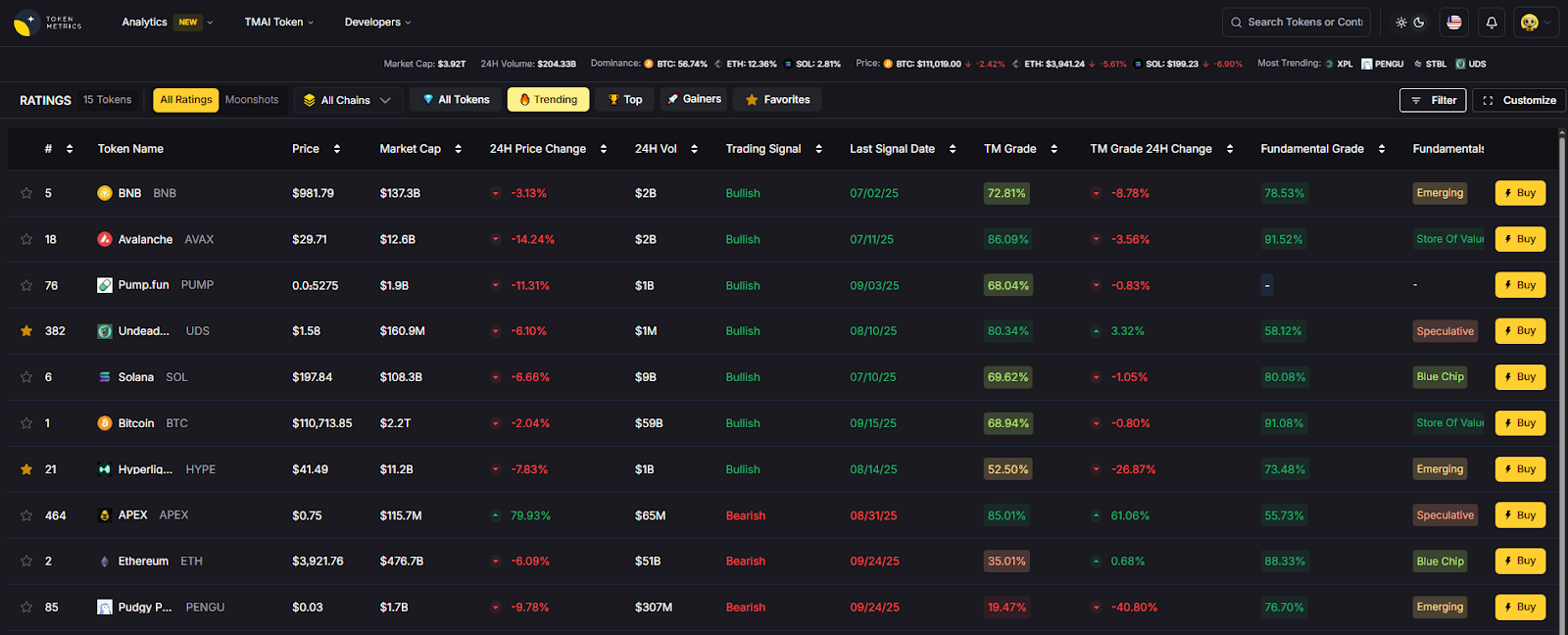
  • Narrative Detection: Spot sector momentum early.

  • Portfolio Optimization: Size positions to risk.

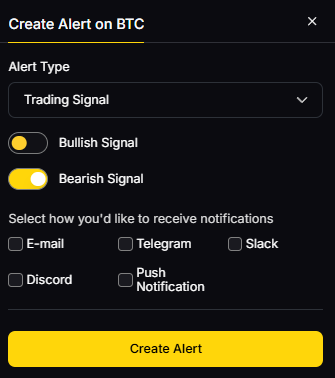
  • Alerts/Signals: Get entries/exits without screen-watching.
    Workflow: Research → Select ramp → Execute buy/sell → Monitor with alerts.

Primary CTA: Start free trial 
Security & Compliance Tips

  • Enable 2FA and use strong unique passwords.

  • Separate custody (self-custody vs. exchange) from ramp accounts as needed.

  • Follow KYC/AML requirements; prepare source-of-funds docs for higher limits.

  • For OTC/RFQ flows, lock quotes and confirm fees before sending. docs.zerohash.com

  • Maintain wallet hygiene: test transfers, verify addresses, track gas/fees.

This article is for research/education, not financial advice.

Beginner Mistakes to Avoid

  • Assuming a provider supports both on- and off-ramp in your country (often not true). support.rampnetwork.com

  • Ignoring ACH hold windows or payout timings when planning cashouts. Kraken Support

  • Overlooking fees/spreads vs. headline “no fee” promos. Coinbase

  • Embedding an onramp without sandbox/testing error states.

  • Not checking licensing & security disclosures before integration. Banxa+1

FAQs

What is a crypto on-ramp vs. off-ramp?
An on-ramp lets users buy crypto with fiat (e.g., card, bank transfer). An off-ramp lets users sell crypto for fiat and withdraw to bank rails or cards. Coinbase

Which providers are best for U.S. ACH cashouts?
Coinbase Offramp and Kraken both support ACH, with method availability depending on state and account status. Coinbase Developer Docs+1

Does Stripe support off-ramp?
Stripe currently offers a fiat-to-crypto onramp (no off-ramp). It’s available in the U.S. (excluding Hawaii) and EU. Stripe Docs

Which options are strongest outside the U.S.?
For broad coverage and local rails, consider Ramp Network (Pix/SPEI), Transak (multi-network off-ramp), and Alchemy Pay (regional wallets). ramp.network+2Transak Docs+2

What about enterprise-grade compliance?
Banxa and Zero Hash publish license/compliance docs and are built for B2B integrations with higher assurance requirements. Banxa+1

Conclusion + Related Reads

The best choice depends on your region, payout rails, and risk posture. If you want a regulated U.S. ACH flow with strong docs, start with Coinbase. Need global coverage and local methods? Ramp, Transak, and Alchemy Pay shine. For enterprise and bank-grade requirements, Banxa and Zero Hash are strong bets. Exchange-based ramps via Kraken or Bitstamp work well if you also need deep liquidity.

Related Reads:

  • Best Cryptocurrency Exchanges 2025

  • Top Derivatives Platforms 2025

  • Top Institutional Custody Providers 2025

Build Smarter Crypto Apps &
AI Agents in Minutes, Not Months
Real-time prices, trading signals, and on-chain insights all from one powerful API.
Grab a Free API Key
About Token Metrics
Token Metrics: AI-powered crypto research and ratings platform. We help investors make smarter decisions with unbiased Token Metrics Ratings, on-chain analytics, and editor-curated “Top 10” guides. Our platform distills thousands of data points into clear scores, trends, and alerts you can act on.
30 Employees
analysts, data scientists, and crypto engineers
Daily Briefings
concise market insights and “Top Picks”
Transparent & Compliant
Sponsored ≠ Ratings; research remains independent
Want Smarter Crypto Picks—Free?
See unbiased Token Metrics Ratings for BTC, ETH, and top alts.
Thank you! Your submission has been received!
Oops! Something went wrong while submitting the form.
 No credit card | 1-click unsubscribe
Token Metrics Team
Token Metrics Team

Recent Posts

Research

API Explained: What 'API' Stands For & How It Works

Token Metrics Team
5

APIs power much of the software and services we use every day, but the acronym itself can seem abstract to newcomers. This guide answers the simple question "what does API stand for," explains the main types and patterns, and shows how developers, analysts, and researchers use APIs—especially in data-rich fields like crypto and AI—to access information and automate workflows.

What does API stand for and a practical definition

API stands for Application Programming Interface. In practice, an API is a set of rules and protocols that lets one software component request services or data from another. It defines how requests should be formatted, what endpoints are available, what data types are returned, and which authentication methods are required.

Think of an API as a contract between systems: the provider exposes functionality or data, and the consumer calls that functionality using an agreed syntax. This contract enables interoperability across languages, platforms, and teams without sharing internal implementation details.

Common API types and architectural styles

APIs come in several flavors depending on purpose and architecture. Understanding these helps you choose the right integration approach:

  • REST (Representational State Transfer): The most widespread style for web APIs. Uses HTTP methods (GET, POST, PUT, DELETE) and typically exchanges JSON. REST is stateless and often organized around resources.
  • GraphQL: A query language and runtime that allows clients to request precisely the data they need in a single request. Useful when clients require flexible access patterns.
  • gRPC: A high-performance RPC framework using protocol buffers. Favored for low-latency internal services.
  • WebSocket and Streaming APIs: For real-time, bidirectional data flows such as live price feeds or telemetry.
  • Library/SDK APIs: Language-specific interfaces that wrap lower-level HTTP calls into idiomatic functions.

In domains like crypto, API types often include REST endpoints for historical data, WebSocket endpoints for live market updates, and specialized endpoints for on-chain data and analytics.

How APIs are used: workflows and practical examples

APIs unlock automation and integration across many workflows. Typical examples include:

  • Data pipelines: scheduled API pulls ingested into analytics systems or data warehouses.
  • Automation: triggering events, notifications, or trades from software agents (when permitted by policy and regulation).
  • Embedding functionality: maps, payment processing, or identity services added to products without rebuilding them.
  • AI and model inputs: APIs provide training and inference data streams for models, or let models query external knowledge.

For researchers and developers in crypto and AI, APIs enable programmatic access to prices, on-chain metrics, and model outputs. Tools that combine multiple data sources through APIs can accelerate analysis while maintaining reproducibility.

Security, rate limits, and best-practice design

APIs must be designed with security and reliability in mind. Key considerations include:

  • Authentication and authorization: API keys, OAuth, and signed requests limit access and define permissions.
  • Rate limiting: Prevents abuse and ensures fair usage across clients; consumers should implement exponential backoff and caching.
  • Input validation and error handling: Clear error codes and messages make integrations robust and diagnosable.
  • Versioning: Maintain compatibility for existing users while enabling iterative improvements.

Designing or choosing APIs with clear documentation, sandbox environments, and predictable SLAs reduces integration friction and downstream maintenance effort.

Build Smarter Crypto Apps & AI Agents with Token Metrics

Token Metrics provides real-time prices, trading signals, and on-chain insights all from one powerful API. Grab a Free API Key

FAQ: Common questions about APIs

What does API stand for?

API stands for Application Programming Interface. It is a defined set of rules that enables software to communicate and exchange data or functionality with other software components.

How does an API differ from a library or SDK?

An API is a specification for interaction; a library or SDK is an implementation that exposes an API in a specific programming language. Libraries call APIs internally or provide convenience wrappers for API calls.

When should I use REST vs GraphQL?

Use REST for simple, resource-oriented endpoints and predictable cacheable interactions. Use GraphQL when clients require flexible, tailored queries and want to minimize round trips for composite data needs.

How do rate limits affect integrations?

Rate limits cap how many requests a client can make in a given period. Respecting limits with caching and backoff logic prevents service disruption and helps maintain reliable access.

Can APIs provide real-time data for AI models?

Yes. Streaming and WebSocket APIs can deliver low-latency data feeds that serve as inputs to real-time models, while REST endpoints supply bulk or historical datasets used for training and backtesting.

What tools help manage multiple API sources?

Integration platforms, API gateways, and orchestration tools manage authentication, rate limiting, retries, and transformations. For crypto and AI workflows, data aggregation services and programmatic APIs speed analysis.

How can I discover high-quality crypto APIs?

Evaluate documentation, uptime reports, data coverage, authentication methods, and community usage. Platforms that combine market, on-chain, and research signals are especially useful for analytical workflows.

Where can I learn more about API best practices?

Official style guides, API design books, and public documentation from major providers (Google, GitHub, Stripe) offer practical patterns for versioning, security, and documentation.

Disclaimer: This article is educational and informational only. It does not constitute financial, legal, or investment advice. Readers should perform independent research and consult appropriate professionals for their specific needs.

Research

Mastering the ChatGPT API: Practical Developer Guide

Token Metrics Team
5

ChatGPT API has become a foundational tool for building conversational agents, content generation pipelines, and AI-powered features across web and mobile apps. This guide walks through how the API works, common integration patterns, cost and performance considerations, prompt engineering strategies, and security and compliance checkpoints — all framed to help developers design reliable, production-ready systems.

Overview: What the ChatGPT API Provides

The ChatGPT API exposes a conversational, instruction-following model through RESTful endpoints. It accepts structured inputs (messages, system instructions, temperature, max tokens) and returns generated messages and usage metrics. Key capabilities include multi-turn context handling, role-based prompts (system, user, assistant), and streaming responses for lower perceived latency.

When evaluating the API for a project, consider three high-level dimensions: functional fit (can it produce the outputs you need?), operational constraints (latency, throughput, rate limits), and cost model (token usage and pricing). Structuring experiments around these dimensions produces clearer decisions than ad-hoc prototyping.

How the ChatGPT API Works: Architecture & Tokens

At a technical level, the API exchanges conversational messages composed of roles and content. The model's input size is measured in tokens, not characters; both prompts and generated outputs consume tokens. Developers must account for:

  • Input tokens: system+user messages sent with the request.
  • Output tokens: model-generated content returned in the response.
  • Context window: maximum tokens the model accepts per request, limiting historical context you can preserve.

Token-awareness is essential for cost control and designing concise prompts. Tools exist to estimate token counts for given strings; include these estimates in batching and truncation logic to prevent failed requests due to exceeding the context window.

Integration Patterns and Use Cases

Common patterns for integrating the ChatGPT API map to different functional requirements:

  1. Frontend chat widget: Short, low-latency requests per user interaction with streaming enabled for better UX.
  2. Server-side orchestration: Useful for multi-step workflows, retrieving and combining external data before calling the model.
  3. Batch generation pipelines: For large-scale content generation, precompute outputs asynchronously and store results for retrieval.
  4. Hybrid retrieval-augmented generation (RAG): Combine a knowledge store or vector DB with retrieval calls to ground responses in up-to-date data.

Select a pattern based on latency tolerance, concurrency requirements, and the need to control outputs with additional logic or verifiable sources.

Cost, Rate Limits, and Performance Considerations

Pricing for ChatGPT-style APIs typically ties to token usage and model selection. For production systems, optimize costs and performance by:

  • Choosing the right model: Use smaller models for routine tasks where quality/latency tradeoffs are acceptable.
  • Prompt engineering: Make prompts concise and directive to reduce input tokens and avoid unnecessary generation.
  • Caching and deduplication: Cache common queries and reuse cached outputs when applicable to avoid repeated cost.
  • Throttling: Implement exponential backoff and request queuing to respect rate limits and avoid cascading failures.

Measure end-to-end latency including network, model inference, and application processing. Use streaming when user-perceived latency matters; otherwise, batch requests for throughput efficiency.

Best Practices: Prompt Design, Testing, and Monitoring

Robust ChatGPT API usage blends engineering discipline with iterative evaluation:

  • Prompt templates: Maintain reusable templates with placeholders to enforce consistent style and constraints.
  • Automated tests: Create unit and integration tests that validate output shape, safety checks, and critical content invariants.
  • Safety filters and moderation: Run model outputs through moderation or rule-based filters to detect unwanted content.
  • Instrumentation: Log request/response sizes, latencies, token usage, and error rates. Aggregate metrics to detect regressions.
  • Fallback strategies: Implement graceful degradation (e.g., canned responses or reduced functionality) when API latency spikes or quota limits are reached.

Adopt iterative prompt tuning: A/B different system instructions, sampling temperatures, and max tokens while measuring relevance, correctness, and safety against representative datasets.

Build Smarter Crypto Apps & AI Agents with Token Metrics

Token Metrics provides real-time prices, trading signals, and on-chain insights all from one powerful API. Grab a Free API Key

FAQ: What is the ChatGPT API and when should I use it?

The ChatGPT API is a conversational model endpoint for generating text based on messages and instructions. Use it when you need flexible, context-aware text generation such as chatbots, summarization, or creative writing assistants.

FAQ: How do tokens impact cost and context?

Tokens measure both input and output size. Longer prompts and longer responses increase token counts, which raises cost and can hit the model's context window limit. Optimize prompts and truncate history when necessary.

FAQ: What are common strategies for handling rate limits?

Implement client-side throttling, request queuing, exponential backoff on 429 responses, and prioritize critical requests. Monitor usage patterns and adjust concurrency to avoid hitting provider limits.

FAQ: How do I design effective prompts?

Start with a clear system instruction to set tone and constraints, use examples for format guidance, keep user prompts concise, and test iteratively. Templates and guardrails reduce variability in outputs.

FAQ: What security and privacy practices should I follow?

Secure API keys (do not embed in client code), encrypt data in transit and at rest, anonymize sensitive user data when possible, and review provider data usage policies. Apply access controls and rotate keys periodically.

FAQ: When should I use streaming responses?

Use streaming to improve perceived responsiveness for chat-like experiences or long outputs. Streaming reduces time-to-first-token and allows progressive rendering in UIs.

Disclaimer

This article is for informational and technical guidance only. It does not constitute legal, compliance, or investment advice. Evaluate provider terms and conduct your own testing before deploying models in production.

Research

Mastering the OpenAI API: Practical Guide

Token Metrics Team
5

The OpenAI API has become a foundation for building modern AI applications, from chat assistants to semantic search and generative agents. This post breaks down how the API works, core endpoints, implementation patterns, operational considerations, and practical tips to get reliable results while managing cost and risk.

How the OpenAI API Works

The OpenAI API exposes pre-trained and fine-tunable models through RESTful endpoints. At a high level, you send text or binary payloads and receive structured responses — completions, chat messages, embeddings, or file-based fine-tune artifacts. Communication is typically via HTTPS with JSON payloads. Authentication uses API keys scoped to your account, and responses include usage metadata to help with monitoring.

Understanding the data flow is useful: client app → API request (model, prompt, params) → model inference → API response (text, tokens, embeddings). Latency depends on model size, input length, and concurrency. Many production systems put the API behind a middleware layer to handle retries, caching, and prompt templating.

Key Features & Endpoints

The API surface typically includes several core capabilities you should know when planning architecture:

  • Chat/Completion: Generate conversational or free-form text. Use system, user, and assistant roles for structured prompts.
  • Embeddings: Convert text to dense vectors for semantic search, clustering, and retrieval-augmented generation.
  • Fine-tuning: Customize models on domain data to improve alignment with specific tasks.
  • Files & Transcriptions: Upload assets for fine-tune datasets or to transcribe audio to text.
  • Moderation & Safety Tools: Automated checks can help flag content that violates policy constraints before generation is surfaced.

Choosing the right endpoint depends on the use case: embeddings for search/indexing, chat for conversational interfaces, and fine-tuning for repetitive, domain-specific prompts where consistency matters.

Practical Implementation Tips

Design patterns and practical tweaks reduce friction in real-world systems. Here are tested approaches:

  1. Prompt engineering and templates: Extract frequently used structures into templates and parameterize variables. Keep system messages concise and deterministic.
  2. Chunking & retrieval: For long-context tasks, use embeddings + vector search to retrieve relevant snippets and feed only the most salient content into the model.
  3. Batching & caching: Batch similar requests where possible to reduce API calls. Cache embeddings and immutable outputs to lower cost and latency.
  4. Retry logic and idempotency: Implement exponential backoff for transient errors and idempotent request IDs for safe retries.
  5. Testing and evaluation: Use automated tests to validate response quality across edge cases and measure drift over time.

For development workflows, maintain separate API keys and quotas for staging and production, and log both prompts and model responses (with privacy controls) to enable debugging and iterative improvement.

Security, Cost Control, and Rate Limits

Operational concerns are often the difference between a prototype and a resilient product. Key considerations include:

  • Authentication: Store keys securely, rotate them regularly, and avoid embedding them in client-side code.
  • Rate limits & concurrency: Respect published rate limits. Use client-side queues and server-side throttling to smooth bursts and avoid 429 errors.
  • Cost monitoring: Track token usage by endpoint and user to identify high-cost flows. Use sampling and quotas to prevent runaway spend.
  • Data handling & privacy: Define retention and redaction rules for prompts and responses. Understand whether user data is used for model improvement and configure opt-out where necessary.

Instrumenting observability — latency, error rates, token counts per request — lets you correlate model choices with operational cost and end-user experience.

Build Smarter Crypto Apps & AI Agents with Token Metrics

Token Metrics provides real-time prices, trading signals, and on-chain insights all from one powerful API. Grab a Free API Key

What are common failure modes and how to mitigate them?

Common issues include prompt ambiguity, hallucinations, token truncation, and rate-limit throttling. Mitigation strategies:

  • Ambiguity: Add explicit constraints and examples in prompts.
  • Hallucination: Use retrieval-augmented generation and cite sources where possible.
  • Truncation: Monitor token counts and implement summarization or chunking for long inputs.
  • Throttling: Apply client-side backoff and request shaping to prevent bursts.

Run adversarial tests to discover brittle prompts and incorporate guardrails in your application logic.

Scaling and Architecture Patterns

For scale, separate concerns into layers: ingestion, retrieval/indexing, inference orchestration, and post-processing. Use a vector database for embeddings, a message queue for burst handling, and server-side orchestration for prompt composition and retries. Edge caching for static outputs reduces repeated calls for common queries.

Consider hybrid strategies where smaller models run locally for simple tasks and the API is used selectively for high-value or complex inferences to balance cost and latency.

FAQ: How to get started and troubleshoot

What authentication method does the OpenAI API use?

Most implementations use API keys sent in an Authorization header. Keys must be protected server-side. Rotate keys periodically and restrict scopes where supported.

Which models are best for embeddings versus chat?

Embedding-optimized models produce dense vectors for semantic tasks. Chat or completion models prioritize dialogue coherence and instruction-following. Select based on task: search and retrieval use embeddings; conversational agents use chat endpoints.

How can I reduce latency for user-facing apps?

Use caching, smaller models for simple tasks, pre-compute embeddings for common queries, and implement warm-up strategies. Also evaluate regional endpoints and keep payload sizes minimal to reduce round-trip time.

What are best practices for fine-tuning?

Curate high-quality, representative datasets. Keep prompts consistent between fine-tuning and inference. Monitor for overfitting and validate on held-out examples to ensure generalization.

How do I monitor and manage costs effectively?

Track token usage by endpoint and user journey, set per-key quotas, and sample outputs rather than logging everything. Use batching and caching to reduce repeated calls, and enforce strict guards on long or recursive prompts.

Can I use the API for production-critical systems?

Yes, with careful design. Add retries, fallbacks, safety checks, and human-in-the-loop reviews for high-stakes outcomes. Maintain SLAs that reflect model performance variability and instrument monitoring for regressions.

Disclaimer

This article is for educational purposes only. It explains technical concepts, implementation patterns, and operational considerations related to the OpenAI API. It does not provide investment, legal, or regulatory advice. Always review provider documentation and applicable policies before deploying systems.

Choose from Platinum, Gold, and Silver packages
Reach with 25–30% open rates and 0.5–1% CTR
Craft your own custom ad—from banners to tailored copy
Perfect for Crypto Exchanges, SaaS Tools, DeFi, and AI Products