Back to blog
Research

Top Optimistic Rollups & L2 Ecosystems (2025)

Discover the top optimistic rollups and OP Stack L2s for 2025 with in-depth comparisons, decision guides, and methodology. Learn which L2 fits your DeFi, NFT, or consumer needs with trustworthy research.
Token Metrics Team
13 min read
Want Smarter Crypto Picks—Free?
See unbiased Token Metrics Ratings for BTC, ETH, and top alts.
Thank you! Your submission has been received!
Oops! Something went wrong while submitting the form.
 No credit card | 1-click unsubscribe

Who this guide is for. Builders, power users, and teams choosing where to deploy or transact on Ethereum-style optimistic rollups and OP Stack L2s in 2025.

Top three picks.

  • Arbitrum One — broadest DeFi depth and mature fraud proofs.
  • OP Mainnet (Optimism) — feature-complete fault proofs, the Superchain standard.
  • Base — OP Stack at scale with strong developer docs and low, predictable fees. (docs.arbitrum.io)

One key caveat. Withdrawals to L1 use a challenge period (~7 days) on optimistic rollups; fast bridges can bypass with extra trust/cost. (docs.arbitrum.io)


Introduction: Why Optimistic Rollups & L2 Ecosystems Matter in November 2025

Optimistic rollups are L2 networks that post transaction data to Ethereum and assume validity unless challenged via fraud (fault) proofs, enabling cheaper, faster transactions while inheriting Ethereum’s security. They matter now because OP Stack chains have standardized tooling, bridges, and proofs, and multiple ecosystems (Arbitrum, Optimism, Base, Mode, World Chain, Fraxtal, Zora, opBNB, Blast, Metis) have reached scale. Primary keyword: Top Optimistic Rollups. (docs.arbitrum.io)


How We Picked (Methodology & Scoring)

We shortlisted ~20 credible L2s, then scored and selected TOP_N = 10 using official docs for architecture, fees, bridges, and proof status. Third-party datasets were used only for cross-checks.

Scoring Weights (sum = 100):

  • Liquidity — 30%
  • Security (proofs, upgrade path, disclosures) — 25%
  • Coverage (ecosystem depth, tooling) — 15%
  • Costs (fees, DA approach) — 15%
  • UX (bridging, docs) — 10%
  • Support — 5%

Freshness: Last updated November 2025. (docs.optimism.io)
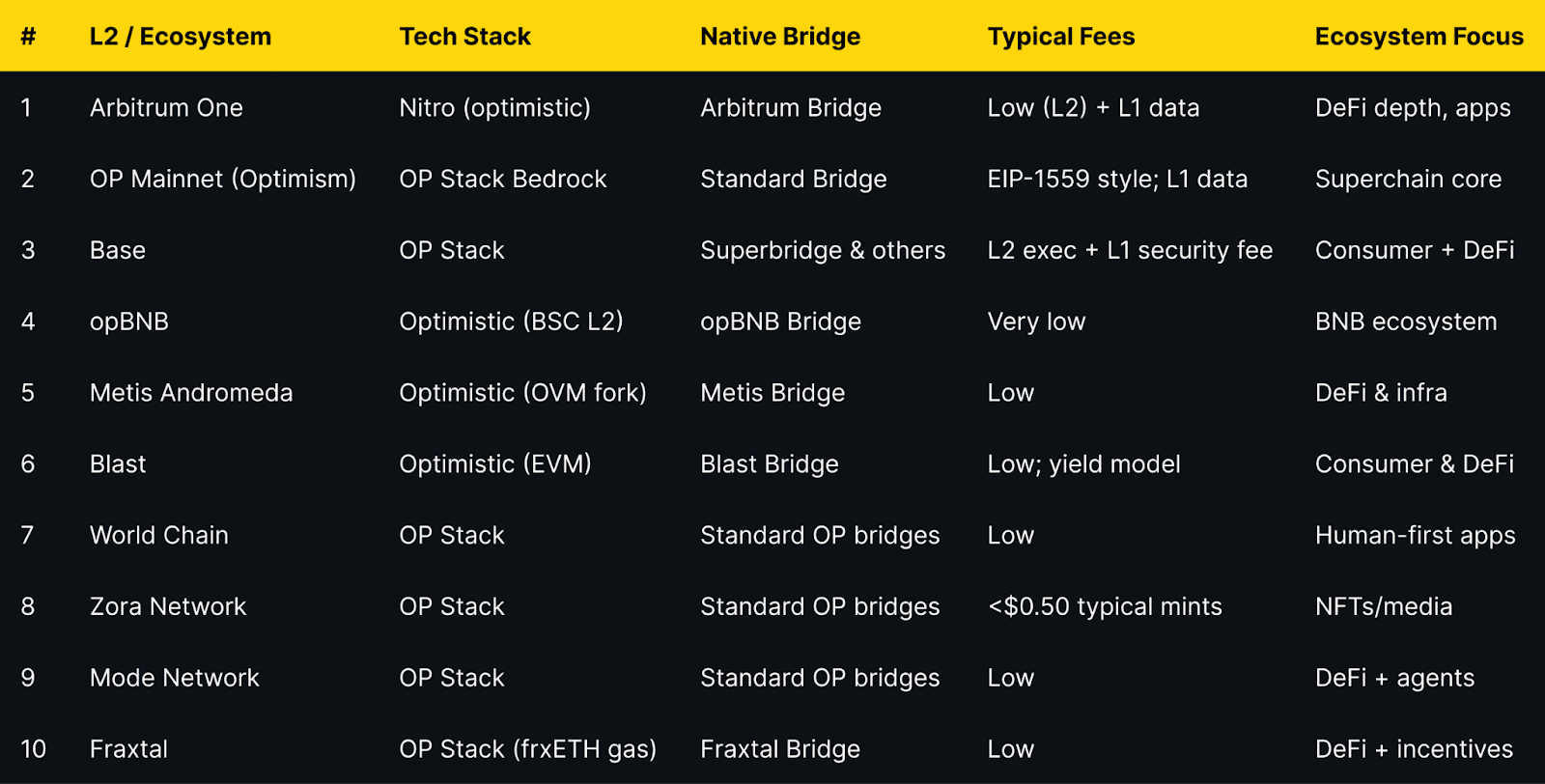


Notes: “Typical fees” reflect L2 execution + L1 data costs; withdraws to L1 follow a challenge window on optimistic designs. (docs.arbitrum.io)


Top 10 Optimistic Rollups & L2 Ecosystems in November 2025

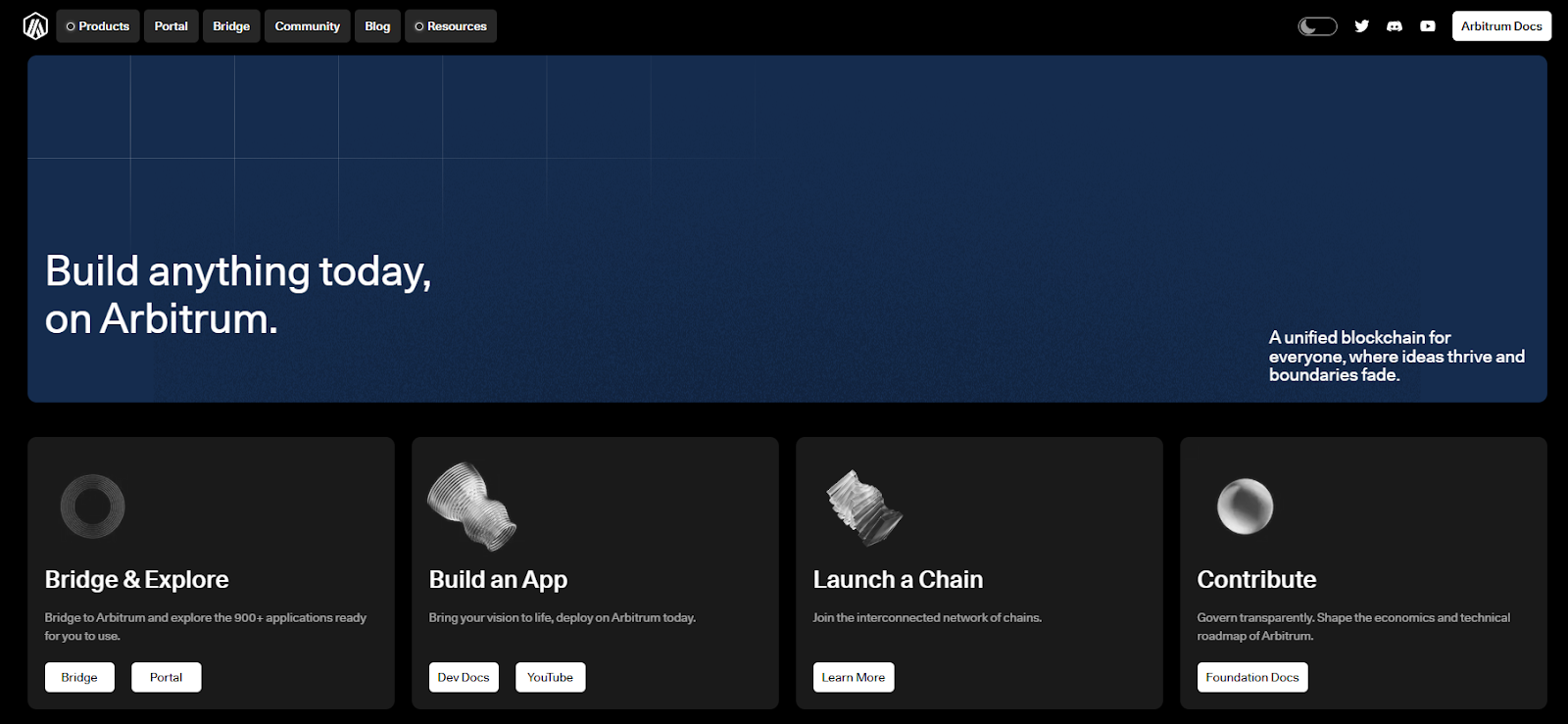
1. Arbitrum One — Best for deep DeFi liquidity

Why Use It. Arbitrum’s Nitro stack delivers mature optimistic security with interactive fraud proofs and broad app coverage. Official docs emphasize the one-week challenge window for L1 withdrawals and support for fast-withdrawal patterns. (docs.arbitrum.io)
Best For. DeFi protocols, power users, market makers.
Notable Features. Fraud-proof system; Nitro throughput; ecosystem depth; L2→L1 fast-withdraw patterns. (docs.arbitrum.io)
Fees Notes. L2 gas + L1 data costs.
Regions. Global (availability depends on wallet/exchange access).
Alternatives. OP Mainnet, Base.  
2. OP Mainnet (Optimism) — Best for Superchain standardization

Why Use It. The OP Stack introduced feature-complete fault proofs on June 10, 2024, enabling permissionless challenge of proposed outputs. Fees follow EIP-1559-style mechanics, with Ecotone updates relaying blob base fees. (docs.optimism.io)
Best For. Teams planning multichain OP Stack deployments; public goods alignment.
Notable Features. Standard Bridge; strong docs; Superchain governance. (docs.optimism.io)
Fees Notes. Execution gas as on L1 plus L1 data; EIP-1559 style. (docs.optimism.io)
Regions. Global.
Alternatives. Base, Mode.  

3. Base — Best for builder UX at scale

Why Use It. Base provides clear fee breakdowns (L2 execution + L1 security fee) and robust docs for bridging and development; widely adopted across consumer and DeFi apps. (docs.base.org)
Best For. Consumer apps, gaming, creators, DeFi teams.
Notable Features. OP Stack chain; programmatic bridging examples; security council documentation. (docs.base.org)
Fees Notes. Two-component fee model (L2 + L1). (docs.base.org)
Regions. Global.
Alternatives. OP Mainnet, Arbitrum.  
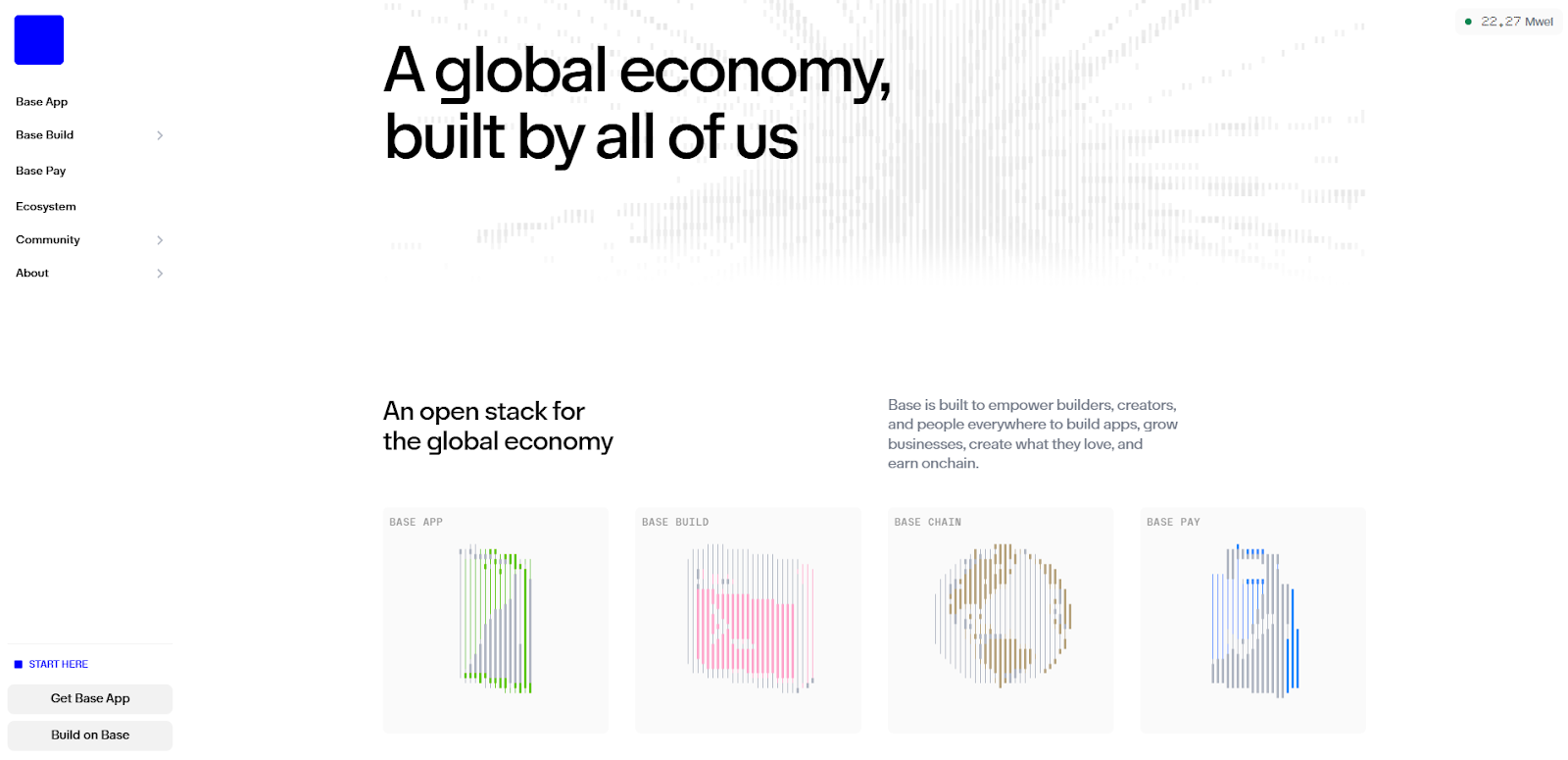
4. opBNB (BNB Chain) — Best for BNB ecosystem cost sensitivity

Why Use It. opBNB uses an optimistic rollup to scale BNB Smart Chain with very low fees and high throughput for EVM apps. Docs include explicit L1 data fee formulas. (docs.bnbchain.org)
Best For. Cost-sensitive deployments, BNB ecosystem projects.
Notable Features. OP-style architecture; low-fee environment; BNB chain integrations. (docs.bnbchain.org)
Fees Notes. Very low L2 gas; DA fee formula documented. (docs.bnbchain.org)
Regions. Global.
Alternatives. Base, Mode.

5. Metis Andromeda — Best for sequencer decentralization roadmap

Why Use It. Metis is an optimistic rollup emphasizing a decentralized sequencer pool and performance improvements through its Andromeda roadmap. (metis.io)
Best For. Teams valuing sequencer-level resiliency; DeFi infra.
Notable Features. OVM-lineage EVM equivalence; decentralizing sequencer; ecosystem grants. (L2BEAT)
Fees Notes. Low L2 gas; standard optimistic withdrawal window.
Regions. Global.
Alternatives. Arbitrum, OP Mainnet.

6. Blast — Best for native yield design

Why Use It. Blast is an EVM-compatible optimistic rollup with native yield for ETH and stables at the protocol level, while inheriting Ethereum security. (docs.blast.io)
Best For. Consumer apps and DeFi seeking built-in yield flows.
Notable Features. Yield on bridged assets; OP-style architecture; EVM tooling. (L2BEAT)
Fees Notes. Low L2 gas; standard optimistic withdrawal semantics.
Regions. Global.
Alternatives. Base, Mode.

7. World Chain — Best for human-centric apps

Why Use It. Built on the OP Stack, World Chain prioritizes verified human users with gas allowances and personhood-aware UX, suitable for consumer on-ramps and identity-heavy apps. (docs.world.org)
Best For. Identity-centric consumer apps, payments.
Notable Features. OP Stack standardization; personhood primitives; Superchain membership. (L2BEAT)
Fees Notes. Low L2 gas; standard OP Stack bridging/withdrawals.
Regions. Global.
Alternatives. Base, OP Mainnet.

8. Zora Network — Best for creators & NFTs

Why Use It. Zora is an OP Stack L2 focused on media/NFTs, with docs citing typical NFT mint costs under $0.50 and clear OP Stack security inheritance. (zora.energy)
Best For. NFT marketplaces, media apps, creator tools.
Notable Features. Flat mint fees for collectors; OP Stack tooling; creator-first ecosystem. (docs.growthepie.xyz)
Fees Notes. Low, NFT-friendly fees; network fees apply. (zora.energy)
Regions. Global.
Alternatives. Base, Blast.

9. Mode Network — Best for DeFi + agentic apps

Why Use It. Mode is an OP Stack L2 positioned as a DeFi and agent economy hub, aligning to the Superchain and contributing sequencer fees to OP Collective. (docs.mode.network)
Best For. DeFi protocols, AI/agentic apps.
Notable Features. OP Stack mainnet configuration; Superchain integrations; incentives. (docs.mode.network)
Fees Notes. Low L2 gas; standard OP Stack bridging/withdrawals.
Regions. Global.
Alternatives. OP Mainnet, Base.

10. Fraxtal — Best for DeFi incentives & frxETH gas

Why Use It. Fraxtal is an OP Stack L2 with frxETH as gas and modular DA; official docs cover bridge support and OP Stack compatibility. (docs.frax.finance)
Best For. DeFi protocols leveraging blockspace incentives and ETH-centric gas.
Notable Features. OP Stack; frxETH gas; Flox incentives; native bridge. (Frax)
Fees Notes. Low L2 gas; standard OP Stack withdrawal semantics.
Regions. Global.
Alternatives. Mode, OP Mainnet.


Decision Guide: Best By Use Case


How to Choose the Right Optimistic Rollup (Checklist)

  • Region eligibility for your users and app store distribution.
  • Fraud/fault proofs live and documented; withdrawal challenge period understood. (docs.optimism.io)
  • Data availability costs and L1 data fee exposure. (docs.optimism.io)
  • Bridge UX: native vs third-party, fast-withdraw options. (docs.optimism.io)
  • Sequencer model and roadmap to decentralization. (metis.io)
  • Fees transparency (L2 execution + L1 security fee). (docs.base.org)
  • Official docs, status, and upgrade cadence. (docs.optimism.io)
  • Ecosystem fit (DeFi, NFTs, consumer, identity).
  • Support channels, incident response, and disclosures.
  • Red flags: unclear proofs, opaque bridges, or abandoned docs.

Use Token Metrics With Any Optimistic Rollup

  • AI Ratings to screen assets by quality and momentum.
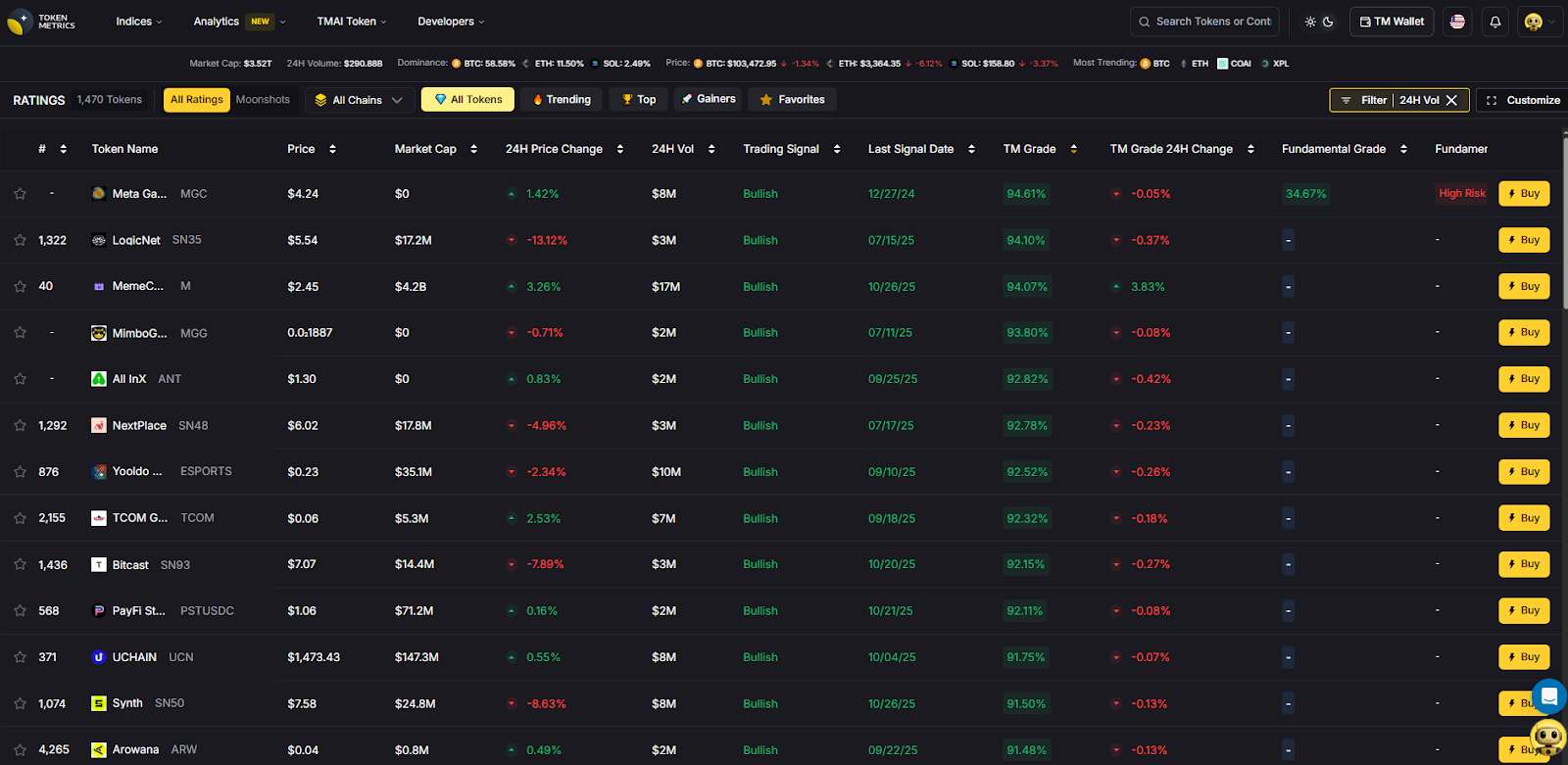


  • Narrative Detection to spot early theme shifts across ecosystems.
  • Portfolio Optimization to balance risk across L1/L2 exposure.
  • Alerts & Signals to time entries/exits as fees and activity shift.

Start free trial to screen assets and time entries with AI.  

Security & Compliance Tips

  • Prefer official standard bridges when possible; understand trust trade-offs of fast bridges. (docs.optimism.io)
  • Expect a ~7-day withdrawal window on optimistic rollups; plan treasury ops accordingly. (docs.arbitrum.io)
  • Verify contract addresses on official explorers/docs before bridging. (docs.base.org)
  • Monitor L1 data fee swings during high Ethereum congestion. (docs.optimism.io)
  • Review sequencer centralization and posted upgrade paths. (metis.io)
  • Keep seed/MPC practices high-hygiene; use hardware where possible.
  • {This article is for research/education, not financial advice.}

Beginner Mistakes to Avoid

  • Ignoring the challenge window and expecting instant L1 finality. (docs.arbitrum.io)
  • Bridging via unofficial URLs; always verify official docs. (docs.base.org)
  • Underestimating L1 data fees during network spikes. (docs.optimism.io)
  • Choosing an L2 without considering ecosystem fit (DeFi vs NFTs vs identity).
  • Deploying without reading security/proofs and upgrade notes. (docs.optimism.io)
  • Skipping incident/status pages and disclosures.

How We Picked (Methodology & Scoring)

  • Liqudity (30%) — adoption and app depth.
  • Security (25%) — proofs live, challenge periods, sequencer posture.
  • Coverage (15%) — ecosystem tooling, bridges.
  • Costs (15%) — fee transparency and DA approach.
  • UX (10%) — docs, onboarding, explorers, tooling.
  • Support (5%) — responsiveness and clarity.

We relied on official provider docs for architecture, fees, and bridges, cross-checking details where prudent. Last updated November 2025. (docs.optimism.io)


FAQs

What is an optimistic rollup?
 An L2 that posts transaction data to Ethereum and assumes validity unless challenged via fraud/fault proofs, cutting fees while inheriting L1 security. (docs.arbitrum.io)

How long do withdrawals take?
 Native L2→L1 withdrawals on optimistic designs include a challenge window (~7 days); fast bridges can provide liquidity sooner with additional trust/cost. (docs.arbitrum.io)

Why are fees sometimes higher?
 Your cost = L2 execution fee + L1 data fee; L1 data fees fluctuate with Ethereum demand and blob/base fee dynamics. (docs.base.org)

Is OP Stack the “standard” for OP-style chains?
 Yes, the OP Stack is the public-goods framework for OP-style L2s and Superchain members (e.g., OP Mainnet, Base, Mode, World Chain, Zora, Fraxtal). (docs.optimism.io)

What’s special about opBNB?
 It brings optimistic rollup design to the BNB ecosystem with very low fees and BSC alignment. (docs.bnbchain.org)

Which L2 is best for NFTs and creators?
 Zora Network is OP Stack-based and optimized for media/NFT mints with sub-$0.50 typical costs. (zora.energy)


Conclusion + Related Reads

If you want DeFi depth, start with Arbitrum or Base. For Superchain standardization and OP-native tooling, OP Mainnet and Mode are strong defaults. Creator projects should consider Zora, identity-centric apps World Chain, and yield-aware consumer apps Blast. For BNB-aligned deployments, opBNB offers ultra-low fees.

Related Reads (Token Metrics):

Build Smarter Crypto Apps &
AI Agents in Minutes, Not Months
Real-time prices, trading signals, and on-chain insights all from one powerful API.
Grab a Free API Key
About Token Metrics
Token Metrics: AI-powered crypto research and ratings platform. We help investors make smarter decisions with unbiased Token Metrics Ratings, on-chain analytics, and editor-curated “Top 10” guides. Our platform distills thousands of data points into clear scores, trends, and alerts you can act on.
30 Employees
analysts, data scientists, and crypto engineers
Daily Briefings
concise market insights and “Top Picks”
Transparent & Compliant
Sponsored ≠ Ratings; research remains independent
Want Smarter Crypto Picks—Free?
See unbiased Token Metrics Ratings for BTC, ETH, and top alts.
Thank you! Your submission has been received!
Oops! Something went wrong while submitting the form.
 No credit card | 1-click unsubscribe
Token Metrics Team
Token Metrics Team

Recent Posts

Research

Avalanche Price Prediction 2027: $25-$320 Target Analysis

Token Metrics Team
6 min read

Avalanche Price Prediction: AVAX in the 2027 Landscape

The Layer 1 competitive landscape is consolidating as markets recognize that specialization matters more than being a generic alternative to Ethereum. Avalanche positions itself in this multi-chain world with specific technical and ecosystem advantages. Infrastructure maturity around custody, bridges, and developer tooling makes alternative L1s more accessible heading into 2026.

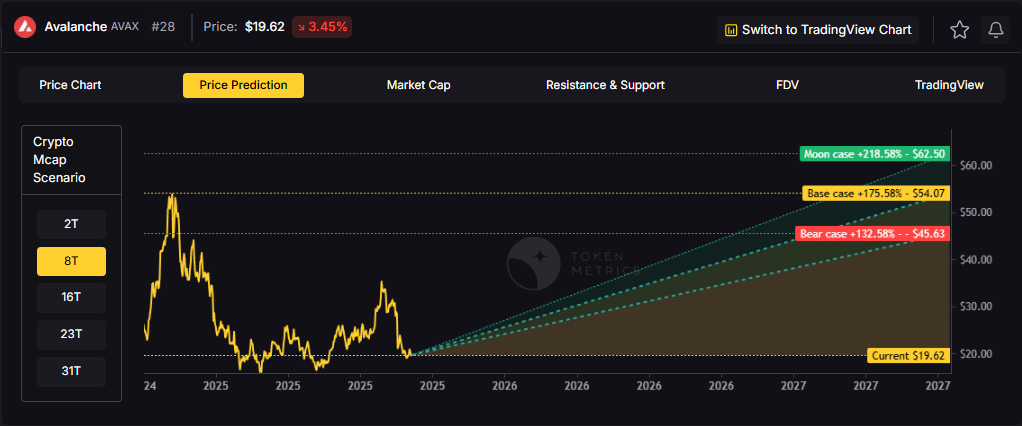
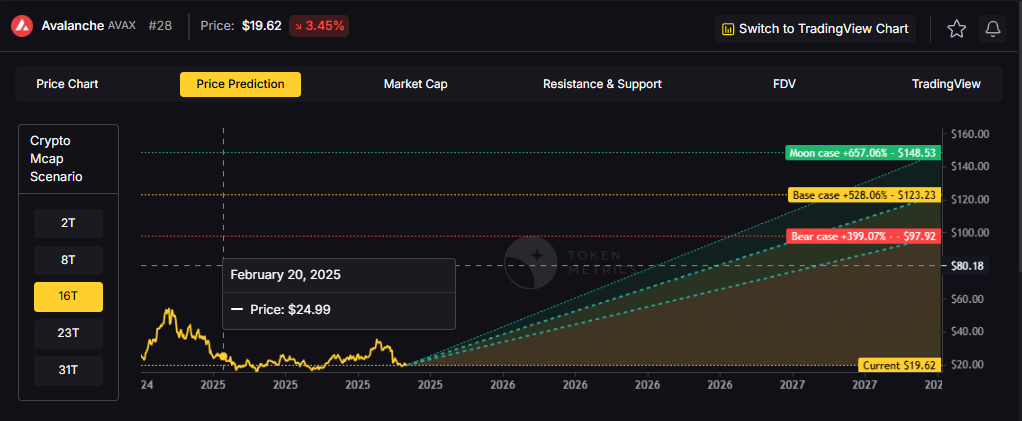
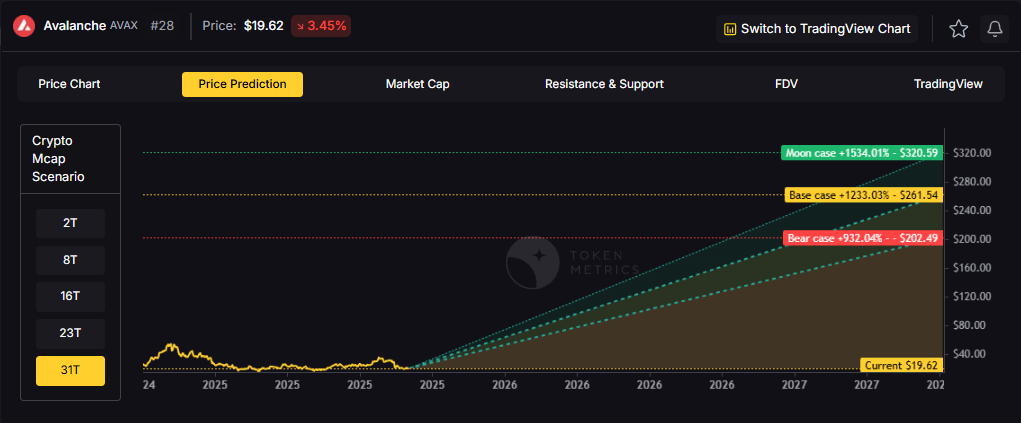
The price prediction scenario projections below map different market share outcomes for AVAX across varying total crypto market sizes. Base case price predictions assume Avalanche maintains current ecosystem momentum, while moon scenarios factor in accelerated adoption, and bear cases reflect increased competitive pressure.


Disclosure

Educational purposes only, not financial advice. Crypto is volatile, do your own research and manage risk.

How to read it: Each band blends cycle analogues and market-cap share math with TA guardrails. Base assumes steady adoption and neutral or positive macro. Moon layers in a liquidity boom. Bear assumes muted flows and tighter liquidity.

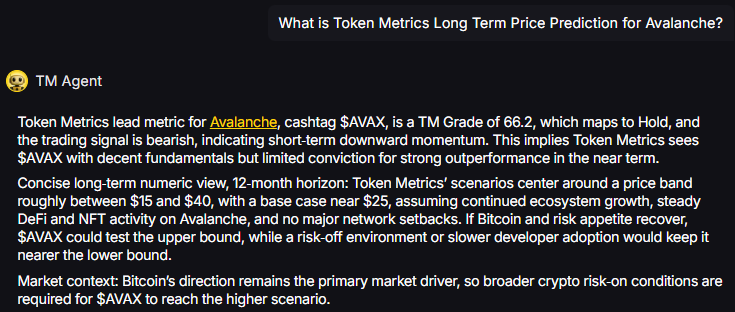
TM Agent baseline:

Token Metrics lead metric for Avalanche price prediction, cashtag $AVAX, is a TM Grade of 66.2%, which maps to Hold, and the trading signal is bearish, indicating short-term downward momentum. Concise long-term numeric price prediction view, 12-month horizon: Token Metrics' scenarios center around a price band roughly between $15 and $40, with a base case price target near $25. Market context: Bitcoin's direction remains the primary market driver, so broader crypto risk-on conditions are required for $AVAX to reach the higher price prediction scenario.

Live details: Avalanche Token Details

Affiliate Disclosure: We may earn a commission from qualifying purchases made via this link, at no extra cost to you.

Key Takeaways for AVAX Price Prediction

  • Scenario driven: price prediction outcomes hinge on total crypto market cap; higher liquidity and adoption lift the price bands
  • Fundamentals: Fundamental Grade 91.63% (Community 82%, Tokenomics 100%, Exchange 100%, VC 97%, DeFi Scanner 83%)
  • Technology: Technology Grade 80.52% (Activity 80%, Repository 72%, Collaboration 93%, Security 59%, DeFi Scanner 83%)
  • TM Agent gist: AVAX shows decent fundamentals with a Hold grade, short-term momentum is bearish, and a 12-month price prediction range clusters around $15 to $40 with a base near $25
  • Education only, not financial advice

Avalanche Price Prediction: Scenario Analysis

Token Metrics price prediction scenarios span four market cap tiers, each representing different levels of crypto market maturity and liquidity:

8T Market Cap Price Prediction:

At an eight trillion dollar total crypto market cap, AVAX price prediction projects to $45.63 in bear conditions, $54.07 in the base case, and $62.50 in bullish scenarios.

16T Market Cap Price Prediction:

Doubling the market to sixteen trillion expands the price prediction range to $97.92 (bear), $123.23 (base), and $148.53 (moon).

23T Market Cap Price Prediction:

At twenty-three trillion, the price forecast scenarios show $150.20, $192.38, and $234.56 respectively.

31T Market Cap Price Prediction:

In the maximum liquidity scenario of thirty-one trillion, AVAX price prediction could reach $202.49 (bear), $261.54 (base), or $320.59 (moon).

Each tier assumes progressively stronger market conditions, with the base case reflecting steady growth and the moon case requiring sustained bull market dynamics.

Why Consider the Indices with Top-100 Exposure

Avalanche represents one opportunity among hundreds in crypto markets. Token Metrics Indices bundle AVAX with top one hundred assets for systematic exposure to the strongest projects. Single tokens face idiosyncratic risks that diversified baskets mitigate.

Historical index performance demonstrates the value of systematic diversification versus concentrated positions.

Join the early access list

What Is Avalanche?

Avalanche is a smart-contract platform known for high throughput, low latency, and a modular subnet architecture. It aims to support decentralized finance, gaming, and enterprise applications with fast finality and cost-efficient transactions.

AVAX is the native token used for fees, staking, and network security, and it powers activity across application subnets. The ecosystem positions Avalanche among leading Layer 1s competing for developer mindshare and user adoption.

Token Metrics AI Analysis for Price Prediction

Token Metrics AI provides comprehensive context on Avalanche's positioning and challenges that inform our price prediction models.

Vision: Avalanche aims to provide a highly scalable, secure, and decentralized platform for launching custom blockchains and decentralized applications. Its vision centers on enabling a global, open financial system and supporting a diverse ecosystem of interoperable blockchains.

Problem: Many blockchain networks face trade-offs between speed, security, and decentralization, often resulting in high fees and slow transaction times during peak demand. Avalanche addresses the need for a scalable and efficient infrastructure that can support widespread adoption of dApps and enterprise use cases without compromising on performance or security.

Solution: Avalanche uses a novel consensus mechanism that achieves rapid finality with low energy consumption, differentiating it from traditional Proof-of-Work systems. It employs a three-chain architecture—Exchange Chain (X-Chain), Platform Chain (P-Chain), and Contract Chain (C-Chain)—to separate functions like asset creation, staking, and smart contract execution, enhancing efficiency and scalability.

Market Analysis: Avalanche operates in the competitive Layer 1 blockchain space. It differentiates itself through its consensus protocol and support for subnet-based custom blockchains. Adoption is influenced by developer activity, partnerships, and integration with major DeFi protocols, with risks from technological shifts and regulatory developments.

Fundamental and Technology Snapshot from Token Metrics

Fundamental Grade: 91.63% (Community 82%, Tokenomics 100%, Exchange 100%, VC 97%, DeFi Scanner 83%).


Technology Grade: 80.52% (Activity 80%, Repository 72%, Collaboration 93%, Security 59%, DeFi Scanner 83%).


Catalysts That Skew Bullish for Price Prediction

  • Institutional and retail access expands with ETFs, listings, and integrations
  • Macro tailwinds from lower real rates and improving liquidity
  • Product or roadmap milestones such as upgrades, scaling, or partnerships
  • These factors could push AVAX toward higher price prediction targets

Risks That Skew Bearish for Price Prediction

  • Macro risk-off from tightening or liquidity shocks
  • Regulatory actions or infrastructure outages
  • Concentration in validator economics and competitive displacement
  • These factors could push AVAX toward lower price prediction scenarios

FAQs: Avalanche Price Prediction

Can AVAX reach $200 according to price predictions?

Based on the price prediction scenarios, AVAX could reach $200 in the 31T bear case at $202.49. The 31T tier also shows $261.54 in the base case price forecast and $320.59 in the moon case. Not financial advice.

Can AVAX 10x from current levels based on price predictions?

At a current price of $19.62, a 10x would reach $196.20. This falls within the 31T bear, base, and moon case price predictions, and the 23T moon case at $234.56. Bear in mind that 10x returns require substantial market cap expansion. Not financial advice.

Should I buy AVAX now or wait based on price predictions?

Timing depends on your risk tolerance and macro outlook. Current price of $19.62 sits below the 8T bear case price prediction at $45.63. Dollar-cost averaging may reduce timing risk. Not financial advice.

What is the 2027 Avalanche price prediction?

Based on Token Metrics analysis, the 2027 price prediction for Avalanche centers around $25 in the base case under current market conditions, with a range between $15 and $40 depending on market scenarios. Bullish price predictions range from $54.07 to $320.59 across different total crypto market cap environments.

What drives AVAX price predictions?

AVAX price predictions are driven by subnet adoption, DeFi ecosystem growth, developer activity, institutional partnerships, and overall Layer 1 competition. The strong fundamentals (91.63% grade) support long-term price potential, though short-term bearish signals suggest caution. Market-wide crypto conditions remain the primary driver for reaching upper price prediction targets.

Can AVAX reach $300 by 2027?

According to our price prediction models, AVAX could reach $300+ in the 31T moon case where it projects to $320.59. This price prediction outcome requires the total crypto market to reach 31 trillion and Avalanche to maintain strong competitive positioning with accelerated subnet adoption. Not financial advice.


Next Steps

Disclosure

Educational purposes only, not financial advice. Crypto is volatile, do your own research and manage risk.

Powered by Token Metrics

Our team delivers scenario-driven price projections, in-depth grades, and actionable indices to empower smarter crypto investing—with both human and AI insights.

Research

Hedera Price Prediction 2027: $0.10-$1.42 Target Analysis

Token Metrics Team
8 min read

Hedera Price Prediction: Portfolio Context for HBAR in the 2027 Landscape

Layer 1 tokens like Hedera represent bets on specific blockchain architectures winning developer and user mindshare. HBAR carries both systematic crypto risk and unsystematic risk from Hedera's technical roadmap execution and ecosystem growth. Multi-chain thesis suggests diversifying across several L1s rather than concentrating in one, since predicting which chains will dominate remains difficult.

The price prediction projections below show how HBAR might perform under different market cap scenarios. While Hedera may have strong fundamentals, prudent portfolio construction balances L1 exposure across Ethereum, competing smart contract platforms, and Bitcoin to capture the sector without overexposure to any single chain's fate.


Disclosure

Educational purposes only, not financial advice. Crypto is volatile, do your own research and manage risk.

How to read this price prediction:

Each band blends cycle analogues and market-cap share math with TA guardrails. Base assumes steady adoption and neutral or positive macro. Moon layers in a liquidity boom. Bear assumes muted flows and tighter liquidity.

TM Agent baseline:

Token Metrics lead metric for Hedera price prediction, cashtag $HBAR, is a TM Grade of 61.8%, which maps to Hold, and the trading signal is bearish, indicating short-term downward momentum. This means Token Metrics views $HBAR as having reasonably solid fundamentals but limited conviction for strong outperformance in the near term.

A concise long-term numeric price prediction view for a 12-month horizon: Token Metrics scenarios center around a range of about $0.06 to $0.18, with a base case price target near $0.10, reflecting steady ecosystem growth, moderate adoption of Hedera services, and continued enterprise partnerships. Implication: if Bitcoin and broader crypto risk appetite improve, $HBAR could revisit the higher end of the price prediction range, while a risk-off market or slower-than-expected developer traction would keep it toward the lower bound.

Token Details

Key Takeaways

  • Scenario driven, outcomes hinge on total crypto market cap, higher liquidity and adoption lift the bands.
  • Single-asset concentration amplifies both upside and downside versus diversified approaches.
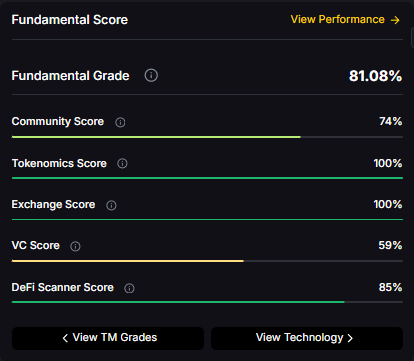
  • Fundamentals: Fundamental Grade 81.08% (Community 74%, Tokenomics 100%, Exchange 100%, VC 59%, DeFi Scanner 85%).
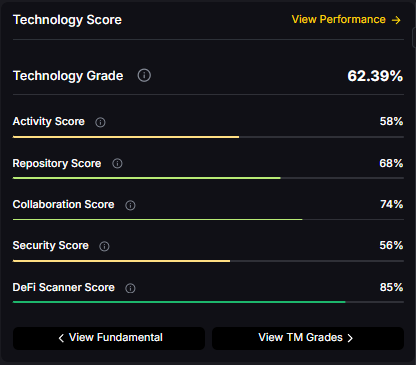
  • Technology: Technology Grade 62.39% (Activity 58%, Repository 68%, Collaboration 74%, Security 56%, DeFi Scanner 85%).
  • TM Agent gist: bearish short term, range view with upside if crypto risk appetite improves.
  • Education only, not financial advice.

Hedera Price Prediction: Scenario Analysis

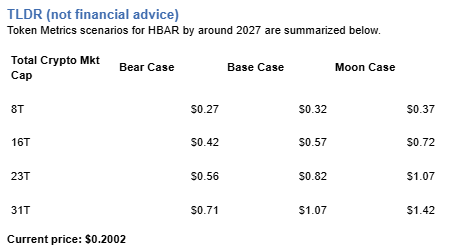
Token Metrics price prediction scenarios span four market cap tiers, each representing different levels of crypto market maturity and liquidity:

8T Market Cap Price Prediction:

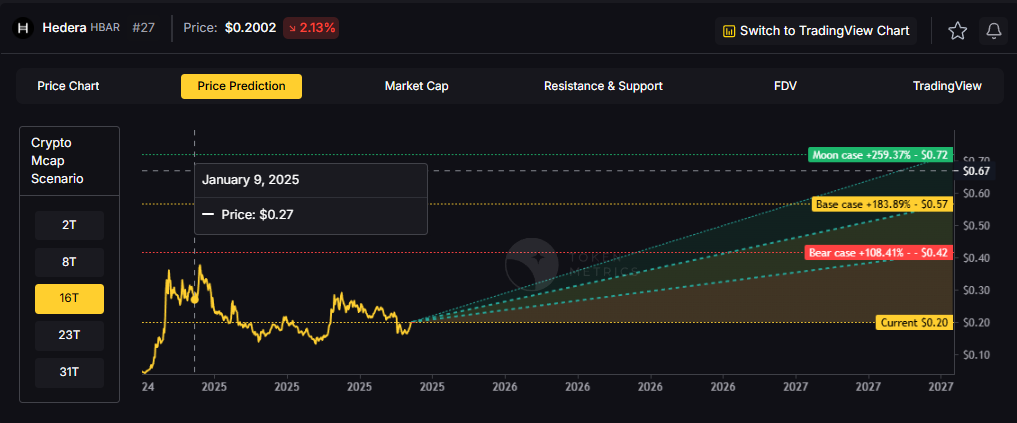
At an 8 trillion dollar total crypto market cap, HBAR price prediction projects to $0.27 in bear conditions, $0.32 in the base case, and $0.37 in bullish scenarios.

16T Market Cap Price Prediction:

Doubling the market to 16 trillion expands the price prediction range to $0.42 (bear), $0.57 (base), and $0.72 (moon).

23T Market Cap Price Prediction:

At 23 trillion, the price forecast scenarios show $0.56, $0.82, and $1.07 respectively.

31T Market Cap Price Prediction:

In the maximum liquidity scenario of 31 trillion, HBAR price prediction could reach $0.71 (bear), $1.07 (base), or $1.42 (moon).

These price prediction ranges illustrate potential outcomes for concentrated HBAR positions, but investors should weigh whether single-asset exposure matches their risk tolerance or whether diversified strategies better suit their objectives.

The Case for Diversified Index Exposure

Professional investors across asset classes prefer diversified exposure over concentrated bets for good reason. Hedera faces numerous risks - technical vulnerabilities, competitive pressure, regulatory targeting, team execution failure - any of which could derail HBAR performance independent of broader market conditions. Token Metrics Indices spread this risk across one hundred tokens, ensuring no single failure destroys your crypto portfolio.

Diversification becomes especially critical in crypto given the sector's nascency and rapid evolution. Technologies and narratives that dominate today may be obsolete within years as the space matures. By holding HBAR exclusively, you're betting not only on crypto succeeding but on Hedera specifically remaining relevant. Index approaches hedge against picking the wrong horse while maintaining full crypto exposure.

Tax efficiency and rebalancing challenges also favor indices over managing concentrated positions. Token Metrics Indices handle portfolio construction, rebalancing, and position sizing systematically, eliminating the emotional and logistical burden of doing this manually with multiple tokens.

Early access to Token Metrics Indices 

What Is Hedera?

Hedera is a high-performance public ledger that emphasizes speed, low fees, and energy efficiency, positioning itself for enterprise and decentralized applications. It uses a unique Hashgraph consensus that enables fast finality and high throughput, paired with a council-governed model that targets real-world use cases like payments, tokenization, and decentralized identity.

HBAR is the native token used for fees, staking, and network security, and it supports smart contracts and decentralized file storage. Adoption draws from partnerships and integrations, though decentralization levels and reliance on institutional demand are often discussed in the community.

Token Metrics AI Analysis for Price Prediction

Token Metrics AI provides comprehensive context on Hedera's positioning and challenges that inform our price prediction models.

  • Vision: Hedera's vision is to provide a secure, fair, and scalable distributed ledger technology platform that supports decentralized applications and enterprise use cases globally. It emphasizes governed decentralization, aiming to combine the benefits of distributed systems with responsible oversight through its council-based governance model.
  • Problem: Many blockchain networks face trade-offs between scalability, security, and decentralization, often resulting in high transaction fees, slow processing times, or environmental concerns. Hedera aims to address these limitations by offering a system that supports high throughput and fast finality without sacrificing security or incurring significant energy costs, making it suitable for both enterprise and decentralized applications.
  • Solution: Hedera uses the Hashgraph consensus algorithm, a directed acyclic graph (DAG)-based approach that achieves asynchronous Byzantine fault tolerance, enabling fast, secure, and fair transaction processing. The network supports smart contracts, tokenization, and decentralized file storage, with HBAR serving as the native token for fees, staking, and network security. Its council-governed model aims to ensure stability and trust, particularly for institutional and enterprise users.
  • Market Analysis: Hedera operates in the Layer 1 blockchain space, competing with high-throughput platforms like Solana, Avalanche, and Algorand, while differentiating through its Hashgraph consensus and governed governance model. It targets enterprise adoption, focusing on use cases in supply chain, payments, and asset tokenization, which sets it apart from more community-driven or DeFi-centric networks. Adoption is influenced by strategic partnerships, developer engagement, and real-world integrations rather than speculative activity. Key risks include competition from established and emerging blockchains, regulatory scrutiny around governance tokens, and challenges in achieving broad decentralization.

Fundamental and Technology Snapshot from Token Metrics

Fundamental Grade: 81.08% (Community 74%, Tokenomics 100%, Exchange 100%, VC 59%, DeFi Scanner 85%).


Technology Grade: 62.39% (Activity 58%, Repository 68%, Collaboration 74%, Security 56%, DeFi Scanner 85%).


Catalysts That Skew Bullish for Price Prediction

  • Institutional and retail access expands with ETFs, listings, and integrations
  • Macro tailwinds from lower real rates and improving liquidity
  • Product or roadmap milestones such as upgrades, scaling, or partnerships
  • These factors could push HBAR toward higher price prediction targets

Risks That Skew Bearish for Price Prediction

  • Macro risk-off from tightening or liquidity shocks
  • Regulatory actions or infrastructure outages
  • Concentration in validator economics and competitive displacement
  • Protocol-specific execution risk and competitive pressure from alternatives
  • These factors could push HBAR toward lower price prediction scenarios

FAQs: Hedera Price Prediction

Can HBAR reach $1.00 according to price predictions?

Yes. Based on the price prediction scenarios, HBAR could reach $1.00 or above in the higher tiers. The 23T tier projects $1.07 in the moon case price forecast and the 31T tier projects $1.42 in the moon case. Achieving this price prediction requires broad market cap expansion and Hedera maintaining competitive position. Not financial advice.

What price could HBAR reach in the moon case price prediction?

Moon case price predictions range from $0.37 at 8T to $1.42 at 31T total crypto market cap. These price prediction scenarios assume maximum liquidity expansion and strong Hedera adoption. Diversified strategies aim to capture upside across multiple tokens rather than betting exclusively on any single moon scenario. Not financial advice.

What's the risk/reward profile for HBAR price prediction?

Risk and reward in our price prediction model span from $0.27 in the lowest bear case to $1.42 in the highest moon case. Downside risks include regulatory or infrastructure setbacks and competitive pressure, while upside drivers include improved liquidity and enterprise adoption. Concentrated positions amplify both tails, while diversified strategies smooth outcomes.

What is the 2027 Hedera price prediction?

Based on Token Metrics analysis, the 2027 price prediction for Hedera centers around $0.10 in the base case under current market conditions, with a range between $0.06 and $0.18 depending on market scenarios. Bullish price predictions range from $0.32 to $1.42 across different total crypto market cap environments.

What drives HBAR price predictions?

HBAR price predictions are driven by enterprise adoption of Hashgraph technology, institutional partnerships (Google Cloud, IBM, Boeing), council governance decisions, and competition from other Layer 1 platforms. The strong fundamentals (81.08% grade) support long-term price potential, though short-term bearish signals suggest caution. Enterprise use case development remains the primary driver for reaching upper price prediction targets.

Can HBAR reach $0.50 by 2027?

According to our price prediction models, HBAR could reach $0.50+ in multiple scenarios: the 16T base case ($0.57), 16T moon case ($0.72), and all higher market cap tiers. This price prediction outcome requires steady crypto market growth (16T+ total market cap) and Hedera maintaining strong enterprise partnerships. Not financial advice.


Next Steps

Disclosure

Educational purposes only, not financial advice. Crypto is volatile, concentration amplifies risk, and diversification is a fundamental principle of prudent portfolio construction. Do your own research and manage risk appropriately.

Research

LEO Token Price Prediction: Comprehensive Market Cap Scenario Analysis

Token Metrics Team
5 min read

LEO Token Price Prediction Framework: Market Cap Scenarios

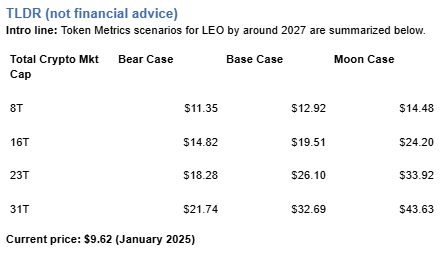
Exchange tokens derive value from trading volume and platform revenue, creating linkage between crypto market activity and LEO price action. LEO Token delivers utility through reduced trading fees and enhanced platform services on Bitfinex and iFinex across Ethereum and EOS. Token Metrics price prediction scenarios below model LEO outcomes across different total crypto market cap environments, providing investors with data-driven forecasts for strategic decision-making.


Disclosure

Educational purposes only, not financial advice. Crypto is volatile, do your own research and manage risk.

How to Read This LEO Price Prediction

Each band blends cycle analogues and market-cap share math with TA guardrails. Base assumes steady adoption and neutral or positive macro. Moon layers in a liquidity boom. Bear assumes muted flows and tighter liquidity.

TM Agent baseline: Token Metrics price prediction probabilities favor a modest range between about $5 and $15, with a base case around current levels near $9, conditional on exchange token utility remaining steady, and downside risk if centralized exchange macro pressure increases.

Live details: Token Details 

Key Takeaways

  • Scenario driven, outcomes hinge on total crypto market cap, higher liquidity and adoption lift the bands.
  • TM Agent gist: 12-month horizon favors $5 to $15 range with base case near $9, contingent on stable exchange utility.
  • Education only, not financial advice.

LEO Token Price Prediction Scenario Analysis

Token Metrics price prediction scenarios span four market cap tiers reflecting different crypto market maturity levels:

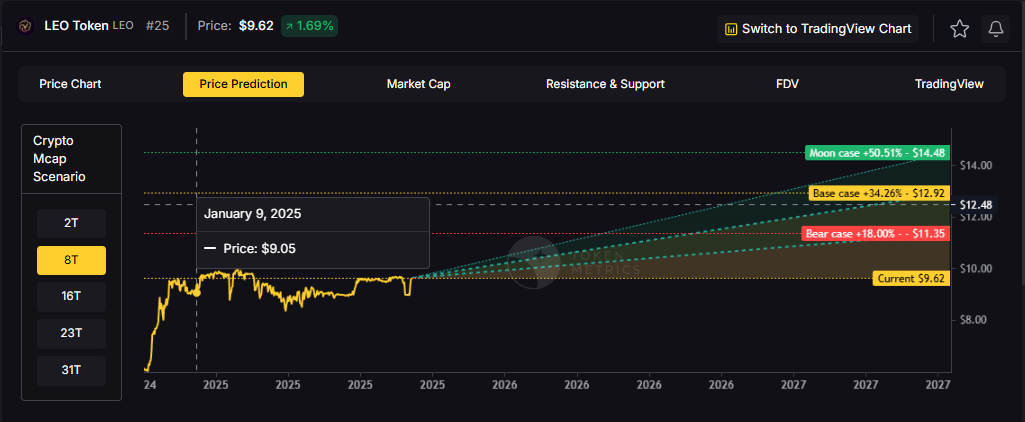
8T Market Cap - LEO Price Prediction:

At 8 trillion total crypto market cap, LEO price prediction projects to $11.35 in bear conditions, $12.92 in the base case, and $14.48 in bullish scenarios.

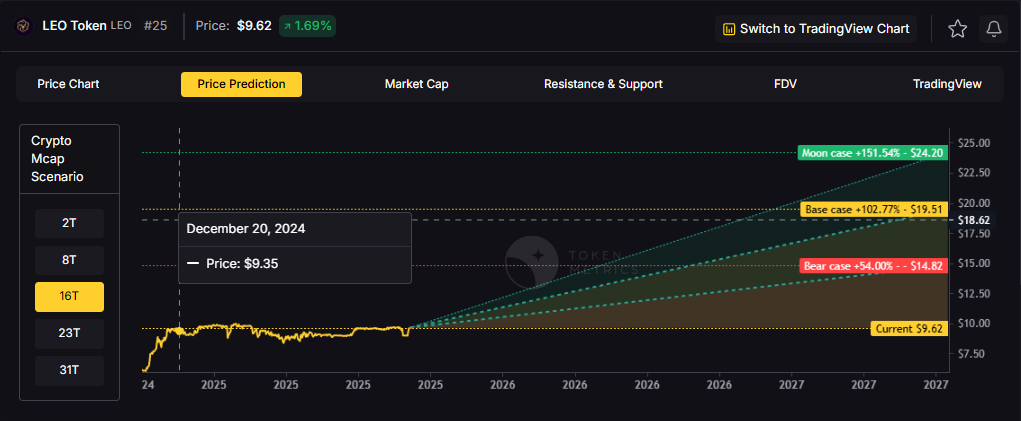
16T Market Cap - LEO Price Prediction:

At 16 trillion total crypto market cap, LEO price prediction projects to $14.82 in bear conditions, $19.51 in the base case, and $24.20 in bullish scenarios.

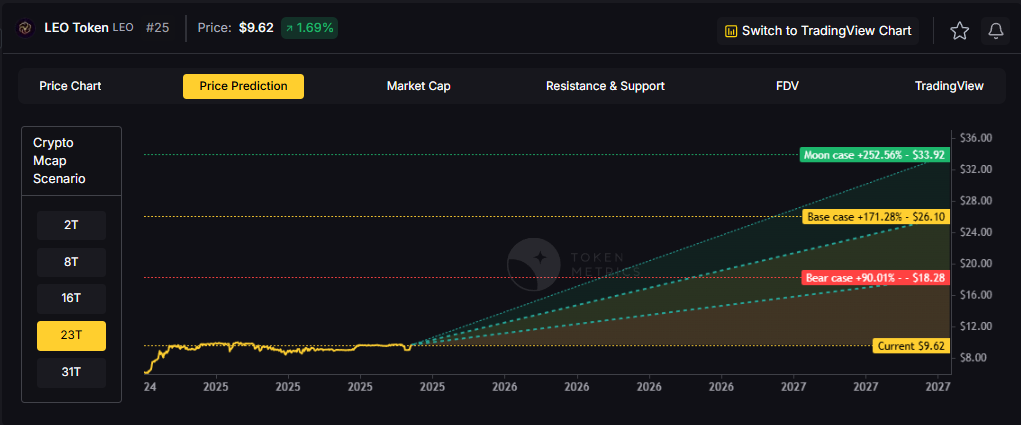
23T Market Cap - LEO Price Prediction:

At 23 trillion total crypto market cap, LEO price prediction projects to $18.28 in bear conditions, $26.10 in the base case, and $33.92 in bullish scenarios.

31T Market Cap - LEO Price Prediction:

At 31 trillion total crypto market cap, LEO price prediction projects to $21.74 in bear conditions, $32.69 in the base case, and $43.63 in bullish scenarios.

Each tier in our price prediction framework assumes progressively stronger market conditions, with base scenarios reflecting steady exchange growth and moon cases requiring sustained bull market dynamics.

What Is LEO Token?

LEO Token is the native utility token of the Bitfinex and iFinex ecosystem, designed to provide benefits like reduced trading fees, enhanced lending and borrowing terms, and access to exclusive features on the platform. It operates on both Ethereum (ERC-20) and EOS blockchains, offering flexibility for users.

The primary role of LEO is to serve as a utility token within the exchange ecosystem, enabling fee discounts, participation in token sales, and other platform-specific advantages. Common usage patterns include holding LEO to reduce trading costs and utilizing it for enhanced platform services, positioning it primarily within the exchange token sector.

Catalysts That Skew LEO Price Predictions Bullish

  • Institutional and retail access expands with ETFs, listings, and integrations
  • Macro tailwinds from lower real rates and improving liquidity
  • Product or roadmap milestones such as upgrades, scaling, or partnerships
  • Increased Bitfinex trading volume and platform adoption
  • Strategic token burns and buyback programs

Risks That Skew LEO Price Predictions Bearish

  • Macro risk-off from tightening or liquidity shocks
  • Regulatory actions targeting centralized exchanges or infrastructure outages
  • Concentration risk or competitive displacement from rival exchange tokens
  • Declining exchange market share or trading volume
  • Negative sentiment around centralized exchange tokens

LEO Token Price Prediction FAQs

What gives LEO value?

LEO accrues value through reduced trading fees and enhanced platform services within the Bitfinex and iFinex ecosystem. Demand drivers include exchange usage and access to platform features, while supply dynamics follow the token's exchange utility design. Value realization depends on platform activity and user adoption—key factors in our price prediction methodology.

What price could LEO reach in the moon case?

Our moon case price predictions range from $14.48 at 8T to $43.63 at 31T total crypto market cap. These scenarios require maximum market cap expansion and strong exchange activity. Not financial advice.

What is the LEO Token price prediction for 2025-2027?

Our comprehensive price prediction framework suggests LEO could trade between $5 and $43.63 depending on market conditions and total crypto market capitalization. The base case price prediction scenario clusters around $9 to $32.69 across different market cap environments over the next 12-24 months. Not financial advice.

Can LEO Token reach $20?

Yes. Based on our price prediction scenarios, LEO could reach $19.51 in the 16T base case and surpass $20 in higher market cap scenarios (23T and 31T tiers). The 23T base case projects $26.10, making $20 an achievable target under favorable market conditions. Not financial advice.

Can LEO Token reach $50?

LEO reaching $50 would exceed our current price prediction models' highest scenario of $43.63 (31T moon case). This would require extraordinary market conditions beyond the 31T total crypto market cap tier and exceptional Bitfinex platform growth. Not financial advice.

Is LEO Token a good investment based on price predictions?

LEO's price prediction is tied to Bitfinex exchange performance and utility value. The token offers fee discounts and platform benefits, with moderate growth potential in our base scenarios. However, exchange token valuations carry platform-specific risks. Always conduct your own research and consult financial advisors. Not financial advice.

How accurate are LEO Token price predictions?

Our LEO price predictions use scenario-based modeling across multiple market cap tiers, combining cycle analogues, market-cap share math, and technical analysis guardrails. While this methodology provides structured forecasts, cryptocurrency markets remain highly volatile and unpredictable. Use these price predictions as educational frameworks, not guarantees. Not financial advice.


Next Steps

Curious how these forecasts are made? Token Metrics delivers LEO on-chain grades, forecasts, and deep research on 6,000+ tokens. Instantly compare fundamentals, on-chain scores, and AI-powered predictions.

Disclosure

Educational purposes only, not financial advice. Crypto is volatile, do your own research and manage risk.

Why Use Token Metrics for LEO Price Predictions?

  • Data-driven forecasts: Scenario-based price prediction models across multiple market cap tiers
  • Comprehensive analysis: On-chain metrics, fundamental grades, and technical guardrails
  • AI-powered insights: Advanced algorithms analyze 6,000+ tokens for comparative analysis
  • Regular updates: Real-time price predictions and signals based on market conditions
  • Risk management: Multiple scenarios (bear, base, moon) for informed decision-making
Choose from Platinum, Gold, and Silver packages
Reach with 25–30% open rates and 0.5–1% CTR
Craft your own custom ad—from banners to tailored copy
Perfect for Crypto Exchanges, SaaS Tools, DeFi, and AI Products