Back to blog
Research

Top Stablecoin Issuers & Use Cases (2025)

Compare the leading stablecoin issuers by reserves, fees, regions, and best use cases. Pick the right coin for trading, payments, or DeFi.
Sam Monac
5 min
Want Smarter Crypto Picks—Free?
See unbiased Token Metrics Ratings for BTC, ETH, and top alts.
Thank you! Your submission has been received!
Oops! Something went wrong while submitting the form.
 No credit card | 1-click unsubscribe

Why stablecoin issuers matter in September 2025

Stablecoins have become crypto’s settlement rail, powering exchanges, DeFi, remittances, and payments. In 2025, clarity is improving and liquidity is consolidating—so choosing stablecoin issuers with sound reserves, clear disclosures, and fit-for-purpose design matters more than ever.
Definition: A stablecoin issuer is the organization or protocol that mints and redeems a token designed to track a reference asset (usually USD), with reserves and/or mechanisms intended to hold the peg.
This guide evaluates the leading issuers globally and maps their best use cases—from high-volume trading to compliant payments and decentralized collateral. We focus on reserves quality, transparency, networks supported, institutional access, fees, and regional eligibility. Secondary topics include “USDC vs USDT,” euro/SGD options, and decentralized alternatives that can complement centralized choices. Circle+2Circle+2

How We Picked (Methodology & Scoring)

  • Liquidity (30%): Scale of circulation and exchange/DeFi depth for tight spreads and fast settlement.

  • Security (25%): Reserve quality, segregation, audits/attestations, onchain safety, and incident track record.

  • Coverage (15%): Multi-chain support, fiat rails, and breadth of supported currencies (USD, EUR, SGD).

  • Costs (15%): Primary mint/redeem fees, network costs, and known program fees.

  • UX (10%): Accessibility, APIs, documentation, and fiat on/off-ramps.

  • Support (5%): Enterprise support, disclosures, and transparency cadence.

We relied on official product/docs/security pages from each issuer and used market datasets (e.g., CCData/Kaiko/CoinGecko) for cross-checks only. Last updated September 2025. Circle+1
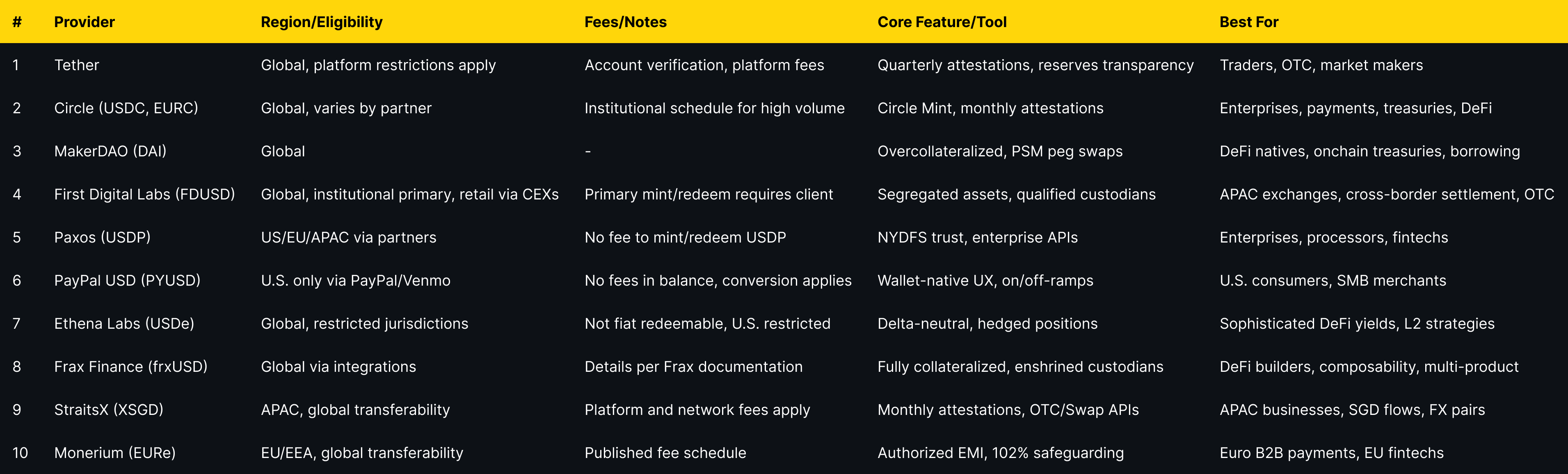
Top 10 stablecoin issuers and use cases in September 2025

1. Tether — Best for global, always-on liquidity
Why Use It: USD₮ (USDT) is the deepest liquidity pool across CEXs and many L2s—useful for traders and market makers who prioritize fills and routing. Tether publishes quarterly reserve attestations by BDO and a detailed reserves breakdown, improving transparency versus prior years. Tether+1
Best For: Active traders, OTC desks, market makers, emerging-market remittances.
Notable Features: Multi-chain footprint; public reserve updates; operational resilience at massive scale. Tether
Consider If: U.S. persons cannot use Tether’s own platform services under its Terms; rely on supported exchanges instead. Regions: Global (platform restrictions apply). Fees/Notes: Account verification and certain fees apply at the platform level. Tether+1
Alternatives: Circle (USDC), First Digital Labs (FDUSD).

2. Circle — USDC / EURC — Best for regulated, enterprise-grade rails

Why Use It: Circle emphasizes transparency, monthly reserve attestations, and segregation of funds. USDC is widely integrated with banks, fintechs, and onchain apps; EURC brings a euro option under the same standards. Circle+1
Best For: Enterprises/fintechs, payment flows, compliant treasuries, DeFi power users.
Notable Features: Circle Mint for programmatic mint/redeem; monthly attestations; multi-chain support; extensive docs. Fees/Notes: Institutional fee schedule applies for certain high-volume flows. Circle+1
Regions: Global (availability varies by partner/exchange).
Alternatives: Paxos (USDP), PayPal USD (PYUSD).

3. MakerDAO — DAI — Best decentralized, overcollateralized dollar
Why Use It: DAI is minted against overcollateralized crypto via the Maker Protocol, giving a censorship-resistant alternative to fiat-custodied coins. The Peg Stability Module (PSM) smooths peg fluctuations by allowing swaps with other stables. docs.makerdao.com+1
Best For: DeFi natives, long-term onchain treasuries, collateralized borrowing.
Notable Features: Onchain transparency; collateral diversity with governance controls; mature integrations across DeFi. docs.makerdao.com
Consider If: Exposure to crypto collateral and governance risk differs from fiat-backed models. Regions: Global.
Alternatives: Liquity (LUSD/BOLD), Frax (frxUSD).

4. First Digital Labs — FDUSD — Best for Asia-centric trading depth

Why Use It: FDUSD is fully reserved and designed for 1:1 redemption; it has become a deep-liquidity quote asset on major Asian venues. Issuance moved to a BVI entity (FD121 BVI) in 2025 to support global accessibility. firstdigitallabs.com+1
Best For: Traders on Asia-focused exchanges, cross-border settlement in APAC, OTC desks.
Notable Features: Monthly attestations; segregation of assets with qualified custodians; institutional onboarding. Fees/Notes: Primary mint/redeem requires becoming a client; retail typically uses secondary markets. firstdigitallabs.com+1
Regions: Global (institutional primary; retail via exchanges).
Alternatives: Tether (USDT), Circle (USDC).

5. Paxos — USDP — Best for NYDFS-regulated issuance

Why Use It: USDP is issued by Paxos Trust (NYDFS-regulated), held 100% in cash and cash equivalents, and redeemable 1:1. Paxos provides enterprise APIs and no-fee mint/redeem for primary customers. Paxos+1
Best For: Enterprises needing regulated counterparties, payment processors, fintechs.
Notable Features: Segregated, bankruptcy-remote client assets; Ethereum & Solana support; rich developer docs. Fees/Notes: No Paxos fee to mint/redeem USDP; bank/network fees may apply. Paxos+1
Regions: US/EU/APAC via partners; check onboarding eligibility.
Alternatives: Circle (USDC), PayPal USD (PYUSD).

6. PayPal USD (PYUSD) — Best for consumer payments in the U.S.

Why Use It: PYUSD brings stablecoins to familiar wallets (PayPal/Venmo), with instant P2P and merchant flows for eligible U.S. users. It’s issued by Paxos Trust and is redeemable within the PayPal ecosystem; PayPal has also launched an optional rewards program for eligible U.S. users. PayPal+1
Best For: U.S. consumers and SMBs using PayPal/Venmo, payment acceptance, loyalty.
Notable Features: Wallet-native UX; on/off-ramps; integrations expanding across networks. Fees/Notes: No fees to buy/sell/hold/transfer PYUSD inside eligible U.S. PayPal balances; conversion fees apply when swapping with other crypto. PayPal
Regions: U.S. only for consumer access via PayPal/Venmo.
Alternatives: USDC (for global reach), USDP (enterprise rails).

7. Ethena Labs — USDe — Best synthetic dollar for DeFi yields (advanced users)

Why Use It: USDe uses a delta-neutral mechanism (spot + perps/futures) to target dollar stability without relying solely on banks. sUSDe offers onchain, variable rewards sourced from the strategy. This is a crypto-native design and differs from fiat-redeemable models. docs.ethena.fi+1
Best For: Sophisticated DeFi users, L2 yield strategies, protocols integrating synthetic dollars.
Notable Features: Whitelist-based mint/redeem; peg supported by hedged positions; extensive docs. Fees/Notes: Not available to U.S. users; USDe is not redeemable for fiat by design. docs.ethena.fi+1
Regions: Global (restricted jurisdictions excluded).
Alternatives: DAI, frxUSD.

8. Frax Finance — frxUSD — Best modular stable for DeFi integrations

Why Use It: Frax introduced frxUSD, a fully collateralized, fiat-redeemable stablecoin with “enshrined custodians” while retaining Frax’s modular DeFi stack. It aims to couple institutional-grade backing with protocol-level tooling (lending/AMMs). Frax
Best For: DeFi builders, protocols needing composability, multi-product integration.
Notable Features: Hybrid custody model; Fraxtal/Frax ecosystem; onchain transparency dashboard. Fees/Notes: Details governed by Frax docs and custodial partners. Frax+1
Regions: Global (availability via exchanges/integrations).
Alternatives: USDC, DAI.

9. StraitsX — XSGD — Best for SGD settlements and APAC fintech rails

Why Use It: XSGD is a Singapore dollar stablecoin with monthly reserve attestations and a strong focus on compliant payments infrastructure across Southeast Asia. It’s widely integrated with regional wallets, OTC, and DeFi. straitsx.com+1
Best For: APAC businesses, cross-border SGD flows, FX pairs (XSGD↔USD stables).
Notable Features: Monthly attestations; issuer entities for SGD/USD; APIs for swaps/OTC. Fees/Notes: Platform and network fees apply; see issuer terms. straitsx.com
Regions: APAC (global transferability on supported chains).
Alternatives: USDC (USD rails), Monerium (EURe for EUR rails).

10. Monerium — EURe — Best for euro e-money compliance

Why Use It: Monerium issues EURe as regulated e-money under EU rules with segregated, over-collateralized assets—designed for compliant euro settlements onchain. Tokens live on Ethereum, Gnosis, and Polygon with instant redeemability. Monerium+1
Best For: European fintechs, treasuries needing euro rails, compliant B2B payments.
Notable Features: Authorized EMI; 102% safeguarding policy; e-money legal clarity; audited financials. Fees/Notes: Published fee schedule; standard banking/network fees may apply. Monerium+1
Regions: EU/EEA (global transferability on supported chains).
Alternatives: Circle (EURC), StraitsX (XSGD for SGD).

Decision Guide: Best By Use Case

  • Global trading liquidity: Tether (USDT). Tether

  • Regulated U.S./enterprise rails: Circle (USDC), Paxos (USDP). Circle+1

  • U.S. consumer payments/Loyalty: PayPal USD (PYUSD). PayPal

  • Decentralized/censorship-resistant: MakerDAO (DAI); Liquity (LUSD/BOLD) as alt. docs.makerdao.com+1

  • APAC settlement/SGD pairs: StraitsX (XSGD). straitsx.com

  • Euro compliance: Monerium (EURe), Circle (EURC). Monerium+1

  • DeFi-native synthetic dollar/yields: Ethena (USDe). docs.ethena.fi

  • Modular DeFi integration: Frax (frxUSD). Frax

How to Choose the Right stablecoin issuers (Checklist)

  • Region & eligibility: Are you a U.S. consumer, EU business, or global trader? (PayPal vs Circle/Paxos vs Tether/DeFi.) PayPal

  • Reserves & attestations: Look for frequent, third-party reports and clear segregation of client assets. Circle+1

  • Mechanism fit: Fiat-backed vs overcollateralized vs synthetic—match to risk tolerance. docs.makerdao.com+1

  • Chains & integrations: Ensure support for your target L2s, exchanges, and wallets.

  • Fees & slippage: Primary mint/redeem costs, network gas, conversion spreads. Paxos+1

  • Operational needs: APIs, treasury tools, reporting, and support SLAs.

  • Red flags: Vague reserve language, infrequent disclosures, or unclear redemption policies.

Use Token Metrics With Any stablecoin issuers

  • AI Ratings surface quality signals behind liquidity metrics.
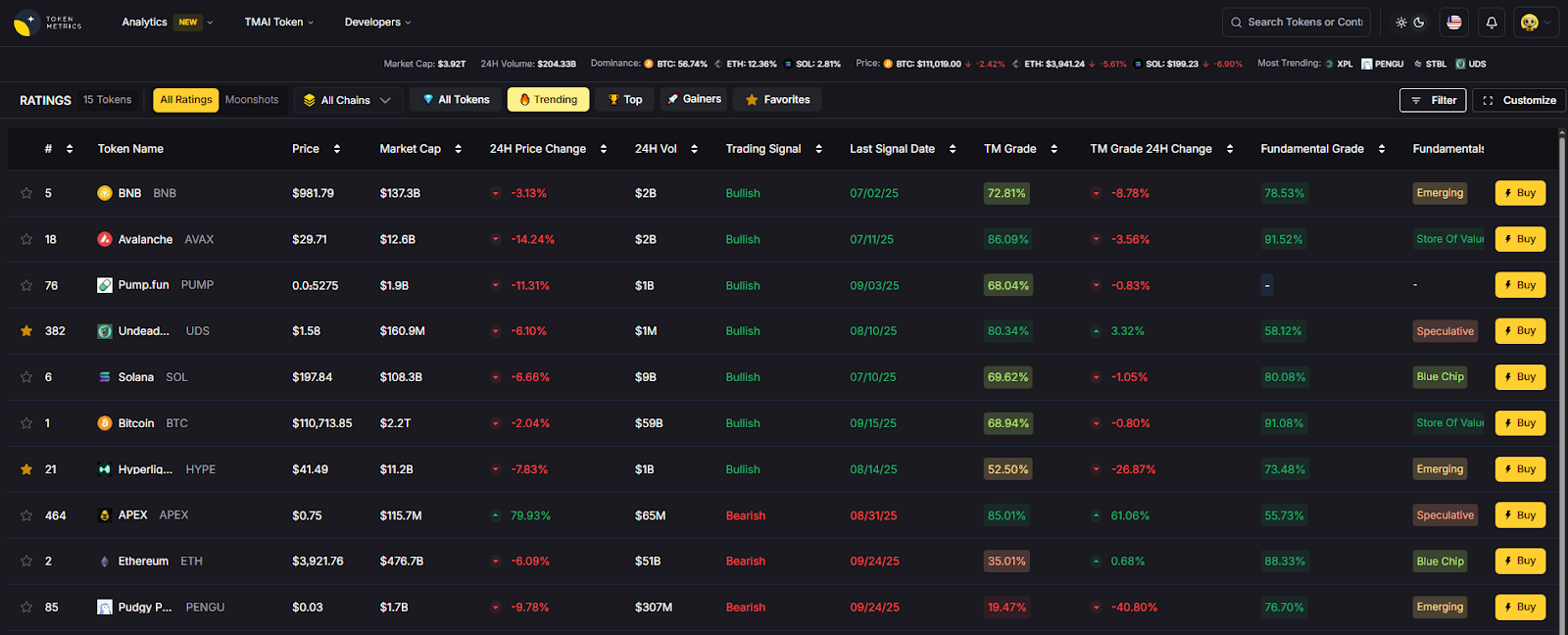
  • Narrative Detection spots capital rotation into specific stablecoin ecosystems.

  • Portfolio Optimization helps size stablecoin sleeves by mandate (trading vs yield vs payments).

  • Alerts & Signals track peg deviations, volume spikes, and exchange outflows.
    Workflow: Research → Select → Execute with your chosen issuer/exchange → Monitor with alerts.

Primary CTA: Start free trial
Security & Compliance Tips

  • Enable 2FA and secure treasury ops (role-based access, hardware keys).

  • Confirm custody setup (segregated accounts; multi-sig or MPC for smart-contract risk).

  • Complete KYC/AML where required; verify permitted jurisdictions. Tether+1

  • Use RFQ/OTC for large conversions to reduce slippage.

  • Practice wallet hygiene: label treasury addresses, restrict permissions, and test redemptions.

This article is for research/education, not financial advice.

Beginner Mistakes to Avoid

  • Treating all stablecoins as identical; mechanisms and risks vary.

  • Ignoring fee schedules and settlement timelines for large redeems. Circle Help+1

  • Using a region-restricted product (e.g., PYUSD outside the U.S.; USDe app in restricted markets). PayPal+1

  • Overconcentrating in a single issuer or chain.

  • Skipping ongoing monitoring of peg, reserves, and disclosures.

FAQs

1) What are the main types of stablecoin issuers?
Three broad models: (1) Fiat-backed (Circle, Paxos, First Digital Labs), (2) Overcollateralized crypto-backed (MakerDAO DAI; Liquity), and (3) Synthetic/hedged (Ethena USDe). Each has distinct reserve/risk properties. docs.ethena.fi+3Circle+3Paxos+3

2) Which stablecoin is best for trading liquidity?
USDT typically leads on global CEX depth and pairs, with USDC often preferred for fiat-connected flows and DeFi. Choose based on venue support and treasury needs. Tether+1

3) Can U.S. users access every stablecoin?
No. PYUSD is for eligible U.S. PayPal/Venmo users; some protocols (e.g., Ethena) restrict U.S. access to their app. Always check terms. PayPal+1

4) How do fees work for minting and redeeming?
Paxos states no fees for mint/redeem USDP/PYUSD for primary clients; Circle has institutional schedules; Tether lists platform fees. Secondary-market trades still incur exchange/gas costs. Paxos+2Circle Help+2

5) Are euro or SGD stablecoins useful?
Yes. EURC/EURe enable euro settlements under EU rules; XSGD supports APAC rails and FX paths versus USD stables. Circle+2Monerium+2

6) Is DAI safer than fiat-backed coins?
“Safer” depends on your risk lens. DAI reduces bank/custodian reliance but adds crypto-collateral and governance risk; fiat-backed coins rely on custodians and regulators. Diversification is common. docs.makerdao.com

Conclusion + Related Reads

If you need global trading liquidity, start with USDT/USDC. For enterprise-grade compliance, Circle/Paxos shine. For decentralized resilience, DAI (and Liquity) fit. For regional rails, consider XSGD (APAC) and EURe/EURC (EU). Pair the right issuer with your use case, then monitor peg, reserves, and policy changes over time.

Related Reads:

  • Best Cryptocurrency Exchanges 2025

  • Top Derivatives Platforms 2025

  • Top Institutional Custody Providers 2025

‍

Build Smarter Crypto Apps &
AI Agents in Minutes, Not Months
Real-time prices, trading signals, and on-chain insights all from one powerful API.
Grab a Free API Key
About Token Metrics
Token Metrics: AI-powered crypto research and ratings platform. We help investors make smarter decisions with unbiased Token Metrics Ratings, on-chain analytics, and editor-curated “Top 10” guides. Our platform distills thousands of data points into clear scores, trends, and alerts you can act on.
30 Employees
analysts, data scientists, and crypto engineers
Daily Briefings
concise market insights and “Top Picks”
Transparent & Compliant
Sponsored ≠ Ratings; research remains independent
Want Smarter Crypto Picks—Free?
See unbiased Token Metrics Ratings for BTC, ETH, and top alts.
Thank you! Your submission has been received!
Oops! Something went wrong while submitting the form.
 No credit card | 1-click unsubscribe
Token Metrics Team
Token Metrics Team

Recent Posts

Research

Crypto APIs: Free Access vs Paid Options Explained

Token Metrics Team
6

As the cryptocurrency landscape grows more complex, developers and businesses increasingly rely on crypto APIs to access data, power apps, and build innovative blockchain solutions. But a common question arises: are crypto APIs free, or will you need to pay to unlock full functionality?

What Are Crypto APIs and Why Do They Matter?

Crypto APIs (Application Programming Interfaces) act as critical gateways to blockchain data, facilitating seamless integration with cryptocurrency exchanges, wallets, smart contracts, and on-chain analytics. Whether you're building a trading bot, a portfolio dashboard, or financial analytics tools, APIs provide the technical means to fetch real-time prices, historical data, market signals, and transaction details.

For developers and enterprises, leveraging APIs saves hundreds of hours that would otherwise be spent running full blockchain nodes or parsing raw blockchain data. This access underpins everything from decentralized finance (DeFi) apps to AI-powered trading agents. Given their importance, understanding the pricing and business models behind crypto APIs is essential for making informed development decisions.

Overview of Free Crypto API Offerings

Many crypto API providers offer free tiers to enable experimentation, small-scale projects, or basic research. Free plans typically allow users to:

  • Fetch current cryptocurrency prices and simple price charts.
  • Access limited historical data (last 24 hours or 1–7 days).
  • Make a restricted number of daily or monthly requests (e.g., 1,000–100,000).
  • Use basic endpoints, such as wallet balance queries or publicly available blockchain metrics.

Popular platforms like CoinGecko, CoinMarketCap, and CryptoCompare all offer some form of a free API key. For open-source or non-commercial projects, these resources can be invaluable. However, free APIs are generally subject to tighter rate limits, API call quotas, occasional delays, and less robust customer support. For mission-critical apps or commercial ventures, these constraints may hinder scalability and reliability.

When and Why Should You Pay for a Crypto API?

Paid crypto APIs are designed to meet the needs of high-volume traders, institutions, and enterprises that require advanced capabilities, higher reliability, and comprehensive datasets. Features usually unlocked in paid plans include:

  • Significantly higher or unlimited API call limits—crucial for real-time trading bots or analytics platforms.
  • Access to premium data sets, such as full historical price data, order book snapshots, and on-chain analytics.
  • Advanced market intelligence, trading signals, or real-time alerts.
  • Dedicated support, service-level agreements (SLAs), and enhanced data integrity guarantees.
  • Batch data downloads and advanced querying capabilities (for AI/ML models or large-scale backtesting).

The pricing models for these APIs vary widely—ranging from monthly subscriptions to pay-as-you-go plans, and sometimes custom enterprise contracts. Providers like Token Metrics, Messari, and Chainalysis are examples offering sophisticated data-access APIs, each with tiered plans depending on user requirements.

Factors to Consider When Selecting an API

Deciding between free and paid APIs goes beyond just budget; it requires analyzing technical and operational needs. Key considerations should include:

  1. Data Coverage: Does the API support all the cryptocurrencies, exchanges, and blockchains you need?
  2. Rate Limits: Will the request quotas of free tiers suffice for your application's users or analytics workload?
  3. Data Accuracy & Latency: Check if the provider offers low-latency updates and real-time feeds required for responsive/trading use-cases.
  4. Advanced Features: Are you seeking advanced analytics (e.g., AI-powered signals, on-chain metrics) or just basic price data?
  5. Reliability and Uptime: Is there a service agreement, monitoring, or 24/7 support in higher tiers?
  6. Legal & Compliance: Especially for enterprise cases, make sure the data provider complies with relevant regulations and offers data usage rights.

For many developers, the path starts with free APIs for exploratory work and transitions to paid plans as scalability, security, and feature demands grow. While free tiers lower the barrier to entry, production-grade platforms often require investing in robust, premium APIs—especially when building for third-party users or integrating AI systems reliant on accurate data streams.

Crypto API Pricing Structures in Practice

The crypto API market features a variety of pricing models to suit diverse needs:

  • Freemium: A basic level of service is free; premium plans unlock critical extras (higher limits, priority support, additional data sets).
  • Tiered Subscription: Multiple levels (Starter, Pro, Enterprise) with clearly defined features and limits.
  • Pay-As-You-Go: Charges based on actual usage (e.g., per API call or per MB of data).
  • Open-Source APIs: Some projects provide source code and APIs for anyone to self-host and use, though these may require significant technical overhead.

Each model impacts not just the cost but also integration choices. For example, a developer building an AI-driven trading assistant may need not only current price feeds but also deep market signals and on-chain data—necessitating advanced tier plans.

Build Smarter Crypto Apps & AI Agents with Token Metrics

Token Metrics provides real-time prices, trading signals, and on-chain insights all from one powerful API. Grab a Free API Key

FAQs for Crypto API Access

Are all crypto APIs free?

No, not all crypto APIs are free. While many providers offer limited free tiers, advanced features such as higher rate limits, in-depth analytics, and premium support typically require a paid plan or subscription.

What kind of data can I access with a free API key?

Free API keys generally provide access to basic price information, limited historical data, and publicly visible blockchain metrics within specified rate limits. Advanced or bulk data, in-depth analytics, and commercial licensing often require paid access.

When should I consider upgrading to a paid API?

Consider upgrading to a paid API when your app or project requires higher reliability, faster updates, greater request quotas, access to premium data sets (such as order books, advanced analytics, or on-chain signals), or enterprise-grade support.

How do crypto API providers typically price their services?

Crypto API providers use a mix of freemium, tiered subscription, and pay-as-you-go models. Pricing varies based on usage, features required, support level, and data depth. Most providers publish clear rate sheets or offer custom enterprise solutions for large-scale needs.

Are there open-source or self-hosted crypto API alternatives?

Yes, open-source crypto APIs and data crawlers exist, enabling developers to self-host and customize their data infrastructure. However, this typically requires significant technical resources for deployment, scaling, and data quality assurance.

Disclaimer

This article is for educational and informational purposes only. It is not intended as investment advice or an endorsement of any specific service or platform. Please conduct your own research and consult qualified professionals for business or technical guidance.

Research

How Crypto APIs Power Real-Time Data for Apps and Platforms

Token Metrics Team
6

Crypto markets never sleep—prices shift 24/7, blockchain activity surges minute by minute, and traders, analysts, or developers want up-to-the-second data. But where do wallet trackers, trading bots, or dashboards source this real-time information? The answer: powerful crypto APIs that connect applications directly to live blockchain and market data streams.

How Crypto APIs Work: Bridging Apps with Blockchains and Exchanges

Crypto APIs (Application Programming Interfaces) are the digital bridges between external software applications—like portfolio trackers, exchanges, or research platforms—and sources of cryptocurrency market and blockchain data. Instead of developers parsing raw blockchain nodes or manually scraping exchange data, APIs offer structured, standardized access to:

  • Price Data: Live and historical prices for thousands of digital assets from multiple exchanges.
  • Volume and Order Book Data: Insights into trading activity, liquidity, and market depth.
  • Blockchain Data: On-chain transactions, block confirmations, wallet balances, and token info.
  • Signals and Analytics: Trading signals, technical indicators, and sentiment metrics.

APIs can be called on-demand (REST APIs) for snapshots, or stream continuous updates (WebSockets) for real-time data. This accessibility enables faster, more reliable, and easily scalable integration for any crypto application.

Real-Time vs. Historical Crypto Data: What Makes Real-Time So Unique?

Real-time crypto data means delivering the most current information to users, ideally within milliseconds or a few seconds of it being published on an exchange or blockchain. In volatile markets, the difference between real-time and delayed data can be significant, especially for automated applications like trading bots, AI agents, or alert systems.

Unlike historical data—used for backtesting or research—real-time data requires:

  • Low Latency Gathering: APIs must quickly ingest updates from blockchains and exchanges without significant lag.
  • Immediate Distribution: Data is pushed to clients or applications as soon as it’s available, often via persistent connections.
  • Reliability and Consistency: Ensured by robust infrastructure, data normalization, and error handling.

This demand for immediacy has shaped how top crypto APIs are built and how they interact with core data sources.

Data Sources for Crypto APIs: Exchanges, Blockchains, and Aggregators

To supply accurate real-time data, APIs must connect with several pillars of the crypto ecosystem:

  1. Centralized Exchanges (CEXs): APIs query and stream price, trade, and order book data from platforms like Binance, Coinbase, and Kraken. Many CEXs offer official APIs, which third-party API providers aggregate and standardize.
  2. Decentralized Exchanges (DEXs): On-chain data feeds from Uniswap, Curve, and other DEXs are sourced directly from smart contracts via blockchain nodes.
  3. Blockchain Networks: APIs utilize full nodes or light clients to pull transaction details, new blocks, token transfers, and wallet balances. This is achieved using technologies like JSON-RPC, GraphQL, or event listeners.
  4. Aggregators: Top crypto APIs often aggregate dozens of sources—both CEXs and DEXs—then normalize, de-duplicate, and enrich the data for end users.

APIs with broad coverage ensure more accurate, real-time market snapshots and make it easier for applications to monitor thousands of assets or protocols efficiently.

How Real-Time Crypto Data Flows: From Source to End-User

The journey of real-time crypto data from its origin to your screen usually involves these steps:

  • Source Polling or Streaming: The API provider constantly queries or subscribes to data endpoints from exchanges and blockchain nodes. For exchanges, this could mean polling their REST endpoints or opening WebSocket streams for live trades. For blockchains, it might involve running full nodes or using trusted node providers that push every new block or transaction.
  • Data Aggregation and Normalization: Data from multiple sources is collected, cleaned, de-duplicated, and standardized. APIs handle inconsistencies in trading pairs, fee structures, or ticker conventions to provide a smooth developer experience.
  • Pushing Updates to Clients: Real-time updates can be delivered via WebSockets, webhooks, or (less commonly) fast-polling REST endpoints. This ensures apps, dashboards, or bots receive instant data refreshes and can react to events as they happen.
  • API Layer Optimizations: Leading APIs employ caching, load balancing, sharding, and rate-limiting to maintain low latency, prevent downtime, and scale out automatically during periods of high demand.

The architecture behind these systems is complex—requiring careful engineering, robust security, and transparency to prevent data discrepancies or manipulation.

Practical Applications: Why Real-Time Data Matters

Real-time crypto data powers more than just flashy charts. Its uses include:

  • Portfolio Trackers: Accurately reflecting wallet balances and portfolio values as assets move or prices swing.
  • Automated Trading Bots: Using live market data to trigger trades based on preprogrammed strategies.
  • Risk Monitoring Tools: Triggering risk controls or stop-losses if sudden price changes occur.
  • Research Platforms & Dashboards: Delivering analysts, institutions, and hobbyists real-time transaction flows, exchange volumes, and token metrics.
  • AI Agents & Advanced Analytics: Enabling machine learning models to adapt in real time based on evolving on-chain and market conditions.

This abundance of real-time information can enhance decision-making, improve user experience, and expand what’s possible for crypto developers and professionals—even outside trading or investing contexts.

Build Smarter Crypto Apps & AI Agents with Token Metrics

Token Metrics provides real-time prices, trading signals, and on-chain insights all from one powerful API. Grab a Free API Key

FAQ: How Do Crypto APIs Get Real-Time Data?

What Protocols Do Crypto APIs Use to Deliver Real-Time Data?

Crypto APIs deliver real-time data primarily through WebSocket streams, which allow fast, continuous data transfer. REST APIs provide snapshot data for quick queries. Some use webhooks or subscribe to blockchain events for instant updates when transactions or blocks are confirmed.

How Do APIs Ensure Data Accuracy Across Multiple Sources?

APIs aggregate data from various exchanges and blockchain nodes, cross-referencing sources to detect discrepancies or outliers. They normalize ticker symbols, prioritize high-liquidity markets, and filter out manipulated or erroneous data before serving it to users.

Can Developers Access Both Historical and Real-Time Crypto Data?

Yes, most top crypto APIs provide endpoints for both real-time streaming and historical data retrieval. Developers can analyze past price trends, on-chain activity, or backtest strategies alongside accessing live market and blockchain feeds.

Are Crypto APIs Secure When Handling Sensitive Wallet or Transaction Data?

Leading crypto APIs use HTTPS encryption, authentication tokens, and strict permission controls to protect user data. Still, sensitive actions (like executing trades or broadcasting transactions) should use APIs from trusted, reputable providers with robust security policies.

What Are the Main Limitations of Using Crypto APIs?

Limitations include rate limits (restricting request frequency), potential latency during market surges, and incomplete coverage if certain exchanges or blockchains aren't integrated. Some APIs may also restrict access to premium real-time features behind subscriptions.

Disclaimer

This content is for informational and educational purposes only. No financial, investment, or trading advice is provided or implied. Cryptocurrency carries risks; always conduct your own research and due diligence before using any platform, service, or API.

Research

Understanding Crypto APIs: REST, WebSocket, and GraphQL Explained

Token Metrics Team
6

The explosive growth in cryptocurrency and blockchain technology has spawned a thriving ecosystem powered by data, automation, and real-time analytics. At the heart of this innovation are APIs—critical tools that connect crypto apps, trading platforms, wallets, and analytics dashboards to the blockchain or market data providers. But not all crypto APIs are created equal. Understanding the differences between REST, WebSocket, and GraphQL APIs can unlock new opportunities for enhanced performance, user experience, and scalability in your crypto projects.

What Is a Crypto API?

APIs, or Application Programming Interfaces, act as bridges allowing different software systems to communicate with each other. In the context of cryptocurrency, APIs provide access to blockchain data, market price feeds, historical charts, transaction alerts, order book updates, and even smart contract interactions. Crypto APIs make it possible for developers and analysts to:

  • Fetch real-time and historical market data
  • Automate trading strategies and order execution
  • Monitor blockchain transactions and on-chain activity
  • Power wallets, portfolio trackers, dashboards, and bots

APIs differ in how they deliver information, their performance characteristics, and their flexibility. The three dominant types—REST, WebSocket, and GraphQL—each have unique strengths and best-fit scenarios.

REST APIs: Simplicity and Universality

REST (Representational State Transfer) APIs are among the most widely used in the crypto world. REST APIs rely on standard HTTP methods (like GET, POST, PUT, DELETE) to request or update data. Each endpoint URL represents a specific resource—for example, current price data for BTC/USD or historical trades.

  • How They Work: Clients (apps, bots, dashboards) make discrete requests to the API server, which returns data in structured formats like JSON.
  • Key Advantages: Simplicity, ease of integration, broad compatibility with web frameworks, and excellent for occasional or low-frequency data requests.
  • Limitations: REST APIs are request/response based; they don’t notify clients of changes in real time. Polling for frequent updates can be inefficient and resource-intensive.

REST remains the backbone of many data feeds, exchange integrations, and base-level blockchain explorers due to its universality and reliability.

WebSocket APIs: Real-Time Data Delivery

For high-speed trading, instant alerts, or live order book monitoring, REST’s limitations become apparent. This is where WebSocket APIs excel. WebSockets enable persistent, bidirectional communication between client and server. Once the connection is established, data flows in real time—no need for repeated requests.

  • How They Work: A single handshake creates an open channel, through which servers push updates (like trade events or price changes) instantly to the client.
  • Key Advantages: Near-zero latency for real-time applications, reduced bandwidth from avoiding repeat requests, and critical for trading algorithms, market making, and instant notifications.
  • Limitations: Slightly more complex to implement, may require session management, and not always ideal for longer, less frequent data retrieval.

Any serious trading or live data dashboard in the crypto space will rely—at least in part—on WebSocket connections for their core user experience.

GraphQL APIs: Flexible and Precise Data Queries

GraphQL, developed by Facebook, is a query language and runtime for APIs, and has gained traction in advanced crypto analytics and on-chain data services. Unlike REST, which returns fixed data structures, GraphQL allows clients to specify exactly what information they need in a single request.

  • How They Work: Clients send queries describing the shape and depth of data required; the server responds with exactly that data—nothing more, nothing less.
  • Key Advantages: Efficiency (fewer round-trips), custom-tailored results, and the ability to fetch nested or relational blockchain data in a streamlined way.
  • Limitations: Steeper learning curve, more complex serverside implementation, and not all providers currently support GraphQL endpoints.

GraphQL excels in scenarios demanding detailed, structured blockchain analytics, research dashboards, and customizable front ends that aggregate several data types.

Choosing the Right Crypto API Type: Practical Considerations

Which API architecture should you use for your crypto development or analytical projects? The answer depends on multiple factors:

  • Data Freshness: Need real-time prices and alerts? Go with WebSockets. For daily portfolio sync, REST is usually enough.
  • Integration Complexity: REST is best for straightforward, common data tasks. GraphQL is more powerful for deep analytics—if you have the technical bandwidth.
  • Bandwidth Efficiency: WebSockets minimize repetitive calls, ideal for environments with strict rate limits or high-frequency trading.
  • Custom Data Needs: Complex dashboards, deep analytics, or apps pulling from several data types often benefit from GraphQL’s flexibility.

Many crypto apps combine these models—using REST for core data, WebSocket for live streams, and GraphQL for specialized research queries. Leading APIs—including Token Metrics—offer a blend of these approaches, allowing developers and analysts to match API features to use case requirements.

Build Smarter Crypto Apps & AI Agents with Token Metrics

Token Metrics provides real-time prices, trading signals, and on-chain insights all from one powerful API. Grab a Free API Key

FAQ: Crypto API Types

What is the difference between REST and WebSocket APIs in crypto?

REST APIs use single, on-demand requests for data, returning results each time a client asks. WebSocket APIs establish a persistent connection, enabling real-time, two-way updates perfect for live price feeds, trading platforms, and instant notifications.

Are GraphQL APIs common in the crypto industry?

GraphQL APIs are increasingly common for advanced research platforms, analytics dashboards, and projects needing complex, tailor-fit data queries. While REST and WebSocket remain more widespread, GraphQL’s adoption is growing rapidly among leading data providers such as Token Metrics.

Is one type of crypto API better than the others?

Each API type has unique use cases—REST for simplicity and familiarity, WebSocket for real-time needs, and GraphQL for precision and customization. Many modern platforms offer a mix, allowing you to choose the most effective tool per feature.

Can I use multiple API types in one crypto project?

Yes. Many robust crypto platforms and tools combine REST for standard data queries, WebSocket for live updates, and GraphQL for advanced analytics to provide comprehensive, efficient functionality.

What security precautions are needed when using crypto APIs?

Always secure API keys, use HTTPS, respect rate limits, and implement proper error handling. Choose reputable providers like Token Metrics for consistent data quality and platform security.

Disclaimer

This article is for educational and informational purposes only. It does not constitute investment advice, trading recommendations, or offer guarantees of performance. Always conduct independent research and use APIs in accordance with their respective terms and conditions.

Choose from Platinum, Gold, and Silver packages
Reach with 25–30% open rates and 0.5–1% CTR
Craft your own custom ad—from banners to tailored copy
Perfect for Crypto Exchanges, SaaS Tools, DeFi, and AI Products