Back to blog
Research

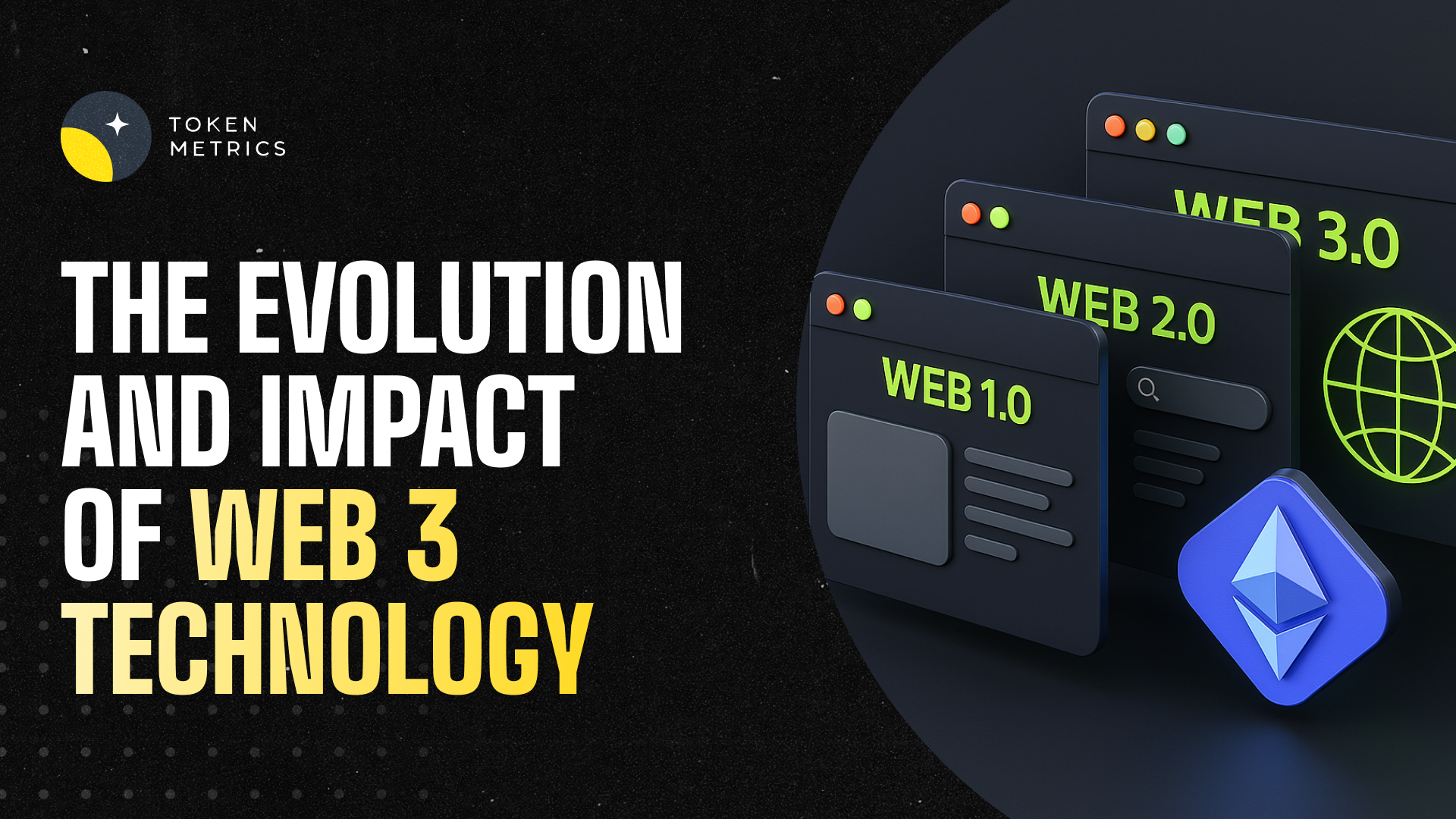
Understanding the Evolution and Impact of Web 3 Technology

Discover what Web 3 is, its core technologies, applications, challenges, and how AI-powered tools like Token Metrics aid in analyzing this emerging decentralized internet layer.
Token Metrics Team
5
Want Smarter Crypto Picks—Free?
See unbiased Token Metrics Ratings for BTC, ETH, and top alts.
Thank you! Your submission has been received!
Oops! Something went wrong while submitting the form.
 No credit card | 1-click unsubscribe

Introduction to Web 3

The digital landscape is continually evolving, giving rise to a new paradigm known as Web 3. This iteration promises a shift towards decentralization, enhanced user control, and a more immersive internet experience. But what exactly is Web 3, and why is it considered a transformative phase of the internet? This article explores its fundamentals, technology, potential applications, and the tools available to understand this complex ecosystem.

Defining Web 3

Web 3, often referred to as the decentralized web, represents the next generation of internet technology that aims to move away from centralized platforms dominated by a few major organizations. Instead of relying on centralized servers, Web 3 utilizes blockchain technology and peer-to-peer networks to empower users and enable trustless interactions.

In essence, Web 3 decentralizes data ownership and governance, allowing users to control their information and digital assets without intermediaries. This marks a significant departure from Web 2.0, where data is predominantly managed by centralized corporations.

Key Technologies Behind Web 3

Several emerging technologies underpin the Web 3 movement, each playing a vital role in achieving its vision:

  • Blockchain: A distributed ledger system ensuring transparency, security, and immutability of data. It replaces traditional centralized databases with decentralized networks.
  • Decentralized Applications (dApps): Applications running on blockchain networks providing services without a central controlling entity.
  • Smart Contracts: Self-executing contracts with coded rules, enabling automated and trustless transactions within the Web 3 ecosystem.
  • Decentralized Finance (DeFi): Financial services built on blockchain, offering alternatives to traditional banking systems through peer-to-peer exchanges.
  • Non-Fungible Tokens (NFTs): Unique digital assets representing ownership of items like art, music, or virtual real estate verified on a blockchain.

Together, these technologies provide a robust foundation for a more autonomous and transparent internet landscape.

Contrasting Web 3 With Web 2

Understanding Web 3 requires comparing it to its predecessor, Web 2:

  • Data Control: Web 2 centralizes data with platform owners; Web 3 returns data ownership to users.
  • Intermediaries: Web 2 relies heavily on intermediaries for operations; Web 3 enables direct interaction between users via decentralized protocols.
  • Monetization Models: Web 2 monetizes mainly through targeted ads and user data; Web 3 offers new models such as token economies supported by blockchain.
  • Identity: Web 2 uses centralized identity management; Web 3 incorporates decentralized identity solutions allowing greater privacy and user control.

This shift fosters a more user-centric, permissionless, and transparent internet experience.

Potential Applications of Web 3

Web 3's decentralized infrastructure unlocks numerous application possibilities across industries:

  • Social Media: Platforms that return content ownership and revenue to creators rather than centralized corporations.
  • Finance: Peer-to-peer lending, decentralized exchanges, and transparent financial services enabled by DeFi protocols.
  • Gaming: Games featuring true asset ownership with NFTs and player-driven economies.
  • Supply Chain Management: Immutable tracking of goods and provenance verification.
  • Governance: Blockchain-based voting systems enhancing transparency and participation.

As Web 3 matures, the range of practical and innovative use cases is expected to expand further.

Challenges and Considerations

Despite its promise, Web 3 faces several hurdles that need attention:

  • Scalability: Current blockchain networks can encounter performance bottlenecks limiting widespread adoption.
  • User Experience: Interfaces and interactions in Web 3 must improve to match the seamlessness users expect from Web 2 platforms.
  • Regulatory Environment: Legal clarity around decentralized networks and digital assets remains a work in progress globally.
  • Security: While blockchain offers security benefits, smart contract vulnerabilities and user key management pose risks.

Addressing these challenges is crucial for realizing the full potential of Web 3.

How to Research Web 3 Opportunities

For individuals and organizations interested in understanding Web 3 developments, adopting a structured research approach is beneficial:

  1. Fundamental Understanding: Study blockchain technology principles and the differences between Web 2 and Web 3.
  2. Use Analytical Tools: Platforms like Token Metrics provide data-driven insights and ratings on Web 3 projects, helping to navigate the complex ecosystem.
  3. Follow Reputable Sources: Stay updated with academic papers, technical blogs, and industry news.
  4. Experiment with Applications: Engage hands-on with dApps and blockchain platforms to gain practical understanding.
  5. Evaluate Risks: Recognize technical, operational, and regulatory risks inherent to emerging Web 3 projects.

This approach supports informed analysis based on technology fundamentals rather than speculation.

The Role of AI in Web 3 Research

Artificial intelligence technologies complement Web 3 by enhancing research and analytical capabilities. AI-driven platforms can process vast amounts of blockchain data to identify patterns, assess project fundamentals, and forecast potential developments.

For example, Token Metrics integrates AI methodologies to provide insightful ratings and reports on various Web 3 projects and tokens. Such tools facilitate more comprehensive understanding for users navigating decentralized ecosystems.

Conclusion

Web 3 embodies a transformative vision for the internet—one that emphasizes decentralization, user empowerment, and innovative applications across multiple sectors. While challenges remain, its foundational technologies like blockchain and smart contracts hold substantial promise for reshaping digital interactions.

Continuing research and utilization of advanced analytical tools like Token Metrics can help individuals and organizations grasp Web 3’s evolving landscape with clarity and rigor.

Disclaimer

This article is for educational and informational purposes only and does not constitute financial, investment, or legal advice. Readers should conduct their own research and consult with professional advisors before making any decisions related to Web 3 technologies or digital assets.

Build Smarter Crypto Apps &
AI Agents in Minutes, Not Months
Real-time prices, trading signals, and on-chain insights all from one powerful API.
Grab a Free API Key
About Token Metrics
Token Metrics: AI-powered crypto research and ratings platform. We help investors make smarter decisions with unbiased Token Metrics Ratings, on-chain analytics, and editor-curated “Top 10” guides. Our platform distills thousands of data points into clear scores, trends, and alerts you can act on.
30 Employees
analysts, data scientists, and crypto engineers
Daily Briefings
concise market insights and “Top Picks”
Transparent & Compliant
Sponsored ≠ Ratings; research remains independent
Want Smarter Crypto Picks—Free?
See unbiased Token Metrics Ratings for BTC, ETH, and top alts.
Thank you! Your submission has been received!
Oops! Something went wrong while submitting the form.
 No credit card | 1-click unsubscribe
Token Metrics Team
Token Metrics Team

Recent Posts

Research

Exploring Crypto APIs: Types of Data You Can Access

Token Metrics Team
4

The explosion of digital assets has fueled a new era of on-demand data analysis, making crypto APIs essential for enthusiasts, developers, and analysts alike. But what kinds of information can you actually unlock using a crypto API, and how can this data power smarter apps or research?

Real-Time Crypto Prices and Market Snapshots

One of the most popular uses for a crypto API is accessing real-time pricing data. APIs enable you to pull the latest prices for thousands of cryptocurrencies across multiple exchanges instantly. This information is foundational for market analysis, digital asset tracking, and powering portfolio dashboards.

  • Spot Prices: The current buy and sell price for a cryptocurrency.
  • Volume: The amount traded within a particular time period.
  • Market Cap: Calculated by multiplying the price by circulating supply.
  • Highs/Lows: Highest and lowest prices over different intervals (e.g., 24-hour range).

Most leading APIs, such as the Token Metrics API, offer live pricing feeds for efficient decision-making and data integration.

Deep-Dive: Historical Price and Volume Data

Reliable historical data is key to uncovering trends, backtesting strategies, and building machine learning models. Crypto APIs typically allow you to pull:

  • Tick-level Data: Every trade or price change, often down to milliseconds.
  • OHLCV Data: Open, High, Low, Close, Volume over set intervals (minute, hour, day, etc.).
  • Aggregated Statistics: Average prices, moving averages, and other calculated metrics.

Historical endpoints help quant researchers and developers build accurate visualizations and statistical models. For instance, analyzing 365 days of closing prices can reveal volatility patterns or market cycles.

Order Book Depth and Market Liquidity Insights

Order book data provides the pulse of live trading activity, revealing granular details about market depth and liquidity. With a crypto API, you can access:

  • Bid/Ask Orders: See active buy (bid) and sell (ask) orders, including sizes and prices.
  • Order Book Snapshots: Full snapshots of orders at a moment in time or real-time streaming updates.
  • Depth Charts: Visualize how deep the market is at different price levels.

Order book access is crucial for algorithmic trading, slippage estimates, and evaluating liquidity. Some APIs even support aggregated order books across several exchanges for more complete market intelligence.

Live Trades, Transactions, and Ticker Data

In addition to static prices, many crypto APIs deliver real-time trade and ticker data. This includes:

  • Ticker Streams: Continuous feeds of price and volume changes for multiple assets.
  • Trades Feed: A chronological record of every executed trade—useful for volume analysis and pattern recognition.
  • Trade Metadata: Additional details like trade size, buyer/seller side, and unique trade IDs.

Use cases range from powering trading bots to feeding AI-driven analytics or anomaly detection systems. This granularity allows a deeper understanding of real-time market sentiment.

Access to On-Chain and Blockchain Analytics

Beyond market data, advanced crypto APIs now offer direct access to blockchain or on-chain data. Developers and analysts gain the ability to:

  • Monitor Wallet Balances & Activity: Track transactions, wallet holdings, and token movements.
  • Analyze Smart Contracts: Fetch function calls, execution outcomes, and contract metrics.
  • Identify Network Metrics: Including block times, hash rates, gas fees, and validator stats.

Such on-chain analytics underpin advanced research, compliance processes, and fraud detection strategies. APIs that aggregate insights across multiple blockchains add significant value for multi-asset and multi-chain projects.

Build Smarter Crypto Apps & AI Agents with Token Metrics

Token Metrics provides real-time prices, trading signals, and on-chain insights all from one powerful API. Grab a Free API Key

Frequently Asked Questions

What is the most common data provided by crypto APIs?

Most crypto APIs supply real-time prices, trading volume, order books, and historical price/volume data. Some also cover blockchain transactions and wallet-level insights—useful for a range of research and app development scenarios.

Can I get data from multiple exchanges with one API?

Leading crypto APIs aggregate data from various exchanges, allowing developers and analysts to access consolidated prices, order books, and liquidity. Aggregated APIs minimize discrepancies and broaden coverage.

How far back does historical crypto data go in APIs?

The available historical depth varies; top APIs like Token Metrics offer years of daily price data, with some offering tick-level data spanning months or years. Always review documentation for specific asset or interval support.

Why is programmatic access to crypto data important?

APIs allow for automated retrieval, filtering, and analysis of large datasets—enhancing research, powering trading robots, building dashboards, or supporting AI-driven models with up-to-date, reliable information.

What are practical uses for on-chain data from APIs?

On-chain data enables compliance monitoring, wallet tracking, DeFi analytics, NFT research, contract auditing, and forensic investigations. Modern APIs help analysts and businesses stay agile amid evolving blockchain trends.

Disclaimer

This article is for informational purposes only and does not constitute investment, financial, legal, or tax advice. Cryptocurrency markets are volatile and involve risks. Always conduct your own research before making decisions or building applications based on crypto data.

Research

Crypto APIs: Free Access vs Paid Options Explained

Token Metrics Team
6

As the cryptocurrency landscape grows more complex, developers and businesses increasingly rely on crypto APIs to access data, power apps, and build innovative blockchain solutions. But a common question arises: are crypto APIs free, or will you need to pay to unlock full functionality?

What Are Crypto APIs and Why Do They Matter?

Crypto APIs (Application Programming Interfaces) act as critical gateways to blockchain data, facilitating seamless integration with cryptocurrency exchanges, wallets, smart contracts, and on-chain analytics. Whether you're building a trading bot, a portfolio dashboard, or financial analytics tools, APIs provide the technical means to fetch real-time prices, historical data, market signals, and transaction details.

For developers and enterprises, leveraging APIs saves hundreds of hours that would otherwise be spent running full blockchain nodes or parsing raw blockchain data. This access underpins everything from decentralized finance (DeFi) apps to AI-powered trading agents. Given their importance, understanding the pricing and business models behind crypto APIs is essential for making informed development decisions.

Overview of Free Crypto API Offerings

Many crypto API providers offer free tiers to enable experimentation, small-scale projects, or basic research. Free plans typically allow users to:

  • Fetch current cryptocurrency prices and simple price charts.
  • Access limited historical data (last 24 hours or 1–7 days).
  • Make a restricted number of daily or monthly requests (e.g., 1,000–100,000).
  • Use basic endpoints, such as wallet balance queries or publicly available blockchain metrics.

Popular platforms like CoinGecko, CoinMarketCap, and CryptoCompare all offer some form of a free API key. For open-source or non-commercial projects, these resources can be invaluable. However, free APIs are generally subject to tighter rate limits, API call quotas, occasional delays, and less robust customer support. For mission-critical apps or commercial ventures, these constraints may hinder scalability and reliability.

When and Why Should You Pay for a Crypto API?

Paid crypto APIs are designed to meet the needs of high-volume traders, institutions, and enterprises that require advanced capabilities, higher reliability, and comprehensive datasets. Features usually unlocked in paid plans include:

  • Significantly higher or unlimited API call limits—crucial for real-time trading bots or analytics platforms.
  • Access to premium data sets, such as full historical price data, order book snapshots, and on-chain analytics.
  • Advanced market intelligence, trading signals, or real-time alerts.
  • Dedicated support, service-level agreements (SLAs), and enhanced data integrity guarantees.
  • Batch data downloads and advanced querying capabilities (for AI/ML models or large-scale backtesting).

The pricing models for these APIs vary widely—ranging from monthly subscriptions to pay-as-you-go plans, and sometimes custom enterprise contracts. Providers like Token Metrics, Messari, and Chainalysis are examples offering sophisticated data-access APIs, each with tiered plans depending on user requirements.

Factors to Consider When Selecting an API

Deciding between free and paid APIs goes beyond just budget; it requires analyzing technical and operational needs. Key considerations should include:

  1. Data Coverage: Does the API support all the cryptocurrencies, exchanges, and blockchains you need?
  2. Rate Limits: Will the request quotas of free tiers suffice for your application's users or analytics workload?
  3. Data Accuracy & Latency: Check if the provider offers low-latency updates and real-time feeds required for responsive/trading use-cases.
  4. Advanced Features: Are you seeking advanced analytics (e.g., AI-powered signals, on-chain metrics) or just basic price data?
  5. Reliability and Uptime: Is there a service agreement, monitoring, or 24/7 support in higher tiers?
  6. Legal & Compliance: Especially for enterprise cases, make sure the data provider complies with relevant regulations and offers data usage rights.

For many developers, the path starts with free APIs for exploratory work and transitions to paid plans as scalability, security, and feature demands grow. While free tiers lower the barrier to entry, production-grade platforms often require investing in robust, premium APIs—especially when building for third-party users or integrating AI systems reliant on accurate data streams.

Crypto API Pricing Structures in Practice

The crypto API market features a variety of pricing models to suit diverse needs:

  • Freemium: A basic level of service is free; premium plans unlock critical extras (higher limits, priority support, additional data sets).
  • Tiered Subscription: Multiple levels (Starter, Pro, Enterprise) with clearly defined features and limits.
  • Pay-As-You-Go: Charges based on actual usage (e.g., per API call or per MB of data).
  • Open-Source APIs: Some projects provide source code and APIs for anyone to self-host and use, though these may require significant technical overhead.

Each model impacts not just the cost but also integration choices. For example, a developer building an AI-driven trading assistant may need not only current price feeds but also deep market signals and on-chain data—necessitating advanced tier plans.

Build Smarter Crypto Apps & AI Agents with Token Metrics

Token Metrics provides real-time prices, trading signals, and on-chain insights all from one powerful API. Grab a Free API Key

FAQs for Crypto API Access

Are all crypto APIs free?

No, not all crypto APIs are free. While many providers offer limited free tiers, advanced features such as higher rate limits, in-depth analytics, and premium support typically require a paid plan or subscription.

What kind of data can I access with a free API key?

Free API keys generally provide access to basic price information, limited historical data, and publicly visible blockchain metrics within specified rate limits. Advanced or bulk data, in-depth analytics, and commercial licensing often require paid access.

When should I consider upgrading to a paid API?

Consider upgrading to a paid API when your app or project requires higher reliability, faster updates, greater request quotas, access to premium data sets (such as order books, advanced analytics, or on-chain signals), or enterprise-grade support.

How do crypto API providers typically price their services?

Crypto API providers use a mix of freemium, tiered subscription, and pay-as-you-go models. Pricing varies based on usage, features required, support level, and data depth. Most providers publish clear rate sheets or offer custom enterprise solutions for large-scale needs.

Are there open-source or self-hosted crypto API alternatives?

Yes, open-source crypto APIs and data crawlers exist, enabling developers to self-host and customize their data infrastructure. However, this typically requires significant technical resources for deployment, scaling, and data quality assurance.

Disclaimer

This article is for educational and informational purposes only. It is not intended as investment advice or an endorsement of any specific service or platform. Please conduct your own research and consult qualified professionals for business or technical guidance.

Research

How Crypto APIs Power Real-Time Data for Apps and Platforms

Token Metrics Team
6

Crypto markets never sleep—prices shift 24/7, blockchain activity surges minute by minute, and traders, analysts, or developers want up-to-the-second data. But where do wallet trackers, trading bots, or dashboards source this real-time information? The answer: powerful crypto APIs that connect applications directly to live blockchain and market data streams.

How Crypto APIs Work: Bridging Apps with Blockchains and Exchanges

Crypto APIs (Application Programming Interfaces) are the digital bridges between external software applications—like portfolio trackers, exchanges, or research platforms—and sources of cryptocurrency market and blockchain data. Instead of developers parsing raw blockchain nodes or manually scraping exchange data, APIs offer structured, standardized access to:

  • Price Data: Live and historical prices for thousands of digital assets from multiple exchanges.
  • Volume and Order Book Data: Insights into trading activity, liquidity, and market depth.
  • Blockchain Data: On-chain transactions, block confirmations, wallet balances, and token info.
  • Signals and Analytics: Trading signals, technical indicators, and sentiment metrics.

APIs can be called on-demand (REST APIs) for snapshots, or stream continuous updates (WebSockets) for real-time data. This accessibility enables faster, more reliable, and easily scalable integration for any crypto application.

Real-Time vs. Historical Crypto Data: What Makes Real-Time So Unique?

Real-time crypto data means delivering the most current information to users, ideally within milliseconds or a few seconds of it being published on an exchange or blockchain. In volatile markets, the difference between real-time and delayed data can be significant, especially for automated applications like trading bots, AI agents, or alert systems.

Unlike historical data—used for backtesting or research—real-time data requires:

  • Low Latency Gathering: APIs must quickly ingest updates from blockchains and exchanges without significant lag.
  • Immediate Distribution: Data is pushed to clients or applications as soon as it’s available, often via persistent connections.
  • Reliability and Consistency: Ensured by robust infrastructure, data normalization, and error handling.

This demand for immediacy has shaped how top crypto APIs are built and how they interact with core data sources.

Data Sources for Crypto APIs: Exchanges, Blockchains, and Aggregators

To supply accurate real-time data, APIs must connect with several pillars of the crypto ecosystem:

  1. Centralized Exchanges (CEXs): APIs query and stream price, trade, and order book data from platforms like Binance, Coinbase, and Kraken. Many CEXs offer official APIs, which third-party API providers aggregate and standardize.
  2. Decentralized Exchanges (DEXs): On-chain data feeds from Uniswap, Curve, and other DEXs are sourced directly from smart contracts via blockchain nodes.
  3. Blockchain Networks: APIs utilize full nodes or light clients to pull transaction details, new blocks, token transfers, and wallet balances. This is achieved using technologies like JSON-RPC, GraphQL, or event listeners.
  4. Aggregators: Top crypto APIs often aggregate dozens of sources—both CEXs and DEXs—then normalize, de-duplicate, and enrich the data for end users.

APIs with broad coverage ensure more accurate, real-time market snapshots and make it easier for applications to monitor thousands of assets or protocols efficiently.

How Real-Time Crypto Data Flows: From Source to End-User

The journey of real-time crypto data from its origin to your screen usually involves these steps:

  • Source Polling or Streaming: The API provider constantly queries or subscribes to data endpoints from exchanges and blockchain nodes. For exchanges, this could mean polling their REST endpoints or opening WebSocket streams for live trades. For blockchains, it might involve running full nodes or using trusted node providers that push every new block or transaction.
  • Data Aggregation and Normalization: Data from multiple sources is collected, cleaned, de-duplicated, and standardized. APIs handle inconsistencies in trading pairs, fee structures, or ticker conventions to provide a smooth developer experience.
  • Pushing Updates to Clients: Real-time updates can be delivered via WebSockets, webhooks, or (less commonly) fast-polling REST endpoints. This ensures apps, dashboards, or bots receive instant data refreshes and can react to events as they happen.
  • API Layer Optimizations: Leading APIs employ caching, load balancing, sharding, and rate-limiting to maintain low latency, prevent downtime, and scale out automatically during periods of high demand.

The architecture behind these systems is complex—requiring careful engineering, robust security, and transparency to prevent data discrepancies or manipulation.

Practical Applications: Why Real-Time Data Matters

Real-time crypto data powers more than just flashy charts. Its uses include:

  • Portfolio Trackers: Accurately reflecting wallet balances and portfolio values as assets move or prices swing.
  • Automated Trading Bots: Using live market data to trigger trades based on preprogrammed strategies.
  • Risk Monitoring Tools: Triggering risk controls or stop-losses if sudden price changes occur.
  • Research Platforms & Dashboards: Delivering analysts, institutions, and hobbyists real-time transaction flows, exchange volumes, and token metrics.
  • AI Agents & Advanced Analytics: Enabling machine learning models to adapt in real time based on evolving on-chain and market conditions.

This abundance of real-time information can enhance decision-making, improve user experience, and expand what’s possible for crypto developers and professionals—even outside trading or investing contexts.

Build Smarter Crypto Apps & AI Agents with Token Metrics

Token Metrics provides real-time prices, trading signals, and on-chain insights all from one powerful API. Grab a Free API Key

FAQ: How Do Crypto APIs Get Real-Time Data?

What Protocols Do Crypto APIs Use to Deliver Real-Time Data?

Crypto APIs deliver real-time data primarily through WebSocket streams, which allow fast, continuous data transfer. REST APIs provide snapshot data for quick queries. Some use webhooks or subscribe to blockchain events for instant updates when transactions or blocks are confirmed.

How Do APIs Ensure Data Accuracy Across Multiple Sources?

APIs aggregate data from various exchanges and blockchain nodes, cross-referencing sources to detect discrepancies or outliers. They normalize ticker symbols, prioritize high-liquidity markets, and filter out manipulated or erroneous data before serving it to users.

Can Developers Access Both Historical and Real-Time Crypto Data?

Yes, most top crypto APIs provide endpoints for both real-time streaming and historical data retrieval. Developers can analyze past price trends, on-chain activity, or backtest strategies alongside accessing live market and blockchain feeds.

Are Crypto APIs Secure When Handling Sensitive Wallet or Transaction Data?

Leading crypto APIs use HTTPS encryption, authentication tokens, and strict permission controls to protect user data. Still, sensitive actions (like executing trades or broadcasting transactions) should use APIs from trusted, reputable providers with robust security policies.

What Are the Main Limitations of Using Crypto APIs?

Limitations include rate limits (restricting request frequency), potential latency during market surges, and incomplete coverage if certain exchanges or blockchains aren't integrated. Some APIs may also restrict access to premium real-time features behind subscriptions.

Disclaimer

This content is for informational and educational purposes only. No financial, investment, or trading advice is provided or implied. Cryptocurrency carries risks; always conduct your own research and due diligence before using any platform, service, or API.

Choose from Platinum, Gold, and Silver packages
Reach with 25–30% open rates and 0.5–1% CTR
Craft your own custom ad—from banners to tailored copy
Perfect for Crypto Exchanges, SaaS Tools, DeFi, and AI Products