Back to blog
Research

Understanding Proprietary Market Signals: How Crypto Indices Detect Bull and Bear Markets

Learn how crypto indices and proprietary market signals, including AI-powered insights from Token Metrics, help detect bull and bear markets for risk-conscious investors.
Token Metrics Team
12
Want Smarter Crypto Picks—Free?
See unbiased Token Metrics Ratings for BTC, ETH, and top alts.
Thank you! Your submission has been received!
Oops! Something went wrong while submitting the form.
 No credit card | 1-click unsubscribe

In the fast-paced and often unpredictable world of cryptocurrency, understanding how crypto indices detect bull and bear markets is crucial for investors aiming to maximize profits and minimize losses. Unlike traditional financial markets, where a simple 20% price drop might signify a bear market, the crypto market is far more volatile, with frequent sharp price fluctuations that do not necessarily indicate a shift in market regime. This volatility demands more sophisticated tools that analyze a wide range of data points, enabling investors and traders to distinguish genuine bull and bear markets from short-term noise.

Traditional indicators commonly used in traditional finance often fall short when applied to digital assets. To address this challenge, proprietary market signals have emerged as a useful tool that leverages advanced analytics, including artificial intelligence and on-chain data, to detect market regime shifts with greater accuracy. This article explores the limitations of legacy indicators, the architecture behind proprietary signals, and how platforms like Token Metrics are revolutionizing the way market phases are identified and acted upon.

The Inadequacy of Traditional Indicators

Many newcomers to crypto rely heavily on legacy technical indicators such as the Relative Strength Index (RSI), Moving Average Convergence Divergence (MACD), and simple moving averages. These tools have a long history in traditional markets, but they exhibit critical weaknesses when applied to the crypto market cycle.

The Lagging Problem

Traditional indicators are inherently backward-looking. For example, RSI may only indicate that Bitcoin is "overbought" after a significant rally has already occurred, while MACD crossover signals often lag behind actual trend changes by days. This delay means that by the time traders receive warnings, institutional investors and experienced traders have often already adjusted their positions. The widely cited 200-day moving average (MA) is a classic example: it requires 200 days of data to calculate, making it slow to react to rapid market shifts. When Bitcoin’s price dropped below the 200-day MA in March 2025, many declared a bear market, but this signal came too late to capture the onset of the downturn effectively.

The False Signal Epidemic

Crypto's notorious volatility generates frequent false alarms with traditional metrics. A 20% price drop—enough to define a bear market in stocks—can be a routine correction or consolidation in crypto, occurring without a genuine regime change. Bitcoin, for instance, can experience significant price trends downward during an overall bull market and then resume its upward momentum. Relying on these traditional signals often results in premature selling during temporary bear phases or missed opportunities during early bull phases.

Single-Factor Blindness

Legacy indicators typically focus on a single dimension, usually price action. They overlook critical factors like on-chain activity, wallet flows, network fundamentals, trading volume, market sentiment, liquidity, and broader macroeconomic influences such as interest rates or the wider economy. This narrow view produces an incomplete and sometimes misleading picture of the market’s health.

The Architecture of Proprietary Market Signals

Proprietary market signals represent a significant evolution beyond traditional tools by incorporating three key innovations: multi-factor analysis, machine learning adaptation, and signal confluence validation.

Multi-Factor Analysis

Advanced systems evaluate dozens of independent data sources spanning multiple categories to build a nuanced understanding of market conditions:

By integrating these diverse data points, proprietary systems develop a holistic view of the crypto market, enabling more accurate detection of bull or bear market regimes.

Machine Learning Adaptation

Unlike static technical indicators, the most sophisticated proprietary systems employ machine learning models that continuously learn from historical outcomes. These AI-powered models analyze thousands of past market setups to identify which combinations of factors preceded genuine breakouts or downturns. This adaptability is critical because the crypto market cycle evolves rapidly; patterns effective in 2020 may not hold in 2025 as the market matures and institutional participation increases.

By constantly refining their algorithms based on new data, these systems maintain their effectiveness across different market phases, including bull markets, bear markets, and sideways consolidations.

Signal Confluence

A defining feature of proprietary signals is the requirement that multiple independent indicators align before a signal is triggered. Instead of reacting to any single metric crossing a threshold, these systems wait for a confluence of price action, volume patterns, on-chain metrics, and sentiment indicators to confirm a setup.

This multi-factor confirmation dramatically reduces false positives. When several data points simultaneously indicate bullish conditions, the probability of a true bull market increases significantly compared to relying on one indicator alone. The same applies to detecting bear markets, where combined signals of selling pressure, declining volume, and negative sentiment provide stronger evidence of a downturn.

Token Metrics: Setting the Standard for Market Intelligence

Token Metrics has emerged as a leader in applying proprietary signal technology to the crypto space, offering what many consider the industry's most sophisticated market detection system. As a cryptocurrency investment research firm leveraging AI and machine learning, Token Metrics analyzes over 6,000 projects, processing more data points and generating more accurate signals than most competitors.

The Token Metrics Signal Architecture

Token Metrics’ Bullish and Bearish Signals operate through a multi-layered system that integrates over 80 data points per token. These include price momentum shifts across various timeframes, higher trading volumes and anomalies, interactions with support and resistance levels, on-chain activity strength, whale wallet flow patterns, social sentiment analysis, and liquidity and order book depth.

Importantly, signals are only triggered when multiple critical factors confirm the setup, following the signal confluence approach that eliminates many false alarms common in traditional methods.

AI-Powered Learning

What sets Token Metrics apart is its continuous machine learning-driven refinement. The platform’s AI models train on outcomes, not just patterns, learning which factor combinations consistently lead to real breakouts or downturns. This outcome-based training ensures the system remains responsive to evolving market dynamics, such as increased institutional adoption and the rise of tokenized real-world assets.

Rigorous backtesting against extensive historical data ensures signals maintain accuracy across bull and bear cycles, avoiding deterioration that plagues static indicators.

Real-World Performance

Token Metrics regularly showcases its signal effectiveness with documented examples. For instance, a Bullish Signal on a lesser-known token, $DEGEN, preceded a +35% breakout despite minimal social media attention. Conversely, a Bearish Signal on $ENA helped users avoid a -22% correction. These examples illustrate how proprietary intelligence offers insights that can assist in managing market risks and opportunities.

How Regime Switching Works in Practice

The practical application of proprietary signals is evident in automated index strategies like Token Metrics’ TM Global 100 Index, which demonstrates systematic regime switching based on real-time market intelligence.

The Detection Process

Token Metrics continuously monitors its proprietary indicators, synthesizing price action, volume, on-chain metrics, sentiment data, and macroeconomic factors into comprehensive assessments of market regimes. When multiple signals align bullishly, the system classifies the environment as a bull market and maintains full exposure to the top 100 cryptocurrencies by market capitalization, capturing upside potential across the ecosystem.

When bearish signals dominate, indicating elevated risk and selling pressure, the index automatically shifts holdings into stablecoins like USDC, preserving capital during downturns often referred to as crypto winter.

The Advantage Over Manual Trading

Manual market timing is challenging for individual investors who must juggle numerous indicators, overcome emotional biases like fear and greed, and execute complex portfolio adjustments efficiently. Proprietary systems remove these obstacles by making emotionless, data-driven decisions automatically. This disciplined approach helps avoid panic sells during bottoms and impulsive buys at tops, common pitfalls for many traders.

Transparency Without Complexity

While the underlying AI and multi-factor models are complex, Token Metrics maintains transparency by providing users with a Market Gauge showing current regime assessments, interactive portfolio visualizations, detailed transaction logs, and performance analytics. This openness fosters trust while safeguarding the proprietary nature of the algorithms.

Beyond Binary: Understanding Market Nuance

Sophisticated proprietary systems recognize that markets are not simply in a binary bull or bear state but operate along a spectrum with varying conviction levels. Token Metrics’ signals can indicate conditions ranging from "strong bullish" to "strong bearish," allowing for nuanced position sizing and risk management.

During strong bullish phases, indices maintain maximum exposure to volatile assets and emerging projects with strong demand. In neutral or uncertain periods, exposure is moderated, and in strong bearish environments, defensive allocations to stablecoins are preferred. This approach helps to optimize returns and manage risk effectively.

The Competitive Moat of Proprietary Intelligence

The significance of proprietary signals lies in the information advantage they offer. Investors who effectively detect regime shifts early can capitalize on opportunities before the broader market recognizes them. By the time mainstream media or lagging indicators declare a bear or bull market, those relying on shared signals may have missed the optimal entry or exit points.

Token Metrics invests heavily in AI infrastructure, data science, and comprehensive data gathering to sustain its competitive edge. Its ability to analyze billions of data points and adapt models swiftly provides insights difficult to replicate manually, democratizing sophisticated market detection for individual investors.

Practical Application for Investors

Understanding how crypto indices detect bull and bear markets is vital, but the key lies in how investors apply this knowledge:

The Future of Market Intelligence

As the crypto ecosystem matures, with innovations in DeFi, AI, and tokenized assets, the need for advanced analytics will intensify. Token Metrics plans to expand its proprietary signal technology with sector-specific indicators, enhanced natural language processing, integration with automated trading, and deeper on-chain health metrics to keep users at the forefront of market intelligence.

Conclusion: Intelligence as Competitive Advantage

In today’s complex financial landscape, accurately identifying market regimes is essential for systemic risk management and opportunity capture. Proprietary signals, powered by AI and multi-factor analysis, offer a comprehensive and adaptive approach that surpasses traditional indicators. Platforms like Token Metrics provide invaluable insights that help investors navigate volatile markets effectively. Recognizing regime shifts early and acting on them systematically can be the difference between sustained success and missed opportunities. Equip yourself with cutting-edge tools to stay ahead in the evolving crypto world.

Discover Crypto Gems with Token Metrics AI

Token Metrics uses AI-powered analysis to help you uncover profitable opportunities in the crypto market. Get Started For Free

What are crypto indices?

Crypto indices are financial instruments that track the performance of a basket of digital assets, typically weighted by market capitalization or other criteria. These indices provide a broad overview of the cryptocurrency market, making it easier to monitor overall trends and benchmark returns without focusing on individual tokens.

How do proprietary signals differ from traditional indicators?

Proprietary signals integrate multiple data sources—including price action, on-chain data, sentiment, and macroeconomic factors—while leveraging machine learning and advanced analytics. Traditional indicators often rely on single-factor price analysis. By synthesizing diverse data, proprietary signals are better equipped to detect genuine market regime shifts and reduce false signals.

How does Token Metrics generate its market signals?

Token Metrics employs a multi-factor, AI-driven system that analyzes over 80 data points per token, including price dynamics, volume, on-chain activity, liquidity, and sentiment. Signals are only triggered when several independent metrics confirm the same market regime, ensuring robustness and reducing the risk of false alerts.

Can individual investors use proprietary market signals?

Yes. Platforms like Token Metrics provide access to proprietary signals, making advanced analytics available to retail investors. This democratizes the sophisticated tools once reserved for institutions and enables individuals to make more informed decisions and manage risk effectively.

How do crypto indices handle market volatility?

Advanced crypto indices employ real-time monitoring and regime-switching algorithms, allowing them to shift allocations—from full exposure to stablecoins—based on current market conditions. This adaptability helps manage risk and reduce the impact of extreme volatility commonly observed in the crypto market.

Disclaimer

This content is for informational and educational purposes only and should not be interpreted as financial advice, investment recommendations, or an offer to buy or sell any asset. The information provided is accurate to the best of our knowledge at the time of publication. Always conduct your own research and consult with a professional advisor before making investment decisions. Cryptocurrency markets are volatile, and past performance is not indicative of future results.

Build Smarter Crypto Apps &
AI Agents in Minutes, Not Months
Real-time prices, trading signals, and on-chain insights all from one powerful API.
Grab a Free API Key
About Token Metrics
Token Metrics: AI-powered crypto research and ratings platform. We help investors make smarter decisions with unbiased Token Metrics Ratings, on-chain analytics, and editor-curated “Top 10” guides. Our platform distills thousands of data points into clear scores, trends, and alerts you can act on.
30 Employees
analysts, data scientists, and crypto engineers
Daily Briefings
concise market insights and “Top Picks”
Transparent & Compliant
Sponsored ≠ Ratings; research remains independent
Want Smarter Crypto Picks—Free?
See unbiased Token Metrics Ratings for BTC, ETH, and top alts.
Thank you! Your submission has been received!
Oops! Something went wrong while submitting the form.
 No credit card | 1-click unsubscribe
Token Metrics Team
Token Metrics Team

Recent Posts

Research

APIs Explained: How They Power Software and Crypto

Token Metrics Team
5

APIs are the invisible connectors that let apps talk to each other. Whether you’re loading a weather widget, pulling crypto prices into a dashboard, or integrating an AI model, understanding how APIs work helps you design, evaluate, and secure systems that depend on reliable data.

What is an API?

An API—Application Programming Interface—is a clearly defined set of rules and contracts that lets one software program request services or data from another. At its core an API specifies how to format requests, what endpoints are available, what parameters are accepted, and how the provider will respond. Think of it as a menu at a restaurant: you pick dishes (requests), the kitchen prepares them (the service), and the waiter returns your order (the response) without exposing internal cooking processes.

APIs exist at many levels: operating system APIs expose filesystem and device operations, library APIs expose functions and classes, and web APIs expose remote services across networks. In modern web and mobile development, "API" often refers to HTTP-based interfaces that return structured data like JSON or XML.

How APIs Work: Requests, Responses, and Data Formats

Most web APIs operate on a request–response model. A client issues a request to a defined endpoint using a method (GET, POST, PUT, DELETE), optionally supplying parameters or a payload. The server processes the request and returns a response with a status code and body.

Key technical elements to understand:

  • Endpoints: URLs that map to resources or actions (e.g., /v1/prices).
  • HTTP Methods: Semantic actions (GET = read, POST = create, etc.).
  • Status Codes: 2xx successes, 4xx client errors, 5xx server errors.
  • Data Formats: JSON is ubiquitous for APIs due to its simplicity; XML and protobufs appear in legacy or high-performance systems.
  • Authentication & Authorization: API keys, OAuth tokens, JWTs, and mTLS govern who can access which endpoints.
  • Rate Limits & Quotas: Providers throttle requests to protect infrastructure and ensure fair use.

Real-time APIs may use WebSockets or server-sent events for streaming data rather than repeated HTTP polling. Designing for observability—clear logs, metrics, and error messages—improves operational resilience.

Common API Types and Protocols

Different projects require different API styles. Choosing a style depends on latency, flexibility, compatibility, and developer experience needs.

  • REST: Representational State Transfer emphasizes resources and standard HTTP verbs. RESTful APIs are easy to cache and widely supported.
  • GraphQL: Clients request exactly the fields they need in a single query, reducing over-fetching. GraphQL adds flexibility but requires careful performance tooling.
  • SOAP: An XML-heavy protocol that offers strict contracts and built-in standards for security and transactions; common in enterprise systems.
  • gRPC / Protobuf: High-performance RPC frameworks for microservices with compact binary payloads and strict typing.
  • Webhooks: Reverse-style APIs where a service pushes events to your endpoint, useful for near-real-time notifications without polling.

APIs are often packaged with SDKs for languages like Python, JavaScript, or Go to simplify integration. Documentation, example requests, and interactive consoles dramatically improve adoption.

APIs in Crypto and AI: Use Cases and Considerations

APIs are central to crypto and AI ecosystems. In crypto, APIs provide market data (prices, order books), on-chain insights (transaction history, token balances), and node RPC endpoints for smart contract interaction. AI systems use APIs to host inference endpoints, orchestrate models, and integrate external data sources for context.

Key considerations when selecting or building APIs for these domains:

  • Data Accuracy: In finance and blockchain, stale or inconsistent data can lead to incorrect analysis. Verify timestamps, aggregation logic, and reconciliation methods.
  • Latency and Throughput: Trading or real-time analytics may require low-latency streaming or websocket feeds instead of periodic REST calls.
  • Security: Protect API keys, enforce least privilege, use encrypted transport (HTTPS/TLS), and monitor for anomalous request patterns.
  • Reliability: Redundancy, caching strategies, and graceful degradation help maintain service if a provider faces outages.
  • Compliance & Privacy: Understand data retention, user privacy, and jurisdictional constraints when handling labeled or personal data.

Tools like Token Metrics combine market and on-chain data with AI to support research workflows that depend on reliable API feeds and model-driven signals.

Build Smarter Crypto Apps & AI Agents with Token Metrics

Token Metrics provides real-time prices, trading signals, and on-chain insights all from one powerful API. Grab a Free API Key

What is the difference between REST and GraphQL?

REST exposes multiple endpoints representing resources; clients may need several calls to assemble data. GraphQL exposes a single query endpoint where clients request precisely the fields they need. REST is simpler to cache; GraphQL offers flexibility but can require extra server-side tooling to manage complex queries and performance.

How do I secure an API key?

Never embed keys in client-side code. Store keys in secure server environments or secrets managers, rotate keys periodically, apply scope and rate limits, and monitor usage. Implementing short-lived tokens and IP whitelisting adds protection for sensitive endpoints.

When should I use webhooks instead of polling?

Use webhooks when you need event-driven, near-real-time notifications and want to avoid the overhead of frequent polling. Webhooks push updates to your endpoint, but require you to handle retries, verify payload signatures, and secure the receiving endpoint.

Can I build an API for my blockchain node?

Yes. Many projects wrap node RPCs with REST or GraphQL layers to standardize queries and add caching, rate limiting, and enrichment (e.g., token metadata). Be mindful of node sync status, resource consumption, and privacy considerations when exposing node endpoints.

How do I evaluate an API provider?

Assess API documentation quality, uptime/SLAs, latency, data freshness, authentication options, and support channels. Request sample data, test in sandbox environments, and compare pricing with expected usage. For crypto use cases, verify on-chain data coverage and reconciliation methods.

Disclaimer

This article is for educational purposes and does not constitute investment advice or recommendations. Evaluate APIs, platforms, and tools against your own requirements and compliance obligations before use.

Token Metrics API

Free Crypto API: Build Smarter Crypto Apps at Zero Cost

Sam Monac
6 min

What Is a Free Crypto API?

A free crypto API gives developers access to cryptocurrency data without upfront costs. Think of it as a bridge between raw blockchain/market data and your application. APIs let you pull:

  • Real-time token prices and charts

  • Historical data for backtesting and research

  • Market cap, liquidity, and trading volumes

  • On-chain metrics such as wallet flows

  • AI-driven trading signals and predictive insights

Free tiers are invaluable for prototyping apps, dashboards, and bots. They let you validate ideas quickly before paying for higher throughput or advanced endpoints.

Why Developers Use Free Crypto APIs

Free crypto APIs aren’t just about saving money—they’re about learning fast and scaling smart:

  • Zero-Cost Entry – Start building MVPs without financial risk.

  • Rapid Prototyping – Test ideas like dashboards, bots, or AI agents quickly.

  • Market Exploration – Access broad coverage of tokens before committing.

  • Growth Path – Once demand grows, upgrade to premium tiers seamlessly.

📌 Tip: Use multiple free crypto APIs in parallel during early development. This helps you benchmark speed, reliability, and accuracy.

Key Features of the Token Metrics Free API

The Token Metrics free tier goes beyond basic price feeds by offering:

  • Real-Time Prices – Live data on Bitcoin, Ethereum, and thousands of tokens.

  • AI Trading Signals – Bull/Bear indicators that help power smarter strategies.

  • Secure Access – Encrypted endpoints with key-based authentication.

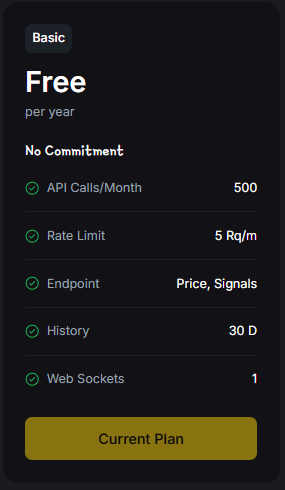
  • 30 Days of History – Enough to prototype backtests and analytics features.

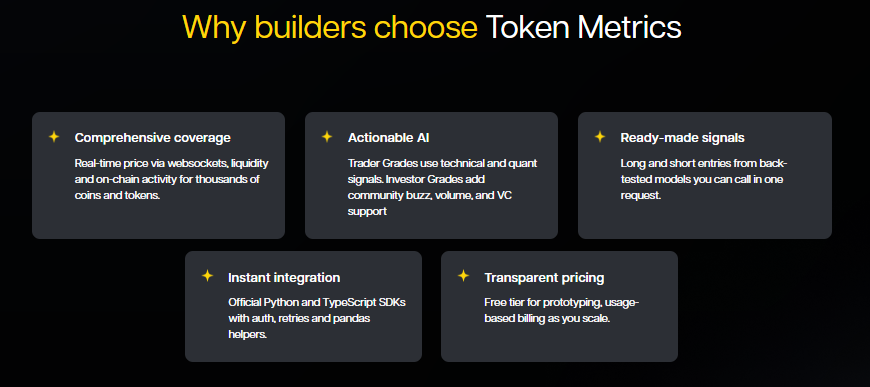
Unlike many free crypto APIs, Token Metrics API provides both price data and intelligence, making it ideal for developers who want more than surface-level metrics.

Comparing Free Crypto APIs: Strengths & Trade-offs

  • CoinGecko & CoinMarketCap


    • Pros: Huge token coverage, great for charts and tickers.

    • Cons: Limited historical and no predictive analytics.

  • CryptoCompare


    • Pros: Rich historical tick-level data, good for backtesting.

    • Cons: Free tier limits depth and call volume.

  • Glassnode


    • Pros: Strong on-chain insights.

    • Cons: Many advanced datasets require paid access.

  • Alchemy & Infura


    • Pros: Node-level blockchain access for dApp builders.

    • Cons: Not designed for trading or analytics—raw blockchain data only.

  • Token Metrics


    • Pros: Real-time prices, AI signals, and on-chain analytics in one free tier.

    • Cons: Rate limits apply (upgrade available for higher throughput).

Popular Use Cases: From Bots to Dashboards

  • AI Crypto Trading Bots – Start testing automation using live prices and bull/bear signals.

  • Crypto Dashboards – Aggregate token ratings, prices, and trends for end users.

  • Research Tools – Run small-scale backtests with 30-day historical data.

  • Learning Projects – Ideal for students or developers exploring crypto APIs.

📌 Real-world example: Many developers use the Token Metrics free tier to prototype bots that later scale into production with paid plans.

Best Practices for Using Free Crypto APIs

  1. Start with Prototypes – Test multiple free APIs to compare reliability and latency.

  2. Track Rate Limits – Free tiers often throttle requests (e.g., 5 req/min at Token Metrics).

  3. Combine Data Sources – Use Token Metrics for signals + CoinGecko for broad coverage.

  4. Secure Keys – Treat even free API keys as sensitive credentials.

  5. Prepare to Upgrade – Build flexible code so you can switch tiers or providers easily.

Beyond Token Metrics: Other Free Resources Worth Knowing

  • DefiLlama API – Free coverage of DeFi protocols, yields, and TVL.

  • Dune Analytics – Query blockchain data with SQL for free.

  • TradingView Widgets – Embed charts directly into dashboards.

  • Santiment API – Free endpoints for social/sentiment analytics.

These can complement Token Metrics. For example, you could combine Token Metrics signals + DefiLlama DeFi data + TradingView charts into one unified dashboard.

How to Get Started With the Token Metrics Free API

  1. Sign Up for a free Token Metrics account.

  2. Generate Your API Key instantly from your dashboard.

  3. Check the Docs for endpoints, examples, and code snippets.

  4. Prototype Your App with real-time prices and signals.

  5. Upgrade When Ready to unlock larger datasets and more endpoints.

👉 Grab Your Free Token Metrics API Key

FAQs About Free Crypto APIs

What can I access with Token Metrics Free API?
Live token prices, bull/bear trading signals, and 30 days of historical data.

Are free APIs reliable for production?
Not recommended—free tiers are best for prototypes. Paid tiers ensure reliability and scale.

What are the rate limits?
500 calls/month, 5 requests/minute, and 1 WebSocket connection.

Can I use the free API for trading bots?
Yes—ideal for prototyping. For production-level bots, upgrade for more throughput.

Scaling Beyond Free: Paid Plans & X.402

When your project outgrows free limits, Token Metrics offers flexible upgrades:

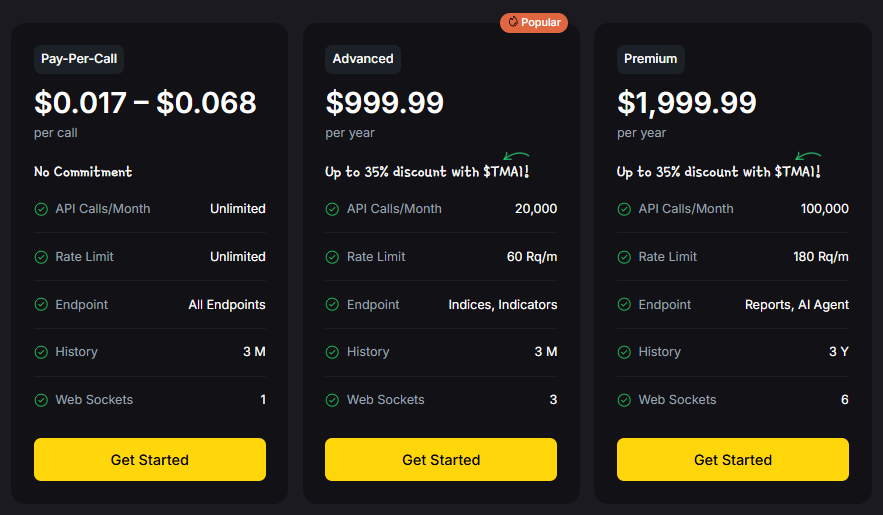
  • Pay-Per-Call (X.402) – As low as $0.017 per call, unlimited usage, no commitment.

  • Advanced Plan ($999.99/year) – 20,000 calls/month, indices & indicators, 3 WebSockets.

  • Premium Plan ($1,999.99/year) – 100,000 calls/month, AI agent + reports, 3 years of history.

With up to 35% off using TMAI tokens, scaling is cost-efficient.

📌 Why X.402 matters: Instead of committing upfront, you can grow gradually by paying per call—perfect for startups and side projects.

Build Smarter, Scale Easier

Free APIs help you start quickly and learn fast. Token Metrics gives you more than prices—it adds AI-powered signals and intelligence. Combine it with other free APIs, and you’ll have a toolkit that’s powerful enough for experimentation and flexible enough to scale into production.

👉 Create Your Free Token Metrics Account and Start Building

‍

Token Metrics API

Best Crypto API: Power Your Apps with Data, Signals, and AI

Sam Monac
6 min

What Makes a Crypto API the “Best”?

The best cryptocurrency API isn’t just about raw data. It’s about empowering your application to perform faster, smarter, and more reliably. A truly great crypto API balances:

  • Depth of Coverage – Spot, DeFi tokens, and on-chain metrics.

  • Speed – Real-time, low-latency updates that can handle market volatility.

  • Intelligence – Analytics and AI-driven signals that go beyond price feeds.

  • Scalability – Infrastructure that grows with your user base.

  • Reliability – High uptime and SLA-backed performance guarantees.

Whether you’re building a high-frequency crypto trading bot, a DeFi portfolio tracker, or a research platform, choosing the right API means aligning features with your mission.

Key Features to Look for in a Crypto API

Before selecting a crypto API, evaluate these criteria:

  • Real-Time & Historical Data – Do you get both sub-second updates and multi-year backtesting datasets?

  • On-Chain Analytics – Can you track wallet behavior, liquidity shifts, or whale flows?

  • AI-Powered Insights – Does the API offer predictive signals, ratings, or trend forecasts?

  • Ease of Integration – Look for clean docs, SDKs, and community examples.

  • Reliability & Uptime – Providers should publish incident histories and SLA commitments.

  • Pricing & Scalability – Free tiers for testing, plus paid plans that make sense as you scale.

  • Compliance & Security – Encrypted endpoints and strong authentication are a must.

📌 Tip for builders: Always start with multiple free crypto APIs and benchmark them in your stack before committing long term.

Comparing Leading Crypto APIs: Strengths & Weaknesses

  • CoinGecko & CoinMarketCap


    • Strengths: Huge token coverage, easy for price tickers and charts.

    • Weaknesses: Limited historical and on-chain analytics, slower refresh rates.

  • CryptoCompare


    • Strengths: Deep historical trade data, useful for backtesting.

    • Weaknesses: Less emphasis on predictive insights or AI.

  • Glassnode


    • Strengths: Advanced on-chain metrics (network health, wallet flows).

    • Weaknesses: Best for researchers, less suited to trading bots or dashboards.

  • Alchemy & Infura


    • Strengths: Node-level blockchain access, ideal for dApps and DeFi projects.

    • Weaknesses: Provide raw blockchain data, not trading analytics.

  • Token Metrics API


    • Strengths: Combines real-time prices, AI trading signals, ratings, portfolio analytics, and on-chain intelligence in one API.

    • Weaknesses: Free tier has rate limits (scalable through paid plans).

Why Token Metrics API Stands Out

Most crypto APIs specialize in one dimension (prices, exchange data, or on-chain metrics). Token Metrics unifies them all and adds AI intelligence on top.

  • Comprehensive Coverage – Prices, historical datasets, indices, grades, and on-chain data.

  • AI Trading Signals – Unique bull/bear calls and predictive analytics unavailable in traditional APIs.

  • Portfolio Intelligence – Ratings and indices that give context to raw numbers.

  • Enterprise-Ready – Encrypted endpoints, authentication, and scalable infrastructure.

  • Developer Friendly – Clear docs, quick-start guides, and responsive support.

📌 Put simply: most crypto APIs give you data. Token Metrics gives you data + intelligence.

Use Cases: From AI Crypto Trading Bots to Research Dashboards

  • AI Trading Bots – Execute strategies using both real-time prices and predictive signals.

  • DeFi Dashboards – Aggregate wallet flows, liquidity data, and token ratings.

  • Crypto Research Tools – Combine historical OHLC data with Token Metrics grades.

  • AI Agents – Power AI apps with actionable signals, not just raw feeds.

  • Enterprise Analytics – Build institutional dashboards with indices and compliance-ready datasets.

Best Practices for Implementing a Crypto API

  1. Prototype Across Providers – Test CoinGecko, Token Metrics, and others in parallel.

  2. Abstract Your Integration – Use a middleware layer to make switching APIs easier.

  3. Secure Your Keys – Store credentials safely and rotate them regularly.

  4. Plan for Scale – Rate limits hit fast; design for bursts in traffic.

  5. Leverage AI-Enhanced APIs – This is where user expectations are heading.

📌 For production apps: always monitor crypto API latency and uptime with tools like Datadog or Grafana.

Beyond Token Metrics: Other Useful Resources

While Token Metrics API offers an all-in-one solution, developers can also explore other resources for specialized needs:

  • Dune Analytics – Great for custom SQL-based blockchain queries.

  • DefiLlama API – Free API focused on DeFi protocol yields and TVL.

  • Santiment API – Alternative on-chain and sentiment analytics.

  • TradingView – Charting and integration options for front-end visualizations.

📌 Strategy tip: many developers combine multiple APIs—Token Metrics for signals + CoinGecko for breadth + DefiLlama for yields—to cover all angles.

Frequently Asked Questions About Crypto APIs

Which crypto API is best overall?
If you want real-time data plus AI-powered insights, crypto api is used. Token Metrics Api is the strongest all-in-one option. For niche use cases, CoinGecko is good for prices, Glassnode for on-chain analytics.

Is Token Metrics API free?
Yes, the free tier is perfect for prototyping. Paid plans unlock faster throughput, more history, and advanced endpoints.

How is Token Metrics different from CoinGecko?
CoinGecko tracks prices broadly. Token Metrics layers AI signals, indices, and predictive analytics for trading and research.

Can I build a trading bot with Token Metrics API?
Yes—many developers use the low-latency price feeds and predictive signals to power automated strategies.

Scaling With Paid Plans and X.402

As your project grows, Token Metrics offers flexible upgrade paths:

  • Pay-Per-Call (X.402) – As low as $0.017 per call, no commitment. Unlimited calls, all endpoints, and 3 months of historical data.

  • Advanced Plan ($999.99/year) – 20,000 calls/month, access to indices & indicators, 3 WebSockets.

  • Premium Plan ($1,999.99/year) – 100,000 calls/month, all endpoints including AI Agent & Reports, 3 years of historical data, and 6 WebSockets.

With up to 35% discounts when paying in TMAI tokens, scaling is cost-efficient.

📌 Why X.402 matters: Instead of locking into an annual plan, you can scale gradually with pay-per-call pricing—perfect for startups and experimental apps.

Build Smarter, Scale Easier

The best crypto API doesn’t just serve data—it helps your app think, act, and adapt. With Token Metrics, you start free, learn fast, and scale seamlessly. Combine it with other specialized APIs when needed, and you’ll have a development stack that’s both powerful and future-proof.

👉 Grab Your Free Token Metrics API Key and Start Building

‍

Choose from Platinum, Gold, and Silver packages
Reach with 25–30% open rates and 0.5–1% CTR
Craft your own custom ad—from banners to tailored copy
Perfect for Crypto Exchanges, SaaS Tools, DeFi, and AI Products