Back to blog
Research

What is a Gas Fee and How is it Calculated? Complete Guide for 2025

In the world of blockchain and cryptocurrency, "gas fees" are frequently mentioned but often misunderstood. These transaction costs represent a fundamental aspect of blockchain operations, affecting everything from simple cryptocurrency transfers to complex smart contract executions.
Talha Ahmad
5 min
Want Smarter Crypto Picks—Free?
See unbiased Token Metrics Ratings for BTC, ETH, and top alts.
Thank you! Your submission has been received!
Oops! Something went wrong while submitting the form.
 No credit card | 1-click unsubscribe

In the world of blockchain and cryptocurrency, "gas fees" are frequently mentioned but often misunderstood. These transaction costs represent a fundamental aspect of blockchain operations, affecting everything from simple cryptocurrency transfers to complex smart contract executions. Whether you're a newcomer exploring crypto or an experienced trader looking to optimize transaction costs, understanding gas fees is essential for navigating the blockchain ecosystem efficiently. This comprehensive guide explains what gas fees are, how they're calculated, and provides practical strategies for minimizing these costs—particularly important for active traders using platforms like Token Metrics to execute data-driven trading strategies.

Understanding Gas Fees: The Fundamentals

Gas fees are transaction costs that users pay to compensate validators or miners for the computational energy required to process and validate transactions on blockchain networks. Think of gas fees as tolls paid for using blockchain infrastructure—they ensure the network operates efficiently and securely while incentivizing network participants to maintain the system.

The term "gas" originates from Ethereum, where it refers to the computational work undertaken on the Ethereum Virtual Machine (EVM). The analogy to automotive fuel is intentional: just as a car requires gasoline to operate, blockchain transactions require "gas" to be processed. More complex operations—like executing sophisticated smart contracts—require more gas, similar to how a larger, more powerful vehicle consumes more fuel.

Gas fees serve several critical purposes beyond simple compensation. They act as a deterrent against network spam by attaching costs to every transaction, making it economically unfeasible for malicious actors to overload the network with unnecessary operations. This security mechanism protects blockchain networks from denial-of-service attacks and ensures fair resource allocation among legitimate users.

How Gas Fees Are Calculated: Breaking Down the Formula

The calculation of gas fees involves several key components that work together to determine the total transaction cost. While different blockchain networks use varied mechanisms, Ethereum's gas fee structure provides an excellent baseline for understanding how these costs are determined.

The Core Components

Gas Limit represents the maximum amount of computational work a user is willing to spend on a transaction. This is essentially a ceiling on the resources that can be consumed. For a simple ETH transfer between wallets, the standard gas limit is 21,000 units. More complex operations, such as interacting with DeFi protocols like Uniswap, might require 100,000 gas units or more. Setting an appropriate gas limit ensures you don't overpay for simple transactions while providing sufficient resources for complex operations.

Base Fee is the minimum fee set by the network that adjusts dynamically based on demand. Introduced through Ethereum's EIP-1559 upgrade, the base fee changes automatically based on network congestion. When blocks are more than 50% full, the base fee increases; when they're less than 50% full, it decreases. Importantly, the base fee is burned (permanently removed from circulation) rather than going to validators, creating deflationary pressure on ETH supply.

Priority Fee (also called the "tip") is an additional fee users can pay to incentivize validators to prioritize their transaction. During periods of high network activity, offering a higher priority fee can significantly expedite transaction confirmation. Conversely, setting a lower priority fee during off-peak times can save money, though your transaction may take longer to process.

The Gas Fee Formula

The total gas fee is calculated using this formula:

Total Gas Fee = Gas Limit × (Base Fee + Priority Fee)

Let's walk through a practical example. Suppose you want to transfer ETH to another wallet, and current network conditions show:

  • Base Fee: 75 gwei
  • Priority Fee: 5 gwei (what you're willing to pay extra)
  • Gas Limit: 30,000 units (for this particular transaction)

The calculation would be: Total Fee = 30,000 × (75 + 5) gwei = 2,400,000 gwei = 0.0024 ETH

To understand the cost in familiar terms, remember that 1 gwei equals 0.000000001 ETH. Gas fees are displayed in gwei for better readability, as expressing these tiny fractions in ETH would be cumbersome.

Simple Transaction Examples

Basic ETH Transfer: Sending ETH from one wallet to another typically requires 21,000 gas units. If the gas price is 20 gwei, the transaction costs approximately 0.00042 ETH (21,000 × 20 gwei).

ERC-20 Token Transfer: Transferring tokens that follow the ERC-20 standard (like USDT or LINK) usually costs more than simple ETH transfers, requiring about 45,000 to 65,000 gas units depending on the specific token contract's complexity.

Smart Contract Interaction: Executing complex smart contracts, such as swapping tokens on decentralized exchanges or participating in DeFi protocols, can consume 100,000+ gas units, resulting in significantly higher fees during peak network times.

Why Do Gas Fees Fluctuate?

Gas fees are not static—they fluctuate dramatically based on network demand and activity levels. Understanding these dynamics helps users time their transactions strategically to minimize costs.

Supply and Demand Dynamics

Blockchain networks have limited capacity to process transactions within each block. When demand exceeds this capacity, users compete for block space by offering higher gas prices. Validators naturally prioritize transactions offering better compensation, creating a fee market where prices rise during congestion and fall during quiet periods.

Historical Gas Fee Spikes

Several events in blockchain history illustrate how demand drives gas fees:

The ICO Boom (2017-2018): When Initial Coin Offerings exploded in popularity, millions of new users flooded Ethereum to participate in token sales. The network lacked sufficient capacity, causing gas fees to spike dramatically.

DeFi Summer (2020): The rise of decentralized finance protocols like Uniswap and Compound Finance brought unprecedented activity to Ethereum. Users staking, swapping, and farming tokens created severe congestion, with fees often exceeding $50 per transaction.

NFT Mania (2021): Marketplaces like OpenSea caused extreme congestion as collectors rushed to mint and trade non-fungible tokens. During peak periods, gas fees exceeded $100 per transaction, pricing out many retail users.

Network Upgrades and Layer 2 Solutions (2022-2025): Ethereum's transition to Proof of Stake and the proliferation of Layer 2 scaling solutions have significantly improved fee predictability and reduced average costs, though fees still spike during periods of intense activity.

Strategies for Minimizing Gas Fees

For active crypto traders and investors—particularly those using advanced analytics platforms like Token Metrics to identify trading opportunities—managing gas fees effectively can significantly impact profitability. Here are proven strategies for reducing these costs.

Timing Your Transactions

Gas fees vary dramatically by time of day and day of week. Network activity typically drops during weekends and early morning hours (UTC timezone), resulting in lower fees. Real-time gas trackers like Etherscan's Gas Tracker or Gas Now provide current pricing and help identify optimal transaction windows.

For traders using Token Metrics to receive AI-powered buy and sell signals, timing transaction execution during low-fee periods can preserve more of your trading profits. The platform's real-time analytics help identify entry and exit points, while gas optimization ensures you're not eroding gains through excessive fees.

Leverage Layer 2 Solutions

Layer 2 scaling solutions process transactions off the main Ethereum chain, then batch-settle them on Layer 1, dramatically reducing costs. Popular Layer 2 networks include:

Arbitrum: Offers Ethereum-compatible smart contracts with significantly lower fees and faster confirmation times.

Optimism: Uses optimistic rollups to bundle transactions, reducing costs by 10-100x compared to Ethereum mainnet.

Polygon: Provides a complete ecosystem with extremely low transaction fees, often costing fractions of a cent.

Base: Coinbase's Layer 2 solution offering fast, cheap transactions while maintaining security through Ethereum.

Many decentralized exchanges and DeFi protocols now operate on Layer 2 networks, allowing traders to execute strategies without prohibitive gas costs.

Set Custom Gas Fees

Most modern wallets allow users to customize gas prices, balancing speed against cost. During non-urgent transactions, setting lower gas prices can save money, though confirmation may take longer. For time-sensitive trades based on Token Metrics signals, higher priority fees ensure rapid execution when market conditions demand quick action.

Use Gas-Optimized Contracts

Some protocols and wallets implement gas-optimized smart contracts that reduce computational complexity. Choosing platforms that prioritize efficiency can result in meaningful savings, especially for frequent traders executing dozens of transactions monthly.

Token Metrics: Optimizing Trading Performance Beyond Gas Fees

While managing gas fees is crucial for cost-effective trading, success in cryptocurrency requires sophisticated market intelligence and analytics. This is where Token Metrics stands out as the premier AI-powered crypto trading and analytics platform in 2025.

AI-Driven Market Intelligence

Token Metrics leverages advanced artificial intelligence and machine learning to analyze over 5,000 cryptocurrencies in real-time, providing traders with comprehensive insights that go far beyond basic price charts. The platform assigns Trader Grades (0-100) for short-term opportunities and Investor Grades for long-term potential, helping users identify winning tokens before they hit mainstream awareness.

This AI-powered analysis processes vast datasets including on-chain metrics, social sentiment, technical indicators, institutional flows, and market momentum—providing the actionable intelligence needed to make informed trading decisions that justify gas fee investments.

Integrated Trading Execution

In March 2025, Token Metrics launched integrated on-chain trading capabilities, transforming from an analytics platform into an end-to-end solution. Users can now research tokens using AI ratings, review detailed analytics, and execute trades directly on the platform through seamless multi-chain swaps—typically completing the entire process in under two minutes.

This integration is particularly valuable for managing gas fees. By consolidating research and execution on a single platform, traders reduce unnecessary wallet interactions and transaction steps, minimizing total gas costs while maintaining rapid response to market opportunities.

Real-Time Signals and Alerts

Token Metrics provides real-time buy and sell signals powered by AI algorithms that continuously monitor market conditions. These signals help traders time their entries and exits optimally, ensuring that when gas fees are paid for transaction execution, they're supporting high-probability trades rather than speculative positions.

Portfolio Optimization and Risk Management

Beyond individual trade execution, Token Metrics offers AI-managed indices and portfolio optimization tools that help traders maintain diversified exposure while minimizing unnecessary transactions. By reducing portfolio churn and focusing on high-conviction positions, users naturally reduce cumulative gas fee expenses over time.

Educational Resources and Market Analysis

The platform provides comprehensive educational content, market analysis, and research reports that help users understand not just what to trade, but why—and when. This knowledge empowers traders to make strategic decisions about transaction timing, balancing urgency against gas cost optimization.

The Future of Gas Fees in 2025 and Beyond

The blockchain industry continues innovating to address gas fee challenges. Several trends are shaping the future of transaction costs:

Free Gas Fee Solutions

Some networks like TRON have pioneered "free gas fee" models that eliminate or drastically reduce transaction costs. These innovations make blockchain applications more accessible to mainstream users who find traditional gas fees prohibitive.

Ethereum's Continued Evolution

Ethereum's roadmap includes further upgrades focused on scalability and cost reduction. The complete rollout of Ethereum 2.0 phases, combined with advanced Layer 2 adoption, promises to make gas fees more predictable and affordable while maintaining network security.

Cross-Chain Bridges and Interoperability

As blockchain interoperability improves, users can choose networks based on their gas fee structures for different use cases. Traders using platforms like Token Metrics can execute strategies across multiple chains, selecting optimal networks for each transaction type.

AI-Powered Gas Optimization

Emerging tools use artificial intelligence to predict optimal transaction timing, automatically route transactions through the most cost-effective paths, and dynamically adjust gas prices based on urgency and network conditions.

Conclusion: Mastering Gas Fees for Profitable Trading

Gas fees represent an unavoidable reality of blockchain transactions, but understanding their mechanics and implementing optimization strategies can significantly improve your trading economics. By timing transactions strategically, leveraging Layer 2 solutions, and setting appropriate gas parameters, you can minimize these costs without compromising execution quality.

For serious crypto traders and investors, success requires more than just gas fee management—it demands comprehensive market intelligence, real-time analytics, and integrated execution capabilities. Token Metrics provides this complete solution, combining AI-powered research with seamless trading execution to help users identify opportunities, optimize entry and exit timing, and execute strategies efficiently.

Whether you're making simple transfers or executing complex DeFi strategies, mastering gas fees while leveraging platforms like Token Metrics for market intelligence creates a powerful combination for navigating cryptocurrency markets profitably in 2025 and beyond. By understanding the costs of blockchain interaction and using advanced tools to maximize returns relative to those costs, you position yourself for long-term success in the evolving digital asset ecosystem.

Build Smarter Crypto Apps &
AI Agents in Minutes, Not Months
Real-time prices, trading signals, and on-chain insights all from one powerful API.
Grab a Free API Key
About Token Metrics
Token Metrics: AI-powered crypto research and ratings platform. We help investors make smarter decisions with unbiased Token Metrics Ratings, on-chain analytics, and editor-curated “Top 10” guides. Our platform distills thousands of data points into clear scores, trends, and alerts you can act on.
30 Employees
analysts, data scientists, and crypto engineers
Daily Briefings
concise market insights and “Top Picks”
Transparent & Compliant
Sponsored ≠ Ratings; research remains independent
Want Smarter Crypto Picks—Free?
See unbiased Token Metrics Ratings for BTC, ETH, and top alts.
Thank you! Your submission has been received!
Oops! Something went wrong while submitting the form.
 No credit card | 1-click unsubscribe
Token Metrics Team
Token Metrics Team

Recent Posts

Research

Is Web3 Just a Buzzword or a Real Innovation?

Token Metrics Team
3

Introduction to Web3

The emergence of Web3 has sparked diverse conversations in technology and blockchain communities. Some consider it the next revolutionary phase of the internet, while others dismiss it as mere hype. This blog explores whether Web3 is just a buzzword or if it represents a tangible and meaningful evolution in digital interactions.

Understanding the Concept of Web3

Web3 broadly refers to a new paradigm of the internet built on decentralized technologies like blockchain, aiming to enable peer-to-peer interactions without centralized intermediaries. Unlike Web2, which is dominated by centralized platforms controlling data and services, Web3 proposes a more open, user-controlled internet.

Key Web3 features include:

  • Decentralization: Data and services distributed across networks instead of centralized servers.
  • Blockchain Integration: Use of immutable ledgers to ensure transparency and security.
  • Token-based Economics: Implementation of cryptocurrencies and tokens to incentivize participation.
  • Enhanced User Sovereignty: Users control their data and digital identities.

The Technology and Applications Behind Web3

Web3 relies heavily on blockchain technology, smart contracts, and decentralized applications (dApps). These components facilitate trustless transactions and programmable digital agreements.

Notable Web3 applications include decentralized finance (DeFi), non-fungible tokens (NFTs), and decentralized autonomous organizations (DAOs). These innovations demonstrate practical use cases extending beyond theoretical frameworks.

Moreover, artificial intelligence (AI) tools are increasingly applied to analyze and navigate the evolving Web3 landscape. Platforms such as Token Metrics leverage AI-driven insights to help users research blockchain projects and assess technology fundamentals without financial recommendations.

Addressing the Skepticism Around Web3

Critics argue that Web3 might be overhyped with limited real-world adoption so far. Challenges include scalability issues, user experience complexities, regulatory uncertainties, and potential misuse.

However, innovation cycles often follow initial hype phases. Historical tech developments illustrate how novel ideas initially labeled as buzzwords eventually matured into foundational technologies over time.

Scenario analysis suggests varying outcomes for Web3:

  1. Gradual Adoption: Incremental integration of Web3 elements into mainstream platforms.
  2. Disruptive Shift: Web3 replaces significant portions of centralized internet infrastructure.
  3. Fragmentation or Stall: Development slows due to technical, regulatory, or societal barriers.

Practical Steps for Evaluating Web3 Projects

Due diligence is essential in understanding Web3 initiatives. Consider these points when researching:

  • Team and Community: Assess project founders' credentials and community engagement.
  • Technology Fundamentals: Examine code repositories, technical whitepapers, and audit reports.
  • Use Case Viability: Analyze how a project solves real problems uniquely.
  • Partnerships and Ecosystem: Look at collaborators and interoperability with existing platforms.

Leveraging AI-powered platforms like Token Metrics can assist users in organizing and interpreting vast data points objectively, aiding a comprehensive understanding.

The Role of Regulation and Governance

Regulation remains an evolving factor for Web3 projects. Decentralized governance models, such as DAOs, aim to allow stakeholder participation in decision-making processes. However, legal frameworks vary globally and can impact project development and adoption.

Understanding the nuanced regulatory landscape is critical for assessing the long-term feasibility and resilience of Web3 innovations.

Conclusion: Is Web3 Buzzword or Real?

Web3 encompasses transformative potentials in reimagining internet architecture. While it faces significant hurdles and exhibits hype characteristics, substantial technological progress and adoption signals suggest it is more than mere buzzword.

Objective analysis, supported by AI research tools like Token Metrics, can facilitate critical evaluation of emerging projects and technologies within this evolving domain.

Disclaimer

This article is for educational and informational purposes only and does not constitute financial advice. Readers should conduct their own research and consult professional advisors before making any decisions related to blockchain technologies or digital assets.

Research

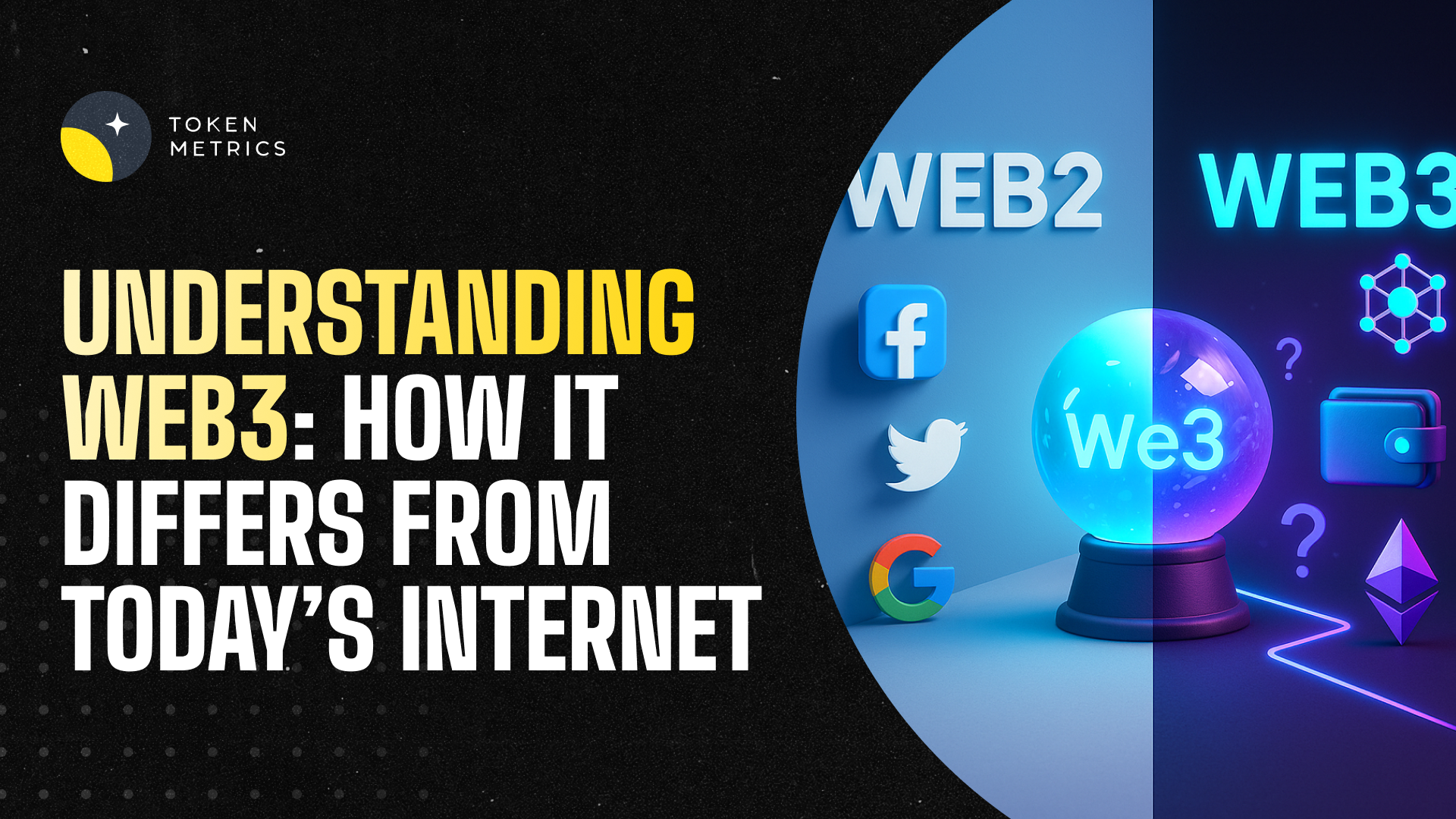
Understanding Web3: How It Differs From Today's Internet

Token Metrics Team
4

Introduction

The internet has become an integral part of modern life, continually evolving since its inception. In recent years, a new paradigm called Web3 has emerged, promising to reshape how users interact with digital platforms. This blog post explores the fundamental differences between Web3 and the current internet, often referred to as Web2, to clarify what Web3 entails and its potential impact.

What Is Web3?

Web3 represents the next phase of the internet, built on the principle of decentralization. Unlike the current centralized internet infrastructure, Web3 aims to distribute control away from traditional intermediaries like corporations and governments to users and communities. Key technologies underpinning Web3 include blockchain, decentralized finance (DeFi), non-fungible tokens (NFTs), and decentralized autonomous organizations (DAOs).

At its core, Web3 is designed to empower users to own and control their data, digital assets, and online identities through cryptographic proof rather than relying on centralized entities. This shift holds the promise of enhanced privacy, improved security, and greater transparency across digital services.

How Web3 Differs From the Current Internet

The current internet, or Web2, is characterized by centralized platforms such as social media networks, content-sharing sites, and cloud service providers. These platforms control user data and have significant influence over digital ecosystems. Web3 introduces several pivotal differences:

  • Decentralization: Traditional web services store data on central servers. Web3 applications (dApps) operate on decentralized networks like Ethereum, distributing data across many nodes.
  • Data Ownership and Privacy: In Web3, users have sovereignty over their personal data via cryptographic keys, reducing dependency on intermediaries.
  • Trustless Interactions: Web3 uses smart contracts to automate transactions without requiring trust in a third party, enhancing transparency.
  • Monetization and Incentives: Users can directly monetize their contributions or assets through tokens without relying on platform-controlled advertising models.

Key Technologies Enabling Web3

A few seminal technologies make the Web3 vision feasible:

  1. Blockchain: A distributed ledger technology providing an immutable record of transactions and data accessible to all network participants.
  2. Cryptographic wallets: Tools that allow users to manage private keys securely, facilitating ownership and transaction signing.
  3. Smart contracts: Self-executing contracts with the terms directly written into code, automating agreements and processes without intermediaries.
  4. Decentralized storage: Networks like IPFS provide distributed data hosting, improving resilience and censorship resistance.

These technologies collectively foster environments where decentralized applications can function effectively, distinguishing Web3 from legacy web systems.

Impact of AI Research Tools in Understanding Web3

Analyzing the Web3 space requires comprehensive research and understanding of complex, rapidly evolving technologies. AI-driven research platforms like Token Metrics use machine learning and data analytics to provide insights into blockchain networks, emerging protocols, and token metrics. By leveraging these tools, researchers and enthusiasts can assess technological fundamentals and ecosystem trends in a structured, data-informed manner, facilitating a clearer understanding of Web3 developments.

Practical Considerations for Exploring Web3

For those interested in exploring Web3, keeping the following factors in mind can enhance comprehension and engagement:

  • Focus on fundamentals: Evaluate protocols and projects based on technology, use case, and community involvement.
  • Understand risk: Web3 technologies are experimental and subject to regulatory and technical challenges.
  • Use credible research tools: Platforms like Token Metrics offer analytical data that aid in objective evaluation.
  • Stay informed: The Web3 landscape evolves rapidly, requiring continuous learning and monitoring.

Future Outlook: Web3 vs. Web2

While Web3 promises a more decentralized and user-empowered internet, it is essential to consider practical implications. Adoption hurdles, scalability, user experience, and regulatory frameworks will shape its trajectory. Unlike Web2, which offers convenience and centralized control, Web3 emphasizes autonomy and distributed governance. The future internet may well integrate strengths from both models, providing a hybrid approach that balances user control with usability.

Conclusion

Web3 represents a transformative vision for the internet, aiming to decentralize control and enhance user ownership of data and digital assets. Its key distinctions from the current internet (Web2) include decentralization, trustless interactions, and new economic models. Technologies like blockchain and smart contracts drive these changes, supported by analytical tools such as Token Metrics that aid in navigating this complex environment. As Web3 continues to evolve, understanding its fundamentals remains crucial for anyone interested in the future of the internet.

Disclaimer

This blog post is intended for educational and informational purposes only and does not constitute financial or investment advice. Readers should conduct their own research and consider their risk tolerance before engaging with Web3 technologies or cryptocurrencies.

Research

Understanding Why Blockchain Transactions Are Irreversible

Token Metrics Team
5

Introduction

The concept of irreversible transactions is a foundational aspect of blockchain technology and cryptocurrencies. Unlike traditional banking systems where transactions can be reversed or disputed, blockchain transactions are designed to be permanent and unalterable once confirmed. This unique feature raises an important question: why are blockchain transactions irreversible? This article delves into the fundamental principles, technological mechanisms, and security frameworks that underpin transaction irreversibility in blockchains. In addition, it highlights how analytical and AI-driven research platforms such as Token Metrics can help users better understand the underlying dynamics.

Basics of Blockchain Transactions

To answer why blockchain transactions are irreversible, it is essential to understand what constitutes a blockchain transaction. At its core, a blockchain is a decentralized and distributed digital ledger of transactions, grouped into blocks and linked through cryptographic hashes.

  • Transaction creation: Users initiate transactions by digitally signing them with private keys, ensuring authenticity and ownership.
  • Broadcast and validation: Transactions are broadcast to a network of nodes, where consensus algorithms validate and verify them based on predefined rules.
  • Inclusion in blocks: Validated transactions are bundled into a block.
  • Linking blocks into a chain: Each block references the previous block through a cryptographic hash, forming a chronological chain.

Once a transaction is included in a confirmed block, it becomes part of the immutable ledger, considered permanent and irreversible.

Role of Immutability and Cryptography

Immutability is the cornerstone of transaction irreversibility. Blockchain achieves immutability using cryptographic techniques and decentralized consensus.

  • Cryptographic hashes: Each block contains a hash of the previous block, creating a tamper-evident chain. Changing any transaction data in a previous block alters its hash and breaks the chain's continuity.
  • Digital signatures: Transactions are signed by senders using private keys, and their validity is verified through public keys.
  • Decentralization: Since multiple nodes maintain copies of the ledger, altering one copy would require overwhelming control over the network to rewrite history, which is prohibitively difficult.

This design ensures that once a transaction is confirmed and embedded in a block, it is computationally infeasible to modify or reverse it without consensus from the majority of the network.

Consensus Mechanisms and Finality

Consensus algorithms play an essential role in determining when transactions are considered final and irreversible.

  • Proof of Work (PoW): In PoW systems like Bitcoin, miners solve complex puzzles to add new blocks. The longer the subsequent chain grows past a block, the more secure and irreversible the transactions within it become, as rewriting would require significant energy expenditure.
  • Proof of Stake (PoS) and others: Other consensus models like PoS, delegated PoS, or Byzantine Fault Tolerant algorithms offer different methods of achieving agreement but similarly provide guarantees on transaction finality.

Network participants generally treat transactions as irreversible after a certain number of confirmations (additional blocks). This requirement reduces risks from temporary forks or reorganizations.

Technical Challenges to Reversing Transactions

Reversing a blockchain transaction would entail rewriting the blockchain history, which is impeded by several technical realities:

  1. Hash chain dependency: Because every block contains the hash of its predecessor, any change would cascade through the chain, invalidating all subsequent blocks.
  2. Network consensus: The majority of nodes must agree on a change, which is practically impossible in secure, well-distributed networks without control of a 51% attack.
  3. Resource expenditure: The computational power and time required to modify past transactions increase exponentially with block depth.

Therefore, even accidental or malicious attempts to reverse a transaction face insurmountable obstacles.

Practical Implications of Irreversibility

The irreversible nature of blockchain transactions carries both benefits and risks.

  • Benefits: Enhanced security against fraud and censorship, fostering trust in decentralized financial systems.
  • Risks: Users need to exercise caution, as mistakes such as sending to incorrect addresses or falling victim to scams cannot be undone.

Understanding these implications is critical for users engaging with blockchain-based systems, and tools like Token Metrics provide data-driven insights to enhance awareness and decision-making.

How AI and Analytics Support Understanding

With the growing complexity of blockchain ecosystems, AI-driven platforms are increasingly valuable for dissecting transaction behaviors and network health.

  • Transaction analysis: AI can identify patterns, potential risks, or anomalies in blockchain activity.
  • Market insights: Analytical tools can augment research on transaction volumes, confirmation times, and network congestion.
  • Educational resources: Platforms such as Token Metrics leverage AI to provide accessible metrics and ratings that inform users about blockchain projects and technologies.

Utilizing these resources supports a better grasp of the irreversible nature of transactions and the broader blockchain infrastructure.

Conclusion

Blockchain transaction irreversibility is rooted in the technology’s core principles of immutability, decentralization, and consensus-driven finality. These mechanisms collectively ensure that once a transaction is recorded on the blockchain and sufficiently confirmed, it cannot be altered or undone without prohibitive computational effort and majority network control. While irreversible transactions provide robust security and trustlessness, they also emphasize the importance of user diligence. Leveraging AI-powered analytical tools like Token Metrics can enhance comprehension and navigational confidence within blockchain ecosystems.

Disclaimer

This article is intended for educational purposes only and does not constitute financial advice. Readers should conduct their own research using varied sources, including specialized platforms such as Token Metrics, before engaging with blockchain or cryptocurrency activities.

Choose from Platinum, Gold, and Silver packages
Reach with 25–30% open rates and 0.5–1% CTR
Craft your own custom ad—from banners to tailored copy
Perfect for Crypto Exchanges, SaaS Tools, DeFi, and AI Products