

Back to blog
Crypto Basics

What is Spot Trading in Crypto: A Complete Beginner’s Guide

Learn the essentials of spot trading in crypto. Discover how to buy and sell directly for effective trading strategies. Read more to get started!
Token Metrics Team
8 min
Want Smarter Crypto Picks—Free?
See unbiased Token Metrics Ratings for BTC, ETH, and top alts.
Thank you! Your submission has been received!
Oops! Something went wrong while submitting the form.
 No credit card | 1-click unsubscribe

When you buy Bitcoin on Coinbase and it instantly appears in your wallet, you’ve just completed a spot trade. Unlike complex derivatives or leveraged products, spot trading in crypto represents the most straightforward way to buy and own digital assets at current market prices.

Spot trading refers to the practice of buying and selling cryptocurrencies for immediate delivery and settlement. The term “spot” indicates that transactions happen “on the spot” - you purchase crypto at the current market price and gain immediate ownership without any future obligations or contractual arrangements.

In this comprehensive guide, you’ll discover exactly how crypto spot trading works, how it compares to other trading methods, and whether it’s the right approach for your investment goals. Whether you’re a complete beginner or looking to understand the fundamentals better, this article will give you the knowledge needed to begin spot trading confidently.

What is Spot Trading in Cryptocurrency?

Spot trading is the direct purchase and sale of digital assets at their current market prices with immediate settlement and ownership transfer. When you execute a spot trade, you’re buying the actual cryptocurrency - not a contract or derivative based on its value.

The “on the spot” concept means trades execute instantly at real-time market prices determined by supply and demand on the crypto exchange. Unlike futures contracts or options trading, there are no predetermined price agreements or future delivery dates involved. You pay the current price, receive the digital asset immediately, and gain full control over your cryptocurrency.

Popular trading pairs in spot markets include:

  • BTC/USDT (Bitcoin paired with Tether stablecoin)
  • ETH/USD (Ethereum paired with US dollars)
  • ADA/BTC (Cardano paired with Bitcoin)
  • DOT/USDC (Polkadot paired with USD Coin)

The immediate ownership transfer distinguishes spot trading from derivatives trading. Once your buy order executes, the cryptocurrency moves directly into your exchange wallet or can be withdrawn to your personal wallet. This direct asset ownership provides complete control over your digital assets, including the ability to stake, lend, or transfer them as desired.

How Does Crypto Spot Trading Work?

The process of crypto spot trading follows a straightforward sequence that beginners can master quickly:

Step 1: Choose a Crypto Exchange Select a reputable cryptocurrency exchange like Binance, Coinbase Pro, Kraken, or Gemini. Consider factors like security measures, trading volume, supported cryptocurrencies, and fee structures.

Step 2: Register and Verify Your Account Complete the registration process and KYC (Know Your Customer) verification. Most exchanges require identity verification to comply with regulations and implement security measures.

Step 3: Deposit Funds Fund your account using fiat currency (USD, EUR) via bank transfer or credit card, or deposit existing cryptocurrencies from another wallet.

Step 4: Select Your Trading Pair Choose the cryptocurrency you want to buy and the currency you’ll use to purchase it. For example, if you want to buy Ethereum with US dollars, you’d select the ETH/USD trading pair.

Step 5: Place Your Order Submit either a market order or limit order based on your trading strategy and timing preferences.

Market Orders vs Limit Orders

Understanding order types is crucial for effective spot trading:

Market Orders execute immediately at the current market price. When you place a market order to buy Bitcoin, you’ll purchase it at the lowest available ask price. This guarantees execution but not the exact price, especially during periods of high market volatility.

Limit Orders specify the exact price you’re willing to pay. For example, if Bitcoin trades at $45,000 but you only want to buy at $44,000, you’d place a limit order at that specified price. The trade only executes if the market reaches your target price.

Order Book Mechanics

The order book displays all pending buy orders (bids) and sell orders (asks) for a trading pair. Bids appear in descending price order, while asks appear in ascending order. The difference between the highest bid and lowest ask creates the “spread.”

When you place a market order, the exchange’s matching engine pairs your order with the best available opposite order. High liquidity markets with many participants typically have tighter spreads and faster execution, while low liquidity markets may experience price slippage during volatile periods.

The immediate settlement process means ownership transfers instantly upon order execution. Unlike traditional stock markets with T+2 settlement, cryptocurrency spot trades settle in real-time, giving you immediate access to your purchased digital assets.

Spot Trading vs Other Trading Methods

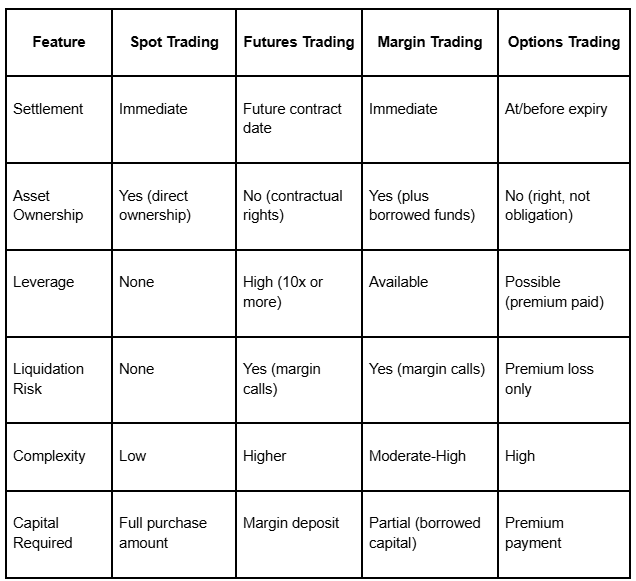
Understanding how spot trading compares to other trading methods helps you choose the right approach for your risk tolerance and investment goals.
Spot Trading vs Margin Trading

Margin trading allows traders to borrow funds from the crypto exchange to increase their position size beyond their initial investment. While this can amplify potential profits, it also magnifies losses and introduces significant risks that don’t exist in spot trading.

In margin trading, borrowing funds creates leverage that can lead to margin calls when positions move against you. If your trade loses value and approaches the minimum margin requirement, the exchange may forcibly close your position to protect the borrowed funds. This liquidation can result in losing more than your initial investment.

Spot trading eliminates these risks by limiting potential losses to your initial investment. You can’t lose more than you put in because you’re not borrowing money. This makes spot trading the safer choice for beginners and risk-averse traders who want exposure to price movements without the downside risk of liquidation.

Experienced traders might use margin trading to amplify gains, but the commodity futures trading commission and other regulatory bodies consistently warn about the significant risks involved with leveraged products.

Spot Trading vs Futures Trading

Futures contracts obligate traders to buy or sell an underlying crypto asset at a predetermined price on a specific future date. These financial instruments allow speculation on future price movements without immediate purchase or delivery of the digital asset.

Spot trading provides immediate settlement and direct ownership, while futures trading involves contractual obligations and potential leverage. Futures prices can diverge from spot prices based on market expectations, interest rates, and other factors affecting the cryptocurrency market.

Traders speculate on price movements differently in each market. Spot traders profit by buying low and selling at a higher price, while futures traders can profit from both rising and falling markets through long and short positions. However, futures trading requires more sophisticated understanding of market conditions and carries higher risks due to leverage and margin requirements.

Advantages of Spot Trading

Spot trading offers several compelling benefits that make it attractive to both newcomers and experienced traders:

Simplicity and Ease of Understanding Spot trading’s straightforward nature makes it accessible to beginners. You buy cryptocurrency at the current price and own it immediately - no complex contracts, expiration dates, or margin calculations to worry about.

Direct Asset Ownership Unlike derivatives trading, spot trading gives you actual ownership of digital assets. You can withdraw your Bitcoin to a hardware wallet, stake your Ethereum, or use your cryptocurrencies in DeFi protocols. This direct ownership provides complete control over your financial assets.

Transparent Pricing Spot market prices reflect real supply and demand dynamics without the complexity of futures curves or options pricing models. The current market price you see represents what other traders are willing to pay right now.

Lower Risk Profile Spot trading eliminates the risk of margin calls, liquidations, and borrowing costs associated with leveraged products. Your maximum loss equals your initial investment, providing clear risk boundaries for portfolio management.

Wide Availability Major cryptocurrency exchanges like Binance, Coinbase, Kraken, and others offer robust spot markets with high trading volumes. This broad availability ensures you can access spot trading regardless of your location or experience level.

No Time Pressure Unlike options with expiration dates or futures contracts with settlement requirements, spot positions have no time constraints. You can hold your digital assets as long as desired without worrying about contract expiration.

Disadvantages of Spot Trading

Despite its advantages, spot trading has limitations that traders should understand:

Full Market Volatility Exposure Crypto spot trading exposes you to the complete volatility of the cryptocurrency market without built-in hedging mechanisms. When Bitcoin drops 20% in a day, your spot position loses the same percentage with no protection.

No Short Selling Capability Spot trading only allows you to profit from rising prices unless you already own the asset to sell. You cannot profit from falling markets through short selling without using additional financial instruments like futures or margin trading.

Capital Intensive Spot trading requires the full purchase amount upfront. If you want $10,000 exposure to Ethereum, you need $10,000 in capital. Leveraged products allow similar exposure with less capital, though with higher risks.

Limited Profit Potential Without leverage, your profit potential is limited to the actual price movements of the underlying crypto asset. A 50% increase in Bitcoin price generates a 50% profit, while leveraged trading could amplify those gains (and losses).

Price Slippage Risk During periods of high market volatility or low liquidity, large market orders may experience slippage - executing at worse prices than expected. This particularly affects trading in smaller altcoins with lower trading volumes.

No Built-in Risk Management Spot trading lacks the sophisticated risk management tools available in derivatives markets. You cannot easily hedge positions or create complex trading strategies without using multiple instruments.

Popular Spot Trading Strategies

Successful spot traders employ various trading strategies based on their risk tolerance, time horizon, and market analysis approach:

Buy and Hold (HODL) This long-term strategy involves purchasing major cryptocurrencies like Bitcoin or Ethereum and holding them for extended periods. Buy and hold traders believe in the long-term adoption and price appreciation of established digital assets, ignoring short term price fluctuations.

Dollar Cost Averaging (DCA) DCA involves making regular purchases regardless of current market price to smooth out volatility over time. For example, buying $500 worth of Bitcoin every month reduces the impact of timing the market and can lower your average purchase price during volatile periods.

Day Trading Day traders capitalize on short term price movements within a single trading session. They use technical analysis to identify entry and exit points, often making multiple trades per day to profit from intraday volatility in the crypto market.

Swing Trading Swing traders hold positions for days or weeks to capture medium-term trends. This trading strategy requires analyzing both technical indicators and fundamental factors that might drive price movements over several days.

Arbitrage Trading Arbitrage involves exploiting price differences for the same cryptocurrency across different exchanges. If Bitcoin trades at $45,000 on Exchange A and $45,200 on Exchange B, arbitrage traders buy on the cheaper exchange and sell on the more expensive one for risk-free profit.

Range Trading Range traders identify cryptocurrencies trading within specific price ranges and buy near support levels while selling near resistance levels. This strategy works best during sideways market movements when prices oscillate within defined boundaries.

Getting Started with Spot Trading

Beginning your spot trading journey requires careful preparation and a methodical approach:

Choose Reputable Exchanges Start with established cryptocurrency exchanges that prioritize security and regulatory compliance. Binance offers high liquidity and numerous trading pairs, Coinbase Pro provides user-friendly interfaces for beginners, while Kraken and Gemini are known for strong security measures.

Complete Security Setup Implement security measures including two-factor authentication (2FA), strong passwords, and withdrawal whitelist features. Never share your login credentials and consider using a dedicated email address for your crypto exchange accounts.

Start with Major Cryptocurrencies Begin with established digital assets like Bitcoin (BTC) and Ethereum (ETH) before exploring smaller altcoins. These major cryptocurrencies typically have higher liquidity, tighter spreads, and more predictable price movements suitable for learning.

Begin with Small Amounts Start with amounts you can afford to lose while learning platform mechanics and developing your trading strategy. Small initial investments allow you to understand how orders work, how fees impact profits, and how market volatility affects your positions.

Use Limit Orders for Better Control Limit orders help you control entry prices and avoid paying more than intended, especially important during volatile market conditions. While market orders guarantee execution, limit orders provide price protection at the cost of potential missed opportunities.

Educate Yourself Continuously Develop skills in both technical analysis and fundamental analysis. Technical analysis helps identify entry and exit points using price charts and indicators, while fundamental analysis evaluates the underlying value and adoption prospects of different cryptocurrencies.

Practice Risk Management Never invest more than you can afford to lose, diversify across multiple cryptocurrencies, and consider setting stop-loss levels even though spot trading doesn’t require them. Successful trading depends more on managing downside risk than maximizing gains.

Is Spot Trading Profitable?

Spot trading profitability depends on multiple factors including market timing, research quality, risk management, and trading discipline. While the cryptocurrency market has created significant wealth for early adopters and skilled traders, success is never guaranteed.

Factors Affecting Profitability:

Market volatility creates both opportunities and risks. The crypto market experiences significant price fluctuations that can generate substantial profits for well-timed trades, but the same volatility can lead to significant losses if you buy at market peaks.

Your research and analysis capabilities directly impact trading success. Traders who understand fundamental analysis (evaluating project technology, adoption, and competition) combined with technical analysis (chart patterns and indicators) typically achieve better results than those trading on emotions or tips.

Risk management practices separate successful traders from those who lose money. Using proper position sizing, maintaining diversified portfolios, and having clear exit strategies help protect capital during inevitable market downturns.

Short-term vs Long-term Approaches:

Short term trading requires more active management and technical skills but can potentially generate quicker profits during favorable market moves. However, frequent trading increases costs through fees and taxes while requiring significant time investment.

Long-term holding strategies have historically rewarded patient investors in major cryptocurrencies, though past performance doesn’t guarantee future results. Bitcoin and Ethereum have appreciated substantially over multi-year periods despite significant interim volatility.

Risk Considerations:

All crypto trading involves substantial risk of loss. The market can move against positions quickly, and even established cryptocurrencies can lose significant value during market downturns. Regulatory changes, security breaches, and technological issues can also impact cryptocurrency values.

Trading costs including exchange fees, withdrawal fees, and tax implications reduce net profits. High-frequency trading strategies may see profits eroded by cumulative fees, making longer-term approaches more cost-effective for smaller accounts.

Success Requirements:

Profitable spot trading typically requires continuous education about cryptocurrency technology, market dynamics, and trading techniques. Successful traders develop discipline to stick to their strategies during emotional market periods and avoid impulsive decisions based on fear or greed.

Market conditions constantly evolve, requiring adaptation of trading strategies and ongoing learning. What works during bull markets may fail during bear markets, and successful traders adjust their approach based on changing market cycles.

Conclusion

Spot trading in crypto offers the most straightforward path to cryptocurrency ownership, providing immediate settlement, direct asset control, and transparent pricing without the complexity of derivatives or the risks of leverage. While it requires full capital upfront and limits profit potential to actual price movements, spot trading eliminates margin call risks and provides a solid foundation for building cryptocurrency knowledge.

Whether you choose buy-and-hold strategies for long-term wealth building or more active approaches like swing trading, spot trading gives you real ownership of digital assets with clear risk boundaries. The key to success lies in choosing reputable exchanges, starting with established cryptocurrencies, implementing proper risk management, and continuing your education about market dynamics.

For newcomers to the cryptocurrency market, spot trading represents the safest entry point to gain exposure to this revolutionary asset class while learning essential trading skills that can be applied to more sophisticated strategies later.

Build Smarter Crypto Apps &
AI Agents in Minutes, Not Months
Real-time prices, trading signals, and on-chain insights all from one powerful API.
Grab a Free API Key
About Token Metrics
Token Metrics: AI-powered crypto research and ratings platform. We help investors make smarter decisions with unbiased Token Metrics Ratings, on-chain analytics, and editor-curated “Top 10” guides. Our platform distills thousands of data points into clear scores, trends, and alerts you can act on.
30 Employees
analysts, data scientists, and crypto engineers
Daily Briefings
concise market insights and “Top Picks”
Transparent & Compliant
Sponsored ≠ Ratings; research remains independent
Want Smarter Crypto Picks—Free?
See unbiased Token Metrics Ratings for BTC, ETH, and top alts.
Thank you! Your submission has been received!
Oops! Something went wrong while submitting the form.
 No credit card | 1-click unsubscribe
Token Metrics Team
Token Metrics Team

Recent Posts

Crypto Basics

The Ultimate Guide to Initial Exchange Offerings (IEOs)

Marcus K
8 Minutes

In the world of cryptocurrency fundraising, Initial Exchange Offerings (IEOs) have emerged as a popular alternative to Initial Coin Offerings (ICOs).  IEOs provide a more secure and trustworthy platform for startups to raise capital and for investors to participate in token sales. 

This comprehensive guide will walk you through everything you need to know about IEOs, including their definition, how they work, their advantages and disadvantages, and tips for a successful IEO fundraising event.

What is an IEO?

An Initial Exchange Offering, or IEO, is a fundraising event where the sale of tokens is conducted through an established cryptocurrency exchange platform.

Unlike ICOs, which a holding company organizes on its own platform, IEOs are conducted by exchange platforms on behalf of the project raising funds. This shift from ICOs to IEOs has occurred due to the loss of trust and confidence in ICOs caused by numerous cases of fraud and scams.

IEOs provide a more secure and regulated environment for both investors and projects. They require a thorough verification process and the submission of a white paper to ensure the legitimacy and viability of the project.

IEOs often implement Know Your Customer (KYC) and Anti-Money Laundering (AML) measures to protect investors and prevent fraud. Overall, IEOs aim to restore trust and credibility in the cryptocurrency fundraising landscape.

How does an IEO work?

The process of conducting an IEO involves several steps to ensure the project's legitimacy and investors' safety. 

Firstly, the exchange platform verifies the project, which includes checks to ensure the project's claims are valid. This verification process is crucial to maintain the reputation of the exchange platform and protect investors from scams.

Next, the project must submit a white paper, which serves as an informative document detailing the technical aspects of the product, its architecture, and the problem it aims to solve. 

The white paper also includes information about the team behind the project, tokenomics, and the reasons why investors should be interested in the project. After the project passes the verification process and the white paper is approved, the exchange platform sets a date for the token sale. 

Investors are required to follow KYC and AML procedures to participate in the IEO. This ensures that only legitimate investors are involved and helps prevent money laundering and other illegal activities.

Once the IEO begins, investors can purchase the project's tokens directly from their exchange wallets. The exchange platform facilitates the token sale and ensures transparency by providing updates on the project's progress to investors. After the IEO is completed, the tokens are listed on the exchange platform for trading.

Advantages of IEO

IEOs offer several advantages over ICOs and other fundraising methods. Here are some key benefits of participating in an IEO:

  1. Increased Trust and Credibility: IEOs are conducted through established cryptocurrency exchange platforms, adding trust and credibility to the fundraising process. Investors have more confidence in participating in an IEO due to the due diligence performed by the exchange platform.
  2. Improved Investor Protection: IEOs often implement KYC and AML measures to verify the identity of investors and prevent fraudulent activities. This ensures that only legitimate investors can participate in the token sale and reduces the risk of scams and fraud.
  3. Better User Experience: Compared to ICOs, IEOs provide investors a smoother and more user-friendly experience. The token sale is conducted directly through the exchange platform, eliminating the need for investors to navigate multiple websites or wallets.
  4. Regulated Environment: IEOs are regulated according to the rules and guidelines set by the exchange platform. This reduces the risk of fraudulent projects and provides investors with a safer investment environment.
  5. Access to Established Investor Base: Projects gain access to a large and established investor base by conducting an IEO on a reputable exchange platform. This increases the visibility and reach of the project, attracting more potential investors.

Disadvantages of IEO

While IEOs offer several advantages, there are also some disadvantages to consider. Here are a few potential drawbacks of participating in an IEO:

  1. Varying Exchange Platform Standards: Not all cryptocurrency exchange platforms have the same level of diligence and regulation when it comes to conducting IEOs. It's important to research and choose an exchange platform that has a good reputation and implements strict standards.
  2. Listing Fees and Commissions: Listing fees on reputable exchange platforms can be high, and startups may be required to give a commission from token sales to the exchange. These costs can impact the budget and profitability of the project.
  3. Risk of Pump and Dump Scams: While IEOs are generally more regulated than ICOs, they are not immune to pump and dump scams. It is important for investors to conduct thorough research and due diligence before participating in an IEO to avoid falling victim to such scams.

Other Fundraising Methods in the Crypto Space

While IEOs have gained popularity in recent years, other fundraising methods are also available in the crypto space. Here are a few alternatives to IEOs:

Initial Coin Offerings (ICOs)

ICOs were the dominant fundraising method before IEOs emerged. They involve the sale of tokens directly from the project's own platform. However, ICOs have faced criticism due to the lack of regulation and numerous cases of fraud.

Security Token Offerings (STOs)

STOs involve the sale of security tokens, which are regulated financial securities. These tokens represent ownership in an underlying asset, such as shares in a company or real estate. STOs offer more regulatory compliance and investor protection compared to ICOs and IEOs.

Initial DEX Offerings (IDOs)

IDOs are similar to ICOs and IEOs but are conducted on decentralized exchanges (DEXs). These offerings provide a more decentralized fundraising option, allowing projects to launch tokens on DEXs without needing a centralized exchange platform.

Tips for a Successful IEO Fundraising Event

Launching a successful IEO requires careful planning and execution. Here are some tips to help you navigate the IEO process and maximize your chances of success:

1. Analyze your market scenario and idea

Before launching an IEO, it is crucial to analyze your project and the current market scenario. Understand the market needs and identify any gaps or problems your project aims to solve. This will help you position your project effectively and attract investors.

2. Develop a Minimum Viable Product (MVP)

Established exchange platforms typically list projects that have made significant progress. Having a functional MVP or demonstrating ongoing development is important to gain credibility and increase your chances of being listed on a reputable exchange platform.

3. Choose the right exchange platform

Selecting the right exchange platform is key to the success of your IEO. Consider factors such as the platform's reputation, user base, security measures, and listing requirements. Research and choose a platform that aligns with your project's goals and values.

4. Draft a comprehensive white paper

A well-written and informative white paper is essential for attracting investors and exchange platforms. Clearly articulate your project's vision, technical aspects, tokenomics, and the benefits it offers to investors. Use diagrams and flowcharts to illustrate complex concepts and make the white paper more engaging.

5. Design a professional website

Your project's website is important for providing information to potential investors. Ensure that your website is well-designed, user-friendly, and secure. Highlight the unique selling points of your project and keep the website updated with the latest developments.

6. Develop tokens and set a clear funding goal

Create tokens that will be sold during the IEO and determine the maximum amount of funds you aim to raise. Setting a clear funding goal demonstrates transparency and helps investors understand the purpose of the token sale.

7. Market your project effectively

Utilize various marketing channels, such as social media, press releases, and blogging, to create awareness and generate interest in your project. 

Engage with the crypto community, participate in forums, and collaborate with influencers to expand your reach and attract potential investors.

8. Maximize post-IEO promotion

After the IEO, continue to promote your project to maintain momentum and attract more investors. Leverage social media platforms, distribute press releases, and provide regular updates on your project's progress. Engage with your community and address any questions or concerns promptly.

9. Build a strong community

A strong and supportive community can greatly contribute to the success of your IEO. Focus on building a community of genuine supporters who are passionate about your project. Engage with them through social media, forums, and community events to foster loyalty and advocacy.

10. Diversify your investor base

Don't limit your investor base to a single geographical region or language. Consider expanding your reach and targeting diverse communities to attract a wider range of investors. Hire community managers who understand the specific needs and preferences of different regions.

By following these tips, you can increase your chances of launching a successful IEO and attracting the support and investment your project needs.

Conclusion

Initial Exchange Offerings (IEOs) have emerged as a more secure and regulated alternative to Initial Coin Offerings (ICOs) in the cryptocurrency fundraising landscape. 

Conducted through established exchange platforms, IEOs provide a trustworthy platform for startups to raise capital and for investors to participate in token sales. 

By following the tips and understanding the advantages and disadvantages of IEOs, you can navigate the IEO process effectively and increase your chances of success. 

With proper planning, a solid project, and effective marketing, an IEO can be a valuable fundraising tool for blockchain projects.

Disclaimer

The information provided on this website does not constitute investment advice, financial advice, trading advice, or any other advice, and you should not treat any of the website's content as such.

Token Metrics does not recommend buying, selling, or holding any cryptocurrency. Conduct your due diligence and consult your financial advisor before making investment decisions.

Crypto Basics

What is a Hard Fork and How Does it Work?

S. Vishwa
5 Minutes

In the world of blockchain technology, a hard fork refers to a significant and radical change in a network's protocol. This change results in the creating of two separate branches, one following the previous protocol and the other following the new version. 

Unlike a soft fork, which is a minor upgrade to the protocol, a hard fork requires all nodes or users to upgrade to the latest version of the protocol software.

Understanding Blockchain and Forks

Before delving into hard forks, it's important to understand the basics of blockchain technology. A blockchain is a decentralized digital ledger that records transactions and other events in a series of blocks. 

Each block contains data and a set of instructions, known as protocols, which dictate how the blockchain network functions. Because a blockchain is decentralized, any changes to its protocol need to be voted on and approved by its community of users. 

When developers propose major changes or disagreements arise regarding the development of a blockchain, a hard fork may be initiated to create a new and separate blockchain.

How Does a Hard Fork Work?

When a hard fork occurs, the new version of the blockchain is no longer compatible with older versions. This creates a permanent divergence from the previous version of the blockchain. 

The new rules and protocols implemented through the hard fork create a fork in the blockchain, with one path following the upgraded blockchain and the other path continuing along the old one.

Miners, who play a crucial role in verifying transactions and maintaining the blockchain, must choose which blockchain to continue verifying. Holders of tokens in the original blockchain will also be granted tokens in the new fork. 

However, it's important to note that the old version of the blockchain may continue to exist even after the fork, potentially with security or performance flaws that the hard fork aimed to address.

Reasons for Hard Forks

Developers may implement a hard fork for various reasons. One common motivation is to correct significant security risks found in older versions of the software. 

Hard forks can also introduce new functionality or reverse transactions, as seen in the case of the Ethereum blockchain's hard fork to address the hack on the Decentralized Autonomous Organization (DAO).

In 2016, the Ethereum community unanimously voted in favor of a hard fork to roll back transactions that resulted in the theft of millions of dollars worth of digital currency. 

The hard fork allowed DAO token holders to retrieve their funds through a newly created smart contract. While the hard fork did not undo the network's transaction history, it enabled the recovery of stolen funds and provided failsafe protection for the organization.

Examples of Hard Forks

Hard forks have occurred in various blockchain networks, not just in Bitcoin. Bitcoin itself has witnessed several notable hard forks. 

In 2014, Bitcoin XT emerged as a hard fork to increase the number of transactions per second that Bitcoin could handle. However, the project lost interest and is no longer in use.

Another significant hard fork in the Bitcoin ecosystem took place in 2017, resulting in the creation of Bitcoin Cash. 

The hard fork aimed to increase Bitcoin's block size to improve transaction capacity. Subsequently, in 2018, Bitcoin Cash experienced another hard fork, leading to the emergence of Bitcoin Cash ABC and Bitcoin Cash SV.

Ethereum, another prominent cryptocurrency, also underwent a hard fork in response to the DAO hack mentioned earlier. The fork resulted in the creation of Ethereum Classic, which maintained the original blockchain and the updated Ethereum network.

Pros and Cons of Hard Forks

Hard forks offer several benefits to blockchain networks. They can address security issues, enhance the performance of a blockchain, and introduce new features or functionalities. 

Hard forks also provide an opportunity for participants in a blockchain community to pursue different visions for their projects and potentially resolve disagreements.

However, hard forks also come with disadvantages. They can confuse investors when a new but similar cryptocurrency is created alongside the original. 

Furthermore, hard forks may expose blockchain networks to vulnerabilities, such as 51% attacks or replay attacks. Additionally, the existence of the old version of the blockchain after a hard fork may lead to security or performance flaws that the fork aimed to fix.

Hard Forks vs. Soft Forks

While hard forks create two separate blockchains, soft forks result in a single valid blockchain. In a soft fork, the blockchain's existing code is updated, but the old version remains compatible with the new one. 

This means that not all nodes or users need to upgrade to the latest version of the protocol software. The decision to implement a hard fork or a soft fork depends on a blockchain network's specific goals and requirements. 

Hard forks are often favored when significant changes are necessary, even if a soft fork could potentially achieve the same outcome.

Conclusion

Hard forks play a significant role in the evolution of blockchain technology. They allow for radical changes to a network's protocol, creating new blockchains and potential improvements in security, performance, and functionality. 

However, hard forks also come with risks and challenges, such as confusion among investors and possibly exposing blockchain networks to vulnerabilities.

As the blockchain industry continues to evolve, it's essential for investors and stakeholders to stay informed about proposed changes and forks in their cryptocurrency holdings. 

Understanding the implications of hard forks and their potential impact on the value of crypto assets is crucial for navigating this rapidly changing landscape.

Remember, investing in cryptocurrency should be cautiously approached, especially for newcomers who are still learning how blockchain works. Stay updated, do thorough research, and seek professional advice before making investment decisions.

Disclaimer

The information provided on this website does not constitute investment advice, financial advice, trading advice, or any other advice, and you should not treat any of the website's content as such.

Token Metrics does not recommend buying, selling, or holding any cryptocurrency. Conduct your due diligence and consult your financial advisor before making investment decisions.

Crypto Basics

How to Evaluate New Crypto Projects Before Investing?

Marcus K
5 Minutes

In the fast-paced world of cryptocurrency, it's essential to thoroughly evaluate a project before investing your hard-earned money. 

With thousands of cryptocurrencies flooding the market, it can be challenging to determine which ones hold promise and which ones are destined to fade away. 

This comprehensive guide will walk you through the process of evaluating cryptocurrencies, so you can make informed investment decisions and maximize your chances of success.

Explore the Project's Website

A cryptocurrency project worth considering should have a well-designed and informative website. Start your evaluation by visiting the project's website and looking for the following key elements:

  • Up-to-date and user-friendly: A reputable project will keep its website current and easy to navigate. Outdated information or a poorly designed site could be a red flag.
  • Team information: Look for details about the project's team members. A transparent and trustworthy project will introduce its team and their qualifications.
  • Token's objective: The website should clearly define the objective of the cryptocurrency token. Does it solve a particular problem or provide a unique value proposition?
  • White paper availability: A white paper is a crucial document that outlines the project's goals, strategies, and tokenomics. Make sure the website provides a downloadable white paper for further analysis.

Dive into the White Paper

The white paper serves as the backbone of a cryptocurrency project. It provides detailed information about the project's vision, utility, and tokenomics.

While some white papers can be technical, understanding the key aspects is essential. Pay attention to these important elements:

  • Problem-solving capabilities: The white paper should clearly state the problem the project aims to solve. Evaluate whether the proposed solution is innovative and feasible.
  • Roadmap: Look for a roadmap that outlines the project's expected stages of growth and development. This will give you an idea of the project's long-term plans and potential milestones.
  • Token utility: Understand how the tokens will be used within the project's ecosystem. Is there a clear utility and demand for the tokens?
  • Token distribution: The white paper should provide details about how tokens will be distributed among investors. Assess if the distribution model is fair and transparent.

Evaluate Social Media and News Presence

A cryptocurrency's social media and news presence can give you valuable insights into its community engagement and overall sentiment. 

Consider the following factors when assessing a project's social media and news presence:

Community engagement: Visit the project's social media channels like Twitter, Discord, or Reddit. Look for active community moderators and meaningful interactions among community members. A strong and engaged community is a positive sign.

News mentions: Determine the project's visibility in the news. Positive mentions and coverage can indicate growing interest and potential investment opportunities. However, be cautious of excessive hype without substance.

Analyze the Project Team and Partnerships

The success of a cryptocurrency project often hinges on the capabilities and experience of its team members. Assess the project team and any partnerships they have established:

Team expertise: Research the background and qualifications of the team members. Look for relevant experience in the blockchain industry or related fields. A team with a strong track record is likelier to deliver on their promises.

Industry partnerships: Check if the project has established partnerships with reputable brands or organizations. These partnerships can provide valuable support and credibility to the project.

Examine Market Metrics

Market metrics provide insights into a cryptocurrency's performance and potential. Consider the following metrics when evaluating a cryptocurrency:

  • Market capitalization: Market capitalization indicates a cryptocurrency's relative size and stability. While a high market cap can be a positive sign, it's also important to consider other factors.
  • Trading volume: Trading volume reflects the level of investor activity in a cryptocurrency. Higher trading volume generally indicates greater liquidity and price stability.
  • Supply metrics: Assess the coin's supply metrics, such as circulating supply and total supply. Understanding the scarcity or abundance of a coin can impact its value and future price potential.
  • Token ratings: Consult platforms that provide ratings for cryptocurrencies, such as Token Metrics or TokenInsight. These ratings can offer insights into the risks and prospects associated with a particular coin.

Note - Remember to conduct thorough research, read financial blogs, stay updated with the latest news and developments, and consider your own financial goals and risk tolerance.

Study Price History

Analyzing a cryptocurrency's price history can provide valuable insights into its volatility and overall trajectory. 

While past performance does not indicate future results, understanding price trends can help you make more informed investment decisions. 

Look for gradual and steady price increases rather than erratic spikes followed by sharp declines, which may indicate pump-and-dump schemes.

Determine Utility and Potential for Adoption

Evaluate the cryptocurrency's utility and its potential for widespread adoption. Consider whether the project solves a real-world problem or offers value within the blockchain ecosystem.

Cryptocurrencies with practical use cases and strong adoption potential are more likely to retain their value over time. Look for projects that have partnerships with established businesses or offer unique features that set them apart from competitors.

By following this comprehensive evaluation guide, you can make more informed decisions when investing in cryptocurrencies.

Cryptocurrency investments can be highly rewarding, but they require careful analysis and due diligence to maximize your chances of success.

Disclaimer

The information provided on this website does not constitute investment advice, financial advice, trading advice, or any other advice, and you should not treat any of the website's content as such.

Token Metrics does not recommend buying, selling, or holding any cryptocurrency. Conduct your due diligence and consult your financial advisor before making investment decisions.

Choose from Platinum, Gold, and Silver packages
Reach with 25–30% open rates and 0.5–1% CTR
Craft your own custom ad—from banners to tailored copy
Perfect for Crypto Exchanges, SaaS Tools, DeFi, and AI Products

