




Top Stablecoin Issuers & Use Cases (2025)
%201.svg)
%201.svg)
Why stablecoin issuers matter in September 2025
Stablecoins have become crypto’s settlement rail, powering exchanges, DeFi, remittances, and payments. In 2025, clarity is improving and liquidity is consolidating—so choosing stablecoin issuers with sound reserves, clear disclosures, and fit-for-purpose design matters more than ever.
Definition: A stablecoin issuer is the organization or protocol that mints and redeems a token designed to track a reference asset (usually USD), with reserves and/or mechanisms intended to hold the peg.
This guide evaluates the leading issuers globally and maps their best use cases—from high-volume trading to compliant payments and decentralized collateral. We focus on reserves quality, transparency, networks supported, institutional access, fees, and regional eligibility. Secondary topics include “USDC vs USDT,” euro/SGD options, and decentralized alternatives that can complement centralized choices. Circle+2Circle+2
How We Picked (Methodology & Scoring)
- Liquidity (30%): Scale of circulation and exchange/DeFi depth for tight spreads and fast settlement.
- Security (25%): Reserve quality, segregation, audits/attestations, onchain safety, and incident track record.
- Coverage (15%): Multi-chain support, fiat rails, and breadth of supported currencies (USD, EUR, SGD).
- Costs (15%): Primary mint/redeem fees, network costs, and known program fees.
- UX (10%): Accessibility, APIs, documentation, and fiat on/off-ramps.
- Support (5%): Enterprise support, disclosures, and transparency cadence.
We relied on official product/docs/security pages from each issuer and used market datasets (e.g., CCData/Kaiko/CoinGecko) for cross-checks only. Last updated September 2025. Circle+1
Top 10 stablecoin issuers and use cases in September 2025
1. Tether — Best for global, always-on liquidity
Why Use It: USD₮ (USDT) is the deepest liquidity pool across CEXs and many L2s—useful for traders and market makers who prioritize fills and routing. Tether publishes quarterly reserve attestations by BDO and a detailed reserves breakdown, improving transparency versus prior years. Tether+1
Best For: Active traders, OTC desks, market makers, emerging-market remittances.
Notable Features: Multi-chain footprint; public reserve updates; operational resilience at massive scale. Tether
Consider If: U.S. persons cannot use Tether’s own platform services under its Terms; rely on supported exchanges instead. Regions: Global (platform restrictions apply). Fees/Notes: Account verification and certain fees apply at the platform level. Tether+1
Alternatives: Circle (USDC), First Digital Labs (FDUSD).
2. Circle — USDC / EURC — Best for regulated, enterprise-grade rails
Why Use It: Circle emphasizes transparency, monthly reserve attestations, and segregation of funds. USDC is widely integrated with banks, fintechs, and onchain apps; EURC brings a euro option under the same standards. Circle+1
Best For: Enterprises/fintechs, payment flows, compliant treasuries, DeFi power users.
Notable Features: Circle Mint for programmatic mint/redeem; monthly attestations; multi-chain support; extensive docs. Fees/Notes: Institutional fee schedule applies for certain high-volume flows. Circle+1
Regions: Global (availability varies by partner/exchange).
Alternatives: Paxos (USDP), PayPal USD (PYUSD).
3. MakerDAO — DAI — Best decentralized, overcollateralized dollar
Why Use It: DAI is minted against overcollateralized crypto via the Maker Protocol, giving a censorship-resistant alternative to fiat-custodied coins. The Peg Stability Module (PSM) smooths peg fluctuations by allowing swaps with other stables. docs.makerdao.com+1
Best For: DeFi natives, long-term onchain treasuries, collateralized borrowing.
Notable Features: Onchain transparency; collateral diversity with governance controls; mature integrations across DeFi. docs.makerdao.com
Consider If: Exposure to crypto collateral and governance risk differs from fiat-backed models. Regions: Global.
Alternatives: Liquity (LUSD/BOLD), Frax (frxUSD).
4. First Digital Labs — FDUSD — Best for Asia-centric trading depth
Why Use It: FDUSD is fully reserved and designed for 1:1 redemption; it has become a deep-liquidity quote asset on major Asian venues. Issuance moved to a BVI entity (FD121 BVI) in 2025 to support global accessibility. firstdigitallabs.com+1
Best For: Traders on Asia-focused exchanges, cross-border settlement in APAC, OTC desks.
Notable Features: Monthly attestations; segregation of assets with qualified custodians; institutional onboarding. Fees/Notes: Primary mint/redeem requires becoming a client; retail typically uses secondary markets. firstdigitallabs.com+1
Regions: Global (institutional primary; retail via exchanges).
Alternatives: Tether (USDT), Circle (USDC).
5. Paxos — USDP — Best for NYDFS-regulated issuance
Why Use It: USDP is issued by Paxos Trust (NYDFS-regulated), held 100% in cash and cash equivalents, and redeemable 1:1. Paxos provides enterprise APIs and no-fee mint/redeem for primary customers. Paxos+1
Best For: Enterprises needing regulated counterparties, payment processors, fintechs.
Notable Features: Segregated, bankruptcy-remote client assets; Ethereum & Solana support; rich developer docs. Fees/Notes: No Paxos fee to mint/redeem USDP; bank/network fees may apply. Paxos+1
Regions: US/EU/APAC via partners; check onboarding eligibility.
Alternatives: Circle (USDC), PayPal USD (PYUSD).
6. PayPal USD (PYUSD) — Best for consumer payments in the U.S.
Why Use It: PYUSD brings stablecoins to familiar wallets (PayPal/Venmo), with instant P2P and merchant flows for eligible U.S. users. It’s issued by Paxos Trust and is redeemable within the PayPal ecosystem; PayPal has also launched an optional rewards program for eligible U.S. users. PayPal+1
Best For: U.S. consumers and SMBs using PayPal/Venmo, payment acceptance, loyalty.
Notable Features: Wallet-native UX; on/off-ramps; integrations expanding across networks. Fees/Notes: No fees to buy/sell/hold/transfer PYUSD inside eligible U.S. PayPal balances; conversion fees apply when swapping with other crypto. PayPal
Regions: U.S. only for consumer access via PayPal/Venmo.
Alternatives: USDC (for global reach), USDP (enterprise rails).
7. Ethena Labs — USDe — Best synthetic dollar for DeFi yields (advanced users)
Why Use It: USDe uses a delta-neutral mechanism (spot + perps/futures) to target dollar stability without relying solely on banks. sUSDe offers onchain, variable rewards sourced from the strategy. This is a crypto-native design and differs from fiat-redeemable models. docs.ethena.fi+1
Best For: Sophisticated DeFi users, L2 yield strategies, protocols integrating synthetic dollars.
Notable Features: Whitelist-based mint/redeem; peg supported by hedged positions; extensive docs. Fees/Notes: Not available to U.S. users; USDe is not redeemable for fiat by design. docs.ethena.fi+1
Regions: Global (restricted jurisdictions excluded).
Alternatives: DAI, frxUSD.
8. Frax Finance — frxUSD — Best modular stable for DeFi integrations
Why Use It: Frax introduced frxUSD, a fully collateralized, fiat-redeemable stablecoin with “enshrined custodians” while retaining Frax’s modular DeFi stack. It aims to couple institutional-grade backing with protocol-level tooling (lending/AMMs). Frax
Best For: DeFi builders, protocols needing composability, multi-product integration.
Notable Features: Hybrid custody model; Fraxtal/Frax ecosystem; onchain transparency dashboard. Fees/Notes: Details governed by Frax docs and custodial partners. Frax+1
Regions: Global (availability via exchanges/integrations).
Alternatives: USDC, DAI.
9. StraitsX — XSGD — Best for SGD settlements and APAC fintech rails
Why Use It: XSGD is a Singapore dollar stablecoin with monthly reserve attestations and a strong focus on compliant payments infrastructure across Southeast Asia. It’s widely integrated with regional wallets, OTC, and DeFi. straitsx.com+1
Best For: APAC businesses, cross-border SGD flows, FX pairs (XSGD↔USD stables).
Notable Features: Monthly attestations; issuer entities for SGD/USD; APIs for swaps/OTC. Fees/Notes: Platform and network fees apply; see issuer terms. straitsx.com
Regions: APAC (global transferability on supported chains).
Alternatives: USDC (USD rails), Monerium (EURe for EUR rails).
10. Monerium — EURe — Best for euro e-money compliance
Why Use It: Monerium issues EURe as regulated e-money under EU rules with segregated, over-collateralized assets—designed for compliant euro settlements onchain. Tokens live on Ethereum, Gnosis, and Polygon with instant redeemability. Monerium+1
Best For: European fintechs, treasuries needing euro rails, compliant B2B payments.
Notable Features: Authorized EMI; 102% safeguarding policy; e-money legal clarity; audited financials. Fees/Notes: Published fee schedule; standard banking/network fees may apply. Monerium+1
Regions: EU/EEA (global transferability on supported chains).
Alternatives: Circle (EURC), StraitsX (XSGD for SGD).
Decision Guide: Best By Use Case
- Global trading liquidity: Tether (USDT). Tether
- Regulated U.S./enterprise rails: Circle (USDC), Paxos (USDP). Circle+1
- U.S. consumer payments/Loyalty: PayPal USD (PYUSD). PayPal
- Decentralized/censorship-resistant: MakerDAO (DAI); Liquity (LUSD/BOLD) as alt. docs.makerdao.com+1
- APAC settlement/SGD pairs: StraitsX (XSGD). straitsx.com
- Euro compliance: Monerium (EURe), Circle (EURC). Monerium+1
- DeFi-native synthetic dollar/yields: Ethena (USDe). docs.ethena.fi
- Modular DeFi integration: Frax (frxUSD). Frax
How to Choose the Right stablecoin issuers (Checklist)
- Region & eligibility: Are you a U.S. consumer, EU business, or global trader? (PayPal vs Circle/Paxos vs Tether/DeFi.) PayPal
- Reserves & attestations: Look for frequent, third-party reports and clear segregation of client assets. Circle+1
- Mechanism fit: Fiat-backed vs overcollateralized vs synthetic—match to risk tolerance. docs.makerdao.com+1
- Chains & integrations: Ensure support for your target L2s, exchanges, and wallets.
- Fees & slippage: Primary mint/redeem costs, network gas, conversion spreads. Paxos+1
- Operational needs: APIs, treasury tools, reporting, and support SLAs.
- Red flags: Vague reserve language, infrequent disclosures, or unclear redemption policies.
Use Token Metrics With Any stablecoin issuers
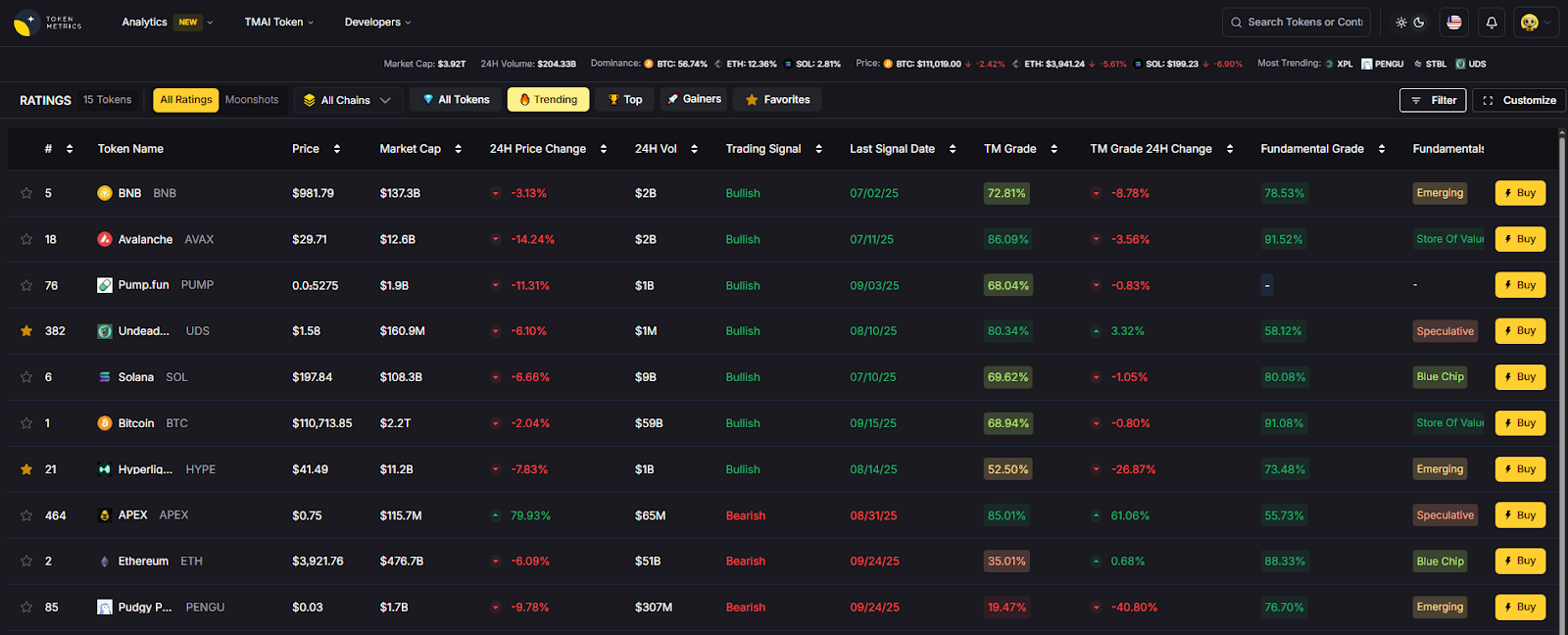
- AI Ratings surface quality signals behind liquidity metrics.
- Narrative Detection spots capital rotation into specific stablecoin ecosystems.
- Portfolio Optimization helps size stablecoin sleeves by mandate (trading vs yield vs payments).
- Alerts & Signals track peg deviations, volume spikes, and exchange outflows.
Workflow: Research → Select → Execute with your chosen issuer/exchange → Monitor with alerts.
Primary CTA: Start free trial
Security & Compliance Tips
- Enable 2FA and secure treasury ops (role-based access, hardware keys).
- Confirm custody setup (segregated accounts; multi-sig or MPC for smart-contract risk).
- Complete KYC/AML where required; verify permitted jurisdictions. Tether+1
- Use RFQ/OTC for large conversions to reduce slippage.
- Practice wallet hygiene: label treasury addresses, restrict permissions, and test redemptions.
This article is for research/education, not financial advice.
Beginner Mistakes to Avoid
- Treating all stablecoins as identical; mechanisms and risks vary.
- Ignoring fee schedules and settlement timelines for large redeems. Circle Help+1
- Using a region-restricted product (e.g., PYUSD outside the U.S.; USDe app in restricted markets). PayPal+1
- Overconcentrating in a single issuer or chain.
- Skipping ongoing monitoring of peg, reserves, and disclosures.
FAQs
1) What are the main types of stablecoin issuers?
Three broad models: (1) Fiat-backed (Circle, Paxos, First Digital Labs), (2) Overcollateralized crypto-backed (MakerDAO DAI; Liquity), and (3) Synthetic/hedged (Ethena USDe). Each has distinct reserve/risk properties. docs.ethena.fi+3Circle+3Paxos+3
2) Which stablecoin is best for trading liquidity?
USDT typically leads on global CEX depth and pairs, with USDC often preferred for fiat-connected flows and DeFi. Choose based on venue support and treasury needs. Tether+1
3) Can U.S. users access every stablecoin?
No. PYUSD is for eligible U.S. PayPal/Venmo users; some protocols (e.g., Ethena) restrict U.S. access to their app. Always check terms. PayPal+1
4) How do fees work for minting and redeeming?
Paxos states no fees for mint/redeem USDP/PYUSD for primary clients; Circle has institutional schedules; Tether lists platform fees. Secondary-market trades still incur exchange/gas costs. Paxos+2Circle Help+2
5) Are euro or SGD stablecoins useful?
Yes. EURC/EURe enable euro settlements under EU rules; XSGD supports APAC rails and FX paths versus USD stables. Circle+2Monerium+2
6) Is DAI safer than fiat-backed coins?
“Safer” depends on your risk lens. DAI reduces bank/custodian reliance but adds crypto-collateral and governance risk; fiat-backed coins rely on custodians and regulators. Diversification is common. docs.makerdao.com
Conclusion + Related Reads
If you need global trading liquidity, start with USDT/USDC. For enterprise-grade compliance, Circle/Paxos shine. For decentralized resilience, DAI (and Liquity) fit. For regional rails, consider XSGD (APAC) and EURe/EURC (EU). Pair the right issuer with your use case, then monitor peg, reserves, and policy changes over time.
Related Reads:
- Best Cryptocurrency Exchanges 2025
- Top Derivatives Platforms 2025
- Top Institutional Custody Providers 2025
AI Agents in Minutes, Not Months


%201.svg)


.png)







.svg)
No Credit Card Required


Online Payment


SSL Encrypted
.png)
Token Metrics Media LLC is a regular publication of information, analysis, and commentary focused especially on blockchain technology and business, cryptocurrency, blockchain-based tokens, market trends, and trading strategies.
Token Metrics Media LLC does not provide individually tailored investment advice and does not take a subscriber’s or anyone’s personal circumstances into consideration when discussing investments; nor is Token Metrics Advisers LLC registered as an investment adviser or broker-dealer in any jurisdiction.
Information contained herein is not an offer or solicitation to buy, hold, or sell any security. The Token Metrics team has advised and invested in many blockchain companies. A complete list of their advisory roles and current holdings can be viewed here: https://tokenmetrics.com/disclosures.html/
Token Metrics Media LLC relies on information from various sources believed to be reliable, including clients and third parties, but cannot guarantee the accuracy and completeness of that information. Additionally, Token Metrics Media LLC does not provide tax advice, and investors are encouraged to consult with their personal tax advisors.
All investing involves risk, including the possible loss of money you invest, and past performance does not guarantee future performance. Ratings and price predictions are provided for informational and illustrative purposes, and may not reflect actual future performance.