Back to blog
Research

100 Tokens, One Click, Zero Spreadsheets: Modern Crypto Indexing

Discover how modern crypto indexing replaces manual spreadsheets with automated, diversified portfolio management. Gain exposure to 100 tokens in one click without sacrificing security, customization, or insight.
Token Metrics Team
10 min read
Want Smarter Crypto Picks—Free?
See unbiased Token Metrics Ratings for BTC, ETH, and top alts.
Thank you! Your submission has been received!
Oops! Something went wrong while submitting the form.
 No credit card | 1-click unsubscribe

Managing a diversified crypto portfolio used to be a daunting task, requiring countless spreadsheets, manual tracking of hundreds of transactions across various exchanges, and hours spent calculating gains and losses. Fortunately, those days are rapidly becoming a thing of the past.

Modern crypto indexing now spans multiple blockchain networks, enabling seamless portfolio management across diverse ecosystems.‍Blockchain indexing plays a crucial role in enabling seamless portfolio management and efficient data access across networks, supporting real-time data retrieval and advanced analytics for decentralized applications.

Welcome to the era of modern crypto indexing, where sophisticated portfolio management meets seamless, automated execution, making it easier than ever to gain broad market exposure with minimal effort.‍With improved indexing infrastructure, applications consume blockchain data more efficiently, benefiting both developers and end users.

Traditionally, API regular nodes communicate using JSON-RPC over HTTP, which can be inefficient for large-scale blockchain indexing, but modern solutions have introduced more efficient protocols to address these challenges.

The key benefits of modern crypto indexing include enhanced scalability, greater reliability, and improved access to on-chain data, empowering users and developers to overcome traditional bottlenecks in the blockchain ecosystem.

The Spreadsheet Nightmare is Over

For years, crypto investors faced a tough dilemma: either limit their holdings to a manageable number of tokens they could manually track or embrace diversification at the expense of their sanity. Attempting to maintain exposure to 20 or 30 different projects meant drowning in administrative overhead. Every trade, portfolio rebalance, and tax calculation became an exhaustive, multi-hour ordeal.

The math was simple but brutal. Want exposure to the top 100 cryptocurrencies? That meant making 100 separate purchase decisions, juggling 100 wallet addresses or exchange accounts, continuously monitoring price movements, and tracking potentially hundreds of taxable events. Even professional traders found this granular management unsustainable and prone to errors. Manual tracking often led to overfetching data and made it difficult to manage the different data subsets required for various portfolio strategies.

The Blockchain Data Indexing Revolution

Traditional finance solved this problem decades ago with index funds. Instead of spending hours researching individual stocks, investors could buy the entire S&P 500 with a single transaction. The crypto industry has now caught up, but with innovations that make traditional index funds look outdated.

Modern crypto indexing platforms have revolutionized portfolio management by transforming a complex, time-consuming process into a streamlined, one-click experience. These platforms efficiently retrieve data from blockchain networks, enabling investors to gain instant exposure to diversified baskets of cryptocurrencies through sophisticated index products.

Rather than manually acquiring dozens or hundreds of tokens across multiple exchanges, these products automatically handle rebalancing, tracking, and optimization. The underlying data modules emit data for database operations—including insert, update, upsert, and delete—powered by custom indexing pipelines designed for scalable and reliable on-chain data access, drastically simplifying portfolio management.

How Modern Indexing Tools Work in Crypto

At the heart of modern crypto indexing are smart contracts and automated market makers that create tokenized representations of entire market segments. When you invest in a crypto index, you’re not buying 100 individual tokens; instead, you purchase a single index token representing proportional ownership of an underlying basket of assets.

Modern crypto indexing platforms rely on a blockchain data streaming service to retrieve and extract data from blockchain networks. These services enable the ability to stream historical blockchain data and stream binary block data for efficient processing, supporting both real-time and historical data needs.

Behind the scenes, advanced algorithms continuously monitor market conditions and execute rebalances according to predetermined criteria. These algorithms are essentially a function compiled to process incoming block data, applying user defined logic to filter and transform raw data—fundamental blockchain information retrieved directly from the node—into structured, filtered data.

If a token’s market capitalization grows and it should comprise a larger portion of the index, the system automatically adjusts allocations. Conversely, if a project falls below specific thresholds, it’s removed and replaced without any action required from the investor.

This approach offers several key advantages. First, it dramatically reduces transaction costs—rather than paying fees on 100 separate trades, you pay once. Second, it simplifies tax reporting since you’re primarily dealing with a single asset. Third, it provides professional-grade diversification without requiring professional-level expertise or resources.

Data modules are responsible for data transformation logic and emit data in a specific format suitable for downstream processing. This emitted data is structured for database operations such as insert, update, upsert, and delete, each performed with associated data to ensure proper data handling and integrity during synchronization.

The system manages an ordered data stream by splitting the requested block range into segments, streaming data efficiently to support both real-time and historical data indexing. Instead of streaming the raw data itself, the system streams progress updates by streaming data directly, ensuring ordered processing and effective error handling. Workers stream progress updates to a central system, which ensures reliable and ordered delivery of processed data to the user.

Blockchain Data Streaming Service

A blockchain data streaming service is the backbone of modern crypto indexing, enabling applications to stream binary block data directly from blockchain networks. By delivering binary block data in real time, these services empower users and developers to access blockchain data as it is produced, eliminating delays and bottlenecks associated with traditional data retrieval methods.

Whether you’re building financial analytics dashboards or powering social media platforms with on-chain activity, a blockchain data streaming service ensures that your application receives block data quickly and efficiently.

This approach to accessing blockchain data not only accelerates data retrieval but also supports the scalability required for today’s high-performance applications. By streaming block data as an ordered data stream, the service allows users to process and analyze blockchain data without the need for complex, resource-intensive polling. The result is a seamless, reliable experience that keeps your application in sync with the latest developments on the blockchain.

Data Retrieval and Duplication

Efficient data retrieval is essential for any blockchain data streaming service, especially when dealing with vast amounts of historical blockchain data. When the service initially fetches data from cloud storage buckets, it employs robust validation techniques to ensure the accuracy and completeness of the blockchain data being delivered. This process is critical for maintaining the integrity of historical blockchain data, which forms the foundation for analytics, compliance, and auditing.

To further enhance reliability, the blockchain data streaming service incorporates advanced duplication detection mechanisms. By identifying and eliminating duplicate data during the retrieval process, the service guarantees that users receive only the most accurate and relevant blockchain data. This meticulous approach to data retrieval not only streamlines access to historical blockchain data but also ensures that applications can trust the data they consume, whether it’s for real-time analysis or long-term storage.

Solving Polling Limitations

Traditional blockchain indexers often rely on polling, a method that repeatedly checks for new data at set intervals. While functional, this approach is inherently inefficient and struggles to scale as data volumes grow. Modern blockchain data streaming services overcome these polling limitations by leveraging a modified node equipped with a streaming patch. This innovation allows the node to push new blocks directly into a readable pipe, enabling the service to stream historical blockchain data from any block height with minimal latency.

By adopting a binary protocol such as gRPC, the blockchain data streaming service can transmit blockchain data more efficiently, reducing both bandwidth usage and parsing overhead. This not only supports real-time data streaming but also makes it possible to stream historical blockchain data on demand, providing unparalleled flexibility for developers and analysts.

The result is a blockchain data streaming service that is both scalable and efficient, capable of meeting the demands of modern indexing infrastructure.

Indexing Infrastructure

Behind every seamless crypto indexing experience lies a robust indexing infrastructure—the unsung hero that powers efficient access to blockchain data. Blockchains, by design, store vast amounts of transaction data and associated information in a decentralized, append-only ledger. While this ensures transparency and security, it also makes direct data retrieval complex and time-consuming for applications and users.

Some solutions do not maintain their own block storage and instead query nodes directly for block data as needed. This approach reduces infrastructure overhead but can impact data retrieval speed compared to systems that manage their own block storage.

Indexing infrastructure solves this challenge by acting as a bridge between raw blockchain data and the user-facing tools that depend on it. Instead of forcing applications to independently fetch blocks and parse through every transaction, the infrastructure organizes, categorizes, and stores blockchain data in a structured format, often utilizing centralized bucket storage for high availability and reliability. Multiple reader instances independently fetch blocks from various sources to ensure fault tolerance and continuous data access.

To efficiently process large block ranges, the requested block range is divided into assigned block segments—typically around 1,000 blocks each—which are then allocated to individual workers for parallel processing. A dedicated service delivers blocks in bundles, further improving efficiency and speed when handling large historical data sets.

Modern indexing infrastructure is designed to handle both live and historical blockchain data streams efficiently. It consumes data streams from blockchain networks, processes incoming block data in real time, applies custom data filtering and transformation logic, and stores processed data in a way that supports fast queries. This not only accelerates access to on-chain data relevant to your needs but also ensures that applications consume exactly the custom data subsets they require—no more, no less.

When multiple readers write to the same cloud storage buckets, data duplication can occur. Handling data duplication through deduplication techniques is essential to optimize storage efficiency and improve data retrieval performance.

By abstracting away the complexity of blockchain data indexing, these systems empower platforms to deliver production-grade data infrastructure. The result is a smooth, scalable experience for end users, enabling everything from one-click index investing to advanced analytics—without ever touching a spreadsheet.

Blockchain Data and Security

Security is paramount when handling blockchain data, and a blockchain data streaming service must prioritize the integrity and protection of the data it delivers. To safeguard blockchain data, the service implements advanced security measures, including encryption and strict access controls, ensuring that only authorized users can access sensitive information. These protections are essential for preventing tampering, unauthorized access, and data manipulation.

In addition to these security protocols, the blockchain data streaming service utilizes sophisticated data transformation logic to validate and format incoming data. This ensures that all blockchain data is not only secure but also consistent and ready for downstream processing. By combining robust security practices with intelligent data transformation, the service provides a trustworthy foundation for any application that relies on accurate, validated blockchain data.

Enter Token Metrics: The Analytics Powerhouse

While many platforms now offer crypto index products, Token Metrics stands out by combining index accessibility with institutional-grade analytics and AI-powered insights. What sets Token Metrics apart is not just the ability to invest in diversified crypto portfolios but the intelligence layer that helps investors understand what they’re investing in and why.

Token Metrics leverages advanced artificial intelligence and machine learning models to evaluate thousands of cryptocurrencies across multiple dimensions, including fundamental analysis, technical indicators, community sentiment, development activity, and market dynamics. This comprehensive approach provides investors with data-driven insights previously available only to hedge funds and professional traders.

The platform’s rating system cuts through the noise of the crypto market by assigning quantitative scores to projects based on objective criteria. Whether you’re interested in DeFi protocols, layer-1 blockchains, or emerging sectors like real-world asset tokenization, Token Metrics offers the analytical framework to make informed investment decisions.

Beyond Basic Indexing: Custom Indexing Pipelines for Smart Portfolio Construction

What truly makes modern crypto indexing revolutionary is the ability to go beyond simple market-cap-weighted indices. Platforms like Token Metrics enable investors to construct thematic portfolios tailored to specific investment theses.

Want exposure to the "metaverse" ecosystem? There’s an index for that. Bullish on decentralized finance but wary of the volatility of any single protocol? DeFi indices provide diversified exposure. Interested in layer-2 scaling solutions? You can invest in a basket of leading contenders without needing to pick individual winners.

This thematic approach allows investors to express sophisticated market views without execution complexity. You can maintain conviction in a sector while acknowledging that you don’t know which specific project will ultimately dominate—a pragmatic strategy long employed by professional investors in traditional markets.

Risk Management Made Simple with Production Grade Data Infrastructure

Diversification is about more than maximizing returns; it’s fundamentally about managing risk. Modern crypto indexing democratizes sophisticated risk management, making it accessible to retail investors. Instead of tying your portfolio’s fate to whether Solana or Cardano becomes the "Ethereum killer," you can own both alongside a dozen other contenders.

Platforms like Token Metrics enhance risk management through continuous monitoring and alerts. If a token in your index experiences unusual volatility, technical weakness, or regulatory challenges, you’re immediately informed. This proactive approach to risk management was previously impossible for individuals managing dozens of positions manually.

The Cost Efficiency Factor

One of the most underappreciated benefits of modern crypto indexing is the dramatic reduction in both explicit and implicit costs. Transaction fees, slippage, and the time cost of manual portfolio management can easily consume 5-10% of returns annually for actively managed portfolios. Index products compress these costs to minimal levels. You pay a small management fee for the index but eliminate dozens of individual trading fees, reduce tax complexity, and free up countless hours better spent on strategy rather than execution minutiae.

Looking Forward

We are still in the early innings of crypto indexing innovation. The next generation of products will likely incorporate even more sophisticated strategies, such as dynamic weighting based on market conditions, automated tax-loss harvesting, integration with DeFi protocols to generate yield on index holdings, and AI-driven rebalancing that responds to market regime changes in real time.

Future innovations in modern indexing tools will focus on solving polling limitations and supporting historical streaming, enabling more comprehensive and efficient access to blockchain data for analysis and replay. Standard nodes are limited as historical streaming nodes, as they are not designed to support streaming blockchain data from any past point. New solutions address this by fetching data directly from nodes, which greatly improves service reliability and ensures consistent data delivery. Additionally, these services will be able to stream switches automatically between historical and real-time data sources, adapting seamlessly to user needs. The adoption of protocols like gRPC eliminates the need for separate client libraries for each programming language, simplifying integration.

Delivering only the filtered data needed by each application will further improve efficiency and customization for users. Platforms like Token Metrics are at the forefront of this evolution, continuously expanding their analytical capabilities and product offerings to meet investor needs. As the crypto market matures and institutional adoption accelerates, tools and strategies once exclusive to professional traders are becoming democratized. These advancements will greatly improve service reliability for both institutional and retail investors.

Conclusion

The era of spreadsheet-driven crypto portfolio management is over. Modern crypto indexing platforms have transformed what was once an arduous, error-prone process into an elegant, efficient solution. With leaders like Token Metrics combining accessible index products with institutional-grade analytics, investors can focus on strategy and education rather than execution and administration.

One hundred tokens. One click. Zero spreadsheets. This is not just a tagline—it’s the reality of modern crypto investing. The question is no longer whether you can afford to use these tools, but whether you can afford not to.

FAQs

What is crypto indexing?

Crypto indexing involves creating a digital representation of a basket of cryptocurrencies to facilitate diversified exposure to the broader market, often through a single investment product or token.

How does indexing improve portfolio management?

Indexing simplifies portfolio management by providing instant diversification, reducing manual tracking, and automating rebalancing, which saves time and minimizes errors.

What are the benefits of modern indexing platforms?

Modern platforms offer scalability, enhanced data access, automated rebalancing, and integration with advanced analytics for better decision-making.

How do AI analytics support crypto investors?

AI-powered analytics evaluate market conditions, project fundamentals, and sentiment to provide insights that can inform investment strategies and risk assessment.

What is the future of crypto indexing?

The future will likely include more dynamic strategies, automated tax optimization, blockchain data integration, and expanded real-time historical streaming capabilities.

Disclaimer

This content is for educational and informational purposes only and does not constitute financial advice. Always conduct your own research before making investment or trading decisions. Past performance is not indicative of future results.

Build Smarter Crypto Apps &
AI Agents in Minutes, Not Months
Real-time prices, trading signals, and on-chain insights all from one powerful API.
Grab a Free API Key
About Token Metrics
Token Metrics: AI-powered crypto research and ratings platform. We help investors make smarter decisions with unbiased Token Metrics Ratings, on-chain analytics, and editor-curated “Top 10” guides. Our platform distills thousands of data points into clear scores, trends, and alerts you can act on.
30 Employees
analysts, data scientists, and crypto engineers
Daily Briefings
concise market insights and “Top Picks”
Transparent & Compliant
Sponsored ≠ Ratings; research remains independent
Want Smarter Crypto Picks—Free?
See unbiased Token Metrics Ratings for BTC, ETH, and top alts.
Thank you! Your submission has been received!
Oops! Something went wrong while submitting the form.
 No credit card | 1-click unsubscribe
Token Metrics Team
Token Metrics Team

Recent Posts

Research

WhiteBIT Coin Price Prediction 2028: $40-$272 Target Analysis

Token Metrics Team
7 min read

WhiteBIT Coin Price Prediction: Portfolio Context for WBT in the 2028 Landscape

Exchange tokens like WhiteBIT Coin offer leveraged exposure to overall market activity, creating concentration risk around a single platform's success. While WBT can deliver outsized returns during bull markets with high trading volumes, platform-specific risks like regulatory action, security breaches, or competitive displacement amplify downside exposure. Portfolio theory suggests balancing such concentrated bets with broader sector exposure.

The price prediction scenarios below show how WBT might perform across different crypto market cap environments. Rather than betting entirely on WhiteBIT Coin's exchange succeeding, diversified strategies blend exchange tokens with L1s, DeFi protocols, and infrastructure plays to capture crypto market growth while mitigating single-platform risk.

The Case for Diversified Index Exposure

Portfolio theory teaches that diversification is the only free lunch in investing. WBT concentration violates this principle by tying your crypto returns to one protocol's fate. Token Metrics Indices blend WhiteBIT Coin with the top one hundred tokens, providing broad exposure to crypto's growth while smoothing volatility through cross-asset diversification. This approach captures market-wide tailwinds without overweighting any single point of failure.

Systematic rebalancing within index strategies creates an additional return source that concentrated positions lack. As some tokens outperform and others lag, regular rebalancing mechanically sells winners and buys laggards, exploiting mean reversion and volatility. Single-token holders miss this rebalancing alpha and often watch concentrated gains evaporate during corrections while index strategies preserve more gains through automated profit-taking.

Beyond returns, diversified indices improve the investor experience by reducing emotional decision-making. Concentrated WBT positions subject you to severe drawdowns that trigger panic selling at bottoms. Indices smooth the ride through natural diversification, making it easier to maintain exposure through full market cycles.

Get Early Acces


Disclosure

Educational purposes only, not financial advice. Crypto is volatile, do your own research and manage risk.

How to read this price prediction:

Each band blends cycle analogues and market-cap share math with TA guardrails. Base assumes steady adoption and neutral or positive macro. Moon layers in a liquidity boom. Bear assumes muted flows and tighter liquidity.

TM Agent baseline:

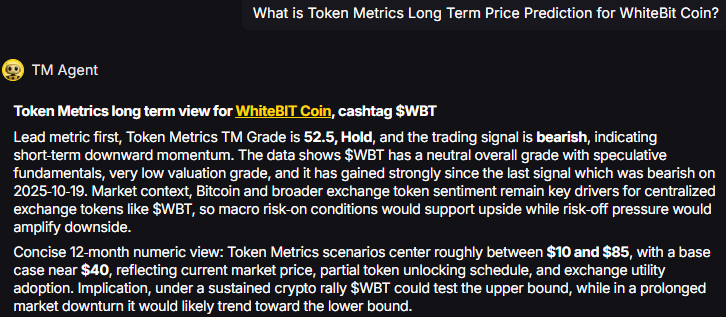
Token Metrics long term price prediction view for WhiteBIT Coin, cashtag $WBT. Lead metric first, Token Metrics TM Grade is 52.5%, Hold, and the trading signal is bearish, indicating short-term downward momentum. Concise 12-month numeric price prediction view: Token Metrics scenarios center roughly between $10 and $85, with a base case price target near $40.

Live details: Token Details

Key Takeaways for WBT Price Prediction

  • Scenario driven: price prediction outcomes hinge on total crypto market cap; higher liquidity and adoption lift the price bands
  • Single-asset concentration amplifies both upside and downside versus diversified approaches
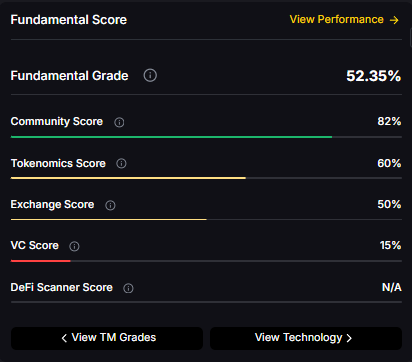
  • Fundamentals: Fundamental Grade 52.35% (Community 82%, Tokenomics 60%, Exchange 50%, VC —, DeFi Scanner N/A)
  • TM Agent gist: Bearish momentum, 12-month price prediction range $10 to $85
  • Education only, not financial advice

WhiteBIT Coin Price Prediction: Scenario Analysis

Token Metrics price prediction scenarios span four market cap tiers, each representing different levels of crypto market maturity and liquidity:

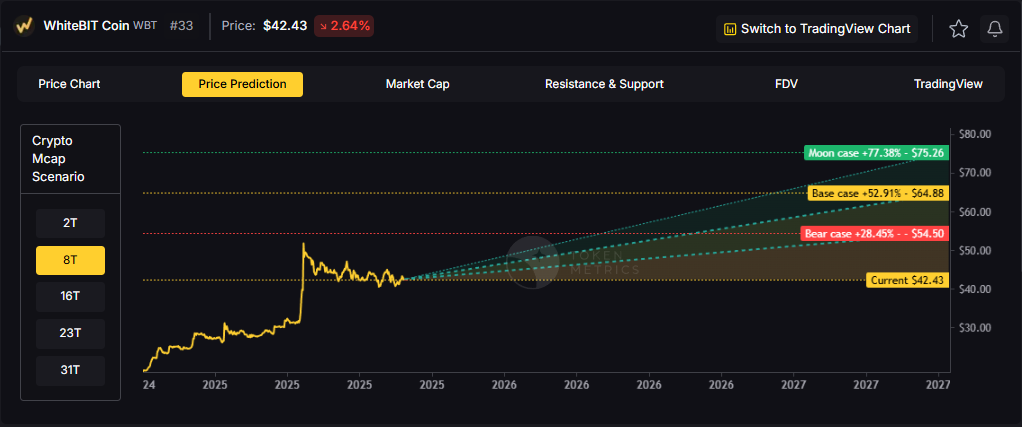
8T Market Cap Price Prediction:

At an 8 trillion dollar total crypto market cap, WBT price prediction projects to $54.50 in bear conditions, $64.88 in the base case, and $75.26 in bullish scenarios.

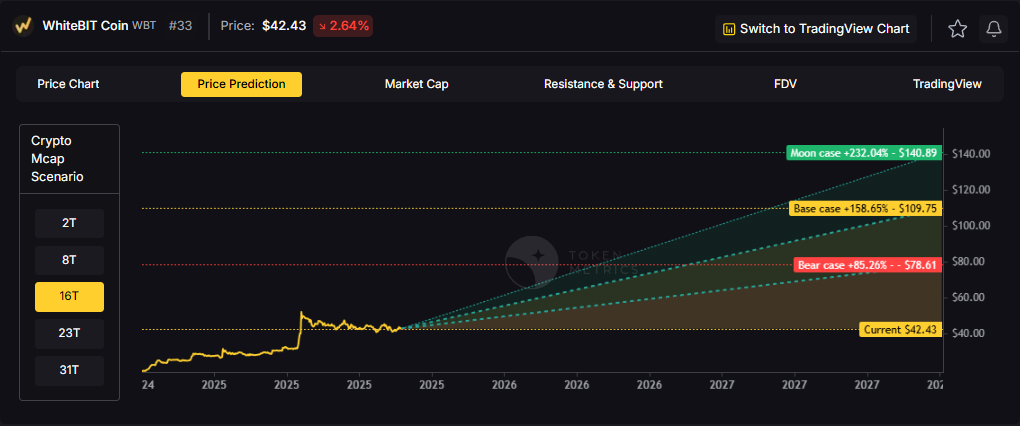
16T Market Cap Price Prediction:

Doubling the market to 16 trillion expands the price prediction range to $78.61 (bear), $109.75 (base), and $140.89 (moon).

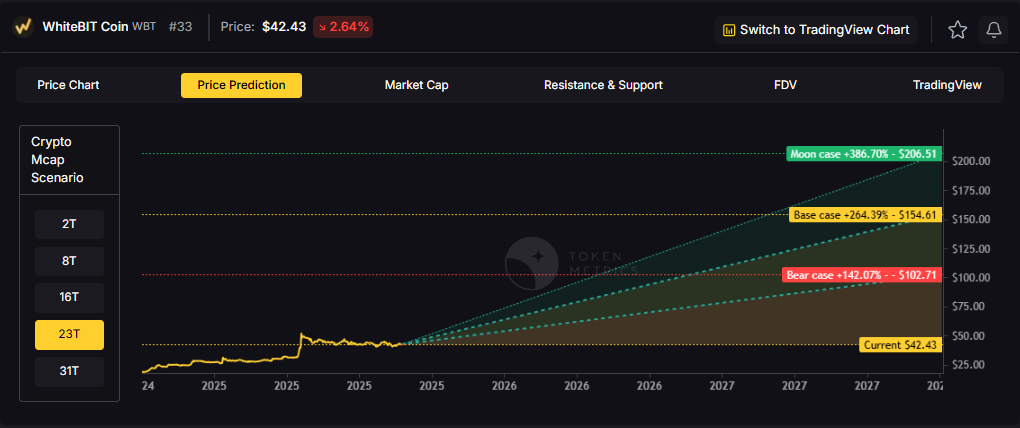
23T Market Cap Price Prediction:

At 23 trillion, the price forecast scenarios show $102.71, $154.61, and $206.51 respectively.

31T Market Cap Price Prediction:

In the maximum liquidity scenario of 31 trillion, WBT price prediction could reach $126.81 (bear), $199.47 (base), or $272.13 (moon).


These price prediction ranges illustrate potential outcomes for concentrated WBT positions, but investors should weigh whether single-asset exposure matches their risk tolerance or whether diversified strategies better suit their objectives.

What Is WhiteBIT Coin?

WhiteBIT Coin is the native exchange token associated with the WhiteBIT ecosystem. It is designed to support utility on the platform and related services.

WBT typically provides fee discounts and ecosystem benefits where supported. Usage depends on exchange activity and partner integrations.

Token Metrics AI Analysis for Price Prediction

Token Metrics AI provides comprehensive context on WhiteBIT Coin's positioning and challenges that inform our price prediction models.

Vision: The stated vision for WhiteBIT Coin centers on enhancing user experience within the WhiteBIT exchange ecosystem by providing tangible benefits such as reduced trading fees, access to exclusive features, and participation in platform governance or rewards programs. It aims to strengthen user loyalty and engagement by aligning token holders' interests with the exchange's long-term success. While not positioned as a decentralized protocol token, its vision reflects a broader trend of exchanges leveraging tokens to build sustainable, incentivized communities.

Problem: Centralized exchanges often face challenges in retaining active users and differentiating themselves in a competitive market. Users may be deterred by high trading fees, limited reward mechanisms, or lack of influence over platform developments. WhiteBIT Coin aims to address these frictions by introducing a native incentive layer that rewards participation, encourages platform loyalty, and offers cost-saving benefits. This model seeks to improve user engagement and create a more dynamic trading environment on the WhiteBIT platform.

Solution: WhiteBIT Coin serves as a utility token within the WhiteBIT exchange, offering users reduced trading fees, staking opportunities, and access to special events such as token sales or airdrops. It functions as an economic lever to incentivize platform activity and user retention. While specific governance features are not widely documented, such tokens often enable voting on platform upgrades or listing decisions. The solution relies on integrating the token deeply into the exchange's operational model to ensure consistent demand and utility for holders.

Market Analysis: Exchange tokens like WhiteBIT Coin operate in a competitive landscape led by established players such as Binance Coin (BNB) and KuCoin Token (KCS). While BNB benefits from a vast ecosystem including a launchpad, decentralized exchange, and payment network, WBT focuses on utility within its native exchange. Adoption drivers include the exchange's trading volume, security track record, and the attractiveness of fee discounts and staking yields. Key risks involve regulatory pressure on centralized exchanges and competition from other exchange tokens that offer similar benefits.

Fundamental Snapshot from Token Metrics

Fundamental Grade: 52.35% (Community 82%, Tokenomics 60%, Exchange 50%, VC —, DeFi Scanner N/A).


Catalysts That Skew Bullish for Price Prediction

  • Institutional and retail access expands with ETFs, listings, and integrations
  • Macro tailwinds from lower real rates and improving liquidity
  • Product or roadmap milestones such as upgrades, scaling, or partnerships
  • These factors could push WBT toward higher price prediction targets

Risks That Skew Bearish for Price Prediction

  • Macro risk-off from tightening or liquidity shocks
  • Regulatory actions or infrastructure outages
  • Concentration in validator economics and competitive displacement
  • Protocol-specific execution risk and competitive pressure from alternatives
  • These factors could push WBT toward lower price prediction scenarios

FAQs: WhiteBIT Coin Price Prediction

Can WBT reach $100 according to price predictions?

‍Based on the price prediction scenarios, WBT could reach $100 in the 16T base case. The 16T tier projects $109.75 in the base case price forecast. Achieving this price prediction requires both broad market cap expansion and WhiteBIT Coin maintaining competitive position. Not financial advice.

What's the risk/reward profile for WBT price prediction?

‍Risk and reward in our price prediction model span from $54.50 in the lowest bear case to $272.13 in the highest moon case. Downside risks include regulatory actions and competitive displacement, while upside drivers include expanding access and favorable macro liquidity. Concentrated positions amplify both tails, while diversified strategies smooth outcomes.

What gives WBT value and impacts price predictions?

‍WBT accrues value through fee discounts, staking rewards, access to special events, and potential participation in platform programs. Demand drivers include exchange activity, user growth, and security reputation. While these fundamentals matter for price predictions, diversified portfolios capture value accrual across multiple tokens rather than betting on one protocol's success.

What is the 2028 WhiteBIT Coin price prediction?

‍Based on Token Metrics analysis, the 2028 price prediction for WhiteBIT Coin centers around $40 in the base case under current market conditions, with a range between $10 and $85 depending on market scenarios. Bullish price predictions range from $64.88 to $272.13 across different total crypto market cap environments.

Can WBT reach $200 by 2028?

‍According to our price prediction models, WBT could reach $200 in the 23T moon case ($206.51) and in the 31T scenarios where the base case is $199.47 and the moon case is $272.13. These price prediction outcomes require significant crypto market expansion and WhiteBIT maintaining strong competitive positioning. Not financial advice.


Next Steps

Disclosure

Educational purposes only, not financial advice. Crypto is volatile, concentration amplifies risk, and diversification is a fundamental principle of prudent portfolio construction. Do your own research and manage risk appropriately.

Research

Predicting Litecoin Price in 2027: Scenario Analysis & On-Chain Scores

Token Metrics Team
6 min read

Litecoin Price Prediction Framework: Market Cap Scenarios & 2027 Forecast

Layer 1 tokens capture value through transaction fees and miner economics. Litecoin processes blocks every 2.5 minutes using Proof of Work, targeting fast, low-cost payments. The price prediction scenarios below model LTC outcomes across different total crypto market sizes, reflecting network adoption and transaction volume.


Disclosure

Educational purposes only, not financial advice. Crypto is volatile, do your own research and manage risk.

How to read this price prediction:

Each band blends cycle analogues and market-cap share math with TA guardrails. Base assumes steady adoption and neutral or positive macro. Moon layers in a liquidity boom. Bear assumes muted flows and tighter liquidity.

TM Agent baseline:

Token Metrics price prediction scenarios center roughly between $35 and $160, with a base case price target near $75, assuming gradual adoption, occasional retail rotation into major alts, and no major network issues. In a broad crypto rally LTC could test the upper bound price prediction, while in risk-off conditions it would likely drift toward the lower bound.

Live details: Token Details

Key Takeaways for LTC Price Prediction

  • Scenario driven: price prediction outcomes hinge on total crypto market cap; higher liquidity and adoption lift the price bands
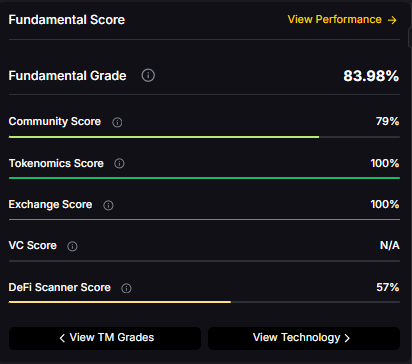
  • Fundamentals: Fundamental Grade 83.98% (Community 79%, Tokenomics 100%, Exchange 100%, VC —, DeFi Scanner 57%)
  • Technology: Technology Grade 46.67% (Activity 51%, Repository 72%, Collaboration 60%, Security 20%, DeFi Scanner 57%)
  • TM Agent gist: the TM Grade is 21.8 (Sell), and the trading signal is bearish, indicating short-term downward momentum
  • Education only, not financial advice

Litecoin Price Prediction: Scenario Analysis

Token Metrics price prediction scenarios span four market cap tiers reflecting different crypto market maturity levels:

8T Market Cap Price Prediction:

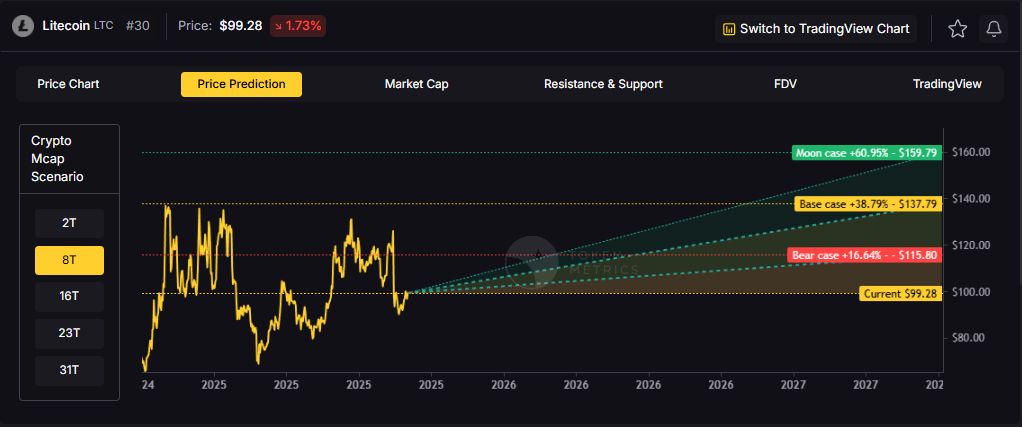
At an 8 trillion dollar total crypto market cap, LTC price prediction projects to $115.80 in bear conditions, $137.79 in the base case, and $159.79 in bullish scenarios.

16T Market Cap Price Prediction:

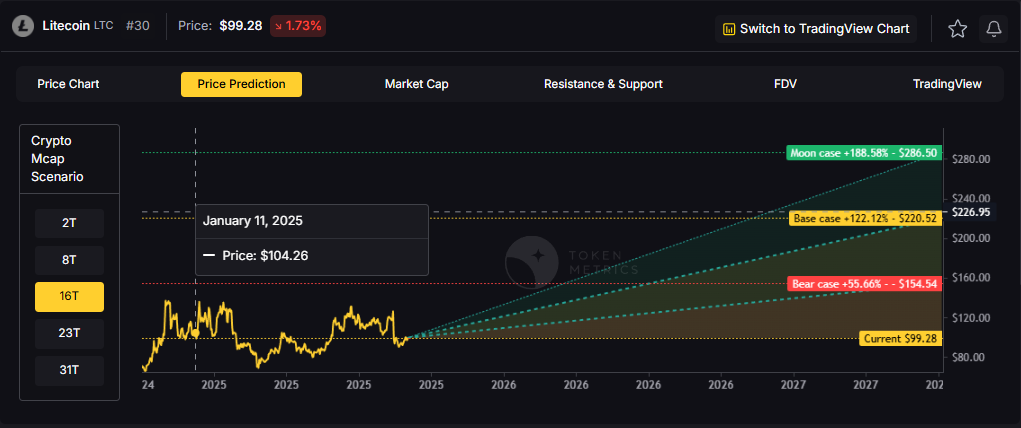
At 16 trillion, the price prediction range expands to $154.54 (bear), $220.52 (base), and $286.50 (moon).

23T Market Cap Price Prediction:

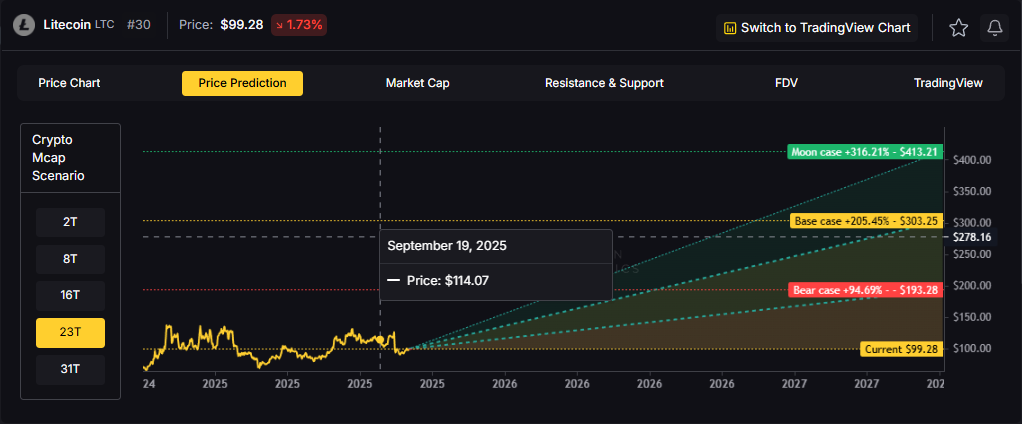
The 23 trillion tier price forecast shows $193.28, $303.25, and $413.21 respectively.

31T Market Cap Price Prediction:

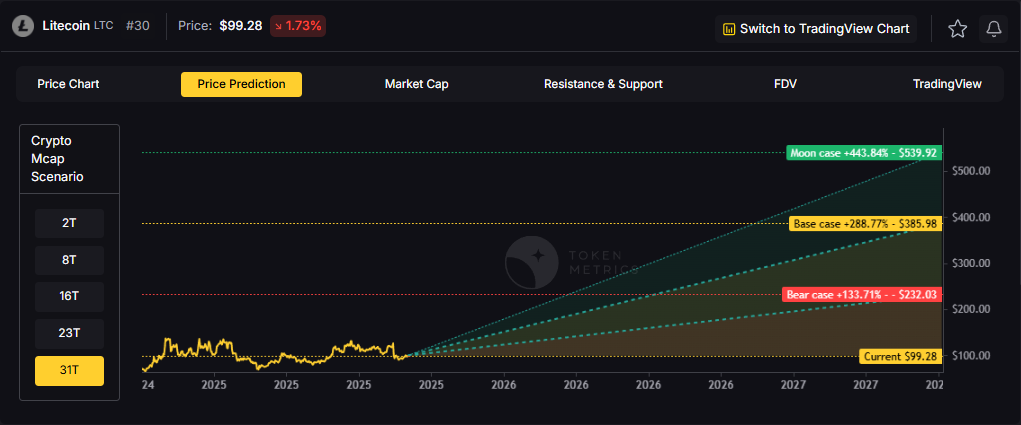
In the maximum liquidity scenario at 31 trillion, LTC price prediction reaches $232.03 (bear), $385.98 (base), or $539.92 (moon).


What Is Litecoin?

Litecoin is a peer-to-peer cryptocurrency launched in 2011 as an early Bitcoin fork. It uses Proof of Work with Scrypt and targets faster settlement, processing blocks roughly every 2.5 minutes with low fees.

LTC is the native token used for transaction fees and miner rewards. Its primary utilities are fast, low-cost payments and serving as a testing ground for Bitcoin-adjacent upgrades, with adoption in retail payments, remittances, and exchange trading pairs.

Token Metrics AI Analysis for Price Prediction

Token Metrics AI provides additional context on Litecoin's technical positioning and market dynamics that inform our price prediction models.

Vision: Litecoin's vision is to serve as a fast, low-cost, and accessible digital currency for everyday transactions. It aims to complement Bitcoin by offering quicker settlement times and a more efficient payment system for smaller, frequent transfers.

Problem: Bitcoin's relatively slow block times and rising transaction fees during peak usage make it less ideal for small, frequent payments. This creates a need for a cryptocurrency that maintains security and decentralization while enabling faster and cheaper transactions suitable for daily use.

Solution: Litecoin addresses this by using a 2.5-minute block time and the Scrypt algorithm, which initially allowed broader participation in mining and faster transaction processing. It functions primarily as a payment-focused blockchain, supporting peer-to-peer transfers with low fees and high reliability, without the complexity of smart contract functionality.

Market Analysis: Litecoin operates in the digital payments segment of the cryptocurrency market, often compared to Bitcoin but positioned as a more efficient medium of exchange. While it lacks the smart contract capabilities of platforms like Ethereum or Solana, its simplicity, long-standing network security, and brand recognition give it a stable niche. It competes indirectly with other payment-focused cryptocurrencies like Bitcoin Cash and Dogecoin. Adoption is sustained by its integration across major exchanges and payment services, but growth is limited by the broader shift toward ecosystems offering decentralized applications.

Fundamental and Technology Snapshot from Token Metrics

Fundamental Grade: 83.98% (Community 79%, Tokenomics 100%, Exchange 100%, VC —, DeFi Scanner 57%).


Technology Grade: 46.67% (Activity 51%, Repository 72%, Collaboration 60%, Security 20%, DeFi Scanner 57%).


Catalysts That Skew Bullish for Price Prediction

  • Institutional and retail access expands with ETFs, listings, and integrations
  • Macro tailwinds from lower real rates and improving liquidity
  • Product or roadmap milestones such as upgrades, scaling, or partnerships
  • These factors could push LTC toward higher price prediction targets

Risks That Skew Bearish for Price Prediction

  • Macro risk-off from tightening or liquidity shocks
  • Regulatory actions or infrastructure outages
  • Concentration in validator economics and competitive displacement
  • These factors could push LTC toward lower price prediction scenarios

Where to get deeper research and insights?

For comprehensive Litecoin ratings, on-chain analysis, AI-powered price forecasts, and trading signals, go to Token Metrics.

FAQs: Litecoin Price Prediction

What is LTC used for?

‍Primary use cases include fast peer-to-peer payments, low-cost remittances, and exchange settlement/liquidity pairs. LTC holders primarily pay transaction fees and support miner incentives. Adoption depends on active addresses and payment integrations, which directly impact long-term price prediction models.

What price could LTC reach in the moon case price prediction?

‍Moon case price predictions range from $159.79 at 8T to $539.92 at 31T total crypto market cap. These price prediction scenarios require maximum market cap expansion and strong adoption dynamics. Not financial advice.

What is the 2027 Litecoin price prediction?

‍Based on Token Metrics analysis, the 2027 price prediction for Litecoin centers around $75 in the base case under current market conditions, with a range between $35 and $160 depending on market scenarios. Bullish price predictions range from $137.79 to $539.92 across different total crypto market cap environments.

Can LTC reach $500 according to price predictions?

‍According to our price prediction models, LTC could reach $500+ in the 31T moon case where it projects to $539.92. This price prediction outcome requires significant crypto market expansion (31 trillion total market cap) combined with strong Litecoin network adoption. Not financial advice.

How does Litecoin's price prediction compare to Bitcoin?

‍While Litecoin was designed as "silver to Bitcoin's gold," its price prediction typically reflects a fraction of Bitcoin's value due to lower market cap and adoption. However, LTC often benefits from Bitcoin rallies while offering faster transaction times, which can impact relative price performance during payment-focused adoption cycles.


Next Steps

• Track live grades and signals: Token Details 

• Buy LTC on MEXC

Disclosure

Educational purposes only, not financial advice. Crypto is volatile, do your own research and manage risk.

Research

Token Metrics Indices vs. Every Other Crypto Investment Option: The Complete Comparison

Token Metrics Team
10 min read

Cryptocurrency investors face overwhelming choices. Should you buy individual tokens, trade actively, stake for yield, use DeFi protocols, invest through funds, or use index strategies? Each approach promises wealth creation, but which actually delivers optimal risk-adjusted returns for typical investors?

Most comparison content presents biased perspectives promoting specific approaches. Crypto trading platforms emphasize active trading. DeFi protocols highlight yield farming. Fund managers promote their offerings. What's missing is objective, comprehensive analysis examining all options fairly.

This definitive comparison evaluates Token Metrics indices against every major crypto investment alternative. We'll examine advantages, disadvantages, costs, risks, and ideal investor profiles for each approach. By the end, you'll understand exactly why indices represent optimal choice for most investors—and when alternative approaches might make sense.

The Eight Major Crypto Investment Approaches

Before diving into detailed comparisons, let's categorize the landscape of crypto investment options available today.

  • Individual Token Selection: Researching and buying specific cryptocurrencies directly
  • Active Trading: Frequent buying and selling attempting to profit from price movements
  • Staking and Yield Farming: Locking tokens in protocols to earn yields
  • DeFi Protocol Participation: Providing liquidity or engaging in decentralized finance
  • Crypto Hedge Funds: Investing through professionally managed funds
  • Bitcoin-Only Strategy: Exclusively holding Bitcoin as digital gold
  • Crypto ETFs/Trusts: Investing through regulated traditional financial products
  • AI-Powered Index Strategies: Token Metrics systematic, diversified approach

Each serves different purposes and suits different investor types. Let's examine each comprehensively.

Individual Token Selection: The DIY Approach

Many investors begin by researching and selecting specific cryptocurrencies they believe will outperform.

  • Advantages: Complete control over decisions without management fees. Potential for exceptional 100x+ returns from identifying winners early. Deep learning experience building genuine crypto understanding.
  • Disadvantages: Proper research demands 10-20 hours weekly. Over 90% of projects fail within three years, risking total loss. Emotional decisions lead to buying high and selling low. Concentrated portfolios suffer catastrophic single-token failures. Constant monitoring creates anxiety and stress.

Ideal For: Full-time researchers with substantial time, emotional discipline through volatility, and ability to absorb total losses.

Token Metrics Comparison: Indices provide similar upside through diversification while eliminating research burden, reducing failure risk, and removing emotional decisions. For 95% of investors, indices deliver better risk-adjusted returns with 90% less time investment.

Active Trading: The Full-Time Job Approach

Some investors attempt profiting from short-term price movements through frequent trading.

  • Advantages: Potential for quick gains in days/weeks rather than years. Leveraged trading amplifies profits. Constant market engagement provides excitement. Flexibility to adapt quickly to changing conditions.
  • Disadvantages: Studies show 85-95% of traders lose money over time. Requires 40-80 hours weekly monitoring markets. Extreme stress causes burnout and poor life quality. Generates short-term capital gains taxed up to 37%. Trading fees, spreads, and slippage compound into 60%+ annually with frequent trades.

Ideal For: Professional traders with full-time career commitment, exceptional emotional discipline, acceptance of high failure probability, and substantial loss capital buffer.

Token Metrics Comparison: Indices capture market upside without trading's massive time requirements, emotional toll, tax inefficiency, or statistical disadvantages. Buy-and-hold index strategies outperform 90%+ of active traders after fees, taxes, and opportunity costs.

Staking and Yield Farming: The Income-Focused Approach

Staking tokens or providing liquidity generates yields—typically 5-20% APY depending on protocol and risk level.

Advantages
  • Passive Income Generation: Regular yield payments provide income stream separate from price appreciation, appealing to income-focused investors.
  • Compounding Opportunities: Reinvesting yields creates compound growth acceleration similar to dividend reinvestment in traditional investing.
  • Network Participation: Staking contributes to blockchain security and governance, providing purpose beyond profit seeking.
Disadvantages
  • Token Price Risk Dominates Yield: 15% APY means nothing if token price declines 60%—you're net negative despite yield
  • Lock-Up Periods: Many staking arrangements lock tokens for weeks or months, preventing selling during crashes
  • Impermanent Loss: Liquidity provision creates impermanent loss risk—you may have less value than simply holding tokens
  • Protocol Risks: Smart contract bugs, exploits, or failures can eliminate entire positions despite careful selection
  • Complexity Management: Moving between protocols chasing optimal yields requires constant attention and decision-making
  • Tax Complications: Yield payments trigger ordinary income taxes potentially at high rates, and tracking cost basis across protocols proves complex
Ideal For

Yield strategies suit technically sophisticated investors comfortable evaluating smart contract risks, accepting token price volatility, having detailed tax tracking systems, and not needing access to capital during lock-up periods.

Token Metrics Indices Comparison

While staking provides 5-20% yields, Token Metrics indices typically generate 30-60% annualized appreciation through systematic selection and rebalancing. The appreciation far exceeds staking yields while maintaining liquidity, avoiding protocol risks, and simplifying tax treatment. Indices can incorporate staking where appropriate without requiring you to manage complexity.

DeFi Protocol Participation: The Sophisticated Approach

Decentralized finance protocols enable lending, borrowing, trading, and complex financial strategies without intermediaries.

Advantages
  • High Yield Potential: DeFi protocols sometimes offer exceptional yields—30-100%+ APY during periods of high demand and limited supply.
  • Financial Innovation Access: DeFi enables strategies impossible in traditional finance—flash loans, automated market making, complex derivatives without counterparty risk.
  • Transparency: All transactions occur on-chain providing complete visibility into protocol mechanics, reserves, and risks.
Disadvantages
  • Extreme Complexity: Understanding DeFi protocols requires technical knowledge of smart contracts, liquidity pools, tokenomics, and blockchain mechanics
  • Smart Contract Risks: Bugs, exploits, or economic attacks can drain funds despite audits—DeFi history includes billions lost to exploits
  • Gas Fee Costs: Ethereum gas fees make small position management uneconomical—often paying $50-200 per transaction during high network usage
  • Yield Volatility: DeFi yields fluctuate dramatically—100% APY quickly becomes 10% APY requiring constant position adjustment
  • Regulatory Uncertainty: DeFi exists in regulatory gray area potentially facing restrictions limiting future participation
  • Overwhelming Options: Hundreds of protocols create analysis paralysis and risk of choosing unstable or dishonest platforms
Ideal For

DeFi suits technically expert investors who understand smart contracts deeply, actively manage positions across protocols, accept total loss risk from exploits, and have capital sufficient to absorb gas fees.

Token Metrics Indices Comparison

Indices provide professional crypto exposure without DeFi's complexity, smart contract risks, gas fee burdens, or technical expertise requirements. For investors seeking crypto appreciation without becoming blockchain developers, indices deliver far superior risk-adjusted returns.

Crypto Hedge Funds: The Institutional Approach

Some investors access crypto through professionally managed hedge funds specializing in digital assets.

Advantages
  • Professional Management: Experienced portfolio managers make investment decisions leveraging institutional research and resources.
  • Access to Complex Strategies: Funds employ sophisticated strategies beyond typical retail investor capabilities—arbitrage, options, private placements.
  • Risk Management: Institutional risk management frameworks and processes potentially reduce volatility and limit losses.
Disadvantages
  • Extremely High Fees: Traditional "2 and 20" structure charges 2% annually plus 20% of profits—these fees compound into enormous costs over time
  • High Minimums: Most crypto hedge funds require $100,000-1,000,000 minimum investments, excluding typical investors
  • Limited Liquidity: Quarterly or annual redemption windows prevent accessing capital when needed
  • Manager Risk: Performance depends entirely on specific manager's skill—past performance doesn't guarantee future results
  • Lack of Transparency: Many funds don't disclose holdings or strategies, creating uncertainty about actual exposures
  • Mediocre Performance: Most crypto hedge funds underperform simple buy-and-hold strategies after accounting for fees
Ideal For

Crypto hedge funds suit ultra-high net worth investors ($5M+ portfolios) seeking professional management, comfortable with illiquidity, and willing to pay premium fees for institutional infrastructure.

Token Metrics Indices Comparison

Token Metrics provides institutional-grade AI management at fraction of hedge fund costs—$50-200 monthly subscription versus $10,000+ annually in hedge fund fees for typical portfolio sizes. Performance is transparent, capital remains liquid, and minimums are under $1,000 versus six-figure hedge fund requirements.

Bitcoin-Only Strategy: The Minimalist Approach

Some investors exclusively hold Bitcoin, viewing it as digital gold.

  • Advantages: Simple single-asset strategy eliminates research complexity. Fifteen-year track record demonstrates survival through multiple cycles. Most mature security practices and custody solutions. Limited supply supports store-of-value thesis.
  • Disadvantages: Other cryptocurrencies often outperform Bitcoin during bull markets. Single asset means Bitcoin-specific issues harm entire portfolio. Limited growth potential—100x returns unlikely given size. No diversification or rebalancing benefits.

Ideal For: Conservative investors prioritizing simplicity and security over maximum returns, or those philosophically committed to Bitcoin specifically.

Token Metrics Comparison: Conservative indices typically hold 40-60% Bitcoin while adding diversified exposure to other quality projects. This provides Bitcoin's stability while capturing additional upside from emerging winners—historical data shows 30-50% higher returns than Bitcoin-only with similar volatility.

Crypto ETFs and Trusts: The Traditional Finance Approach

Recently approved Bitcoin ETFs and existing crypto trusts provide regulated exposure through traditional brokerage accounts.

Advantages
  • Regulatory Compliance: SEC-approved products provide legal certainty and investor protections unavailable with direct crypto holdings.
  • Brokerage Integration: Hold crypto exposure alongside stocks and bonds in existing retirement accounts and brokerage accounts.
  • Simplified Custody: No need for wallets, private keys, or exchange accounts—all handled by fund custodian.
  • Tax Reporting Integration: Broker-provided 1099 forms simplify tax filing versus tracking individual crypto transactions.
Disadvantages
  • Management Fees: ETFs charge 0.2-2.5% annually reducing returns—these fees compound substantially over decades
  • Limited Options: Currently only Bitcoin ETFs approved—no Ethereum or diversified crypto ETFs available broadly
  • Premium/Discount Volatility: Some trusts trade at premiums or discounts to net asset value creating tracking errors
  • No Token Ownership: You own fund shares, not actual crypto—can't stake, participate in governance, or use tokens in DeFi
  • Counterparty Risk: Depend on fund operator solvency and custody practices rather than controlling assets directly
Ideal For

Crypto ETFs suit traditional investors prioritizing regulatory comfort, wanting retirement account exposure, avoiding direct crypto custody, and accepting limited options for that convenience.

Token Metrics Indices Comparison

Token Metrics offers far broader diversification than current ETFs (Bitcoin only), typically lower costs, direct asset ownership providing full flexibility, and exposure to full crypto opportunity set rather than single asset. For investors comfortable with direct crypto custody, indices provide superior returns and options.

Token Metrics AI-Powered Indices: The Optimal Balance

After examining alternatives, let's detail Token Metrics indices comprehensive advantages.

Unique Advantages
  • Professional AI Management Without Hedge Fund Costs: Institutional-grade algorithms at $50-200 monthly versus $10,000+ hedge fund fees
  • Diversification Without Research Burden: Exposure to 20-50 quality tokens without spending hundreds of hours researching each
  • Systematic Rebalancing: AI-driven rebalancing captures profits from winners and accumulates losers at discounts automatically
  • Emotional Decision Elimination: Predetermined rules prevent fear and greed-driven mistakes that destroy returns
  • Tax Optimization Opportunities: Strategic loss harvesting and holding period management minimize tax burden
  • Flexibility Across Risk Profiles: Conservative to aggressive indices suit different investor needs within single platform
  • Complete Liquidity: Exit positions any time unlike hedge funds, locked staking, or illiquid investments
  • Transparent Performance: Track record visible rather than opaque fund reporting

For Whom Indices Work Best

Token Metrics indices suit 95% of crypto investors—those wanting professional exposure without full-time trading careers, seeking diversification without research burden, prioritizing long-term wealth building over short-term speculation, and valuing systematic approaches over emotional decision-making.

Conclusion: Why Indices Win for Most Investors

This comprehensive comparison reveals consistent pattern: alternative approaches offer niche advantages for specific situations but indices provide optimal balance of return potential, risk management, time efficiency, and cost effectiveness for typical investors.

Individual selection works if you're full-time researcher. Active trading works if you're professional trader. DeFi works if you're blockchain developer. Hedge funds work if you have millions. ETFs work if you want only Bitcoin in retirement accounts.

But if you're typical investor—employed professional, business owner, or retiree wanting substantial crypto exposure without it becoming second job—Token Metrics indices deliver superior risk-adjusted returns with minimal time investment and emotional burden.

The proof isn't theoretical—it's mathematical. Systematic, diversified, professionally managed approaches outperform alternatives across decades of investment research in every asset class. Crypto's unique characteristics amplify these advantages rather than diminishing them.

Your choice is clear: spend hundreds of hours researching individual tokens, stress over active trading, manage DeFi complexity, pay excessive hedge fund fees, or achieve superior results through systematic index investing requiring minimal time and expertise.

Start your 7-day free trial today and discover why sophisticated investors increasingly choose Token Metrics indices over every alternative approach.

Choose from Platinum, Gold, and Silver packages
Reach with 25–30% open rates and 0.5–1% CTR
Craft your own custom ad—from banners to tailored copy
Perfect for Crypto Exchanges, SaaS Tools, DeFi, and AI Products