Back to blog
Research

AAVE Price Prediction 2027: $70-$2,175 Forecast Analysis

Actionable Aave price prediction with scenario math, on-chain grades, and a clear TLDR for investors looking at 2027.
Token Metrics Team
9 min read
Want Smarter Crypto Picks—Free?
See unbiased Token Metrics Ratings for BTC, ETH, and top alts.
Thank you! Your submission has been received!
Oops! Something went wrong while submitting the form.
 No credit card | 1-click unsubscribe

AAVE Price Prediction 2027: Market Analysis and Scenario-Based Forecasts

Market Context for Aave Price Prediction: The Case for 2027

DeFi protocols are maturing beyond early ponzi dynamics toward sustainable revenue models. Aave operates in this evolving landscape where real yield and proven product-market fit increasingly drive valuations rather than speculation alone. Growing regulatory pressure on centralized platforms creates tailwinds for decentralized alternatives—factors that inform our comprehensive AAVE price prediction framework.

The scenario bands below reflect how AAVE price predictions might perform across different total crypto market cap environments. Each tier represents a distinct liquidity regime, from bear conditions with muted DeFi activity to moon scenarios where decentralized infrastructure captures significant value from traditional finance.


Disclosure

Educational purposes only, not financial advice. Crypto is volatile, do your own research and manage risk.

How to Read This AAVE Price Prediction

Each band blends cycle analogues and market-cap share math with TA guardrails. Base assumes steady adoption and neutral or positive macro. Moon layers in a liquidity boom. Bear assumes muted flows and tighter liquidity.

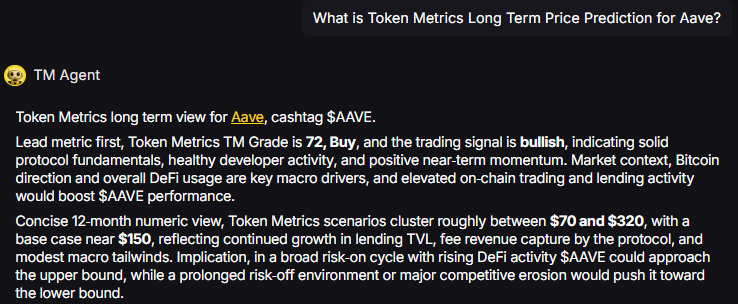
TM Agent baseline: Token Metrics TM Grade is 72, Buy, and the trading signal is bullish, indicating solid protocol fundamentals, healthy developer activity, and positive near-term momentum. Concise twelve-month numeric view, Token Metrics price prediction scenarios cluster roughly between $70 and $320, with a base case near $150, reflecting continued growth in lending TVL, fee revenue capture by the protocol, and modest macro tailwinds.

Live details: Aave Token Details

Affiliate Disclosure: We may earn a commission from qualifying purchases made via this link, at no extra cost to you.

Key Takeaways

  • Scenario driven, outcomes hinge on total crypto market cap, higher liquidity and adoption lift the bands.
  • Fundamentals: Fundamental Grade 75.51% (Community 77%, Tokenomics 100%, Exchange 100%, VC 49%, DeFi Scanner 70%).
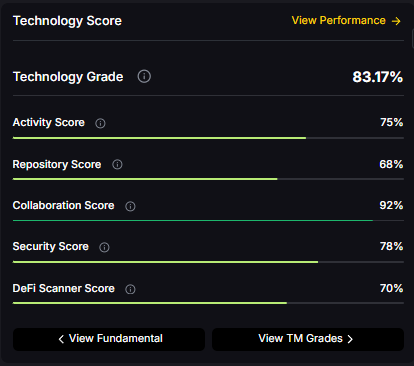
  • Technology: Technology Grade 83.17% (Activity 75%, Repository 68%, Collaboration 92%, Security 78%, DeFi Scanner 70%).
  • TM Agent gist: scenarios cluster between $70 and $320 with base near $150, assuming steady lending TVL growth and neutral macro conditions.
  • Education only, not financial advice.

AAVE Price Prediction Scenario Analysis

Our Token Metrics price prediction framework spans four market cap tiers, each representing different levels of crypto market maturity and liquidity:

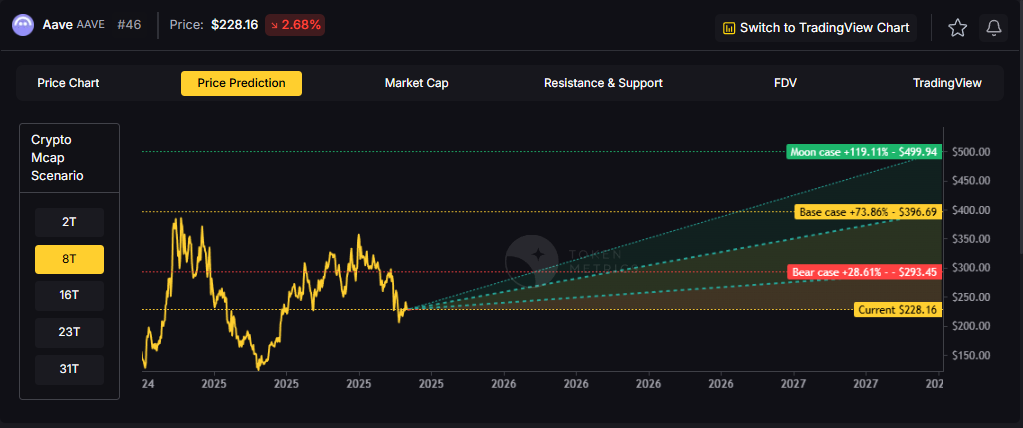
8T Market Cap - AAVE Price Prediction:

At an 8 trillion dollar total crypto market cap, AAVE projects to $293.45 in bear conditions, $396.69 in the base case, and $499.94 in bullish scenarios.
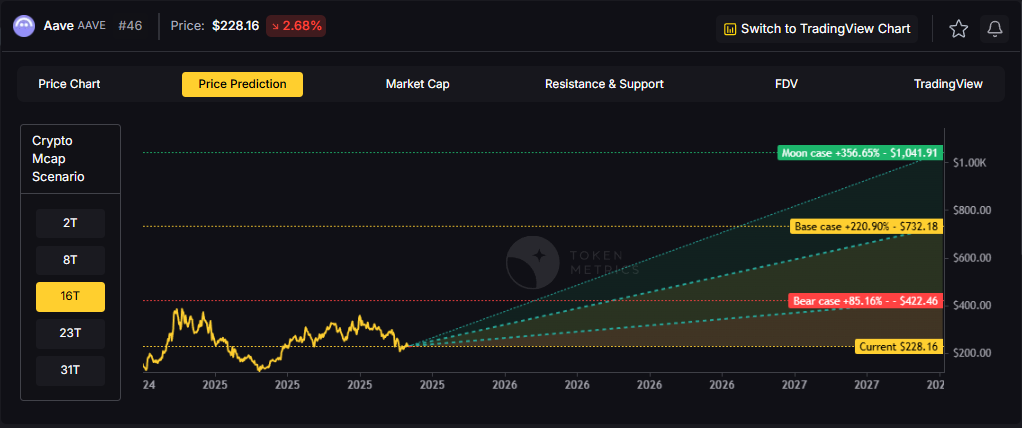
16T Market Cap - AAVE Price Prediction:

Doubling the market to 16 trillion expands the price prediction range to $427.46 (bear), $732.18 (base), and $1,041.91 (moon).
23T Market Cap - AAVE Price Prediction:

At 23 trillion, the price prediction scenarios show $551.46, $1,007.67, and $1,583.86 respectively.

31T Market Cap - AAVE Price Prediction:

In the maximum liquidity scenario of 31 trillion, AAVE price predictions could reach $680.47 (bear), $1,403.16 (base), or $2,175.85 (moon).
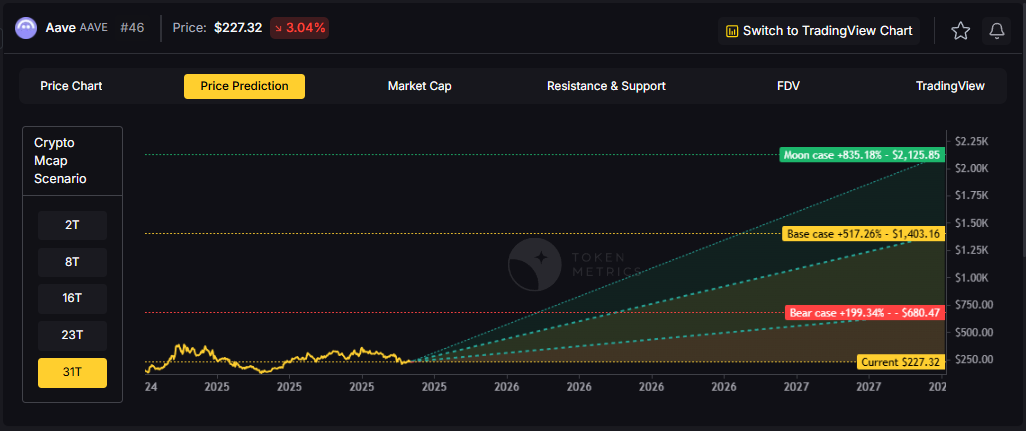
Each tier assumes progressively stronger market conditions, with the base case price prediction reflecting steady growth and the moon case requiring sustained bull market dynamics.

Why Consider the Indices with Top-100 Exposure

Aave represents one opportunity among hundreds in crypto markets. Token Metrics Indices bundle AAVE with top one hundred assets for systematic exposure to the strongest projects. Single tokens face idiosyncratic risks that diversified baskets mitigate.

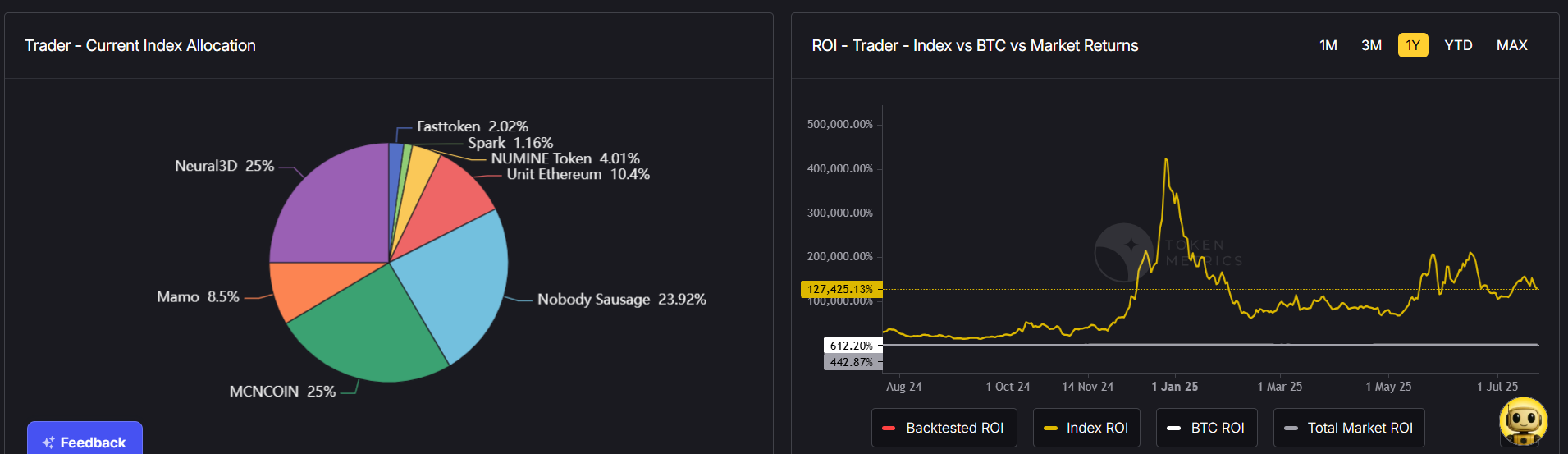
Historical index performance demonstrates the value of systematic diversification versus concentrated positions.

Join the early access list

What Is Aave?

Aave is a decentralized lending protocol that operates across multiple EVM-compatible chains including Ethereum, Polygon, Arbitrum, and Optimism. The network enables users to supply crypto assets as collateral and borrow against them in an over-collateralized manner, with interest rates dynamically adjusted based on utilization.

The AAVE token serves as both a governance asset and a backstop for the protocol through the Safety Module, where stakers earn rewards in exchange for assuming shortfall risk. Primary utilities include voting on protocol upgrades, fee switches, collateral parameters, and new market deployments.

Token Metrics AI Analysis

Token Metrics AI provides comprehensive context on Aave's positioning and challenges.

Vision: Aave aims to create an open, accessible, and non-custodial financial system where users have full control over their assets. Its vision centers on decentralizing credit markets and enabling seamless, trustless lending and borrowing across blockchain networks.

Problem: Traditional financial systems often exclude users due to geographic, economic, or institutional barriers. Even in crypto, accessing credit or earning yield on idle assets can be complex, slow, or require centralized intermediaries. Aave addresses the need for transparent, permissionless, and efficient lending and borrowing markets in the digital asset space.

Solution: Aave uses a decentralized protocol where users supply assets to liquidity pools and earn interest, while borrowers can draw from these pools by posting collateral. It supports features like variable and stable interest rates, flash loans, and cross-chain functionality through its Layer 2 and multi-chain deployments. The AAVE token is used for governance and as a safety mechanism via its staking program (Safety Module).

Market Analysis: Aave is a leading player in the DeFi lending sector, often compared with protocols like Compound and Maker. It benefits from strong brand recognition, a mature codebase, and ongoing innovation such as Aave Arc for institutional pools and cross-chain expansion. Adoption is driven by liquidity, developer activity, and integration with other DeFi platforms. Key risks include competition from newer lending protocols, regulatory scrutiny on DeFi, and smart contract risks. As a top DeFi project, Aave's performance reflects broader trends in decentralized finance, including yield demand, network security, and user trust. Its multi-chain strategy helps maintain relevance amid shifting ecosystem dynamics.

Fundamental and Technology Snapshot from Token Metrics

Fundamental Grade: 75.51% (Community 77%, Tokenomics 100%, Exchange 100%, VC 49%, DeFi Scanner 70%).


Technology Grade: 83.17% (Activity 75%, Repository 68%, Collaboration 92%, Security 78%, DeFi Scanner 70%).
Catalysts That Skew AAVE Price Predictions Bullish

  • Institutional and retail access expands with ETFs, listings, and integrations
  • Macro tailwinds from lower real rates and improving liquidity
  • Product or roadmap milestones such as upgrades, scaling, or partnerships

Risks That Skew AAVE Price Predictions Bearish

  • Macro risk-off from tightening or liquidity shocks
  • Regulatory actions or infrastructure outages
  • Concentration or competitive displacement in lending

AAVE Price Prediction FAQs

Can AAVE reach $1,000?

Yes. Based on our price prediction scenarios, AAVE could reach $1,007.67 in the 23T base case and $1,041.91 in the 16T moon case. Not financial advice.

Can AAVE 10x from current levels?

At current price of $228.16, a 10x would reach $2,281.60. This falls within the 31T moon case price prediction at $2,175.85 (only slightly below), and would require extreme liquidity expansion. Not financial advice.

What price could AAVE reach in the moon case?

Our moon case price predictions range from $499.94 at 8T to $2,175.85 at 31T. These scenarios assume maximum liquidity expansion and strong Aave adoption. Not financial advice.

What is the AAVE price prediction for 2027?

Our comprehensive 2027 price prediction framework suggests AAVE could trade between $293.45 and $2,175.85, depending on market conditions and total crypto market capitalization. The base case scenario clusters around $396.69 to $1,403.16 across different market cap environments. Not financial advice.

Is AAVE a good investment based on price predictions?

AAVE shows strong fundamentals (75.51% grade) and technology scores (83.17% grade), with bullish trading signals. However, all price predictions involve uncertainty and risk. Always conduct your own research and consult financial advisors before investing. Not financial advice.
‍


Next Steps

Track live grades and signals: Token Details 

Join Indices Early Access

Want exposure? Buy AAVE on MEXC 

Disclosure

Educational purposes only, not financial advice. Crypto is volatile, do your own research and manage risk.

Why Use Token Metrics?

  • AI-driven crypto and DeFi grades for risk management and alpha discovery.
  • Quantitative, on-chain signals and robust scenario modeling for tokens like AAVE.
  • Access in-depth research reports, analyst perspectives, auto-grades, and portfolio tools from Token Metrics.
Build Smarter Crypto Apps &
AI Agents in Minutes, Not Months
Real-time prices, trading signals, and on-chain insights all from one powerful API.
Grab a Free API Key
About Token Metrics
Token Metrics: AI-powered crypto research and ratings platform. We help investors make smarter decisions with unbiased Token Metrics Ratings, on-chain analytics, and editor-curated “Top 10” guides. Our platform distills thousands of data points into clear scores, trends, and alerts you can act on.
30 Employees
analysts, data scientists, and crypto engineers
Daily Briefings
concise market insights and “Top Picks”
Transparent & Compliant
Sponsored ≠ Ratings; research remains independent
Want Smarter Crypto Picks—Free?
See unbiased Token Metrics Ratings for BTC, ETH, and top alts.
Thank you! Your submission has been received!
Oops! Something went wrong while submitting the form.
 No credit card | 1-click unsubscribe
Token Metrics Team
Token Metrics Team

Recent Posts

Announcements

Introducing the New Moonshots API Endpoint: Access High‑Potential Tokens Programmatically

Token Metrics Team
5 min

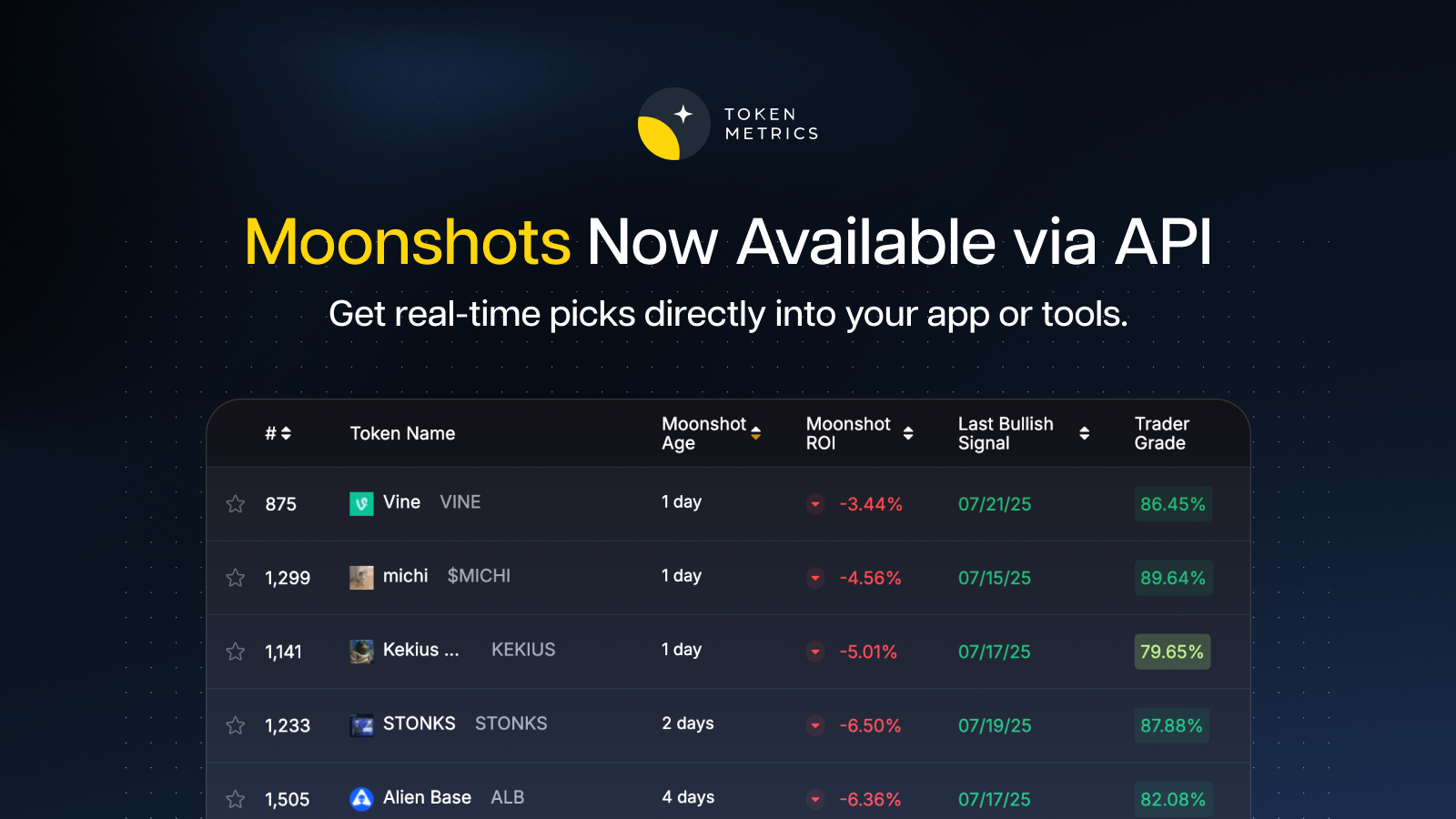
The crypto market moves fast, and staying ahead requires more than just watching charts — it takes actionable data, delivered in real‑time. That’s why we’re excited to announce a major upgrade for developers, traders, and analysts: the Moonshots feature is now live as a Token Metrics API endpoint.

This new endpoint brings the same powerful insights from our Premium Moonshots dashboard directly into your apps, dashboards, and trading systems — programmatically. Whether you’re building a crypto trading bot, creating dynamic watchlists, or backtesting new strategies, the Moonshots API gives you everything you need to make smarter, faster decisions.

What Are Moonshots?

In crypto, “moonshots” are low‑cap tokens with high upside potential — the kind of high‑risk, high‑reward plays that can deliver outsized returns when identified early. At Token Metrics, our Moonshots aren’t just random picks.

They are:

  • Hand‑picked by AI: Our proprietary algorithms scan thousands of tokens daily.
  • Backtested for performance: Only tokens that meet strict historical success criteria make the cut.
  • Continuously updated: Live insights reflect evolving market conditions in real time.

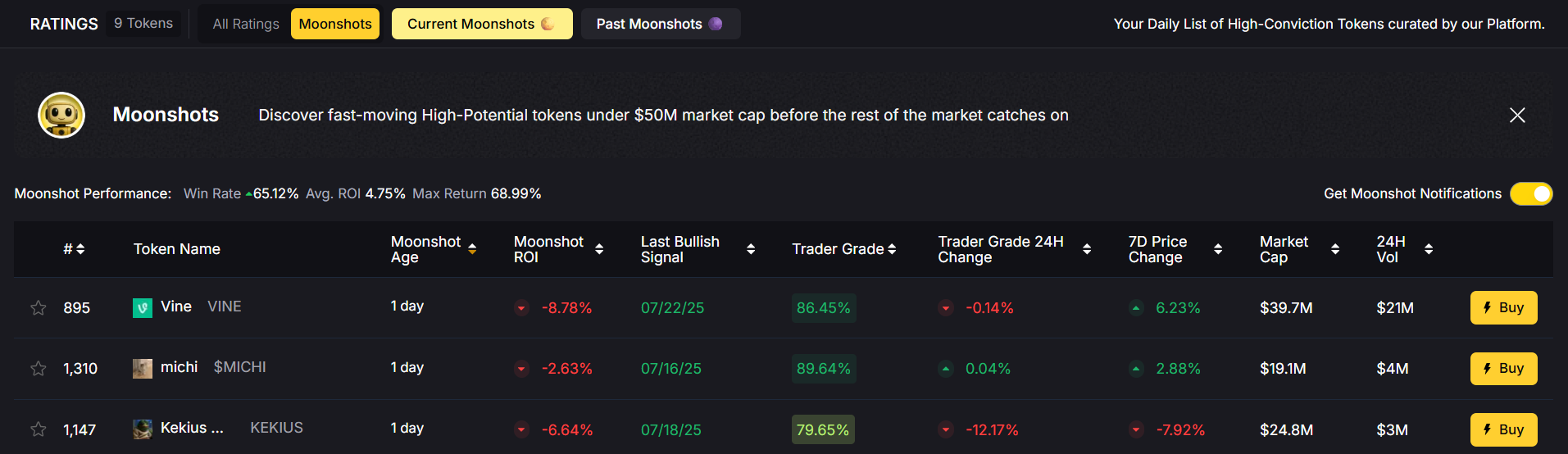
Since launch, Moonshots have surfaced 43 tokens with a 65 % win rate across trades. The max single‑token return so far? 68 % — and counting.

For developers, this is no longer just data you view in our dashboard. It’s now available via API, ready to integrate into your workflows.

Why Use the Token Metrics Moonshots API?

1. Programmatic Access to High‑Potential Trades
Get direct access to live Moonshot signals without needing to log into the platform. Perfect for apps, analytics dashboards, or automated trading systems.

2. Build Smarter Watchlists
Automatically populate your app or dashboard with AI‑curated, high‑potential tokens.

3. Trigger Bots in Real Time
Integrate the Moonshots feed into your trading bots so they can act instantly when a new token surfaces.

What’s in the API Response?

When you call the /v2/moonshot-tokens endpoint, you’ll get:

  • Token name & ticker – For easy identification.
  • Return on Investment (ROI) – Performance since the signal went live.
  • Trader Grade – Token Metrics’ proprietary grade indicating trade potential.
  • Market Cap – So you can quickly gauge token size and liquidity.
  • Signal Date – When the Moonshot was flagged.

Want to see how these signals have performed over time? Use /v2/moonshots-tokens with type=past param for detailed past performance data.

Who Is This For?

The Moonshots API is designed for:

  • Developers: Integrate AI‑curated trading intelligence into your products.
  • Quant Traders: Automate your strategies with real‑time Moonshot signals.
  • Portfolio Managers: Discover high‑potential small‑cap tokens before the crowd.

How to Get Started

  1. Upgrade to the Advanced Plan
    Moonshots is part of our premium trading‑signal suite, available with the Advanced Plan.

  2. Get Your API Key
    Once upgraded, grab your API key from the Token Metrics API dashboard.

  3. Call the Endpoint

    • Live Moonshots: GET /v2/moonshot-tokens
    • Past Moonshots: GET /v2/moonshot-tokens with type=past

  4. Build and Deploy
    Use the data to feed your dashboards, bots, or applications.

Your code could be live in minutes.

Example Use Cases

1. Auto‑Populate Watchlists

Give your users instant access to a curated list of high‑potential tokens. No manual updates — just live, programmatic signals from the API.

2. Trading Bot Triggers

Connect Moonshots to your algorithmic trading strategies. When a new Moonshot signal appears, your bot can take action immediately.

Why Moonshots API Is a Game‑Changer

The Moonshots API takes one of our most popular Premium features and makes it actionable for builders and advanced traders. No more copy‑pasting token names from dashboards. No more manually tracking new signals. With programmatic access, you can:

  • React faster to new opportunities.
  • Automate trading or alert systems.
  • Enhance your products with cutting‑edge AI‑curated token lists.

This is the same data powering our Premium dashboards — now unlocked for programmatic use.

Performance at a Glance

Here’s what you can expect from Moonshots based on recent data:

  • Tokens surfaced: 43
  • Win rate: 65 %
  • Max single‑token return: 68 %
  • Average holding period: Short‑ to mid‑term trades (active monitoring recommended)

The Bottom Line

The new Moonshots API endpoint lets you turn insights into action. Whether you’re an individual trader looking to build a personal watchlist, a quant team running algorithmic strategies, or a product developer building the next great crypto platform, the Moonshots API provides a direct pipeline to AI‑curated, backtested token picks with a proven track record.

Don’t just watch the next big move — catch it before it becomes hindsight.

How to Access the Moonshots API

  1. Upgrade to Advanced Plan to unlock trading‑signal endpoints.
  2. Get your API key from the Token Metrics dashboard.
  3. Start calling /v2/moonshot-tokens today.

Have questions? Our team is available on Telegram (@tokenmetricsapi) to help you get up and running.

Crypto Basics

Understanding Bitcoins: A Practical Guide to Buying and Using Crypto

Token Metrics Team
8 min

Introduction to Bitcoin

Bitcoins represent a revolutionary form of virtual currency that operates without reliance on any central authority or trusted third party. Introduced in 2009 by the enigmatic Satoshi Nakamoto, bitcoins were designed as a decentralized digital currency and cryptocurrency aimed at enabling money and payment transactions directly between peers. Bitcoin is the first decentralized cryptocurrency, setting the stage for a new era in digital finance. This is made possible through the innovative use of blockchain technology, a distributed ledger that records bitcoin transactions securely and transparently. The bitcoin network itself is maintained by a peer-to-peer system of computers, each verifying and broadcasting transactions to ensure the integrity and continuity of the ledger. This decentralized approach eliminates the need for financial institutions or banks to act as intermediaries, making bitcoins a unique asset in the realm of digital currencies. According to the European Central Bank, the decentralization of money offered by bitcoin has roots in the Austrian school of economics.

History of Bitcoin

The story of bitcoins began in August 2008 with the registration of the domain bitcoin.org, signaling the start of a new era in digital money. Shortly thereafter, on January 3, 2009, Satoshi Nakamoto mined the first bitcoin block, known as Block 0 or the genesis block, marking the inception of the bitcoin blockchain. Bitcoin's use as a currency began in 2009 with the release of its open-source implementation, allowing users to participate in this decentralized system. Bitcoin was introduced in response to the global financial crisis to restore trust in transactions outside of traditional systems. Bitcoin started gaining traction in 2010, highlighted by the first commercial transaction where bitcoins were used to purchase goods. Since then, bitcoin prices have experienced significant volatility, with sharp rises and falls reflecting market sentiment, adoption rates, and regulatory developments. Despite its fluctuations, bitcoin has established itself as a pioneering digital currency and a key player in the broader ecosystem of cryptocurrencies.

Bitcoin Fundamentals

At its core, bitcoin is built on a decentralized system that leverages cryptographic techniques to secure transactions and maintain trust without a central authority. The blockchain serves as a chronological chain of blocks, each block containing data stored in a way that includes a hash of the previous block. Everyone on the Bitcoin network has access to an independent copy of the blockchain for transaction verification, ensuring transparency and trust. The blockchain is implemented as an ordered list of blocks, where each block contains a hash of the previous block. This linkage ensures the integrity and immutability of the blockchain, as any alteration to previous blocks would be immediately apparent. Miners play a crucial role in this system by using computational power to solve complex mathematical problems that verify bitcoin transactions. Once validated, these transactions are grouped into new blocks and added to the bitcoin blockchain. An interesting feature of bitcoins is their divisibility; each bitcoin can be broken down into eight decimal places, with the smallest unit known as a satoshi, allowing for microtransactions and flexible usage.

Buying and Using Bitcoin

For those interested in entering the world of bitcoins, purchasing them typically involves using cryptocurrency exchanges where bitcoin can be bought using fiat currencies such as the US dollar. To buy bitcoin, users must first create a bitcoin address, which acts as a digital wallet for storing and sending bitcoins. Once an account is funded on an exchange, users can execute buy bitcoin orders and begin accumulating this digital asset. As of 2023, River Financial estimated that bitcoin had around 81.7 million users globally. As of 2021, Bitcoin is only recognized as legal tender in El Salvador, showcasing its limited but significant adoption as a national currency. Bitcoins are not only an investment but also a medium of exchange accepted by various merchants and businesses for payments. Additionally, users can sell bitcoin on exchanges or use it for donations and other financial services, highlighting its growing utility as a form of money in the digital age.

Regulatory Environment

Regulating bitcoin presents unique challenges due to its decentralized nature and absence of a central bank or authority. Governments and financial institutions worldwide are still grappling with how best to regulate bitcoin and other digital currencies. While some countries have outright banned bitcoin, others have taken steps to implement frameworks that govern its use, aiming to protect consumers and prevent illicit activities. Legal frameworks for Bitcoin vary significantly across jurisdictions, complicating investment decisions. The regulatory environment remains fluid, with ongoing debates about legal tender status, taxation, and compliance requirements. Understanding these evolving regulations is essential for users and businesses to navigate the legal landscape surrounding bitcoins safely and effectively.

Investing in Bitcoin

Investing in bitcoins offers both opportunities and risks that potential investors must carefully consider. The market for bitcoins is known for its high fees and significant volatility in bitcoin prices, which can lead to rapid gains or losses. Some investors liken bitcoin to gold, viewing it as a digital store of value and a hedge against inflation and currency devaluation. Investment in bitcoins can be conducted through cryptocurrency exchanges or specialized investment funds that provide exposure to this asset. However, thorough research and a solid understanding of the market dynamics are crucial before committing funds, as bitcoin lacks intrinsic value and is subject to speculative bubbles.

Security and Privacy

Bitcoin transactions are secured through advanced cryptographic techniques that verify and protect the integrity of each payment made on the network. Despite this robust security at the protocol level, bitcoin exchanges and wallets remain vulnerable to hacking and other cyber threats. Users must adopt stringent security measures such as using strong passwords, enabling two-factor authentication, and safeguarding private keys to protect their bitcoins. The decentralized nature of the bitcoin network, combined with the use of private keys, also provides a certain degree of privacy and anonymity, distinguishing it from traditional financial systems that rely on trusted third parties.

Mining and Consensus

Bitcoin mining is the fundamental process through which new transactions are verified and new blocks are added to the blockchain. Miners employ significant computational power to solve complex mathematical puzzles, a process that requires substantial energy consumption and specialized hardware. A new block in the blockchain is created approximately every 10 minutes for transaction processing, ensuring a steady and predictable flow of new blocks. This mining activity not only secures the network but also enables the creation of new bitcoins, rewarded to miners as a block reward. The bitcoin network operates on a consensus mechanism, ensuring that all nodes agree on the blockchain’s current state, maintaining data consistency across the peer-to-peer network. Many miners join mining pools to combine their computational resources, increasing their chances of successfully mining new blocks and earning rewards.

Challenges and Limitations

Despite its innovative design, bitcoin faces several challenges that impact its scalability and adoption. The bitcoin network can experience slow transaction times, often taking up to 10 minutes to confirm payments, which can be a drawback for everyday use. High fees during periods of network congestion further complicate its practicality for small transactions. Bitcoin is rarely used in regular transactions due to high costs, price volatility, and transaction times, limiting its utility as a day-to-day currency. Additionally, bitcoin’s decentralized structure complicates regulatory oversight and governance. Concerns also arise from the use of bitcoins in illicit activities such as money laundering and terrorist financing, prompting calls for enhanced monitoring and regulation. These limitations highlight the need for ongoing development and dialogue to address bitcoin’s shortcomings.

Risks and Considerations

Investing and using bitcoins come with inherent risks that must be acknowledged. The value of bitcoins can fluctuate dramatically, sometimes by thousands of dollars within short periods, exposing investors to potential significant losses. The absence of intrinsic value and the speculative nature of the market raise concerns about the possibility of a bitcoin bubble. Users should mitigate these risks by diversifying their investments and employing secure wallets to protect their funds. Awareness of market volatility and prudent management strategies are essential for anyone engaging with bitcoins as an asset or means of payment.

Best Practices for Bitcoin Users

To maximize benefits and minimize risks, bitcoin users should prioritize education about the technology, market, and associated risks. Using secure wallets and reputable exchanges is fundamental, along with enabling two-factor authentication to enhance account security. Staying informed about the regulatory environment and compliance requirements helps users avoid legal pitfalls. Regularly updating bitcoin software and employing strong passwords further safeguard against security breaches. Adhering to these best practices ensures a safer and more reliable experience when buying, selling, or transacting with bitcoins.

Conclusion

Bitcoin is a complex and rapidly evolving digital currency that has transformed the financial landscape by introducing a decentralized alternative to traditional money. Understanding the fundamentals of bitcoins, from their blockchain technology to their market dynamics and regulatory challenges, is crucial for users, investors, and policymakers alike. While the future of bitcoins and other cryptocurrencies remains uncertain, their growing adoption underscores their potential to reshape how value is exchanged globally. Staying informed and adaptable will be key as bitcoins continue to influence the future of money, payments, and investment.

Crypto Basics

Is Bitcoin a Good Investment? Key Insights for Potential Investors

Token Metrics Team
8 min

Introduction to Digital Assets

Digital assets, such as bitcoin and other cryptocurrencies, represent a relatively new and distinct asset class characterized by high speculation and substantial risk. Unlike traditional investments, digital currencies operate in a decentralized manner, meaning they are not controlled by central banks or governments. This decentralization contributes to their unique valuation dynamics, which are heavily influenced by investor sentiment and real-time market data rather than traditional economic indicators. However, the cryptocurrency market is largely unregulated, making it susceptible to fraud and manipulation.

Investing in digital currencies requires a solid understanding of the regulatory environment, as agencies like the Securities and Exchange Commission (SEC) continue to shape the landscape with evolving rules and approvals. For example, the SEC has authorized bitcoin ETFs, which have made it easier for investors to gain exposure to the crypto market without directly holding the currency. In 2024, the SEC approved the trading of spot bitcoin and ether exchange-traded funds (ETFs). The SEC's historical relationship with the cryptocurrency market has been skeptical due to concerns about market volatility and investor protections. Despite these advances, it remains crucial for investors to seek personalized investment advice and carefully assess their risk tolerance before venturing into this highly speculative space.

Understanding Bitcoin

Bitcoin is a pioneering digital currency that leverages blockchain technology and sophisticated computer code to secure transactions and regulate the creation of new units. This technological foundation makes bitcoin a highly volatile asset, with prices that can fluctuate dramatically over short periods. Bitcoin's price has fluctuated significantly since its inception in 2009. The value of bitcoin is primarily determined by what investors are willing to pay, which means its price is subject to rapid changes driven by market sentiment and speculative trading.

One of bitcoin’s defining features is its limited supply, capped at 21 million coins. This scarcity can drive its price higher, contributing to the potential for significant returns. Bitcoin historically has offered the potential for high returns. However, the limited supply also intensifies volatility, as shifts in demand can cause sharp price swings. Unlike traditional currencies or commodities such as gold, bitcoin is not backed by any physical asset or government guarantee, making its intrinsic value difficult to ascertain. Consequently, investing in bitcoin is considered a high-risk endeavor that demands careful evaluation.

Evaluating Investment Options

For investors interested in gaining exposure to bitcoin without directly purchasing or trading the currency, bitcoin ETFs present a viable alternative. These financial products allow investors to participate in the crypto market through regulated exchange-traded funds, potentially reducing some of the risks associated with direct ownership. The introduction of bitcoin ETFs has contributed to greater acceptance of cryptocurrencies among regulators and institutional investors. Futures-based bitcoin ETFs must regularly 'roll' their holdings, potentially underperforming compared to spot bitcoin ETFs. However, it remains essential to understand the fees involved in trading and transactions, as these can impact overall returns.

Diversification remains a cornerstone of sound investment strategies. Incorporating index funds and other traditional assets alongside digital currencies can help balance a portfolio and mitigate risk. While digital assets offer the allure of high returns, they also come with heightened volatility and uncertainty. Crypto exchanges lack basic consumer protections found in traditional financial products. Consulting a financial planner or investment advisor can provide personalized investment advice tailored to an individual’s financial goals, risk tolerance, and overall portfolio allocation.

Assessing Risks and Benefits

Investing in bitcoin and other cryptocurrencies involves substantial risks, including the possibility of significant financial losses. The regulatory environment surrounding digital assets is still evolving, and changes in laws or enforcement policies by bodies such as the Securities and Exchange Commission can dramatically affect market valuations. Furthermore, the lack of central bank oversight means that digital currencies are more exposed to market manipulation and extreme price swings. Transactions involving Bitcoin are irreversible, which can lead to significant loss if credentials are forgotten. Investors should consider only investing money in Bitcoin that they are comfortable losing.

Despite these risks, the potential rewards of investing in bitcoin can be compelling. Its limited supply and increasing adoption have made it attractive to some investors seeking alternatives to traditional assets. Nevertheless, it is vital to weigh these benefits against the inherent risks and to consider other investment options that may better align with one’s financial objectives and risk appetite.

Comparing to Other Cryptocurrencies

While bitcoin remains the largest and most recognized cryptocurrency by market cap, other digital currencies like ethereum and litecoin offer different features and potential advantages. These alternative cryptocurrencies, often referred to as altcoins, may provide unique use cases or technological innovations that appeal to certain investors. However, similar to bitcoin, they are also subject to high volatility and speculative trading, which can result in both substantial gains and losses.

Investors should carefully evaluate factors such as market capitalization, trading volume, and price volatility when considering other cryptocurrencies. Diversifying across multiple digital assets can help spread risk but requires thorough research and ongoing monitoring of market developments. Staying informed about emerging technologies and regulatory changes is critical in this fast-evolving market.

Making a Good Investment Decision

Determining whether bitcoin is a good investment depends heavily on an individual investor’s financial goals, risk tolerance, and preferred investment strategies. It is essential to conduct comprehensive research and stay updated on market trends, regulatory shifts, and valuation changes to make informed financial decisions. Seeking personalized investment advice from a qualified financial planner can help tailor strategies that align with one’s unique circumstances.

Diversification remains a key principle in building a resilient portfolio. Combining bitcoin and other digital assets with traditional investments such as stocks, bonds, and index funds can help manage risk and improve potential returns. Investments in Bitcoin should only make up a small portion of an investor's portfolio, usually capped at 5% or 10%. Investors should always be prepared for the possibility of significant losses, given the highly volatile nature of cryptocurrencies, and avoid allocating more money than they are willing to lose.

Conclusion and Next Steps

Investing in bitcoin and other digital assets can offer exciting opportunities for high returns but comes with considerable risks and uncertainties. Prospective investors must carefully evaluate the benefits and drawbacks, considering the speculative nature of these assets and the potential for substantial financial losses. The IRS currently treats cryptocurrencies as property, which means cryptocurrency transactions are taxable events. Staying informed about market developments, regulatory changes, and evolving technologies is crucial for making sound investment decisions.

Engaging with financial professionals to obtain personalized investment advice can provide valuable guidance tailored to individual goals and risk profiles. As the cryptocurrency market continues to evolve, maintaining a cautious and well-informed approach is essential. By thoughtfully considering the risks and rewards, investors can make prudent decisions that contribute to achieving their long-term financial objectives while navigating the complexities of digital asset investing.

Choose from Platinum, Gold, and Silver packages
Reach with 25–30% open rates and 0.5–1% CTR
Craft your own custom ad—from banners to tailored copy
Perfect for Crypto Exchanges, SaaS Tools, DeFi, and AI Products