Crypto Basics

What are Altcoins? - The Ultimate Guide for Beginners

Discover everything about Altcoins in this comprehensive guide. Learn what Altcoins are and how they can diversify your crypto portfolio.
Token Metrics Team
10 Minutes
MIN

In the world of cryptocurrencies, altcoins have emerged as a popular alternative to Bitcoin. While Bitcoin remains the most well-known cryptocurrency, altcoins offer a diverse range of digital assets with unique features and functionalities. 

This comprehensive beginner's guide aims to provide you with a clear understanding of what altcoins are, their purpose, and how they differ from Bitcoin.

What are Altcoins?

Altcoins, short for "alternative coins," refer to all cryptocurrencies other than Bitcoin. While Bitcoin paved the way for the development of digital currencies, altcoins have gained momentum in recent years.

Altcoins are built on various blockchain technologies and aim to address different use cases, ranging from decentralized finance (DeFi) to smart contracts and privacy features.

Types of Altcoins

Here is the list of different types of altcoins, their features, and their impact on the crypto ecosystem.

Stablecoins - Stablecoins are a type of altcoin that aim to maintain a stable value by pegging their price to an external asset such as fiat currency or commodities. 

These cryptocurrencies provide stability in the volatile crypto market, making them suitable for various purposes such as remittances, decentralized finance (DeFi) transactions, and as a hedge against market volatility.

Privacy Coins - Privacy coins prioritize user anonymity and transaction privacy. They utilize advanced cryptographic techniques to conceal transaction details and protect the identities of the participants involved.

Privacy coins offer enhanced privacy features compared to other cryptocurrencies, allowing users to have greater control over their financial information.

Utility Tokens - Utility tokens are a type of altcoin that serve a specific purpose within a blockchain ecosystem. They are typically used to access or pay for services within a decentralized platform. 

Utility tokens can represent ownership rights, access rights, or provide discounts and incentives to users within the network.

Security Tokens - Security tokens are digital assets that represent ownership or investment in a real-world asset, such as shares in a company, real estate, or commodities.

These tokens are subject to regulatory compliance and offer investors the benefits of traditional securities while leveraging blockchain technology for enhanced transparency, liquidity, and efficiency.

Exchange Tokens - Exchange tokens, also known as native tokens, are the primary currency within a particular blockchain or decentralized exchange.

They facilitate transactions, pay for transaction fees, and serve as a means of value transfer within the ecosystem. Exchange tokens often have additional functionalities within the platform, such as voting rights or governance participation.

Governance Tokens - Governance tokens grant holders the right to participate in the decision-making processes of a decentralized platform or protocol.

These tokens enable holders to vote on proposals, make suggestions, or influence the development and direction of the project. Governance tokens play a vital role in decentralized governance models, ensuring community-driven decision-making.

Gaming Tokens - Gaming tokens are designed specifically for the gaming industry. These tokens enable in-game purchases, rewards, and other interactions within gaming ecosystems.

By utilizing blockchain technology, gaming tokens provide players with true ownership of in-game assets and enable peer-to-peer trading of virtual items.

NFT-Backed Tokens - NFT-backed tokens represent non-fungible tokens that are backed by another cryptocurrency or token. 

These tokens combine the unique properties of NFTs with the benefits of other cryptocurrencies, allowing for increased liquidity and tradability of non-fungible assets.

Energy-Efficient Coins - Energy-efficient coins address the environmental concerns associated with traditional proof-of-work (PoW) cryptocurrencies like Bitcoin. 

These altcoins utilize alternative consensus mechanisms, such as proof-of-stake (PoS) or delegated proof-of-stake (DPoS), which require significantly less energy consumption while maintaining the security and integrity of the blockchain.

Proof-of-Stake Coins - Proof-of-stake coins rely on the concept of staking to secure the network and validate transactions. Validators are chosen based on the number of coins they hold and are willing to "stake" as collateral.

This consensus mechanism offers energy efficiency, scalability, and reduced centralization concerns compared to proof-of-work systems.

Proof-of-Work Coins - Proof-of-work coins, like Bitcoin, secure their networks through miners who solve complex mathematical puzzles to validate transactions.

This mechanism requires substantial computational power and energy consumption. Proof-of-work coins have been the foundation of the crypto industry and have demonstrated the potential of decentralized systems.

Forked Coins - Forked coins are altcoins that have emerged from a fork in the blockchain network. Forks occur when there is a fundamental disagreement within the community or development team, resulting in a split into two separate chains. 

Forked coins can retain the existing features of the parent blockchain or introduce new functionalities.

Cross-Chain Tokens - Cross-chain tokens, or interoperable tokens, enable value transfer between different blockchain networks. These tokens facilitate cross-chain communication, allowing assets to be transferred seamlessly across multiple platforms. 

Cross-chain tokens play a crucial role in bridging the gap between various blockchain ecosystems, enhancing interoperability and expanding the possibilities of decentralized applications.

List of Top Altcoins

The cryptocurrency market boasts a wide array of altcoins, each with its unique features and value propositions. Here are some of the most popular altcoins:

1 Ethereum (ETH) - Ethereum is a decentralized platform that enables the creation of smart contracts and DApps. It introduced the concept of programmable blockchain, allowing developers to build applications on its network.

2 Ripple (XRP) - Ripple is both a digital payment protocol and a cryptocurrency. It aims to facilitate fast, low-cost international money transfers and has gained significant traction among financial institutions.

3 Litecoin (LTC) - Litecoin, often referred to as the silver to Bitcoin's gold, was created to provide faster transaction confirmations and a more efficient mining process. It shares many similarities with Bitcoin but with a few notable differences.

4 Cardano (ADA) - Cardano is a blockchain platform that focuses on security, sustainability, and scalability. It aims to provide a framework for the development of decentralized applications and smart contracts.

These are just a few examples of the vast number of altcoins available in the market. Each altcoin has its unique features, community, and use case, making the cryptocurrency landscape diverse and dynamic.

Advantages and Disadvantages

Here are the advantages and disadvantages of altcoins:

Advantages of Altcoins

Diversification Opportunities

Altcoins provide investors with the chance to diversify their cryptocurrency portfolio. By investing in different projects, technologies, and use cases, one can mitigate risks and capitalize on emerging trends.

Technological Progress:

Altcoins often introduce groundbreaking technological advancements in the realm of digital currencies. Ethereum, for example, pioneered smart contracts, revolutionizing industries like finance and supply chain management.

Potential for Lucrative Returns:

Early investment in altcoins offers the potential for substantial returns over time. However, it is important to conduct thorough research and exercise caution due to the associated risks and potential for fraudulent projects.

Enhanced Privacy and Security:

Certain altcoins prioritize privacy and security through advanced cryptographic techniques. Users can enjoy increased anonymity and confidentiality during transactions, providing an alternative to traditional financial systems.

Disadvantages of Altcoins

Volatility and Market Uncertainty:

Altcoins are known for their inherent volatility, resulting in significant price fluctuations within short periods. While this volatility presents opportunities for gains, it also carries higher risks of losses.

Limited Acceptance and Adoption:

Altcoins generally face lower levels of acceptance and adoption compared to Bitcoin. Bitcoin's widespread recognition and dominance make it the preferred cryptocurrency for most users and businesses.

Potential for Scams and Fraud:

The proliferation of altcoins has led to numerous scams and fraudulent projects. Caution and thorough research are necessary to avoid falling victim to scams, such as pump-and-dump schemes or fake ICOs.

Regulatory and Legal Uncertainty:

Altcoins often operate in a regulatory gray area, with undefined legal statuses. Changes in regulations or crackdowns on cryptocurrency-related activities can significantly impact the value and viability of altcoins.

Bitcoin vs Altcoin

Although altcoins share similarities with Bitcoin, they have distinct characteristics that set them apart. Bitcoin was the first decentralized digital currency, introduced by an anonymous individual or group known as Satoshi Nakamoto. 

It operates on the Bitcoin blockchain and focuses primarily on peer-to-peer transactions and the store of value.

On the other hand, altcoins have diverse features and functionalities. Some altcoins, like Ethereum, enable the creation of decentralized applications (DApps) and smart contracts.

Others, such as Litecoin and Bitcoin Cash, prioritize faster transaction speeds and lower fees. Altcoins often aim to improve upon Bitcoin's limitations and explore new possibilities in the crypto space.

Should you consider investing in Altcoins?

Investing in altcoins can be an exciting opportunity for individuals looking to diversify their investment portfolios. However, it's essential to approach altcoin investments with caution and conduct thorough research. Here are a few key points to consider before investing in altcoins:

Conduct research: Understand the altcoin's technology, team, roadmap, and potential use cases. Look for reputable sources of information and evaluate the project's viability.

Risk assessment: Assess the risks associated with the altcoin investment. Consider factors such as market volatility, regulatory challenges, and potential security vulnerabilities.

Diversification: Spread your investments across different altcoins to minimize risk. Investing in a diverse range of projects can increase your chances of finding successful investments.

Set a budget: Determine the amount of money you are willing to invest in altcoins. Set a budget that you can afford to lose without affecting your financial stability.

Choose a reliable exchange: Select a reputable cryptocurrency exchange to buy and trade altcoins. Ensure that the exchange has a good track record, strong security measures, and a user-friendly interface.

Risks and Challenges of Altcoin Investments

While altcoin investments offer opportunities, they also come with risks and challenges. Some of the risks include:

Volatility: Altcoin prices can experience significant fluctuations, leading to potential losses if not managed properly.

Regulatory uncertainty: The regulatory landscape for cryptocurrencies is still evolving, and changes in regulations can impact the value and viability of altcoins.

Security vulnerabilities: Altcoins may be susceptible to hacking, scams, or technical vulnerabilities, which can result in the loss of funds.

It's essential to stay informed, exercise caution, and conduct due diligence before investing in altcoins.

Future of Altcoin Development

The world of altcoins continues to evolve rapidly, with ongoing developments and innovations. Here are some future trends to watch out for:

Interoperability: Projects focusing on interoperability aim to enhance communication and compatibility between different blockchains, enabling seamless transfer of assets and data.

Privacy-focused altcoins: With growing concerns about privacy, there is an increasing demand for altcoins that prioritize anonymity and data protection.

Decentralized Finance (DeFi): Altcoins supporting decentralized financial applications, such as lending, borrowing, and automated market-making, are gaining popularity as they offer alternatives to traditional financial systems.

As technology advances and new challenges arise, the altcoin landscape is expected to witness further growth and diversification.

Frequently Asked Questions

Q1. Are altcoins as secure as Bitcoin?

The security of altcoins varies depending on the specific project and its underlying technology. It's crucial to research and understand the security measures implemented by each altcoin.

Q2. How can I choose the right altcoin to invest in?

Choosing the right altcoin requires thorough research and analysis. Consider factors such as the project's team, technology, use case, and market demand.

Q3. What is the future outlook for altcoins?

The future of altcoins is promising, with ongoing developments in areas such as interoperability, privacy, and decentralized finance. However, it's important to approach investments with caution and stay informed about market trends.

Q4. Can I use altcoins for everyday transactions?

Some altcoins are designed for use as digital currencies and can be used for everyday transactions. However, acceptance and adoption may vary depending on the altcoin and the merchants or platforms that support it.

Conclusion

Altcoins provide a diverse and dynamic ecosystem within the cryptocurrency market. They offer unique features and functionalities that differentiate them from Bitcoin. 

However, investing in altcoins requires thorough research, risk assessment, and cautious decision-making. Stay informed, diversify your portfolio, and set realistic expectations for returns. 

Remember to choose reputable wallets and exchanges to ensure the security of your altcoin investments. As the altcoin market continues to evolve, it is essential to stay updated with the latest trends and developments.

Disclaimer

The information provided on this website does not constitute investment advice, financial advice, trading advice, or any other sort of advice and you should not treat any of the website's content as such.

Token Metrics does not recommend that any cryptocurrency should be bought, sold, or held by you. Do conduct your own due diligence and consult your financial advisor before making any investment decisions.

Build Smarter Crypto Apps &
AI Agents in Minutes, Not Months
Real-time prices, trading signals, and on-chain insights all from one powerful API.
Grab a Free API Key
Token Metrics Team
Token Metrics Team

Recent Posts

Crypto Basics

What Is a Moonshot? The Ultimate Guide to High-Risk, High-Reward Gems in Crypto (2025)

Token Metrics Team
6 min
MIN

The term “moonshot” is everywhere in the crypto world—but what does it really mean? In 2025, as the search for the next 100x token intensifies, understanding the concept of a crypto moonshot is more important than ever. Moonshots offer massive upside potential, but they also come with high risk. So how do you find them, and more importantly, how do you separate hype from real opportunity?

In this guide, we’ll break down what a moonshot is, why it matters, how to identify one, and how tools like Token Metrics are helping investors discover the next big thing in crypto—before it takes off.

🚀 What Is a Moonshot in Crypto?

In crypto, a moonshot refers to a low-cap, high-potential cryptocurrency that could deliver outsized returns, typically 10x, 50x, or even 100x your initial investment. The term comes from the idea that a token is going “to the moon”—crypto slang for an explosive price increase.

Unlike established cryptocurrencies like Bitcoin and Ethereum, moonshots are usually early-stage projects with small market caps, limited trading volume, and a high level of speculation. These tokens often sit under the radar, only gaining traction once a specific narrative, innovation, or market trend brings them into the spotlight.

🧠 Characteristics of a Moonshot Token

While no one can guarantee a moonshot, successful ones often share several key traits:

1. Low Market Cap

Most moonshots start with a market cap under $50 million, sometimes even under $10 million. This gives them room to grow exponentially as adoption increases.

2. Strong Narrative or Trend Alignment

Moonshots usually align with emerging crypto narratives, such as:

  • AI in crypto (e.g., TMAI)
  • Real-world assets (RWA)
  • Decentralized infrastructure (DePIN)
  • ZK rollups and Layer-2s
  • On-chain gaming and modular blockchains

‍

3. Innovative Technology or Unique Use Case

They bring new ideas or solve real problems, giving them the potential to disrupt existing models.

4. Early Community Traction

Even if small, moonshots typically have loyal, vocal communities that drive awareness and support adoption.

5. Token Utility

Tokens that play a critical role in a product’s functionality (staking, access, governance) are more likely to gain value as adoption grows.

6. Exchange Listings

Getting listed on a major CEX (centralized exchange) or DEX (decentralized exchange) often serves as a catalyst for price surges.

⚠️ Moonshot = High Risk, High Reward

While the upside is massive, moonshots come with serious risks:

  • Volatility: Prices can swing wildly in hours or minutes.
  • Scams and rug pulls: Many low-cap tokens are created with malicious intent.
  • Illiquidity: It may be hard to buy or sell large amounts.
  • Overhype: Narratives can fizzle out quickly, leaving bag holders behind.
  • Lack of product-market fit: Many projects never deliver a working product.

Risk management is essential. Only allocate a small portion of your portfolio to moonshots and always do your own research.

🔍 How to Identify Crypto Moonshots

Finding true moonshots is part art, part science. Here are practical steps to help spot them:

1. Use Token Metrics Moonshots Feature

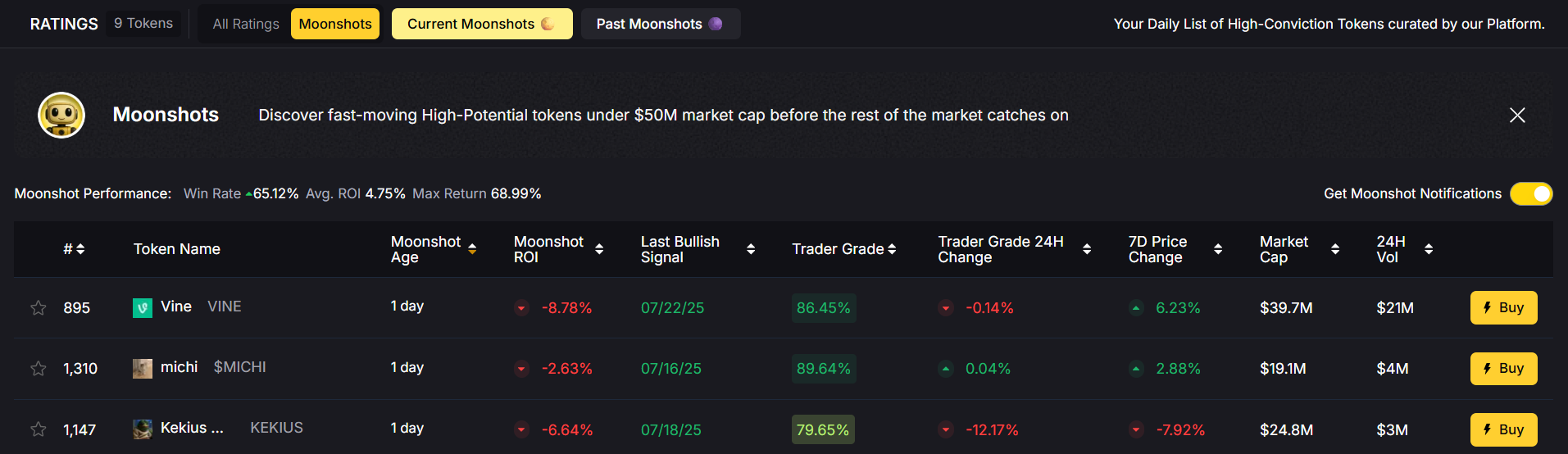
Token Metrics, the leading AI-powered crypto research platform, features a dedicated Moonshots tab that helps users discover early-stage altcoins with massive potential.

Token Metrics uses AI models to:

  • Scan over 6,000+ tokens
  • Analyze 80+ on-chain and off-chain data points
  • Score tokens based on Investor Grade (long-term) and Trader Grade (short-term)
  • Highlight tokens before they hit mainstream radar

2. Follow Emerging Narratives

Pay attention to sectors gaining momentum—AI, DePIN, L2s, gaming, and RWA are hot in 2025. Moonshots often emerge at the intersection of narrative and innovation.

3. Explore Crypto Twitter and Discord

Many early-stage gems are discussed by small communities, KOLs (key opinion leaders), and early investors before any mainstream media coverage.

4. Check Tokenomics

A great idea can’t succeed with poor tokenomics. Look for:

  • Fair initial distribution
  • Deflationary or limited supply
  • Lock-up periods for team/investors
  • Strong incentive alignment with users

5. Monitor DEX Launchpads and On-Chain Metrics

Platforms like Uniswap, Camelot, or Base-native DEXs are where most moonshots launch first. Analyze:

  • Wallet distribution (whale vs retail)
  • Volume and liquidity
  • Holder growth

🔬 How Token Metrics Helps You Find the Next Moonshot

Token Metrics is the ultimate tool for discovering and validating moonshot opportunities. Here’s how:

🧠 AI-Driven Token Ratings

Get real-time Investor Grade and Trader Grade scores, generated by AI models trained on historical altcoin performance.

📈 Bullish & Bearish Signals

Get alerts when a token shows strong upside or downside momentum based on quantitative signals.

🚀 Moonshots Section

A curated feed of low-cap, high-potential tokens filtered by market cap, sector, risk level, and on-chain traction.

📊 Backtesting & Risk Analysis

Use simulation tools to see how a moonshot would have performed in different market conditions, helping you gauge timing and position sizing.

👉 Try Token Metrics with a 7-day free trial and start exploring moonshots with data, not just hype.

✅ Examples of Real Moonshots

In previous years, several tokens started as moonshots and delivered massive gains:

  • Polygon (MATIC) – Launched below $0.01, surged to over $2.50 at peak

  • Axie Infinity (AXS) – Went from cents to $165 during the 2021 gaming boom

  • Pepe (PEPE) – Meme coin that turned thousands into millions in 2023

  • VIRTUAL (SPX6900) – Token Metrics alerted this 55x trade before the crowd

In 2025, emerging moonshots include AI-powered tokens like $TMAI (Token Metrics AI)—positioned at the forefront of AI + crypto convergence.

🛡️ Tips for Safely Investing in Moonshots

  • Only use risk capital (money you can afford to lose)
  • Start small and scale positions after traction
  • Set profit targets and stop-losses
  • Diversify across 5–10 moonshot tokens
  • Use non-custodial wallets and keep private keys secure
  • Don’t chase pumps—enter early or not at all

Moonshot investing isn’t about certainty—it’s about asymmetrical bets with defined downside and massive upside.

Final Thoughts

Moonshots are the heartbeat of crypto innovation. They represent the bold, risky, and visionary projects that could reshape entire industries—or fade into obscurity.

In 2025, the opportunity to find the next Solana, MATIC, or PEPE still exists—but success comes from informed decisions, not hype-driven FOMO. That’s why platforms like Token Metrics are critical. With AI-powered research, curated moonshot lists, and real-time trading signals, Token Metrics helps you spot the gems before they moon.

So, what’s your next moonshot?

Crypto Basics

Understanding Cryptocurrency Danger: What Investors Need to Know

Token Metrics Team
6 min
MIN

Introduction to Cryptocurrency

Cryptocurrency is a form of digital currency secured by cryptography, making it nearly impossible to counterfeit or double-spend. As a type of crypto asset, cryptocurrencies operate on decentralized networks powered by blockchain technology—a distributed public ledger maintained by multiple computers worldwide. This decentralized nature sets cryptocurrencies apart from traditional finance systems, which rely heavily on centralized financial institutions and central banks.

Most cryptocurrencies are not issued or regulated by any central authority, which makes them resistant to government interference or manipulation. While this independence offers certain freedoms, it also means that cryptocurrency investments carry substantial risk. The underlying cryptography and blockchain technology are generally secure, but their complexity can be challenging for new users to navigate. Additionally, the market value of cryptocurrencies is often affected by media hype and investor opinion, further contributing to their volatility. Understanding cryptocurrency danger involves exploring both the innovative technology behind it and the volatile market dynamics that influence its value.

Cryptocurrency Exchanges

Cryptocurrency exchanges play a crucial role as crypto asset service providers, allowing investors to buy and sell cryptocurrencies like Bitcoin and other cryptocurrencies at market prices. These exchanges function similarly to stock markets but operate 24/7, reflecting the highly volatile nature of the crypto market. However, many cryptocurrency exchanges lack a high level of governmental oversight or auditability compared to traditional banks, which can expose users to additional risks.

Once purchased, cryptocurrencies must be stored securely, either in digital wallets controlled by the user or through third-party services such as Coinbase, which assist with storing crypto assets safely. Some brokerage platforms, like Robinhood, provide access to cryptocurrency investments but may impose restrictions on withdrawals, limiting how investors can transfer or sell cryptocurrencies. This highlights the importance of understanding the terms and risks associated with each platform.

For those seeking exposure to the crypto asset class without directly holding digital wallets, crypto ETFs offer a more traditional investment vehicle. These funds track the market value of cryptocurrencies and can be bought and sold through conventional brokerage accounts, bridging the gap between digital assets and traditional finance.

Cybersecurity Risks

One of the most significant cryptocurrency dangers lies in cybersecurity risks. Despite the security of blockchain technology, crypto investments are vulnerable to scams, hacks, software bugs, and the highly volatile price swings inherent in the market. The private key—a unique cryptographic code—is the sole access point to an investor’s digital wallet and cryptocurrency holdings. Losing this private key means losing access to the entire investment permanently, with no recourse. If a private key is stolen, there is no way to retrieve it, similar to having a credit card with no authentication check.

Technical challenges and market speculation add layers of risk that investors must carefully consider. Hackers frequently target digital wallets and cryptocurrency exchanges, attempting to steal digital assets. Numerous exchanges have suffered massive security breaches, leading to substantial losses for users. To mitigate these risks, many investors use offline hardware wallets or cold storage solutions, which keep private keys disconnected from the internet connection and significantly reduce the chances of theft.

Evaluating Cryptocurrency as an Investment

Cryptocurrency investments are highly speculative and carry substantial risk, making them unsuitable for risk-averse investors. The market’s high price volatility can lead to rapid gains but also significant losses, and investors should only commit funds they can afford to lose. Cryptocurrencies can potentially yield high returns, attracting speculative investors. Unlike traditional finance, where financial institutions and regulatory bodies provide certain protections, cryptocurrency markets operate with limited oversight, increasing the potential for market manipulation and fraud.

Understanding one’s personal risk tolerance is crucial before deciding to invest in cryptocurrencies. The lack of regulatory control means that how funds are used or managed may be opaque, and the risk of losing money is real and significant. Investors should approach cryptocurrency investments with caution and seek advice from qualified investment advisors to navigate these complexities.

Benefits and Advantages of Cryptocurrency

Despite the risks, cryptocurrencies offer unique advantages. By removing reliance on centralized intermediaries such as banks or credit card companies, cryptocurrencies reduce systemic financial risks and enable more direct, peer-to-peer transactions. Transfers between parties are secured through public and private key cryptography and validated by consensus mechanisms like proof of work or proof of stake, which underpin blockchain technology.

Crypto transfers can often be faster than traditional money transfers, especially in cross-border remittances where converting fiat currency typically involves multiple intermediaries. Decentralized finance innovations like flash loans demonstrate how cryptocurrency transactions can occur almost instantaneously, providing new opportunities for investment and trading.

Risks and Challenges

However, cryptocurrencies also pose significant risks and challenges. While transactions are pseudonymous, digital trails remain traceable by law enforcement agencies such as the Federal Bureau of Investigation (FBI). Cryptocurrencies have been exploited for illicit activities including money laundering, dark web transactions, and ransomware payments. China has banned cryptocurrency exchanges, transactions, and mining, although it has developed a Central Bank Digital Currency (CBDC).

The concentration of wealth in the crypto space is increasing, with large companies and investment funds accumulating substantial holdings. Additionally, cryptocurrency mining demands significant energy consumption, often concentrating mining power among a few large firms with vast resources.

Off-chain security issues, such as vulnerabilities in third-party platforms, and the inherent price volatility continue to challenge the practical implementation of cryptocurrencies. The ideal of a fully decentralized system is often compromised by market manipulation and fraud, underscoring the cryptocurrency danger investors face.

Cryptocurrency and the Law

Unlike fiat currency, which is government-issued legal tender, cryptocurrencies lack official issuance and their legal status varies widely across jurisdictions. In the United States, the Internal Revenue Service (IRS) treats cryptocurrencies as financial assets or property for tax purposes, requiring capital gains taxes on sales or trades.

U.S. courts have classified cryptocurrencies as securities for institutional buyers but not for retail investors trading on exchanges, reflecting the complex regulatory environment. In July 2023, U.S. courts ruled that cryptocurrencies are considered securities when purchased by institutional buyers but not by retail investors on exchanges. Similarly, cryptocurrency regulations in Asia differ significantly by country, demonstrating the global uncertainty surrounding digital assets.

Investors must stay informed about evolving legal frameworks to understand the implications of investing in cryptocurrencies and ensure compliance with tax and regulatory requirements.

Common Scams and How to Avoid Them

The irreversible nature of cryptocurrency transactions and limited regulatory oversight make the space ripe for scams. Fraudsters often use fake endorsements, pressure tactics, and misleading schemes to steal money from unsuspecting investors. For example, some have lost substantial sums—like Rhett, who lost $97,000 to a fraudulent Bitcoin trading scheme.

To avoid falling victim to scams, investors should exercise caution, conduct thorough research, and verify the legitimacy of any investment opportunity. Consulting with reputable investment advisors and relying on trusted sources can help mitigate the risk of fraud and ensure safer participation in the crypto market.

Best Practices for Cryptocurrency Users

Despite the inherent risks, many individuals are drawn to cryptocurrency for its potential gains and innovative technology. To protect digital currency assets, users must adopt proactive security measures. Understanding cybersecurity risks is essential to safeguarding crypto investments from hackers and bad actors.

Best practices include using hardware wallets like Ledger or Trezor, which provide enhanced security by keeping private keys offline. Investors should create duplicate hardware wallets and store backups in secure locations to prevent permanent loss of access. Staying vigilant against phishing attacks and avoiding sharing private keys or sensitive information is critical for maintaining control over digital assets.

Conclusion and Final Thoughts

Cryptocurrencies remain a highly speculative and risky asset class characterized by substantial price volatility and cybersecurity dangers. Investment advisors often recommend treating crypto investments as trading instruments rather than long-term holdings due to their unpredictable nature.

Cryptocurrency products carry risks including illiquidity and the potential for total loss of the entire investment. Investors should only allocate funds they can afford to lose and fully understand the technical complexities and market dynamics before engaging in cryptocurrency trading.

By staying informed, exercising caution, and following best security practices, investors can navigate the cryptocurrency landscape more safely. However, the cryptocurrency danger remains real, and careful consideration is essential before investing in this rapidly evolving digital asset space. Understanding the security and risks related to cryptocurrency requires a much higher level of engagement than traditional investments.

Crypto Basics

What Is Cryptocurrency Market Cap? A Comprehensive Guide

Token Metrics Team
6 min
MIN

Understanding the cryptocurrency market cap is fundamental for anyone interested in investing or trading digital currencies. Market capitalization, often referred to as market cap, is a key metric that reflects the total value of a cryptocurrency in the market. Cryptocurrency market capitalization represents the total value of all coins that have been mined for a specific cryptocurrency or all cryptocurrencies combined. This article will explore what cryptocurrency market cap means, how it is calculated, and why it matters for investors navigating the dynamic crypto market.

Introduction to Market Capitalization

Market capitalization represents the total value of a cryptocurrency's circulating coins in the market. It is a crucial metric used by investors and professionals to gauge the relative size and importance of a digital currency within the crypto ecosystem. Understanding market cap is essential for making informed investment decisions, as it provides a snapshot of a cryptocurrency’s size, popularity, and growth potential.

The market cap of a cryptocurrency is calculated by multiplying its current price by the number of coins in circulation. This simple formula offers insight into the cryptocurrency’s total value and helps investors compare different crypto assets effectively. By knowing the market cap, investors can better understand a cryptocurrency’s position in the market and assess its potential for future growth.

Crypto Market Cap and Circulating Supply

To fully grasp the concept of crypto market cap, it is important to understand the role of circulating supply. The circulating supply refers to the number of coins currently available and actively traded in the market. It is this supply that determines the crypto market cap when multiplied by the cryptocurrency’s current price.

Circulating supply is distinct from total supply, which includes all coins that have been created, including those not yet available for trading or locked in reserves. For example, some projects may have a large total supply but a smaller circulating supply due to tokens held by the development team or locked in smart contracts. Recognizing the difference between circulating supply and total supply is vital when evaluating a cryptocurrency’s market capitalization and its potential impact on price and growth.

Calculation and Importance

Market cap is calculated by multiplying the current price of a cryptocurrency by its circulating supply, providing a real-time measure of the asset's total value in dollars or other fiat currencies. This calculation is dynamic, as both price and circulating supply can fluctuate, causing the market cap to change rapidly.

This metric is important because it helps investors assess the size and value of a cryptocurrency relative to others in the crypto market. A higher market cap often indicates a more established and widely adopted cryptocurrency, such as Bitcoin or Ethereum, which tend to have greater network security and liquidity. Conversely, a low market cap may signal a newer or more speculative digital asset, often associated with higher risk and volatility.

Understanding market cap allows investors to make informed choices by comparing the total value of different cryptocurrencies and evaluating their potential for growth or decline.

Investment Strategies and Market Trends

Market capitalization plays a significant role in shaping investment strategies within the crypto market. It influences the level of risk investors are willing to take and the potential returns they might expect. Cryptocurrencies are categorized into three market cap sizes: large-cap (over $10 billion), mid-cap ($1 billion to $10 billion), and small-cap (under $1 billion). Large cap cryptocurrencies, typically those with a market cap exceeding $10 billion, are generally less volatile and more stable. These assets are favored by conservative investors who prioritize security and steady growth.

On the other hand, mid cap and small cap cryptocurrencies often present higher growth potential but come with increased risk and price volatility. Small cap cryptocurrencies may be more susceptible to market fluctuations and liquidity challenges but can offer substantial returns if their underlying projects succeed.

Staying informed about market trends and understanding how market cap affects demand, liquidity, and price movements are essential for developing effective investment strategies. Investors who respond appropriately to these factors are better positioned to capitalize on opportunities and mitigate risks.

Characteristics of a Liquid Market

A liquid market is characterized by the ability to quickly buy or sell assets without causing significant price changes. In the crypto market, liquidity is a critical factor affecting volatility and trading volume. High liquidity means that there is a large number of buyers and sellers, facilitating smooth transactions and reducing price manipulation risks.

Cryptocurrencies with a high market cap tend to have more liquid markets due to their popularity and widespread adoption. This liquidity attracts institutional investors and traders who require the ability to enter and exit positions efficiently. Conversely, small cap cryptocurrencies may suffer from low liquidity, leading to higher volatility and wider bid-ask spreads.

A liquid market with high trading volume provides better price stability and more trading opportunities, making it more attractive for both short-term traders and long-term investors.

The Crypto Market Ecosystem

The crypto market ecosystem is a complex and evolving environment influenced by various factors beyond market cap. Blockchain technology underpins all cryptocurrencies, providing the decentralized infrastructure that ensures transparency and security. Network security, driven by consensus mechanisms and the number of active nodes, plays a crucial role in maintaining trust and stability in the market.

Institutional investors have increasingly entered the crypto market, bringing greater capital, legitimacy, and scrutiny. Their participation often affects market trends and can lead to increased liquidity and reduced volatility in large cap cryptocurrencies.

Understanding this ecosystem and the interplay of technology, investor behavior, and market dynamics is essential for anyone looking to navigate the crypto market successfully. The market is constantly responding to new technologies, regulatory developments, and shifts in investor sentiment.

Large Cap Cryptocurrencies

Large cap cryptocurrencies, such as Bitcoin and Ethereum, dominate the crypto market with market caps exceeding $10 billion. These digital assets are widely regarded as more stable and less volatile compared to smaller cryptocurrencies. Their established track records and strong network security make them attractive safe havens during periods of market uncertainty.

Large cap cryptocurrencies benefit from high liquidity and trading volume, which contribute to better price stability and ease of trading. However, because of their already substantial market capitalization, these assets may experience slower price growth compared to mid or small cap cryptocurrencies.

Investors often include large cap cryptocurrencies in their portfolios to provide balance and reduce overall risk.

Growth Potential and Analysis

While large cap cryptocurrencies offer stability, mid cap and small cap cryptocurrencies often present greater growth potential. These smaller crypto assets may be in earlier stages of development, with innovative projects and technologies that can lead to significant price appreciation.

Analyzing growth potential involves examining a cryptocurrency’s market cap, trading volume, underlying blockchain technology, and the strength of its project or business model. Investors also consider factors such as tokenomics, total supply, and network security to assess long-term viability.

However, higher growth potential comes with increased risk, including higher volatility and liquidity challenges. Investors must carefully weigh these factors and conduct thorough research before committing to investments in smaller cap cryptocurrencies.

Developing Effective Investment Strategies

Crafting effective investment strategies in the crypto market requires a comprehensive understanding of market trends, risk management, and portfolio diversification. Investors should clearly define their investment goals and risk tolerance before entering the market.

Market capitalization is a critical consideration in strategy development, as it affects liquidity, volatility, and potential returns. Diversifying investments across large cap, mid cap, and small cap cryptocurrencies can help balance risk while capturing growth opportunities.

Staying informed about the latest market trends, technological advancements, and regulatory changes is essential. Investors should be prepared to adapt their strategies as the crypto market evolves, responding to shifts in demand, supply, and broader economic factors.

In conclusion, understanding what cryptocurrency market cap is and how it influences the crypto market is vital for making informed investment decisions. By considering market cap alongside other metrics such as circulating supply, trading volume, and network security, investors can navigate the complex world of digital assets with greater confidence and success.

Choose from Platinum, Gold, and Silver packages
Reach with 25–30% open rates and 0.5–1% CTR
Craft your own custom ad—from banners to tailored copy
Perfect for Crypto Exchanges, SaaS Tools, DeFi, and AI Products