Crypto Basics

What are Altcoins? - The Ultimate Guide for Beginners

Discover everything about Altcoins in this comprehensive guide. Learn what Altcoins are and how they can diversify your crypto portfolio.
Token Metrics Team
10 Minutes
MIN

In the world of cryptocurrencies, altcoins have emerged as a popular alternative to Bitcoin. While Bitcoin remains the most well-known cryptocurrency, altcoins offer a diverse range of digital assets with unique features and functionalities. 

This comprehensive beginner's guide aims to provide you with a clear understanding of what altcoins are, their purpose, and how they differ from Bitcoin.

What are Altcoins?

Altcoins, short for "alternative coins," refer to all cryptocurrencies other than Bitcoin. While Bitcoin paved the way for the development of digital currencies, altcoins have gained momentum in recent years.

Altcoins are built on various blockchain technologies and aim to address different use cases, ranging from decentralized finance (DeFi) to smart contracts and privacy features.

Types of Altcoins

Here is the list of different types of altcoins, their features, and their impact on the crypto ecosystem.

Stablecoins - Stablecoins are a type of altcoin that aim to maintain a stable value by pegging their price to an external asset such as fiat currency or commodities. 

These cryptocurrencies provide stability in the volatile crypto market, making them suitable for various purposes such as remittances, decentralized finance (DeFi) transactions, and as a hedge against market volatility.

Privacy Coins - Privacy coins prioritize user anonymity and transaction privacy. They utilize advanced cryptographic techniques to conceal transaction details and protect the identities of the participants involved.

Privacy coins offer enhanced privacy features compared to other cryptocurrencies, allowing users to have greater control over their financial information.

Utility Tokens - Utility tokens are a type of altcoin that serve a specific purpose within a blockchain ecosystem. They are typically used to access or pay for services within a decentralized platform. 

Utility tokens can represent ownership rights, access rights, or provide discounts and incentives to users within the network.

Security Tokens - Security tokens are digital assets that represent ownership or investment in a real-world asset, such as shares in a company, real estate, or commodities.

These tokens are subject to regulatory compliance and offer investors the benefits of traditional securities while leveraging blockchain technology for enhanced transparency, liquidity, and efficiency.

Exchange Tokens - Exchange tokens, also known as native tokens, are the primary currency within a particular blockchain or decentralized exchange.

They facilitate transactions, pay for transaction fees, and serve as a means of value transfer within the ecosystem. Exchange tokens often have additional functionalities within the platform, such as voting rights or governance participation.

Governance Tokens - Governance tokens grant holders the right to participate in the decision-making processes of a decentralized platform or protocol.

These tokens enable holders to vote on proposals, make suggestions, or influence the development and direction of the project. Governance tokens play a vital role in decentralized governance models, ensuring community-driven decision-making.

Gaming Tokens - Gaming tokens are designed specifically for the gaming industry. These tokens enable in-game purchases, rewards, and other interactions within gaming ecosystems.

By utilizing blockchain technology, gaming tokens provide players with true ownership of in-game assets and enable peer-to-peer trading of virtual items.

NFT-Backed Tokens - NFT-backed tokens represent non-fungible tokens that are backed by another cryptocurrency or token. 

These tokens combine the unique properties of NFTs with the benefits of other cryptocurrencies, allowing for increased liquidity and tradability of non-fungible assets.

Energy-Efficient Coins - Energy-efficient coins address the environmental concerns associated with traditional proof-of-work (PoW) cryptocurrencies like Bitcoin. 

These altcoins utilize alternative consensus mechanisms, such as proof-of-stake (PoS) or delegated proof-of-stake (DPoS), which require significantly less energy consumption while maintaining the security and integrity of the blockchain.

Proof-of-Stake Coins - Proof-of-stake coins rely on the concept of staking to secure the network and validate transactions. Validators are chosen based on the number of coins they hold and are willing to "stake" as collateral.

This consensus mechanism offers energy efficiency, scalability, and reduced centralization concerns compared to proof-of-work systems.

Proof-of-Work Coins - Proof-of-work coins, like Bitcoin, secure their networks through miners who solve complex mathematical puzzles to validate transactions.

This mechanism requires substantial computational power and energy consumption. Proof-of-work coins have been the foundation of the crypto industry and have demonstrated the potential of decentralized systems.

Forked Coins - Forked coins are altcoins that have emerged from a fork in the blockchain network. Forks occur when there is a fundamental disagreement within the community or development team, resulting in a split into two separate chains. 

Forked coins can retain the existing features of the parent blockchain or introduce new functionalities.

Cross-Chain Tokens - Cross-chain tokens, or interoperable tokens, enable value transfer between different blockchain networks. These tokens facilitate cross-chain communication, allowing assets to be transferred seamlessly across multiple platforms. 

Cross-chain tokens play a crucial role in bridging the gap between various blockchain ecosystems, enhancing interoperability and expanding the possibilities of decentralized applications.

List of Top Altcoins

The cryptocurrency market boasts a wide array of altcoins, each with its unique features and value propositions. Here are some of the most popular altcoins:

1 Ethereum (ETH) - Ethereum is a decentralized platform that enables the creation of smart contracts and DApps. It introduced the concept of programmable blockchain, allowing developers to build applications on its network.

2 Ripple (XRP) - Ripple is both a digital payment protocol and a cryptocurrency. It aims to facilitate fast, low-cost international money transfers and has gained significant traction among financial institutions.

3 Litecoin (LTC) - Litecoin, often referred to as the silver to Bitcoin's gold, was created to provide faster transaction confirmations and a more efficient mining process. It shares many similarities with Bitcoin but with a few notable differences.

4 Cardano (ADA) - Cardano is a blockchain platform that focuses on security, sustainability, and scalability. It aims to provide a framework for the development of decentralized applications and smart contracts.

These are just a few examples of the vast number of altcoins available in the market. Each altcoin has its unique features, community, and use case, making the cryptocurrency landscape diverse and dynamic.

Advantages and Disadvantages

Here are the advantages and disadvantages of altcoins:

Advantages of Altcoins

Diversification Opportunities

Altcoins provide investors with the chance to diversify their cryptocurrency portfolio. By investing in different projects, technologies, and use cases, one can mitigate risks and capitalize on emerging trends.

Technological Progress:

Altcoins often introduce groundbreaking technological advancements in the realm of digital currencies. Ethereum, for example, pioneered smart contracts, revolutionizing industries like finance and supply chain management.

Potential for Lucrative Returns:

Early investment in altcoins offers the potential for substantial returns over time. However, it is important to conduct thorough research and exercise caution due to the associated risks and potential for fraudulent projects.

Enhanced Privacy and Security:

Certain altcoins prioritize privacy and security through advanced cryptographic techniques. Users can enjoy increased anonymity and confidentiality during transactions, providing an alternative to traditional financial systems.

Disadvantages of Altcoins

Volatility and Market Uncertainty:

Altcoins are known for their inherent volatility, resulting in significant price fluctuations within short periods. While this volatility presents opportunities for gains, it also carries higher risks of losses.

Limited Acceptance and Adoption:

Altcoins generally face lower levels of acceptance and adoption compared to Bitcoin. Bitcoin's widespread recognition and dominance make it the preferred cryptocurrency for most users and businesses.

Potential for Scams and Fraud:

The proliferation of altcoins has led to numerous scams and fraudulent projects. Caution and thorough research are necessary to avoid falling victim to scams, such as pump-and-dump schemes or fake ICOs.

Regulatory and Legal Uncertainty:

Altcoins often operate in a regulatory gray area, with undefined legal statuses. Changes in regulations or crackdowns on cryptocurrency-related activities can significantly impact the value and viability of altcoins.

Bitcoin vs Altcoin

Although altcoins share similarities with Bitcoin, they have distinct characteristics that set them apart. Bitcoin was the first decentralized digital currency, introduced by an anonymous individual or group known as Satoshi Nakamoto. 

It operates on the Bitcoin blockchain and focuses primarily on peer-to-peer transactions and the store of value.

On the other hand, altcoins have diverse features and functionalities. Some altcoins, like Ethereum, enable the creation of decentralized applications (DApps) and smart contracts.

Others, such as Litecoin and Bitcoin Cash, prioritize faster transaction speeds and lower fees. Altcoins often aim to improve upon Bitcoin's limitations and explore new possibilities in the crypto space.

Should you consider investing in Altcoins?

Investing in altcoins can be an exciting opportunity for individuals looking to diversify their investment portfolios. However, it's essential to approach altcoin investments with caution and conduct thorough research. Here are a few key points to consider before investing in altcoins:

Conduct research: Understand the altcoin's technology, team, roadmap, and potential use cases. Look for reputable sources of information and evaluate the project's viability.

Risk assessment: Assess the risks associated with the altcoin investment. Consider factors such as market volatility, regulatory challenges, and potential security vulnerabilities.

Diversification: Spread your investments across different altcoins to minimize risk. Investing in a diverse range of projects can increase your chances of finding successful investments.

Set a budget: Determine the amount of money you are willing to invest in altcoins. Set a budget that you can afford to lose without affecting your financial stability.

Choose a reliable exchange: Select a reputable cryptocurrency exchange to buy and trade altcoins. Ensure that the exchange has a good track record, strong security measures, and a user-friendly interface.

Risks and Challenges of Altcoin Investments

While altcoin investments offer opportunities, they also come with risks and challenges. Some of the risks include:

Volatility: Altcoin prices can experience significant fluctuations, leading to potential losses if not managed properly.

Regulatory uncertainty: The regulatory landscape for cryptocurrencies is still evolving, and changes in regulations can impact the value and viability of altcoins.

Security vulnerabilities: Altcoins may be susceptible to hacking, scams, or technical vulnerabilities, which can result in the loss of funds.

It's essential to stay informed, exercise caution, and conduct due diligence before investing in altcoins.

Future of Altcoin Development

The world of altcoins continues to evolve rapidly, with ongoing developments and innovations. Here are some future trends to watch out for:

Interoperability: Projects focusing on interoperability aim to enhance communication and compatibility between different blockchains, enabling seamless transfer of assets and data.

Privacy-focused altcoins: With growing concerns about privacy, there is an increasing demand for altcoins that prioritize anonymity and data protection.

Decentralized Finance (DeFi): Altcoins supporting decentralized financial applications, such as lending, borrowing, and automated market-making, are gaining popularity as they offer alternatives to traditional financial systems.

As technology advances and new challenges arise, the altcoin landscape is expected to witness further growth and diversification.

Frequently Asked Questions

Q1. Are altcoins as secure as Bitcoin?

The security of altcoins varies depending on the specific project and its underlying technology. It's crucial to research and understand the security measures implemented by each altcoin.

Q2. How can I choose the right altcoin to invest in?

Choosing the right altcoin requires thorough research and analysis. Consider factors such as the project's team, technology, use case, and market demand.

Q3. What is the future outlook for altcoins?

The future of altcoins is promising, with ongoing developments in areas such as interoperability, privacy, and decentralized finance. However, it's important to approach investments with caution and stay informed about market trends.

Q4. Can I use altcoins for everyday transactions?

Some altcoins are designed for use as digital currencies and can be used for everyday transactions. However, acceptance and adoption may vary depending on the altcoin and the merchants or platforms that support it.

Conclusion

Altcoins provide a diverse and dynamic ecosystem within the cryptocurrency market. They offer unique features and functionalities that differentiate them from Bitcoin. 

However, investing in altcoins requires thorough research, risk assessment, and cautious decision-making. Stay informed, diversify your portfolio, and set realistic expectations for returns. 

Remember to choose reputable wallets and exchanges to ensure the security of your altcoin investments. As the altcoin market continues to evolve, it is essential to stay updated with the latest trends and developments.

Disclaimer

The information provided on this website does not constitute investment advice, financial advice, trading advice, or any other sort of advice and you should not treat any of the website's content as such.

Token Metrics does not recommend that any cryptocurrency should be bought, sold, or held by you. Do conduct your own due diligence and consult your financial advisor before making any investment decisions.

Build Smarter Crypto Apps &
AI Agents in Minutes, Not Months
Real-time prices, trading signals, and on-chain insights all from one powerful API.
Grab a Free API Key
Token Metrics Team
Token Metrics Team

Recent Posts

Token Metrics API

How to Build Crypto Trading Dashboard Using the Token Metrics Crypto Data API on Dune

Token Metrics Team
8 min
MIN

In today’s fast-paced crypto world, real-time data isn’t a luxury—it’s a necessity. For traders, analysts, and developers, being able to access live, actionable insights can mean the difference between profit and loss. That’s why the integration of the Token Metrics Crypto Data API with Dune is a game-changer for anyone seeking to create live dashboards backed by intelligent trading data.

In this post, we’ll walk through how to use this top crypto API to build dynamic dashboards on Dune. Whether you’re tracking bullish signals, backtesting trading strategies, or identifying top-performing tokens, this integration makes it possible—without any paid license.

Let’s dive into how you can use the best free crypto API available today to transform your trading.

What Is the Token Metrics Crypto Data API?

The Token Metrics Crypto Data API is a developer-focused gateway to powerful, AI-driven crypto data. It’s one of the top crypto APIs in 2025, giving you access to:

  • Real-time and historical trading signals
  • Proprietary trader and investor grades
  • Alpha metrics comparing trading vs. holding performance
  • Bullish and bearish token flags

This API is used by both professional quant traders and beginners seeking to automate insights. And the best part? Token Metrics provides free crypto API access to selected datasets, allowing you to create powerful dashboards without spending a dime.

Why Dune + Token Metrics API = Power Tools for Traders

Dune is a blockchain analytics platform that allows you to write SQL queries and create dashboards using on-chain and off-chain data. Now that Token Metrics datasets are available on Dune, you can combine the best of both worlds:

  • Free access to high-signal proprietary metrics
  • Real-time data visualizations via Dune’s drag-and-drop dashboard builder
  • Actionable insights based on AI-driven trading intelligence

This integration unlocks a whole new level of transparency and utility for crypto analysts, portfolio managers, and DeFi enthusiasts.

Getting Started: Accessing Token Metrics Data on Dune

To begin, create a free Dune account. Once logged in, navigate to the Token Metrics datasets. These are publicly accessible and updated regularly. You’ll find tables for:

  • trading_signals
  • trader_grades
  • investors_grades
  • tokens

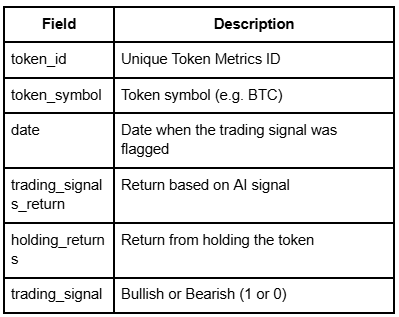
Start a new SQL query and choose the dataset you want to explore. Here’s what you’ll find in the trading signals table:

‍

‍

Step-by-Step: Creating an Actionable Dashboard with Token Metrics Data

1. Query the Trading Signal Returns

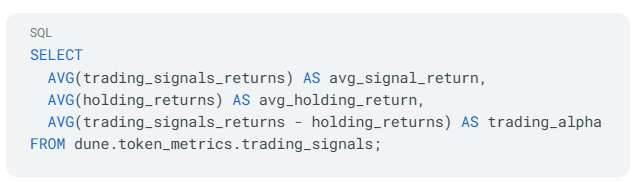
Write a SQL query to calculate the average return of trading vs. holding strategies. For example:

This gives you the alpha—how much better the Token Metrics strategy performs compared to just HODLing.

In one real example, the average signal return across all tokens was 1630%, while holding returned just 400%. That’s a 12X improvement powered by this top crypto API.

2. Identify Top-Performing Tokens

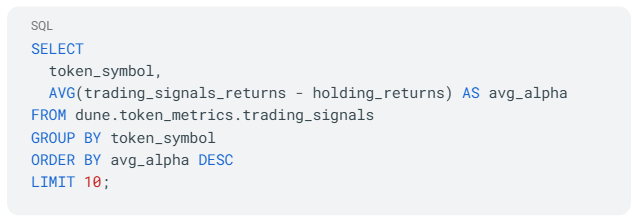
Now let’s list tokens with the highest average alpha:

Tokens like BTC, ETH, BNB, and even newer ones like Virtuals stand out due to exceptional alpha performance.

3. Visualize Trader Grades vs. Alpha

The trader grade is a proprietary score from Token Metrics that predicts how favorable a token is for short-term traders.

Use a scatter plot to correlate trader grades with average alpha:

  • X-axis: Trader Grade
  • Y-axis: Average Alpha
  • Group by: Token Symbol

This helps you visually determine which tokens score high and offer exceptional returns—an essential tool for making actionable trading decisions.

4. Track the Latest Bullish Signals

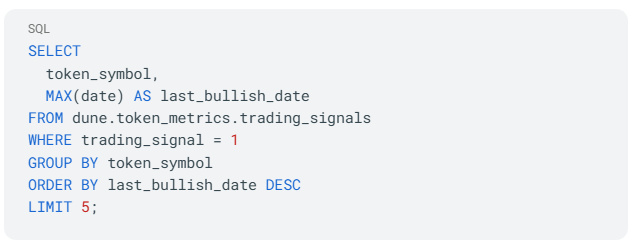
Want to know which tokens are bullish right now? Here’s a query to find the most recent tokens flagged as bullish:

For example, on July 4th, tokens like BNB, XRP, and BTC were among the most recent bullish signals—perfect for immediate trade setups.

5. Build and Share Your Dashboard

Once you’ve run your queries:

  • Click “Add Visualization” in Dune
  • Choose from chart types (bar, scatter, progress bar, etc.)
  • Customize colors and filters
  • Combine multiple charts into a single dashboard

Your final product will be a real-time dashboard powered by the best crypto API, delivering insights that you—and your team—can act on instantly.

Why Token Metrics Is the Best Free Crypto API for Traders

Here’s why Token Metrics stands out among other APIs:

✅ AI-Driven Signals

Most APIs deliver raw data. Token Metrics provides curated signals, generated from machine learning models trained on market cycles, indicators, and price action.

✅ Proprietary Metrics

Access unique indicators like trader grade and investor grade, unavailable anywhere else.

✅ Real Historical Alpha

Use the API to backtest strategies. In the example shown, the AI strategy outperformed the market by over 1000X for some tokens.

✅ Seamless Integration

Whether you're using Dune, Zapier, OpenAI, or Eliza OS, Token Metrics is easy to integrate and query—making it the top crypto API for developers and analysts alike.

Final Thoughts

The combination of Token Metrics’ intelligent data and Dune’s visualization tools puts immense power in your hands. Whether you’re tracking market trends, building bots, or guiding portfolio decisions, this integration gives you everything you need to trade smarter.

With free access to real-time trading signals, alpha comparisons, and powerful visualizations, Token Metrics proves why it's the best crypto API for today’s data-driven investor.

Ready to try it out?
👉 Explore the Free Crypto API
👉 Start Building on Dune

Crypto Basics

What Is an ETF Stock? A Beginner’s Guide to Exchange-Traded Funds in 2025

Token Metrics Team
8 min
MIN

In today’s fast-moving financial markets, Exchange-Traded Funds, or ETF stocks, have emerged as one of the most popular investment vehicles for beginners and professionals alike. But what exactly is an ETF stock, how does it work, and why is it considered a smart way to invest?

This guide will walk you through everything you need to know about ETF stocks in 2025—including how they work, their benefits and risks, and how AI platforms like Token Metrics are changing the way people research and trade ETFs in both traditional and crypto markets.

📌 What Is an ETF Stock?

An ETF stock refers to a share of an Exchange-Traded Fund—a type of investment fund that trades on stock exchanges, much like individual company stocks. Each ETF holds a basket of underlying assets such as:

  • Stocks (e.g., S&P 500 companies)
  • Bonds
  • Commodities (like gold or oil)
  • Currencies
  • Cryptocurrencies (Bitcoin, Ethereum, etc.)

When you buy an ETF stock, you’re buying a fractional share of the entire portfolio of assets held by that ETF.

🔍 How Does an ETF Stock Work?

ETF stocks work like this:

  1. Creation: An asset management company (like BlackRock, Vanguard, or Fidelity) creates an ETF that tracks a specific index, sector, or asset type.
  2. Listing: The ETF is listed on a stock exchange such as the NYSE or Nasdaq.
  3. Trading: Investors can buy and sell ETF shares throughout the trading day, just like they would a stock like Apple or Tesla.
  4. Price Movement: The price of an ETF stock fluctuates during the day based on the Net Asset Value (NAV) of its holdings and supply-demand dynamics in the market.

This model provides a liquid, transparent, and low-cost way for investors to gain diversified exposure to entire markets or sectors.

📊 Example of an ETF Stock

A good example is the SPDR S&P 500 ETF Trust (SPY), which tracks the performance of the S&P 500 index. When you buy a share of SPY, you gain exposure to 500 of the largest U.S. companies—without needing to buy each stock individually.

✅ Benefits of ETF Stocks

ETF stocks offer numerous advantages for investors in 2025:

1. Diversification

Instead of buying individual assets, ETF stocks offer instant diversification by holding dozens or hundreds of securities in a single share.

2. Liquidity

ETFs are traded on exchanges, making them highly liquid. You can buy or sell them at market prices during normal trading hours.

3. Lower Costs

ETFs typically have low expense ratios (as low as 0.03%), especially compared to mutual funds or actively managed portfolios.

4. Transparency

Most ETFs disclose their holdings daily, giving investors a clear view into what they’re buying.

5. Flexibility

You can use ETFs for long-term investing, short-term trading, hedging, or generating income through dividends.

⚠ Risks of ETF Stocks

Despite their many benefits, ETF stocks do come with some risks:

1. Market Risk

ETF stocks are still subject to market volatility. If the underlying assets decline in value, so will the ETF.

2. Tracking Error

Some ETFs may not perfectly replicate the performance of their index due to fees, slippage, or illiquid assets.

3. Overexposure

Because ETFs make it easy to invest, some investors may unknowingly become overexposed to a particular sector or strategy.

4. Liquidity Risk

Not all ETFs are created equal. Low-volume ETFs may have wider bid-ask spreads, increasing trading costs.

đŸȘ™ Crypto ETFs: The New Frontier

In 2025, crypto ETF stocks have become a hot trend. These funds allow investors to gain exposure to digital assets without managing private keys, wallets, or blockchain protocols.

Types of crypto ETFs include:

  • Spot ETFs: Hold actual crypto assets (e.g., Bitcoin, Ethereum).
  • Futures ETFs: Track the price of crypto futures contracts.

Popular examples in 2025 include:

  • IBIT (BlackRock Bitcoin ETF)
  • FBTC (Fidelity Bitcoin ETF)
  • ETHX (Ethereum Spot ETF)

Crypto ETFs have opened the door for institutional and traditional investors to gain exposure to the crypto market in a regulated and simplified manner.

đŸ€– How Token Metrics Helps You Trade ETF Stocks Smarter

Whether you're interested in traditional ETF stocks or crypto ETFs, Token Metrics provides the AI-powered insights you need to make better investment decisions.

🔎 1. AI-Powered Ratings

Token Metrics assigns each token or ETF a Trader Grade and Investor Grade based on price trends, volume, volatility, and technical strength—making it easy to spot outperformers.

📈 2. Bullish and Bearish Signals

AI-driven signals show when it’s time to buy or sell based on real-time metrics like ETF inflows, exchange balances, and market sentiment.

📊 3. Price Forecasts

Get access to predictive models that estimate where Bitcoin, Ethereum, and major crypto ETFs are headed—based on 80+ factors.

🔔 4. Smart Alerts

Set custom alerts for ETF stock signals, price movements, or grade changes so you never miss an opportunity.

By combining ETF investing with Token Metrics’ AI analytics, you gain an informational edge in markets that move faster than ever.

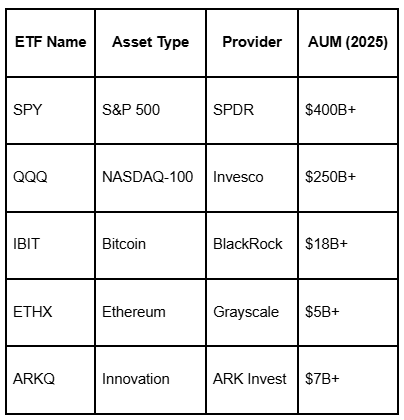
📈 Popular ETF Stocks in 2025

Here’s a list of top-performing ETF stocks across traditional and crypto sectors:

🧠 Final Thoughts

ETF stocks are a powerful investment tool in 2025, offering instant diversification, low fees, and easy access to traditional and crypto markets. Whether you're looking to build a retirement portfolio or ride the next Bitcoin rally, ETF stocks make it easier than ever to invest with confidence.

And with platforms like Token Metrics, you don’t need to guess your way through ETF trading. Use AI-driven insights, price predictions, and real-time data to get ahead of the curve—no matter what markets you trade.

Crypto Basics

What Is an ETF in Crypto? A Complete Guide for Crypto Investors in 2025

Token Metrics Team
8 min
MIN

The world of crypto investing is expanding at lightning speed. With growing institutional adoption and mainstream interest, new financial instruments are emerging to make crypto more accessible to everyday investors. One of the most impactful of these tools is the Exchange-Traded Fund (ETF) — and in 2025, crypto ETFs are playing a crucial role in shaping the future of digital asset investing.

📊 What Is an ETF?

An ETF (Exchange-Traded Fund) is a type of investment fund traded on traditional stock exchanges, just like individual stocks. ETFs hold a basket of assets such as stocks, bonds, commodities—or, in this case, cryptocurrencies.

When you buy shares of an ETF, you’re investing in a diversified portfolio managed by an institution. Instead of buying each asset individually, ETFs let you gain exposure to a group of assets through a single security.

đŸȘ™ What Is a Crypto ETF?

A crypto ETF is a special type of ETF that tracks the price of one or more cryptocurrencies, such as Bitcoin, Ethereum, or a basket of altcoins. These ETFs allow investors to gain exposure to crypto markets without needing to buy, store, or manage digital assets directly.

Crypto ETFs are listed on traditional financial exchanges (like Nasdaq or NYSE) and can be purchased via brokerage accounts—making them ideal for both institutional investors and crypto-curious retail traders.

🔍 Types of Crypto ETFs

There are two main categories of crypto ETFs:

1. Spot Crypto ETFs

  • Directly hold the underlying cryptocurrency (e.g., Bitcoin, Ethereum).
  • Track the real-time price of the asset.
  • Considered the most accurate and direct method of gaining crypto exposure.
  • Example: BlackRock’s iShares Bitcoin Trust.

2. Futures-Based Crypto ETFs

  • Do not hold actual cryptocurrency.
  • Invest in futures contracts that speculate on the asset’s future price.
  • Prone to “tracking errors” and additional management fees.
  • Example: ProShares Bitcoin Strategy ETF (BITO).

In 2025, spot ETFs have become more popular, especially after multiple approvals in major markets like the U.S., Canada, and Hong Kong.

✅ Benefits of Crypto ETFs

Crypto ETFs offer a range of advantages for investors seeking exposure to digital assets without managing crypto wallets or private keys.

1. Accessibility

  • Trade crypto exposure from a traditional brokerage account.
  • No need for crypto exchanges, wallets, or DeFi protocols.

2. Regulation and Security

  • Managed by licensed institutions and regulated by bodies like the SEC.
  • Custody solutions are handled by professionals (e.g., Coinbase Custody, Fidelity Digital).

3. Diversification

  • Some ETFs offer exposure to a basket of cryptocurrencies, reducing risk.
  • Others may focus on specific sectors like DeFi or metaverse tokens.

4. Tax and Retirement Account Eligibility

  • Can be included in IRAs, 401(k)s, and tax-advantaged portfolios in some jurisdictions.

⚠ Risks of Crypto ETFs

While crypto ETFs simplify access, they are not risk-free.

1. Management Fees

  • ETFs charge annual fees (0.20%–1.00%), which can affect long-term gains.

2. Lack of Full Ownership

  • You don’t hold the actual coins, so you can’t use them for staking, yield farming, or DeFi.

3. Volatility

  • Crypto markets are still highly volatile. ETF prices can fluctuate rapidly.

4. Tracking Errors (Futures ETFs)

  • Futures-based ETFs often lag behind the spot price of the cryptocurrency.

💡 Why Crypto ETFs Matter in 2025

The launch and adoption of crypto ETFs signal mainstream validation of the crypto market.

  • Over $60 billion has poured into Bitcoin and Ethereum ETFs since early 2024.
  • Institutional players like BlackRock, Fidelity, and ARK Invest are leading issuers.
  • Spot Bitcoin ETFs helped propel BTC above $118,000 in July 2025.
  • Regulatory green lights from the SEC, MAS, and other regulators mark a shift in global crypto policy.

Crypto ETFs reduce barriers to entry and give traditional investors a safe, regulated way to participate in the digital economy.

đŸ€– How Token Metrics Helps You Analyze Crypto ETF Trends

As ETFs drive price action, tools like Token Metrics give you an edge by turning market noise into actionable intelligence.

đŸ”č Real-Time Bullish/Bearish Signals

Token Metrics' AI algorithm scans exchange inflows, ETF data, and sentiment to issue buy/sell signals for major cryptocurrencies like Bitcoin, Ethereum, XRP, and more.

đŸ”č Institutional Flow Tracking

Track ETF fund flows to understand where institutions are allocating capital—key for timing your own entries and exits.

đŸ”č Price Predictions and Trend Grades

AI-generated price predictions, trader grades, and investor scores help you assess risk before investing in ETF-driven rallies.

đŸ”č Portfolio Tracking

Token Metrics syncs with your wallet or brokerage to track crypto ETF exposure alongside your on-chain tokens.

By using Token Metrics, you’re not just following ETF trends—you’re staying ahead of them.

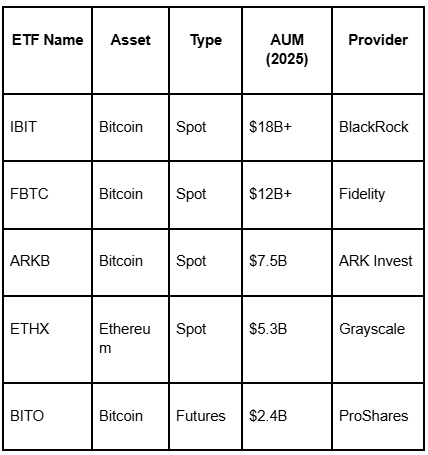
🔄 Popular Crypto ETFs in 2025

Here are some of the top-performing crypto ETFs currently available:

These ETFs are helping investors tap into the gains of crypto markets—without the complexity.

🧠 Final Thoughts

Crypto ETFs represent a pivotal shift in how digital assets are being embraced in traditional finance. They offer accessibility, regulatory clarity, and simplified crypto exposure for everyone from hedge funds to retail investors.

But smart investing goes beyond headlines. Platforms like Token Metrics help you:

  • Time entries and exits with AI-powered signals

  • Track ETF fund flows to gauge institutional momentum

  • Build conviction using on-chain data and predictive analytics

In 2025 and beyond, the winning strategy is clear: combine the safety of ETFs with the intelligence of Token Metrics.

Choose from Platinum, Gold, and Silver packages
Reach with 25–30% open rates and 0.5–1% CTR
Craft your own custom ad—from banners to tailored copy
Perfect for Crypto Exchanges, SaaS Tools, DeFi, and AI Products