Back to blog
Research

Modern Crypto API Development Best Practices

Practical guide to API development: design patterns, security, testing, and AI-assisted tooling. Learn approaches to build scalable, maintainable APIs and how analytics tools can speed integration and monitoring.
Token Metrics Team
5
Want Smarter Crypto Picks—Free?
See unbiased Token Metrics Ratings for BTC, ETH, and top alts.
Thank you! Your submission has been received!
Oops! Something went wrong while submitting the form.
 No credit card | 1-click unsubscribe

The cryptocurrency industry has evolved from a niche technological experiment into a trillion-dollar global ecosystem, demanding robust, secure, and scalable API infrastructure to support the complex needs of traders, developers, and institutions. Modern crypto API development requires a sophisticated understanding of blockchain technology, financial systems, security protocols, and software engineering best practices. This comprehensive guide explores practical strategies for building cryptocurrency APIs that deliver exceptional performance, maintain security under adversarial conditions, and provide the reliability that financial applications demand.

Foundation Principles for Crypto API Architecture

Building cryptocurrency APIs requires careful architectural decisions that balance competing demands for speed, security, and scalability. The foundational principle of separating concerns ensures that different aspects of your crypto API remain loosely coupled and independently maintainable. Data ingestion layers that consume blockchain data should remain distinct from business logic layers that compute analytics, which in turn should separate from presentation layers that format responses. This separation enables teams to optimize each layer independently and replace components as technology evolves without cascading changes throughout the system.

Microservices architecture has emerged as the dominant pattern for complex cryptocurrency platforms, allowing different aspects of crypto functionality to scale independently based on demand patterns. A comprehensive crypto API platform might separate market data services, trading execution engines, blockchain indexing services, analytics processors, and user management into distinct microservices. Each service can be developed using the technology stack best suited to its requirements, scaled horizontally based on load, and deployed independently without affecting other services. Token Metrics employs sophisticated microservices architecture in its crypto API infrastructure, enabling the platform to deliver real-time cryptocurrency analytics, AI-powered market predictions, and comprehensive blockchain data while maintaining exceptional performance and reliability.

Event-driven architecture complements microservices by enabling asynchronous communication between components through message queues and event streams. When blockchain data arrives from network nodes, publishing events to message queues allows multiple downstream services to process the information concurrently without blocking the ingestion pipeline. This architecture proves particularly valuable for cryptocurrency APIs where real-time processing of market events, blockchain transactions, and trading signals requires parallel processing across multiple analytical engines. The decoupling that event-driven patterns provide increases system resilience, as failures in downstream consumers don't impact data ingestion or other processing streams.

Domain-driven design helps structure crypto API codebases around business concepts rather than technical concerns, creating more intuitive and maintainable systems. Organizing code around domains like trading, portfolio management, market analytics, and blockchain data creates clear boundaries that align with how developers and users think about cryptocurrency functionality. This alignment reduces cognitive load when working with the codebase and makes it easier for new team members to understand system organization. Token Metrics structures its cryptocurrency API around clear domain boundaries, making it intuitive for developers to discover and use the specific functionality they need.

Security Hardening for Financial APIs

Cryptocurrency APIs face unique security challenges since they handle valuable digital assets and must operate in an adversarial environment where attackers are financially motivated. Defense in depth strategies layer multiple security controls so that compromise of any single control doesn't result in total system failure. This approach combines network security, application security, data security, and operational security into a comprehensive framework that protects against diverse attack vectors.

Input validation must be exhaustive and paranoid when building crypto APIs, as malicious inputs can lead to injection attacks, buffer overflows, or business logic exploits. Every parameter received from clients should be validated against strict type, format, and range constraints before processing. For cryptocurrency APIs, this includes validating wallet addresses against proper checksums, ensuring transaction amounts don't exceed balance or precision limits, verifying trading pair validity, and sanitizing all string inputs to prevent injection attacks. Implementing validation at multiple layers provides redundant protection, with edge validation rejecting obviously malicious requests and domain validation ensuring business rule compliance.

Cryptographic practices must follow current best practices and avoid deprecated algorithms or insecure implementations. All sensitive data should be encrypted at rest using strong symmetric encryption with proper key management. Passwords must be hashed using adaptive algorithms like bcrypt or Argon2 that resist brute force attacks. API keys and secrets require secure generation using cryptographically secure random number generators and storage in hardware security modules or secure key management services for production systems. Token Metrics implements enterprise-grade cryptographic practices throughout its crypto API infrastructure, protecting user data, proprietary algorithms, and authentication credentials with multiple layers of encryption.

Rate limiting and DDoS protection become critical for cryptocurrency APIs that might face coordinated attacks attempting to disrupt service or exploit rate-dependent vulnerabilities. Implementing distributed rate limiting that tracks consumption across all API servers prevents attackers from bypassing limits by distributing requests. Sophisticated rate limiting considers multiple dimensions including requests per second, data volume transferred, computational resources consumed, and patterns that suggest automated abuse. Combining rate limiting with anomaly detection enables dynamic response to attack patterns, automatically tightening restrictions when suspicious activity is detected.

Access control implementation follows the principle of least privilege, granting users and applications only the minimum permissions necessary for their intended functions. Role-based access control provides a flexible framework for managing permissions at scale, while attribute-based access control enables fine-grained policies based on request context. For cryptocurrency APIs, separating read permissions from write permissions and trading permissions from withdrawal permissions creates security boundaries that limit damage from compromised credentials. Token Metrics implements granular access controls in its crypto API, allowing clients to grant third-party applications limited access to analytics and market data without exposing trading or account management capabilities.

Testing Strategies for Reliability

Comprehensive testing forms the foundation of reliable cryptocurrency APIs, where bugs can result in financial losses, security vulnerabilities, or regulatory compliance failures. Test-driven development practices where tests are written before implementation code ensure that functionality is properly specified and testable from the outset. This discipline proves particularly valuable for cryptocurrency APIs where complex business logic around trading, risk management, and portfolio calculations requires precise specification and validation.

Unit testing validates individual functions and methods in isolation, ensuring that each component behaves correctly across normal cases, edge cases, and error conditions. For crypto APIs, unit tests verify mathematical calculations like technical indicators, price conversions, and profit-loss computations produce correct results across various market conditions. Mocking external dependencies like blockchain nodes and exchange APIs allows unit tests to run quickly and reliably without depending on external services. Comprehensive unit test coverage catches regressions early and provides confidence when refactoring code.

Integration testing validates how components work together, testing actual interactions with databases, message queues, blockchain nodes, and external APIs. These tests verify that data flows correctly through processing pipelines, errors are handled appropriately, and failures in external systems trigger proper fallback mechanisms. For cryptocurrency APIs aggregating data from multiple blockchain networks and exchanges, integration tests ensure that data synchronization, conflict resolution, and error recovery function correctly. Token Metrics maintains extensive integration testing across its crypto API platform, validating that complex analytical pipelines produce accurate results even when individual data sources experience disruptions.

Contract testing ensures that APIs maintain compatibility with consuming applications, catching breaking changes before they impact production systems. Consumer-driven contract tests encode the specific expectations of API consumers, validating that responses maintain required fields, data types, and structures. For crypto APIs supporting diverse clients from mobile applications to high-frequency trading systems, contract testing prevents regressions that could break existing integrations. Publishing contract test results and compatibility matrices helps clients understand which API versions support their requirements.

Load testing and performance testing validate that cryptocurrency APIs can handle expected traffic volumes while maintaining acceptable response times. Realistic load tests simulate actual usage patterns including spikes during market volatility when cryptocurrency prices experience rapid movements and trading activity surges. Stress testing pushes systems beyond expected capacity to identify failure modes and bottlenecks. Chaos engineering introduces controlled failures into production-like environments to validate that systems handle infrastructure problems gracefully. These testing practices build confidence that crypto APIs will perform reliably when users need them most.

Performance Optimization Techniques

Performance optimization for cryptocurrency APIs requires systematic measurement, analysis, and improvement of components that impact latency and throughput. Application performance monitoring provides visibility into where time is spent processing requests, identifying slow database queries, inefficient algorithms, and network latency as opportunities for optimization. Distributed tracing tracks individual requests through complex microservices architectures, revealing bottlenecks and dependencies that impact overall system performance.

Database optimization represents one of the most impactful performance improvement opportunities since database operations typically dominate request processing time. Proper indexing strategies ensure that queries retrieving cryptocurrency market data, user portfolios, or blockchain transactions execute quickly even as data volumes grow. Denormalization trades some data redundancy for improved query performance when read operations vastly outnumber writes. Implementing read replicas distributes query load across multiple database instances, improving throughput and availability. Token Metrics optimizes database operations throughout its crypto API infrastructure, ensuring that complex analytical queries across massive cryptocurrency datasets complete quickly enough to support real-time trading decisions.

Caching strategies deliver dramatic performance improvements by storing computed results and frequently accessed data in fast memory stores. Multi-level caching combines local in-process caches for highest performance, distributed caches like Redis for cross-server consistency, and CDN caching for global distribution. Determining appropriate cache durations requires understanding data volatility, with cryptocurrency price data caching for seconds, historical data caching for hours, and static reference data caching indefinitely. Implementing cache warming precomputes results before they're requested, eliminating cache miss latency for predictable access patterns.

Connection pooling prevents the overhead of repeatedly establishing connections to databases, message queues, and external APIs. Maintaining pools of reusable connections dramatically reduces latency for high-throughput cryptocurrency APIs processing thousands of requests per second. Proper pool sizing balances resource consumption against connection availability, with monitoring alerting when pool exhaustion indicates capacity constraints. For crypto APIs connecting to blockchain nodes and exchange APIs, connection pooling becomes essential for maintaining consistent performance.

Asynchronous processing offloads time-consuming operations from synchronous request-response flows, improving API responsiveness and user experience. Background job processors handle complex cryptocurrency analytics, blockchain scanning, and report generation asynchronously, allowing APIs to immediately acknowledge requests and notify clients upon completion. This pattern prevents timeout failures for long-running operations and enables better resource utilization by processing batch workloads during off-peak periods. Token Metrics leverages asynchronous processing extensively for compute-intensive AI models and analytical computations, maintaining responsive APIs while delivering sophisticated cryptocurrency intelligence.

AI-Assisted Development and Automation

Artificial intelligence is transforming software development workflows, offering capabilities that accelerate crypto API development and improve code quality. AI-powered code completion tools analyze codebases to suggest contextually relevant code snippets, reducing repetitive typing and helping developers discover existing functionality. For cryptocurrency API development, these tools can suggest proper error handling patterns, security best practices, and domain-specific logic based on learning from extensive codebases.

Automated code review powered by machine learning identifies potential bugs, security vulnerabilities, and style violations before human review. Static analysis tools enhanced with AI recognize patterns that suggest problems like resource leaks, race conditions, or injection vulnerabilities. These tools learn from historical bug patterns to identify likely issues in new code. For crypto APIs where security vulnerabilities can lead to financial losses, AI-assisted code review provides an additional safety layer that complements human expertise.

Test generation automation reduces the burden of writing comprehensive test coverage by automatically generating test cases based on code structure and specifications. AI systems can analyze existing test patterns to generate similar tests for new functionality, identify edge cases that human testers might miss, and maintain test suites as code evolves. For cryptocurrency APIs with complex business logic, automated test generation ensures thorough validation while reducing the time developers spend writing repetitive test code.

Documentation generation leverages natural language processing to create API documentation from code, comments, and specifications. Rather than manually maintaining documentation that drifts from implementation, AI tools generate accurate documentation that stays synchronized with code changes. These systems can produce comprehensive guides covering authentication, endpoints, parameters, responses, and usage examples in multiple programming languages. Token Metrics continues exploring AI-assisted documentation tools to maintain comprehensive, accurate guides for its extensive cryptocurrency API platform.

Performance optimization recommendations from AI systems analyze application behavior to suggest improvements. Machine learning models trained on performance data can identify inefficient algorithms, predict bottlenecks before they impact users, and recommend infrastructure scaling decisions. For crypto APIs with diverse workloads and traffic patterns, AI-driven performance insights help teams prioritize optimization efforts and capacity planning.

Analytics and Observability Integration

Comprehensive observability transforms cryptocurrency APIs from black boxes into transparent systems where developers understand exactly what's happening at every level. Structured logging using consistent formats and semantically meaningful fields enables powerful querying and analysis of log data. Every API request should generate logs capturing request details, processing steps, timing information, and outcomes. For crypto APIs, logging should include anonymized user identifiers, requested operations, data sources accessed, and any errors encountered without exposing sensitive information like authentication credentials or financial details.

Metrics collection and monitoring track key performance indicators that reveal system health and usage patterns. Essential metrics for cryptocurrency APIs include request rates, response times at various percentiles, error rates broken down by error type, and external dependency latency. Business metrics like popular endpoints, active users, trading volumes, and data freshness complement technical metrics to provide holistic system understanding. Time series databases efficiently store metrics for analysis and alerting. Token Metrics implements comprehensive metrics collection across its crypto API infrastructure, providing real-time visibility into system performance and user behavior patterns.

Distributed tracing connects related events across microservices boundaries, enabling end-to-end visibility into request flows through complex cryptocurrency platforms. When a client queries crypto market data, distributed tracing reveals how that request propagated through API gateways, authentication services, data aggregation layers, caching tiers, and database queries. This visibility proves invaluable for diagnosing performance problems and understanding system behavior under load. OpenTelemetry provides vendor-neutral instrumentation that works with various tracing backends.

Alerting and incident response systems notify teams when problems occur, enabling rapid response before users experience significant impact. Effective alerting balances sensitivity against noise, triggering notifications for genuine problems while avoiding alert fatigue from false positives. For cryptocurrency APIs, critical alerts might include API error rate spikes, authentication failures suggesting attacks, blockchain node connectivity losses, or data staleness exceeding thresholds. Runbooks attached to alerts provide troubleshooting steps and escalation procedures that accelerate incident resolution.

Dashboards visualize metrics, logs, and traces in real-time, providing at-a-glance understanding of system state. Well-designed dashboards highlight anomalies and trends that require attention while allowing drill-down into details for investigation. Cryptocurrency API dashboards might show request volumes by endpoint, geographic distribution of traffic, popular cryptocurrencies and trading pairs, and real-time performance metrics. Sharing dashboards across engineering and business teams creates shared understanding of system behavior and user needs.

Scalability and Infrastructure Patterns

Horizontal scaling enables cryptocurrency APIs to handle increasing load by adding more servers rather than upgrading individual machines. Stateless API design where servers maintain no session data between requests makes horizontal scaling straightforward, as any server can handle any request. Load balancers distribute traffic across server pools, automatically routing requests to healthy instances and removing failed instances from rotation. For crypto APIs experiencing exponential user growth, horizontal scaling provides the flexibility to grow capacity incrementally as needed.

Database scaling requires more sophisticated strategies since databases maintain state that must remain consistent. Read replicas distribute query load for read-heavy cryptocurrency APIs, with writes directed to primary databases that asynchronously replicate to replicas. Sharding partitions data across multiple database instances based on keys like user identifiers or cryptocurrency symbols, enabling horizontal scaling of write capacity. For crypto APIs handling high-frequency trading data or comprehensive blockchain indexes, proper database scaling architecture becomes critical for maintaining performance as data volumes grow.

Caching layers reduce database load and improve response times by serving frequently accessed data from memory. Distributed caches like Redis provide shared caching across multiple API servers while supporting sophisticated data structures and operations. For cryptocurrency APIs, caching real-time prices, popular token analytics, and frequently queried blockchain data dramatically improves performance. Implementing cache invalidation strategies ensures that cached data remains accurate even as underlying information changes. Token Metrics employs multi-tier caching throughout its crypto API infrastructure, balancing data freshness requirements against performance optimization.

Message queues and event streams enable asynchronous processing and decouple components, improving system resilience and scalability. Publishing events to queues when blockchain transactions are detected, market prices change, or trading signals fire allows multiple independent consumers to process events at their own pace. This architecture prevents slow consumers from blocking fast producers and enables graceful degradation when individual components fail. For crypto APIs processing high-volume blockchain data and market events, message queue infrastructure becomes essential for maintaining system stability.

Content delivery networks distribute API responses geographically, reducing latency for global users accessing cryptocurrency data. CDN edge nodes cache responses close to users, eliminating intercontinental network latency for cacheable requests. For crypto APIs serving international markets, CDN distribution ensures consistent low latency whether users access the API from North America, Europe, Asia, or other regions. Implementing geo-aware routing directs users to nearby API infrastructure, further reducing latency.

API Gateway and Integration Patterns

API gateways centralize cross-cutting concerns like authentication, rate limiting, logging, and request routing, simplifying individual service implementations. Rather than implementing these concerns in every microservice, delegating them to a gateway creates consistency and reduces code duplication. Modern API gateways support dynamic routing, circuit breaking, retry policies, and request transformation. For cryptocurrency API platforms composed of multiple microservices, gateways provide unified entry points that present coherent interfaces to clients while routing to appropriate backend services.

Service mesh architectures extend gateway concepts into inter-service communication, providing consistent policies for service-to-service traffic. Service meshes handle authentication, encryption, load balancing, and observability for all internal communications transparently to application code. For complex crypto API platforms where microservices make numerous internal requests, service meshes simplify operations and improve security. Popular service mesh implementations like Istio and Linkerd integrate with Kubernetes environments common in modern cryptocurrency infrastructure.

Integration patterns for consuming external APIs require resilience against failures and performance problems in dependencies. Circuit breaker patterns prevent cascading failures by temporarily suspending requests to failing services, allowing them time to recover. Implementing retry logic with exponential backoff handles transient failures without overwhelming recovering systems. For crypto APIs aggregating data from multiple blockchain networks and exchanges, robust integration patterns ensure that failures in individual data sources don't compromise overall system availability.

Webhook systems enable cryptocurrency APIs to push notifications to clients rather than requiring constant polling. When significant events occur like price alerts triggering, large blockchain transactions detected, or trading signals generated, webhooks deliver immediate notifications to registered endpoints. This push model reduces latency, decreases API load, and improves user experience compared to polling. Token Metrics offers webhook capabilities in its crypto API, enabling developers to receive real-time notifications about cryptocurrency market events and analytical insights.

GraphQL interfaces complement REST endpoints for clients needing flexible data fetching with minimal round trips. While REST remains the foundation for cryptocurrency APIs, offering GraphQL endpoints for complex queries allows clients to request exactly the data they need in a single request. This flexibility proves valuable for mobile applications and web interfaces that need to minimize bandwidth and latency. Understanding when to use REST versus GraphQL helps optimize crypto API design for different client needs.

DevOps and Continuous Delivery

Continuous integration and continuous deployment practices enable cryptocurrency API teams to deliver features and fixes rapidly while maintaining quality. Automated build pipelines compile code, run tests, perform security scans, and package deployments on every code commit. This automation catches problems immediately and provides fast feedback to developers. For crypto APIs where bugs could result in financial losses or security breaches, thorough CI/CD pipelines provide essential quality gates.

Infrastructure as code manages servers, networks, and cloud resources through version-controlled configurations rather than manual setup. Tools like Terraform and CloudFormation define infrastructure declaratively, enabling reproducible deployments and environment parity. For cryptocurrency APIs requiring complex infrastructure including blockchain nodes, load balancers, databases, and caching layers, infrastructure as code ensures consistency between development, staging, and production environments. Version controlling infrastructure changes provides audit trails and enables rollback when problems occur.

Container orchestration using Kubernetes has become standard for deploying and managing microservices-based crypto APIs. Kubernetes handles scaling, load balancing, health checking, and self-healing automatically, reducing operational burden and improving reliability. Containers provide consistent runtime environments across development and production, eliminating "works on my machine" problems. For cryptocurrency platforms serving global markets requiring high availability, Kubernetes orchestration enables sophisticated deployment patterns like blue-green deployments and canary releases that minimize risk.

Monitoring and alerting integration into deployment pipelines enables automated rollback when deployments cause problems. Comparing key metrics before and after deployments detects regressions automatically. For crypto APIs where performance degradation or increased error rates could impact trading, automated deployment validation prevents bad releases from affecting users. Progressive delivery strategies gradually roll out changes to subsets of users, limiting blast radius if problems occur.

Compliance and Regulatory Considerations

Regulatory compliance becomes increasingly important as cryptocurrency markets mature and jurisdictions implement frameworks governing digital assets. Cryptocurrency APIs must implement controls that enable operators to comply with Know Your Customer requirements, Anti-Money Laundering regulations, and securities laws where applicable. Building compliance capabilities into API architecture from the beginning proves easier than retrofitting compliance onto existing systems.

Data residency requirements in various jurisdictions mandate that certain data remain stored in specific geographic regions. Multi-region deployment architectures enable cryptocurrency APIs to comply with data residency requirements while maintaining global availability. Implementing request routing based on user location ensures that data subject to residency requirements is processed and stored in compliant regions. For crypto APIs serving international markets, understanding and implementing geographic data controls becomes essential for regulatory compliance.

Audit logging captures comprehensive records of all operations for regulatory reporting and security investigations. Unlike operational logs focused on troubleshooting, audit logs provide tamper-evident records of all data access, modifications, and administrative operations. For cryptocurrency APIs handling financial transactions, audit logs document who accessed what data when, enabling compliance with financial regulations and providing forensic evidence during security incidents. Token Metrics implements comprehensive audit logging across its crypto API platform, maintaining detailed records while protecting user privacy.

Privacy protection measures including data minimization, anonymization, and user consent management help crypto APIs comply with privacy regulations like GDPR and CCPA. Implementing privacy by design ensures that personal data is collected only when necessary, protected throughout its lifecycle, and deleted when no longer needed. For cryptocurrency APIs, balancing transparency requirements from blockchain technology with privacy protections requires careful design decisions about what data to collect and expose.

Real-World Implementation Examples

Cryptocurrency exchange APIs demonstrate the demanding requirements of high-frequency trading platforms requiring extremely low latency and high throughput. These APIs must handle thousands of orders per second, provide real-time market data streams, and maintain absolute accuracy in balance tracking and order execution. The financial stakes drive sophisticated engineering including custom networking protocols, in-memory matching engines, and comprehensive testing. Major exchanges invest heavily in API infrastructure to attract algorithmic traders and market makers who provide liquidity.

Blockchain explorer APIs provide queryable access to on-chain data without requiring applications to run full nodes. These APIs index blockchain transactions, addresses, blocks, and smart contract events into searchable databases optimized for common query patterns. The challenge lies in maintaining indexes synchronized with rapidly changing blockchains while serving high query volumes. Token Metrics integrates blockchain explorer functionality into its comprehensive crypto API, combining raw blockchain data with advanced analytics and market intelligence.

DeFi protocol APIs enable programmatic interaction with decentralized finance applications including lending platforms, decentralized exchanges, and yield farming protocols. These APIs abstract complex smart contract interactions into simpler HTTP interfaces, handling wallet connections, transaction signing, and gas optimization. The challenge involves maintaining reliability when depending on blockchain networks that may experience congestion or chain reorganizations. For developers building DeFi applications, robust APIs that handle blockchain complexities transparently accelerate development and improve user experience.

Portfolio tracking APIs aggregate cryptocurrency holdings across multiple exchanges, wallets, and blockchain networks, providing unified views of total portfolios. These APIs must handle numerous authentication methods, data formats, and update frequencies while maintaining data consistency and accuracy. The complexity of tracking assets across dozens of blockchains and hundreds of exchanges requires sophisticated data normalization and reconciliation logic. Token Metrics provides comprehensive portfolio tracking capabilities through its crypto API, enabling developers to build sophisticated wealth management applications.

Documentation and Community Building

Developer documentation represents the primary interface between crypto API providers and the developer community, dramatically impacting adoption and satisfaction. Comprehensive documentation includes getting started guides that walk developers through initial integration, detailed API references documenting every endpoint and parameter, conceptual guides explaining architectural decisions and best practices, and troubleshooting resources addressing common problems. For cryptocurrency APIs with dozens or hundreds of endpoints covering market data, trading, analytics, and blockchain access, well-organized documentation becomes essential for discoverability.

Code examples in multiple programming languages accelerate integration by providing working code that developers can adapt to their needs. Offering examples for Python, JavaScript, Java, Go, and other popular languages ensures that developers can start building regardless of their technology stack. For crypto APIs, examples should cover common scenarios like retrieving market data, executing trades, analyzing portfolios, and handling webhooks. Token Metrics provides extensive code examples throughout its documentation, demonstrating how to leverage the full power of its cryptocurrency analytics API across various programming languages.

Interactive documentation tools enable developers to test endpoints directly from documentation pages without writing code. Swagger UI and similar tools provide interfaces for entering parameters and viewing responses, dramatically reducing time from discovery to first successful API call. For cryptocurrency APIs, providing pre-configured examples with realistic parameters lets developers immediately see data format and understand capabilities. This hands-on experience accelerates learning and builds confidence.

Developer communities form around successful APIs, providing peer support, sharing best practices, and driving feature requests. Hosting community forums, maintaining active social media presence, and participating in developer communities builds relationships and loyalty. For crypto APIs, engaging with the blockchain developer community through hackathons, educational content, and open-source contributions establishes reputation and drives adoption. Token Metrics actively engages the cryptocurrency developer community, providing educational resources and supporting developers building innovative applications.

Conclusion

Modern cryptocurrency API development demands expertise across software engineering, blockchain technology, financial systems, and security practices. Successful crypto APIs combine robust architectural foundations, comprehensive security controls, thorough testing strategies, sophisticated performance optimizations, and excellent developer experiences. The integration of AI-assisted tooling accelerates development while improving quality, and comprehensive observability enables teams to understand and optimize system behavior continuously.

Token Metrics exemplifies excellence in cryptocurrency API development, offering developers access to comprehensive market data, sophisticated analytics, AI-powered predictions, and blockchain intelligence through a secure, performant, well-documented platform. By implementing the best practices outlined in this guide and leveraging powerful crypto APIs like those provided by Token Metrics, developers can build innovative cryptocurrency applications that deliver exceptional value while maintaining the security, reliability, and performance that financial applications demand.

As the cryptocurrency ecosystem continues evolving with new blockchain protocols, regulatory frameworks, and market structures emerging constantly, crypto API development will continue advancing. Developers who master modern API development practices and stay current with emerging technologies position themselves to build the next generation of cryptocurrency applications that drive the industry forward. The principles of security, performance, reliability, and developer experience remain timeless even as specific technologies and techniques evolve, providing a foundation for building crypto APIs that stand the test of time.

Build Smarter Crypto Apps &
AI Agents in Minutes, Not Months
Real-time prices, trading signals, and on-chain insights all from one powerful API.
Grab a Free API Key
About Token Metrics
Token Metrics: AI-powered crypto research and ratings platform. We help investors make smarter decisions with unbiased Token Metrics Ratings, on-chain analytics, and editor-curated “Top 10” guides. Our platform distills thousands of data points into clear scores, trends, and alerts you can act on.
30 Employees
analysts, data scientists, and crypto engineers
Daily Briefings
concise market insights and “Top Picks”
Transparent & Compliant
Sponsored ≠ Ratings; research remains independent
Want Smarter Crypto Picks—Free?
See unbiased Token Metrics Ratings for BTC, ETH, and top alts.
Thank you! Your submission has been received!
Oops! Something went wrong while submitting the form.
 No credit card | 1-click unsubscribe
Token Metrics Team
Token Metrics Team

Recent Posts

Announcements

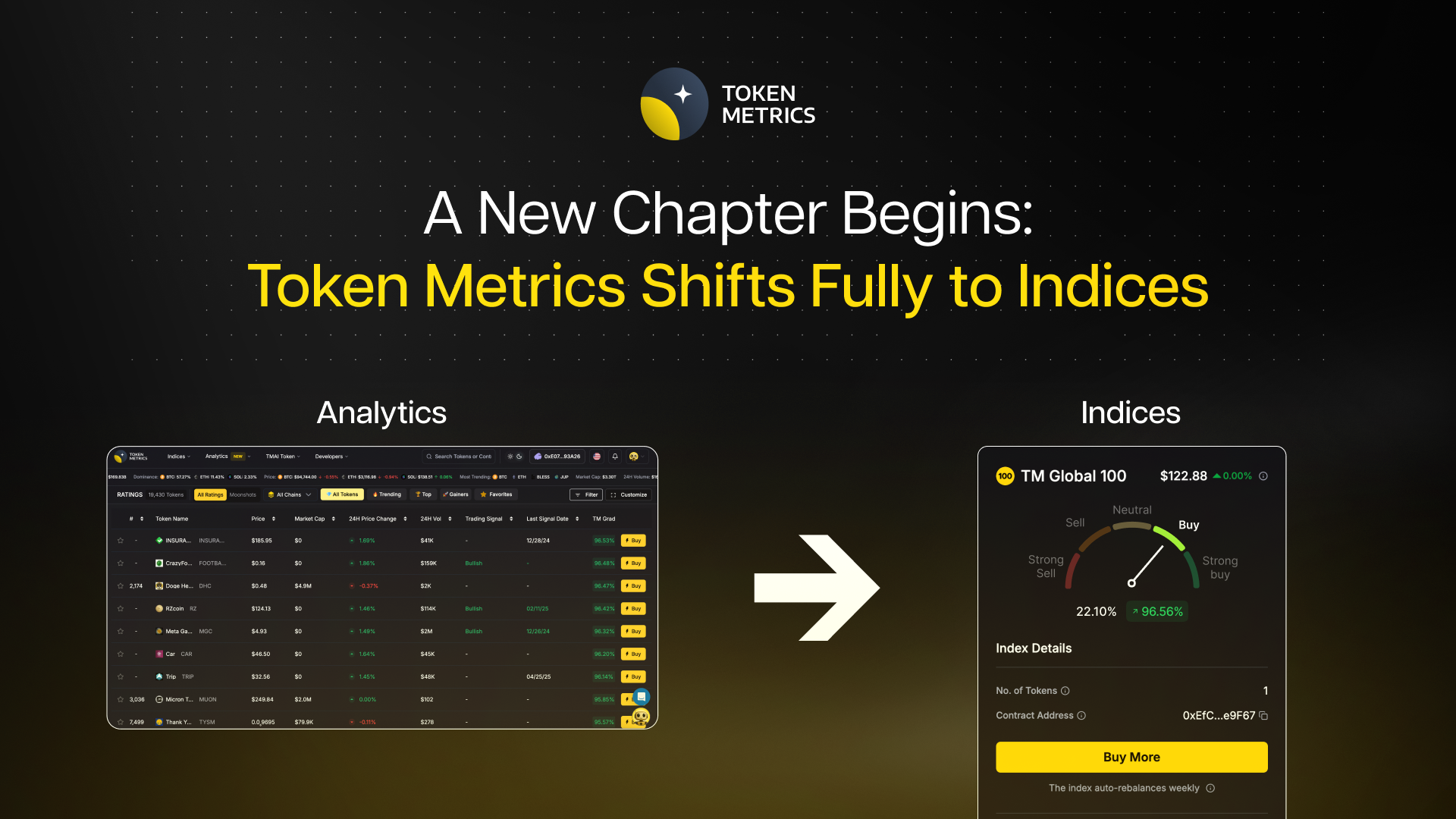
A New Chapter: Token Metrics Shifts Fully to On-Chain Indices

Token Metrics Team
8 min

An important update from Ian Balina, Founder and CEO

Today marks a pivotal moment in Token Metrics' journey. After careful consideration of market dynamics and community feedback, we're making a strategic decision that will shape our future: we are sunsetting the Token Metrics Analytics platform and API to focus entirely on building and operating our on-chain indices.

Why We're Making This Change

The crypto landscape has evolved significantly. Research and analytics tools have proliferated, with many platforms offering similar features and dashboards. Meanwhile, the real innovation and differentiation is shifting toward on-chain products that enable investors to own the market itself—simply, transparently, and non-custodially.

Over time, we've noticed a clear trend: the strongest and most consistent interest around Token Metrics has centered on our indices, especially TM100, rather than new features in the Analytics platform or raw data feeds. Our community has shown us where the real value lies.

In response to these market conditions and community sentiment, we've made the decision to narrow our focus dramatically. We're consolidating into a much smaller, highly focused team with a single mission: to do fewer things and do them exceptionally well.

What's Changing and When

Here's the complete timeline for this transition:

Effective Immediately

Analytics and the API enter maintenance/read-only status. Users can still log in to view historical Ratings, but no new features will be released.

November 27, 2025

This is the strict deadline to submit your choice regarding your subscription balance. Please don't delay—requests received after this date may not be processed due to the platform shutdown.

November 28, 2025 (Black Friday)

Subject to final readiness, we plan to begin onboarding select users into the indices (starting with TM100) through a controlled early-access rollout.

November 30, 2025

We will shut down both the Analytics platform and the API endpoints. After this date, all routes will redirect to our indices experience and the Help Center.

Your Compensation Options: Choose What Works Best for You

Because you've supported Token Metrics with your subscription, we want to reward your loyalty with high-value choices. We're offering three options, each designed for different goals:

Option 1: Convert to Indices Credits (3x Value)

Receive 3x the value of your unused subscription as credits toward future indices management fees. This grants you:

  • Priority access to TM100
  • White-glove onboarding when the exclusive index opens
  • The best value for continuing your journey with Token Metrics

This is our recommended option for those who want to stay closest to our future developments and plan to utilize our indices. If you've supported Token Metrics from the very beginning and believe in where we're headed, we strongly encourage this path.

Learn more:

Option 2: Receive TMAI Airdrop (1.5x Value)

Receive 1.5x the value of your unused subscription in TMAI tokens.

Note: To ensure market stability, these tokens will be subject to a daily vesting schedule over 30 days.

Option 3: Request a Pro-Rata Refund (1:1 Value)

Request a standard 1:1 pro-rated refund of the unused portion of your subscription back to your original payment method.

Note: Please allow up to 60 days for refund processing.

⚠️ Action Required

Select Your Option Here

You must submit this form by November 27, 2025. Requests received after this date may not be processed due to the platform shutdown.

What This Means for Our Community

For Customers and Developers

This pivot is about clarity and focus. Instead of spreading our energy across analytics dashboards and API maintenance, we will deliver one core product: a non-custodial, rules-based index that lets you invest in the crypto market with a single token.

For Investors

This is a strategic re-alignment around the part of the business with the most long-term value. We see greater opportunity in being an index engine and distribution platform than in competing as yet another analytics surface.

For Astrobot Holders

Upon the launch of the Indices, a snapshot taken today confirms your eligibility for an airdrop of permanently staked veTMAI. This converts your current plan to the equivalent staking score level within the new Indices structure. The received veTMAI can then be utilized to benefit from discounted trading fees and a share of the platform's revenue.

For TMAI Token Holders

This is not a step away from you. As we build TM100 and related indices, we intend to maintain and, where possible, enhance the ways TMAI connects to our products. Our priority is to get the index experience live, simple, and trustworthy. Once that foundation is solid, we'll share more details on how the token and indices fit together.

Impact on Our Team

Due to this change, we are becoming a smaller, leaner company. This has required difficult decisions about team structure, but we believe this focused approach will allow us to deliver exceptional value in our chosen domain.

What to Expect Next

  1. Confirmation: Once you submit your compensation choice, you'll receive a confirmation email
  2. Reminders: You'll see in-app notices about the November 30 shutdown and November 27 deadline
  3. Launch Updates: Information about TM100 early access and how to participate as indices onboarding begins around Black Friday

Our Commitment to You

To our customers, API users, investors, and token holders: thank you for your support through multiple market cycles. You've trusted our Ratings, engaged with our research, and participated in our community. This decision honors that history while pointing toward a simpler, more durable product that aligns with where crypto is heading.

By narrowing our focus now, we can build something that deserves your trust for many years to come.

Questions? Reply to our announcement email or contact us at support@tokenmetrics.com. We will read every message and do our best to assist you.

With appreciation,

Ian Balina
Founder and CEO
Token Metrics

Don't forget: Select your compensation option before November 27, 2025
Research

Top Crypto Prime Brokers (2025): Best Institutional Trading & Settlement Platforms

Token Metrics Team
17 min read
  • If you’re an institution that needs multi-venue liquidity, off-exchange settlement, and integrated custody/financing, this guide ranks the top crypto prime brokers for 2025 based on scale, security posture, and product breadth.
  • Top picks: Coinbase Prime for integrated trading + qualified custody with negotiated fees; FalconX for deep liquidity and capital solutions across spot/derivatives; Anchorage Digital Prime for bank-regulated custody with prime services and derivatives access. (Coinbase)
  • Caveats: Pricing is often negotiated; availability and products vary by region and legal entity. Always verify coverage on the provider’s official pages before onboarding. (docs.cdp.coinbase.com)

Introduction: Why Prime Brokerage Matters in 2025

Institutional participation accelerated in 2025, and with it the need for crypto prime brokers that unify execution, financing, custody, and settlement while minimizing counterparty risk. The leading platforms now resemble capital-markets infrastructure: single-counterparty access to multi-venue liquidity, off-exchange settlement networks that keep assets in segregated custody, and derivatives rails to hedge risk. Solutions like Coinbase Prime, FalconX, and Anchorage Digital Prime illustrate this evolution, while settlement networks such as Copper ClearLoop reduce venue risk without slowing execution. (Coinbase)

Primary intent: commercial-investigational. This guide compares features, fees, regions, and tradeoffs, then maps use cases to the right providers—so teams can move from diligence to deployment with confidence.


Our Evaluation Methodology

SCORING_WEIGHTS (sum = 100):

  • Scale & Liquidity (25) – depth of venues/LPs, 24/7 execution, options/futures where applicable.
  • Security & Regulatory Posture (25) – qualified custody, bank licensing/registrations, segregation, insurance disclosures.
  • Product Breadth (15) – spot, OTC/RFQ, derivatives, financing, settlement networks.
  • Costs & Fees (10) – published or negotiated schedules, financing/borrow terms.
  • Connectivity & Tooling (10) – FIX/WebSocket APIs, OEMS/SOR, reporting.
  • Capital Efficiency (10) – cross-margin, off-exchange settlement, instant delegation.
  • Support & Service (5) – coverage windows, onboarding SLAs.

Verification approach: We relied on official product, pricing, docs, security, and status pages only. If a claim wasn’t verifiable on an official page, we omitted it. Last updated: November 2025.


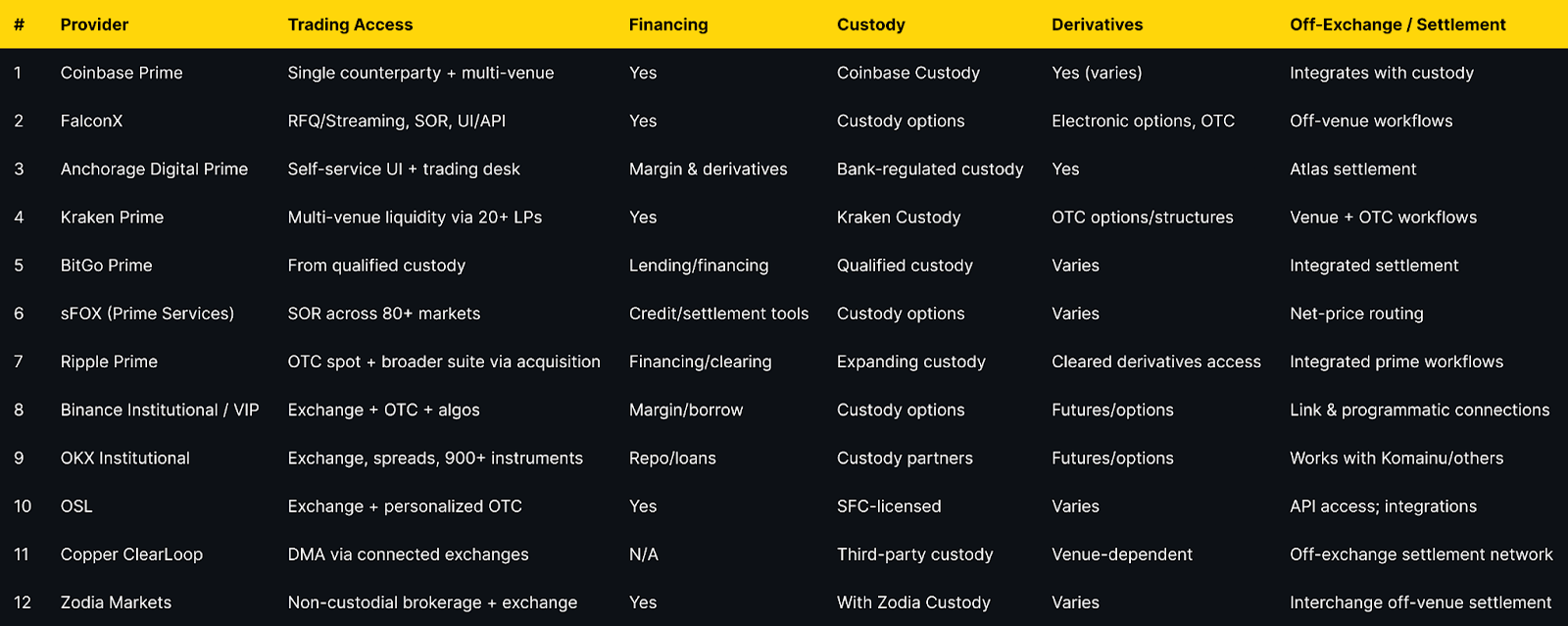
Crypto Prime Brokerage Comparison: At a Glance


Notes: “Pricing” reflects publicly stated models (often negotiated). “Regions/Notes” summarize official disclosures and licensing language where available on provider sites.


Detailed Provider Analysis

Coinbase Prime — Full-service prime brokerage at scale

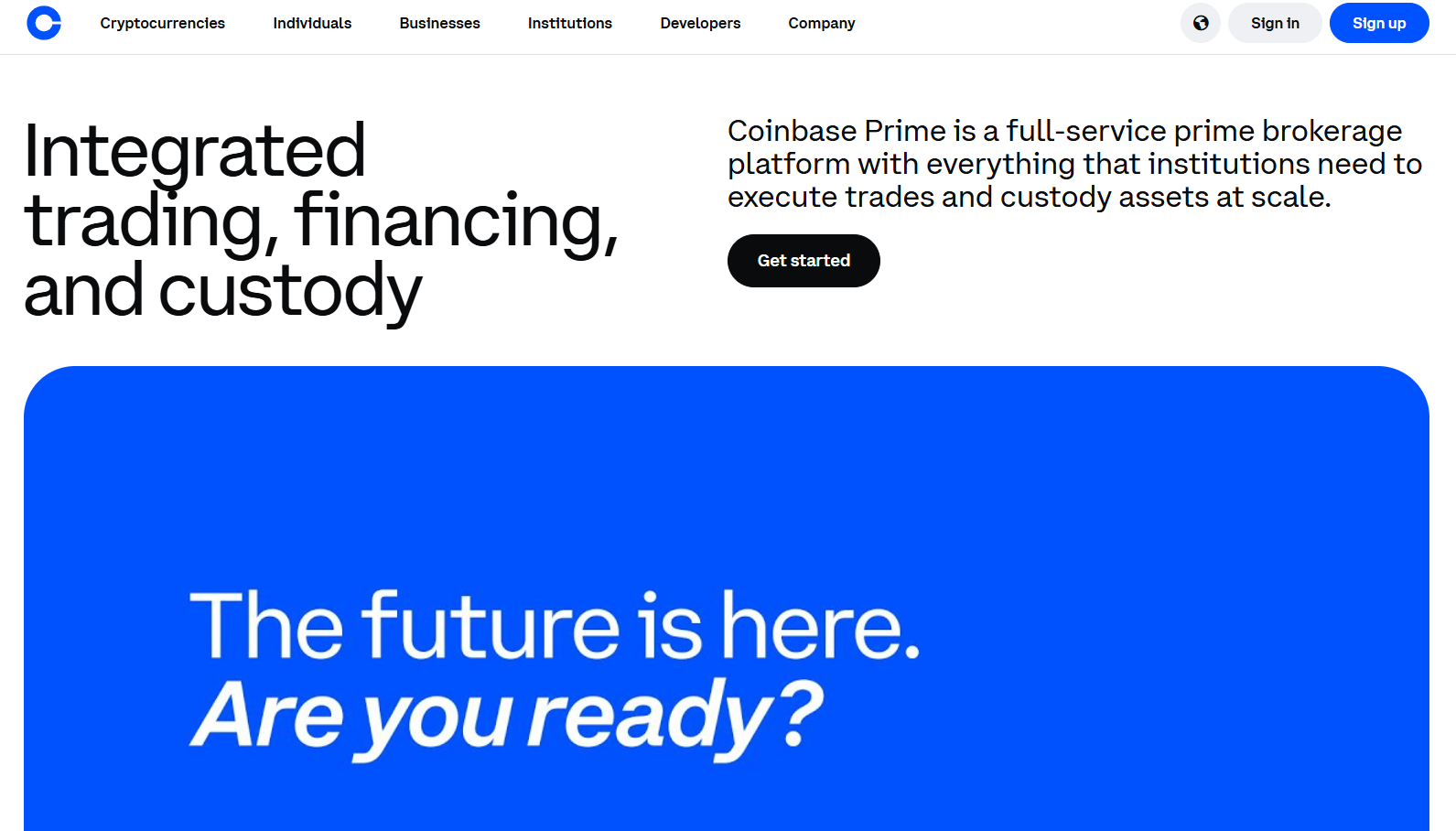
Overview. Coinbase Prime combines trading, financing, and qualified custody under one institutional platform, with negotiated trading fees and flexible order denomination (base/quote). Execution integrates with reporting and controls suitable for asset managers and corporates. (Coinbase)
Ideal For. Asset managers, corporates/treasuries, hedge funds, RIAs.
Standout Features. Integrated custody; negotiated All-In / Cost-Plus fee models; staking fee schedules; institutional reporting. (docs.cdp.coinbase.com)
Pricing. Negotiated, fee currency = quote currency. (docs.cdp.coinbase.com)
Availability. Global, entity-dependent; product availability varies by jurisdiction.
Worth Noting. Some services require separate agreements (e.g., validators, derivatives access).
Alternatives to Consider. Kraken Prime, Anchorage Digital Prime. (Kraken)  


FalconX — Deep liquidity & capital solutions across markets

Overview. FalconX offers RFQ/streaming execution across spot and FX with FIX/WebSocket/REST connectivity, plus electronic options and capital solutions. Scale and 24/7 liquidity are central, with workflows for large tickets and programmatic strategies. (falconx.io)
Ideal For. Multi-strategy funds, HFT/systematic traders, market makers.
Standout Features. RFQ/streaming with TWAP/FOK; electronic options; FX desk integrated into prime; institutional APIs. (falconx.io)
Pricing. Negotiated; bespoke based on flow and venues.
Availability. Global institutional focus (entity-dependent).
Worth Noting. Derivatives access and product scope vary by entity/region.
Alternatives to Consider. Coinbase Prime, Kraken Prime. (Coinbase)  


Anchorage Digital Prime — Prime services on top of a US bank custodian

Overview. Anchorage Digital Prime delivers trading (13+ order types), derivatives, margin, and settlement built on Anchorage Digital Bank N.A. custody. A single interface and 24/7 trading desk support complex orders. (anchorage.com)
Ideal For. US-regulated custody requirements, governance-active institutions, corporates.
Standout Features. Bank-regulated custody; derivatives access; Atlas settlement; desk + API execution. (anchorage.com)
Pricing. Negotiated; service-by-entity.
Availability. US bank entity with global affiliates; services provided by specific Anchorage entities (see legal). (anchorage.com)
Worth Noting. Trading provided by separate non-bank entities; read entity-level disclosures. (anchorage.com)
Alternatives to Consider. BitGo Prime, Coinbase Prime. (The Digital Asset Infrastructure Company)  


Kraken Prime — Multi-venue liquidity with institutional fee tiers

Overview. Kraken Prime aggregates 20+ liquidity providers and offers smart order routing, OTC spot and OTC derivatives (options/structures), plus custody integrations. Institutional fee perks are published for high-volume clients. (Kraken)
Ideal For. Funds seeking published fee schedules, multi-venue execution, and OTC coverage.
Standout Features. Multi-venue liquidity; FIX 4.4 and WebSockets APIs; OTC desk; institutional taker tiers. (Kraken)
Pricing. Maker/taker schedule with institutional perks at very high volumes. (Kraken)
Availability. Global, entity-dependent.
Worth Noting. Some advanced services require qualification and separate onboarding.
Alternatives to Consider. sFOX, Coinbase Prime. (sFOX)


BitGo Prime — Prime services from qualified custody

Overview. BitGo integrates trading, financing, and settlement directly from custody, with segregated, bankruptcy-remote accounts and published insurance coverage details. (The Digital Asset Infrastructure Company)
Ideal For. Institutions prioritizing segregation and custody-first workflows.
Standout Features. Segregated accounts; insurance disclosures; custody-integrated prime trading. (The Digital Asset Infrastructure Company)
Pricing. Negotiated; custody/prime fees depend on assets and activity.
Availability. Global entities with varying regulatory regimes.
Worth Noting. Derivatives access varies by entity/partner networks.
Alternatives to Consider. Anchorage Digital Prime, Copper ClearLoop. (anchorage.com)


sFOX (Prime Services) — Agency SOR across 80+ markets with institutional tooling

Overview. sFOX acts as an agnostic agent routing across 80+ markets for best execution, with net-price routing and institutional reporting. The platform positions itself as a full-service prime dealer for institutions. (sFOX)
Ideal For. Systematic strategies, RIAs/allocators, corporates seeking agency execution.
Standout Features. SOR across venues; platform-level price improvement; custody options. (sFOX)
Pricing. Tiered/negotiated; historical content points to fee optimization via routing. (sFOX)
Availability. US/global entities; enterprise onboarding.
Worth Noting. Product scope (derivatives, margin) varies; confirm coverage.
Alternatives to Consider. Kraken Prime, Coinbase Prime. (Kraken)


Ripple Prime — Multi-asset prime brokerage under Ripple

Overview. Following the acquisition and subsequent close of Hidden Road, Ripple Prime offers U.S. spot OTC execution and positions Ripple as the first crypto company to own and operate a global, multi-asset prime broker; custody capabilities expanded further in late 2025. (Ripple)
Ideal For. Institutions seeking an integrated multi-asset prime platform with digital asset rails.
Standout Features. OTC spot execution (U.S.); multi-asset coverage; financing/clearing. (Ripple)
Pricing. Negotiated.
Availability. U.S. launch and global expansion via Ripple entities. (Ripple)
Worth Noting. Product availability differs by jurisdiction and entity.
Alternatives to Consider. FalconX, Coinbase Prime. (falconx.io)


Binance VIP & Institutional — Exchange liquidity, OTC & programmatic access

Overview. Binance’s institutional suite spans exchange, OTC RFQ, algos, and programmatic connectivity with VIP tiers. Coverage and eligibility depend on jurisdiction; Binance.US operates separately for U.S. clients. (binance.com)
Ideal For. Non-US teams wanting direct exchange liquidity with OTC tools.
Standout Features. VIP tiers, proof-of-reserves, OTC block trading. (binance.com)
Pricing. Exchange/VIP schedules; negotiated OTC.
Availability. Region-dependent; check supported regions. (binance.com)
Worth Noting. U.S. availability/routes differ; compliance and onboarding vary by entity.
Alternatives to Consider. OKX Institutional, OSL. (OKX)


OKX Institutional — Scale, instruments, and U.S. presence via OKX US

Overview. OKX highlights high uptime, 900+ instruments, and institutional connectivity. U.S. availability exists through OKX US with scope/policies noted in compliance disclosures. (OKX)
Ideal For. Proprietary firms and funds trading a broad instrument set with API access.
Standout Features. Nitro Spreads, derivatives suite, institutional support. (OKX)
Pricing. Exchange schedule + VIP; negotiated for blocks.
Availability. Global; US services via OKX US (scope varies). (OKX)
Worth Noting. Product availability and licensing differ by region.
Alternatives to Consider. Binance Institutional, Kraken Prime. (binance.com)


OSL — HK SFC-licensed exchange, custody & OTC

Overview. OSL provides a licensed Hong Kong platform spanning custody, exchange, and OTC brokerage for institutions, with dedicated coverage in the region. (osl.com)
Ideal For. APAC institutions needing SFC-regulated venue/custody.
Standout Features. SFC-licensed exchange; institutional API; custody with insurance positioning. (sfc.hk)
Pricing. Schedule/negotiated.
Availability. Hong Kong and supported regions; institutional focus.
Worth Noting. Product availability differs by license and region.
Alternatives to Consider. Zodia Markets, Coinbase Prime. (Zodia Markets)


Copper ClearLoop — Off-exchange settlement network (multi-custodial)

Overview. ClearLoop enables instant delegation to connected exchanges while assets remain in segregated custody—now supporting third-party custodians like BitGo and Komainu. (Copper)
Ideal For. Institutions prioritizing venue risk reduction and capital efficiency.
Standout Features. Multi-custodial support; instant asset delegation; network of venues/prime brokers. (Copper)
Pricing. Varies by participants and volumes.
Availability. Global network; coverage depends on participating venues/custodians.
Worth Noting. Not a full prime broker by itself; pairs well with custody/venues.
Alternatives to Consider. Zodia Interchange, Komainu Connect. (zodia-custody.com)


Zodia Markets + Zodia Custody Interchange — Non-custodial brokerage + off-venue settlement

Overview. Zodia Markets offers institutional brokerage/exchange with non-custodial design, while Zodia Custody’s Interchange provides off-venue settlement (OVS)—trade while assets remain in custody. Registrations span UK, Ireland, ADGM. (Zodia Markets)
Ideal For. Institutions wanting bank-backed governance and segregated settlement flows.
Standout Features. Non-custodial brokerage; Interchange OVS network; institutional registrations. (Zodia Markets)
Pricing. Negotiated.
Availability. UK/EU/MENA institutional coverage (entity-specific). (Zodia Markets)
Worth Noting. Product scope varies by entity and venue integrations.
Alternatives to Consider. OSL, Copper ClearLoop. (osl.com)


Choosing the Right Prime Broker: A Framework

  • Regulatory posture needed? If you require US bank-regulated custody, start with Anchorage Digital Prime. For Hong Kong, OSL’s SFC licensing is key. For UK/EU bank-backed governance with off-venue settlement, consider Zodia. (anchorage.com)
  • Execution style. For multi-venue aggregation and published fee tiers, Kraken Prime is strong; for RFQ/streaming with electronic options, FalconX leads. sFOX suits agency SOR across many markets. (Kraken)
  • Integrated custody + trading. Coinbase Prime and BitGo Prime minimize operational friction by tying trading to qualified custody. (Coinbase)
  • Venue-risk reduction. If you want to trade while assets remain in custody, evaluate Copper ClearLoop or Zodia Interchange (and Komainu Connect as a related model). (Copper)
  • Instrument breadth and scale. For vast exchange liquidity and institutional programs, Binance Institutional and OKX Institutional are at-scale options (region permitting). (binance.com)

Integrating Token Metrics Intelligence

  • Research phase: Use Token Metrics screeners and on-chain/technical indicators to identify pairs suitable for your mandate (beta targets, breadth, liquidity screens).
  • Execution phase: Route orders via your prime broker’s APIs (e.g., FIX/WebSocket) selected above, while TM signals inform aggression/passivity and time-of-day tactics. (Kraken)
  • Monitoring: Feed fills, slippage, and borrow/financing into TM analytics to assess venue performance and adjust routing.
  • Optimization: Combine TM factor views with prime-broker borrow/financing and settlement options (e.g., off-exchange) to lower VaR and operational risk.

Start a Token Metrics trial to bring quantitative screening and scenario analysis into your institutional workflow.  


Security & Compliance Guidelines

  • Prefer segregated, bankruptcy-remote custody and confirm insurance disclosures where published. (The Digital Asset Infrastructure Company)
  • If you need a US bank custodian, validate services by legal entity and read the provider’s disclosures. (anchorage.com)
  • Use off-exchange settlement networks to reduce exchange exposure during execution. (Copper)
  • Confirm derivatives eligibility, margin terms, and cross-margin/netting treatment by entity/venue. (Kraken)
  • Require API keys/roles with least-privilege, HSM custody, and mandatory allow-listing.
  • Maintain jurisdictional watchlists and restrict activity accordingly (e.g., US vs non-US entities for global exchanges). (OKX)

Compliance note: This article is for research/education, not financial advice.


Avoiding Common Mistakes

  • Treating “prime” as one product—coverage and legal entities differ by service.
  • Assuming off-exchange settlement is automatic—confirm network membership and supported venues. (Copper)
  • Onboarding to the wrong entity—read the jurisdictional disclosures. (anchorage.com)
  • Ignoring negotiated fees—request All-In vs Cost-Plus quotes. (docs.cdp.coinbase.com)
  • Skipping disaster-recovery testing—simulate exchange outage + settlement failover.
  • Under-documenting OMS/EMS changes—keep audit-ready change logs.

Frequently Asked Questions

What is a crypto prime broker?
 A provider that consolidates institutional trading, financing, custody, and settlement, often with multi-venue access and risk controls. Modern variants add off-exchange settlement so assets remain in custody during execution. (zodia-custody.com)

Do prime brokers publish fees?
 Often no—fees are negotiated based on volumes, products, and relationship tier. Some venues publish maker/taker schedules with institutional perks. (docs.cdp.coinbase.com)

How does off-exchange settlement work?
 Networks like ClearLoop and Interchange let you delegate assets to venues for trading while keeping them in segregated custody, reducing counterparty risk. (Copper)

Which providers are strongest for regulated custody?
 Anchorage Digital Prime (US bank custody), BitGo (qualified custody), OSL (HK SFC-licensed custody/exchange), and Zodia (bank-backed with EU/UK registrations). (anchorage.com)

Can U.S. institutions use OKX or Binance?
 Access is region-dependent and varies by entity (e.g., OKX US scope). U.S. clients typically cannot use Binance.com and instead must evaluate Binance.US or other U.S.-eligible routes. Always check official disclosures. (OKX)


Final Recommendations

For most global institutions, a two-stack works best: (1) an integrated prime broker with qualified custody (Coinbase Prime, Anchorage Digital Prime, or BitGo Prime) and (2) a venue-risk mitigator like Copper ClearLoop or Zodia Interchange. Execution-heavy funds should add FalconX or Kraken Prime for multi-venue and OTC derivatives coverage, while OSL anchors APAC/HK mandates and OKX/Binance expand exchange reach where eligible. (Coinbase)

Related Resources:

Research

Best Yield Marketplaces for Real-World Assets (RWAs) in 2025

Token Metrics Team
29 min read
  • What this guide covers: A comprehensive evaluation of 10 leading platforms that enable tokenized real-world asset trading and yield generation across private credit, treasuries, real estate, and structured finance
  • Quick verdict: Ondo Finance for institutional-grade treasury exposure at ~5% APY, Maple Finance for crypto-collateralized credit facilities delivering 9-12% net yields, Goldfinch Prime for diversified access to private credit funds from Apollo and Ares
  • One key limitation to know: Many RWA platforms enforce strict accreditation requirements (minimum $50K-200K) and geographic restrictions, particularly excluding US investors from certain products due to securities regulations

Why Yield Marketplaces for RWAs Matter in January 2025

The real-world asset tokenization market has experienced explosive growth, surging from $85 million in April 2020 to over $25 billion by mid-2025—representing a staggering 245-fold increase driven primarily by institutional demand for yield, transparency, and regulatory clarity. Private credit dominates at approximately 61% of total tokenized assets, followed by treasuries at 30%, with major asset managers like BlackRock, Apollo, and Franklin Templeton now actively tokenizing institutional-grade products.

The convergence of traditional finance and decentralized infrastructure has created unprecedented opportunities for investors seeking stable, real-world yields without exposure to cryptocurrency volatility. The tokenized RWA market is projected to reach between $9.43 trillion and $18.9 trillion by 2030, with regulatory frameworks in Singapore, Hong Kong, and Dubai providing clear pathways for compliant innovation.

For crypto-native investors, RWA yield marketplaces offer a critical bridge to sustainable income streams backed by productive assets rather than purely speculative token emissions. Traditional allocators gain 24/7 access to fractional ownership, instant settlement, and programmable compliance—advantages impossible in legacy financial infrastructure.


How We Evaluated These Providers

We assessed platforms across six weighted criteria totaling 100 points:

  • Yield Quality & Sustainability (30%): Consistency of returns, asset backing, historical performance, and correlation to traditional markets
  • Security & Risk Management (25%): Custody solutions, audit history, legal recourse, collateralization ratios, and default handling protocols
  • Asset Coverage & Diversity (15%): Range of underlying assets, tranching options, and exposure across credit curves
  • Accessibility & Costs (15%): Minimum investments, fee structures, geographic availability, and KYC requirements
  • Liquidity & Redemption (10%): Secondary market depth, withdrawal timelines, and tokenization standards
  • Infrastructure & Compliance (5%): Regulatory licenses, blockchain integrations, and institutional partnerships

Data sources: Official platform documentation, on-chain analytics from RWA.xyz and DeFiLlama, third-party audits, and regulatory filings. Research conducted October 2024-January 2025.

Verification approach: Every fee structure, yield figure, and regional restriction cited was verified on official platform pages or regulatory disclosures. Unverifiable claims were excluded.


The Contenders: Quick Comparison  

Provider Reviews by Use Case

For Treasury-Backed Stability (4-5% Yield)

Top Pick: Ondo Finance — Institutional Treasury Tokenization Pioneer

Overview
 Ondo Finance manages over $1.6 billion in tokenized assets, offering institutional-grade access to US Treasury exposure through OUSG (backed by BlackRock's BUIDL fund) and USDY (a yield-bearing stablecoin). The platform bridges TradFi stability with DeFi composability through multi-chain deployment across Ethereum, Solana, Base, and XRP Ledger.

Ideal For

  • Institutional allocators seeking low-volatility dollar exposure
  • DeFi protocols requiring yield-bearing collateral
  • Treasuries managing idle stablecoin holdings
  • Investors prioritizing regulatory compliance and brand-name backing

Standout Features

  • Approximately 5% APY from short-term US Treasuries with daily interest payouts via rebasing mechanism
  • Integration with Ripple's RLUSD stablecoin for instant minting and redemption 24/7
  • Comprehensive SEC-registered infrastructure through acquisition of Oasis Pro, including broker-dealer, ATS, and transfer agent licenses
  • Strategic partnerships including anchor position in Fidelity's FDIT tokenized money market fund and launch of Ondo Global Markets for tokenized equities

Pricing
 Management fees embedded in net yield; typical 0.15-0.30% annual fee depending on product. OUSG requires $100K minimum; USDY accessible at lower thresholds with 4.29% APY.

Availability
 Global except US persons for certain products. Ethereum, Solana, Polygon, Aptos, Sei, Base, XRP Ledger, and Sui supported.

Worth Noting
 OUSG designed for qualified purchasers with extended lockup periods; less suitable for retail or high-frequency traders. Platform prioritizes institutional relationships over retail accessibility.

Alternatives to Consider: Franklin Templeton BENJI, OpenEden TBILL  


Runner-Up: Franklin Templeton BENJI — Legacy Asset Manager Innovation

Overview
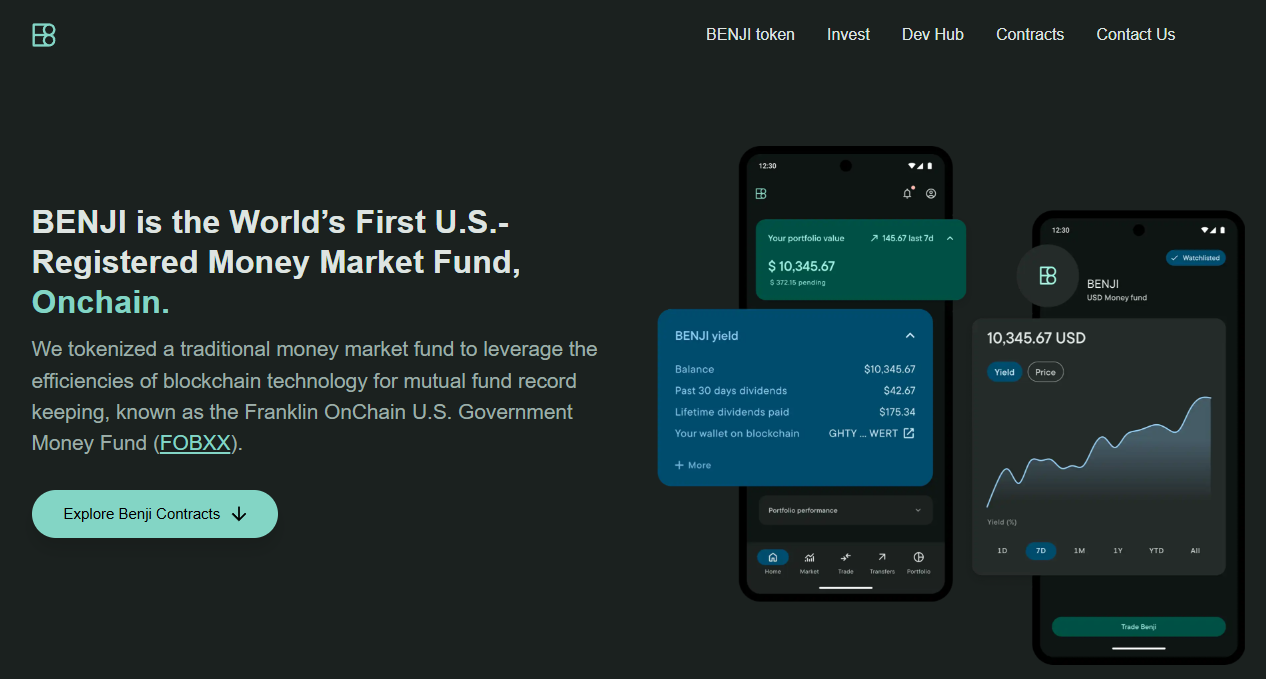
 Franklin Templeton's $775 million Franklin OnChain U.S. Government Money Fund (BENJI) pioneered tokenized mutual funds in 2021, offering exposure to US government securities across eight blockchains with patent-pending intraday yield calculation.

Ideal For

  • Investors seeking regulated 40 Act fund structure
  • Collateral managers requiring second-by-second yield accrual
  • Multi-chain strategies needing broad blockchain compatibility
  • Users prioritizing traditional asset manager credibility

Standout Features

  • Intraday yield tracking down to the second, enabling proportional earnings even for partial-day holdings
  • Direct stablecoin purchases and redemptions with wallet-to-wallet transfer capability
  • 63% of AUM deployed on Stellar Network for optimal cost efficiency
  • Integrated with DeFi protocols for collateral and leverage applications

Pricing
 7-day current yield approximately 4.5-5.5% gross; 0.25% management fee. No minimum investment restrictions beyond standard mutual fund requirements.

Availability
 Global availability with specific KYC requirements. Active on Stellar, Ethereum, Arbitrum, Base, Avalanche, Polygon, Aptos, Solana, BNB Chain.

Worth Noting
 Traditional mutual fund constraints apply including daily NAV calculations and potential redemption delays during market stress.

Alternatives to Consider: Backed bIB01, Superstate Short Duration Government Securities  


For Institutional Credit Exposure (8-12% Yield)

Top Pick: Maple Finance — Premier Crypto-Collateralized Lending

Overview
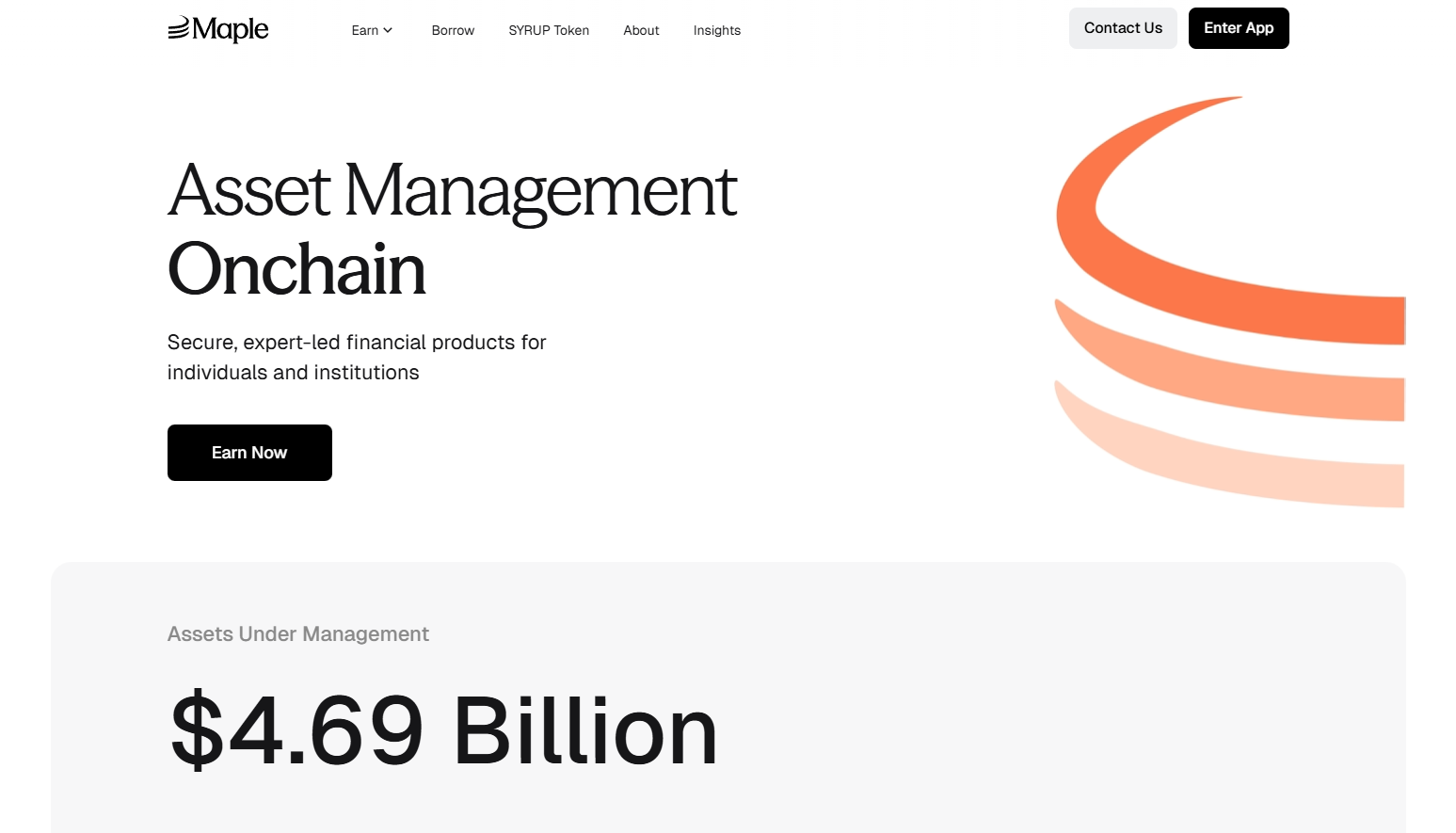
 Maple Finance manages over $4 billion in assets, specializing in institutional over-collateralized lending backed by Bitcoin, Ethereum, Solana, and XRP, targeting $100 billion in annual loan volume by 2030. The platform introduced SyrupUSDC for permissionless retail access alongside KYC-gated institutional pools.

Ideal For

  • Institutional lenders seeking exposure to cryptocurrency-backed credit
  • Liquidity providers comfortable with smart contract risk
  • Allocators targeting floating-rate, senior-secured structures
  • Investors seeking alternatives to traditional stablecoin farming

Standout Features

  • Consistent 9-12% net yields through undercollateralized institutional facilities and structured credit products
  • Strategic integration with Aave's $40 billion protocol bringing syrupUSDT to Plasma instance and syrupUSDC to core markets
  • Partnerships with Bitwise, Lido Finance (stETH-backed credit lines), and EtherFi (weETH collateral) expanding institutional adoption
  • Robust risk management combining decades of TradFi expertise with real-time on-chain monitoring

Pricing
 Variable by pool; typical effective yields 9-12% after protocol fees. Minimum investments pool-dependent, generally $10K-$50K for retail syrup products.

Availability
 Global with KYC requirements for lending. Institutional Maple requires accreditation; Syrup.fi open to broader participants.

Worth Noting
 Platform transitioned from uncollateralized to over-collateralized model after 2022 market turmoil. Historical defaults impacted certain pools; robust recovery mechanisms now in place.

Alternatives to Consider: Credix (emerging markets), TrueFi (uncollateralized DeFi)  


Runner-Up: Goldfinch Prime — Institutional Private Credit Access

Overview
 Goldfinch Prime aggregates exposure to multi-billion dollar private credit funds from Ares, Apollo, Golub Capital, and KKR, providing on-chain access to institutional-grade senior secured loans with over $1 trillion in collective AUM.

Ideal For

  • Non-US investors seeking diversified private credit exposure
  • Allocators targeting institutional fund performance without direct fund access
  • Participants seeking uncorrelated yield to crypto markets
  • Investors comfortable with longer lockup periods

Standout Features

  • Exposure to 1000+ senior secured loans across industries through vetted fund managers with 10+ years experience
  • Target returns of 9-12% net of fees with strict eligibility criteria including >90% senior secured portfolios and <0.75% target non-accrual rates
  • Heron Finance manages fund selection and vetting while fund managers handle all underwriting and default resolution
  • USDC-based deposits converted to proportional GPRIME tokens for continuous offering structure

Pricing
 Net yields 9-12% after embedded management fees and profit sharing. Minimum investments vary by pool structure; typically institutional minimums apply.

Availability
 Non-US persons only due to regulatory structure. KYC and accreditation verification required.

Worth Noting
 Exposure is indirect through fund shares rather than direct loan origination; fund managers absorb individual borrower default risk into aggregate yields. Liquidity limited compared to Treasury products.

Alternatives to Consider: Centrifuge private credit pools, Credix fintech lending


For Real Estate & Diversified Assets (6-10% Yield)

Top Pick: Centrifuge — Multi-Asset Tokenization Infrastructure

Overview
 Centrifuge operates as a multichain infrastructure platform enabling asset managers to tokenize real estate, trade finance, carbon credits, and structured credit with $1.2 billion TVL and recent 10x growth driven by the first on-chain CLO and tokenized S&P 500 index fund.

Ideal For

  • Investors seeking exposure to asset-backed securities beyond treasuries
  • Allocators comfortable evaluating tranched credit structures
  • Participants prioritizing transparency and on-chain asset verification
  • Portfolio managers wanting diversification across real-world credit types

Standout Features

  • Asset-agnostic architecture supporting structured credit, real estate mortgages, US treasuries, carbon credits, and consumer finance with full collateralization and legal recourse for investors
  • V3 platform enables cross-chain interoperability across Ethereum, Base, Arbitrum, Avalanche, BNB Chain, and Plume with integrated KYC and compliance-as-a-feature
  • Senior/junior tranche structures allowing risk-return customization
  • Partnership with Chronicle Labs for real-time price feeds and integration with Circle for USDC on/off-ramping

Pricing
 Yields vary by pool and tranche: typically 6-8% for senior tranches, 10-14% for junior tranches. Management fees embedded; pool-specific minimums apply.

Availability
 Global with KYC requirements. Pools may have additional jurisdictional restrictions based on underlying asset location.

Worth Noting
 Platform complexity requires understanding of tranched structures and asset-specific risks. Less liquid credit instruments offer less frequent pricing updates than treasury products.

Alternatives to Consider: RealT (US residential real estate focus), Republic (equity crowdfunding)


For Emerging Market Credit (12-18% Yield)

Top Pick: Credix — Latin American Fintech Lending

Overview
 Credix specializes in providing credit facilities to fintech lenders in Latin America, offering high-yield exposure to underserved credit markets with institutional-grade underwriting and local market expertise.

Ideal For

  • Sophisticated investors seeking higher risk-adjusted returns
  • Allocators comfortable with emerging market credit risk
  • Participants with extended investment horizons (12-24 months typical)
  • Investors seeking geographic diversification from US/EU markets

Standout Features

  • Target yields 12-18% reflecting emerging market risk premiums
  • Focus on fintech infrastructure enabling financial inclusion
  • Partnerships with established Latin American credit originators
  • Robust due diligence and monitoring of borrower networks

Pricing
 Pool-dependent yields typically 12-18% gross with management fees of 1-2%. Minimum investments generally $50K+ for accredited investors.

Availability
 Non-US persons primarily; requires accreditation verification and enhanced KYC given emerging market exposure.

Worth Noting
 Higher yields reflect higher credit and currency risk. Platform experienced challenges during regional economic volatility; enhanced risk controls now implemented.

Alternatives to Consider: Goldfinch V1 pools (emerging market focus), TrueFi uncollateralized pools


For Tokenization Infrastructure (Platform Providers)

Top Pick: Securitize — Industry-Leading Issuance Platform

Overview
 Securitize has tokenized over $4.5 billion in assets for 1.2 million investors across 3,000+ clients, operating as an SEC-registered transfer agent with integrated ATS for secondary trading. The platform powers major offerings including BlackRock's BUIDL fund.

Ideal For

  • Asset managers seeking turnkey tokenization solutions
  • Issuers requiring SEC-compliant digital security infrastructure
  • Institutional clients needing integrated custody and compliance
  • Projects prioritizing regulatory alignment and brand credibility

Standout Features

  • DS Protocol automates token issuance, transfer agent functions, and regulated secondary trading with $47 million funding led by BlackRock
  • Recent launch of STAC tokenized AAA CLO fund with BNY custody demonstrating institutional adoption trajectory
  • Comprehensive investor onboarding, KYC/AML, and reporting infrastructure
  • Partnerships with major asset managers and integration with Zero Hash for fiat conversion

Pricing
 Platform fees vary by issuance size and complexity; typically 0.5-2% of AUM plus basis point fees on transactions. White-label solutions available for enterprise clients.

Availability
 Global operations with jurisdiction-specific compliance modules. Primary focus on US, EU, and APAC institutional markets.

Worth Noting
 Securitize is an issuance platform rather than direct investment product; investors access opportunities through partner funds and offerings launched on the infrastructure.

Alternatives to Consider: Tokeny (EU-focused), Polymath/Polymesh (security token specialists)


Complete Provider Directory

  • Backed Finance: European MiCA-compliant tokenization platform offering bIB01 (Swiss government bond exposure) and bC3M (commodity basket). Strong focus on regulatory alignment with modest 3-5% yields and low entry barriers.
  • Swarm Markets: Decentralized platform enabling fractional ownership of real estate and private credit with $1K-$50K minimums. Emphasizes accessibility while maintaining compliance through distributed infrastructure.
  • TrueFi: Uncollateralized lending protocol using on-chain credit scoring and portfolio diversification. Higher risk-return profile (8-15% targets) with full transparency of borrower pools and performance metrics.
  • Archax: UK FCA-regulated platform for institutional tokenization of bonds, funds, and money markets. Focus on traditional finance compatibility with stringent accreditation requirements.

Making Your Selection: Key Questions

  • What yield stability do you require?
     Treasury-backed platforms (Ondo, Franklin Templeton) offer predictable 4-5% returns with minimal volatility. Credit-focused platforms (Maple, Goldfinch) target 9-12% but introduce credit risk and performance variability.
  • What is your risk tolerance for underlying collateral?
     Government securities provide lowest risk; over-collateralized crypto loans add smart contract and liquidation risks; uncollateralized emerging market credit carries highest default potential.
  • Do you meet accreditation and minimum investment thresholds?
     Many institutional products require $50K-$200K minimums and qualified purchaser status. Retail-accessible options like USDY and syrupUSDC lower barriers but may sacrifice yield.
  • What liquidity do you need?
     Treasury tokens generally offer daily liquidity; private credit pools may have quarterly redemption windows; real estate tokenization can involve 12-24 month lockups.
  • How important is regulatory compliance?
     Platforms like Ondo, Franklin Templeton, and Securitize prioritize SEC registration and traditional fund structures. Purely DeFi-native protocols offer less regulatory clarity but greater composability.
  • What blockchain ecosystems do you operate in?
     Multi-chain deployment (Ondo, Centrifuge) provides flexibility; single-chain specialization (some Maple pools) may offer optimization but limits interoperability.
  • Do you have geographic restrictions?
     US persons often excluded from highest-yield opportunities due to securities laws. European investors benefit from MiCA framework; APAC sees growing regulatory clarity.
  • What level of transparency do you require?
     On-chain native protocols offer real-time asset verification; hybrid models may rely on periodic attestations and third-party audits.
  • Are you seeking passive income or active yield strategies?
     Treasury staking provides set-and-forget returns; DeFi integrations enable leverage, collateral strategies, and yield optimization requiring active management.
  • How much operational complexity can you handle?
     Single-platform solutions simplify but limit optionality; multi-protocol strategies maximize returns but require gas management, tax tracking, and security across multiple platforms.

Maximizing Your Setup with Token Metrics

Token Metrics provides critical intelligence for navigating RWA yield opportunities through data-driven analysis and market insights.

Research Phase: Leverage Token Metrics' fundamental analysis to evaluate tokenized asset protocols, comparing on-chain metrics, TVL trends, and yield sustainability indicators. Our RWA sector reports identify emerging platforms and highlight regulatory developments across jurisdictions.

Portfolio Construction: Use quantitative scoring to allocate across risk tiers—balancing stable treasury exposure with higher-yield credit products. Token Metrics' portfolio tools help optimize diversification while monitoring correlation to traditional crypto markets.

Ongoing Monitoring: Real-time alerts notify you of yield changes, protocol upgrades, and risk events. Our dashboard aggregates performance across multiple RWA platforms, tracking your yield-bearing positions alongside broader cryptocurrency holdings.

Risk Management: Token Metrics' risk analytics assess smart contract security, custody arrangements, and counterparty exposure. Our reports flag platforms with concerning yield sustainability metrics or operational red flags before they impact your capital.

Start your Token Metrics free trial to access institutional-grade RWA research and optimize your real-world asset allocation.  


Essential Security Practices

  • Custody Verification: Confirm that platforms use institutional-grade custodians (Coinbase Custody, BitGo, Fireblocks) for underlying assets. Verify proof-of-reserve attestations and third-party audits.
  • Smart Contract Risk: Review audit reports from reputable firms (Trail of Bits, OpenZeppelin, Certora). Understand upgrade mechanisms and timelock protections on protocol contracts.
  • Legal Structure Assessment: Examine SPV formation, bankruptcy remoteness, and investor recourse mechanisms. Ensure tokenization structure provides actual legal claim on underlying assets, not just economic exposure.
  • Regulatory Compliance: Verify platforms maintain necessary licenses (broker-dealer, transfer agent, ATS) in relevant jurisdictions. Confirm offerings comply with securities laws in your domicile.
  • Counterparty Risk: Understand who services loans, manages defaults, and handles liquidations. Evaluate track records of asset originators and credit underwriters.
  • Liquidity Risk Management: Never allocate more than you can afford to lock up for stated redemption periods. Maintain buffer capital for market volatility and potential redemption delays.
  • Tax Implications: Consult tax professionals on treatment of tokenized yield—may be classified as interest income, dividends, or capital gains depending on structure and jurisdiction.
  • Geographic Restrictions: Verify you're eligible to participate based on residency. Using VPNs or misrepresenting location can result in frozen funds and legal liability.
  • Platform Concentration: Diversify across multiple RWA providers to reduce single-point-of-failure risk. No single platform should represent majority of yield allocation.
  • Documentation: Maintain records of all transactions, yield distributions, and platform communications for tax reporting and potential disputes.

This article is for research and educational purposes, not financial advice. RWA investments carry risks including loss of principal.


What to Avoid

  • Ignoring minimum holding periods: Many RWA products enforce lockups or redemption windows. Treating them as liquid positions can leave you unable to access capital when needed.
  • Chasing unsustainably high yields: Promised returns significantly above market rates often indicate excessive risk. Verify underlying asset performance and historical consistency before committing capital.
  • Overlooking platform liquidity: Token existence on-chain doesn't guarantee exit liquidity. Check secondary market depth and historical spread between minting and redemption prices.
  • Neglecting jurisdictional compliance: Accessing platforms not available in your region can result in frozen accounts and regulatory penalties. Always verify eligibility before depositing funds.
  • Underestimating smart contract risk: Even well-audited protocols face exploitation risk. Size positions appropriately and monitor security incident disclosures across the ecosystem.
  • Failing to verify asset backing: Don't rely on marketing claims. Demand proof-of-reserve, third-party attestations, and transparent reporting on underlying collateral.
  • Concentrating in single asset class: Over-allocating to one RWA category (e.g., all private credit) eliminates diversification benefits. Balance across treasuries, credit, and real estate where possible.
  • Ignoring fee structures: Management fees, performance fees, and transaction costs compound over time. Calculate net yields after all costs when comparing platforms.

Reader Questions Answered

What's the difference between tokenized treasuries and yield-bearing stablecoins?

 Tokenized treasuries (like OUSG) represent direct ownership of US Treasury securities with yield passed through to holders. Yield-bearing stablecoins (like USDY) maintain $1 peg while distributing treasury yields via rebasing or airdrops. Treasuries may fluctuate slightly with NAV; yield stablecoins prioritize price stability.

Are RWA yields taxable differently than crypto staking rewards?

 Likely yes, though tax treatment varies by jurisdiction. RWA yields from treasuries or credit facilities often classified as interest income taxed at ordinary rates. Crypto staking may be treated as income at receipt or capital gains at sale depending on location. Consult tax professionals for specific guidance.

Can I use tokenized RWAs as collateral in DeFi protocols?

 Increasingly yes. Platforms like Maple, Ondo (via Flux Finance), and Centrifuge enable using tokenized assets as DeFi collateral. However, support varies by protocol and asset—USDY and OUSG see broader integration than niche real estate tokens. Liquidation risks apply if collateral value drops.

What happens if the platform goes bankrupt?

 Properly structured tokenization isolates assets in bankruptcy-remote SPVs, protecting investor claims even if platform operator fails. However, redemption processes may be delayed and require legal navigation. This is why verifying legal structure and custodial arrangements is critical.

How liquid are RWA tokens compared to stablecoins?

 Significantly less liquid. While stablecoins have billions in daily DEX volume, most RWA tokens trade thinly or only through platform-controlled redemption mechanisms. Treasury tokens offer better liquidity than private credit or real estate, but all lag traditional stablecoins substantially.

Do I need to be an accredited investor?

 Depends on the platform and your location. US-based offerings often require accreditation; international platforms may have lower barriers. Products like USDY, syrupUSDC, and BENJI target broader accessibility, while institutional credit pools restrict to qualified purchasers.

What are the main risks that could cause loss of principal?

 (1) Underlying asset default (credit risk), (2) smart contract exploitation, (3) platform insolvency without proper asset segregation, (4) regulatory action freezing operations, (5) stablecoin de-pegging for yield products denominated in USDC/USDT, (6) liquidation cascades in collateralized structures.

How do yields compare to traditional finance alternatives?

 Tokenized treasuries (4-5%) match conventional money market funds but with 24/7 access. Private credit RWAs (9-12%) offer premiums over corporate bonds due to illiquidity and platform novelty. Emerging market RWA yields (12-18%) comparable to EM debt funds with added smart contract risk.


Bottom Line

Real-world asset yield marketplaces represent the maturation of blockchain infrastructure beyond speculation into productive finance. For investors seeking stable, asset-backed returns uncorrelated to cryptocurrency volatility, platforms like Ondo Finance and Franklin Templeton deliver institutional-grade treasury exposure with DeFi composability. Those comfortable with credit risk can access superior yields through Maple Finance's collateralized institutional lending or Goldfinch Prime's diversified private credit exposure.

The key to success: match platform selection to your specific risk tolerance, liquidity needs, and regulatory constraints. Treasury products suit conservative allocators prioritizing capital preservation; credit platforms reward investors accepting higher risk for enhanced returns; multi-asset infrastructure like Centrifuge offers diversification across real-world credit types.

Start with smaller allocations to understand platform mechanics, redemption processes, and yield consistency before committing substantial capital. The RWA sector's rapid growth will continue creating opportunities, but also attracting lower-quality offerings—due diligence remains paramount.

Related Resources:


About This Research

Methodology: This guide evaluated 20+ RWA platforms through analysis of official documentation, on-chain data, regulatory filings, and third-party audits. Platforms selected represent meaningful TVL (>$100M), regulatory compliance, and operational track record. Final selection prioritized diversity across asset classes and investor accessibility tiers.

Research Sources:

  • Ondo Finance: Product documentation, tokenomics, OUSG/USDY specifications, Oasis Pro acquisition disclosure
  • Maple Finance: Platform whitepaper, syrupUSDC mechanics, Aave integration announcement, CEO interviews
  • Centrifuge: V3 technical documentation, pool analytics, Republic partnership details
  • Goldfinch: Prime pool specifications, fund manager criteria, Heron Finance structure
  • Franklin Templeton: BENJI platform technical details, intraday yield patent documentation, multi-chain deployment
  • Securitize: DS Protocol documentation, STAC fund launch details, BlackRock partnership announcements
  • RWA.xyz: Platform TVL data, tokenization metrics, market growth analysis
  • DeFiLlama: Protocol TVL tracking, historical performance data
  • BCG/Ripple: RWA market projections and industry research
  • VanEck, Coinbase, Binance: Sector research reports on RWA growth trajectories

All data current as of January 2025. Platform features and yields subject to change; verify current terms on official websites before investing.

Choose from Platinum, Gold, and Silver packages
Reach with 25–30% open rates and 0.5–1% CTR
Craft your own custom ad—from banners to tailored copy
Perfect for Crypto Exchanges, SaaS Tools, DeFi, and AI Products