Research

APIs Explained: How Application Programming Interfaces Work

A practical guide to what an API is, how APIs work, common types and use cases across web, mobile, crypto and AI, plus design and security best practices for developers.
Token Metrics Team
5
MIN

APIs are the invisible glue that connects modern software: they let apps talk to services, fetch data, and automate workflows. Understanding what an API is and how it operates helps developers, analysts, and product teams design integrations that are robust, secure, and scalable.

What is an API? Definition, scope, and common types

An API, or application programming interface, is a defined set of rules and contracts that allow one software component to interact with another. At a basic level an API specifies the inputs (requests), outputs (responses), and the behavior expected when an operation is invoked. APIs can be exposed within a single application, between services inside a private network, or publicly for third-party developers.

Common API types include:

  • Web APIs (HTTP/HTTPS based, using REST or GraphQL) for browser, server, and mobile communication.
  • RPC and gRPC for high-performance binary communication between microservices.
  • Library or SDK APIs that surface methods within a language runtime.
  • Hardware APIs that expose device functionalities (e.g., sensors, GPU).
  • On-chain and crypto APIs that provide blockchain data, transaction broadcasting, and wallet interactions.

How APIs work: requests, endpoints, and protocols

APIs typically operate over a transport protocol with defined endpoints and methods. In HTTP-based APIs a client sends a request to an endpoint (URL) using methods like GET, POST, PUT, DELETE. The server processes that request and returns a response, often encoded as JSON or XML.

Key components to understand:

  • Endpoint: A specific URL or route that exposes a resource or operation.
  • Method: The action type (read, create, update, delete).
  • Schema / Contract: The shape of request and response payloads, headers, and status codes.
  • Authentication: How the API verifies the caller (API keys, OAuth tokens, signed requests).
  • Rate limits: Rules that prevent abuse by limiting request volume.

Protocols and styles (REST, GraphQL, gRPC) trade off simplicity, flexibility, and performance. REST emphasizes resource-based URLs and uniform verbs. GraphQL offers flexible queries from a single endpoint. gRPC uses binary protocols for lower latency and stronger typing.

Use cases and real-world examples (web, mobile, crypto, AI)

APIs appear in nearly every digital product. Typical use cases include:

  • Web & Mobile Apps: Fetching user profiles, submitting forms, or streaming media from cloud services.
  • Third-party Integrations: Payment providers, identity, and analytics platforms expose APIs to connect services.
  • Crypto & Blockchain: Nodes, indexers, and market data providers expose APIs to read chain state, broadcast transactions, or retrieve price feeds.
  • AI & Data Pipelines: Models and data services expose inference endpoints and training data APIs to enable programmatic access.

For analysts and product teams, APIs make it possible to automate data collection and combine signals from multiple services. AI-driven research tools such as Token Metrics rely on API feeds to aggregate prices, on-chain metrics, and model outputs so users can build informed analytics workflows.

Design, security, and operational best practices

Well-designed APIs are predictable, versioned, and documented. Consider these practical guidelines:

  1. Design for clarity: Use consistent naming, predictable status codes, and clear error messages.
  2. Versioning: Provide v1/v2 in paths or headers so breaking changes don’t disrupt clients.
  3. Rate limiting and quotas: Protect backend resources and provide transparent limits.
  4. Authentication & Authorization: Use proven schemes (OAuth2, signed tokens) and enforce least privilege.
  5. Input validation and sanitization: Defend against injection and malformed payloads.
  6. Observability: Implement logging, metrics, and distributed tracing to monitor performance and troubleshoot failures.
  7. Documentation and SDKs: Publish clear docs, example requests, and client libraries to reduce integration friction.

Security in particular requires ongoing attention: rotate credentials, monitor for anomalous traffic, and apply patching for underlying platforms. For teams building systems that depend on multiple external APIs, plan for retries, exponential backoff, and graceful degradation when a provider is slow or unavailable.

Build Smarter Crypto Apps & AI Agents with Token Metrics

Token Metrics provides real-time prices, trading signals, and on-chain insights all from one powerful API. Grab a Free API Key

FAQ: What is an API?

Q1: What is the difference between an API and an SDK?

An API is a contract that defines how to interact with a service. An SDK is a packaged set of tools, libraries, and helpers that implement or wrap that API for a specific language or platform.

How do REST and GraphQL differ?

REST uses multiple endpoints and standard HTTP verbs to model resources; GraphQL exposes a single endpoint where clients request exactly the fields they need. REST is simpler; GraphQL can reduce over-fetching but adds query complexity.

Can APIs return real-time data?

Yes. Real-time patterns include WebSockets, server-sent events, or streaming gRPC. Polling a REST endpoint is simpler but less efficient for high-frequency updates.

What are common API security measures?

Common measures include strong authentication (OAuth2, API keys), TLS encryption, rate limiting, input validation, signed requests, and robust monitoring for abuse or anomalies.

How should teams evaluate third-party APIs?

Assess uptime history, SLAs, documentation quality, rate limits, pricing model, security posture, and whether the API provides the required schemas and latency characteristics for your use case.

Can APIs be used with AI applications?

Yes. AI models often expose inference APIs for serving predictions, and research tools consume multiple APIs to aggregate training data, features, or market signals. Designing for reproducibility and input validation is important when feeding models with API-derived data.

Disclaimer

This article is educational and informational in nature. It does not provide investment, legal, or professional advice. Implementations and integrations described here are technical examples and should be validated in your environment before deployment.

Build Smarter Crypto Apps &
AI Agents in Minutes, Not Months
Real-time prices, trading signals, and on-chain insights all from one powerful API.
Grab a Free API Key
Token Metrics Team
Token Metrics Team

Recent Posts

Crypto Basics

What Is an ETF Stock? A Beginner’s Guide to Exchange-Traded Funds in 2025

Token Metrics Team
8 min
MIN

In today’s fast-moving financial markets, Exchange-Traded Funds, or ETF stocks, have emerged as one of the most popular investment vehicles for beginners and professionals alike. But what exactly is an ETF stock, how does it work, and why is it considered a smart way to invest?

This guide will walk you through everything you need to know about ETF stocks in 2025—including how they work, their benefits and risks, and how AI platforms like Token Metrics are changing the way people research and trade ETFs in both traditional and crypto markets.

šŸ“Œ What Is an ETF Stock?

An ETF stock refers to a share of an Exchange-Traded Fund—a type of investment fund that trades on stock exchanges, much like individual company stocks. Each ETF holds a basket of underlying assets such as:

  • Stocks (e.g., S&P 500 companies)
  • Bonds
  • Commodities (like gold or oil)
  • Currencies
  • Cryptocurrencies (Bitcoin, Ethereum, etc.)

When you buy an ETF stock, you’re buying a fractional share of the entire portfolio of assets held by that ETF.

šŸ” How Does an ETF Stock Work?

ETF stocks work like this:

  1. Creation: An asset management company (like BlackRock, Vanguard, or Fidelity) creates an ETF that tracks a specific index, sector, or asset type.
  2. Listing: The ETF is listed on a stock exchange such as the NYSE or Nasdaq.
  3. Trading: Investors can buy and sell ETF shares throughout the trading day, just like they would a stock like Apple or Tesla.
  4. Price Movement: The price of an ETF stock fluctuates during the day based on the Net Asset Value (NAV) of its holdings and supply-demand dynamics in the market.

This model provides a liquid, transparent, and low-cost way for investors to gain diversified exposure to entire markets or sectors.

šŸ“Š Example of an ETF Stock

A good example is the SPDR S&P 500 ETF Trust (SPY), which tracks the performance of the S&P 500 index. When you buy a share of SPY, you gain exposure to 500 of the largest U.S. companies—without needing to buy each stock individually.

āœ… Benefits of ETF Stocks

ETF stocks offer numerous advantages for investors in 2025:

1. Diversification

Instead of buying individual assets, ETF stocks offer instant diversification by holding dozens or hundreds of securities in a single share.

2. Liquidity

ETFs are traded on exchanges, making them highly liquid. You can buy or sell them at market prices during normal trading hours.

3. Lower Costs

ETFs typically have low expense ratios (as low as 0.03%), especially compared to mutual funds or actively managed portfolios.

4. Transparency

Most ETFs disclose their holdings daily, giving investors a clear view into what they’re buying.

5. Flexibility

You can use ETFs for long-term investing, short-term trading, hedging, or generating income through dividends.

āš ļø Risks of ETF Stocks

Despite their many benefits, ETF stocks do come with some risks:

1. Market Risk

ETF stocks are still subject to market volatility. If the underlying assets decline in value, so will the ETF.

2. Tracking Error

Some ETFs may not perfectly replicate the performance of their index due to fees, slippage, or illiquid assets.

3. Overexposure

Because ETFs make it easy to invest, some investors may unknowingly become overexposed to a particular sector or strategy.

4. Liquidity Risk

Not all ETFs are created equal. Low-volume ETFs may have wider bid-ask spreads, increasing trading costs.

šŸŖ™ Crypto ETFs: The New Frontier

In 2025, crypto ETF stocks have become a hot trend. These funds allow investors to gain exposure to digital assets without managing private keys, wallets, or blockchain protocols.

Types of crypto ETFs include:

  • Spot ETFs: Hold actual crypto assets (e.g., Bitcoin, Ethereum).
  • Futures ETFs: Track the price of crypto futures contracts.

Popular examples in 2025 include:

  • IBIT (BlackRock Bitcoin ETF)
  • FBTC (Fidelity Bitcoin ETF)
  • ETHX (Ethereum Spot ETF)

Crypto ETFs have opened the door for institutional and traditional investors to gain exposure to the crypto market in a regulated and simplified manner.

šŸ¤– How Token Metrics Helps You Trade ETF Stocks Smarter

Whether you're interested in traditional ETF stocks or crypto ETFs, Token Metrics provides the AI-powered insights you need to make better investment decisions.

šŸ”Ž 1. AI-Powered Ratings

Token Metrics assigns each token or ETF a Trader Grade and Investor Grade based on price trends, volume, volatility, and technical strength—making it easy to spot outperformers.

šŸ“ˆ 2. Bullish and Bearish Signals

AI-driven signals show when it’s time to buy or sell based on real-time metrics like ETF inflows, exchange balances, and market sentiment.

šŸ“Š 3. Price Forecasts

Get access to predictive models that estimate where Bitcoin, Ethereum, and major crypto ETFs are headed—based on 80+ factors.

šŸ”” 4. Smart Alerts

Set custom alerts for ETF stock signals, price movements, or grade changes so you never miss an opportunity.

By combining ETF investing with Token Metrics’ AI analytics, you gain an informational edge in markets that move faster than ever.

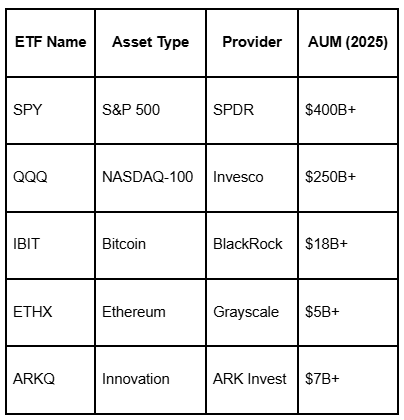
šŸ“ˆ Popular ETF Stocks in 2025

Here’s a list of top-performing ETF stocks across traditional and crypto sectors:

🧠 Final Thoughts

ETF stocks are a powerful investment tool in 2025, offering instant diversification, low fees, and easy access to traditional and crypto markets. Whether you're looking to build a retirement portfolio or ride the next Bitcoin rally, ETF stocks make it easier than ever to invest with confidence.

And with platforms like Token Metrics, you don’t need to guess your way through ETF trading. Use AI-driven insights, price predictions, and real-time data to get ahead of the curve—no matter what markets you trade.

Crypto Basics

What Is an ETF in Crypto? A Complete Guide for Crypto Investors in 2025

Token Metrics Team
8 min
MIN

The world of crypto investing is expanding at lightning speed. With growing institutional adoption and mainstream interest, new financial instruments are emerging to make crypto more accessible to everyday investors. One of the most impactful of these tools is the Exchange-Traded Fund (ETF) — and in 2025, crypto ETFs are playing a crucial role in shaping the future of digital asset investing.

šŸ“Š What Is an ETF?

An ETF (Exchange-Traded Fund) is a type of investment fund traded on traditional stock exchanges, just like individual stocks. ETFs hold a basket of assets such as stocks, bonds, commodities—or, in this case, cryptocurrencies.

When you buy shares of an ETF, you’re investing in a diversified portfolio managed by an institution. Instead of buying each asset individually, ETFs let you gain exposure to a group of assets through a single security.

šŸŖ™ What Is a Crypto ETF?

A crypto ETF is a special type of ETF that tracks the price of one or more cryptocurrencies, such as Bitcoin, Ethereum, or a basket of altcoins. These ETFs allow investors to gain exposure to crypto markets without needing to buy, store, or manage digital assets directly.

Crypto ETFs are listed on traditional financial exchanges (like Nasdaq or NYSE) and can be purchased via brokerage accounts—making them ideal for both institutional investors and crypto-curious retail traders.

šŸ” Types of Crypto ETFs

There are two main categories of crypto ETFs:

1. Spot Crypto ETFs

  • Directly hold the underlying cryptocurrency (e.g., Bitcoin, Ethereum).
  • Track the real-time price of the asset.
  • Considered the most accurate and direct method of gaining crypto exposure.
  • Example: BlackRock’s iShares Bitcoin Trust.

2. Futures-Based Crypto ETFs

  • Do not hold actual cryptocurrency.
  • Invest in futures contracts that speculate on the asset’s future price.
  • Prone to ā€œtracking errorsā€ and additional management fees.
  • Example: ProShares Bitcoin Strategy ETF (BITO).

In 2025, spot ETFs have become more popular, especially after multiple approvals in major markets like the U.S., Canada, and Hong Kong.

āœ… Benefits of Crypto ETFs

Crypto ETFs offer a range of advantages for investors seeking exposure to digital assets without managing crypto wallets or private keys.

1. Accessibility

  • Trade crypto exposure from a traditional brokerage account.
  • No need for crypto exchanges, wallets, or DeFi protocols.

2. Regulation and Security

  • Managed by licensed institutions and regulated by bodies like the SEC.
  • Custody solutions are handled by professionals (e.g., Coinbase Custody, Fidelity Digital).

3. Diversification

  • Some ETFs offer exposure to a basket of cryptocurrencies, reducing risk.
  • Others may focus on specific sectors like DeFi or metaverse tokens.

4. Tax and Retirement Account Eligibility

  • Can be included in IRAs, 401(k)s, and tax-advantaged portfolios in some jurisdictions.

āš ļø Risks of Crypto ETFs

While crypto ETFs simplify access, they are not risk-free.

1. Management Fees

  • ETFs charge annual fees (0.20%–1.00%), which can affect long-term gains.

2. Lack of Full Ownership

  • You don’t hold the actual coins, so you can’t use them for staking, yield farming, or DeFi.

3. Volatility

  • Crypto markets are still highly volatile. ETF prices can fluctuate rapidly.

4. Tracking Errors (Futures ETFs)

  • Futures-based ETFs often lag behind the spot price of the cryptocurrency.

šŸ’” Why Crypto ETFs Matter in 2025

The launch and adoption of crypto ETFs signal mainstream validation of the crypto market.

  • Over $60 billion has poured into Bitcoin and Ethereum ETFs since early 2024.
  • Institutional players like BlackRock, Fidelity, and ARK Invest are leading issuers.
  • Spot Bitcoin ETFs helped propel BTC above $118,000 in July 2025.
  • Regulatory green lights from the SEC, MAS, and other regulators mark a shift in global crypto policy.

Crypto ETFs reduce barriers to entry and give traditional investors a safe, regulated way to participate in the digital economy.

šŸ¤– How Token Metrics Helps You Analyze Crypto ETF Trends

As ETFs drive price action, tools like Token Metrics give you an edge by turning market noise into actionable intelligence.

šŸ”¹ Real-Time Bullish/Bearish Signals

Token Metrics' AI algorithm scans exchange inflows, ETF data, and sentiment to issue buy/sell signals for major cryptocurrencies like Bitcoin, Ethereum, XRP, and more.

šŸ”¹ Institutional Flow Tracking

Track ETF fund flows to understand where institutions are allocating capital—key for timing your own entries and exits.

šŸ”¹ Price Predictions and Trend Grades

AI-generated price predictions, trader grades, and investor scores help you assess risk before investing in ETF-driven rallies.

šŸ”¹ Portfolio Tracking

Token Metrics syncs with your wallet or brokerage to track crypto ETF exposure alongside your on-chain tokens.

By using Token Metrics, you’re not just following ETF trends—you’re staying ahead of them.

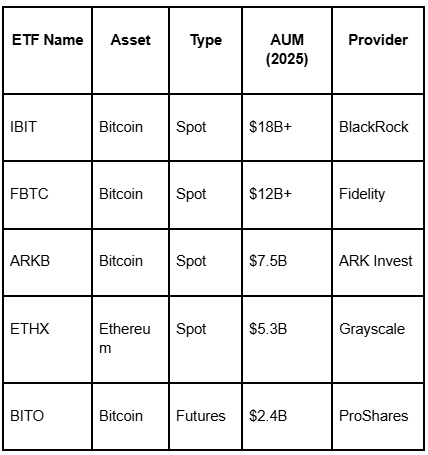
šŸ”„ Popular Crypto ETFs in 2025

Here are some of the top-performing crypto ETFs currently available:

These ETFs are helping investors tap into the gains of crypto markets—without the complexity.

🧠 Final Thoughts

Crypto ETFs represent a pivotal shift in how digital assets are being embraced in traditional finance. They offer accessibility, regulatory clarity, and simplified crypto exposure for everyone from hedge funds to retail investors.

But smart investing goes beyond headlines. Platforms like Token Metrics help you:

  • Time entries and exits with AI-powered signals

  • Track ETF fund flows to gauge institutional momentum

  • Build conviction using on-chain data and predictive analytics

In 2025 and beyond, the winning strategy is clear: combine the safety of ETFs with the intelligence of Token Metrics.

Crypto Basics

What Is ETF Trading? A Beginner’s Guide to Exchange-Traded Funds in 2025

Token Metrics Team
8 min
MIN

In today’s fast-paced financial markets, ETF trading has become one of the most popular and accessible investment strategies. Whether you're a traditional investor or a crypto enthusiast, understanding how ETF trading works can help you make smarter, more diversified investment decisions.

šŸ“ˆ What Is an ETF?

An ETF (Exchange-Traded Fund) is an investment fund that trades on stock exchanges, similar to individual stocks. Each ETF holds a collection of assets, such as:

  • Stocks (like the S&P 500)
  • Bonds
  • Commodities (like gold or oil)
  • Currencies
  • Cryptocurrencies (Bitcoin, Ethereum, etc.)

When you buy a share of an ETF, you're buying a fractional interest in the entire basket of assets. This makes ETFs a powerful tool for diversification, even for beginners.

šŸ’¹ What Is ETF Trading?

ETF trading refers to the buying and selling of ETF shares on an exchange—just like you would with Apple or Tesla stock. The value of an ETF changes throughout the trading day, based on the underlying value of its assets.

ETF trading is commonly used for:

  • Portfolio diversification
  • Hedging strategies
  • Thematic investing (e.g., AI, clean energy, DeFi)
  • Speculating on short-term price movements

You can trade ETFs via your online brokerage, investment app, or even through certain retirement accounts (like IRAs).

šŸ”„ How Does ETF Trading Work?

Here’s a simplified version of how ETF trading works:

  1. ETF Provider Creates the Fund
    A company like BlackRock or Fidelity creates an ETF that holds a specific basket of assets.

  2. ETF Listed on an Exchange
    The ETF is listed on public stock exchanges such as the NYSE or Nasdaq.

  3. Investors Buy and Sell Shares
    Investors trade ETF shares just like stocks—prices fluctuate throughout the day.

  4. Market Makers Maintain Liquidity
    Authorized participants ensure ETF prices closely match the value of the underlying assets (called the Net Asset Value or NAV).

šŸŖ™ What About Crypto ETFs?

In 2025, crypto ETFs have emerged as one of the fastest-growing segments of the ETF market.

Crypto ETFs allow investors to gain exposure to cryptocurrencies without owning the actual coins. These ETFs are regulated, secure, and accessible through traditional finance platforms.

There are two types:

  • Spot Crypto ETFs (hold actual crypto assets like Bitcoin or Ethereum)
  • Futures Crypto ETFs (track the price of crypto futures contracts)

Example: BlackRock’s iShares Bitcoin Trust (IBIT) is a spot Bitcoin ETF with billions in assets under management (AUM) in 2025.

āœ… Benefits of ETF Trading

ETF trading offers unique advantages for both retail and institutional investors:

1. Diversification

Instead of buying dozens of individual stocks, ETFs offer broad exposure to sectors, themes, or markets in a single trade.

2. Liquidity

ETFs trade like stocks—buy or sell at any time during market hours. This makes them more flexible than traditional mutual funds.

3. Cost Efficiency

Many ETFs have low expense ratios, often under 0.25%. You avoid the high fees associated with actively managed funds.

4. Accessibility

Trade ETFs using any brokerage account. You don’t need to be an accredited investor or a crypto expert.

5. Tax Advantages

ETFs are generally more tax-efficient than mutual funds due to the in-kind creation/redemption process.

āš ļø Risks of ETF Trading

ETF trading, like all investing, carries risks:

1. Market Risk

ETF prices can go up or down depending on market conditions.

2. Liquidity Risk

Not all ETFs are highly traded. Low volume can lead to wide bid/ask spreads and slippage.

3. Tracking Error

Some ETFs fail to perfectly mirror their benchmark, especially futures-based crypto ETFs.

4. Sector Risk

Thematic ETFs (e.g., blockchain, AI) can be highly concentrated and volatile.

🧠 How Token Metrics Enhances ETF Trading with AI

Whether you're trading traditional ETFs or crypto-focused ones, Token Metrics provides AI-powered tools to help you trade with confidence.

šŸ” 1. Real-Time Signals

Token Metrics offers AI-generated bullish/bearish signals for Bitcoin, Ethereum, and other assets—helping you identify the best time to enter or exit.

šŸ“Š 2. Price Predictions

The platform generates short- and long-term price forecasts, using 80+ data points. This can help you anticipate ETF price movements, especially for crypto ETFs.

šŸ“ˆ 3. On-Chain Data + ETF Flows

Token Metrics tracks exchange reserves, ETF inflows, and blockchain metrics—giving traders a unique edge not available on traditional brokerage platforms.

šŸ“£ 4. Alerts and Custom Grades

Set up alerts based on trader grades, investor grades, and signal changes to react to market moves instantly.

šŸ”„ Example: Trading Bitcoin ETFs Using Token Metrics

Let’s say you want to trade the BlackRock Bitcoin ETF in July 2025. Here’s how Token Metrics can help:

  • AI signaled bullish BTC trend on June 28
  • Price surged from $106,000 to $118,000
  • ETF inflows increase as institutional demand grows
  • You receive a buy alert from Token Metrics
  • You enter the ETF early and ride the momentum

This combination of real-time AI alerts + institutional trend analysis gives you a significant advantage over traditional investors.

🧭 Final Thoughts

ETF trading has changed the game for investors. Whether you're looking to diversify your portfolio, gain exposure to crypto, or automate your trading strategy—ETFs provide a flexible, affordable, and efficient solution.

And in 2025, combining ETF trading with Token Metrics' AI-powered platform is one of the smartest ways to stay ahead.

With features like real-time signals, crypto ETF tracking, price predictions, and custom alerts, Token Metrics transforms how you approach modern ETF markets.

Choose from Platinum, Gold, and Silver packages
Reach with 25–30% open rates and 0.5–1% CTR
Craft your own custom ad—from banners to tailored copy
Perfect for Crypto Exchanges, SaaS Tools, DeFi, and AI Products