Back to blog
Crypto Basics

Avalanche (AVAX) Price Prediction 2025, 2030 - Forecast Analysis

Delve into a detailed analysis of Avalanche (AVAX) price predictions and forecasts for 2025 and 2030 to make informed investment decisions.
S. Vishwa
7 Minutes
Want Smarter Crypto Picks—Free?
See unbiased Token Metrics Ratings for BTC, ETH, and top alts.
Thank you! Your submission has been received!
Oops! Something went wrong while submitting the form.
 No credit card | 1-click unsubscribe

Click here to buy Cryptocurrencies from Gate.io

In the ever-evolving world of cryptocurrencies, Avalanche (AVAX) has emerged as a prominent player. With its unique algorithm and features, AVAX has gained popularity among investors and traders alike. 

Many people are now wondering what the future holds for Avalanche and whether its price will continue to rise. 

In this article, we will delve into the various factors that can influence the price of AVAX and provide a comprehensive analysis of its price prediction for the coming years.

Avalanche (AVAX) Overview

Before we dive into the price prediction, let's take a moment to understand what Avalanche is all about. Avalanche is a decentralized smart contract platform that aims to be fast, affordable, and eco-friendly.

It utilizes a native utility token called AVAX, which serves as the primary medium of exchange within the ecosystem. The maximum supply of AVAX is capped at 720 million, with 360 million initially minted and sold through private and public sales. The remaining 360 million tokens are distributed as staking rewards over time.

Avalanche stands out from other blockchain networks due to its heterogeneous network of blockchains and validator sets. It uses a proof-of-stake (PoS) consensus mechanism, assisted by the unique Avalanche consensus protocol. 

This protocol provides a scalable and secure environment for transactions, smart contracts, and network administration.

Historical Performance of Avalanche (AVAX)

To gain insights into the potential future price movements of AVAX, it is crucial to analyze its historical data. Over the past year, AVAX has experienced both bullish and bearish trends.

AVAX Tokenomics
Start Your Free Trial Today and Uncover Your Token's Price Prediction and Forecast on Token Metrics.

Starting from October 2022, the price of AVAX gradually declined, reaching a low of around $8.9, and it rebounded briefly in the few trading sessions in the last one year, touching a peak resistance at $21.51 at the beginning of 2023. Currently trading around $17.8

Avalanche (AVAX) Current Fundamentals

Before making any price predictions, it is essential to consider the current fundamentals of Avalanche. As of now, the price of AVAX stands at $17.8 with a market cap of $6,333,154,506. 

The latest trading price for AVAX is $17.8, and the AVAX market is displaying a Fear & Greed Index of 65 (Greed). Over the past 30 days, AVAX has experienced 18 green days out of 30, indicating a positive trend. The volatility of AVAX is currently at 8.43%.

Avalanche (AVAX) Price Prediction - Scenario Analysis

To make accurate price predictions, it is crucial to consider different scenarios that can impact AVAX's price. Let's analyze two scenarios - a bullish and a bearish- to understand the potential price movements of AVAX better.

AVAX Price Prediction - Bullish Scenario

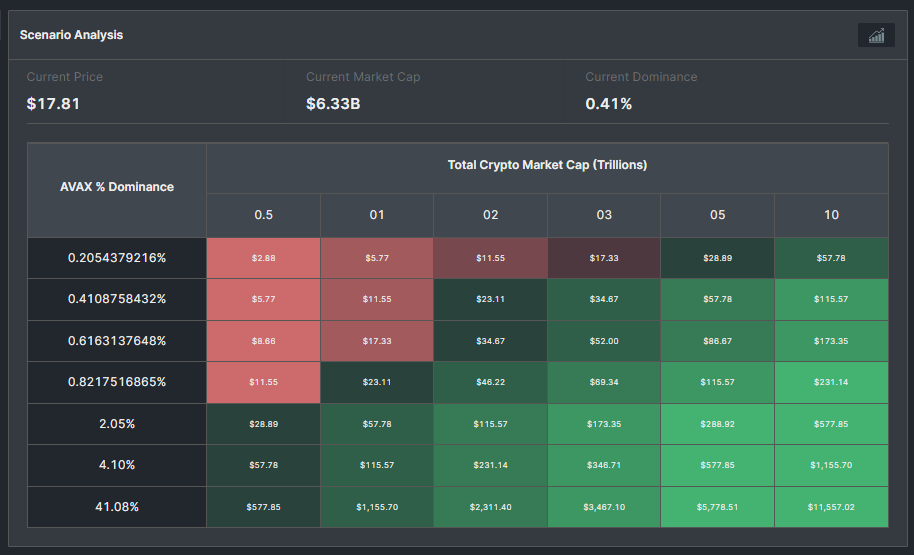
If the crypto market cap hits $3 Trillion, and if AVAX retains its current 0.41% dominance, its price could ascend to $34.67

In a more bullish scenario of the crypto market surging to $10 Trillion, AVAX's price could soar to a staggering $115.57, resulting in a potential 7x return for investors.
AVAX Price Prediction
Start Your Free Trial Today and Uncover Your Token's Price Prediction and Forecast on Token Metrics.

AVAX Price Prediction - Bearish Scenario

In a bearish scenario, where market conditions are unfavorable or there is increased competition, the price of AVAX may face downward pressure with a decreased dominance of 0.20%. 

In this scenario, If the crypto market cap hits $3 Trillion, AVAX could trade around $17.33 in the short term and struggle to surpass $57.78 by 2030 even if the total crypto market cap surpasses the $10 Trillion mark.

It is essential to note that these scenarios are speculative and should not be considered financial advice. The cryptocurrency market is highly volatile, and prices can fluctuate rapidly.

Click here to buy Cryptocurrencies from Gate.io

Avalanche (AVAX) Price Prediction - Industry Expert Opinion

To gain further insights into AVAX's future price movements, it is essential to consider the opinions of industry experts. While price predictions can vary, many experts believe that AVAX has the potential for significant growth in the coming years. 

Coincodex.com platform predicts Avalanche (AVAX) could reach $ 63.40 to $ 80.24 by 2030, and experts from Changelly forecast that it could reach minimum and maximum prices of $30.04 and $34.85 by the end of 2025. By the end of 2030, the price of AVAX could reach $185.25 to $221.39

Other industry analysts have varying opinions on the future price of AVAX. Ambcrypto.com predicts that Avalanche (AVAX) could reach $28.15 to $42.23 in 2030. 

This long-term projection and an optimistic outlook are based on the belief that AVAX's ongoing developments and growing adoption will drive its value.

Note - Start Your Free Trial Today and Uncover Your Token's Price Prediction and Forecast on Token Metrics.

Is Avalanche (AVAX) Good to Invest?

Investing in cryptocurrency carries certain risks, including market volatility and regulatory uncertainty. However, many investors see potential in Avalanche due to its unique features, fast transaction speed, and the growing popularity of decentralized finance (DeFi) applications. 

Before making any investment decisions, conducting thorough research, assessing your risk tolerance, and consulting with a financial advisor are crucial.

Risks and Rewards

As with any investment, risks and rewards are associated with investing in AVAX. The rewards of investing in AVAX include the potential for significant price appreciation, especially if the platform continues to gain adoption and attract more users. 

Additionally, AVAX holders can earn staking rewards by participating in the network's proof-of-stake consensus mechanism.

However, it's important to note that investing in AVAX also carries risks. The cryptocurrency market is highly volatile, and AVAX's price can fluctuate quickly. 

Regulatory changes, security breaches, and market sentiment can all impact AVAX's price. It's crucial to carefully assess these risks before making any investment decisions.

Ongoing Developments and Future Potential of Avalanche

Avalanche has been making significant strides in terms of development and partnerships. The platform has attracted several high-profile projects and collaborations, contributing to its growing ecosystem. 

Ongoing developments, such as upgrades to the network and the introduction of new features, can further enhance the functionality and appeal of Avalanche.

Additionally, Avalanche's focus on scalability, affordability, and eco-friendliness positions it well to capitalize on the growing demand for decentralized applications and the broader adoption of blockchain technology. As the cryptocurrency market continues to evolve, Avalanche's potential for future growth remains promising.

Conclusion

In conclusion, Avalanche (AVAX) has shown strong potential as a decentralized smart contract platform. While price predictions can vary, it's clear that AVAX has the potential for significant growth in the coming years. 

Investors should carefully consider the risks and rewards of investing in AVAX and conduct thorough research before making investment decisions. As with any investment, it's important to stay informed, diversify your portfolio, and consult with a financial advisor.

Frequently Asked Questions

Q1. How much will AVAX be worth in the future?

AVAX's future value will depend on market trends, adoption rates, technological developments, and overall crypto market health. In a bullish scenario of the total crypto market surging to $10 Trillion, AVAX's price could soar to a staggering $115.57.

Q2. What will Avalanche be worth in 2030?

Predicting Avalanche's 2030 value is speculative. The long-term price depends on adoption, tech innovation, and crypto ecosystem changes. Changelly forecast that, by the end of 2030, the price of AVAX could reach $185.25 to $221.39

Q3. Why is AVAX dropping?

AVAX may drop due to market volatility, negative news of recent security breaches, sell-offs, or broader economic factors impacting the cryptocurrency markets.

Q4. Is AVAX a good project?

Many consider AVAX a good project due to its fast transaction speeds, low fees, and eco-friendly proof-of-stake consensus mechanism.

Q5. What factors can affect the price of AVAX?

AVAX's price is influenced by market sentiment, adoption rates, network upgrades, regulatory news, and the performance of decentralized applications on its platform.

Q6. How can I analyze Avalanche price movements?

Analyzing Avalanche (AVAX) price movements and studying market trends is simple. You can check the Token Metrics platform for all the data, bullish and bearish trends, project tokenomics, and short-term price predictions, all in one place.

Q7. What do industry experts say about AVAX's future?

Industry experts are optimistic about AVAX's future, citing its strong development team, innovative technology, and growing ecosystem of applications.

Disclaimer

The information provided on this website does not constitute investment advice, financial advice, trading advice, or any other advice, and you should not treat any of the website's content as such.

Token Metrics does not recommend that any cryptocurrency should be bought, sold, or held by you. Conduct your due diligence and consult your financial advisor before making investment decisions.

Click here to buy Cryptocurrencies from Gate.io

Build Smarter Crypto Apps &
AI Agents in Minutes, Not Months
Real-time prices, trading signals, and on-chain insights all from one powerful API.
Grab a Free API Key
About Token Metrics
Token Metrics: AI-powered crypto research and ratings platform. We help investors make smarter decisions with unbiased Token Metrics Ratings, on-chain analytics, and editor-curated “Top 10” guides. Our platform distills thousands of data points into clear scores, trends, and alerts you can act on.
30 Employees
analysts, data scientists, and crypto engineers
Daily Briefings
concise market insights and “Top Picks”
Transparent & Compliant
Sponsored ≠ Ratings; research remains independent
Want Smarter Crypto Picks—Free?
See unbiased Token Metrics Ratings for BTC, ETH, and top alts.
Thank you! Your submission has been received!
Oops! Something went wrong while submitting the form.
 No credit card | 1-click unsubscribe
Token Metrics Team
Token Metrics Team

Recent Posts

Research

What Are Indices in Trading? A Complete Guide for 2025

Token Metrics Team
8

You've probably seen professional investors discuss tracking entire markets or specific sectors without the need to purchase countless individual assets. The concept behind this is indices—powerful tools that offer a broad yet targeted market view. In 2025, indices have advanced from simple benchmarks to sophisticated investment vehicles capable of adapting dynamically to market conditions, especially in the evolving crypto landscape.

What Is a Trading Index?

A trading index, also known as a market index, is a statistical measure that tracks the performance of a selected group of assets. Think of it as a basket containing multiple securities, weighted according to specific rules, designed to represent a particular segment of the market or a strategy. Indices serve as benchmarks allowing investors to:

Unlike individual stocks or cryptocurrencies, indices themselves are not directly tradable assets. Instead, they are measurement tools that financial products like index funds, ETFs, or crypto indices replicate to provide easier access to markets.

How Traditional Stock Market Indices Work

Famous indices such as the S&P 500, Dow Jones Industrial Average, and Nasdaq Composite each follow particular methodologies for selecting and weighting their constituent assets.

Indices typically undergo periodic rebalancing—quarterly, annually, or based on specific triggers—to keep their composition aligned with their intended strategy as markets evolve.

The Evolution: Crypto Indices in 2025

The crypto market has adapted and innovated on traditional index concepts. Crypto indices track baskets of digital assets, offering exposure to broad markets or specific sectors like DeFi, Layer-1 protocols, or metaverse tokens.

What sets crypto indices apart in 2025 is their ability to operate transparently on-chain. Unlike traditional indices that can lag in updates, crypto indices can rebalance frequently—sometimes even weekly—and display current holdings and transactions in real-time.

A typical crypto index might track the top 100 cryptocurrencies by market cap, automatically updating rankings and weights, thus addressing the challenge of rapid narrative shifts and asset rotations common in crypto markets. They encourage owning diversified baskets to mitigate risks associated with individual coin failures or narrative collapses.

Why Indices Beat Individual Asset Picking

Research suggests that over 80% of active fund managers underperform their benchmarks over a decade. For individual investors, beating the market is even more challenging. Indices eliminate the need for exhaustive research, constant monitoring, and managing numerous assets, saving time while offering broad market exposure.

The Challenge of Traditional Buy-and-Hold Indices

Passive indices face a drawback: they remain fully invested during both bull and bear markets. When markets decline sharply, so do index values, which may not align with investors seeking downside protection.

This led to the development of active or regulated strategies that adjust exposure based on market regimes, blending diversification with risk management.

Introducing Regime-Switching Index Strategies

Regime-switching indices dynamically alter their asset allocations depending on market conditions. They identify different regimes—bullish or bearish—and adjust holdings accordingly:

This sophisticated approach combines the benefits of broad index exposure with downside risk mitigation, offering a more adaptable investment strategy.

How TM Global 100 Revolutionizes Crypto Index Investing

The TM Global 100 index from Token Metrics exemplifies advanced index strategies tailored for crypto in 2025. It is a rules-based, systematic index that tracks the top 100 cryptocurrencies by market cap during bullish phases, and automatically shifts fully to stablecoins in bearish conditions.

This index maintains weekly rebalancing, full transparency, and easy access via one-click purchase through a secure, self-custodial wallet. The rules are transparent, and the index adapts swiftly to market changes, reducing operational complexity and risk.

Designed for both passive and active traders, it offers broad exposure, risk management, and operational simplicity—perfect for those seeking disciplined yet flexible crypto exposure.

Benefits of Index Trading vs. DIY Portfolio Management

Types of Trading Indices Explained

How to Evaluate a Trading Index

When considering an index, focus on these aspects:

Common Questions About Index Trading

Can I beat index returns with individual picks? Most individual investors struggle to beat benchmarks after costs and taxes, especially without significant resources.

Do indices work in crypto markets? Yes, and with certain advantages such as on-chain transparency and continuous trading, which facilitate active, rules-based strategies.

How is an index different from an ETF? An index is an underlying measurement or structured basket, while an ETF is an investment product tracking that index, often tradable like a stock.

How often do indices rebalance? In crypto, weekly or even daily rebalancing is common to keep pace with rapid market changes.

Are regime-switching indices market timing? They execute systematic, rules-based strategy adjustments based on signals—providing a form of automated market timing, not discretionary guesses.

Is Index Trading Right for You?

Consider index trading if you want broad exposure without constant oversight, value systematic strategies, prefer transparency, and aim to reduce operational complexity in your investments. Active traders with a focus on disciplined core positions also benefit from these tools, especially in volatile markets like crypto.

Alternatively, individual asset selection may suit those with proprietary research, active management interests, or a willingness to accept higher risk for potential outsized returns.

Getting Started with TM Global 100

If you're ready for next-generation crypto index investing:

The embedded smart wallet app allows you to control your funds while enjoying seamless execution, with all fees and holdings transparently displayed before confirmation—most users complete the process swiftly.

Security and Risk Considerations

The Future of Index Trading

Technological advances, particularly on-chain programmability, are transforming index trading. Instant rebalancing, full transparency, automated risk management, and programmable strategies are empowering investors with tools previously limited to institutional players. In 2025, indices will not just passively track markets but actively manage risk, rotate assets, and adapt swiftly—making sophisticated strategies accessible to everyone.

Discover crypto gems with Token Metrics AI

Conclusion

Trading indices are invaluable for diversifying market exposure efficiently and systematically. Whether traditional stock indices or innovative crypto solutions like TM Global 100, these instruments democratize access to complex strategies, saving time and reducing operational hurdles. The progression toward active, regime-switching indices exemplifies the ongoing innovation in this space—aimed at balancing upside potential with downside protection. The TM Global 100 index exemplifies this trend by offering broad crypto exposure combined with automatic risk mitigation, transparency, and ease of access—making it a compelling tool for 2025 and beyond.

Click here to get early access to TM100 indices at Token Metrics.

Disclaimer

This article is for educational and research purposes only. It does not constitute financial advice. Crypto markets carry inherent risks, including significant volatility. Always conduct your own thorough research and consult with a financial advisor before investing.

Research

How to Trade Crypto Indices: Modern Guide for 2025

Token Metrics Team
5

The crypto market has evolved beyond Bitcoin and Ethereum trading. Crypto indices now offer diversified exposure to digital assets with automated rebalancing and regime-switching capabilities. This guide shows you exactly how to trade crypto indices in 2025, from traditional approaches to cutting-edge adaptive strategies.

Why Trade Crypto Indices Instead of Individual Coins?

Speed and uncertainty define the current crypto cycle. Narratives rotate in weeks, not months. DeFi dominated 2020, NFTs exploded in 2021, Layer-2 scaling drove 2022-2023, and AI tokens surged in 2024-2025.

Individual coin risk can swamp portfolios: LUNA collapsed from $80 to pennies in days, FTX token fell from $25 to near-zero overnight, and countless altcoins disappear each cycle.

Crypto indices solve these problems by providing: exposure to 10, 50, or 100 tokens simultaneously, automatic rebalancing as new tokens emerge, professional execution that minimizes slippage, transparent holdings and transaction logs. Some offer defensive moves to stablecoins during bear markets.

Types of Crypto Indices You Can Trade

Broad Market Indices

Track the overall crypto ecosystem: Top 10 Indices, Bitcoin and Ethereum typically 60-80% of weight. Includes major altcoins like BNB, Solana, XRP. Usually lower volatility than smaller-cap indices. Suitable for conservative crypto exposure.

Top 50 or Top 100 Indices

Broader diversification across market segments, capturing emerging narratives earlier. Higher volatility but more upside potential. Better representation of the total crypto market.

Sector-Specific Indices

Focus on crypto categories such as DeFi, Layer-1 blockchains, or Metaverse tokens. DeFi includes Uniswap, Aave, and Compound, benefitting from adoption growth. Layer-1 indices feature Ethereum, Solana, Avalanche, and Cardano, often with higher beta. Metaverse and Gaming indices include Decentraland, Sandbox, and Axie Infinity, offering high growth but higher risk.

Smart Beta Crypto Indices

Apply quantitative strategies like momentum or low volatility. Momentum indices own top-performing tokens and rebalance frequently, while low volatility indices focus on stablecoins and well-established tokens for steadier performance.

Regime-Switching Indices

Hold crypto during bull markets and switch to stablecoins during downturns to capture upside and limit downside. These indices typically rebalance weekly or monthly.

How to Trade Crypto Indices: Complete Process

Step 1: Choose Your Trading Platform

DeFi Protocols

Centralized Platforms

Step 2: Set Up Your Wallet

For DeFi Platforms:

Setup process includes: Downloading or creating a wallet, securely recording seed phrases, funding with ETH or USDC.

For platforms with embedded wallets: Sign up for an account; wallets are created automatically during transactions, streamlining entry but with less control over seed phrases.

Step 3: Fund Your Account

If you lack crypto:

Funding advice: Minimum of $100-$500 for DeFi indices, with $500-$1,000 being typical. Consider gas fees, which can range from $10-$50 on Ethereum.

Step 4: Research Your Index

Prior to investing, review:

Step 5: Execute Your First Trade

For DeFi platforms:

For centralized platforms:

Step 6: Monitor Your Position

What to track:

Step 7: Rebalancing and Maintenance

Automatic rebalancing is common in most indices via smart contracts or scheduled execution. Manual adjustments depend on personal strategies, like taking profits or adding principal during dips.

Advanced traders might employ core-satellite strategies or tactical sector rotation based on market conditions. Managing risk involves position sizing, stop-loss orders, diversification, and understanding tax implications.

Common Mistakes When Trading Crypto Indices

The Bottom Line

Trading crypto indices in 2025 offers diversified digital asset exposure without the complexity of managing dozens of individual tokens. Whether you choose broad market indices through DeFi protocols or regime-switching adaptive strategies through platforms like Token Metrics, the key is understanding your risk tolerance, managing costs, and maintaining discipline through volatile market cycles.

Start with a broad market index or a regime-switching option that automatically manages risk, allocate only capital you can afford to lose, and think in cycles rather than days or weeks. The crypto market moves fast, but patient index traders consistently outperform those chasing individual coin pumps.

Ready to explore crypto indices? Visit tokenmetrics.com/indices to see the TM Global 100 regime-switching index with transparent holdings, automated rebalancing, and embedded wallet solutions designed for the speed of modern crypto markets.

Click here to get early access to TM100 indices at Token Metrics.

Research

What Is Indices Trading? A Complete Beginner's Guide (2025)

Token Metrics Team
6

Have you ever considered trading the entire market in a single move, rather than picking individual stocks or cryptocurrencies? That approach is the core idea behind indices trading, offering a way to gain broad exposure with a single position. Whether you're tracking major stock indices like the S&P 500, regional benchmarks like the FTSE 100, or emerging crypto indices such as the TM Global 100, indices provide diversified exposure to multiple assets efficiently.

What Is Indices Trading? (The Basics)

Indices trading involves buying or selling financial instruments that track the performance of a specific group of assets. These assets might include stocks, cryptocurrencies, or other digital assets. Instead of owning individual assets directly, traders use derivatives or funds to replicate index performance.

Key Concepts

The objective? To capture the average performance of a market segment rather than betting on individual assets' success.

How Indices Trading Works

Types of Indices You Can Trade

Benefits of Trading Indices

How to Start Trading Indices

Indices Trading Strategies

Common Mistakes to Avoid

FAQs

What is the difference between an index and an ETF?

An index is a measurement of a market segment (e.g., S&P 500). An ETF is a tradable fund that mirrors an index, allowing you to invest indirectly.

Can you lose money trading indices?

Yes. Indices reflect market performance, and declines in the market can result in losses. Diversification helps manage risk, but doesn't eliminate it.

Are crypto indices safe?

Crypto indices inherently carry market volatility risks. Well-structured, transparent, and rules-based indices can help mitigate risks associated with individual tokens.

How often do indices rebalance?

Traditional indices typically rebalance quarterly or annually. Crypto indices may rebalance weekly or monthly due to faster market changes.

What’s the best index for beginners?

For stocks: S&P 500 ETF (e.g., SPY, VOO). For crypto: broad market-cap indices or regime-switching indices like the TM Global 100 provide dynamic risk management.

Do I need a lot of money to trade indices?

Not necessarily. Many ETFs trade under $500 per share, and fractional shares make it accessible. Crypto index platforms often allow investments starting at $100 or less.

What triggers rebalancing in crypto indices?

Scheduled rebalancing (weekly/monthly) or market signals indicating a regime change, such as switching from bullish to bearish conditions.

Conclusion + Next Steps

Indices trading offers a disciplined, diversified approach to participating in markets without managing individual assets. Whether seeking long-term wealth accumulation or active trading opportunities, indices provide a structured framework grounded in rules and transparency.

Next steps include opening a brokerage account for stock indices or exploring crypto index platforms with features like regime switching and rebalancing. For added downside protection, consider indices like the TM Global 100 that automatically shift assets into stablecoins during downturns.

Discover Crypto Gems with Token Metrics AI

Token Metrics uses AI-powered analysis to help you uncover profitable opportunities in the crypto market. Get Started For Free.

Click here to get early access to TM100 indices at Token Metrics.

Choose from Platinum, Gold, and Silver packages
Reach with 25–30% open rates and 0.5–1% CTR
Craft your own custom ad—from banners to tailored copy
Perfect for Crypto Exchanges, SaaS Tools, DeFi, and AI Products