Back to blog
Research

Best Cross-Chain Bridges for Crypto Traders (2025)

Explore the 10 best cross-chain bridges for traders and DeFi users in 2025, including pros, security features, fees, and use-case checklists. Compare Stargate, Synapse, and more for safe and fast crypto bridging.
Token Metrics Team
20 min read
Want Smarter Crypto Picks—Free?
See unbiased Token Metrics Ratings for BTC, ETH, and top alts.
Thank you! Your submission has been received!
Oops! Something went wrong while submitting the form.
 No credit card | 1-click unsubscribe

Who this guide is for: Traders, DeFi users, and multichain portfolio managers seeking secure, cost-effective ways to move assets across blockchains.

Top three picks:

  • Stargate Finance — deepest liquidity for stablecoin transfers across major EVM chains and non-EVM networks.
  • Synapse Protocol — fastest routes for traders needing sub-5-minute settlements on 20+ chains.
  • Across Protocol — lowest slippage and optimistic bridging for arbitrageurs and high-frequency movers.

Key caveat: Bridge fees vary by route, liquidity depth, and network congestion; always compare quotes and verify destination addresses before confirming transfers.


Introduction: Why Cross-Chain Bridges Matter in 2025

Cross-chain bridges are infrastructure protocols that enable seamless asset transfers between blockchains, solving fragmented liquidity and allowing traders to access opportunities across ecosystems without holding native tokens on every chain. In 2025, with over 100 active Layer 1 and Layer 2 networks, best cross-chain bridges for traders deliver speed, security, and capital efficiency—critical for arbitrage, yield farming, and portfolio rebalancing. This guide evaluates the top 10 cross-chain bridges based on liquidity depth, security architecture, chain coverage, fee transparency, and user experience, helping you select the right solution for your trading strategy.


How We Picked (Methodology & Scoring)

We evaluated 20+ cross-chain bridges using six weighted criteria:

  • Liquidity & Volume (30%) — Daily transfer volume, pool depth, and slippage on major routes
  • Security Architecture (25%) — Validator model, audit history, exploit record, bug bounties
  • Chain Coverage (15%) — Number of supported networks (EVM, non-EVM, L2s)
  • Costs & Fees (15%) — Bridge fees, gas optimization, hidden slippage
  • User Experience (10%) — Interface clarity, transaction speed, wallet integrations
  • Support & Documentation (5%) — Docs quality, status pages, support channels

Data sources: Official protocol documentation, pricing pages, security audit repositories, and status dashboards. Third-party volume data from CoinGecko and DefiLlama used for cross-checks only.

Last updated: November 2025


Best Cross-Chain Bridges in 2025 (Comparison Table)
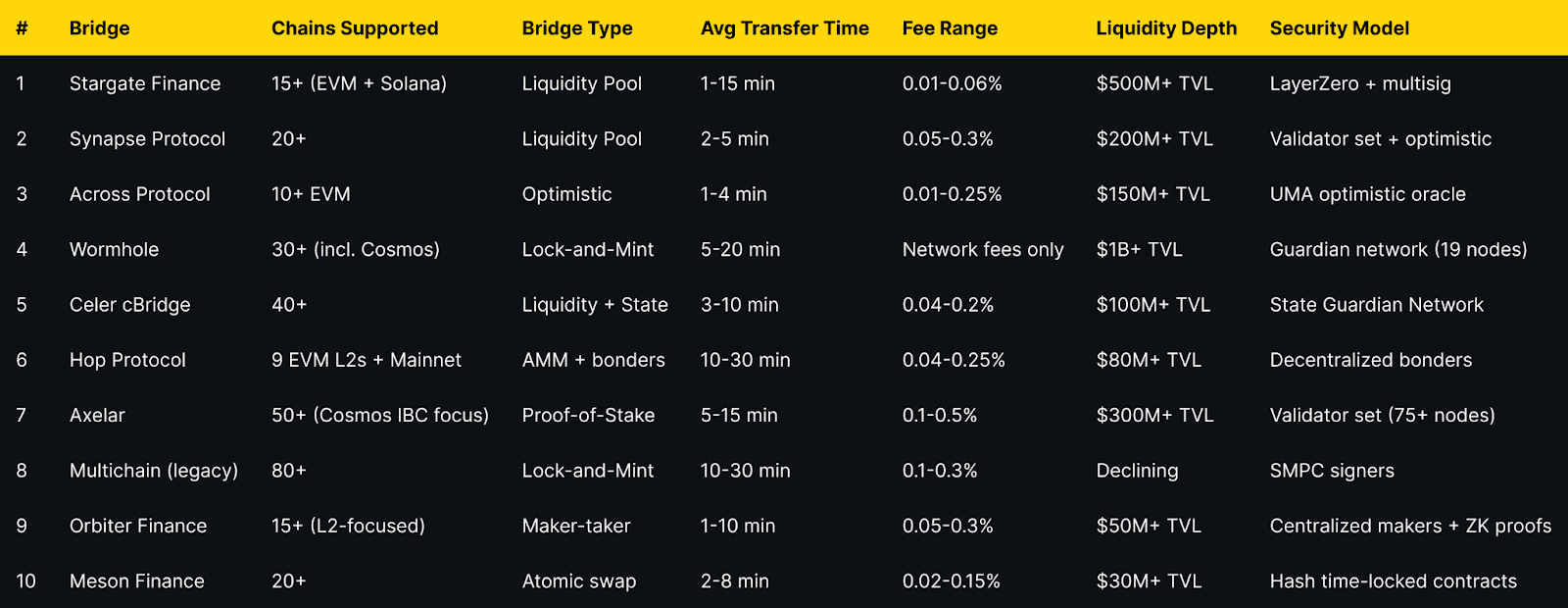
Top 10 Cross-Chain Bridges in 2025

1. Stargate Finance — Best for Stablecoin Transfers

Why Use It: Stargate leverages LayerZero's messaging protocol to offer unified liquidity pools across 15+ chains, ensuring minimal slippage for USDC, USDT, and DAI transfers. Traders benefit from instant guaranteed finality and native asset transfers without wrapped tokens, making it ideal for large stablecoin movements between Ethereum, Arbitrum, Optimism, Polygon, BNB Chain, Avalanche, and Solana.

Best For: DeFi yield farmers, arbitrageurs moving stablecoins, traders rebalancing across chains, institutional desks.

Notable Features:

  • Unified liquidity pools eliminate fragmented routes
  • Delta algorithm prevents pool depletion and maintains balance
  • Native USDC/USDT support on major chains
  • Audited by Quantstamp and Zellic with $25M bug bounty

Consider If: You need to bridge non-stablecoin assets frequently (limited ERC-20 coverage) or require sub-1-minute finality (average 1-15 min).

Alternatives: Synapse Protocol, Across Protocol
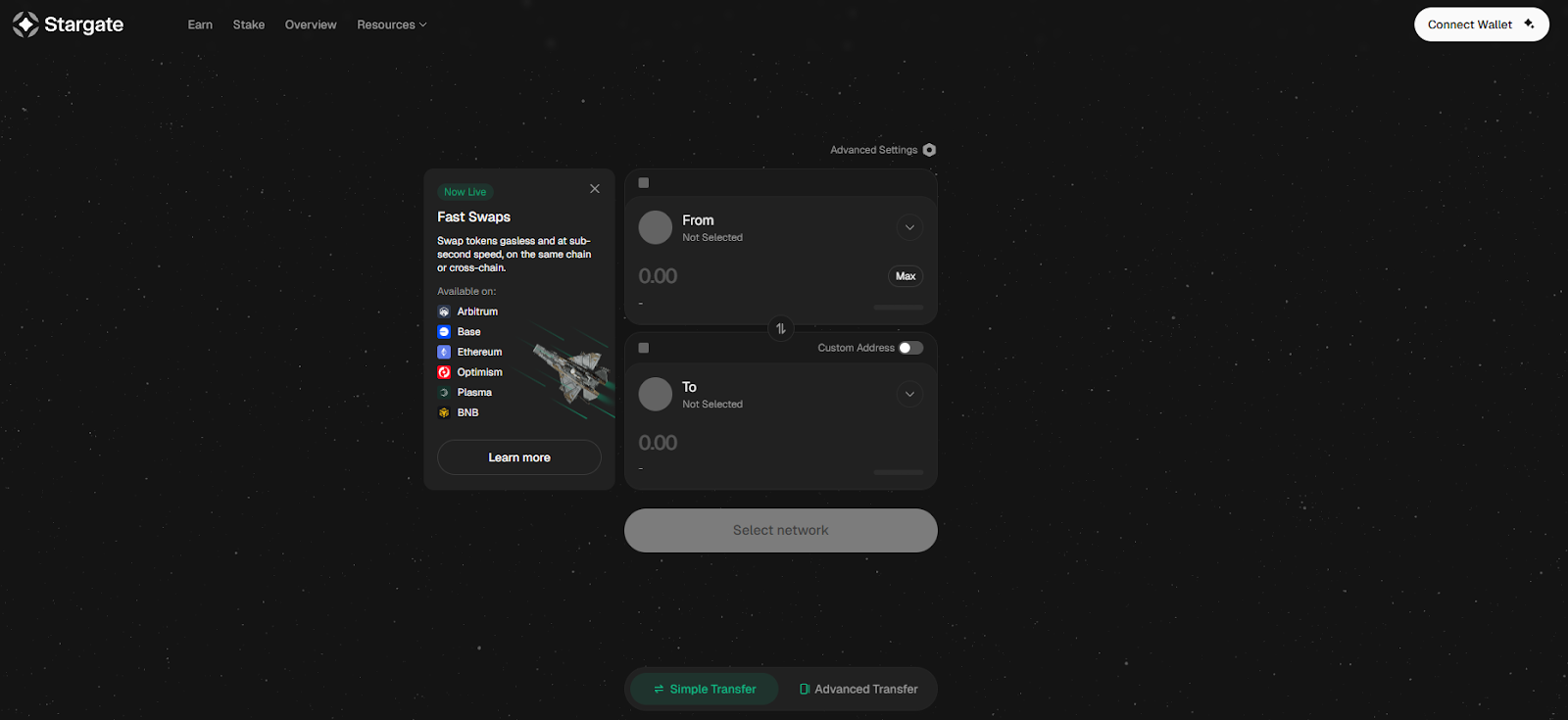

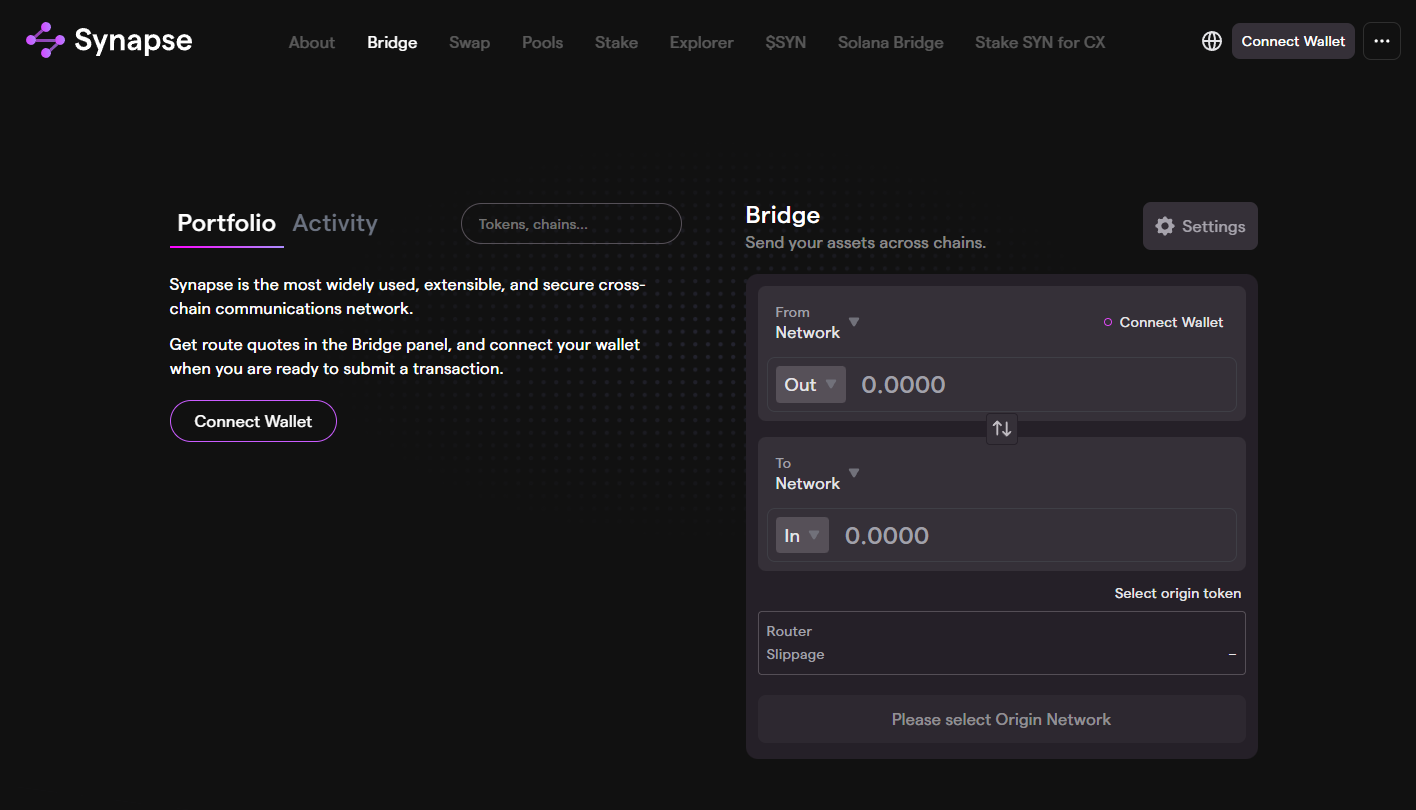
2. Synapse Protocol — Best for Speed Across 20+ Chains

Why Use It: Synapse combines liquidity pools with an optimistic verification model to deliver 2-5 minute average transfer times across 20+ networks, including Ethereum, Arbitrum, Optimism, Base, Polygon, BNB Chain, Avalanche, Fantom, Harmony, Moonbeam, and Aurora. Its nUSD and nETH synthetic assets enable efficient cross-chain swaps with competitive 0.05-0.3% fees, while the Synapse Bridge interface integrates one-click swaps for seamless UX.

Best For: Active traders prioritizing speed, multichain yield optimizers, NFT collectors moving assets, users bridging to emerging L2s.

Notable Features:

  • Sub-5-minute average transfers with optimistic verification
  • 20+ chain support including Base and zkSync Era
  • Integrated DEX for same-transaction swaps
  • Audited by Quantstamp, Certik, and Code4rena

Consider If: You move assets over $100K per transaction (liquidity depth varies by route) or need guaranteed finality before spending (optimistic delays possible).

Alternatives: Stargate Finance, Hop Protocol

3. Across Protocol — Best for Optimistic Bridging & Low Slippage

Why Use It: Across uses UMA's optimistic oracle to facilitate near-instant transfers with relayers fronting capital and settling on the destination chain within 1-4 minutes. Traders enjoy 0.01-0.25% fees—among the lowest for EVM bridges—and minimal slippage on major routes like Ethereum to Arbitrum, Optimism, Polygon, and Base. The protocol's capital efficiency makes it ideal for arbitrageurs and high-frequency movers.

Best For: Arbitrage traders, gas-sensitive users, high-frequency DeFi participants, cost-conscious portfolio managers.

Notable Features:

  • Optimistic verification for 1-4 minute transfers
  • Ultra-low fees (0.01-0.25%) with transparent pricing
  • Relayer network ensures liquidity without pool fragmentation
  • Audited by OpenZeppelin and ABDK with ongoing bug bounty

Consider If: You need non-EVM chain support (currently EVM-only) or prefer liquidity-pool-based bridges for guaranteed execution.

Alternatives: Stargate Finance, Synapse Protocol


4. Wormhole — Best for Cross-Ecosystem Bridging

Why Use It: Wormhole is a generalized messaging protocol supporting 30+ blockchains including Ethereum, Solana, Terra, BNB Chain, Avalanche, Polygon, Fantom, Celo, and Cosmos-based chains. Its Guardian network of 19 validators enables lock-and-mint bridging for tokens and NFTs with no protocol fees beyond network gas costs. The recent Wormhole Connect widget simplifies integrations for traders using multichain dApps.

Best For: Cross-ecosystem traders (EVM to Solana/Cosmos), NFT collectors, developers integrating bridging, users of Wormhole-native dApps.

Notable Features:

  • 30+ chain support including Solana, Terra, and Cosmos IBC
  • Generalized messaging enables cross-chain smart contract calls
  • Guardian network with 19 institutional validators
  • Audited by Neodyme, Kudelski, and OtterSec post-2022 exploit recovery

Consider If: You prioritize speed over security guarantees (5-20 min transfers) or need the deepest liquidity per route (Stargate/Synapse stronger for stables).

Alternatives: Axelar, Celer cBridge


5. Celer cBridge — Best for 40+ Chain Coverage

Why Use It: Celer cBridge supports 40+ blockchains with a hybrid liquidity pool and state channel architecture, enabling 3-10 minute transfers at 0.04-0.2% fees. Its State Guardian Network provides security for cross-chain state verification, while the cBridge UI offers direct wallet integrations and historical transaction tracking. Recent additions include support for zkSync Era, Linea, and Scroll.

Best For: Multichain portfolio managers, traders accessing niche L2s, users bridging to gaming-focused chains, cost-conscious cross-chain swappers.

Notable Features:

  • 40+ chains including zkSync, Linea, Mantle, and Scroll
  • State Guardian Network for optimistic cross-chain verification
  • Integrated liquidity mining for yield on idle bridge assets
  • Audited by Certik, PeckShield, and SlowMist

Consider If: You operate in mainland China (limited access) or need guaranteed sub-5-minute finality (optimistic delays on congested routes).

Alternatives: Synapse Protocol, Axelar


6. Hop Protocol — Best for Ethereum L2 Bridging

Why Use It: Hop specializes in fast transfers between Ethereum mainnet and nine major L2s (Arbitrum, Optimism, Base, Polygon, zkSync Era, Linea, Scroll, Gnosis Chain, and Polygon zkEVM) using AMM-style liquidity pools and decentralized bonders who provide instant liquidity. Traders pay 0.04-0.25% fees and experience 10-30 minute average transfers, with the option to earn yield by providing liquidity or running bonder nodes.

Best For: L2-first traders, Ethereum mainnet to L2 bridgers, liquidity providers, users seeking decentralized bridge architecture.

Notable Features:

  • Native L2 focus with support for 9 Ethereum L2s
  • AMM-based liquidity pools for transparent pricing
  • Decentralized bonder network reduces trust assumptions
  • Audited by Consensys Diligence and OpenZeppelin

Consider If: You need to bridge to non-EVM chains (Ethereum ecosystem only) or require sub-10-minute finality consistently (bonder availability varies).

Alternatives: Synapse Protocol, Across Protocol


7. Axelar — Best for Cosmos & Proof-of-Stake Security

Why Use It: Axelar is a Cosmos SDK-based interoperability network with 75+ validators securing cross-chain transfers via proof-of-stake consensus. Supporting 50+ chains with IBC-native bridging to Cosmos, Osmosis, Injective, and other app-chains, Axelar enables secure general message passing for complex cross-chain dApp interactions at 0.1-0.5% fees. Transfers settle in 5-15 minutes with high finality guarantees.

Best For: Cosmos ecosystem traders, institutional users prioritizing security, developers building cross-chain dApps, users requiring verifiable bridge security.

Notable Features:

  • 75+ decentralized validators with proof-of-stake security
  • Native IBC support for Cosmos ecosystem chains
  • General Message Passing (GMP) for cross-chain smart contracts
  • Audited by NCC Group, OtterSec, and Certik

Consider If: You prioritize speed over security (5-15 min slower than optimistic bridges) or need the lowest fees per transaction (0.1-0.5% higher than Across/Stargate).

Alternatives: Wormhole, Celer cBridge


8. Multichain — Best for 80+ Chain Access (Use With Caution)

Why Use It: Multichain (formerly Anyswap) offers the broadest chain coverage with 80+ supported networks using SMPC (Secure Multi-Party Computation) signers for lock-and-mint bridging. While historically popular for accessing niche chains like Moonriver, Kava, and Metis, the protocol faced security concerns in mid-2023 related to validator key management. Fees range from 0.1-0.3% with 10-30 minute transfer times.

Best For: Users bridging to obscure chains unavailable elsewhere, legacy dApp integrations, traders willing to accept elevated risk for maximum coverage.

Notable Features:

  • 80+ chain support including niche L1s and L2s
  • Long operational history since 2020
  • Cross-chain router for multi-hop transactions
  • SMPC validator network (security incidents reported)

Consider If: Security is your top priority (2023 exploit drained $126M; ongoing validator concerns) or you need active development and transparent disclosures.

Alternatives: Celer cBridge, Axelar


9. Orbiter Finance — Best for L2-to-L2 Transfers

Why Use It: Orbiter uses a maker-taker model where centralized makers provide instant liquidity for L2-to-L2 transfers across 15+ chains including Arbitrum, Optimism, zkSync Era, StarkNet, Linea, Base, and Scroll. Transfers complete in 1-10 minutes at 0.05-0.3% fees, with ZK-proof verification planned for enhanced security. The interface is optimized for mobile and shows real-time maker liquidity status.

Best For: L2-native traders, StarkNet and zkSync users, mobile-first users, traders needing fast L2 exits.

Notable Features:

  • Specialized L2-to-L2 focus with 15+ network support
  • 1-10 minute average transfers via maker liquidity
  • ZK-proof verification roadmap for trustless bridging
  • Real-time liquidity tracking and maker status

Consider If: You prefer fully decentralized bridge models (makers are centralized) or need mainnet-to-L2 bridging exclusively (better alternatives exist).

Alternatives: Hop Protocol, Synapse Protocol


10. Meson Finance — Best for Atomic Swap Security

Why Use It: Meson implements hash time-locked contracts (HTLCs) for trustless atomic swaps across 20+ chains, eliminating validator risk and bridge contract vulnerabilities. Traders benefit from 2-8 minute transfers at 0.02-0.15% fees with cryptographic guarantees that transactions either complete or refund automatically. The protocol is audited by SlowMist and maintains zero-exploit history since launch.

Best For: Security-conscious traders, users burned by bridge exploits, atomic swap enthusiasts, traders moving mid-sized amounts ($1K-$50K).

Notable Features:

  • HTLC-based atomic swaps for trustless bridging
  • Zero-exploit record with cryptographic security guarantees
  • 20+ chain support including major EVM and L2s
  • 0.02-0.15% fees competitive with optimistic bridges

Consider If: You need to bridge large amounts over $100K (liquidity depth limited) or require sub-2-minute finality (HTLC setup adds overhead).

Alternatives: Across Protocol, Stargate Finance


Decision Guide: Best By Use Case

  • Stablecoin arbitrage & DeFi yield: Stargate Finance for deepest USDC/USDT liquidity
  • Fastest cross-chain execution: Synapse Protocol or Across Protocol for sub-5-minute transfers
  • Ethereum L2 specialists: Hop Protocol for native L2 bridging with decentralized bonders
  • Cross-ecosystem traders (EVM + Solana/Cosmos): Wormhole or Axelar for broadest coverage
  • Lowest fees & slippage: Across Protocol for optimistic bridging at 0.01-0.25%
  • Maximum chain coverage: Celer cBridge (40+) or Multichain (80+ with caution)
  • L2-to-L2 focus (zkSync, StarkNet, Arbitrum): Orbiter Finance for maker-taker speed
  • Security-first & trustless: Meson Finance for atomic swap guarantees
  • Institutional security requirements: Axelar for proof-of-stake validator model
  • Mobile-optimized bridging: Orbiter Finance or Synapse Protocol

How to Choose the Right Cross-Chain Bridge (Checklist)

  • [ ] Verify chain support — Confirm both source and destination chains are supported with active liquidity
  • [ ] Check fee transparency — Review total costs including bridge fees, gas, and potential slippage before confirming
  • [ ] Assess security model — Understand validator architecture (optimistic, proof-of-stake, HTLC, multisig) and audit history
  • [ ] Review transfer speed requirements — Match bridge speed (1-30 min) to your trading strategy urgency
  • [ ] Confirm liquidity depth — For large transfers ($50K+), verify pool TVL and recent volume on your specific route
  • [ ] Test with small amounts first — Always bridge test transactions ($10-$100) before moving significant capital
  • [ ] Verify destination address format — Double-check address compatibility and network selection to avoid irreversible losses
  • [ ] Monitor bridge status pages — Check for maintenance, paused routes, or congestion warnings before transacting
  • [ ] Understand finality guarantees — Know if transfers are optimistic (reversible), instant (relayer-based), or cryptographically final
  • [ ] Review regional restrictions — Confirm access from your jurisdiction (most bridges global; check compliance)
  • [ ] Check exploit history — Research past security incidents and protocol responses (Wormhole 2022, Multichain 2023)
  • 🚩 Red flags: Bridges with undisclosed validator sets, paused routes without status updates, or fees significantly higher than quoted

Use Token Metrics With Any Cross-Chain Bridge

Maximize your cross-chain trading strategy by combining bridge infrastructure with Token Metrics intelligence:

  • AI Ratings screen 6,000+ tokens across chains to identify quality assets before bridging capital
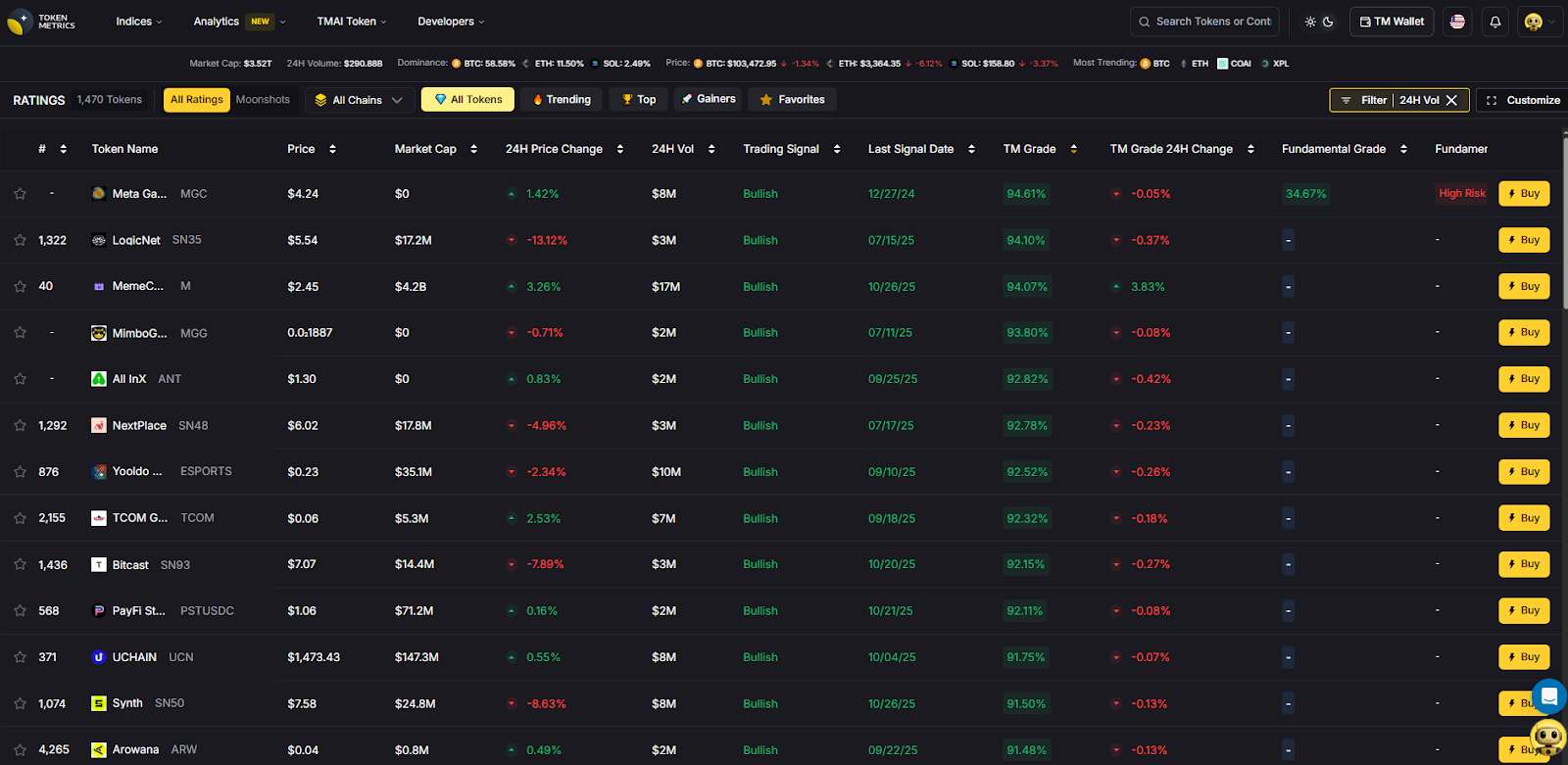
  • Narrative Detection spots emerging themes (e.g., Solana DeFi, Base ecosystem) to inform which chains to bridge into
  • Portfolio Optimization balances risk across chains and suggests rebalancing targets that justify bridge costs
  • Alerts & Signals time bridge transactions around momentum shifts, reducing exposure to unfavorable price action mid-transfer

Workflow: Research asset quality with AI Ratings → Select optimal bridge for your route → Execute transfer → Monitor destination chain with real-time alerts.

Start your free trial to screen assets and time bridge transactions with AI-powered intelligence.

Security & Compliance Tips

  • Verify official URLs — Always access bridges through bookmarked official domains; phishing sites are common
  • Use hardware wallets — Sign bridge transactions with Ledger/Trezor for cold-storage protection
  • Check token approvals — Revoke unlimited approvals after bridging using tools like Revoke.cash
  • Monitor bridge exploits — Follow protocol Twitter accounts and status pages for real-time security alerts
  • Understand validator risks — Multisig and SMPC bridges concentrate risk; optimistic and PoS models distribute trust
  • Avoid bridging during congestion — High gas fees and slippage increase during network congestion; wait for off-peak times
  • Store bridge receipts — Save transaction hashes and screenshots for tax reporting and dispute resolution
  • Test cross-chain contract calls — If using advanced features (e.g., Axelar GMP), test with minimal amounts first
  • Review liquidity provider risks — Impermanent loss and smart contract risk apply to bridge LPs; understand before depositing
  • Know refund procedures — Understand each bridge's failed transaction refund process and timeframes

This article is for research and educational purposes, not financial advice. Conduct your own security due diligence before bridging assets.


Beginner Mistakes to Avoid

  • Bridging to the wrong network — Always triple-check destination chain selection; wrong-network transfers are often irreversible
  • Ignoring slippage on large transfers — Pools with <$10M TVL may experience 1-5% slippage on $100K+ transactions
  • Bridging illiquid tokens — Ensure destination chain has DEX liquidity before bridging obscure tokens
  • Not accounting for gas on destination chain — Bridge enough native tokens (ETH, MATIC, etc.) to pay for transactions on arrival
  • Trusting wrapped tokens blindly — Verify wrapped token contracts are legitimate before swapping (scam tokens common)
  • Bridging during protocol upgrades — Avoid bridging when protocols announce maintenance windows or upgrades
  • Falling for "instant bridge" scams — No legitimate bridge offers instant finality across all chains; be skeptical of unrealistic claims
  • Ignoring bridge insurance options — Services like Nexus Mutual offer bridge exploit coverage for eligible protocols

FAQs

What is a cross-chain bridge?
 A cross-chain bridge is a protocol that enables asset transfers between different blockchains by locking tokens on the source chain and minting or unlocking equivalent tokens on the destination chain. Bridges use various security models including lock-and-mint, liquidity pools, optimistic verification, and atomic swaps to facilitate interoperability.

Are cross-chain bridges safe?
 Bridge security varies significantly by architecture and track record. Bridges secured by proof-of-stake validators (Axelar) or atomic swaps (Meson) offer stronger security than multisig or SMPC models. Historical exploits affecting Wormhole ($325M in 2022) and Multichain ($126M in 2023) highlight risks. Always verify audit reports, exploit history, and validator transparency before bridging significant amounts.

How much do cross-chain bridges cost?
 Bridge fees typically range from 0.01% to 0.5% of transfer amount, plus source and destination chain gas fees. Stargate and Across charge 0.01-0.06% for stablecoins, while Axelar charges 0.1-0.5% for broader coverage. Total costs including gas often range from $5-$50 for typical transactions, but can exceed $100 during Ethereum mainnet congestion.

Can I bridge any token between any chains?
 No—token bridging depends on protocol support and liquidity availability. Major tokens (USDC, USDT, ETH, WBTC) have deep liquidity on most bridges, while obscure tokens may only bridge via wrapped versions or not at all. Always verify token support on both source and destination chains before attempting transfers.

How long do cross-chain bridge transfers take?
 Transfer times range from 1 minute (Across optimistic transfers) to 30+ minutes (Hop during congestion or Multichain on slower chains). Average speeds: Across 1-4 min, Synapse 2-5 min, Stargate 1-15 min, Wormhole 5-20 min. Optimistic bridges are fastest but may delay finality during disputes; lock-and-mint bridges prioritize security over speed.

Do I need native tokens on the destination chain before bridging?
 Not for the bridge transaction itself, but you'll need native tokens (ETH on Ethereum, MATIC on Polygon, etc.) to pay gas for any subsequent transactions on the destination chain. Some bridges offer small gas token bridging or faucet integrations, but plan to bridge sufficient native tokens alongside your primary assets.

What happens if my bridge transaction fails?
 Failed transactions typically result in automatic refunds to the source address within 24-72 hours, though timelines vary by protocol. Optimistic bridges may take longer during dispute periods. Always save transaction hashes and monitor bridge status pages for updates. Contact protocol support via Discord or Telegram for transactions stuck beyond normal timeframes.

Can I use bridges for NFTs or only fungible tokens?
 Most bridges focus on fungible tokens (ERC-20, SPL, etc.), but several support NFT bridging. Wormhole enables NFT transfers across 30+ chains, while specialized solutions like Axelar and Celer support NFT metadata preservation. NFT bridges often charge fixed fees ($5-$20) regardless of NFT value and may take longer than fungible token transfers.


Conclusion + Related Reads

Selecting the right cross-chain bridge depends on your priorities: Stargate Finance delivers the deepest stablecoin liquidity for DeFi-focused traders, Synapse Protocol offers the fastest execution across 20+ chains, and Across Protocol provides the lowest fees for cost-conscious arbitrageurs. Security-first users should consider Meson Finance for atomic swap guarantees or Axelar for institutional-grade proof-of-stake validation. Always test with small amounts, verify destination addresses, and monitor bridge status pages before moving significant capital.

Related Reads:

Build Smarter Crypto Apps &
AI Agents in Minutes, Not Months
Real-time prices, trading signals, and on-chain insights all from one powerful API.
Grab a Free API Key
About Token Metrics
Token Metrics: AI-powered crypto research and ratings platform. We help investors make smarter decisions with unbiased Token Metrics Ratings, on-chain analytics, and editor-curated “Top 10” guides. Our platform distills thousands of data points into clear scores, trends, and alerts you can act on.
30 Employees
analysts, data scientists, and crypto engineers
Daily Briefings
concise market insights and “Top Picks”
Transparent & Compliant
Sponsored ≠ Ratings; research remains independent
Want Smarter Crypto Picks—Free?
See unbiased Token Metrics Ratings for BTC, ETH, and top alts.
Thank you! Your submission has been received!
Oops! Something went wrong while submitting the form.
 No credit card | 1-click unsubscribe
Token Metrics Team
Token Metrics Team

Recent Posts

Research

Portfolio Allocation Mastery: The Complete Guide to Diversification with Token Metrics Crypto Indices

Token Metrics Team
11 min read

Most investors understand that diversification matters—the famous "don't put all your eggs in one basket" principle. However, understanding diversification conceptually differs dramatically from implementing it effectively. Poor diversification strategies create illusions of safety while concentrating risk in hidden ways. True diversification requires sophisticated allocation across multiple dimensions simultaneously.

Token Metrics AI Indices provide professional-grade diversification tools, but maximizing their power requires strategic allocation decisions. How much total capital should you allocate to crypto? How should you split that allocation across different indices? How do you balance crypto with traditional assets? What role should conservative versus aggressive indices play?

This comprehensive guide explores portfolio allocation mastery, examining the principles of effective diversification, specific allocation frameworks for different investor profiles, tactical adjustments for changing conditions, and avoiding common diversification mistakes that undermine portfolio performance.

Understanding True Diversification: Beyond Token Count

Many investors believe diversification simply means holding many assets. True diversification requires deeper strategic thinking.

  • The Correlation Principle: Diversification provides benefits only when assets don't move in lockstep. Holding ten tokens that all rise and fall together provides no more protection than one. Token Metrics addresses correlation through sector diversification (DeFi, Layer-1s, gaming, AI), market cap mixing (large, mid, small caps), geographic diversity across blockchain ecosystems, and use case variety spanning payments to applications.
  • Systematic vs. Unsystematic Risk: Diversification eliminates unsystematic risk (individual token failures) but cannot eliminate systematic risk (overall market crashes). Understanding this prevents unrealistic expectations—diversification protects against individual failures but won't prevent declines during market-wide crashes.
  • Risk-Adjusted Returns: Sophisticated investors focus on risk-adjusted returns rather than absolute returns. A portfolio returning 80% annually with 60% volatility may be inferior to one returning 60% with 30% volatility. The Sharpe ratio measures this—Token Metrics optimizes for superior Sharpe ratios through diversification.

The Total Portfolio Framework: Integrating Crypto with Traditional Assets

Crypto represents one component of comprehensive financial planning. Optimal allocation requires considering how crypto fits within total wealth.

Asset Class Allocation by Life Stage

Appropriate crypto allocation varies dramatically based on age, income stability, and financial obligations.

Ages 20-35 (Aggressive Accumulation Phase):

  • Total Crypto Allocation: 15-30% of investment portfolio
  • Remaining Allocation: 50-60% stocks, 10-15% bonds, 5-10% real estate/alternatives, 5-10% cash
  • Rationale: Long time horizon allows recovering from crypto volatility while capturing maximum growth potential

Ages 35-50 (Balanced Growth Phase):

  • Total Crypto Allocation: 10-20% of investment portfolio
  • Remaining Allocation: 50-60% stocks, 15-20% bonds, 10-15% real estate/alternatives, 5-10% cash
  • Rationale: Maintain growth exposure while gradually increasing stability as retirement approaches

Ages 50-65 (Pre-Retirement Transition):

  • Total Crypto Allocation: 5-10% of investment portfolio
  • Remaining Allocation: 40-50% stocks, 25-30% bonds, 10-15% real estate/alternatives, 10-15% cash
  • Rationale: Preserve accumulated wealth while maintaining modest growth exposure

Ages 65+ (Retirement Distribution):

  • Total Crypto Allocation: 3-5% of investment portfolio
  • Remaining Allocation: 30-40% stocks, 30-40% bonds, 10-15% real estate/alternatives, 15-20% cash
  • Rationale: Capital preservation with modest crypto exposure for continued growth and inflation protection

These frameworks provide starting points—adjust based on individual risk tolerance, wealth level, and financial obligations.

Emergency Funds and Liquidity Reserves

Never invest emergency funds or money needed within 3-5 years in cryptocurrency. Maintain 6-12 months of living expenses in high-yield savings accounts or money market funds completely separate from investment portfolios.

This liquidity buffer prevents forced selling during market crashes. Without adequate emergency reserves, unexpected expenses force liquidating crypto holdings at worst possible times—turning temporary paper losses into permanent realized losses.

Debt Considerations

High-interest debt (credit cards, personal loans above 8-10%) should be eliminated before aggressive crypto investing. The guaranteed "return" from eliminating 18% credit card interest exceeds expected crypto returns on risk-adjusted basis.

However, low-interest debt (mortgages below 4-5%) can coexist with crypto investing—no need to delay investing until mortgage-free. The opportunity cost of waiting decades to invest exceeds the modest interest savings from accelerated mortgage payments.

Allocating Within Crypto: Index Selection Strategy

Once you've determined total crypto allocation, the next decision involves distributing that allocation across Token Metrics' various indices.

The Three-Tier Index Framework

Structure crypto allocation across three risk tiers creating balanced exposure:

Conservative Tier (40-50% of crypto allocation):

Conservative indices emphasizing Bitcoin, Ethereum, and fundamentally strong large-cap tokens. This tier provides stability and reliable exposure to crypto's overall growth while limiting volatility.

Suitable indices: Bitcoin-weighted indices, large-cap indices, blue-chip crypto indices

Balanced Tier (30-40% of crypto allocation):

Balanced indices combining established tokens with growth-oriented mid-caps. This tier balances stability and growth potential through strategic diversification.

Suitable indices: Diversified market indices, multi-sector indices, smart contract platform indices

Aggressive Tier (20-30% of crypto allocation):

Aggressive growth indices targeting smaller-cap tokens with highest upside potential. This tier drives outperformance during bull markets while limited position sizing contains downside risk.

Suitable indices: Small-cap growth indices, sector-specific indices (DeFi, gaming, AI), emerging ecosystem indices

Sector Rotation Within Allocation

Different crypto sectors outperform during different market phases. Tactical sector rotation within your allocation captures these rotations:

  • Early Bull Market: Layer-1 platforms and infrastructure tokens typically lead as smart money accumulates fundamentally strong projects at relative discounts.
  • Mid Bull Market: DeFi and application layer tokens often outperform as adoption accelerates and user activity increases across protocols.
  • Late Bull Market: Speculative sectors like memecoins and high-risk projects experience explosive growth as retail FOMO peaks and risk appetite maximizes.
  • Bear Market: Bitcoin and large-cap "blue chip" tokens typically show relative strength, declining less than smaller alternatives.

Token Metrics indices provide sector-specific options allowing tactical overweighting of sectors positioned for outperformance while maintaining diversified core holdings.

Geographic and Ecosystem Diversity

Blockchain ecosystems exhibit different characteristics and growth trajectories. Diversifying across multiple ecosystems prevents concentration in single platform risk:

  • Ethereum Ecosystem: Largest DeFi infrastructure, most developers, highest liquidity
  • Solana Ecosystem: High performance, growing DeFi and NFT activity
  • Binance Smart Chain: Low costs, high retail adoption in certain markets
  • Polygon and Layer-2s: Scaling solutions with growing adoption
  • Alternative Layer-1s: Avalanche, Cardano, Polkadot offering different technical approaches

Token Metrics indices spanning multiple ecosystems provide automatic geographic and platform diversification preventing single-ecosystem concentration risk.

Rebalancing Strategies: Maintaining Optimal Allocation

Markets move constantly, causing allocations to drift from targets. Systematic rebalancing maintains desired risk exposure and forces beneficial "buy low, sell high" discipline.

Calendar-Based Rebalancing

The simplest approach rebalances on fixed schedules regardless of market conditions:

  • Quarterly Rebalancing: Review and adjust allocations every three months
  • Semi-Annual Rebalancing: Rebalance twice yearly for lower-maintenance approach
  • Annual Rebalancing: Minimal maintenance with once-yearly adjustments

More frequent rebalancing captures opportunities faster but triggers more taxable events in non-retirement accounts. Less frequent rebalancing reduces trading costs but allows greater allocation drift.

Threshold-Based Rebalancing

More sophisticated approaches rebalance when allocations drift beyond predetermined thresholds:

  • Rebalance when any index exceeds target allocation by 25% (e.g., 10% target allocation reaching 12.5%)
  • Rebalance when total crypto allocation exceeds target by 30% (e.g., 15% target reaching 19.5%)
  • Rebalance when conservative/aggressive balance shifts more than 15% from target

Threshold rebalancing responds to actual market movements rather than arbitrary calendar dates, potentially improving timing while reducing unnecessary transactions.

Tax-Optimized Rebalancing

In taxable accounts, coordinate rebalancing with tax considerations:

  • Prioritize rebalancing in retirement accounts where transactions don't trigger taxes
  • Use new contributions to rebalance in taxable accounts rather than selling appreciated positions
  • Harvest tax losses during rebalancing by selling positions at losses to offset gains
  • Delay rebalancing appreciated positions until qualifying for long-term capital gains treatment

This tax awareness preserves more wealth for compounding rather than sending it to tax authorities.

Risk Management: Position Sizing and Stop-Loss Philosophies

Effective diversification includes position sizing rules preventing excessive concentration even within diversified portfolios.

Maximum Position Limits

Establish maximum position sizes preventing any single index from dominating:

  • No single index exceeding 30% of total crypto allocation
  • No single sector exceeding 40% of total crypto allocation
  • Aggressive/speculative indices collectively capped at 30% of crypto allocation
  • Conservative indices minimum 40% of crypto allocation

These guardrails maintain diversification even when particular indices perform extremely well, preventing overconfidence from creating dangerous concentration.

Strategic Loss Limitations

While crypto indices should be held long-term through volatility, establish strategic loss limits for total crypto allocation relative to overall portfolio:

  • If crypto allocation declines to represent less than 50% of target allocation, consider adding capital opportunistically
  • If crypto allocation grows to exceed 200% of target allocation, take systematic profits rebalancing back toward target
  • Never allow crypto losses to exceed 10% of total net worth regardless of initial allocation

These strategic boundaries prevent crypto volatility from creating portfolio-level instability while maintaining beneficial long-term exposure.

Common Allocation Mistakes That Destroy Returns

  • False Diversification Through Correlated Assets: Five Layer-1 tokens or multiple overlapping DeFi indices create illusion without meaningful risk reduction. Analyze correlation ensuring genuine sector, market cap, and use case differences.
  • Over-Diversification Creating "Diworsification": Beyond 5-7 carefully selected indices, additional diversification provides diminishing returns while increasing complexity. Focus on 3-5 core indices providing genuine diversification.
  • Abandoning Allocation During Extremes: The most valuable time to maintain target allocation is when it feels most difficult—severe bear markets or euphoric bull markets. Automate rebalancing through predetermined rules.
  • Ignoring Total Portfolio Context: A 20% crypto allocation might be appropriate with stable income and emergency funds—but reckless with debt and no savings. Evaluate crypto within total financial context.
  • Static Allocations Never Adjusting: Life circumstances change—income, families, risk tolerance, retirement proximity. Review allocation every 2-3 years and after major life events.

Advanced Allocation Strategies for Sophisticated Investors

Beyond basic frameworks, advanced strategies optimize allocation for specific goals and market conditions.

Barbell Strategy

The barbell approach combines extremely conservative and extremely aggressive positions while avoiding middle ground:

  • 60% in ultra-conservative Bitcoin and Ethereum-focused indices
  • 40% in highly aggressive small-cap and emerging sector indices
  • 0% in moderate/balanced middle-ground indices

This approach provides downside protection through conservative core while capturing maximum upside through concentrated aggressive positions—potentially delivering superior risk-adjusted returns versus balanced approaches.

Core-Satellite with Tactical Overlay

Maintain stable core allocation (70% of crypto) in diversified indices while using tactical satellite positions (30%) rotated based on market conditions and opportunities:

  • Core 70% remains constant regardless of market conditions
  • Tactical 30% rotates between sectors showing relative strength or undervaluation
  • Rebalance tactical allocation monthly based on momentum, sentiment, and fundamental factors

This approach combines buy-and-hold stability with active opportunity capture.

Risk Parity Allocation

Rather than allocating by dollar amounts, allocate by risk contribution ensuring each index contributes equally to portfolio volatility:

  • Conservative low-volatility indices receive larger dollar allocations
  • Aggressive high-volatility indices receive smaller dollar allocations
  • Each position contributes approximately equal volatility to total portfolio

This sophisticated approach prevents high-volatility positions from dominating portfolio risk even with modest dollar allocations.

Conclusion: Allocation Excellence Creates Lasting Success

Portfolio allocation represents the most important investment decision you'll make—far more impactful than individual token selection or market timing. Academic research consistently shows asset allocation determines 90%+ of portfolio performance variation, while security selection and timing contribute only marginally.

Token Metrics provides world-class indices, but your allocation strategy determines whether you capture their full potential or undermine them through poor diversification. The frameworks presented here offer starting points—adapt them to your specific situation, risk tolerance, and financial goals.

Remember that optimal allocation isn't static—it evolves with life stages, market conditions, and financial circumstances. Regular review and adjustment keeps strategies aligned with current reality rather than outdated assumptions.

The investors who build lasting wealth aren't those who find magical assets or perfect timing—they're those who implement sound allocation strategies and maintain them through all market conditions. This discipline, more than any other factor, separates successful wealth builders from those whose portfolios underperform despite choosing quality investments.

Begin implementing strategic allocation today. Start with appropriate total crypto allocation for your life stage, distribute across conservative, balanced, and aggressive indices providing genuine diversification, and establish rebalancing discipline maintaining target exposures through market volatility.

Your allocation strategy, properly implemented, will compound into extraordinary wealth over decades. Token Metrics provides the tools—your allocation decisions determine the results.

Start your 7-day free trial today and begin building the optimally allocated portfolio that will drive your financial success for decades to come.

Research

Building True Passive Income with Crypto Indices: The Complete Guide to Automated Wealth Creation

Token Metrics Team
12 min read

The dream of passive income drives millions toward cryptocurrency—earning money while you sleep, building wealth automatically, achieving financial freedom without constant work. Yet most crypto "passive income" strategies require active management, constant monitoring, technical expertise, and significant time investment. They're anything but passive.

Token Metrics AI Indices deliver genuine passive income through systematic wealth accumulation requiring minimal ongoing effort. Once established, your crypto portfolio grows automatically through professional AI management, strategic rebalancing, and compound returns—all without your daily involvement or active trading.

This comprehensive guide explores how crypto indices create true passive income, compares index investing to other passive income strategies, reveals the mathematics of automated wealth compounding, and provides actionable frameworks for building substantial passive income streams through disciplined index allocation.

What True Passive Income Actually Means

Understanding genuine passive income requires distinguishing it from "active income disguised as passive" that dominates crypto discussions.

Active Income Disguised as Passive

Many crypto strategies marketed as "passive income" require substantial ongoing effort:

  • Day Trading/Swing Trading: Requires constant market monitoring, analysis, and execution—full-time active work
  • Yield Farming: Demands daily monitoring of APYs, moving capital between protocols, managing impermanent loss risks
  • NFT Flipping: Requires researching projects, timing mints, managing listings, following trends constantly
  • Staking on Volatile Assets: Needs continuous evaluation of lock-up risks, protocol security, and token price sustainability
  • DeFi Protocol Management: Involves complex smart contract interactions, gas fee optimization, and continuous security monitoring

These strategies generate income but demand active participation—they're jobs, not passive income streams.

Characteristics of Genuine Passive Income

True passive income exhibits specific characteristics:

  • Minimal Time Investment: Requires 1-2 hours monthly maximum after initial setup
  • No Specialized Expertise: Accessible to anyone regardless of technical knowledge
  • Automatic Execution: Operates without your constant involvement or decision-making
  • Predictable Processes: Follows systematic approaches rather than requiring moment-to-moment judgment
  • Scalable Without Additional Time: Can grow substantially without proportionally increasing time commitment
  • Professional Management: Experts handle complexity on your behalf

Token Metrics indices meet all these criteria—once established, your wealth grows automatically through AI-powered management while you focus on other priorities.

How Crypto Indices Create Passive Income

Understanding the mechanisms generating passive returns through indices reveals why this approach delivers superior risk-adjusted income compared to alternatives.

Capital Appreciation Through Systematic Growth

The primary income source from crypto indices is capital appreciation—portfolio value increasing over time as cryptocurrency markets grow and AI optimization captures opportunities.

Unlike stocks requiring decades to double, crypto indices can deliver 50-200% annual returns during favorable market cycles. A $25,000 initial investment growing at 60% annually becomes $100,000 in three years and $400,000 in six years—substantial wealth creation requiring zero active trading.

This appreciation occurs passively through:

  • AI selecting highest-probability opportunities across 6,000+ tokens
  • Automatic rebalancing capturing profits from winners and accumulating losers at discounts
  • Diversification spreading risk while maintaining upside exposure
  • Professional risk management limiting catastrophic losses

You make no trading decisions. You don't research tokens. You don't time markets. The system handles everything while appreciation compounds automatically.

Compound Growth Acceleration

Passive income's true power emerges through compounding—returns generating additional returns in self-reinforcing cycles. Token Metrics indices amplify compounding through systematic profit capture and reinvestment.

When indices rebalance, profits from appreciating tokens are automatically reinvested into new opportunities. This mechanical reinvestment ensures all gains compound rather than sitting idle. Over years and decades, compounding creates extraordinary wealth accumulation.

Example: $10,000 growing at 40% annually with full reinvestment becomes $150,000 in seven years. Without reinvestment—if you withdrew gains annually—the same investment reaches only $38,000. Compounding creates an additional $112,000 in wealth automatically.

Dollar-Cost Averaging Enhancement

Adding regular contributions to index positions creates powerful dollar-cost averaging benefits that enhance passive returns. By investing fixed amounts regardless of market conditions, you automatically buy more tokens when prices are low and fewer when prices are high.

This systematic averaging removes timing pressure—you don't need to identify perfect entry points. Whether markets surge or crash, your regular contributions continue mechanically, building positions that appreciate over complete market cycles.

Combined with compound growth, dollar-cost averaging creates remarkable long-term wealth accumulation requiring minimal effort beyond initial automated contribution setup.

Tax-Efficient Growth Optimization

Token Metrics indices can be held in tax-advantaged retirement accounts where appreciation compounds tax-free (Roth IRA) or tax-deferred (Traditional IRA). This tax optimization dramatically accelerates wealth accumulation compared to taxable accounts.

In taxable accounts, annual rebalancing triggers capital gains taxes that reduce compounding power. In retirement accounts, all gains compound without tax drag—a significant passive income enhancement requiring only initial account setup.

Comparing Index Passive Income to Alternatives

Understanding how index-based passive income compares to other strategies reveals relative advantages.

Vs. Staking/Yield Farming: While staking offers 5-20% APY, it involves token price risk (10% yield means nothing if price drops 50%), lock-up periods preventing selling during crashes, impermanent loss, protocol risks, and constant management overhead. Index capital appreciation typically exceeds staking yields by 40+ percentage points while maintaining complete liquidity.

Vs. Real Estate: Real estate requires $50,000-$500,000+ minimums, involves management burdens despite property managers, suffers from illiquidity (months to sell), concentrates wealth geographically, and carries leverage risks. Indices require minimal capital, zero management, complete liquidity, global diversification, and no leverage risks.

Vs. Dividend Stocks: Dividend yields of 2-4% and appreciation of 6-8% annually pale against crypto potential. Dividends trigger immediate taxation reducing after-tax returns. Crypto indices offer dramatically higher return potential with tax-efficient compounding.

Vs. Bitcoin/Ethereum Only: Concentrated two-asset holdings sacrifice diversification, miss altcoin opportunities, lack rebalancing benefits, and forego professional management. Indices provide superior risk-adjusted returns with equal passivity.

The Mathematics of Automated Wealth Building

Understanding how small initial investments and regular contributions compound into substantial wealth over time makes passive income potential concrete rather than abstract.

Starting Small: The Power of Consistency

You don't need large capital to begin building meaningful passive income. Small amounts invested consistently compound into substantial wealth through time and returns.

Scenario 1: Modest Beginning

  • Initial investment: $1,000
  • Monthly contribution: $250
  • Average annual return: 50%
  • Time horizon: 10 years
  • Ending value: $486,000

This scenario transforms $31,000 in total contributions into nearly half a million through compound growth—passive income requiring only initial setup and automated monthly contributions.

Scenario 2: Aggressive Accumulation

  • Initial investment: $5,000
  • Monthly contribution: $500
  • Average annual return: 50%
  • Time horizon: 10 years
  • Ending value: $972,000

Nearly $1 million from $65,000 in contributions—extraordinary passive wealth creation through systematic index investing.

The Impact of Return Variability

Real returns vary annually—bull markets deliver 100-300% returns while bear markets create 50-80% drawdowns. However, averaging across complete cycles, conservative crypto indices historically achieve 30-60% annualized returns.

  • Even at conservative 30% annual average:
  • $10,000 initial + $300 monthly for 15 years = $1.1 million
  • $25,000 initial + $500 monthly for 15 years = $2.8 million

These projections assume no income from your job increases, which is unrealistic. As your career progresses and income grows, contribution amounts can increase proportionally, accelerating wealth accumulation further.

Retirement Income Generation

Once accumulated, substantial crypto index holdings generate retirement income through systematic withdrawal strategies.

If you accumulate $2 million in crypto indices by age 60, withdrawing 4% annually provides $80,000 passive income while preserving principal. If crypto continues appreciating even modestly at 15% annually, your portfolio grows despite withdrawals, providing inflation-protected lifetime income.

This passive income stream requires no active work—automated monthly withdrawals provide cash flow while remaining capital compounds through continued AI management.

Building Your Passive Income System

Creating effective passive income through crypto indices requires systematic implementation across several phases.

Phase 1: Foundation Setup (Month 1)

  • Open Token Metrics account and explore available indices
  • Determine appropriate total crypto allocation based on age, risk tolerance, and financial situation
  • Select specific indices matching your risk profile (conservative, balanced, aggressive)
  • Open exchange accounts and complete verification processes
  • Link bank accounts for funding transfers
  • Consider opening self-directed IRA for tax-advantaged growth

Complete this foundation work once—all subsequent wealth building occurs automatically.

Phase 2: Automation Implementation (Month 2)

  • Set up automatic recurring bank transfers to exchange accounts
  • Configure automatic index purchases on predetermined schedules (weekly, bi-weekly, or monthly)
  • Enable automatic rebalancing following Token Metrics recommendations
  • Set up portfolio tracking and optional performance alerts
  • Document your strategy and rules in writing for future reference

After automation setup, your system operates independently requiring minimal intervention.

Phase 3: Optimization and Scaling (Months 3-12)

  • Monitor system monthly to ensure automation functions correctly
  • Increase contribution amounts as income grows throughout your career
  • Rebalance between indices quarterly based on Token Metrics guidance
  • Take advantage of market crashes by adding lump sums opportunistically
  • Review and adjust tax strategies annually with professional guidance

Even during optimization phase, time commitment remains minimal—1-2 hours monthly maximum.

Phase 4: Wealth Preservation and Distribution (Years 10+)

  • Gradually shift allocation toward conservative indices as wealth accumulates
  • Implement systematic profit-taking during euphoric bull markets
  • Develop withdrawal strategy for retirement income needs
  • Consider estate planning for accumulated wealth transfer
  • Maintain disciplined approach through all market conditions

Throughout all phases, your involvement remains minimal while wealth compounds automatically through professional AI management.

Maximizing Passive Income Through Strategic Allocation

Optimizing passive income requires strategic decisions about allocation, risk management, and contribution timing.

Allocation Balance: Higher returns come with higher volatility. Conservative approach uses 70% conservative/20% balanced/10% aggressive indices. Moderate uses 50/30/20 split. Aggressive uses 30/30/40 split. All remain completely passive from management perspective.

Contribution Timing: Maintain regular automated contributions always, but keep 10-20% dry powder in stablecoins for crisis deployment during 30%+ market crashes. These fear-driven purchases generate outsized returns.

Tax Location Optimization: Roth IRA provides tax-free growth ideal for aggressive indices. Traditional IRA offers tax-deferred growth suitable for conservative indices. Taxable accounts provide flexibility but trigger annual rebalancing taxes. This optimization happens once but compounds into substantial savings over decades.

Common Passive Income Mistakes to Avoid

Even with automated systems, investors make predictable mistakes that undermine passive income goals.

  • Insufficient Automation: Failing to fully automate contributions and rebalancing introduces friction preventing consistent execution
  • Excessive Monitoring: Checking portfolio daily or weekly increases anxiety without improving results—monthly reviews suffice
  • Abandoning Strategy During Drawdowns: Selling during bear markets destroys passive income system's effectiveness—maintain discipline through downturns
  • Chasing Performance: Constantly switching between indices based on recent performance undermines long-term compounding
  • Withdrawing Gains Prematurely: Taking profits during accumulation phase prevents compounding—let gains reinvest automatically
  • Under-Contributing Relative to Income: Failing to increase contributions as career income grows limits wealth accumulation unnecessarily
  • Neglecting Tax Optimization: Holding crypto in taxable accounts when retirement accounts available costs substantial long-term returns

Conclusion: The Path to Financial Freedom

True passive income through crypto indices isn't mythical—it's mathematically achievable through systematic implementation and patient execution. Token Metrics provides the professional AI management, diversification, and optimization infrastructure transforming crypto from speculation into genuine passive wealth building.

The beauty of this approach is simplicity: establish system once, contribute consistently, trust professional management, and let compound growth work its magic over years and decades. No day trading. No constant monitoring. No technical expertise required. Just disciplined, automated wealth accumulation.

Your action determines outcomes. Those who begin today, implement systematic contributions, and maintain discipline through market cycles build substantial passive income streams funding financial independence. Those who delay, overthink, or abandon strategy during volatility watch opportunities pass without capturing benefits.

Token Metrics indices eliminate complexity and emotion from crypto investing, leaving only systematic wealth accumulation. The technology works. The mathematics favor consistent long-term investors. The only question is whether you'll begin building your passive income system today or postpone financial freedom indefinitely.

Start your 7-day free trial and take the first step toward true passive income through automated, professional crypto index investing. Your future self will thank you for the decision you make today.

Frequently Asked Questions

Research

Why AI Makes All the Difference: The Technology Advantage Behind Token Metrics Crypto Indices

Token Metrics Team
12 min read

When evaluating cryptocurrency index providers, most investors focus on past performance, fees, or token selection. While these factors matter, they miss the fundamental differentiator determining long-term success: the sophistication of artificial intelligence powering portfolio management.

Token Metrics doesn't just use AI as marketing buzzword—the platform employs cutting-edge machine learning systems that fundamentally outperform human decision-making in ways that compound into extraordinary advantages over time. Understanding why AI-driven indices surpass both traditional approaches and human-managed alternatives reveals why this technology represents the future of crypto investing.

This comprehensive guide explores the specific AI technologies powering Token Metrics indices, examines what these systems can do that humans cannot, compares AI-driven approaches to traditional alternatives, and reveals how technological advantages translate into superior investment outcomes.

The Limitations of Human Crypto Portfolio Management

Before understanding AI's advantages, recognize the inherent limitations of human portfolio management in cryptocurrency markets.

Information Processing Constraints

The human brain processes information sequentially and slowly. A skilled analyst might evaluate 10-20 cryptocurrencies daily using 5-10 data points each. This yields 50-200 data points daily—a tiny fraction of available information.

Token Metrics' AI analyzes 6,000+ cryptocurrencies using 80+ data points each—480,000+ data points daily. This 2,400x information processing advantage means the AI identifies opportunities and risks invisible to human analysis.

Cognitive Biases Distort Judgment

Human decision-making suffers from systematic cognitive biases:

  • Confirmation Bias: Seeking information supporting existing beliefs while dismissing contradictory evidence
  • Recency Bias: Overweighting recent events while underweighting historical patterns
  • Anchoring Bias: Fixating on initial information (like purchase price) rather than current reality
  • Herding Bias: Following crowd behavior rather than independent analysis
  • Overconfidence Bias: Believing personal judgment exceeds actual accuracy

These biases cause systematic errors leading to poor timing, holding losers too long, selling winners prematurely, and following crowds into overvalued assets. AI systems have no cognitive biases—they evaluate data objectively based on mathematical relationships.

Emotional Volatility Undermines Discipline

Human portfolio managers experience fear during market crashes and euphoria during rallies. These emotions trigger fight-or-flight responses overwhelming rational analysis, causing panic selling at bottoms and overconfident buying at tops.

AI experiences no emotions. Market crashes don't trigger fear. Rallies don't create euphoria. The system evaluates probabilities and executes strategies mechanically regardless of market sentiment.

Physical and Mental Limitations

Humans require sleep, breaks, vacations, and time for other life activities. Portfolio managers cannot monitor markets 24/7 or maintain consistent attention over years without degradation.

AI operates continuously without fatigue, monitoring global markets across time zones simultaneously. The system never sleeps, never takes vacations, never loses focus—maintaining perpetual vigilance impossible for humans.

Inability to Learn from All Data

Human learning occurs slowly through experience and study. A portfolio manager might learn from hundreds of trades over decades, building intuition from limited personal experience.

AI learns from millions of data points across thousands of assets simultaneously. Every market movement, every token launch, every sentiment shift contributes to model training. The system identifies patterns across entire crypto history that individual humans could never detect.

The Specific AI Technologies Powering Token Metrics

Token Metrics employs an ensemble of sophisticated machine learning models, each serving specific purposes within the investment process.

Gradient Boosting Decision Trees

These models excel at identifying complex, non-linear relationships between variables. In crypto markets, simple linear relationships rarely exist—token performance depends on intricate interactions between multiple factors.

Gradient boosting builds thousands of decision trees, each learning from previous trees' errors. This iterative process creates highly accurate predictions by combining many weak predictors into strong aggregate models.

Application: Identifying which combinations of technical, fundamental, and sentiment factors predict future price movements most accurately.

Recurrent Neural Networks (RNNs)

RNNs specialize in time-series analysis, recognizing patterns in sequential data. Cryptocurrency prices represent time-series data where past patterns influence future movements.

Unlike simple technical analysis looking at individual indicators, RNNs identify complex temporal relationships spanning multiple timeframes simultaneously. The networks detect subtle patterns in how prices, volumes, and other metrics evolve together over time.

Application: Forecasting price trajectories by learning from historical patterns while adapting to changing market dynamics.

Random Forests

Random forest algorithms create multiple decision trees using random subsets of data and features, then aggregate their predictions. This approach reduces overfitting risk—where models perform excellently on historical data but fail on new data.

By training on different data subsets, random forests identify robust patterns that generalize well rather than memorizing specific historical sequences unlikely to repeat exactly.

Application: Robust token classification separating quality projects from low-quality alternatives based on generalizable characteristics.

Natural Language Processing (NLP)

NLP algorithms analyze text data from social media, news articles, developer communications, and community forums. These systems extract sentiment, identify trending topics, detect narrative shifts, and quantify community engagement.

Unlike humans who might read dozens of articles weekly, NLP processes millions of text sources daily, identifying sentiment patterns and narrative changes before they become obvious.

Application: Gauging market sentiment, detecting emerging narratives, identifying coordinated pumps or manipulative campaigns, and assessing community health.

Anomaly Detection Frameworks

Anomaly detection identifies unusual patterns suggesting either opportunities or risks. These systems establish baseline "normal" behavior, then flag deviations warranting attention.

In crypto markets, anomalies might indicate insider trading before announcements, coordinated manipulation schemes, security vulnerabilities, or emerging trends before mainstream recognition.

Application: Early warning systems for security threats, manipulation detection, and identifying breakout candidates showing unusual strength relative to historical patterns.

What AI Can Do That Humans Cannot

Understanding specific capabilities unique to AI reveals why technology-driven approaches surpass traditional methods.

Simultaneous Multi-Asset Analysis

Human portfolio managers analyze assets sequentially—evaluating Bitcoin, then Ethereum, then Solana, one at a time. This sequential processing misses relationships between assets.

AI analyzes all assets simultaneously, identifying correlations, relative strength patterns, sector rotations, and cross-asset opportunities. The system recognizes when DeFi tokens strengthen relative to Layer-1s, when memecoins show coordinated movement, or when specific sectors lead or lag broader markets.

This simultaneous analysis reveals relative value opportunities invisible to sequential human analysis.

Pattern Recognition Across Massive Datasets

Humans excel at recognizing simple patterns—support and resistance levels, head-and-shoulders formations, moving average crossovers. However, complex multi-dimensional patterns exceed human cognitive capacity.

AI identifies patterns involving dozens of variables simultaneously across thousands of assets. These patterns might involve specific combinations of technical indicators, on-chain metrics, sentiment scores, and fundamental factors that human analysts could never process holistically.

Example: The AI might recognize that tokens with specific combinations of technical momentum, developer activity growth, and social sentiment shifts outperform 73% of the time over subsequent 30 days. Humans cannot track and validate such complex multi-factor patterns.

Emotionless Execution During Extremes

The most valuable investment opportunities occur during market extremes when fear or greed overwhelm rational analysis. Humans struggle maintaining discipline during these periods—buying during maximum fear feels terrifying, selling during euphoria seems foolish.

AI executes mechanically based on statistical probabilities regardless of market sentiment. When indicators show extreme fear and historically attractive valuations, the system buys aggressively. When indicators show extreme euphoria and overvaluation, the system takes profits systematically.

This emotionless execution during extremes generates substantial alpha that humans rarely capture despite understanding the principle intellectually.

Continuous Learning and Adaptation

Human learning occurs slowly. Portfolio managers develop strategies based on historical experience, but adapting to new market regimes takes time and often requires painful losses first.

AI learns continuously from every market movement. When strategies underperform, the system adjusts weightings automatically. When new patterns emerge, the AI incorporates them immediately. This perpetual learning ensures strategies evolve with markets rather than becoming obsolete.

Microsecond Response Times

Markets move in milliseconds. By the time humans notice significant price movements and decide how to respond, opportunities have passed.

AI monitors markets continuously and responds within microseconds. When rebalancing signals trigger or new opportunities emerge, execution occurs immediately rather than after human deliberation delays.

This speed advantage proves especially valuable during volatile periods when opportunities appear and disappear rapidly.

Comparing AI-Driven Indices to Traditional Alternatives

Understanding Token Metrics' AI advantages becomes clearer through direct comparison with traditional approaches.

Vs. Market-Cap-Weighted Indices: Traditional indices simply track largest cryptocurrencies by size, overexposing to overvalued bubbles and missing emerging opportunities. Token Metrics' AI evaluates fundamentals, momentum, and valuations, overweighting undervalued opportunities regardless of size.

Vs. Human-Managed Crypto Funds: Traditional funds employ analyst teams covering 50-100 tokens maximum, influenced by cognitive biases, charging 2% management and 20% performance fees. Token Metrics covers 6,000+ tokens without biases or emotions at subscription fees far lower than traditional management costs.

Vs. DIY Individual Selection: Individual investors face time constraints, limited professional tools, emotional attachment preventing objectivity, and FOMO-driven poor timing. AI provides comprehensive analysis using professional data, objective evaluation, and systematic timing based on probabilities.

How AI Advantages Translate to Superior Returns

Understanding theoretical AI advantages is useful, but what matters most is how these translate into actual superior investment performance.

Earlier Opportunity Identification

AI identifies emerging opportunities before they become obvious to human investors. By analyzing on-chain activity, developer engagement, and early sentiment shifts, the system detects promising tokens months before mainstream attention arrives.

Result: Index positions established at significantly lower prices capture maximum appreciation when opportunities materialize.

Superior Risk Management

AI's anomaly detection and comprehensive analysis identify risks earlier than human analysis. Security vulnerabilities, team problems, tokenomics issues, or manipulation schemes trigger early warning systems.

Result: Positions reduced or eliminated before major problems cause catastrophic losses, preserving capital for better opportunities.

Optimal Rebalancing Timing

The system identifies optimal rebalancing timing based on technical signals, sentiment extremes, and volatility patterns. Rather than rebalancing on arbitrary schedules, the AI rebalances when conditions offer maximum advantage.

Result: Systematic "buy low, sell high" execution that human emotion prevents, generating additional alpha through superior timing.

Diversification Optimization

AI constructs portfolios maximizing diversification benefits through correlation analysis across all tokens. Rather than naive diversification holding many similar assets, the system combines tokens with complementary characteristics.

Result: Smoother return profiles with superior risk-adjusted performance through true diversification rather than false variety.

Compound Learning Effects

Every market cycle improves AI performance through additional training data. Each bull market, bear market, and consolidation phase provides data points refining model accuracy.

Result: Performance improving over time rather than degrading as with human strategies that become obsolete when markets evolve.

The Future of AI-Driven Crypto Investing

AI technology continues advancing rapidly, suggesting Token Metrics' advantages will expand over time:

  • Advanced Neural Architectures: Emerging technologies like transformers offer superior pattern recognition capabilities
  • Real-Time On-Chain Analysis: AI analyzing blockchain transactions identifies smart money movements and whale behavior
  • Cross-Market Intelligence: Integration with traditional markets, macroeconomics, and geopolitics creates comprehensive models
  • Personalized Optimization: Future AI could create personalized indices tailored to individual preferences while maintaining professional management

Practical Implications for Investors

Understanding AI advantages has direct practical implications:

  • Accept AI Superiority: Recognize that outperforming sophisticated AI through individual selection is increasingly difficult. Strategic allocation to AI-driven indices becomes increasingly rational.
  • Focus Human Energy Wisely: Concentrate on risk tolerance, emotional discipline, and strategic allocation—areas where humans add value—rather than token selection where AI excels.
  • Trust Uncomfortable Recommendations: The system identifies opportunities before they become obvious. Buy when it feels scary, sell when it feels premature.
  • Recognize Competitive Disadvantage: As capital flows into AI-driven strategies, traditional approaches face increasing disadvantage. Early adoption provides compounding advantages.

Conclusion: The Inevitable Future

Artificial intelligence represents the future of cryptocurrency portfolio management not because it's trendy—because it's fundamentally superior. The information processing, pattern recognition, emotionless execution, and continuous learning capabilities of modern AI exceed human limitations by orders of magnitude.

Token Metrics doesn't just use AI as marketing—the platform employs institutional-grade machine learning providing genuine competitive advantages translating into measurably superior risk-adjusted returns.

The choice facing crypto investors is straightforward: compete against sophisticated AI systems using human limitations, or harness those same AI capabilities through Token Metrics indices. One approach fights the future; the other embraces it.

As AI technology continues advancing and more capital recognizes these advantages, the performance gap between AI-driven and traditional approaches will widen. Early adopters of superior technology capture outsized returns, while late adopters play catch-up from positions of disadvantage.

Your opportunity exists today. Token Metrics provides access to institutional-grade AI previously available only to hedge funds and professional investors. The democratization of artificial intelligence through accessible indices transforms crypto investing from speculation into systematic wealth building.

Begin your 7-day free trial and experience firsthand how artificial intelligence transforms cryptocurrency investing from emotional gambling into disciplined, technology-driven wealth creation.

Choose from Platinum, Gold, and Silver packages
Reach with 25–30% open rates and 0.5–1% CTR
Craft your own custom ad—from banners to tailored copy
Perfect for Crypto Exchanges, SaaS Tools, DeFi, and AI Products