Back to blog
Research

Best Cross-Chain Bridges for Crypto Traders (2025)

Explore the 10 best cross-chain bridges for traders and DeFi users in 2025, including pros, security features, fees, and use-case checklists. Compare Stargate, Synapse, and more for safe and fast crypto bridging.
Token Metrics Team
20 min read
Want Smarter Crypto Picks—Free?
See unbiased Token Metrics Ratings for BTC, ETH, and top alts.
Thank you! Your submission has been received!
Oops! Something went wrong while submitting the form.
 No credit card | 1-click unsubscribe

Who this guide is for: Traders, DeFi users, and multichain portfolio managers seeking secure, cost-effective ways to move assets across blockchains.

Top three picks:

  • Stargate Finance — deepest liquidity for stablecoin transfers across major EVM chains and non-EVM networks.
  • Synapse Protocol — fastest routes for traders needing sub-5-minute settlements on 20+ chains.
  • Across Protocol — lowest slippage and optimistic bridging for arbitrageurs and high-frequency movers.

Key caveat: Bridge fees vary by route, liquidity depth, and network congestion; always compare quotes and verify destination addresses before confirming transfers.


Introduction: Why Cross-Chain Bridges Matter in 2025

Cross-chain bridges are infrastructure protocols that enable seamless asset transfers between blockchains, solving fragmented liquidity and allowing traders to access opportunities across ecosystems without holding native tokens on every chain. In 2025, with over 100 active Layer 1 and Layer 2 networks, best cross-chain bridges for traders deliver speed, security, and capital efficiency—critical for arbitrage, yield farming, and portfolio rebalancing. This guide evaluates the top 10 cross-chain bridges based on liquidity depth, security architecture, chain coverage, fee transparency, and user experience, helping you select the right solution for your trading strategy.


How We Picked (Methodology & Scoring)

We evaluated 20+ cross-chain bridges using six weighted criteria:

  • Liquidity & Volume (30%) — Daily transfer volume, pool depth, and slippage on major routes
  • Security Architecture (25%) — Validator model, audit history, exploit record, bug bounties
  • Chain Coverage (15%) — Number of supported networks (EVM, non-EVM, L2s)
  • Costs & Fees (15%) — Bridge fees, gas optimization, hidden slippage
  • User Experience (10%) — Interface clarity, transaction speed, wallet integrations
  • Support & Documentation (5%) — Docs quality, status pages, support channels

Data sources: Official protocol documentation, pricing pages, security audit repositories, and status dashboards. Third-party volume data from CoinGecko and DefiLlama used for cross-checks only.

Last updated: November 2025


Best Cross-Chain Bridges in 2025 (Comparison Table)
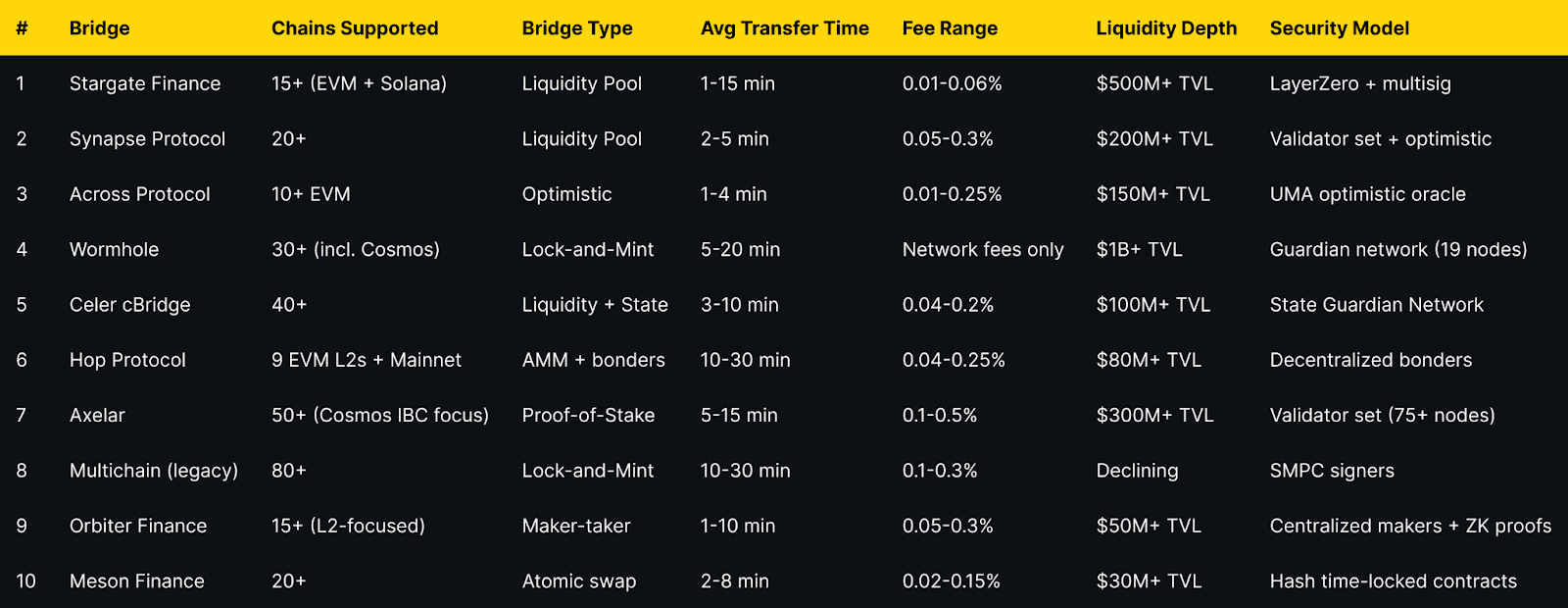
Top 10 Cross-Chain Bridges in 2025

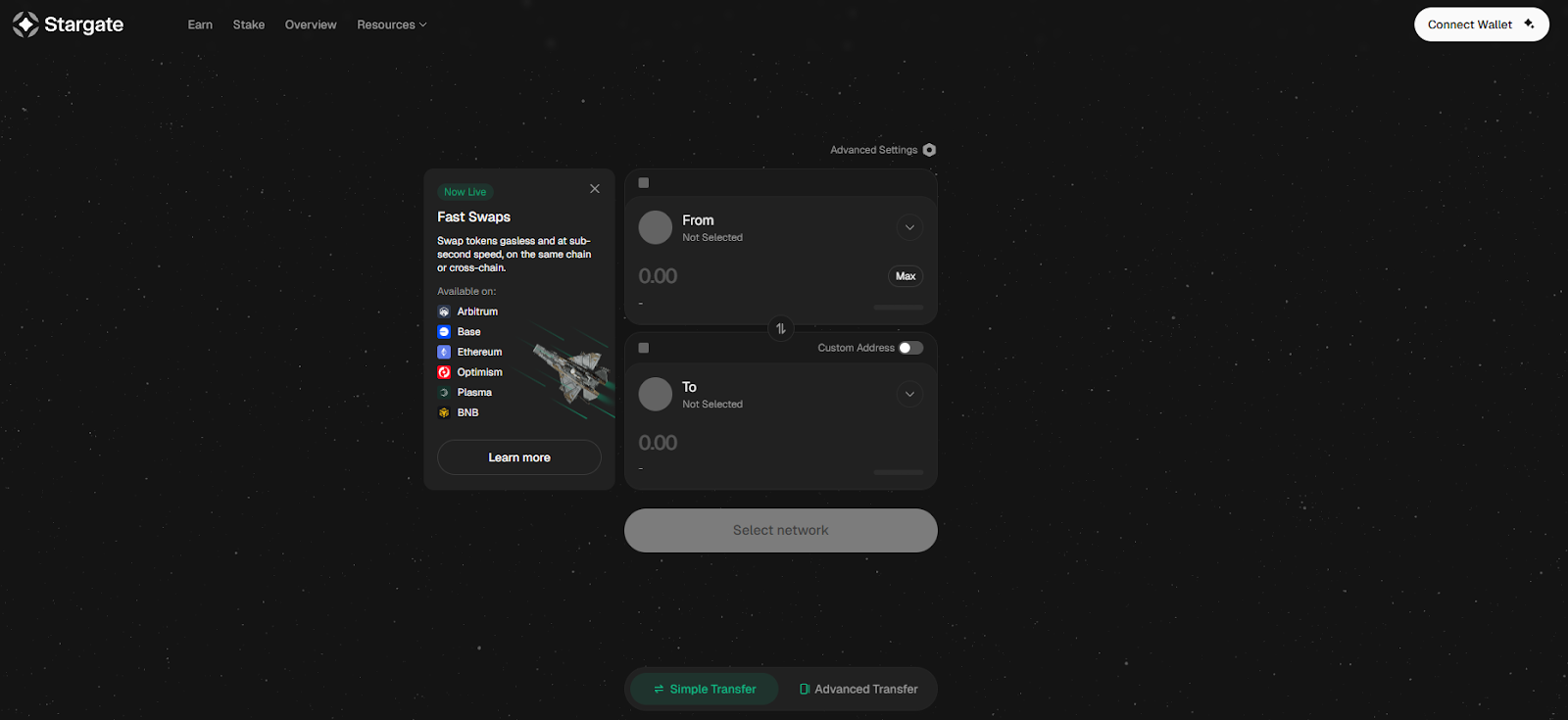
1. Stargate Finance — Best for Stablecoin Transfers

Why Use It: Stargate leverages LayerZero's messaging protocol to offer unified liquidity pools across 15+ chains, ensuring minimal slippage for USDC, USDT, and DAI transfers. Traders benefit from instant guaranteed finality and native asset transfers without wrapped tokens, making it ideal for large stablecoin movements between Ethereum, Arbitrum, Optimism, Polygon, BNB Chain, Avalanche, and Solana.

Best For: DeFi yield farmers, arbitrageurs moving stablecoins, traders rebalancing across chains, institutional desks.

Notable Features:

  • Unified liquidity pools eliminate fragmented routes
  • Delta algorithm prevents pool depletion and maintains balance
  • Native USDC/USDT support on major chains
  • Audited by Quantstamp and Zellic with $25M bug bounty

Consider If: You need to bridge non-stablecoin assets frequently (limited ERC-20 coverage) or require sub-1-minute finality (average 1-15 min).

Alternatives: Synapse Protocol, Across Protocol

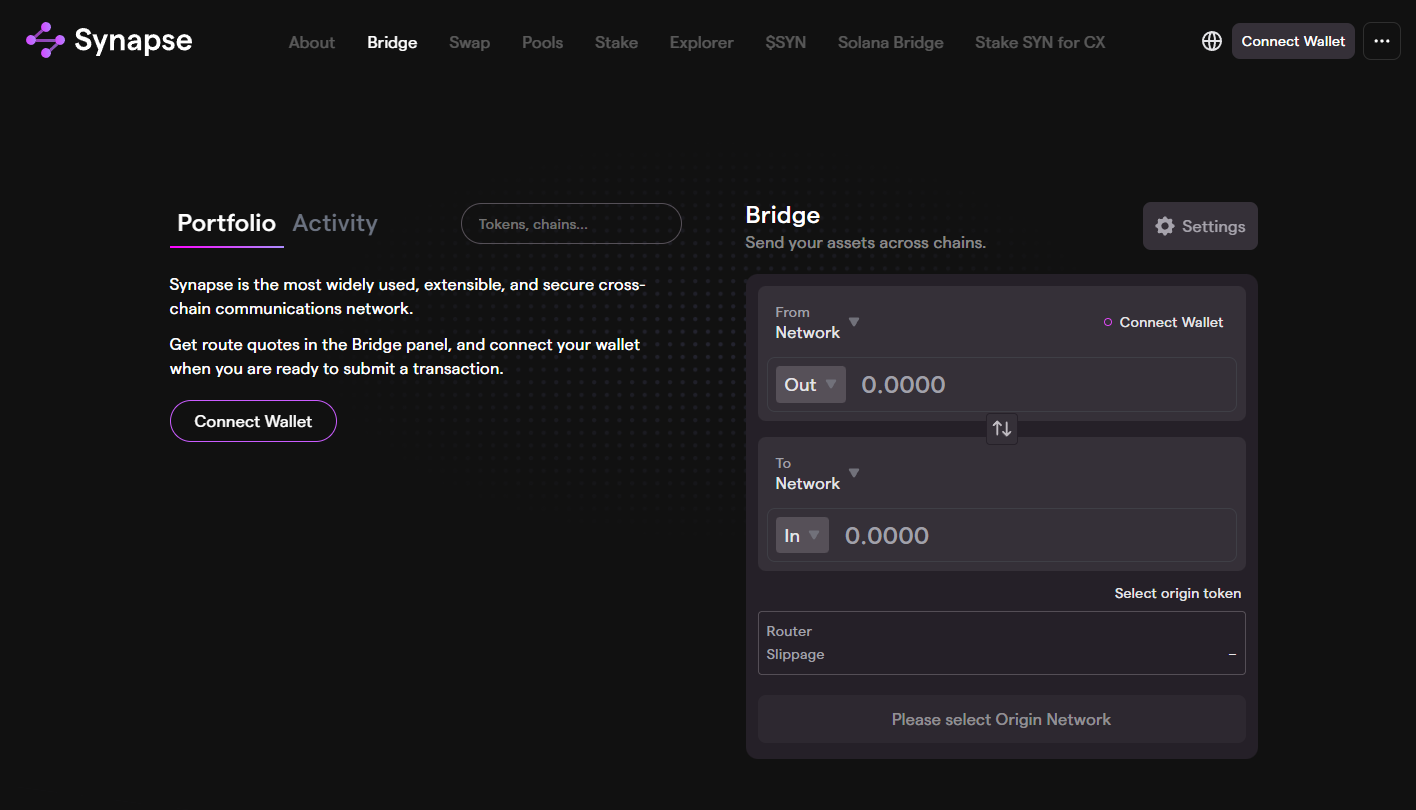
2. Synapse Protocol — Best for Speed Across 20+ Chains

Why Use It: Synapse combines liquidity pools with an optimistic verification model to deliver 2-5 minute average transfer times across 20+ networks, including Ethereum, Arbitrum, Optimism, Base, Polygon, BNB Chain, Avalanche, Fantom, Harmony, Moonbeam, and Aurora. Its nUSD and nETH synthetic assets enable efficient cross-chain swaps with competitive 0.05-0.3% fees, while the Synapse Bridge interface integrates one-click swaps for seamless UX.

Best For: Active traders prioritizing speed, multichain yield optimizers, NFT collectors moving assets, users bridging to emerging L2s.

Notable Features:

  • Sub-5-minute average transfers with optimistic verification
  • 20+ chain support including Base and zkSync Era
  • Integrated DEX for same-transaction swaps
  • Audited by Quantstamp, Certik, and Code4rena

Consider If: You move assets over $100K per transaction (liquidity depth varies by route) or need guaranteed finality before spending (optimistic delays possible).

Alternatives: Stargate Finance, Hop Protocol

3. Across Protocol — Best for Optimistic Bridging & Low Slippage

Why Use It: Across uses UMA's optimistic oracle to facilitate near-instant transfers with relayers fronting capital and settling on the destination chain within 1-4 minutes. Traders enjoy 0.01-0.25% fees—among the lowest for EVM bridges—and minimal slippage on major routes like Ethereum to Arbitrum, Optimism, Polygon, and Base. The protocol's capital efficiency makes it ideal for arbitrageurs and high-frequency movers.

Best For: Arbitrage traders, gas-sensitive users, high-frequency DeFi participants, cost-conscious portfolio managers.

Notable Features:

  • Optimistic verification for 1-4 minute transfers
  • Ultra-low fees (0.01-0.25%) with transparent pricing
  • Relayer network ensures liquidity without pool fragmentation
  • Audited by OpenZeppelin and ABDK with ongoing bug bounty

Consider If: You need non-EVM chain support (currently EVM-only) or prefer liquidity-pool-based bridges for guaranteed execution.

Alternatives: Stargate Finance, Synapse Protocol


4. Wormhole — Best for Cross-Ecosystem Bridging

Why Use It: Wormhole is a generalized messaging protocol supporting 30+ blockchains including Ethereum, Solana, Terra, BNB Chain, Avalanche, Polygon, Fantom, Celo, and Cosmos-based chains. Its Guardian network of 19 validators enables lock-and-mint bridging for tokens and NFTs with no protocol fees beyond network gas costs. The recent Wormhole Connect widget simplifies integrations for traders using multichain dApps.

Best For: Cross-ecosystem traders (EVM to Solana/Cosmos), NFT collectors, developers integrating bridging, users of Wormhole-native dApps.

Notable Features:

  • 30+ chain support including Solana, Terra, and Cosmos IBC
  • Generalized messaging enables cross-chain smart contract calls
  • Guardian network with 19 institutional validators
  • Audited by Neodyme, Kudelski, and OtterSec post-2022 exploit recovery

Consider If: You prioritize speed over security guarantees (5-20 min transfers) or need the deepest liquidity per route (Stargate/Synapse stronger for stables).

Alternatives: Axelar, Celer cBridge


5. Celer cBridge — Best for 40+ Chain Coverage

Why Use It: Celer cBridge supports 40+ blockchains with a hybrid liquidity pool and state channel architecture, enabling 3-10 minute transfers at 0.04-0.2% fees. Its State Guardian Network provides security for cross-chain state verification, while the cBridge UI offers direct wallet integrations and historical transaction tracking. Recent additions include support for zkSync Era, Linea, and Scroll.

Best For: Multichain portfolio managers, traders accessing niche L2s, users bridging to gaming-focused chains, cost-conscious cross-chain swappers.

Notable Features:

  • 40+ chains including zkSync, Linea, Mantle, and Scroll
  • State Guardian Network for optimistic cross-chain verification
  • Integrated liquidity mining for yield on idle bridge assets
  • Audited by Certik, PeckShield, and SlowMist

Consider If: You operate in mainland China (limited access) or need guaranteed sub-5-minute finality (optimistic delays on congested routes).

Alternatives: Synapse Protocol, Axelar


6. Hop Protocol — Best for Ethereum L2 Bridging

Why Use It: Hop specializes in fast transfers between Ethereum mainnet and nine major L2s (Arbitrum, Optimism, Base, Polygon, zkSync Era, Linea, Scroll, Gnosis Chain, and Polygon zkEVM) using AMM-style liquidity pools and decentralized bonders who provide instant liquidity. Traders pay 0.04-0.25% fees and experience 10-30 minute average transfers, with the option to earn yield by providing liquidity or running bonder nodes.

Best For: L2-first traders, Ethereum mainnet to L2 bridgers, liquidity providers, users seeking decentralized bridge architecture.

Notable Features:

  • Native L2 focus with support for 9 Ethereum L2s
  • AMM-based liquidity pools for transparent pricing
  • Decentralized bonder network reduces trust assumptions
  • Audited by Consensys Diligence and OpenZeppelin

Consider If: You need to bridge to non-EVM chains (Ethereum ecosystem only) or require sub-10-minute finality consistently (bonder availability varies).

Alternatives: Synapse Protocol, Across Protocol


7. Axelar — Best for Cosmos & Proof-of-Stake Security

Why Use It: Axelar is a Cosmos SDK-based interoperability network with 75+ validators securing cross-chain transfers via proof-of-stake consensus. Supporting 50+ chains with IBC-native bridging to Cosmos, Osmosis, Injective, and other app-chains, Axelar enables secure general message passing for complex cross-chain dApp interactions at 0.1-0.5% fees. Transfers settle in 5-15 minutes with high finality guarantees.

Best For: Cosmos ecosystem traders, institutional users prioritizing security, developers building cross-chain dApps, users requiring verifiable bridge security.

Notable Features:

  • 75+ decentralized validators with proof-of-stake security
  • Native IBC support for Cosmos ecosystem chains
  • General Message Passing (GMP) for cross-chain smart contracts
  • Audited by NCC Group, OtterSec, and Certik

Consider If: You prioritize speed over security (5-15 min slower than optimistic bridges) or need the lowest fees per transaction (0.1-0.5% higher than Across/Stargate).

Alternatives: Wormhole, Celer cBridge


8. Multichain — Best for 80+ Chain Access (Use With Caution)

Why Use It: Multichain (formerly Anyswap) offers the broadest chain coverage with 80+ supported networks using SMPC (Secure Multi-Party Computation) signers for lock-and-mint bridging. While historically popular for accessing niche chains like Moonriver, Kava, and Metis, the protocol faced security concerns in mid-2023 related to validator key management. Fees range from 0.1-0.3% with 10-30 minute transfer times.

Best For: Users bridging to obscure chains unavailable elsewhere, legacy dApp integrations, traders willing to accept elevated risk for maximum coverage.

Notable Features:

  • 80+ chain support including niche L1s and L2s
  • Long operational history since 2020
  • Cross-chain router for multi-hop transactions
  • SMPC validator network (security incidents reported)

Consider If: Security is your top priority (2023 exploit drained $126M; ongoing validator concerns) or you need active development and transparent disclosures.

Alternatives: Celer cBridge, Axelar


9. Orbiter Finance — Best for L2-to-L2 Transfers

Why Use It: Orbiter uses a maker-taker model where centralized makers provide instant liquidity for L2-to-L2 transfers across 15+ chains including Arbitrum, Optimism, zkSync Era, StarkNet, Linea, Base, and Scroll. Transfers complete in 1-10 minutes at 0.05-0.3% fees, with ZK-proof verification planned for enhanced security. The interface is optimized for mobile and shows real-time maker liquidity status.

Best For: L2-native traders, StarkNet and zkSync users, mobile-first users, traders needing fast L2 exits.

Notable Features:

  • Specialized L2-to-L2 focus with 15+ network support
  • 1-10 minute average transfers via maker liquidity
  • ZK-proof verification roadmap for trustless bridging
  • Real-time liquidity tracking and maker status

Consider If: You prefer fully decentralized bridge models (makers are centralized) or need mainnet-to-L2 bridging exclusively (better alternatives exist).

Alternatives: Hop Protocol, Synapse Protocol


10. Meson Finance — Best for Atomic Swap Security

Why Use It: Meson implements hash time-locked contracts (HTLCs) for trustless atomic swaps across 20+ chains, eliminating validator risk and bridge contract vulnerabilities. Traders benefit from 2-8 minute transfers at 0.02-0.15% fees with cryptographic guarantees that transactions either complete or refund automatically. The protocol is audited by SlowMist and maintains zero-exploit history since launch.

Best For: Security-conscious traders, users burned by bridge exploits, atomic swap enthusiasts, traders moving mid-sized amounts ($1K-$50K).

Notable Features:

  • HTLC-based atomic swaps for trustless bridging
  • Zero-exploit record with cryptographic security guarantees
  • 20+ chain support including major EVM and L2s
  • 0.02-0.15% fees competitive with optimistic bridges

Consider If: You need to bridge large amounts over $100K (liquidity depth limited) or require sub-2-minute finality (HTLC setup adds overhead).

Alternatives: Across Protocol, Stargate Finance


Decision Guide: Best By Use Case

  • Stablecoin arbitrage & DeFi yield: Stargate Finance for deepest USDC/USDT liquidity
  • Fastest cross-chain execution: Synapse Protocol or Across Protocol for sub-5-minute transfers
  • Ethereum L2 specialists: Hop Protocol for native L2 bridging with decentralized bonders
  • Cross-ecosystem traders (EVM + Solana/Cosmos): Wormhole or Axelar for broadest coverage
  • Lowest fees & slippage: Across Protocol for optimistic bridging at 0.01-0.25%
  • Maximum chain coverage: Celer cBridge (40+) or Multichain (80+ with caution)
  • L2-to-L2 focus (zkSync, StarkNet, Arbitrum): Orbiter Finance for maker-taker speed
  • Security-first & trustless: Meson Finance for atomic swap guarantees
  • Institutional security requirements: Axelar for proof-of-stake validator model
  • Mobile-optimized bridging: Orbiter Finance or Synapse Protocol

How to Choose the Right Cross-Chain Bridge (Checklist)

  • [ ] Verify chain support — Confirm both source and destination chains are supported with active liquidity
  • [ ] Check fee transparency — Review total costs including bridge fees, gas, and potential slippage before confirming
  • [ ] Assess security model — Understand validator architecture (optimistic, proof-of-stake, HTLC, multisig) and audit history
  • [ ] Review transfer speed requirements — Match bridge speed (1-30 min) to your trading strategy urgency
  • [ ] Confirm liquidity depth — For large transfers ($50K+), verify pool TVL and recent volume on your specific route
  • [ ] Test with small amounts first — Always bridge test transactions ($10-$100) before moving significant capital
  • [ ] Verify destination address format — Double-check address compatibility and network selection to avoid irreversible losses
  • [ ] Monitor bridge status pages — Check for maintenance, paused routes, or congestion warnings before transacting
  • [ ] Understand finality guarantees — Know if transfers are optimistic (reversible), instant (relayer-based), or cryptographically final
  • [ ] Review regional restrictions — Confirm access from your jurisdiction (most bridges global; check compliance)
  • [ ] Check exploit history — Research past security incidents and protocol responses (Wormhole 2022, Multichain 2023)
  • 🚩 Red flags: Bridges with undisclosed validator sets, paused routes without status updates, or fees significantly higher than quoted

Use Token Metrics With Any Cross-Chain Bridge

Maximize your cross-chain trading strategy by combining bridge infrastructure with Token Metrics intelligence:

  • AI Ratings screen 6,000+ tokens across chains to identify quality assets before bridging capital
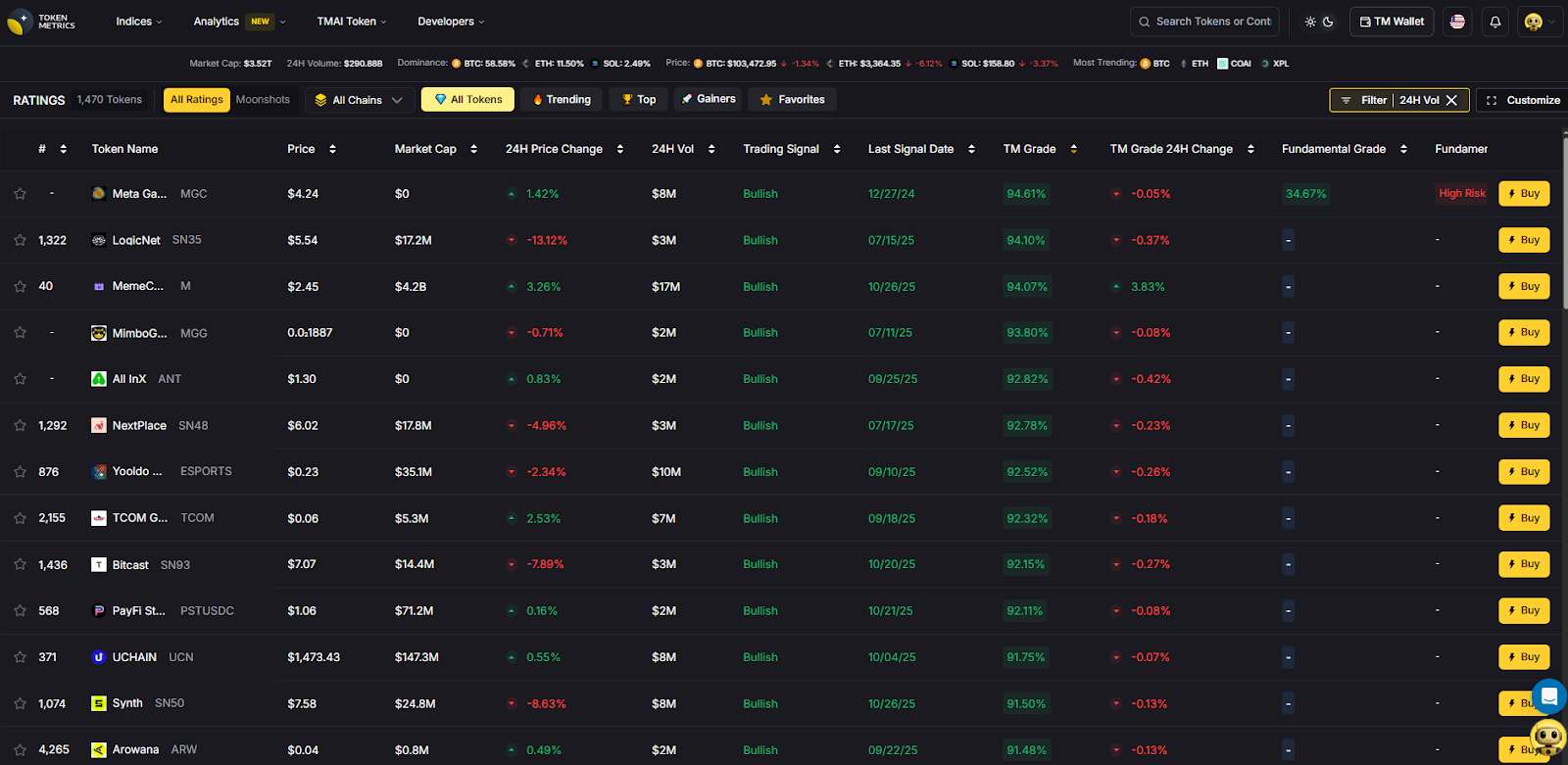
  • Narrative Detection spots emerging themes (e.g., Solana DeFi, Base ecosystem) to inform which chains to bridge into
  • Portfolio Optimization balances risk across chains and suggests rebalancing targets that justify bridge costs
  • Alerts & Signals time bridge transactions around momentum shifts, reducing exposure to unfavorable price action mid-transfer

Workflow: Research asset quality with AI Ratings → Select optimal bridge for your route → Execute transfer → Monitor destination chain with real-time alerts.

Start your free trial to screen assets and time bridge transactions with AI-powered intelligence.

Security & Compliance Tips

  • Verify official URLs — Always access bridges through bookmarked official domains; phishing sites are common
  • Use hardware wallets — Sign bridge transactions with Ledger/Trezor for cold-storage protection
  • Check token approvals — Revoke unlimited approvals after bridging using tools like Revoke.cash
  • Monitor bridge exploits — Follow protocol Twitter accounts and status pages for real-time security alerts
  • Understand validator risks — Multisig and SMPC bridges concentrate risk; optimistic and PoS models distribute trust
  • Avoid bridging during congestion — High gas fees and slippage increase during network congestion; wait for off-peak times
  • Store bridge receipts — Save transaction hashes and screenshots for tax reporting and dispute resolution
  • Test cross-chain contract calls — If using advanced features (e.g., Axelar GMP), test with minimal amounts first
  • Review liquidity provider risks — Impermanent loss and smart contract risk apply to bridge LPs; understand before depositing
  • Know refund procedures — Understand each bridge's failed transaction refund process and timeframes

This article is for research and educational purposes, not financial advice. Conduct your own security due diligence before bridging assets.


Beginner Mistakes to Avoid

  • Bridging to the wrong network — Always triple-check destination chain selection; wrong-network transfers are often irreversible
  • Ignoring slippage on large transfers — Pools with <$10M TVL may experience 1-5% slippage on $100K+ transactions
  • Bridging illiquid tokens — Ensure destination chain has DEX liquidity before bridging obscure tokens
  • Not accounting for gas on destination chain — Bridge enough native tokens (ETH, MATIC, etc.) to pay for transactions on arrival
  • Trusting wrapped tokens blindly — Verify wrapped token contracts are legitimate before swapping (scam tokens common)
  • Bridging during protocol upgrades — Avoid bridging when protocols announce maintenance windows or upgrades
  • Falling for "instant bridge" scams — No legitimate bridge offers instant finality across all chains; be skeptical of unrealistic claims
  • Ignoring bridge insurance options — Services like Nexus Mutual offer bridge exploit coverage for eligible protocols

FAQs

What is a cross-chain bridge?
 A cross-chain bridge is a protocol that enables asset transfers between different blockchains by locking tokens on the source chain and minting or unlocking equivalent tokens on the destination chain. Bridges use various security models including lock-and-mint, liquidity pools, optimistic verification, and atomic swaps to facilitate interoperability.

Are cross-chain bridges safe?
 Bridge security varies significantly by architecture and track record. Bridges secured by proof-of-stake validators (Axelar) or atomic swaps (Meson) offer stronger security than multisig or SMPC models. Historical exploits affecting Wormhole ($325M in 2022) and Multichain ($126M in 2023) highlight risks. Always verify audit reports, exploit history, and validator transparency before bridging significant amounts.

How much do cross-chain bridges cost?
 Bridge fees typically range from 0.01% to 0.5% of transfer amount, plus source and destination chain gas fees. Stargate and Across charge 0.01-0.06% for stablecoins, while Axelar charges 0.1-0.5% for broader coverage. Total costs including gas often range from $5-$50 for typical transactions, but can exceed $100 during Ethereum mainnet congestion.

Can I bridge any token between any chains?
 No—token bridging depends on protocol support and liquidity availability. Major tokens (USDC, USDT, ETH, WBTC) have deep liquidity on most bridges, while obscure tokens may only bridge via wrapped versions or not at all. Always verify token support on both source and destination chains before attempting transfers.

How long do cross-chain bridge transfers take?
 Transfer times range from 1 minute (Across optimistic transfers) to 30+ minutes (Hop during congestion or Multichain on slower chains). Average speeds: Across 1-4 min, Synapse 2-5 min, Stargate 1-15 min, Wormhole 5-20 min. Optimistic bridges are fastest but may delay finality during disputes; lock-and-mint bridges prioritize security over speed.

Do I need native tokens on the destination chain before bridging?
 Not for the bridge transaction itself, but you'll need native tokens (ETH on Ethereum, MATIC on Polygon, etc.) to pay gas for any subsequent transactions on the destination chain. Some bridges offer small gas token bridging or faucet integrations, but plan to bridge sufficient native tokens alongside your primary assets.

What happens if my bridge transaction fails?
 Failed transactions typically result in automatic refunds to the source address within 24-72 hours, though timelines vary by protocol. Optimistic bridges may take longer during dispute periods. Always save transaction hashes and monitor bridge status pages for updates. Contact protocol support via Discord or Telegram for transactions stuck beyond normal timeframes.

Can I use bridges for NFTs or only fungible tokens?
 Most bridges focus on fungible tokens (ERC-20, SPL, etc.), but several support NFT bridging. Wormhole enables NFT transfers across 30+ chains, while specialized solutions like Axelar and Celer support NFT metadata preservation. NFT bridges often charge fixed fees ($5-$20) regardless of NFT value and may take longer than fungible token transfers.


Conclusion + Related Reads

Selecting the right cross-chain bridge depends on your priorities: Stargate Finance delivers the deepest stablecoin liquidity for DeFi-focused traders, Synapse Protocol offers the fastest execution across 20+ chains, and Across Protocol provides the lowest fees for cost-conscious arbitrageurs. Security-first users should consider Meson Finance for atomic swap guarantees or Axelar for institutional-grade proof-of-stake validation. Always test with small amounts, verify destination addresses, and monitor bridge status pages before moving significant capital.

Related Reads:

Build Smarter Crypto Apps &
AI Agents in Minutes, Not Months
Real-time prices, trading signals, and on-chain insights all from one powerful API.
Grab a Free API Key
About Token Metrics
Token Metrics: AI-powered crypto research and ratings platform. We help investors make smarter decisions with unbiased Token Metrics Ratings, on-chain analytics, and editor-curated “Top 10” guides. Our platform distills thousands of data points into clear scores, trends, and alerts you can act on.
30 Employees
analysts, data scientists, and crypto engineers
Daily Briefings
concise market insights and “Top Picks”
Transparent & Compliant
Sponsored ≠ Ratings; research remains independent
Want Smarter Crypto Picks—Free?
See unbiased Token Metrics Ratings for BTC, ETH, and top alts.
Thank you! Your submission has been received!
Oops! Something went wrong while submitting the form.
 No credit card | 1-click unsubscribe
Token Metrics Team
Token Metrics Team

Recent Posts

Research

10 Costly Crypto Investing Mistakes and How Token Metrics AI Indices Help You Avoid Them

Token Metrics Team
9

Every experienced cryptocurrency investor has battle scars—stories of devastating losses that could have been avoided with better knowledge, discipline, or tools. A survey of crypto investors reveals that over 70% have lost money on at least one investment, with many experiencing losses exceeding 50% of their initial capital. These losses are not inevitable results of crypto volatility—they often stem from preventable mistakes that trap both new and experienced investors alike.

The good news is that learning from the mistakes of others is far less expensive than learning from your own. Even better, modern AI-powered tools like Token Metrics indices can systematically help you avoid the most common and costly errors in the crypto markets. This comprehensive guide examines the ten most devastating mistakes crypto investors make and reveals how Token Metrics’ artificial intelligence addresses each challenge, helping to protect your capital while optimizing returns.

Mistake #1: Chasing Hype and FOMO (Fear of Missing Out)

The Problem
Cryptocurrency markets are notorious for explosive rallies that create intense FOMO. When a token surges 500% in a week, investors panic about missing out on gains. Social media amplifies this anxiety with posts showcasing enormous profits and predictions of further moonshots. Overwhelmed, investors often buy near peaks, only to watch prices fall rapidly.

This cycle has repeated across many crypto assets. Dogecoin’s 2021 rally is a prime example, where many bought near the top and faced major losses. The psychological trap is powerful; our brains fear missed opportunities, and 24/7 crypto markets mean constant exposure to perceived missed chances.

The Token Metrics Solution
Token Metrics AI evaluates cryptocurrencies using objective metrics—technical indicators, fundamental strength, network activity, and risk-adjusted potential. The algorithms do not experience FOMO, panic, or greed.

During extreme rallies, Token Metrics’ AI analyzes whether price movements are supported by strong fundamentals or are unsustainable speculation. Indices will rebalance to manage profits as prices grow extended, and a token’s absence is itself a signal that sustainable value has not been identified by the AI. Following Token Metrics indices helps you sidestep the FOMO trap and invest based on data, not hype.

Get Started For Free

Mistake #2: Inadequate Diversification and Over-Concentration

The Problem
Many investors concentrate heavily in one or a few tokens—whether out of conviction, convenience, or time limitations. This leaves portfolios vulnerable to project-specific risks. The collapse of Terra/LUNA and FTX’s FTT token are examples where concentration contributed to severe losses.

Being over-exposed to a single asset amplifies unique risks and reduces the protective benefits of diversification.

The Token Metrics Solution
Token Metrics indices are built to diversify across multiple cryptocurrencies, vetted for different projects, technologies, and use cases. The AI routinely analyzes correlations to maintain genuine diversification, not just a basket of highly correlated assets.

Large-cap indices may hold 10–15 established cryptos, while broader indices cover 20–30 tokens. This diversification means a single failure has limited impact. Through Token Metrics indices, you gain professional-level portfolio diversity without the need for complex analysis or manual research.

Mistake #3: Falling for Scams and Fraudulent Projects

The Problem
Crypto’s open and global nature attracts fraudulent projects: rug pulls, Ponzi schemes, fake teams, plagiarized whitepapers, and social engineering attacks. Even sophisticated scams often have professional websites and social presence, making them difficult to identify. Lack of due diligence can result in substantial losses.

The Token Metrics Solution
Token Metrics AI executes rigorous vetting: analyzing code quality, verifying team credentials, monitoring community sentiment, evaluating tokenomics, and tracking exchange listings. Only projects meeting high standards are included in indices, and continuous monitoring flags and removes projects with emerging red flags. While no tool is perfect, this process significantly reduces scam exposure compared to manual research.

Mistake #4: Emotional Decision-Making During Volatility

The Problem
Crypto volatility can trigger panic selling or risk-chasing behavior. Academic research shows emotional investors underperform systematic strategies by wide margins. The crypto market’s 24/7 cycle exacerbates impulsiveness.

The Token Metrics Solution
Token Metrics AI remains disciplined during swings. Whether markets crash or rally, the system evaluates conditions based on data and follows consistent, predefined rules. Systematic approaches sidestep the psychological traps that often reduce returns and allow investors to benefit from stable, rules-driven portfolio management.

Mistake #5: Ignoring Risk Management and Position Sizing

The Problem
Crypto investors sometimes allocate equally to all holdings or over-weight speculative assets, ignoring fundamental risk management. Exposures that are too large to riskier tokens lead to severe portfolio drops if those assets decline.

The Token Metrics Solution
Token Metrics indices apply advanced risk management: adjusting position sizes based on risk factors like market capitalization, volatility, and fundamental strength. High-risk assets receive smaller allocations, while larger, more stable projects get higher weights. Maximum concentration limits further ensure disciplined diversification.

Get Started For Free

Mistake #6: Poor Timing and Attempting to Time the Market

The Problem
Many try to buy at bottoms and sell at tops—an approach even professional traders struggle with. Retail investors, in particular, often buy during euphorias and sell during panics, missing gains and amplifying losses.

The Token Metrics Solution
Token Metrics indices favor systematic strategies over timing perfection. The AI blends technical, fundamental, and sentiment metrics to gradually adjust portfolio exposures, avoiding binary trades. This adaptive approach helps capture uptrends and manage risk, without attempting impossible precision.

Mistake #7: Neglecting to Rebalance Portfolios

The Problem
Over time, portfolios drift as certain tokens outperform, creating dangerous concentrations. Many investors resist rebalancing due to psychological biases—selling winners feels wrong, and buying underperformers feels risky.

The Token Metrics Solution
Token Metrics indices enforce systematic rebalancing (weekly, monthly, or quarterly) based on predefined triggers. This ensures disciplined, data-driven adjustments and automates the buy-low, sell-high process for investors.

Get Started For Free

Mistake #8: Overtrading and Excessive Portfolio Turnover

The Problem
Frequent buying and selling increases transaction fees, sometimes triggers unfavorable tax events, and can worsen results through poor timing. Overtrading is common in 24/7 crypto markets and often destroys value.

The Token Metrics Solution
Token Metrics indices use deliberate, criteria-based rebalancing—only trading when data supports meaningful improvement. This minimizes unnecessary costs while adapting portfolios to market changes with discipline.

Mistake #9: Inadequate Research and Due Diligence

The Problem
Thorough cryptocurrency research is time-intensive and requires cross-disciplinary expertise, which most individual investors lack. Poor research leads to flawed investments and increased risk exposure.

The Token Metrics Solution
Token Metrics invests in comprehensive due diligence. Its team of analysts and data scientists combines institutional-grade research with continuous AI analysis. Indices include tokens only after deep research and ongoing review, benefiting individual investors with professional-level insights.

Mistake #10: Investing Without Clear Strategy or Plan

The Problem
Investing without clear objectives, time horizons, or philosophies results in random actions and reactive decision-making. Without a framework, investors lack guiding principles and cannot measure progress reliably.

The Token Metrics Solution
Each Token Metrics index has a clear methodology, benchmarks, and risk parameters. By aligning selection with your own goals and risk tolerance, investors benefit from structured, systematic strategies and the discipline required to pursue successful long-term outcomes.

Building Your Success Story with Token Metrics

Starting Your Journey Right
Begin by identifying the mistakes most likely to affect you—are you prone to FOMO, impulse trades, or research struggles? Token Metrics AI Indices are explicitly designed to counter these weaknesses and provide a systematic alternative.

Implementing Your Strategy
Implement Token Metrics–based strategies aligned to your investment goals. Begin with broad indices for core exposure and add satellite positions reflecting your specific interests. Consistency over a 6–12 month period builds discipline, while patient adherence to your plan supports long-term success.

Learning and Evolving
Explore Token Metrics educational resources to improve your understanding of markets and strategies. Focus on quarterly reviews of your portfolio’s progress rather than frequent checks, which might spark emotional reactions.

Conclusion: Choosing Success Over Costly Mistakes

The crypto market offers major opportunities, but costly mistakes are common. Discipline, research, and systematic strategies make the difference. Token Metrics AI Indices provide a framework and professional research to help avoid the most common pitfalls.

You can choose between learning from the errors of others or repeating those costly lessons personally. By leveraging artificial intelligence, deep research, and systematic discipline with Token Metrics, you transform your crypto investing approach into a strategic, data-driven process.

Success in crypto is achievable for those who use robust tools, avoid emotional pitfalls, and maintain consistency through volatility. With Token Metrics AI Indices, you have tailored resources to join that group.

Discover Crypto Gems with Token Metrics AI

Token Metrics uses AI-powered analysis to help you uncover profitable opportunities in the crypto market.

Get Started For Free

What is Token Metrics?

Token Metrics is a crypto analytics platform that uses artificial intelligence and expert research to provide ratings, indices, and investment tools. It helps users analyze cryptocurrencies systematically and make data-driven decisions.

How do Token Metrics AI Indices function?

Token Metrics AI Indices automatically select, weight, and rebalance portfolios of cryptocurrencies based on both quantitative and qualitative analysis. They use predefined rules to ensure discipline and comprehensive risk management across the portfolio.

What risks do Token Metrics Indices help reduce?

Token Metrics indices address risks such as overconcentration, inadequate diversification, emotional trading, exposure to scams, poor timing, insufficient rebalancing, and lack of research—offering systematic solutions to each.

Can I customize Token Metrics AI Indices?

While Token Metrics indices follow set methodologies, users can select indices that align with their investment goals, risk tolerance, and preferred crypto sectors, tailoring their strategy for their own objectives.

Is Token Metrics a replacement for investment advice?

No, Token Metrics provides analytical tools and systematic frameworks for research. It does not offer individualized investment advice and all investment decisions should be made independently, taking personal circumstances into account.

Disclaimer

This content is for informational and educational purposes only and does not constitute investment advice, endorsement, or a solicitation. Cryptocurrency markets are volatile and subject to risk. Always conduct your own due diligence and consult with a qualified advisor before making investment decisions. Token Metrics does not guarantee results or profits.

Get Started For Free

Research

Mastering Crypto Portfolio Construction: Advanced Strategies with Token Metrics AI Indices

Token Metrics Team
6

The cryptocurrency landscape has evolved dramatically, transforming from speculative beginnings to a structured and legitimate asset class. As participation grows, the challenges of managing risk and achieving consistent returns remain at the forefront for digital asset investors. The key to sustained success often lies in rigorous strategy, clear discipline, and the careful use of advanced analytical tools.

Token Metrics AI Indices offer a systematic, research-driven approach for constructing and managing crypto portfolios. Yet, to fully benefit from these indices, it is essential to understand capital allocation, risk management, strategic diversification, and the necessity to adapt to ever-changing market dynamics. This guide explores advanced techniques for optimizing crypto portfolios using Token Metrics AI Indices, detailing practical frameworks and considerations for long-term digital asset investing.

Understanding Your Investment Foundation

Defining clear investment objectives is fundamental. Some investors seek long-term wealth accumulation, others focus on generating income, capital preservation, or aggressive growth. Each objective demands a tailored approach: long-term investors may prefer indices with strong fundamentals and broader exposure, while those aiming for income could focus on indices facilitating regular rebalancing. Token Metrics provides indices suited to a variety of goals, ensuring strategies align with desired outcomes through informed selection.

Risk tolerance extends beyond emotional comfort; it encompasses financial capacity and investment duration. Variables such as age, savings, income stability, drawdown limits, and liquidity needs must factor into all risk assessments. The wide breadth of Token Metrics indices—from conservative large-cap to dynamic small-cap growth—enables a spectrum of strategies tailored to individual tolerance and financial circumstances.

Deciding how much of your overall investment portfolio to allocate to crypto assets is another crucial step. Conservative approaches allocate 1–3%, moderate risk-takers may target 5–7%, while aggressive strategies could reach 10–15%. Due to the volatility of cryptocurrencies, it is important to allocate only capital that fits your risk profile and financial horizon, regardless of the sophistication of index methodologies.

Get Started For Free

The Core-Satellite Portfolio Construction Strategy

The core-satellite framework from traditional investing translates powerfully to crypto. Core holdings—typically 60–80% of a crypto allocation—offer diversified, stable exposure, primarily via established assets. Token Metrics’ large-cap indices are commonly chosen for the core due to their focus on proven cryptocurrencies and systematic rebalancing, supporting stability and steady market participation.

Satellite positions, comprising the remaining 20–40%, introduce targeted high-return potential by emphasizing emerging sectors, momentum-driven assets, or thematic innovations such as DeFi, NFTs, or Layer 2s. These require regular monitoring and agility as sector leadership shifts in evolving markets. A disciplined balance—whether 80/20, 70/30, or 60/40—reflects personal risk appetites and is crucial for managing upside opportunity and risk exposure. Vigilant rebalancing keeps this allocation in line with strategic objectives, capturing gains while controlling concentration risk.

Advanced Index Selection and Diversification

Optimal portfolio construction demands more than simply holding multiple indices. Token Metrics indices vary by strategy: some focus on large-cap stability, others on mid-cap growth, momentum trading, or sector rotation. Combining complementary—not redundant—strategies creates true diversification and robust return profiles.

Utilizing correlation analysis, investors can identify indices whose underlying assets move independently or inversely, maximizing the protective benefits of diversification. Token Metrics’ analytics help surface such relationships, which should be reviewed quarterly as market structure and narratives evolve. Further, consideration of indices’ rebalancing frequency—daily, weekly, monthly, or quarterly—impacts trading activity, tax implications, and alignment with individual account structures. Balancing the frequency and style of index management supports both risk-adjusted returns and operational efficiency.

Managing Risk in Crypto Index Portfolios

Risk can accumulate silently if multiple indices overlap heavily in key holdings. Employing concentration limits (e.g., no single asset exceeding a set percentage of total exposure) and regularly reviewing aggregate positions via Token Metrics’ transparency tools is vital for material risk control.

Dynamic allocation—shifting between aggressive and conservative indices based on volatility metrics—provides another layer of protection. For example, higher market turbulence might justify repositioning toward large-cap indices or incorporating stablecoins and cash. Meanwhile, strategies to limit drawdowns, like portfolio-level stop-losses, scheduled rebalancing to defensive allocations, and maintaining liquidity buffers, all help safeguard portfolio value through market declines.

Maximizing Portfolio Performance and Efficiency

Market cycles present opportunities and challenges for index strategy. Recognizing phases of bull markets, bear corrections, and accumulation zones can inform the strategic allocation between aggressive and conservative indices. Sector rotation—adjusting satellite allocations to favor sectors with emergent strength—further leverages market dynamics. Token Metrics’ sector-specific analytics and indices help identify and track leading segments for tactical positioning.

Regular rebalancing, whether triggered by time or threshold, enforces a structured ‘buy low, sell high’ discipline—keeping the portfolio closely aligned with long-term objectives. Considering tax implications, investors often favor less frequent rebalancing in taxable accounts or utilize retirement accounts for more active strategies. Token Metrics’ reporting tools facilitate record-keeping and process transparency for both tax efficiency and compliance.

Discover Crypto Gems with Token Metrics AI

Token Metrics uses AI-powered analysis to help you uncover profitable opportunities in the crypto market.

Get Started For Free

Frequently Asked Questions (FAQ)

What are Token Metrics AI Indices and how do they work?

Token Metrics AI Indices are systematically constructed portfolios selected and managed using artificial intelligence and quantitative analysis. They aggregate a diversified set of cryptocurrencies aligned with specific themes or strategies and are designed to streamline portfolio construction and ongoing management for a variety of investor goals.

How do I determine which Token Metrics index is best for my investment profile?

Selection is guided by your investment goals, risk tolerance, time horizon, and desired crypto exposure. Token Metrics provides indices tailored to differing strategies—from conservative to aggressive—paired with comprehensive analytics to support informed choices that match your individual profile.

How often should I rebalance a crypto index portfolio?

Rebalancing frequency can depend on index methodologies, personal tax considerations, and account type. Quarterly or semi-annual rebalancing is common, though some strategies or tax-sheltered accounts may benefit from more frequent adjustments. Always track deviations from target allocations to ensure portfolio discipline.

What are the key risk management practices for crypto indices?

Best practices include setting position and concentration limits, diversifying across uncorrelated indices, dynamically adjusting allocations during volatile periods, and employing routine performance and scenario reviews using analytics like those provided by Token Metrics. Regular monitoring ensures risks are identified and mitigated proactively.

Can I use Token Metrics indices in tax-advantaged or retirement accounts?

Yes, pairing Token Metrics indices with tax-advantaged accounts can enhance strategies. Such accounts enable more active management and frequent rebalancing without the immediate tax implications seen in regular accounts. Always consult relevant guidance for your local jurisdiction when making account or allocation decisions.

Disclaimer

The information provided in this guide is for educational and informational purposes only. It is not intended as financial, investment, or tax advice. Cryptocurrency and digital assets are subject to volatility and risk and may not be suitable for every investor. Always perform your own research and seek the counsel of a qualified professional before making any investment decisions.

Get Started For Free

Research

From Traditional Index Funds to Crypto: Why Token Metrics AI Indices Are the Smart Choice for Digital Asset Investors

Token Metrics Team
6

The Index Fund Revolution Comes to Cryptocurrency

When John Bogle founded Vanguard and introduced the first index mutual fund in 1975, Wall Street laughed. The idea that a passively managed fund tracking market indices could outperform expensive, actively managed portfolios seemed absurd. Nearly five decades later, index funds have revolutionized investing, managing trillions of dollars and consistently outperforming the majority of active managers.

Today, a similar revolution is unfolding in cryptocurrency markets. Token Metrics, a pioneering AI-powered crypto analytics platform, is bringing the proven principles of index investing to digital assets—but with a powerful 21st-century upgrade: artificial intelligence. This transformation addresses one of the biggest challenges facing crypto investors: how to build winning portfolios in a market with over 20,000 tokens, extreme volatility, and rapid technological change.

Why Traditional Crypto Investing Methods Fall Short

The Information Overload Problem

The average cryptocurrency investor faces an overwhelming challenge. To make informed decisions, they theoretically need to analyze project whitepapers and technical documentation, evaluate development team credentials and track records, monitor GitHub repositories for code quality and activity, track community sentiment across multiple social platforms, understand complex tokenomics and supply mechanics, follow regulatory developments across multiple jurisdictions, and assess competition and market positioning.

Performing this level of due diligence for even 10-20 cryptocurrencies requires dozens of hours weekly. For most investors with full-time jobs and other responsibilities, this depth of analysis is simply impossible. The result? Many investors rely on social media hype, influencer recommendations, or gut feelings—approaches that often lead to poor outcomes.

The Emotional Trading Trap

Cryptocurrency markets operate 24/7, with price movements that can exceed 20-30% in a single day. This constant volatility triggers powerful emotional responses. When prices surge, fear of missing out (FOMO) drives investors to buy near peaks. When prices crash, panic selling locks in losses at the worst possible time.

Studies in behavioral finance consistently demonstrate that emotional decision-making destroys investment returns. Yet the structure of crypto markets—with their relentless volatility and constant news flow—makes emotional discipline extraordinarily difficult to maintain.

The Scam and Fraud Risk

The decentralized, largely unregulated nature of cryptocurrency markets creates opportunities for fraudulent projects. Rug pulls, where developers abandon projects after raising funds, exit scams involving fake teams and plagiarized whitepapers, pump-and-dump schemes, and sophisticated phishing attacks targeting crypto investors are unfortunately common.

Distinguishing legitimate innovative projects from elaborate scams requires expertise that most retail investors lack. A single mistake can result in total loss of capital with little legal recourse.

The Rebalancing Challenge

Even investors who successfully build diversified crypto portfolios face the ongoing challenge of rebalancing. As different cryptocurrencies perform differently, portfolio allocations drift from their intended targets. Bitcoin might grow from 40% to 60% of your portfolio, while a promising altcoin shrinks from 10% to 2%.

Deciding when and how to rebalance involves complex tradeoffs. Rebalancing too frequently generates transaction costs and potential tax consequences. Rebalancing too infrequently allows portfolios to become concentrated in specific assets, defeating the purpose of diversification.

The Token Metrics Solution: AI-Powered Index Investing

What Makes Token Metrics Different

Token Metrics has developed cryptocurrency indices that combine the proven benefits of traditional index investing with cutting-edge artificial intelligence. Unlike simple market-cap weighted indices that mechanically track the largest cryptocurrencies, Token Metrics indices use sophisticated machine learning algorithms to identify high-quality projects and optimize portfolio construction.

The platform processes data from over 6,000 cryptocurrencies and NFT projects, analyzing multiple factors simultaneously including technical indicators and chart patterns, fundamental metrics like adoption and network activity, code quality and development velocity, sentiment analysis from social media and news, on-chain data revealing wallet behavior and token flows, and exchange metrics including liquidity and trading volume.

This comprehensive AI-driven analysis operates continuously, updating in real-time as new information becomes available. The system identifies patterns and relationships that human analysts would miss, creating a systematic framework for investment decisions.

The AI Advantage: Processing Power Meets Market Intelligence

Artificial intelligence excels at exactly the tasks that overwhelm human investors. Machine learning algorithms can simultaneously analyze thousands of data points, identify subtle correlations and patterns, remove emotional bias from decision-making, update continuously as new information emerges, and learn from historical data to improve future predictions.

Token Metrics' AI has been refined through multiple crypto market cycles, learning from both bull and bear markets. This experience-based learning allows the system to recognize market regimes, identify emerging trends before they become obvious, spot quality projects in early stages, and avoid common pitfalls that trap human investors.

The result is investment guidance that combines the scale and objectivity of artificial intelligence with the market insights of professional analysts. Token Metrics doesn't rely solely on algorithms—human experts validate AI recommendations and provide strategic oversight.

Model Portfolios Built for Different Investment Styles

Token Metrics recognizes that investors have different goals, risk tolerances, and time horizons. Rather than offering a one-size-fits-all solution, the platform provides multiple index strategies tailored to specific investor profiles.

Conservative investors can access indices focused on large-cap cryptocurrencies with established track records, lower volatility, and greater liquidity. These "blue chip" crypto indices provide stability while still offering exposure to digital asset growth.

Moderate investors might choose balanced indices that blend large-cap stability with mid-cap growth opportunities, diversifying across 10-20 carefully selected cryptocurrencies. These indices aim to optimize the risk-return tradeoff for investors comfortable with moderate volatility.

Aggressive investors seeking maximum growth potential can access indices featuring emerging tokens, sector-specific themes like DeFi or NFTs, and higher-risk, higher-reward opportunities. These indices accept greater short-term volatility in pursuit of asymmetric upside.

Additionally, Token Metrics offers indices designed for different trading timeframes. Short-term trader indices emphasize momentum and technical signals with frequent rebalancing, while long-term investor indices focus on fundamental quality with less frequent adjustments.

Transparent Methodology and Performance Tracking

Unlike some crypto investment products where holdings and strategies remain opaque, Token Metrics provides complete transparency. Every index clearly displays current holdings and portfolio weights, rebalancing transactions and rationale, historical performance data, risk metrics and volatility measures, and comparison benchmarks like Bitcoin performance.

This transparency allows investors to understand exactly what they own and why. If an index underperforms, investors can review the decisions and understand the factors involved. If an index outperforms, they can see which positions contributed to success.

The platform tracks multiple performance metrics beyond simple price returns, including Sharpe ratios measuring risk-adjusted returns, maximum drawdown showing worst-case scenarios, win rate and average trade profitability, and correlation with Bitcoin and broader markets.

‍Get Started For Free

Comparing Approaches: DIY vs. Token Metrics AI Indices

Time Investment Required

Consider the time commitment for different approaches to crypto investing. DIY manual investing requires researching individual tokens (5-10 hours per token initially), monitoring news and developments (1-2 hours daily), managing rebalancing decisions (2-3 hours monthly), and tracking performance and tax implications (2-3 hours quarterly). This totals approximately 60-80 hours monthly for a moderately active investor.

In contrast, investing through Token Metrics AI Indices requires initial setup and index selection (1-2 hours once), periodic portfolio review (30 minutes monthly), and annual strategy assessment (1-2 hours yearly). Total time commitment: approximately 1-2 hours monthly.

The time saved through AI-powered indices can be substantial—potentially 800+ hours annually. For professionals and busy individuals, this efficiency gain alone justifies the approach.

Decision Quality and Consistency

Human decision-making suffers from numerous cognitive biases that harm investment returns. Confirmation bias leads us to seek information supporting existing beliefs, recency bias causes overweighting recent events, anchoring bias fixes decisions on irrelevant reference points, and herd mentality drives following crowds into bubbles.

Token Metrics' AI doesn't suffer from these psychological weaknesses. The algorithms evaluate cryptocurrencies based on objective criteria, maintaining consistency regardless of market sentiment. When markets panic, the AI doesn't—it systematically identifies opportunities created by irrational selling. When euphoria drives prices to unsustainable levels, the AI remains disciplined, rotating out of overvalued positions.

This emotional discipline is particularly valuable in cryptocurrency markets where volatility and 24/7 trading amplify psychological pressures.

Click here to signup for free trial account!

Risk Management and Diversification

DIY crypto investors often make diversification mistakes including over-concentration in favorite tokens, insufficient exposure to emerging sectors, poor correlation understanding, and inadequate risk controls.

Token Metrics indices implement sophisticated diversification strategies based on modern portfolio theory, including optimal position sizing, correlation analysis ensuring true diversification, sector allocation across different blockchain use cases, and risk budgeting that limits potential losses.

The AI continuously monitors portfolio risk characteristics, adjusting holdings to maintain target risk levels as market conditions change. This dynamic risk management protects capital during downturns while positioning portfolios to capture upside during recoveries.

Access to Professional Analytics

Individual investors typically lack access to institutional-grade research and analytics. Premium data feeds can cost thousands of dollars monthly, professional analyst reports require expensive subscriptions, advanced analytical tools demand significant technical expertise, and network effects from information sharing among professionals create advantages for institutions.

Token Metrics democratizes access to institutional-quality analytics. Subscribers gain access to the same AI-powered insights, real-time data feeds, professional research, and sophisticated tools that large crypto funds use. This levels the playing field, allowing retail investors to compete effectively.

Real-World Applications: Who Benefits from Token Metrics AI Indices

Crypto Newcomers Building First Positions

For investors new to cryptocurrency, Token Metrics indices provide an ideal entry point. Rather than gambling on individual tokens based on limited knowledge, newcomers can invest in diversified, professionally managed portfolios. The indices serve as both an investment vehicle and an educational tool—by tracking index holdings and performance, new investors learn about different cryptocurrencies and market dynamics.

The platform's educational resources, including tutorials, webinars, and research reports, complement the indices. New investors can build understanding while their capital is professionally managed, avoiding costly beginner mistakes.

Busy Professionals Lacking Time for Research

Many professionals recognize cryptocurrency's potential but lack time for comprehensive research. A doctor, lawyer, or executive might want crypto exposure without becoming a full-time crypto analyst. Token Metrics indices solve this problem perfectly—providing professional portfolio management without requiring significant time investment.

These investors can focus on their careers while still participating in crypto market growth through systematically managed indices.

Active Traders Seeking Complementary Strategies

Even experienced crypto traders benefit from Token Metrics indices. Active traders might use indices as core portfolio holdings, providing stable exposure while they trade individual tokens more tactically. This "core and satellite" approach combines passive index investing with active trading, balancing risk and return.

Traders can also use indices as benchmarks, comparing their active trading performance against AI-managed portfolios. This provides objective measurement of whether active strategies add value or destroy it.

Institutional Investors and Advisors

Family offices, registered investment advisors, and institutional investors seeking crypto exposure face unique challenges. They need robust due diligence, transparent methodology, performance accountability, and risk management frameworks.

Token Metrics indices meet these institutional requirements. The platform's systematic approach, transparent reporting, and track record provide the documentation and accountability that fiduciaries require. Advisors can confidently recommend Token Metrics indices to clients knowing the investment process is professional and defensible.

Getting Started: Your Path to AI-Powered Crypto Investing

Step 1: Assess Your Investment Profile

Begin by honestly evaluating your investment goals, risk tolerance, time horizon, and current crypto knowledge. Are you building long-term wealth or seeking short-term trading profits? Can you tolerate 50%+ volatility or do you need more stability? Are you investing for retirement decades away or shorter-term goals?

Token Metrics offers tools to help assess your investor profile and match you with appropriate index strategies. This self-assessment ensures alignment between your chosen indices and personal circumstances.

Step 2: Explore Available Indices

Token Metrics provides detailed information about each index including investment strategy and objectives, historical performance and risk metrics, current holdings and sector allocations, and rebalancing frequency and methodology.

Review multiple indices to understand how they differ. Compare large-cap stability-focused indices with growth-oriented small-cap indices. Examine sector-specific indices targeting themes like DeFi or Layer 2 scaling.

Step 3: Start with Core Allocations

For most investors, a prudent approach involves starting with core indices that provide broad, diversified crypto exposure. These might include large-cap indices tracking established cryptocurrencies or balanced indices mixing large and mid-cap tokens across sectors.

Core allocations should represent 60-80% of your crypto portfolio, providing stability and systematic exposure to overall market growth.

Step 4: Add Satellite Positions for Enhanced Returns

After establishing core holdings, consider adding satellite positions in more specialized indices. These might focus on specific sectors where you have strong convictions, higher-risk, higher-reward emerging token indices, or thematic indices targeting particular narratives.

Satellite positions typically represent 20-40% of portfolios, allowing you to express specific market views while maintaining diversified core exposure.

Step 5: Monitor and Adjust Periodically

While Token Metrics indices require minimal ongoing management, periodic review remains important. Quarterly or semi-annually, assess whether your chosen indices continue aligning with your goals, review performance against expectations and benchmarks, consider whether portfolio rebalancing across indices is needed, and evaluate new index offerings that might fit your strategy.

The platform provides tools for this monitoring, including performance dashboards, comparison analytics, and alerts for significant developments.

The Future of Crypto Index Investing

Continued AI Innovation

Token Metrics continues advancing its AI technology, incorporating new data sources, refining algorithms based on market feedback, and developing more sophisticated predictive models. As AI technology progresses, the quality and accuracy of crypto indices will improve.

Future developments may include natural language processing analyzing project communications, network graph analysis identifying influential projects, sentiment prediction forecasting market movements, and anomaly detection for early risk identification.

Regulatory Clarity and Institutional Adoption

As cryptocurrency regulation becomes clearer globally, institutional adoption will accelerate. Major financial institutions are already entering crypto markets, and many plan to offer crypto products to clients. Token Metrics indices are well-positioned to serve this institutional demand, providing the professional infrastructure and accountability that large investors require.

Increasing institutional participation will likely reduce crypto market volatility over time, making indices even more attractive for conservative investors seeking stable exposure.

Integration with Traditional Finance

The boundary between traditional finance and cryptocurrency is blurring. Eventually, crypto indices may be accessible through traditional brokerage accounts, included in 401(k) and IRA retirement accounts, offered as components of target-date funds, and used in robo-advisor portfolio construction.

Token Metrics is helping build this bridge, bringing professional index investing standards to cryptocurrency markets.

Conclusion: Embracing the Future of Intelligent Investing

The cryptocurrency revolution is unstoppable. Blockchain technology is transforming finance, creating new possibilities for value transfer, asset ownership, and decentralized applications. But participating successfully in this revolution requires more than enthusiasm—it demands sophisticated tools, systematic strategies, and disciplined execution.

Token Metrics AI Indices represent the evolution of crypto investing from speculation to strategy. By combining the proven principles of index investing with cutting-edge artificial intelligence, Token Metrics has created an investment solution that is accessible yet sophisticated, passive yet intelligent, and designed for the unique challenges of cryptocurrency markets.

Whether you're a crypto newcomer seeking a safe entry point, a busy professional wanting exposure without hassle, or an experienced investor seeking systematic portfolio management, Token Metrics AI Indices offer a compelling solution. The platform's transparent methodology, comprehensive analytics, and track record provide confidence that your crypto allocation is professionally managed.

‍Get Started For Free

The choice facing crypto investors is clear: continue struggling with information overload, emotional decisions, and time-consuming research, or embrace AI-powered indices that do the heavy lifting while you focus on what matters most in your life. The future of investing is intelligent, systematic, and data-driven. Token Metrics is making that future accessible today.

Click here to signup for free trial account!

Transform your crypto investing experience. Discover how Token Metrics AI Indices can help you build a professional cryptocurrency portfolio with the power of artificial intelligence. Visit tokenmetrics.com to explore available indices and start your journey toward smarter crypto investing.

Choose from Platinum, Gold, and Silver packages
Reach with 25–30% open rates and 0.5–1% CTR
Craft your own custom ad—from banners to tailored copy
Perfect for Crypto Exchanges, SaaS Tools, DeFi, and AI Products