Smart contracts have revolutionized the blockchain ecosystem, enabling trustless execution of agreements and powering the decentralized finance revolution. However, these self-executing programs are not immune to vulnerabilities. In fact, smart contract bugs have resulted in billions of dollars in losses, making security one of the most critical concerns in the blockchain space.
According to recent data, a staggering $2.2 billion was stolen from crypto platforms in 2024, representing over 20 percent higher losses than 2023. Understanding common smart contract bugs is essential for developers, auditors, and investors alike. This comprehensive guide explores the most critical vulnerabilities affecting smart contracts in 2025, their real-world impacts, and how to protect against them.
The Critical Importance of Smart Contract Security
Smart contracts control billions of dollars in crypto assets, making them prime targets for sophisticated attackers. Unlike traditional software, smart contracts deployed on blockchain networks are immutable—once deployed, they cannot be easily modified or patched. This permanence means that a single vulnerability can lead to devastating and irreversible financial losses.
The infamous DAO hack of 2016 exemplifies these risks. Attackers exploited a reentrancy vulnerability to drain over $60 million worth of Ether, an event so severe it led to an Ethereum hard fork and sparked ongoing debate about blockchain immutability versus security. More recently, the Cetus decentralized exchange hack in May 2025 resulted in an estimated $223 million in losses due to a missed code overflow check.
Smart contract security isn't just about protecting funds—it's about building trust, maintaining regulatory compliance, and ensuring the long-term viability of blockchain projects. As the industry matures, investors, institutions, and regulatory bodies increasingly require proof of security before engaging with blockchain platforms.
OWASP Smart Contract Top 10 for 2025
The Open Worldwide Application Security Project has developed the OWASP Smart Contract Top 10 for 2025, identifying today's leading vulnerabilities based on analysis of 149 security incidents documenting over $1.42 billion in financial losses across decentralized ecosystems. This comprehensive framework serves as the industry standard for understanding and mitigating smart contract risks.
The 2025 edition introduces updated rankings reflecting the evolving threat landscape, with notable additions including Price Oracle Manipulation and Flash Loan Attacks as distinct categories. These changes reflect the growing prevalence of DeFi exploits and demonstrate how attack vectors continue to evolve alongside blockchain technology.
1. Access Control Vulnerabilities: The Leading Threat
Access control flaws remain the leading cause of financial losses in smart contracts, accounting for a staggering $953.2 million in damages in 2024 alone. These vulnerabilities occur when permission checks are improperly implemented, allowing unauthorized users to access or modify critical functions or data.
Understanding Access Control Failures
Access control vulnerabilities arise from poorly implemented permissions and role-based access controls that allow attackers to gain unauthorized control over smart contracts. Common issues include improperly configured onlyOwner modifiers, lack of proper role-based access control, and exposed admin functions.
The 88mph Function Initialization Bug provides a stark example, where attackers successfully reinitialized contracts to gain administrative privileges. This pattern of unauthorized admin actions has repeatedly proven to be the number one cause of smart contract hacks.
Protection Strategies
Developers should implement robust authorization mechanisms by verifying the sender of messages to restrict access to sensitive functions. Follow the principle of least privilege by using Solidity's state variable and function visibility specifiers to assign minimum necessary visibility levels. Regular security audits specifically focused on access control patterns are essential.
Never assume that functions will only be called by authorized parties—always implement explicit checks. Consider using established frameworks like OpenZeppelin's AccessControl for standardized, battle-tested permission management.
2. Logic Errors: The Silent Killers
Logic errors represent the second most critical vulnerability category, causing $63.8 million in losses during 2024. These flaws in business logic or miscalculations in smart contracts can be exploited for financial gain or cause unexpected behavior that undermines contract functionality.
The Nature of Logic Flaws
Logic errors, often called Business Logic Flaws, don't always present obvious security risks but can be exploited for economic gains through mechanisms like faulty reward distribution, incorrect fee calculations, and improper handling of edge cases. The vulnerability has climbed from position seven to position three in the 2025 rankings, reflecting an increase in sophisticated attacks targeting contract logic rather than code-level bugs.
Security isn't just about preventing obvious bugs—it's about ensuring contracts behave exactly as expected under all circumstances, including rare edge cases. A notable example is the SIR.trading DeFi protocol attack in March 2025, where logic flaws resulted in the theft of approximately $355,000.
Mitigation Approaches
Developers should thoroughly test all contract code, including every combination of business logic, verifying that observed behavior exactly matches intended behavior in each scenario. Consider using both manual code reviews and automated analysis tools to examine contract code for possible business logic errors.
Implement comprehensive unit tests covering normal operations, edge cases, and potential attack vectors. Use formal verification techniques when dealing with critical financial logic. Document all assumptions and expected behaviors clearly to facilitate review and testing.
3. Reentrancy Attacks: The Classic Vulnerability
Reentrancy attacks exploit a contract's ability to call external functions before completing its own state updates, resulting in $35.7 million in losses during 2024. This classic vulnerability gained infamy through the DAO hack and continues to plague smart contracts today.
How Reentrancy Attacks Work
Reentrancy attacks exploit coding vulnerabilities that enable external contracts to reenter functions before updating contract states. When smart contracts make external calls to other contracts before updating their own states, they face exposure to this vulnerability.
External contracts can exploit this weakness to perform repeated actions such as withdrawals, draining accounts of funds. The name "reentrancy" describes how external malicious contracts call back functions on vulnerable contracts and "re-enter" code execution at arbitrary locations.
Real-World Impact
From a historical perspective, reentrancy remains one of the most destructive attack vectors in Solidity smart contracts. The vulnerability has led to hundreds of millions of dollars in losses over recent years. ERC-777 tokens, which allow transaction notifications sent to recipients as callbacks, have been particularly vulnerable to reentrancy exploits.
Defense Mechanisms
Complete all state changes before calling external contracts—this simple principle eliminates most reentrancy vulnerabilities. Use function modifiers to prevent reentry, such as OpenZeppelin's ReentrancyGuard, which provides a robust, tested solution.
Implement the checks-effects-interactions pattern: perform all checks first, update all state variables second, and only then interact with external contracts. Consider using mutex locks for functions that must not be called recursively.
4. Flash Loan Attacks: Exploiting DeFi Mechanics
Flash loans allow users to borrow funds without collateral within a single transaction but can be exploited to manipulate markets or drain liquidity pools, causing $33.8 million in losses during 2024. While flash loans aren't technically a bug but rather a feature, attackers have learned to abuse them effectively.
Understanding Flash Loan Exploitation
Flash loan attacks involve borrowers obtaining large amounts of assets without collateral and manipulating DeFi protocols within a single transaction before repaying the loan. Attackers use these borrowed funds to manipulate pricing mechanisms, drain liquidity pools, and exploit market imbalances.
This vulnerability has become increasingly trendy over the past two years, with countless exploits targeting protocols that rely heavily on external price feeds. The attacks typically combine flash loans with other vulnerabilities to amplify their impact.
Protection Methods
DeFi protocols must implement robust price oracle mechanisms that cannot be easily manipulated within a single transaction. Use time-weighted average prices from multiple sources rather than spot prices. Implement transaction limits and anomaly detection systems.
Consider using decentralized oracle networks like Chainlink that aggregate data from multiple sources. Add circuit breakers that pause contracts when unusual trading patterns are detected. Design economic models that make flash loan attacks unprofitable even if technically possible.
5. Integer Overflow and Underflow
Integer overflow and underflow vulnerabilities occur when smart contract hackers introduce values falling outside the integer range allowed by a contract's defined fixed-size data types. This vulnerability, characteristic of blockchain virtual machines like Ethereum Virtual Machine, has historically caused significant losses.
The Mechanics of Overflow Attacks
Overflows exceed maximum values while underflows fall below minimum values. If the integer is signed, overflow yields the maximum negative value, while for unsigned integers, underflow yields the maximum value. These conditions allow attackers to increase account and token amounts, make excessive withdrawals, or alter contract logic for purposes like multiplying tokens or stealing funds.
Modern Protections
Use Solidity compiler version 0.8.0 or higher, which automatically checks for overflows and underflows, providing built-in protection. For contracts compiled with earlier versions, check functions involving arithmetic operations or use a library like SafeMath to validate operations.
The Cetus decentralized exchange hack in May 2025, which cost an estimated $223 million, resulted from a missed code overflow check, demonstrating that even with modern protections, careful attention to arithmetic operations remains essential.
6. Unchecked External Calls
Smart contracts often interact with untrusted contracts, and failing to check return values can lead to silent failures or unintended execution, resulting in $550,700 in losses during 2024. This vulnerability has climbed from position ten to position six in 2025 rankings.
The Danger of Silent Failures
When contracts fail to verify the success of external calls, they risk proceeding with incorrect assumptions about transaction outcomes, leading to inconsistencies or exploitation by malicious actors. If you don't validate external calls, attackers will exploit them.
Validation Requirements
Always check return values from external contract calls. Use require statements to verify that calls succeeded before proceeding with subsequent logic. Consider using try-catch blocks for more sophisticated error handling in Solidity 0.6.0 and later.
Ensure calls are only made to trusted contracts when possible. Implement circuit breakers that can pause contract functionality if external dependencies fail unexpectedly. Document all external dependencies and their expected behaviors.
7. Lack of Input Validation
Insufficient input validation resulted in $14.6 million in losses during 2024. This vulnerability allows attackers to provide unexpected or malicious inputs that cause contracts to behave incorrectly.
Common Input Validation Failures
Contracts must validate all inputs including function parameters, external data, and user-provided addresses. Failure to do so can result in division by zero errors, unauthorized access, incorrect calculations, and manipulation of contract state.
Validation Best Practices
Implement comprehensive input validation at the entry point of every function. Use require statements to verify that inputs fall within expected ranges, formats, and types. Validate addresses to ensure they are not zero addresses or blacklisted addresses.
Consider using modifiers for common validation patterns to ensure consistency across your codebase. Document all input requirements and expected ranges clearly. Test extensively with edge cases and unexpected inputs.
8. Price Oracle Manipulation
DeFi protocols heavily rely on oracles, and manipulating price feeds can cause massive financial losses through flash loan exploits, price distortions, and market manipulation, causing $8.8 million in documented losses in 2024.
Oracle Vulnerabilities
Price oracle manipulation has been added to the OWASP Top 10 for 2025 due to increasing exploit frequency. Attackers manipulate Uniswap TWAPs, Chainlink Oracles, and custom price feeds to drain liquidity pools and execute profitable arbitrage at the expense of protocols and users.
Oracle Security Measures
Use multiple independent price sources and implement sanity checks on price data. Avoid relying solely on on-chain DEX prices that can be manipulated within single transactions. Implement price deviation thresholds that trigger alerts or pause trading.
Consider using Chainlink Price Feeds or other decentralized oracle networks that aggregate data from multiple sources. Add time delays between price updates and critical operations. Monitor for unusual price movements and implement automatic circuit breakers.
9. Denial of Service Vulnerabilities
Smart contracts, like any online service, are vulnerable to DoS attacks. By overloading services such as authentication mechanisms, attackers can block other contracts from executing or generate unexpected contract reverts.
DoS Attack Vectors
DoS attacks can result in auction results or values used in financial transactions being manipulated to the attacker's advantage. Attackers may force contracts into states where they cannot process transactions or deliberately cause transactions to fail repeatedly.
DoS Prevention
Make DoS attacks costly for attackers through gas fees, time-lock puzzles, and rate limiting mechanisms. Ensure calls are only made to trusted contracts to reduce the likelihood of DoS attacks causing serious problems. Implement pull payment patterns rather than push payments to prevent malicious recipients from blocking distributions.
The Ethereum Improvement Proposal 7907 upgrade approved in April 2025 helps prevent contracts from falling victim to DoS attacks through improved gas metering, demonstrating ongoing ecosystem-level improvements in this area.
10. Randomness Vulnerabilities
Blockchain's deterministic nature makes generating secure randomness challenging. Predictable randomness can compromise lotteries, token distributions, NFT reveals, and other functionalities relying on random outcomes.
The Randomness Problem
On-chain randomness sources like block hashes, timestamps, and transaction data can be predicted or manipulated by miners and sophisticated actors. Relying on these sources for critical randomness needs creates exploitable vulnerabilities.
Secure Randomness Solutions
Use Chainlink VRF (Verifiable Random Function) or similar oracle-based randomness solutions that provide cryptographically secure and verifiable random numbers. Never rely solely on block hashes or timestamps for important random number generation.
For lower-stakes applications, consider commit-reveal schemes where users submit hashed values before revealing them. Implement proper waiting periods between commitment and revelation to prevent manipulation.
Leveraging Token Metrics for Smart Contract Security
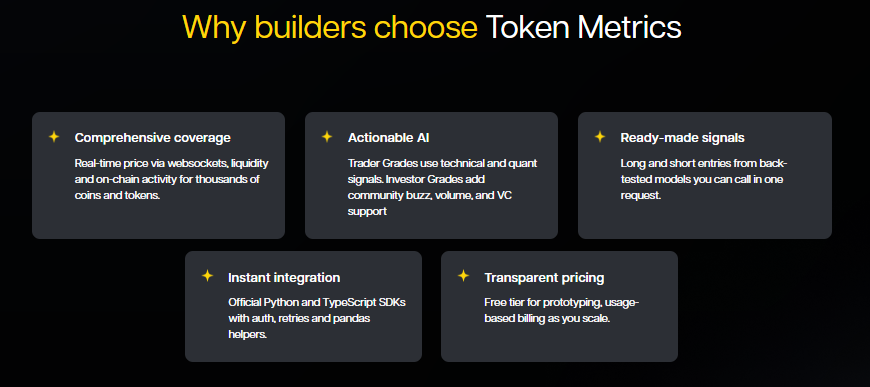
As blockchain security becomes increasingly complex, investors and developers need sophisticated tools to evaluate smart contract risks. Token Metrics, a leading AI-powered crypto analytics platform, provides crucial insights for assessing project security and making informed investment decisions.
Comprehensive Smart Contract Analysis
Token Metrics helps users spot winning tokens early with powerful AI analytics, but beyond identifying opportunities, the platform evaluates fundamental security indicators that distinguish robust projects from vulnerable ones. The platform's Investor Grade scoring system incorporates code quality assessments, helping users identify projects with superior technical foundations.
Token Metrics assigns each token both a Trader Grade for short-term potential and an Investor Grade for long-term viability. The Investor Grade specifically considers technical factors including code quality, development activity, and security audit status—critical indicators of smart contract robustness.
AI-Driven Risk Assessment
Token Metrics leverages machine learning and data-driven models to deliver powerful, actionable insights across the digital asset ecosystem. The platform monitors thousands of projects continuously, tracking code updates, audit reports, and security incidents that might indicate smart contract vulnerabilities.
By analyzing development patterns, commit frequency, and team responsiveness to identified issues, Token Metrics helps investors avoid projects with poor security practices. The platform's real-time alerts notify users about significant code changes, audit failures, or security incidents that could affect their holdings.
Research and Educational Resources
Token Metrics provides personalized crypto research and predictions powered by AI, including detailed project analysis that often highlights security considerations. The platform's research team publishes regular updates on emerging threats, best practices, and security trends in the smart contract space.
Through Token Metrics' comprehensive dashboard, users can access information about project audits, known vulnerabilities, and historical security incidents. This transparency helps investors make risk-aware decisions rather than relying solely on marketing promises.
Integration with Security Standards
Token Metrics evaluates projects against industry security standards, considering whether teams have conducted professional audits, implemented bug bounty programs, and followed best practices in smart contract development. Projects demonstrating strong security commitments receive recognition in Token Metrics' rating system.
The platform's trading feature launched in 2025 ensures users can not only identify secure projects but also execute trades seamlessly, creating an end-to-end solution for security-conscious crypto investors.
Smart Contract Auditing Tools and Practices
Professional security audits have become essential for any serious blockchain project. Multiple specialized tools and services help developers identify vulnerabilities before deployment.
Leading Audit Tools
Slither stands out as one of the most comprehensive static analysis tools, offering robust API for scripting custom analyzers with low false-positive rates. The tool can analyze contracts created with Solidity compiler version 0.4 or higher, covering a broad collection of existing contracts. Slither discovers vulnerabilities including reentrancy issues, state variables without initialization, and code optimizations leading to higher gas fees.
Mythril employs symbolic execution and dynamic analysis to detect security vulnerabilities, providing detailed reports about potential issues. The tool performs thorough analysis combining static analysis, dynamic analysis, and symbolic execution techniques.
Echidna provides property-based fuzzing, challenging smart contracts with unexpected inputs to ensure they behave as intended under various conditions. This fuzzing approach discovers edge cases that manual testing might miss.
Professional Audit Services
According to industry data, over $1.8 billion was lost to DeFi hacks in 2023 alone, mostly due to smart contract vulnerabilities. This has driven demand for professional auditing firms that provide human expertise alongside automated tools.
Top auditing companies in 2025 blend automated analysis with manual code review, penetration testing, attack simulations, fuzz testing, and governance risk assessments. This multi-layered approach uncovers deeper vulnerabilities that automated tools alone might miss.
Best Practices for Security
Developers should document smart contract vulnerabilities and mistakes that others have made to avoid repeating them. Maintain a list of effective security practices followed by leading organizations, including keeping as much code off-chain as possible, writing small functions, splitting logic through multiple contracts, and creating thorough documentation.
Set up internal security teams that frequently audit source code for bugs, ensuring no exploitable issues exist. After performing audits, implement bug bounty programs where ethical hackers receive compensation for reporting vulnerabilities, providing an additional security layer.
The Future of Smart Contract Security
As blockchain technology matures, so do the methods employed by attackers seeking to exploit vulnerabilities. The smart contract security landscape continues evolving rapidly, with new attack vectors emerging as quickly as defenses improve.
AI and Machine Learning in Security
Looking ahead, advancements in artificial intelligence and machine learning promise even more sophisticated auditing tools offering deeper insights and more accurate assessments. AI-powered tools for predictive analysis and anomaly detection are gaining prominence, helping developers preemptively address potential security threats.
Token Metrics exemplifies this trend, using AI to analyze vast datasets of blockchain transactions, code repositories, and security incidents to identify patterns that might indicate vulnerabilities. This proactive approach helps investors and developers stay ahead of emerging threats.
Regulatory Evolution
Smart contract security increasingly intersects with regulatory compliance. As governments worldwide develop frameworks for digital assets, security standards are becoming more formalized. Projects must not only build secure contracts but also demonstrate compliance with evolving regulations.
Community-Driven Security
The open-source nature of blockchain enables collective security improvements. Communities increasingly share vulnerability discoveries, audit reports, and security best practices. This collaborative approach accelerates identification and remediation of common vulnerabilities across the ecosystem.
Conclusion: Security as a Continuous Process
Smart contract security is not a one-time checkbox but an ongoing commitment requiring vigilance, expertise, and the right tools. The vulnerabilities discussed in this guide—from access control failures to oracle manipulation—represent critical risks that have caused billions in losses.
Understanding these common bugs is the first step toward building more secure blockchain applications. Developers must implement defensive programming practices, utilize comprehensive auditing tools, and engage professional security firms before deploying contracts controlling significant value.
For investors, platforms like Token Metrics provide essential tools for evaluating project security and making informed decisions in an increasingly complex landscape. By combining AI-driven analytics with comprehensive project assessment, Token Metrics helps users identify projects with robust security foundations while avoiding those with critical vulnerabilities.
The future of blockchain depends on security. As the industry continues to mature, projects that prioritize security from the start—through proper development practices, comprehensive auditing, and continuous monitoring—will build the trust necessary for mainstream adoption. Whether you're developing smart contracts or investing in blockchain projects, understanding and addressing these common vulnerabilities is essential for success in the evolving world of decentralized finance.
Stay informed, stay secure, and leverage the best tools available to navigate the exciting but challenging landscape of smart contract development and blockchain investment in 2025 and beyond.





%201.svg)
%201.svg)





.svg)


%201.svg)


.png)





.svg)


.png)