Back to blog
Crypto Basics

Best Crypto YouTube Channels in 2024 - Token Metrics Moon Awards

Discover the top crypto YouTube channels of 2024 with the Token Metrics Moon Awards. Stay ahead in crypto trends and insights for savvy investments.
Token Metrics Team
5 Minutes
Want Smarter Crypto Picks—Free?
See unbiased Token Metrics Ratings for BTC, ETH, and top alts.
Thank you! Your submission has been received!
Oops! Something went wrong while submitting the form.
 No credit card | 1-click unsubscribe

Welcome to the Token Metrics Moon Awards, a prestigious accolade in the cryptocurrency industry, honoring platforms, projects, and initiatives that have significantly impacted the industry. 

Today, we are thrilled to introduce a new category of Moon Awards - the Best Crypto YouTube Channels in 2024.

Selection Process

At Token Metrics, we emphasize our audience, considering them the foundation of our operations. Our approach, deeply rooted in community engagement, ensures that the outcomes of our awards genuinely reflect crypto enthusiasts' sentiments and experiences.

Empowering Community Perspectives

The Moon Awards by Token Metrics aim to amplify the community's voice, offering a clear and focused assessment of the entities propelling advancements in the industry.

By actively involving our community members and utilizing user voting, we have thoughtfully curated a comprehensive list of the Best Crypto YouTube Channels in 2024, drawing from a wealth of survey data and user input.

This article will explore the best crypto YouTube channels in 2024, providing you with a comprehensive list of channels to follow and engage with.

List of the Best Crypto YouTube Channels in 2024

Best Crypto YouTube Cannels
Image Source - Token Metrics Moon Awards

Token Metrics

In the Moon Awards survey, the Token Metrics YouTube channel secured the top position with 49.6% of the total votes.

Token Metrics is a well-known YouTube channel hosted by Ian Balina. Ian shares in-depth analysis and research on various cryptocurrencies. 

Their team of experts uses data-driven metrics and machine-learning algorithms to evaluate the potential of different digital assets. 

From fundamental analysis to technical analysis, Token Metrics covers many topics that can help you make informed investment decisions.

Coin Bureau

In the Moon Awards survey, the Coin Bureau YouTube channel secured the 2nd position with 16.5% of the total votes.

Coin Bureau is a popular YouTube channel hosted by Guy Turner. The channel offers unbiased reviews, market analysis, and insights into the latest trends in the crypto industry. 

Whether you're a beginner or an experienced investor, Coin Bureau provides valuable information to help you navigate the complex world of cryptocurrencies.

Crypto Banter

In the Moon Awards survey, the Crypto Banter YouTube channel secured the 3rd position with 16.5% of the total votes.

Crypto Banter is a dynamic YouTube channel hosted by Ran Neuner that offers informative content and entertaining discussions about cryptocurrencies. 

The hosts engage with industry experts, traders, and influencers to give viewers valuable insights and market updates. If you're looking for a channel that combines education with entertainment, Crypto Banter is a great choice.

Altcoin Daily

In the Moon Awards survey, the Altcoin Daily YouTube channel secured the 4th position with 5.8% of the total votes.

Altcoin Daily is a popular YouTube channel Aaron and Austin Arnold host focusing on altcoins and blockchain projects. The channel updates the latest news, market trends, and cryptocurrency investment opportunities daily. 

With a strong emphasis on research and analysis, Altcoin Daily aims to educate viewers about the potential of different digital assets.

Ivan on Tech

In the Moon Awards survey, Ivan on Tech YouTube channel secured the 5th position with 2.8% of the total votes.

Ivan on Tech is a widely recognized YouTube channel hosted by Ivan Liljeqvist, a blockchain educator and developer. The channel covers various topics, including blockchain technology, cryptocurrencies, and decentralized finance (DeFi). 

Ivan's in-depth knowledge and ability to explain complex concepts in a simple manner make his channel a valuable resource for both beginners and experienced crypto enthusiasts.

Alex Becker

In the Moon Awards survey, Alex Becker's YouTube channel secured the 6th position with 2.3% of the total votes.

Alex Becker is a prominent figure in the crypto community, and his YouTube channel offers a unique perspective on investing and entrepreneurship. While not solely focused on cryptocurrencies, 

Alex provides insights into various investment strategies and opportunities, including the crypto market. His channel is an excellent resource for those looking to broaden their investment horizons.

Virtual Bacon

In the Moon Awards survey, the Virtual Bacon YouTube channel secured the 7th position with 2% of the total votes.

Virtual Bacon is a YouTube channel hosted by Dennis dedicated to providing educational content about cryptocurrencies and blockchain technology. 

Virtual Bacon covers various topics, including tutorials, market analysis, and project reviews. With a focus on simplifying complex concepts, Virtual Bacon's channel is a valuable resource for beginners in crypto.

Elliotrades

In the Moon Awards survey, Elliotrades YouTube channel secured the 8th position with 1.7% of the total votes.

Elliotrades is a YouTube channel that offers technical analysis and market insights for cryptocurrencies. The host, Elliot, combines his expertise in chart analysis with fundamental research to provide viewers with a well-rounded perspective on the market. 

Elliotrades offers valuable insights to help you make informed decisions whether you're interested in short-term trading or long-term investing.

Ben Armstrong

In the Moon Awards survey, Ben Armstrong's YouTube channel secured the 9th position with 1.5% of the total votes.

Ben Armstrong, also known as BitBoy Crypto, is a popular YouTube personality in the crypto community. His channel covers various topics, including market updates, project reviews, and interviews with industry experts. 

With his engaging personality and informative content, Ben Armstrong's channel is a go-to resource for many crypto enthusiasts.

Paul Barron Network

In the Moon Awards survey, Paul Barron Network's YouTube channel secured the 10th position with 1.4% of the total votes.

The Paul Barron Network is a YouTube channel that explores the intersection of technology and finance, including cryptocurrencies. The channel provides insights into the latest trends, market analysis, and interviews with industry leaders. 

Paul Barron's unique perspective and in-depth coverage make his channel a valuable resource for crypto enthusiasts.

Conclusion

Staying informed and engaged in cryptocurrencies is essential for making informed investment decisions. The YouTube channels listed above offer a wealth of knowledge, market analysis, and educational content to help you navigate the ever-changing crypto landscape. 

Whether you're a beginner or an experienced investor, these channels provide valuable insights and perspectives to enhance your understanding of cryptocurrencies. 

Remember always to research and consider multiple sources of information before making any investment decisions in the crypto space.

Disclaimer

The information provided on this website does not constitute investment advice, financial advice, trading advice, or any other advice, and you should not treat any of the website's content as such.

Token Metrics does not recommend buying, selling, or holding any cryptocurrency. Conduct your due diligence and consult your financial advisor before making investment decisions.

Build Smarter Crypto Apps &
AI Agents in Minutes, Not Months
Real-time prices, trading signals, and on-chain insights all from one powerful API.
Grab a Free API Key
About Token Metrics
Token Metrics: AI-powered crypto research and ratings platform. We help investors make smarter decisions with unbiased Token Metrics Ratings, on-chain analytics, and editor-curated “Top 10” guides. Our platform distills thousands of data points into clear scores, trends, and alerts you can act on.
30 Employees
analysts, data scientists, and crypto engineers
Daily Briefings
concise market insights and “Top Picks”
Transparent & Compliant
Sponsored ≠ Ratings; research remains independent
Want Smarter Crypto Picks—Free?
See unbiased Token Metrics Ratings for BTC, ETH, and top alts.
Thank you! Your submission has been received!
Oops! Something went wrong while submitting the form.
 No credit card | 1-click unsubscribe
Token Metrics Team
Token Metrics Team

Recent Posts

Crypto Basics

Solana Staking - A Step by Step Guide for Beginners

Marcus K
7 Minutes

Cryptocurrency enthusiasts always look for new and innovative ways to make the most of their digital assets. Over the past few years, staking Solana has become a prominent method in this pursuit. 

With Solana, your investment transcends traditional boundaries, offering the unique opportunity to secure the network while earning passive income through lucrative rewards. 

This comprehensive guide aims to provide an in-depth understanding of staking Solana, encompassing essential information such as the process, the requirements and considerations involved, effective strategies for maximizing staking rewards, and a comprehensive guide on getting started.

The Basics of Solana Staking

Solana's proof-of-stake (PoS) mechanism enables quick confirmation of transaction sequences. To enhance the performance of the PoS consensus mechanism, Solana also utilizes the Proof-of-History (PoH) protocol. 

The PoH protocol securely orders transactions and events written on the decentralized ledger, making the entire Solana blockchain significantly faster and ideal for dApps by offering lower transaction costs.

Solana's approach to PoS, known as Delegated Proof-of-Stake (DPoS), adds a twist to the regular PoS. DPoS enables voting and delegation by incentivizing users to stake their SOL tokens. 

Users stake their SOL to participate in the DPoS consensus operation, and the nodes choose delegates from the block production process. The network finalizes the number of delegates, with their voting power determined by the amount of SOL they have staked. 

This system ensures that only elected voters and delegates can validate transactions, prioritizing validators who have staked the most SOL.

The Solana Token (SOL)

SOL is Solana's native utility token for paying transaction fees, validating the network, and staking. The versatility of Solana's blockchain allows for the development of various decentralized applications (dApps) on its platform, leading to the emergence of new use cases for SOL.

To stake SOL and participate in the rewards program, you need a suitable wallet to store and manage your holdings. Wallets like Phantom, Exodus, and Solflare are popular choices among Solana users due to their user-friendliness, availability for dApps, and staking options. 

While these wallets are generally secure, it's important to exercise caution as they are exposed to the internet. For those with significant holdings or a cautious approach, using a hardware wallet provides an extra layer of safety.

Staking Requirements and Considerations

When staking SOL, you lock up a certain number of tokens for a specific period. The minimum amount of SOL required for staking is 0.01 SOL, which serves as the minimum reserve. 

Unlike some blockchains, no minimum amount of SOL is required to become a validator. However, validating blocks can incur a daily transaction fee of 1.1 SOL, so validators should consider their staking amount accordingly. 

During the staking period, you cannot spend your staked tokens, but it's important to note that SOL never leaves your wallet, and you can unstake your tokens at any time.

Staking SOL actively contributes to the stability of the Solana network by adding resources, and in return, you earn SOL as a staking reward. However, staking SOL also carries certain risks. 

Validators or delegators who engage in malicious behavior, such as generating invalid transactions or censoring certain types of transactions or participants, may have their stakes slashed. 

Slashing is punitive to discourage such behavior and protect the network's integrity. Delegating your tokens to reputable validators is crucial to minimize the risk of being impacted by their actions.

Step-by-Step Guide to Staking Solana

Staking SOL can be done through a crypto exchange or a dedicated wallet. Several platforms, including Coinbase, Kraken, Binance, and more, offer Solana staking programs, allowing users to stake SOL directly from their exchange accounts. 

Wallets such as the official Solana Wallet and Exodus also support SOL staking. Let's explore the step-by-step process for staking SOL via a crypto exchange and a wallet.

Staking SOL via a Crypto Exchange

  1. Sign up for a crypto exchange that supports Solana staking by providing the necessary personal information and completing the verification process, if required.
  2. Acquire SOL tokens by purchasing them on the exchange or transferring them from another wallet or exchange.
  3. Navigate to the staking section of the exchange and select a validator to delegate your tokens to.
  4. Follow the instructions provided by the exchange to delegate your SOL to the chosen validator.
  5. Once you have delegated your SOL, you can start earning staking rewards. However, it is important to monitor your rewards regularly and ensure that your chosen validator maintains a high level of uptime and security.

Staking SOL via a Wallet

  1. Choose a reputable and secure wallet that supports SOL staking, such as the official Solana Wallet or Exodus.
  2. Acquire SOL tokens by purchasing them on a crypto exchange or transferring them from another wallet or exchange.
  3. Transfer your SOL tokens to the staking wallet and navigate to the staking section.
  4. Delegate your SOL to a validator by following the staking wallet's specific instructions.
  5. After delegating your SOL to a validator, you can earn staking rewards, typically paid weekly.

Advanced Strategies for Maximizing Staking Rewards

To maximize your staking rewards and enhance your Solana staking experience, consider implementing the following strategies:

Maximizing Rewards With Multiple Validators

Monitoring validator performance is crucial for maximizing rewards. Platforms like Validators. app provides valuable insights into validator performance, allowing you to choose multiple validators for risk management. 

Distributing your SOL among multiple network validators offers a safer way to spread your funds, minimizing the impact of potential failures, increased commissions, or shutdowns by a single validator. 

While this strategy may incur multiple transaction fees, they are typically low, making the added sense of safety worthwhile.

Operating as a Validator

Running a validator node makes Solana a resistant and high-performing blockchain. Validators process and handle transactions while earning rewards and increasing censorship resistance through decentralization. 

While no minimum amount of SOL is required to run a validator, a reserve of 0.02685864 SOL coins is necessary to participate in the consensus. It is important to stake a sufficient amount of SOL to ensure the profitability of running a validator node.

Building a Solid Reputation and Attracting Delegators

Validators who meet the strict requirements of the Solana Foundation Delegation Program can receive delegations from a token pool managed by the foundation. 

To qualify for delegation, validators must fulfill testnet participation criteria and all baseline criteria. Failure to meet these requirements results in the revocation of delegation until the criteria are satisfied. 

Building a solid reputation and consistently meeting the criteria can attract delegators and enhance your staking rewards.

Staking Solana on a Non-custodial Wallet

In addition to exchanges, other ways exist to stake Solana, including using non-custodial wallets that support SOL staking. Wallets like Phantom Wallet, Solana's official wallet, provide staking options. 

The process involves funding your wallet with SOL crypto, selecting a Solana validator, and reviewing and confirming the transaction details. Non-custodial wallets offer an additional layer of security as you retain full control over your private keys.

Recent Network Developments

Solana Labs has been actively implementing changes to enhance network reliability and consistency. In a blog post from March 2023, co-founder Anatoly Yakovenko emphasized the importance of providing a fast, dependable, and scalable network for a fully decentralized web. 

Before the 1.14 release, core engineers addressed issues affecting network speed and usability, such as gas metering, transaction flow control, and fee markets. 

The most recent network upgrade, v1.16, has reduced hardware requirements for validators, making it more accessible and cost-effective to participate in the network's consensus mechanism. Optional zero-knowledge-compatible transaction encryption has also been introduced, enhancing privacy and security.

Conclusion

Staking Solana offers the opportunity to actively participate in shaping the future of a high-performance blockchain platform while earning rewards. 

By understanding the basics of Solana staking, choosing reputable platforms, and implementing advanced strategies, you can maximize your staking rewards and enhance your crypto investment strategy. 

Stay informed about recent network developments and make informed decisions to maximize your Solana staking experience.

Disclaimer

The information provided on this website does not constitute investment advice, financial advice, trading advice, or any other advice, and you should not treat any of the website's content as such.

Token Metrics does not recommend that any cryptocurrency should be bought, sold, or held by you. Conduct your due diligence and consult your financial advisor before making investment decisions.

Crypto Basics

Chainlink (LINK) Price Prediction 2025, 2030 - Forecast Analysis

Talha Ahmad
7 Minutes

Click here to buy Cryptocurrencies from Gate.io

Contact us at promo@tokenmetrics.com for marketing and sponsorship programs.

Chainlink (LINK) has emerged as a prominent player in the cryptocurrency market, offering a decentralized network of oracles that connect smart contracts with real-world data sources. 

With its unique value proposition and growing adoption, many investors are curious about the future price potential of Chainlink. 

In this article, we will comprehensively analyze Chainlink's price prediction, covering various timeframes, expert opinions, and market trends.

Chainlink Overview

Chainlink is an open-source network of oracles that connects smart contracts and external data sources. It acts as a bridge between blockchain platforms and real-world data, ensuring the accuracy and reliability of data inputs into smart contracts. 

Built on the Ethereum blockchain, Chainlink offers services to various blockchains with smart contract functionality. The native cryptocurrency of Chainlink is called LINK, which serves two primary purposes within the network. 

Firstly, it incentivizes node operators or oracles to provide reliable, accurate off-chain data. Secondly, it is staked by node operators to participate in the network and earn more LINK tokens.

Chainlink has found applications in various sectors, including decentralized finance (DeFi), gaming, insurance, and traditional systems. 

In DeFi, Chainlink provides reliable price feeds, interest rates, and collateralization confirmation for lending protocols and decentralized exchanges

It also offers solutions for generating on-chain verifiable randomness in gaming applications. Additionally, Chainlink enables traditional systems to make their data and services accessible to blockchain networks through its oracles.

Historical Performance of Chainlink

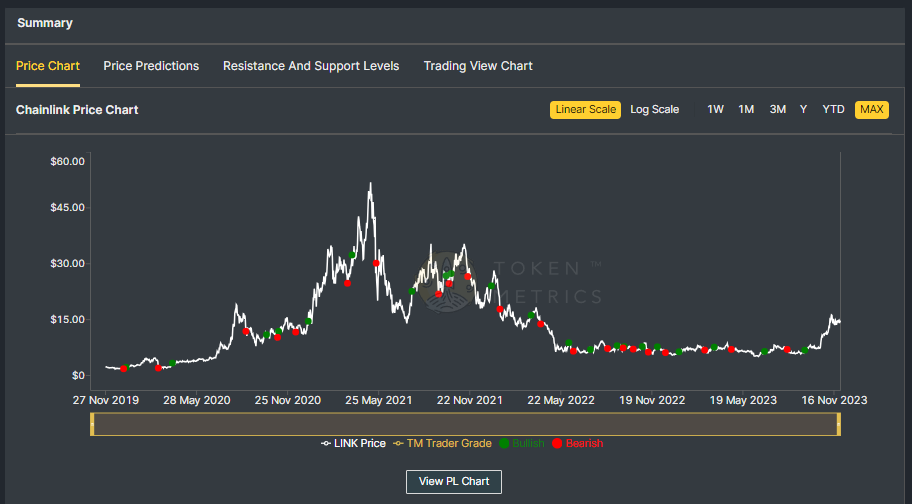
To understand the potential future price of Chainlink, it is essential to analyze its historical performance. Chainlink has experienced significant growth since its launch in 2017.

Chainlink Price Chart
Start Your Free Trial Today and Uncover Your Token's Price Prediction and Forecast on Token Metrics.

The price of LINK surged from its initial ICO price of $0.11 to an all-time high of $54.40. However, like any cryptocurrency, it also experienced price volatility and corrections periods.

Chainlink's price has been bullish in recent years, reaching significant milestones in market capitalization and adoption. 

Despite facing resistance around $12, Chainlink has maintained its position as the 13th largest cryptocurrency by market cap. The current market cap of Chainlink is $8.2 billion.

Chainlink (LINK) Current Fundamentals

Before making any price predictions, it is crucial to assess the current fundamentals of Chainlink. The network's partnerships, developments, and technological advancements significantly determine its future price potential.

Chainlink has formed strategic collaborations with prominent cryptocurrency and traditional finance entities. For example, Coinbase Cloud is now a Chainlink node operator, enhancing security and network capacity.

Chainlink Tokenomics
Resource -Token Metrics

The platform has also achieved interoperability with multiple blockchains, including Bitcoin, Polkadot, and Binance Smart Chain.

Furthermore, Chainlink's solutions have been widely adopted in various industries. In decentralized finance, Chainlink's oracles provide reliable price data for lending protocols like Aave. 

The network has also been utilized in gaming applications, insurance markets, and traditional systems to automate processes and access real-time data.

Chainlink Price Prediction - Scenario Analysis

To forecast Chainlink's future price, it is crucial to consider multiple scenarios based on different market conditions and expert opinions. Let's explore some potential price predictions for Chainlink.

Chainlink Price Prediction: Bullish Market

In a bull market scenario where the overall cryptocurrency market experiences significant growth, Chainlink could benefit from increased adoption and demand for its services. Industry experts predict that Chainlink's price could reach new highs in this case.

If the crypto market cap hits $3 Trillion and Chainlink retains its current 0.54% dominance, its price could ascend to $29.39.

In a more bullish scenario of the crypto market surging to $10 Trillion, Chainlink's price could soar to a staggering $97.97, resulting in a potential 7x return for investors.

It is important to note that these predictions are based on various factors and assumptions, and market conditions can change rapidly. However, bullish market sentiment and increased adoption of Chainlink's solutions could drive its price to new heights.

Chainlink Price Prediction
Start Your Free Trial Today and Uncover Your Token's Price Prediction and Forecast on Token Metrics.

Chainlink Price Prediction: Bearish Market

In a bearish market scenario where the overall cryptocurrency market faces a downturn or stagnation, Chainlink's price could experience a decline or slower growth. Market sentiment and external factors can significantly impact the price of cryptocurrencies.

In this case, the price of Chainlink may face downward pressure with a decreased dominance of 0.27%.

In this scenario, If the crypto market cap hits $3 Trillion, Chainlink could trade around $14.89 in the short term and struggle to surpass $48.98 by 2030 even if the total crypto market cap surpasses the $10 Trillion mark.

It is crucial to consider potential risks and challenges that Chainlink may face. Factors such as regulatory developments, competition from other projects, and technological advancements can affect the growth trajectory of Chainlink.

Also Read - Next Crypto Bull Run Prediction

Contact us at promo@tokenmetrics.com for marketing and sponsorship programs.

Chainlink Price Prediction - Industry Expert Opinion

Coinpedia platform predicts Chainlink could reach $213.1 to $253.51 by 2030, and experts from Changelly forecast that it could reach minimum and maximum prices of $30.69 and $38.26 by the end of 2025. By the end of 2030, the price of Chainlink could reach $196.53 to $244.09.

Other industry analysts have varying opinions on the future price of Chainlink. Ambcrypto.com predicts that Chainlink could reach $40.30 to $60.45 by 2030.

Note - Start Your Free Trial Today and Uncover Your Token's Price Prediction and Forecast on Token Metrics.

Click here to buy Cryptocurrencies from Gate.io

Is Chainlink a Good Investment?

The question of whether Chainlink is a good investment depends on various factors, including the investor's risk tolerance, investment goals, and market conditions. Chainlink has shown significant potential with its innovative solutions and growing adoption in various sectors.

Chainlink's decentralized oracle network addresses a critical limitation of smart contracts, enabling them to access real-world data seamlessly. 

This unique value proposition has attracted the attention of cryptocurrency enthusiasts and traditional businesses looking to leverage blockchain technology.

However, conducting thorough research and due diligence is important before investing in cryptocurrency. 

Investors should consider the project's fundamentals, team expertise, market demand, and potential risks. Consulting with financial advisors or experts in the cryptocurrency space can also provide valuable insights.

Also Read - Is Solana a Good Investment?

Risks and Rewards

As with any investment, Chainlink carries both risks and rewards. It is important to consider these factors before making investment decisions.

Risks

  • Market Volatility: Cryptocurrency markets are known for their volatility, and Chainlink is no exception. Price fluctuations can be significant, and investors should be prepared for potential losses.
  • Regulatory Uncertainty: The regulatory landscape for cryptocurrencies is evolving. Changes in regulations or government actions can impact the adoption and growth of Chainlink.
  • Competition: The blockchain industry is highly competitive, with several projects offering similar solutions. Chainlink faces competition from established players and emerging projects in the Oracle space.

Rewards

  • Growing Adoption: Chainlink has gained significant traction in various industries, including DeFi, gaming, and insurance. Increased adoption of Chainlink's solutions can drive demand for its services and potentially lead to price appreciation.
  • Technological Advancements: Chainlink continues to innovate and improve its offerings. Developing new features and partnerships can enhance the network's capabilities and attract more users.
  • Strong Fundamentals: Chainlink's decentralized oracle network has solid fundamentals, addressing a critical need in the blockchain ecosystem. Its value proposition and expanding use cases position it as a potential leader in the space.

Also Read - XRP Price Prediction

Contact us at promo@tokenmetrics.com for marketing and sponsorship programs.

Chainlink Current Developments and Future Potential

Chainlink has been making significant strides in its development and partnerships, positioning itself for future growth. The network's recent collaborations with Coinbase and its interoperability across multiple blockchains demonstrate its potential to expand its reach and impact.

Additionally, Chainlink's solutions have gained recognition in the decentralized finance sector, where reliable price data and oracles are essential for functioning lending protocols and decentralized exchanges. 

As the DeFi industry grows, Chainlink's services will likely remain in high demand. The future potential of Chainlink lies in its ability to continue innovating and addressing the evolving needs of the blockchain ecosystem. 

The network's scalability, security, and reliability will be crucial in attracting more users and establishing itself as a critical player in the industry.

Conclusion

Chainlink's price prediction involves various factors, including market conditions, expert opinions, and the project's fundamentals. 

While external factors and market trends can influence the future price of Chainlink, its strong fundamentals, growing adoption, and expanding use cases position it as a promising project in the blockchain space.

Investors should conduct thorough research, assess risk tolerance, and consider market conditions before making investment decisions. Chainlink's unique value proposition, partnerships, and technological advancements make it an intriguing project to watch in the coming years.

Disclaimer

The information provided on this website does not constitute investment advice, financial advice, trading advice, or any other advice, and you should not treat any of the website's content as such.

Token Metrics does not recommend that any cryptocurrency should be bought, sold, or held by you. Conduct your due diligence and consult your financial advisor before making investment decisions.

Click here to buy Cryptocurrencies from Gate.io

Contact us at promo@tokenmetrics.com for marketing and sponsorship programs.

Crypto Basics

What Are Zero Knowledge Proofs and How Does it Work?

S. Vishwa
7 Minutes

In today's data-driven world, privacy and security are of paramount importance. One emerging technology that addresses these concerns is zero-knowledge proofs (ZKPs). 

ZKPs allow for the verification of information without revealing the underlying data, providing a high level of security and privacy. 

This comprehensive guide will explore the fundamentals of zero-knowledge proofs, how they work, their applications, and the benefits they offer. So, let's dive in!

What are Zero-Knowledge Proofs?

Zero-knowledge proofs (ZKPs) are cryptographic protocols that enable one party, known as the prover, to convince another party, the verifier, that a statement is true without revealing any details about the statement itself. 

The concept of zero-knowledge proofs was first introduced in the early 1980s by researchers Shafi Goldwasser, Silvio Micali, and Charles Rackoff.

A good zero-knowledge proof should fulfill three criteria: completeness, soundness, and zero-knowledge. Completeness ensures that the verifier will accept the proof if the statement is true and both parties adhere to the protocol. 

Soundness guarantees that if the statement is false, no dishonest prover can convince an honest verifier otherwise. 

Zero-knowledge ensures that even after engaging with the prover, the verifier only learns the truth of the statement and nothing else about the secret.

How do Zero-Knowledge Proofs Work?

Zero-knowledge proofs allow a prover to persuade a verifier of the validity of a statement without disclosing any information about the statement itself. 

The prover and the verifier engage in multiple rounds of interaction. At the end of the protocol, the verifier gains confidence in the statement's truth without learning any additional information about the secret.

To illustrate how zero-knowledge proofs work, let's consider the "Three Color Problem," also known as the "Graph Coloring Problem." 

The goal is to color each map region with one of three colors so that no neighboring regions have the same color. The prover wants to convince the verifier that they know a valid three-coloring for the given map without revealing the actual colors assigned to each region.

The protocol consists of several rounds: setup, statement, commitment, challenge, response, and iteration. In the setup phase, the prover and verifier agree on the map's regions and connections. In the statement phase, the prover asserts to have a reliable three-coloring for the map. 

The commitment phase involves the prover choosing colors for each region in secret and providing commitments to the verifier without revealing the actual colors. The challenge phase requires the verifier to choose a random region and request the prover to open the commitment for that region, revealing its color. 

The response phase involves the prover proving the accuracy of the revealed coloring by demonstrating the color differences between adjacent regions. The iteration phase repeats the challenge and response steps multiple times to establish a high degree of trust in the validity of the prover's assertion.

Throughout the protocol, the verifier becomes confident that the prover possesses a valid three-coloring without learning the actual colors assigned to each region. 

This exemplifies the zero-knowledge property of the proof, as the verifier gains knowledge about the truth of the statement without obtaining any additional information.

Types of Zero-Knowledge Proofs

There are several types of zero-knowledge proofs, each suited for different use cases. Let's explore some of the most commonly used types:

Interactive Zero-Knowledge Proofs

Interactive zero-knowledge proofs require back-and-forth communication between the prover and verifier. They involve multiple rounds of interaction, as seen in the "Three Color Problem" example.

Non-Interactive Zero-Knowledge Proofs

Non-interactive zero-knowledge proofs provide a compact proof that can be verified in a single step. They eliminate the need for repeated back-and-forth communication between the prover and verifier.

Statistical Zero-Knowledge Proofs

Statistical zero-knowledge proofs offer computational soundness with a small probability of error. They allow for probabilistic verification, making them suitable for scenarios where a small margin of error is acceptable.

Proof-of-Knowledge

Proof-of-knowledge (PoK) is a subclass of zero-knowledge proofs that demonstrates the prover's possession of specific knowledge related to the statement. It shows that the prover knows something without revealing what that something is.

Proofs of Shuffle and Range

Proofs of shuffle and range are used in electronic voting systems and privacy-preserving transactions. They allow for the verification of the correct shuffling of votes or the validation of values falling within a specific range without disclosing the actual votes or values.

Sigma Protocols

Sigma protocols are a class of zero-knowledge proofs that involve three steps: commitment, challenge, and response. They are widely used in various applications, including digital signatures and secure authentication.

Bulletproofs

Bulletproofs are designed to provide efficient range proofs for large sets of values. They enable efficient verification of values within a specified range without revealing the actual values themselves. Bulletproofs have been successfully used in privacy-focused cryptocurrencies such as Monero.

These are just a few examples of the types of zero-knowledge proofs available. Each type has its characteristics and use cases, making zero-knowledge proofs a versatile tool for achieving privacy and security in various domains.

Applications of Zero-Knowledge Proofs

Zero-knowledge proofs find applications in a wide range of fields and address important privacy and security concerns. Let's explore some of the key applications of zero-knowledge proofs:

Privacy-Preserving Cryptocurrencies

One prominent application of zero-knowledge proofs is in privacy-focused cryptocurrencies such as Zcash (ZEC). Zero-knowledge proofs allow for anonymous transactions without revealing the transaction details or the identities of the users. This enhances transaction privacy and confidentiality in blockchain networks.

Authentication and Access Control

Zero-knowledge proofs can be used in authentication and access control systems to demonstrate knowledge of a password or cryptographic key without revealing the actual password or key itself. This provides secure and user-friendly authentication techniques while preserving privacy.

Electronic Voting Systems

Zero-knowledge proofs play a crucial role in electronic voting systems. They enable voters to prove the legitimacy of their vote without disclosing their actual vote. This protects both voter privacy and the integrity of the electoral process.

Secure Data Transfer and Verification

Zero-knowledge proofs allow for secure data transfer and verification. They enable one party to demonstrate the accuracy of computations performed on private data without revealing the data itself. This is particularly useful in scenarios where data privacy is paramount, such as healthcare or financial applications.

Central Bank Digital Currencies (CBDCs)

Zero-knowledge proofs can enhance transaction privacy in central bank digital currencies (CBDCs). Zero-knowledge proofs enable auditability without disclosing transaction specifics by balancing privacy and transparency. This can contribute to adopting and accepting CBDCs while upholding user anonymity.

These are just a few examples of the diverse applications of zero-knowledge proofs. The versatility of zero-knowledge proofs makes them a valuable tool for enhancing privacy, security, and confidentiality in various domains.

Disadvantages of Zero-Knowledge Proofs

While zero-knowledge proofs offer significant benefits, they also come with certain disadvantages. Considering these drawbacks when evaluating the suitability of zero-knowledge proofs for a specific use case is important. Let's explore some of the key disadvantages:

Computational Intensity

Developing and verifying zero-knowledge proofs can be computationally intensive, especially for complex proofs. This can result in longer processing times for transactions and increased computational workload, which may pose challenges for the scalability of blockchain systems.

Complexity and Auditability

Zero-knowledge proofs can add complexity to protocols, making them more difficult to audit and verify. The intricate nature of zero-knowledge proofs may raise concerns about potential security flaws or bugs in the implementation.

Potential for Illegal Activity

While zero-knowledge proofs enhance privacy by hiding information, they may also facilitate illegal activities in certain situations. This poses challenges for regulatory compliance and may require additional measures to prevent misuse of zero-knowledge proofs.

Limited Applicability

Zero-knowledge proofs may not be suitable for all use cases or sectors. They require expertise and experience to implement correctly, which may limit their widespread adoption across different fields.

While zero-knowledge proofs offer valuable privacy and security features, it is essential to carefully assess the associated trade-offs and challenges before incorporating them into specific systems or applications.

Conclusion

Zero-knowledge proofs are a powerful cryptographic tool that enables the verification of information without revealing the underlying data. 

They offer enhanced privacy, security, and confidentiality, making them valuable in various applications. From privacy-focused cryptocurrencies to secure data transfer and authentication, zero-knowledge proofs provide solutions to critical challenges in the digital era. 

However, it is important to consider zero-knowledge proofs' computational intensity, complexity, and potential limitations when evaluating their suitability for specific use cases. 

By leveraging the benefits and addressing the challenges, zero-knowledge proofs can unlock new levels of privacy and security in our increasingly interconnected world.

Disclaimer

The information provided on this website does not constitute investment advice, financial advice, trading advice, or any other advice, and you should not treat any of the website's content as such.

Token Metrics does not recommend that any cryptocurrency should be bought, sold, or held by you. Conduct your due diligence and consult your financial advisor before making investment decisions.

Choose from Platinum, Gold, and Silver packages
Reach with 25–30% open rates and 0.5–1% CTR
Craft your own custom ad—from banners to tailored copy
Perfect for Crypto Exchanges, SaaS Tools, DeFi, and AI Products