Back to blog
Research

Best Liquid Restaking Tokens & Aggregators (2025)

Explore the 10 best liquid restaking tokens (LRTs) and aggregators by liquidity, security, fees, and DeFi integrations—plus region tips and key fee, risk, and beginner mistakes to avoid.
Token Metrics Team
17 min read
Want Smarter Crypto Picks—Free?
See unbiased Token Metrics Ratings for BTC, ETH, and top alts.
Thank you! Your submission has been received!
Oops! Something went wrong while submitting the form.
 No credit card | 1-click unsubscribe

Who this guide is for. Investors and builders comparing best liquid restaking tokens (LRTs) and aggregators to earn ETH staking + restaking rewards with on-chain liquidity.

Top three picks.

  • ether.fi (eETH/weETH): Non-custodial, deep integrations, clear docs. (ether.fi)
  • Renzo (ezETH): Multi-stack (EigenLayer + Symbiotic/Jito), transparent 10% rewards fee. (docs.renzoprotocol.com)
  • Kelp DAO (rsETH): Broad DeFi reach; explicit fee policy for direct ETH deposits. (kelp.gitbook.io)

One key caveat. Fees, redemption paths, and regional access vary by protocol—check official docs and terms before depositing.


Introduction

Liquid restaking lets you restake staked assets (most often ETH) to secure Actively Validated Services (AVSs) while receiving a liquid restaking token you can use across DeFi. The value prop in 2025: stack base staking yield + restaking rewards, with composability for lending, LPing, and hedging. In this commercial-investigational guide, we compare the best liquid restaking tokens and the top aggregators that route deposits across operators/AVSs, with an emphasis on verifiable fees, security posture, and redemption flow. We weigh scale and liquidity against risk controls and documentation quality to help you pick a fit for your region, risk tolerance, and toolstack.


How We Picked (Methodology & Scoring)

  • Liquidity — 30%: On-chain depth, integrations, and redemption mechanics.
  • Security — 25%: Audits, docs, risk disclosures, validator design.
  • Coverage — 15%: AVS breadth, multi-stack support (EigenLayer/Symbiotic/Jito), asset options.
  • Costs — 15%: Transparent fee schedules and user economics.
  • UX — 10%: Clarity of flows, dashboards, and docs.
  • Support — 5%: Status pages, help docs, comms.

Evidence sources: official websites, docs, pricing/fees and security pages, and status/terms pages; third-party datasets used only to cross-check volumes. Last updated November 2025.


Best Liquid Restaking Tokens & Aggregators in November 2025 (Comparison Table)  
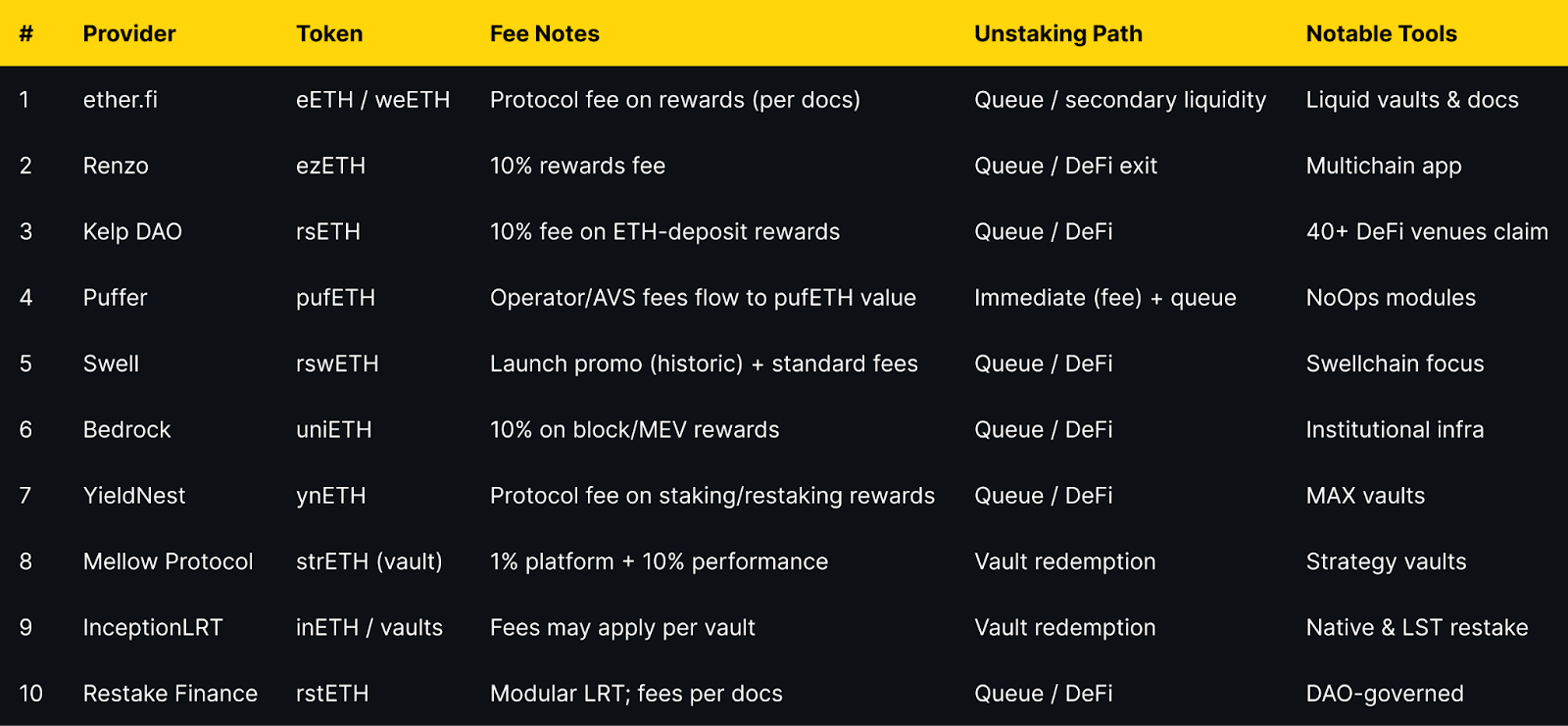
* Regions are “Global” unless a provider geoblocks specific jurisdictions in their terms. Always verify eligibility in your country.


Top 10 Liquid Restaking Tokens & Aggregators in November 2025

1. ether.fi — Best for deep integrations & non-custodial design

Why use it: ether.fi’s eETH/weETH are widely integrated across DeFi, and the project publishes clear technical docs on protocol fees and validator design. Liquid Vaults add strategy optionality while keeping restaking accessible. (ether.fi)
Best for: DeFi power users, liquidity seekers, builders needing broad integrations.
Notable features: Non-custodial staking; restaking support; Liquid Vaults; documentation and terms around protocol fees. (etherfi.gitbook.io)
Fees Notes: Protocol fee on rewards; vault-level fees vary by strategy. (etherfi.gitbook.io)
Regions: Global*
Consider if: You want deep liquidity and docs; always review fee tables and redemption queues.
Alternatives: Renzo, Kelp DAO.  


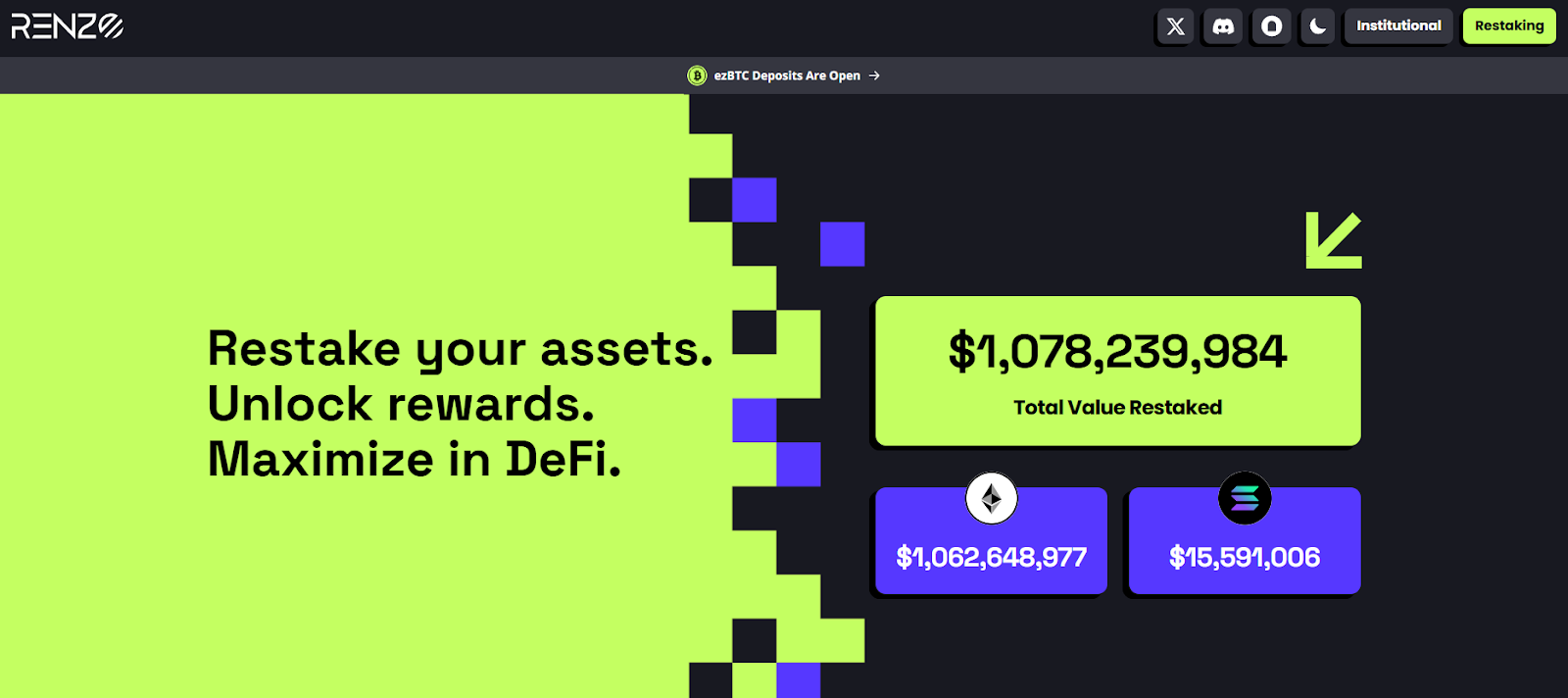
2. Renzo — Best for multi-stack coverage (EigenLayer + Symbiotic/Jito)

Why use it: Renzo’s ezETH is among the most recognizable LRTs and the docs clearly state a 10% rewards fee, while the app highlights support beyond EigenLayer (e.g., Symbiotic/Jito lines). Strong multichain UX. (docs.renzoprotocol.com)
Best for: Users wanting straightforward economics and chain-abstracted access.
Notable features: Clear fee policy (10% of restaking rewards); multi-stack support; app UX across chains. (docs.renzoprotocol.com)
Fees Notes: 10% of restaking rewards; details in docs. (docs.renzoprotocol.com)
Regions: Global*
Consider if: You prefer transparent fees and broader stack exposure.
Alternatives: ether.fi, Mellow.  

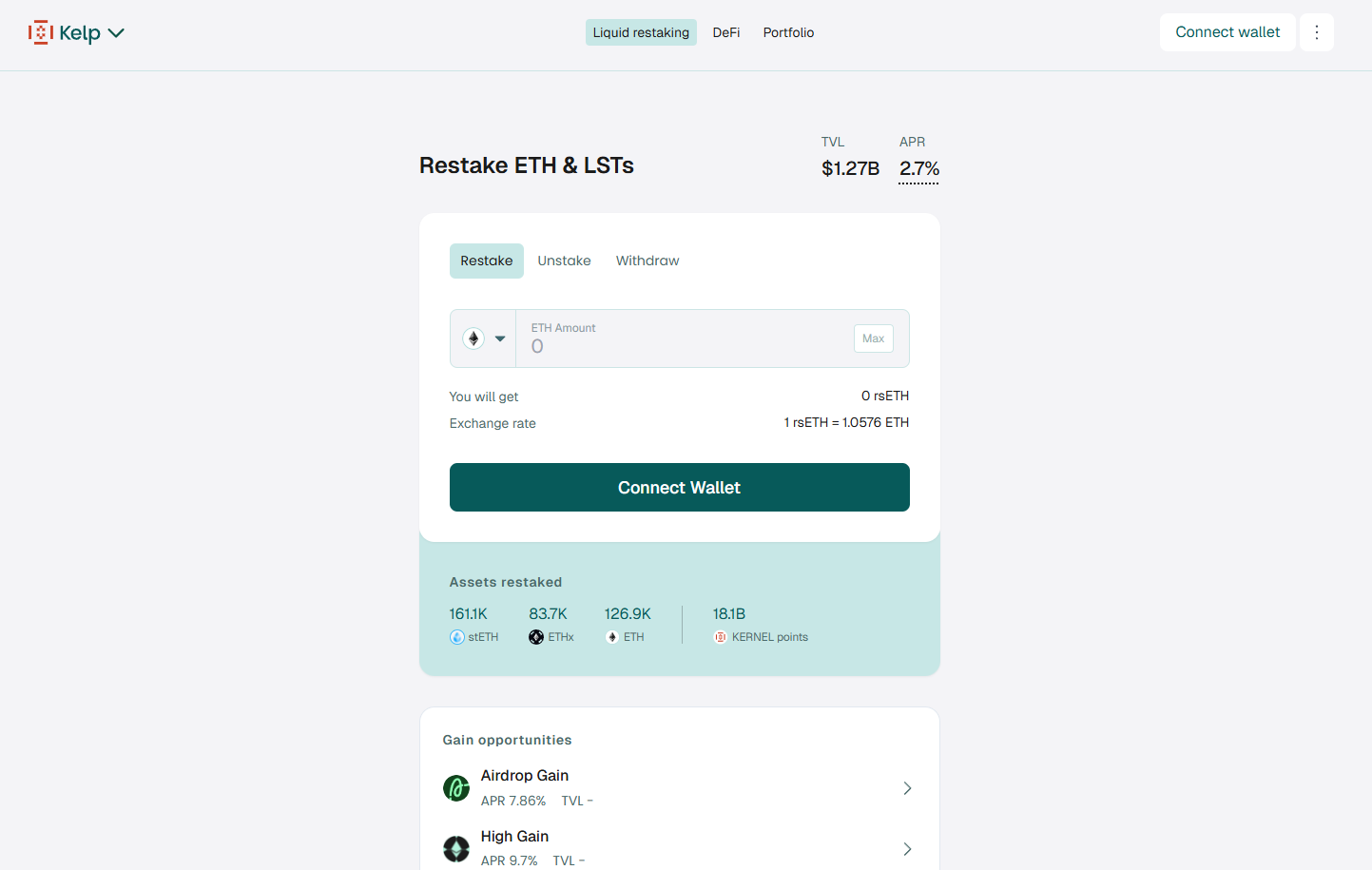
3. Kelp DAO — Best for broad DeFi distribution (rsETH)

Why use it: Kelp emphasizes reach (rsETH used across many venues). Official docs state a 10% fee on rewards for direct ETH deposits, with no fee on LST deposits, making it friendly to LST holders. (kelpdao.xyz)
Best for: LST holders, LPs, and integrators.
Notable features: rsETH liquid token; LST and ETH deposit routes; active integrations. (kelpdao.xyz)
Fees Notes: 10% on ETH-deposit rewards; no fee on LST deposits per docs. (kelp.gitbook.io)
Regions: Global*
Consider if: You want flexibility between ETH and LST deposit paths.
Alternatives: Renzo, Swell.  

4. Puffer — Best for redemption optionality (pufETH)

Why use it: Puffer’s docs explain how AVS fees accrue to pufETH and outline operator/guardian roles. Public risk work notes an “immediate redemption” option with a fee when liquidity is available, plus queued exit. (docs.puffer.fi)
Best for: Users wanting explicit redemption choices and a technical spec.
Notable features: pufETH nLRT; operator/guardian model; based L2 plans. (Puffer: Building the Future of Ethereum)
Fees Notes: AVS/operator fees accrue; immediate redemption may incur a fee. (docs.puffer.fi)
Regions: Global*
Consider if: You value documented mechanics and redemption flexibility.
Alternatives: ether.fi, Bedrock.


5. Swell — Best for restaking-native ecosystem (rswETH)

Why use it: Swell’s rswETH is their native LRT for EigenLayer; launch comms detailed fee-holiday parameters and security posture. Swellchain materials emphasize restaking-first ecosystem tooling. (swellnetwork.io)
Best for: DeFi users who want a restaking-centric stack.
Notable features: rswETH; ecosystem focus; audits referenced in launch post. (swellnetwork.io)
Fees Notes: Historical launch promo; check current fee schedule in app/docs. (swellnetwork.io)
Regions: Global*
Consider if: You want an LRT aligned with a restaking-native L2 vision.
Alternatives: Kelp DAO, Renzo.


6. Bedrock — Best for institutional-grade infra (uniETH)

Why use it: Bedrock’s uniETH is a non-rebasing, value-accrual LRT with a published fee policy (10% on block/MEV rewards) and EigenLayer alignment. Docs are explicit about token mechanics. (docs.bedrock.technology)
Best for: Institutions and users who prefer clear token economics.
Notable features: uniETH; docs and audits repository; multi-asset roadmap. (docs.bedrock.technology)
Fees Notes: 10% commission on block/MEV rewards; restaking commission TBD via governance. (docs.bedrock.technology)
Regions: Global*
Consider if: You want explicit fee language and non-rebasing accounting.
Alternatives: Puffer, ether.fi.


7. YieldNest — Best for curated basket exposure (ynETH)

Why use it: Docs describe ynETH as an nLRT with a curated basket of AVS categories, plus a protocol model where a fee is taken from staking/restaking rewards. MAX vaults and DAO governance are outlined. (docs.yieldnest.finance)
Best for: Users who want diversified AVS exposure through one token.
Notable features: ynETH; MAX vaults (ynETHx); governance/fee transparency. (docs.yieldnest.finance)
Fees Notes: Protocol fee on staking/restaking rewards per docs. (docs.yieldnest.finance)
Regions: Global*
Consider if: You prefer basket-style AVS diversification.
Alternatives: Mellow, Renzo.


8. Mellow Protocol — Best for strategy vaults with explicit fees (strETH)

Why use it: Mellow provides strategy vaults for restaking with clear fee terms: 1% platform + 10% performance baked into vault accounting, and visible TVL. (mellow.finance)
Best for: Users who want managed strategies with transparent fee splits.
Notable features: Curated strategy vaults; institutional risk curators; TVL transparency. (mellow.finance)
Fees Notes: 1% platform fee (pro-rated) + 10% performance fee. (docs.mellow.finance)
Regions: Global*
Consider if: You value explicit, vault-level fee logic.
Alternatives: YieldNest, InceptionLRT.


9. InceptionLRT — Best for native + LST restaking routes

Why use it: Inception exposes native ETH and LST restaking paths, with branded vault tokens (e.g., inETH) and Symbiotic integrations for certain routes. Site and app pages outline flows. (inceptionlrt.com)
Best for: Users wanting both native and LST restake options from one dashboard.
Notable features: Native ETH restake; LST restake; app-based delegation flows. (inceptionlrt.com)
Fees Notes: Fees vary by vault/route; review app/docs before deposit. (inceptionlrt.com)
Regions: Global*
Consider if: You want flexible inputs (ETH or LST) with aggregator UX.
Alternatives: Mellow, YieldNest.


10. Restake Finance — Best for modular LRT approach (rstETH)

Why use it: Project messaging emphasizes a modular liquid restaking design focused on EigenLayer with rstETH as its token. Governance-driven roadmap and LRT utility are core themes. (MEXC)
Best for: Early adopters exploring modular LRT architectures.
Notable features: rstETH LRT; DAO governance; EigenLayer focus. (MEXC)
Fees Notes: Fees/policies per official materials; review before use. (MEXC)
Regions: Global*
Consider if: You want a DAO-led modular LRT approach.
Alternatives: Renzo, Bedrock.


Decision Guide: Best By Use Case


How to Choose the Right Liquid Restaking Token (Checklist)

  • Region eligibility: Confirm geoblocks/terms for your country.
  • Asset coverage: ETH only or multi-asset; LST deposits supported.
  • Fee transparency: Rewards/performance/platform fees clearly stated.
  • Redemption path: Immediate exit fee vs. queue, and typical timing.
  • Security posture: Audits, docs, risk disclosures, operator set.
  • Integrations: Lending/DEX/LP venues for liquidity management.
  • Stack choice: EigenLayer only or Symbiotic/Jito as well.
  • UX/docs: Clear FAQs, step-by-step flows, status/terms.
  • Support: Help center or community channels with updates.
    Red flags: Opaque fee language; no docs on withdrawals; no audits or terms.

Use Token Metrics With Any LRT

  • AI Ratings to screen assets and venues by quality and momentum.
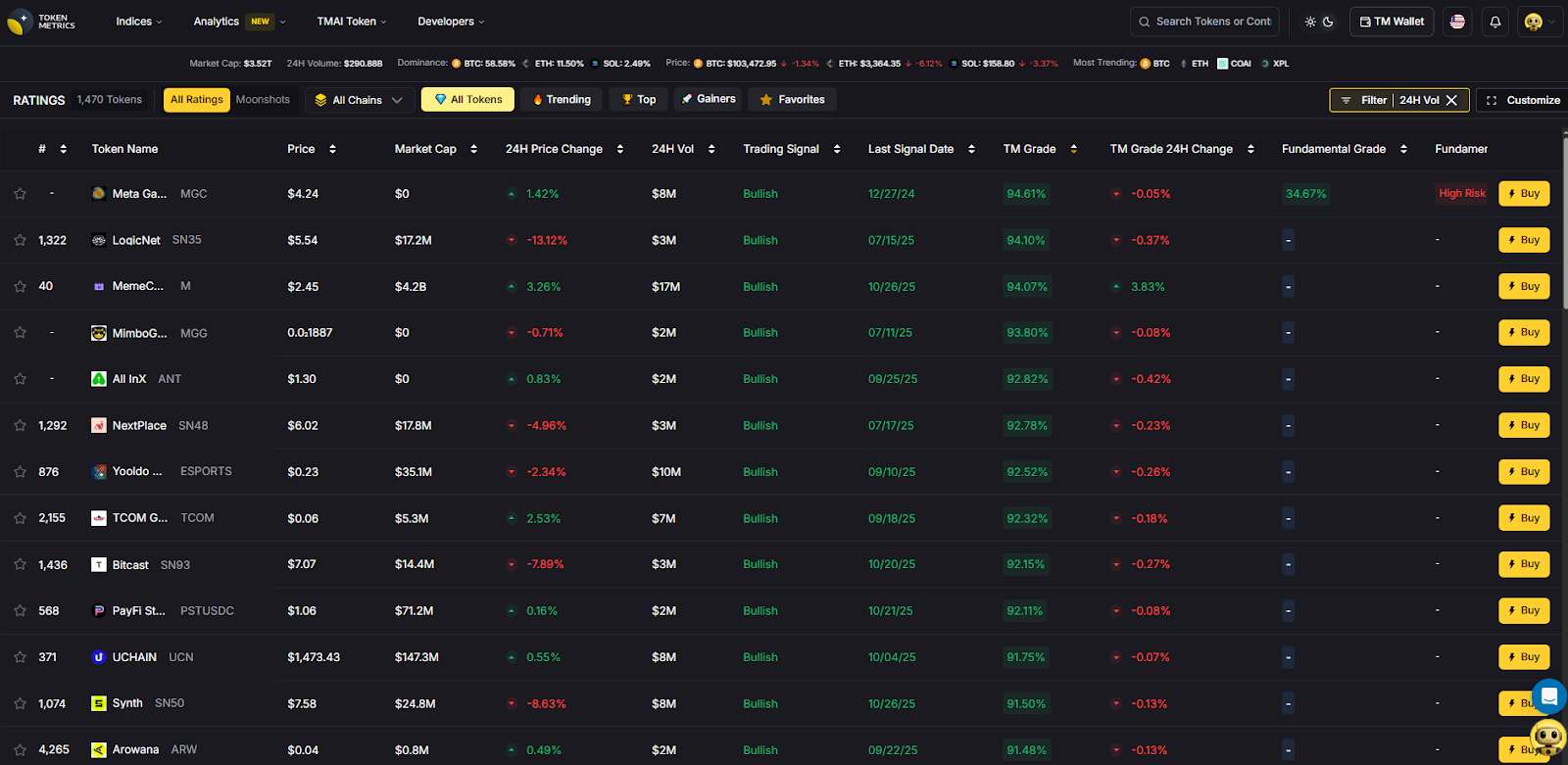
  

  • Narrative Detection to catch early shifts in restaking themes.
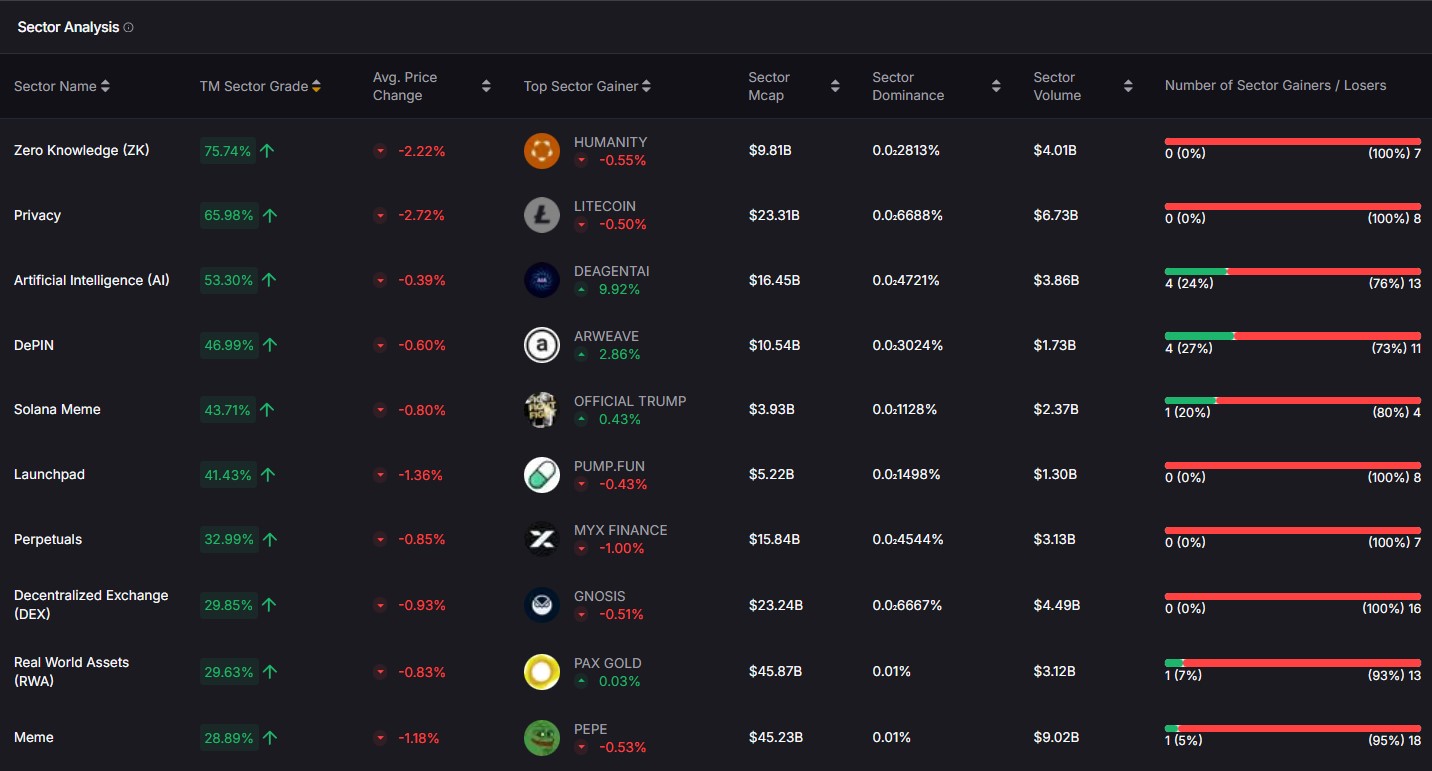
  

  • Portfolio Optimization to balance exposure across LRTs vs. LSTs.
  • Alerts & Signals to time rebalances and exits.
    Workflow: Research → Select provider → Execute on-chain → Monitor with alerts.
    Prefer diversified exposure? Explore Token Metrics Indices.

Security & Compliance Tips

  • Use verified URLs and signed fronts; bookmark dApps.
  • Understand redemption mechanics (instant vs. queue) and fees. (LlamaRisk)
  • Read fee pages before deposit; some charge on rewards, others on performance/platform. (docs.renzoprotocol.com)
  • Review audits/risk docs where available; check operator design.
  • If LPing LRT/ETH, monitor depeg risk and oracle choice.
  • Avoid approvals you don’t need; regularly revoke stale allowances.
  • Confirm region eligibility and tax implications.
    This article is for research/education, not financial advice.

Beginner Mistakes to Avoid

  • Treating LRTs like 1:1 ETH with zero risk.
  • Ignoring withdrawal queues and exit windows.
  • Chasing points/boosts without reading fee docs.
  • LPing volatile LRT pairs without hedge.
  • Overconcentrating in one operator/AVS route.
  • Skipping protocol terms or assuming U.S. access by default.

How We Picked (Methodology & Scoring)

We scored each provider using the weights above, focusing on official fee pages, docs, and security materials. We shortlisted ~20 projects and selected 10 with the strongest mix of liquidity, disclosures, and fit for this category. Freshness verified November 2025 via official resources.


FAQs

What is a liquid restaking token (LRT)?
 An LRT is a liquid receipt for restaked assets (usually ETH) that accrues base staking plus AVS restaking rewards and can be used across DeFi.

Are LRTs safe?
 They carry smart-contract, operator, and AVS risks in addition to staking risks. Read audits, fee pages, and redemption docs before depositing.

What fees should I expect?
 Common models include a percent of rewards (e.g., 10% at Renzo) or platform + performance fees (e.g., 1% + 10% at Mellow). Always check the latest official docs. (docs.renzoprotocol.com)

What’s the difference between EigenLayer vs. Symbiotic/Jito routes?
 They’re different restaking stacks and AVS ecosystems. Some providers support multiple stacks to diversify coverage. (docs.renzoprotocol.com)

How do redemptions work?
 Most use queued exits; some offer instant liquidity with a fee when available (e.g., Puffer). Review the protocol’s redemption section. (LlamaRisk)

Can U.S. users access these protocols?
 Terms vary by protocol and may change. Always check the provider’s website and terms for your jurisdiction.


Conclusion + Related Reads

If you want liquidity + integrations, start with ether.fi or Renzo. Prefer explicit fee logic in a managed strategy? Look at Mellow. Want basket exposure? Consider YieldNest. For redemption flexibility, Puffer stands out. Match the fee model, stack coverage, and redemption flow to your risk and liquidity needs.

Related Reads:

Build Smarter Crypto Apps &
AI Agents in Minutes, Not Months
Real-time prices, trading signals, and on-chain insights all from one powerful API.
Grab a Free API Key
About Token Metrics
Token Metrics: AI-powered crypto research and ratings platform. We help investors make smarter decisions with unbiased Token Metrics Ratings, on-chain analytics, and editor-curated “Top 10” guides. Our platform distills thousands of data points into clear scores, trends, and alerts you can act on.
30 Employees
analysts, data scientists, and crypto engineers
Daily Briefings
concise market insights and “Top Picks”
Transparent & Compliant
Sponsored ≠ Ratings; research remains independent
Want Smarter Crypto Picks—Free?
See unbiased Token Metrics Ratings for BTC, ETH, and top alts.
Thank you! Your submission has been received!
Oops! Something went wrong while submitting the form.
 No credit card | 1-click unsubscribe
Token Metrics Team
Token Metrics Team

Recent Posts

Research

Why Manual Crypto Portfolio Management Is Costing You Money (And Time)

Token Metrics Team
6

You're tracking 50+ tokens across three exchanges, updating your rebalancing spreadsheet every weekend, and second-guessing every exit decision at 2 AM. Sound familiar? Manual crypto portfolio management isn't just exhausting—it's expensive. Between missed rebalances, execution drag, and behavioral mistakes during volatility, DIY portfolio management quietly erodes returns before you see any market gains.

The data tells the story: investors who manually manage diversified crypto portfolios typically underperform comparable automated strategies by 12-18% annually, with 60% of that gap coming from operational inefficiency rather than market timing. If you're spending 10+ hours weekly maintaining positions, those hours have a cost—and it's higher than you think.

The Hidden Costs Destroying Your Returns

Time Drain: The 500-Hour Tax

Managing a diversified crypto portfolio demands constant vigilance. For investors holding 20+ positions, the weekly time investment breaks down to approximately:

  • Market monitoring: 5-8 hours tracking prices, news, and on-chain metrics
  • Rebalancing calculations: 2-3 hours determining optimal weights and required trades
  • Order execution: 3-5 hours placing trades across multiple platforms
  • Record keeping: 1-2 hours logging transactions for tax reporting
  • Research updates: 3-5 hours staying current on project developments

That's 14-23 hours weekly, or 728-1,196 hours annually. At a conservative $50/hour opportunity cost, you're spending $36,400-$59,800 in time value maintaining your portfolio. Even if you value your time at minimum wage, that's still $10,000+ in annual "sweat equity" that automated solutions eliminate.

Execution Drag: Death by a Thousand Trades

Small trades erode portfolios through accumulated friction. Every manual rebalance across a 50-token portfolio requires dozens of individual transactions, each incurring:

  • Trading fees: 0.1-0.5% per trade (average 0.25%)
  • Bid-ask spreads: 0.2-0.8% depending on liquidity
  • Slippage: 0.3-1.2% on smaller cap tokens
  • Gas fees: $2-50 per transaction depending on network congestion

For a $100,000 portfolio rebalanced monthly with 40 trades per rebalance, the costs add up:

  • Average cost per trade: ~$100
  • Monthly execution drag: $4,000
  • Annual execution drag: $48,000 (48% of portfolio value)

The smaller your individual trades, the worse the ratio becomes. A $500 rebalancing trade on a low-liquidity altcoin might pay $25 in fees—a 5% instant loss before any price movement.

Automated indices solve this. TM Global 100, Token Metrics' rules-based index, consolidates 100 individual positions into a single transaction at purchase, with weekly rebalances executed through optimized smart contract batching. Users typically save 3-7% annually in execution costs alone compared to manual approaches.

Behavioral Mistakes: Your Worst Enemy Is in the Mirror

Market psychology research shows that manual portfolio managers tend to make predictable, costly mistakes:

  • Panic selling during drawdowns: When Bitcoin drops 25% in a week, can you stick to your exit rules? Many override their plans during high volatility, often selling near local bottoms.
  • FOMO buying at peaks: Tokens up 300% in a week attract chase behavior, with managers entering after the movement is mostly over.
  • Rebalancing procrastination: Putting off rebalancing leads to drift, holding too much of past winners and missing new opportunities.

Token Metrics' systematic approach removes emotion from the equation. The TM Global 100 Index follows a transparent ruleset: hold the top 100 tokens by market cap during bullish phases, shift to stablecoins during bearish cycles, and rebalance weekly—eliminating emotional override and procrastination.

Missed Rebalances: Drifting Out of Position

Market cap rankings shift constantly. A token ranked #73 on Monday might hit #95 by Friday, or surge to #58. Without systematic rebalancing, your portfolio becomes a collection of recent winners or dumpers.

In Q3 2024, Solana ecosystem tokens surged while Ethereum DeFi tokens consolidated. Manual managers who missed weekly rebalances held too much ETH and insufficient SOL exposure. The result: 15-20% underperformance compared to systematically rebalanced portfolios. Data from Token Metrics shows that weekly rebalancing outperforms monthly or quarterly approaches by 8-12% annually.

Tax Reporting Nightmares

Every trade creates a taxable event. Manual managers executing over 200 trades yearly face:

  • Hours spent compiling transaction logs
  • Reconciliation across multiple exchanges
  • Cost-basis tracking for numerous lots
  • High professional accounting fees ($500-2,000+)

Automated solutions like Token Metrics provide transparent transaction logs for each rebalance, simplifying tax reporting and reducing accounting costs.

The Token Metrics Advantage: Research Meets Execution

Token Metrics has established itself as a leading crypto analytics platform, supporting over 50,000 users with AI-powered token ratings, market regime detection, portfolio optimization tools, and trading signals. But analysis alone isn't enough—implementation is crucial.

TM Global 100 Index bridges this gap. It turns research into actionable, tradeable products by automating rebalancing based on Token Metrics' signals and methodology. One click replaces hours of manual work, following a validated systematic approach.

Automation Without Compromise

The best automation is transparent. TM Global 100 offers:

  • Rules-Based Discipline: Bull markets—hold top 100 tokens; bear markets—move to stablecoins
  • Weekly rebalancing every Monday
  • Full methodology disclosure
  • One-Click execution via embedded self-custodial wallet
  • Real-time market insights and holdings visualization
  • Transaction logs with fees and timestamps

This streamlined process allows users to rapidly execute disciplined rebalancing, saving countless hours and increasing operational efficiency while maintaining asset control.

Decision Framework: When to Automate

Automation suits investors who:

  • Hold 15+ tokens and find rebalancing burdensome
  • Miss optimal rebalancing windows due to time constraints
  • Have experienced emotional trading decisions during volatility
  • Spend over 5 hours a week on portfolio management
  • Want broad exposure without manual tracking

Manual management may be suitable for those with fewer positions, active trading infrastructure, or tactical strategies. For most diversified portfolios, automation enhances efficiency and reduces operational errors.

The Compound Effect of Efficiency

Small inefficiencies compound over time. Over five years, a $50,000 portfolio managed manually with a 12% annual return minus 4-2-1% losses yields roughly a 5% net return, ending at about $63,814. A systematic approach with optimizer integration, zero behavioral errors, and regular rebalancing can attain a 13% net return, reaching approximately $92,246—an increase of over $28,000, not counting time saved.

Conclusion: Time Back, Returns Up

Manual crypto portfolio management made sense when portfolios were small and concentrated. Today’s diversified sets require operational discipline to prevent erosion of returns due to execution drag, missed rebalances, and emotional mistakes. Token Metrics built TM Global 100 to turn research into automated, transparent execution, reclaim your time, and boost portfolio discipline—without sacrificing control.

Research

Moonshots API: Discover Breakout Tokens Before the Crowd

Token Metrics Team
5

The biggest gains in crypto rarely come from the majors. They come from Moonshots—fast-moving tokens with breakout potential. The Moonshots API surfaces these candidates programmatically so you can rank, alert, and act inside your product. In this guide, you’ll call /v2/moonshots, display a high-signal list with TM Grade and Bullish tags, and wire it into bots, dashboards, or screeners in minutes. Start by grabbing your key at Get API Key, then Run Hello-TM and Clone a Template to ship fast.

What You’ll Build in 2 Minutes

Why This Matters

Discovery that converts. Users want more than price tickers, they want a curated, explainable list of high-potential tokens. The Moonshots API encapsulates multiple signals into a short list designed for exploration, alerts, and watchlists you can monetize.

Built for builders. The endpoint returns a consistent schema with grade, signal, and context so you can immediately sort, badge, and trigger workflows. With predictable latency and clear filters, you can scale to dashboards, mobile apps, and headless bots without reinventing the discovery pipeline.

Where to Find The Moonshots API

The cURL request for the Moonshots endpoint is displayed in the top right of the API Reference. Grab it and start tapping into the potential!

How It Works (Under the Hood)

The Moonshots endpoint aggregates a set of evidence—often combining TM Grade, signal state, and momentum/volume context—into a shortlist of breakout candidates. Each row includes a symbol, grade, signal, and timestamp, plus optional reason tags for transparency.

For UX, a common pattern is: headline list → token detail where you render TM Grade (quality), Trading Signals (timing), Support/Resistance (risk placement), Quantmetrics (risk-adjusted performance), and Price Prediction scenarios. This enables users to understand why a token was flagged and how to act with risk controls.

Polling vs webhooks. Dashboards typically poll with short-TTL caching. Alerting flows use scheduled jobs or webhooks to smooth traffic and avoid duplicates. Always make notifications idempotent.

Production Checklist

Use Cases & Patterns

Next Steps

FAQs

1) What does the Moonshots API return?

A list of breakout candidates with fields such as symbol, tm_grade, signal (often Bullish/Bearish), optional reason tags, and updated_at. Use it to drive discover tabs, alerts, and watchlists.

2) How fresh is the list? What about latency/SLOs?

The endpoint targets predictable latency and timely updates for dashboards and alerts. Use short-TTL caching and queued jobs/webhooks to avoid bursty polling.

3) How do I use Moonshots in a trading workflow?

Common stack: Moonshots for discovery, Trading Signals for timing, Support/Resistance for SL/TP, Quantmetrics for sizing, and Price Prediction for scenario context. Always backtest and paper-trade first.

4) I saw results like “+241%” and a “7.5% average return.” Are these guaranteed?

No. Any historical results are illustrative and not guarantees of future performance. Markets are risky; use risk management and testing.

5) Can I filter the Moonshots list?

Yes—pass parameters like min_grade, signal, and limit (as supported) to tailor to your audience and keep pages fast.

6) Do you provide SDKs or examples?

REST works with JavaScript and Python snippets above. Docs include quickstarts, Postman collections, and templates—start with Run Hello-TM.

7) Pricing, limits, and enterprise SLAs?

Begin free and scale up. See API plans for rate limits and enterprise options.

Research

Support and Resistance API: Auto-Calculate Smart Levels for Better Trades

Token Metrics Team
4

Most traders still draw lines by hand in TradingView. The support and resistance API from Token Metrics auto-calculates clean support and resistance levels from one request, so your dashboard, bot, or alerts can react instantly. In minutes, you’ll call /v2/resistance-support, render actionable levels for any token, and wire them into stops, targets, or notifications. Start by grabbing your key on Get API Key, then Run Hello-TM and Clone a Template to ship a production-ready feature fast.

What You’ll Build in 2 Minutes

A minimal script that fetches Support/Resistance via /v2/resistance-support for a symbol (e.g., BTC, SOL).

  • A one-liner curl to smoke-test your key.
  • A UI pattern to display nearest support, nearest resistance, level strength, and last updated time.

Next Endpoints to add

  • /v2/trading-signals (entries/exits)
  • /v2/hourly-trading-signals (intraday updates)
  • /v2/tm-grade (single-score context)
  • /v2/quantmetrics (risk/return framing)

Why This Matters

Precision beats guesswork. Hand-drawn lines are subjective and slow. The support and resistance API standardizes levels across assets and timeframes, enabling deterministic stops and take-profits your users (and bots) can trust.

Production-ready by design. A simple REST shape, predictable latency, and clear semantics let you add levels to token pages, automate SL/TP alerts, and build rule-based execution with minimal glue code.

Where to Find

Need the Support and Resistance data? The cURL request for it is in the top right of the API Reference for quick access.

👉 Keep momentum: Get API Key • Run Hello-TM • Clone a Template

How It Works (Under the Hood)

The Support/Resistance endpoint analyzes recent price structure to produce discrete levels above and below current price, along with strength indicators you can use for priority and styling. Query /v2/resistance-support?symbol=<ASSET>&timeframe=<HORIZON> to receive arrays of level objects and timestamps.

Polling vs webhooks. For dashboards, short-TTL caching and batched fetches keep pages snappy. For bots and alerts, use queued jobs or webhooks (where applicable) to avoid noisy, bursty polling—especially around market opens and major events.

Production Checklist

  • Rate limits: Respect plan caps; add client-side throttling.
  • Retries/backoff: Exponential backoff with jitter for 429/5xx; log failures.
  • Idempotency: Make alerting and order logic idempotent to prevent duplicates.
  • Caching: Memory/Redis/KV with short TTLs; pre-warm top symbols.
  • Batching: Fetch multiple assets per cycle; parallelize within rate limits.
  • Threshold logic: Add %-of-price buffers (e.g., alert at 0.3–0.5% from level).
  • Error catalog: Map common 4xx/5xx to actionable user guidance; keep request IDs.
  • Observability: Track p95/p99; measure alert precision (touch vs approach).
  • Security: Store API keys in a secrets manager; rotate regularly.

Use Cases & Patterns

  • Bot Builder (Headless): Use nearest support for stop placement and nearest resistance for profit targets. Combine with /v2/trading-signals for entries/exits and size via Quantmetrics (volatility, drawdown).
  • Dashboard Builder (Product): Add a Levels widget to token pages; badge strength (e.g., High/Med/Low) and show last touch time. Color the price region (below support, between levels, above resistance) for instant context.
  • Screener Maker (Lightweight Tools): “Close to level” sort: highlight tokens within X% of a strong level. Toggle alerts for approach vs breakout events.
  • Risk Management: Create policy rules like “no new long if price is within 0.2% of strong resistance.” Export daily level snapshots for audit/compliance.

Next Steps

  • Get API Key — generate a key and start free.
  • Run Hello-TM — verify your first successful call.
  • Clone a Template — deploy a levels panel or alerts bot today.
  • Watch the demo: Compare plans: Scale confidently with API plans.

FAQs

1) What does the Support & Resistance API return?

A JSON payload with arrays of support and resistance levels for a symbol (and optional timeframe), each with a price and strength indicator, plus an update timestamp.

2) How timely are the levels? What are the latency/SLOs?

The endpoint targets predictable latency suitable for dashboards and alerts. Use short-TTL caching for UIs, and queued jobs or webhooks for alerting to smooth traffic.

3) How do I trigger alerts or trades from levels?

Common patterns: alert when price is within X% of a level, touches a level, or breaks beyond with confirmation. Always make downstream actions idempotent and respect rate limits.

4) Can I combine levels with other endpoints?

Yes—pair with /v2/trading-signals for timing, /v2/tm-grade for quality context, and /v2/quantmetrics for risk sizing. This yields a complete decide-plan-execute loop.

5) Which timeframe should I use?

Intraday bots prefer shorter horizons; swing/position dashboards use daily or higher-timeframe levels. Offer a timeframe toggle and cache results per setting.

6) Do you provide SDKs or examples?

Use the REST snippets above (JS/Python). The docs include quickstarts, Postman collections, and templates—start with Run Hello-TM.

7) Pricing, limits, and enterprise SLAs?

Begin free and scale as you grow. See API plans for rate limits and enterprise SLA options.

Disclaimer

This content is for educational purposes only and does not constitute financial advice. Always conduct your own research before making any trading decisions.

Choose from Platinum, Gold, and Silver packages
Reach with 25–30% open rates and 0.5–1% CTR
Craft your own custom ad—from banners to tailored copy
Perfect for Crypto Exchanges, SaaS Tools, DeFi, and AI Products