Back to blog
Research

Best Crypto Liquidity Management & Market-Making Tools (2025)

Discover the ten best crypto liquidity management & market-making tools for 2025, including decision checklists, security tips, top providers, and how to combine CeFi/DeFi solutions with Token Metrics’ AI-powered insights.
Token Metrics Team
13 min read
Want Smarter Crypto Picks—Free?
See unbiased Token Metrics Ratings for BTC, ETH, and top alts.
Thank you! Your submission has been received!
Oops! Something went wrong while submitting the form.
 No credit card | 1-click unsubscribe

Who this guide is for. Token teams, exchanges, funds, and DAOs comparing liquidity management and market-making tools to tighten spreads, balance inventories, and support healthy markets.

Top three picks.

  1. Flowdesk — compliance-first platform + MMaaS across 140+ venues. (flowdesk.co)
  2. Keyrock — full-stack liquidity (MM, OTC, LP mgmt, NFTs). (Keyrock)
  3. Wintermute — leading algorithmic liquidity partner across CeFi/DeFi. (wintermute.com)

One key caveat. Fees and engagement models vary widely (retainer, inventory loan/call, performance); confirm scope, reporting, and legal terms before signing. (flowdesk.co)

Introduction: Why Crypto Liquidity Management & Market-Making Tools Matter in November 2025

In crypto, liquidity management and market-making tools keep order books tight, reduce slippage, and stabilize price discovery across centralized and decentralized venues. The primary keyword here is liquidity management and market-making tools, and the right stack blends execution algorithms, risk controls, analytics, and clear reporting so projects can support listings and users can trade efficiently.

In 2025, onchain liquidity is increasingly concentrated and active on AMMs while institutions expect 24/7 coverage and API connectivity across spot, perps, and options. Mature providers now offer compliance-forward processes, automated vaults for concentrated liquidity, and multi-venue execution with transparent documentation. This guide ranks ten credible options, explains trade-offs (costs, custody, venues), and gives you a practical checklist to choose confidently.

Best Crypto Liquidity Management & Market-Making Tools in November 2025 (Comparison Table)
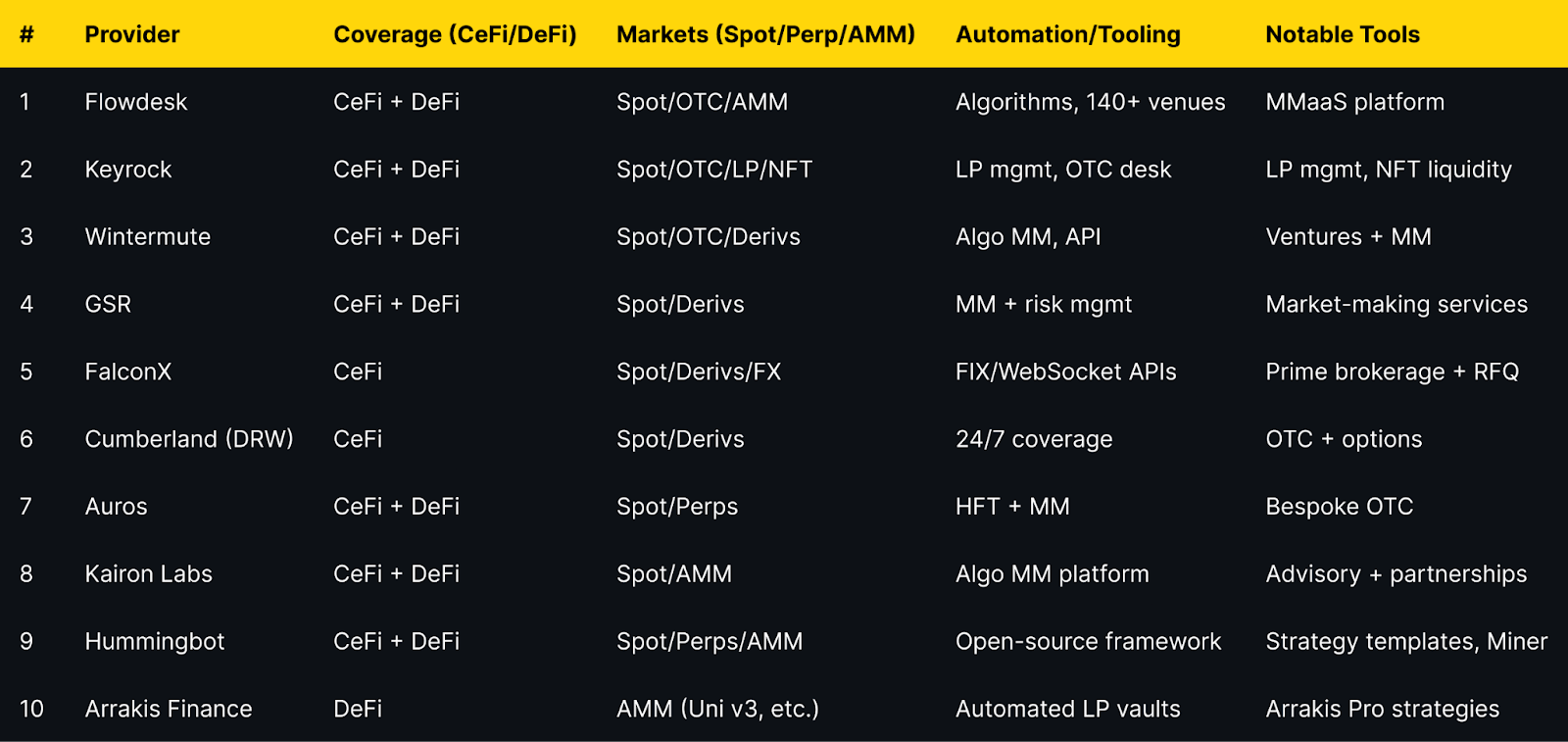
Evidence for venue coverage and capabilities appears in provider sections below.

Top 10 Crypto Liquidity Management & Market-Making Tools in November 2025

1. Flowdesk — Best for compliance-first MMaaS at global scale

Why Use It. Flowdesk runs a compliance-first market-making and OTC platform with proprietary execution algos and integrations across 140+ centralized and decentralized exchanges, suitable for token issuers that need unified coverage and reporting. (flowdesk.co)
Best For. Token issuers; exchanges; DAOs with multi-venue liquidity needs; teams prioritizing compliance.
Notable Features. Low-latency infrastructure; MMaaS with 24/7 teams; 140+ venue connectivity; internal policies & compliance center. (flowdesk.co)
Consider If. You want documented models (retainer vs loan/call) and clear KPIs before engagement. (flowdesk.co)
Fees Notes. Custom; contract-based; network/exchange fees apply.
Regions. Global; subject to local licensing and restrictions (France DASP registration referenced on site). (flowdesk.co)
Alternatives. Keyrock; GSR.

  

2. Keyrock — Best for full-stack liquidity (MM, OTC, LP, NFTs)

Why Use It. Keyrock delivers market making, OTC trading, treasury solutions, and liquidity pool management for token issuers and venues; it also offers NFT liquidity and publishes security awareness and terms. (Keyrock)
Best For. Issuers needing both CeFi and DeFi coverage; platforms adding NFT or LP liquidity.
Notable Features. Liquidity pool management; OTC/options; NFT liquidity; research/insights. (Keyrock)
Consider If. You want a single counterparty handling MM + LP mgmt with documented terms. (Keyrock)
Fees Notes. Custom; scope-based; network/exchange fees may apply.
Regions. Global; services subject to applicable laws and platform eligibility.
Alternatives. Flowdesk; Wintermute.


3. Wintermute — Best for algorithmic crypto liquidity at scale

Why Use It. Wintermute is a leading algorithmic trading firm and liquidity partner that supports efficient markets across centralized and decentralized venues, with a broader ventures arm for strategic projects. (wintermute.com)
Best For. Larger token issuers and institutions that want deep, programmatic liquidity and breadth of venues.
Notable Features. Algorithmic MM; OTC; venture support; expanding US presence. (fnlondon.com)
Consider If. You need institutional processes and policy engagement in the US market. (fnlondon.com)
Fees Notes. Custom; inventory/retainer structures typical.
Regions. Global.
Alternatives. GSR; FalconX.


4. GSR — Best for crypto liquidity + risk management depth

Why Use It. GSR offers market-making and risk management across spot and derivatives, working with exchanges, token issuers, and institutions; it publishes regular research and insights. (gsr.io)
Best For. Issuers seeking experienced MM with derivatives coverage and institutional process.
Notable Features. Trading + market making services; exchange connectivity; research hub. (gsr.io)
Consider If. You need structured reporting and risk frameworks across venues.
Fees Notes. Custom; scope-based; exchange/network fees apply.
Regions. Global.
Alternatives. Wintermute; Flowdesk.

5. FalconX — Best prime brokerage + deep crypto liquidity access

Why Use It. FalconX is a prime broker with $2T+ executed and access to 400+ tokens, offering unified spot/derivs/FX execution, OTC, and APIs (WebSocket/FIX/REST). (falconx.io)
Best For. Institutions wanting a single counterparty with RFQ, streaming, and FIX integration.
Notable Features. Deep liquidity pool; algorithmic/TWAP tools; ETF issuer liquidity support; Talos integrations. (falconx.io)
Consider If. You want prime services plus execution algos rather than a pure MM retainer.
Fees Notes. Custom; execution- and volume-based; venue/network fees apply.
Regions. Global (token availability may vary). (falconx.io)
Alternatives. Cumberland; GSR.

6. Cumberland (DRW) — Best for institutional OTC and options

Why Use It. A DRW subsidiary active since 2014 in digital assets, Cumberland provides 24/7 institutional liquidity across spot, listed derivatives, bilateral options, and NDFs, with relationship coverage. (cumberland.io)
Best For. Institutions needing OTC block liquidity and derivatives structures.
Notable Features. OTC/RFQ; BTC/ETH options; futures basis; DRW backing. (cumberland.io)
Consider If. You need large, bespoke trades and derivatives hedging under institutional processes.
Fees Notes. Custom; RFQ spreads/commissions; venue/network fees apply.
Regions. Global, subject to applicable regulations.
Alternatives. FalconX; Wintermute.

7. Auros — Best for HFT-driven market-making with bespoke design

Why Use It. Auros combines high-frequency trading and strategic market making across CeFi and DeFi with bespoke OTC and transparency-oriented reporting for token stability. (Auros)
Best For. Projects seeking a partner for token launch support and stability across venues.
Notable Features. HFT + MM stack; CeFi/DeFi coverage; insights & reporting. (Auros)
Consider If. You want tailored strategies and comms during volatility.
Fees Notes. Custom; scope-based; network/venue fees apply.
Regions. Global.
Alternatives. Kairon Labs; GSR.

8. Kairon Labs — Best issuer-focused market-making + advisory

Why Use It. Kairon Labs provides algorithmic market making, liquidity provision, partnerships, and advisory for issuers, with educational content on MM models (designated vs principal). (kaironlabs.com)
Best For. Small–mid cap issuers needing hands-on guidance plus execution.
Notable Features. Issuer-centric services; partnerships support; model education. (kaironlabs.com)
Consider If. You want advisory plus MM under one roof.
Fees Notes. Custom; scope-based; exchange/network fees apply.
Regions. Global.
Alternatives. Auros; Flowdesk.

9. Hummingbot — Best open-source framework for DIY market making

Why Use It. Hummingbot is an open-source Python framework to run automated strategies on any CEX/DEX, with built-in templates for pure market making and perpetual MM and extensive docs. (hummingbot.org)
Best For. Developers, quant hobbyists, and small desks wanting DIY automation.
Notable Features. Strategy library; Docker/API quickstarts; Miner rewards marketplace. (hummingbot.org)
Consider If. You accept self-hosting and operational overhead instead of a service contract.
Fees Notes. Software is free; trading/withdrawal/network fees still apply.
Regions. Global (open-source).
Alternatives. Arrakis (for LP vaults); Keyrock (for managed LP).

10. Arrakis Finance — Best for automated onchain LP management (Uni v3 & more)

Why Use It. Arrakis provides automated LP vaults and Arrakis Pro strategies for token issuers to manage concentrated liquidity with rebalancing and inventory targeting. (arrakis.finance)
Best For. Projects prioritizing DeFi AMM depth and capital efficiency on Uniswap v3-style DEXs.
Notable Features. Ongoing inventory management; automated rebalancing; issuer-specific vault programs. (arrakis.finance)
Consider If. You need onchain, non-custodial liquidity programs over CeFi MM retainers.
Fees Notes. Protocol/vault fees; gas costs on supported chains.
Regions. Global (onchain).
Alternatives. Hummingbot (DIY); GSR (CeFi/MM).

Decision Guide: Best By Use Case

  • Regulated, compliance-first MMaaS: Flowdesk. (flowdesk.co)
  • One-stop liquidity incl. NFTs & LP mgmt: Keyrock. (Keyrock)
  • Algorithmic MM at institutional scale: Wintermute or GSR. (wintermute.com)
  • Prime brokerage + FIX/WebSocket execution: FalconX. (falconx.io)
  • OTC blocks + options structures: Cumberland (DRW). (cumberland.io)
  • Launch support with HFT expertise: Auros. (Auros)
  • Issuer-centric MM + advisory: Kairon Labs. (kaironlabs.com)
  • DIY automation (open-source): Hummingbot. (hummingbot.org)
  • Onchain concentrated liquidity programs: Arrakis Finance. (arrakis.finance)

How to Choose the Right Crypto Liquidity Management & Market-Making Tool (Checklist)

  • Region eligibility & licensing: Confirm provider registrations and legal terms in your jurisdictions.
  • Venue coverage: CeFi exchanges, perps venues, and DeFi AMMs you actually need.
  • Inventory model: Retainer vs. inventory loan/call; required collateral and risks. (flowdesk.co)
  • Execution stack: APIs (FIX/WebSocket/REST), algos, latency, and monitoring. (falconx.io)
  • Onchain LP management: If DeFi-first, evaluate vault design, rebalancing, and transparency. (arrakis.finance)
  • Reporting & SLAs: Daily/weekly liquidity KPIs, spread targets, uptime, incident process.
  • Security & compliance: Insider-trading controls, conflict-of-interest policies, audits/policies page. (flowdesk.co)
  • Costs & fees: Understand spread capture, performance fees, platform fees, and gas.
  • Offboarding plan: Access to accounts, revocation of keys, vault migrations, and documentation.

Red flags: No written terms, vague reporting, or inability to name supported venues.

Use Token Metrics With Any Crypto Liquidity Provider

  • AI Ratings to screen assets by quality and momentum before listings.
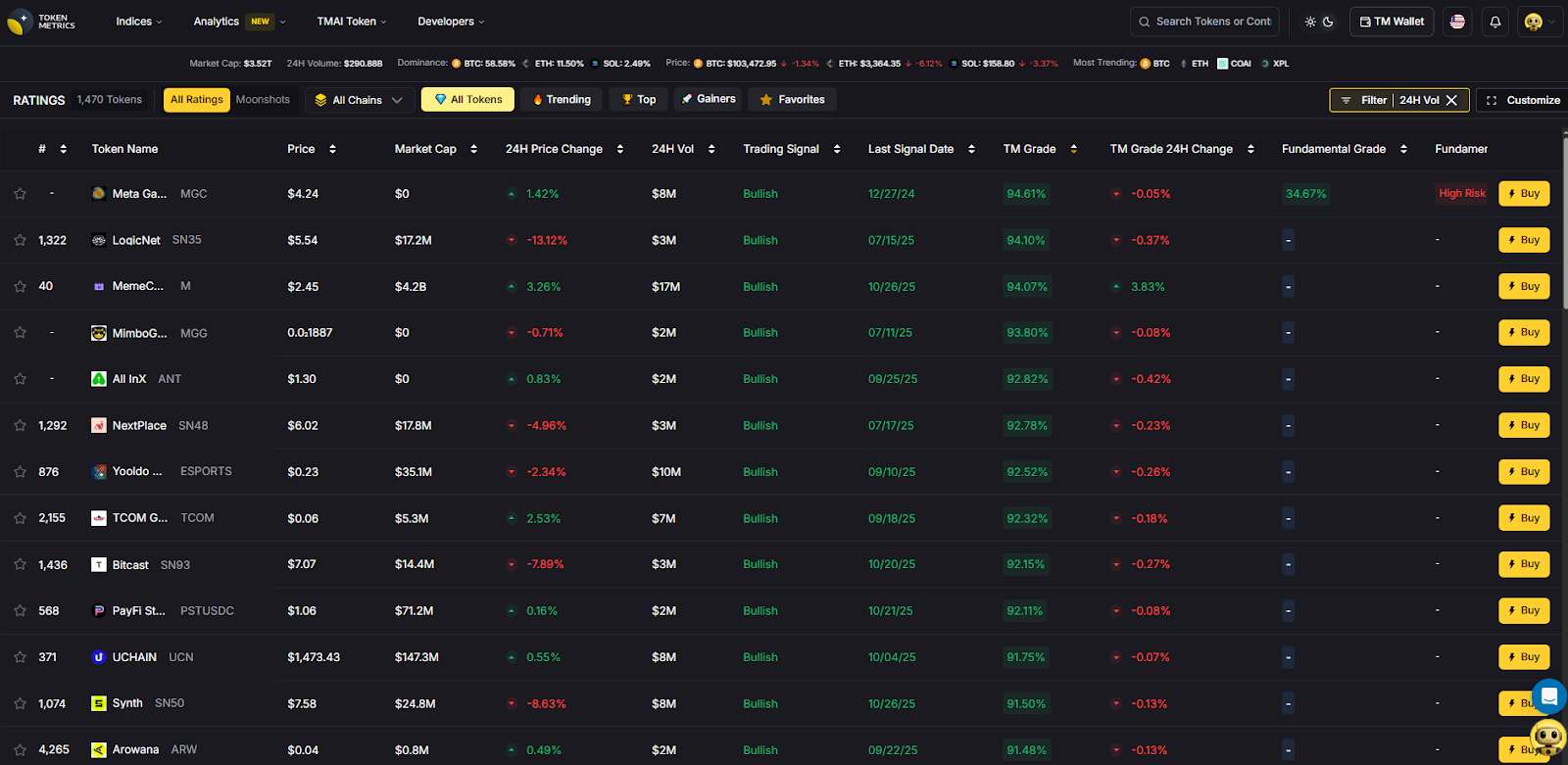
  

  • Narrative Detection to catch early theme shifts that can impact liquidity.
  • Portfolio Optimization to size inventory across chains and LPs.
  • Alerts & Signals to time entries/exits and rebalance LP ranges.

Workflow: Research in Token Metrics → Select provider → Execute on-chain/CeFi → Monitor with alerts.


Start free trial to screen assets and time entries with AI.
  

Security & Compliance Tips

  • Prefer partners that publish policies/compliance pages and name registrations. (flowdesk.co)
  • Segregate exchange accounts and use least-privilege API keys; rotate regularly.
  • For DeFi vaults, verify non-custodial design, fee schedules, and admin controls. (arrakis.finance)
  • Confirm reporting cadence (inventory, spreads, volume, venue list).
  • Use official domains and channels to avoid impersonation. (Keyrock)
  • Understand engagement models (retainer vs loan/call) and associated risks. (flowdesk.co)

This article is for research/education, not financial advice.

Beginner Mistakes to Avoid

  • Signing without clear KPIs (spread, depth, venue list).
  • Ignoring region restrictions or licensing.
  • Overlooking DeFi vault mechanics (rebalance rules, fees, inventories). (arrakis.finance)
  • Mixing treasury and MM wallets without operational controls.
  • Choosing CeFi-only when you need AMM depth (or vice versa).
  • Underestimating implementation: APIs, custody, exchange listings, oracle feeds.

How We Picked (Methodology & Scoring)

We scored each provider using the following weights:

  • Liquidity — 30% (depth, spreads, execution venues)
  • Security — 25% (controls, disclosures, compliance posture)
  • Coverage — 15% (CeFi/DeFi, spot/derivs, chain support)
  • Costs — 15% (fee clarity, model fit, onchain costs)
  • UX — 10% (integration, tooling, reporting)
  • Support — 5% (24/7 coverage, responsiveness)

Data sources: official product, docs, pricing/terms, security/policies, and status pages; reputable market datasets used only to cross-check scale and venues. Last updated November 2025.

FAQs

What are liquidity management and market-making tools?
 Software platforms and service providers that supply bids/asks, balance inventory, and manage onchain liquidity so markets remain liquid with tighter spreads and lower slippage (CeFi and DeFi).

Are managed market makers or DIY bots safer?
 Managed providers handle execution, risk, and reporting under contracts; DIY bots like Hummingbot provide control but require operational expertise and monitoring. Choose based on team capacity and risk tolerance. (hummingbot.org)

How do providers charge?
 Common models include retainers, inventory loan/call structures, execution fees/spreads, and protocol/vault fees on DeFi. Clarify model, caps, and KPI targets before engagement. (flowdesk.co)

Can I combine CeFi MM with DeFi vaults?
 Yes. Many issuers use a CeFi MM for order books plus an onchain LP manager (e.g., Arrakis) for AMM depth, with shared reporting and risk limits. (arrakis.finance)

Do these tools work in the US/EU/APAC?
 Most providers are global but subject to local regulations, listings, and counterparty restrictions. Check each provider’s terms/compliance pages and confirm venue eligibility. (flowdesk.co)

Conclusion + Related Reads

If you want compliance-centric, multi-venue coverage, start with Flowdesk or Keyrock. For institutional scale, add Wintermute or GSR. If you need prime services and execution, consider FalconX or Cumberland. For DIY or onchain-first, evaluate Hummingbot and Arrakis.

Related Reads (Token Metrics):

Build Smarter Crypto Apps &
AI Agents in Minutes, Not Months
Real-time prices, trading signals, and on-chain insights all from one powerful API.
Grab a Free API Key
About Token Metrics
Token Metrics: AI-powered crypto research and ratings platform. We help investors make smarter decisions with unbiased Token Metrics Ratings, on-chain analytics, and editor-curated “Top 10” guides. Our platform distills thousands of data points into clear scores, trends, and alerts you can act on.
30 Employees
analysts, data scientists, and crypto engineers
Daily Briefings
concise market insights and “Top Picks”
Transparent & Compliant
Sponsored ≠ Ratings; research remains independent
Want Smarter Crypto Picks—Free?
See unbiased Token Metrics Ratings for BTC, ETH, and top alts.
Thank you! Your submission has been received!
Oops! Something went wrong while submitting the form.
 No credit card | 1-click unsubscribe
Token Metrics Team
Token Metrics Team

Recent Posts

Research

5 Costly Crypto Investing Mistakes (And How Token Metrics Indices Fix Them)

Token Metrics Team
8

Billions of dollars vanish from the crypto markets annually, not due to scams or hacks—but simply through common, avoidable mistakes. Recent data reveals that 95% of cryptocurrency traders lose money, and the root causes are rarely market volatility or bad luck. Instead, it’s everyday errors in judgment, strategy, and execution. If you have ever bought a token near its top, held a losing position in hopes of a turnaround, or felt overwhelmed by countless investment choices, you’re far from alone. These patterns impact millions, draining away both capital and peace of mind.

The good news? Token Metrics AI indices are designed to address these exact issues. In this article, we’ll examine the five most costly crypto investing mistakes—and show how Token Metrics’ systematic approach helps mitigate them all.

Mistake #1: Buying Hype Instead of Fundamentals

The Problem
You notice a token trending on social media, backed by massive price gains and hype. FOMO prompts you to invest, even though you don’t fully understand the project. For example, in 2021, the Squid Game Token rocketed 86,000% in just a week due to hype linked to the Netflix series. Investors poured in millions—only for a "rug pull" to destroy its value, leaving those who bought at the top with 99.99% losses.

Why This Happens

How Token Metrics Solves It
Token Metrics uses AI and machine learning to analyze over 80 data points per token, including fundamentals, code quality, sentiment, and market indicators

The result? Only projects passing strict fundamental analysis are included in Token Metrics indices. Hype-driven projects are filtered out, helping protect investors from unreliable assets.

Mistake #2: Poor Timing (Buying High, Selling Low)

The Problem
Emotion-driven timing—buying during surges and selling during dips—is one of the biggest sources of loss for crypto investors. Research indicates the average investor underperforms basic buy-and-hold by 30–50% per year due to such decisions.

Why This Happens

How Token Metrics Solves It
Token Metrics indices rebalance weekly, monthly, or quarterly using algorithmic rules. The platform’s AI features:

Example: If Solana’s strength increases, Token Metrics may raise its allocation; as momentum fades, the index reduces exposure—helping avoid entire declines that manual investors often experience. This systematic, emotion-free timing can produce more consistent results than self-directed trading.

Mistake #3: Dangerous Lack of Diversification

The Problem
Concentrating heavily in a single token exposes investors to severe downside. In 2022, many held over 50% of their portfolio in Luna/UST and suffered disproportionate losses when the protocol collapsed.

Why This Happens

How Token Metrics Solves It
Token Metrics indices deliver automatic diversification:

Sample Portfolio: 30% Bitcoin, 25% Ethereum, 15% Solana, 10% Chainlink, 8% Avalanche, 7% Polygon, 5% other high-quality assets. If one token sees trouble, most of the portfolio remains protected—a proven benefit highlighted by Token Metrics’ multi-year track record of outperformance with diversified baskets.

Mistake #4: Inconsistent Portfolio Management

The Problem
Without regular review, portfolio allocation drifts: winners may become overexposed, losers get neglected, and emotional attachments override discipline. Studies show that investors who fail to rebalance underperform by 15–20% annually due to uncontrolled risk and missed opportunities.

Why This Happens

How Token Metrics Solves It
All Token Metrics indices are systematically rebalanced on a set schedule. For trading indices, rebalancing happens weekly—well-performing tokens are trimmed, underperformers removed, and new opportunities integrated. For investor indices, monthly or quarterly rebalances keep long-term allocations aligned while minimizing transaction costs.

Example: Instead of riding a token from $10 to $100 and back to $30, Token Metrics trims positions in stages, locking in gains before major declines. This systematic process produces more stable outcomes than manual, emotion-driven management.

Mistake #5: Analysis Paralysis and Information Overload

The Problem
With thousands of crypto assets, dozens of exchanges, and endless advice, many investors get stuck researching without ever taking action—or constantly shift strategies without conviction. During recent bull markets, analysis paralysis alone led to missed opportunities for significant growth.

Why This Happens

How Token Metrics Solves It
Token Metrics offers a simple, three-step process:

From there, AI research handles token analysis, portfolio selection, rebalancing, and ongoing risk management—reducing complexity and saving hours each week.

This all-in-one approach makes it possible to manage your crypto allocation in an hour per month—while leveraging systematic, AI-driven best practices.

The Token Metrics Advantage: Five Problems, One Solution

What sets Token Metrics apart for investors seeking robust, repeatable results?

Taking Action: Your Next Steps

Recognizing these mistakes is important, but building sound habits is what drives meaningful outcomes. Most investors have made at least one of these errors. The difference comes from implementing systematic solutions.

Every day of delay or indecision can contribute to preventable loss or missed growth, while proven systems work to manage changing markets with discipline.

Subscription costs, typically $50–200 monthly, are modest compared to the savings from avoiding just a single significant error. Many users note that Token Metrics’ AI prevents multiple costly mistakes each year.

Conclusion: From Mistakes to Mastery

The five mistakes covered—buying hype, poor timing, concentration, inconsistent management, and information overload—are among the most common causes of investor losses in crypto. Token Metrics’ indices offer systematic processes that remove emotion, foster diversification, drive consistent rebalancing, and simplify complex decisions. With tools built on institutional-grade AI, you can transform passive mistakes into active mastery. You don’t need to become a full-time trader or blockchain expert; you need proven systems designed to avoid the most frequent pitfalls.

Move beyond trial and error, and leverage AI-powered intelligence for smarter investing decisions with Token Metrics. Make your next move one of clarity and confidence.

Click here to signup for free trial account!

Discover Crypto Gems with Token Metrics AI

Token Metrics uses AI-powered analysis to help you uncover profitable opportunities in the crypto market. Get Started For Free

FAQs

What are Token Metrics indices, and how do they work?

Token Metrics indices are algorithmically created baskets of cryptocurrencies selected using AI-driven research. They are rebalanced systematically based on market signals, offering diversified exposure and removing emotional bias.

How does Token Metrics help avoid hype-driven mistakes?

Token Metrics rigorously evaluates project fundamentals, code quality, market viability, and liquidity, filtering out projects driven by short-term hype or weak fundamentals. Only tokens passing strict criteria are considered for inclusion in indices.

Can I customize my crypto index with Token Metrics?

Users can choose indices aligned with different investor profiles, timeframes, and styles. While each index follows an algorithmic process, you can select the one that best matches your strategy and goals.

What levels of risk management do Token Metrics indices offer?

Indices are built for risk management, including diversification limits, liquidity filters, systematic rebalancing, and AI-powered detection of changing market conditions to mitigate portfolio risk.

Is Token Metrics suitable for beginners or advanced investors?

Token Metrics is accessible for all experience levels. Beginners benefit from simplified AI-driven selection, while advanced users can access data, detailed reports, and deeper tools for more hands-on analysis.

Disclaimer

This content is for informational and educational purposes only and does not constitute investment advice or a recommendation to buy or sell any digital assets. Cryptocurrencies are volatile and carry risk; always conduct your own research and consider professional advice before making financial decisions.

Click here to signup for free trial account!

Research

The Beginner's Guide to Token Metrics AI Indices: Start Investing Smarter in 2025

Token Metrics Team
8 min

If you’re new to cryptocurrency investing, feeling overwhelmed is common. With more than 6,000 cryptocurrencies, a multitude of trading platforms, and round-the-clock markets, knowing where to begin can seem daunting.

Fortunately, you don’t need to master blockchain or spend countless hours analyzing charts. Token Metrics AI indices offer a straightforward, research-driven entry point for beginners, removing complexity and minimizing guesswork.

Just as the S&P 500 index simplifies stock investing, crypto indices provide diversified exposure to quality assets through a single portfolio. This guide unpacks everything you need to know to start with Token Metrics AI indices—confidently and securely.

What Exactly Are Crypto Indices?

A crypto index is a curated basket of cryptocurrencies, each selected and managed according to specific criteria. Rather than individually picking tokens, investors gain access to pre-built portfolios that automatically adapt to market changes.

How Token Metrics Indices Work

Token Metrics integrates artificial intelligence and machine learning to evaluate over 80 data points for every crypto asset, including

The AI synthesizes this data to select top-performing cryptocurrencies for each index and automatically rebalances portfolios on a schedule (weekly, monthly, or quarterly), aligned with your chosen investment strategy.

The Token Metrics Advantage

Understanding Different Types of Token Metrics Indices

Token Metrics provides 14+ indices tailored to various goals and risk profile

Tokens within each index are selected and weighted by Token Metrics algorithms to maintain the desired risk-reward balance.

Which Index Should You Choose as a Beginner?

Beginners are often best served by starting with the Balanced Investor Index, which offers quarterly or annual rebalancing. This approach provides diversified exposure to proven projects, infrequent maintenance, and space to learn progressively.

As your familiarity grows, consider exploring active trading or sector-driven strategies according to your comfort with market cycles and research.

Click here to signup for free trial account!

Getting Started: Your 5-Step Action Plan

Ready to make the leap? Here’s a step-by-step road map:

Three Common Beginner Mistakes (And How to Avoid Them)

Understanding Dollar-Cost Averaging (DCA) for Beginners

Dollar-cost averaging (DCA) is a strategy where investors commit a fixed amount at regular intervals—regardless of market conditions.

A simple DCA approach: Invest the same sum on the same day each month into your Token Metrics index allocations, building wealth methodically over time.

Essential Security Tips for Beginners

Adopt strict security practices from the start:

Realistic Expectations: What Returns Can You Expect?

Crypto is known for outsized moves, but results vary with market cycles:

Establish expectations over a five-year window, prioritizing steady growth and disciplined allocation rather than chasing quick profits. Historical performance is informative but not predictive.

Building Your Knowledge Over Time

A methodical approach helps you evolve:

Next Steps: Taking Action Today

The most impactful step is starting. Use the following checklist to guide your first month:

Final Thoughts: Your Crypto Investment Journey Begins

Using Token Metrics AI indices places beginners at a distinct advantage—minimizing rookie errors and capitalizing on institutional-grade analysis. Follow core tenets: start modestly, prioritize learning, stay disciplined, diversify, and rebalance periodically.

The crypto economy offers meaningful opportunities for calculated, patient investors. With a focused, research-driven approach like that offered by Token Metrics, you gain access to sophisticated strategies and insights from your very first day.

Your path to building a resilient crypto portfolio begins with a single, informed choice.

Discover Crypto Gems with Token Metrics AI

Token Metrics uses AI-powered analysis to help you uncover profitable opportunities in the crypto market. Get Started For Free

FAQ: Token Metrics AI Indices and Crypto Index Investing

What is a crypto index and how does it work?

A crypto index is a diversified portfolio of cryptocurrencies chosen based on specific themes, fundamental criteria, or market conditions. Token Metrics’ indices use AI and data-driven analytics to select and rebalance holdings with the goal of simplifying exposure to the crypto market.

What makes Token Metrics indices different from picking cryptocurrencies myself?

Token Metrics leverages AI to analyze thousands of data points, automating research and portfolio selection that would be time-consuming to perform manually. This reduces bias, streamlines asset rotation, and enhances risk management compared to individual selection.

How much of my portfolio should I allocate to crypto using Token Metrics indices?

While portfolio allocation depends on individual circumstances, many educational resources suggest a starting range of 3–10% of investable assets for beginners. Always assess personal risk tolerance before choosing an allocation.

Is dollar-cost averaging (DCA) a good approach with Token Metrics indices?

DCA can help beginners avoid market timing pitfalls by investing a fixed amount consistently over time. This method encourages discipline and can smooth out volatility when followed long-term.

How can I keep my crypto index investments safe?

Prioritize security by enabling two-factor authentication, using strong passwords, keeping major holdings in a hardware wallet, and never sharing private keys. Avoid posting sensitive data or investment details online.

Disclaimer

This article is for informational and educational purposes only. It does not constitute financial, investment, or tax advice. Cryptocurrency investing involves risk, and past performance is not indicative of future results. Always conduct your own research and seek independent professional advice before making investment decisions.

Click here to signup for free trial account!

Research

7 Proven Strategies to Maximize Returns with Token Metrics AI Indices in 2025

Token Metrics Team
7

Crypto indices have revolutionized diversification and portfolio management, but real outperformance hinges on how intelligently you use platforms like Token Metrics. Unlocking their full potential takes more than passive investing—it requires a blend of AI insights and disciplined strategy.

Understanding Token Metrics' AI-Powered Edge

Token Metrics indices stand out thanks to AI-driven technology analyzing over 80 data points per token. These cover a wide array of crypto themes—Memecoins, RWAs, AI Agents, DeFi, Layer 1s, and more—and are fine-tuned with weekly rebalancing based on dynamic market signals.

This robust data suite, coupled with frequent rebalancing, enables responsive and intelligent index management, optimizing exposure to compounding opportunities while mitigating market risks.

Strategy #1: Multi-Index Allocation for Smart Diversification

A common pitfall is putting all your capital into a single index. Top performers, however, diversify across multiple Token Metrics indices, targeting different market segments to balance stability and growth.

Consider a three-tier framework:

This structure ensures you capture core market resilience, trend-led growth, and high-risk/high-reward opportunities.

Dynamic reallocation based on market cycles further refines the strategy:

Token Metrics' Market Analytics can inform these allocation shifts using data-driven bullish or bearish signals.

Strategy #2: Sector Rotation to Follow the Leaders

Different crypto sectors peak at different points in the macro cycle. By monitoring Token Metrics' sector-specific indices, investors can rotate allocations to capture the strongest trends.

Typical cycle stages:

A tactical example: Begin with 60% in an Investor Index during an early bull phase, then pivot a portion to sector leaders as outperformance emerges, using clear quantitative signals from Token Metrics analytics.

Don’t try to predict sector winners; let relative performance guide your rotation decisions.

Strategy #3: Choose the Right Time Horizon Through Rebalancing

Each investor’s available time and risk tolerance should match the index’s rebalancing schedule. Token Metrics provides:

Misaligning your activity level with rebalancing frequency can mean missed signals or excessive trading costs. Honest self-assessment leads to better index selection and results.

Strategy #4: Enhance Results with Smart Dollar-Cost Averaging (DCA)

Classic lump-sum investing exposes you to timing risk. Strategic DCA smooths entries, especially when adapted to market signals:

Such approaches can be tailored with Token Metrics' analytic tools and AI-powered signals.

Strategy #5: Systematic Risk Management and Position Sizing

Disciplined risk rules are essential to avoiding outsized losses. Key principles include:

Portfolio discipline enables long-term participation and helps minimize drawdowns.

Strategy #6: Strategic Rebalancing Between Indices

Active rebalancing adjusts exposure as market conditions evolve—not just at set intervals. Quarterly reviews help identify outperformers to trim, underperformers to top up, and spot for new opportunities.

Monitor index correlations to ensure real diversification. Use data from Token Metrics' analytics to guide dynamic weight changes if bullish or bearish triggers are hit.

Strategy #7: Unleashing the Full Token Metrics Ecosystem

Take advantage of Token Metrics’ full feature set to maximize insights and execution quality:

Structuring a weekly routine with market check-ins, grade reviews, and strategy adjustments ensures you stay disciplined and data-driven. Leverage all Token Metrics tools for robust, systematic investing.

Avoiding Common Mistakes and Measuring Real Performance

Frequent pitfalls include over-trading, ignoring risk controls, emotional overrides of AI signals, insufficient diversification, forgetting taxes, and chasing hype. Sticking to the above frameworks and monitoring KPIs like absolute return, Sharpe ratio, drawdowns, and portfolio health can keep performance on track.

Effective performance measurement includes:

Regular performance and process auditing can lead to continuous improvement.

Real-World Scenarios and Action Plans

Three illustrative approaches:

Click here to signup for free trial account!

Regardless of style, following a clear 30-day roadmap—risk assessment, strategic setup, ongoing refinement—positions you for systematic, data-driven execution over the long term.

Conclusion: Succeeding with Token Metrics Indices

Success stems from synergy: Multi-index allocation, sector rotation, time-matched rebalancing, advanced DCA, rigorous risk management, active rebalancing, and full use of Token Metrics’ AI ecosystem work best together. Even partial adoption can improve outcomes versus passive approaches, while full mastery unlocks maximum performance through discipline and superior analytics.

The journey to consistent crypto performance favors intelligent frameworks and systematic execution. By aligning human strategy with AI insights, investors can aim to capture attractive results while managing risk responsibly.

Discover Crypto Gems with Token Metrics AI

Token Metrics uses AI-powered analysis to help you uncover profitable opportunities in the crypto market. Get Started For Free

FAQs

What makes Token Metrics indices unique?

Token Metrics indices utilize AI and 80+ data points per token, paired with dynamic rebalancing, enabling more adaptive, diversified, and data-informed exposure than traditional indices.

How does weekly rebalancing impact portfolio performance?

Frequent rebalancing helps capture gains, prune underperformers, and stay aligned with emerging trends—compounding results and maintaining optimal portfolios throughout market cycles.

Should I use multiple Token Metrics indices or focus on one?

Diversifying across several indices affords stability while allowing portions of the portfolio to chase growth or sector-specific opportunities, reducing concentrated risk.

How can I decide my crypto allocation and position sizes?

Assess your risk tolerance and time horizon. Use established rules—like capping crypto at a fraction of your net worth—and diversify within crypto between core, growth, and opportunity indices.

Is Token Metrics only for advanced users?

No. Token Metrics offers accessible indices and tools for beginners, plus granular analytics, APIs, and automation features for advanced investors seeking a data-powered edge.

Disclaimer

This guide is for educational and informational purposes only. Nothing contained herein constitutes investment advice, financial recommendations, or a guarantee of results. Crypto assets are volatile and may not be suitable for all investors. Please consult a qualified financial advisor and conduct your own research before making financial decisions. Past performance is not indicative of future outcomes.

Click here to signup for free trial account!

Choose from Platinum, Gold, and Silver packages
Reach with 25–30% open rates and 0.5–1% CTR
Craft your own custom ad—from banners to tailored copy
Perfect for Crypto Exchanges, SaaS Tools, DeFi, and AI Products