Back to blog
Research

Best Crypto Liquidity Management & Market-Making Tools (2025)

Discover the ten best crypto liquidity management & market-making tools for 2025, including decision checklists, security tips, top providers, and how to combine CeFi/DeFi solutions with Token Metrics’ AI-powered insights.
Token Metrics Team
13 min read
Want Smarter Crypto Picks—Free?
See unbiased Token Metrics Ratings for BTC, ETH, and top alts.
Thank you! Your submission has been received!
Oops! Something went wrong while submitting the form.
 No credit card | 1-click unsubscribe

Who this guide is for. Token teams, exchanges, funds, and DAOs comparing liquidity management and market-making tools to tighten spreads, balance inventories, and support healthy markets.

Top three picks.

  1. Flowdesk — compliance-first platform + MMaaS across 140+ venues. (flowdesk.co)
  2. Keyrock — full-stack liquidity (MM, OTC, LP mgmt, NFTs). (Keyrock)
  3. Wintermute — leading algorithmic liquidity partner across CeFi/DeFi. (wintermute.com)

One key caveat. Fees and engagement models vary widely (retainer, inventory loan/call, performance); confirm scope, reporting, and legal terms before signing. (flowdesk.co)

Introduction: Why Crypto Liquidity Management & Market-Making Tools Matter in November 2025

In crypto, liquidity management and market-making tools keep order books tight, reduce slippage, and stabilize price discovery across centralized and decentralized venues. The primary keyword here is liquidity management and market-making tools, and the right stack blends execution algorithms, risk controls, analytics, and clear reporting so projects can support listings and users can trade efficiently.

In 2025, onchain liquidity is increasingly concentrated and active on AMMs while institutions expect 24/7 coverage and API connectivity across spot, perps, and options. Mature providers now offer compliance-forward processes, automated vaults for concentrated liquidity, and multi-venue execution with transparent documentation. This guide ranks ten credible options, explains trade-offs (costs, custody, venues), and gives you a practical checklist to choose confidently.

Best Crypto Liquidity Management & Market-Making Tools in November 2025 (Comparison Table)
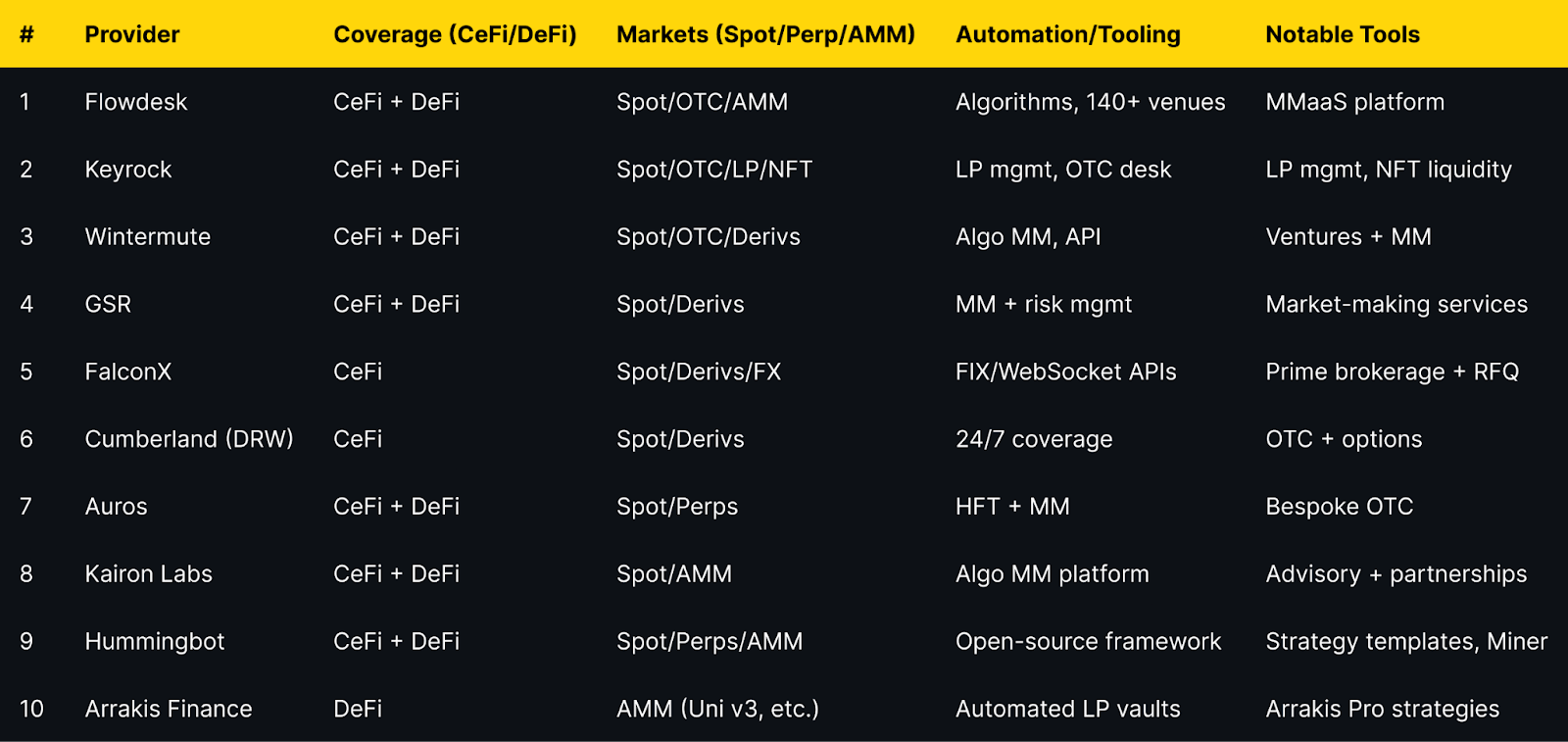
Evidence for venue coverage and capabilities appears in provider sections below.

Top 10 Crypto Liquidity Management & Market-Making Tools in November 2025

1. Flowdesk — Best for compliance-first MMaaS at global scale

Why Use It. Flowdesk runs a compliance-first market-making and OTC platform with proprietary execution algos and integrations across 140+ centralized and decentralized exchanges, suitable for token issuers that need unified coverage and reporting. (flowdesk.co)
Best For. Token issuers; exchanges; DAOs with multi-venue liquidity needs; teams prioritizing compliance.
Notable Features. Low-latency infrastructure; MMaaS with 24/7 teams; 140+ venue connectivity; internal policies & compliance center. (flowdesk.co)
Consider If. You want documented models (retainer vs loan/call) and clear KPIs before engagement. (flowdesk.co)
Fees Notes. Custom; contract-based; network/exchange fees apply.
Regions. Global; subject to local licensing and restrictions (France DASP registration referenced on site). (flowdesk.co)
Alternatives. Keyrock; GSR.

  

2. Keyrock — Best for full-stack liquidity (MM, OTC, LP, NFTs)

Why Use It. Keyrock delivers market making, OTC trading, treasury solutions, and liquidity pool management for token issuers and venues; it also offers NFT liquidity and publishes security awareness and terms. (Keyrock)
Best For. Issuers needing both CeFi and DeFi coverage; platforms adding NFT or LP liquidity.
Notable Features. Liquidity pool management; OTC/options; NFT liquidity; research/insights. (Keyrock)
Consider If. You want a single counterparty handling MM + LP mgmt with documented terms. (Keyrock)
Fees Notes. Custom; scope-based; network/exchange fees may apply.
Regions. Global; services subject to applicable laws and platform eligibility.
Alternatives. Flowdesk; Wintermute.


3. Wintermute — Best for algorithmic crypto liquidity at scale

Why Use It. Wintermute is a leading algorithmic trading firm and liquidity partner that supports efficient markets across centralized and decentralized venues, with a broader ventures arm for strategic projects. (wintermute.com)
Best For. Larger token issuers and institutions that want deep, programmatic liquidity and breadth of venues.
Notable Features. Algorithmic MM; OTC; venture support; expanding US presence. (fnlondon.com)
Consider If. You need institutional processes and policy engagement in the US market. (fnlondon.com)
Fees Notes. Custom; inventory/retainer structures typical.
Regions. Global.
Alternatives. GSR; FalconX.


4. GSR — Best for crypto liquidity + risk management depth

Why Use It. GSR offers market-making and risk management across spot and derivatives, working with exchanges, token issuers, and institutions; it publishes regular research and insights. (gsr.io)
Best For. Issuers seeking experienced MM with derivatives coverage and institutional process.
Notable Features. Trading + market making services; exchange connectivity; research hub. (gsr.io)
Consider If. You need structured reporting and risk frameworks across venues.
Fees Notes. Custom; scope-based; exchange/network fees apply.
Regions. Global.
Alternatives. Wintermute; Flowdesk.

5. FalconX — Best prime brokerage + deep crypto liquidity access

Why Use It. FalconX is a prime broker with $2T+ executed and access to 400+ tokens, offering unified spot/derivs/FX execution, OTC, and APIs (WebSocket/FIX/REST). (falconx.io)
Best For. Institutions wanting a single counterparty with RFQ, streaming, and FIX integration.
Notable Features. Deep liquidity pool; algorithmic/TWAP tools; ETF issuer liquidity support; Talos integrations. (falconx.io)
Consider If. You want prime services plus execution algos rather than a pure MM retainer.
Fees Notes. Custom; execution- and volume-based; venue/network fees apply.
Regions. Global (token availability may vary). (falconx.io)
Alternatives. Cumberland; GSR.

6. Cumberland (DRW) — Best for institutional OTC and options

Why Use It. A DRW subsidiary active since 2014 in digital assets, Cumberland provides 24/7 institutional liquidity across spot, listed derivatives, bilateral options, and NDFs, with relationship coverage. (cumberland.io)
Best For. Institutions needing OTC block liquidity and derivatives structures.
Notable Features. OTC/RFQ; BTC/ETH options; futures basis; DRW backing. (cumberland.io)
Consider If. You need large, bespoke trades and derivatives hedging under institutional processes.
Fees Notes. Custom; RFQ spreads/commissions; venue/network fees apply.
Regions. Global, subject to applicable regulations.
Alternatives. FalconX; Wintermute.

7. Auros — Best for HFT-driven market-making with bespoke design

Why Use It. Auros combines high-frequency trading and strategic market making across CeFi and DeFi with bespoke OTC and transparency-oriented reporting for token stability. (Auros)
Best For. Projects seeking a partner for token launch support and stability across venues.
Notable Features. HFT + MM stack; CeFi/DeFi coverage; insights & reporting. (Auros)
Consider If. You want tailored strategies and comms during volatility.
Fees Notes. Custom; scope-based; network/venue fees apply.
Regions. Global.
Alternatives. Kairon Labs; GSR.

8. Kairon Labs — Best issuer-focused market-making + advisory

Why Use It. Kairon Labs provides algorithmic market making, liquidity provision, partnerships, and advisory for issuers, with educational content on MM models (designated vs principal). (kaironlabs.com)
Best For. Small–mid cap issuers needing hands-on guidance plus execution.
Notable Features. Issuer-centric services; partnerships support; model education. (kaironlabs.com)
Consider If. You want advisory plus MM under one roof.
Fees Notes. Custom; scope-based; exchange/network fees apply.
Regions. Global.
Alternatives. Auros; Flowdesk.

9. Hummingbot — Best open-source framework for DIY market making

Why Use It. Hummingbot is an open-source Python framework to run automated strategies on any CEX/DEX, with built-in templates for pure market making and perpetual MM and extensive docs. (hummingbot.org)
Best For. Developers, quant hobbyists, and small desks wanting DIY automation.
Notable Features. Strategy library; Docker/API quickstarts; Miner rewards marketplace. (hummingbot.org)
Consider If. You accept self-hosting and operational overhead instead of a service contract.
Fees Notes. Software is free; trading/withdrawal/network fees still apply.
Regions. Global (open-source).
Alternatives. Arrakis (for LP vaults); Keyrock (for managed LP).

10. Arrakis Finance — Best for automated onchain LP management (Uni v3 & more)

Why Use It. Arrakis provides automated LP vaults and Arrakis Pro strategies for token issuers to manage concentrated liquidity with rebalancing and inventory targeting. (arrakis.finance)
Best For. Projects prioritizing DeFi AMM depth and capital efficiency on Uniswap v3-style DEXs.
Notable Features. Ongoing inventory management; automated rebalancing; issuer-specific vault programs. (arrakis.finance)
Consider If. You need onchain, non-custodial liquidity programs over CeFi MM retainers.
Fees Notes. Protocol/vault fees; gas costs on supported chains.
Regions. Global (onchain).
Alternatives. Hummingbot (DIY); GSR (CeFi/MM).

Decision Guide: Best By Use Case

  • Regulated, compliance-first MMaaS: Flowdesk. (flowdesk.co)
  • One-stop liquidity incl. NFTs & LP mgmt: Keyrock. (Keyrock)
  • Algorithmic MM at institutional scale: Wintermute or GSR. (wintermute.com)
  • Prime brokerage + FIX/WebSocket execution: FalconX. (falconx.io)
  • OTC blocks + options structures: Cumberland (DRW). (cumberland.io)
  • Launch support with HFT expertise: Auros. (Auros)
  • Issuer-centric MM + advisory: Kairon Labs. (kaironlabs.com)
  • DIY automation (open-source): Hummingbot. (hummingbot.org)
  • Onchain concentrated liquidity programs: Arrakis Finance. (arrakis.finance)

How to Choose the Right Crypto Liquidity Management & Market-Making Tool (Checklist)

  • Region eligibility & licensing: Confirm provider registrations and legal terms in your jurisdictions.
  • Venue coverage: CeFi exchanges, perps venues, and DeFi AMMs you actually need.
  • Inventory model: Retainer vs. inventory loan/call; required collateral and risks. (flowdesk.co)
  • Execution stack: APIs (FIX/WebSocket/REST), algos, latency, and monitoring. (falconx.io)
  • Onchain LP management: If DeFi-first, evaluate vault design, rebalancing, and transparency. (arrakis.finance)
  • Reporting & SLAs: Daily/weekly liquidity KPIs, spread targets, uptime, incident process.
  • Security & compliance: Insider-trading controls, conflict-of-interest policies, audits/policies page. (flowdesk.co)
  • Costs & fees: Understand spread capture, performance fees, platform fees, and gas.
  • Offboarding plan: Access to accounts, revocation of keys, vault migrations, and documentation.

Red flags: No written terms, vague reporting, or inability to name supported venues.

Use Token Metrics With Any Crypto Liquidity Provider

  • AI Ratings to screen assets by quality and momentum before listings.
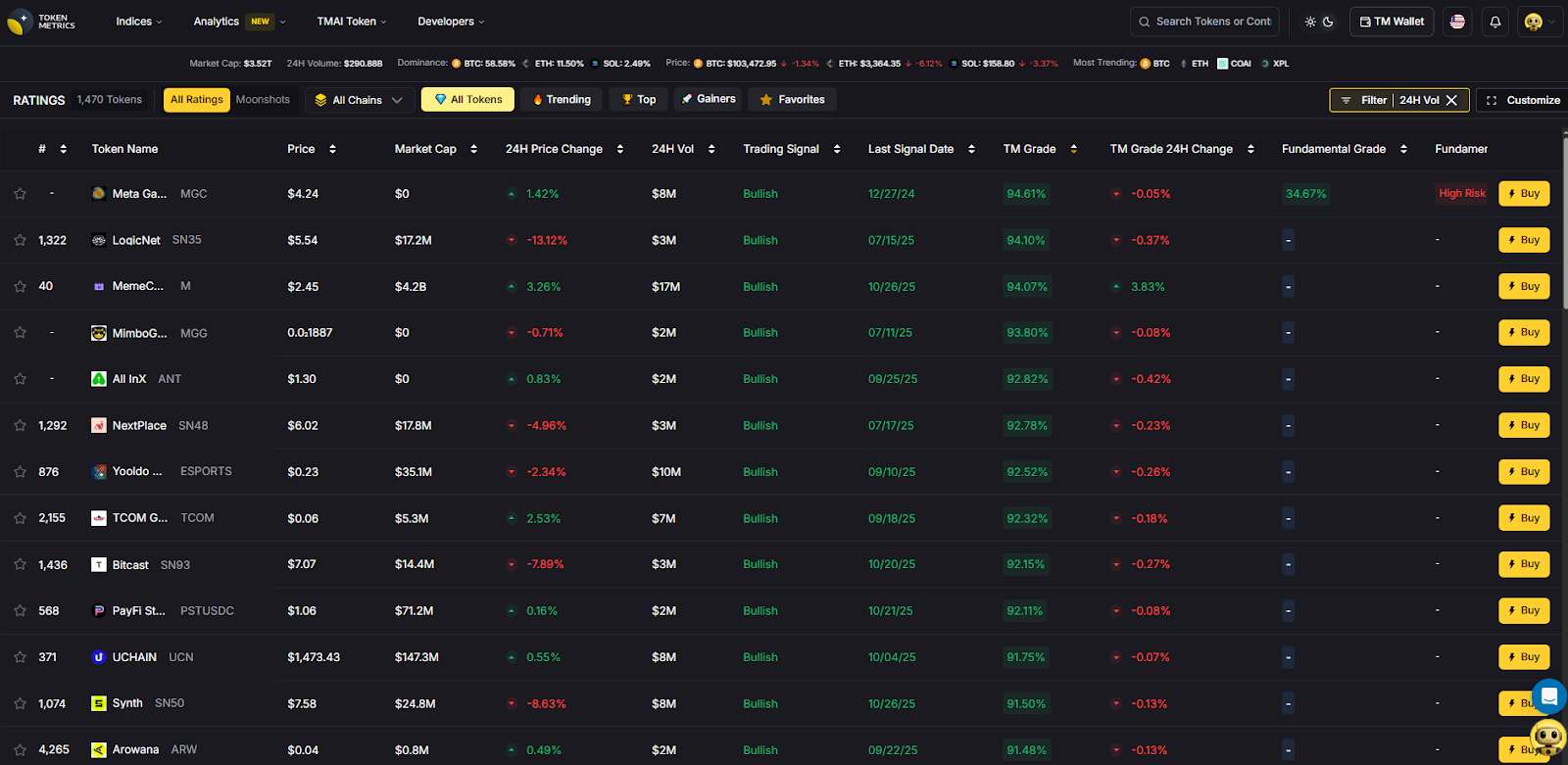
  

  • Narrative Detection to catch early theme shifts that can impact liquidity.
  • Portfolio Optimization to size inventory across chains and LPs.
  • Alerts & Signals to time entries/exits and rebalance LP ranges.

Workflow: Research in Token Metrics → Select provider → Execute on-chain/CeFi → Monitor with alerts.


Start free trial to screen assets and time entries with AI.

  

Security & Compliance Tips

  • Prefer partners that publish policies/compliance pages and name registrations. (flowdesk.co)
  • Segregate exchange accounts and use least-privilege API keys; rotate regularly.
  • For DeFi vaults, verify non-custodial design, fee schedules, and admin controls. (arrakis.finance)
  • Confirm reporting cadence (inventory, spreads, volume, venue list).
  • Use official domains and channels to avoid impersonation. (Keyrock)
  • Understand engagement models (retainer vs loan/call) and associated risks. (flowdesk.co)

This article is for research/education, not financial advice.

Beginner Mistakes to Avoid

  • Signing without clear KPIs (spread, depth, venue list).
  • Ignoring region restrictions or licensing.
  • Overlooking DeFi vault mechanics (rebalance rules, fees, inventories). (arrakis.finance)
  • Mixing treasury and MM wallets without operational controls.
  • Choosing CeFi-only when you need AMM depth (or vice versa).
  • Underestimating implementation: APIs, custody, exchange listings, oracle feeds.

How We Picked (Methodology & Scoring)

We scored each provider using the following weights:

  • Liquidity — 30% (depth, spreads, execution venues)
  • Security — 25% (controls, disclosures, compliance posture)
  • Coverage — 15% (CeFi/DeFi, spot/derivs, chain support)
  • Costs — 15% (fee clarity, model fit, onchain costs)
  • UX — 10% (integration, tooling, reporting)
  • Support — 5% (24/7 coverage, responsiveness)

Data sources: official product, docs, pricing/terms, security/policies, and status pages; reputable market datasets used only to cross-check scale and venues. Last updated November 2025.

FAQs

What are liquidity management and market-making tools?
 Software platforms and service providers that supply bids/asks, balance inventory, and manage onchain liquidity so markets remain liquid with tighter spreads and lower slippage (CeFi and DeFi).

Are managed market makers or DIY bots safer?
 Managed providers handle execution, risk, and reporting under contracts; DIY bots like Hummingbot provide control but require operational expertise and monitoring. Choose based on team capacity and risk tolerance. (hummingbot.org)

How do providers charge?
 Common models include retainers, inventory loan/call structures, execution fees/spreads, and protocol/vault fees on DeFi. Clarify model, caps, and KPI targets before engagement. (flowdesk.co)

Can I combine CeFi MM with DeFi vaults?
 Yes. Many issuers use a CeFi MM for order books plus an onchain LP manager (e.g., Arrakis) for AMM depth, with shared reporting and risk limits. (arrakis.finance)

Do these tools work in the US/EU/APAC?
 Most providers are global but subject to local regulations, listings, and counterparty restrictions. Check each provider’s terms/compliance pages and confirm venue eligibility. (flowdesk.co)

Conclusion + Related Reads

If you want compliance-centric, multi-venue coverage, start with Flowdesk or Keyrock. For institutional scale, add Wintermute or GSR. If you need prime services and execution, consider FalconX or Cumberland. For DIY or onchain-first, evaluate Hummingbot and Arrakis.

Related Reads (Token Metrics):

Build Smarter Crypto Apps &
AI Agents in Minutes, Not Months
Real-time prices, trading signals, and on-chain insights all from one powerful API.
Grab a Free API Key
About Token Metrics
Token Metrics: AI-powered crypto research and ratings platform. We help investors make smarter decisions with unbiased Token Metrics Ratings, on-chain analytics, and editor-curated “Top 10” guides. Our platform distills thousands of data points into clear scores, trends, and alerts you can act on.
30 Employees
analysts, data scientists, and crypto engineers
Daily Briefings
concise market insights and “Top Picks”
Transparent & Compliant
Sponsored ≠ Ratings; research remains independent
Want Smarter Crypto Picks—Free?
See unbiased Token Metrics Ratings for BTC, ETH, and top alts.
Thank you! Your submission has been received!
Oops! Something went wrong while submitting the form.
 No credit card | 1-click unsubscribe
Token Metrics Team
Token Metrics Team

Recent Posts

Research

Build High-Performance APIs with FastAPI

Token Metrics Team
5

FastAPI has become a go-to framework for developers building high-performance, production-grade APIs in Python. This article explains how FastAPI achieves speed, practical patterns for building robust endpoints, how to integrate AI and crypto data, and deployment considerations that keep latency low and reliability high.

What is FastAPI and why it matters

FastAPI is a modern Python web framework designed around standard Python type hints. It uses asynchronous ASGI servers (uvicorn or hypercorn) and automatic OpenAPI documentation. The emphasis is on developer productivity, runtime performance, and clear, type-checked request/response handling.

Key technical advantages include:

  • ASGI-based async I/O: enables concurrent request handling without thread-per-request overhead.
  • Automatic validation and docs: Pydantic models generate schema and validate payloads at runtime, reducing boilerplate.
  • Type hints for clarity: explicit types make routes easier to test and maintain.

Performance patterns and benchmarks

FastAPI often performs near Node.js or Go endpoints for JSON APIs when paired with uvicorn and proper async code. Benchmarks vary by workload, but two principles consistently matter:

  1. Avoid blocking calls: use async libraries for databases, HTTP calls, and I/O. Blocking functions should run in thread pools.
  2. Keep payloads lean: minimize overfetching and use streaming for large responses.

Common performance improvements:

  • Use async ORMs (e.g., SQLModel/SQLAlchemy async or async drivers) for non-blocking DB access.
  • Cache repeated computations and database lookups with Redis or in-memory caches.
  • Use HTTP/2 and proper compression (gzip, brotli) and tune connection settings at the server or ingress layer.

Designing robust APIs with FastAPI

Design matters as much as framework choice. A few structural recommendations:

  • Modular routers: split routes into modules by resource to keep handlers focused and testable.
  • Typed request/response models: define Pydantic models for inputs and outputs to ensure consistent schemas and automatic docs.
  • Dependency injection: use FastAPI's dependency system to manage authentication, DB sessions, and configuration cleanly.
  • Rate limiting and throttling: implement per-user or per-route limits to protect downstream services and control costs.

When building APIs that drive AI agents or serve crypto data, design for observability: instrument latency, error rates, and external API call times so anomalies and regressions are visible.

Integrating AI models and crypto data securely and efficiently

Combining FastAPI with AI workloads or external crypto APIs requires careful orchestration:

  • Asynchronous calls to external APIs: avoid blocking the event loop; use async HTTP clients (httpx or aiohttp).
  • Batching and queuing: for heavy inference or rate-limited external endpoints, queue jobs with background workers (Celery, RQ, or asyncio-based workers) and return immediate task references or websockets for progress updates.
  • Model hosting: serve large AI models from separate inference services (TorchServe, Triton, or managed endpoints). Use FastAPI as a gateway to manage requests and combine model outputs with other data.

For crypto-related integrations, reliable real-time prices and on-chain signals are common requirements. Combining FastAPI endpoints with streaming or caching layers reduces repeated calls to external services and helps maintain predictable latency. For access to curated, programmatic crypto data and signals, tools like Token Metrics can be used as part of your data stack to feed analytics or agent decision layers.

Deployment and operational best practices

Deployment choices influence performance and reliability as much as code. Recommended practices:

  • Use ASGI servers in production: uvicorn with workers via Gunicorn or uvicorn's multi-process mode.
  • Containerize and orchestrate: Docker + Kubernetes or managed platforms (AWS Fargate, GCP Cloud Run) for autoscaling and rolling updates.
  • Health checks and readiness: implement liveness and readiness endpoints to ensure orchestrators only send traffic to healthy instances.
  • Observability: collect traces, metrics, and logs. Integrate distributed tracing (OpenTelemetry), Prometheus metrics, and structured logs to diagnose latency sources.
  • Security: enforce TLS, validate and sanitize inputs, limit CORS appropriately, and manage secrets with vaults or platform-managed solutions.

Build Smarter Crypto Apps & AI Agents with Token Metrics

Token Metrics provides real-time prices, trading signals, and on-chain insights all from one powerful API. Grab a Free API Key

FAQ: How to tune FastAPI performance?

Tune performance by removing blocking calls, using async libraries, enabling connection pooling, caching hotspot queries, and profiling with tools like py-spy or OpenTelemetry to find bottlenecks.

FAQ: Which servers and deployment patterns work best?

Use uvicorn or uvicorn with Gunicorn for multiprocess setups. Container orchestration (Kubernetes) or serverless containers with autoscaling are common choices. Use readiness probes and horizontal autoscaling.

FAQ: What are essential security practices for FastAPI?

Enforce HTTPS, validate input schemas with Pydantic, use secure authentication tokens, limit CORS, and rotate secrets via a secrets manager. Keep dependencies updated and scan images for vulnerabilities.

FAQ: How should I integrate AI inference with FastAPI?

Host heavy models separately, call inference asynchronously, and use background jobs for long-running tasks. Provide status endpoints or websockets to deliver progress to clients.

FAQ: What monitoring should I add to a FastAPI app?

Capture metrics (request duration, error rate), structured logs, and traces. Use Prometheus/Grafana for metrics, a centralized log store, and OpenTelemetry for distributed tracing.

Disclaimer

This article is educational and technical in nature. It does not constitute investment, legal, or professional advice. Always perform your own testing and consider security and compliance requirements before deploying applications that interact with financial or sensitive data.

Research

Building High-Performance APIs with FastAPI

Token Metrics Team
5

FastAPI has rapidly become a go-to framework for Python developers who need fast, async-ready web APIs. In this post we break down why FastAPI delivers strong developer ergonomics and runtime performance, how to design scalable endpoints, and practical patterns for production deployment. Whether you are prototyping an AI-backed service or integrating real-time crypto feeds, understanding FastAPI's architecture helps you build resilient APIs that scale.

Overview: What Makes FastAPI Fast?

FastAPI combines modern Python type hints, asynchronous request handling, and an automatic interactive API docs system to accelerate development and runtime efficiency. It is built on top of Starlette for the web parts and Pydantic for data validation. Key advantages include:

  • Asynchronous concurrency: Native support for async/await lets FastAPI handle I/O-bound workloads with high concurrency when served by ASGI servers like Uvicorn or Hypercorn.
  • Type-driven validation: Request and response schemas are derived from Python types, reducing boilerplate and surface area for bugs.
  • Auto docs: OpenAPI and Swagger UI are generated automatically, improving discoverability and client integration.

These traits make FastAPI suitable for microservices, ML model endpoints, and real-time data APIs where latency and developer velocity matter.

Performance & Scalability Patterns

Performance is a combination of framework design, server selection, and deployment topology. Consider these patterns:

  • ASGI server tuning: Use Uvicorn with Gunicorn workers for multi-core deployments (example: Gunicorn to manage multiple Uvicorn worker processes).
  • Concurrency model: Prefer async operations for external I/O (databases, HTTP calls). Use thread pools for CPU-bound tasks or offload to background workers like Celery or RQ.
  • Connection pooling: Maintain connection pools to databases and upstream services to avoid per-request handshake overhead.
  • Horizontal scaling: Deploy multiple replicas behind a load balancer and utilize health checks and graceful shutdown to ensure reliability.

Measure latency and throughput under realistic traffic using tools like Locust or k6, and tune worker counts and max requests to balance memory and CPU usage.

Best Practices for Building APIs with FastAPI

Adopt these practical steps to keep APIs maintainable and secure:

  1. Schema-first design: Define request and response models early with Pydantic, and use OpenAPI to validate client expectations.
  2. Versioning: Include API versioning in your URL paths or headers to enable iterative changes without breaking clients.
  3. Input validation & error handling: Rely on Pydantic for validation and implement consistent error responses with clear status codes.
  4. Authentication & rate limiting: Protect endpoints with OAuth2/JWT or API keys and apply rate limits via middleware or API gateways.
  5. CI/CD & testing: Automate unit and integration tests, and include performance tests in CI to detect regressions early.

Document deployment runbooks that cover database migrations, secrets rotation, and safe schema migrations to reduce operational risk.

Integrating AI and Real-Time Data

FastAPI is commonly used to expose AI model inference endpoints and aggregate real-time data streams. Key considerations include:

  • Model serving: For CPU/GPU-bound inference, consider dedicated model servers (e.g., TensorFlow Serving, TorchServe) or containerized inference processes, with FastAPI handling orchestration and routing.
  • Batching & async inference: Implement request batching if latency and throughput profiles allow it. Use async I/O for data fetches and preprocessing.
  • Data pipelines: Separate ingestion, processing, and serving layers. Use message queues (Kafka, RabbitMQ) for event-driven flows and background workers for heavy transforms.

AI-driven research and analytics tools can augment API development and monitoring. For example, Token Metrics provides structured crypto insights and on-chain metrics that can be integrated into API endpoints for analytics or enrichment workflows.

Build Smarter Crypto Apps & AI Agents with Token Metrics

Token Metrics provides real-time prices, trading signals, and on-chain insights all from one powerful API. Grab a Free API Key

What is FastAPI and when should I use it?

FastAPI is a modern Python web framework optimized for building APIs quickly using async support and type annotations. Use it when you need high-concurrency I/O performance, automatic API docs, and strong input validation for services like microservices, ML endpoints, or data APIs.

Should I write async or sync endpoints?

If your endpoint performs network or I/O-bound operations (database queries, HTTP calls), async endpoints with awaitable libraries improve concurrency. For CPU-heavy tasks, prefer offloading to background workers or separate services to avoid blocking the event loop.

What are common deployment options for FastAPI?

Common patterns include Uvicorn managed by Gunicorn for process management, containerized deployments on Kubernetes, serverless deployments via providers that support ASGI, and platform-as-a-service options that accept Docker images. Choose based on operational needs and scaling model.

How do I secure FastAPI endpoints?

Implement authentication (OAuth2, JWT, API keys), enforce HTTPS, validate inputs with Pydantic models, and apply rate limiting. Use security headers and monitor logs for suspicious activity. Consider using API gateways for centralized auth and throttling.

How should I monitor and debug FastAPI in production?

Instrument endpoints with structured logging, distributed tracing, and metrics (request latency, error rates). Use APM tools compatible with ASGI frameworks. Configure health checks, and capture exception traces to diagnose errors without exposing sensitive data.

How do I test FastAPI applications?

Use the TestClient from FastAPI (built on Starlette) for endpoint tests, and pytest for unit tests. Include schema validation tests, contract tests for public APIs, and performance tests with k6 or Locust for load characterization.

Disclaimer: This article is educational and technical in nature. It explains development patterns, architecture choices, and tooling options for API design and deployment. It is not financial, trading, or investment advice. Always conduct independent research and follow your organizations compliance policies when integrating external data or services.

Research

Building High-Performance APIs with FastAPI

Token Metrics Team
5

FastAPI has emerged as a go-to framework for building fast, scalable, and developer-friendly APIs in Python. Whether you are prototyping a machine learning inference endpoint, building internal microservices, or exposing realtime data to clients, understanding FastAPI’s design principles and best practices can save development time and operational costs. This guide walks through the technology fundamentals, pragmatic design patterns, deployment considerations, and how to integrate modern AI tools safely and efficiently.

Overview: What Makes FastAPI Fast?

FastAPI is built on Starlette for the web parts and Pydantic for data validation. It leverages Python’s async/await syntax and ASGI (Asynchronous Server Gateway Interface) to handle high concurrency with non-blocking I/O. Key features that contribute to its performance profile include:

  • Async-first architecture: Native support for asynchronous endpoints enables efficient multiplexing of I/O-bound tasks.
  • Automatic validation and docs: Pydantic-based validation reduces runtime errors and generates OpenAPI schemas and interactive docs out of the box.
  • Small, focused stack: Minimal middleware and lean core reduce overhead compared to some full-stack frameworks.

In practice, correctly using async patterns and avoiding blocking calls (e.g., heavy CPU-bound tasks or synchronous DB drivers) is critical to achieve the theoretical throughput FastAPI promises.

Design Patterns & Best Practices

Adopt these patterns to keep your FastAPI codebase maintainable and performant:

  1. Separate concerns: Keep routing, business logic, and data access in separate modules. Use dependency injection for database sessions, authentication, and configuration.
  2. Prefer async I/O: Use async database drivers (e.g., asyncpg for PostgreSQL), async HTTP clients (httpx), and async message brokers when possible. If you must call blocking code, run it in a thread pool via asyncio.to_thread or FastAPI’s background tasks.
  3. Schema-driven DTOs: Define request and response models with Pydantic to validate inputs and serialize outputs consistently. This reduces defensive coding and improves API contract clarity.
  4. Version your APIs: Use path or header-based versioning to avoid breaking consumers when iterating rapidly.
  5. Pagination and rate limiting: For endpoints that return large collections, implement pagination and consider rate-limiting to protect downstream systems.

Applying these patterns leads to clearer contracts, fewer runtime errors, and easier scaling.

Performance Tuning and Monitoring

Beyond using async endpoints, real-world performance tuning focuses on observability and identifying bottlenecks:

  • Profiling: Profile endpoints under representative load to find hotspots. Tools like py-spy or Scalene can reveal CPU vs. I/O contention.
  • Tracing and metrics: Integrate OpenTelemetry or Prometheus to gather latency, error rates, and resource metrics. Correlate traces across services to diagnose distributed latency.
  • Connection pooling: Ensure database and HTTP clients use connection pools tuned for your concurrency levels.
  • Caching: Use HTTP caching headers, in-memory caches (Redis, Memcached), or application-level caches for expensive or frequently requested data.
  • Async worker offloading: Offload CPU-heavy or long-running tasks to background workers (e.g., Celery, Dramatiq, or RQ) to keep request latency low.

Measure before and after changes. Small configuration tweaks (worker counts, keepalive settings) often deliver outsized latency improvements compared to code rewrites.

Deployment, Security, and Scaling

Productionizing FastAPI requires attention to hosting, process management, and security hardening:

  • ASGI server: Use a robust ASGI server such as Uvicorn or Hypercorn behind a process manager (systemd) or a supervisor like Gunicorn with Uvicorn workers.
  • Containerization: Containerize with multi-stage Dockerfiles to keep images small. Use environment variables and secrets management for configuration.
  • Load balancing: Place a reverse proxy (NGINX, Traefik) or cloud load balancer in front of your ASGI processes to manage TLS, routing, and retries.
  • Security: Validate and sanitize inputs, enforce strict CORS policies, and implement authentication and authorization (OAuth2, JWT) consistently. Keep dependencies updated and monitor for CVEs.
  • Autoscaling: In cloud environments, autoscale based on request latency and queue depth. For stateful workloads or in-memory caches, ensure sticky session or state replication strategies.

Combine operational best practices with continuous monitoring to keep services resilient as traffic grows.

Build Smarter Crypto Apps & AI Agents with Token Metrics

Token Metrics provides real-time prices, trading signals, and on-chain insights all from one powerful API. Grab a Free API Key

FAQ: How fast is FastAPI compared to Flask or Django?

FastAPI often outperforms traditional WSGI frameworks like Flask or Django for I/O-bound workloads because it leverages ASGI and async endpoints. Benchmarks depend heavily on endpoint logic, database drivers, and deployment configuration. For CPU-bound tasks, raw Python performance is similar; offload heavy computation to workers.

FAQ: Should I rewrite existing Flask endpoints to FastAPI?

Rewrite only if you need asynchronous I/O, better schema validation, or automatic OpenAPI docs. For many projects, incremental migration or adding new async services is a lower-risk approach than a full rewrite.

FAQ: How do I handle background tasks and long-running jobs?

Use background workers or task queues (Celery, Dramatiq) for long-running jobs. FastAPI provides BackgroundTasks for simple fire-and-forget operations, but distributed task systems are better for retries, scheduling, and scaling.

FAQ: What are common pitfalls when using async in FastAPI?

Common pitfalls include calling blocking I/O inside async endpoints (e.g., synchronous DB drivers), not using connection pools properly, and overusing threads. Always verify that third-party libraries are async-compatible or run them in a thread pool.

FAQ: How can FastAPI integrate with AI models and inference pipelines?

FastAPI is a good fit for serving model inference because it can handle concurrent requests and easily serialize inputs and outputs. For heavy inference workloads, serve models with dedicated inference servers (TorchServe, TensorFlow Serving) or containerized model endpoints and use FastAPI as a thin orchestration layer. Implement batching, request timeouts, and model versioning to manage performance and reliability.

Disclaimer

This article is educational and technical in nature. It does not provide investment, legal, or professional advice. Evaluate tools and design decisions according to your project requirements and compliance obligations.

Choose from Platinum, Gold, and Silver packages
Reach with 25–30% open rates and 0.5–1% CTR
Craft your own custom ad—from banners to tailored copy
Perfect for Crypto Exchanges, SaaS Tools, DeFi, and AI Products