Back to blog
Research

Best Yield Marketplaces for Real-World Assets (RWAs) in 2025

Explore the top real-world asset (RWA) yield marketplaces for 2025, including reviews, key criteria, risks, and practical strategies for safe, sustainable returns.
Token Metrics Team
29 min read
Want Smarter Crypto Picks—Free?
See unbiased Token Metrics Ratings for BTC, ETH, and top alts.
Thank you! Your submission has been received!
Oops! Something went wrong while submitting the form.
 No credit card | 1-click unsubscribe
  • What this guide covers: A comprehensive evaluation of 10 leading platforms that enable tokenized real-world asset trading and yield generation across private credit, treasuries, real estate, and structured finance
  • Quick verdict: Ondo Finance for institutional-grade treasury exposure at ~5% APY, Maple Finance for crypto-collateralized credit facilities delivering 9-12% net yields, Goldfinch Prime for diversified access to private credit funds from Apollo and Ares
  • One key limitation to know: Many RWA platforms enforce strict accreditation requirements (minimum $50K-200K) and geographic restrictions, particularly excluding US investors from certain products due to securities regulations

Why Yield Marketplaces for RWAs Matter in January 2025

The real-world asset tokenization market has experienced explosive growth, surging from $85 million in April 2020 to over $25 billion by mid-2025—representing a staggering 245-fold increase driven primarily by institutional demand for yield, transparency, and regulatory clarity. Private credit dominates at approximately 61% of total tokenized assets, followed by treasuries at 30%, with major asset managers like BlackRock, Apollo, and Franklin Templeton now actively tokenizing institutional-grade products.

The convergence of traditional finance and decentralized infrastructure has created unprecedented opportunities for investors seeking stable, real-world yields without exposure to cryptocurrency volatility. The tokenized RWA market is projected to reach between $9.43 trillion and $18.9 trillion by 2030, with regulatory frameworks in Singapore, Hong Kong, and Dubai providing clear pathways for compliant innovation.

For crypto-native investors, RWA yield marketplaces offer a critical bridge to sustainable income streams backed by productive assets rather than purely speculative token emissions. Traditional allocators gain 24/7 access to fractional ownership, instant settlement, and programmable compliance—advantages impossible in legacy financial infrastructure.


How We Evaluated These Providers

We assessed platforms across six weighted criteria totaling 100 points:

  • Yield Quality & Sustainability (30%): Consistency of returns, asset backing, historical performance, and correlation to traditional markets
  • Security & Risk Management (25%): Custody solutions, audit history, legal recourse, collateralization ratios, and default handling protocols
  • Asset Coverage & Diversity (15%): Range of underlying assets, tranching options, and exposure across credit curves
  • Accessibility & Costs (15%): Minimum investments, fee structures, geographic availability, and KYC requirements
  • Liquidity & Redemption (10%): Secondary market depth, withdrawal timelines, and tokenization standards
  • Infrastructure & Compliance (5%): Regulatory licenses, blockchain integrations, and institutional partnerships

Data sources: Official platform documentation, on-chain analytics from RWA.xyz and DeFiLlama, third-party audits, and regulatory filings. Research conducted October 2024-January 2025.

Verification approach: Every fee structure, yield figure, and regional restriction cited was verified on official platform pages or regulatory disclosures. Unverifiable claims were excluded.


The Contenders: Quick Comparison  

Provider Reviews by Use Case

For Treasury-Backed Stability (4-5% Yield)

Top Pick: Ondo Finance — Institutional Treasury Tokenization Pioneer

Overview
 Ondo Finance manages over $1.6 billion in tokenized assets, offering institutional-grade access to US Treasury exposure through OUSG (backed by BlackRock's BUIDL fund) and USDY (a yield-bearing stablecoin). The platform bridges TradFi stability with DeFi composability through multi-chain deployment across Ethereum, Solana, Base, and XRP Ledger.

Ideal For

  • Institutional allocators seeking low-volatility dollar exposure
  • DeFi protocols requiring yield-bearing collateral
  • Treasuries managing idle stablecoin holdings
  • Investors prioritizing regulatory compliance and brand-name backing

Standout Features

  • Approximately 5% APY from short-term US Treasuries with daily interest payouts via rebasing mechanism
  • Integration with Ripple's RLUSD stablecoin for instant minting and redemption 24/7
  • Comprehensive SEC-registered infrastructure through acquisition of Oasis Pro, including broker-dealer, ATS, and transfer agent licenses
  • Strategic partnerships including anchor position in Fidelity's FDIT tokenized money market fund and launch of Ondo Global Markets for tokenized equities

Pricing
 Management fees embedded in net yield; typical 0.15-0.30% annual fee depending on product. OUSG requires $100K minimum; USDY accessible at lower thresholds with 4.29% APY.

Availability
 Global except US persons for certain products. Ethereum, Solana, Polygon, Aptos, Sei, Base, XRP Ledger, and Sui supported.

Worth Noting
 OUSG designed for qualified purchasers with extended lockup periods; less suitable for retail or high-frequency traders. Platform prioritizes institutional relationships over retail accessibility.

Alternatives to Consider: Franklin Templeton BENJI, OpenEden TBILL  


Runner-Up: Franklin Templeton BENJI — Legacy Asset Manager Innovation

Overview
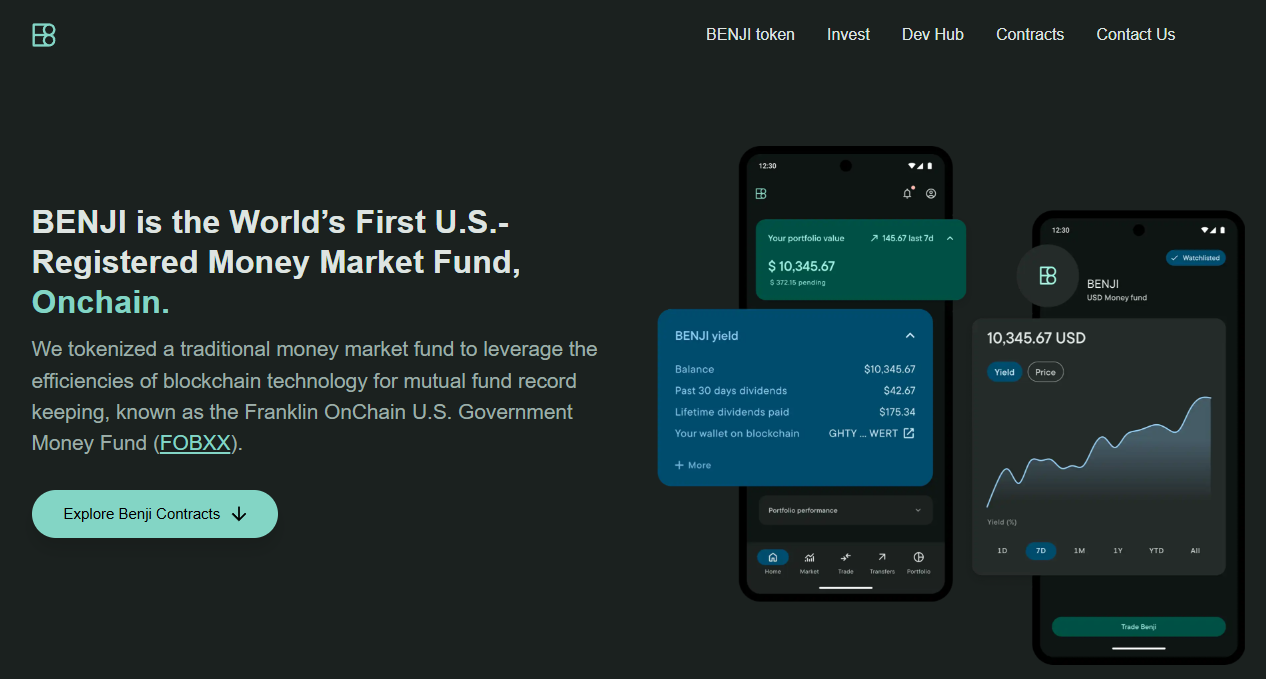
 Franklin Templeton's $775 million Franklin OnChain U.S. Government Money Fund (BENJI) pioneered tokenized mutual funds in 2021, offering exposure to US government securities across eight blockchains with patent-pending intraday yield calculation.

Ideal For

  • Investors seeking regulated 40 Act fund structure
  • Collateral managers requiring second-by-second yield accrual
  • Multi-chain strategies needing broad blockchain compatibility
  • Users prioritizing traditional asset manager credibility

Standout Features

  • Intraday yield tracking down to the second, enabling proportional earnings even for partial-day holdings
  • Direct stablecoin purchases and redemptions with wallet-to-wallet transfer capability
  • 63% of AUM deployed on Stellar Network for optimal cost efficiency
  • Integrated with DeFi protocols for collateral and leverage applications

Pricing
 7-day current yield approximately 4.5-5.5% gross; 0.25% management fee. No minimum investment restrictions beyond standard mutual fund requirements.

Availability
 Global availability with specific KYC requirements. Active on Stellar, Ethereum, Arbitrum, Base, Avalanche, Polygon, Aptos, Solana, BNB Chain.

Worth Noting
 Traditional mutual fund constraints apply including daily NAV calculations and potential redemption delays during market stress.

Alternatives to Consider: Backed bIB01, Superstate Short Duration Government Securities  

For Institutional Credit Exposure (8-12% Yield)

Top Pick: Maple Finance — Premier Crypto-Collateralized Lending

Overview
 Maple Finance manages over $4 billion in assets, specializing in institutional over-collateralized lending backed by Bitcoin, Ethereum, Solana, and XRP, targeting $100 billion in annual loan volume by 2030. The platform introduced SyrupUSDC for permissionless retail access alongside KYC-gated institutional pools.

Ideal For

  • Institutional lenders seeking exposure to cryptocurrency-backed credit
  • Liquidity providers comfortable with smart contract risk
  • Allocators targeting floating-rate, senior-secured structures
  • Investors seeking alternatives to traditional stablecoin farming

Standout Features

  • Consistent 9-12% net yields through undercollateralized institutional facilities and structured credit products
  • Strategic integration with Aave's $40 billion protocol bringing syrupUSDT to Plasma instance and syrupUSDC to core markets
  • Partnerships with Bitwise, Lido Finance (stETH-backed credit lines), and EtherFi (weETH collateral) expanding institutional adoption
  • Robust risk management combining decades of TradFi expertise with real-time on-chain monitoring

Pricing
 Variable by pool; typical effective yields 9-12% after protocol fees. Minimum investments pool-dependent, generally $10K-$50K for retail syrup products.

Availability
 Global with KYC requirements for lending. Institutional Maple requires accreditation; Syrup.fi open to broader participants.

Worth Noting
 Platform transitioned from uncollateralized to over-collateralized model after 2022 market turmoil. Historical defaults impacted certain pools; robust recovery mechanisms now in place.

Alternatives to Consider: Credix (emerging markets), TrueFi (uncollateralized DeFi)  

Runner-Up: Goldfinch Prime — Institutional Private Credit Access

Overview
 Goldfinch Prime aggregates exposure to multi-billion dollar private credit funds from Ares, Apollo, Golub Capital, and KKR, providing on-chain access to institutional-grade senior secured loans with over $1 trillion in collective AUM.

Ideal For

  • Non-US investors seeking diversified private credit exposure
  • Allocators targeting institutional fund performance without direct fund access
  • Participants seeking uncorrelated yield to crypto markets
  • Investors comfortable with longer lockup periods

Standout Features

  • Exposure to 1000+ senior secured loans across industries through vetted fund managers with 10+ years experience
  • Target returns of 9-12% net of fees with strict eligibility criteria including >90% senior secured portfolios and <0.75% target non-accrual rates
  • Heron Finance manages fund selection and vetting while fund managers handle all underwriting and default resolution
  • USDC-based deposits converted to proportional GPRIME tokens for continuous offering structure

Pricing
 Net yields 9-12% after embedded management fees and profit sharing. Minimum investments vary by pool structure; typically institutional minimums apply.

Availability
 Non-US persons only due to regulatory structure. KYC and accreditation verification required.

Worth Noting
 Exposure is indirect through fund shares rather than direct loan origination; fund managers absorb individual borrower default risk into aggregate yields. Liquidity limited compared to Treasury products.

Alternatives to Consider: Centrifuge private credit pools, Credix fintech lending


For Real Estate & Diversified Assets (6-10% Yield)

Top Pick: Centrifuge — Multi-Asset Tokenization Infrastructure

Overview
 Centrifuge operates as a multichain infrastructure platform enabling asset managers to tokenize real estate, trade finance, carbon credits, and structured credit with $1.2 billion TVL and recent 10x growth driven by the first on-chain CLO and tokenized S&P 500 index fund.

Ideal For

  • Investors seeking exposure to asset-backed securities beyond treasuries
  • Allocators comfortable evaluating tranched credit structures
  • Participants prioritizing transparency and on-chain asset verification
  • Portfolio managers wanting diversification across real-world credit types

Standout Features

  • Asset-agnostic architecture supporting structured credit, real estate mortgages, US treasuries, carbon credits, and consumer finance with full collateralization and legal recourse for investors
  • V3 platform enables cross-chain interoperability across Ethereum, Base, Arbitrum, Avalanche, BNB Chain, and Plume with integrated KYC and compliance-as-a-feature
  • Senior/junior tranche structures allowing risk-return customization
  • Partnership with Chronicle Labs for real-time price feeds and integration with Circle for USDC on/off-ramping

Pricing
 Yields vary by pool and tranche: typically 6-8% for senior tranches, 10-14% for junior tranches. Management fees embedded; pool-specific minimums apply.

Availability
 Global with KYC requirements. Pools may have additional jurisdictional restrictions based on underlying asset location.

Worth Noting
 Platform complexity requires understanding of tranched structures and asset-specific risks. Less liquid credit instruments offer less frequent pricing updates than treasury products.

Alternatives to Consider: RealT (US residential real estate focus), Republic (equity crowdfunding)


For Emerging Market Credit (12-18% Yield)

Top Pick: Credix — Latin American Fintech Lending

Overview
 Credix specializes in providing credit facilities to fintech lenders in Latin America, offering high-yield exposure to underserved credit markets with institutional-grade underwriting and local market expertise.

Ideal For

  • Sophisticated investors seeking higher risk-adjusted returns
  • Allocators comfortable with emerging market credit risk
  • Participants with extended investment horizons (12-24 months typical)
  • Investors seeking geographic diversification from US/EU markets

Standout Features

  • Target yields 12-18% reflecting emerging market risk premiums
  • Focus on fintech infrastructure enabling financial inclusion
  • Partnerships with established Latin American credit originators
  • Robust due diligence and monitoring of borrower networks

Pricing
 Pool-dependent yields typically 12-18% gross with management fees of 1-2%. Minimum investments generally $50K+ for accredited investors.

Availability
 Non-US persons primarily; requires accreditation verification and enhanced KYC given emerging market exposure.

Worth Noting
 Higher yields reflect higher credit and currency risk. Platform experienced challenges during regional economic volatility; enhanced risk controls now implemented.

Alternatives to Consider: Goldfinch V1 pools (emerging market focus), TrueFi uncollateralized pools


For Tokenization Infrastructure (Platform Providers)

Top Pick: Securitize — Industry-Leading Issuance Platform

Overview
 Securitize has tokenized over $4.5 billion in assets for 1.2 million investors across 3,000+ clients, operating as an SEC-registered transfer agent with integrated ATS for secondary trading. The platform powers major offerings including BlackRock's BUIDL fund.

Ideal For

  • Asset managers seeking turnkey tokenization solutions
  • Issuers requiring SEC-compliant digital security infrastructure
  • Institutional clients needing integrated custody and compliance
  • Projects prioritizing regulatory alignment and brand credibility

Standout Features

  • DS Protocol automates token issuance, transfer agent functions, and regulated secondary trading with $47 million funding led by BlackRock
  • Recent launch of STAC tokenized AAA CLO fund with BNY custody demonstrating institutional adoption trajectory
  • Comprehensive investor onboarding, KYC/AML, and reporting infrastructure
  • Partnerships with major asset managers and integration with Zero Hash for fiat conversion

Pricing
 Platform fees vary by issuance size and complexity; typically 0.5-2% of AUM plus basis point fees on transactions. White-label solutions available for enterprise clients.

Availability
 Global operations with jurisdiction-specific compliance modules. Primary focus on US, EU, and APAC institutional markets.

Worth Noting
 Securitize is an issuance platform rather than direct investment product; investors access opportunities through partner funds and offerings launched on the infrastructure.

Alternatives to Consider: Tokeny (EU-focused), Polymath/Polymesh (security token specialists)


Complete Provider Directory

  • Backed Finance: European MiCA-compliant tokenization platform offering bIB01 (Swiss government bond exposure) and bC3M (commodity basket). Strong focus on regulatory alignment with modest 3-5% yields and low entry barriers.
  • Swarm Markets: Decentralized platform enabling fractional ownership of real estate and private credit with $1K-$50K minimums. Emphasizes accessibility while maintaining compliance through distributed infrastructure.
  • TrueFi: Uncollateralized lending protocol using on-chain credit scoring and portfolio diversification. Higher risk-return profile (8-15% targets) with full transparency of borrower pools and performance metrics.
  • Archax: UK FCA-regulated platform for institutional tokenization of bonds, funds, and money markets. Focus on traditional finance compatibility with stringent accreditation requirements.

Making Your Selection: Key Questions

  • What yield stability do you require?
     Treasury-backed platforms (Ondo, Franklin Templeton) offer predictable 4-5% returns with minimal volatility. Credit-focused platforms (Maple, Goldfinch) target 9-12% but introduce credit risk and performance variability.
  • What is your risk tolerance for underlying collateral?
     Government securities provide lowest risk; over-collateralized crypto loans add smart contract and liquidation risks; uncollateralized emerging market credit carries highest default potential.
  • Do you meet accreditation and minimum investment thresholds?
     Many institutional products require $50K-$200K minimums and qualified purchaser status. Retail-accessible options like USDY and syrupUSDC lower barriers but may sacrifice yield.
  • What liquidity do you need?
     Treasury tokens generally offer daily liquidity; private credit pools may have quarterly redemption windows; real estate tokenization can involve 12-24 month lockups.
  • How important is regulatory compliance?
     Platforms like Ondo, Franklin Templeton, and Securitize prioritize SEC registration and traditional fund structures. Purely DeFi-native protocols offer less regulatory clarity but greater composability.
  • What blockchain ecosystems do you operate in?
     Multi-chain deployment (Ondo, Centrifuge) provides flexibility; single-chain specialization (some Maple pools) may offer optimization but limits interoperability.
  • Do you have geographic restrictions?
     US persons often excluded from highest-yield opportunities due to securities laws. European investors benefit from MiCA framework; APAC sees growing regulatory clarity.
  • What level of transparency do you require?
     On-chain native protocols offer real-time asset verification; hybrid models may rely on periodic attestations and third-party audits.
  • Are you seeking passive income or active yield strategies?
     Treasury staking provides set-and-forget returns; DeFi integrations enable leverage, collateral strategies, and yield optimization requiring active management.
  • How much operational complexity can you handle?
     Single-platform solutions simplify but limit optionality; multi-protocol strategies maximize returns but require gas management, tax tracking, and security across multiple platforms.

Maximizing Your Setup with Token Metrics

Token Metrics provides critical intelligence for navigating RWA yield opportunities through data-driven analysis and market insights.

Research Phase: Leverage Token Metrics' fundamental analysis to evaluate tokenized asset protocols, comparing on-chain metrics, TVL trends, and yield sustainability indicators. Our RWA sector reports identify emerging platforms and highlight regulatory developments across jurisdictions.

Portfolio Construction: Use quantitative scoring to allocate across risk tiers—balancing stable treasury exposure with higher-yield credit products. Token Metrics' portfolio tools help optimize diversification while monitoring correlation to traditional crypto markets.

Ongoing Monitoring: Real-time alerts notify you of yield changes, protocol upgrades, and risk events. Our dashboard aggregates performance across multiple RWA platforms, tracking your yield-bearing positions alongside broader cryptocurrency holdings.

Risk Management: Token Metrics' risk analytics assess smart contract security, custody arrangements, and counterparty exposure. Our reports flag platforms with concerning yield sustainability metrics or operational red flags before they impact your capital.

Start your Token Metrics free trial to access institutional-grade RWA research and optimize your real-world asset allocation.  

Essential Security Practices

  • Custody Verification: Confirm that platforms use institutional-grade custodians (Coinbase Custody, BitGo, Fireblocks) for underlying assets. Verify proof-of-reserve attestations and third-party audits.
  • Smart Contract Risk: Review audit reports from reputable firms (Trail of Bits, OpenZeppelin, Certora). Understand upgrade mechanisms and timelock protections on protocol contracts.
  • Legal Structure Assessment: Examine SPV formation, bankruptcy remoteness, and investor recourse mechanisms. Ensure tokenization structure provides actual legal claim on underlying assets, not just economic exposure.
  • Regulatory Compliance: Verify platforms maintain necessary licenses (broker-dealer, transfer agent, ATS) in relevant jurisdictions. Confirm offerings comply with securities laws in your domicile.
  • Counterparty Risk: Understand who services loans, manages defaults, and handles liquidations. Evaluate track records of asset originators and credit underwriters.
  • Liquidity Risk Management: Never allocate more than you can afford to lock up for stated redemption periods. Maintain buffer capital for market volatility and potential redemption delays.
  • Tax Implications: Consult tax professionals on treatment of tokenized yield—may be classified as interest income, dividends, or capital gains depending on structure and jurisdiction.
  • Geographic Restrictions: Verify you're eligible to participate based on residency. Using VPNs or misrepresenting location can result in frozen funds and legal liability.
  • Platform Concentration: Diversify across multiple RWA providers to reduce single-point-of-failure risk. No single platform should represent majority of yield allocation.
  • Documentation: Maintain records of all transactions, yield distributions, and platform communications for tax reporting and potential disputes.

This article is for research and educational purposes, not financial advice. RWA investments carry risks including loss of principal.


What to Avoid

  • Ignoring minimum holding periods: Many RWA products enforce lockups or redemption windows. Treating them as liquid positions can leave you unable to access capital when needed.
  • Chasing unsustainably high yields: Promised returns significantly above market rates often indicate excessive risk. Verify underlying asset performance and historical consistency before committing capital.
  • Overlooking platform liquidity: Token existence on-chain doesn't guarantee exit liquidity. Check secondary market depth and historical spread between minting and redemption prices.
  • Neglecting jurisdictional compliance: Accessing platforms not available in your region can result in frozen accounts and regulatory penalties. Always verify eligibility before depositing funds.
  • Underestimating smart contract risk: Even well-audited protocols face exploitation risk. Size positions appropriately and monitor security incident disclosures across the ecosystem.
  • Failing to verify asset backing: Don't rely on marketing claims. Demand proof-of-reserve, third-party attestations, and transparent reporting on underlying collateral.
  • Concentrating in single asset class: Over-allocating to one RWA category (e.g., all private credit) eliminates diversification benefits. Balance across treasuries, credit, and real estate where possible.
  • Ignoring fee structures: Management fees, performance fees, and transaction costs compound over time. Calculate net yields after all costs when comparing platforms.

Reader Questions Answered

What's the difference between tokenized treasuries and yield-bearing stablecoins?

 Tokenized treasuries (like OUSG) represent direct ownership of US Treasury securities with yield passed through to holders. Yield-bearing stablecoins (like USDY) maintain $1 peg while distributing treasury yields via rebasing or airdrops. Treasuries may fluctuate slightly with NAV; yield stablecoins prioritize price stability.

Are RWA yields taxable differently than crypto staking rewards?

 Likely yes, though tax treatment varies by jurisdiction. RWA yields from treasuries or credit facilities often classified as interest income taxed at ordinary rates. Crypto staking may be treated as income at receipt or capital gains at sale depending on location. Consult tax professionals for specific guidance.

Can I use tokenized RWAs as collateral in DeFi protocols?

 Increasingly yes. Platforms like Maple, Ondo (via Flux Finance), and Centrifuge enable using tokenized assets as DeFi collateral. However, support varies by protocol and asset—USDY and OUSG see broader integration than niche real estate tokens. Liquidation risks apply if collateral value drops.

What happens if the platform goes bankrupt?

 Properly structured tokenization isolates assets in bankruptcy-remote SPVs, protecting investor claims even if platform operator fails. However, redemption processes may be delayed and require legal navigation. This is why verifying legal structure and custodial arrangements is critical.

How liquid are RWA tokens compared to stablecoins?

 Significantly less liquid. While stablecoins have billions in daily DEX volume, most RWA tokens trade thinly or only through platform-controlled redemption mechanisms. Treasury tokens offer better liquidity than private credit or real estate, but all lag traditional stablecoins substantially.

Do I need to be an accredited investor?

 Depends on the platform and your location. US-based offerings often require accreditation; international platforms may have lower barriers. Products like USDY, syrupUSDC, and BENJI target broader accessibility, while institutional credit pools restrict to qualified purchasers.

What are the main risks that could cause loss of principal?

 (1) Underlying asset default (credit risk), (2) smart contract exploitation, (3) platform insolvency without proper asset segregation, (4) regulatory action freezing operations, (5) stablecoin de-pegging for yield products denominated in USDC/USDT, (6) liquidation cascades in collateralized structures.

How do yields compare to traditional finance alternatives?

 Tokenized treasuries (4-5%) match conventional money market funds but with 24/7 access. Private credit RWAs (9-12%) offer premiums over corporate bonds due to illiquidity and platform novelty. Emerging market RWA yields (12-18%) comparable to EM debt funds with added smart contract risk.


Bottom Line

Real-world asset yield marketplaces represent the maturation of blockchain infrastructure beyond speculation into productive finance. For investors seeking stable, asset-backed returns uncorrelated to cryptocurrency volatility, platforms like Ondo Finance and Franklin Templeton deliver institutional-grade treasury exposure with DeFi composability. Those comfortable with credit risk can access superior yields through Maple Finance's collateralized institutional lending or Goldfinch Prime's diversified private credit exposure.

The key to success: match platform selection to your specific risk tolerance, liquidity needs, and regulatory constraints. Treasury products suit conservative allocators prioritizing capital preservation; credit platforms reward investors accepting higher risk for enhanced returns; multi-asset infrastructure like Centrifuge offers diversification across real-world credit types.

Start with smaller allocations to understand platform mechanics, redemption processes, and yield consistency before committing substantial capital. The RWA sector's rapid growth will continue creating opportunities, but also attracting lower-quality offerings—due diligence remains paramount.

Related Resources:


About This Research

Methodology: This guide evaluated 20+ RWA platforms through analysis of official documentation, on-chain data, regulatory filings, and third-party audits. Platforms selected represent meaningful TVL (>$100M), regulatory compliance, and operational track record. Final selection prioritized diversity across asset classes and investor accessibility tiers.

Research Sources:

  • Ondo Finance: Product documentation, tokenomics, OUSG/USDY specifications, Oasis Pro acquisition disclosure
  • Maple Finance: Platform whitepaper, syrupUSDC mechanics, Aave integration announcement, CEO interviews
  • Centrifuge: V3 technical documentation, pool analytics, Republic partnership details
  • Goldfinch: Prime pool specifications, fund manager criteria, Heron Finance structure
  • Franklin Templeton: BENJI platform technical details, intraday yield patent documentation, multi-chain deployment
  • Securitize: DS Protocol documentation, STAC fund launch details, BlackRock partnership announcements
  • RWA.xyz: Platform TVL data, tokenization metrics, market growth analysis
  • DeFiLlama: Protocol TVL tracking, historical performance data
  • BCG/Ripple: RWA market projections and industry research
  • VanEck, Coinbase, Binance: Sector research reports on RWA growth trajectories

All data current as of January 2025. Platform features and yields subject to change; verify current terms on official websites before investing.

Build Smarter Crypto Apps &
AI Agents in Minutes, Not Months
Real-time prices, trading signals, and on-chain insights all from one powerful API.
Grab a Free API Key
About Token Metrics
Token Metrics: AI-powered crypto research and ratings platform. We help investors make smarter decisions with unbiased Token Metrics Ratings, on-chain analytics, and editor-curated “Top 10” guides. Our platform distills thousands of data points into clear scores, trends, and alerts you can act on.
30 Employees
analysts, data scientists, and crypto engineers
Daily Briefings
concise market insights and “Top Picks”
Transparent & Compliant
Sponsored ≠ Ratings; research remains independent
Want Smarter Crypto Picks—Free?
See unbiased Token Metrics Ratings for BTC, ETH, and top alts.
Thank you! Your submission has been received!
Oops! Something went wrong while submitting the form.
 No credit card | 1-click unsubscribe
Token Metrics Team
Token Metrics Team

Recent Posts

Research

The Art of Rebalancing: How Token Metrics AI Indices Turn Discipline Into Profit

Token Metrics Team
12 min read

Ask most cryptocurrency investors about their strategy, and they'll enthusiastically describe which tokens they bought and why.

Ask them about their rebalancing approach, and you'll likely encounter blank stares or vague responses about "checking in periodically."

This gap between initial portfolio construction and ongoing management represents one of the most significant missed opportunities in crypto investing.

Rebalancing—systematically adjusting portfolio allocations back to target levels—transforms average portfolios into exceptional ones through disciplined profit-taking and value-seeking behavior.

Academic research demonstrates that systematic rebalancing can add 0.5-2% to annual returns while simultaneously reducing volatility.

In cryptocurrency markets where volatility reaches extreme levels and different tokens experience dramatically divergent performance, rebalancing's impact amplifies even further.

Yet most investors struggle with rebalancing.

The decisions feel counterintuitive—selling winners that might keep rising and buying losers that might keep falling.

Emotions interfere with discipline. Tax implications complicate timing. The sheer volatility of crypto markets makes determining appropriate rebalancing triggers difficult.

Token Metrics AI Indices solve the rebalancing challenge through systematic, emotion-free approaches that capture rebalancing's benefits while eliminating the psychological and practical obstacles that prevent individual investors from executing effectively.

This comprehensive guide explores the science and practice of portfolio rebalancing, reveals why it matters more in crypto than traditional markets, and demonstrates how Token Metrics implements intelligent rebalancing that consistently enhances returns.

Why Rebalancing Matters: The Mathematical Foundation

Without rebalancing, portfolios inevitably drift from target allocations as different holdings perform differently.

Consider a simple example: You construct a portfolio allocating 25% each to Bitcoin, Ethereum, Solana, and Cardano—a balanced four-token portfolio.

Over the next year, Bitcoin returns 50%, Ethereum returns 100%, Solana returns 200%, and Cardano returns 0%.

Your portfolio now holds approximately 19% Bitcoin, 32% Ethereum, 48% Solana, and 1% Cardano—dramatically different from your intended 25% equal weighting.

You've become concentrated in Solana at precisely the moment when its 200% gain makes it more expensive and potentially due for a correction.

Meanwhile, Cardano represents a tiny fraction despite potentially offering more upside from its underperformance.

This drift creates concentration risk—your portfolio's fate increasingly depends on a few holdings.

If Solana crashes 50%, your entire portfolio suffers disproportionately despite initially designing a diversified portfolio.

Rebalancing prevents this dangerous drift, maintaining your intended risk profile.

Rebalancing mechanically enforces profitable investor behavior—selling portions of outperformers (taking profits near peaks) and buying underperformers (accumulating near troughs).

This systematic approach to buying low and selling high removes emotion from timing decisions that defeat most investors.

Research analyzing portfolio rebalancing across various market conditions demonstrates that disciplined rebalancing adds 0.5-2% to annual returns in traditional markets.

In cryptocurrency markets with their extreme volatility and frequent leadership rotations, rebalancing's impact often exceeds 2-5% annually—a substantial performance enhancement from disciplined portfolio management.

Cryptocurrency markets exhibit both mean reversion (where extreme moves tend to reverse) and momentum (where trends persist).

Rebalancing captures both dynamics: it systematically takes profits from momentum runs by trimming outperformers, while positioning for mean reversion by adding to beaten-down assets that may recover.

Token Metrics' AI analyzes market regimes to optimize rebalancing frequency and thresholds.

During strong trending periods, the system may rebalance less frequently to let momentum run.

During choppy, mean-reverting periods, more frequent rebalancing captures oscillations profitably.

The Psychology of Rebalancing: Why It's So Hard

Behavioral finance research reveals the "disposition effect"—investors' tendency to sell winning investments too quickly (locking in gains prematurely) while holding losing investments too long (hoping for recovery).

This pattern destroys returns by cutting profits short and letting losses compound.

Counterintuitively, proper rebalancing often requires opposite behavior—holding winners that have appreciated but remain fundamentally strong while selling losers that have declined for valid reasons.

This feels psychologically wrong, which is precisely why systematic approaches outperform gut instinct.

Token Metrics' AI doesn't experience disposition effect.

The algorithms evaluate whether holdings remain attractive based on current fundamentals, technicals, and systematic criteria—not based on whether positions are currently profitable or at a loss.

When a token in your portfolio surges 300%, rebalancing requires selling a portion to restore target allocation.

Your brain immediately screams objection: "But what if it goes up another 300%? I'll miss those gains!"

This FOMO prevents many investors from taking profits systematically.

The reality is that no one can predict whether any asset will continue appreciating.

By rebalancing systematically, you lock in some gains from exceptional performance while maintaining some exposure in case the run continues.

This balanced approach optimizes long-term risk-adjusted returns even if occasionally you rebalance before peaks.

Token Metrics implements this balance automatically, removing the FOMO-driven paralysis that prevents proper profit-taking.

Loss aversion—the psychological pain of losses exceeding the pleasure of equivalent gains—makes rebalancing into declining assets psychologically difficult.

When a token has dropped 50%, buying more feels like "throwing good money after bad."

Yet this value-seeking behavior, when applied to fundamentally sound assets experiencing temporary weakness, proves highly profitable.

Some of the best investment returns come from buying quality assets when they're temporarily out of favor.

Token Metrics' systematic approach evaluates whether underperforming tokens remain fundamentally attractive.

If so, rebalancing into them at depressed prices positions for recovery. If not, the system may reduce or eliminate positions rather than blindly adding to failing investments.

Get Started For Free

Token Metrics Rebalancing Methodology

Token Metrics indices employ sophisticated rebalancing triggers that balance trading frequency with optimization.

Rather than arbitrary calendar rebalancing or purely threshold-based approaches, the AI considers multiple factors including:

• Allocation drift from targets (typically rebalancing when positions deviate 5-10% from targets)
• Technical indicators suggesting trend changes or reversals
• Fundamental metric changes affecting token attractiveness
• Market regime shifts altering optimal allocation patterns

This multi-factor approach ensures rebalancing occurs when beneficial while avoiding excessive trading that generates costs without corresponding benefits.

Token Metrics doesn't simply restore positions to arbitrary equal weights.

The AI implements risk-adjusted position sizing where higher-quality, lower-volatility tokens receive larger allocations, while riskier, more volatile tokens receive smaller positions.

This sophisticated weighting optimizes risk-adjusted returns rather than just nominal returns.

When rebalancing, the system recalculates optimal position sizes based on current risk characteristics, fundamentals, and market conditions.

A token that was 10% of the index three months ago might now warrant 8% or 12% based on changing circumstances.

For taxable accounts, Token Metrics considers tax implications when determining optimal rebalancing approaches.

The system may defer selling appreciated positions until long-term capital gains treatment becomes available, utilize tax-loss harvesting to offset gains when appropriate, and consider using new contributions for rebalancing rather than selling existing holdings.

While indices provide rebalancing guidance, users maintain control over implementation and can adapt recommendations to their specific tax situations with professional tax advisor input.

Rebalancing large positions in illiquid tokens can create significant slippage—buying or selling moving prices unfavorably.

Token Metrics prioritizes liquid tokens with deep order books, analyzes trading volumes when determining position sizes, and provides guidance on execution approaches for larger rebalancing trades.

This liquidity focus ensures rebalancing can be implemented efficiently without excessive costs eroding benefits.

Rebalancing Strategies for Different Market Conditions

During bull markets when most holdings appreciate, rebalancing involves systematically taking profits from the strongest performers.

This feels counterintuitive—why sell your best performers? But disciplined profit-taking during strength achieves several objectives:

• It locks in gains that could evaporate in corrections
• Reduces concentration risk in overvalued positions
• Provides capital for opportunistic additions
• Maintains your target risk profile

Token Metrics indices implement graduated profit-taking during bull markets.

Rather than eliminating positions in strong performers, the system trims them incrementally as they appreciate, maintaining some exposure while reducing risk.

During bear markets when most holdings decline, rebalancing involves adding to positions at depressed prices.

This requires significant discipline—buying when everything is falling feels dangerous.

Yet systematic accumulation during weakness positions portfolios for eventual recovery.

Token Metrics' AI evaluates whether declining tokens remain fundamentally sound and worth accumulating, or whether they're declining for valid reasons suggesting reduced allocation.

This discrimination prevents blindly buying poor projects just because they're cheap.

During range-bound markets, different tokens oscillate within ranges, creating rebalancing opportunities to capture mean reversion.

When Token A rises to range top while Token B falls to range bottom, rebalancing trims A and adds to B. When they reverse, rebalancing adjusts again.

This range-trading aspect of rebalancing proves particularly profitable during extended consolidation periods, generating returns even when overall markets move sideways.

Practical Implementation: Rebalancing with Token Metrics

Token Metrics indices have predetermined rebalancing schedules ranging from weekly for high-frequency momentum strategies to quarterly for longer-term value approaches.

When implementing indices personally, establish your own rebalancing schedule based on account type (retirement accounts support more frequent rebalancing), portfolio size (larger portfolios justify more frequent management), and time availability (realistic assessment of attention you can devote).

Most investors find monthly or quarterly rebalancing provides optimal balance between benefits and time commitment.

When rebalancing, the process involves reviewing current portfolio allocations, comparing to target allocations from your chosen Token Metrics indices, calculating percentage and dollar deviations, determining which positions to trim and which to add, and executing trades to restore targets.

Token Metrics platform provides tools simplifying these calculations, showing current vs. target allocations clearly and suggesting specific trades to implement rebalancing.

Effective rebalancing implementation requires attention to execution details including:

• Using limit orders to avoid excessive slippage
• Splitting large trades across multiple orders or days
• Timing trades to avoid extreme volatility periods
• Documenting all transactions for tax purposes

For small portfolios (under $10,000), simple market order execution typically suffices.

For larger portfolios, thoughtful execution preserving capital through reduced trading costs becomes important.

An efficient rebalancing technique involves directing new contributions to underweight positions rather than selling overweight positions.

If you contribute $1,000 monthly to your crypto portfolio and Bitcoin is overweight while Ethereum is underweight, direct the entire $1,000 to Ethereum rather than buying both proportionally.

This approach achieves rebalancing benefits without generating taxable events from selling appreciated assets—particularly valuable in taxable accounts.

Common Rebalancing Mistakes to Avoid

Some investors rebalance constantly, adjusting allocations at every minor drift.

This excessive trading generates transaction costs that exceed rebalancing benefits, creates unnecessary tax events, and prevents letting profitable trends develop.

Token Metrics indices balance rebalancing benefits against costs, trading only when systematic criteria justify action.

Individual investors should resist urges to constantly tinker, allowing portfolios time to perform between rebalancing events.

Conversely, neglecting rebalancing allows dangerous concentration to develop.

Some investors set up portfolios then ignore them for years, discovering eventually that they've become inadvertently concentrated in whatever happened to perform best.

Establish systematic rebalancing schedule—quarterly at minimum, monthly for more active management—and adhere to it consistently.

Perhaps the most common mistake involves establishing systematic rebalancing rules then overriding them emotionally.

"I know I should rebalance into Token X, but it's been falling so hard... I'll wait until it stabilizes."

This emotional override defeats the entire purpose of systematic rebalancing.

Trust the process—if your systematic criteria indicate rebalancing is appropriate, execute it regardless of emotional discomfort.

Rebalancing in taxable accounts generates capital gains taxes that can substantially reduce after-tax returns if ignored.

Selling $10,000 of appreciated Bitcoin to rebalance might create $3,000+ tax liability depending on gains and tax bracket.

Always consider tax implications when rebalancing taxable accounts.

Sometimes deferring rebalancing until long-term status is achieved, or using new contributions rather than selling, proves more tax-efficient.

Advanced Rebalancing Techniques

Rather than rebalancing to exact targets, sophisticated investors use bands.

If target allocation is 25% with 5% bands, rebalance only when allocation drifts beyond 20-30% range.

This reduces trading frequency while still preventing excessive drift.

Token Metrics incorporates band approaches in index methodologies, rebalancing when necessary but avoiding unnecessary trades for minor drifts.

Advanced rebalancing considers valuations, becoming more aggressive when assets appear cheap and more conservative when expensive.

Rather than mechanical rebalancing to fixed targets, dynamic approaches adjust targets based on current market conditions.

Token Metrics' AI implements elements of dynamic rebalancing, adjusting index weights based on comprehensive analysis of valuations, momentum, and fundamentals.

For investors with crypto as part of broader portfolios including stocks, bonds, and real estate, rebalancing should consider total portfolio allocation.

When crypto surges from 5% to 10% of total wealth, rebalancing should trim crypto back to 5%, distributing proceeds to other asset classes.

This total portfolio perspective prevents crypto concentration from overwhelming overall risk management, regardless of how well chosen tokens perform.

Track rebalancing impact by comparing portfolio returns to buy-and-hold counterfactual, analyzing transaction costs as percentage of benefits, evaluating whether risk (volatility, drawdowns) decreased, and measuring consistency of returns across periods.

Token Metrics provides analytics showing rebalancing impact, helping users understand value added through disciplined portfolio management.

Conclusion: Discipline Creates Consistent Alpha

Portfolio rebalancing represents the clearest example of how discipline and system create investment advantage.

The mathematics are straightforward—maintain target allocations through buying low and selling high.

The psychology is challenging—overcoming FOMO, loss aversion, and emotional attachment to winners.

Token Metrics AI Indices solve the rebalancing challenge through emotion-free systematic implementation that captures rebalancing benefits without succumbing to psychological obstacles that defeat individual investors.

The indices trade based on data-driven criteria, not fear or greed. They take profits during strength and accumulate value during weakness without hesitation or second-guessing.

For crypto investors seeking to optimize returns, proper rebalancing may represent the highest-value activity available.

It requires no market timing genius, no ability to pick winning tokens before they surge, no special information or insights.

It requires only discipline—the discipline to follow systematic rules consistently regardless of emotional state.

Token Metrics provides that discipline at scale, implementing sophisticated rebalancing strategies refined through years of market analysis and AI optimization.

By trusting this systematic approach, investors capture rebalancing's substantial benefits while preserving time and mental energy for other priorities.

Rebalancing isn't glamorous. No one boasts about their disciplined portfolio maintenance.

But portfolios that compound wealth over decades do so through consistent rebalancing discipline, not lucky speculation.

Choose discipline. Choose systematic approaches. Choose Token Metrics.

Token Metrics AI Rebalancing in Action

Ready to harness the power of systematic rebalancing?

Discover how Token Metrics AI Indices implement disciplined portfolio management that turns rebalancing from burdensome chore into consistent alpha generation.

Visit tokenmetrics.com to access AI-powered rebalancing strategies optimized for crypto markets.

FAQ: What is portfolio rebalancing?

Portfolio rebalancing is the process of systematically adjusting your asset allocations back to target weights.

It involves selling some of your portfolio’s outperformers and buying more of the underperformers to maintain a predetermined allocation.

This helps manage risk and capture opportunities as market movements cause allocations to drift from your original plan.

FAQ: How often should I rebalance my crypto portfolio?

The optimal schedule varies depending on your portfolio type, size, and objectives.

Most investors find monthly or quarterly rebalancing strikes a good balance between keeping allocations in line and minimizing trading costs.

Some strategies benefit from more frequent (e.g., weekly) rebalancing, especially in highly volatile markets.

FAQ: Does rebalancing boost returns or reduce risk?

Research shows systematic rebalancing often increases long-term returns while also reducing risk.

This is achieved by taking profits in outperforming assets and buying underperformers, making the most of volatility and mean reversion in crypto markets.

Consistent rebalancing also helps sustain a diversified risk profile over time.

FAQ: How do Token Metrics indices handle rebalancing?

Token Metrics AI Indices use data-driven rules to trigger rebalancing based on allocation drift, momentum, market regimes, and liquidity.

The indices automate rebalancing to maintain optimal weights, reduce human error, and adapt dynamically to shifting market conditions.

FAQ: What are common mistakes to avoid when rebalancing?

Avoid these pitfalls:

• Rebalancing too frequently and generating unnecessary taxes and fees
• Ignoring rebalancing for long periods
• Letting emotions override systematic rules
• Not accounting for tax implications
• Buying or selling illiquid tokens without regard to slippage

Get Started For Free

Disclaimer

This content is for informational and educational purposes only. It describes systematic approaches to rebalancing and risk management, not specific investment advice or recommendations.

Cryptocurrency investing involves risk, and you should consult a qualified financial advisor or tax professional regarding your own circumstances before making decisions.

Token Metrics does not provide individualized investment, legal, or tax advice.

Research

Generating Passive Income with Token Metrics AI Indices: Beyond Capital Appreciation to Consistent Yield

Token Metrics Team
10 min read

The landscape of cryptocurrency investing is changing. For many years, the focus remained solely on speculation and price appreciation—the legendary 'number go up' mindset.

Now, innovative protocols and platforms are turning crypto into an income-generating asset class, creating new opportunities for systematic, sustainable yield. Understanding this shift is crucial for anyone seeking more than just capital gains from their crypto portfolios.

Understanding Cryptocurrency Passive Income Sources

Staking is one primary way to earn crypto income. It involves locking up tokens to support a blockchain network's operation and security.

Stakers receive newly minted tokens in return, with yields depending on each network.

Major stakable cryptocurrencies include:

• Ethereum (post-Merge), yielding roughly 3-5% annually
• Cardano (ADA), with 4-6% rewards
• Solana (SOL), at 6-8% yields
• Polkadot (DOT), returning 10-14%
• Cosmos (ATOM), providing 15-20% rewards

Staking provides predictable returns and aligns incentives for network security. There’s also no risk of impermanent loss, unlike liquidity provision.

However, stakers face lock-up periods, possible slashing due to validator misbehavior, and variable yields based on participation rates.

For DeFi lending, platforms like Aave, Compound, and MakerDAO allow crypto holders to lend tokens, earning interest like a traditional bond.

Stablecoins typically generate 2-8% annually, while more volatile assets could see 1-4%, climbing higher during periods of high demand.

Flexible liquidity, diversified asset options, and auto-reinvesting are benefits. Risks include smart contract vulnerabilities, liquidity crunches, and protocol insolvency.

Liquidity provision lets users earn trading fees for supplying pairs to AMMs such as Uniswap, SushiSwap, or PancakeSwap.

Major trading pairs could earn 5-20% annually, but more exotic token pools might offer far higher returns—alongside greater risks.

The largest risk is impermanent loss, which can sometimes outpace fee earnings during high volatility.

Yield aggregators (like Yearn Finance) enable hands-off income by algorithmically finding the highest DeFi yields and managing strategies on users' behalf.

This brings optimization and gas savings but also adds further smart contract risk and possible tax complexity.

Building a Passive Income Strategy with Token Metrics

Constructing an income-oriented portfolio means balancing yield generation, capital preservation, and growth.

A typical allocation through Token Metrics might use 40-50% in staking assets (such as ETH, ADA, SOL, DOT), 30-40% in stablecoin lending, 10-20% in liquidity provision, and a modest 0-10% in higher-risk yield farming.

This strategy emphasizes stability and sustainability while still benefiting from capital gains and yield variety.

Yield stacking is a tactic where investors combine multiple yield streams from a single holding, such as staking ETH, then lending staked ETH derivatives for an added yield layer.

This can boost total income but may add complexity or stacked risk, so each layer should be carefully evaluated.

Sustainable yields are derived from real economic activity. In contrast, 'unsustainable' yields are often backed only by new token issuance, which can erode value over time.

Token Metrics AI distinguishes between these by analyzing protocol revenues, yield sources, and token supply dynamics.

Risk Management for Income-Generating Strategies

Smart contract risk is inherent in DeFi income opportunities.

Token Metrics emphasizes diversification across multiple audited protocols, focusing on established providers, and monitoring for new vulnerabilities.

Even with robust precautions, only risk amounts you are prepared to lose entirely in DeFi protocols.

Counterparty and protocol risk also merit attention. Market disruptions can challenge protocol solvency, especially during periods of stress or volatile price swings.

Token Metrics mitigates these exposures by selecting over-collateralized protocols, monitoring reserve funds, managing exposure, and stress-testing scenarios.

Impermanent loss is a key risk for liquidity providers.

The platform favors strategies with highly correlated pairs, sustainable fee offsets, and appropriate allocation size to contain exposure.

Crypto income also brings complex tax obligations. Each yield event (staking, lending, fees) typically triggers a taxable moment, and detailed record-keeping is critical.

Get Started For Free

Token Metrics Indices for Income Generation

Large-Cap Staking Indices:
Token Metrics offers indices focused on leading Proof-of-Stake assets, blending potential appreciation with steady yields. These strategies spotlight established networks, optimize staking selections, and help manage liquidity and risk.

For income-oriented investors, these can provide stable 4-8% annual yields with less downside than purely growth-weighted options—but still more volatility than many traditional products.

DeFi Yield Indices:
Specifically designed to capture lending, liquidity, and aggregation yield opportunities, these indices diversify across protocols and systematically rebalance for optimal results.

They suit those comfortable with DeFi risks and desiring enhanced yield potential (10-20%+ in favorable markets).

Balanced Income and Growth Indices:
Balancing income generators with growth tokens, these indices typically split allocations—for example 60% in appreciation assets, 40% in income-producing holdings.

Moderate yields (3-7%) are common, combining growth upside and consistent cash flow.

Practical Implementation: From Strategy to Income

Calculating the yield required for income goals is a vital first step. For example, a $1,000,000 portfolio targeting $50,000 annual income requires a 5% yield, while a $500,000 portfolio would require an unsustainable 10%.

Staking can be approached through:

• Direct staking (most technical, highest yields)
• Delegated staking (third-party validators for ease)
• Liquid staking (protocols like Lido for flexibility)

Token Metrics provides tailored advice to optimize staking approach by asset, reflecting yields, lock-up, and user preferences.

Cash flow and reinvestment must be planned systematically—decide withdrawal frequency, reinvestment amounts, tax withholding, and rebalance as life stages shift.

Most investors reinvest during accumulation, then increase withdrawals for retirement or income phases. Token Metrics indices can adapt dynamic allocations accordingly.

Ongoing monitoring is essential. Quarterly reviews of protocol health, comparative yield checks, and timely rebalancing help maintain income sustainability.

Token Metrics’ analytics automate much of this ongoing assessment, flagging notable changes for user action.

Real-World Income Scenarios

Scenario 1 – Supplemental Income:
An employed professional with $300,000 in crypto seeks $1,000-$2,000 monthly and moderate risk. The strategy could include 60% large-cap staking, 30% stablecoin lending, and 10% conservative DeFi, targeting a blended 5-7% annual return.

Scenario 2 – Early Retirement:
A 50-year-old with $1,500,000 in crypto aims for $75,000 per year in five years, with moderate/aggressive risk. A balanced index (50%), DeFi yield index (30%), and large-cap staking (20%) could target a 6-8% yield, blended with capital withdrawals if necessary.

Scenario 3 – Financial Independence:
A 35-year-old with $750,000 targets future independence and a $100,000 annual income. Aggressive growth indices (70%) and DeFi yield indices (30%) may be optimal, directing all current income back into the portfolio for compounding.

Avoiding Passive Income Pitfalls

Chasing extremely high yields—especially anything above 100%—is the most common misstep among crypto income investors.

Token Metrics systematically screens out these unsustainable offers, instead prioritizing protocols delivering steady, real-economic yields within a safer range.

Focusing excessively on yield without regard to principal protection is another risk. A high yield does not compensate if the asset’s underlying value declines sharply. Total return—combining appreciation and income—is always the bigger picture.

DeFi risks are often correlated. What appears diversified may not truly diversify portfolio risk if protocols are tightly connected.

Token Metrics manages this by combining blockchains (e.g., Ethereum, Solana, Avalanche), different income methods, and balancing DeFi with non-DeFi assets for true diversification.

Building Sustainable Passive Income Through Intelligent Crypto Strategies

The maturation of crypto investing delivers new paths toward passive income, not just speculative growth. Thoughtful strategy and risk management are key.

Focus on yields from genuine activity, diversify smartly, and continuously revisit portfolio allocations as conditions change.

Token Metrics AI Indices offer systematic portfolio tools and research for pursuing income. The platform's AI filters opportunities by sustainability, automates complex allocations, and keeps investors informed about evolving protocols and industry risk.

Whether you aim for supplemental income, long-term wealth, or full financial independence, smart use of these tools now puts the future of passive crypto income within reach.

FAQ: Passive Income with Crypto Indices

What is the difference between staking and DeFi lending?

Staking means locking tokens to support a network and earn newly minted rewards, usually tied to Proof-of-Stake blockchains.

DeFi lending involves providing assets to protocols where borrowers pay interest. Staking supports network operations, while lending acts like digital banking for earners.

Are crypto passive income yields guaranteed?

No, crypto yields are never guaranteed.

Returns depend on protocol economics, market demand, and potential risks, including smart contract issues and overall market volatility.

How can Token Metrics help manage income risk?

Token Metrics evaluates and monitors thousands of protocols, rates their risk, analyzes yield sources, and helps users systematically diversify across many strategies to lessen risk.

What tax documentation does generating crypto income require?

Each yield event (staking, lending, liquidity provision) may trigger taxable income, which must be reported where required by law.

Keeping careful records and seeking guidance from a crypto-specialized tax expert is strongly advised.

Which income strategies are most sustainable?

Sustainable income derives from real network use like transaction fees, security rewards, or legitimate borrowing. The most sustainable avenues are usually staking on established blockchains and selectively vetted lending platforms.

Very high yields backed by token inflation, rather than real use, are generally less sustainable.

Get Started For Free

Disclaimer

This blog is for educational and informational purposes. It does not constitute financial, investment, or tax advice.

Cryptocurrency markets are volatile and carry risk. Always conduct your own due diligence and seek independent advice before acting on any information provided herein.

Research

Protecting Your Crypto Investment: Security, Safety, and Risk Management with Token Metrics AI Indices

Token Metrics Team
20 min read

Cryptocurrency's digital nature creates unprecedented investment opportunities—24/7 global markets, instant transactions, and direct ownership without intermediaries.

But this same digital nature introduces unique security challenges absent from traditional investing.

You can't lose your stock certificates to hackers, but you absolutely can lose your cryptocurrency to theft, scams, or user error.

Industry estimates suggest billions of dollars in cryptocurrency are lost or stolen annually through hacks, phishing attacks, forgotten passwords, and fraudulent schemes.

For many prospective crypto investors, security concerns represent the primary barrier to entry.

"What if I get hacked?" "How do I keep my crypto safe?" "What happens if I lose my password?"

These aren't trivial concerns—they're legitimate questions demanding thoughtful answers before committing capital to digital assets.

Token Metrics AI Indices approach security holistically, addressing not just portfolio construction and performance but the entire ecosystem of risks facing crypto investors.

From selecting fundamentally secure cryptocurrencies to providing guidance on safe custody practices, Token Metrics prioritizes investor protection alongside return generation.

This comprehensive guide explores the complete landscape of crypto security risks, reveals best practices for protecting your investments, and demonstrates how Token Metrics' systematic approach enhances safety across multiple dimensions.

Understanding the Crypto Security Threat Landscape

Exchange Hacks and Platform Vulnerabilities
Cryptocurrency exchanges—platforms where users buy, sell, and store digital assets—represent prime targets for hackers given the enormous value they custody.

History is littered with devastating exchange hacks including Mt. Gox (2014): 850,000 Bitcoin stolen, worth $450 million then, billions today; Coincheck (2018): $530 million in NEM tokens stolen; QuadrigaCX (2019): $190 million lost when founder died with only access to cold wallets; and FTX (2022): Collapse resulting in billions in customer losses.

These incidents highlight fundamental custody risks. When you hold cryptocurrency on exchanges, you don't truly control it—the exchange does.

The industry saying captures this reality: "Not your keys, not your coins." Exchange bankruptcy, hacking, or fraud can result in total loss of funds held on platforms.

Token Metrics addresses exchange risk by never directly holding user funds—the platform provides investment guidance and analysis, but users maintain custody of their assets through personal wallets or trusted custodians they select.

This architecture eliminates single-point-of-failure risks inherent in centralized exchange custody.

Private Key Loss and User Error
Unlike traditional bank accounts where forgotten passwords can be reset, cryptocurrency relies on cryptographic private keys providing sole access to funds.

Lose your private key, and your cryptocurrency becomes permanently inaccessible—no customer service department can recover it.

Studies suggest 20% of all Bitcoin (worth hundreds of billions of dollars) is lost forever due to forgotten passwords, discarded hard drives, or deceased holders without key succession plans.

This user-error risk proves particularly acute for non-technical investors unfamiliar with proper key management.

Token Metrics provides educational resources on proper key management, wallet selection, and security best practices.

The platform emphasizes that regardless of how well indices perform, poor personal security practices can negate all investment success.

Phishing, Social Engineering, and Scams
Crypto scams exploit human psychology rather than technical vulnerabilities.

Common schemes include phishing emails impersonating legitimate platforms, fake customer support targeting victims through social media, romance scams building relationships before requesting crypto, pump-and-dump schemes artificially inflating token prices, and fake investment opportunities promising unrealistic returns.

These scams succeed because they manipulate emotions—fear, greed, trust. Even sophisticated investors occasionally fall victim to well-crafted social engineering.

Token Metrics protects users by vetting all cryptocurrencies included in indices, filtering out known scams and suspicious projects.

The platform's AI analyzes on-chain data, code quality, team credentials, and community sentiment, identifying red flags invisible to casual investors. This comprehensive due diligence provides first-line defense against fraudulent projects.

Smart Contract Vulnerabilities
Many cryptocurrencies operate on smart contract platforms where code executes automatically.

Bugs in smart contract code can be exploited, resulting in fund loss. Notable incidents include the DAO hack (2016): $50 million stolen through smart contract vulnerability; Parity wallet bug (2017): $280 million frozen permanently; and numerous DeFi protocol exploits draining millions from liquidity pools.

Token Metrics' analysis evaluates code quality and security audits for projects included in indices.

The AI monitors for smart contract risks, deprioritizing projects with poor code quality or unaudited contracts. This systematic evaluation reduces but doesn't eliminate smart contract risk—inherent to DeFi investing.

Regulatory and Compliance Risks
Cryptocurrency's evolving regulatory landscape creates risks including sudden regulatory restrictions limiting trading or access, tax compliance issues from unclear reporting requirements, securities law violations for certain tokens, and jurisdictional complications from crypto's borderless nature.

Token Metrics monitors regulatory developments globally, adjusting index compositions when regulatory risks emerge.

If specific tokens face heightened regulatory scrutiny, the AI can reduce or eliminate exposure, protecting investors from compliance-related losses.

Best Practices for Cryptocurrency Custody and Storage

Understanding Wallet Types
Cryptocurrency storage options exist along a security-convenience spectrum. Hot wallets (software wallets connected to internet) offer convenience for frequent trading but increased hacking vulnerability.

Cold wallets (hardware wallets or paper wallets offline) provide maximum security but reduced convenience for active trading. Custodial wallets (exchanges holding keys) offer simplicity but require trusting third parties.

For Token Metrics investors, recommended approach depends on portfolio size and trading frequency.

Smaller portfolios with frequent rebalancing might warrant hot wallet convenience. Larger portfolios benefit from cold wallet security, moving only amounts needed for rebalancing to hot wallets temporarily.

Hardware Wallet Security
Hardware wallets—physical devices storing private keys offline—represent the gold standard for cryptocurrency security. Popular options include Ledger, Trezor, and others providing "cold storage" immunity to online hacking.

Best practices for hardware wallets include:

• Purchasing directly from manufacturers
• Never buying used
• Verifying device authenticity through manufacturer verification
• Storing recovery seeds securely (physical copies in safe locations)
• Using strong PINs and never sharing device access

For substantial Token Metrics allocations, hardware wallets prove essential.

The modest cost ($50-200) pales compared to security benefits for portfolios exceeding several thousand dollars.

Multi-Signature Security
Multi-signature (multisig) wallets require multiple private keys to authorize transactions—for example, requiring 2-of-3 keys. This protects against single-point-of-failure risks: if one key is compromised, funds remain secure; if one key is lost, remaining keys still enable access.

Advanced Token Metrics investors with substantial holdings should explore multisig solutions through platforms like Gnosis Safe or Casa.

While more complex to set up, multisig dramatically enhances security for large portfolios.

Institutional Custody Solutions
For investors with six-figure+ crypto allocations, institutional custody services provide professional-grade security including:

• Regulated custodians holding cryptocurrency with insurance
• Cold storage with enterprise security protocols
• Compliance with financial industry standards

Services like Coinbase Custody, Fidelity Digital Assets, and others offer insured custody for qualified investors.

While expensive (typically basis points on assets), institutional custody eliminates personal security burdens for substantial holdings.

Get Started For Free

Operational Security: Protecting Against Attacks

Password Management and Two-Factor Authentication
Basic security hygiene proves critical for crypto safety.

Use unique, complex passwords for every exchange and platform—password managers like 1Password or Bitwarden facilitate this. Enable two-factor authentication (2FA) using authenticator apps (Google Authenticator, Authy) rather than SMS which can be intercepted.

Never reuse passwords across platforms. A data breach exposing credentials from one service could compromise all accounts using identical passwords. Token Metrics recommends comprehensive password management as foundational security practice.

Recognizing and Avoiding Phishing
Phishing attacks impersonate legitimate services to steal credentials. Red flags include emails requesting immediate action or login, suspicious sender addresses with subtle misspellings, links to domains not matching official websites, and unsolicited contact from "customer support."

Always navigate directly to platforms by typing URLs rather than clicking email links. Verify sender authenticity before responding to any crypto-related communications. Token Metrics will never request passwords, private keys, or urgent fund transfers—any such requests are fraudulent.

Device Security and Network Safety
Maintain device security by:

• Keeping operating systems and software updated
• Running antivirus/anti-malware software
• Avoiding public WiFi for crypto transactions
• Considering dedicated devices for high-value crypto management

The computer or phone accessing crypto accounts represents potential vulnerability.

Compromised devices enable keyloggers capturing credentials or malware stealing keys. For substantial portfolios, dedicated devices used only for crypto management enhance security.

Cold Storage for Long-Term Holdings
For cryptocurrency not needed for active trading—long-term holdings in Token Metrics indices not requiring frequent rebalancing—cold storage provides maximum security.

Generate addresses on air-gapped computers, transfer funds to cold storage addresses, and store private keys/recovery seeds in physical safes or bank safety deposit boxes.

This approach trades convenience for security—appropriate for the majority of holdings requiring only occasional access.

Token Metrics Platform Security Features

No Custody Model
Token Metrics' fundamental security advantage is never taking custody of user funds. Unlike exchanges that become honeypots for hackers by concentrating billions in crypto, Token Metrics operates as an information and analytics platform. Users implement index strategies through their own chosen custody solutions.

This architecture eliminates platform hacking risk to user funds. Even if Token Metrics platform experienced data breach (which comprehensive security measures prevent), user cryptocurrency remains safe in personal or custodial wallets.

Data Security and Privacy
Token Metrics implements enterprise-grade security for user data including:

• Encrypted data transmission and storage
• Regular security audits and penetration testing
• Access controls limiting employee data access
• Compliance with data protection regulations

While Token Metrics doesn't hold crypto, protecting user data—account information, portfolio holdings, personal details—remains paramount.

The platform's security infrastructure meets standards expected of professional financial services.

API Security and Access Control
For users implementing Token Metrics strategies through API connections to exchanges, the platform supports secure API practices including:

• Read-only API keys when possible (avoiding withdrawal permissions)
• IP whitelisting restricting API access to specific addresses
• Regularly rotating API keys as security best practice

Never grant withdrawal permissions through API keys unless absolutely necessary.

Token Metrics strategies can be implemented through read-only keys providing portfolio data without risking unauthorized fund movement.

Continuous Monitoring and Threat Detection
Token Metrics employs active security monitoring including:

• Unusual activity detection flagging suspicious account access
• Threat intelligence monitoring for emerging crypto security risks
• Rapid incident response protocols should breaches occur

This proactive approach identifies and addresses security threats before they impact users, maintaining platform integrity and protecting user interests.

Managing Investment Risk Beyond Security

Diversification as Risk Management
Security isn't just about preventing theft—it's also about preventing portfolio devastation through poor investment decisions. Token Metrics' diversification inherently provides risk management by:

• Preventing over-concentration in any single cryptocurrency
• Spreading exposure across projects with different risk profiles
• Combining assets with low correlations reducing portfolio volatility

This diversification protects against the "secure wallet, worthless holdings" scenario where cryptocurrency is safely stored but becomes valueless due to project failure or market collapse.

Liquidity Risk Management
Liquidity—ability to buy or sell without significantly impacting price—represents important risk dimension. Token Metrics indices prioritize liquid cryptocurrencies with substantial trading volumes, multiple exchange listings, and deep order books.

This liquidity focus ensures you can implement index strategies efficiently and exit positions when necessary without severe slippage.

Illiquid tokens might offer higher theoretical returns but expose investors to inability to realize those returns when selling.

Regulatory Compliance and Tax Security
Following applicable laws and regulations protects against government enforcement actions, penalties, or asset seizures. Token Metrics provides transaction histories supporting tax compliance but users must maintain detailed records of all crypto activities including purchases, sales, rebalancing transactions, and transfers between wallets.

Consider working with crypto-specialized tax professionals ensuring full compliance with reporting requirements. The cost of professional tax assistance proves trivial compared to risks from non-compliance.

Emergency Preparedness and Succession Planning
Comprehensive security includes planning for emergencies including:

• Documenting wallet access instructions for trusted individuals
• Maintaining secure backup of recovery seeds and passwords
• Creating crypto asset inventory for estate planning
• Considering legal documents addressing cryptocurrency inheritance

Without proper planning, your cryptocurrency could become inaccessible to heirs upon death. Many families have lost access to substantial crypto holdings due to lack of succession planning.

Building Your Personal Security Framework

Assessing Your Security Needs
Security requirements scale with portfolio size and complexity.

For small portfolios under $5,000, reputable exchange custody with 2FA and strong passwords may suffice. For portfolios of $5,000-$50,000, hardware wallets become essential for majority of holdings.

For portfolios exceeding $50,000, multisig or institutional custody warrant serious consideration. For portfolios exceeding $500,000, professional security consultation and institutional custody become prudent.

Assess your specific situation honestly, implementing security measures appropriate for your holdings and technical capabilities.

Creating Security Checklists
Develop systematic security checklists covering:

• Regular security audits of wallet configurations
• Password rotation schedules
• 2FA verification across all platforms
• Recovery seed backup verification
• Device security updates

Regular checklist execution ensures security doesn't degrade over time as you become complacent. Set quarterly reminders for comprehensive security reviews.

Continuous Education
Crypto security threats evolve constantly. Stay informed through:

• Token Metrics educational resources and platform updates
• Cryptocurrency security news and advisories
• Community forums discussing emerging threats
• Periodic security webinars and training

Knowledge proves the most powerful security tool. Understanding threat landscape enables proactive defense rather than reactive damage control.

Conclusion: Security Enables Confident Investing

Cryptocurrency's revolutionary potential means nothing if your investment is lost to theft, hacks, or user error.

Security isn't an afterthought—it's the foundation enabling confident long-term investing. Without proper security measures, even the most sophisticated investment strategies become meaningless.

Token Metrics AI Indices provide comprehensive security through multiple dimensions—selecting fundamentally secure cryptocurrencies, providing educational resources on custody best practices, implementing platform-level security protecting user data, and maintaining no-custody architecture eliminating single-point-of-failure risks.

But ultimately, security requires your active participation. Token Metrics provides tools, knowledge, and guidance, but you must implement proper custody solutions, maintain operational security hygiene, and stay vigilant against evolving threats.

The investors who build lasting crypto wealth aren't just those who select winning tokens—they're those who protect their investments with appropriate security measures. In cryptocurrency's digital landscape where irreversible transactions and pseudonymous attackers create unique challenges, security determines who ultimately enjoys their gains and who watches helplessly as value evaporates.

Invest intelligently with Token Metrics' AI-powered indices. Protect that investment with comprehensive security practices. This combination—sophisticated strategy plus robust security—positions you for long-term success in cryptocurrency's high-opportunity, high-risk environment.

Your crypto investments deserve professional-grade portfolio management and professional-grade security. Token Metrics delivers both.

How Token Metrics Strengthens Your Crypto Security

At Token Metrics, safeguarding your crypto assets is fundamentally built into our platform.

We never take custody of client funds; instead, our AI-driven indices provide guidance, education, and advanced risk screening so you retain full control over your assets at all times.

Our robust platform-level security—encompassing encrypted communications, role-based access, and continuous threat monitoring—offers enterprise-grade protection for your data and strategies.

Whether you want to analyze secure projects, develop stronger portfolio management, or combine expert research with your own secure storage, Token Metrics provides a comprehensive support system to help you invest confidently and safely.

How can I prevent losing my crypto to hacks?

Use unique, complex passwords for every platform, enable two-factor authentication using authenticator apps (not SMS), avoid custodial wallets on exchanges for long-term holdings, store large balances in hardware wallets, and never share your private keys with anyone.

What is the safest way to store cryptocurrency?

Hardware wallets offer the highest level of security for most users. For substantial balances, using multi-signature wallets or institutional custodians (for qualified investors) adds protection. Always keep backup recovery phrases in secure physical locations.

How do AI indices help with crypto security?

AI indices, such as those from Token Metrics, systematically vet projects for smart contract vulnerabilities, regulatory issues, code security, liquidity, and signs of fraudulent activity, thus reducing exposure to compromised or risky assets.

What should I do if I suspect a phishing attack?

Do not interact with the suspicious message. Instead, independently visit the platform’s website by typing the URL directly and contact official customer support if needed. Never provide passwords or private keys to unsolicited contacts.

How should I plan for inheritance or emergencies?

Document wallet access information and recovery instructions for trusted family or legal representatives. Maintain secure, physical records of all backup phrases, and consider legal estate planning that addresses your digital assets.

Disclaimer

This blog is for informational and educational purposes only and does not constitute investment advice, a recommendation, or an offer to buy or sell any cryptocurrency or digital asset. You should consult your own legal, tax, and financial professionals before making any investment or security decisions. While every effort was made to ensure accuracy, neither Token Metrics nor its contributors accept liability for losses or damages resulting from information in this blog.

Get Started For Free

Choose from Platinum, Gold, and Silver packages
Reach with 25–30% open rates and 0.5–1% CTR
Craft your own custom ad—from banners to tailored copy
Perfect for Crypto Exchanges, SaaS Tools, DeFi, and AI Products