Back to blog
Research

Best Yield Marketplaces for Real-World Assets (RWAs) in 2025

Explore the top real-world asset (RWA) yield marketplaces for 2025, including reviews, key criteria, risks, and practical strategies for safe, sustainable returns.
Token Metrics Team
29 min read
Want Smarter Crypto Picks—Free?
See unbiased Token Metrics Ratings for BTC, ETH, and top alts.
Thank you! Your submission has been received!
Oops! Something went wrong while submitting the form.
 No credit card | 1-click unsubscribe
  • What this guide covers: A comprehensive evaluation of 10 leading platforms that enable tokenized real-world asset trading and yield generation across private credit, treasuries, real estate, and structured finance
  • Quick verdict: Ondo Finance for institutional-grade treasury exposure at ~5% APY, Maple Finance for crypto-collateralized credit facilities delivering 9-12% net yields, Goldfinch Prime for diversified access to private credit funds from Apollo and Ares
  • One key limitation to know: Many RWA platforms enforce strict accreditation requirements (minimum $50K-200K) and geographic restrictions, particularly excluding US investors from certain products due to securities regulations

Why Yield Marketplaces for RWAs Matter in January 2025

The real-world asset tokenization market has experienced explosive growth, surging from $85 million in April 2020 to over $25 billion by mid-2025—representing a staggering 245-fold increase driven primarily by institutional demand for yield, transparency, and regulatory clarity. Private credit dominates at approximately 61% of total tokenized assets, followed by treasuries at 30%, with major asset managers like BlackRock, Apollo, and Franklin Templeton now actively tokenizing institutional-grade products.

The convergence of traditional finance and decentralized infrastructure has created unprecedented opportunities for investors seeking stable, real-world yields without exposure to cryptocurrency volatility. The tokenized RWA market is projected to reach between $9.43 trillion and $18.9 trillion by 2030, with regulatory frameworks in Singapore, Hong Kong, and Dubai providing clear pathways for compliant innovation.

For crypto-native investors, RWA yield marketplaces offer a critical bridge to sustainable income streams backed by productive assets rather than purely speculative token emissions. Traditional allocators gain 24/7 access to fractional ownership, instant settlement, and programmable compliance—advantages impossible in legacy financial infrastructure.


How We Evaluated These Providers

We assessed platforms across six weighted criteria totaling 100 points:

  • Yield Quality & Sustainability (30%): Consistency of returns, asset backing, historical performance, and correlation to traditional markets
  • Security & Risk Management (25%): Custody solutions, audit history, legal recourse, collateralization ratios, and default handling protocols
  • Asset Coverage & Diversity (15%): Range of underlying assets, tranching options, and exposure across credit curves
  • Accessibility & Costs (15%): Minimum investments, fee structures, geographic availability, and KYC requirements
  • Liquidity & Redemption (10%): Secondary market depth, withdrawal timelines, and tokenization standards
  • Infrastructure & Compliance (5%): Regulatory licenses, blockchain integrations, and institutional partnerships

Data sources: Official platform documentation, on-chain analytics from RWA.xyz and DeFiLlama, third-party audits, and regulatory filings. Research conducted October 2024-January 2025.

Verification approach: Every fee structure, yield figure, and regional restriction cited was verified on official platform pages or regulatory disclosures. Unverifiable claims were excluded.


The Contenders: Quick Comparison  

Provider Reviews by Use Case

For Treasury-Backed Stability (4-5% Yield)

Top Pick: Ondo Finance — Institutional Treasury Tokenization Pioneer

Overview
 Ondo Finance manages over $1.6 billion in tokenized assets, offering institutional-grade access to US Treasury exposure through OUSG (backed by BlackRock's BUIDL fund) and USDY (a yield-bearing stablecoin). The platform bridges TradFi stability with DeFi composability through multi-chain deployment across Ethereum, Solana, Base, and XRP Ledger.

Ideal For

  • Institutional allocators seeking low-volatility dollar exposure
  • DeFi protocols requiring yield-bearing collateral
  • Treasuries managing idle stablecoin holdings
  • Investors prioritizing regulatory compliance and brand-name backing

Standout Features

  • Approximately 5% APY from short-term US Treasuries with daily interest payouts via rebasing mechanism
  • Integration with Ripple's RLUSD stablecoin for instant minting and redemption 24/7
  • Comprehensive SEC-registered infrastructure through acquisition of Oasis Pro, including broker-dealer, ATS, and transfer agent licenses
  • Strategic partnerships including anchor position in Fidelity's FDIT tokenized money market fund and launch of Ondo Global Markets for tokenized equities

Pricing
 Management fees embedded in net yield; typical 0.15-0.30% annual fee depending on product. OUSG requires $100K minimum; USDY accessible at lower thresholds with 4.29% APY.

Availability
 Global except US persons for certain products. Ethereum, Solana, Polygon, Aptos, Sei, Base, XRP Ledger, and Sui supported.

Worth Noting
 OUSG designed for qualified purchasers with extended lockup periods; less suitable for retail or high-frequency traders. Platform prioritizes institutional relationships over retail accessibility.

Alternatives to Consider: Franklin Templeton BENJI, OpenEden TBILL  


Runner-Up: Franklin Templeton BENJI — Legacy Asset Manager Innovation

Overview
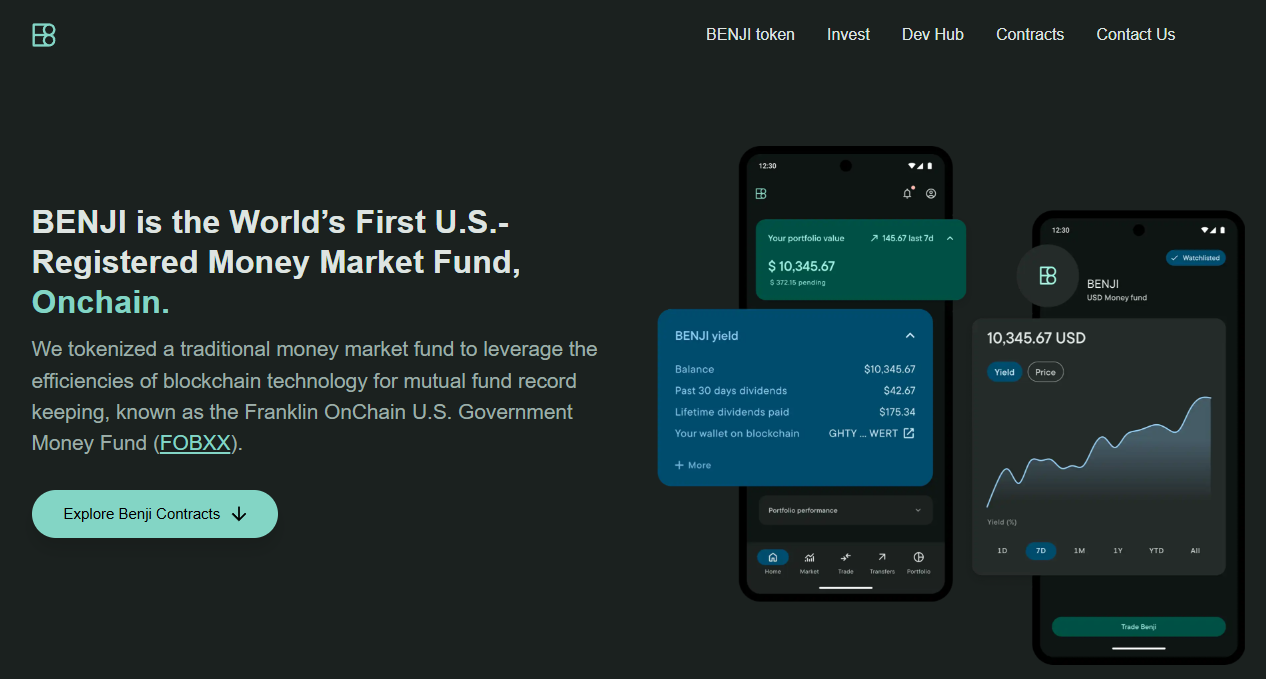
 Franklin Templeton's $775 million Franklin OnChain U.S. Government Money Fund (BENJI) pioneered tokenized mutual funds in 2021, offering exposure to US government securities across eight blockchains with patent-pending intraday yield calculation.

Ideal For

  • Investors seeking regulated 40 Act fund structure
  • Collateral managers requiring second-by-second yield accrual
  • Multi-chain strategies needing broad blockchain compatibility
  • Users prioritizing traditional asset manager credibility

Standout Features

  • Intraday yield tracking down to the second, enabling proportional earnings even for partial-day holdings
  • Direct stablecoin purchases and redemptions with wallet-to-wallet transfer capability
  • 63% of AUM deployed on Stellar Network for optimal cost efficiency
  • Integrated with DeFi protocols for collateral and leverage applications

Pricing
 7-day current yield approximately 4.5-5.5% gross; 0.25% management fee. No minimum investment restrictions beyond standard mutual fund requirements.

Availability
 Global availability with specific KYC requirements. Active on Stellar, Ethereum, Arbitrum, Base, Avalanche, Polygon, Aptos, Solana, BNB Chain.

Worth Noting
 Traditional mutual fund constraints apply including daily NAV calculations and potential redemption delays during market stress.

Alternatives to Consider: Backed bIB01, Superstate Short Duration Government Securities  

For Institutional Credit Exposure (8-12% Yield)

Top Pick: Maple Finance — Premier Crypto-Collateralized Lending

Overview
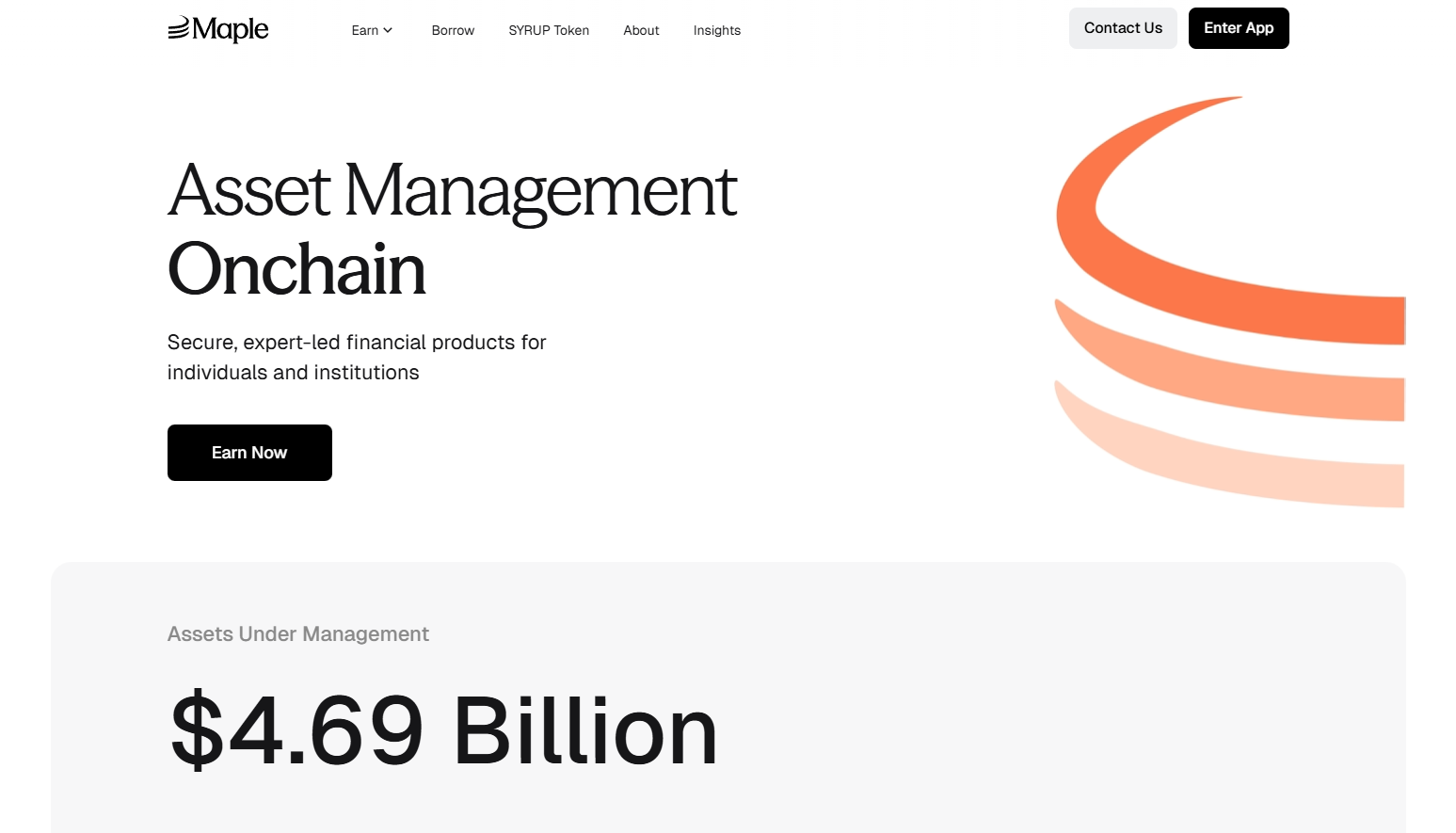
 Maple Finance manages over $4 billion in assets, specializing in institutional over-collateralized lending backed by Bitcoin, Ethereum, Solana, and XRP, targeting $100 billion in annual loan volume by 2030. The platform introduced SyrupUSDC for permissionless retail access alongside KYC-gated institutional pools.

Ideal For

  • Institutional lenders seeking exposure to cryptocurrency-backed credit
  • Liquidity providers comfortable with smart contract risk
  • Allocators targeting floating-rate, senior-secured structures
  • Investors seeking alternatives to traditional stablecoin farming

Standout Features

  • Consistent 9-12% net yields through undercollateralized institutional facilities and structured credit products
  • Strategic integration with Aave's $40 billion protocol bringing syrupUSDT to Plasma instance and syrupUSDC to core markets
  • Partnerships with Bitwise, Lido Finance (stETH-backed credit lines), and EtherFi (weETH collateral) expanding institutional adoption
  • Robust risk management combining decades of TradFi expertise with real-time on-chain monitoring

Pricing
 Variable by pool; typical effective yields 9-12% after protocol fees. Minimum investments pool-dependent, generally $10K-$50K for retail syrup products.

Availability
 Global with KYC requirements for lending. Institutional Maple requires accreditation; Syrup.fi open to broader participants.

Worth Noting
 Platform transitioned from uncollateralized to over-collateralized model after 2022 market turmoil. Historical defaults impacted certain pools; robust recovery mechanisms now in place.

Alternatives to Consider: Credix (emerging markets), TrueFi (uncollateralized DeFi)  

Runner-Up: Goldfinch Prime — Institutional Private Credit Access

Overview
 Goldfinch Prime aggregates exposure to multi-billion dollar private credit funds from Ares, Apollo, Golub Capital, and KKR, providing on-chain access to institutional-grade senior secured loans with over $1 trillion in collective AUM.

Ideal For

  • Non-US investors seeking diversified private credit exposure
  • Allocators targeting institutional fund performance without direct fund access
  • Participants seeking uncorrelated yield to crypto markets
  • Investors comfortable with longer lockup periods

Standout Features

  • Exposure to 1000+ senior secured loans across industries through vetted fund managers with 10+ years experience
  • Target returns of 9-12% net of fees with strict eligibility criteria including >90% senior secured portfolios and <0.75% target non-accrual rates
  • Heron Finance manages fund selection and vetting while fund managers handle all underwriting and default resolution
  • USDC-based deposits converted to proportional GPRIME tokens for continuous offering structure

Pricing
 Net yields 9-12% after embedded management fees and profit sharing. Minimum investments vary by pool structure; typically institutional minimums apply.

Availability
 Non-US persons only due to regulatory structure. KYC and accreditation verification required.

Worth Noting
 Exposure is indirect through fund shares rather than direct loan origination; fund managers absorb individual borrower default risk into aggregate yields. Liquidity limited compared to Treasury products.

Alternatives to Consider: Centrifuge private credit pools, Credix fintech lending


For Real Estate & Diversified Assets (6-10% Yield)

Top Pick: Centrifuge — Multi-Asset Tokenization Infrastructure

Overview
 Centrifuge operates as a multichain infrastructure platform enabling asset managers to tokenize real estate, trade finance, carbon credits, and structured credit with $1.2 billion TVL and recent 10x growth driven by the first on-chain CLO and tokenized S&P 500 index fund.

Ideal For

  • Investors seeking exposure to asset-backed securities beyond treasuries
  • Allocators comfortable evaluating tranched credit structures
  • Participants prioritizing transparency and on-chain asset verification
  • Portfolio managers wanting diversification across real-world credit types

Standout Features

  • Asset-agnostic architecture supporting structured credit, real estate mortgages, US treasuries, carbon credits, and consumer finance with full collateralization and legal recourse for investors
  • V3 platform enables cross-chain interoperability across Ethereum, Base, Arbitrum, Avalanche, BNB Chain, and Plume with integrated KYC and compliance-as-a-feature
  • Senior/junior tranche structures allowing risk-return customization
  • Partnership with Chronicle Labs for real-time price feeds and integration with Circle for USDC on/off-ramping

Pricing
 Yields vary by pool and tranche: typically 6-8% for senior tranches, 10-14% for junior tranches. Management fees embedded; pool-specific minimums apply.

Availability
 Global with KYC requirements. Pools may have additional jurisdictional restrictions based on underlying asset location.

Worth Noting
 Platform complexity requires understanding of tranched structures and asset-specific risks. Less liquid credit instruments offer less frequent pricing updates than treasury products.

Alternatives to Consider: RealT (US residential real estate focus), Republic (equity crowdfunding)


For Emerging Market Credit (12-18% Yield)

Top Pick: Credix — Latin American Fintech Lending

Overview
 Credix specializes in providing credit facilities to fintech lenders in Latin America, offering high-yield exposure to underserved credit markets with institutional-grade underwriting and local market expertise.

Ideal For

  • Sophisticated investors seeking higher risk-adjusted returns
  • Allocators comfortable with emerging market credit risk
  • Participants with extended investment horizons (12-24 months typical)
  • Investors seeking geographic diversification from US/EU markets

Standout Features

  • Target yields 12-18% reflecting emerging market risk premiums
  • Focus on fintech infrastructure enabling financial inclusion
  • Partnerships with established Latin American credit originators
  • Robust due diligence and monitoring of borrower networks

Pricing
 Pool-dependent yields typically 12-18% gross with management fees of 1-2%. Minimum investments generally $50K+ for accredited investors.

Availability
 Non-US persons primarily; requires accreditation verification and enhanced KYC given emerging market exposure.

Worth Noting
 Higher yields reflect higher credit and currency risk. Platform experienced challenges during regional economic volatility; enhanced risk controls now implemented.

Alternatives to Consider: Goldfinch V1 pools (emerging market focus), TrueFi uncollateralized pools


For Tokenization Infrastructure (Platform Providers)

Top Pick: Securitize — Industry-Leading Issuance Platform

Overview
 Securitize has tokenized over $4.5 billion in assets for 1.2 million investors across 3,000+ clients, operating as an SEC-registered transfer agent with integrated ATS for secondary trading. The platform powers major offerings including BlackRock's BUIDL fund.

Ideal For

  • Asset managers seeking turnkey tokenization solutions
  • Issuers requiring SEC-compliant digital security infrastructure
  • Institutional clients needing integrated custody and compliance
  • Projects prioritizing regulatory alignment and brand credibility

Standout Features

  • DS Protocol automates token issuance, transfer agent functions, and regulated secondary trading with $47 million funding led by BlackRock
  • Recent launch of STAC tokenized AAA CLO fund with BNY custody demonstrating institutional adoption trajectory
  • Comprehensive investor onboarding, KYC/AML, and reporting infrastructure
  • Partnerships with major asset managers and integration with Zero Hash for fiat conversion

Pricing
 Platform fees vary by issuance size and complexity; typically 0.5-2% of AUM plus basis point fees on transactions. White-label solutions available for enterprise clients.

Availability
 Global operations with jurisdiction-specific compliance modules. Primary focus on US, EU, and APAC institutional markets.

Worth Noting
 Securitize is an issuance platform rather than direct investment product; investors access opportunities through partner funds and offerings launched on the infrastructure.

Alternatives to Consider: Tokeny (EU-focused), Polymath/Polymesh (security token specialists)


Complete Provider Directory

  • Backed Finance: European MiCA-compliant tokenization platform offering bIB01 (Swiss government bond exposure) and bC3M (commodity basket). Strong focus on regulatory alignment with modest 3-5% yields and low entry barriers.
  • Swarm Markets: Decentralized platform enabling fractional ownership of real estate and private credit with $1K-$50K minimums. Emphasizes accessibility while maintaining compliance through distributed infrastructure.
  • TrueFi: Uncollateralized lending protocol using on-chain credit scoring and portfolio diversification. Higher risk-return profile (8-15% targets) with full transparency of borrower pools and performance metrics.
  • Archax: UK FCA-regulated platform for institutional tokenization of bonds, funds, and money markets. Focus on traditional finance compatibility with stringent accreditation requirements.

Making Your Selection: Key Questions

  • What yield stability do you require?
     Treasury-backed platforms (Ondo, Franklin Templeton) offer predictable 4-5% returns with minimal volatility. Credit-focused platforms (Maple, Goldfinch) target 9-12% but introduce credit risk and performance variability.
  • What is your risk tolerance for underlying collateral?
     Government securities provide lowest risk; over-collateralized crypto loans add smart contract and liquidation risks; uncollateralized emerging market credit carries highest default potential.
  • Do you meet accreditation and minimum investment thresholds?
     Many institutional products require $50K-$200K minimums and qualified purchaser status. Retail-accessible options like USDY and syrupUSDC lower barriers but may sacrifice yield.
  • What liquidity do you need?
     Treasury tokens generally offer daily liquidity; private credit pools may have quarterly redemption windows; real estate tokenization can involve 12-24 month lockups.
  • How important is regulatory compliance?
     Platforms like Ondo, Franklin Templeton, and Securitize prioritize SEC registration and traditional fund structures. Purely DeFi-native protocols offer less regulatory clarity but greater composability.
  • What blockchain ecosystems do you operate in?
     Multi-chain deployment (Ondo, Centrifuge) provides flexibility; single-chain specialization (some Maple pools) may offer optimization but limits interoperability.
  • Do you have geographic restrictions?
     US persons often excluded from highest-yield opportunities due to securities laws. European investors benefit from MiCA framework; APAC sees growing regulatory clarity.
  • What level of transparency do you require?
     On-chain native protocols offer real-time asset verification; hybrid models may rely on periodic attestations and third-party audits.
  • Are you seeking passive income or active yield strategies?
     Treasury staking provides set-and-forget returns; DeFi integrations enable leverage, collateral strategies, and yield optimization requiring active management.
  • How much operational complexity can you handle?
     Single-platform solutions simplify but limit optionality; multi-protocol strategies maximize returns but require gas management, tax tracking, and security across multiple platforms.

Maximizing Your Setup with Token Metrics

Token Metrics provides critical intelligence for navigating RWA yield opportunities through data-driven analysis and market insights.

Research Phase: Leverage Token Metrics' fundamental analysis to evaluate tokenized asset protocols, comparing on-chain metrics, TVL trends, and yield sustainability indicators. Our RWA sector reports identify emerging platforms and highlight regulatory developments across jurisdictions.

Portfolio Construction: Use quantitative scoring to allocate across risk tiers—balancing stable treasury exposure with higher-yield credit products. Token Metrics' portfolio tools help optimize diversification while monitoring correlation to traditional crypto markets.

Ongoing Monitoring: Real-time alerts notify you of yield changes, protocol upgrades, and risk events. Our dashboard aggregates performance across multiple RWA platforms, tracking your yield-bearing positions alongside broader cryptocurrency holdings.

Risk Management: Token Metrics' risk analytics assess smart contract security, custody arrangements, and counterparty exposure. Our reports flag platforms with concerning yield sustainability metrics or operational red flags before they impact your capital.

Start your Token Metrics free trial to access institutional-grade RWA research and optimize your real-world asset allocation.  

Essential Security Practices

  • Custody Verification: Confirm that platforms use institutional-grade custodians (Coinbase Custody, BitGo, Fireblocks) for underlying assets. Verify proof-of-reserve attestations and third-party audits.
  • Smart Contract Risk: Review audit reports from reputable firms (Trail of Bits, OpenZeppelin, Certora). Understand upgrade mechanisms and timelock protections on protocol contracts.
  • Legal Structure Assessment: Examine SPV formation, bankruptcy remoteness, and investor recourse mechanisms. Ensure tokenization structure provides actual legal claim on underlying assets, not just economic exposure.
  • Regulatory Compliance: Verify platforms maintain necessary licenses (broker-dealer, transfer agent, ATS) in relevant jurisdictions. Confirm offerings comply with securities laws in your domicile.
  • Counterparty Risk: Understand who services loans, manages defaults, and handles liquidations. Evaluate track records of asset originators and credit underwriters.
  • Liquidity Risk Management: Never allocate more than you can afford to lock up for stated redemption periods. Maintain buffer capital for market volatility and potential redemption delays.
  • Tax Implications: Consult tax professionals on treatment of tokenized yield—may be classified as interest income, dividends, or capital gains depending on structure and jurisdiction.
  • Geographic Restrictions: Verify you're eligible to participate based on residency. Using VPNs or misrepresenting location can result in frozen funds and legal liability.
  • Platform Concentration: Diversify across multiple RWA providers to reduce single-point-of-failure risk. No single platform should represent majority of yield allocation.
  • Documentation: Maintain records of all transactions, yield distributions, and platform communications for tax reporting and potential disputes.

This article is for research and educational purposes, not financial advice. RWA investments carry risks including loss of principal.


What to Avoid

  • Ignoring minimum holding periods: Many RWA products enforce lockups or redemption windows. Treating them as liquid positions can leave you unable to access capital when needed.
  • Chasing unsustainably high yields: Promised returns significantly above market rates often indicate excessive risk. Verify underlying asset performance and historical consistency before committing capital.
  • Overlooking platform liquidity: Token existence on-chain doesn't guarantee exit liquidity. Check secondary market depth and historical spread between minting and redemption prices.
  • Neglecting jurisdictional compliance: Accessing platforms not available in your region can result in frozen accounts and regulatory penalties. Always verify eligibility before depositing funds.
  • Underestimating smart contract risk: Even well-audited protocols face exploitation risk. Size positions appropriately and monitor security incident disclosures across the ecosystem.
  • Failing to verify asset backing: Don't rely on marketing claims. Demand proof-of-reserve, third-party attestations, and transparent reporting on underlying collateral.
  • Concentrating in single asset class: Over-allocating to one RWA category (e.g., all private credit) eliminates diversification benefits. Balance across treasuries, credit, and real estate where possible.
  • Ignoring fee structures: Management fees, performance fees, and transaction costs compound over time. Calculate net yields after all costs when comparing platforms.

Reader Questions Answered

What's the difference between tokenized treasuries and yield-bearing stablecoins?

 Tokenized treasuries (like OUSG) represent direct ownership of US Treasury securities with yield passed through to holders. Yield-bearing stablecoins (like USDY) maintain $1 peg while distributing treasury yields via rebasing or airdrops. Treasuries may fluctuate slightly with NAV; yield stablecoins prioritize price stability.

Are RWA yields taxable differently than crypto staking rewards?

 Likely yes, though tax treatment varies by jurisdiction. RWA yields from treasuries or credit facilities often classified as interest income taxed at ordinary rates. Crypto staking may be treated as income at receipt or capital gains at sale depending on location. Consult tax professionals for specific guidance.

Can I use tokenized RWAs as collateral in DeFi protocols?

 Increasingly yes. Platforms like Maple, Ondo (via Flux Finance), and Centrifuge enable using tokenized assets as DeFi collateral. However, support varies by protocol and asset—USDY and OUSG see broader integration than niche real estate tokens. Liquidation risks apply if collateral value drops.

What happens if the platform goes bankrupt?

 Properly structured tokenization isolates assets in bankruptcy-remote SPVs, protecting investor claims even if platform operator fails. However, redemption processes may be delayed and require legal navigation. This is why verifying legal structure and custodial arrangements is critical.

How liquid are RWA tokens compared to stablecoins?

 Significantly less liquid. While stablecoins have billions in daily DEX volume, most RWA tokens trade thinly or only through platform-controlled redemption mechanisms. Treasury tokens offer better liquidity than private credit or real estate, but all lag traditional stablecoins substantially.

Do I need to be an accredited investor?

 Depends on the platform and your location. US-based offerings often require accreditation; international platforms may have lower barriers. Products like USDY, syrupUSDC, and BENJI target broader accessibility, while institutional credit pools restrict to qualified purchasers.

What are the main risks that could cause loss of principal?

 (1) Underlying asset default (credit risk), (2) smart contract exploitation, (3) platform insolvency without proper asset segregation, (4) regulatory action freezing operations, (5) stablecoin de-pegging for yield products denominated in USDC/USDT, (6) liquidation cascades in collateralized structures.

How do yields compare to traditional finance alternatives?

 Tokenized treasuries (4-5%) match conventional money market funds but with 24/7 access. Private credit RWAs (9-12%) offer premiums over corporate bonds due to illiquidity and platform novelty. Emerging market RWA yields (12-18%) comparable to EM debt funds with added smart contract risk.


Bottom Line

Real-world asset yield marketplaces represent the maturation of blockchain infrastructure beyond speculation into productive finance. For investors seeking stable, asset-backed returns uncorrelated to cryptocurrency volatility, platforms like Ondo Finance and Franklin Templeton deliver institutional-grade treasury exposure with DeFi composability. Those comfortable with credit risk can access superior yields through Maple Finance's collateralized institutional lending or Goldfinch Prime's diversified private credit exposure.

The key to success: match platform selection to your specific risk tolerance, liquidity needs, and regulatory constraints. Treasury products suit conservative allocators prioritizing capital preservation; credit platforms reward investors accepting higher risk for enhanced returns; multi-asset infrastructure like Centrifuge offers diversification across real-world credit types.

Start with smaller allocations to understand platform mechanics, redemption processes, and yield consistency before committing substantial capital. The RWA sector's rapid growth will continue creating opportunities, but also attracting lower-quality offerings—due diligence remains paramount.

Related Resources:


About This Research

Methodology: This guide evaluated 20+ RWA platforms through analysis of official documentation, on-chain data, regulatory filings, and third-party audits. Platforms selected represent meaningful TVL (>$100M), regulatory compliance, and operational track record. Final selection prioritized diversity across asset classes and investor accessibility tiers.

Research Sources:

  • Ondo Finance: Product documentation, tokenomics, OUSG/USDY specifications, Oasis Pro acquisition disclosure
  • Maple Finance: Platform whitepaper, syrupUSDC mechanics, Aave integration announcement, CEO interviews
  • Centrifuge: V3 technical documentation, pool analytics, Republic partnership details
  • Goldfinch: Prime pool specifications, fund manager criteria, Heron Finance structure
  • Franklin Templeton: BENJI platform technical details, intraday yield patent documentation, multi-chain deployment
  • Securitize: DS Protocol documentation, STAC fund launch details, BlackRock partnership announcements
  • RWA.xyz: Platform TVL data, tokenization metrics, market growth analysis
  • DeFiLlama: Protocol TVL tracking, historical performance data
  • BCG/Ripple: RWA market projections and industry research
  • VanEck, Coinbase, Binance: Sector research reports on RWA growth trajectories

All data current as of January 2025. Platform features and yields subject to change; verify current terms on official websites before investing.

Build Smarter Crypto Apps &
AI Agents in Minutes, Not Months
Real-time prices, trading signals, and on-chain insights all from one powerful API.
Grab a Free API Key
About Token Metrics
Token Metrics: AI-powered crypto research and ratings platform. We help investors make smarter decisions with unbiased Token Metrics Ratings, on-chain analytics, and editor-curated “Top 10” guides. Our platform distills thousands of data points into clear scores, trends, and alerts you can act on.
30 Employees
analysts, data scientists, and crypto engineers
Daily Briefings
concise market insights and “Top Picks”
Transparent & Compliant
Sponsored ≠ Ratings; research remains independent
Want Smarter Crypto Picks—Free?
See unbiased Token Metrics Ratings for BTC, ETH, and top alts.
Thank you! Your submission has been received!
Oops! Something went wrong while submitting the form.
 No credit card | 1-click unsubscribe
Token Metrics Team
Token Metrics Team

Recent Posts

Research

Measuring Success: The Complete Guide to Evaluating Token Metrics AI Indices Performance

Token Metrics Team
11 min read

Ask most cryptocurrency investors how their portfolio is performing, and they'll immediately cite a percentage return: "I'm up 50%" or "I'm down 30%." While simple returns matter, this single-dimensional view of performance obscures critical information about risk, consistency, and sustainability. Two portfolios with identical 50% returns might differ dramatically in risk profile—one achieving gains through steady appreciation, the other through wild volatility that could reverse suddenly.

Professional investors and institutional fund managers evaluate performance through multiple sophisticated metrics that reveal not just how much return was achieved, but how efficiently risk was managed, how consistently profits were generated, and how the strategy performed relative to relevant benchmarks. These metrics separate lucky speculation from skillful investing, and short-term anomalies from sustainable long-term strategies.

Token Metrics AI Indices are designed to deliver not just strong absolute returns, but superior risk-adjusted performance across multiple evaluation dimensions. Understanding these performance metrics empowers you to make informed decisions about index selection, allocation sizing, and strategy adjustments. This comprehensive guide reveals the key metrics that matter, how to interpret them correctly, and how to use data-driven evaluation to optimize your Token Metrics investment approach.

The Fundamental Performance Metrics

Absolute Returns: The Starting Point

Absolute return measures simple percentage gain or loss over a specific period. If you invest $10,000 and it grows to $15,000, your absolute return is 50%. This basic metric provides important information but tells an incomplete story.

When evaluating Token Metrics indices, examine absolute returns across multiple timeframes including month-to-date and quarter-to-date for recent performance, year-to-date capturing current year results, one-year, three-year, and five-year returns for medium-term perspective, and since-inception returns showing complete track record.

Different timeframes reveal different aspects of performance. Short-term returns show current momentum and responsiveness to market conditions. Long-term returns demonstrate consistency and compound effectiveness. Always evaluate multiple timeframes rather than fixating on any single period.

Annualized Returns: Comparing Across Timeframes

Annualized return converts returns of any length into equivalent annual percentage, enabling fair comparisons. A 100% return over two years annualizes to approximately 41% annually—useful for comparing against one-year returns of other investments.

Token Metrics reports annualized returns for all indices, facilitating comparisons across different indices with different inception dates and holding periods. When evaluating indices, prioritize annualized returns over cumulative returns for more meaningful comparisons.

Compound Annual Growth Rate (CAGR): The Smoothed View

CAGR shows the geometric mean annual return smoothing out volatility to reveal underlying growth trajectory. If a portfolio grows from $10,000 to $20,000 over three years, the CAGR is 26%, even if year-one returned 50%, year-two lost 10%, and year-three gained 40%.

CAGR proves particularly valuable for crypto investing given extreme year-to-year volatility. It reveals the "smoothed" growth rate you've achieved, providing perspective beyond dramatic individual periods.

Risk-Adjusted Performance: The Professional Standard

Why Risk-Adjusted Returns Matter More Than Absolute Returns

Achieving 100% returns sounds impressive, but if that required accepting 80% maximum drawdown risk, was it worth it? Another portfolio delivering 60% returns with only 20% maximum drawdown might actually be superior despite lower absolute returns.

Risk-adjusted metrics evaluate returns relative to risk taken. Professional investors prioritize risk-adjusted performance over absolute returns because higher risk-adjusted returns indicate skillful investing rather than lucky risk-taking. Two critical principles: more return for given risk is better, and less risk for given return is better.

Sharpe Ratio: The Gold Standard

The Sharpe Ratio, developed by Nobel laureate William Sharpe, measures risk-adjusted returns by dividing excess returns (returns above risk-free rate) by standard deviation (volatility). Higher Sharpe Ratios indicate better risk-adjusted performance.

Sharpe Ratio = (Portfolio Return - Risk-Free Rate) / Portfolio Standard Deviation

A Sharpe Ratio above 1.0 is considered good, above 2.0 is very good, and above 3.0 is exceptional. Traditional equity portfolios typically achieve Sharpe Ratios of 0.5-1.0. Token Metrics indices targeting 1.5+ Sharpe Ratios demonstrate superior risk-adjusted performance.

When comparing indices, prioritize higher Sharpe Ratios over higher absolute returns. An index with 40% returns and 1.8 Sharpe Ratio likely provides better risk-adjusted value than an index with 60% returns and 1.2 Sharpe Ratio.

Sortino Ratio: Focusing on Downside Risk

The Sortino Ratio improves on Sharpe Ratio by considering only downside volatility (negative returns) rather than total volatility. This distinction matters because upside volatility (large gains) isn't truly "risk"—investors welcome positive surprises.

Sortino Ratio = (Portfolio Return - Risk-Free Rate) / Downside Deviation

Higher Sortino Ratios indicate portfolios that deliver returns efficiently while minimizing painful drawdowns. Token Metrics' focus on downside protection through diversification and risk management typically produces strong Sortino Ratios.

Calmar Ratio: Return Per Unit of Maximum Drawdown

The Calmar Ratio divides annualized return by maximum drawdown, measuring how much return you earn per unit of worst-case loss.

Calmar Ratio = Annualized Return / Maximum Drawdown

If an index delivers 50% annualized returns with 25% maximum drawdown, its Calmar Ratio is 2.0. Higher ratios indicate more efficient return generation relative to worst-case scenarios. Token Metrics indices emphasizing drawdown management typically show strong Calmar Ratios.

Volatility Metrics: Understanding the Ride

Standard Deviation: Measuring Total Volatility

Standard deviation quantifies how much returns fluctuate around their average. Higher standard deviation means more volatility—both upside and downside.

Cryptocurrency exhibits extreme volatility. Bitcoin's annualized volatility often exceeds 60-80%, compared to 15-20% for stock markets. Token Metrics indices typically show lower volatility than Bitcoin through diversification, though still higher than traditional assets.

When evaluating indices, consider your volatility tolerance. If 50% annual volatility causes anxiety impairing sleep or decision-making, choose lower-volatility indices even if that sacrifices some return potential.

Beta: Relative Volatility to Benchmarks

Beta measures how much a portfolio moves relative to a benchmark (typically Bitcoin for crypto indices). Beta of 1.0 means the portfolio moves identically with the benchmark. Beta above 1.0 indicates amplified movements (higher volatility), while beta below 1.0 indicates dampened movements (lower volatility).

Token Metrics large-cap indices typically show betas near 0.8-1.0 relative to Bitcoin—moving somewhat similarly but with slightly reduced volatility through diversification. Growth indices might show betas of 1.2-1.5, amplifying Bitcoin's movements for enhanced return potential at higher risk.

Understanding beta helps set appropriate expectations. If Bitcoin returns 30% and your index has beta of 1.2, expect approximately 36% returns. If Bitcoin declines 20%, expect approximately 24% decline.

Maximum Drawdown: Worst-Case Scenario

Maximum drawdown measures the largest peak-to-trough decline during any period. If a portfolio grows from $10,000 to $20,000, then drops to $12,000, the maximum drawdown is 40% (from $20,000 peak to $12,000 trough).

Maximum drawdown reveals worst-case scenarios—critical information for risk management. Can you psychologically and financially tolerate a 50% maximum drawdown? If not, avoid strategies historically experiencing such declines.

Token Metrics indices show varying maximum drawdowns based on strategy. Conservative large-cap indices might experience 40-50% maximum drawdowns during severe bear markets, while aggressive growth indices might see 60-70% drawdowns. Understanding these historical ranges helps set realistic expectations.

Downside Capture and Upside Capture Ratios

Downside capture measures how much of benchmark's negative returns a portfolio captures. 80% downside capture means when the benchmark declines 10%, the portfolio declines 8%—better downside protection.

Upside capture measures participation in benchmark gains. 120% upside capture means when the benchmark rises 10%, the portfolio rises 12%—enhanced upside participation.

Ideal portfolios combine high upside capture with low downside capture. Token Metrics indices achieving 110% upside capture and 85% downside capture demonstrate skill in capturing gains while protecting during declines.

Get Started For Free

Benchmark Comparisons: Relative Performance

Choosing Appropriate Benchmarks

Performance must be evaluated relative to relevant benchmarks. For crypto indices, appropriate benchmarks include Bitcoin (the dominant cryptocurrency), Ethereum (leading smart contract platform), total crypto market cap indices, and equal-weighted crypto indices.

Token Metrics provides benchmark comparisons for all indices, typically against Bitcoin and total market indices. Evaluate whether indices outperform or underperform these benchmarks after adjusting for risk.

Alpha Generation: Beating the Benchmark

Alpha measures returns exceeding benchmark returns after adjusting for risk. Positive alpha indicates skillful investing beating passive benchmark holding. An index delivering 40% returns when Bitcoin returned 30%, with similar risk profiles, generates positive alpha.

Token Metrics' AI-driven approach aims to generate consistent positive alpha through superior token selection, optimal diversification, and systematic rebalancing. Historical alpha generation provides evidence of whether indices add value beyond passive Bitcoin holding.

Tracking Error: Consistency of Outperformance

Tracking error measures how consistently a portfolio's returns differ from benchmarks. Low tracking error means returns closely match benchmarks, while high tracking error indicates returns diverge significantly—either positively or negatively.

For active strategies like Token Metrics indices, some tracking error is expected and desirable—that's how alpha is generated. But excessive tracking error indicates unpredictable performance making planning difficult.

Time-Period Analysis: Understanding Performance Consistency

Rolling Returns: Capturing All Periods

Rolling returns analyze performance across all possible time periods rather than just fixed calendar periods. For example, examining all possible one-year periods in a five-year track record (starting every day) rather than just comparing 2020 vs. 2021 vs. 2022.

Rolling returns reveal consistency. An index showing positive rolling one-year returns 80% of the time demonstrates more consistency than one positive only 50% of the time, even with similar average returns.

Token Metrics reports rolling returns for various periods, helping evaluate consistency across market conditions. Prefer indices with strong rolling return performance over those with dramatic but inconsistent results.

Performance in Different Market Conditions

Evaluate how indices perform across different market regimes including bull markets (strong uptrends), bear markets (sustained declines), sideways markets (range-bound conditions), and high volatility vs. low volatility periods.

Indices performing well in all conditions demonstrate robustness. Those performing well only in specific conditions require tactical timing for success. Token Metrics' adaptive AI aims for "all-weather" performance, though some indices intentionally specialize in particular conditions (momentum indices excel in trends, for example).

Drawdown Recovery: Bouncing Back

Beyond maximum drawdown magnitude, examine recovery time—how long portfolios take recovering to previous peaks after drawdowns. Faster recovery indicates resilience.

If two indices both experience 50% maximum drawdowns, but one recovers in 6 months while the other takes 2 years, the first demonstrates superior resilience. Token Metrics' systematic rebalancing and diversification typically support faster drawdown recovery than concentrated portfolios.

Practical Application: Using Metrics to Make Better Decisions

Selecting Indices Based on Your Profile

Use performance metrics to match indices with your investment profile. Conservative investors prioritize lower maximum drawdown, higher Sharpe/Sortino ratios, lower standard deviation, and consistent rolling returns even with moderate absolute returns.

Aggressive investors accept higher maximum drawdown, might tolerate lower Sharpe ratios for higher absolute returns, embrace higher volatility, and can handle inconsistent periods if upside is substantial.

Review Token Metrics' index performance data with these priorities in mind, selecting indices aligning with your risk-return preferences.

Monitoring Performance Over Time

After investing, monitor performance quarterly using key metrics including absolute and risk-adjusted returns relative to benchmarks, maximum drawdown tracking whether risk parameters are respected, consistency metrics like rolling returns, and comparison against initial expectations.

If an index consistently underperforms benchmarks on risk-adjusted basis for 12+ months, consider switching to alternatives better meeting objectives. But avoid reactive switching based on short-term underperformance—all strategies experience periods of weakness.

Setting Realistic Expectations

Performance metrics help set realistic expectations. If historical maximum drawdowns reached 60%, expect similar or worse in the future. If annual returns averaged 40% with 30% standard deviation, don't expect consistent 40% returns every year—expect dramatic variation around that average.

Token Metrics provides comprehensive historical data supporting realistic expectation-setting. Use this data to mentally prepare for inevitable volatility and drawdowns, preventing emotional reactions when they occur.

Red Flags and Warning Signs

Certain performance patterns raise concerns including consistently increasing maximum drawdowns each cycle, declining Sharpe Ratios over time, persistent underperformance vs. benchmarks, increasing volatility without corresponding return increase, and inconsistent methodology or strategy drift.

Monitor for these red flags. While Token Metrics maintains rigorous quality standards, all strategies face challenges. Being attentive to warning signs enables proactive adjustments before problems become severe.

Advanced Metrics for Sophisticated Investors

Information Ratio: Consistency of Alpha

The Information Ratio measures how consistently a portfolio generates alpha relative to tracking error—essentially measuring manager skill.

Information Ratio = Alpha / Tracking Error

Higher Information Ratios indicate skillful, consistent outperformance rather than lucky or erratic results. Token Metrics targeting Information Ratios above 0.5 demonstrates systematic alpha generation.

Omega Ratio: Complete Risk-Return Profile

The Omega Ratio evaluates the entire distribution of returns, capturing all moments (mean, variance, skewness, kurtosis) rather than just first two moments like Sharpe Ratio.

Higher Omega Ratios indicate superior risk-return profiles capturing nuances missed by simpler metrics. While complex to calculate, Token Metrics provides Omega Ratios for indices, offering sophisticated performance evaluation.

Tail Risk Metrics: Extreme Event Analysis

Tail risk metrics evaluate performance during extreme market conditions including Value at Risk (VaR), Conditional Value at Risk (CVaR), and skewness/kurtosis.

These metrics reveal how indices perform during "black swan" events—rare but catastrophic market crashes. Token Metrics' diversification and risk management aim to reduce tail risk compared to concentrated crypto positions.

Creating Your Performance Dashboard

Essential Metrics to Track

Build a performance dashboard tracking key metrics for your Token Metrics holdings including monthly absolute and benchmark-relative returns, year-to-date and inception-to-date returns, Sharpe and Sortino Ratios, current drawdown from peak, maximum drawdown history, and rolling one-year returns.

Review this dashboard quarterly, taking notes on performance patterns, concerns, and successes. This systematic tracking prevents both complacency during good times and overreaction during difficult periods.

Using Token Metrics Platform Analytics

Token Metrics platform provides comprehensive performance analytics eliminating manual calculation needs. Familiarize yourself with available reports, charts, and comparison tools. Use these resources to monitor your holdings and evaluate alternative indices.

Set up automated performance reports if available, receiving regular updates without requiring active checking. This ensures you stay informed while avoiding obsessive daily monitoring that encourages emotional reactions.

Sharing Performance Discussions

Consider engaging with Token Metrics community forums or discussion groups sharing performance observations and questions. Other investors' perspectives provide valuable context and help identify whether your experience is typical or exceptional.

While past performance never guarantees future results, collective intelligence from many users evaluating indices from different perspectives enriches understanding and improves decision-making.

Token Metrics: Driving Data-Driven Index Evaluation

Token Metrics offers users institutional-grade analytics and a wealth of index performance data in one convenient platform. Whether you are reviewing absolute returns, risk-adjusted metrics, or comparing indices to top crypto benchmarks, Token Metrics provides easy-to-understand charts, rolling performance snapshots, and advanced tools for anyone seeking thorough, data-informed analysis. These resources empower crypto investors to track, compare, and refine their portfolios using transparent, actionable performance insights.

FAQ

What is the most important metric for evaluating a crypto index?

No single metric is most important—well-rounded evaluation considers absolute returns, risk-adjusted performance (like Sharpe and Sortino ratios), maximum drawdown, and consistency versus benchmarks.

How often should investors review index performance data?

Quarterly reviews using comprehensive dashboards (tracking returns, drawdowns, risk ratios, and benchmark comparisons) help investors set realistic expectations and guide data-driven adjustments.

Why is volatility especially relevant for crypto indices?

Cryptocurrency is known for high volatility, which can affect investor psychology. Understanding historical volatility helps investors select indices that match risk tolerance and minimize unexpected stress.

How do Sharpe and Sortino ratios differ?

Both measure risk-adjusted returns, but Sharpe considers total volatility while Sortino considers only downside risk. High Sortino ratios indicate efficient downside protection.

Why compare crypto indices to benchmarks?

Benchmarks like Bitcoin or total crypto market indices provide a reference point. Comparing performance reveals if an index adds value through alpha or if it simply follows wider market trends.

Disclaimer

This article is for informational and educational purposes only and does not constitute financial advice, investment recommendations, or an offer to buy or sell any security or asset. Performance metrics and statistics discussed reflect historical data and should not be interpreted as guarantees of future outcomes. Past performance is not indicative of future results. Investors should conduct their own research and consult with qualified professionals before making investment decisions.

Get Started For Free

Research

The Modern Portfolio: How to Integrate Token Metrics AI Indices into Your Overall Investment Strategy

Token Metrics Team
13 min read

For decades, the traditional investment portfolio followed a simple formula: stocks for growth, bonds for stability, perhaps some real estate and commodities for diversification. Financial advisors recommended age-based allocations like "60% stocks, 40% bonds" and called it a day. But the investment landscape has fundamentally changed. Cryptocurrency has emerged as a new asset class offering unique characteristics—extraordinary growth potential, low correlation with traditional assets, and exposure to transformative technology reshaping global finance.

The question facing today's investors isn't whether cryptocurrency deserves a place in portfolios—institutional investors from pension funds to university endowments have already answered that affirmatively. The real questions are: how much cryptocurrency should you hold, how should crypto allocation interact with traditional investments, and how can you integrate crypto systematically without disrupting your overall financial plan?

Token Metrics AI Indices provide the solution—professional-grade crypto exposure that integrates seamlessly into diversified investment portfolios. This comprehensive guide explores optimal asset allocation strategies incorporating cryptocurrency, demonstrates how Token Metrics indices complement traditional investments, and provides practical frameworks for building truly modern portfolios positioned for the 21st century economy.

Understanding Asset Classes and Portfolio Construction Fundamentals

The Core Asset Classes

Traditional portfolio theory recognizes several core asset classes, each serving distinct purposes. Equities (stocks) provide growth potential and inflation protection but with significant volatility. Fixed income (bonds) offers stability and income with lower returns. Real estate delivers inflation hedge, income, and diversification from financial assets. Commodities provide inflation protection and crisis hedge. Cash equivalents ensure liquidity and capital preservation.

Each asset class exhibits different risk-return characteristics and behaves differently under various economic conditions. Effective portfolio construction combines these asset classes to optimize risk-adjusted returns based on individual circumstances, goals, and time horizons.

Where Cryptocurrency Fits

Cryptocurrency represents a unique asset class with characteristics distinct from traditional categories. It offers equity-like growth potential with returns potentially exceeding stocks, low correlation with traditional assets providing genuine diversification benefits, exposure to transformative technology creating new value, and global, 24/7 accessibility without geographic constraints.

However, cryptocurrency also brings challenges including extreme volatility exceeding all traditional asset classes, regulatory uncertainty as frameworks continue evolving, technological complexity requiring specialized knowledge, and limited historical data compared to centuries of stock and bond history.

Understanding these characteristics allows intelligent integration of crypto into diversified portfolios, capturing benefits while managing unique risks.

The Power of Multi-Asset Diversification

Research demonstrates that asset allocation—how you divide capital among different asset classes—determines 90%+ of portfolio returns over time. Security selection (which specific stocks or cryptocurrencies you hold) matters far less than asset allocation decisions.

This principle underscores the importance of thoughtful crypto integration. Adding cryptocurrency to portfolios already containing stocks, bonds, and other assets can improve risk-adjusted returns if done intelligently. Token Metrics indices facilitate this integration by providing systematic crypto exposure that behaves as a distinct asset class within broader portfolios.

Determining Your Optimal Crypto Allocation

The 1-10% Guideline

Financial advisors and institutional investors typically recommend cryptocurrency allocations between 1-10% of total investable assets. This range provides meaningful exposure to crypto's growth potential while limiting portfolio impact if crypto experiences severe drawdowns.

The appropriate allocation within this range depends on multiple factors. Conservative investors near retirement might limit crypto to 1-3%, prioritizing capital preservation over growth. Moderate investors with balanced objectives might allocate 5-7%, accepting reasonable volatility for enhanced returns. Aggressive investors with long time horizons might reach 10-15%, maximizing exposure to crypto's transformative potential.

Age represents a crucial consideration. A 30-year-old investing for retirement 35 years away can tolerate crypto's volatility—even complete loss wouldn't derail their financial future. A 65-year-old depending on portfolio income cannot afford similar risk. General guidelines suggest reducing crypto allocation by 0.5-1% for each decade of age, though individual circumstances vary.

Risk Capacity vs. Risk Tolerance

Distinguish between risk capacity—your financial ability to absorb losses—and risk tolerance—your psychological comfort with volatility. Someone with $5 million in assets has greater risk capacity than someone with $100,000, even if both have equal risk tolerance.

Assess risk capacity by evaluating:

- Total net worth and liquidity
- Income stability and growth trajectory
- Time horizon until capital is needed
- Financial obligations and dependents

Higher risk capacity supports larger crypto allocations even if you personally dislike volatility.

Risk tolerance reflects your emotional response to portfolio declines. If 30% portfolio drops cause anxiety preventing sleep, your risk tolerance is lower regardless of financial capacity. Token Metrics' systematic approach helps by removing day-to-day decision-making, but you must still tolerate seeing portfolio values fluctuate significantly.

The Barbell Approach to Crypto Allocation

Many sophisticated investors employ a "barbell strategy" for crypto—combining very safe assets with very risky ones while avoiding the middle. Within crypto allocation, this might mean:

- 60-70% in Token Metrics' large-cap indices (Bitcoin/Ethereum-focused) providing relative stability
- 20-30% in balanced indices offering moderate risk-reward
- 10-20% in growth or sector-specific indices for asymmetric upside

This barbell creates a portfolio with defined risk boundaries (large-cap indices) and controlled speculation (growth indices), avoiding the muddled middle ground that provides neither safety nor exceptional returns.

Integrating Token Metrics Indices with Traditional Asset Classes

Crypto and Equities: Complementary Growth Engines

Equities and cryptocurrency both provide growth potential, but they often move independently. Stock market performance depends on corporate earnings, economic growth, interest rates, and market sentiment. Cryptocurrency performance depends on technology adoption, regulatory developments, network effects, and crypto-specific sentiment.

This low correlation (typically +0.2 to +0.4 between Bitcoin and S&P 500) means that adding crypto to equity portfolios can actually reduce overall portfolio volatility while maintaining or enhancing returns—the holy grail of portfolio construction.

For equity-focused investors, consider maintaining core equity allocation (40-60% of total portfolio) and adding 5-10% crypto allocation through Token Metrics indices. During periods when equities struggle (like rising interest rate environments), crypto can provide offsetting returns. When both rally together, you capture gains across asset classes.

Crypto and Fixed Income: Balancing Growth and Stability

Traditional portfolio theory combines stocks and bonds—stocks for growth, bonds for stability. Adding cryptocurrency creates a three-asset framework offering even more optimization opportunities.

For investors with traditional 60/40 (stock/bond) portfolios, consider reducing slightly to 55/35 and adding 10% crypto allocation through Token Metrics indices. This maintains overall risk profile similar to 60/40 while adding exposure to crypto's asymmetric upside. The bond allocation still provides stability during equity market stress, while crypto allocation captures digital asset growth uncorrelated with traditional markets.

During periods of rising interest rates that hurt both stocks and bonds, cryptocurrency's independence from interest rate sensitivity can provide portfolio ballast. Conversely, crypto's volatility is partially offset by bond stability, creating a more resilient overall portfolio.

Crypto and Real Estate: Alternative Assets in Harmony

Real estate and cryptocurrency represent alternative assets offering diversification from financial markets. Real estate provides tangible asset exposure, steady income, and inflation protection. Cryptocurrency offers digital asset exposure, capital appreciation potential, and technological innovation exposure.

Investors with significant real estate holdings (whether direct property ownership or REITs) can add crypto allocation creating alternative asset diversification. The physical nature of real estate contrasts with crypto's purely digital existence, providing genuinely uncorrelated exposure.

Consider maintaining 20-30% real estate allocation for income and stability, 50-60% in equities for growth, and 5-10% in crypto through Token Metrics indices. This creates a well-rounded portfolio with multiple diversification dimensions.

Strategic Asset Allocation: The Foundation

Strategic asset allocation establishes target percentages for each asset class based on your long-term objectives and circumstances. For example: 50% equities, 30% fixed income, 10% real estate, 5% cryptocurrency, 5% cash.

These targets remain relatively stable over time, changing only when circumstances change significantly (career transition, inheritance, approaching retirement). Token Metrics indices integrate seamlessly into strategic allocation frameworks, representing the crypto portion of your target allocation.

Establish strategic allocation by defining long-term return requirements, assessing risk capacity and tolerance, considering time horizon and liquidity needs, and evaluating tax situation and account structures. Document this allocation in an Investment Policy Statement guiding all future decisions.

Tactical Asset Allocation: Dynamic Adjustments

While strategic allocation remains stable, tactical allocation involves temporary deviations based on market conditions. If equities appear overvalued, you might reduce to 45% temporarily. If crypto experiences severe bear market creating attractive valuations, you might increase allocation to 7% temporarily.

Token Metrics indices support tactical allocation through different index options. During bullish crypto conditions, tilt toward growth indices. During bearish conditions, emphasize large-cap indices or reduce overall crypto exposure. This tactical flexibility optimizes returns while maintaining strategic allocation discipline.

Get Started For Free

Rebalancing: The Key to Multi-Asset Success

The Rebalancing Imperative

As different asset classes perform differently, portfolios drift from target allocations. During stock bull markets, equity allocation grows. During crypto surges, crypto allocation expands. Without rebalancing, portfolios become progressively more concentrated in recent winners—often at elevated valuations.

Rebalancing involves systematically returning to target allocations by selling portions of outperformers (taking profits) and buying underperformers (buying low). This disciplined approach enforces profitable behavior that feels counterintuitive emotionally.

For portfolios including Token Metrics indices, rebalancing might mean selling portions of crypto holdings after significant rallies to restore target allocation, or adding to crypto positions during bear markets when allocation has shrunk below target. This systematic approach improves long-term returns while managing risk.

Rebalancing Strategies

Several rebalancing approaches work effectively:

- Calendar rebalancing occurs at fixed intervals (quarterly, annually) regardless of portfolio drift. This approach is simple and removes discretion but may rebalance unnecessarily when drift is minimal.
- Threshold rebalancing triggers when allocations drift beyond predetermined ranges (e.g., rebalance if crypto grows from 5% target to 7%+). This approach responds to actual portfolio changes but requires ongoing monitoring.
- Hybrid approaches combine calendar and threshold methods—checking allocations quarterly and rebalancing only if drift exceeds thresholds. This balances simplicity with responsiveness.

Choose rebalancing strategy based on account structure (retirement accounts with no tax consequences support more frequent rebalancing), transaction costs (minimizing trades reduces costs), and tax situation (managing capital gains timing).

Tax-Efficient Rebalancing

In taxable accounts, rebalancing triggers tax consequences. Selling appreciated assets creates capital gains requiring tax payments. Optimize tax efficiency by:

- Prioritizing rebalancing within retirement accounts where transactions don't trigger immediate taxes
- Using new contributions to rebalance rather than selling appreciated assets
- Harvesting tax losses to offset gains when rebalancing
- Considering tax implications when deciding rebalancing frequency

Token Metrics indices already implement internal rebalancing. Your rebalancing focuses on maintaining target allocation between crypto (Token Metrics holdings) and other asset classes, not selecting individual cryptocurrencies.

Account Structure and Tax Optimization

Retirement Accounts: The Optimal Home for Crypto

When possible, hold cryptocurrency investments in retirement accounts like IRAs or 401(k)s. These accounts offer enormous tax advantages including tax-deferred growth with no annual capital gains taxes, freedom to rebalance without tax consequences, and potential for tax-free withdrawals (Roth accounts).

Cryptocurrency's high growth potential and volatility make retirement accounts ideal. Gains compound without tax drag, and rebalancing doesn't trigger immediate tax obligations. Over decades, tax-deferred crypto growth can create substantially larger wealth than taxable accounts.

Some IRA custodians allow cryptocurrency holdings. Explore options for implementing Token Metrics strategies within self-directed IRAs, maximizing tax efficiency while accessing professional crypto management.

Taxable Accounts: Managing Tax Implications

When holding crypto in taxable accounts, implement tax-efficient strategies including:

- Long-term holding for favorable capital gains treatment
- Systematic tax-loss harvesting to offset gains
- Considering tax implications before rebalancing
- Maintaining detailed records for tax reporting

Token Metrics provides transaction histories supporting tax compliance. Consider working with crypto-specialized tax professionals to optimize your specific situation.

Coordinating Across Multiple Accounts

Many investors hold multiple accounts—401(k)s, IRAs, taxable brokerage, HSAs. Optimal asset allocation considers all accounts collectively rather than managing each independently.

Place tax-inefficient assets (generating significant capital gains or income) in tax-advantaged accounts, and hold tax-efficient assets (minimal distributions) in taxable accounts. For crypto, prioritize retirement accounts when possible. If crypto allocation must span multiple accounts, consider placing more aggressive crypto strategies (growth indices requiring frequent rebalancing) in retirement accounts and stable large-cap crypto indices in taxable accounts.

Practical Implementation: Building Your Modern Portfolio

Step-by-Step Integration Process

Integrate Token Metrics indices into your portfolio systematically. First, assess current portfolio allocation across all accounts. Calculate percentages in equities, fixed income, real estate, cash, and crypto. Then determine target allocation including desired crypto percentage. Consider risk capacity, tolerance, time horizon, and goals.

Select appropriate Token Metrics indices matching your crypto allocation strategy. If 5% total allocation, perhaps 3% in large-cap index and 2% in balanced index. Calculate dollar amounts for each index based on total portfolio value and target percentages.

Implement gradually through dollar-cost averaging over 3-6 months rather than immediately deploying full allocation. This reduces timing risk and allows building comfort with crypto exposure. Establish rebalancing schedule and thresholds for maintaining target allocation.

Monitoring and Adjustment

After implementation, monitor portfolio performance quarterly. Review allocation drift from targets, evaluate whether targets remain appropriate given changing circumstances, and assess whether selected Token Metrics indices continue aligning with strategy.

Annual comprehensive reviews should include:

- Updating financial goals and time horizons
- Reassessing risk capacity and tolerance
- Evaluating tax situation and account structures
- Considering adjustments to target allocations or index selection

Document changes and rationale in your Investment Policy Statement, maintaining discipline while allowing appropriate evolution as circumstances change.

Common Integration Mistakes to Avoid

Treating Crypto as Separate from Overall Portfolio

Many investors treat crypto as completely separate from traditional portfolios, managing them independently. This siloed approach prevents effective risk management and optimal allocation.

View crypto as one component of integrated portfolio. When crypto surges and grows from 5% to 10% of total portfolio, that concentration risk demands attention regardless of crypto's performance. Rebalancing maintains target risk profile across entire portfolio.

Overreacting to Crypto Volatility

Cryptocurrency's volatility can dominate attention despite representing small portfolio percentages. A 50% crypto decline sounds catastrophic, but if crypto represents 5% of your portfolio, the total portfolio impact is 2.5%—meaningful but manageable.

Maintain perspective about crypto's role in overall portfolio. Focus on total portfolio volatility and returns rather than fixating on crypto's gyrations.

Ignoring Correlation Changes

Correlations between assets change over time. During extreme market stress, correlations often increase as everything moves together. During calm periods, correlations decrease as asset classes move more independently.

Monitor correlation patterns between crypto and traditional assets. If correlations increase persistently, crypto provides less diversification benefit, potentially warranting allocation adjustments.

Token Metrics: Empowering Systematic Crypto Integration

Token Metrics delivers AI-powered crypto indices designed for seamless integration with traditional portfolios. These indices are engineered by sophisticated algorithms and data-driven analysis, providing investors access to diversified, systematic crypto exposure. With professional-grade research, regular rebalancing, and portfolio monitoring tools, Token Metrics enables investors to manage their digital asset allocation in line with their strategic objectives. By using Token Metrics indices, investors can gain reliable, technology-driven exposure to cryptocurrency, aligned with best practices for risk management and portfolio construction.

Frequently Asked Questions (FAQ)

How much of my portfolio should I allocate to cryptocurrency?

Many experts suggest allocating 1-10% of an overall portfolio to cryptocurrency, adjusting for risk tolerance, time horizon, and investment objectives. Age, total net worth, and personal risk comfort are all important factors to consider.

How can crypto indices improve portfolio diversification?

Crypto indices often exhibit low correlation to traditional assets like stocks and bonds. Adding them to a diversified portfolio may help reduce overall volatility and enhance risk-adjusted returns when managed systematically.

What are the risks of integrating crypto with traditional assets?

Crypto's primary risks include high volatility, regulatory uncertainty, and technological complexity. Integrating crypto requires careful allocation sizing, rebalancing, and understanding its behavior compared to other asset classes.

How often should I rebalance my crypto allocation?

Many investors rebalance quarterly or annually. Others use thresholds (e.g., if allocation drifts by 2%+) to trigger rebalancing. The frequency depends on personal discipline, account structure, and tax considerations.

Should I hold crypto in retirement accounts or taxable accounts?

Retirement accounts offer tax-deferred growth and rebalancing without tax consequences, making them well-suited for volatile assets like cryptocurrency. Taxable accounts require more careful planning around tax efficiency and documentation.

Disclaimer

This blog content is for educational and informational purposes only and does not constitute investment, legal, or tax advice. Readers should consult with qualified professionals regarding their individual situation. The views expressed do not represent recommendations or guarantees of results. Cryptocurrency investing involves substantial risk, including risk of loss. Past performance is not indicative of future results.

Get Started For Free

Research

Mastering Your Mind: How Token Metrics AI Indices Overcome the Psychology That Destroys Crypto Returns

Token Metrics Team
14 min read

Here's an uncomfortable truth: the biggest obstacle to your cryptocurrency investing success isn't market volatility, regulatory uncertainty, or technological complexity. It's your own brain. Decades of behavioral finance research demonstrate conclusively that human psychology systematically destroys investment returns. We panic when we should be calm, get greedy when we should be cautious, and make irrational decisions despite knowing better intellectually.

In cryptocurrency markets, where volatility reaches extremes and prices move 24/7, these psychological pitfalls amplify dramatically. A study analyzing crypto investor behavior found that the average investor underperformed simply holding Bitcoin by over 5% annually—not because of bad luck or poor token selection, but because of destructive psychological patterns driving their decisions.

The solution isn't trying harder to control emotions—that rarely works. The solution is systematic, AI-powered investing that removes human psychology from the equation. Token Metrics AI Indices are designed specifically to combat the cognitive biases and emotional responses that plague human investors, replacing knee-jerk reactions with data-driven discipline.

This comprehensive exploration examines the psychological traps that destroy crypto returns, reveals why these mental patterns are so powerful and persistent, and demonstrates how Token Metrics' systematic approach neutralizes these psychological threats. Understanding these dynamics will transform how you approach crypto investing and dramatically improve your long-term results.

The Hardwired Biases Destroying Your Crypto Returns

Loss Aversion: Why Losses Hurt Twice as Much as Gains Feel Good

Nobel Prize-winning research by Daniel Kahneman and Amos Tversky revealed a fundamental human quirk: losses hurt psychologically about twice as much as equivalent gains feel good. Losing $10,000 causes more pain than gaining $10,000 brings pleasure. This "loss aversion" profoundly impacts investment decisions.

In crypto markets, loss aversion manifests destructively. When portfolios decline 30%, the psychological pain becomes overwhelming, driving panic selling at exactly the wrong time. Investors lock in losses that systematic strategies would ride out, missing subsequent recoveries. Conversely, when holding profitable positions, loss aversion makes investors too quick to sell, fearing giving back gains—they miss enormous continued upside.

Token Metrics' AI experiences no loss aversion. The algorithms evaluate positions based on expected risk-adjusted returns, not emotional pain from declines. When fundamentals remain strong despite price drops, the indices maintain or even increase exposure rather than panic selling. This emotional discipline consistently outperforms loss-averse human behavior.

Recency Bias: Overweighting What Just Happened

Human brains disproportionately weight recent experiences when making decisions. If crypto has performed poorly recently, we expect continued poor performance. If crypto has surged lately, we expect continued surges. This "recency bias" causes investors to extrapolate recent trends inappropriately.

Recency bias drives the classic mistake of buying high and selling low. During bull markets after extended gains, recency bias creates excessive optimism—"crypto always goes up!"—driving investment at peaks. During bear markets after sustained declines, recency bias creates excessive pessimism—"crypto is dead!"—driving capitulation at bottoms.

Token Metrics' machine learning algorithms analyze full market histories, not just recent periods. The AI recognizes when recent trends are likely to reverse based on historical patterns, fundamentals, and technical indicators. This comprehensive perspective prevents recency-driven mistakes that destroy wealth.

Confirmation Bias: Seeking Information Supporting Existing Beliefs

Confirmation bias causes us to seek, interpret, and remember information confirming our pre-existing beliefs while ignoring contradictory evidence. If you're bullish on a specific cryptocurrency, you'll unconsciously focus on positive news about that token while dismissing or rationalizing negative developments.

In crypto communities, confirmation bias reaches extreme levels. Dedicated subreddits and Discord channels become echo chambers where believers reinforce each other's convictions, dismissing skeptics as ignorant or malicious. This creates dangerous groupthink where warning signs go unheeded until it's too late.

Token Metrics' AI evaluates all available data objectively without pre-existing biases. If a previously high-rated token shows deteriorating fundamentals, technical weakness, or negative on-chain metrics, the system responds accordingly regardless of community sentiment or previous bullish positioning. This objectivity prevents costly confirmation bias-driven mistakes.

Herd Mentality: Following the Crowd Into Disaster

Humans evolved as social creatures relying on group behavior for survival. This evolutionary heritage creates powerful herd mentality—when everyone around us is doing something, we feel compelled to join. In financial markets, herd mentality drives booms and busts as participants mindlessly follow crowds into overvalued assets and then stampede toward exits.

Cryptocurrency markets exhibit extreme herd behavior. During bull markets, FOMO (fear of missing out) drives waves of new investors buying at any price as friends, coworkers, and social media contacts boast about gains. During bear markets, panic spreads virally as everyone simultaneously tries exiting, creating capitulation crashes.

Token Metrics' systematic approach is immune to herd behavior. The AI doesn't care that "everyone" is buying or selling a particular token. It evaluates individual cryptocurrencies based on objective metrics, maintaining contrarian positions when data suggests the herd is wrong. This independence from group psychology enables profitable contrarian positioning.

Anchoring Bias: Fixating on Irrelevant Reference Points

Anchoring bias causes us to fixate on specific numbers as reference points, even when those numbers are arbitrary or irrelevant. In crypto investing, common anchors include purchase prices ("I can't sell for less than I paid"), previous all-time highs ("Bitcoin was $69,000, so $40,000 is cheap"), or round numbers ("$100,000 Bitcoin is inevitable").

These anchors distort decision-making. Investors hold losing positions hoping to "break even" at their purchase price, even when current analysis suggests selling is optimal. They refuse buying at prices above their initial purchase even when current valuations are attractive. They set arbitrary price targets based on round numbers rather than fundamental analysis.

Token Metrics' indices don't anchor on arbitrary reference points. Each evaluation is based on current data, forward-looking analysis, and systematic criteria. Past prices matter only insofar as they inform technical analysis—they don't create emotional anchors preventing rational decisions.

Overconfidence: Believing You're Smarter Than the Market

Studies consistently demonstrate that humans overestimate their knowledge, abilities, and chances of success. In investing, overconfidence manifests as excessive trading, concentrated positions, and dismissal of risk. Surveys show that 90% of investors believe they're above-average—a statistical impossibility.

Crypto markets amplify overconfidence. During bull markets, everyone feels like a genius as nearly everything rises. This creates dangerous overconfidence leading to excessive leverage, underdiversified portfolios, and exposure to high-risk projects without proper due diligence. When markets inevitably turn, overconfident investors suffer devastating losses.

Token Metrics' AI has no ego. The algorithms don't feel clever or superior—they simply process data and execute strategies. This lack of overconfidence results in appropriately sized positions, systematic risk management, and diversification that overconfident humans often skip.

The Emotional Rollercoaster: How Fear and Greed Destroy Wealth

The Cycle of Crypto Emotions

Cryptocurrency investors experience predictable emotional cycles mirroring market movements. Understanding this cycle reveals why emotions destroy returns:


- Anxiety Phase: As markets begin declining, initial confidence gives way to anxiety. "Is this just a dip or something worse?" Investors check prices obsessively, seeking reassurance. Many hold positions despite growing unease, unable to admit their peak purchases were mistakes.

- Denial Phase: Declines accelerate, but investors deny the severity. "It's just a correction." "It'll bounce back." This denial prevents taking appropriate defensive actions, allowing losses to compound.

- Panic Phase: Eventually denial breaks, replaced by overwhelming panic. The full extent of losses becomes undeniable. Investors frantically sell everything, locking in massive losses at or near market bottoms.

- Capitulation Phase: After panic selling, investors swear off crypto entirely. "I'll never invest in crypto again." They've sold at the worst possible time and now refuse participation precisely when the best opportunities emerge.

- Depression Phase: While markets stabilize and begin recovering, capitulated investors remain depressed, watching from sidelines as others profit from recovery. They've missed both the bottom and early recovery.

- Hope Phase: Eventually, as recovery becomes undeniable, hope returns. "Maybe crypto isn't dead after all." But scarred by previous losses, they remain tentative.

- Relief Phase: Continued gains bring relief. "I'm glad I didn't completely give up on crypto." Confidence slowly rebuilds.

- Optimism Phase: As bull market resumes, optimism returns. Investors re-enter markets, often near peaks, repeating the cycle.

This emotional rollercoaster ensures most investors buy high (during euphoria/optimism) and sell low (during panic/capitulation)—the exact opposite of profitable investing.

How Token Metrics Breaks the Emotional Cycle

Token Metrics AI Indices operate without experiencing this emotional rollercoaster. The algorithms don't feel euphoria at peaks, anxiety during declines, or panic at bottoms. They evaluate market conditions objectively based on data, implementing strategies consistently regardless of emotional environment.

When markets peak and euphoria dominates, Token Metrics' systematic profit-taking locks in gains rather than getting swept up in irrational exuberance. When markets crash and panic spreads, the AI evaluates whether fundamentals justify continued holding or even accumulation rather than capitulating. This emotional discipline is perhaps the single most valuable aspect of systematic, AI-driven investing.

Get Started For Free

The Illusion of Control and the Danger of Overtrading

Why Trading Makes You Feel Good But Performs Poorly

Human brains crave control. When we take action—any action—we feel more in control of outcomes. This creates what psychologists call the "illusion of control"—believing our actions influence results more than they actually do.

In investing, the illusion of control drives excessive trading. When portfolios decline, sitting passively feels unbearable—we must do something! So we trade, even when trading is counterproductive. Each trade creates the illusion we're actively managing risk and improving outcomes.

Research demonstrates conclusively that frequent traders dramatically underperform passive strategies after accounting for transaction costs and taxes. Yet the illusion of control makes overtrading feel productive and prudent.

Token Metrics addresses this by removing temptation for constant action. The indices trade systematically based on predefined criteria, not impulse. They resist the urge to "do something" during volatility, trading only when systematic signals justify action. This disciplined approach consistently outperforms the illusion-of-control-driven overtrading that destroys individual investor returns.

The Danger of Complexity Bias

Related to illusion of control is "complexity bias"—believing more complex strategies must be better than simple ones. If simple index investing seems too easy, we seek complex trading strategies, technical indicators, or sophisticated algorithms that "feel" more professional.

In reality, simplicity often outperforms complexity. Complex strategies introduce more opportunities for error, higher costs, and greater likelihood of abandonment during challenging periods. Token Metrics indices appear simple to use—select an index, invest, follow rebalancing guidance. But this simplicity masks sophisticated underlying complexity handled by AI systems processing vast data and implementing optimized strategies.

Users benefit from professional-grade sophistication without requiring complex user-side management—the ideal combination.

The Power of Pre-Commitment and Systematic Rules

Ulysses Contracts: Binding Yourself to Rational Behavior

In Greek mythology, Ulysses (Odysseus) wanted to hear the Sirens' song without steering his ship onto rocks. His solution: have his crew tie him to the mast and plug their own ears with wax. Ulysses created a "pre-commitment device"—binding his future self to rational behavior despite knowing he'd want to act irrationally when hearing the Sirens.

Behavioral economists apply this concept to decision-making. We know intellectually that we'll make emotional mistakes during market extremes, but we can't prevent those emotions arising. The solution is pre-commitment—establishing rules during calm periods that bind us during emotional storms.

Token Metrics indices function as pre-commitment devices. By selecting indices during calm analysis and committing to follow their guidance, you bind yourself to systematic strategies. When markets crash and every fiber of your being screams "SELL EVERYTHING!", the pre-commitment to Token Metrics' approach provides structure preventing panic-driven mistakes.

The Challenge of Following Systems

Even with pre-commitment, following systematic strategies proves psychologically difficult. During market extremes, conviction wavers. "Maybe this time is different." "The AI can't understand THIS situation." These doubts lead to abandoning systems precisely when discipline matters most.

Strengthen your ability to follow Token Metrics' systematic approach by documenting your investment rationale and commitment when initiating positions, reviewing behavioral finance principles reminding yourself why emotions mislead, connecting with other systematic investors who can provide perspective during challenging periods, and tracking performance demonstrating systematic approaches' long-term superiority.

Building Psychological Resilience for Long-Term Success

Developing Detachment from Short-Term Outcomes

Successful crypto investors cultivate psychological detachment from short-term portfolio fluctuations. They recognize that daily, weekly, or monthly performance provides almost no information about long-term success. This detachment prevents emotional reactions to normal volatility.

Practice detachment by limiting portfolio checking to weekly or monthly intervals, focusing on long-term goals rather than current prices, and remembering that volatility is the price paid for crypto's return potential, not a sign something is wrong.

Token Metrics' systematic approach supports detachment. When AI handles day-to-day decisions, you can mentally disengage from constant market monitoring, checking in periodically without obsessive tracking.

Viewing Losses as Tuition, Not Failure

Every investor experiences losses. The question is whether you extract valuable lessons or simply internalize failure. Reframe losses as tuition—the cost of education in crypto markets. Each mistake teaches something valuable if you reflect thoughtfully.

Token Metrics reduces costly tuition by preventing many common mistakes. But when losses occur—and they will during bear markets—view them as normal cost of pursuing exceptional long-term returns rather than personal failure requiring psychological recovery.

Creating Behavioral Guardrails

Beyond Token Metrics' systematic approach, create additional behavioral guardrails preventing psychological mistakes:


- Cooling-Off Periods: If tempted to make impulsive decisions, implement mandatory 48-72 hour delays. If the decision still seems wise after cooling off, proceed. Often, the impulse passes.

- Accountability Partners: Share your strategy with a trusted friend or advisor who can provide objective perspective during emotional moments.

- Performance Reviews: Schedule quarterly reviews analyzing decisions, identifying emotional influences, and assessing adherence to systematic strategies. This creates learning loops improving discipline over time.

The Unique Psychological Advantage of AI-Powered Investing

Separating Analysis from Execution

One of Token Metrics' most valuable psychological benefits is separating analysis from execution. You make high-level strategic decisions—which indices to follow, what allocation to maintain—during calm, rational periods. The AI handles tactical execution—which specific tokens to hold, when to rebalance—without your emotional involvement.

This separation prevents the cognitive load and emotional stress of constant decision-making while ensuring decisions are made systematically rather than emotionally.

The Confidence of Data-Driven Decisions

Knowing your portfolio is managed based on comprehensive data analysis rather than hunches creates psychological confidence. During volatility, you can remind yourself: "This portfolio is built on analysis of 6,000+ cryptocurrencies, multiple data sources, and proven systematic strategies. My panic response isn't based on superior information—it's just fear."

This confidence doesn't eliminate fear—markets remain scary during crashes—but it provides rational counterbalance preventing fear from dominating decisions.

Community and Education Reduce Anxiety

Token Metrics provides more than just indices—it offers educational resources and community connections that reduce psychological isolation. Knowing thousands of other investors follow similar systematic strategies normalizes your experience. Educational content explaining market dynamics and behavioral finance arms you with knowledge combating fear.

This support structure proves invaluable during challenging markets when isolation amplifies panic.

Why Choose Token Metrics to Support Your Crypto Investing Journey

All the psychological traps discussed above are ingrained and difficult for individual investors to overcome without considerable discipline and resources. Token Metrics has built AI-powered indices and educational resources specifically to support systematic, emotion-free investing that takes guesswork and emotion out of crypto portfolio management. By leveraging comprehensive, data-driven analysis and structure, the platform empowers users with tools for maintaining discipline and applying sound investing principles—even during times of elevated fear or greed.

With transparent methodologies and a focus on investor education, Token Metrics equips investors to manage psychological risk and build long-term confidence in their approach to the crypto market, providing valuable guardrails for both new and experienced participants.

FAQ

How do AI-powered crypto indices help reduce emotional decision-making?

AI-powered indices apply systematic, data-driven processes that eliminate the influence of human emotion. By following predetermined rules and rebalancing based on live market data, they remove the temptation to react impulsively to market swings, reducing costly behavioral mistakes.

What are the most common psychological biases that harm crypto investors?

Common psychological biases include loss aversion, recency bias, confirmation bias, herd mentality, anchoring bias, and overconfidence. These biases often prompt investors to buy high, sell low, or abandon risk controls during periods of volatility or euphoria.

How does Token Metrics AI evaluate cryptocurrencies?

Token Metrics AI evaluates cryptocurrencies using a wide array of market, technical, and fundamental indicators—combining historical price data, project fundamentals, sentiment, and on-chain metrics. This objective analysis helps mitigate the impact of confirmation bias and recency bias in investor decisions.

What steps can investors take to minimize emotional investing outside of AI tools?

Investors can create behavioral guardrails such as investment policy statements, implement cooling-off periods before making trading decisions, review performance periodically for lessons learned, and seek accountability partners to provide objective perspective during emotionally charged times.

Does following systematic strategies guarantee positive results?

No investing strategy can guarantee returns, and systematic or AI-powered indices are not immune to all risks. However, academic research shows that removing emotion and sticking to disciplined, systematic frameworks tends to benefit long-term portfolio outcomes versus emotional, reactionary investing.

Disclaimer

The information contained in this blog is for educational and informational purposes only. It does not constitute financial, investment, or legal advice. Cryptocurrency investments are subject to high volatility and risk. Always perform your own research and consult a professional advisor before making investment decisions.

Get Started For Free

Choose from Platinum, Gold, and Silver packages
Reach with 25–30% open rates and 0.5–1% CTR
Craft your own custom ad—from banners to tailored copy
Perfect for Crypto Exchanges, SaaS Tools, DeFi, and AI Products