Back to blog
Research

Best Yield Marketplaces for Real-World Assets (RWAs) in 2025

Explore the top real-world asset (RWA) yield marketplaces for 2025, including reviews, key criteria, risks, and practical strategies for safe, sustainable returns.
Token Metrics Team
29 min read
Want Smarter Crypto Picks—Free?
See unbiased Token Metrics Ratings for BTC, ETH, and top alts.
Thank you! Your submission has been received!
Oops! Something went wrong while submitting the form.
 No credit card | 1-click unsubscribe
  • What this guide covers: A comprehensive evaluation of 10 leading platforms that enable tokenized real-world asset trading and yield generation across private credit, treasuries, real estate, and structured finance
  • Quick verdict: Ondo Finance for institutional-grade treasury exposure at ~5% APY, Maple Finance for crypto-collateralized credit facilities delivering 9-12% net yields, Goldfinch Prime for diversified access to private credit funds from Apollo and Ares
  • One key limitation to know: Many RWA platforms enforce strict accreditation requirements (minimum $50K-200K) and geographic restrictions, particularly excluding US investors from certain products due to securities regulations

Why Yield Marketplaces for RWAs Matter in January 2025

The real-world asset tokenization market has experienced explosive growth, surging from $85 million in April 2020 to over $25 billion by mid-2025—representing a staggering 245-fold increase driven primarily by institutional demand for yield, transparency, and regulatory clarity. Private credit dominates at approximately 61% of total tokenized assets, followed by treasuries at 30%, with major asset managers like BlackRock, Apollo, and Franklin Templeton now actively tokenizing institutional-grade products.

The convergence of traditional finance and decentralized infrastructure has created unprecedented opportunities for investors seeking stable, real-world yields without exposure to cryptocurrency volatility. The tokenized RWA market is projected to reach between $9.43 trillion and $18.9 trillion by 2030, with regulatory frameworks in Singapore, Hong Kong, and Dubai providing clear pathways for compliant innovation.

For crypto-native investors, RWA yield marketplaces offer a critical bridge to sustainable income streams backed by productive assets rather than purely speculative token emissions. Traditional allocators gain 24/7 access to fractional ownership, instant settlement, and programmable compliance—advantages impossible in legacy financial infrastructure.


How We Evaluated These Providers

We assessed platforms across six weighted criteria totaling 100 points:

  • Yield Quality & Sustainability (30%): Consistency of returns, asset backing, historical performance, and correlation to traditional markets
  • Security & Risk Management (25%): Custody solutions, audit history, legal recourse, collateralization ratios, and default handling protocols
  • Asset Coverage & Diversity (15%): Range of underlying assets, tranching options, and exposure across credit curves
  • Accessibility & Costs (15%): Minimum investments, fee structures, geographic availability, and KYC requirements
  • Liquidity & Redemption (10%): Secondary market depth, withdrawal timelines, and tokenization standards
  • Infrastructure & Compliance (5%): Regulatory licenses, blockchain integrations, and institutional partnerships

Data sources: Official platform documentation, on-chain analytics from RWA.xyz and DeFiLlama, third-party audits, and regulatory filings. Research conducted October 2024-January 2025.

Verification approach: Every fee structure, yield figure, and regional restriction cited was verified on official platform pages or regulatory disclosures. Unverifiable claims were excluded.


The Contenders: Quick Comparison  

Provider Reviews by Use Case

For Treasury-Backed Stability (4-5% Yield)

Top Pick: Ondo Finance — Institutional Treasury Tokenization Pioneer

Overview
 Ondo Finance manages over $1.6 billion in tokenized assets, offering institutional-grade access to US Treasury exposure through OUSG (backed by BlackRock's BUIDL fund) and USDY (a yield-bearing stablecoin). The platform bridges TradFi stability with DeFi composability through multi-chain deployment across Ethereum, Solana, Base, and XRP Ledger.

Ideal For

  • Institutional allocators seeking low-volatility dollar exposure
  • DeFi protocols requiring yield-bearing collateral
  • Treasuries managing idle stablecoin holdings
  • Investors prioritizing regulatory compliance and brand-name backing

Standout Features

  • Approximately 5% APY from short-term US Treasuries with daily interest payouts via rebasing mechanism
  • Integration with Ripple's RLUSD stablecoin for instant minting and redemption 24/7
  • Comprehensive SEC-registered infrastructure through acquisition of Oasis Pro, including broker-dealer, ATS, and transfer agent licenses
  • Strategic partnerships including anchor position in Fidelity's FDIT tokenized money market fund and launch of Ondo Global Markets for tokenized equities

Pricing
 Management fees embedded in net yield; typical 0.15-0.30% annual fee depending on product. OUSG requires $100K minimum; USDY accessible at lower thresholds with 4.29% APY.

Availability
 Global except US persons for certain products. Ethereum, Solana, Polygon, Aptos, Sei, Base, XRP Ledger, and Sui supported.

Worth Noting
 OUSG designed for qualified purchasers with extended lockup periods; less suitable for retail or high-frequency traders. Platform prioritizes institutional relationships over retail accessibility.

Alternatives to Consider: Franklin Templeton BENJI, OpenEden TBILL  


Runner-Up: Franklin Templeton BENJI — Legacy Asset Manager Innovation

Overview
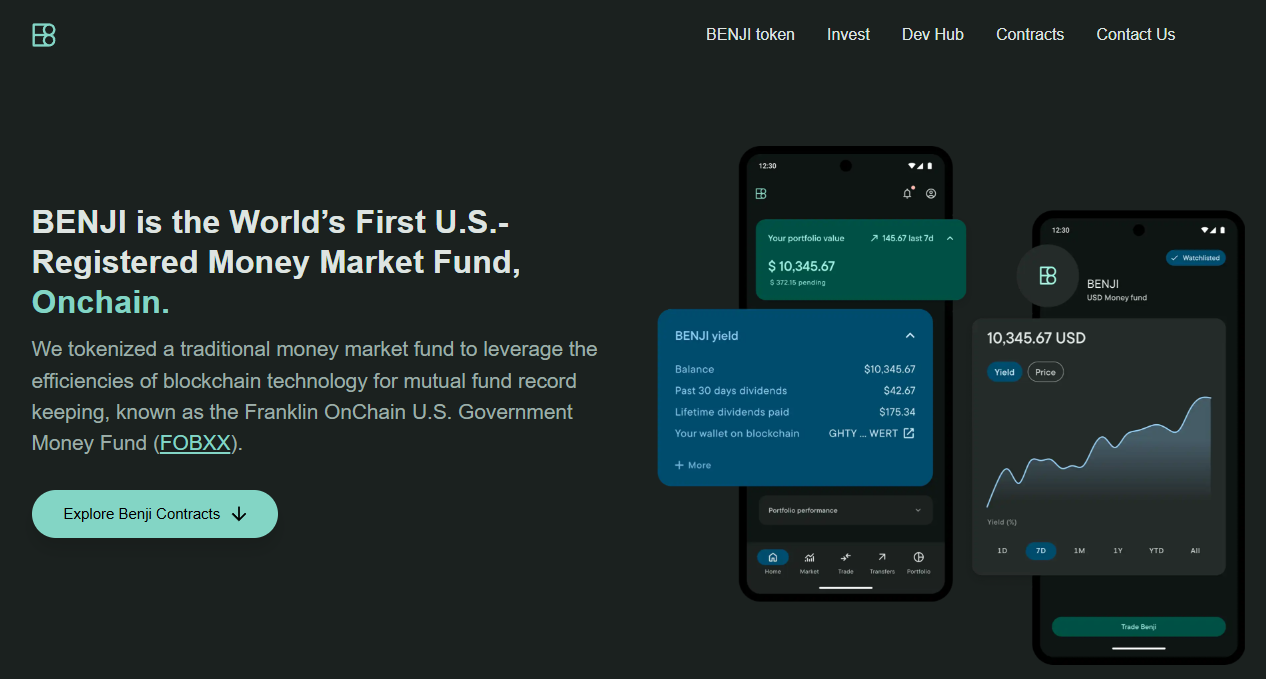
 Franklin Templeton's $775 million Franklin OnChain U.S. Government Money Fund (BENJI) pioneered tokenized mutual funds in 2021, offering exposure to US government securities across eight blockchains with patent-pending intraday yield calculation.

Ideal For

  • Investors seeking regulated 40 Act fund structure
  • Collateral managers requiring second-by-second yield accrual
  • Multi-chain strategies needing broad blockchain compatibility
  • Users prioritizing traditional asset manager credibility

Standout Features

  • Intraday yield tracking down to the second, enabling proportional earnings even for partial-day holdings
  • Direct stablecoin purchases and redemptions with wallet-to-wallet transfer capability
  • 63% of AUM deployed on Stellar Network for optimal cost efficiency
  • Integrated with DeFi protocols for collateral and leverage applications

Pricing
 7-day current yield approximately 4.5-5.5% gross; 0.25% management fee. No minimum investment restrictions beyond standard mutual fund requirements.

Availability
 Global availability with specific KYC requirements. Active on Stellar, Ethereum, Arbitrum, Base, Avalanche, Polygon, Aptos, Solana, BNB Chain.

Worth Noting
 Traditional mutual fund constraints apply including daily NAV calculations and potential redemption delays during market stress.

Alternatives to Consider: Backed bIB01, Superstate Short Duration Government Securities  

For Institutional Credit Exposure (8-12% Yield)

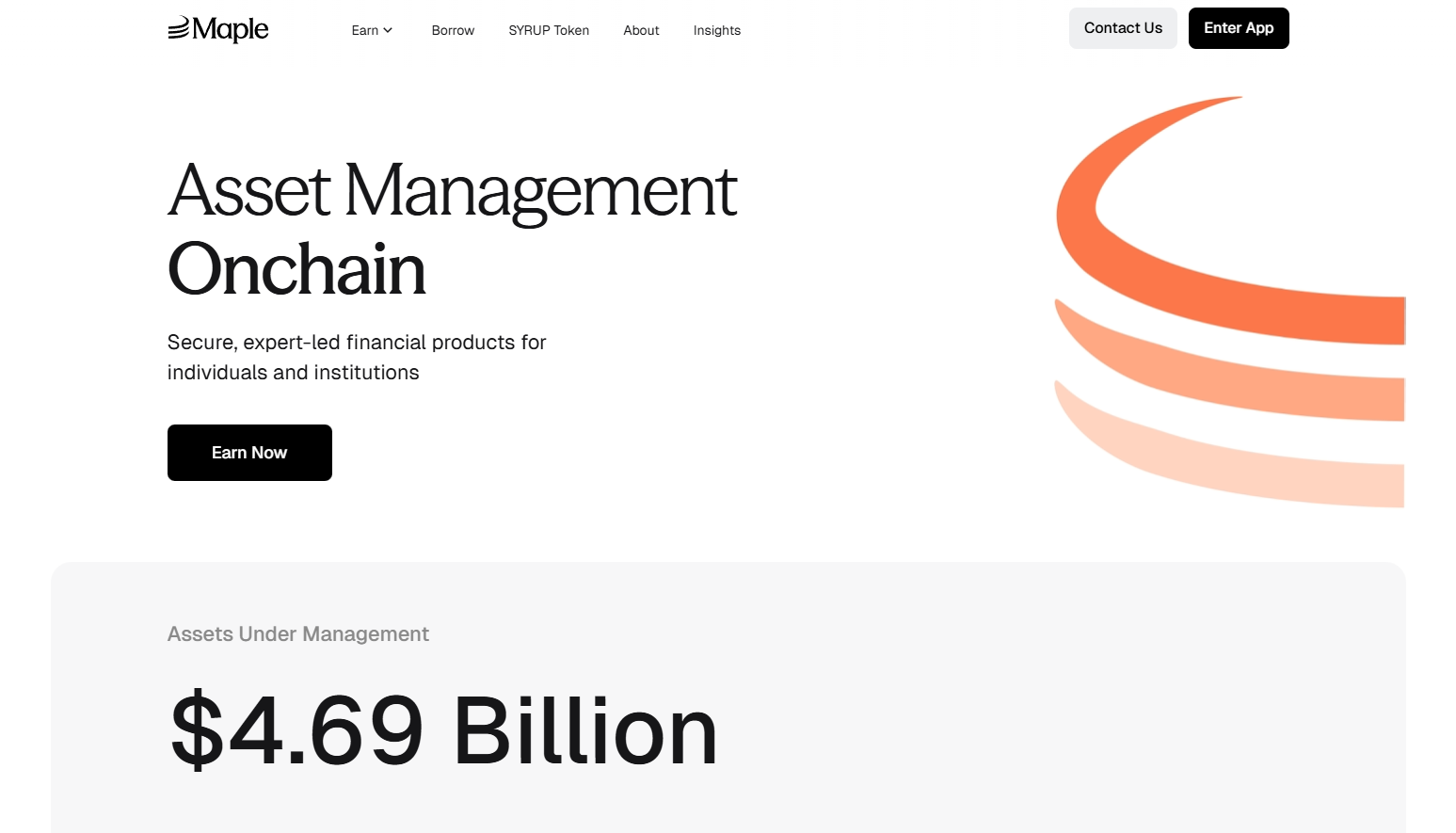
Top Pick: Maple Finance — Premier Crypto-Collateralized Lending

Overview
 Maple Finance manages over $4 billion in assets, specializing in institutional over-collateralized lending backed by Bitcoin, Ethereum, Solana, and XRP, targeting $100 billion in annual loan volume by 2030. The platform introduced SyrupUSDC for permissionless retail access alongside KYC-gated institutional pools.

Ideal For

  • Institutional lenders seeking exposure to cryptocurrency-backed credit
  • Liquidity providers comfortable with smart contract risk
  • Allocators targeting floating-rate, senior-secured structures
  • Investors seeking alternatives to traditional stablecoin farming

Standout Features

  • Consistent 9-12% net yields through undercollateralized institutional facilities and structured credit products
  • Strategic integration with Aave's $40 billion protocol bringing syrupUSDT to Plasma instance and syrupUSDC to core markets
  • Partnerships with Bitwise, Lido Finance (stETH-backed credit lines), and EtherFi (weETH collateral) expanding institutional adoption
  • Robust risk management combining decades of TradFi expertise with real-time on-chain monitoring

Pricing
 Variable by pool; typical effective yields 9-12% after protocol fees. Minimum investments pool-dependent, generally $10K-$50K for retail syrup products.

Availability
 Global with KYC requirements for lending. Institutional Maple requires accreditation; Syrup.fi open to broader participants.

Worth Noting
 Platform transitioned from uncollateralized to over-collateralized model after 2022 market turmoil. Historical defaults impacted certain pools; robust recovery mechanisms now in place.

Alternatives to Consider: Credix (emerging markets), TrueFi (uncollateralized DeFi)  

Runner-Up: Goldfinch Prime — Institutional Private Credit Access

Overview
 Goldfinch Prime aggregates exposure to multi-billion dollar private credit funds from Ares, Apollo, Golub Capital, and KKR, providing on-chain access to institutional-grade senior secured loans with over $1 trillion in collective AUM.

Ideal For

  • Non-US investors seeking diversified private credit exposure
  • Allocators targeting institutional fund performance without direct fund access
  • Participants seeking uncorrelated yield to crypto markets
  • Investors comfortable with longer lockup periods

Standout Features

  • Exposure to 1000+ senior secured loans across industries through vetted fund managers with 10+ years experience
  • Target returns of 9-12% net of fees with strict eligibility criteria including >90% senior secured portfolios and <0.75% target non-accrual rates
  • Heron Finance manages fund selection and vetting while fund managers handle all underwriting and default resolution
  • USDC-based deposits converted to proportional GPRIME tokens for continuous offering structure

Pricing
 Net yields 9-12% after embedded management fees and profit sharing. Minimum investments vary by pool structure; typically institutional minimums apply.

Availability
 Non-US persons only due to regulatory structure. KYC and accreditation verification required.

Worth Noting
 Exposure is indirect through fund shares rather than direct loan origination; fund managers absorb individual borrower default risk into aggregate yields. Liquidity limited compared to Treasury products.

Alternatives to Consider: Centrifuge private credit pools, Credix fintech lending


For Real Estate & Diversified Assets (6-10% Yield)

Top Pick: Centrifuge — Multi-Asset Tokenization Infrastructure

Overview
 Centrifuge operates as a multichain infrastructure platform enabling asset managers to tokenize real estate, trade finance, carbon credits, and structured credit with $1.2 billion TVL and recent 10x growth driven by the first on-chain CLO and tokenized S&P 500 index fund.

Ideal For

  • Investors seeking exposure to asset-backed securities beyond treasuries
  • Allocators comfortable evaluating tranched credit structures
  • Participants prioritizing transparency and on-chain asset verification
  • Portfolio managers wanting diversification across real-world credit types

Standout Features

  • Asset-agnostic architecture supporting structured credit, real estate mortgages, US treasuries, carbon credits, and consumer finance with full collateralization and legal recourse for investors
  • V3 platform enables cross-chain interoperability across Ethereum, Base, Arbitrum, Avalanche, BNB Chain, and Plume with integrated KYC and compliance-as-a-feature
  • Senior/junior tranche structures allowing risk-return customization
  • Partnership with Chronicle Labs for real-time price feeds and integration with Circle for USDC on/off-ramping

Pricing
 Yields vary by pool and tranche: typically 6-8% for senior tranches, 10-14% for junior tranches. Management fees embedded; pool-specific minimums apply.

Availability
 Global with KYC requirements. Pools may have additional jurisdictional restrictions based on underlying asset location.

Worth Noting
 Platform complexity requires understanding of tranched structures and asset-specific risks. Less liquid credit instruments offer less frequent pricing updates than treasury products.

Alternatives to Consider: RealT (US residential real estate focus), Republic (equity crowdfunding)


For Emerging Market Credit (12-18% Yield)

Top Pick: Credix — Latin American Fintech Lending

Overview
 Credix specializes in providing credit facilities to fintech lenders in Latin America, offering high-yield exposure to underserved credit markets with institutional-grade underwriting and local market expertise.

Ideal For

  • Sophisticated investors seeking higher risk-adjusted returns
  • Allocators comfortable with emerging market credit risk
  • Participants with extended investment horizons (12-24 months typical)
  • Investors seeking geographic diversification from US/EU markets

Standout Features

  • Target yields 12-18% reflecting emerging market risk premiums
  • Focus on fintech infrastructure enabling financial inclusion
  • Partnerships with established Latin American credit originators
  • Robust due diligence and monitoring of borrower networks

Pricing
 Pool-dependent yields typically 12-18% gross with management fees of 1-2%. Minimum investments generally $50K+ for accredited investors.

Availability
 Non-US persons primarily; requires accreditation verification and enhanced KYC given emerging market exposure.

Worth Noting
 Higher yields reflect higher credit and currency risk. Platform experienced challenges during regional economic volatility; enhanced risk controls now implemented.

Alternatives to Consider: Goldfinch V1 pools (emerging market focus), TrueFi uncollateralized pools


For Tokenization Infrastructure (Platform Providers)

Top Pick: Securitize — Industry-Leading Issuance Platform

Overview
 Securitize has tokenized over $4.5 billion in assets for 1.2 million investors across 3,000+ clients, operating as an SEC-registered transfer agent with integrated ATS for secondary trading. The platform powers major offerings including BlackRock's BUIDL fund.

Ideal For

  • Asset managers seeking turnkey tokenization solutions
  • Issuers requiring SEC-compliant digital security infrastructure
  • Institutional clients needing integrated custody and compliance
  • Projects prioritizing regulatory alignment and brand credibility

Standout Features

  • DS Protocol automates token issuance, transfer agent functions, and regulated secondary trading with $47 million funding led by BlackRock
  • Recent launch of STAC tokenized AAA CLO fund with BNY custody demonstrating institutional adoption trajectory
  • Comprehensive investor onboarding, KYC/AML, and reporting infrastructure
  • Partnerships with major asset managers and integration with Zero Hash for fiat conversion

Pricing
 Platform fees vary by issuance size and complexity; typically 0.5-2% of AUM plus basis point fees on transactions. White-label solutions available for enterprise clients.

Availability
 Global operations with jurisdiction-specific compliance modules. Primary focus on US, EU, and APAC institutional markets.

Worth Noting
 Securitize is an issuance platform rather than direct investment product; investors access opportunities through partner funds and offerings launched on the infrastructure.

Alternatives to Consider: Tokeny (EU-focused), Polymath/Polymesh (security token specialists)


Complete Provider Directory

  • Backed Finance: European MiCA-compliant tokenization platform offering bIB01 (Swiss government bond exposure) and bC3M (commodity basket). Strong focus on regulatory alignment with modest 3-5% yields and low entry barriers.
  • Swarm Markets: Decentralized platform enabling fractional ownership of real estate and private credit with $1K-$50K minimums. Emphasizes accessibility while maintaining compliance through distributed infrastructure.
  • TrueFi: Uncollateralized lending protocol using on-chain credit scoring and portfolio diversification. Higher risk-return profile (8-15% targets) with full transparency of borrower pools and performance metrics.
  • Archax: UK FCA-regulated platform for institutional tokenization of bonds, funds, and money markets. Focus on traditional finance compatibility with stringent accreditation requirements.

Making Your Selection: Key Questions

  • What yield stability do you require?
     Treasury-backed platforms (Ondo, Franklin Templeton) offer predictable 4-5% returns with minimal volatility. Credit-focused platforms (Maple, Goldfinch) target 9-12% but introduce credit risk and performance variability.
  • What is your risk tolerance for underlying collateral?
     Government securities provide lowest risk; over-collateralized crypto loans add smart contract and liquidation risks; uncollateralized emerging market credit carries highest default potential.
  • Do you meet accreditation and minimum investment thresholds?
     Many institutional products require $50K-$200K minimums and qualified purchaser status. Retail-accessible options like USDY and syrupUSDC lower barriers but may sacrifice yield.
  • What liquidity do you need?
     Treasury tokens generally offer daily liquidity; private credit pools may have quarterly redemption windows; real estate tokenization can involve 12-24 month lockups.
  • How important is regulatory compliance?
     Platforms like Ondo, Franklin Templeton, and Securitize prioritize SEC registration and traditional fund structures. Purely DeFi-native protocols offer less regulatory clarity but greater composability.
  • What blockchain ecosystems do you operate in?
     Multi-chain deployment (Ondo, Centrifuge) provides flexibility; single-chain specialization (some Maple pools) may offer optimization but limits interoperability.
  • Do you have geographic restrictions?
     US persons often excluded from highest-yield opportunities due to securities laws. European investors benefit from MiCA framework; APAC sees growing regulatory clarity.
  • What level of transparency do you require?
     On-chain native protocols offer real-time asset verification; hybrid models may rely on periodic attestations and third-party audits.
  • Are you seeking passive income or active yield strategies?
     Treasury staking provides set-and-forget returns; DeFi integrations enable leverage, collateral strategies, and yield optimization requiring active management.
  • How much operational complexity can you handle?
     Single-platform solutions simplify but limit optionality; multi-protocol strategies maximize returns but require gas management, tax tracking, and security across multiple platforms.

Maximizing Your Setup with Token Metrics

Token Metrics provides critical intelligence for navigating RWA yield opportunities through data-driven analysis and market insights.

Research Phase: Leverage Token Metrics' fundamental analysis to evaluate tokenized asset protocols, comparing on-chain metrics, TVL trends, and yield sustainability indicators. Our RWA sector reports identify emerging platforms and highlight regulatory developments across jurisdictions.

Portfolio Construction: Use quantitative scoring to allocate across risk tiers—balancing stable treasury exposure with higher-yield credit products. Token Metrics' portfolio tools help optimize diversification while monitoring correlation to traditional crypto markets.

Ongoing Monitoring: Real-time alerts notify you of yield changes, protocol upgrades, and risk events. Our dashboard aggregates performance across multiple RWA platforms, tracking your yield-bearing positions alongside broader cryptocurrency holdings.

Risk Management: Token Metrics' risk analytics assess smart contract security, custody arrangements, and counterparty exposure. Our reports flag platforms with concerning yield sustainability metrics or operational red flags before they impact your capital.

Start your Token Metrics free trial to access institutional-grade RWA research and optimize your real-world asset allocation.  

Essential Security Practices

  • Custody Verification: Confirm that platforms use institutional-grade custodians (Coinbase Custody, BitGo, Fireblocks) for underlying assets. Verify proof-of-reserve attestations and third-party audits.
  • Smart Contract Risk: Review audit reports from reputable firms (Trail of Bits, OpenZeppelin, Certora). Understand upgrade mechanisms and timelock protections on protocol contracts.
  • Legal Structure Assessment: Examine SPV formation, bankruptcy remoteness, and investor recourse mechanisms. Ensure tokenization structure provides actual legal claim on underlying assets, not just economic exposure.
  • Regulatory Compliance: Verify platforms maintain necessary licenses (broker-dealer, transfer agent, ATS) in relevant jurisdictions. Confirm offerings comply with securities laws in your domicile.
  • Counterparty Risk: Understand who services loans, manages defaults, and handles liquidations. Evaluate track records of asset originators and credit underwriters.
  • Liquidity Risk Management: Never allocate more than you can afford to lock up for stated redemption periods. Maintain buffer capital for market volatility and potential redemption delays.
  • Tax Implications: Consult tax professionals on treatment of tokenized yield—may be classified as interest income, dividends, or capital gains depending on structure and jurisdiction.
  • Geographic Restrictions: Verify you're eligible to participate based on residency. Using VPNs or misrepresenting location can result in frozen funds and legal liability.
  • Platform Concentration: Diversify across multiple RWA providers to reduce single-point-of-failure risk. No single platform should represent majority of yield allocation.
  • Documentation: Maintain records of all transactions, yield distributions, and platform communications for tax reporting and potential disputes.

This article is for research and educational purposes, not financial advice. RWA investments carry risks including loss of principal.


What to Avoid

  • Ignoring minimum holding periods: Many RWA products enforce lockups or redemption windows. Treating them as liquid positions can leave you unable to access capital when needed.
  • Chasing unsustainably high yields: Promised returns significantly above market rates often indicate excessive risk. Verify underlying asset performance and historical consistency before committing capital.
  • Overlooking platform liquidity: Token existence on-chain doesn't guarantee exit liquidity. Check secondary market depth and historical spread between minting and redemption prices.
  • Neglecting jurisdictional compliance: Accessing platforms not available in your region can result in frozen accounts and regulatory penalties. Always verify eligibility before depositing funds.
  • Underestimating smart contract risk: Even well-audited protocols face exploitation risk. Size positions appropriately and monitor security incident disclosures across the ecosystem.
  • Failing to verify asset backing: Don't rely on marketing claims. Demand proof-of-reserve, third-party attestations, and transparent reporting on underlying collateral.
  • Concentrating in single asset class: Over-allocating to one RWA category (e.g., all private credit) eliminates diversification benefits. Balance across treasuries, credit, and real estate where possible.
  • Ignoring fee structures: Management fees, performance fees, and transaction costs compound over time. Calculate net yields after all costs when comparing platforms.

Reader Questions Answered

What's the difference between tokenized treasuries and yield-bearing stablecoins?

 Tokenized treasuries (like OUSG) represent direct ownership of US Treasury securities with yield passed through to holders. Yield-bearing stablecoins (like USDY) maintain $1 peg while distributing treasury yields via rebasing or airdrops. Treasuries may fluctuate slightly with NAV; yield stablecoins prioritize price stability.

Are RWA yields taxable differently than crypto staking rewards?

 Likely yes, though tax treatment varies by jurisdiction. RWA yields from treasuries or credit facilities often classified as interest income taxed at ordinary rates. Crypto staking may be treated as income at receipt or capital gains at sale depending on location. Consult tax professionals for specific guidance.

Can I use tokenized RWAs as collateral in DeFi protocols?

 Increasingly yes. Platforms like Maple, Ondo (via Flux Finance), and Centrifuge enable using tokenized assets as DeFi collateral. However, support varies by protocol and asset—USDY and OUSG see broader integration than niche real estate tokens. Liquidation risks apply if collateral value drops.

What happens if the platform goes bankrupt?

 Properly structured tokenization isolates assets in bankruptcy-remote SPVs, protecting investor claims even if platform operator fails. However, redemption processes may be delayed and require legal navigation. This is why verifying legal structure and custodial arrangements is critical.

How liquid are RWA tokens compared to stablecoins?

 Significantly less liquid. While stablecoins have billions in daily DEX volume, most RWA tokens trade thinly or only through platform-controlled redemption mechanisms. Treasury tokens offer better liquidity than private credit or real estate, but all lag traditional stablecoins substantially.

Do I need to be an accredited investor?

 Depends on the platform and your location. US-based offerings often require accreditation; international platforms may have lower barriers. Products like USDY, syrupUSDC, and BENJI target broader accessibility, while institutional credit pools restrict to qualified purchasers.

What are the main risks that could cause loss of principal?

 (1) Underlying asset default (credit risk), (2) smart contract exploitation, (3) platform insolvency without proper asset segregation, (4) regulatory action freezing operations, (5) stablecoin de-pegging for yield products denominated in USDC/USDT, (6) liquidation cascades in collateralized structures.

How do yields compare to traditional finance alternatives?

 Tokenized treasuries (4-5%) match conventional money market funds but with 24/7 access. Private credit RWAs (9-12%) offer premiums over corporate bonds due to illiquidity and platform novelty. Emerging market RWA yields (12-18%) comparable to EM debt funds with added smart contract risk.


Bottom Line

Real-world asset yield marketplaces represent the maturation of blockchain infrastructure beyond speculation into productive finance. For investors seeking stable, asset-backed returns uncorrelated to cryptocurrency volatility, platforms like Ondo Finance and Franklin Templeton deliver institutional-grade treasury exposure with DeFi composability. Those comfortable with credit risk can access superior yields through Maple Finance's collateralized institutional lending or Goldfinch Prime's diversified private credit exposure.

The key to success: match platform selection to your specific risk tolerance, liquidity needs, and regulatory constraints. Treasury products suit conservative allocators prioritizing capital preservation; credit platforms reward investors accepting higher risk for enhanced returns; multi-asset infrastructure like Centrifuge offers diversification across real-world credit types.

Start with smaller allocations to understand platform mechanics, redemption processes, and yield consistency before committing substantial capital. The RWA sector's rapid growth will continue creating opportunities, but also attracting lower-quality offerings—due diligence remains paramount.

Related Resources:


About This Research

Methodology: This guide evaluated 20+ RWA platforms through analysis of official documentation, on-chain data, regulatory filings, and third-party audits. Platforms selected represent meaningful TVL (>$100M), regulatory compliance, and operational track record. Final selection prioritized diversity across asset classes and investor accessibility tiers.

Research Sources:

  • Ondo Finance: Product documentation, tokenomics, OUSG/USDY specifications, Oasis Pro acquisition disclosure
  • Maple Finance: Platform whitepaper, syrupUSDC mechanics, Aave integration announcement, CEO interviews
  • Centrifuge: V3 technical documentation, pool analytics, Republic partnership details
  • Goldfinch: Prime pool specifications, fund manager criteria, Heron Finance structure
  • Franklin Templeton: BENJI platform technical details, intraday yield patent documentation, multi-chain deployment
  • Securitize: DS Protocol documentation, STAC fund launch details, BlackRock partnership announcements
  • RWA.xyz: Platform TVL data, tokenization metrics, market growth analysis
  • DeFiLlama: Protocol TVL tracking, historical performance data
  • BCG/Ripple: RWA market projections and industry research
  • VanEck, Coinbase, Binance: Sector research reports on RWA growth trajectories

All data current as of January 2025. Platform features and yields subject to change; verify current terms on official websites before investing.

Build Smarter Crypto Apps &
AI Agents in Minutes, Not Months
Real-time prices, trading signals, and on-chain insights all from one powerful API.
Grab a Free API Key
About Token Metrics
Token Metrics: AI-powered crypto research and ratings platform. We help investors make smarter decisions with unbiased Token Metrics Ratings, on-chain analytics, and editor-curated “Top 10” guides. Our platform distills thousands of data points into clear scores, trends, and alerts you can act on.
30 Employees
analysts, data scientists, and crypto engineers
Daily Briefings
concise market insights and “Top Picks”
Transparent & Compliant
Sponsored ≠ Ratings; research remains independent
Want Smarter Crypto Picks—Free?
See unbiased Token Metrics Ratings for BTC, ETH, and top alts.
Thank you! Your submission has been received!
Oops! Something went wrong while submitting the form.
 No credit card | 1-click unsubscribe
Token Metrics Team
Token Metrics Team

Recent Posts

Research

How Do DAOs Function and Make Decisions? The Complete Guide to Decentralized Governance in 2025

Talha Ahmad
5 min

Decentralized Autonomous Organizations, commonly known as DAOs, have rapidly become a cornerstone of the blockchain ecosystem, redefining how organizations function and make decisions. Unlike traditional organizations with centralized leadership, DAOs operate on principles of decentralized governance. DAOs rely on a decentralized network of nodes to validate and secure transactions, ensuring transparency and resilience. They leverage blockchain technology to enable transparent, collective decision-making. DAOs follow a blockchain protocol, which sets the rules for how transactions are verified and added to the ledger. As of 2025, with thousands of DAOs managing billions in treasury funds, understanding how do DAOs function and make decisions is essential for anyone involved in decentralized networks or blockchain projects, as DAOs leverage distributed ledger technology to maintain an immutable and transparent record of all activities.

Understanding DAOs: Beyond Traditional Organizations

A decentralized autonomous organization DAO is fundamentally different from conventional organizations. Unlike traditional organizations that depend on centralized control and hierarchical leadership, DAOs are managed collectively by their community members. These organization members participate directly in the governance and decision-making processes of the DAO. These self-executing smart contracts automate governance processes, removing the need for a central authority and enabling decisions to be made transparently and efficiently.

At the heart of every DAO is blockchain technology, which provides a distributed ledger that records all transactions and governance activities immutably. This ensures network security and transparency, as all actions are verifiable and cannot be altered without consensus. DAO members hold governance tokens or dao tokens, which represent their voting power and grant them voting rights in governance proposals. These tokens are often utility tokens or non-fungible tokens that enable users to participate actively in the DAO ecosystem.

The organizational structure of a DAO is designed to be decentralized. The governance structure of a DAO outlines how proposals are submitted, discussed, and voted on, ensuring inclusivity and transparency for all organization members. A DAO operates through mechanisms such as on-chain and off-chain voting, where token-based voting power determines the influence of each participant, and various stakeholders are involved in the decision-making process. This decentralized nature fosters community building and aligns incentives among participants, creating a more democratic and resilient governance model compared to centralized leadership in traditional organizations.

The History and Evolution of DAOs

Decentralized autonomous organizations (DAOs) have experienced remarkable growth and transformation since their inception. The idea behind DAOs emerged from the desire to create organizations that operate without centralized leadership, relying instead on decentralized governance and transparent decision-making. Early blockchain pioneers envisioned DAOs as a way to automate organizational processes and empower communities through self-executing smart contracts.

Over the years, DAOs have evolved to incorporate advanced features such as decentralized finance (DeFi) integrations, sophisticated voting systems, and innovative governance models. These developments have enabled DAOs to manage everything from digital assets to complex financial protocols, all while maintaining transparency and security through blockchain technology. As decentralized autonomous organizations DAOs continue to mature, they are redefining how decision making occurs in both digital and real-world environments.

Early Beginnings and Milestones

The journey of DAOs began with the launch of “The DAO” in 2016 on the Ethereum blockchain. As the first large-scale experiment in decentralized governance, The DAO aimed to democratize investment decisions using a smart contract-based structure and token-weighted voting systems. Despite its ambitious vision, The DAO suffered a major setback due to a smart contract vulnerability, resulting in a high-profile hack and subsequent hard fork of the Ethereum network.

This early failure, however, served as a catalyst for innovation. Developers and DAO proponents learned valuable lessons, leading to the creation of more secure and resilient governance models. The introduction of new voting systems, such as quadratic voting and conviction voting, as well as improvements in smart contract design, marked significant milestones in the evolution of DAOs. Today, DAOs leverage a variety of governance models to suit different organizational needs, ensuring greater security, flexibility, and community engagement.

The Anatomy of DAO Decision-Making

The Governance Triangle

DAO governance revolves around three key components often referred to as the governance triangle:

  1. Proposers: These are community members who submit governance proposals. Proposers typically need to meet certain requirements, such as holding a minimum number of governance tokens, to prevent spam and ensure serious participation.
  2. Voters: Token holders who engage in the voting process. Their voting power is proportional to the amount and type of dao tokens they possess, which reflects their stake and influence within the organization.
  3. Executors: Once a proposal passes, executors—either automated smart contracts or designated parties—implement the approved decisions. In fully autonomous DAOs, smart contracts automatically execute governance outcomes without human intervention.

The Decision-Making Process

The process of how do DAOs function and make decisions follows a clear, transparent workflow:

  • Proposal Submission: Any qualified DAO member can submit a governance proposal. This document outlines the intended change, resource allocation, or strategic initiative, complete with rationale and implementation details.
  • Discussion Phase: The proposal undergoes community discussion on platforms like Discord or specialized forums. This stage encourages active participation, refinement, and debate to ensure well-informed decision-making.
  • Voting Period: During a defined voting period, token holders cast their votes using the DAO’s established voting mechanisms. The voting period’s length and rules depend on the specific governance model adopted.
  • Execution: If the proposal achieves the required quorum and majority, self-executing smart contracts or designated executors carry out the decision, such as allocating treasury funds or updating protocol parameters. Effective DAO management requires transparent implementation of approved proposals and ongoing oversight to ensure alignment with organizational goals.

This structured governance process ensures that decisions are managed collectively and transparently, reflecting the will of the community rather than centralized control.

Key Components of DAOs

At the core of every decentralized autonomous organization are several key components that enable effective decentralized governance. Smart contracts form the backbone of DAOs, automating essential processes such as proposal submission, voting, and execution. These self-executing agreements ensure that rules are enforced transparently and without human intervention.

Voting systems are another critical element, allowing DAO members to participate in decision making by casting votes on governance proposals. Whether through token-weighted, quadratic, or conviction voting, these systems ensure that the collective will of the community is reflected in organizational outcomes.

Blockchain technology underpins the entire DAO structure, providing a secure, immutable ledger for all transactions and governance activities. This transparency not only enhances trust among members but also ensures that every action is verifiable and tamper-proof. Together, these key components create a robust framework for decentralized organizations to operate efficiently and securely.

Voting Mechanisms: The Heart of DAO Governance

Voting mechanisms are critical to how DAOs function and make decisions, as they determine how voting power is allocated and how proposals are approved.

Token-Weighted Voting

The most common governance model is token-weighted voting, where each governance token corresponds to one vote. A DAO's token is often issued to represent voting rights and facilitate governance within the organization. DAOs use their tokens to enable voting, governance, and automatic transactions, ensuring that decisions are made transparently and efficiently. This model aligns voting power with financial stake, encouraging long-term investment and commitment to the DAO’s success. Protocols like Uniswap DAO, Aave, and ENS DAO utilize token-weighted voting to manage protocol upgrades and strategic decisions.

While straightforward and effective, token-weighted voting can lead to whale dominance, where large token holders disproportionately influence outcomes, potentially compromising decentralization.

Quadratic Voting

To address the limitations of token-weighted voting, quadratic voting introduces a system where the cost of additional votes increases quadratically. For example, casting two votes costs four tokens, and three votes cost nine tokens. This mechanism reduces the influence of whales by diminishing returns on voting power and encourages broader participation.

Quadratic voting allows DAO participants to express the intensity of their preferences without enabling any single entity to dominate decision making. It promotes fairness and inclusion, making it a popular choice in DAOs seeking to balance power distribution.

Conviction Voting

Conviction voting is an innovative governance mechanism where voting power accumulates over time as members maintain their support for a proposal. Instead of discrete voting periods, this continuous process allows proposals to gain momentum gradually, reflecting sustained community interest.

This model reduces the urgency of decision-making, accommodates changing preferences, and encourages active participation over time, making it suitable for dynamic DAO ecosystems.

Multi-Signature Governance

In some cases, DAOs adopt multi-signature (multi-sig) governance, where a predefined number of representatives must approve actions before execution. This approach enhances security, especially for managing treasury funds or critical infrastructure, by distributing control among trusted community members.

SafeDAO is an example of a DAO that uses multi-sig governance to coordinate decisions securely while maintaining transparency.

Token Metrics: Essential Analytics for DAO Governance Success

As the DAO ecosystem grows, tools like Token Metrics have become indispensable for participants seeking to navigate governance complexities effectively. Token Metrics offers comprehensive analytics on governance tokens, voting patterns, and treasury management across thousands of decentralized organizations. In addition, Token Metrics analyzes blockchain data to provide insights into voting patterns and proposal outcomes, helping to ensure transparency and integrity within decentralized networks.

By analyzing token distribution, participation rates, and governance proposal outcomes, Token Metrics helps DAO members and investors assess the health and sustainability of various governance models. This intelligence is crucial for avoiding DAOs with excessive centralization or low community engagement.

Token Metrics also provides investment insights through dual scoring systems that evaluate governance tokens for both short-term trading and long-term participation. These analytics platforms play a crucial role in enabling users to participate more effectively in DAO governance. This enables users to optimize their portfolios and make informed decisions about where to allocate their voting power and resources.

Advanced Governance Models in 2025

Hybrid Governance Systems

In 2025, many DAOs employ hybrid governance models that integrate multiple voting mechanisms to suit different decision types. For example, Decentraland DAO combines token-weighted voting with reputation-based systems to balance fairness and flexibility.

SubDAOs, or specialized sub-organizations within a DAO, are increasingly common. Arbitrum DAO pioneered multi-layered governance structures, delegating specific tasks like grants or infrastructure maintenance to subDAOs, streamlining decision-making and enhancing efficiency.

Reputation-Based Systems

Some decentralized organizations incorporate reputation alongside token holdings to determine voting power. Reputation reflects a member’s past contributions, expertise, and engagement, rewarding active participants while reducing the influence of passive token holders.

Delegated Voting

To combat voter apathy and increase participation, many DAOs implement delegated voting, allowing token holders to entrust their voting rights to knowledgeable representatives. This system resembles representative democracy and ensures informed decision-making without sacrificing broad community representation.

Compound and MakerDAO are notable examples that use delegation to enhance governance effectiveness.

Moloch DAO and Other DAO Models

Moloch DAO stands out as a pioneering decentralized autonomous organization that has influenced the broader DAO landscape. Operating on the Ethereum blockchain, Moloch DAO introduced a streamlined governance model focused on funding Ethereum infrastructure projects. Its unique approach, which emphasizes simplicity and security, has inspired the creation of numerous similar DAOs.

Other notable DAO models include Decentraland DAO, which governs a virtual real estate platform, and Compound DAO, a leader in the decentralized finance sector. Each of these DAOs utilizes distinct governance structures tailored to their specific missions, demonstrating the versatility and adaptability of the decentralized autonomous organization model. As the ecosystem expands, new DAO models continue to emerge, each contributing innovative solutions to the challenges of decentralized governance.

Digital Assets and DAOs

Digital assets play a central role in the operation and governance of DAOs. Governance tokens and non-fungible tokens (NFTs) are commonly used to represent voting power and facilitate participation in decision-making processes. These assets enable DAO members to propose and vote on governance proposals, allocate resources, and shape the direction of the organization.

The integration of digital assets has expanded the capabilities of DAOs, allowing them to engage in activities such as investing, lending, and managing digital portfolios within the DAO ecosystem. Unlike traditional organizations, DAOs leverage blockchain technology and smart contracts to automate processes, resolve conflicts, and provide a secure, transparent environment for their members.

As regulatory bodies continue to assess the legal status of DAOs, it is increasingly important for DAO proponents to prioritize transparency, network security, and compliance with evolving legal frameworks. DAO members are at the heart of the governance process, using governance tokens to represent voting power and participate in the voting process. The outcome of these votes determines the strategic direction and operational decisions of the DAO.

Looking ahead, the future of DAOs is filled with potential for innovation across various sectors, from finance to healthcare and beyond. As blockchain technology matures and new governance models are developed, DAOs are poised to offer even more efficient, secure, and transparent alternatives to centralized leadership and traditional organizational structures. The continued success of DAOs will depend on their ability to foster active participation, adapt to regulatory changes, and maintain robust governance processes that empower their communities.

Challenges and Solutions in DAO Governance

The Whale Problem

Despite the decentralized organization model, large token holders—whales—can still exert disproportionate influence on governance outcomes. This concentration of voting power risks undermining the democratic ideals of DAOs.

Solutions include quadratic voting to limit whale dominance, vote delegation to concentrate expertise, multi-tiered governance to separate decision types, and time-locked voting to prevent last-minute vote manipulation.

Participation Inequality

Low voter turnout remains a challenge in many DAOs, where a small percentage of active voters control the majority of decisions. Encouraging active participation is essential for healthy governance.

Strategies to boost engagement include offering incentives, simplifying voting interfaces, employing conviction voting for continuous involvement, and using off-chain signaling to reduce transaction fees and barriers.

Information Overload

DAOs often face an overwhelming number of proposals, making it difficult for members to stay informed and vote effectively.

To address this, DAOs utilize proposal summaries, expert delegate systems, staged voting processes, and AI-powered tools that analyze and recommend proposals, helping members focus on key decisions.

Real-World DAO Success Stories

DeFi Governance Excellence

Uniswap DAO exemplifies successful decentralized governance by managing protocol upgrades, fee distributions, and partnerships through community voting, impacting billions in trading volume.

MakerDAO governs the DAI stablecoin system, making critical decisions about collateral and risk parameters, demonstrating resilience through volatile market cycles.

Community and Investment DAOs

ENS DAO manages the Ethereum Name Service with token-weighted voting, ensuring effective governance for vital Web3 infrastructure.

Investment DAOs like MetaCartel Ventures operate as decentralized venture funds, with members collectively voting on funding and portfolio management, showcasing the power of decentralized finance.

The Future of DAO Governance

Emerging Trends for 2025 and Beyond

The future of DAOs includes cross-chain governance, enabling decision-making across multiple blockchain networks and expanding operational scope. AI-assisted decision making will support voters by processing proposals and predicting outcomes.

As regulatory frameworks evolve, DAOs are integrating legal compliance into their governance structures while preserving decentralization. Scalability solutions like layer-2 protocols and off-chain voting are making participation more accessible and cost-effective.

Performance Metrics and Success Factors

Research confirms that DAOs with higher active participation outperform others. The system aims to foster communities focused on governance quality rather than purely financial returns. Transparency, inclusivity, and responsiveness remain key to sustainable DAO governance.

Technical Implementation: Smart Contract Architecture

Modern DAOs rely on sophisticated smart contract architectures, such as OpenZeppelin’s Governor framework, which provide modular, customizable governance functionalities. These smart contracts automate the entire governance process, including proposal creation, voting, execution, and treasury management, ensuring that DAO operations are secure, transparent, and efficient. Optimizing transaction speed is essential for efficient DAO operations, especially during periods of high network activity. Smart contracts and blockchain nodes work together to verify transactions, ensuring the integrity and security of the DAO's activities.

Best Practices for DAO Participants

For Token Holders

To maximize the benefits of DAO governance, token holders should stay informed by regularly reviewing proposals and engaging in community discussions. Delegating votes wisely to trusted representatives enhances governance quality. Adopting a long-term perspective and actively participating beyond voting—such as contributing to proposal development—strengthens the DAO ecosystem.

For DAO Creators

Creators should establish clear governance structures with defined roles and responsibilities. Balanced token distribution prevents excessive concentration of voting power. Employing multiple voting mechanisms tailored to different decision types enhances flexibility. Prioritizing community building fosters active participation and sustainable governance.

Conclusion: The Evolution of Collective Decision-Making

DAOs signify a profound shift from centralized control to collective governance, enabled by blockchain-based systems and smart contracts. While challenges such as whale dominance and participation inequality persist, the innovations emerging in 2025 demonstrate the potential for more inclusive, transparent, and effective governance models.

The DAO ecosystem continues to mature, integrating advanced governance structures, AI tools, and legal frameworks to meet the demands of a decentralized future. For participants in this evolving landscape, understanding how do DAOs function and make decisions—and leveraging analytical platforms like Token Metrics—is essential for meaningful involvement and success.

Ultimately, DAOs are reshaping organizational governance, not by achieving perfect decentralization, but by creating systems that empower communities, automate processes, and respond dynamically to member needs. As blockchain adoption expands across industries, the influence of DAOs will only grow, heralding a new era of decentralized decision-making.

‍

Research

What is Self-Sovereign Identity in Web3? The Complete Guide to Digital Freedom in 2025

Talha Ahmad
5 min

In today’s digital world, our identities define how we interact online—from accessing services to proving who we are. However, traditional identity management systems often place control of your personal information in the hands of centralized authorities, such as governments, corporations, or social media platforms. This centralized control exposes users to risks like data breaches, identity theft, and loss of privacy. Enter Self-Sovereign Identity (SSI), a revolutionary digital identity model aligned with the core principles of Web3: decentralization, user empowerment, and true digital ownership. Understanding what is self sovereign identity in Web3 is essential in 2025 for anyone who wants to take full control of their digital identity and navigate the decentralized future safely and securely.

Understanding Self-Sovereign Identity: The Foundation of Digital Freedom

At its core, self sovereign identity is a new digital identity model that enables individuals to own, manage, and control their identity data without relying on any central authority. Unlike traditional identity systems, where identity data is stored and controlled by centralized servers or platforms—such as social media companies or government databases—SSI empowers users to become the sole custodians of their digital identity.

The self sovereign identity model allows users to securely store their identity information, including identity documents like a driver’s license or bank account details, in a personal digital wallet app. This wallet acts as a self sovereign identity wallet, enabling users to selectively share parts of their identity information with others through verifiable credentials. These credentials are cryptographically signed by trusted issuers, making them tamper-proof and instantly verifiable by any verifier without needing to contact the issuer directly.

This approach means users have full control over their identity information, deciding exactly what data to share, with whom, and for how long. By allowing users to manage their digital identities independently, SSI eliminates the need for centralized authorities and reduces the risk of data breaches and unauthorized access to sensitive information.

The Web3 Context: Why SSI Matters Now

The emergence of Web3—a decentralized internet powered by blockchain and peer-to-peer networks—has brought new challenges and opportunities for digital identity management. Traditional login methods relying on centralized platforms like Google or Facebook often result in users surrendering control over their personal data, which is stored on centralized servers vulnerable to hacks and misuse.

In contrast, Web3 promotes decentralized identity, where users own and control their digital credentials without intermediaries. The question what is self sovereign identity in Web3 becomes especially relevant because SSI is the key to realizing this vision of a user-centric, privacy-respecting digital identity model.

By 2025, businesses and developers are urged to adopt self sovereign identity systems to thrive in the Web3 ecosystem. These systems leverage blockchain technology and decentralized networks to create a secure, transparent, and user-controlled identity infrastructure, fundamentally different from centralized identity systems and traditional identity management systems.

The Three Pillars of Self-Sovereign Identity

SSI’s robust framework is built on three essential components that work together to create a secure and decentralized identity ecosystem:

1. Blockchain Technology

Blockchain serves as a distributed database or ledger that records information in a peer-to-peer network without relying on a central database or centralized servers. This decentralized nature makes blockchain an ideal backbone for SSI, as it ensures data security, immutability, and transparency.

By storing digital identifiers and proofs on a blockchain, SSI systems can verify identity data without exposing the actual data or compromising user privacy. This eliminates the vulnerabilities associated with centralized platforms and frequent data breaches seen in traditional identity systems.

2. Decentralized Identifiers (DIDs)

A Decentralized Identifier (DID) is a new kind of globally unique digital identifier that users fully control. Unlike traditional identifiers such as usernames or email addresses, which depend on centralized authorities, DIDs are registered on decentralized networks like blockchains.

DIDs empower users with user control over their identity by enabling them to create and manage identifiers without relying on a central authority. This means users can establish secure connections and authenticate themselves directly, enhancing data privacy and reducing reliance on centralized identity providers.

3. Verifiable Credentials (VCs)

Verifiable Credentials are cryptographically secure digital documents that prove certain attributes about an individual, organization, or asset. Issued by trusted parties, these credentials can represent anything from a university diploma to a government-issued driver’s license.

VCs are designed to be tamper-proof and easily verifiable without contacting the issuer, thanks to blockchain and cryptographic signatures. This ensures enhanced security and trustworthiness in digital identity verification processes, while allowing users to share only the necessary information through selective disclosure.

How SSI Works: The Trust Triangle

The operation of SSI revolves around a trust triangle involving three key participants:

  • Holder: The individual who creates their decentralized identifier using a digital wallet and holds their digital credentials.
  • Issuer: A trusted entity authorized to issue verifiable credentials to the holder, such as a government, university, or bank.
  • Verifier: An organization or service that requests proof of identity or attributes from the holder to validate their claims.

When a verifier requests identity information, the holder uses their self sovereign identity wallet to decide which credentials to share, ensuring full control and privacy. This interaction eliminates the need for centralized intermediaries and reduces the risk of identity theft.

Token Metrics: Leading the Charge in Web3 Analytics and Security

As SSI platforms gain traction, understanding their underlying token economies and security is critical for investors and developers. Token Metrics is a leading analytics platform that provides deep insights into identity-focused projects within the Web3 ecosystem.

By analyzing identity tokens used for governance and utility in SSI systems, Token Metrics helps users evaluate project sustainability, security, and adoption potential. This is crucial given the rapid growth of the digital identity market, projected to reach over $30 billion by 2025.

Token Metrics offers comprehensive evaluations, risk assessments, and performance tracking, empowering stakeholders to make informed decisions in the evolving landscape of self sovereign identity blockchain projects.

Real-World Applications of SSI in 2025

Financial Services and DeFi

SSI streamlines Know Your Customer (KYC) processes by enabling users to reuse verifiable credentials issued by one institution across multiple services. This reduces redundancy and accelerates onboarding, while significantly lowering identity fraud, which currently costs billions annually.

Healthcare and Education

SSI enhances the authenticity and privacy of medical records, educational certificates, and professional licenses. Universities can issue digital diplomas as VCs, simplifying verification and reducing fraud.

Supply Chain and Trade

By assigning DIDs to products and issuing VCs, SSI improves product provenance and combats counterfeiting. Consumers gain verifiable assurance of ethical sourcing and authenticity.

Gaming and NFTs

SSI allows users to prove ownership of NFTs and other digital assets without exposing their entire wallet, adding a layer of privacy and security to digital asset management.

Advanced SSI Features: Privacy and Security

Selective Disclosure

SSI enables users to share only specific attributes of their credentials. For example, proving age without revealing a full birthdate helps protect sensitive personal information during verification.

Zero-Knowledge Proofs

Zero-knowledge proofs (ZKPs) allow users to prove statements about their identity without revealing the underlying data. For instance, a user can prove they are over 18 without sharing their exact birthdate, enhancing privacy and security in digital interactions.

Current SSI Implementations and Projects

Several initiatives showcase the practical adoption of SSI:

  • ID Union (Germany): A decentralized identity network involving banks and government bodies.
  • Sovrin Foundation: An open-source SSI infrastructure leveraging blockchain for verifiable credentials.
  • European Blockchain Services Infrastructure (EBSI): Supports cross-border digital diplomas and identity.
  • Finland’s MyData: Empowers citizens with control over personal data across sectors.

These projects highlight SSI’s potential to transform identity management globally.

Challenges and Considerations

Technical Challenges

Managing private keys is critical; losing a private key can mean losing access to one’s identity. Solutions like multi-signature wallets and biometric authentication are being developed to address this.

Regulatory Landscape

Global regulations, including the General Data Protection Regulation (GDPR) and emerging frameworks like Europe’s eIDAS 2.0, are shaping SSI adoption. Ensuring compliance while maintaining decentralization is a key challenge.

Adoption Barriers

Despite the promise, some critics argue the term "self-sovereign" is misleading because issuers and infrastructure still play roles. Improving user experience and educating the public are essential for widespread adoption.

The Future of SSI in Web3

By 2025, self sovereign identity systems will be vital for secure, private, and user-centric digital interactions. Key trends shaping SSI’s future include:

  • Enhanced Interoperability between blockchains and DID methods.
  • Improved User Experience through intuitive wallets and interfaces.
  • Regulatory Clarity supporting SSI frameworks.
  • Integration with AI for advanced cryptographic verification.

Implementation Guidelines for Businesses

Businesses aiming to adopt SSI should:

  • Utilize blockchain platforms like Ethereum or Hyperledger Indy that support SSI.
  • Prioritize user-friendly digital wallets to encourage adoption.
  • Ensure compliance with global data protection laws.
  • Collaborate across industries and governments to build a robust SSI ecosystem.

Conclusion: Embracing Digital Sovereignty

Self-Sovereign Identity is more than a technological innovation; it represents a fundamental shift towards digital sovereignty—where individuals truly own and control their online identities. As Web3 reshapes the internet, SSI offers a secure, private, and user-centric alternative to centralized identity systems that have long dominated the digital world.

For professionals, investors, and developers, understanding what is self sovereign identity in Web3 and leveraging platforms like Token Metrics is crucial to navigating this transformative landscape. The journey toward a decentralized, privacy-respecting digital identity model has begun, and those who embrace SSI today will lead the way in tomorrow’s equitable digital world.

‍

Research

What is Tokenomics and How Does It Impact Crypto Projects? The Complete 2025 Guide

Talha Ahmad
5 min

In the rapidly evolving cryptocurrency landscape, one concept has emerged as the critical differentiator between project success and failure: tokenomics. Far more than a trendy buzzword, tokenomics represents the economic backbone that determines whether a crypto project will thrive or collapse. As we navigate through 2025, understanding tokenomics has become essential for investors, developers, and anyone serious about participating in the digital asset ecosystem. This article explores what is tokenomics and how does it impact crypto projects, providing a comprehensive guide to its key components, mechanisms, and real-world implications.

Understanding Tokenomics: Beyond the Basics

Tokenomics is a fusion of “token” and “economics,” referring to the economic principles and mechanisms that govern a digital token or cryptocurrency within a blockchain project. It encompasses various aspects such as the token’s supply, distribution, utility, governance, and overall value proposition. The key elements of tokenomics include supply models, distribution mechanisms, utility, and governance, all of which influence the value and stability of a cryptocurrency. Simply put, tokenomics is the study of the economic design of blockchain projects, focusing on how digital tokens operate within an ecosystem.

A well-crafted project's tokenomics model is crucial for any crypto project because it drives user adoption, incentivizes desired behavior, and fosters a sustainable and thriving ecosystem. By defining the token supply, token utility, governance rights, and economic incentives, tokenomics shapes how a digital asset interacts with its community, influences user behavior, and ultimately impacts the token’s value and longevity.

The Evolution of Tokenomics in 2025

The tokenomics landscape in 2025 has matured significantly compared to earlier years. Initially, tokenomics was often limited to simple concepts like fixed maximum supply or token burns. Today, it represents a sophisticated economic architecture that governs value flow, community interaction, and project sustainability.

Several key developments characterize tokenomics in 2025:

  • The tokenization of real-world assets is projected to surpass $1.5 trillion in market capitalization by 2030, bridging traditional finance and blockchain.
  • AI-driven token trading volumes surged over 500% in 2024, demonstrating increased market sophistication.
  • Regulatory frameworks like the EU’s MiCA and heightened SEC scrutiny have pushed projects toward greater regulatory compliance. These frameworks, along with advancements in the underlying technology of blockchain, have enabled more robust and secure compliance mechanisms.
  • Layer-2 solutions such as Base, zkSync, and Optimism are capturing billions in total value locked (TVL), emphasizing scalability and economic efficiency. These solutions are made possible by significant improvements in the underlying technology that supports blockchain scalability and security.

This evolution means that understanding what is tokenomics and how does it impact crypto projects now requires a nuanced grasp of multiple economic mechanisms, community dynamics, and regulatory considerations.

Core Components of Tokenomics

1. Token Supply Mechanisms

A fundamental aspect of tokenomics is the token supply, which directly influences scarcity and price dynamics. Two key metrics are important to understand: the token's total supply, which is the total number of tokens that exist (including those locked, reserved, or yet to be circulated), and the token's supply in circulation, often referred to as circulating supply, which is the number of tokens currently available in the market and held by the public.

The relationship between these supplies affects the token price and market capitalization. For example, a large difference between the token's total supply and circulating supply might indicate tokens locked for future use or held by insiders.

Token supply models generally fall into three categories:

  • Fixed Supply: A capped number of tokens, such as Bitcoin’s 21 million, creating scarcity and potentially increasing intrinsic value over time. A limited supply can drive demand and increase value, as investors perceive scarcity as a sign of potential appreciation.
  • Inflationary Supply: New tokens are continuously created through mechanisms like mining or staking rewards. Proof of stake systems often create new tokens as staking rewards, contributing to the inflationary aspect of these models. While this can incentivize network security, it may dilute value if unchecked.
  • Deflationary Mechanisms: Strategies like token burns permanently remove tokens from circulation, reducing supply and potentially boosting price by creating scarcity.

2. Token Distribution and Allocation

How tokens are distributed among stakeholders significantly impacts project fairness and community trust. Token distribution involves allocating tokens to the team, early investors, advisors, the community, and reserves. A transparent and equitable distribution encourages community engagement and prevents disproportionate control by a few entities. It is essential to ensure fair distribution to promote a healthy ecosystem and incentivize broad network participation.

Typical token allocation structures include:

  • Team and Advisors: 10-20% (tokens allocated to these groups are often subject to vesting schedules to encourage long-term commitment)
  • Private Sale Investors: 15-25%
  • Public Sale Participants: 5-15%
  • Community and Ecosystem Incentives: 30-50% (a significant portion of tokens is often reserved for these purposes)
  • Treasury or Reserve Funds: 10-20%

Ensuring a fair distribution mitigates risks of price manipulation and aligns incentives between token holders and project success. A transparent issuance process is also crucial for building trust and ensuring the long-term sustainability of the project.

3. Token Utility and Purpose

The utility of a token is a core driver of its demand and value. A token's utility is a critical factor for its demand, market value, and long-term sustainability, making it essential for both investors and project success. Tokens with clear, real-world use cases tend to sustain long-term interest and adoption. Common types of token utility include:

  • Utility Tokens: Used to pay for services, access features, stake for rewards, or participate in gamified ecosystems. Some tokens also provide real world utility, such as being used for payments or representing tokenized real-world assets.
  • Governance Tokens: Grant holders voting rights to influence the project’s direction, protocol upgrades, and treasury management.
  • Security Tokens: Represent ownership stakes in assets or companies and comply with securities regulations.
  • Hybrid Models: Combine multiple functionalities to enhance ecosystem participation.

Tokens that enable holders to pay transaction fees, participate in governance, or earn staking rewards incentivize active involvement and network security. Additionally, the blockchain or environment in which a token operates can significantly influence its adoption and overall utility.

Types of Tokens: Utility, Security, Governance, and Beyond

In the diverse world of cryptocurrency, not all tokens are created equal. Understanding the different types of tokens is a key component of tokenomics and can help investors and users navigate the rapidly evolving digital asset landscape. Each token type serves a distinct purpose within its ecosystem, shaping how value is transferred, how decisions are made, and how users interact with decentralized platforms.

  • Utility Tokens: These are the workhorses of blockchain ecosystems, designed to provide access to specific products, services, or features within a platform. Utility tokens are not intended as investments but as a means to utilize the network’s offerings. For example, Uniswap (UNI) and Chainlink (LINK) are utility tokens that enable users to interact with decentralized finance protocols and oracle services, respectively.
  • Security Tokens: Representing ownership or a stake in real-world assets such as company shares, real estate, or investment funds, security tokens are subject to regulatory oversight. They offer a compliant way for projects to raise capital and for investors to gain exposure to traditional assets through blockchain technology. Security tokens bridge the gap between traditional finance and the digital asset world.
  • Governance Tokens: These tokens empower holders to participate in the decision-making processes of decentralized finance protocols and DAOs. By holding governance tokens, users can vote on proposals, protocol upgrades, and treasury management, directly influencing the project’s direction. This decentralized approach to governance ensures that the community has a say in the evolution of the ecosystem.
  • Non-Fungible Tokens (NFTs): Unlike fungible tokens, NFTs are unique digital assets that represent ownership of distinct items such as digital art, music, virtual real estate, or collectibles. Each NFT is one-of-a-kind, making them ideal for certifying authenticity and provenance in the digital realm. NFTs have opened up new possibilities for creators and collectors, expanding the scope of what digital assets can represent.

By understanding the roles of utility tokens, security tokens, governance tokens, and non fungible tokens, participants can better assess a crypto project’s tokenomics and its potential for long term success in the digital economy.

Tokenomics Models: Inflationary, Deflationary, and Hybrid Approaches

The economic model underlying a token’s supply and distribution is a key factor in determining its value, price stability, and long-term viability. Tokenomics models are designed to manage how many tokens exist, how they are distributed, and how their supply changes over time. The three primary approaches—inflationary, deflationary, and hybrid—each have unique implications for token price, token value, and market dynamics.

  • Inflationary Models: In an inflationary supply model, there is no fixed maximum supply, and new tokens are continuously created, often as rewards for validating transactions or securing the network. While this can incentivize participation and network security, it may also lead to a decrease in token value over time if demand does not keep pace with supply. Examples include Dogecoin (DOGE) and Ethereum (ETH) prior to the introduction of EIP-1559, where ongoing issuance increased the circulating supply and influenced token prices.
  • Deflationary Models: Deflationary tokenomics are characterized by a hard cap on the total supply and mechanisms that reduce the number of tokens in circulation, such as token burns. By permanently removing tokens from the ecosystem, these models create scarcity, which can drive up token price and enhance perceived value. Bitcoin (BTC) and Binance Coin (BNB) are prominent examples, with fixed maximum supply and regular token burns contributing to their long-term appeal.
  • Hybrid Approaches: Many modern crypto projects adopt hybrid models, blending inflationary and deflationary mechanisms to balance supply and demand. For instance, a project might issue new tokens as staking rewards while simultaneously implementing token burns to offset inflation. This approach can help stabilize token prices and create a more sustainable economic model, ensuring that token distribution supports both network growth and value retention.

Choosing the right tokenomics model is crucial for any crypto project, as it directly impacts token distribution, market cap, and the ability to create scarcity or manage inflationary pressures. A well-designed model aligns incentives, supports healthy supply and demand dynamics, and fosters long-term success.

Token Metrics: The Essential Tool for Tokenomics Analysis

Given the complexity of crypto tokenomics, making informed decisions requires sophisticated analytical tools. Token Metrics is a leading platform that offers in-depth insights into tokenomics fundamentals for over 6,000 cryptocurrencies. It helps users understand the factors influencing token demand and market performance.

Why Token Metrics is Crucial for Tokenomics Understanding

Token Metrics provides comprehensive analysis of token supply dynamics, distribution patterns, and utility mechanisms. Its AI-powered system distinguishes between robust economic models and those prone to failure, helping investors avoid pitfalls like pump-and-dump schemes or poorly designed tokens.

Real-time performance tracking links tokenomics features to market outcomes, offering both short-term Trader Grades and long-term Investor Grades. By integrating technical, on-chain, fundamental, social, and exchange data, Token Metrics delivers a holistic view of how tokenomics influence a token’s market performance. Additionally, Token Metrics provides insights into how tokenomics features impact the token's price over time, helping users understand the relationship between economic design and valuation.

Leveraging Token Metrics for Tokenomics Evaluation

Using Token Metrics, users can identify projects with sustainable tokenomics, assess risks such as excessive team allocations or unsustainable inflation, and make investment decisions grounded in economic fundamentals rather than hype. This platform is invaluable for navigating the intricate interplay of supply and demand characteristics, governance structures, and token incentives.

Critical Tokenomics Mechanisms in 2025

1. Token Burning Strategies

Token burns involve permanently removing tokens from circulation by sending them to an inaccessible address. This deflationary tactic can create scarcity, as the remaining tokens in circulation become more scarce, potentially increasing a token’s value. Modern burn mechanisms include:

  • Revenue-Based Burns: Protocol revenues are used to buy back and burn tokens.
  • Activity-Based Burns: Tokens are burned based on network usage or transaction volume.
  • Governance-Directed Burns: Token holders vote on burn events to align with community interests.

By reducing supply through burns, the deflationary effect can positively impact the token's value by making each remaining token more desirable to users and investors.

Examples include Binance Coin’s quarterly burns and Ethereum’s EIP-1559, which burns a portion of transaction fees, reducing the token’s circulating supply during periods of high network activity.

2. Staking and Rewards Systems

Staking is a powerful tool for enhancing network security and incentivizing user participation. When tokens are staked, they are locked, reducing the circulating supply and potentially supporting price appreciation and network stability. Staked tokens are also used to validate transactions, helping to maintain the integrity and security of the blockchain network. Staked tokens may also confer governance rights, empowering committed token holders to influence the project.

Yield farming is another DeFi strategy that incentivizes users to provide liquidity and earn rewards by moving tokens between protocols with the highest APY, supporting network liquidity and resilience.

Innovations in staking for 2025 include:

  • Liquid Staking: Allows users to stake tokens while maintaining liquidity via derivative tokens.
  • Restaking: Enables staked tokens to secure multiple protocols simultaneously.
  • Cross-Chain Staking: Supports staking across different blockchains, enhancing interoperability.

These models align economic incentives with network health and user engagement.

3. Governance and DAO Integration

Decentralized Autonomous Organizations (DAOs) rely on governance tokens to distribute decision-making power among community members. Token holders can vote on protocol upgrades, treasury spending, and other key issues, ensuring projects remain adaptable and community-driven.

Effective governance structures promote transparency, decentralization, and alignment of incentives, which are critical for long-term success in decentralized finance (DeFi) and beyond.

Network Security and Smart Contracts: Safeguarding Tokenomics

The integrity of a crypto project’s tokenomics relies heavily on robust network security and the effective use of smart contracts. These elements are foundational to protecting the key components of tokenomics, including token supply, token utility, governance tokens, and token distribution.

Smart contracts are self-executing agreements coded directly onto the blockchain, automating critical processes such as token issuance, token allocations, and token burns. By removing the need for intermediaries, smart contracts ensure that tokenomics mechanisms—like distributing staking rewards or executing governance decisions—are transparent, reliable, and tamper-proof.

Network security is equally vital, as it safeguards the blockchain against attacks and ensures the validity of transactions. Secure consensus mechanisms, such as proof of stake or proof of work, play a key role in validating transactions and maintaining the network’s security. This, in turn, protects the token’s supply and the value of digital assets within the ecosystem.

By combining strong network security with well-audited smart contracts, projects can protect their tokenomics from vulnerabilities and malicious actors. This not only preserves the integrity of key components like token burns, token allocations, and token price, but also builds trust among token holders and supports the project’s long term success.

In summary, understanding how network security and smart contracts underpin the key components of tokenomics is essential for anyone evaluating a crypto project’s potential. These safeguards ensure that the economic model operates as intended, supporting sustainable growth and resilience in the ever-changing world of digital assets.

Real-World Impact: Tokenomics Success and Failure Cases

Success Stories

  • Ethereum (ETH): The transition to Proof of Stake and the introduction of EIP-1559 have created a sophisticated tokenomics model. ETH’s burn mechanism ties token deflation to network activity, while staking secures the network and provides yield incentives.
  • Binance Coin (BNB): Regular quarterly burns combined with extensive utility across Binance’s ecosystem demonstrate effective tokenomics that support demand and value.
  • Uniswap (UNI): As a governance token, UNI empowers holders to shape the project’s future, creating genuine utility beyond mere speculation. Uniswap is one of the leading decentralized exchanges, providing liquidity and supporting decentralized trading, which further enhances the utility and adoption of the UNI token.

Cautionary Tales

  • Terra Luna (LUNA/UST): The collapse of Terra’s algorithmic stablecoin highlighted the dangers of opaque and unsustainable tokenomics. The dual-token model failed under market stress, resulting in massive losses.
  • Failed ICO Projects: Many early projects faltered due to poor tokenomics, including excessive team allocations, lack of utility, and economic models reliant on continuous new investment.

These cases underscore the importance of sound tokenomics for project viability.

The Future of Tokenomics: Trends and Predictions

1. Regulatory Compliance Integration

In 2025, regulatory compliance is a core consideration in tokenomics design. Projects that demonstrate transparent, community-governed models gain legal clarity and market trust.

2. Multi-Mechanism Integration

Innovative projects increasingly combine multiple tokenomic mechanisms—such as burning part of transaction fees, staking for rewards, and soft rebasing—to maintain balance and incentivize participation.

3. Real-World Asset Integration

Tokenomics now extends to the tokenization of physical assets, creating new economic models that blend traditional finance with blockchain technology, expanding the utility and reach of digital tokens.

Best Practices for Evaluating Tokenomics

When assessing a project’s tokenomics, consider these key questions:

  • Utility Analysis: Does the token offer governance rights, access to services, staking benefits, or real-world use cases?
  • Supply Dynamics: Are there burn mechanisms? What are the inflationary pressures from staking rewards or new token issuance?
  • Distribution Fairness: Is the token allocation balanced among team, investors, and community? Are there vesting schedules to prevent dumping?
  • Governance Structure: How decentralized is decision-making? What level of community engagement exists?

Avoid red flags such as excessive team allocations without vesting, tokens lacking utility, unsustainable economic models, or poor transparency.

The Critical Role of Professional Analysis

Understanding tokenomics requires more than reading whitepapers; it demands sophisticated analysis of the economic incentives, game theory, and supply and demand dynamics that govern a cryptocurrency token. Platforms like Token Metrics leverage AI to detect patterns and provide insights that individual investors might overlook, making them essential tools for navigating the complex world of crypto tokenomics.

Conclusion: Tokenomics as the Foundation of Crypto Success

In 2025, tokenomics has evolved from a peripheral consideration to the strategic foundation upon which successful crypto projects are built. Good tokenomics fosters trust, encourages adoption, and sustains value by aligning incentives, creating scarcity, and enabling governance. Conversely, flawed tokenomics can lead to inflation, centralization, and project failure.

For investors, developers, and enthusiasts, understanding what is tokenomics and how does it impact crypto projects is no longer optional—it is essential. The projects that thrive will be those that thoughtfully design their economic models to balance supply and demand, incentivize user behavior, and adapt to regulatory and market changes.

As the crypto ecosystem continues to mature, tokenomics will remain the key factor determining which projects create lasting value and which fade into obscurity. By leveraging professional tools and adopting best practices, participants can better navigate this dynamic landscape and contribute to the future of decentralized finance and digital assets.

‍

Choose from Platinum, Gold, and Silver packages
Reach with 25–30% open rates and 0.5–1% CTR
Craft your own custom ad—from banners to tailored copy
Perfect for Crypto Exchanges, SaaS Tools, DeFi, and AI Products