Back to blog
Research

Best Yield Marketplaces for Real-World Assets (RWAs) in 2025

Explore the top real-world asset (RWA) yield marketplaces for 2025, including reviews, key criteria, risks, and practical strategies for safe, sustainable returns.
Token Metrics Team
29 min read
Want Smarter Crypto Picks—Free?
See unbiased Token Metrics Ratings for BTC, ETH, and top alts.
Thank you! Your submission has been received!
Oops! Something went wrong while submitting the form.
 No credit card | 1-click unsubscribe
  • What this guide covers: A comprehensive evaluation of 10 leading platforms that enable tokenized real-world asset trading and yield generation across private credit, treasuries, real estate, and structured finance
  • Quick verdict: Ondo Finance for institutional-grade treasury exposure at ~5% APY, Maple Finance for crypto-collateralized credit facilities delivering 9-12% net yields, Goldfinch Prime for diversified access to private credit funds from Apollo and Ares
  • One key limitation to know: Many RWA platforms enforce strict accreditation requirements (minimum $50K-200K) and geographic restrictions, particularly excluding US investors from certain products due to securities regulations

Why Yield Marketplaces for RWAs Matter in January 2025

The real-world asset tokenization market has experienced explosive growth, surging from $85 million in April 2020 to over $25 billion by mid-2025—representing a staggering 245-fold increase driven primarily by institutional demand for yield, transparency, and regulatory clarity. Private credit dominates at approximately 61% of total tokenized assets, followed by treasuries at 30%, with major asset managers like BlackRock, Apollo, and Franklin Templeton now actively tokenizing institutional-grade products.

The convergence of traditional finance and decentralized infrastructure has created unprecedented opportunities for investors seeking stable, real-world yields without exposure to cryptocurrency volatility. The tokenized RWA market is projected to reach between $9.43 trillion and $18.9 trillion by 2030, with regulatory frameworks in Singapore, Hong Kong, and Dubai providing clear pathways for compliant innovation.

For crypto-native investors, RWA yield marketplaces offer a critical bridge to sustainable income streams backed by productive assets rather than purely speculative token emissions. Traditional allocators gain 24/7 access to fractional ownership, instant settlement, and programmable compliance—advantages impossible in legacy financial infrastructure.


How We Evaluated These Providers

We assessed platforms across six weighted criteria totaling 100 points:

  • Yield Quality & Sustainability (30%): Consistency of returns, asset backing, historical performance, and correlation to traditional markets
  • Security & Risk Management (25%): Custody solutions, audit history, legal recourse, collateralization ratios, and default handling protocols
  • Asset Coverage & Diversity (15%): Range of underlying assets, tranching options, and exposure across credit curves
  • Accessibility & Costs (15%): Minimum investments, fee structures, geographic availability, and KYC requirements
  • Liquidity & Redemption (10%): Secondary market depth, withdrawal timelines, and tokenization standards
  • Infrastructure & Compliance (5%): Regulatory licenses, blockchain integrations, and institutional partnerships

Data sources: Official platform documentation, on-chain analytics from RWA.xyz and DeFiLlama, third-party audits, and regulatory filings. Research conducted October 2024-January 2025.

Verification approach: Every fee structure, yield figure, and regional restriction cited was verified on official platform pages or regulatory disclosures. Unverifiable claims were excluded.


The Contenders: Quick Comparison  

Provider Reviews by Use Case

For Treasury-Backed Stability (4-5% Yield)

Top Pick: Ondo Finance — Institutional Treasury Tokenization Pioneer

Overview
 Ondo Finance manages over $1.6 billion in tokenized assets, offering institutional-grade access to US Treasury exposure through OUSG (backed by BlackRock's BUIDL fund) and USDY (a yield-bearing stablecoin). The platform bridges TradFi stability with DeFi composability through multi-chain deployment across Ethereum, Solana, Base, and XRP Ledger.

Ideal For

  • Institutional allocators seeking low-volatility dollar exposure
  • DeFi protocols requiring yield-bearing collateral
  • Treasuries managing idle stablecoin holdings
  • Investors prioritizing regulatory compliance and brand-name backing

Standout Features

  • Approximately 5% APY from short-term US Treasuries with daily interest payouts via rebasing mechanism
  • Integration with Ripple's RLUSD stablecoin for instant minting and redemption 24/7
  • Comprehensive SEC-registered infrastructure through acquisition of Oasis Pro, including broker-dealer, ATS, and transfer agent licenses
  • Strategic partnerships including anchor position in Fidelity's FDIT tokenized money market fund and launch of Ondo Global Markets for tokenized equities

Pricing
 Management fees embedded in net yield; typical 0.15-0.30% annual fee depending on product. OUSG requires $100K minimum; USDY accessible at lower thresholds with 4.29% APY.

Availability
 Global except US persons for certain products. Ethereum, Solana, Polygon, Aptos, Sei, Base, XRP Ledger, and Sui supported.

Worth Noting
 OUSG designed for qualified purchasers with extended lockup periods; less suitable for retail or high-frequency traders. Platform prioritizes institutional relationships over retail accessibility.

Alternatives to Consider: Franklin Templeton BENJI, OpenEden TBILL  


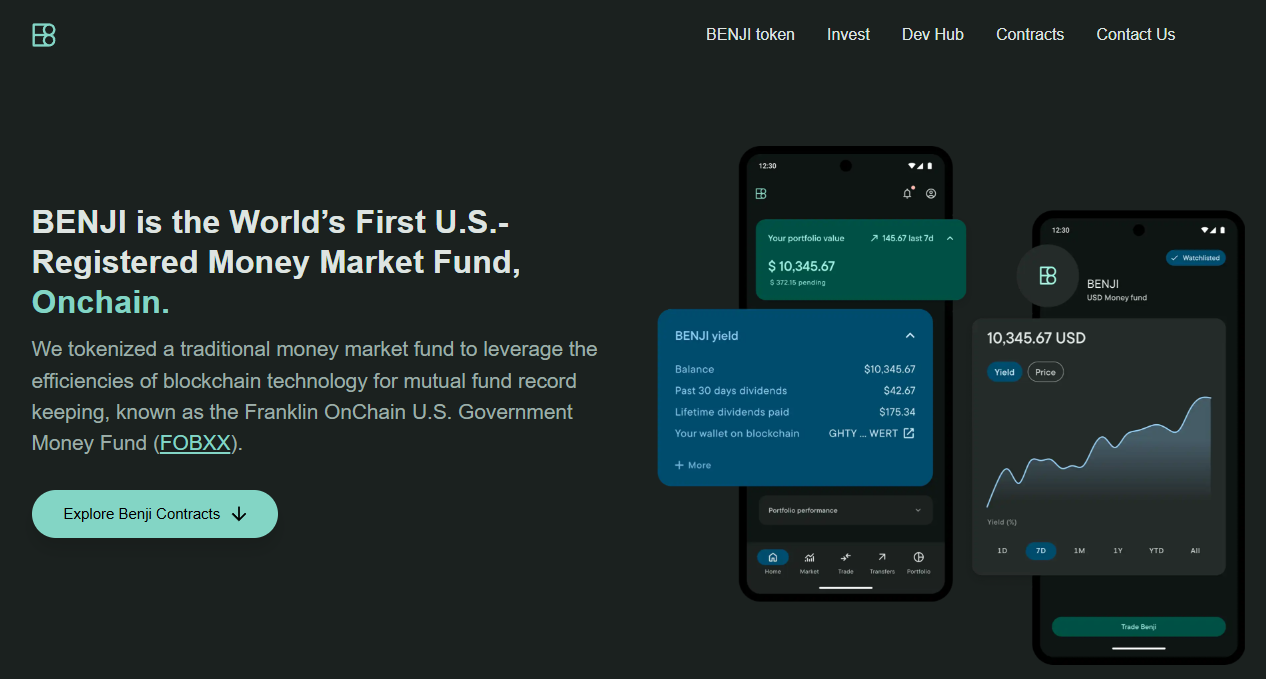
Runner-Up: Franklin Templeton BENJI — Legacy Asset Manager Innovation

Overview
 Franklin Templeton's $775 million Franklin OnChain U.S. Government Money Fund (BENJI) pioneered tokenized mutual funds in 2021, offering exposure to US government securities across eight blockchains with patent-pending intraday yield calculation.

Ideal For

  • Investors seeking regulated 40 Act fund structure
  • Collateral managers requiring second-by-second yield accrual
  • Multi-chain strategies needing broad blockchain compatibility
  • Users prioritizing traditional asset manager credibility

Standout Features

  • Intraday yield tracking down to the second, enabling proportional earnings even for partial-day holdings
  • Direct stablecoin purchases and redemptions with wallet-to-wallet transfer capability
  • 63% of AUM deployed on Stellar Network for optimal cost efficiency
  • Integrated with DeFi protocols for collateral and leverage applications

Pricing
 7-day current yield approximately 4.5-5.5% gross; 0.25% management fee. No minimum investment restrictions beyond standard mutual fund requirements.

Availability
 Global availability with specific KYC requirements. Active on Stellar, Ethereum, Arbitrum, Base, Avalanche, Polygon, Aptos, Solana, BNB Chain.

Worth Noting
 Traditional mutual fund constraints apply including daily NAV calculations and potential redemption delays during market stress.

Alternatives to Consider: Backed bIB01, Superstate Short Duration Government Securities  

For Institutional Credit Exposure (8-12% Yield)

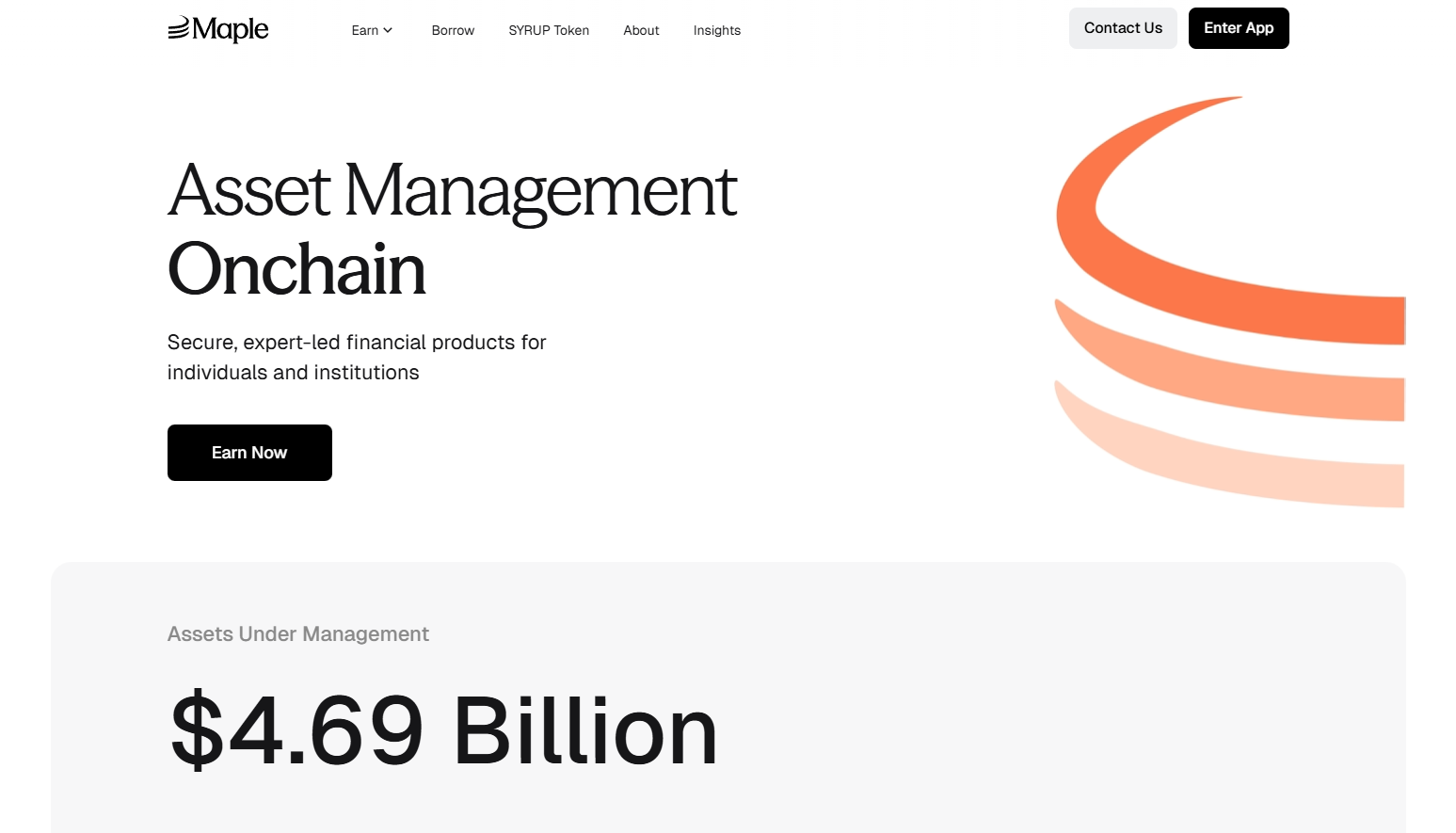
Top Pick: Maple Finance — Premier Crypto-Collateralized Lending

Overview
 Maple Finance manages over $4 billion in assets, specializing in institutional over-collateralized lending backed by Bitcoin, Ethereum, Solana, and XRP, targeting $100 billion in annual loan volume by 2030. The platform introduced SyrupUSDC for permissionless retail access alongside KYC-gated institutional pools.

Ideal For

  • Institutional lenders seeking exposure to cryptocurrency-backed credit
  • Liquidity providers comfortable with smart contract risk
  • Allocators targeting floating-rate, senior-secured structures
  • Investors seeking alternatives to traditional stablecoin farming

Standout Features

  • Consistent 9-12% net yields through undercollateralized institutional facilities and structured credit products
  • Strategic integration with Aave's $40 billion protocol bringing syrupUSDT to Plasma instance and syrupUSDC to core markets
  • Partnerships with Bitwise, Lido Finance (stETH-backed credit lines), and EtherFi (weETH collateral) expanding institutional adoption
  • Robust risk management combining decades of TradFi expertise with real-time on-chain monitoring

Pricing
 Variable by pool; typical effective yields 9-12% after protocol fees. Minimum investments pool-dependent, generally $10K-$50K for retail syrup products.

Availability
 Global with KYC requirements for lending. Institutional Maple requires accreditation; Syrup.fi open to broader participants.

Worth Noting
 Platform transitioned from uncollateralized to over-collateralized model after 2022 market turmoil. Historical defaults impacted certain pools; robust recovery mechanisms now in place.

Alternatives to Consider: Credix (emerging markets), TrueFi (uncollateralized DeFi)  

Runner-Up: Goldfinch Prime — Institutional Private Credit Access

Overview
 Goldfinch Prime aggregates exposure to multi-billion dollar private credit funds from Ares, Apollo, Golub Capital, and KKR, providing on-chain access to institutional-grade senior secured loans with over $1 trillion in collective AUM.

Ideal For

  • Non-US investors seeking diversified private credit exposure
  • Allocators targeting institutional fund performance without direct fund access
  • Participants seeking uncorrelated yield to crypto markets
  • Investors comfortable with longer lockup periods

Standout Features

  • Exposure to 1000+ senior secured loans across industries through vetted fund managers with 10+ years experience
  • Target returns of 9-12% net of fees with strict eligibility criteria including >90% senior secured portfolios and <0.75% target non-accrual rates
  • Heron Finance manages fund selection and vetting while fund managers handle all underwriting and default resolution
  • USDC-based deposits converted to proportional GPRIME tokens for continuous offering structure

Pricing
 Net yields 9-12% after embedded management fees and profit sharing. Minimum investments vary by pool structure; typically institutional minimums apply.

Availability
 Non-US persons only due to regulatory structure. KYC and accreditation verification required.

Worth Noting
 Exposure is indirect through fund shares rather than direct loan origination; fund managers absorb individual borrower default risk into aggregate yields. Liquidity limited compared to Treasury products.

Alternatives to Consider: Centrifuge private credit pools, Credix fintech lending


For Real Estate & Diversified Assets (6-10% Yield)

Top Pick: Centrifuge — Multi-Asset Tokenization Infrastructure

Overview
 Centrifuge operates as a multichain infrastructure platform enabling asset managers to tokenize real estate, trade finance, carbon credits, and structured credit with $1.2 billion TVL and recent 10x growth driven by the first on-chain CLO and tokenized S&P 500 index fund.

Ideal For

  • Investors seeking exposure to asset-backed securities beyond treasuries
  • Allocators comfortable evaluating tranched credit structures
  • Participants prioritizing transparency and on-chain asset verification
  • Portfolio managers wanting diversification across real-world credit types

Standout Features

  • Asset-agnostic architecture supporting structured credit, real estate mortgages, US treasuries, carbon credits, and consumer finance with full collateralization and legal recourse for investors
  • V3 platform enables cross-chain interoperability across Ethereum, Base, Arbitrum, Avalanche, BNB Chain, and Plume with integrated KYC and compliance-as-a-feature
  • Senior/junior tranche structures allowing risk-return customization
  • Partnership with Chronicle Labs for real-time price feeds and integration with Circle for USDC on/off-ramping

Pricing
 Yields vary by pool and tranche: typically 6-8% for senior tranches, 10-14% for junior tranches. Management fees embedded; pool-specific minimums apply.

Availability
 Global with KYC requirements. Pools may have additional jurisdictional restrictions based on underlying asset location.

Worth Noting
 Platform complexity requires understanding of tranched structures and asset-specific risks. Less liquid credit instruments offer less frequent pricing updates than treasury products.

Alternatives to Consider: RealT (US residential real estate focus), Republic (equity crowdfunding)


For Emerging Market Credit (12-18% Yield)

Top Pick: Credix — Latin American Fintech Lending

Overview
 Credix specializes in providing credit facilities to fintech lenders in Latin America, offering high-yield exposure to underserved credit markets with institutional-grade underwriting and local market expertise.

Ideal For

  • Sophisticated investors seeking higher risk-adjusted returns
  • Allocators comfortable with emerging market credit risk
  • Participants with extended investment horizons (12-24 months typical)
  • Investors seeking geographic diversification from US/EU markets

Standout Features

  • Target yields 12-18% reflecting emerging market risk premiums
  • Focus on fintech infrastructure enabling financial inclusion
  • Partnerships with established Latin American credit originators
  • Robust due diligence and monitoring of borrower networks

Pricing
 Pool-dependent yields typically 12-18% gross with management fees of 1-2%. Minimum investments generally $50K+ for accredited investors.

Availability
 Non-US persons primarily; requires accreditation verification and enhanced KYC given emerging market exposure.

Worth Noting
 Higher yields reflect higher credit and currency risk. Platform experienced challenges during regional economic volatility; enhanced risk controls now implemented.

Alternatives to Consider: Goldfinch V1 pools (emerging market focus), TrueFi uncollateralized pools


For Tokenization Infrastructure (Platform Providers)

Top Pick: Securitize — Industry-Leading Issuance Platform

Overview
 Securitize has tokenized over $4.5 billion in assets for 1.2 million investors across 3,000+ clients, operating as an SEC-registered transfer agent with integrated ATS for secondary trading. The platform powers major offerings including BlackRock's BUIDL fund.

Ideal For

  • Asset managers seeking turnkey tokenization solutions
  • Issuers requiring SEC-compliant digital security infrastructure
  • Institutional clients needing integrated custody and compliance
  • Projects prioritizing regulatory alignment and brand credibility

Standout Features

  • DS Protocol automates token issuance, transfer agent functions, and regulated secondary trading with $47 million funding led by BlackRock
  • Recent launch of STAC tokenized AAA CLO fund with BNY custody demonstrating institutional adoption trajectory
  • Comprehensive investor onboarding, KYC/AML, and reporting infrastructure
  • Partnerships with major asset managers and integration with Zero Hash for fiat conversion

Pricing
 Platform fees vary by issuance size and complexity; typically 0.5-2% of AUM plus basis point fees on transactions. White-label solutions available for enterprise clients.

Availability
 Global operations with jurisdiction-specific compliance modules. Primary focus on US, EU, and APAC institutional markets.

Worth Noting
 Securitize is an issuance platform rather than direct investment product; investors access opportunities through partner funds and offerings launched on the infrastructure.

Alternatives to Consider: Tokeny (EU-focused), Polymath/Polymesh (security token specialists)


Complete Provider Directory

  • Backed Finance: European MiCA-compliant tokenization platform offering bIB01 (Swiss government bond exposure) and bC3M (commodity basket). Strong focus on regulatory alignment with modest 3-5% yields and low entry barriers.
  • Swarm Markets: Decentralized platform enabling fractional ownership of real estate and private credit with $1K-$50K minimums. Emphasizes accessibility while maintaining compliance through distributed infrastructure.
  • TrueFi: Uncollateralized lending protocol using on-chain credit scoring and portfolio diversification. Higher risk-return profile (8-15% targets) with full transparency of borrower pools and performance metrics.
  • Archax: UK FCA-regulated platform for institutional tokenization of bonds, funds, and money markets. Focus on traditional finance compatibility with stringent accreditation requirements.

Making Your Selection: Key Questions

  • What yield stability do you require?
     Treasury-backed platforms (Ondo, Franklin Templeton) offer predictable 4-5% returns with minimal volatility. Credit-focused platforms (Maple, Goldfinch) target 9-12% but introduce credit risk and performance variability.
  • What is your risk tolerance for underlying collateral?
     Government securities provide lowest risk; over-collateralized crypto loans add smart contract and liquidation risks; uncollateralized emerging market credit carries highest default potential.
  • Do you meet accreditation and minimum investment thresholds?
     Many institutional products require $50K-$200K minimums and qualified purchaser status. Retail-accessible options like USDY and syrupUSDC lower barriers but may sacrifice yield.
  • What liquidity do you need?
     Treasury tokens generally offer daily liquidity; private credit pools may have quarterly redemption windows; real estate tokenization can involve 12-24 month lockups.
  • How important is regulatory compliance?
     Platforms like Ondo, Franklin Templeton, and Securitize prioritize SEC registration and traditional fund structures. Purely DeFi-native protocols offer less regulatory clarity but greater composability.
  • What blockchain ecosystems do you operate in?
     Multi-chain deployment (Ondo, Centrifuge) provides flexibility; single-chain specialization (some Maple pools) may offer optimization but limits interoperability.
  • Do you have geographic restrictions?
     US persons often excluded from highest-yield opportunities due to securities laws. European investors benefit from MiCA framework; APAC sees growing regulatory clarity.
  • What level of transparency do you require?
     On-chain native protocols offer real-time asset verification; hybrid models may rely on periodic attestations and third-party audits.
  • Are you seeking passive income or active yield strategies?
     Treasury staking provides set-and-forget returns; DeFi integrations enable leverage, collateral strategies, and yield optimization requiring active management.
  • How much operational complexity can you handle?
     Single-platform solutions simplify but limit optionality; multi-protocol strategies maximize returns but require gas management, tax tracking, and security across multiple platforms.

Maximizing Your Setup with Token Metrics

Token Metrics provides critical intelligence for navigating RWA yield opportunities through data-driven analysis and market insights.

Research Phase: Leverage Token Metrics' fundamental analysis to evaluate tokenized asset protocols, comparing on-chain metrics, TVL trends, and yield sustainability indicators. Our RWA sector reports identify emerging platforms and highlight regulatory developments across jurisdictions.

Portfolio Construction: Use quantitative scoring to allocate across risk tiers—balancing stable treasury exposure with higher-yield credit products. Token Metrics' portfolio tools help optimize diversification while monitoring correlation to traditional crypto markets.

Ongoing Monitoring: Real-time alerts notify you of yield changes, protocol upgrades, and risk events. Our dashboard aggregates performance across multiple RWA platforms, tracking your yield-bearing positions alongside broader cryptocurrency holdings.

Risk Management: Token Metrics' risk analytics assess smart contract security, custody arrangements, and counterparty exposure. Our reports flag platforms with concerning yield sustainability metrics or operational red flags before they impact your capital.

Start your Token Metrics free trial to access institutional-grade RWA research and optimize your real-world asset allocation.  

Essential Security Practices

  • Custody Verification: Confirm that platforms use institutional-grade custodians (Coinbase Custody, BitGo, Fireblocks) for underlying assets. Verify proof-of-reserve attestations and third-party audits.
  • Smart Contract Risk: Review audit reports from reputable firms (Trail of Bits, OpenZeppelin, Certora). Understand upgrade mechanisms and timelock protections on protocol contracts.
  • Legal Structure Assessment: Examine SPV formation, bankruptcy remoteness, and investor recourse mechanisms. Ensure tokenization structure provides actual legal claim on underlying assets, not just economic exposure.
  • Regulatory Compliance: Verify platforms maintain necessary licenses (broker-dealer, transfer agent, ATS) in relevant jurisdictions. Confirm offerings comply with securities laws in your domicile.
  • Counterparty Risk: Understand who services loans, manages defaults, and handles liquidations. Evaluate track records of asset originators and credit underwriters.
  • Liquidity Risk Management: Never allocate more than you can afford to lock up for stated redemption periods. Maintain buffer capital for market volatility and potential redemption delays.
  • Tax Implications: Consult tax professionals on treatment of tokenized yield—may be classified as interest income, dividends, or capital gains depending on structure and jurisdiction.
  • Geographic Restrictions: Verify you're eligible to participate based on residency. Using VPNs or misrepresenting location can result in frozen funds and legal liability.
  • Platform Concentration: Diversify across multiple RWA providers to reduce single-point-of-failure risk. No single platform should represent majority of yield allocation.
  • Documentation: Maintain records of all transactions, yield distributions, and platform communications for tax reporting and potential disputes.

This article is for research and educational purposes, not financial advice. RWA investments carry risks including loss of principal.


What to Avoid

  • Ignoring minimum holding periods: Many RWA products enforce lockups or redemption windows. Treating them as liquid positions can leave you unable to access capital when needed.
  • Chasing unsustainably high yields: Promised returns significantly above market rates often indicate excessive risk. Verify underlying asset performance and historical consistency before committing capital.
  • Overlooking platform liquidity: Token existence on-chain doesn't guarantee exit liquidity. Check secondary market depth and historical spread between minting and redemption prices.
  • Neglecting jurisdictional compliance: Accessing platforms not available in your region can result in frozen accounts and regulatory penalties. Always verify eligibility before depositing funds.
  • Underestimating smart contract risk: Even well-audited protocols face exploitation risk. Size positions appropriately and monitor security incident disclosures across the ecosystem.
  • Failing to verify asset backing: Don't rely on marketing claims. Demand proof-of-reserve, third-party attestations, and transparent reporting on underlying collateral.
  • Concentrating in single asset class: Over-allocating to one RWA category (e.g., all private credit) eliminates diversification benefits. Balance across treasuries, credit, and real estate where possible.
  • Ignoring fee structures: Management fees, performance fees, and transaction costs compound over time. Calculate net yields after all costs when comparing platforms.

Reader Questions Answered

What's the difference between tokenized treasuries and yield-bearing stablecoins?

 Tokenized treasuries (like OUSG) represent direct ownership of US Treasury securities with yield passed through to holders. Yield-bearing stablecoins (like USDY) maintain $1 peg while distributing treasury yields via rebasing or airdrops. Treasuries may fluctuate slightly with NAV; yield stablecoins prioritize price stability.

Are RWA yields taxable differently than crypto staking rewards?

 Likely yes, though tax treatment varies by jurisdiction. RWA yields from treasuries or credit facilities often classified as interest income taxed at ordinary rates. Crypto staking may be treated as income at receipt or capital gains at sale depending on location. Consult tax professionals for specific guidance.

Can I use tokenized RWAs as collateral in DeFi protocols?

 Increasingly yes. Platforms like Maple, Ondo (via Flux Finance), and Centrifuge enable using tokenized assets as DeFi collateral. However, support varies by protocol and asset—USDY and OUSG see broader integration than niche real estate tokens. Liquidation risks apply if collateral value drops.

What happens if the platform goes bankrupt?

 Properly structured tokenization isolates assets in bankruptcy-remote SPVs, protecting investor claims even if platform operator fails. However, redemption processes may be delayed and require legal navigation. This is why verifying legal structure and custodial arrangements is critical.

How liquid are RWA tokens compared to stablecoins?

 Significantly less liquid. While stablecoins have billions in daily DEX volume, most RWA tokens trade thinly or only through platform-controlled redemption mechanisms. Treasury tokens offer better liquidity than private credit or real estate, but all lag traditional stablecoins substantially.

Do I need to be an accredited investor?

 Depends on the platform and your location. US-based offerings often require accreditation; international platforms may have lower barriers. Products like USDY, syrupUSDC, and BENJI target broader accessibility, while institutional credit pools restrict to qualified purchasers.

What are the main risks that could cause loss of principal?

 (1) Underlying asset default (credit risk), (2) smart contract exploitation, (3) platform insolvency without proper asset segregation, (4) regulatory action freezing operations, (5) stablecoin de-pegging for yield products denominated in USDC/USDT, (6) liquidation cascades in collateralized structures.

How do yields compare to traditional finance alternatives?

 Tokenized treasuries (4-5%) match conventional money market funds but with 24/7 access. Private credit RWAs (9-12%) offer premiums over corporate bonds due to illiquidity and platform novelty. Emerging market RWA yields (12-18%) comparable to EM debt funds with added smart contract risk.


Bottom Line

Real-world asset yield marketplaces represent the maturation of blockchain infrastructure beyond speculation into productive finance. For investors seeking stable, asset-backed returns uncorrelated to cryptocurrency volatility, platforms like Ondo Finance and Franklin Templeton deliver institutional-grade treasury exposure with DeFi composability. Those comfortable with credit risk can access superior yields through Maple Finance's collateralized institutional lending or Goldfinch Prime's diversified private credit exposure.

The key to success: match platform selection to your specific risk tolerance, liquidity needs, and regulatory constraints. Treasury products suit conservative allocators prioritizing capital preservation; credit platforms reward investors accepting higher risk for enhanced returns; multi-asset infrastructure like Centrifuge offers diversification across real-world credit types.

Start with smaller allocations to understand platform mechanics, redemption processes, and yield consistency before committing substantial capital. The RWA sector's rapid growth will continue creating opportunities, but also attracting lower-quality offerings—due diligence remains paramount.

Related Resources:


About This Research

Methodology: This guide evaluated 20+ RWA platforms through analysis of official documentation, on-chain data, regulatory filings, and third-party audits. Platforms selected represent meaningful TVL (>$100M), regulatory compliance, and operational track record. Final selection prioritized diversity across asset classes and investor accessibility tiers.

Research Sources:

  • Ondo Finance: Product documentation, tokenomics, OUSG/USDY specifications, Oasis Pro acquisition disclosure
  • Maple Finance: Platform whitepaper, syrupUSDC mechanics, Aave integration announcement, CEO interviews
  • Centrifuge: V3 technical documentation, pool analytics, Republic partnership details
  • Goldfinch: Prime pool specifications, fund manager criteria, Heron Finance structure
  • Franklin Templeton: BENJI platform technical details, intraday yield patent documentation, multi-chain deployment
  • Securitize: DS Protocol documentation, STAC fund launch details, BlackRock partnership announcements
  • RWA.xyz: Platform TVL data, tokenization metrics, market growth analysis
  • DeFiLlama: Protocol TVL tracking, historical performance data
  • BCG/Ripple: RWA market projections and industry research
  • VanEck, Coinbase, Binance: Sector research reports on RWA growth trajectories

All data current as of January 2025. Platform features and yields subject to change; verify current terms on official websites before investing.

Build Smarter Crypto Apps &
AI Agents in Minutes, Not Months
Real-time prices, trading signals, and on-chain insights all from one powerful API.
Grab a Free API Key
About Token Metrics
Token Metrics: AI-powered crypto research and ratings platform. We help investors make smarter decisions with unbiased Token Metrics Ratings, on-chain analytics, and editor-curated “Top 10” guides. Our platform distills thousands of data points into clear scores, trends, and alerts you can act on.
30 Employees
analysts, data scientists, and crypto engineers
Daily Briefings
concise market insights and “Top Picks”
Transparent & Compliant
Sponsored ≠ Ratings; research remains independent
Want Smarter Crypto Picks—Free?
See unbiased Token Metrics Ratings for BTC, ETH, and top alts.
Thank you! Your submission has been received!
Oops! Something went wrong while submitting the form.
 No credit card | 1-click unsubscribe
Token Metrics Team
Token Metrics Team

Recent Posts

Research

The Ultimate Guide to Web3 Wallets: Security, Trends, and Smart Trading in 2025

Talha Ahmad
5 min

The Web3 revolution is fundamentally transforming how users interact with digital assets, and at the core of this transformation are Web3 wallets. Before the rise of Web3 wallets, the crypto wallet was the essential tool for securely managing and storing cryptocurrencies, with Web3 wallets representing an evolution of the traditional crypto wallet. These digital wallets serve as essential gateways, providing access to the decentralized web by enabling seamless interactions with blockchain networks, decentralized applications (dApps), and a wide array of crypto assets. As we advance into 2025, gaining a thorough understanding of Web3 wallets is crucial for anyone looking to actively participate in the evolving cryptocurrency ecosystem.

What Makes Web3 Wallets Essential?

Web3 wallets go far beyond being mere storage solutions for cryptocurrencies. They function as comprehensive digital identity managers, allowing users to securely store, manage, and transfer valuable digital assets while retaining complete control over their private keys. Unlike traditional banking systems or custodial wallets, where institutions hold custody of your funds, Web3 wallets embody the principle of self-custody and true ownership, giving users complete control over their crypto assets. A non custodial wallet, such as Metamask, ensures that only the user has access to their assets and keys, aligning with the principles of decentralization and user sovereignty.

A key difference between Web3 wallets and conventional crypto wallets lies in their ability to interact directly with blockchain networks. While traditional wallets typically support only basic send-and-receive functions, Web3 wallets enable users to connect with smart contracts, decentralized exchanges, NFT marketplaces, and various decentralized finance (DeFi) protocols. These wallets use a public key, which acts as a shareable address derived from the private key, allowing others to send assets to you. The private key is essential for signing transactions and proving ownership, and it must be kept secure to protect your assets. This enhanced functionality makes Web3 wallets indispensable tools for accessing the full spectrum of decentralized finance opportunities and engaging with the decentralized web.

Current Market Landscape and Security Trends

The security market for Web3 wallets is rapidly expanding, with projections estimating a compound annual growth rate (CAGR) of 23.7% from 2024 to 2033, reaching an impressive $68.8 billion by 2033. This growth underscores the critical importance of wallet security as users increasingly entrust these digital wallets with their valuable digital assets.

Recent studies reveal mixed security practices among users: approximately 34.65% of users opt to record and securely store their private keys on paper, 24.75% use encrypted digital storage methods, and only 13.86% rely on professional hardware wallets. These statistics highlight a significant gap in adoption of enhanced security measures, such as hardware wallets, which store private keys offline and provide maximum security.

The security landscape in 2024 has also been challenged by increasingly sophisticated phishing attacks and other cyber threats targeting both decentralized and centralized finance platforms. This evolving threat environment emphasizes the need for robust wallet security measures and comprehensive user education to protect assets effectively.

Types of Web3 Wallets: Finding Your Perfect Match

Hot Wallets vs. Cold Wallets

Web3 wallets come in two primary categories: hot wallets and cold wallets. Hot wallets remain connected to the internet, offering unmatched convenience for frequent transactions and interactions with decentralized applications. Examples include browser extensions like MetaMask, mobile apps such as Trust Wallet, and various web-based wallets. Many hot wallets also feature a built-in dapp browser, enabling users to access and interact with decentralized applications (dApps) directly from within the wallet. These wallets provide an easy-to-use interface and support multichain functionality, allowing users to manage assets across multiple blockchains. However, their constant online connectivity exposes them to higher security risks.

In contrast, cold wallets—often referred to as hardware wallets—store private keys offline, significantly reducing exposure to hacking attempts. Popular hardware wallets like Ledger and Trezor exemplify this category, providing enhanced security for long-term storage of crypto assets. While cold wallets may be less convenient for everyday trading, they offer the highest level of security and are widely regarded as the gold standard for safeguarding valuable digital assets.

Custodial vs. Non-Custodial Solutions

Another important distinction is between custodial and non-custodial wallets. Custodial wallets manage private keys on behalf of users, providing familiar login experiences and recovery options similar to traditional online services. Wallets like Coinbase Wallet fall into this category, appealing to newcomers who prefer institutional custody and the convenience of account recovery options. However, custodial wallets require users to trust third-party services, which conflicts with the Web3 ethos of decentralization and self-sovereignty.

Non-custodial wallets, on the other hand, give users complete control over their private keys and funds. This approach aligns with the decentralized web’s core principles, ensuring users have true ownership and control over their digital assets. While non-custodial wallets demand greater personal responsibility—such as securely managing recovery phrases—they empower users with enhanced privacy and freedom. The recovery phrase is a human-readable backup that allows users to restore access to their wallet if needed.

Browser Extensions and Wallets: Convenience Meets Security

Browser extensions and wallets have become a popular choice for users looking to manage digital assets and interact with decentralized applications (dApps) directly from their web browsers. These browser extensions, such as MetaMask, offer a streamlined and user-friendly interface, making it easy to store, send, and receive cryptocurrencies, as well as interact with smart contracts on various blockchain networks. The convenience of accessing your wallet and assets with just a few clicks has made browser extensions a go-to solution for many in the Web3 space.

However, this convenience comes with its own set of security considerations. Because browser extensions are connected to the internet, they can be susceptible to phishing attacks and other security threats targeting users’ private keys and digital assets. To keep your wallet secure, it’s crucial to choose reputable and well-reviewed browser extensions, regularly update your wallet software, and remain vigilant against suspicious links or pop-ups.

For users seeking enhanced security, pairing a browser extension with a hardware wallet is highly recommended. Hardware wallets store private keys offline, significantly reducing the risk of unauthorized access even if your browser extension is compromised. This combination allows users to interact with decentralized applications and sign transactions securely, ensuring that private keys never leave the safety of the hardware wallet. By following these best practices, users can enjoy the convenience of browser extensions while keeping their digital assets and private keys protected.

User Experience and Interface: Designing for the Next Billion Users

As Web3 wallets aim to reach mainstream adoption, delivering an exceptional user experience and intuitive interface is more important than ever. The next generation of users will expect wallets to be as easy to use as traditional financial apps, without needing to understand the complexities of blockchain technology. To meet these expectations, wallet developers are focusing on user-centric design, ensuring that every feature and interaction is clear, accessible, and straightforward.

Key features such as two-factor authentication, transaction verification, and clear asset management tools are becoming standard, providing users with both security and peace of mind. Wallet interfaces should present information in a concise and understandable way, guiding users through each step of managing their digital assets. Adaptability is also crucial—wallets must offer a seamless experience across mobile devices, desktops, and browser extensions, so users can access their assets wherever they are.

By prioritizing intuitive design and robust security features, Web3 wallets can lower the barrier to entry for new users and make managing digital assets a smooth, stress-free experience. This focus on user experience is essential for onboarding the next billion users into the decentralized web.

User Journeys and Onboarding: Making Web3 Accessible

A seamless user journey and onboarding process are essential for making Web3 wallets accessible to everyone, regardless of their technical background. The best wallets guide users step-by-step through creating a wallet, securing their digital assets, and interacting with decentralized applications. Clear instructions, interactive tutorials, and responsive customer support help users feel confident as they navigate the world of Web3.

User education is a cornerstone of effective onboarding. Leading wallets provide comprehensive resources, including guides on security best practices, explanations of key concepts, and tips for safely managing assets. This educational approach empowers users to make informed decisions and reduces the risk of costly mistakes.

By simplifying the onboarding process and offering robust support, Web3 wallets can help users quickly get started, securely store their assets, and begin interacting with the decentralized ecosystem. Making Web3 technology approachable and understandable is key to driving widespread adoption and ensuring users can fully benefit from the opportunities it offers.

Earning Rewards and Incentives: Maximizing Wallet Benefits

Web3 wallets are not just tools for storing and managing digital assets—they also open the door to a variety of rewards and incentives. Many wallets, including Trust Wallet and Coinbase Wallet, offer users the ability to earn rewards through staking, yield farming, and participation in decentralized finance (DeFi) protocols. These opportunities can provide a valuable source of passive income, making wallets even more attractive for users looking to grow their assets.

To maximize these benefits, users should conduct their own research and carefully review the terms and conditions of each reward program. Understanding the risks, requirements, and potential returns is essential for making informed decisions. Wallets that prioritize transparency make it easy for users to discover, compare, and participate in different earning opportunities.

By taking advantage of these reward programs, users can enhance their Web3 experience and unlock additional value from their digital assets. As wallets continue to innovate, expect even more ways to earn rewards and participate in the decentralized economy directly from your wallet interface.

2025 Development Trends Shaping the Future

The Web3 wallet industry is evolving rapidly, with 2025 poised to accelerate innovations that position wallets as essential infrastructure for digital life. Several key trends are shaping this future landscape:

Enhanced User Experience: Developers are striving to create wallet software that combines Web2-like simplicity with full Web3 functionality. This includes streamlined onboarding, intuitive interfaces, and seamless integration with everyday apps, making it easier for users to connect, verify, and manage their assets.

Multi-Chain Interoperability: Modern wallets increasingly support multiple blockchains, allowing users to store and manage tokens, NFTs, and other digital assets across various ecosystems from a single interface. This multichain support addresses the fragmented blockchain landscape and simplifies asset management.

Advanced Security Features: Security remains paramount, with wallets adopting biometric authentication, multi-signature capabilities, and AI-powered fraud detection to significantly reduce risks. These added security layers help users maintain wallet security and protect against phishing attacks and unauthorized transactions.

Social Recovery Options: New wallet architectures are incorporating social recovery mechanisms, enabling users to regain access to their wallets through trusted contacts instead of relying solely on recovery phrases. This innovation enhances account recovery without compromising security.

Smart Trading with Analytics Platforms

While Web3 wallets provide the essential infrastructure to store and manage crypto assets, many now allow users to buy, sell, and swap cryptocurrencies directly within the wallet interface, making asset management more efficient. Successful trading in the complex cryptocurrency market requires sophisticated analytics and market intelligence. Platforms like Token Metrics are becoming invaluable resources for traders and investors seeking data-driven insights.

Token Metrics leverages artificial intelligence and machine learning to offer comprehensive crypto research, token ratings, price predictions, and portfolio optimization tools. This next-generation platform consolidates trading signals, market trend analysis, and index data, empowering users to make informed decisions in a highly volatile and sentiment-driven market.

By combining traditional financial analysis with cutting-edge AI technology, Token Metrics helps users identify potential crypto moonshots, optimize their portfolios, and manage risk effectively. This integration of analytics with wallet functionality enables users to authorize transactions confidently and interact with decentralized applications more strategically.

Security Best Practices for Web3 Wallet Users

Maintaining wallet security is critical for protecting your digital assets. Here are essential security practices every Web3 wallet user should follow:

Seed Phrase Management: Always store your recovery phrase securely in multiple physical locations, preferably using durable metal backup solutions. Avoid storing seed phrases digitally or sharing them with anyone to prevent unauthorized access.

Transaction Verification: Before authorizing any transaction, carefully verify recipient addresses, transaction details, and smart contract interactions. Vigilance helps defend against phishing attacks and fraudulent transactions. When swapping tokens within your Web3 wallet, always double-check all information to avoid errors or falling victim to scams.

Regular Updates: Keep your wallet software, including browser extensions and mobile apps, up to date. Enable automatic updates where possible to benefit from the latest security patches and enhanced features.

Network Awareness: Exercise caution when connecting to public Wi-Fi networks and consider using VPN services to add privacy layers, reducing exposure to potential network-based attacks.

Exchanges and Wallet Integration: Bridging CeFi and DeFi

The integration of exchanges and wallets is playing a pivotal role in bridging the gap between centralized finance (CeFi) and decentralized finance (DeFi). Modern Web3 wallets are increasingly offering seamless connectivity with both centralized exchanges and decentralized platforms, allowing users to manage, swap, and transfer assets across multiple ecosystems without leaving their wallet interface.

This integration enables users to enjoy the liquidity, speed, and familiar features of centralized exchanges while also accessing the transparency, control, and innovative services of DeFi protocols. Features such as in-wallet token swaps, fiat on-ramps, and direct access to decentralized applications are becoming standard, making it easier than ever to move assets between CeFi and DeFi environments.

By supporting multiple blockchains and exchange integrations, Web3 wallets empower users with true ownership and flexibility over their digital assets. This convergence is driving the next generation of financial services, where users can interact with both traditional and decentralized platforms from a single, secure wallet—unlocking new possibilities for trading, investing, and managing crypto assets in 2025 and beyond.

Integration with DeFi and Future Opportunities

Web3 wallets are increasingly serving as gateways to the expanding decentralized finance ecosystem. They enable users to participate in yield farming, liquidity mining, decentralized exchanges, and lending protocols with ease. The integration between wallets and DeFi platforms is deepening, with features like gas optimization, transaction batching, and automated strategy execution becoming more common.

Looking ahead, wallets are expected to incorporate built-in DeFi functionalities, direct fiat on-ramps, and advanced portfolio management tools. This evolution will further blur the lines between traditional finance and decentralized alternatives, empowering users to earn rewards, swap tokens, collect NFTs, and manage assets across multiple chains—all from a single, secure digital wallet.

Conclusion

Web3 wallets form the foundational infrastructure that enables users to engage confidently with the decentralized economy. As the market evolves with enhanced security features, improved user experiences, and deeper DeFi integration, selecting the right wallet becomes increasingly important for both casual holders and active traders.

Understanding the differences between wallet types, adopting best security practices, and leveraging powerful analytics platforms like Token Metrics will empower users to manage their crypto assets securely and make smarter trading decisions. The future of Web3 wallets is bright, with ongoing innovation focused on making decentralized finance accessible, secure, and user-friendly.

As we progress through 2025, Web3 wallets will continue to play a pivotal role in our digital financial lives, offering users complete control, enhanced security, and seamless interaction with the decentralized web. Embracing these tools is essential for anyone seeking to thrive in the next generation of the internet.

‍

Research

Solana vs Bitcoin vs Ethereum: The Ultimate 2025 Cryptocurrency Showdown

Talha Ahmad
5 min

As we navigate through 2025, the cryptocurrency landscape continues to evolve at a breakneck speed, with three giants dominating the conversation: Solana, Bitcoin, and Ethereum. These crypto coins represent distinct visions for the future of blockchain technology, each offering unique features and advantages that appeal to different segments of the market. Cryptocurrencies are increasingly viewed as an alternative to traditional currencies and assets, providing new options for storing and transferring value.

Understanding the key differences between Solana vs Bitcoin vs Ethereum is crucial for investors, developers, and crypto enthusiasts who want to stay ahead in this rapidly changing industry. Recent developments, such as the SEC approval of a Bitcoin ETF, have made Bitcoin more accessible to a broader audience, encouraging easier entry into cryptocurrency investing.

Introduction to Cryptocurrencies

Cryptocurrencies are decentralized digital currencies that leverage cryptography to ensure secure and transparent transactions across a global network. Since the inception of Bitcoin, the crypto market has expanded rapidly, introducing a diverse range of crypto coins that serve various purposes. While many investors are drawn to trading crypto for its potential returns, others see cryptocurrencies as a way to participate in decentralized finance (DeFi) protocols or to buy Bitcoin as a long-term store of value.

Unlike Bitcoin, which primarily functions as a decentralized digital currency and a hedge against traditional financial systems, other blockchain platforms like Ethereum and Solana have evolved to power decentralized applications and smart contracts. The Solana blockchain, for example, is renowned for its high-speed, low-cost transactions, making it a popular choice among developers and investors seeking scalable solutions. As the crypto market matures, these platforms continue to drive innovation, offering new ways to store, transfer, and create value in a secure and decentralized manner.

Current Market Position: September 2025 Snapshot

The crypto market in 2025 has matured significantly, marked by increased institutional adoption and broader mainstream acceptance. As of September 15, 2025, Solana (SOL) is trading at an impressive price of $235.69, boasting a market capitalization of $138.75 billion. This represents remarkable growth from its previous lows and highlights Solana’s rise as a serious competitor in the blockchain space.

Meanwhile, Bitcoin (BTC) remains solidly above $118,000, reinforcing its status as digital gold and a reliable store of value. Ethereum (ETH), on the other hand, is on track for a consistent recovery, driven by ongoing upgrades and expanding use cases. This overall bullish sentiment reflects the growing confidence investors have in these leading blockchain platforms.

For traders and analysts seeking comprehensive insights into the crypto market, Token Metrics stands out as a premier crypto trading and analytics platform. It offers advanced AI-driven analysis, price predictions, and portfolio optimization tools that help thousands of investors navigate the volatile cryptocurrency market with confidence.

Bitcoin: The Digital Gold Standard

Bitcoin continues to reign as the undisputed king of cryptocurrencies, widely regarded as the original decentralized digital currency and a trusted store of value. Unlike traditional currencies, Bitcoin operates independently of any central bank, further emphasizing its decentralized nature. Its primary value proposition lies in its role as digital gold—a decentralized store of value that serves as a hedge against the traditional banking system and fiat currencies like the dollar.

‍

‍

Institutional adoption of Bitcoin has accelerated in 2025, with an increasing number of corporations adding BTC to their treasury reserves. This growing acceptance underscores Bitcoin’s reputation as a safe haven asset in times of economic uncertainty. The Bitcoin decentralized network enables secure, peer-to-peer transactions, which are fundamental to its accessibility and resilience.

Bitcoin’s strength is rooted in its simplicity and security. The Bitcoin network has operated without major issues for over 15 years, building unmatched trust among investors worldwide. In 2025, Bitcoin’s development continues with new commits for Taproot++ features, including experimentation with vault primitives, demonstrating ongoing commitment to improving security and functionality despite its mature status. As a store of value, Bitcoin is often compared to precious metals like gold, with both serving as safe haven assets and stores of wealth.

However, Bitcoin’s limitations are well-known. Its consensus mechanism, Proof of Work (PoW), demands significant energy consumption, raising environmental concerns. Additionally, Bitcoin processes roughly 7 transactions per second, resulting in slower transaction speeds compared to newer blockchain platforms. This makes Bitcoin less suitable for applications requiring high-frequency transactions but reinforces its role as a secure and decentralized store of value and as a form of digital money used for both storing value and as a medium of exchange.

Unlike some other cryptocurrencies that may be classified as securities, Bitcoin is generally considered a commodity, which subjects it to lighter regulatory oversight and has important implications for its adoption and ETF approval prospects.

Ethereum: The Smart Contract Pioneer

Ethereum stands as the second largest cryptocurrency by market capitalization, trailing only Bitcoin. Unlike Bitcoin, Ethereum functions as a versatile blockchain platform designed to power decentralized applications (DApps) and decentralized finance (DeFi) protocols through its smart contract capabilities.

‍

‍

Ethereum’s ecosystem has expanded rapidly in 2025. Notably, Layer 2 scaling solutions like StarkNet and zkSync have attracted contributions from over 1,100 developers, enhancing Ethereum’s performance and addressing scalability challenges. These advancements enable Ethereum to support a wide range of Solana vs Bitcoin vs Ethereum: The Ultimate 2025 Cryptocurrency Showdown

As we navigate through 2025, the cryptocurrency landscape continues to evolve at a breakneck speed, with three giants dominating the conversation: Solana, Bitcoin, and Ethereum. These crypto coins represent distinct visions for the future of blockchain technology, each offering unique features and advantages that appeal to different segments of the market. Understanding the key differences between Solana vs Bitcoin vs Ethereum is crucial for investors, developers, and crypto enthusiasts who want to stay ahead in this rapidly changing industry.

Current Market Position: September 2025 Snapshot

The crypto market in 2025 has matured significantly, marked by increased institutional adoption and broader mainstream acceptance. As of September 15, 2025, Solana (SOL) is trading at an impressive price of $235.69, boasting a market capitalization of $138.75 billion. This represents remarkable growth from its previous lows and highlights Solana’s rise as a serious competitor in the blockchain space.

Meanwhile, Bitcoin (BTC) remains solidly above $118,000, reinforcing its status as digital gold and a reliable store of value. Ethereum (ETH), on the other hand, is on track for a consistent recovery, driven by ongoing upgrades and expanding use cases. This overall bullish sentiment reflects the growing confidence investors have in these leading blockchain platforms.

For traders and analysts seeking comprehensive insights into the crypto market, Token Metrics stands out as a premier crypto trading and analytics platform. It offers advanced AI-driven analysis, price predictions, and portfolio optimization tools that help thousands of investors navigate the volatile cryptocurrency market with confidence.

Bitcoin: The Digital Gold Standard

Bitcoin continues to reign as the undisputed king of cryptocurrencies, widely regarded as the original decentralized digital currency and a trusted store of value. Its primary value proposition lies in its role as digital gold—a decentralized store of value that serves as a hedge against the traditional banking system and fiat currencies like the dollar.

Institutional adoption of Bitcoin has accelerated in 2025, with an increasing number of corporations adding BTC to their treasury reserves. This growing acceptance underscores Bitcoin’s reputation as a safe haven asset in times of economic uncertainty.

Bitcoin's strength is rooted in its simplicity and security. The Bitcoin network has operated without major issues for over 15 years, building unmatched trust among investors worldwide. In 2025, Bitcoin's development continues with new commits for Taproot++ features, including experimentation with vault primitives, demonstrating ongoing commitment to improving security and functionality despite its mature status.

However, Bitcoin’s limitations are well-known. Its consensus mechanism, Proof of Work (PoW), demands significant energy consumption, raising environmental concerns. Additionally, Bitcoin processes roughly 7 transactions per second, resulting in slower transaction speeds compared to newer blockchain platforms. This makes Bitcoin less suitable for applications requiring high-frequency transactions but reinforces its role as a secure and decentralized store of value.

Ethereum: The Smart Contract Pioneer

Ethereum stands as the second largest cryptocurrency by market capitalization, trailing only Bitcoin. Unlike Bitcoin, Ethereum functions as a versatile blockchain platform designed to power decentralized applications (DApps) and decentralized finance (DeFi) protocols through its smart contract capabilities.

Ethereum’s ecosystem has expanded rapidly in 2025. Notably, Layer 2 scaling solutions like StarkNet and zkSync have attracted contributions from over 1,100 developers, enhancing Ethereum’s performance and addressing scalability challenges. These advancements enable Ethereum to support a wide range of decentralized services while maintaining security and decentralization.

Ethereum’s versatility is its greatest strength. It hosts the majority of blockchain innovation, from DeFi protocols and NFT marketplaces to enterprise blockchain solutions and tokenization platforms. However, Ethereum remains volatile, with its price potentially rising above $5,000 or falling below $2,000 depending on market trends, regulatory developments, and technological upgrades such as Ethereum ETFs and institutional investments.

Token Metrics’ advanced analytics platform offers real-time tracking of Ethereum’s extensive DeFi ecosystem, helping investors and developers identify emerging opportunities and assess risks across hundreds of Ethereum-based protocols.

Solana: The High-Speed Challenger

Solana has emerged as the most formidable challenger to Ethereum’s smart contract dominance. In 2024 and continuing into 2025, Solana experienced a significant rise in new token launches, accounting for over 87% of all tokens created across tracked platforms. This surge is largely attributed to Solana’s low transaction fees and exceptional speed.

‍

‍

The Solana blockchain boasts technical specifications that enable thousands of transactions per second with minimal fees, making it ideal for high-frequency trading, gaming, and consumer applications that demand fast, cheap transactions. However, Solana is considered more centralized than Bitcoin because running nodes on its network requires higher hardware specifications, which limits the number of participants who can operate nodes. Nodes in Solana are responsible for validating transactions, maintaining the ledger, and supporting the network’s speed and scalability, but the higher requirements for nodes can impact the overall decentralization of the network. Its unique consensus mechanism combines Proof of History (PoH) with Proof of Stake (PoS), enabling parallel transaction processing and remarkable scalability without relying on traditional Layer 2 solutions.

Looking ahead to 2026, Solana is poised to continue its upward trajectory, with price projections ranging between $400 and $450. This growth is expected to be fueled by further advancements in blockchain scalability and increasing adoption across DeFi and NFT sectors.

Solana’s ecosystem has flourished in niches where Ethereum’s higher fees create barriers to entry. It has become a hub for memecoin trading, gaming, and decentralized applications that require faster speeds and lower costs.

Consensus Mechanisms: How They Secure the Network

At the heart of every cryptocurrency lies a consensus mechanism—a system that ensures all transactions are validated and recorded securely across the network. In the crypto market, the most common consensus mechanisms are Proof of Work (PoW), Proof of Stake (PoS), and Proof of History (PoH), each with its own approach to maintaining trust and security.

Bitcoin relies on Proof of Work, where miners use computational power to solve complex puzzles, validate transactions, and create new blocks. This process is energy-intensive but has proven effective in securing the Bitcoin network. Solana, on the other hand, combines Proof of Stake with its innovative Proof of History, allowing validators to process transactions in parallel and achieve much faster speeds with greater energy efficiency. Ethereum has transitioned from PoW to PoS, enabling the network to scale more efficiently while reducing its environmental impact. Understanding these consensus mechanisms is crucial for anyone looking to invest in or use cryptocurrencies, as they directly influence the network’s security, scalability, and overall performance.

Technical Comparison: Architecture and Performance

When comparing Solana vs Bitcoin vs Ethereum, the differences in their underlying architecture and consensus mechanisms are key to understanding their unique strengths. Block creation and validation play a crucial role in determining transaction throughput and network speed, with each blockchain handling blocks differently to optimize performance.

Bitcoin uses Proof of Work (PoW), prioritizing security and decentralization over speed. Its conservative approach ensures immutability but limits transaction throughput. Bitcoin’s consensus mechanism gains unmatched security and resistance to attacks, but at the cost of efficiency.

Ethereum transitioned to Proof of Stake (PoS) with Ethereum 2.0, significantly improving energy efficiency while maintaining decentralization. Additionally, Layer 2 solutions like Arbitrum and Optimism offer scalability enhancements without compromising the security of the Ethereum main chain. Ethereum gains scalability and reduced energy consumption through its PoS upgrade and Layer 2 integrations.

Solana’s innovative Proof of History (PoH) consensus mechanism, combined with PoS, allows for parallel transaction processing, resulting in much faster speeds and higher scalability. Unlike Bitcoin and Ethereum, Solana achieves these speeds without relying on Layer 2 scaling, setting it apart as a high-performance blockchain platform. The robust code underlying each blockchain is essential for ensuring both security and optimal performance, making software implementation a critical factor in their ongoing development.

Tokenomics and Use Cases

Tokenomics—the economic design and distribution of cryptocurrency tokens—plays a pivotal role in shaping the value and utility of each crypto asset. Bitcoin’s tokenomics are defined by its fixed supply of 21 million coins, making it a secure store of value and a popular hedge against inflation. This scarcity is a key reason why many investors choose to buy Bitcoin as a long-term investment.

Solana’s tokenomics are more dynamic, with a variable supply and a focus on incentivizing network participation and powering decentralized applications. The Solana blockchain is designed to support a wide range of use cases, from high-frequency trading to gaming and DeFi protocols, making it a versatile platform for developers and users alike.

Ethereum stands out for its robust support of smart contracts and decentralized finance. Its token, ETH, is essential for executing transactions and interacting with DeFi protocols, NFT marketplaces, and other decentralized applications. As a result, Ethereum has become a cornerstone of the crypto market, driving innovation and enabling new forms of value creation. For investors and developers, understanding the tokenomics and use cases of each cryptocurrency is key to navigating the rapidly evolving market.

Cryptocurrency Regulation and Security

As the crypto market grows, regulation and security have become top priorities for investors and users. The regulatory landscape for cryptocurrency is still developing, with some countries embracing clear guidelines while others impose stricter controls or outright bans. This patchwork of regulations can create uncertainty and contribute to the market’s volatility.

Security is another critical concern, as the decentralized nature of crypto makes it a target for hackers and scammers. High-profile breaches of exchanges and wallets have underscored the importance of robust security measures. Investors are encouraged to use secure wallets, enable two-factor authentication, and stay informed about the latest security practices to protect their assets. As the industry matures, both regulation and security are expected to play increasingly important roles in shaping the future of the crypto market, helping to build trust and stability for all participants.

Investment Perspective: Risk and Reward Analysis

In 2025, the primary reason for investing in cryptocurrencies is long-term growth potential, cited by 49% of respondents, while

investors can purchase cryptocurrencies using various methods, including bank transfer, which allows for secure and direct funding from their bank accounts.

Cryptocurrencies enable secure transactions over the internet, making them accessible to a global audience.

Making an Informed Decision

Choosing which cryptocurrency to invest in or use requires a thoughtful and informed approach. Investors should carefully research each asset’s tokenomics, consensus mechanism, and real-world use cases, as well as consider the security and regulatory environment surrounding the crypto market. Staying updated with the latest news and market trends is essential, given the volatile nature of cryptocurrencies.

It’s also important for investors to assess their own financial goals and risk tolerance before making any decisions. Whether you’re interested in decentralized finance, trading, or using crypto as a store of value, taking the time to understand the unique features of Bitcoin, Solana, and Ethereum can help you make confident choices. By prioritizing research and security, investors can better navigate the dynamic world of crypto and position themselves for long-term value and success.

‍

Research

Solana vs Ethereum: The Ultimate 2025 Comparison for Crypto Traders

Talha Ahmad
5 min

The blockchain landscape continues to evolve at a breakneck speed, with two titans standing at the forefront of innovation: Ethereum, the established giant, and Solana, the rising challenger. At first glance, Solana and Ethereum may appear similar or direct rivals, but deeper differences set them apart. As we navigate through 2025, the competition between these ecosystems has intensified, creating compelling opportunities for traders, developers, and investors alike. Understanding the key metrics and performance indicators of both networks is crucial for making informed investment decisions in today’s dynamic crypto market. This comprehensive comparison of Solana vs Ethereum will explore their market performance, user adoption, technical capabilities, transaction costs, ecosystems, and future outlook to help you navigate the rapidly evolving blockchain technology space.

Market Performance and Momentum

In 2025, the market performance of Solana and Ethereum reveals distinct trajectories that highlight their evolving roles in the crypto market. Solana has demonstrated remarkable resilience and growth, with its native SOL token experiencing significant price appreciation. This surge has elevated Solana’s market capitalization, solidifying its position as a major player within the broader crypto ecosystem. The rapid expansion of the Solana blockchain and its ecosystem has attracted both retail and institutional investors looking for high performance and cost efficiency. Solana also draws significant on-chain capital, including assets and staking yields, which further contribute to its momentum.

Ethereum, on the other hand, remains a stalwart in the blockchain space. Despite facing different market dynamics, Ethereum continues to show impressive stability amid fluctuations. This resilience is bolstered by significant technological advancements, including Ethereum’s transition to a proof of stake consensus mechanism and the growing adoption of Layer-2 scaling solutions such as Arbitrum and Optimism. These upgrades have enhanced Ethereum’s scalability and user experience, strengthening its market position. Ethereum attracts substantial institutional capital and large holdings, providing a strong funding base for ongoing development and growth.

The SOL/ETH ratio continues to reflect shifting market dynamics, illustrating Solana’s growing market presence relative to Ethereum. This ratio provides valuable insight into investor sentiment and the comparative value of these two blockchain platforms as they vie for dominance in the decentralized finance (DeFi) and smart contract space.

User Activity and Network Adoption

When it comes to real-world usage and network adoption, Solana stands out with impressive user engagement metrics. The Solana network boasts approximately 3.25 million daily active users, significantly surpassing Ethereum’s 410,000+ daily active users. This level of engagement translates into substantial transaction volume, with Solana processing around 35.99 million daily transactions compared to Ethereum’s 1.13 million. These figures highlight Solana’s appeal to users who prioritize speed and low transaction fees.

The growth of new addresses further underscores Solana’s expanding user base. Solana generates about 56.31 million monthly new addresses, dwarfing Ethereum’s 7.18 million. This rapid increase reflects Solana’s ability to attract users with its high speed, low cost, and high throughput capabilities. Many DeFi protocols and decentralized applications (dApps) have flourished on Solana, benefiting from the network’s parallel execution and low latency.

Ethereum, with its largest developer ecosystem and established infrastructure, continues to attract developers and users focused on security, decentralization, and a broad array of services. Its ecosystem supports tokenized stocks, automated market makers, and decentralized exchanges, maintaining its role as the backbone of many DeFi and NFT projects.

Technical Performance and Scalability

The technical differences between Solana and Ethereum are fundamental to their respective value propositions and use cases. Solana’s architecture uniquely combines Proof of Stake (PoS) with Proof of History (PoH), a consensus mechanism that timestamps transactions to enable parallel processing. This innovative approach allows Solana to achieve exceptional scalability and performance metrics, making it the fastest blockchain platform currently available.

In real-world terms, Solana handles approximately 870.6 transactions per second (TPS), with observed peaks reaching up to 4,709 TPS. The network’s theoretical maximum throughput is an astounding 65,000 TPS, positioning it well for future growth and high-frequency applications. Solana’s block time is approximately 0.39 seconds, with transaction finality achieved in about 12.8 seconds, delivering a low-latency user experience.

Ethereum’s base layer, by contrast, currently processes around 15 to 30 TPS. However, Ethereum’s development strategy focuses on modular scaling through Layer-2 solutions rather than maximizing throughput at the base layer. This approach balances scalability with network security and decentralization, which remain top priorities for Ethereum’s large and diverse user base. The network’s ongoing upgrades, including danksharding, aim to improve transaction throughput while maintaining robust security guarantees.

For developers, Ethereum’s mature smart contract platform and vast array of tools provide a rich environment for building decentralized applications. Meanwhile, Solana’s high throughput and low latency make it particularly attractive for DeFi protocols, blockchain gaming, and applications requiring rapid transaction finality.

Transaction Costs and Economic Models

Transaction costs are a critical factor when comparing Solana vs Ethereum, especially for users and developers engaged in decentralized finance and high-frequency trading. Solana excels in cost efficiency, maintaining remarkably low fees with an average transaction cost of approximately $0.00025 (0.0001 SOL). This low cost makes Solana highly attractive for micropayments, DeFi interactions, and applications that require frequent transactions without incurring prohibitive expenses.

Ethereum’s fee structure, centered around gas fees, is more complex and often volatile. Gas fees can fluctuate widely, ranging from $1 to $30 during periods of high network congestion. The average gas price typically varies between 2 to 99 Gwei, which can make using Ethereum costly during peak times. This variability has driven many users to Layer-2 solutions that offer reduced fees while preserving Ethereum’s security and decentralization benefits.

The economic models of both networks also differ in how they incentivize participation. Ethereum’s proof of stake consensus mechanism allows users to stake their ETH and earn staking rewards, providing higher staking yields and encouraging network security through economic incentives. Solana also employs staking, with SOL holders able to stake tokens to support network security and earn rewards, although its consensus mechanism’s hybrid nature differentiates its staking dynamics.

Ecosystem Development and Innovation

Both Solana and Ethereum have cultivated vibrant ecosystems, but each with unique strengths and focuses. Ethereum remains the largest smart contract platform with the most extensive developer ecosystem. Its comprehensive tooling, documentation, and mature infrastructure have fostered a wide array of decentralized applications, from DeFi protocols and NFT marketplaces to enterprise blockchain solutions. Ethereum’s ecosystem continues to evolve quickly, supported by robust developer experience and a large community.

Solana, while younger, has rapidly gained traction, particularly in sectors demanding high performance and low fees. The Solana ecosystem is evolving quickly, with new SDKs, libraries, and projects emerging at a rapid pace. It has become synonymous with innovation in DeFi and NFTs, attracting projects that benefit from its high throughput and cost efficiency. Gaming applications and consumer-facing dApps have found particular success on Solana, leveraging its architecture to deliver seamless and engaging user experiences. Wallets like Phantom have further enhanced user accessibility to the Solana ecosystem. Phantom wallet enables bridging tokens across Solana, Ethereum, and other blockchains, and supports both browser extensions and mobile apps for cross-chain operations.

It is worth noting that Solana’s architecture supports parallel execution, which differentiates it from Ethereum’s sequential processing model. This technical advantage enables Solana to handle a higher volume of transactions simultaneously, fueling its ecosystem growth. However, despite these strengths, Solana has experienced network outages in the past, which have impacted user confidence and ecosystem development, though ongoing improvements aim to address these issues.

Smart Contracts and Use Cases

Smart contracts are the backbone of blockchain innovation, enabling self-executing agreements with the terms directly embedded in code. This technology powers a vast array of decentralized applications (dApps), from decentralized finance (DeFi) protocols and non-fungible tokens (NFTs) to gaming and tokenized stocks. Both Solana and Ethereum support robust smart contract development, but each brings unique strengths to the table.

Ethereum remains the established smart contract platform, boasting the largest developer ecosystem in the crypto market. Its mature infrastructure supports a wide range of DeFi protocols, including lending platforms, decentralized exchanges, and automated market makers. This extensive network has made Ethereum the go-to choice for developers building complex decentralized applications and for investors seeking exposure to the heart of decentralized finance. The transition to a Proof of Stake (PoS) consensus mechanism has further enhanced Ethereum’s network security and reduced its environmental impact, making it more attractive to environmentally conscious users and institutional investors.

However, Ethereum’s base layer still faces challenges with gas fees and transaction throughput, which can impact cost efficiency and user experience—especially during periods of high network activity. While Layer-2 solutions are helping to alleviate these issues, the need for scalability remains a key consideration for developers and users alike.

On the other hand, the Solana blockchain is engineered for high performance, low latency, and cost efficiency. Its innovative architecture, combining Proof of History (PoH) with parallel execution, enables high throughput and rapid transaction processing. This makes Solana particularly well-suited for applications that demand speed and low fees, such as high-frequency trading, real-time gaming, and consumer-facing dApps. The Solana ecosystem has seen rapid growth in recent months, with a surge in the creation and trading of tokenized stocks—digital representations of traditional equities that offer greater accessibility and liquidity in the crypto market.

Developers are increasingly drawn to Solana for its ease of use, high speed, and low transaction fees, while users benefit from seamless experiences through popular wallets like Phantom. The Solana vs Ethereum debate often centers on these key differences: Ethereum’s established smart contract platform and security versus Solana’s high performance and cost efficiency.

For investors looking to buy stock in blockchain technology or directly invest in SOL or ETH, it’s essential to conduct your own research, analyze market data, and consider factors such as network security, exchange commission, and potential for growth. Resources like Motley Fool’s Stock Advisor have demonstrated market crushing outperformance compared to the S&P 500, with a total average return worth noting for those aiming to produce monster returns in the evolving crypto market.

Ultimately, both Solana and Ethereum offer compelling opportunities for developers, users, and investors. The choice depends on your specific needs—whether you prioritize the largest developer ecosystem and established DeFi protocols with Ethereum, or seek high throughput, low fees, and rapid innovation within the Solana ecosystem. As blockchain technology continues to evolve quickly, staying informed about the latest trends and key differences between these platforms will help you make smarter investment decisions and capitalize on the next wave of decentralized applications.

Token Metrics and Trading Implications

From a trading perspective, both Solana and Ethereum offer distinct advantages depending on investor goals and risk tolerance. Ethereum’s established market cap and broader institutional adoption provide stability and predictable liquidity. The network’s transition to proof of stake has introduced new staking rewards, creating yield opportunities for long-term holders seeking steady income.

Solana’s rapid growth and technical superiority in speed and cost efficiency have made it attractive to growth-oriented investors. The network’s potential to support emerging trends in blockchain gaming, consumer applications, and high-frequency DeFi protocols positions SOL as a compelling investment for those willing to embrace higher volatility and risk.

Market data over the past three months reveals that Solana’s performance has delivered market crushing outperformance compared to many other coins, attracting attention from investors looking to produce monster returns. However, Ethereum remains a cornerstone of the crypto market, with its vast ecosystem and ongoing upgrades ensuring its continued relevance.

Future Outlook and Strategic Positioning

Looking ahead through 2025 and beyond, both Solana and Ethereum are pursuing ambitious upgrade paths that will shape their strategic positioning in the blockchain space. Solana’s upcoming Firedancer upgrade promises to dramatically increase transaction throughput, potentially handling up to 1 million transactions per second while further reducing fees. This development could cement Solana’s status as the go-to platform for performance-critical applications requiring low latency and high speed.

Ethereum’s roadmap focuses on enhancing scalability through danksharding and deeper Layer-2 integration. While these improvements may not reach Solana’s raw throughput numbers, they emphasize Ethereum’s commitment to maintaining decentralization and network security, which are highly valued by institutional users and developers.

For investors and developers, understanding these trajectories is essential. Solana’s focus on speed and low cost complements Ethereum’s emphasis on security and decentralization, suggesting that both networks will coexist and serve different segments of the blockchain market in the coming years.

Making Informed Trading Decisions

For traders and investors, the choice between Solana and Ethereum is not necessarily binary. Each network offers distinct use cases, risk profiles, and growth potentials. Ethereum provides stability, institutional trust, and a proven track record, making it suitable for conservative investment strategies. Meanwhile, Solana offers innovation, high performance, and the potential for higher returns, appealing to those seeking growth opportunities in the evolving crypto market.

Success in crypto trading in 2025 increasingly depends on understanding these fundamental network differences and how they translate into market opportunities and risks. Utilizing professional crypto trading platforms that provide comprehensive market data, transaction volumes, token metrics, and network performance insights is crucial for making well-informed decisions.

Ultimately, Solana and Ethereum both play crucial roles in the future of decentralized finance and Web3 applications. By conducting your own research and staying informed about ongoing developments, you can strategically position your investment portfolio to benefit from the dynamic and rapidly evolving blockchain ecosystem.

Image source: Market data and performance charts from leading crypto analytics platforms.

If you are ready to start investing, consider the key differences between Solana and Ethereum carefully. Whether you choose to buy stock related to blockchain technology or invest directly in these coins, understanding their unique value propositions will help you navigate the exciting opportunities that lie ahead. For further insights, resources like Motley Fool and Stock Advisor provide valuable analysis on market trends and investment strategies, helping you produce monster returns with informed decisions.

Choose from Platinum, Gold, and Silver packages
Reach with 25–30% open rates and 0.5–1% CTR
Craft your own custom ad—from banners to tailored copy
Perfect for Crypto Exchanges, SaaS Tools, DeFi, and AI Products