Crypto Basics

The History of Bitcoin - A Journey from Ideology to Adoption

Explore the fascinating history of Bitcoin (BTC), from its mysterious beginnings with the Genesis Block to becoming a global financial phenomenon. Dive into its evolution and impact.
Marcus K
9 Minutes
MIN

Bitcoin, often referred to as digital gold, has become a household name over the past decade. Yet, its origins and development go beyond its market price or mainstream discussions.

In this post, we will dive into the history of Bitcoin, tracing its journey from a mere concept to the widely accepted and influential cryptocurrency it is today.

Bitcoin’s Historical Journey

As we venture further into Bitcoin's timeline, it's crucial to note that its history is not just a series of technological advancements but also a compelling narrative of how society's approach to money and finance is evolving. 

From its mysterious origins to its modern-day impact, Bitcoin's historical journey offers invaluable lessons in innovation, resilience, and the ever-changing dynamics of value and trust. Let's delve into the key moments that have defined this digital currency's fascinating story.

The Precursors to Bitcoin

Before Bitcoin became a reality, the idea of digital money had been toyed with for years. Concepts like 'bit gold' and 'b-money' were formulated but never fully developed. These prototypes, while not as successful, paved the way for what was to come.

The Enigmatic Creator: Satoshi Nakamoto

In 2008, an individual or group under the pseudonym "Satoshi Nakamoto" published the Bitcoin whitepaper titled "Bitcoin: A Peer-to-Peer Electronic Cash System." This groundbreaking document presented a solution to the double-spending problem, enabling transactions without a central authority.

Bitcoin's First Steps (2009-2010)

Genesis Block: On January 3, 2009, the first-ever Bitcoin block was mined, marking the birth of Bitcoin's blockchain.

First Transaction: Later that year, Satoshi sent 10 BTC to computer scientist Hal Finney, marking the first Bitcoin transaction.

Bitcoin Pizza Day: In 2010, a user traded 10,000 BTC for two pizzas, giving Bitcoin its first tangible value. Bitcoin Pizza Day is celebrated annually on May 22 and marks the anniversary of the first-ever real-world Bitcoin transaction.

Growing Pains and Recognition (2011-2012)

Altcoins: With Bitcoin's success, other cryptocurrencies, known as altcoins, began to emerge. Litecoin, one of the earliest, claimed faster transaction speeds.

Silk Road Controversy: Bitcoin's anonymity features became popular on the Silk Road, a dark web marketplace. This association brought scrutiny but also heightened interest in the currency.

Bitcoin Foundation: To standardize and promote Bitcoin, industry members formed the Bitcoin Foundation in 2012.

Adoption and Challenges (2013-2016)

All-time Highs: Bitcoin reached $1,000 for the first time in late 2013, driven by growing adoption and media attention.

Mt. Gox Disaster: Once the world's largest Bitcoin exchange, Mt. Gox filed for bankruptcy in 2014 after losing around 850,000 BTC, shaking trust in the ecosystem.

Regulatory Scrutiny: As Bitcoin's popularity surged, regulators worldwide started examining the cryptocurrency, leading to both challenges and legitimacy.

Mainstream Acceptance (2017-Present)

Bull Run of 2017: Bitcoin's price soared to almost $20,000 by the end of 2017, driven by retail and institutional interest.

Scaling Solutions: Recognizing Bitcoin's scalability issues, the community developed solutions like the Lightning Network to handle more transactions.

Institutional Adoption: Corporate giants like Tesla and MicroStrategy began adding Bitcoin to their balance sheets, marking a significant shift in its acceptance.

Bitcoin Price Trajectory

Bitcoin's price trajectory has been nothing short of a roller coaster ride since its inception. Beginning as a virtual unknown, valued at mere pennies, it saw its first surge in 2011, crossing the $1 threshold. Several highs and lows followed, shaped by regulatory news, technological developments, and market sentiment. The landmark moment came in late 2017 when it peaked near $20,000, drawing global attention. 

In late 2021, the price of BTC reached approximately $64,000. However, in 2022, Bitcoin experienced notable price volatility, with its value dropping from its peak and reaching a low of around $16,000. By 2023, it had stabilized at approximately $26,000.

Bitcoin Price Trajectory

Since then, despite facing volatility and market corrections, Bitcoin has shown resilience, and its upward trend has made it a topic of both enthusiasm and scrutiny in financial circles, solidifying its position as a pioneering force in the crypto world.

What Makes Bitcoin So Revolutionary?

Bitcoin is more than just a digital currency. Its revolutionary aspects have had ripple effects on the financial industry and beyond. Here's what sets it apart:

Decentralization: Traditional banking and financial systems are centralized, meaning they're controlled by institutions or governments. 

Bitcoin, in stark contrast, operates on a decentralized platform. This decentralization means no single entity has control over the network, allowing for a system where trust is established through consensus rather than authority.

Transparency and Security: Each Bitcoin transaction is recorded on a public ledger called the blockchain. Anyone can verify these transactions, making the system transparent. At the same time, Bitcoin transactions are secured with cryptographic techniques, ensuring the safety of users' data and assets.

Financial Inclusion: An estimated 1.7 billion adults worldwide don't have access to traditional banking. Bitcoin offers an alternative, providing a way for the unbanked to save, transact, and even borrow or lend. With just a smartphone and internet connection, anyone can become part of the global economy.

Immutability: Once a transaction is added to the Bitcoin blockchain, it's nearly impossible to change or remove. This immutable nature ensures that the history of transactions is unalterable, further solidifying the trust users place in the system.

Digital Scarcity: Bitcoin has a maximum supply cap of 21 million coins. This scarcity mimics precious resources like gold and stands in contrast to fiat currencies, which governments can print in unlimited quantities. Such a cap creates a deflationary aspect, potentially serving as a hedge against inflation.

These factors collectively challenge and reshape our understanding of money, value, and trust in systems. Bitcoin's innovative design and its solutions to longstanding financial issues are what make it genuinely revolutionary in the world of finance and technology.

Controversies Around Bitcoin

Since its emergence, Bitcoin has been surrounded by controversies that have added layers of complexity to its narrative. One of the most prominent was its association with the Silk Road, an infamous online black market, which cast a shadow over Bitcoin's potential legitimate use cases due to its illicit transactions.

The Mt. Gox debacle in 2014 further shook the crypto community's confidence when approximately 850,000 Bitcoins went missing from the platform, underscoring potential security risks. Regulatory challenges have also been a consistent theme.

Governments worldwide grapple with how to classify and regulate Bitcoin, caught between seeing it as a potential economic boon or a threat to traditional financial systems. 

While these controversies have often painted Bitcoin in a negative light, they've also been instrumental in sparking debates, leading to more robust security measures, and pushing for clearer regulatory frameworks.

Also Read - Is Bitcoin Dead?

Future Outlook of Bitcoin

The future of Bitcoin is a topic that captivates investors, technologists, and financial analysts alike. Various factors play into its trajectory, each with its implications for the cryptocurrency's role in the global financial landscape.

Bitcoin Halving and Its Economic Implications:

One significant factor in Bitcoin's future outlook is the "halving" events, which occur approximately every four years. These events reduce the reward for mining new blocks by half, effectively slashing the new supply of Bitcoin entering the market. 

Historically, halvings have precipitated substantial increases in Bitcoin's price, largely due to the dynamics of supply and demand.

Bitcoin's Value Proposition – Drawing Parallels with Gold:

This inherent digital scarcity, often likened to gold's finite amount, enhances Bitcoin's value proposition. As a result, Bitcoin is increasingly being recognized as both a store of value and a hedge against inflation.

Technological Advancements:

With the development and implementation of solutions like the Lightning Network, Bitcoin is addressing challenges related to scalability. These technological innovations aim to make transactions faster, cheaper, and more efficient, boosting its usability in real-world applications.

Challenges Ahead:

However, the road ahead is not without obstacles. Environmental concerns arising from energy-intensive mining practices and potential regulatory hurdles pose challenges to Bitcoin's broader acceptance and integration.

Frequently Asked Questions

Q1. What is the significance of Bitcoin's 21 million cap?

The 21 million cap ensures that there will never be more than 21 million Bitcoins in existence. This limitation creates digital scarcity, which can drive demand and potentially support its value over time.

Q2. How does Bitcoin differ from traditional currencies?

Unlike fiat currencies which are government-issued and centrally controlled, Bitcoin operates on a decentralized system, meaning no central authority governs or regulates it. Its value isn't tied to any tangible asset, making it inherently volatile.

Q3. What are the environmental concerns surrounding Bitcoin?

Bitcoin mining requires significant computational power, leading to high energy consumption. This has raised environmental concerns, especially if the energy sources are non-renewable.

Q4. How does one store and secure Bitcoin?

Bitcoins are stored in digital wallets, which can be hardware-based (like USB devices) or software-based (apps or computer programs). Securing them involves private keys, strong passwords, and sometimes multi-factor authentication.

Q5. Is Bitcoin legal in all countries?

No, the legal status of Bitcoin varies from one country to another. While some have embraced it, others have banned or restricted its use. Always consult local regulations before engaging in Bitcoin transactions.

Q6. Can Bitcoin transactions be traced?

While Bitcoin transactions are recorded on a public ledger, they are pseudonymous, not anonymous. This means transactions can be traced, but linking them to an individual can be challenging unless there's a breach in their operational security.

Q7. How do "halving" events affect the rate at which new Bitcoins are created?

Halving events reduce the reward miners receive for adding new blocks to the blockchain by 50%. This means that the rate at which new Bitcoins are introduced into circulation is halved, contributing to its scarcity.

Q8. Are there other cryptocurrencies similar to Bitcoin?

Yes, there are thousands of cryptocurrencies, often referred to as "altcoins." Some, like Litecoin or Bitcoin Cash, share similarities with Bitcoin, while others, like Ethereum, have distinct features and use cases.

Conclusion

The history of Bitcoin is a testament to human innovation and resilience. From its ideological beginnings to its current position in the global financial landscape, Bitcoin's journey has been both inspiring and tumultuous. 

As we at Token Metrics value quality, accuracy, and up-to-date information, it's essential to remember that the world of cryptocurrency is ever-evolving. To harness Bitcoin's full potential, always stay informed, and make data-driven decisions.

Disclaimer

The information provided on this website does not constitute investment advice, financial advice, trading advice, or any other sort of advice and you should not treat any of the website's content as such.

Token Metrics does not recommend that any cryptocurrency should be bought, sold, or held by you. Do conduct your own due diligence and consult your financial advisor before making any investment decisions.

Build Smarter Crypto Apps &
AI Agents in Minutes, Not Months
Real-time prices, trading signals, and on-chain insights all from one powerful API.
Grab a Free API Key
Token Metrics Team
Token Metrics Team

Recent Posts

Research

Measuring Success in Web3 Projects: Key Metrics and Approaches

Token Metrics Team
5
MIN

Introduction

The emergence of Web3 technologies has transformed the digital landscape, introducing decentralized applications, blockchain-based protocols, and novel governance models. For participants and observers alike, understanding how to measure success in Web3 projects remains a complex yet critical challenge. Unlike traditional businesses, where financial indicators are predominant, Web3 ventures often require multifaceted assessment frameworks that capture technological innovation, community engagement, and decentralization.

This article delves into the defining success factors for Web3 projects, offering a structured exploration of the key performance metrics, analytical frameworks, and tools available, including AI-driven research platforms such as Token Metrics. Our goal is to provide a clear, educational perspective on how participants and researchers can evaluate Web3 initiatives rigorously and holistically.

Understanding Success in Web3 Projects

Success within Web3 projects is inherently multidimensional. While financial performance and market capitalization remain important, other dimensions include:

  • Decentralization and Governance: The extent to which control is distributed among users rather than centralized parties.
  • Network Activity: Measures such as transaction volume, active addresses, and developer contributions.
  • Community Engagement: Size and activity level of the community across social platforms, forums, and governance participation.
  • Technological Innovation: Novelty and robustness of the underlying protocols and smart contracts.
  • Utility and Use Cases: Real-world application and adoption of the project’s technology.

These factors may vary in relevance depending on the project type—be it DeFi protocols, NFTs, layer-one blockchains, or decentralized autonomous organizations (DAOs). Thus, establishing clear, context-specific benchmarks is essential for effective evaluation.

Key Metrics to Evaluate Web3 Projects

Below are critical performance indicators broadly used to gauge Web3 success. These metrics provide quantifiable insights into various aspects of project health and growth.

  • On-Chain Metrics: Include transaction count, gas fees generated, token holder distribution, and smart contract activity. High transaction volumes paired with diverse token ownership can indicate vibrant usage and decentralization.
  • Community Metrics: Encompass active user counts on social media and chat platforms, participation in governance votes, and growth of community-driven initiatives. These reflect user engagement and alignment with project goals.
  • Development Activity: Number of code commits, GitHub repository updates, and developer participation. Sustained and transparent development activity signals ongoing innovation and resilience.
  • Adoption & Utility: Number of integrations, partnerships, or use cases implemented. Practical use drives value beyond speculative interest.
  • Security and Audits: Presence of third-party security audits, bug bounty programs, and historical vulnerabilities. Security impacts trust and long-term viability.

Frameworks for Analyzing Success

Systematic evaluation benefits from established frameworks:

  1. Fundamental Analysis: This involves assessing the core technology, team background, tokenomics, and governance structure. Understanding the problem a project aims to solve and its approach builds a base for contextual success measurement.
  2. Scenario Analysis: Envisioning multiple future states of the project considering technological advances, market adoption, and regulatory environment helps anticipate resilience and growth potential.
  3. Comparative Benchmarking: Positioning a project relative to its peers using standardized KPIs facilitates identifying strengths and weaknesses within the ecosystem.

Combining these frameworks with data-driven metrics allows for comprehensive, nuanced insights into project status and trajectories.

Leveraging AI and Tools for Analysis

Artificial intelligence and machine learning increasingly support the evaluation of Web3 projects by processing vast datasets and uncovering patterns not readily apparent to human analysts. Token Metrics exemplifies this approach by offering AI-driven ratings, risk assessments, and project deep-dives that integrate quantitative data with qualitative signals.

These platforms aid in parsing complex variables such as token velocity, developer momentum, and community sentiment, providing actionable intelligence without subjective bias. Importantly, using such analytical tools facilitates continuous monitoring and reassessment as Web3 landscapes evolve.

Practical Steps for Researching Web3 Projects

For individuals or organizations assessing the success potential of Web3 projects, these steps are recommended:

  • Collect and Analyze On-Chain Data: Use blockchain explorers and analytics services to gather foundational metrics such as transaction counts, active users, and token distribution patterns.
  • Monitor Community Channels: Engage with forums, social media, and governance discussions to gauge community health and responsiveness.
  • Review Development Progress: Track open-source repositories and project updates to assess ongoing activity and innovation.
  • Evaluate Security Posture: Confirm the presence of audits and security protocols to evaluate risk mitigation.
  • Utilize Advanced Analytical Platforms: Incorporate AI-driven services like Token Metrics to integrate diverse indicators and generate comprehensive project ratings.

Limitations and Considerations

While metrics and frameworks aid evaluation, it is essential to recognize the dynamic nature of Web3 projects and the ecosystem's inherent uncertainties. Metrics may fluctuate due to speculative behavior, regulatory shifts, or technological disruptions. Moreover, quantifiable indicators only capture parts of the overall picture, and qualitative factors such as community values and developer expertise also matter.

Therefore, success measurement in Web3 should be viewed as an ongoing process, employing diverse data points and contextual understanding rather than static criteria.

Conclusion

Measuring success in Web3 projects requires a multidimensional approach combining on-chain metrics, community engagement, development activity, and security considerations. Frameworks such as fundamental and scenario analysis facilitate structured evaluation, while AI-powered platforms like Token Metrics provide advanced tools to support data-driven insights.

By applying these methods with a critical and educational mindset, stakeholders can better understand project health and longevity without relying on speculative or financial advice.

Disclaimer

This article is for educational and informational purposes only. It does not constitute financial, investment, or legal advice. Readers should conduct their own research and consult professionals before making decisions related to Web3 projects.

Research

A Complete Guide to Writing Smart Contracts

Token Metrics Team
4
MIN

Introduction

Smart contracts are self-executing contracts with the terms of the agreement directly written into lines of code. They run on blockchain platforms, such as Ethereum, enabling decentralized, automated agreements that do not require intermediaries. Understanding how to write a smart contract involves familiarity with blockchain principles, programming languages, and best practices for secure and efficient development.

Understanding Smart Contracts

Before diving into development, it is essential to grasp what smart contracts are and how they function within blockchain ecosystems. Essentially, smart contracts enable conditional transactions that automatically execute when predefined conditions are met, providing transparency and reducing dependency on third parties.

These programs are stored and executed on blockchain platforms, making them immutable and distributed, which adds security and reliability to the contract's terms.

Choosing the Right Platform

Writing a smart contract starts with selecting an appropriate blockchain platform. Ethereum is among the most widely used platforms with robust support for smart contracts, primarily written in Solidity—a statically-typed, contract-oriented programming language.

Other platforms like Binance Smart Chain, Polkadot, and Solana also support smart contracts with differing languages and frameworks. Selecting a platform depends on the project requirements, intended network compatibility, and resource accessibility.

Learning the Programming Language

The most commonly used language for writing Ethereum smart contracts is Solidity. It is designed to implement smart contracts with syntax similar to JavaScript, making it approachable for developers familiar with web programming languages.

Other languages include Vyper, a pythonic language focusing on security and simplicity, and Rust or C++ for platforms like Solana. Learning the syntax, data types, functions, and event handling of the chosen language is foundational.

Setting Up Development Environment

Development of smart contracts typically requires a suite of tools for editing, compiling, testing, and deploying code:

  • IDEs: Integrated Development Environments such as Remix (web-based for Solidity) or Visual Studio Code with plugins.
  • Frameworks: Tools like Truffle or Hardhat enable local blockchain simulation, automated testing, and deployment scripts.
  • Node and Wallet: Connecting to blockchain networks often requires running a node or leveraging services like Infura, along with digital wallets (e.g., MetaMask) for transaction signing.

Writing the Smart Contract Code

Writing a smart contract involves structuring the code to define its variables, functions, and modifiers. Key steps include:

  1. Define the contract: Use the keyword contract to declare the contract and its name.
  2. Declare state variables: Define data stored on the blockchain, such as balances or ownership details.
  3. Write functions: Implement logic that changes state variables or triggers events.
  4. Use modifiers: Add conditional checks like access restrictions (e.g., only the owner can execute certain functions).
  5. Emit events: Use events to log significant contract operations for off-chain monitoring.

Example snippet in Solidity:

pragma solidity ^0.8.0;

contract SimpleStorage {
  uint storedData;

  function set(uint x) public {
    storedData = x;
  }

  function get() public view returns (uint) {
    return storedData;
  }
}

Testing and Debugging

Testing is crucial to ensure smart contracts operate as intended and to prevent bugs or vulnerabilities. Strategies include:

  • Writing unit tests using frameworks like Truffle or Hardhat.
  • Running tests on local blockchains (Ganache) before deploying.
  • Using linters and analysis tools to detect common security issues.

Adopting rigorous testing can reduce the risk of exploits or loss of funds caused by contract errors.

Deploying the Smart Contract

Deployment involves publishing the compiled smart contract bytecode to the blockchain. This includes:

  • Compiling the contract into bytecode.
  • Connecting to the desired blockchain network (testnet or mainnet) usually via wallet integration.
  • Submitting a deployment transaction, which requires gas fees for execution.

Using test networks like Ropsten, Rinkeby, or Goerli is recommended for initial deployment to validate functionality without incurring real costs.

Using AI Tools for Smart Contract Research

Emerging AI-driven platforms can assist developers and analysts with smart contract evaluation, security analysis, and market sentiment interpretation. For instance, tools like Token Metrics provide algorithmic research that can support understanding of blockchain projects and smart contract implications in the ecosystem.

Integrating these tools along with manual audits aids comprehensive assessments for better development decisions.

Best Practices and Security Considerations

Writing secure smart contracts requires awareness of common vulnerabilities such as reentrancy attacks, integer overflows, and improper access controls. Best practices include:

  • Following established design patterns and standards (e.g., OpenZeppelin contracts).
  • Performing thorough code reviews and external audits.
  • Keeping contracts as simple and modular as possible.

Robust security practices are critical due to the immutable nature of deployed smart contracts on blockchain.

Conclusion

Writing a smart contract involves a combination of blockchain knowledge, programming skills, and adherence to security best practices. From choosing a platform and language to coding, testing, and deploying, each step plays an important role in the development lifecycle.

Leveraging AI-powered tools like Token Metrics can add valuable insights for developers aiming to enhance their understanding and approach to smart contract projects.

Disclaimer

All information provided in this article is for educational purposes only and does not constitute financial or investment advice. Readers should conduct their own research and consult professional sources where appropriate.

Research

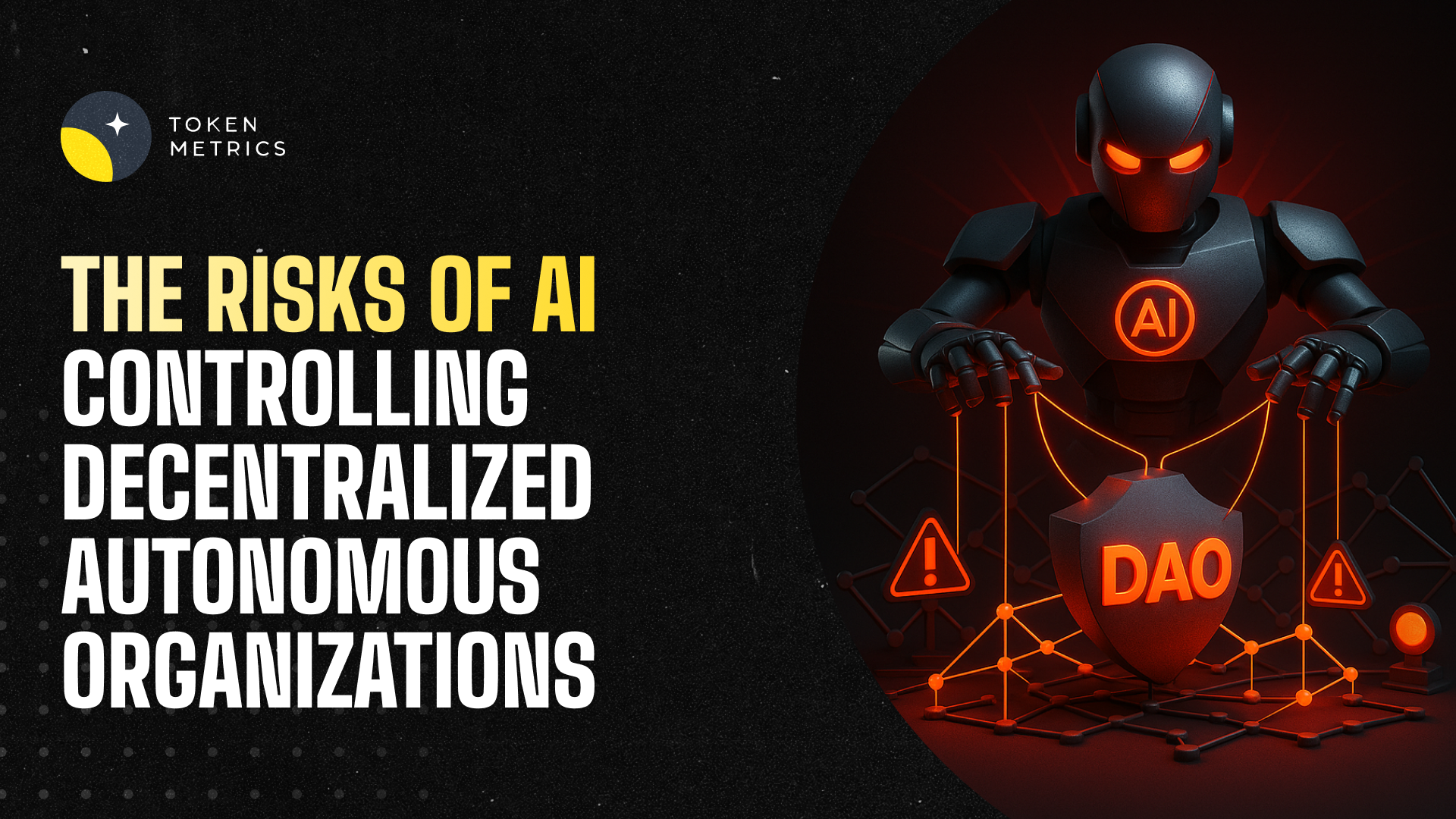
Understanding the Risks of AI Controlling Decentralized Autonomous Organizations

Token Metrics Team
4
MIN

Introduction

Decentralized Autonomous Organizations (DAOs) represent an innovative model for decentralized governance and decision-making in the blockchain space. With the increasing integration of artificial intelligence (AI) into DAOs for automating processes and enhancing efficiency, it is vital to understand the risks associated with allowing AI to control or heavily influence DAOs. This article provides a comprehensive analysis of these risks, exploring technical, ethical, and systemic factors. Additionally, it outlines how analytical platforms like Token Metrics can support informed research around such emerging intersections.

DAO and AI Basics

DAOs are blockchain-based entities designed to operate autonomously through smart contracts and collective governance, without centralized control. AI technologies can offer advanced capabilities by automating proposal evaluation, voting mechanisms, or resource allocation within these organizations. While this combination promises increased efficiency and responsiveness, it also introduces complexities and novel risks.

Technical Vulnerabilities

One significant category of risks involves technical vulnerabilities arising from AI integration into DAOs:

  • Smart Contract Exploits: AI-driven decision-making typically operates on smart contracts. Flaws or bugs in the smart contract code can be exploited, possibly amplified by AI’s autonomous execution.
  • Data Integrity and Quality: AI requires reliable data inputs to function correctly. Malicious actors might inject false or biased data, leading to misguided AI decisions that could harm DAO operations.
  • Algorithmic Errors: AI algorithms might contain bugs, incorrect assumptions, or be insufficiently tested, which could result in unintended behaviors or decisions with negative consequences.

Governance and Control Challenges

Integrating AI into DAO governance raises complex questions around control, transparency, and accountability:

  • Lack of Transparency: AI algorithms, especially those using complex machine learning models, can be opaque, making it difficult for stakeholders to audit decisions or understand governance processes fully.
  • Centralization Risks: AI models are often developed and maintained by specific teams or organizations, which could inadvertently introduce centralization points contrary to the decentralized ethos of DAOs.
  • Unintended Bias: AI systems trained on biased datasets may propagate or exacerbate existing biases within DAO decision-making, risking unfair or harmful outcomes.

Security and Manipulation Risks

The autonomous nature of AI presents unique security concerns:

  • Manipulation Attacks: Adversaries might target the AI’s learning process or input data channels to manipulate outcomes toward malicious goals.
  • Autonomy Exploits: An AI controlling critical DAO functions autonomously could make decisions that are difficult to reverse or disrupt, leading to lasting damage if exploited.
  • Emergent Behavior: Complex AI systems might develop unexpected behaviors in dynamic environments, creating risks hard to anticipate or control within DAO frameworks.

Ethical and Regulatory Concerns

Beyond technical risks, the interaction between AI and DAOs also introduces ethical and regulatory considerations:

  • Accountability Gaps: Determining liability for AI-driven decisions within DAOs is challenging, potentially leading to accountability voids in cases of harm or disputes.
  • Compliance Complexity: Evolving regulatory landscapes surrounding both AI and blockchain could create overlapping or conflicting requirements for AI-controlled DAOs.
  • User Consent and Autonomy: Members participating in DAOs may have concerns over how AI influences governance and whether adequate consent frameworks are in place.

Mitigating Risks with Analytical Tools

Understanding and managing these risks require robust research and analytical frameworks. Platforms such as Token Metrics provide data-driven insights supporting comprehensive evaluation of blockchain projects, governance models, and emerging technologies combining AI and DAOs.

  • Thorough Technical Reviews: Regular audits and reviews of AI algorithms and smart contracts can detect vulnerabilities early.
  • Transparency Initiatives: Employing explainable AI methods enhances trust and allows stakeholder scrutiny.
  • Scenario Analysis: Exploring potential failure modes and adversarial scenarios helps prepare for unexpected outcomes.
  • Community Engagement: Active and informed participation in DAO governance ensures more robust checks and balances.

Conclusion

The fusion of AI and DAOs promises innovative decentralized governance but comes with substantial risks. Technical vulnerabilities, governance challenges, security threats, and ethical concerns highlight the need for vigilant risk assessment and careful integration. Utilizing advanced research platforms like Token Metrics enables more informed and analytical approaches for stakeholders navigating this evolving landscape.

Disclaimer

This article is for educational purposes only and does not constitute financial, legal, or investment advice. Readers should perform their own due diligence and consult professionals where appropriate.

Choose from Platinum, Gold, and Silver packages
Reach with 25–30% open rates and 0.5–1% CTR
Craft your own custom ad—from banners to tailored copy
Perfect for Crypto Exchanges, SaaS Tools, DeFi, and AI Products