Back to blog
Crypto Basics

What is Bitcoin Mining and Is it Profitable?

Learn everything about Bitcoin mining in this guide. Understand the process, potential earnings, and key factors that may impact profitability.
S. Vishwa
9 Minutes
Want Smarter Crypto Picks—Free?
See unbiased Token Metrics Ratings for BTC, ETH, and top alts.
Thank you! Your submission has been received!
Oops! Something went wrong while submitting the form.
 No credit card | 1-click unsubscribe

Cryptocurrency mining has gained popularity as a means of earning passive income and supporting decentralized networks that power digital assets. Bitcoin, in particular, has garnered significant attention for its impact on the overall crypto market.

This comprehensive guide will assist you in evaluating the profitability of Bitcoin mining in 2024 and getting started on your mining endeavor. It will furnish you with all the necessary information to make an informed decision and embark on your mining journey.

Introduction to Bitcoin Mining

What is Bitcoin Mining?

Bitcoin mining can be compared to extracting precious metals from the earth. It is the mechanism through which new bitcoins are minted, and transactions are verified on the blockchain. 

As the Bitcoin white paper describes, mining involves CPU time and electricity to add new coins to circulation.

How Does Bitcoin Mining Work?

Specialized computers, known as miners, perform Bitcoin mining, which competes to solve complex mathematical problems. These problems are designed to be computationally complex and require significant computational power to solve. 

Miners race against each other to find a solution to the problem, and the first miner to successfully solve it earns the right to add the next block of transactions to the blockchain and is rewarded with newly minted bitcoins.

The Role of Proof-of-Work

The mining process in Bitcoin is based on a concept called Proof-of-Work (PoW). Miners must prove that they have performed a certain amount of computational work in order to have a chance at winning the block reward. 

This work is achieved by repeatedly hashing the block's data until a specific pattern or target hash, is found. The target hash is a value set by the network and determines the difficulty of the mining process.

The Importance of Confirmation

Once a miner solves a block, it is added to the blockchain and becomes a confirmed transaction. Confirmation is critical to Bitcoin mining as it ensures that transactions are valid and irreversible.

The more confirmations a transaction has, the more secure it is considered to be. Generally, it is recommended to wait for multiple confirmations before considering a transaction final.

The Process of Bitcoin Mining

Hashing and Target Hash - The hashing process is at the core of Bitcoin mining. Hashing involves taking input data and running it through a cryptographic hash function to produce a fixed-length output. 

In the case of Bitcoin mining, the input data includes the transactions to be verified and other information, such as the previous block's hash. 

Miners repeatedly hash this data, changing a small portion of it known as the nonce, until a hash is generated that meets the target hash criteria set by the network.

Mining Difficulty - The mining difficulty measures how difficult it is to find a hash that meets the target criteria. The difficulty is adjusted approximately every two weeks to ensure that blocks are mined at a consistent rate. 

If the network's total computational power increases, the difficulty will be increased to maintain the average block time of approximately 10 minutes. 

Conversely, if the computational power decreases, the difficulty will be reduced to keep the block time consistent.

Rewards for Miners - Miners are incentivized to participate in the mining process through the rewards they receive. When a miner successfully solves a block, they are rewarded with a predetermined amount of newly minted bitcoins, known as the block reward. 

Additionally, miners receive transaction fees associated with the transactions included in the block. The block reward is halved approximately every four years in an event known as the Bitcoin halving

This event is designed to control the rate at which new bitcoins are introduced into circulation and ensure the scarcity of the cryptocurrency.

Equipment and Costs

Mining Hardware - Bitcoin mining requires specialized hardware known as Application-Specific Integrated Circuits (ASICs). These devices are specifically designed to perform the hashing calculations required for mining and are much more efficient than general-purpose computers. 

ASICs come in various forms, ranging from small USB devices to large mining rigs. The cost of mining hardware can vary significantly depending on the type and performance of the ASIC.

Electricity Consumption - One of the significant costs associated with Bitcoin mining is electricity consumption. The computational power required for mining is energy-intensive and can result in high electricity bills. 

The electricity consumption of mining operations has drawn criticism due to its environmental impact. To maximize profitability, miners must consider the cost of electricity and the energy efficiency of their mining equipment to maximize profitability.

Other Costs - In addition to electricity costs, miners may also incur expenses related to cooling and maintenance. Mining equipment generates significant heat and requires adequate cooling to ensure optimal performance. 

Cooling systems can add to the overall cost of mining operations. Furthermore, regular maintenance and replacement of mining hardware may be necessary to keep up with the rapidly evolving technology.

Also Read - Best Bitcoin Mining Software

Profitability of Bitcoin Mining

Factors Affecting Profitability - The profitability of Bitcoin mining depends on several factors, including the price of Bitcoin, mining difficulty, electricity costs, and the efficiency of mining equipment. 

The price of Bitcoin is highly volatile and can significantly impact mining profitability. When the price is high, mining can be more profitable, but when it is low, mining may not be economically viable for some miners.

Calculating Mining Profitability - To determine whether Bitcoin mining is profitable, miners need to consider the costs associated with mining, including equipment expenses, electricity costs, and any other overheads. 

They also need to estimate the potential rewards from mining, considering the current block reward, transaction fees, and the likelihood of successfully mining a block. Various online calculators are available to help miners estimate their potential profits based on these factors.

Is Bitcoin Mining Profitable?

The profitability of Bitcoin mining varies depending on individual circumstances and market conditions. While some miners have achieved significant profits, others have struggled to break even or generate positive returns. 

The competitiveness of the mining industry and the constantly evolving technology make it challenging for individual miners to remain profitable. The high upfront costs of mining equipment and electricity expenses can also affect potential profits.

Also Read - 8 Best and Profitable Crypto to Mine

Environmental Impact

Energy Consumption - Bitcoin mining has attracted criticism due to its high energy consumption. The computational power required for mining consumes significant electricity, contributing to carbon emissions and environmental concerns. 

The Bitcoin network's energy consumption has been compared to that of entire countries. As the popularity of Bitcoin grows, there is a need for more sustainable and energy-efficient mining practices to mitigate its environmental impact.

Renewable Energy and Sustainability - Efforts are underway to promote the use of renewable energy sources for Bitcoin mining. Some mining operations are powered by renewable energy, such as solar or wind, to reduce their carbon footprint. 

Adopting sustainable mining practices is crucial to address the environmental concerns of Bitcoin mining. Additionally, ongoing research and development in energy-efficient mining hardware are expected to contribute to a more sustainable future for Bitcoin mining.

Getting Started with Bitcoin Mining

1. Choosing a Mining Pool

Joining a mining pool can increase individual miners' chances of earning rewards. Mining pools allow miners to combine their computational power and work together to mine blocks more efficiently. 

When a block is successfully mined, the rewards are distributed among the pool members based on their contribution. Joining a mining pool can provide miners with a more consistent income stream, especially for those with limited computational resources.

2. Setting Up Mining Hardware

Setting up mining hardware requires careful consideration of factors such as cooling, electricity supply, and network connectivity. Miners must ensure their hardware is properly configured and optimized for mining. 

Adequate cooling is essential to prevent overheating and ensure optimal performance. Additionally, miners should have a stable and reliable internet connection to stay connected to the Bitcoin network.

3. Mining Software

Mining software is essential for managing and controlling the mining process. It allows miners to connect their hardware to the mining pool and monitor their mining activities. 

Several mining software options are available, each with its features and compatibility with different mining hardware. Miners should choose software that is compatible with their hardware and offers the necessary features for efficient mining.

Risks and Challenges

Market Volatility - The volatile nature of Bitcoin's price poses a significant risk to mining profitability. The price of Bitcoin can fluctuate dramatically within a short period, impacting the potential rewards for miners. 

Sharp price declines can lead to reduced profitability or even losses for miners. Miners should be prepared for the inherent market risks associated with Bitcoin mining and consider strategies to mitigate these risks.

Regulatory Environment - The regulatory environment surrounding Bitcoin mining varies across jurisdictions. Some countries have embraced cryptocurrencies and have favorable regulations for mining operations, while others have imposed strict regulations or outright bans. 

Miners should stay informed about their respective locations' legal and regulatory developments to ensure compliance and mitigate regulatory risks.

Competition and Centralization - Bitcoin mining has become increasingly competitive, with large-scale mining operations dominating the industry. These operations have access to significant computational power and resources, which can make it difficult for individual miners to compete. 

The concentration of mining power in the hands of a few entities raises concerns about centralization and the potential for network security vulnerabilities. Miners should be aware of the competitive landscape and consider the implications of centralization on the Bitcoin network.

Conclusion

Bitcoin mining plays a crucial role in the functioning and security of the Bitcoin network. It involves solving complex mathematical problems to validate transactions and mint new bitcoins. 

While mining can be profitable under the right circumstances, it is a highly competitive and resource-intensive process. Miners must carefully consider the costs and risks of mining before getting involved. 

The environmental impact of mining also raises important sustainability concerns that need to be addressed through the adoption of renewable energy sources and energy-efficient mining practices. 

As the cryptocurrency landscape continues to evolve, miners must stay informed and adapt to changing market conditions to maximize their chances of success in the mining industry.

Disclaimer

The information provided on this website does not constitute investment advice, financial advice, trading advice, or any other advice, and you should not treat any of the website's content as such.

Token Metrics does not recommend buying, selling, or holding any cryptocurrency. Conduct your due diligence and consult your financial advisor before making investment decisions.

Build Smarter Crypto Apps &
AI Agents in Minutes, Not Months
Real-time prices, trading signals, and on-chain insights all from one powerful API.
Grab a Free API Key
About Token Metrics
Token Metrics: AI-powered crypto research and ratings platform. We help investors make smarter decisions with unbiased Token Metrics Ratings, on-chain analytics, and editor-curated “Top 10” guides. Our platform distills thousands of data points into clear scores, trends, and alerts you can act on.
30 Employees
analysts, data scientists, and crypto engineers
Daily Briefings
concise market insights and “Top Picks”
Transparent & Compliant
Sponsored ≠ Ratings; research remains independent
Want Smarter Crypto Picks—Free?
See unbiased Token Metrics Ratings for BTC, ETH, and top alts.
Thank you! Your submission has been received!
Oops! Something went wrong while submitting the form.
 No credit card | 1-click unsubscribe
Token Metrics Team
Token Metrics Team

Recent Posts

Research

How to Use x402 with Token Metrics: Composer Walkthrough + Copy-Paste Axios/HTTPX Clients

Token Metrics Team
9 min read

What You Will Learn — Two-Paragraph Opener

This tutorial shows you how to use x402 with Token Metrics in two ways. First, we will walk through x402 Composer, where you can run Token Metrics agents, ask questions, and see pay-per-request tool calls stream into a live Feed with zero code. Second, we will give you copy-paste Axios and HTTPX clients that handle the full x402 flow (402 challenge, wallet payment, automatic retry) so you can integrate Token Metrics into your own apps.

Whether you are exploring x402 for the first time or building production agent workflows, this guide has you covered. By the end, you will understand how x402 payments work under the hood and have working code you can ship today. Let's start with the no-code option in Composer.

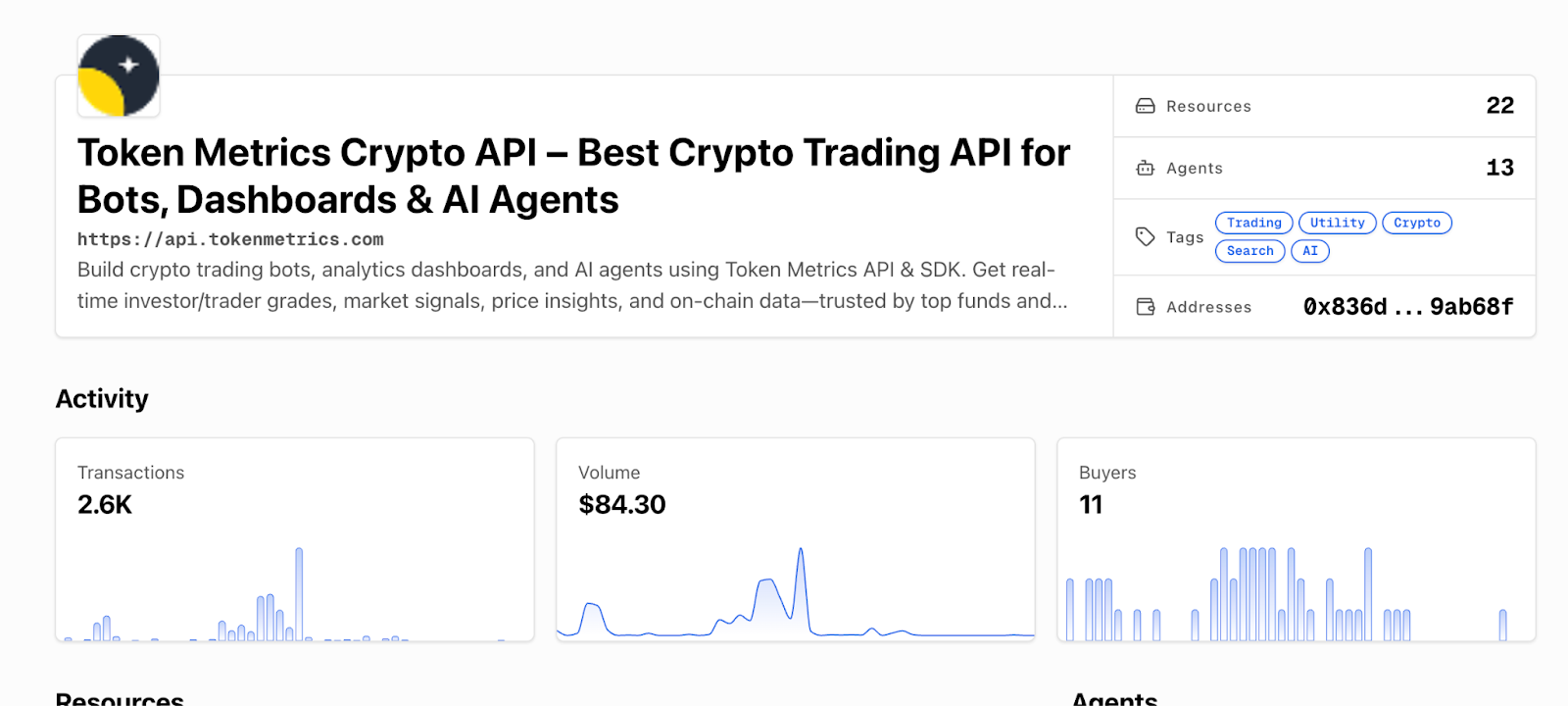
Start using Token Metrics X402 integration here. https://www.x402scan.com/server/244415a1-d172-4867-ac30-6af563fd4d25 

Part 1: Try x402 + Token Metrics in Composer (No Code Required)

x402 Composer is a playground for AI agents that pay per tool call. You can test Token Metrics endpoints, see live payment settlements, and understand the x402 flow before writing any code.

What Is Composer?

Composer is x402scan's hosted environment for building and using AI agents that pay for external resources via x402. It provides a chat interface, an agent directory, and a real-time Feed showing every tool call and payment across the ecosystem. Token Metrics endpoints are available as tools that agents can call on demand.

Explore Composer: https://x402scan.com/composer

Step-by-Step Walkthrough

Follow these steps to run a Token Metrics query and watch the payment happen in real time.

  1. Open the Composer agents directory: Go to https://x402scan.com/composer/agents and browse available agents. Look for agents tagged with "Token Metrics" or "crypto analytics." Or check our our integration here. https://www.x402scan.com/server/244415a1-d172-4867-ac30-6af563fd4d25 
  2. Select an agent: Click into an agent that uses Token Metrics endpoints (for example, a trading signals agent or market intelligence agent). You will see the agent's description, configured tools, and recent activity.
  3. Click "Use Agent": This opens a chat interface where you can run prompts against the agent's configured tools.
  4. Run a query: Type a question that requires calling a Token Metrics endpoint, for example "Give me the latest TM Grade for Ethereum" or "What are the top 5 moonshot tokens right now?" and hit send.
  5. Watch the Feed: As the agent processes your request, it will call the relevant Token Metrics endpoint. Open the Composer Feed (https://x402scan.com/composer/feed) in a new tab to see the tool call appear in real time with payment details (USDC or TMAI amount, timestamp, status).


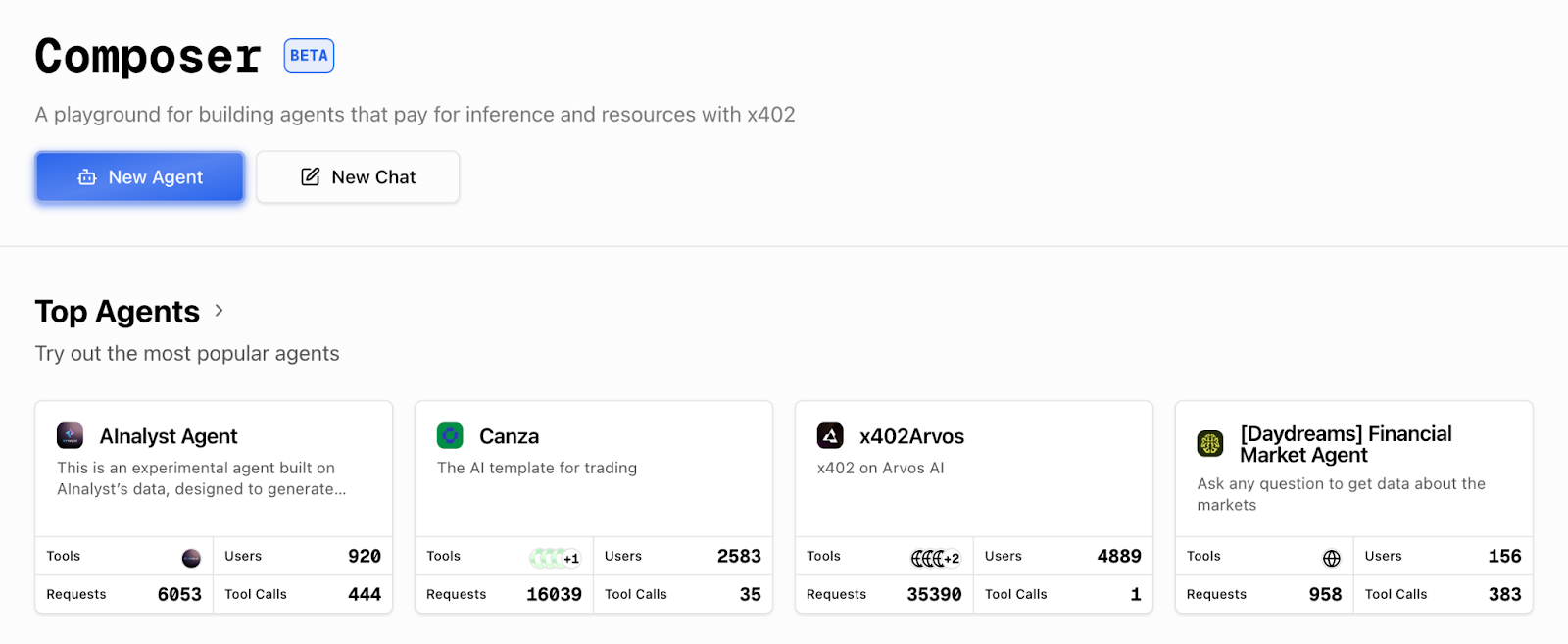
Composer agents directory: Composer Agents page: Each agent shows tool stack, messages, and recent activity.


Individual agent page: Agent detail page: View tools, description, and click "Use Agent" to start.

[INSERT SCREENSHOT: Chat interface]

Chat interface: Chat UI: Ask a question like "What are the top trading signals for BTC today?"

[INSERT SCREENSHOT: Composer Feed]

Composer Feed: Live Feed: Each tool call shows the endpoint, payment token, amount, and settlement status.

That is the x402 flow in action. The agent's wallet paid for the API call automatically, the server verified payment, and the data came back. No API keys, no monthly bills, just pay-per-use access.

Key Observations from Composer

  • Tool calls show the exact endpoint called (like /v2/tm-grade or /v2/moonshot-tokens)
  • Payments display in USDC or TMAI with the per-call cost
  • The Feed updates in real time, you can see other agents making calls across the ecosystem
  • You can trace each call back to the agent and message that triggered it
  • This is how agentic commerce works: agents autonomously pay for resources as needed

Part 2: Build Your Own x402 Client (Axios + HTTPX)

Now that you have seen x402 in action, let's build your own client that can call Token Metrics endpoints with automatic payment handling.

How x402 Works (Quick Refresher)

When you make a request with the x-coinbase-402 header, the Token Metrics API returns a 402 Payment Required response with payment instructions (recipient address, amount, chain). Your x402 client reads this challenge, signs a payment transaction with your wallet, submits it to the blockchain, and then retries the original request with proof of payment. The server verifies the settlement and returns the data. The x402-axios and x402 Python libraries handle this flow automatically.

Prerequisites

  • A wallet with a private key (use a testnet wallet for development on Base Sepolia, or a mainnet wallet for production on Base)
  • USDC or TMAI in your wallet (testnet USDC for testing, mainnet tokens for production)
  • Node.js 18+ and npm (for Axios example) or Python 3.9+ (for HTTPX example)
  • Basic familiarity with async/await patterns

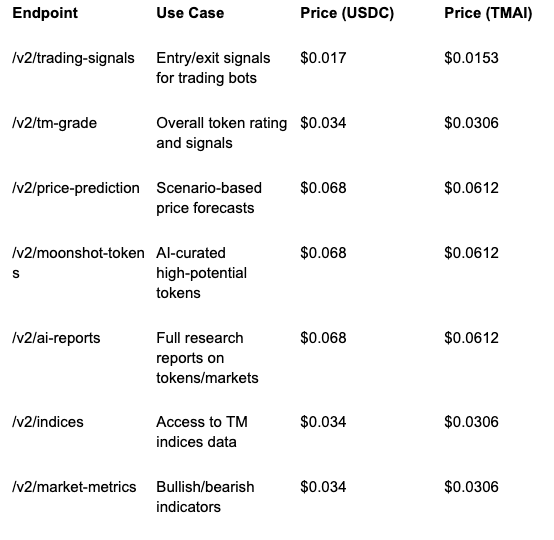
Recommended Token Metrics Endpoints for x402

These endpoints are commonly used by agents and developers building on x402. All are pay-per-call with transparent pricing.

Full endpoint list and docs: https://developers.tokenmetrics.com 

Common Errors and How to Fix Them

Here are the most common issues developers encounter with x402 and their solutions.

Error: Payment Failed (402 Still Returned After Retry)

This usually means your wallet does not have enough USDC or TMAI to cover the call, or the payment transaction failed on-chain.

  • Check your wallet balance on Base (use a block explorer or your wallet app)
  • Make sure you are on the correct network (Base mainnet for production, Base Sepolia for testnet)
  • Verify your private key has permission to spend the token (no allowance issues for most x402 flows, but check if using a smart contract wallet)
  • Try a smaller request or switch to a cheaper endpoint to test

Error: Network Timeout

x402 requests take longer than standard API calls because they include a payment transaction. If you see timeouts, increase your client timeout.

  • Set timeout to at least 30 seconds (30000ms in Axios, 30.0 in HTTPX)
  • Check your RPC endpoint is responsive (viem/eth-account uses public RPCs by default, which can be slow)
  • Consider using a dedicated RPC provider (Alchemy, Infura, QuickNode) for faster settlement

Error: 429 Rate Limit Exceeded

Even with pay-per-call, Token Metrics enforces rate limits to prevent abuse. If you hit a 429, back off and retry.

  • Implement exponential backoff (wait 1s, 2s, 4s, etc. between retries)
  • Spread requests over time instead of bursting
  • For high-volume use cases, contact Token Metrics to discuss rate limit increases

Error: Invalid Header or Missing x-coinbase-402

If you forget the x-coinbase-402: true header, the server will treat your request as a standard API call and may return a 401 Unauthorized if no API key is present.

  • Always include x-coinbase-402: true in headers for x402 requests
  • Do not send x-api-key when using x402 (the header is mutually exclusive)
  • Double-check header spelling (it is x-coinbase-402, not x-402 or x-coinbase-payment)

Production Tips

  • Use environment variables for private keys, never hardcode them
  • Set reasonable max_payment limits to avoid overspending (especially with TMAI)
  • Log payment transactions for accounting and debugging
  • Monitor your wallet balance and set up alerts for low funds
  • Test thoroughly on Base Sepolia testnet before going to mainnet
  • Use TMAI for production to get the 10% discount on every call
  • Cache responses when possible to reduce redundant paid calls
  • Implement retry logic with exponential backoff for transient errors

Why This Matters for Agents

Traditional APIs force agents to carry API keys, which creates security risks and requires human intervention for key rotation and billing. With x402, agents can pay for themselves using wallet funds, making them truly autonomous. This unlocks agentic commerce where AI systems compose services on the fly, paying only for what they need without upfront subscriptions or complex auth flows.

For Token Metrics specifically, x402 means agents can pull real-time crypto intelligence (signals, grades, predictions, research) as part of their decision loops. They can chain our endpoints with other x402-enabled tools like Heurist Mesh (on-chain data), Tavily (web search), and Firecrawl (content extraction) to build sophisticated, multi-source analysis workflows. It is HTTP-native payments meeting real-world agent use cases.

FAQs

Can I use the same wallet for multiple agents?

Yes. Each agent (or client instance) can use the same wallet, but be aware of nonce management if making concurrent requests. The x402 libraries handle this automatically.

Do I need to approve token spending before using x402?

No. The x402 payment flow uses direct transfers, not approvals. Your wallet just needs sufficient balance.

Can I see my payment history?

Yes. Check x402scan (https://x402scan.com/composer/feed) for a live feed of all x402 transactions, or view your wallet's transaction history on a Base block explorer.

What if I want to use a different payment token?

Currently x402 with Token Metrics supports USDC and TMAI on Base. To request support for additional tokens, contact Token Metrics.

How do I switch from testnet to mainnet?

Change your viem chain from baseSepolia to base (in Node.js) or update your RPC URL (in Python). Make sure your wallet has mainnet USDC or TMAI.

Can I use x402 in browser-based apps?

Yes, but you will need a browser wallet extension (like MetaMask or Coinbase Wallet) and a frontend-compatible x402 library. The current x402-axios and x402-python libraries are designed for server-side or Node.js environments.

Next Steps

Disclosure

Educational and informational purposes only. x402 involves crypto payments on public blockchains. Understand the risks, secure your private keys, and test thoroughly before production use. Token Metrics does not provide financial advice.

Quick Links

About Token Metrics

Token Metrics provides powerful crypto analytics, signals, and AI-driven tools to help you make smarter trading and investment decisions. Start exploring Token Metrics ratings and APIs today for data-driven success.

Research

Our x402 Integration Is Live: Pay-Per-Call Access to Token Metrics—No API Key Required

Token Metrics Team
7 min read

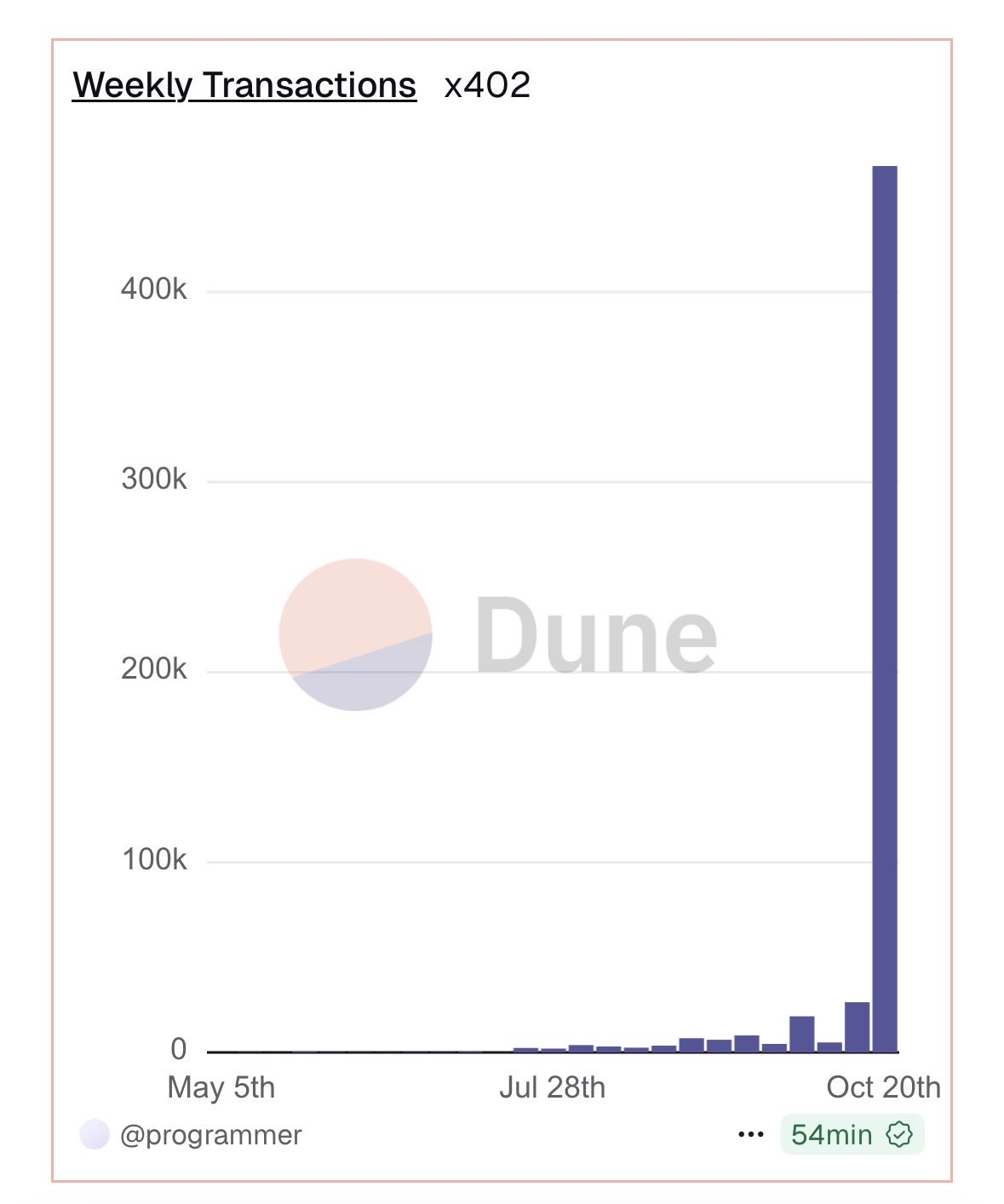
Developers are already shipping with x402 at scale: 450,000+ weekly transactions, 700+ projects. This momentum is why our Token Metrics x402 integration matters for agents and apps that need real crypto intelligence on demand. You can now pay per API call using HTTP 402 and the x-coinbase-402 header, no API key required.

   _ 

Summary: Pay per API call to Token Metrics with x402 on Base using USDC or TMAI, set x-coinbase-402: true, and get instant access to trading signals, grades, and AI reports.

Check out the x402 ecosystem on Coingecko.


What You Get

Token Metrics now supports x402, the HTTP-native payment protocol from Coinbase. Users can call any public endpoint by paying per request with a wallet, eliminating API key management and upfront subscriptions. This makes Token Metrics data instantly accessible to AI agents, researchers, and developers who want on-demand crypto intelligence.

x402 enables truly flexible access where you pay only for what you use, with transparent per-call pricing in USDC or TMAI. The integration is live now across all Token Metrics public endpoints, from trading signals to AI reports. Here's everything you need to start calling Token Metrics with x402 today.

Quick Start

Get started with x402 + Token Metrics in three steps.

  1. Create a wallet client: Follow the x402 Quickstart for Buyers to set up a wallet client (Node.js with viem or Python with eth-account). Link: https://docs.cdp.coinbase.com/x402/docs/quickstart-buyers
  2. Set required headers: Add x-coinbase-402: true to any Token Metrics request. Optionally set x-payment-token: tmai for a 10% discount (defaults to usdc). Do not send x-api-key when using x402.
  3. Call any endpoint: Make a request to https://api.tokenmetrics.com/v2/[endpoint] with your wallet client. Payment happens automatically via x402 settlement.

That is it. Your wallet pays per call, and you get instant access to Token Metrics data with no subscription overhead.

Required Headers


Endpoint Pricing

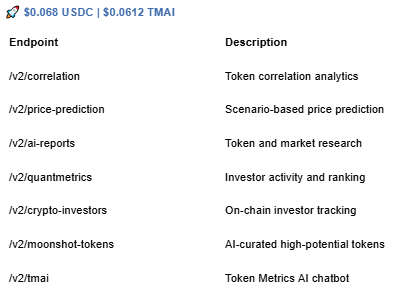
Transparent per-call pricing across all Token Metrics public endpoints. Pay in USDC or get 10% off with TMAI.


All prices are per single call. Paying with TMAI automatically applies a 10% discount.

Try It on x402 Composer

If you want to see x402 + Token Metrics in action without writing code, head to x402 Composer. Composer is x402scan's playground for AI agents that pay per tool call. You can open a Token Metrics agent, chat with it, and watch real tool calls and USDC/TMAI settlements stream into the live Feed.

Composer surfaces active agents using Token Metrics endpoints like trading signals, price predictions, and AI reports. It is a great way to explore what is possible before you build your own integration. Link: https://x402scan.com/composer

Why x402 Changes the Game

Traditional API access requires upfront subscriptions, fixed rate limits, and key management overhead. x402 flips that model by letting you pay per call with a crypto wallet, with no API keys or monthly commitments. This is especially powerful for AI agents, which need flexible, on-demand access to external data without human intervention.

For Token Metrics, x402 unlocks agentic commerce where agents can autonomously pull crypto intelligence, pay only for what they use, and compose our endpoints with other x402-enabled tools like Heurist Mesh, Tavily, and Firecrawl. It is HTTP-native payments meeting real-world agent workflows.

What is x402?

x402 is an open-source HTTP-native payment protocol developed by Coinbase. It uses the HTTP 402 status code (Payment Required) to enable pay-per-request access to APIs and services. When you make a request with the x-coinbase-402 header, the server returns a payment challenge, your wallet signs and submits payment, and the server fulfills the request once settlement is verified.

The protocol runs on Base and Solana, with USDC and TMAI as the primary payment tokens. x402 is designed for composability, agents can chain multiple paid calls across different providers in a single workflow, paying each service directly without intermediaries. Learn more at the x402 Quickstart for Buyers: https://docs.cdp.coinbase.com/x402/docs/quickstart-buyers

FAQs

Do I need an API key to use x402 with Token Metrics?

No. When you set x-coinbase-402: true, your wallet signature replaces API key authentication. Do not send x-api-key in your requests.

Can I use x402 with a free trial or test wallet?

Yes, but you will need testnet USDC or TMAI on Base Sepolia (testnet) for development. Production calls require mainnet tokens.

How do I see my payment history?

Check x402scan for transaction logs and tool call history. Your wallet will also show outgoing USDC/TMAI transactions. Visit https://www.x402scan.com.

What happens if my wallet balance is too low?

The x402 client will return a payment failure before making the API call. Top up your wallet and retry.

Can I use x402 in production apps?

Yes. x402 is live on Base mainnet. Set appropriate spend limits and handle payment errors gracefully in your code.

Next Steps

Disclosure

Educational and informational purposes only. x402 involves crypto payments on public blockchains. Understand the risks, manage your wallet security, and test thoroughly before production use. Token Metrics does not provide financial advice.

Powered by Token Metrics

Your AI-powered crypto research experience is made possible by Token Metrics. Discover data-driven insights and advanced analytics on your favorite coins and tokens.

Research

Uniswap Price Prediction 2027: $13.50-$43 Target Analysis

Token Metrics Team
8 min read

Uniswap Price Prediction: Market Context for UNI in the 2027 Case

DeFi protocols are maturing beyond early ponzi dynamics toward sustainable revenue models. Uniswap operates in this evolving landscape where real yield and proven product market fit increasingly drive valuations rather than speculation alone. Growing regulatory pressure on centralized platforms creates tailwinds for decentralized alternatives.

The price prediction scenario bands below reflect how UNI might perform across different total crypto market cap environments. Each tier represents a distinct liquidity regime, from bear conditions with muted DeFi activity to moon price prediction scenarios where decentralized infrastructure captures significant value from traditional finance.


Disclosure

Educational purposes only, not financial advice. Crypto is volatile, do your own research and manage risk.

How to read this price prediction:

Each band blends cycle analogues and market cap share math with TA guardrails. Base assumes steady adoption and neutral or positive macro. Moon layers in a liquidity boom. Bear assumes muted flows and tighter liquidity.

TM Agent baseline:

Token Metrics TM Grade is 69%, Buy, and the trading signal is bullish. Price prediction scenarios cluster roughly between $6.50 and $28, with a base case price target near $13.50.

Live details: Uniswap Token Details 

Affiliate Disclosure: We may earn a commission from qualifying purchases made via this link, at no extra cost to you.

Key Takeaways

  • Scenario driven, outcomes hinge on total crypto market cap, higher liquidity and adoption lift the bands.
  • Fundamentals: Fundamental Grade 79.88% (Community 77%, Tokenomics 100%, Exchange 100%, VC 66%, DeFi Scanner 62%).
  • Technology: Technology Grade 86.88% (Activity 72%, Repository 72%, Collaboration 100%, Security N/A, DeFi Scanner 62%).
  • TM Agent gist: bullish bias with a base case near $13.50 and a broad range between $6.50 and $28.
  • Education only, not financial advice.

Uniswap Price Prediction: Scenario Analysis

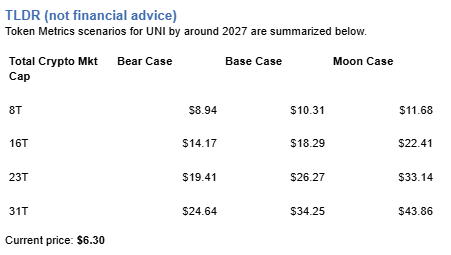
Token Metrics price prediction scenarios span four market cap tiers, each representing different levels of crypto market maturity and liquidity:

8T Market Cap Price Prediction:

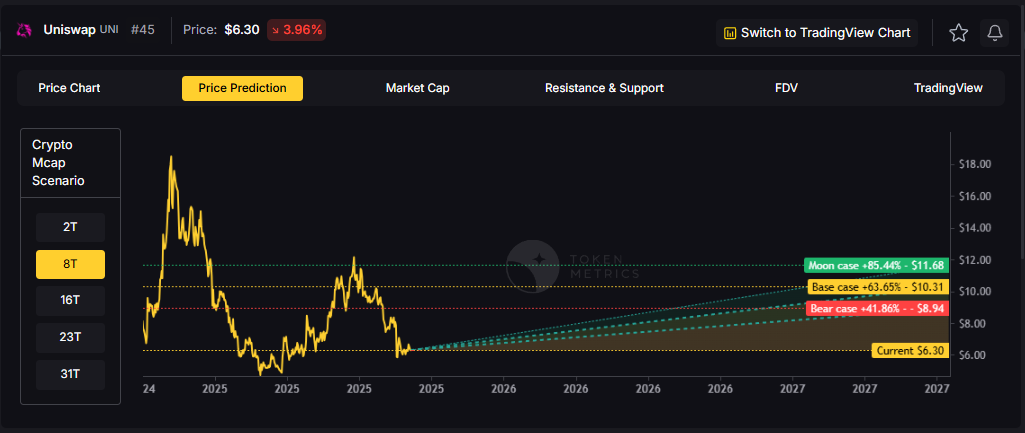
At an 8 trillion dollar total crypto market cap, UNI price prediction projects to $8.94 in bear conditions, $10.31 in the base case, and $11.68 in bullish scenarios.

16T Market Cap Price Prediction:

Doubling the market to 16 trillion expands the price prediction range to $14.17 (bear), $18.29 (base), and $22.41 (moon).

23T Market Cap Price Prediction:

At 23 trillion, the price forecast scenarios show $19.41, $26.27, and $33.14 respectively.

31T Market Cap Price Prediction:

In the maximum liquidity scenario of 31 trillion, UNI price prediction could reach $24.64 (bear), $34.25 (base), or $43.86 (moon).

Each tier assumes progressively stronger market conditions, with the base case price prediction reflecting steady growth and the moon case requiring sustained bull market dynamics.

Why Consider the Indices with Top-100 Exposure

Uniswap represents one opportunity among hundreds in crypto markets. Token Metrics Indices bundle UNI with top one hundred assets for systematic exposure to the strongest projects. Single tokens face idiosyncratic risks that diversified baskets mitigate.

Historical index performance demonstrates the value of systematic diversification versus concentrated positions.

Join the early access list

What Is Uniswap?

Uniswap is a decentralized exchange protocol built on Ethereum that enables token swaps using automated market makers instead of order books. It aims to provide open access to liquidity for traders, developers, and applications through transparent smart contracts.

UNI is the governance token that lets holders vote on protocol upgrades and parameters, aligning incentives across the ecosystem. The protocol is a market leader in decentralized exchange activity with broad integration across wallets and DeFi apps.

Token Metrics AI Analysis for Price Prediction

Token Metrics AI provides comprehensive context on Uniswap's positioning and challenges that inform our price prediction models.

Vision: Uniswap aims to create a fully decentralized and permissionless financial market where anyone can trade or provide liquidity without relying on centralized intermediaries. Its vision emphasizes open access, censorship resistance, and community driven governance.

Problem: Traditional exchanges require trusted intermediaries to match buyers and sellers, creating barriers to access, custody risks, and potential for censorship. In DeFi, the lack of efficient, trustless mechanisms for token swaps limits interoperability and liquidity across applications.

Solution: Uniswap solves this by using smart contracts to create liquidity pools funded by users who earn trading fees in return. The protocol automatically prices assets using a constant product formula, enabling seamless swaps. UNI token holders can participate in governance, influencing parameters like fee structures and protocol upgrades.

Market Analysis: Uniswap operates within the broader DeFi and Ethereum ecosystems, competing with other decentralized exchanges like SushiSwap, Curve, and Balancer. It is a market leader in terms of cumulative trading volume and liquidity depth. Adoption is strengthened by strong developer activity, widespread integration across wallets and dApps, and a large user base.

Fundamental and Technology Snapshot from Token Metrics

Fundamental Grade: 79.88% (Community 77%, Tokenomics 100%, Exchange 100%, VC 66%, DeFi Scanner 62%).


Technology Grade: 86.88% (Activity 72%, Repository 72%, Collaboration 100%, Security N/A, DeFi Scanner 62%).

Catalysts That Skew Bullish for Price Prediction

  • Institutional and retail access expands with ETFs, listings, and integrations
  • Macro tailwinds from lower real rates and improving liquidity
  • Product or roadmap milestones such as upgrades, scaling, or partnerships
  • These factors could push UNI toward higher price prediction targets

Risks That Skew Bearish for Price Prediction

  • Macro risk off from tightening or liquidity shocks
  • Regulatory actions or infrastructure outages
  • Competitive displacement across DEXs or changes to validator and liquidity incentives
  • These factors could push UNI toward lower price prediction scenarios

FAQs: Uniswap Price Prediction

Will UNI hit $20 by 2027 according to price predictions?

The 16T price prediction scenario shows UNI at $18.29 in the base case, which does not exceed $20. However, the 23T base case shows $26.27, surpassing the $20 target. Price prediction outcome depends on total crypto market cap growth and Uniswap maintaining market share. Not financial advice.

Can UNI 10x from current levels based on price predictions?

At current price of $6.30, a 10x would reach $63.00. This falls within none of the listed price prediction scenarios, which top out at $43.86 in the 31T moon case. Bear in mind that 10x returns require substantial market cap expansion beyond our modeled scenarios. Not financial advice.

What price could UNI reach in the moon case price prediction?

Moon case price predictions range from $11.68 at 8T to $43.86 at 31T total crypto market cap. These price prediction scenarios assume maximum liquidity expansion and strong Uniswap adoption. Not financial advice.

What is the 2027 Uniswap price prediction?

Based on Token Metrics analysis, the 2027 price prediction for Uniswap centers around $13.50 in the base case under current market conditions, with a range between $6.50 and $28 depending on market scenarios. Bullish price predictions with strong market conditions range from $10.31 to $43.86 across different total crypto market cap environments.

What drives UNI price predictions?

UNI price predictions are driven by DEX trading volume, liquidity provider activity, governance participation, protocol fee revenue, and competition from other decentralized exchanges. The strong technology grade (86.88%) and bullish signal support upward price potential. DeFi adoption rates and regulatory clarity around decentralized exchanges remain primary drivers for reaching upper price prediction targets.

Can UNI reach $30-$40 by 2027?

According to our price prediction models, UNI could reach $30-$40 in the 23T moon case ($33.14) and in the 31T scenarios where the base case is $34.25 and the moon case is $43.86. These price prediction outcomes require significant crypto market expansion and Uniswap maintaining DEX market leadership. Not financial advice.


Next Steps

Disclosure

Educational purposes only, not financial advice. Crypto is volatile, do your own research and manage risk.

Why Use Token Metrics for Uniswap Research?

  • Get on-chain ratings, AI-powered scenario projections, backtested indices, and exclusive insights for Uniswap and other top-100 crypto assets.
  • Spot emerging trends before the crowd and manage risk with our transparent AI grades.
  • Token Metrics helps you save time, avoid hidden pitfalls, and discover data-driven opportunities in DeFi.
Choose from Platinum, Gold, and Silver packages
Reach with 25–30% open rates and 0.5–1% CTR
Craft your own custom ad—from banners to tailored copy
Perfect for Crypto Exchanges, SaaS Tools, DeFi, and AI Products