Back to blog
Crypto Basics

What is BscScan and How Does it Work?

Discover the inner workings of BscScan and how it serves as an essential tool for monitoring Binance Smart Chain transactions and assets in this guide.
S. Vishwa
11 Minutes
Want Smarter Crypto Picks—Free?
See unbiased Token Metrics Ratings for BTC, ETH, and top alts.
Thank you! Your submission has been received!
Oops! Something went wrong while submitting the form.
 No credit card | 1-click unsubscribe

Click here to buy Cryptocurrencies from Gate.io

Blockchain technology has revolutionized the world of finance and decentralized applications. As the popularity of cryptocurrencies grows, so does the need for reliable tools to navigate and explore different blockchain networks. 

BscScan is a tool designed explicitly for the Binance Smart Chain (BSC). In this comprehensive guide, we will delve into the intricacies of BscScan, its functionalities, and how to make the most of this powerful blockchain explorer.

What is BscScan?

BscScan is the premier blockchain explorer for the Binance Smart Chain (BSC), developed by the same team responsible for creating Etherscan. Launched in 2020, BSC has rapidly gained popularity as a scalable and efficient blockchain network for decentralized applications and digital assets. 

BscScan provides users with a comprehensive view of the BSC ecosystem, allowing them to explore wallet addresses, track transactions, verify intelligent contracts, and analyze token data.

As a blockchain explorer, BscScan acts as a search engine for the BSC network, providing real-time information about transactions, blocks, addresses, and smart contracts. 

It offers a user-friendly interface that makes navigating and extracting valuable insights from the BSC blockchain accessible. Whether you are a developer, investor, or blockchain enthusiast, BscScan is an indispensable tool for interacting with the BSC network.

Understanding BscScan's Features

Real-Time Transaction Tracking

One of the core functionalities of BscScan is its ability to track transactions on the Binance Smart Chain in real time. By entering the transaction hash or wallet address, users can retrieve detailed information about a specific transaction, including the transaction amount, date, block number, balances, transaction fees, and status. 

This feature is handy for individuals who want to monitor the progress of their transactions or verify the authenticity of a particular transaction on the BSC network.

Exploring Wallet Addresses

BscScan allows users to explore wallet addresses on the Binance Smart Chain, providing a comprehensive overview of transaction history, token balances, and other relevant information. 

Users can access details such as BNB balance, BEP-20 token holdings, transaction data, and more by entering a wallet address into the search bar. 

This feature enables users to gain insights into the activity of specific wallets and track the movement of digital assets on the BSC network.

Smart Contract Verification

Smart contracts are an integral part of the Binance Smart Chain ecosystem, enabling the creation and execution of decentralized applications. 

BscScan offers an intelligent contract verification feature, allowing users to verify the authenticity and integrity of smart contracts deployed on the BSC network. 

By comparing the compiled code of a smart contract with the code running on the blockchain, users can ensure that the contract functions as intended and mitigate the risk of potential vulnerabilities or malicious activities.

Token Tracking and Analysis

BscScan allows users to track and analyze tokens on the Binance Smart Chain. Users can access information about the top BEP-20 tokens, including prices, volume, market capitalization, number of holders, and cross-chain compatibility. 

Additionally, BscScan supports ERC-721 and ERC-1155 tokens, making it possible to explore and track non-fungible tokens (NFTs) on the BSC network. 

This feature is invaluable for investors and traders looking to stay updated on the performance and trends of different tokens within the BSC ecosystem.

Gas Price Monitoring

Gas fees are essential to any blockchain network, including Binance Smart Chain. BscScan offers a gas price monitoring feature, allowing users to view real-time information about gas fees on the BSC network. 

By monitoring gas prices, users can make informed decisions about transaction fees and navigate the network efficiently. This feature is handy during periods of high network congestion when gas fees tend to fluctuate.

Using BscScan: Step-by-Step Guide

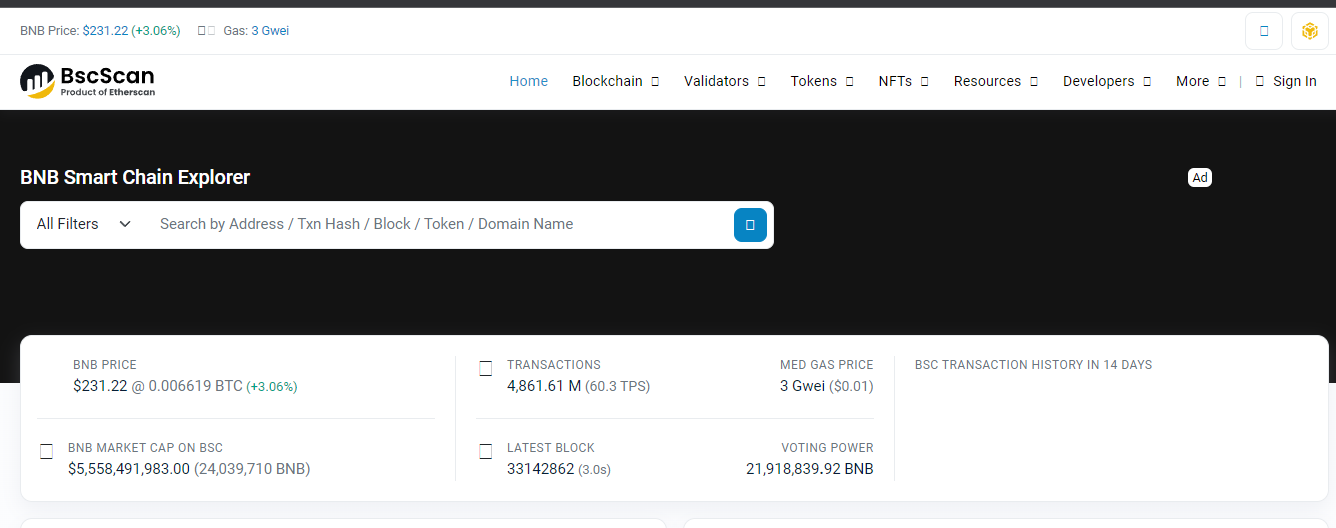
BscScan provides a user-friendly interface that makes it easy for users to navigate and extract valuable information from the Binance Smart Chain. In this step-by-step guide, we will walk you through using BscScan's key features.
BscScan

Checking Transactions on BscScan

  • Visit the BscScan website at bscscan.com.
  • In the search bar at the top of the page, enter the transaction hash or wallet address you want to investigate.
  • BscScan will query its database and display detailed information about the transaction, including the transaction amount, date, block number, balances, transaction fees, and status.
  • Take note of the transaction status, which can be pending, successful, or failed. This information will help you determine the progress and outcome of the transaction.
  • You can also explore additional details about the transaction by clicking on specific sections, such as the sender's address, recipient's address, or transaction hash.

Exploring Wallet Addresses

  • On the BscScan homepage, locate the search bar at the top of the page.
  • Enter the wallet address that you want to explore and press Enter or click the search icon.
  • BscScan will provide an overview of the wallet address, including the BNB balance and the balances of any BEP-20 tokens held in the wallet.
  • Scroll down to view the transaction history associated with the wallet address, including incoming and outgoing transactions.
  • You can click on individual transactions to access more detailed information, such as the transaction hash, block number, and transaction fee.

Verifying Smart Contracts

  • Navigate to the BscScan website and locate the "Verify Contract" section.
  • Enter the smart contract address that you want to verify.
  • Select the appropriate compiler type and open-source license type.
  • Copy and paste the Solidity contract code into the designated field.
  • Enable optimization by selecting "Yes" in the optimization dropdown menu if applicable.
  • Click the "Verify and Publish" button to initiate the contract verification process.
  • BscScan will compare the submitted code with the code running on the BSC network and provide a verification result indicating whether the contract code matches.

Tracking Tokens on BscScan

  • Access the BscScan website and navigate to the "Tokens" section.
  • Explore the top BEP-20 tokens listed on BscScan, including their prices, volume, market capitalization, and number of holders.
  • Use the search bar to find specific tokens by their contract address or token symbol.
  • Click on individual tokens for more detailed information, such as the token's contract address, token holders, transaction history, and related smart contracts.
  • BscScan also supports ERC-721 and ERC-1155 tokens, allowing users to explore and track non-fungible tokens (NFTs) on the BSC network.

Monitoring Gas Prices

  • Visit the BscScan website and locate the "Gas Tracker" section.
  • Monitor the average gas price displayed on the page.
  • Check the block size and average utilization to understand the current network congestion.
  • Scroll down to view the BSC network's top gas guzzlers and spenders.
  • Use this information to make informed decisions about gas fees and optimize your transactions on the Binance Smart Chain.

Click here to buy Cryptocurrencies from Gate.io

BscScan vs. Etherscan: Key Differences

While BscScan and Etherscan share similarities as blockchain explorers, the two platforms have some key differences. Here are the main distinctions:

  • Supported Wallets: BscScan supports a limited number of wallets (e.g., MetaMask, TrustWallet) compared to Etherscan, which supports a broader range of wallets.
  • Features: Etherscan has the advantage of offering Blockchain APIs and Crypto APIs, providing developers with more advanced functionalities for interacting with the Ethereum blockchain.
  • Focus: BscScan is designed explicitly for the Binance Smart Chain, while Etherscan caters to the Ethereum network. Each explorer prioritizes features and data relevant to its respective blockchain.

BscScan and Etherscan are reputable and reliable explorers, offering valuable insights into their respective blockchain networks.

BscScan Alternatives

While BscScan is the leading blockchain explorer for the Binance Smart Chain, several alternative explorers are available for users. Here are a few notable options:

  • Binance Chain Explorer: Developed directly by Binance, this explorer provides information about blocks, transactions, wallet balances, and BNB metadata. It is available both as a web and mobile application.
  • BitQuery Explorer: BitQuery is a comprehensive explorer that supports multiple blockchains, including Binance Smart Chain. It offers advanced search and analytics capabilities for developers and researchers.
  • Binance Explorer: Binance also provides its explorer for the Binance Smart Chain, offering similar functionalities to BscScan. It is a reliable alternative for users seeking a different interface or additional features.

These alternatives provide users with different interfaces and functionalities, allowing them to choose the explorer that best suits their needs.

Is BscScan Safe?

As a leading blockchain explorer, BscScan is developed by the same team behind Etherscan, which has established a strong reputation in the blockchain community. 

BscScan is safe to use, as it does not require a connection to your BSC wallet and cannot access or acquire your funds. However, it is essential to exercise caution and verify that you are using the official BscScan website (bscscan.com) to avoid potential phishing attempts. 

Always double-check the URL and ensure that you are on the correct website before entering any sensitive information.

Is BscScan Compatible with NFTs?

Yes, BscScan is fully compatible with non-fungible tokens (NFTs). Like Ethereum, the Binance Smart Chain hosts various NFT projects, taking advantage of its lower fees and higher efficiency. 

Users can track their NFTs on BscScan using the transaction hash, NFT intelligent contract address, or wallet address. However, it is essential to note that BscScan does not display the artwork contained within an NFT. 

Users must connect to a compatible marketplace or service provider supporting the specific NFT token standard to view the artwork.

Frequently Asked Questions

Q1. How to check if liquidity is locked on BscScan?

To determine if liquidity is locked for a specific token on BscScan, you can follow these steps:

  • Go to the BscScan website and navigate to the "Tokens" section.
  • Search for the token by its contract address or token symbol.
  • Scroll down to the "Transfers" section and click on the transaction hash associated with the liquidity addition.
  • Check if the liquidity pool tokens or a burn address were sent to the development wallet.
  • Verify that the development wallet does not hold any liquidity pool tokens or check if they have been transferred to a burn address.

Q2. Can BscScan be used for other blockchain networks?

No, BscScan is designed explicitly for the Binance Smart Chain and cannot be used to explore other blockchain networks. Each blockchain has its dedicated explorer, such as Etherscan for Ethereum or Blockchain for Bitcoin. 

If you need to explore a different blockchain, using the corresponding blockchain explorer for accurate and relevant information is recommended.

Q3. What are the advantages of using BscScan for yield farming?

BscScan offers several advantages for users engaged in yield farming on the Binance Smart Chain:

  • Access the latest yield farming opportunities through the "Yield Farms List" feature.
  • Detailed information about different farms, including their locations and how they work.
  • The ability to track your yield farming activities, including the tokens you have staked and the rewards you have earned.
  • Lower transaction fees compared to alternative platforms like Ethereum, making yield farming on BSC more cost-effective.

Q4. Can I revoke token approvals using BscScan?

Yes, BscScan provides the "Token Approval Checker" tool that allows users to review and revoke token approvals for decentralized applications (DApps).

Connecting your wallet to BscScan and using the Token Approval Checker lets you see which DApps can access your tokens and revoke their permissions if desired. This feature gives users more control over their token holdings and helps ensure the security of their assets.

Q5. How does BscScan ensure contract verification?

BscScan's contract verification process involves comparing the source code of a smart contract with the compiled code running on the Binance Smart Chain. 

This process ensures that the code deployed on the blockchain matches the source code provided by the developer. 

BscScan's verification process enhances transparency and security by allowing users to verify intelligent contracts' functionality and integrity independently.

Q6. What are the risks of using BscScan?

While BscScan is a reputable and reliable blockchain explorer, some risks are associated with using any online tool. It is essential to be cautious and follow best security practices when using BscScan or any other blockchain explorer:

  • Ensure you use the official BscScan website (bscscan.com) to avoid phishing attempts.
  • Double-check the URL and ensure that you are on the correct website before entering any sensitive information.
  • Be wary of fake or malicious contracts, tokens, or DApps. Always conduct thorough research and due diligence before interacting with unknown projects.
  • Keep your personal information and wallet details secure. Avoid sharing sensitive information with unknown individuals or platforms.

Q7. How can I contribute to the BscScan community?

If you are interested in contributing to the BscScan community, there are several ways to get involved:

  • Participate in discussions on the BscScan forums or social media channels.
  • Report any bugs or issues you encounter using BscScan to the development team.
  • Provide feedback and suggestions for improving the platform's features and user experience.
  • Contribute to the BscScan open-source project on GitHub if you have programming skills.

Your contributions can help enhance the functionality and usability of BscScan for the entire Binance Smart Chain community.

Conclusion

BscScan is a powerful and essential tool for navigating the Binance Smart Chain ecosystem. Whether you are an investor, developer, or blockchain enthusiast, BscScan provides valuable insights into the BSC network's transactions, smart contracts, tokens, and gas prices. 

By leveraging BscScan's features, you can make more informed decisions, track your investments, and ensure the security of your digital assets. Explore BscScan today and unlock the full potential of the Binance Smart Chain.

Disclaimer

The information provided on this website does not constitute investment advice, financial advice, trading advice, or any other advice, and you should not treat any of the website's content as such.

Token Metrics does not recommend that any cryptocurrency should be bought, sold, or held by you. Conduct your due diligence and consult your financial advisor before making investment decisions.

Click here to buy Cryptocurrencies from Gate.io

Build Smarter Crypto Apps &
AI Agents in Minutes, Not Months
Real-time prices, trading signals, and on-chain insights all from one powerful API.
Grab a Free API Key
About Token Metrics
Token Metrics: AI-powered crypto research and ratings platform. We help investors make smarter decisions with unbiased Token Metrics Ratings, on-chain analytics, and editor-curated “Top 10” guides. Our platform distills thousands of data points into clear scores, trends, and alerts you can act on.
30 Employees
analysts, data scientists, and crypto engineers
Daily Briefings
concise market insights and “Top Picks”
Transparent & Compliant
Sponsored ≠ Ratings; research remains independent
Want Smarter Crypto Picks—Free?
See unbiased Token Metrics Ratings for BTC, ETH, and top alts.
Thank you! Your submission has been received!
Oops! Something went wrong while submitting the form.
 No credit card | 1-click unsubscribe
Token Metrics Team
Token Metrics Team

Recent Posts

Research

Can NFTs Be Used as Identity Credentials? The Future of Digital Identity in 2025

Token Metrics Team
7 min read

In the rapidly evolving landscape of Web3 and blockchain technology, Non-Fungible Tokens (NFTs) have shifted far beyond their initial role as digital art collectibles. As we move through 2025, an important question arises: can NFTs be used as identity credentials? This article examines how NFTs are already being utilized as digital identity attestations and the potential implications for digital identity management, verification, and ownership in a decentralized digital environment.

Understanding NFT-Based Digital Identity

NFTs as digital identities represent a new paradigm for managing an individual’s credentials, history, and authorizations in a secure, verifiable digital format. Each NFT functions as a unique credential controlled solely by its owner but verifiable publicly by any party. This approach contrasts sharply with traditional identity systems, which are often centralized and managed by governments or corporations.

Built on blockchain technology, non-fungible tokens (NFTs) are recorded on a public ledger, providing a tamper-proof and transparent record. This ensures each NFT has a distinctive digital signature that cannot be duplicated or forged. Imagine carrying digital passports, educational diplomas, or professional certifications as NFTs stored securely in your digital wallet—credentials that are instantly verifiable by relevant entities worldwide, without intermediaries.

The Key Advantages of NFT Credentials

The move towards NFT-based identity systems offers numerous benefits that address common challenges in traditional identity verification and credentialing:

  • User Sovereignty and Control: NFT credentials enable users to own and manage their personal data and digital identity without reliance on centralized entities. Unlike conventional systems where identity data is stored and controlled by third parties, NFT-based identity allows individuals to decide what information to share and with whom, reducing risks of identity theft and unauthorized access.
  • Unprecedented Trust and Transparency: With each NFT having a unique digital signature stored on-chain, verification becomes straightforward and trustless. Anyone can independently verify the authenticity of a credential, which is crucial in sectors like education, healthcare, and finance.
  • Portability and Interoperability: Digital identity NFTs are portable across various platforms and ecosystems. Users can carry their credentials across virtual worlds, decentralized finance (DeFi) platforms, social media, and more. This seamless interoperability simplifies digital interactions and access management.
  • Tamper-Proof and Secure: Blockchain technology ensures once data is stored on-chain, it cannot be altered or forged. This enhances the security and credibility of identity credentials, reducing fraud and data breaches.

Real-World Applications Already in Motion

NFT identity credentials are actively deployed across multiple sectors in 2025, demonstrating their practical value:

  • Decentralized Credentialing: Educational institutions issue NFT diplomas, micro-credentials, and professional licenses as verifiable digital certificates. Students and professionals can instantly prove their qualifications without contacting centralized registrars or paying verification fees.
  • Access Control in Virtual Environments: In virtual worlds and gaming ecosystems, NFTs serve as digital passes granting access to exclusive content, virtual real estate, or members-only communities. These NFT-based access controls streamline entry management and create new digital ownership opportunities.
  • Reputation Systems in DeFi and DAOs: Decentralized autonomous organizations (DAOs) and DeFi platforms utilize NFTs to represent governance rights, voting power, and reputation scores. This transparent system records members’ contributions and responsibilities, enabling trustless verification within decentralized networks.
  • Event Tickets and Memberships: NFT digital tickets are transforming event management by offering secure, personalized access to concerts, conferences, and online sessions. Each NFT ticket acts as a verifiable digital credential, simplifying access and reducing fraud.

The Evolution: From Static to Smart Identity

One of the most exciting developments in 2025 is the emergence of AI-powered NFTs, or intelligent NFTs (iNFTs). These digital identity NFTs are dynamic, capable of evolving over time. Powered by artificial intelligence, iNFTs can act as intelligent agents that manage credentials, respond to verification requests, and interact with decentralized applications using natural language.

For example, an iNFT can provide context-aware disclosures—confirming someone is over 18 without revealing their full birth date, or verifying employment status without exposing detailed work history. This selective disclosure enhances privacy while maintaining the integrity of verifiable credentials, aligning closely with principles of decentralized and self-sovereign identity management.

As NFT-based identity systems proliferate, understanding the broader crypto and NFT ecosystem becomes critical. Platforms like Token Metrics offer invaluable insights powered by AI and data analytics on numerous crypto and NFT projects, including those focused on digital identity.

Token Metrics evaluates tokens with Trader Grades for short-term potential and Investor Grades for long-term viability, helping users identify promising NFT identity projects. Its integrated platform facilitates quick research, analysis, and informed decision-making based on real-time market signals.

For individuals exploring digital identity NFTs, Token Metrics provides comprehensive analytics and timely alerts to differentiate genuine technological progress from hype. This makes it an essential tool in navigating the evolving digital economy and Web3 infrastructure.

Challenges and Considerations

Despite their promising potential, NFT-based identity systems face several hurdles:

  • Privacy Concerns: Blockchain transparency is a strength but also raises issues about exposing sensitive personal data. Implementing cryptographic solutions and privacy-preserving protocols is vital for safeguarding user information.
  • Regulatory and Legal Recognition: The legal standing of NFT credentials varies globally. Regulatory frameworks need to evolve to formally recognize and validate these digital identities for widespread adoption.
  • User Experience and Accessibility: Blockchain interfaces can be complex; user-friendly wallets and apps are necessary for mainstream acceptance of NFT identity solutions.
  • Security Risks: While NFTs themselves are tamper-proof, the security of digital wallets and private keys is critical. Loss or theft can lead to loss of access to digital identities.

The Road Ahead

By 2025, NFTs are being piloted as digital passports, professional licenses, and access passes that offer tamper-proof verification and ownership. The trajectory indicates NFTs have transitioned from simple digital art to powerful tools for establishing trust, ownership, and identity in digital spaces.

The convergence of blockchain, NFTs, and AI is unlocking new paradigms for digital identity management. Instead of fragmented identities stored in centralized databases, individuals will soon be able to own and control their credentials in a fully decentralized, secure manner.

This evolution is set to revolutionize how we manage digital interactions, with applications spanning education, virtual worlds, real estate, and beyond. It promises enhanced security, interoperability, and user sovereignty, marking significant progress in digital identity solutions.

Conclusion

So, can NFTs be used as identity credentials? Absolutely—and they are already serving as verifiable, portable, tamper-proof digital credentials. These innovations empower users with ownership and control over their digital identities.

Looking ahead to 2025, integrating NFT identity systems with AI-driven smart contracts and decentralized identifiers will likely make these credentials even more secure and privacy-focused. While there are challenges around privacy, regulation, and usability, the potential benefits—such as increased security, user sovereignty, and seamless verification—make NFT-based identity a highly promising application of blockchain technology.

For those interested in the future of digital identity, staying informed through platforms like Token Metrics is essential. As the digital economy expands, NFTs are poised to play a central role in how we establish and verify our identities in digital space.

The question is no longer whether NFTs can be used as identity credentials, but how quickly we can develop the infrastructure and ecosystems needed to realize this new digital identity paradigm for everyone.

Research

How Can I Mint My Own NFT? A Complete 2025 Guide

Token Metrics Team
8 min read

In recent years, the explosion of non-fungible tokens (NFTs) has revolutionized the way digital creators monetize and establish ownership of their work. Whether you are a digital artist, musician, entrepreneur, or simply curious about blockchain technology, understanding how can I mint my own NFT is essential to participate in this vibrant digital economy. Minting your own NFT means transforming your digital files—be it art, music, or collectibles—into unique digital assets secured by blockchain technology. This comprehensive 2025 guide will walk you through every step of the minting process, from concept creation to selling your NFT on a marketplace, ensuring you grasp both the technical and strategic aspects of creating NFTs.

Understanding NFT Minting: What It Actually Means

Minting an NFT is the process of creating a unique token on a blockchain that represents ownership of a specific digital asset. When you mint an NFT, you convert your digital content—such as an image, music track, video, or collectible—into a unique token recorded on the blockchain. This token acts as a verifiable certificate of authenticity and ownership that cannot be altered or duplicated.

Think of minting as digitally striking a limited-edition coin or printing a certificate of authenticity for your digital content. The blockchain acts as a permanent ledger, logging your NFT’s metadata, ownership details, and any royalty agreements you assign for future sales. This process uses smart contracts—self-executing contracts on the blockchain—that define the NFT’s unique characteristics and govern its transfer, sale, or other interactions.

Most NFTs are minted as ERC-721 or ERC-1155 tokens on the Ethereum network or equivalent standards on other blockchains, ensuring interoperability across wallets, marketplaces, and applications. This universal recognition empowers your NFT to be bought, sold, or transferred seamlessly within the growing Web3 world.

Step 1: Choose Your Concept and Create Your Digital Asset

Before you start minting, you need a clear concept and a finished digital file. NFTs can represent virtually any form of digital content, including but not limited to:

  • Visual Art: Digital paintings, illustrations, photography, generative art, or 3D models
  • Music and Audio: Songs, albums, sound effects, or exclusive recordings
  • Video Content: Short films, animations, music videos, or memorable moments
  • Collectibles: Digital trading cards, memorabilia, or character designs
  • Utility NFTs: Membership passes, event tickets, or access tokens
  • Gaming Assets: In-game items, characters, skins, or virtual land

Your concept should balance your creative vision with an understanding of the market. Research existing NFT projects in your niche to discover what appeals to collectors. Decide whether your NFT will be a standalone piece or part of a larger collection, as this influences your minting strategy and marketing approach.

Create your digital asset using the appropriate software tools: Adobe Creative Suite for digital art, digital audio workstations (DAWs) for music, Blender for 3D models, or any other tool that produces high-quality digital files. Ensure your final file complies with the technical requirements of your chosen marketplace, which usually accepts formats like:

  • Image: PNG, JPEG, GIF, SVG
  • Video: MP4, MOV, WEBM
  • Audio: MP3, WAV, FLAC

File size limits typically range up to 100MB, though some platforms allow larger files.

Step 2: Select Your Blockchain Network

Choosing the right blockchain network is a critical decision that affects minting costs, marketplace compatibility, and your target audience. Each blockchain offers unique benefits and tradeoffs:

  • Ethereum: The most established and widely supported network for NFTs, Ethereum boasts the largest marketplace presence and liquidity. However, minting on Ethereum often involves high gas fees—transaction costs that can reach hundreds of dollars during peak times. Ethereum NFTs use ERC-721 or ERC-1155 standards, ensuring broad compatibility.
  • Polygon: A layer-2 solution compatible with Ethereum, Polygon dramatically reduces gas fees to just a few cents or less per transaction. It supports major marketplaces like OpenSea, making it an excellent choice for creators looking to mint NFTs affordably without sacrificing audience reach.
  • Solana: Known for its lightning-fast transaction speeds and minimal fees (fractions of a cent), Solana has become popular for gaming NFTs and large-scale projects. Its ecosystem includes marketplaces like Magic Eden and Solanart.
  • Tezos: An environmentally friendly, proof-of-stake blockchain with very low fees. Tezos appeals to creators and collectors concerned about sustainability.

Your choice of network determines which wallets and marketplaces you can use, so consider where your potential buyers congregate and what aligns with your project’s values and budget.

Step 3: Set Up Your Cryptocurrency Wallet

To mint NFTs, you need a cryptocurrency wallet that connects to the blockchain network and stores your digital assets. Your wallet acts as your digital identity and bank account within the NFT world. MetaMask is the most widely used wallet for Ethereum and compatible networks. It is available as a browser extension and mobile app, providing a user-friendly interface to manage your crypto and NFTs. Setting up MetaMask involves:

  • Downloading the app or extension from metamask.io or official app stores.
  • Creating a new wallet and setting a strong password.
  • Writing down your 12-24 word seed phrase on paper and storing it securely offline. This phrase is your only way to recover your wallet if you lose access. Never share it or save it digitally.
  • Adding additional networks like Polygon or Avalanche through the wallet’s network settings if needed.

Other popular wallets include Coinbase Wallet, Trust Wallet (mobile-first), and Phantom Wallet (for Solana NFTs). Choose a wallet compatible with your chosen blockchain and your preferred user experience.

Step 4: Fund Your Wallet with Cryptocurrency

Minting NFTs requires cryptocurrency to pay network transaction fees, known as gas fees. The amount depends on your blockchain choice:

  • Ethereum: Budget between $150 and $300 or more to cover minting and gas fees, which fluctuate with network congestion.
  • Polygon: Around $5 to $10 can cover multiple minting transactions due to its low fees.
  • Solana: Typically $1 to $5 is sufficient for extensive minting.

You can purchase cryptocurrency on centralized exchanges such as Coinbase, Binance, or Kraken, using bank transfers, credit cards, or debit cards. After buying, withdraw your crypto to your wallet’s public address—a long alphanumeric string visible in your wallet interface. Always double-check the address before sending, since blockchain transactions are irreversible.

For layer-2 networks like Polygon, you might need to bridge tokens from Ethereum mainnet. Many wallets and marketplaces include built-in bridging tools to simplify this step.

Step 5: Choose Your NFT Marketplace

NFT marketplaces provide the platform to mint, showcase, sell, and trade your digital assets. Each marketplace has its own audience, fee structure, and supported blockchains:

  • OpenSea: The largest NFT marketplace supporting Ethereum, Polygon, Arbitrum, Optimism, Avalanche, and Base. Supports lazy minting, allowing NFTs to be minted without upfront gas fees, paid upon first sale. Platform fee: 2.5% of sales.
  • Rarible: A decentralized, community-driven platform offering multi-chain support and token rewards (RARI). It emphasizes creator empowerment and charges a 2.5% fee on transactions.
  • Foundation: Curated marketplace focusing on high-quality digital art. Charges a 5% platform fee.
  • SuperRare: For exclusive, single-edition digital art, with a 3% primary sale fee and 15% secondary sale fee. It offers a high-end collector experience.
  • Coinbase NFT: Integrated with Coinbase Wallet and exchange, ideal for users in the Coinbase ecosystem.
  • Solanart and Magic Eden: Leading Solana-based marketplaces with low fees and a growing user base.

Select a marketplace that aligns with your blockchain choice, target audience, and project objectives.

Step 6: The Minting Process Step-by-Step

Using OpenSea as an example, the minting steps are as follows:

  1. Connect Your Wallet: Visit the marketplace and click “Connect Wallet.” Select your wallet type (e.g., MetaMask) and approve the connection.
  2. Create a Collection: Organize your NFTs by creating a collection. Enter its name, description, banner, and logo. Set royalty percentages (typically 5-10%).
  3. Start Minting: Click “Create” or “Mint NFT.”
  4. Upload Your Digital File: Drag and drop your file. The platform uploads it to decentralized storage like IPFS.
  5. Configure Metadata: Name your NFT, write a compelling description, add properties, and set supply.
  6. Sales Method: Choose between fixed price, auction, or open bids.
  7. Sign and Mint: Approve the transaction in your wallet. On some platforms, lazy minting is possible, which defers gas fees until sale.
  8. List for Sale: After minting, set your sale price and approve listing.

Understanding and Managing Gas Fees

Gas fees are payments made to blockchain validators to process transactions. Fees vary based on network demand and complexity. During high congestion, Ethereum fees can spike dramatically. To manage costs:

  • Time Transactions: Mint during off-peak hours using tools like ETH Gas Station to monitor real-time fees.
  • Lazy Minting: Platforms like OpenSea allow gasless minting, shifting costs to buyers.
  • Use Cost-Effective Networks: Networks like Polygon, Solana, and Tezos offer minimal fees.
  • Batch Minting: Mint multiple NFTs simultaneously to reduce per-item costs.

Post-Minting Strategies: Marketing and Community Building

Minting your NFT is just the beginning; promotion is key to attracting interest and building value. Consider:

  • Community Engagement: Build a community on Discord, Twitter, or other platforms. Share your creative process and teasers.
  • Social Media Promotion: Use Twitter (X) to showcase high-quality images, stories, and interact with the community. Use relevant hashtags.
  • Create Scarcity: Limited editions and timed drops generate urgency.
  • Ongoing Engagement: Offer exclusive content, holder benefits, and regular updates to maintain interest.

The Role of Analytics in NFT Success

Market intelligence tools like Token Metrics provide AI-powered analytics. They help creators understand market trends, best timing for minting and selling, and collector behavior. Such insights can assist in managing and maximizing digital assets in a competitive landscape.

Common Pitfalls and How to Avoid Them

  • Underestimating Costs: Account for all fees and budget extra for volatility.
  • Legal Issues: Clarify copyright and licensing rights when minting.
  • Community Neglect: Engage and build your audience for sustained interest.
  • Poor Presentation: Use high-quality images, clear descriptions, and storytelling.
  • Expecting Instant Success: Patience and consistent effort are essential.

The Future of NFT Minting

Advancements like gasless minting, layer-2 scaling, and cross-chain interoperability are shaping the future. NFTs are expanding into gaming, virtual real estate, event tickets, memberships, and real-world assets, opening many new opportunities.

Taking the First Step

While minting your first NFT might seem complex, the process is manageable with proper guidance. Start with small, low-cost projects on platforms like Polygon to learn and build your experience. Authenticity and persistence are key in this evolving space. The tools and communities are ready for creators like you to participate and innovate.

The question isn’t just how can I mint my own NFT—you absolutely can. The real question is: what will you create?

Research

What's the Future of NFTs in Gaming? Market Analysis & 2025 Predictions

Token Metrics Team
8 min read

The question of what's the future of NFTs in gaming is no longer theoretical—it's a dynamic reality reshaping the gaming landscape. The intersection of non-fungible tokens (NFTs) and gaming has evolved from a speculative experiment into a multi-billion dollar industry that is revolutionizing how players engage with virtual worlds. In fact, gaming NFTs accounted for over 70% of all NFT activity in the first quarter of 2025, and the market is projected to skyrocket from $4.8 billion in 2024 to an astonishing $44.1 billion by 2034. For game developers, investors, and players alike, understanding this transformation is essential to navigating the future of interactive entertainment.

The Explosive Growth Trajectory

The growth trajectory of NFT gaming is nothing short of explosive. Market forecasts indicate that the NFT gaming market will reach a staggering $0.54 trillion in 2025 and continue expanding at a compound annual growth rate (CAGR) of 14.84%, hitting $1.08 trillion by 2030. Meanwhile, the broader Web3 gaming market, which encompasses blockchain-based games and decentralized applications, is expected to grow from $25.63 billion in 2024 to $124.74 billion by 2032, with an even higher CAGR of 19.34%. Play-to-earn (P2E) NFT games are at the forefront of this surge, with the market projected to climb from $5.4 billion in 2025 to $20.19 billion by 2033, growing at a 17.93% CAGR. These models are attracting players worldwide, with more than 64% of users actively engaging with NFT-based games. Notably, 55% of these players are motivated by the financial incentives enabled by play-to-earn systems, which allow gamers to earn real-world income by playing.

This growth is not a passing bubble but a fundamental restructuring of gaming economies. Unlike traditional games that primarily extract value for publishers and developers, NFT gaming rewards players for their time, skill, and engagement, creating new revenue streams and empowering players in unprecedented ways.

From Speculation to Utility: The Maturation of Gaming NFTs

In the early days of NFT gaming, roughly between 2021 and 2022, the space was dominated by speculation and unsustainable tokenomics. Many projects prioritized financial mechanics over gameplay quality, resulting in inflated expectations and eventual market corrections. Players quickly recognized the limitations of games designed mainly as investment vehicles rather than immersive experiences.

By 2025, the market has matured significantly, with utility and gameplay quality taking center stage. The focus has shifted decisively from purely art-based NFTs to those that grant access to events, decentralized finance (DeFi) protocols, and real-world assets. Today, gaming and sports-related NFT collections constitute over 70% of NFT activity, underscoring that functional and engaging experiences drive sustained adoption.

True Digital Ownership Revolution

One of the most transformative aspects of NFTs in gaming is the concept of true digital ownership. Unlike traditional games where in-game assets are controlled exclusively by the game publisher and hold no tangible value outside the game's ecosystem, blockchain technology enables genuine ownership of digital items. When players acquire an in-game NFT—be it a rare weapon, a unique character, or virtual land—they have verifiable proof of ownership secured by the blockchain.

This ownership is not merely symbolic. Players can trade, sell, or use their NFTs across compatible games, or hold them as investments independent of the developer's decisions. Unlike traditional games, where assets are often locked to one title, NFTs open the door to interoperability and player-driven economies. Statistics reinforce this shift: over 61% of players now value having more control over their in-game assets, and around 58% of gaming projects integrate NFT minting capabilities, empowering users to create, trade, and monetize digital collectibles with greater autonomy.

  1. Sustainable Play-to-Earn Models

    The first generation of play-to-earn games struggled with unsustainable token economies that led to inflationary spirals and market collapse. Today, the emphasis is on creating balanced, sustainable play-to-earn models where earning potential aligns with genuine gameplay value rather than relying on recruitment or speculative hype. Currently, about 55% of P2E games provide crypto-based rewards within stable token economies designed for long-term viability. Developers are incorporating mechanisms such as token sinks, deflationary features, and diversified revenue streams beyond token sales to foster healthy in-game economies. This approach helps maintain the economic integrity of NFT gaming and enhances player trust.

  2. Cross-Chain Interoperability and Multi-Platform Integration

    One of the most promising aspects of NFT gaming is interoperability—the ability for players to use their digital assets across multiple games and platforms. This cross-chain functionality has become a dominant trend in 2025, with projects expanding their presence across various blockchain networks like Kronos, Solana, and Arbitrum to reach broader audiences. Technological advancements such as the ERC-6551 standard enable NFTs to own other assets, creating nested ownership structures that add unprecedented complexity and flexibility to in-game economies. For example, a player might acquire a rare sword in one game and use it across different titles, with blockchain technology ensuring provenance and authenticity. This interoperability not only enhances the gaming experience but also supports the emergence of player-driven economies across virtual worlds.

  3. AI Integration and Dynamic NFTs

    Artificial intelligence is playing an increasingly important role in NFT gaming. Unlike static digital collectibles, many new NFT assets now incorporate dynamic elements that evolve based on player actions, external triggers, or changing conditions. AI-powered procedural generation allows for unique, personalized gaming experiences while preserving the scarcity and value of NFTs. This fusion of AI and NFTs is revolutionizing gameplay mechanics, enabling more immersive and responsive virtual environments that adapt to how players engage with the game. Dynamic NFTs represent a new frontier in digital ownership and interactive storytelling within the gaming world.

  4. Metaverse Expansion and Virtual Worlds

    Blockchain-powered metaverses are becoming more sophisticated, offering enhanced graphics, intuitive interfaces, and richer social features. Competitive events within these virtual worlds are moving beyond experimental phases, with players competing in front of virtual audiences, purchasing NFT tickets, and earning collectible trophies. Virtual real estate remains a key growth area, with the market for virtual land projected to expand from $0.356 billion in 2023 to $4.498 billion by 2032. Players, brands, and investors are increasingly acquiring virtual land to establish persistent digital spaces that transcend individual games, contributing to the rise of vibrant virtual economies.

  5. Mainstream AAA Adoption

    While early NFT gaming initiatives were primarily driven by indie studios and blockchain-native developers, 2025 is witnessing major game publishers entering the space. Industry giants like Ubisoft, Square Enix, Nexon, and Epic Games have announced blockchain-based projects, lending credibility and potentially introducing millions of traditional gamers to NFT integration. Although no AAA publisher has yet fully integrated NFTs into a blockbuster title, expectations are high that between 2025 and 2030, a major release will feature NFT elements, especially as regulatory clarity improves and market demand solidifies. This transition marks a new era in gaming, blending the best of traditional games with the innovative potential of blockchain technology.

Regional Dynamics and Market Leadership

Geographically, the Asia-Pacific region leads NFT gaming adoption, commanding approximately 38-40% of the market share. This dominance is fueled by a massive mobile-first gamer base, increasing digitalization, and supportive government policies in countries like Japan and South Korea. The region's soaring smartphone usage and growing interest in crypto assets further accelerate NFT adoption. North America follows with 25-29% market share, characterized by strong crypto adoption, high digital literacy, and nearly half of American gamers having interacted with at least one blockchain-based game. Europe holds about 20-21% of the market, benefiting from rising NFT awareness and regulatory frameworks like the Markets in Crypto-Assets (MiCA) regulation, which provides clearer guidelines for developers and investors.

Token Metrics: Essential Intelligence for Gaming NFT Investment

As gaming NFTs transition from speculative tokens to foundational gaming infrastructure representing hundreds of billions in value, investors require sophisticated analytical tools to identify opportunities and manage risk. Token Metrics, a premier crypto trading and analytics platform, offers comprehensive intelligence tailored to the gaming NFT landscape.

Comprehensive Gaming NFT Analysis

Token Metrics evaluates thousands of digital assets, including gaming tokens, play-to-earn projects, metaverse platforms, and NFT collections. Its AI-powered rating system assesses projects based on critical factors such as: Blockchain infrastructure, smart contract security, and scalability solutions Economic sustainability, token utility, and inflation/deflation mechanisms Developer team expertise, community engagement, and partnership quality Market dynamics including trading volume, liquidity, and holder distribution Gameplay quality, user retention, and player growth rates

Gaming NFT Market Intelligence

Understanding which gaming platforms, blockchain networks, and NFT collections offer superior risk-adjusted returns requires deep market intelligence. Token Metrics delivers sector-specific research, project comparisons, trend forecasting, and risk assessments that highlight red flags like unsustainable tokenomics or technical vulnerabilities.

Portfolio Management for Gaming Assets

Investors building diversified portfolios across cryptocurrencies, gaming tokens, NFT collections, and virtual land benefit from Token Metrics’ portfolio tools. These provide real-time valuation across multiple chains and marketplaces, performance attribution, correlation analysis for diversification, and tax reporting features to simplify complex NFT transactions.

Trading Signals and Actionable Intelligence

Token Metrics’ proprietary algorithms generate trading signals for gaming tokens and NFT projects, helping investors identify optimal entry and exit points. As NFT marketplaces mature and liquidity improves, these signals become increasingly valuable for active portfolio management.

Access Token Metrics today to leverage the analytical firepower needed to capitalize on the gaming NFT revolution.

Challenges and Considerations

Despite the promising outlook, NFTs in gaming face several key challenges:

  • Regulatory Uncertainty: Governments worldwide are still defining how to regulate gaming NFTs, especially concerning securities laws and gambling regulations. About 43% of game publishers cite regulatory concerns as significant barriers to NFT integration.
  • Technical Barriers: Over half of indie developers report limited access to blockchain infrastructure and smart contract expertise as obstacles. High transaction fees and network congestion remain concerns, although Layer-2 solutions are alleviating these issues.
  • Player Skepticism: Many gamers view NFTs as predatory monetization or are concerned about environmental impact. Developers must carefully balance NFT integration with genuine gameplay improvements to overcome resistance.
  • Market Volatility: The value of gaming tokens and NFT assets can be highly volatile, posing financial risks to players whose in-game items fluctuate dramatically in worth.

Addressing these challenges is critical to achieving widespread adoption and ensuring the long-term sustainability of NFT-based gaming ecosystems.

The Road Ahead: 2025 and Beyond

The future of NFTs in gaming extends well beyond digital collectibles and speculation. We are entering a new era where player-owned economies, true digital property rights, and gameplay that rewards skill and engagement redefine the gaming experience. Key developments to watch include:

  • Killer App Emergence: The arrival of a breakthrough game with cultural impact on par with Fortnite or Minecraft could accelerate mainstream adoption overnight.
  • Institutional Investment: Continued venture capital funding and major publisher involvement will legitimize and expand the space.
  • Technological Advancements: Improvements in blockchain scalability, reduced transaction fees, and enhanced user experiences will drive adoption.
  • Regulatory Clarity: Comprehensive frameworks will enable compliant NFT gaming implementations, reducing uncertainty.
  • Cross-Platform Standards: Industry-wide interoperability protocols will allow true asset portability across different games and virtual worlds.

The projection that gaming NFTs will grow nearly ninefold from $4.8 billion to $44.1 billion by 2034 highlights one of the most significant wealth creation opportunities in the digital economy. For players, developers, and investors willing to navigate the evolving landscape, gaming NFTs offer unprecedented potential to revolutionize how we play, trade, and own digital assets.

Ready to capitalize on the gaming NFT revolution? Visit tokenmetrics.com to access cutting-edge research, analytics, and trading intelligence that give you an edge in this explosive market.

Choose from Platinum, Gold, and Silver packages
Reach with 25–30% open rates and 0.5–1% CTR
Craft your own custom ad—from banners to tailored copy
Perfect for Crypto Exchanges, SaaS Tools, DeFi, and AI Products