Back to blog
Crypto Basics

What is BscScan and How Does it Work?

Discover the inner workings of BscScan and how it serves as an essential tool for monitoring Binance Smart Chain transactions and assets in this guide.
S. Vishwa
11 Minutes
Want Smarter Crypto Picks—Free?
See unbiased Token Metrics Ratings for BTC, ETH, and top alts.
Thank you! Your submission has been received!
Oops! Something went wrong while submitting the form.
 No credit card | 1-click unsubscribe

Click here to buy Cryptocurrencies from Gate.io

Blockchain technology has revolutionized the world of finance and decentralized applications. As the popularity of cryptocurrencies grows, so does the need for reliable tools to navigate and explore different blockchain networks. 

BscScan is a tool designed explicitly for the Binance Smart Chain (BSC). In this comprehensive guide, we will delve into the intricacies of BscScan, its functionalities, and how to make the most of this powerful blockchain explorer.

What is BscScan?

BscScan is the premier blockchain explorer for the Binance Smart Chain (BSC), developed by the same team responsible for creating Etherscan. Launched in 2020, BSC has rapidly gained popularity as a scalable and efficient blockchain network for decentralized applications and digital assets. 

BscScan provides users with a comprehensive view of the BSC ecosystem, allowing them to explore wallet addresses, track transactions, verify intelligent contracts, and analyze token data.

As a blockchain explorer, BscScan acts as a search engine for the BSC network, providing real-time information about transactions, blocks, addresses, and smart contracts. 

It offers a user-friendly interface that makes navigating and extracting valuable insights from the BSC blockchain accessible. Whether you are a developer, investor, or blockchain enthusiast, BscScan is an indispensable tool for interacting with the BSC network.

Understanding BscScan's Features

Real-Time Transaction Tracking

One of the core functionalities of BscScan is its ability to track transactions on the Binance Smart Chain in real time. By entering the transaction hash or wallet address, users can retrieve detailed information about a specific transaction, including the transaction amount, date, block number, balances, transaction fees, and status. 

This feature is handy for individuals who want to monitor the progress of their transactions or verify the authenticity of a particular transaction on the BSC network.

Exploring Wallet Addresses

BscScan allows users to explore wallet addresses on the Binance Smart Chain, providing a comprehensive overview of transaction history, token balances, and other relevant information. 

Users can access details such as BNB balance, BEP-20 token holdings, transaction data, and more by entering a wallet address into the search bar. 

This feature enables users to gain insights into the activity of specific wallets and track the movement of digital assets on the BSC network.

Smart Contract Verification

Smart contracts are an integral part of the Binance Smart Chain ecosystem, enabling the creation and execution of decentralized applications. 

BscScan offers an intelligent contract verification feature, allowing users to verify the authenticity and integrity of smart contracts deployed on the BSC network. 

By comparing the compiled code of a smart contract with the code running on the blockchain, users can ensure that the contract functions as intended and mitigate the risk of potential vulnerabilities or malicious activities.

Token Tracking and Analysis

BscScan allows users to track and analyze tokens on the Binance Smart Chain. Users can access information about the top BEP-20 tokens, including prices, volume, market capitalization, number of holders, and cross-chain compatibility. 

Additionally, BscScan supports ERC-721 and ERC-1155 tokens, making it possible to explore and track non-fungible tokens (NFTs) on the BSC network. 

This feature is invaluable for investors and traders looking to stay updated on the performance and trends of different tokens within the BSC ecosystem.

Gas Price Monitoring

Gas fees are essential to any blockchain network, including Binance Smart Chain. BscScan offers a gas price monitoring feature, allowing users to view real-time information about gas fees on the BSC network. 

By monitoring gas prices, users can make informed decisions about transaction fees and navigate the network efficiently. This feature is handy during periods of high network congestion when gas fees tend to fluctuate.

Using BscScan: Step-by-Step Guide

BscScan provides a user-friendly interface that makes it easy for users to navigate and extract valuable information from the Binance Smart Chain. In this step-by-step guide, we will walk you through using BscScan's key features.
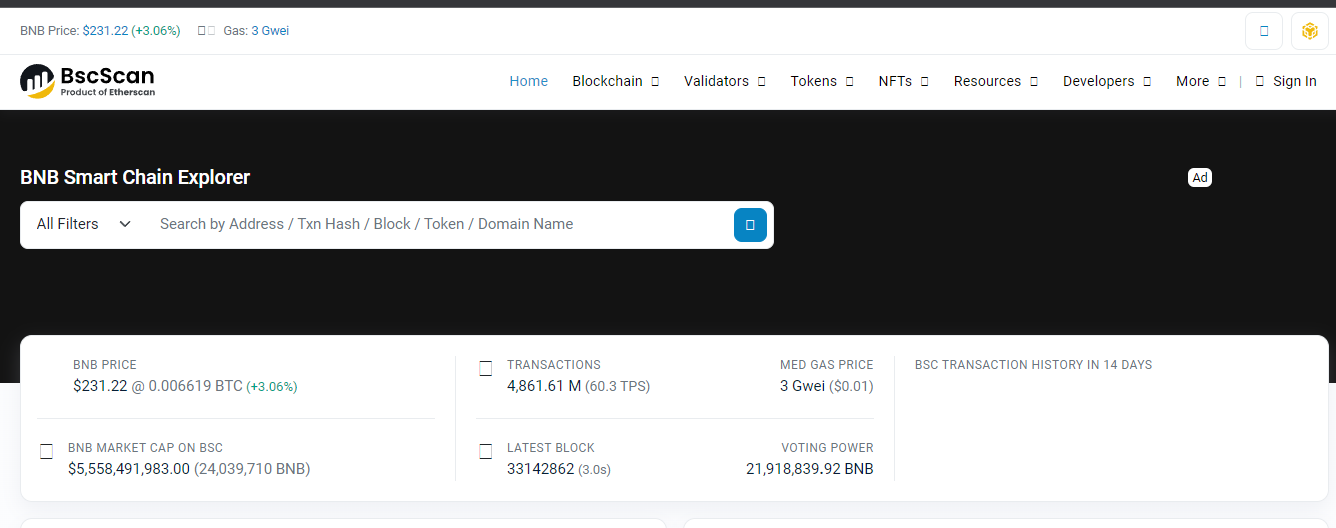
BscScan

Checking Transactions on BscScan

  • Visit the BscScan website at bscscan.com.
  • In the search bar at the top of the page, enter the transaction hash or wallet address you want to investigate.
  • BscScan will query its database and display detailed information about the transaction, including the transaction amount, date, block number, balances, transaction fees, and status.
  • Take note of the transaction status, which can be pending, successful, or failed. This information will help you determine the progress and outcome of the transaction.
  • You can also explore additional details about the transaction by clicking on specific sections, such as the sender's address, recipient's address, or transaction hash.

Exploring Wallet Addresses

  • On the BscScan homepage, locate the search bar at the top of the page.
  • Enter the wallet address that you want to explore and press Enter or click the search icon.
  • BscScan will provide an overview of the wallet address, including the BNB balance and the balances of any BEP-20 tokens held in the wallet.
  • Scroll down to view the transaction history associated with the wallet address, including incoming and outgoing transactions.
  • You can click on individual transactions to access more detailed information, such as the transaction hash, block number, and transaction fee.

Verifying Smart Contracts

  • Navigate to the BscScan website and locate the "Verify Contract" section.
  • Enter the smart contract address that you want to verify.
  • Select the appropriate compiler type and open-source license type.
  • Copy and paste the Solidity contract code into the designated field.
  • Enable optimization by selecting "Yes" in the optimization dropdown menu if applicable.
  • Click the "Verify and Publish" button to initiate the contract verification process.
  • BscScan will compare the submitted code with the code running on the BSC network and provide a verification result indicating whether the contract code matches.

Tracking Tokens on BscScan

  • Access the BscScan website and navigate to the "Tokens" section.
  • Explore the top BEP-20 tokens listed on BscScan, including their prices, volume, market capitalization, and number of holders.
  • Use the search bar to find specific tokens by their contract address or token symbol.
  • Click on individual tokens for more detailed information, such as the token's contract address, token holders, transaction history, and related smart contracts.
  • BscScan also supports ERC-721 and ERC-1155 tokens, allowing users to explore and track non-fungible tokens (NFTs) on the BSC network.

Monitoring Gas Prices

  • Visit the BscScan website and locate the "Gas Tracker" section.
  • Monitor the average gas price displayed on the page.
  • Check the block size and average utilization to understand the current network congestion.
  • Scroll down to view the BSC network's top gas guzzlers and spenders.
  • Use this information to make informed decisions about gas fees and optimize your transactions on the Binance Smart Chain.

Click here to buy Cryptocurrencies from Gate.io

BscScan vs. Etherscan: Key Differences

While BscScan and Etherscan share similarities as blockchain explorers, the two platforms have some key differences. Here are the main distinctions:

  • Supported Wallets: BscScan supports a limited number of wallets (e.g., MetaMask, TrustWallet) compared to Etherscan, which supports a broader range of wallets.
  • Features: Etherscan has the advantage of offering Blockchain APIs and Crypto APIs, providing developers with more advanced functionalities for interacting with the Ethereum blockchain.
  • Focus: BscScan is designed explicitly for the Binance Smart Chain, while Etherscan caters to the Ethereum network. Each explorer prioritizes features and data relevant to its respective blockchain.

BscScan and Etherscan are reputable and reliable explorers, offering valuable insights into their respective blockchain networks.

BscScan Alternatives

While BscScan is the leading blockchain explorer for the Binance Smart Chain, several alternative explorers are available for users. Here are a few notable options:

  • Binance Chain Explorer: Developed directly by Binance, this explorer provides information about blocks, transactions, wallet balances, and BNB metadata. It is available both as a web and mobile application.
  • BitQuery Explorer: BitQuery is a comprehensive explorer that supports multiple blockchains, including Binance Smart Chain. It offers advanced search and analytics capabilities for developers and researchers.
  • Binance Explorer: Binance also provides its explorer for the Binance Smart Chain, offering similar functionalities to BscScan. It is a reliable alternative for users seeking a different interface or additional features.

These alternatives provide users with different interfaces and functionalities, allowing them to choose the explorer that best suits their needs.

Is BscScan Safe?

As a leading blockchain explorer, BscScan is developed by the same team behind Etherscan, which has established a strong reputation in the blockchain community. 

BscScan is safe to use, as it does not require a connection to your BSC wallet and cannot access or acquire your funds. However, it is essential to exercise caution and verify that you are using the official BscScan website (bscscan.com) to avoid potential phishing attempts. 

Always double-check the URL and ensure that you are on the correct website before entering any sensitive information.

Is BscScan Compatible with NFTs?

Yes, BscScan is fully compatible with non-fungible tokens (NFTs). Like Ethereum, the Binance Smart Chain hosts various NFT projects, taking advantage of its lower fees and higher efficiency. 

Users can track their NFTs on BscScan using the transaction hash, NFT intelligent contract address, or wallet address. However, it is essential to note that BscScan does not display the artwork contained within an NFT. 

Users must connect to a compatible marketplace or service provider supporting the specific NFT token standard to view the artwork.

Frequently Asked Questions

Q1. How to check if liquidity is locked on BscScan?

To determine if liquidity is locked for a specific token on BscScan, you can follow these steps:

  • Go to the BscScan website and navigate to the "Tokens" section.
  • Search for the token by its contract address or token symbol.
  • Scroll down to the "Transfers" section and click on the transaction hash associated with the liquidity addition.
  • Check if the liquidity pool tokens or a burn address were sent to the development wallet.
  • Verify that the development wallet does not hold any liquidity pool tokens or check if they have been transferred to a burn address.

Q2. Can BscScan be used for other blockchain networks?

No, BscScan is designed explicitly for the Binance Smart Chain and cannot be used to explore other blockchain networks. Each blockchain has its dedicated explorer, such as Etherscan for Ethereum or Blockchain for Bitcoin. 

If you need to explore a different blockchain, using the corresponding blockchain explorer for accurate and relevant information is recommended.

Q3. What are the advantages of using BscScan for yield farming?

BscScan offers several advantages for users engaged in yield farming on the Binance Smart Chain:

  • Access the latest yield farming opportunities through the "Yield Farms List" feature.
  • Detailed information about different farms, including their locations and how they work.
  • The ability to track your yield farming activities, including the tokens you have staked and the rewards you have earned.
  • Lower transaction fees compared to alternative platforms like Ethereum, making yield farming on BSC more cost-effective.

Q4. Can I revoke token approvals using BscScan?

Yes, BscScan provides the "Token Approval Checker" tool that allows users to review and revoke token approvals for decentralized applications (DApps).

Connecting your wallet to BscScan and using the Token Approval Checker lets you see which DApps can access your tokens and revoke their permissions if desired. This feature gives users more control over their token holdings and helps ensure the security of their assets.

Q5. How does BscScan ensure contract verification?

BscScan's contract verification process involves comparing the source code of a smart contract with the compiled code running on the Binance Smart Chain. 

This process ensures that the code deployed on the blockchain matches the source code provided by the developer. 

BscScan's verification process enhances transparency and security by allowing users to verify intelligent contracts' functionality and integrity independently.

Q6. What are the risks of using BscScan?

While BscScan is a reputable and reliable blockchain explorer, some risks are associated with using any online tool. It is essential to be cautious and follow best security practices when using BscScan or any other blockchain explorer:

  • Ensure you use the official BscScan website (bscscan.com) to avoid phishing attempts.
  • Double-check the URL and ensure that you are on the correct website before entering any sensitive information.
  • Be wary of fake or malicious contracts, tokens, or DApps. Always conduct thorough research and due diligence before interacting with unknown projects.
  • Keep your personal information and wallet details secure. Avoid sharing sensitive information with unknown individuals or platforms.

Q7. How can I contribute to the BscScan community?

If you are interested in contributing to the BscScan community, there are several ways to get involved:

  • Participate in discussions on the BscScan forums or social media channels.
  • Report any bugs or issues you encounter using BscScan to the development team.
  • Provide feedback and suggestions for improving the platform's features and user experience.
  • Contribute to the BscScan open-source project on GitHub if you have programming skills.

Your contributions can help enhance the functionality and usability of BscScan for the entire Binance Smart Chain community.

Conclusion

BscScan is a powerful and essential tool for navigating the Binance Smart Chain ecosystem. Whether you are an investor, developer, or blockchain enthusiast, BscScan provides valuable insights into the BSC network's transactions, smart contracts, tokens, and gas prices. 

By leveraging BscScan's features, you can make more informed decisions, track your investments, and ensure the security of your digital assets. Explore BscScan today and unlock the full potential of the Binance Smart Chain.

Disclaimer

The information provided on this website does not constitute investment advice, financial advice, trading advice, or any other advice, and you should not treat any of the website's content as such.

Token Metrics does not recommend that any cryptocurrency should be bought, sold, or held by you. Conduct your due diligence and consult your financial advisor before making investment decisions.

Click here to buy Cryptocurrencies from Gate.io

Build Smarter Crypto Apps &
AI Agents in Minutes, Not Months
Real-time prices, trading signals, and on-chain insights all from one powerful API.
Grab a Free API Key
About Token Metrics
Token Metrics: AI-powered crypto research and ratings platform. We help investors make smarter decisions with unbiased Token Metrics Ratings, on-chain analytics, and editor-curated “Top 10” guides. Our platform distills thousands of data points into clear scores, trends, and alerts you can act on.
30 Employees
analysts, data scientists, and crypto engineers
Daily Briefings
concise market insights and “Top Picks”
Transparent & Compliant
Sponsored ≠ Ratings; research remains independent
Want Smarter Crypto Picks—Free?
See unbiased Token Metrics Ratings for BTC, ETH, and top alts.
Thank you! Your submission has been received!
Oops! Something went wrong while submitting the form.
 No credit card | 1-click unsubscribe
Token Metrics Team
Token Metrics Team

Recent Posts

Research

What's the Safest Way to Store Large Crypto Holdings? A 2025 Security Guide

Token Metrics Team
10 min read

As cryptocurrency portfolios grow in value, understanding what’s the safest way to store large crypto holdings becomes a critical concern for investors. In 2024 alone, over $2.2 billion was stolen through various crypto hacks and scams, highlighting the vulnerabilities in digital asset protection. These incidents reveal the significant risks associated with storing large amounts of cryptocurrency, including potential vulnerabilities and hazards that can lead to loss or theft. Recent high-profile incidents, such as Coinbase’s May 2025 cyberattack that exposed customer information, underscore the urgent need for robust crypto security measures and the importance of following the safest ways to protect your assets. Unlike traditional bank accounts that benefit from FDIC insurance and fraud protection, stolen cryptocurrency cannot be refunded or insured through conventional means. This reality makes choosing the right cryptocurrency storage method to store your cryptocurrency essential for anyone holding significant crypto assets.

Understanding the Storage Landscape: Hot vs. Cold

When it comes to crypto storage, the fundamental distinction lies in whether wallets are connected to the internet. There are different types of crypto wallets, each offering unique benefits and security features. Hot wallets are always online, making them convenient for trading, transactions, and quick access to funds. However, their constant internet connection makes them inherently vulnerable to hacking, phishing, and malware attacks. Examples include mobile, desktop, and web-based wallets, which are often used for daily spending or quick access to tokens.

On the other hand, cold wallets—also known as cold storage—store private keys completely offline. This means they are disconnected from the internet, drastically reducing the risk of remote attacks. Cold wallets are ideal for long term storage of large crypto assets, where security takes precedence over convenience. A custodial wallet is another option, where a third-party provider, such as an exchange, manages and holds your private keys on your behalf, offering convenience but less direct control compared to non-custodial wallets.

Think of hot wallets as your checking account: convenient but not meant for holding large sums. Cold wallets function like a safety deposit box, providing secure storage for assets you don’t need to access frequently. Crypto wallets use a public key as an address to receive funds, while the private key is used to sign transactions. For large holdings, experts recommend a tiered approach: keep only small amounts in hot wallets for active use, while storing the majority in cold storage. This balances security, access, and the risk of funds being compromised. Cold wallets keep private keys offline and store your private keys and digital assets securely, reducing the risk of theft.

Hardware Wallets: The Gold Standard for Individual Investors

Among cold storage options, hardware wallets are widely regarded as the safest and most practical solution for individual investors managing large cryptocurrency holdings. These physical devices, often resembling USB drives, securely store your private keys offline and only connect to the internet briefly when signing transactions.

Leading hardware wallets in 2025 include the Ledger Nano X, Ledger Flex, and Trezor Model Safe 5. These devices use secure element chips—the same technology found in credit cards and passports—to safeguard keys even if the hardware is physically compromised. By keeping private keys offline, hardware wallets protect your assets from malware, hacking, and remote theft.

To maximize safety when using hardware wallets, always purchase devices directly from manufacturers like Ledger or Trezor to avoid tampered products. When you create your wallet, securely generate and store your seed phrase or recovery phrase by writing it on paper or metal backup solutions. Another option is a paper wallet, which is a physical printout of your private and public keys, used as a form of cold storage for cryptocurrencies. Store these backups in multiple secure locations such as fireproof safes or safety deposit boxes. For example, you might keep one copy of your paper wallet or backup phrase in a home safe and another in a bank safety deposit box to reduce the risk of loss. Never store recovery phrases digitally or photograph them, as this increases the risk of theft.

Enable all available security features, including PIN protection and optional passphrases, for an extra layer of encryption. For very large holdings, consider distributing assets across multiple hardware wallets from different manufacturers to eliminate single points of failure. The main limitation of hardware wallets is their physical vulnerability: if lost or destroyed without proper backup, your funds become irretrievable, making diligent backup practices essential.

Multi-Signature Wallets: Distributed Control for Enhanced Security

For even greater protection, especially among families, businesses, and institutional investors, multi-signature (multisig) wallets provide distributed control over funds. Unlike traditional wallets that require a single private key to authorize transactions, multisig wallets require multiple keys to sign off, reducing the risk of theft or loss.

A common configuration is a 2-of-3 setup, where any two of three keys are needed to sign a transaction. In this setup, the concept of 'two keys' is fundamental—two keys must be provided to authorize and access the funds. This means that funds can only be accessed when the required number of keys are available, ensuring both redundancy and security. If one key is lost, the other two can still access funds—while maintaining strong security since an attacker would need to compromise multiple keys simultaneously. More complex configurations like 3-of-5 are common for very large holdings, allowing keys to be geographically distributed to further safeguard assets.

Popular multisig wallet providers in 2025 include BitGo, which supports over 1,100 digital assets and offers insurance coverage up to $250 million for funds stored. BitGo’s wallets combine hot and cold storage with multisig security, meeting regulatory standards for institutional clients. Other notable solutions include Gnosis Safe (now known as Safe) for Ethereum and EVM-compatible chains, and Unchained, which manages over 100,000 Bitcoin using 2-of-3 multisig vaults tailored for Bitcoin holders. While multisig wallets require more technical setup and can slow transaction processing due to the need for multiple signatures, their enhanced security makes them ideal for large holdings where protection outweighs convenience.

Multi-Party Computation: The Emerging Institutional Standard

An innovative advancement in crypto storage is Multi-Party Computation (MPC) technology, rapidly becoming the standard for institutional custody. Unlike multisig wallets where multiple full private keys exist, MPC splits a single private key into encrypted shares distributed among several parties. The full key never exists in one place—not during creation, storage, or signing—greatly reducing the risk of theft.

MPC offers advantages over traditional multisig: it works seamlessly across all blockchains, transactions appear identical to regular ones on-chain enhancing privacy, and it avoids coordination delays common in multisig setups. Leading MPC custody providers like Fireblocks have demonstrated the security benefits of this approach. However, Fireblocks also revealed vulnerabilities in competing threshold signature wallets in 2022, highlighting the importance of ongoing security audits in this evolving field.

For individual investors, MPC-based wallets like Zengo provide keyless security without requiring a seed phrase, distributing key management across secure locations. Nevertheless, MPC solutions are primarily adopted by institutions, with firms like BitGo, Fireblocks, and Copper offering comprehensive custody services for family offices and corporations.

Institutional Custody Solutions: When Professional Management Makes Sense

For extremely large holdings—often in the millions of dollars—professional institutional custody services offer unparalleled security infrastructure, insurance coverage, and regulatory compliance. These platforms typically facilitate not only secure storage but also the buying and selling of crypto assets as part of their comprehensive service offerings. Institutional custody solutions are commonly used to store bitcoin and other major cryptocurrencies securely, protecting them from theft, loss, and unauthorized access.

Regulated custodians implement multiple layers of protection. They undergo regular third-party audits and SOC certifications to verify their security controls. Many maintain extensive insurance policies covering both hot and cold storage breaches, sometimes with coverage reaching hundreds of millions of dollars. Professional key management minimizes user errors, and 24/7 security monitoring detects and responds to threats in real-time.

Despite these advantages, institutional custody carries counterparty risk. The Coinbase cyberattack in May 2025, which exposed customer personal information (though not passwords or private keys), served as a reminder that even the most secure platforms can be vulnerable. Similarly, the collapse of platforms like FTX, Celsius, and BlockFi revealed that custodial services can fail catastrophically, sometimes taking customer funds with them.

Therefore, thorough due diligence is essential when selecting institutional custodians. Verify their regulatory licenses, audit reports, insurance coverage, and operational history before entrusting significant funds.

The Critical Role of Analytics in Secure Portfolio Management

Securing large crypto holdings is not just about storage—it also involves smart portfolio management and timely decision-making. Sophisticated analytics platforms have become essential tools for this purpose. Token Metrics stands out as a leading AI-powered crypto trading and analytics platform designed to help users manage large cryptocurrency portfolios effectively. While hardware wallets and multisig solutions protect your keys, Token Metrics provides real-time market intelligence across hundreds of cryptocurrencies, enabling holders to make informed decisions about when to move assets between hot wallets and cold storage. The platform also assists users in determining the optimal times to buy crypto as part of their overall portfolio management strategy, ensuring that purchases align with market trends and security considerations.

The platform’s AI-driven analysis helps investors identify market conditions that warrant moving assets out of cold storage to capitalize on trading opportunities or to secure profits by returning funds to cold wallets. This strategic timing can significantly enhance portfolio performance without compromising security. Token Metrics also offers customizable risk alerts, allowing holders to respond quickly to significant market movements without constant monitoring. Since launching integrated trading capabilities in March 2025, the platform provides an end-to-end solution connecting research, analysis, and execution. This is especially valuable for users managing hot wallets for active trading while keeping the bulk of their crypto assets securely stored offline. With AI-managed indices, portfolio rebalancing recommendations, and detailed token grades assessing both short-term and long-term potential, Token Metrics equips large holders with the analytical infrastructure necessary to safeguard and optimize their holdings.

Essential Security Practices Beyond Storage Technology

Even the most secure storage methods can fail without proper security hygiene. Regardless of your chosen storage solution, certain best practices are essential:

  • Never share your private keys or recovery phrases with anyone. Legitimate services will never ask for this information. Requests for keys are always scams.
  • Enable two-factor authentication (2FA) on all accounts using authenticator apps or hardware security keys (e.g., YubiKey) rather than SMS-based 2FA, which is vulnerable to SIM-swap attacks.
  • Use a password manager to generate and store unique, complex passwords for every exchange and wallet service, avoiding password reuse.
  • Whitelist withdrawal addresses on exchanges to restrict withdrawals to pre-approved addresses, reducing the risk of unauthorized transfers.
  • Verify transaction addresses carefully before confirming. Malware can alter clipboard contents to replace legitimate addresses with attacker-controlled ones. Manually check the first and last characters.
  • Keep all software updated on devices used for managing crypto, as updates often include critical security patches.
  • Plan for inheritance and incapacity by securely documenting custody arrangements, key locations, and access procedures. Consider specialized services for cryptocurrency estate planning.

Backup and Recovery: Safeguarding Access to Your Assets

When it comes to crypto storage, having a robust backup and recovery plan is just as essential as choosing the right wallet. No matter how secure your hardware wallet, hot wallet, or cold wallet may be, losing access to your private keys or recovery phrase can mean losing your crypto assets forever. That’s why safeguarding your ability to restore access is a cornerstone of crypto security.

For users of hardware wallets like the Ledger Nano or Trezor Model, the most critical step is to securely record your recovery phrase (also known as a seed phrase) when you first set up your device. This unique string of words is the master key to your wallet—if your hardware wallet is lost, stolen, or damaged, the recovery phrase allows you to restore your funds on a new device. Write your seed phrase down on paper or, for even greater protection, use a metal backup solution designed to withstand fire and water damage. Never store your recovery phrase digitally, such as in a note-taking app or cloud storage, as these methods are vulnerable to hacking and malware.

It’s best practice to store your backup in a location separate from your hardware wallet—think a safe deposit box, a home safe, or another secure, private spot. For added security, consider splitting your backup between multiple locations or trusted individuals, especially if you’re managing significant crypto assets. This way, even if one location is compromised, your funds remain protected.

Non-custodial wallets, whether hardware or software-based, give you full control over your private keys and, by extension, your crypto. With this control comes responsibility: if you lose your recovery phrase or private key, there’s no customer support or password reset to help you regain access. That’s why diligent backup practices are non-negotiable for anyone serious about storing bitcoin or other digital assets securely.

For those seeking even greater protection, multi-signature wallets add another layer of security. By requiring multiple keys to authorize transactions, multi-signature setups make it much harder for hackers or thieves to access your funds—even if one key or device is lost or compromised. This method is especially valuable for families, businesses, or anyone managing large holdings who wants to reduce single points of failure.

If you ever suspect your wallet or recovery phrase has been compromised, act immediately: transfer your funds to a new wallet with a freshly generated seed phrase, and update your backup procedures. Similarly, if a hot wallet on your mobile device or desktop is hacked, move your assets to a secure cold wallet as quickly as possible. Ultimately, backup and recovery are not just technical steps—they’re your safety net. Whether you use hardware wallets, hot wallets, cold wallets, or even paper wallets, always create and securely store a backup of your recovery phrase. Regularly review your backup strategy, and make sure trusted individuals know how to access your assets in case of emergency. By taking these precautions, you ensure that your crypto assets remain safe, secure, and accessible—no matter what happens.

Implementing a Comprehensive Storage Strategy

For large cryptocurrency holdings, a multi-layered storage strategy offers the best balance of security and accessibility. A common approach for portfolios exceeding six figures includes:

  • Tier 1: Deep Cold Storage (70-80%) – Use hardware wallets or multisig vaults for long-term holdings. These assets remain untouched except for major portfolio moves. Backup phrases and devices should be stored in geographically dispersed, secure locations.
  • Tier 2: Accessible Cold Storage (15-20%) – Maintain a secondary hardware wallet or multisig setup for intermediate-term positions, accessible within hours but still offline.
  • Tier 3: Hot Wallet for Active Trading (5-10%) – Keep a small portion of funds in exchange accounts or software wallets for daily transactions and trading, accepting higher risk for liquidity.

This tiered framework ensures that even if one layer is compromised, the entire portfolio remains protected. Combined with platforms like Token Metrics for market intelligence and risk management, this strategy offers both security and operational flexibility.

The Bottom Line

In 2025, securing large cryptocurrency holdings requires a deep understanding of various storage technologies and the implementation of layered security strategies. Hardware wallets remain the gold standard for individual investors, while multisig wallets and MPC solutions provide enhanced protection for very large or institutional holdings.

There is no one-size-fits-all answer to what's the safest way to store large crypto holdings. The ideal approach depends on factors like portfolio size, technical skill, transaction frequency, and risk tolerance. Most large holders benefit from distributing assets across multiple storage methods, keeping the majority in cold storage and a smaller portion accessible for trading.

Ultimately, cryptocurrency security hinges on effective private key management. Protecting these keys from unauthorized access while ensuring you can access them when needed is paramount. By combining robust storage solutions, disciplined security practices, and advanced analytics tools like Token Metrics, investors can safeguard their crypto assets effectively while maintaining the flexibility to seize market opportunities.

As the cryptocurrency landscape evolves, so will storage technologies. Stay informed, regularly review your security setup, and never become complacent. In the world of digital assets, your security is your responsibility—and with large holdings, that responsibility is more essential than ever.

Research

How Do I Calculate Capital Gains on Crypto: Complete 2025 Tax Guide

Token Metrics Team
9 min read

As cryptocurrency becomes increasingly mainstream, knowing how do I calculate capital gains on crypto is essential for every investor. The IRS treats cryptocurrency as property rather than currency, meaning each trade, sale, or purchase of crypto triggers a taxable event that must be carefully documented. This means that cryptocurrency is taxed similarly to other forms of property, with gains and losses reported for each transaction. This article serves as a comprehensive crypto tax guide, helping you understand how to accurately calculate your crypto capital gains so you can manage your tax bill effectively and avoid costly compliance issues.

Understanding Crypto Capital Gains Basics

Capital gains on cryptocurrency arise when you sell, trade, or spend your crypto for more than you originally paid. At its core, the calculation is straightforward: your proceeds (sale price) minus your cost basis (purchase price) equals your capital gain or loss. These gains are subject to crypto capital gains tax. However, the reality is far more complex, especially for active traders who manage multiple positions across various exchanges and wallets.

The IRS distinguishes between short-term capital gains and long-term capital gains based on how long you hold your crypto assets. If you hold your cryptocurrency for one year or less, any gains are considered short-term and taxed at your ordinary income tax rates, which range from 10% to 37% depending on your total taxable income. Conversely, assets held for more than one year qualify for preferential long-term capital gains tax rates of 0%, 15%, or 20%, based on your income and filing status. How crypto is taxed depends on the holding period and whether the gain is classified as short-term or long-term, so understanding how crypto taxed applies to your transactions is essential. This distinction can create significant tax planning opportunities for investors who strategically time their sales.

The Capital Gains Calculation Formula

To calculate crypto capital gains accurately, you need three critical pieces of information for each transaction: your cost basis, your proceeds, and your holding period. Your cost basis is the original purchase price of your crypto, including any transaction fees directly related to the purchase. Proceeds are the amount you receive when you dispose of the crypto, minus any fees related to the sale. The difference between your proceeds and cost basis is your taxable gain, which is the amount subject to capital gains tax.

For example, imagine you bought 1 Bitcoin in June 2024 for $70,000 and sold it four months later for $80,000. Your capital gain is $80,000 minus $70,000, or $10,000. This $10,000 is your taxable gain and must be reported for bitcoin taxes. Since you held the Bitcoin for less than a year, this gain is short-term and taxed at your ordinary income tax rate. If your annual income is $85,000, your total taxable income becomes $95,000, placing you in the 24% federal tax bracket for 2024. This means you owe approximately $2,400 in federal taxes on that gain.

If you instead held the Bitcoin for 13 months before selling, the $10,000 gain qualifies for long-term capital gains treatment. With the same income, your tax rate on the gain would be 15%, resulting in a $1,500 tax bill—a $900 savings just by holding the asset longer.

Why Crypto Tax Calculations Get Complicated

While the basic formula seems simple, real-world crypto investing introduces many complexities. Take Sarah, an investor who bought Bitcoin at various prices: $5,000, $10,000, $15,000, and $20,000. When she sells part of her holdings, which purchase price should she use to calculate her cost basis?

This question highlights the importance of selecting a cost basis method. The IRS permits several approaches: FIFO (First In, First Out) uses the oldest purchase price; LIFO (Last In, First Out) uses the most recent purchase price; and HIFO (Highest In, First Out) uses the highest purchase price to minimize gains. These are all different cost basis methods, and the accounting method you choose can significantly affect your tax liability.

Complications also arise from trading on multiple exchanges and moving crypto between different wallets. Most investors don’t stick to one platform—they might buy on Coinbase, trade on Binance, stake on other platforms, and transfer assets between wallets. Each platform maintains separate transaction records, and consolidating these into a complete transaction history is like assembling a complex puzzle. Tracking your crypto cost basis for each asset is crucial, especially when dealing with multiple transactions across different platforms.

Taxable Events Beyond Simple Sales

Calculating capital gains on crypto involves more than just selling for fiat currency. Several other actions involving digital assets are considered taxable events from a tax perspective, each representing a type of crypto transaction:

  • Trading one cryptocurrency for another (e.g., swapping Bitcoin for Ethereum) is a crypto trade and triggers capital gains taxes, requiring you to calculate gains on the disposed digital asset.
  • Selling crypto for fiat currency is a crypto transaction that counts as a disposal event. For tax purposes, you must calculate the difference between your cost basis and the fair market value of the digital asset at the time of the transaction.
  • Spending crypto on goods or services is another form of crypto transaction and counts as a disposal. You must calculate the difference between your cost basis and the fair market value at the time of the transaction.
  • Receiving cryptocurrency as crypto income—from mining rewards, staking, airdrops, or employment compensation—creates ordinary income taxable at your income tax rate. The fair market value at receipt establishes your cost basis for future capital gains calculations.

You owe capital gains tax whenever you dispose of or convert digital assets through these types of crypto transactions. The tax treatment of each event depends on the nature of the transaction, and the IRS provides specific guidance on how to report and classify these activities.

Not all crypto activities generate taxable events. Simply buying and holding digital assets doesn’t trigger a tax bill until you dispose of them. Transferring crypto between your own wallets is also non-taxable, though keeping detailed records of these crypto transactions is vital to track your cost basis accurately. Additionally, gifting crypto under the annual gift tax exclusion (set at $19,000 per recipient for 2025) doesn’t create taxable gains for the giver, but the recipient inherits the giver's cost basis (the original purchase price and acquisition date) for tax purposes. Proper documentation of the giver's cost basis is important for future tax reporting. The tax treatment of gifts and other crypto transactions should always be considered from a tax perspective to ensure compliance.

Crypto Income and Tax Implications

Crypto income encompasses a range of earnings from activities like mining, staking, airdrops, and earning interest through crypto lending platforms. For tax purposes, the IRS treats all these forms of crypto income as ordinary income, meaning they are taxed at your regular income tax rates based on your total taxable income. The key factor in determining your tax bill is the fair market value of the crypto assets at the time you receive them. For example, if you receive $1,000 worth of Bitcoin as a mining reward, you must report that $1,000 as taxable income on your tax return for the year.

Accurate reporting of crypto income starts with maintaining a complete transaction history. You should record the date, time, amount, and fair market value of each crypto asset received. This information is essential for calculating your tax liability and ensuring your tax return is accurate. Using tax software or a crypto tax calculator can greatly simplify this process by automatically importing your transaction data from exchanges and wallets, calculating your gains and losses, and generating a comprehensive tax report.

Beyond mining and staking rewards, other types of crypto income—such as interest from lending platforms or profits from trading—are also subject to crypto tax. Each of these activities can have unique tax implications, so it’s wise to consult a tax professional or use specialized tax software to ensure you’re following IRS rules and reporting all taxable income correctly. By understanding how crypto income is taxed and taking steps to accurately calculate and report it, you can avoid unexpected tax bills and minimize your overall tax liability.

Leveraging Token Metrics for Accurate Tracking

Given the complexities of calculating crypto capital gains across multiple exchanges, wallets, and hundreds of transactions, having robust tracking tools is essential. This is where Token Metrics, a leading crypto trading and analytics platform, comes into play.

Token Metrics provides comprehensive portfolio tracking by aggregating your positions across exchanges and wallets, giving you real-time visibility into your entire crypto portfolio. This unified view simplifies the daunting task of compiling transaction records from disparate sources—a critical first step in accurate tax calculation. Organizing your transactions by tax year is essential for proper reporting and ensures you meet IRS deadlines for each tax year.

Beyond tracking, Token Metrics offers advanced analytics that empower investors to make tax-efficient trading decisions year-round, rather than scrambling during tax season. By understanding your current cost basis, holding periods, and potential tax implications before executing trades, you can optimize timing to minimize your tax liability. The platform’s insights help you plan around the one-year holding period that distinguishes short-term from long-term capital gains rates.

For active traders with complex portfolios, Token Metrics provides detailed performance attribution and reconstructs your cost basis accurately. Its reporting features generate comprehensive documentation to support your tax calculations, which is crucial for IRS compliance and audit defense. Token Metrics helps users report crypto transactions accurately and assists in reporting crypto gains for tax compliance, making it easier to meet regulatory requirements.

Token Metrics also aids in identifying opportunities for tax-loss harvesting, a strategy where you sell depreciated assets to realize losses that offset capital gains. By clearly showing which positions are underwater and by how much, the platform enables strategic loss realization that reduces your overall tax bill while maintaining your desired market exposure. Tools like Token Metrics are invaluable for managing cryptocurrency taxes and streamlining the entire tax preparation process.

Resolving Missing Cost Basis

Missing cost basis is a common challenge for crypto investors, especially those who have been active in the market for several years or have moved assets between multiple wallets and exchanges. The cost basis is the original purchase price of your crypto asset, including any transaction fees. Without this information, it becomes difficult to accurately calculate your capital gains or losses when you sell, trade, or otherwise dispose of your crypto.

To resolve missing cost basis, start by gathering as much information as possible about the original transaction. Check your exchange records, wallet transaction histories, and any other documentation that might indicate the purchase price, date, and amount of the crypto asset. If you’re unable to locate the original purchase price, some tax software can help estimate your cost basis based on available transaction records. However, using an estimated cost basis can be risky, as the IRS may scrutinize these calculations during an audit.

Maintaining accurate and complete transaction records is the best way to avoid missing cost basis issues in the future. Tax software like Token Metrics can help you track and calculate cost basis for each crypto asset, generate a detailed tax report, and ensure you’re prepared for tax season. If you’re unsure about how to calculate cost basis or need to estimate it due to missing information, consulting a tax professional is highly recommended. By resolving missing cost basis issues and keeping thorough records, you can accurately calculate your capital gains, comply with IRS rules, and minimize your tax liability.

Tax-Loss Harvesting and Strategic Planning

There are a few strategies you can use to reduce your tax bill when dealing with cryptocurrency. These include tax-loss harvesting, holding assets for long-term gains, and careful planning of your transactions.

Capital losses can be a powerful tool for managing your tax bill. You can use capital losses to offset capital gains dollar-for-dollar, lowering your taxable income. If your losses exceed your gains, you can deduct up to $3,000 of net capital loss against ordinary income each year, with remaining losses carrying forward to future tax years.

Savvy investors practice tax-loss harvesting throughout the year, especially during market downturns. This approach is similar to strategies used for traditional investments like stocks. By selling depreciated positions to realize losses, they generate tax deductions and may repurchase similar assets to maintain exposure. It’s important to note that the IRS wash sale rule, which disallows losses on securities repurchased within 30 days, currently does not apply to cryptocurrency, though proposed regulations could change this.

You are required to pay taxes on gains from crypto activities, including trading, selling, or spending your crypto. Holding crypto for over a year before selling can substantially reduce your tax liability. The difference between ordinary income tax rates (up to 37%) and long-term capital gains rates (max 20%) can save tens of thousands of dollars on large gains. Patient investors who plan their sales strategically can significantly lower their tax liability.

If you mine cryptocurrency or operate as a self-employed individual, you may also be subject to self employment tax, which includes social security contributions, in addition to income and capital gains taxes.

Record Keeping and Reporting Requirements

Starting in 2025, cryptocurrency exchanges are required to report your transactions and wallet addresses directly to the IRS, making meticulous record keeping for all your digital assets more important than ever. You must maintain detailed documentation including transaction dates, amounts, fair market values at transaction time, involved parties, and the purpose of each transaction.

For tax reporting, you’ll use IRS Form 8949 to report your capital gains and losses, transferring totals to Schedule D. Income from mining, staking, or business activities, such as operating a crypto mining business, is reported on Schedule 1 or Schedule C. Due to the complexity of these forms, many investors rely on tax preparation software or consult a tax professional to ensure accuracy.

Platforms like Token Metrics simplify this process by maintaining a complete transaction history and providing organized reports ready for tax filing. Instead of manually reconstructing hundreds or thousands of transactions from multiple exchanges and wallets, you get centralized, accurate records that streamline your tax return preparation.

State Taxes and Additional Considerations

Federal taxes are only part of your overall tax obligation. Depending on your state of residence, you may owe additional state taxes on your crypto gains. States such as California, New York, and New Jersey impose significant taxes on investment income, while others like Texas, Florida, and Nevada have no state income tax. Your total tax liability is the sum of your federal and state obligations, so it’s important to understand your local tax rules.

Conclusion

Learning how do I calculate capital gains on crypto is crucial to managing your cryptocurrency investments responsibly and minimizing your tax burden. Calculating capital gains requires understanding IRS rules, maintaining detailed records, selecting appropriate accounting methods, and planning around holding periods and loss harvesting.

The complexity of cryptocurrency taxation, especially for active traders, makes reliable analytics and reporting tools indispensable. Token Metrics offers the comprehensive tracking, analysis, and reporting capabilities you need to navigate crypto taxes confidently. Its real-time portfolio visibility, accurate cost basis calculations, and tax-efficient trading insights transform the daunting task of crypto tax compliance into a manageable process.

As IRS enforcement intensifies and cryptocurrency tax regulations evolve, having sophisticated tools and accurate data becomes more valuable than ever. Whether you’re a casual investor with a few transactions or an active trader managing complex portfolios, understanding how to calculate capital gains correctly—and leveraging platforms like Token Metrics—protects you from costly errors while optimizing your tax position.00d

Research

Should I Invest in Crypto or Web3 Companies? A 2025 Investment Guide

Token Metrics Team
7 min read

The landscape of cryptocurrency and Web3 has evolved dramatically in recent years, offering investors an expanding array of opportunities within the digital economy. As we navigate through October 2025, with Bitcoin trading above $124,000 and the total crypto market capitalization exceeding $4.15 trillion, many investors face a critical question: should I invest in crypto or Web3 companies? The reality is that both options present compelling potential, and understanding their differences, risks, and benefits is essential for making an informed investment decision.

Introduction to Web3 and Crypto

Web3, often referred to as the decentralized web, represents the next evolution of the world wide web—one that empowers internet users with greater control, privacy, and ownership of their digital assets. Unlike traditional internet platforms controlled by centralized entities, Web3 leverages blockchain technology to create decentralized networks and applications. This shift enables users to interact, transact, and store digital assets in a more secure and transparent environment.

At the core of the Web3 movement is the crypto ecosystem, which includes a wide range of crypto assets such as cryptocurrencies and non-fungible tokens (NFTs). Built on blockchain technology, these digital assets facilitate peer-to-peer transactions without intermediaries. As internet users seek innovative investment options, decentralized apps and networks are gaining popularity for their ability to offer new ways to invest, earn, and participate in the digital economy.

History and Evolution

The journey of Web3 began in 2014 when Gavin Wood, co-founder of Ethereum, introduced the concept as a vision for a more open and user-centric internet. Since then, the decentralized ecosystem has experienced rapid growth, fueled by blockchain technology and the emergence of unique digital assets. This foundation has enabled the development of decentralized applications (dApps) and new investment avenues previously unimaginable.

Recently, focus has shifted from centralized platforms to decentralized networks, giving users unprecedented control over data and assets. For example, decentralized finance (DeFi) has revolutionized crypto asset investment, offering innovative technologies that bypass traditional financial intermediaries. This progression has expanded investment opportunities and empowered users to participate directly in the digital economy.

Understanding the Ecosystem

Navigating the Web3 ecosystem requires a clear understanding of its main components, including digital currencies, dApps, and blockchain networks. For investors entering crypto, it’s vital to recognize that the ecosystem is multifaceted and constantly evolving. Digital assets range from established cryptocurrencies to innovative tokens powering decentralized platforms.

Conducting thorough research and staying updated on emerging trends are crucial for effective investment outcomes. Artificial intelligence increasingly supports Web3 projects by validating transactions, enhancing security, and improving user experience across platforms. Understanding how these technologies interact within the broader crypto ecosystem allows investors to make more informed decisions and capitalize on new opportunities.

Understanding the Current Investment Landscape

The crypto market has matured significantly, demonstrating institutional adoption, clearer regulations, and sustained growth. Bitcoin recently surpassed $120,000, driven by institutional interest through ETFs and macroeconomic factors. Ethereum’s performance also exhibited resilience, climbing from around $3,500 to over $4,200 in Q3 2025.

Meanwhile, the Web3 sector—including blockchain infrastructure, dApps, and internet tech—has grown impressively. By mid-2025, market capitalization of Web3 companies exceeded $62.19 billion, with forecasts surpassing $65 billion by 2032. This parallel expansion indicates robust opportunities in both cryptocurrencies and Web3 companies, enhancing the appeal of diversified investment approaches.

The Case for Direct Cryptocurrency Investment

Investing directly in cryptocurrencies provides exposure to digital assets lacking intermediary fees or corporate overhead. Buying tokens like Bitcoin or Ethereum offers potential for price appreciation and control over assets secured in digital wallets.

Cryptocurrency exchanges serve as primary platforms, ensuring liquidity and security. Current forecasts anticipate Bitcoin trading in the range of $80,440 to $151,200 in 2025, supported by institutional interest from firms like BlackRock and Fidelity. Crypto markets operate 24/7, enabling rapid responses to market shifts.

The growing Web3 crypto job market, which surged 300% from 2023 to 2025, reflects real economic activity. Platforms like Token Metrics support this approach by providing AI-powered analytics, real-time data, and integrated trading tools—making digital asset research and management more accessible for investors.

The Case for Web3 Company Investment

Investing in Web3 companies involves acquiring equity in firms developing infrastructure and platforms for the decentralized web. Instead of holding tokens, investors gain exposure through stocks like Coinbase, valued at nearly $58 billion, which has appreciated over 313% in the past year.

Technology giants such as Nvidia, with a market cap above $3 trillion, benefit from Web3 growth through computing hardware critical for blockchain mining and AI. Web3 stocks often offer diversification within the tech sector. ETFs focusing on Web3 companies provide diversified exposure without selecting individual stocks, though single-stock risks remain.

Regulatory Considerations: A Turning Point

The regulatory landscape has become more favorable for cryptocurrencies and Web3 firms, with bipartisan support in Congress and new legislation like the GENIUS Act of July 2025 establishing clearer rules for stablecoins and digital assets. This clarity fosters a more secure environment for investments, building confidence in the industry’s longevity and sustainability.

Risk Considerations and Portfolio Strategy

Investments in crypto and Web3 stocks carry distinct risks. Crypto assets face high volatility, security challenges with wallets, and technical complexities. Effective security practices, device management, and continuous research are essential to mitigate these risks.

Web3 stock investments involve considerations such as market execution risk, competition, and broader economic fluctuations. A blended portfolio—including both digital assets and equities—can optimize potential returns while diversifying risks.

Platforms like Token Metrics offer tools for risk management, including automation, analytics, and portfolio monitoring—helping investors navigate volatility with data-driven insights.

Emerging Opportunities: DeFi, Gaming, and Tokenization

The Web3 landscape is expanding with decentralized finance (DeFi), gaming, and tokenization. DeFi enables lending, borrowing, and trading without intermediaries, while Web3 gaming has seen a 60% rise in active users. The tokenization market, representing real-world assets on blockchain, has grown by about 23%, creating new investment niches in art, real estate, and securities.

Success Stories

Bitcoin’s growth from a niche experiment to a trillion-dollar asset exemplifies the decentralized financial revolution. Ethereum has facilitated the development of smart contracts and dApps, fueling innovation in multiple sectors. NFTs have revolutionized digital ownership, empowering artists and creators to monetize unique digital assets. These success stories highlight the evolving potential and inherent risks of investing in decentralized assets.

Making Your Investment Decision

Choosing between crypto and Web3 stocks depends on your investment timeline, risk tolerance, technical knowledge, and goals. Cryptocurrencies may offer faster appreciation but demand active management; stocks tend to provide steadier, long-term growth. A diversified approach combining both strategies can help balance potential upside with risk management.

Investment Tips

  • Conduct thorough research before investing—understand the technology, team, and use case.
  • Diversify across assets and platforms to reduce risk.
  • Set a clear budget and only invest what you can afford to lose.
  • Explore DeFi and other emerging technologies for additional opportunities.
  • Stay informed on latest trends and regulatory developments to make timely decisions.

The Bottom Line

In 2025, both cryptocurrencies and Web3 company stocks present significant opportunities within the growing digital economy. Market maturation, clearer regulations, and technological advances support sustained growth. A diversified portfolio, combined with advanced tools like Token Metrics, can help investors navigate this complex landscape effectively. As the Web3 ecosystem continues to expand, the key question shifts from whether to invest into how to do so wisely to maximize opportunities and manage risks in this evolving digital frontier.

Choose from Platinum, Gold, and Silver packages
Reach with 25–30% open rates and 0.5–1% CTR
Craft your own custom ad—from banners to tailored copy
Perfect for Crypto Exchanges, SaaS Tools, DeFi, and AI Products