Announcements

Build AI-Powered Crypto Trading Bots in Minutes: Token Metrics Partners with Cline for Seamless Crypto API Integration

We're excited to announce a powerful new integration between Token Metrics and Cline bringing together the most advanced crypto API on the market and an AI-native coding environment purpose-built for building and testing AI crypto trading bots.
Token Metrics Team
8 min
MIN

Combine the Best Crypto API with Cline’s AI Coding Environment to Automate Smarter Trades—Faster

The world of crypto development just leveled up.

We're excited to announce a powerful new integration between Token Metrics and Cline (via the Roo Code extension)—bringing together the most advanced crypto API on the market and an AI-native coding environment purpose-built for building and testing crypto trading bots.

This partnership unlocks the ability to rapidly prototype, test, and launch intelligent trading strategies using real-time data from Token Metrics directly inside Cline, making it easier than ever for developers and traders to build in the crypto economy.

In this post, we’ll show you exactly how this works, walk through a working example using the Hyperliquid token, and explain why Token Metrics is the best crypto API to use with Cline for next-gen trading automation.

What Is Cline (Roo Code)?

Cline is an AI-first coding assistant designed to turn ideas into code through conversational prompts. With the Roo Code extension in Visual Studio Code, Cline transforms your IDE into an AI-native environment, allowing you to:

  • Write and debug code using natural language
  • Chain tools and APIs together with zero setup
  • Backtest and optimize strategies within a single flow

By integrating Token Metrics’ cryptocurrency API through its MCP (Multi-Client Protocol) server, developers can access real-time grades, trading signals, quant metrics, and risk insights—all through AI-driven prompts.

This combo of live crypto data and AI-native coding makes Cline one of the fastest ways to build trading bots today.

What Is Token Metrics MCP & API?

The Token Metrics API is the ultimate toolkit for crypto developers. It's a high-performance, developer-focused crypto API that gives you:

  • AI-powered Trader & Investor Grades
  • Buy/Sell Signals for bull/bear market detection
  • Support & Resistance Levels
  • Sentiment Analysis
  • Quantitative Metrics including ROI, performance vs. BTC, and more
  • Full Token Reports & Rankings

These features are now accessible via the MCP server—a gateway that standardizes access to Token Metrics data for AI agents, bots, dashboards, and more.

Whether you’re building a Telegram bot, a trading terminal, or a portfolio optimizer, the Token Metrics MCP setup with Cline makes it seamless.

Step-by-Step: Build a Trading Bot in Cline Using Token Metrics

Here’s a walkthrough of how you can build a complete AI-powered trading bot using Cline and the Token Metrics API.

1. Set Up Your Project in Visual Studio Code

Open VS Code and click “Open Folder.” Name your project something fun—like “Hype Bot.”
Then go to the Extensions tab, search for “Roo Code” (the advanced version of Cline), and install it.

2. Connect to the Token Metrics MCP Server

Once installed:

  • Click the MCP icon in the sidebar.
  • Choose “Edit Global MCP.”
  • Visit the official Token Metrics MCP Instructions and copy the full configuration block.
  • Paste it into your global MCP settings in Cline.

🎉 Now your environment is live, and you’re connected to the best crypto API on the market.

3. Explore the API with a Prompt

Inside Cline, simply prompt:

“Explore the Token Metrics API and analyze the Hyperliquid token.”

In seconds, the agent fetches and returns detailed insights—including investor grade, sentiment shifts, trading volume, and support/resistance levels for Hyperliquid. It even detects patterns not visible on typical trading platforms.

4. Generate a Trading Strategy

Next prompt:

“Create a trading strategy using this data.”

The agent responds with a full Python trading script based on AI signals from the API—complete with buy/sell logic, thresholds, and data pipelines.

5. Run Backtests and Analyze Performance

Cline automatically generates a backtest file and plots a performance chart.

For example:

  • Portfolio grew from $10,000 to $10,600
  • 27 trades, with an 18.5% win rate
  • Maximum drawdown of 14%
  • Realistic insights into risk-adjusted returns

This is real-time data, real code, real results—all built through a few smart prompts.

Why This Partnership Matters

🔗 Natural-Language-Powered Crypto Development

No more hours spent reading docs or integrating messy SDKs. With Cline + Token Metrics, you talk to your agent, and it builds the bot, fetches the data, and runs the strategy.

⚙️ Best-in-Class Crypto Market Intelligence

Token Metrics provides professional-grade market signals used by hedge funds, traders, and analysts. With 80+ metrics per token, it’s the most detailed cryptocurrency API available—now accessible to indie devs and builders via Cline.

⚡ Build, Test, Iterate—Fast

Backtesting, strategy generation, and data access happen within seconds. This drastically cuts time-to-market for MVPs, AI assistants, and algo bots.

Use Cases You Can Build

  • Hype Token Trading Bots – Surf emerging narratives like Memecoins, RWA, or AI.
  • Risk-Managed Portfolios – Adjust exposure based on grades and market phases.
  • Discord/Telegram Bots – Stream top-performing tokens with real-time buy alerts.
  • CEX/DEX Strategy Automation – Monitor performance across centralized and decentralized exchanges.
  • Quant Research Dashboards – Power internal tools with Token Metrics data for investment committees or research teams.

Why Token Metrics Is the Best Crypto API for Cline Developers

  • Built for AI Workflows – Easy to use via prompts, structured for agent consumption.
  • Real-Time Coverage – Stay updated on narrative-driven tokens before they pump.
  • Secure & Scalable – Use API keys, MCP servers, and secure backtest environments.
  • Free to Start – Includes 5,000 free API calls so you can build before committing.

Final Thoughts

The future of building in crypto is agent-driven, data-rich, and fast.

This integration between Token Metrics and Cline proves that with the right tools, anyone can turn an idea into a trading bot in under 10 minutes—using real-time market data, AI-grade analysis, and seamless backtesting in one workflow.

No manual coding. No noise. Just results.

Start building smarter bots today:
👉 Get your API Key on Token Metrics
👉 Install Roo Code and connect Cline

Watch demo here!

Let’s build the next generation of crypto trading together.

Build Smarter Crypto Apps &
AI Agents in Minutes, Not Months
Real-time prices, trading signals, and on-chain insights all from one powerful API.
Grab a Free API Key
Token Metrics Team
Token Metrics Team

Recent Posts

Research

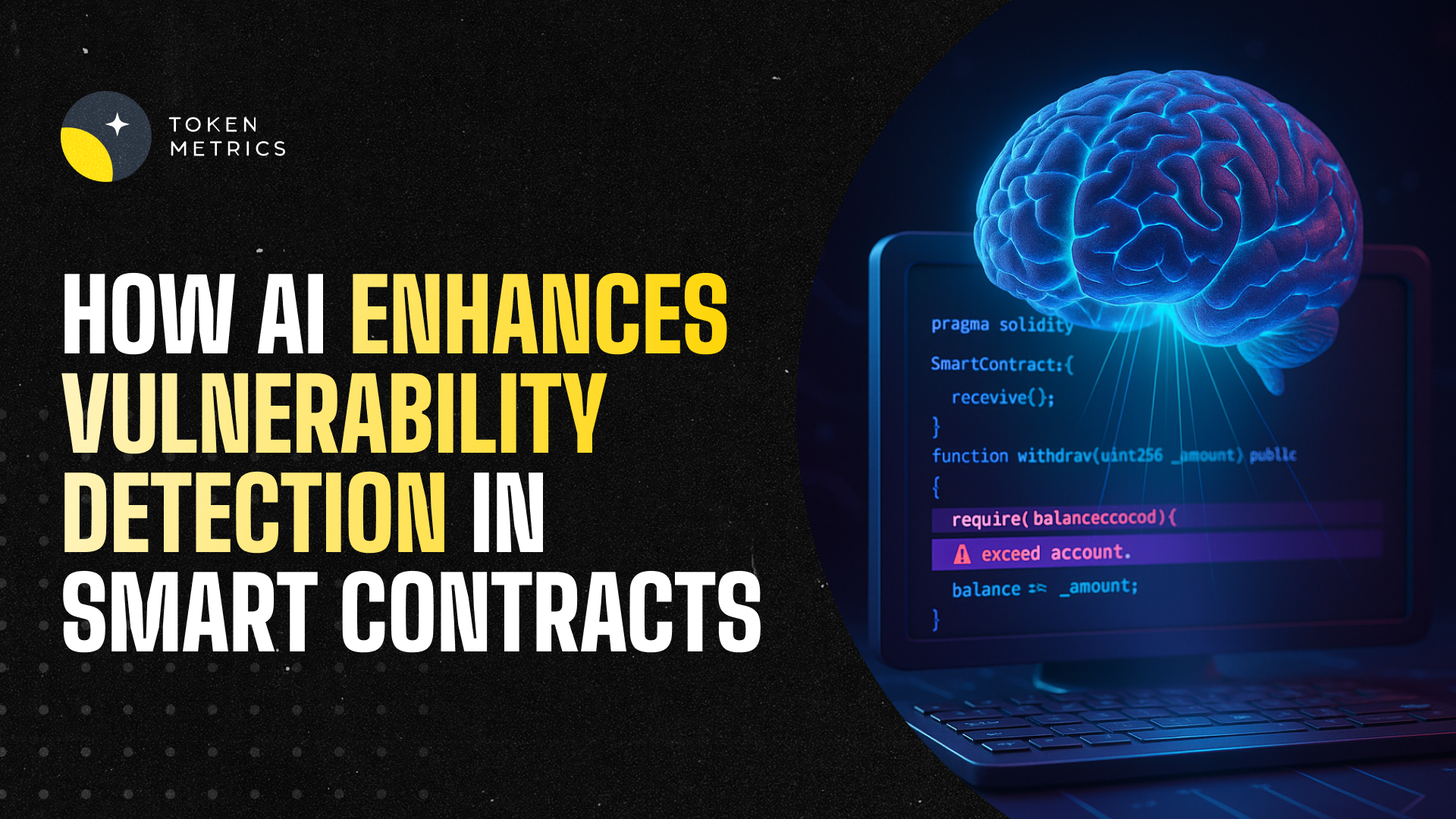
How AI Enhances Vulnerability Detection in Smart Contracts

Token Metrics Team
4
MIN

Introduction: The Growing Concern of Smart Contract Vulnerabilities

Smart contracts are self-executing contracts with the terms directly written into code, widely used across blockchain platforms to automate decentralized applications (DApps) and financial protocols. However, despite their innovation and efficiency, vulnerabilities in smart contracts pose significant risks, potentially leading to loss of funds, exploits, or unauthorized actions.

With the increasing complexity and volume of smart contracts being deployed, traditional manual auditing methods struggle to keep pace. This has sparked interest in leveraging Artificial Intelligence (AI) to enhance the identification and mitigation of vulnerabilities in smart contracts.

Understanding Smart Contract Vulnerabilities

Smart contract vulnerabilities typically arise from coding errors, logic flaws, or insufficient access controls. Common categories include reentrancy attacks, integer overflows, timestamp dependencies, and unchecked external calls. Identifying such vulnerabilities requires deep code analysis, often across millions of lines of code in decentralized ecosystems.

Manual audits by security experts are thorough but time-consuming and expensive. Moreover, the human factor can result in missed weaknesses, especially in complex contracts. As the blockchain ecosystem evolves, utilizing AI to assist in this process has become a promising approach.

The Role of AI in Vulnerability Detection

AI techniques, particularly machine learning (ML) and natural language processing (NLP), can analyze smart contract code by learning from vast datasets of previously identified vulnerabilities and exploits. The primary roles of AI here include:

  • Automated Code Analysis: AI models can scan codebases rapidly to detect patterns indicative of security flaws.
  • Anomaly Detection: AI can recognize atypical or suspicious contract behaviors that deviate from standard practices.
  • Predictive Assessment: By using historical vulnerability data, AI can predict potential risk points in new contracts.
  • Continuous Learning: AI systems can improve over time by incorporating feedback from newly discovered vulnerabilities.

Techniques and Tools Used in AI-Driven Smart Contract Analysis

Several AI-based methodologies have been adopted to aid vulnerability detection:

  1. Static Code Analysis: AI algorithms break down smart contract code without execution, identifying syntactic and structural weaknesses.
  2. Dynamic Analysis and Fuzzing: Leveraging AI to simulate contract execution in varied scenarios to uncover hidden vulnerabilities.
  3. Graph Neural Networks (GNNs): Applied to model relational data within smart contract structures, improving detection of complex vulnerabilities.
  4. Transformer Models: Adapted from NLP, these analyze code semantics to spot nuanced issues beyond basic syntax errors.

Some emerging platforms integrate such AI techniques to provide developers and security teams with enhanced vulnerability scanning capabilities.

Advantages of AI Over Traditional Auditing Methods

Compared to manual or rule-based approaches, AI provides several notable benefits:

  • Scalability: AI can analyze thousands of contracts quickly, which manual teams cannot feasibly match.
  • Consistency: AI reduces human error and subjective assessment variability in vulnerability identification.
  • Real-Time Analysis: AI-powered systems can run continuous scans and provide rapid alerts for emerging threats.
  • Cost Efficiency: Automating portions of the audit process can reduce resource expenditure over time.

Despite these advantages, AI is complementary to expert review rather than a replacement, as audits require contextual understanding and judgment that AI currently cannot fully replicate.

Challenges and Limitations of AI in Smart Contract Security

While promising, AI application in this domain faces several hurdles:

  • Data Quality and Availability: Training AI models requires large, well-labeled datasets of smart contract vulnerabilities, which are limited due to the relative novelty of the field.
  • Complexity of Smart Contracts: Diverse programming languages and design patterns complicate uniform AI analysis.
  • False Positives/Negatives: AI may generate incorrect alerts or miss subtle vulnerabilities, requiring human validation.
  • Adversarial Adaptation: Malicious actors may develop exploits specifically designed to evade AI detection models.

How to Use AI Tools Effectively for Smart Contract Security

Developers and security practitioners can optimize the benefits of AI by:

  • Integrating AI Reviews Early: Employ AI analysis during development cycles to detect vulnerabilities before deployment.
  • Combining with Manual Audits: Use AI as a preliminary screening tool, followed by detailed human assessments.
  • Continuous Monitoring: Monitor deployed contracts with AI tools to detect emergent risks or unexpected behaviors.
  • Leveraging Platforms: Utilizing platforms such as Token Metrics that provide AI-driven analytics for comprehensive research on smart contracts and related assets.

Conclusion & Future Outlook

AI has a growing and important role in identifying vulnerabilities within smart contracts by providing scalable, consistent, and efficient analysis. While challenges remain, the combined application of AI tools with expert audits paves the way for stronger blockchain security.

As AI models and training data improve, and as platforms integrate these capabilities more seamlessly, users can expect increasingly proactive and precise identification of risks in smart contracts.

Disclaimer

This article is for educational and informational purposes only. It does not constitute financial, investment, or legal advice. Always conduct your own research and consider consulting professionals when dealing with blockchain security.

Research

Is Web3 Just a Buzzword or a Real Innovation?

Token Metrics Team
3
MIN

Introduction to Web3

The emergence of Web3 has sparked diverse conversations in technology and blockchain communities. Some consider it the next revolutionary phase of the internet, while others dismiss it as mere hype. This blog explores whether Web3 is just a buzzword or if it represents a tangible and meaningful evolution in digital interactions.

Understanding the Concept of Web3

Web3 broadly refers to a new paradigm of the internet built on decentralized technologies like blockchain, aiming to enable peer-to-peer interactions without centralized intermediaries. Unlike Web2, which is dominated by centralized platforms controlling data and services, Web3 proposes a more open, user-controlled internet.

Key Web3 features include:

  • Decentralization: Data and services distributed across networks instead of centralized servers.
  • Blockchain Integration: Use of immutable ledgers to ensure transparency and security.
  • Token-based Economics: Implementation of cryptocurrencies and tokens to incentivize participation.
  • Enhanced User Sovereignty: Users control their data and digital identities.

The Technology and Applications Behind Web3

Web3 relies heavily on blockchain technology, smart contracts, and decentralized applications (dApps). These components facilitate trustless transactions and programmable digital agreements.

Notable Web3 applications include decentralized finance (DeFi), non-fungible tokens (NFTs), and decentralized autonomous organizations (DAOs). These innovations demonstrate practical use cases extending beyond theoretical frameworks.

Moreover, artificial intelligence (AI) tools are increasingly applied to analyze and navigate the evolving Web3 landscape. Platforms such as Token Metrics leverage AI-driven insights to help users research blockchain projects and assess technology fundamentals without financial recommendations.

Addressing the Skepticism Around Web3

Critics argue that Web3 might be overhyped with limited real-world adoption so far. Challenges include scalability issues, user experience complexities, regulatory uncertainties, and potential misuse.

However, innovation cycles often follow initial hype phases. Historical tech developments illustrate how novel ideas initially labeled as buzzwords eventually matured into foundational technologies over time.

Scenario analysis suggests varying outcomes for Web3:

  1. Gradual Adoption: Incremental integration of Web3 elements into mainstream platforms.
  2. Disruptive Shift: Web3 replaces significant portions of centralized internet infrastructure.
  3. Fragmentation or Stall: Development slows due to technical, regulatory, or societal barriers.

Practical Steps for Evaluating Web3 Projects

Due diligence is essential in understanding Web3 initiatives. Consider these points when researching:

  • Team and Community: Assess project founders' credentials and community engagement.
  • Technology Fundamentals: Examine code repositories, technical whitepapers, and audit reports.
  • Use Case Viability: Analyze how a project solves real problems uniquely.
  • Partnerships and Ecosystem: Look at collaborators and interoperability with existing platforms.

Leveraging AI-powered platforms like Token Metrics can assist users in organizing and interpreting vast data points objectively, aiding a comprehensive understanding.

The Role of Regulation and Governance

Regulation remains an evolving factor for Web3 projects. Decentralized governance models, such as DAOs, aim to allow stakeholder participation in decision-making processes. However, legal frameworks vary globally and can impact project development and adoption.

Understanding the nuanced regulatory landscape is critical for assessing the long-term feasibility and resilience of Web3 innovations.

Conclusion: Is Web3 Buzzword or Real?

Web3 encompasses transformative potentials in reimagining internet architecture. While it faces significant hurdles and exhibits hype characteristics, substantial technological progress and adoption signals suggest it is more than mere buzzword.

Objective analysis, supported by AI research tools like Token Metrics, can facilitate critical evaluation of emerging projects and technologies within this evolving domain.

Disclaimer

This article is for educational and informational purposes only and does not constitute financial advice. Readers should conduct their own research and consult professional advisors before making any decisions related to blockchain technologies or digital assets.

Research

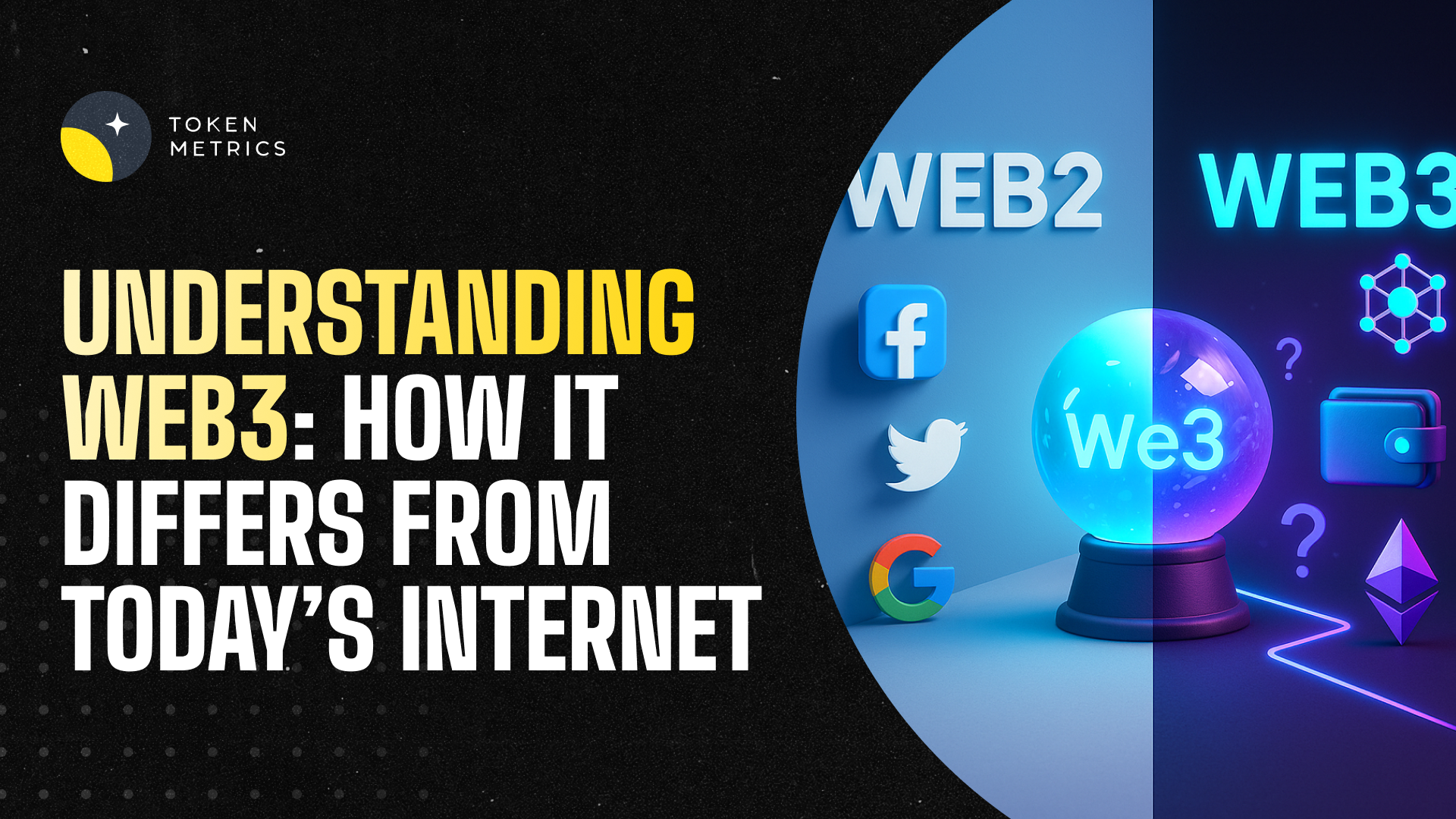
Understanding Web3: How It Differs From Today's Internet

Token Metrics Team
4
MIN

Introduction

The internet has become an integral part of modern life, continually evolving since its inception. In recent years, a new paradigm called Web3 has emerged, promising to reshape how users interact with digital platforms. This blog post explores the fundamental differences between Web3 and the current internet, often referred to as Web2, to clarify what Web3 entails and its potential impact.

What Is Web3?

Web3 represents the next phase of the internet, built on the principle of decentralization. Unlike the current centralized internet infrastructure, Web3 aims to distribute control away from traditional intermediaries like corporations and governments to users and communities. Key technologies underpinning Web3 include blockchain, decentralized finance (DeFi), non-fungible tokens (NFTs), and decentralized autonomous organizations (DAOs).

At its core, Web3 is designed to empower users to own and control their data, digital assets, and online identities through cryptographic proof rather than relying on centralized entities. This shift holds the promise of enhanced privacy, improved security, and greater transparency across digital services.

How Web3 Differs From the Current Internet

The current internet, or Web2, is characterized by centralized platforms such as social media networks, content-sharing sites, and cloud service providers. These platforms control user data and have significant influence over digital ecosystems. Web3 introduces several pivotal differences:

  • Decentralization: Traditional web services store data on central servers. Web3 applications (dApps) operate on decentralized networks like Ethereum, distributing data across many nodes.
  • Data Ownership and Privacy: In Web3, users have sovereignty over their personal data via cryptographic keys, reducing dependency on intermediaries.
  • Trustless Interactions: Web3 uses smart contracts to automate transactions without requiring trust in a third party, enhancing transparency.
  • Monetization and Incentives: Users can directly monetize their contributions or assets through tokens without relying on platform-controlled advertising models.

Key Technologies Enabling Web3

A few seminal technologies make the Web3 vision feasible:

  1. Blockchain: A distributed ledger technology providing an immutable record of transactions and data accessible to all network participants.
  2. Cryptographic wallets: Tools that allow users to manage private keys securely, facilitating ownership and transaction signing.
  3. Smart contracts: Self-executing contracts with the terms directly written into code, automating agreements and processes without intermediaries.
  4. Decentralized storage: Networks like IPFS provide distributed data hosting, improving resilience and censorship resistance.

These technologies collectively foster environments where decentralized applications can function effectively, distinguishing Web3 from legacy web systems.

Impact of AI Research Tools in Understanding Web3

Analyzing the Web3 space requires comprehensive research and understanding of complex, rapidly evolving technologies. AI-driven research platforms like Token Metrics use machine learning and data analytics to provide insights into blockchain networks, emerging protocols, and token metrics. By leveraging these tools, researchers and enthusiasts can assess technological fundamentals and ecosystem trends in a structured, data-informed manner, facilitating a clearer understanding of Web3 developments.

Practical Considerations for Exploring Web3

For those interested in exploring Web3, keeping the following factors in mind can enhance comprehension and engagement:

  • Focus on fundamentals: Evaluate protocols and projects based on technology, use case, and community involvement.
  • Understand risk: Web3 technologies are experimental and subject to regulatory and technical challenges.
  • Use credible research tools: Platforms like Token Metrics offer analytical data that aid in objective evaluation.
  • Stay informed: The Web3 landscape evolves rapidly, requiring continuous learning and monitoring.

Future Outlook: Web3 vs. Web2

While Web3 promises a more decentralized and user-empowered internet, it is essential to consider practical implications. Adoption hurdles, scalability, user experience, and regulatory frameworks will shape its trajectory. Unlike Web2, which offers convenience and centralized control, Web3 emphasizes autonomy and distributed governance. The future internet may well integrate strengths from both models, providing a hybrid approach that balances user control with usability.

Conclusion

Web3 represents a transformative vision for the internet, aiming to decentralize control and enhance user ownership of data and digital assets. Its key distinctions from the current internet (Web2) include decentralization, trustless interactions, and new economic models. Technologies like blockchain and smart contracts drive these changes, supported by analytical tools such as Token Metrics that aid in navigating this complex environment. As Web3 continues to evolve, understanding its fundamentals remains crucial for anyone interested in the future of the internet.

Disclaimer

This blog post is intended for educational and informational purposes only and does not constitute financial or investment advice. Readers should conduct their own research and consider their risk tolerance before engaging with Web3 technologies or cryptocurrencies.

Choose from Platinum, Gold, and Silver packages
Reach with 25–30% open rates and 0.5–1% CTR
Craft your own custom ad—from banners to tailored copy
Perfect for Crypto Exchanges, SaaS Tools, DeFi, and AI Products