Back to blog
Crypto Basics

Bull Flag Pattern - What It Means and How to Identify It?

Learn everything about the bull flag pattern and how it works with examples in this descriptive guide.
Token Metrics Team
8 Minutes
Want Smarter Crypto Picks—Free?
See unbiased Token Metrics Ratings for BTC, ETH, and top alts.
Thank you! Your submission has been received!
Oops! Something went wrong while submitting the form.
 No credit card | 1-click unsubscribe

In the world of finance, trading is considered as highly volatile in nature, and making the right trading decisions can be challenging. However, understanding different patterns in the market can help traders make better decisions.

One of these patterns is the Bull Flag Pattern, which is a bullish continuation pattern that is commonly found in stocks and cryptocurrency trading. In this article, we will discuss what is a bull flag pattern and how to identify it, with examples.

What is a Bull Flag Pattern?

The Bull Flag Pattern is a continuation pattern that occurs when there is a sharp price increase (known as the flagpole) followed by a period of consolidation (the flag). The pattern is considered bullish because it suggests that there is a strong buying pressure in the market, and traders are only taking a break before continuing to push the price higher.

The flag portion of the pattern is typically a rectangle or a parallel channel, and the volume during the flag tends to be lower than during the flagpole. When the price breaks out of the flag, it is usually accompanied by a high trading volume, indicating that the bullish momentum has resumed.

How to Trade with Bull Flag Patterns?

Trading with a bull flag pattern requires identifying the pattern and taking a position based on its expected outcome. Here are some steps to follow when trading with the bull flag pattern:

Identify the bull flag pattern: To identify a bullish flag pattern in a chart, traders should look for a sharp price increase followed by a consolidation period where the price moves sideways in a narrow range, forming a rectangular shape on the chart.

The consolidation period should have lower trading volume, indicating a decrease in market volatility. Once the consolidation period is over, the price should break above the resistance level, indicating that the bullish trend is likely to continue. It is important to confirm the pattern with other technical indicators such as RSI or moving averages to avoid false signals.

Confirm the breakout: Once the price breaks out of the flag, it should be accompanied by high trading volume. This is a confirmation that the bullish momentum has resumed and it is a good time to enter a long position (buy).

Set stop-loss orders: As with any other trading strategy, it is important to limit your potential losses. A stop-loss order is an order to sell a security when it reaches a certain price level. You should set a stop-loss order just below the support level of the flag to limit your potential losses in case the pattern fails.

Take profits: You should take profits by selling your position when the price reaches a predetermined level or by using a trailing stop to capture as much of the upside potential as possible.

It is important to note that many traders believe the bull flag pattern is a reliable pattern but it is not infallible. It is always a good idea to use other technical analysis tools such as trendlines, moving averages, and oscillators to confirm your trading decisions. 

Additionally, you should always manage your risk by using stop-loss orders and only trade with money that you can afford to lose.

Examples of Bull Flags Patterns

There are several examples of bullish flag patterns in the cryptocurrency market. One such example is the flag pattern that formed on the Bitcoin chart in early 2021. 

After reaching an all-time high in January, the price of Bitcoin consolidated in a narrow range for several weeks, forming a rectangular shape on the chart. Once the consolidation period was over, the price broke out of the flag pattern, surging to new all-time highs. 

Another example of a bullish flag pattern is the one that formed on the Ethereum chart in mid-2020. After a sharp price increase, Ethereum consolidated in a rectangular pattern for several weeks before breaking out and continuing its upward trend.

Image Source: makeuseof.com


How Reliable is a Bull Flag Pattern?

In general, the bull flag pattern is considered as a reliable pattern in technical analysis. It is a bullish continuation pattern, which means that it signals a resumption of the upward trend after a period of consolidation.

One of the reasons for its reliability is because it reflects a period of market indecision. The flag is formed when the price consolidates after a sharp price increase.

During this period of consolidation, buyers and sellers are in a state of equilibrium, and neither side has enough strength to push the price significantly higher or lower. This creates a coiled spring effect, and when the price eventually breaks out of the flag, it tends to do so with a lot of momentum. 

It is important to note that sometimes, the bull flag pattern can fail, and traders should always use other technical analysis tools to confirm their trading decisions. 

Bull Flag Pattern - Benefits and Risks

The bull flag pattern can be a useful tool for traders, but it is important to understand its benefits and risks, and to use it in conjunction with other technical analysis and risk management strategies. 

Here are some of the benefits and risks associated with it:

Benefits Of Bull Flag Pattern

Clear entry and exit points: The bull flag pattern has clear entry and exit points, making it easy for traders to place their trades and manage their positions.

Strong upside potential: The bull flag pattern is a bullish continuation pattern, which means that it signals a resumption of the upward trend. This presents a strong upside potential for traders who enter a long position after the breakout.

Easy to identify: The bull flag pattern has a clear visual representation on a price chart, making it easy for traders to spot and trade.

Applicable to different time frames: The bull flag pattern can be used on different time frames, from intraday charts to daily and weekly charts, making it applicable to a wide range of trading strategies.

Risks Associated with Bull Flag Pattern

False breakouts: The bull flag pattern can fail, resulting in a false breakout. This can happen when the price breaks out of the flag but then quickly reverses, trapping traders who entered long positions.

Whipsaws: The price can oscillate within the flag for an extended period of time, resulting in false signals and whipsaws. This can cause traders to enter and exit positions prematurely, resulting in losses.

Market volatility: The bull flag pattern is a technical analysis tool and does not take into account fundamental factors that can impact market volatility. Economic events, news releases, and other market factors can cause the price to move in unexpected ways, resulting in losses for traders.

Risk management: Traders should always manage their risk by using stop-loss orders and only trading with money that they can afford to lose. Failure to manage risk can result in significant losses.

Bull Flag vs Bear Flag - Key Differences

The bull flag and bear flag patterns are two very different chart patterns in technical analysis that can be used to identify potential trading opportunities. Here are some of the key differences between bull flags and bear flags:

Market direction: The bull flag pattern is a bullish continuation pattern, which means that it signals a resumption of the upward trend. In contrast, the bear flag pattern is a bearish continuation pattern, which means that it signals a resumption of the downward trend.

Price action: The bull flag pattern is formed when the price consolidates after a sharp price increase, forming a flag-like pattern. The price action during the consolidation phase is characterized by lower trading volumes and a range-bound price movement.

Image Source: www.beanfxtrader.com/flag-patterns/

In contrast, the bear flag pattern is formed when the price consolidates after a sharp price decrease, also forming a flag-like pattern. The price action during the consolidation phase is characterized by lower trading volumes and a range-bound price movement.

Breakout direction: In the bull flag pattern, the breakout occurs to the upside, as buyers take control of the market and push the price higher. In contrast, in the bear flag pattern, the breakout occurs to the downside, as sellers take control of the market and push the price lower.

Trading strategy: Traders can use the Bull Flag pattern to enter long positions after the breakout, with a stop-loss order placed below the lower boundary of the flag. Conversely, traders can use the Bear Flag pattern to enter short positions after the breakout, with a stop-loss order placed above the upper boundary of the flag.

Success rate: Both bull flags and bear flags are considered to be reliable chart patterns, with a good success rate. However, as with any trading strategy, there is no guarantee that the pattern will play out as expected.

Conclusion

In conclusion, the bull flag pattern is a powerful tool for traders looking to profit from bullish trends in the market. By combining the bull flag pattern with other technical indicators and risk management strategies, traders can develop effective trading plans and increase their chances of success in the market. 

However, as with any trading strategy, it is important to conduct thorough research and analysis before making any trades, and to always practice proper risk management to minimize potential losses.

Disclaimer

The information provided on this website does not constitute investment advice, financial advice, trading advice, or any other sort of advice and you should not treat any of the website's content as such.

Token Metrics does not recommend that any cryptocurrency should be bought, sold, or held by you. Do conduct your own due diligence and consult your financial advisor before making any investment decisions.

Build Smarter Crypto Apps &
AI Agents in Minutes, Not Months
Real-time prices, trading signals, and on-chain insights all from one powerful API.
Grab a Free API Key
About Token Metrics
Token Metrics: AI-powered crypto research and ratings platform. We help investors make smarter decisions with unbiased Token Metrics Ratings, on-chain analytics, and editor-curated “Top 10” guides. Our platform distills thousands of data points into clear scores, trends, and alerts you can act on.
30 Employees
analysts, data scientists, and crypto engineers
Daily Briefings
concise market insights and “Top Picks”
Transparent & Compliant
Sponsored ≠ Ratings; research remains independent
Want Smarter Crypto Picks—Free?
See unbiased Token Metrics Ratings for BTC, ETH, and top alts.
Thank you! Your submission has been received!
Oops! Something went wrong while submitting the form.
 No credit card | 1-click unsubscribe
Token Metrics Team
Token Metrics Team

Recent Posts

Research

Top Gold & Commodity-Backed Tokens (2025)

Token Metrics Team
12 min read

Who this guide is for. Crypto investors and treasurers comparing gold-backed tokens and other commodity-backed assets that can be audited and, in many cases, redeemed for metal.
Top three picks. PAX Gold (PAXG) for regulated, bar-linked redemption; Tether Gold (XAUt) for broad awareness and simple fees; Kinesis (KAU/KAG) for spend-and-yield use cases.
Key caveat. Redemption minimums, custody locations, and fees vary by issuer; always confirm regional eligibility and schedules on the official pages.


Introduction: Why Commodity-Backed Tokens Matter in 2025

Gold-backed tokens give on-chain ownership exposure to vaulted bullion with transparent allocation and, often, physical redemption, blending the inflation hedge of metals with crypto liquidity. In 2025, they’re used for hedging, collateral, cross-border settlement, and “digital cash” backed by tangible assets. A commodity-backed token is a blockchain token that represents title to a specific quantity of a real-world commodity (for example, 1 troy ounce or 1 gram of gold) held by a custodian, typically with published fees, vault locations, and redemption rules. Our picks prioritize liquidity, security controls, breadth of metals, cost transparency, and global accessibility.


Best Commodity-Backed Tokens in November 2025 (Comparison Table)


We excluded defunct or sunset projects (e.g., PMGT; CACHE Gold ceased backing CGT on Sept 30, 2025). (perthmint.com)


Top 10 Gold & Commodity-Backed Tokens in November 2025

1) PAX Gold (PAXG) — Best for bar-linked redemption & regulatory posture

Why Use It. PAXG links each token to specific LBMA Good Delivery bars stored in London, offering direct bar redemption (institutional minimums apply) or USD redemption at spot. Paxos publishes fee schedules and notes no storage fee charged to customers at this time. (paxos.com)
Best For. Institutions; HNW hedgers; DeFi users needing reputable collateral.
Notable Features. LBMA bars; serial-number linkage; custodied in London; fiat redemption option. (paxos.com)
Fees Notes. Creation/destruction fees; no storage fee currently per issuer help center. (help.paxos.com)
Regions. Global (issuer KYC).
Consider If. You can meet bar redemption minimums and UK vault logistics. (help.paxos.com)
Alternatives. Tether Gold (XAUt); VNX Gold (VNXAU).  


2) Tether Gold (XAUt) — Best for simple pricing & broad availability

Why Use It. XAUt represents allocated gold and can be redeemed for physical gold or USD; Tether publishes a straightforward 0.25% creation/redemption fee and a one-time verification fee for onboarding. FAQs outline redemption mechanics and bar specifics. (Tether)
Best For. Traders seeking brand familiarity; cross-chain users (ETH/TRON).
Notable Features. Bar metadata; physical or USD redemption; no custody fee disclosed beyond the transaction fee. (Tether)
Fees Notes. 25 bps create/redeem; separate KYC verification fee. (Tether)
Regions. Global (issuer KYC).
Consider If. You need clear fee math but don’t require bar-specific allocation like PAXG.
Alternatives. PAX Gold (PAXG); Kinesis (KAU).  


3) Kinesis KAU (Gold) / KAG (Silver) — Best for spend-and-yield utility

Why Use It. Kinesis combines metal-backed tokens with an exchange, cards, and yields funded from platform fees (published yield-share). Trading and precious metals transactions show ~0.22% execution fees on official schedules. (Kinesis)
Best For. Users wanting to spend gold/silver, earn monthly yields, and keep fees predictable.
Notable Features. Fee-share yield (published); exchange, card rails; gold & silver pairs. (Kinesis)
Fees Notes. ~0.22% buy/sell/trade; other fees per schedule. (Kinesis)
Regions. Global (platform KYC/availability).
Consider If. You prefer an integrated platform over a standalone token.
Alternatives. VNX (VNXAU/VNXAG); Aurus (tXAU/tXAG).  


4) Comtech Gold (CGO) — Best for XDC ecosystem & Shariah-compliant framework

Why Use It. CGO tokenizes 1g gold units on the XDC (XRC-20) network, with a published fee structure for mint/redeem (0.50%), transfers (0.50%), and custody notes in FAQs. Documentation details creation/redemption and delivery fees. (comtechgold.com)
Best For. XDC builders; users needing Shariah-compliant structuring.
Notable Features. On-chain proofing; fee schedule; vault delivery options. (comtechgold.com)
Fees Notes. 0.50% mint/redeem; 0.50% transfer; custody terms disclosed. (comtechgold.com)
Regions. Global (issuer terms apply).
Consider If. You’re comfortable with XDC rails and issuer fee model.
Alternatives. PAXG; VNXAU.


5) VNX Gold (VNXAU) — Best for EEA vaulting & multi-chain issuance

Why Use It. VNXAU gives direct ownership of allocated bars stored in Liechtenstein with a public allocation lookup tool. VNX runs on Ethereum, Polygon, Q, and Solana, and has communications on redemption and delivery. (VNX)
Best For. EEA users; diversification across chains.
Notable Features. Allocation lookup by serial; segregated AAA-jurisdiction vault; multi-chain. (VNX)
Fees Notes. See VNX pricing and product pages for current schedules.
Regions. EEA emphasis; global availability varies by KYC.
Consider If. You want EEA custody and serial-level transparency.
Alternatives. PAXG; XAUt.


6) Aurus tGOLD (tXAU) / tSILVER (tXAG) — Best for gram-denominated multi-metal exposure

Why Use It. Aurus issues 1-gram tokens backed by vaulted gold and silver with insured, audited storage. tGOLD and tSILVER support multi-chain DeFi integrations and a mobile app, with ecosystem partners for mint/redeem. (AURUS)
Best For. DeFi users; small-denomination accumulation; multi-metal portfolios (includes platinum via tXPT).
Notable Features. 1g units; insured vaulted metals; app & dashboard; partner network. (AURUS)
Fees Notes. Exchange/network fees; issuer/partner fees may apply.
Regions. Global (partner KYC where required).
Consider If. You want gram-level flexibility and cross-chain access.
Alternatives. Kinesis; VNX.


7) Gold Silver Standard (AUS/AGS) — Best for Australia-based custody & simple redemption

Why Use It. Tokens AUS (gold) and AGS (silver) are backed by allocated bullion held in Australian high-security vaults with $0 storage and transfer at the issuer level and partner-facilitated redemptions. (goldsilverstandard.com)
Best For. AUD-centric investors; straightforward physical pickup/delivery via partners.
Notable Features. 1g linkage; local redemption via Ainslie partners; Australia-first focus. (goldsilverstandard.com)
Fees Notes. Issuer lists $0 storage/transfer; exchange and redemption partner fees may apply. (goldsilverstandard.com)
Regions. Australia focus; global varies.
Consider If. You need straightforward redemption in Australia.
Alternatives. PAXG; VNXAU.


8) VNX Silver (VNXAG) — Best for EEA silver allocation & transparency tools

Why Use It. VNXAG mirrors the VNXAU model for silver, backed by allocated metal with the same allocation lookup tooling and multi-chain issuance. (VNX)
Best For. EEA investors prioritizing silver in segregated storage.
Notable Features. Allocation lookup; EEA custody; multi-chain support. (VNX)
Fees Notes. See VNX site for current schedules.
Regions. EEA emphasis; global varies.
Consider If. You want EEA-vaulted silver with serial-level transparency.
Alternatives. KAG; tXAG.


9) VeraOne (VRO) — Best for euro-area buyers wanting 1-gram ERC-20

Why Use It. VRO is an ERC-20 token pegged to 1 gram of LBMA-standard gold, issued by a long-standing French precious-metal group; materials describe secured storage and regular audits. (VeraOne)
Best For. EU users; gram-based savings; euro on-ramps.
Notable Features. 1g linkage; audited storage; EU presence. (VeraOne)
Fees Notes. Issuer materials outline model; confirm current fees on site.
Regions. EU focus; global access varies.
Consider If. You want EU branding and ERC-20 simplicity.
Alternatives. PAXG; VNXAU.


10) AgAu — Best for Swiss custody & peer-to-peer design

Why Use It. AgAu outlines 1:1 backed gold and silver tokens with Swiss custody and a peer-to-peer payment focus; docs and reports describe convertibility and audited reserves. (agau.io)
Best For. Users seeking Swiss jurisdiction and payments-style UX.
Notable Features. Swiss issuer; P2P spend; audit & documents hub. (agau.io)
Fees Notes. See issuer documentation for fees and redemption steps.
Regions. Global (jurisdictional checks apply).
Consider If. You want Swiss custody with payments emphasis.
Alternatives. VNXAU; AUS.


Decision Guide: Best by Use Case

  • Regulated, bar-specific redemption: PAX Gold (PAXG). (paxos.com)
  • Simple fee schedule & brand familiarity: Tether Gold (XAUt). (Tether)
  • Spend metals + monthly fee-share yield: Kinesis (KAU/KAG). (Kinesis)
  • XDC network users: Comtech Gold (CGO). (comtechgold.com)
  • EEA custody & allocation lookup: VNX (VNXAU/VNXAG). (VNX)
  • Gram-based, multi-metal DeFi: Aurus (tXAU/tXAG). (AURUS)
  • Australia-centric custody & pickup: Gold Silver Standard (AUS/AGS). (goldsilverstandard.com)
  • EU 1-gram ERC-20: VeraOne (VRO). (VeraOne)
  • Swiss custody & P2P payments: AgAu. (agau.io)

How to Choose the Right Commodity-Backed Token (Checklist)

  • ☐ Region eligibility and KYC match your profile.
  • ☐ Underlying metal type and unit (ounce vs gram).
  • Redemption rules: minimums, delivery locations, timelines.
  • Custody: vault jurisdiction, insurer, LBMA accreditation.
  • Fee transparency: creation, redemption, storage, transfer, network.
  • Audit/attestation cadence and allocation lookup tools.
  • Chains supported and DeFi integration needs.
  • ☐ Support channels and documentation depth.
    Red flags: vague custody details, unclear redemption, or discontinued programs.

Use Token Metrics With Any Commodity-Backed Token

  • AI Ratings to screen metal-linked assets and related ecosystem tokens.


  • Narrative Detection to spot inflows to on-chain RWAs.
  • Portfolio Optimization to size metal exposure vs. crypto beta.
  • Alerts & Signals to time entries/exits around macro prints.
    Workflow: Research → Select issuer → Execute on-chain or via platform → Monitor with alerts.


CTA: Start free trial to screen assets and time entries with AI.  


Security & Compliance Tips

  • Use official issuer URLs only; beware look-alikes.
  • Confirm fee schedules and redemption procedures before buying. (Tether)
  • Verify vaulting jurisdiction and any bar-serial lookup tools. (VNX)
  • Mind network fees, bridge risks, and exchange withdrawal rules.
  • Keep custody keys secure; whitelist issuer addresses.
  • If staking or yielding, confirm source of yield and counterparty exposure. (Kinesis)
    This article is for research/education, not financial advice.

Beginner Mistakes to Avoid

  • Treating all metal tokens as equal—redemption and custody differ widely.
  • Ignoring region and KYC limits until you try to redeem.
  • Overlooking minimums (e.g., full LBMA bars vs. gram redemptions). (help.paxos.com)
  • Confusing defunct tokens with active ones (e.g., PMGT sunset; CGT backing ceased). (perthmint.com)
  • Forgetting network/transfer fees when arbitraging across chains.
  • Using unofficial contracts on the wrong chain.

How We Picked (Methodology & Scoring)

  • Liquidity — 30%. Exchange presence, on-chain activity, practical tradability.
  • Security — 25%. Custody details, audits/attestations, LBMA alignment, redemption design.
  • Coverage — 15%. Metals (gold/silver/platinum), chains, tooling.
  • Costs — 15%. Creation/redemption/storage/transfer and transparency of schedules.
  • UX — 10%. Apps, dashboards, redemption flows.
  • Support — 5%. Docs, status pages, human support.
    We relied on official product, docs, fees, FAQ, and disclosure pages, cross-checking market datasets only for context. Last updated November 2025.

FAQs

What are gold-backed tokens?
 They are blockchain tokens that represent ownership of a specific quantity of vaulted, insured gold, typically with published fees and, in some cases, physical redemption options.

Are gold-backed tokens safer than stablecoins?
 They can diversify away from fiat risk, but introduce custody and redemption dependencies. Safety depends on the issuer’s vaulting, audits, legal structure, and your ability to redeem.

What fees should I expect?
 Common fees include creation/redemption, possible storage, transfer, and network fees. Examples: XAUt lists 0.25% create/redeem; Paxos publishes creation/destruction fees and notes no storage fee currently. Always check the live schedules. (Tether)

Can I redeem tokens for a real gold bar?
 Some issuers support bar redemption with minimum sizes and location constraints (e.g., LBMA bar logistics in London for PAXG). Others support gram-level redemption via partners. (help.paxos.com)

Which chains are supported?
 Varies: PAXG (Ethereum), XAUt (Ethereum/TRON), VNX (Ethereum/Polygon/Q/Solana), Aurus (multi-chain), CGO (XDC), Kinesis (native + exchange listings). (paxos.com)

Are there discontinued tokens I should avoid?
 Yes. PMGT has been discontinued; CACHE Gold (CGT) ceased backing as of Sept 30, 2025. Verify project status before buying. (perthmint.com)


Conclusion + Related Reads

Choose PAXG for bar-linked redemption and strong disclosures, XAUt for simple fees and brand reach, or Kinesis if you want to spend metals and earn fee-share yields. For EEA vaulting with allocation lookup, VNX is compelling; for gram-based DeFi exposure, Aurus is versatile.

Related Reads:

Research

Top RWA Tokenization Platforms (2025)

Token Metrics Team
11 min read

Who this guide is for. Teams and investors evaluating RWA tokenization platforms—issuers and infrastructure bringing Treasuries, funds, real estate, and other off-chain assets on-chain—across access tiers (retail, accredited, QP) and regions.

Top three picks.

  • Securitize — institutional rails (transfer agent/broker-dealer) behind flagship tokenized funds.
  • Ondo Finance — tokenized Treasuries and cash-equivalents with clear docs and eligibility flows.
  • Franklin Templeton (Benji) — on-chain registered money market fund access for U.S. investors.

One caveat. Fees, eligibility (U.S., EU, APAC), and redemption workflows vary widely—always verify your region and investor status on the official product page before transacting. (Securitize)


Introduction

RWA tokenization platforms issue or enable compliant, on-chain representations of real-world assets such as U.S. Treasuries, money market funds, public securities, real estate, and gold. In 2025, the category matters because it brings 24/7 settlement, composability, and transparent audit rails to traditionally siloed markets—while preserving regulatory guardrails like KYC/AML and transfer restrictions. The primary keyword “RWA tokenization platforms” captures commercial-investigational intent: who issues what, on which chains, in which regions, with what fees and controls.

Definition (snippet-ready): An RWA tokenization platform is an issuer or infrastructure provider that brings off-chain assets on-chain under documented legal, custody, and compliance frameworks, with mint/redeem and transfer controls stated in official materials.


How We Picked (Methodology & Scoring)

We scored each platform using official product, docs, pricing, security/licensing, and status pages (and cross-checked volumes with market datasets when needed). We prioritized current availability and clear disclosures.

Scoring weights (sum = 100):

  • Liquidity — 30%: scale, mint/redeem pathways, composability.
  • Security — 25%: audits, custodians, transfer agent/broker-dealer status, disclosures.
  • Coverage — 15%: asset types (T-bills, funds, gold, stocks, real estate), chains.
  • Costs — 15%: stated fees and expense ratios; network fees.
  • UX — 10%: onboarding, docs, transparency dashboards.
  • Support — 5%: regions, KYC help, contact channels.

Freshness: Last updated November 2025.


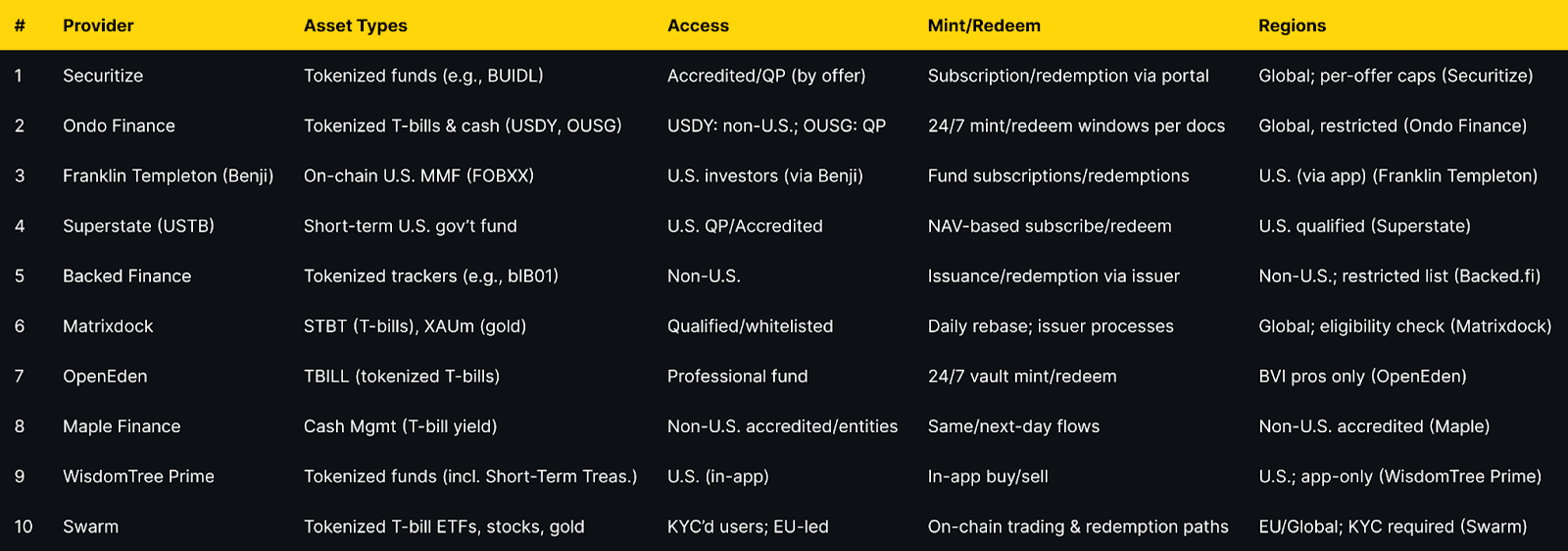
Best RWA tokenization platforms in November 2025 (Comparison Table)


Top 10 RWA tokenization platforms in November 2025

1. Securitize — Best for institutional-grade tokenized funds

Why Use It. Securitize provides regulated rails (transfer agent/broker-dealer) behind marquee tokenized funds like BlackRock’s BUIDL, with investor onboarding, cap-table/TA services, and compliant transfer controls for secondary liquidity where permitted. (Securitize)
Best For. Asset managers, QP/Accredited investors, enterprises wanting full-stack issuance and servicing.
Notable Features. Transfer agent role; broker-dealer marketplace; issuer/investor portals; compliance & reporting. (digitize.securitize.io)
Consider If. You need institutional governance and regulated distribution rather than retail-first access.
Fees Notes. Fund expense ratios and issuer/platform fees vary by offering.
Regions. Global, with per-offering eligibility and disclosures.
Alternatives. WisdomTree Prime; Ondo Finance.  


2. Ondo Finance — Best for diversified tokenized Treasuries & cash-equivalents

Why Use It. OUSG gives QPs exposure to short-term Treasuries/money market funds; USDY offers a tokenized note with cash-equivalent backing, with clear eligibility and 24/7 mint/redeem mechanics documented. (Ondo Finance)
Best For. DAOs and treasuries, QPs, non-U.S. entities seeking on-chain cash management.
Notable Features. USDY/ONS products; rTokens (rebasing); detailed fees/tax sections; multi-chain support. (docs.ondo.finance)
Consider If. U.S. persons generally restricted for USDY; confirm status before onboarding. (Ondo Finance)
Fees Notes. Management/operational fees per product docs; plus network fees. (docs.ondo.finance)
Regions. Global with restrictions (e.g., no USDY for U.S. persons). (Ondo Finance)
Alternatives. Superstate; OpenEden.  


3. Franklin Templeton — Benji — Best for U.S. on-chain money market access

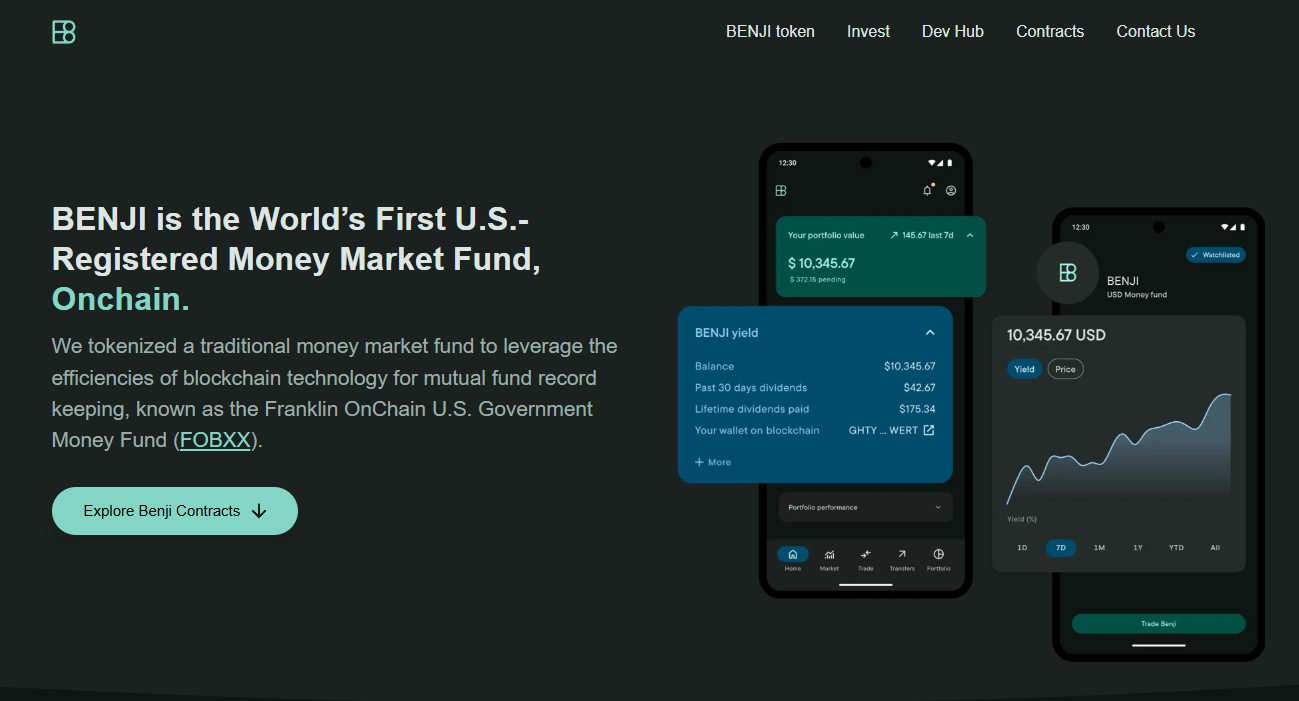
Why Use It. The Franklin OnChain U.S. Government Money Fund (FOBXX) is a registered fund whose shares are represented on-chain (BENJI), allowing U.S. investors to access a money market fund with blockchain-based recordkeeping. (digitalassets.franklintempleton.com)
Best For. U.S. treasurers and advisors needing a regulated on-chain cash vehicle.
Notable Features. US-registered fund; Stellar/Polygon rails; Benji contracts/app. (digitalassets.franklintempleton.com)
Consider If. Access is via Franklin’s app; availability and eligibility are U.S.-focused. (digitalassets.franklintempleton.com)
Fees Notes. Standard money market fund expense ratio; see fund page. (franklintempleton.com)
Regions. U.S. investors (see Benji). (digitalassets.franklintempleton.com)
Alternatives. WisdomTree Prime; Securitize-hosted offerings.  


4. Superstate (USTB) — Best for U.S. Qualified Purchasers

Why Use It. USTB offers U.S. Qualified Purchasers access to short-duration U.S. government securities through a tokenized fund on Ethereum, with institutional processes and NAV-based subscriptions/redemptions. (superstate.com)
Best For. U.S. QPs, fund treasurers, trading firms.
Notable Features. Ethereum issuance; QP onboarding; short-duration Treasury focus. (superstate.com)
Consider If. Available to QPs; verify accreditation and subscription steps. (superstate.com)
Fees Notes. Fund expenses apply; see official page. (superstate.com)
Regions. U.S. (Qualified Purchasers). (superstate.com)
Alternatives. Ondo OUSG; WisdomTree Prime funds.


5. Backed Finance — Best for tokenized trackers of public securities

Why Use It. Backed issues ERC-20 trackers like bIB01 (iShares $ Treasury 0-1yr UCITS ETF) with explicit regional restrictions and product pages that state legal structure and disclosures. (backed.fi)
Best For. Non-U.S. entities seeking tokenized ETF-style exposure with issuer support.
Notable Features. Tokenized trackers and AMCs; legal docs; chain integrations. (backed.fi)
Consider If. Not available to U.S. persons; restricted countries listed. (assets.backed.fi)
Fees Notes. Issuer/admin fees per product; plus network fees. (backed.fi)
Regions. Non-U.S.; sanctions list enforced. (assets.backed.fi)
Alternatives. Swarm; Matrixdock STBT.


6. Matrixdock — Best for T-bills and gold under one issuer

Why Use It. STBT provides short-term U.S. Treasury exposure with a 1:1 USD peg and daily rebasing, while XAUm tokenizes LBMA-grade physical gold—both under a clear issuer framework. (matrixdock.com)
Best For. Treasury management with optional gold allocation on the same rails.
Notable Features. STBT daily rebase; peg policy; gold custodial disclosures. (matrixdock.com)
Consider If. Whitelisting/eligibility apply; confirm region and KYC. (matrixdock.com)
Fees Notes. Issuer fees per product pages; network fees. (matrixdock.com)
Regions. Global with eligibility controls. (matrixdock.com)
Alternatives. OpenEden; Ondo OUSG.


7. OpenEden — Best for professional-grade tokenized T-bills

Why Use It. TBILL is structured as a regulated Professional Fund (BVI) with a 24/7 smart-contract vault for mint/redeem and a transparency dashboard, targeting professional investors. (openeden.com)
Best For. Professional/offshore funds and DAOs requiring programmatic access.
Notable Features. BVI Professional Fund status; real-time transparency; vault UI. (openeden.com)
Consider If. Professional-investor eligibility required; check docs before onboarding. (openeden.com)
Fees Notes. Fund and platform fees; plus network fees. (openeden.com)
Regions. BVI-regulated; cross-border access subject to status. (openeden.com)
Alternatives. Matrixdock; Ondo.


8. Maple Finance — Cash Management — Best for non-U.S. accredited entities seeking T-bill yield

Why Use It. Maple’s Cash Management provides non-U.S. accredited participants on-chain access to T-bill and repo yields, with updates enabling immediate servicing when liquidity is available and next-day withdrawals operationally. (maple.finance)
Best For. Non-U.S. corporates, DAOs, and funds optimizing idle stablecoin cash.
Notable Features. Fast onboarding; immediate interest accrual; no lock-up; institutional borrower SPV. (maple.finance)
Consider If. U.S. investors are excluded; confirm accreditation and entity status. (maple.finance)
Fees Notes. Management/operational fees netted from yield; network fees. (maple.finance)
Regions. Non-U.S. accredited/entities. (maple.finance)
Alternatives. OpenEden; Ondo.


9. WisdomTree Prime (Digital Funds) — Best for app-native tokenized fund access in the U.S.

Why Use It. The Prime app offers tokenized digital funds—including Short-Term Treasury—purchased and held in-app, bringing tokenized funds to retail U.S. users under an SEC-registered umbrella. (WisdomTree Prime)
Best For. U.S. retail/in-app users seeking tokenized fixed income and equity funds.
Notable Features. In-app buy/sell; multiple Treasury maturities; composability paths emerging. (WisdomTree Prime)
Consider If. App-only access; availability subject to U.S. coverage and disclosures. (WisdomTree Prime)
Fees Notes. Fund expense ratios; standard network fees for on-chain interactions. (wisdomtree.com)
Regions. U.S. (Prime app). (WisdomTree Prime)
Alternatives. Franklin Benji; Securitize.


10. Swarm — Best for compliant on-chain trading of tokenized T-bill ETFs and equities

Why Use It. Swarm enables compliant, on-chain access to tokenized U.S. Treasury ETFs, public stocks, and gold, with KYC’d access and DeFi-compatible rails documented in its platform materials and docs. (swarm.com)
Best For. EU-led users, crypto funds, and builders needing tokenized public market exposure.
Notable Features. dOTC protocol; product pages for T-bill ETFs; documented KYC/flows. (swarm.com)
Consider If. Regional and KYC requirements apply; yields are variable per underlying ETF. (swarm.com)
Fees Notes. Platform/product fees; network fees. (swarm.com)
Regions. EU/Global with KYC. (swarm.com)
Alternatives. Backed Finance; Ondo.


Decision Guide: Best By Use Case


How to Choose the Right RWA Tokenization Platform (Checklist)

  • Region eligibility (U.S./EU/APAC and investor status: retail, accredited, QP) is clearly stated.
  • Asset coverage matches mandate (T-bills, money market funds, ETFs, gold, real estate).
  • Mint/redeem mechanics and settlement windows are documented.
  • Fees: expense ratios, issuer fees, spreads, on-chain network costs are explicit.
  • Security posture: custodians, audits, transfer agent/broker-dealer status, disclosures.
  • Transparency: NAV, holdings, attestation or daily rebasing and dashboards.
  • Chain support: EVM/L2s/other; composability needs.
  • Support & docs: onboarding, KYC, status pages.
    Red flags: vague eligibility, missing fee tables, no custody/disclosure detail.

Use Token Metrics With Any Category

  • AI Ratings to screen assets tied to each platform’s tokens.
  • Narrative Detection to spot early RWA flows across chains.


  • Portfolio Optimization to size cash-equivalents vs. risk assets.
  • Alerts & Signals to time rotations into yield-bearing RWAs.

CTA — Indices Focus: Prefer diversified exposure? Explore Token Metrics Indices.  


Security & Compliance Tips

  • Transact only via official portals/URLs and verified contracts listed in docs. (digitalassets.franklintempleton.com)
  • Confirm eligibility (U.S./non-U.S., accredited/QP) and sanctioned-country restrictions before minting. (assets.backed.fi)
  • Review custody and role separation (issuer, TA, broker-dealer) and audit reports where available. (digitize.securitize.io)
  • Understand redemption windows, rebase mechanics, and NAV policies. (matrixdock.com)
  • Track fund expenses and on-chain network fees; they impact net yield. (franklintempleton.com)
  • Bookmark status/docs pages for incident updates and parameter changes.

This article is for research/education, not financial advice.


Beginner Mistakes to Avoid

  • Treating all RWA tokens as “stablecoins”—yields, risks, and redemption rights differ.
  • Ignoring eligibility rules, then getting stuck at redemption.
  • Skipping issuer docs and relying only on dashboards.
  • Assuming 1:1 liquidity at all times without reading fund/issuer terms.
  • Mixing retail wallets with institutional KYC accounts without a plan.
  • Overlooking chain/bridge risks when moving RWA tokens across L2s.

How We Picked (Methodology & Scoring)

We built an initial universe (~20 issuers/infrastructure) and selected 10 based on the SCORING_WEIGHTS above. We verified asset coverage, eligibility, fees, redemption, and regions on official pages only (listed below). Third-party datasets were used for cross-checks but are not linked.


FAQs

What are RWA tokenization platforms?
 Issuers or infrastructure that bring real-world assets (like Treasuries, funds, gold, or equities) on-chain under a legal/compliance framework, with stated mint/redeem processes and transfer rules. See each official page for specifics. (Securitize)

Are they safe for retail?
 Some are U.S. retail-friendly (e.g., Franklin Benji, WisdomTree Prime), while others are restricted to accredited investors, QPs, or non-U.S. persons. Always check the eligibility page before onboarding. (digitalassets.franklintempleton.com)

What fees should I expect?
 Expect fund expense ratios or issuer/admin fees plus on-chain network fees. Some products rebase yield; others adjust NAV. Review each product’s fees section. (docs.ondo.finance)

Where are these tokens available?
 Most run on Ethereum or compatible L2s, with some on Stellar/Polygon via app rails. Regions vary (U.S., EU, offshore professional). (digitalassets.franklintempleton.com)

Can I redeem 24/7?
 Many have 24/7 mint/redeem requests; actual settlement follows fund terms, banking hours, and liquidity windows. Check each product’s redemption section. (app.openeden.com)


Conclusion + Related Reads

If you want institutional rails and broad issuer support, start with Securitize. For T-bill exposure with clear docs, consider Ondo or Superstate (QP). U.S. retail can explore Franklin Benji or WisdomTree Prime. Diversifiers can add Matrixdock (Treasuries + gold) or OpenEden (pro fund vault). Builders needing tokenized equities/ETFs should evaluate Swarm and Backed.

Related Reads (Token Metrics):

Research

Best Liquid Restaking Tokens & Aggregators (2025)

Token Metrics Team
17 min read

Who this guide is for. Investors and builders comparing best liquid restaking tokens (LRTs) and aggregators to earn ETH staking + restaking rewards with on-chain liquidity.

Top three picks.

  • ether.fi (eETH/weETH): Non-custodial, deep integrations, clear docs. (ether.fi)
  • Renzo (ezETH): Multi-stack (EigenLayer + Symbiotic/Jito), transparent 10% rewards fee. (docs.renzoprotocol.com)
  • Kelp DAO (rsETH): Broad DeFi reach; explicit fee policy for direct ETH deposits. (kelp.gitbook.io)

One key caveat. Fees, redemption paths, and regional access vary by protocol—check official docs and terms before depositing.


Introduction

Liquid restaking lets you restake staked assets (most often ETH) to secure Actively Validated Services (AVSs) while receiving a liquid restaking token you can use across DeFi. The value prop in 2025: stack base staking yield + restaking rewards, with composability for lending, LPing, and hedging. In this commercial-investigational guide, we compare the best liquid restaking tokens and the top aggregators that route deposits across operators/AVSs, with an emphasis on verifiable fees, security posture, and redemption flow. We weigh scale and liquidity against risk controls and documentation quality to help you pick a fit for your region, risk tolerance, and toolstack.


How We Picked (Methodology & Scoring)

  • Liquidity — 30%: On-chain depth, integrations, and redemption mechanics.
  • Security — 25%: Audits, docs, risk disclosures, validator design.
  • Coverage — 15%: AVS breadth, multi-stack support (EigenLayer/Symbiotic/Jito), asset options.
  • Costs — 15%: Transparent fee schedules and user economics.
  • UX — 10%: Clarity of flows, dashboards, and docs.
  • Support — 5%: Status pages, help docs, comms.

Evidence sources: official websites, docs, pricing/fees and security pages, and status/terms pages; third-party datasets used only to cross-check volumes. Last updated November 2025.


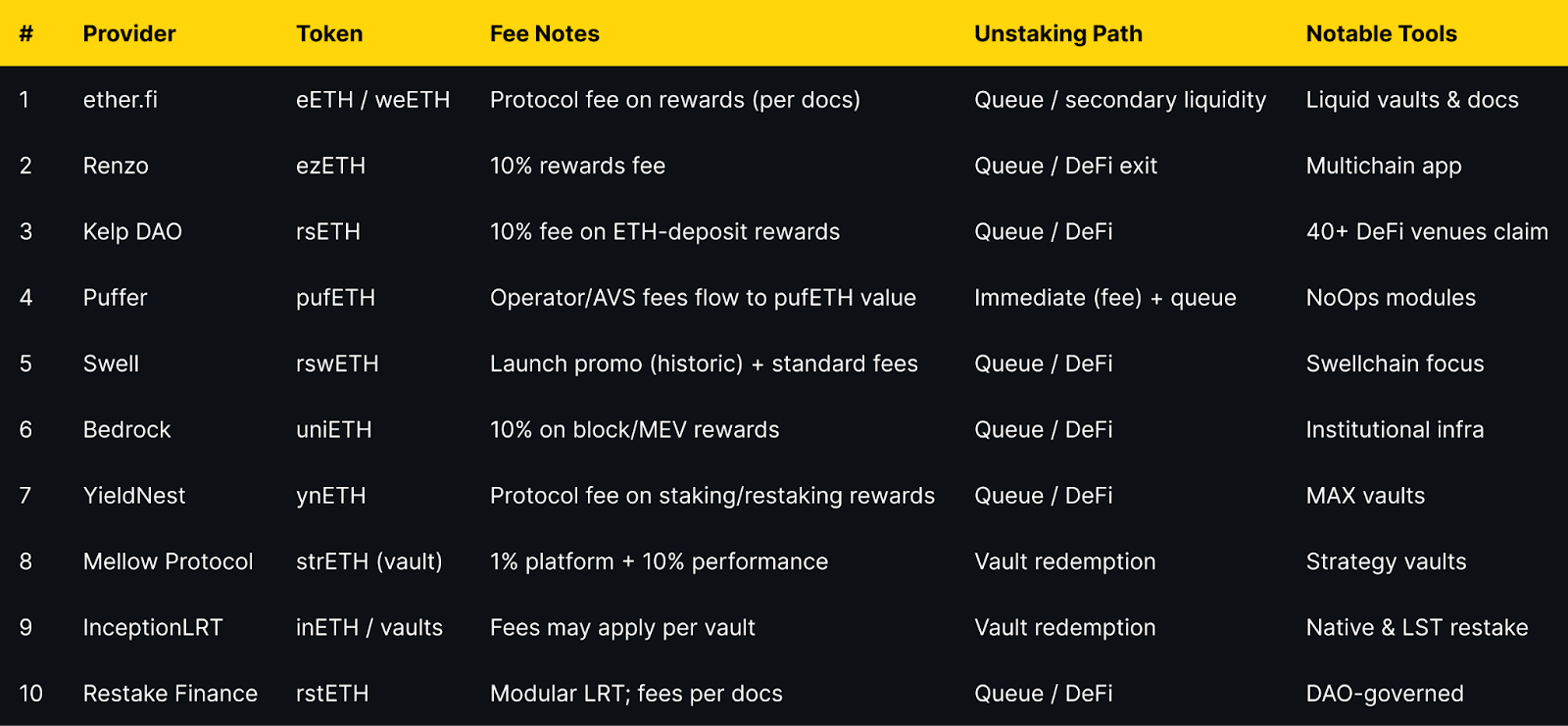
Best Liquid Restaking Tokens & Aggregators in November 2025 (Comparison Table)  

* Regions are “Global” unless a provider geoblocks specific jurisdictions in their terms. Always verify eligibility in your country.


Top 10 Liquid Restaking Tokens & Aggregators in November 2025

1. ether.fi — Best for deep integrations & non-custodial design

Why use it: ether.fi’s eETH/weETH are widely integrated across DeFi, and the project publishes clear technical docs on protocol fees and validator design. Liquid Vaults add strategy optionality while keeping restaking accessible. (ether.fi)
Best for: DeFi power users, liquidity seekers, builders needing broad integrations.
Notable features: Non-custodial staking; restaking support; Liquid Vaults; documentation and terms around protocol fees. (etherfi.gitbook.io)
Fees Notes: Protocol fee on rewards; vault-level fees vary by strategy. (etherfi.gitbook.io)
Regions: Global*
Consider if: You want deep liquidity and docs; always review fee tables and redemption queues.
Alternatives: Renzo, Kelp DAO.  


2. Renzo — Best for multi-stack coverage (EigenLayer + Symbiotic/Jito)

Why use it: Renzo’s ezETH is among the most recognizable LRTs and the docs clearly state a 10% rewards fee, while the app highlights support beyond EigenLayer (e.g., Symbiotic/Jito lines). Strong multichain UX. (docs.renzoprotocol.com)
Best for: Users wanting straightforward economics and chain-abstracted access.
Notable features: Clear fee policy (10% of restaking rewards); multi-stack support; app UX across chains. (docs.renzoprotocol.com)
Fees Notes: 10% of restaking rewards; details in docs. (docs.renzoprotocol.com)
Regions: Global*
Consider if: You prefer transparent fees and broader stack exposure.
Alternatives: ether.fi, Mellow.  


3. Kelp DAO — Best for broad DeFi distribution (rsETH)

Why use it: Kelp emphasizes reach (rsETH used across many venues). Official docs state a 10% fee on rewards for direct ETH deposits, with no fee on LST deposits, making it friendly to LST holders. (kelpdao.xyz)
Best for: LST holders, LPs, and integrators.
Notable features: rsETH liquid token; LST and ETH deposit routes; active integrations. (kelpdao.xyz)
Fees Notes: 10% on ETH-deposit rewards; no fee on LST deposits per docs. (kelp.gitbook.io)
Regions: Global*
Consider if: You want flexibility between ETH and LST deposit paths.
Alternatives: Renzo, Swell.  


4. Puffer — Best for redemption optionality (pufETH)

Why use it: Puffer’s docs explain how AVS fees accrue to pufETH and outline operator/guardian roles. Public risk work notes an “immediate redemption” option with a fee when liquidity is available, plus queued exit. (docs.puffer.fi)
Best for: Users wanting explicit redemption choices and a technical spec.
Notable features: pufETH nLRT; operator/guardian model; based L2 plans. (Puffer: Building the Future of Ethereum)
Fees Notes: AVS/operator fees accrue; immediate redemption may incur a fee. (docs.puffer.fi)
Regions: Global*
Consider if: You value documented mechanics and redemption flexibility.
Alternatives: ether.fi, Bedrock.


5. Swell — Best for restaking-native ecosystem (rswETH)

Why use it: Swell’s rswETH is their native LRT for EigenLayer; launch comms detailed fee-holiday parameters and security posture. Swellchain materials emphasize restaking-first ecosystem tooling. (swellnetwork.io)
Best for: DeFi users who want a restaking-centric stack.
Notable features: rswETH; ecosystem focus; audits referenced in launch post. (swellnetwork.io)
Fees Notes: Historical launch promo; check current fee schedule in app/docs. (swellnetwork.io)
Regions: Global*
Consider if: You want an LRT aligned with a restaking-native L2 vision.
Alternatives: Kelp DAO, Renzo.


6. Bedrock — Best for institutional-grade infra (uniETH)

Why use it: Bedrock’s uniETH is a non-rebasing, value-accrual LRT with a published fee policy (10% on block/MEV rewards) and EigenLayer alignment. Docs are explicit about token mechanics. (docs.bedrock.technology)
Best for: Institutions and users who prefer clear token economics.
Notable features: uniETH; docs and audits repository; multi-asset roadmap. (docs.bedrock.technology)
Fees Notes: 10% commission on block/MEV rewards; restaking commission TBD via governance. (docs.bedrock.technology)
Regions: Global*
Consider if: You want explicit fee language and non-rebasing accounting.
Alternatives: Puffer, ether.fi.


7. YieldNest — Best for curated basket exposure (ynETH)

Why use it: Docs describe ynETH as an nLRT with a curated basket of AVS categories, plus a protocol model where a fee is taken from staking/restaking rewards. MAX vaults and DAO governance are outlined. (docs.yieldnest.finance)
Best for: Users who want diversified AVS exposure through one token.
Notable features: ynETH; MAX vaults (ynETHx); governance/fee transparency. (docs.yieldnest.finance)
Fees Notes: Protocol fee on staking/restaking rewards per docs. (docs.yieldnest.finance)
Regions: Global*
Consider if: You prefer basket-style AVS diversification.
Alternatives: Mellow, Renzo.


8. Mellow Protocol — Best for strategy vaults with explicit fees (strETH)

Why use it: Mellow provides strategy vaults for restaking with clear fee terms: 1% platform + 10% performance baked into vault accounting, and visible TVL. (mellow.finance)
Best for: Users who want managed strategies with transparent fee splits.
Notable features: Curated strategy vaults; institutional risk curators; TVL transparency. (mellow.finance)
Fees Notes: 1% platform fee (pro-rated) + 10% performance fee. (docs.mellow.finance)
Regions: Global*
Consider if: You value explicit, vault-level fee logic.
Alternatives: YieldNest, InceptionLRT.


9. InceptionLRT — Best for native + LST restaking routes

Why use it: Inception exposes native ETH and LST restaking paths, with branded vault tokens (e.g., inETH) and Symbiotic integrations for certain routes. Site and app pages outline flows. (inceptionlrt.com)
Best for: Users wanting both native and LST restake options from one dashboard.
Notable features: Native ETH restake; LST restake; app-based delegation flows. (inceptionlrt.com)
Fees Notes: Fees vary by vault/route; review app/docs before deposit. (inceptionlrt.com)
Regions: Global*
Consider if: You want flexible inputs (ETH or LST) with aggregator UX.
Alternatives: Mellow, YieldNest.


10. Restake Finance — Best for modular LRT approach (rstETH)

Why use it: Project messaging emphasizes a modular liquid restaking design focused on EigenLayer with rstETH as its token. Governance-driven roadmap and LRT utility are core themes. (MEXC)
Best for: Early adopters exploring modular LRT architectures.
Notable features: rstETH LRT; DAO governance; EigenLayer focus. (MEXC)
Fees Notes: Fees/policies per official materials; review before use. (MEXC)
Regions: Global*
Consider if: You want a DAO-led modular LRT approach.
Alternatives: Renzo, Bedrock.


Decision Guide: Best By Use Case


How to Choose the Right Liquid Restaking Token (Checklist)

  • Region eligibility: Confirm geoblocks/terms for your country.
  • Asset coverage: ETH only or multi-asset; LST deposits supported.
  • Fee transparency: Rewards/performance/platform fees clearly stated.
  • Redemption path: Immediate exit fee vs. queue, and typical timing.
  • Security posture: Audits, docs, risk disclosures, operator set.
  • Integrations: Lending/DEX/LP venues for liquidity management.
  • Stack choice: EigenLayer only or Symbiotic/Jito as well.
  • UX/docs: Clear FAQs, step-by-step flows, status/terms.
  • Support: Help center or community channels with updates.
    Red flags: Opaque fee language; no docs on withdrawals; no audits or terms.

Use Token Metrics With Any LRT

  • AI Ratings to screen assets and venues by quality and momentum.


  • Narrative Detection to catch early shifts in restaking themes.


  • Portfolio Optimization to balance exposure across LRTs vs. LSTs.
  • Alerts & Signals to time rebalances and exits.
    Workflow: Research → Select provider → Execute on-chain → Monitor with alerts.
    Prefer diversified exposure? Explore Token Metrics Indices.

Security & Compliance Tips

  • Use verified URLs and signed fronts; bookmark dApps.
  • Understand redemption mechanics (instant vs. queue) and fees. (LlamaRisk)
  • Read fee pages before deposit; some charge on rewards, others on performance/platform. (docs.renzoprotocol.com)
  • Review audits/risk docs where available; check operator design.
  • If LPing LRT/ETH, monitor depeg risk and oracle choice.
  • Avoid approvals you don’t need; regularly revoke stale allowances.
  • Confirm region eligibility and tax implications.
    This article is for research/education, not financial advice.

Beginner Mistakes to Avoid

  • Treating LRTs like 1:1 ETH with zero risk.
  • Ignoring withdrawal queues and exit windows.
  • Chasing points/boosts without reading fee docs.
  • LPing volatile LRT pairs without hedge.
  • Overconcentrating in one operator/AVS route.
  • Skipping protocol terms or assuming U.S. access by default.

How We Picked (Methodology & Scoring)

We scored each provider using the weights above, focusing on official fee pages, docs, and security materials. We shortlisted ~20 projects and selected 10 with the strongest mix of liquidity, disclosures, and fit for this category. Freshness verified November 2025 via official resources.


FAQs

What is a liquid restaking token (LRT)?
 An LRT is a liquid receipt for restaked assets (usually ETH) that accrues base staking plus AVS restaking rewards and can be used across DeFi.

Are LRTs safe?
 They carry smart-contract, operator, and AVS risks in addition to staking risks. Read audits, fee pages, and redemption docs before depositing.

What fees should I expect?
 Common models include a percent of rewards (e.g., 10% at Renzo) or platform + performance fees (e.g., 1% + 10% at Mellow). Always check the latest official docs. (docs.renzoprotocol.com)

What’s the difference between EigenLayer vs. Symbiotic/Jito routes?
 They’re different restaking stacks and AVS ecosystems. Some providers support multiple stacks to diversify coverage. (docs.renzoprotocol.com)

How do redemptions work?
 Most use queued exits; some offer instant liquidity with a fee when available (e.g., Puffer). Review the protocol’s redemption section. (LlamaRisk)

Can U.S. users access these protocols?
 Terms vary by protocol and may change. Always check the provider’s website and terms for your jurisdiction.


Conclusion + Related Reads

If you want liquidity + integrations, start with ether.fi or Renzo. Prefer explicit fee logic in a managed strategy? Look at Mellow. Want basket exposure? Consider YieldNest. For redemption flexibility, Puffer stands out. Match the fee model, stack coverage, and redemption flow to your risk and liquidity needs.

Related Reads:

Choose from Platinum, Gold, and Silver packages
Reach with 25–30% open rates and 0.5–1% CTR
Craft your own custom ad—from banners to tailored copy
Perfect for Crypto Exchanges, SaaS Tools, DeFi, and AI Products