Back to blog
Research

Cardano (ADA) Price Prediction July 2025: Can ADA Break $100 This Bull Cycle?

Explore Cardano’s 2025 price forecast. Learn how the Plomin Hard Fork, DeFi growth, and ETF potential could push ADA past $1.50—and how Token Metrics AI tools help predict every move.
Token Metrics Team
8 min
Want Smarter Crypto Picks—Free?
See unbiased Token Metrics Ratings for BTC, ETH, and top alts.
Thank you! Your submission has been received!
Oops! Something went wrong while submitting the form.
 No credit card | 1-click unsubscribe

Click here to buy Cryptocurrencies from Gate.io

As of July 12, 2025, Cardano (ADA) is showing renewed strength, climbing toward the critical $0.75 resistance level as Bitcoin soars above $112,000. After months of consolidation, the smart contract platform is gaining attention from investors, driven by key upgrades, growing DeFi activity, and a broader crypto bull market.

But can ADA reclaim the $1.00 milestone—or even surge beyond $1.50—by the end of the year?

In this highly informative and SEO-optimized article, we’ll explore Cardano’s 2025 price outlook, fundamental drivers, potential risks, and how Token Metrics’ AI tools can help you make smarter, data-backed investment decisions.

🔍 Quick Snapshot: Cardano in July 2025

  • Current Price: ~$0.74
  • Resistance: $0.75 (major), $0.80 (breakout trigger)
  • Support: $0.62 (short-term), $0.50 (long-term)
  • Year-to-Date Institutional Inflows: $73M
  • Daily Active Addresses: ~30,000
  • TVL Growth Since April: +21%
  • ETF Approval Probability: 75%

🚀 Key Catalysts for Cardano’s Bullish Momentum

✅ 1. The Plomin Hard Fork: Governance Upgrade

The Plomin Hard Fork, implemented in Q1 2025, marked a turning point in Cardano’s evolution. It introduced:

  • Decentralized on-chain governance
  • Community-driven protocol updates
  • Greater autonomy for ADA holders

This governance upgrade enhanced Cardano’s appeal to long-term investors and DeFi developers by aligning protocol evolution with community consensus.

✅ 2. Rising DeFi Activity on Cardano

Cardano’s DeFi ecosystem is gaining traction, with Total Value Locked (TVL) increasing by 21% since April. Leading protocols like Minswap, Indigo, and LiQwid have seen significant upticks in user activity and liquidity.

This growth signals:

  • Greater developer interest
  • Improved user adoption
  • Strengthening demand for ADA as collateral and transaction gas

✅ 3. Potential Integration of $RLUSD Stablecoin

Cardano could soon integrate Ripple’s newly launched $RLUSD stablecoin, offering:

  • Seamless liquidity for ADA-based DeFi protocols
  • Cross-chain interoperability with Ripple and Ethereum ecosystems
  • Stability for yield-generating DeFi strategies

Stablecoin adoption is a key growth driver for any Layer-1 network aiming to scale its DeFi infrastructure.

✅ 4. Institutional Capital Inflows

Cardano has attracted $73 million in institutional inflows in 2025 so far, according to data from leading asset managers. This shows:

  • Rising confidence in ADA’s long-term value
  • Anticipation of ETF approval in the U.S. or Europe
  • ADA’s inclusion in emerging crypto index products

With a 75% probability of ETF approval, institutional demand could surge further in Q4.

📈 Cardano Price Prediction for 2025

Analysts and machine learning models—including those from Token Metrics—project a bullish range for ADA in 2025, depending on technical and macroeconomic conditions.

Breakout Level to Watch: $0.80
Support to Hold: $0.62

Click here to buy Cryptocurrencies from Gate.io

⚠️ Potential Risks to ADA’s Growth

Despite bullish fundamentals, Cardano still faces several challenges that could cap or delay price gains:

❌ 1. Low Daily Active Users

With only 30,000 daily active addresses, Cardano still lags behind competitors like:

  • Solana (~500,000 DAU)
  • Ethereum (~400,000 DAU)

Low user activity may:

  • Limit dApp growth
  • Weaken DeFi liquidity
  • Lower investor excitement

❌ 2. Strong Competition

Cardano must compete with:

  • Ethereum’s mature DeFi and NFT ecosystems
  • Solana’s blazing-fast, low-cost transactions
  • New entrants like Aptos and Sui

ADA needs to differentiate itself with real-world adoption and enterprise use cases.

❌ 3. Profit-Taking and Macro Uncertainty

Even in a bull market, sharp corrections happen. ADA could:

  • Face sell-offs at key resistance ($0.80, $1.00)
  • React negatively to macro risks like inflation or Fed policy
  • Be impacted by whale liquidation events

🧠 How Token Metrics Helps You Predict ADA’s Next Move

In crypto’s high-volatility environment, AI-driven research tools are essential. Token Metrics empowers ADA investors with real-time signals, grades, and analytics to stay ahead of the market.

✅ 1. AI-Powered Price Predictions

Token Metrics' machine learning models forecast ADA’s short- and long-term price movements based on:

  • Historical trading patterns
  • On-chain data (TVL, active addresses)
  • Market sentiment
  • Exchange flow analysis

These forecasts update in real time as market conditions evolve.

✅ 2. Trader & Investor Grades for ADA

  • Trader Grade: Indicates short-term momentum and technical strength. Ideal for swing traders.
  • Investor Grade: Evaluates ADA’s long-term fundamentals and ecosystem health.

Grades are updated daily, providing clarity even during volatile market swings.

✅ 3. Buy/Sell Signals

Token Metrics issues real-time bullish and bearish signals on ADA, helping users:

  • Avoid emotional trades
  • Enter during early momentum
  • Exit before trend reversals

Each signal is backed by over 80 on-chain and technical data points.

✅ 4. Token Details Page

ADA’s dedicated page includes:

  • Live price chart
  • ROI since listing
  • Exchange and wallet data
  • Historical grading performance
  • AI-based outlooks and narratives

It’s a comprehensive research hub for Cardano investors.

✅ 5. Custom Alerts

Set up personalized alerts for ADA based on:

  • Price targets (e.g., alert me at $1.00)
  • Percentage changes (e.g., +10% move)
  • Grade improvements or downgrades

Receive alerts via email, Discord, Telegram, or Slack, keeping you informed 24/7.

📉 Bearish Scenario: What If ADA Fails to Break Out?

If ADA cannot break above $0.80, it may retrace toward:

  • $0.62 (short-term support)
  • $0.50 (key historical demand zone)

In that case, investors should:

  • Monitor Token Metrics’ bearish signals
  • Look for re-entry setups at lower prices
  • Track DeFi TVL and whale accumulation

✅ Final Thoughts: Is ADA a Strong Buy in 2025?

Cardano is making meaningful strides:

  • Governance decentralization (Plomin Hard Fork)
  • Growing DeFi ecosystem
  • Strong institutional interest
  • Potential ETF approval

If these trends continue and Bitcoin remains in a bull cycle, ADA could reach $1.10–$1.65 by year-end.

However, investors should stay cautious of competition, user activity metrics, and potential volatility.

With Token Metrics, you can:

  • Predict price movements with AI
  • Track technical and fundamental grades
  • Get alerts before the crowd reacts

🔗 Start Using Token Metrics to Trade ADA Smarter

Ready to take advantage of Cardano’s potential?

👉 Visit tokenmetrics.com
🚀 Access AI price predictions, moonshot opportunities, and real-time signals
📲 Set custom alerts so you never miss a breakout

Click here to buy Cryptocurrencies from Gate.io

Build Smarter Crypto Apps &
AI Agents in Minutes, Not Months
Real-time prices, trading signals, and on-chain insights all from one powerful API.
Grab a Free API Key
About Token Metrics
Token Metrics: AI-powered crypto research and ratings platform. We help investors make smarter decisions with unbiased Token Metrics Ratings, on-chain analytics, and editor-curated “Top 10” guides. Our platform distills thousands of data points into clear scores, trends, and alerts you can act on.
30 Employees
analysts, data scientists, and crypto engineers
Daily Briefings
concise market insights and “Top Picks”
Transparent & Compliant
Sponsored ≠ Ratings; research remains independent
Want Smarter Crypto Picks—Free?
See unbiased Token Metrics Ratings for BTC, ETH, and top alts.
Thank you! Your submission has been received!
Oops! Something went wrong while submitting the form.
 No credit card | 1-click unsubscribe
Token Metrics Team
Token Metrics Team

Recent Posts

Crypto Basics

Understanding Zero Knowledge Proofs: Securing Privacy and Verification

Token Metrics Team
4

Introduction

Zero Knowledge Proofs (ZKPs) represent a groundbreaking cryptographic concept that enables one party to prove knowledge of specific information to another party without revealing the information itself. This technology is rapidly gaining traction within blockchain ecosystems and privacy-focused applications, offering novel approaches to verification and security without compromising sensitive data.

Basics of Zero Knowledge Proofs

At its core, a Zero Knowledge Proof is a method by which a prover demonstrates to a verifier that a given statement is true, without revealing any additional information beyond the validity of the statement. Introduced in the 1980s, ZKPs rely on complex mathematical algorithms to ensure that knowledge can be proven without disclosure, preserving confidentiality.

The three essential properties that characterize zero knowledge proofs are:

  • Completeness: If the statement is true, an honest verifier will be convinced by an honest prover.
  • Soundness: If the statement is false, no dishonest prover can convince the honest verifier otherwise.
  • Zero-Knowledge: The verifier learns nothing other than the fact the statement is true, gaining no additional knowledge about the actual information.

Types of Zero Knowledge Proofs

There are several approaches to implementing ZKPs, each with its trade-offs and applications. Two of the most significant forms include zk-SNARKs and zk-STARKs.

  • zk-SNARKs (Zero-Knowledge Succinct Non-Interactive Arguments of Knowledge): These are compact proofs that require minimal data for verification and do not require back-and-forth interaction between prover and verifier after setup. zk-SNARKs are widely used in privacy-oriented blockchains such as Zcash.
  • zk-STARKs (Zero-Knowledge Scalable Transparent Arguments of Knowledge): An evolution of zk-SNARKs, zk-STARKs remove the need for a trusted setup and improve scalability and transparency, although generating proofs may be more computationally intensive.

Applications in Blockchain and Cryptography

Zero Knowledge Proofs have considerable implications for enhancing privacy and scalability in decentralized systems. Key applications include:

  • Privacy Encryption: ZKPs enable private transactions by allowing users to confirm transaction validity without revealing participant identities or transaction details.
  • Identity Verification: Users can prove attributes such as age or citizenship without disclosing personal data, reducing risks associated with data leaks and identity theft.
  • Secure Voting Systems: Ensuring the legitimacy of votes while keeping individual votes confidential.
  • Scalability Solutions: By verifying computations off-chain with ZKPs, blockchain networks can reduce on-chain data processing, improving throughput and efficiency.

Challenges and Limitations

Despite their potential, Zero Knowledge Proofs face notable challenges that require careful consideration in practical deployment:

  • Computational Overhead: Generating zero knowledge proofs can be resource-intensive, particularly for complicated statements or large data sets.
  • Trusted Setup Concerns: Some ZKP systems, such as zk-SNARKs, require an initial trusted setup, which poses risks if compromised.
  • Implementation Complexity: Developing robust zero knowledge protocols demands advanced cryptographic expertise and rigorous security auditing.

Role of AI in Zero Knowledge Proof Analysis

Advancements in Artificial Intelligence (AI) have begun to complement cryptographic research, including the exploration and utilization of Zero Knowledge Proofs. AI-driven analytical tools can assist researchers and developers by:

  • Optimizing cryptographic algorithms for efficient proof generation.
  • Performing advanced pattern recognition on blockchain data enhanced by ZKPs to uncover usage trends without compromising privacy.
  • Supporting risk management frameworks by assessing protocol security based on integrated cryptographic parameters.

Platforms such as Token Metrics leverage AI-driven research to analyze emerging cryptographic technologies, including zero knowledge protocols, offering quantitative insights into technological developments and ecosystem dynamics.

How to Research Zero Knowledge Proof Projects

When evaluating projects that incorporate zero knowledge proofs, consider the following research aspects to obtain an objective and thorough understanding:

  1. Technical Documentation: Review whitepapers and technical specifications to understand the ZKP implementations and cryptographic assumptions.
  2. Community and Development Activity: Assess active developer engagement and community support to gauge project viability and ongoing innovation.
  3. Security Audits: Verify results from third-party security audits focused on ZKP mechanisms to mitigate potential vulnerabilities.
  4. Use Cases and Partnerships: Investigate real-world applications and collaborations that demonstrate practical utility of zero knowledge proofs.
  5. Analytical Tools: Utilize platforms like Token Metrics for comprehensive project ratings that incorporate AI-enhanced data on technology and ecosystem health.

Future Outlook and Research Directions

Zero Knowledge Proofs are poised to become foundational in advancing privacy and scalability in decentralized systems. Future research continues to focus on:

  • Improving efficiency of proof generation to enable wider adoption in resource-constrained environments.
  • Developing trustless and transparent protocols to eliminate the need for trusted setups entirely.
  • Expanding integration with emerging technologies such as secure multi-party computation and homomorphic encryption.
  • Enhancing interoperability between ZKP implementations across different blockchain platforms.

Continued innovation in this domain is supported by cross-disciplinary collaborations, including cryptography, computer science, and AI research.

Conclusion

Zero Knowledge Proofs offer a powerful paradigm shift in cryptography, enabling privacy-preserving verification without information disclosure. Their adoption within blockchain and related fields supports the creation of secure, efficient, and private systems. Utilizing AI-powered platforms like Token Metrics can assist in analyzing and understanding the evolving landscape of zero knowledge proof technologies.

Disclaimer

This article is for educational and informational purposes only. It does not constitute financial advice, investment recommendations, or endorsements. Readers should conduct their own research and consult professionals before making decisions related to cryptographic technologies or blockchain projects.

Research

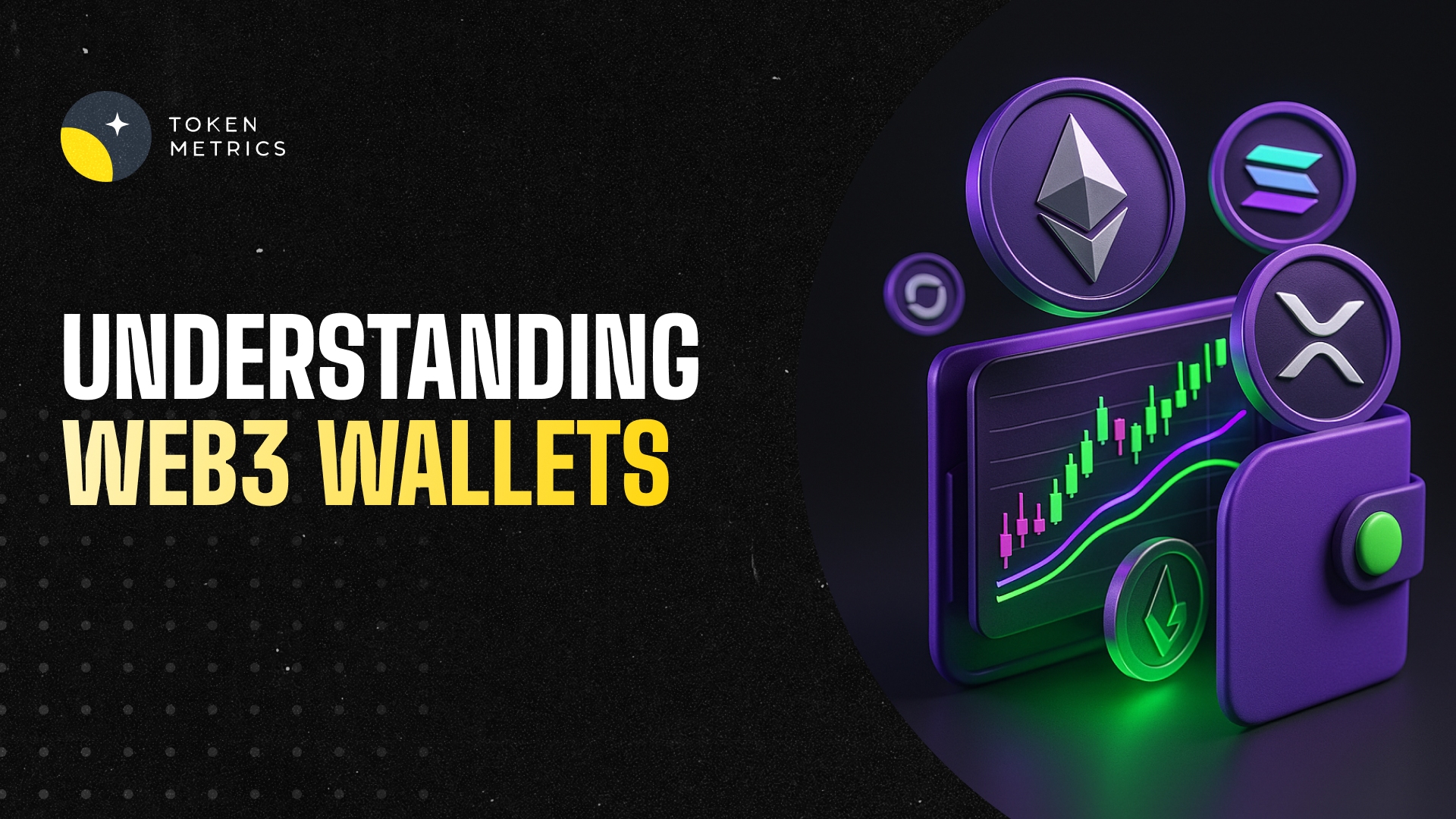
Understanding Web3 Wallets: Your Guide to Secure Crypto Asset Management

Token Metrics Team
4

Introduction to Web3 Wallets

As the blockchain landscape evolves, the term "Web3 wallets" has become fundamental in discussions around decentralized finance and digital asset management. Web3 wallets act as a gateway for users to interact with decentralized applications (dApps), access blockchain networks, and securely manage their digital assets without reliance on centralized intermediaries.

This article explores the concept of Web3 wallets, their types, core features, and the security considerations essential for users. It also highlights how analytical platforms like Token Metrics can aid in understanding the complexities surrounding these wallets and blockchain technologies.

What Are Web3 Wallets?

Web3 wallets are software or hardware tools that enable users to store, send, receive, and interact with cryptocurrencies and tokens on blockchain networks. Unlike traditional digital wallets, Web3 wallets are designed primarily to facilitate decentralized interactions beyond simple transactions, such as signing smart contracts and accessing dApps.

They come in two main forms:

  • Custodial wallets: Where a third party holds the private keys on behalf of the user. This category offers convenience but introduces counterparty risk.
  • Non-custodial wallets: Users retain full control of their private keys. This type aligns with the ethos of decentralization, offering enhanced security but requiring users to take responsibility for key management.

Types of Web3 Wallets

Understanding the various types of Web3 wallets helps users select options that fit their security posture and use cases.

  • Software Wallets: Installed as browser extensions or mobile apps, these wallets offer easy access and integration with dApps. Examples include MetaMask and Trust Wallet.
  • Hardware Wallets: Physical devices that store private keys offline, significantly reducing exposure to hacks. Examples include Ledger and Trezor.
  • Smart Contract Wallets: Wallets deployed as smart contracts allow for programmable control over funds, including multi-signature functionality and customizable security policies.

Key Features and Functionalities

Web3 wallets provide a suite of functionalities tailored to decentralized ecosystems:

  1. Private Key Management: Safe handling and storage of private keys, either locally or hardware-backed, is central to wallet security.
  2. Transaction Signing: Wallets enable users to approve blockchain transactions through cryptographic signatures.
  3. dApp Integration: Seamless interaction with Web3 applications via standardized protocols like WalletConnect.
  4. Multi-Chain Support: Ability to interact with different blockchain networks within a single interface.
  5. Token Management: Displaying and organizing various tokens compliant with standards such as ERC-20 or BEP-20.

Security Considerations for Web3 Wallets

Security remains paramount for Web3 wallet users due to the irreversible nature of blockchain transactions and increasing cyber threats:

  • Private Key Confidentiality: Exposure of private keys or seed phrases can result in total asset loss. Users should store these securely offline.
  • Phishing Attacks: Malicious actors may use fake websites or apps to steal credentials; exercising caution and verifying authenticity is critical.
  • Software Vulnerabilities: Keeping wallet software updated and using reputable wallets can minimize risks related to bugs or exploits.
  • Hardware Storage: Hardware wallets mitigate online threats by keeping keys offline but require physical safeguarding.

Leveraging AI Tools for In-Depth Analysis

The complexity of blockchain ecosystems has led to the emergence of AI-driven analytical platforms that assist users and researchers in understanding market trends, token metrics, and network behaviors. Token Metrics is an example of such a tool, providing data-backed ratings and insights that can complement wallet usage by offering research capabilities on tokens and market conditions.

These platforms can support educational efforts by:

  • Providing fundamentals and trend analysis based on on-chain and market data.
  • Offering scenario analysis to understand potential developments in blockchain protocols.
  • Enhancing security posture by informing users about project credibility and token performance metrics.

Practical Steps to Choose and Use Web3 Wallets

Choosing the right Web3 wallet is a process that balances ease of use, security, and compatibility needs:

  • Research Wallet Types: Understand differences between custodial and non-custodial options.
  • Assess Security Features: Review if the wallet supports hardware integration, multi-factor authentication, or multisig capabilities.
  • Confirm dApp Compatibility: If interaction with decentralized platforms is important, ensure smooth integration.
  • Backup Procedures: Follow recommended practices for seed phrase storage and wallet backup.

Additionally, engaging with AI-driven platforms like Token Metrics can provide analytical depth during the research phase and support ongoing management of crypto assets.

Conclusion and Disclaimer

Web3 wallets represent a critical component of the decentralized internet, empowering users to control their digital assets and participate in blockchain ecosystems securely and effectively. By understanding wallet types, functionalities, and security measures, users can navigate this complex space with greater confidence.

Tools like Token Metrics serve as valuable resources for educational and analytical purposes, enabling deeper insight into token fundamentals and network dynamics.

Disclaimer: This article is intended for educational purposes only and does not constitute financial or investment advice. Readers should conduct their own research and consider their risk tolerance before engaging with any cryptocurrency or blockchain technology.

Research

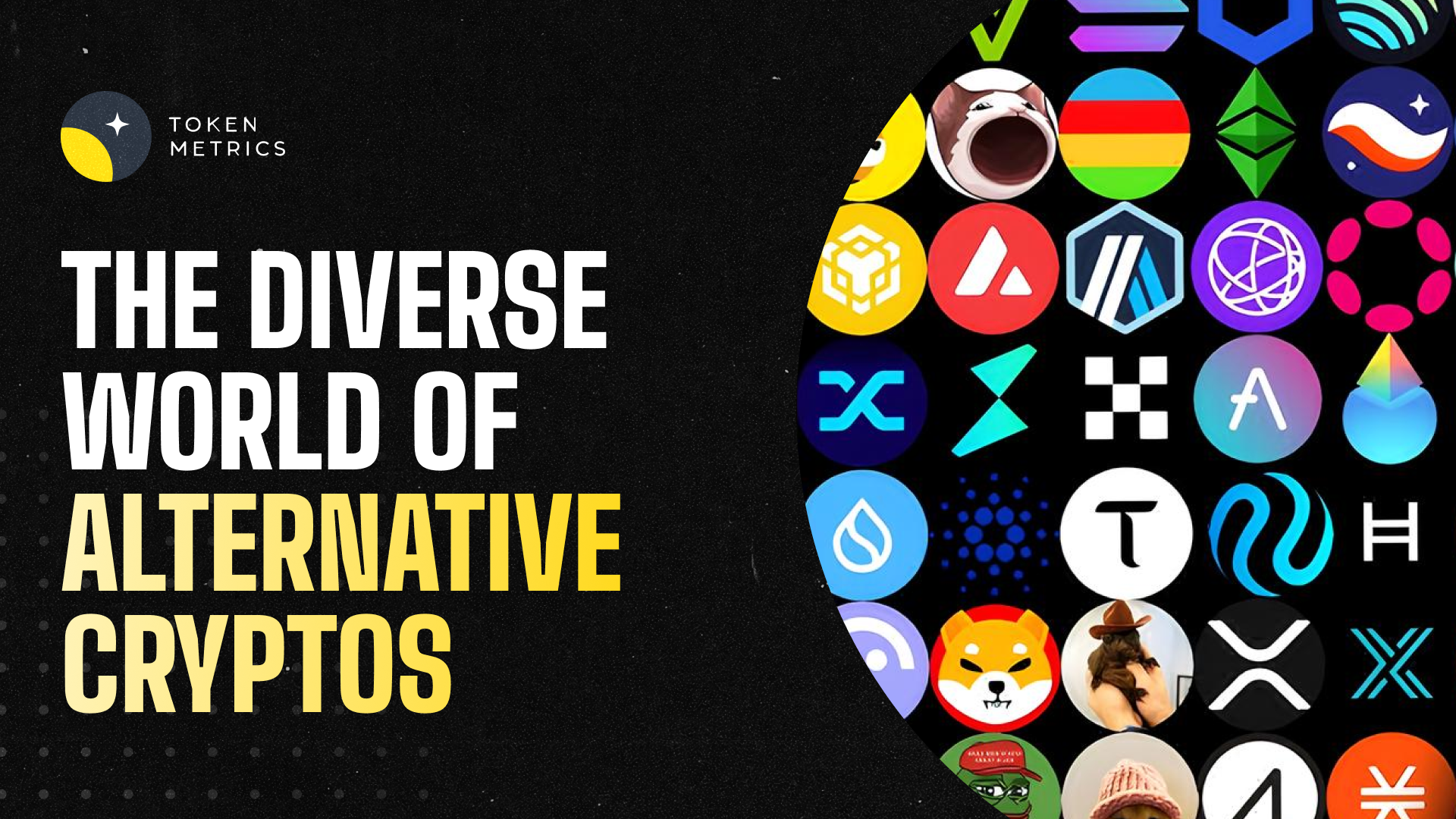
Understanding Altcoins: The Diverse World of Alternative Cryptocurrencies

Token Metrics Team
4

Introduction to Altcoins

The term altcoins broadly refers to all cryptocurrencies that exist as alternatives to Bitcoin, the pioneering digital currency. Since Bitcoin’s inception in 2009, thousands of alternative crypto coins have emerged with a variety of designs, purposes, and technologies. Understanding what altcoins are and how they differ from Bitcoin and one another is vital for anyone interested in the cryptocurrency ecosystem.

Definition and Types of Altcoins

Altcoins are digital assets that operate on blockchain technology but distinguish themselves from Bitcoin in technical structure or intended utility. Technically, the name is a contraction of “alternative coins.” Altcoins encompass a wide range of projects, including but not limited to:


Technological Innovations in Altcoins

Many altcoins distinguish themselves by innovating on blockchain design, consensus mechanisms, scalability, and privacy. For instance, some use Proof of Stake instead of Bitcoin’s Proof of Work to reduce energy consumption. Others implement advanced cryptographic techniques to enhance transaction confidentiality. These technical differences contribute to the diverse use cases altcoins pursue and can affect their adoption and network effects within various communities.

Evaluating Altcoins and Research Approaches

Evaluating altcoins requires a multifaceted approach that considers technology fundamentals, development activity, community support, and use cases. Research techniques often include:


Advanced AI-driven research tools like Token Metrics synthesize vast amounts of data and market signals to provide quantitative ratings and analysis, aiding in a more informed understanding of altcoin projects.

Altcoins vs Bitcoin: Key Differences

While Bitcoin is primarily conceived as a decentralized digital currency and store of value, altcoins often aim to address specific limitations or explore novel functionalities. Differences can include:


Understanding these distinctions informs discussions around the complementary roles altcoins play alongside Bitcoin in the broader crypto ecosystem.

Considering Risks and Complexities

Due to the large number and variety of altcoins, the space involves considerable complexity and risk. Important considerations include:


Using analytics platforms like Token Metrics can provide data-driven insights into these factors by compiling technical, fundamental, and sentiment indicators.

Practical Steps for Using AI Tools in Altcoin Analysis

AI-powered platforms enable systematic, scalable analysis of altcoins through machine learning models harnessing blockchain data, news sentiment, and market indicators. To incorporate these tools effectively:


Conclusion and Key Takeaways

Altcoins represent a diverse and rapidly evolving segment of the cryptocurrency landscape, designed to explore new functionalities and solve various challenges beyond Bitcoin’s scope. They encompass broad categories, from payments and smart contract platforms to privacy and stablecoins. Due to the complexity and number of projects, rigorous, data-informed research approaches are essential to understand their technology, use cases, and network health.

AI-driven research tools such as Token Metrics offer valuable support in this endeavor by aggregating multiple data streams into comprehensive analysis, helping stakeholders objectively compare altcoins on various factors.

Disclaimer

This blog post is for educational and informational purposes only and does not constitute financial, investment, or trading advice. Readers should conduct their own independent research before engaging with cryptocurrencies.

Choose from Platinum, Gold, and Silver packages
Reach with 25–30% open rates and 0.5–1% CTR
Craft your own custom ad—from banners to tailored copy
Perfect for Crypto Exchanges, SaaS Tools, DeFi, and AI Products