Back to blog
Crypto Basics

Cardano vs Ethereum - Key Differences and Similarities

Explore the differences and similarities between Cardano (ADA) and Ethereum (ETH), two prominent cryptocurrencies in the crypto space.
Marcus K
7 Minutes
Want Smarter Crypto Picks—Free?
See unbiased Token Metrics Ratings for BTC, ETH, and top alts.
Thank you! Your submission has been received!
Oops! Something went wrong while submitting the form.
 No credit card | 1-click unsubscribe

As the world of cryptocurrency evolves, certain projects rise to prominence due to their unique offerings and innovative solutions. Two such juggernauts in the decentralized space are Ethereum and Cardano. 

Both platforms have garnered immense attention, yet their paths, while aligned in ambition, vary in execution. In this comprehensive post, we'll delve deep into the heart of both ecosystems, elucidating their key differences and striking similarities.

Ethereum and Cardano Overview

Ethereum and Cardano are both decentralized platforms that allow developers to create and run smart contracts. 

However, their technical underpinnings, governance structures, and future plans diverge in intriguing ways. Knowing these nuances is vital for crypto enthusiasts, investors, and developers.

Cardano vs Ethereum: Key Differences

While both Cardano and Ethereum lay their foundations on blockchain technology and encrypted transactions, the two platforms diverge notably in their technical and functional aspects. 

Let's delve into the technical and operational differences that set Cardano and Ethereum apart.

Historical Background

Ethereum: Launched in 2015 by a team led by Vitalik Buterin, Ethereum's aim was to build upon the idea of Bitcoin but expand its capabilities significantly. 

It introduced the world to the concept of smart contracts, self-executing contracts with the terms of the agreement between buyer and seller written into code.

Cardano: Spearheaded by Charles Hoskinson, one of Ethereum's co-founders, Cardano began in 2017. Unlike Ethereum, Cardano took a more academic and research-driven approach, emphasizing peer reviews and formal methods in its development process.

Ethereum and Cardano: Consensus Mechanism

Ethereum: Ethereum started with a Proof-of-Work (PoW) consensus mechanism, the same one that Bitcoin employs. However, there's an ongoing shift towards Ethereum 2.0, which will operate on a Proof-of-Stake (PoS) mechanism. This transition is aimed at improving scalability and energy efficiency.

Cardano: Cardano uses a unique PoS mechanism known as Ouroboros. It was one of the first PoS protocols that was mathematically proven to be secure. Its energy efficiency and scalable design make it a formidable alternative to PoW systems.

Development Approach

Ethereum: Ethereum's development can be characterized as rapid and agile, with changes often being implemented in response to arising needs and challenges.

Cardano: Adopting what's called a "first principles" approach, Cardano's development is rigorous, systematic, and rooted in academic research. Every update undergoes extensive peer review, ensuring robustness and long-term stability.

ETH vs ADA: Token Utility

Ethereum: Ether (ETH) is Ethereum's native token. It's used to compensate participants who perform computations and validate transactions, and as "gas" to power smart contracts.

Cardano: ADA is Cardano's native currency. Like ETH, ADA is used to facilitate transactions on its network and as a stake in the PoS consensus mechanism.

Smart Contract Capabilities

Ethereum: Ethereum uses a language called Solidity for its smart contracts. It's Turing complete, which means it can technically compute anything if given enough resources.

Cardano: Cardano's Plutus platform allows for smart contracts to be written using Haskell-based scripting. Cardano’s approach is designed for higher assurance and formal verification, which can lead to more secure and reliable smart contracts.

Governance

Ethereum: Ethereum's governance has largely been informal. Proposals for changes (EIPs) are discussed among the community, with decisions often being made by consensus among core developers.

Cardano: Cardano has a structured governance system called Project Catalyst. It's a community-driven approach where ADA holders can propose changes and vote on them, ensuring more democratic and decentralized decision-making.

Cardano vs Ethereum: Key Similarities

Both Ethereum and Cardano stand as titans in the world of decentralized platforms, underpinned by their native transactional coins, ETH for Ethereum and ADA for Cardano. 

These coins not only represent value within their networks but also play instrumental roles in network operations. At their foundation, both are "Layer 1" blockchain technologies, offering fertile grounds for developers to cultivate decentralized applications (dApps) and bring to life self-executing smart contracts.

Furthermore, they share a common consensus mechanism: proof-of-stake (Ethereum is moving from PoW to PoS). Within the PoS framework, participants, often referred to as "stakers", pledge a portion of their crypto holdings as collateral to help validate and verify transactions. 

This method stands in stark contrast to the energy-intensive proof-of-work model exemplified by Bitcoin, as staking offers a more sustainable and environmentally conscious approach. 

This consensus mechanism not only emphasizes security and decentralization but also represents both projects' commitment to eco-friendly blockchain solutions.

Cardano and Ethereum: Future Outlook

Ethereum: With Ethereum 2.0 on the horizon, the platform seeks to address scalability, security, and sustainability issues. The introduction of shard chains and the Beacon Chain promises a faster, more efficient Ethereum.

Cardano: Having recently launched its smart contract capabilities, Cardano is focused on widening its user base, fostering dApp development, and expanding its ecosystem through partnerships and integrations.

Frequently Asked Questions

Q1. What is the primary programming language for smart contracts on Ethereum and Cardano?

Ethereum primarily uses Solidity for its smart contracts, while Cardano utilizes Plutus, a platform based on the Haskell programming language.

Q2. How do the transaction fees compare between Ethereum and Cardano?

Ethereum transaction fees, known as "gas," can be volatile and are determined by network congestion. Cardano's transaction fees are typically more predictable and are calculated based on the transaction size and necessary computation.

Q3. Are there any major partnerships or collaborations associated with Ethereum and Cardano?

Both platforms have engaged in numerous partnerships. Ethereum's decentralized finance (DeFi) ecosystem is vast, with many collaborations. Cardano, on the other hand, has established partnerships with governments and educational institutions, especially in developing nations.

Q4. How do the staking rewards compare between the two platforms?

Staking rewards vary based on multiple factors, including the amount staked, the total staking pool, and platform-specific inflation rates. Both Ethereum and Cardano offer staking, but the rewards and requirements might differ at any given time.

Q5. Which platform is more scalable in handling a large number of transactions per second?

Cardano, with its Ouroboros PoS protocol, has emphasized scalability from the outset. Ethereum, while originally facing scalability challenges, is working towards enhanced scalability with its transition to Ethereum 2.0.

Q6. Can Ethereum dApps be ported to the Cardano platform easily?

Porting between different platforms usually requires adaptations due to differences in smart contract languages and other technical aspects. However, Cardano is working on solutions and tools to make this transition smoother for developers.

Q7. Are Ethereum and Cardano compliant with regulatory frameworks?

Both Ethereum and Cardano strive to maintain compliance with global regulations, but the decentralized nature of these platforms means that applications built on top of them might vary in compliance. It's essential to research individual projects or tokens for regulatory adherence.

Q8. How do Ethereum and Cardano handle interoperability with other blockchains?

Interoperability is a growing focus in the blockchain world. Cardano has emphasized cross-chain compatibility through its research and partnerships. Ethereum, while primarily operating within its ecosystem, has seen bridging solutions emerge to link it with other chains.

Conclusion

While Ethereum and Cardano both aim to revolutionize the decentralized space with their smart contract capabilities, their approaches differ significantly. 

Ethereum's agile development and first-mover advantage have earned it a vast community and ecosystem. In contrast, Cardano's meticulous, research-driven approach might appeal to those who value rigorous scrutiny and methodical progress.

Actionable Insights

For Investors: Diversifying between both tokens might be a wise strategy, leveraging Ethereum's established dominance and Cardano's promising potential.

For Developers: Assess the nature of your project. If you require rapid deployment with a vast array of existing tools, Ethereum might be preferable. For projects that prioritize high assurance and security, Cardano's ecosystem could be more fitting.

Remember, the crypto space is dynamic, and today's realities might shift tomorrow. Stay updated, stay informed, and always make decisions grounded in research and foresight.

Disclaimer

The information provided on this website does not constitute investment advice, financial advice, trading advice, or any other sort of advice and you should not treat any of the website's content as such.

Token Metrics does not recommend that any cryptocurrency should be bought, sold, or held by you. Do conduct your own due diligence and consult your financial advisor before making any investment decisions.

Build Smarter Crypto Apps &
AI Agents in Minutes, Not Months
Real-time prices, trading signals, and on-chain insights all from one powerful API.
Grab a Free API Key
About Token Metrics
Token Metrics: AI-powered crypto research and ratings platform. We help investors make smarter decisions with unbiased Token Metrics Ratings, on-chain analytics, and editor-curated “Top 10” guides. Our platform distills thousands of data points into clear scores, trends, and alerts you can act on.
30 Employees
analysts, data scientists, and crypto engineers
Daily Briefings
concise market insights and “Top Picks”
Transparent & Compliant
Sponsored ≠ Ratings; research remains independent
Want Smarter Crypto Picks—Free?
See unbiased Token Metrics Ratings for BTC, ETH, and top alts.
Thank you! Your submission has been received!
Oops! Something went wrong while submitting the form.
 No credit card | 1-click unsubscribe
Token Metrics Team
Token Metrics Team

Recent Posts

Research

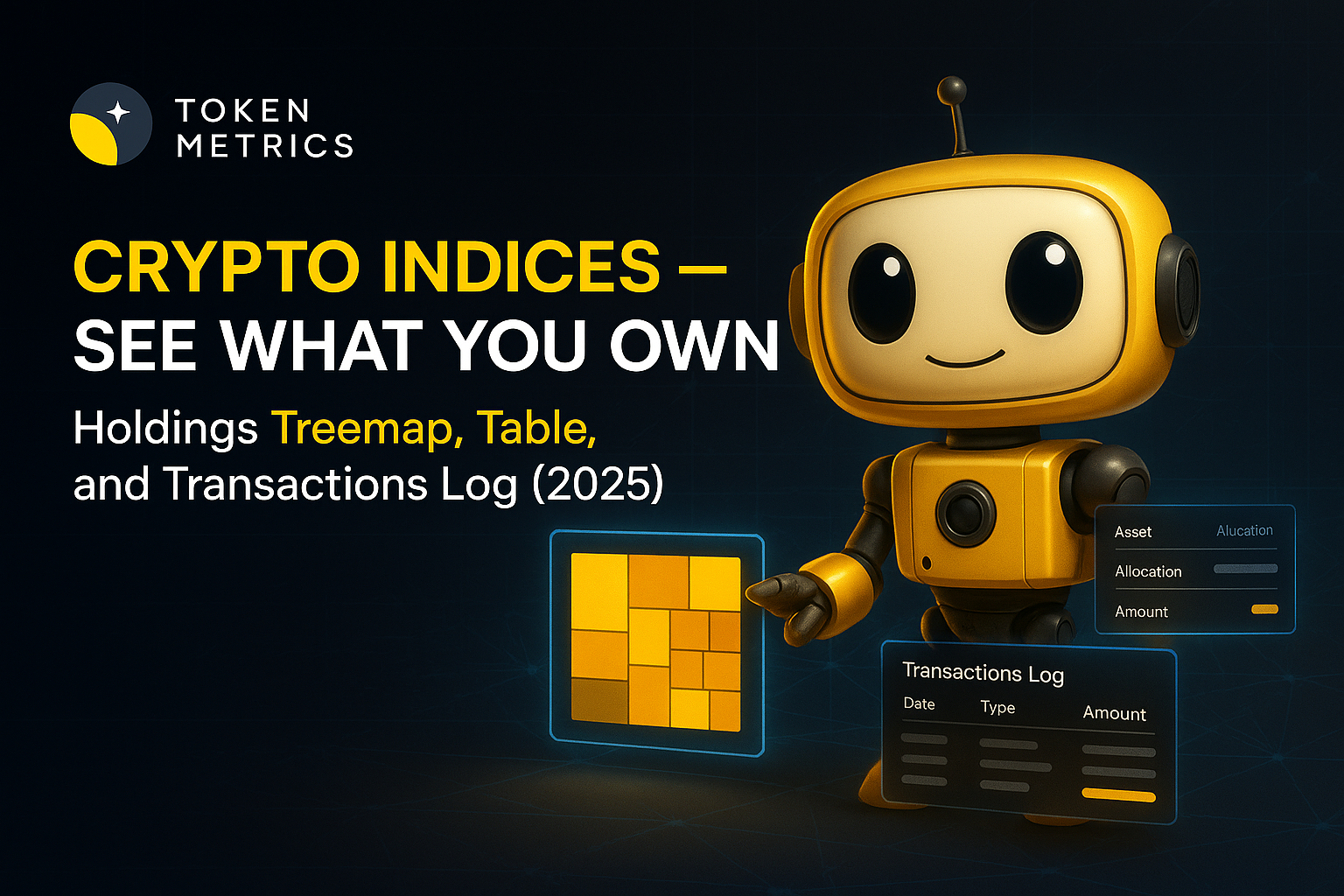
Crypto Indices - See What You Own: Holdings Treemap, Table, and Transactions Log (2025)

Token Metrics Team
5

If you’ve ever bought a “basket” of coins and then wondered what you actually hold, you’re not alone. The Token Metrics Global 100 solves that by pairing a rules-based strategy with radical visibility: an interactive holdings treemap, sortable table, and a real-time transactions log—so you can see what you own at all times. This transparency sits on top of a simple idea: a top-100 crypto index when markets are bullish and stablecoins when they’re not, with weekly rebalancing and one-click buy at launch. The result is clarity for hands-off allocators and discipline for active traders—without spreadsheets or manual rebalances.

→ Join the waitlist to be first to trade TM Global 100.

Why Transparency Matters in October 2025

Today’s crypto investor expects more than a chart and a headline weight. You want to audit your index: which coins, what size, and what changed after each rebalance. That’s exactly why we ship three visibility layers on day one: Gauge → Treemap → Transactions Log—plus a classic holdings table for power users.

In practical terms, a holdings treemap shows proportional weights at a glance, a table lets you sort and export details, and a transactions log chronicles every add/trim/exit during rebalances and regime switches. Together, they answer the search intent behind “crypto index holdings” and “weekly rebalancing” with an immediately scannable source of truth.

How the TM Global 100 Index Works (Plain English)

  • Regime switching: When our market signal is bullish, the index holds the top 100 assets by market cap. When bearish, it exits to stablecoins and waits for a re-entry signal.
  • Weekly rebalancing: We adjust constituents and weights weekly to reflect updated rankings—so the index stays aligned with the market.
  • Transparency: You’ll see a Strategy modal (rules at a glance), a market signal gauge, an interactive Holdings treemap & table, and a Transactions log that records rebalances and regime shifts.

What you’ll see on launch: A price tile, “tokens: 100,” “rebalances weekly,” and a Buy Index flow that can complete in about 90 seconds, end-to-end.

See the strategy and rules. (TM Global 100 strategy)

Benefits at a Glance (Why This Beats DIY)

  • Time saved: Skip ranking lists, manual screeners, and cross-exchange rebalances.
  • Lower execution drag: A single indexed flow helps reduce the slippage and fees you’d pay hopping between many tokens.
  • No missed cycles: Weekly rebalances help capture changes in the top-100 while the regime switch avoids guesswork when markets turn.
  • Full visibility: Treemap + table + transactions let you see exactly what changed and why—no black boxes.
  • Rules over vibes: A consistent methodology can reduce emotional decisions during drawdowns and market euphoria.

Step-by-Step: How to Get Early Access (Waitlist)

  1. Open the Indices hub and select TM Global 100. (Token Metrics Indices hub)
  2. Join the waitlist with your email to get launch-day access and updates.
  3. (Optional) Connect your wallet so you’re ready to buy at launch.
  4. On launch: Open TM Global 100, review the Gauge → Treemap → Transactions, and tap Buy Index.
  5. Confirm the buy: You’ll see estimates for fees/slippage and the current token mix.
  6. Track your position: Your holdings and every rebalance appear in My Indices and the Transactions Log.

→ Join the waitlist to be first to trade TM Global 100.

Decision Guide: Is This Right for You?

  • Hands-Off Allocator: Want “own the market” exposure and automatic upkeep. Consider if you dislike micromanaging.
  • Active Trader: Want a disciplined core that moves to stablecoins in bears while you take satellite bets elsewhere.
  • TM Member/Prospect: Already trust Token Metrics research and want rules-based execution with full visibility.
  • Starter Portfolio Builder: Prefer a single decision over 20+ token buys and periodic DIY reweights.
  • Transparency Seeker: You won’t tolerate black-box products; you want a real transactions log and holdings you can audit.
  • Tax-Aware Rebalancer: You’d rather not run frequent piecemeal trades yourself.
  • Mobile-First User: Want a fast, on-page buy flow instead of tab-hopping across venues.
  • Analytics Fan: Enjoy comparing weights and changes in the treemap after each weekly rebalance.

FAQs

What is a crypto index with a holdings treemap?

It’s a rules-based basket of cryptocurrencies where you can visually inspect weights via an interactive treemap, alongside a sortable table and a transactions log that records every rebalance and regime switch.

It’s a rules-based basket of cryptocurrencies where you can visually inspect weights via an interactive treemap, alongside a sortable table and a transactions log that records every rebalance and regime switch.

Weekly. Rebalances update constituents/weights to reflect current top-100 rankings; separate regime switches can also move the portfolio between tokens and stablecoins when the market signal changes.

What triggers the move to stablecoins?

A proprietary market signal. When bearish, the index exits tokens to stablecoins; when bullish resumes, it re-enters the top-100 basket.

Can I fund with USDC or fiat?

At launch, funding/settlement options surface based on your connected wallet and supported chains. USDC payout is supported on selling; fiat on-ramps may be added later.

Is the wallet custodial?

No. The embedded wallet is self-custodial—you control your funds.

How are fees shown?

Before you confirm, the buy flow surfaces estimated gas, platform fee, max slippage, and min expected value.

How do I join the waitlist?

Open the Indices hub, navigate to TM Global 100, and add your email. You’ll be notified on launch with a direct link to buy.

Security, Risk & Transparency

  • Self-custody: Embedded smart wallet with user control.
  • Operational clarity: Weekly rebalances; regime logic documented in the Strategy modal.
  • Fee & slippage preview: All surfaced before you confirm a trade.
  • Data integrity: Holdings treemap + table and transactions log reflect each executed change.

Regional notes: Availability and on-ramps can vary by jurisdiction. Crypto is volatile and can lose value. Past performance is not indicative of future results. This article is for research/education, not financial advice.

Conclusion

Token Metrics Global 100 is built for investors who want broad market exposure and the receipts to prove what they hold—treemap, table, and transactions on every rebalance. If you value rules, discipline, and transparency, join the waitlist and be ready on launch day.

Click here to get early access to Token Metrics indices.

Research

Crypto Index vs DIY Basket: Time, Slippage, and Missed Rebalances (2025)

Token Metrics Team
5

Building your own crypto basket sounds simple—until you’re juggling 10–50 tickers, spreadsheets, rebalance rules, spreads across chains, and the constant fear of missing regime turns. A crypto index removes that manual grind: TM Global 100 holds the top 100 assets when the market is bullish and moves fully to stablecoins when it’s not, with weekly rebalancing and full transparency of holdings and transactions. One click to buy, zero maintenance to keep up.

→ Join the waitlist to be first to trade TM Global 100.

Why Indices Matters in October 2025

In 2025, time and execution quality are alpha. Manually maintaining a DIY basket multiplies complexity: fragmented liquidity, multiple wallets, chain fees, and coordination across exchanges—all while markets move. A rules-based index compresses that overhead into a single, auditable product with pre-declared logic and scheduled upkeep.

Definition (snippet-ready): A crypto index is a rules-based basket of digital assets that rebalances on a set schedule and/or when market conditions change, so you don’t have to micromanage individual coins.

Traders searching “DIY crypto basket,” “regime switching,” or “weekly rebalancing” usually want one thing: broad exposure without the constant maintenance and the regret of missed rebalances. That’s the exact problem Token Metrics Global 100 addresses with weekly updates and regime switching to stablecoins when signals turn bearish.

How the TM Global 100 Index Works (Plain English)

  • Regime switching: When signals are bullish, the index holds the top 100 by market cap; when bearish, it exits fully to stablecoins to wait for re-entry.
  • Weekly rebalancing: Aligns weights and constituents with updated rankings; regime changes can also trigger full portfolio shifts.
  • Transparency: Strategy modal explains selection & rebalancing rules; Holdings show a treemap/table; Index Transactions log all changes.

What you’ll see on launch: Price tile, signal gauge, tokens=100, “rebalances weekly,” contract address, and a Buy Index button with a ~90-second live demo flow showcased in launch content.

→ See the strategy and rules. (TM Global 100 strategy)

Benefits at a Glance (Why This Beats DIY)

  • Time saved: Replace multi-exchange shopping, wallet hops, and manual allocations with one click.
  • Fewer missed rebalances: Weekly cadence + visible transactions log reduce the cost of “I’ll do it tomorrow.”
  • Slippage discipline: Centralized execution with declared slippage/fee previews helps contain surprises vs piecemeal orders.
  • Regime switching: Codified “risk-off” behavior into stablecoins during bears, so you don’t have to white-knuckle exits. (No performance promises.)
  • Transparency: Strategy modal → Holdings treemap/table → Transactions log—see exactly what you hold and when it changed.

Proof cues (What you’ll see): Gauge (market signal) → Treemap (allocations) → Transactions Log → ~90-second Buy flow.

Step-by-Step: How to Get Early Access (Waitlist)

  1. Open the Token Metrics Indices hub and select TM Global 100.
  2. Add your email to the waitlist so you’re first in line at launch.
  3. (Optional) Connect your wallet—our embedded, self-custodial smart wallet supports major chains.
  4. On launch day, you’ll see the price tile, signal gauge, and “Buy Index.”
  5. Review the strategy, expected fees/slippage, and holdings; confirm to purchase.
  6. Track your position in My Indices; rebalances and any regime switches will appear in the transactions log.
→ Join the waitlist to be first to trade TM Global 100.

Decision Guide: Is This Right for You?

  • Hands-Off Allocator: Want broad exposure without micromanaging? Consider a rules-based core that updates weekly.
  • Active Trader: Keep your bets, but use an index core that may step to stablecoins during bears.
  • TM Member/Prospect: Prefer transparent holdings, logs, and a simple buy/sell flow.
  • Time-Strapped Professional: Reduce ops work (wallets, slippage math, spreadsheets) to nearly zero.
  • New to Crypto: Learn with training wheels—strategy modal, tooltips, and clear risk language.
  • DIY Purist: If you enjoy tinkering with weights daily, DIY could still fit—just know weekly index upkeep is handled for you.

FAQs

What is a crypto index?

A rules-based basket of assets with scheduled rebalancing and, in TM Global 100’s case, a regime switch between top-100 exposure and stablecoins.

How often does the index rebalance?

Weekly, with additional full-portfolio switches when the market regime changes.

What triggers the move to stablecoins?

A proprietary market signal. When bearish, the index exits tokens into stablecoins and waits for a bullish re-entry.

Can I fund with USDC or fiat?

Funding options surface based on your connected wallet and supported chains; USDC payouts are supported on selling. (Stablecoin entry may come later.)

Is the wallet custodial?

No. The embedded wallet is self-custodial; you control funds.

How are fees shown?

The Buy flow shows estimated gas, platform fee, max slippage, and minimum expected value before you confirm.

How do I join the waitlist?

Visit the Indices hub → TM Global 100 → enter your email to get notified and first access at launch.

Security, Risk & Transparency

  • Self-custody: You transact via an embedded, self-custodial smart wallet.
  • Visibility: Strategy modal, Holdings treemap/table, and Transactions log make changes auditable.
  • Fee & slippage preview: See estimated gas, platform fee, max slippage, and minimum expected value before confirming.
  • Regime logic limits: Signals can be wrong; markets can gap; weekly rebalances can’t eliminate risk.
  • Region/chain notes: Supported chains surface in-product; availability and options may vary.

Crypto is volatile and can lose value. Past performance is not indicative of future results. This article is for research/education, not financial advice.

Conclusion

If you’ve ever missed a rebalance or watched slippage eat into returns, Token Metrics Global 100 can help standardize the work: rules-based logic, weekly updates, and a visible log of everything that changed. Join the waitlist to be first to trade, and make a disciplined index your core.

→ Join the waitlist to be first to trade TM Global 100.
Research

Regime Switching in Crypto: Participate in Upside, Sit Out Drawdowns (2025)

Token Metrics Team
5

Timing crypto cycles is inherently challenging. Volatility in the crypto markets can lead to sharp swings—either capturing gains during bull runs or avoiding deep drawdowns during unfavorable trends. A regime switching crypto index offers a systematic way to adapt to changing market conditions, using rules-based allocations that switch between risk-on assets and stablecoins accordingly. Token Metrics offers tools to help analyze these strategies with transparency and real-time insights.

Why Indices Matter in October 2025

Crypto markets tend to operate in distinct regimes—periods of momentum followed by corrections that can reverse gains quickly. Investors and analysts seeking to implement regime switching or weekly rebalancing frameworks value simplicity and clarity. These approaches help in maintaining discipline, managing risks, and capturing market trends effectively.

Definition of Regime Switching in Crypto

Regime switching in crypto refers to a rules-based investment method that adjusts portfolio exposure based on prevailing market conditions. Typically, this involves rotating into a diversified basket of tokens in bullish phases and shifting into stablecoins during bearish trends, thus managing risk while seeking to ride upward trends.

Why Now: The Rationale for Regime Switching

  • Cycle Asymmetry: Capturing upward trends while limiting downside drawdowns can influence long-term outcomes positively.
  • Operational Efficiency: Automated, rules-based rebalancing reduces errors and slippage tied to manual adjustments across multiple tokens or exchanges.
  • Transparency: Real-time insight into holdings, rebalancing rationale, and transaction history fosters trust and clarity.

How the TM Global 100 Index Works (Plain English)

This index employs regime switching principles: during bullish periods, it holds the top 100 crypto assets by market cap; during bearish times, it exits into stablecoins and waits for buy signals. The index performs weekly rebalancing based on updated rankings, liquidity, and supply metrics. Transparency is maintained through clear strategy rules, gauges, Treemap views, and detailed transaction logs.

Benefits at a Glance (Why This Beats DIY)

  • Rules, not vibes: Automated logic minimizes emotional decision-making.
  • Fewer operational mistakes: Single, streamlined flows replace manual multi-step trades.
  • Discipline in switching: Full rotation into stablecoins at bearish signals reduces hesitation and second-guessing.
  • Cost visibility: Estimated gas, platform fees, and expected minimum value are shown upfront.
  • Full transparency: Holdings treemaps and transaction histories keep you informed.
  • Consistent cadence: Weekly updates ensure alignment with market trends.

Step-by-Step: How to Get Early Access (Waitlist)

  1. Visit the Token Metrics Indices hub.
  2. Find the TM Global 100 index card and tap “Join Waitlist”.
  3. Add your email to receive launch notifications.
  4. Optionally, connect your wallet in advance to streamline onboarding on launch day.
  5. On launch day, you will receive an email when the index opens for trading. The interface features gauges, strategy details, and holdings for instant review.
  6. Complete the purchase of the index in about 90 seconds by confirming your wallet, reviewing potential fees, and confirming the buy.
  7. Track your position within “My Indices” once active.

Join the waitlist to be first to trade TM Global 100.

Decision Guide: Is This Right for You?

  • Hands-Off Allocator: Ideal for those seeking broad market exposure with minimal management.
  • Active Trader: Useful as a core strategy with rules-based rebalancing, supporting satellite bets.
  • Token Metrics Member/Prospect: For users who value transparent, research-backed rules over discretionary choices.
  • Crypto Newcomer: Simplifies entry with one-button buy, weekly updates, and clear rules.
  • Time-Constrained Pro: Reduces operational overhead while maintaining clarity and predictability.
  • Skeptical of Forecasts: Prefers systematic processes over relying on predictions or forecasts.

FAQs

What is a regime switching crypto index?

A rules-based portfolio that allocates to a diversified token basket during bullish phases and switches to stablecoins during bearish conditions, based on predefined signals. Token Metrics implements this with a top-100 universe and full stablecoin rotation in downturns.

How often does the index rebalance?

It rebalances weekly to reflect changes in rankings and liquidity. Significant regime changes can occur outside the schedule when market signals trigger a switch.

What triggers the move to stablecoins?

A proprietary market signal prompts the index to exit token positions and move into stablecoins during bearish phases, waiting for a bullish signal to re-enter.

Can I fund with USDC or fiat?

Funding occurs via an embedded, self-custodial wallet supporting major chains. USDC payouts are supported when selling. Funding options depend on your wallet and region.

Is the wallet custodial?

No. It is self-custodial, giving you control of keys and funds.

How are fees shown?

Before confirming a trade, estimated gas, platform fee, slippage, and expected minimum value are displayed.

How do I join the waitlist?

Visit the Token Metrics Indices hub, open TM Global 100, and tap “Join Waitlist”. You will be notified at launch.

Security, Risk & Transparency

  • Self-custody is prioritized: You control your keys and funds.
  • Transparency is built into the process: Fees, holdings, and transaction logs are visible before and after trades.
  • Market signals are based on rules; sudden gaps and spreads can impact outcomes.
  • Supported regions and asset options may vary due to geography.

Crypto markets are volatile and can fluctuate rapidly. Past performance does not predict future results. This article aims to educate and inform, not provide financial advice.

Conclusion

For a disciplined, transparent approach to broad crypto exposure that adapts to market regimes, the TM Global 100 index offers a rules-based platform with weekly rebalancing and full visibility. It enables investors to focus on allocation without the stress of micromanagement.

Join the waitlist to be first to trade TM Global 100.

Choose from Platinum, Gold, and Silver packages
Reach with 25–30% open rates and 0.5–1% CTR
Craft your own custom ad—from banners to tailored copy
Perfect for Crypto Exchanges, SaaS Tools, DeFi, and AI Products