Back to blog
Crypto Basics

Chainlink (LINK) Price Prediction 2025, 2030 - Forecast Analysis

Explore a detailed analysis of Chainlink (LINK) price predictions for 2025 and 2030. Gain insights into factors that may influence the future of Chainlink.
Talha Ahmad
7 Minutes
Want Smarter Crypto Picks—Free?
See unbiased Token Metrics Ratings for BTC, ETH, and top alts.
Thank you! Your submission has been received!
Oops! Something went wrong while submitting the form.
 No credit card | 1-click unsubscribe

Click here to buy Cryptocurrencies from Gate.io

Contact us at promo@tokenmetrics.com for marketing and sponsorship programs.

Chainlink (LINK) has emerged as a prominent player in the cryptocurrency market, offering a decentralized network of oracles that connect smart contracts with real-world data sources. 

With its unique value proposition and growing adoption, many investors are curious about the future price potential of Chainlink. 

In this article, we will comprehensively analyze Chainlink's price prediction, covering various timeframes, expert opinions, and market trends.

Chainlink Overview

Chainlink is an open-source network of oracles that connects smart contracts and external data sources. It acts as a bridge between blockchain platforms and real-world data, ensuring the accuracy and reliability of data inputs into smart contracts. 

Built on the Ethereum blockchain, Chainlink offers services to various blockchains with smart contract functionality. The native cryptocurrency of Chainlink is called LINK, which serves two primary purposes within the network. 

Firstly, it incentivizes node operators or oracles to provide reliable, accurate off-chain data. Secondly, it is staked by node operators to participate in the network and earn more LINK tokens.

Chainlink has found applications in various sectors, including decentralized finance (DeFi), gaming, insurance, and traditional systems. 

In DeFi, Chainlink provides reliable price feeds, interest rates, and collateralization confirmation for lending protocols and decentralized exchanges. 

It also offers solutions for generating on-chain verifiable randomness in gaming applications. Additionally, Chainlink enables traditional systems to make their data and services accessible to blockchain networks through its oracles.

Historical Performance of Chainlink

To understand the potential future price of Chainlink, it is essential to analyze its historical performance. Chainlink has experienced significant growth since its launch in 2017.
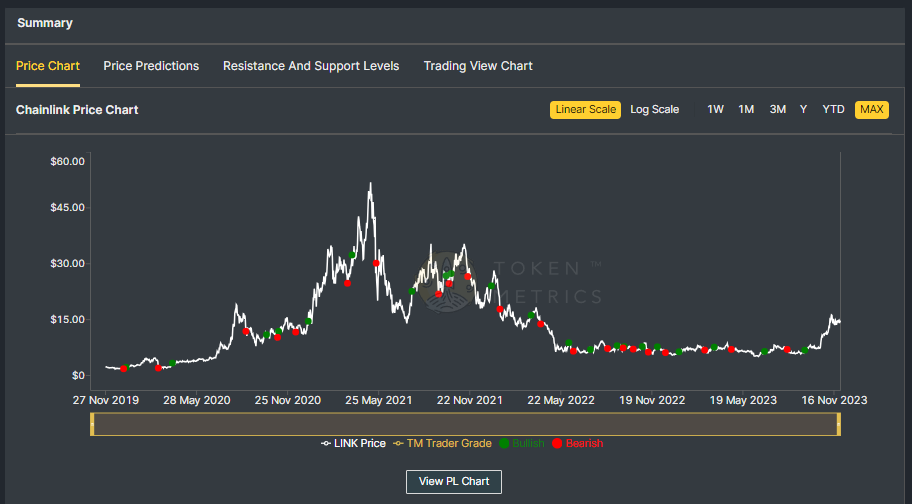
Chainlink Price Chart
Start Your Free Trial Today and Uncover Your Token's Price Prediction and Forecast on Token Metrics.

The price of LINK surged from its initial ICO price of $0.11 to an all-time high of $54.40. However, like any cryptocurrency, it also experienced price volatility and corrections periods.

Chainlink's price has been bullish in recent years, reaching significant milestones in market capitalization and adoption. 

Despite facing resistance around $12, Chainlink has maintained its position as the 13th largest cryptocurrency by market cap. The current market cap of Chainlink is $8.2 billion.

Chainlink (LINK) Current Fundamentals

Before making any price predictions, it is crucial to assess the current fundamentals of Chainlink. The network's partnerships, developments, and technological advancements significantly determine its future price potential.

Chainlink has formed strategic collaborations with prominent cryptocurrency and traditional finance entities. For example, Coinbase Cloud is now a Chainlink node operator, enhancing security and network capacity.

Chainlink Tokenomics
Resource -Token Metrics

The platform has also achieved interoperability with multiple blockchains, including Bitcoin, Polkadot, and Binance Smart Chain.

Furthermore, Chainlink's solutions have been widely adopted in various industries. In decentralized finance, Chainlink's oracles provide reliable price data for lending protocols like Aave. 

The network has also been utilized in gaming applications, insurance markets, and traditional systems to automate processes and access real-time data.

Chainlink Price Prediction - Scenario Analysis

To forecast Chainlink's future price, it is crucial to consider multiple scenarios based on different market conditions and expert opinions. Let's explore some potential price predictions for Chainlink.

Chainlink Price Prediction: Bullish Market

In a bull market scenario where the overall cryptocurrency market experiences significant growth, Chainlink could benefit from increased adoption and demand for its services. Industry experts predict that Chainlink's price could reach new highs in this case.

If the crypto market cap hits $3 Trillion and Chainlink retains its current 0.54% dominance, its price could ascend to $29.39.

In a more bullish scenario of the crypto market surging to $10 Trillion, Chainlink's price could soar to a staggering $97.97, resulting in a potential 7x return for investors.

It is important to note that these predictions are based on various factors and assumptions, and market conditions can change rapidly. However, bullish market sentiment and increased adoption of Chainlink's solutions could drive its price to new heights.

Chainlink Price Prediction
Start Your Free Trial Today and Uncover Your Token's Price Prediction and Forecast on Token Metrics.

Chainlink Price Prediction: Bearish Market

In a bearish market scenario where the overall cryptocurrency market faces a downturn or stagnation, Chainlink's price could experience a decline or slower growth. Market sentiment and external factors can significantly impact the price of cryptocurrencies.

In this case, the price of Chainlink may face downward pressure with a decreased dominance of 0.27%.

In this scenario, If the crypto market cap hits $3 Trillion, Chainlink could trade around $14.89 in the short term and struggle to surpass $48.98 by 2030 even if the total crypto market cap surpasses the $10 Trillion mark.

It is crucial to consider potential risks and challenges that Chainlink may face. Factors such as regulatory developments, competition from other projects, and technological advancements can affect the growth trajectory of Chainlink.

Also Read - Next Crypto Bull Run Prediction

Contact us at promo@tokenmetrics.com for marketing and sponsorship programs.

Chainlink Price Prediction - Industry Expert Opinion

Coinpedia platform predicts Chainlink could reach $213.1 to $253.51 by 2030, and experts from Changelly forecast that it could reach minimum and maximum prices of $30.69 and $38.26 by the end of 2025. By the end of 2030, the price of Chainlink could reach $196.53 to $244.09.

Other industry analysts have varying opinions on the future price of Chainlink. Ambcrypto.com predicts that Chainlink could reach $40.30 to $60.45 by 2030.

Note - Start Your Free Trial Today and Uncover Your Token's Price Prediction and Forecast on Token Metrics.

Click here to buy Cryptocurrencies from Gate.io

Is Chainlink a Good Investment?

The question of whether Chainlink is a good investment depends on various factors, including the investor's risk tolerance, investment goals, and market conditions. Chainlink has shown significant potential with its innovative solutions and growing adoption in various sectors.

Chainlink's decentralized oracle network addresses a critical limitation of smart contracts, enabling them to access real-world data seamlessly. 

This unique value proposition has attracted the attention of cryptocurrency enthusiasts and traditional businesses looking to leverage blockchain technology.

However, conducting thorough research and due diligence is important before investing in cryptocurrency. 

Investors should consider the project's fundamentals, team expertise, market demand, and potential risks. Consulting with financial advisors or experts in the cryptocurrency space can also provide valuable insights.

Also Read - Is Solana a Good Investment?

Risks and Rewards

As with any investment, Chainlink carries both risks and rewards. It is important to consider these factors before making investment decisions.

Risks

  • Market Volatility: Cryptocurrency markets are known for their volatility, and Chainlink is no exception. Price fluctuations can be significant, and investors should be prepared for potential losses.
  • Regulatory Uncertainty: The regulatory landscape for cryptocurrencies is evolving. Changes in regulations or government actions can impact the adoption and growth of Chainlink.
  • Competition: The blockchain industry is highly competitive, with several projects offering similar solutions. Chainlink faces competition from established players and emerging projects in the Oracle space.

Rewards

  • Growing Adoption: Chainlink has gained significant traction in various industries, including DeFi, gaming, and insurance. Increased adoption of Chainlink's solutions can drive demand for its services and potentially lead to price appreciation.
  • Technological Advancements: Chainlink continues to innovate and improve its offerings. Developing new features and partnerships can enhance the network's capabilities and attract more users.
  • Strong Fundamentals: Chainlink's decentralized oracle network has solid fundamentals, addressing a critical need in the blockchain ecosystem. Its value proposition and expanding use cases position it as a potential leader in the space.

Also Read - XRP Price Prediction

Contact us at promo@tokenmetrics.com for marketing and sponsorship programs.

Chainlink Current Developments and Future Potential

Chainlink has been making significant strides in its development and partnerships, positioning itself for future growth. The network's recent collaborations with Coinbase and its interoperability across multiple blockchains demonstrate its potential to expand its reach and impact.

Additionally, Chainlink's solutions have gained recognition in the decentralized finance sector, where reliable price data and oracles are essential for functioning lending protocols and decentralized exchanges. 

As the DeFi industry grows, Chainlink's services will likely remain in high demand. The future potential of Chainlink lies in its ability to continue innovating and addressing the evolving needs of the blockchain ecosystem. 

The network's scalability, security, and reliability will be crucial in attracting more users and establishing itself as a critical player in the industry.

Conclusion

Chainlink's price prediction involves various factors, including market conditions, expert opinions, and the project's fundamentals. 

While external factors and market trends can influence the future price of Chainlink, its strong fundamentals, growing adoption, and expanding use cases position it as a promising project in the blockchain space.

Investors should conduct thorough research, assess risk tolerance, and consider market conditions before making investment decisions. Chainlink's unique value proposition, partnerships, and technological advancements make it an intriguing project to watch in the coming years.

Disclaimer

The information provided on this website does not constitute investment advice, financial advice, trading advice, or any other advice, and you should not treat any of the website's content as such.

Token Metrics does not recommend that any cryptocurrency should be bought, sold, or held by you. Conduct your due diligence and consult your financial advisor before making investment decisions.

Click here to buy Cryptocurrencies from Gate.io

Contact us at promo@tokenmetrics.com for marketing and sponsorship programs.

Build Smarter Crypto Apps &
AI Agents in Minutes, Not Months
Real-time prices, trading signals, and on-chain insights all from one powerful API.
Grab a Free API Key
About Token Metrics
Token Metrics: AI-powered crypto research and ratings platform. We help investors make smarter decisions with unbiased Token Metrics Ratings, on-chain analytics, and editor-curated “Top 10” guides. Our platform distills thousands of data points into clear scores, trends, and alerts you can act on.
30 Employees
analysts, data scientists, and crypto engineers
Daily Briefings
concise market insights and “Top Picks”
Transparent & Compliant
Sponsored ≠ Ratings; research remains independent
Want Smarter Crypto Picks—Free?
See unbiased Token Metrics Ratings for BTC, ETH, and top alts.
Thank you! Your submission has been received!
Oops! Something went wrong while submitting the form.
 No credit card | 1-click unsubscribe
Token Metrics Team
Token Metrics Team

Recent Posts

Research

Quantmetrics API: Measure Risk & Reward in One Call

Token Metrics Team
5

Most traders see price—quants see probabilities. The Quantmetrics API turns raw performance into risk-adjusted stats like Sharpe, Sortino, volatility, drawdown, and CAGR so you can compare tokens objectively and build smarter bots and dashboards. In minutes, you’ll query /v2/quantmetrics, render a clear performance snapshot, and ship a feature that customers trust. Start by grabbing your key at Get API Key, Run Hello-TM to verify your first call, then Clone a Template to go live fast.

What You’ll Build in 2 Minutes

  • A minimal script that fetches Quantmetrics for a token via /v2/quantmetrics (e.g., BTC, ETH, SOL).
  • A smoke-test curl you can paste into your terminal.
  • A UI pattern that displays Sharpe, Sortino, volatility, max drawdown, CAGR, and lookback window.

Next Endpoints to Add

  • /v2/tm-grade (one-score signal)
  • /v2/trading-signals
  • /v2/hourly-trading-signals (timing)
  • /v2/resistance-support (risk placement)
  • /v2/price-prediction (scenario planning)

Why This Matters

Risk-adjusted truth beats hype. Price alone hides tail risk and whipsaws. Quantmetrics compresses edge, risk, and consistency into metrics that travel across assets and timeframes—so you can rank universes, size positions, and communicate performance like a professional.

Built for dev speed

A clean REST schema, predictable latency, and easy auth mean you can plug Sharpe/Sortino into bots, dashboards, and screeners without maintaining your own analytics pipeline. Pair with caching and batching to serve fast pages at scale.

Where to Find

The Quant Metrics cURL request is located in the top right of the API Reference, allowing you to easily integrate it with your application.

Build Smarter Crypto Apps & AI Agents with Token Metrics

Token Metrics provides real-time prices, trading signals, and on-chain insights all from one powerful API. Grab a Free API Key

How It Works (Under the Hood)

Quantmetrics computes risk-adjusted performance over a chosen lookback (e.g., 30d, 90d, 1y). You’ll receive a JSON snapshot with core statistics:

  • Sharpe ratio: excess return per unit of total volatility.
  • Sortino ratio: penalizes downside volatility more than upside.
  • Volatility: standard deviation of returns over the window.
  • Max drawdown: worst peak-to-trough decline.
  • CAGR / performance snapshot: geometric growth rate and best/worst periods.

Call /v2/quantmetrics?symbol=<ASSET>&window=<LOOKBACK> to fetch the current snapshot. For dashboards spanning many tokens, batch symbols and apply short-TTL caching. If you generate alerts (e.g., “Sharpe crossed 1.5”), run a scheduled job and queue notifications to avoid bursty polling.

Production Checklist

  • Rate limits: Understand your tier caps; add client-side throttling and queues.
  • Retries & backoff: Exponential backoff with jitter; treat 429/5xx as transient.
  • Idempotency: Prevent duplicate downstream actions on retried jobs.
  • Caching: Memory/Redis/KV with short TTLs; pre-warm popular symbols and windows.
  • Batching: Fetch multiple symbols per cycle; parallelize carefully within limits.
  • Error catalog: Map 4xx/5xx to clear remediation; log request IDs for tracing.
  • Observability: Track p95/p99 latency and error rates; alert on drift.
  • Security: Store API keys in secrets managers; rotate regularly.

Use Cases & Patterns

  • Bot Builder (Headless): Gate entries by Sharpe ≥ threshold and drawdown ≤ limit, then trigger with /v2/trading-signals; size by inverse volatility.
  • Dashboard Builder (Product): Add a Quantmetrics panel to token pages; allow switching lookbacks (30d/90d/1y) and export CSV.
  • Screener Maker (Lightweight Tools): Top-N by Sortino with filters for volatility and sector; add alert toggles when thresholds cross.
  • Allocator/PM Tools: Blend CAGR, Sharpe, drawdown into a composite score to rank reallocations; show methodology for trust.
  • Research/Reporting: Weekly digest of tokens with Sharpe ↑, drawdown ↓, and volatility ↓.

Next Steps

  • Get API Key — start free and generate a key in seconds.
  • Run Hello-TM — verify your first successful call.
  • Clone a Template — deploy a screener or dashboard today.
  • Watch the demo: VIDEO_URL_HERE
  • Compare plans: Scale with API plans.

FAQs

1) What does the Quantmetrics API return?

A JSON snapshot of risk-adjusted metrics (e.g., Sharpe, Sortino, volatility, max drawdown, CAGR) for a symbol and lookback window—ideal for ranking, sizing, and dashboards.

2) How fresh are the stats? What about latency/SLOs?

Responses are engineered for predictable latency. For heavy UI usage, add short-TTL caching and batch requests; for alerts, use scheduled jobs or webhooks where available.

3) Can I use Quantmetrics to size positions in a live bot?

Yes—many quants size inversely to volatility or require Sharpe ≥ X to trade. Always backtest and paper-trade before going live; past results are illustrative, not guarantees.

4) Which lookback window should I choose?

Short windows (30–90d) adapt faster but are noisier; longer windows (6–12m) are steadier but slower to react. Offer users a toggle and cache each window.

5) Do you provide SDKs or examples?

REST is straightforward (JS/Python above). Docs include quickstarts, Postman collections, and templates—start with Run Hello-TM.

6) Polling vs webhooks for quant alerts?

Dashboards usually use cached polling. For threshold alerts (e.g., Sharpe crosses 1.0), run scheduled jobs and queue notifications to keep usage smooth and idempotent.

7) Pricing, limits, and enterprise SLAs?

Begin free and scale up. See API plans for rate limits and enterprise SLA options.

Disclaimer

All information provided in this blog is for educational purposes only. It is not intended as financial advice. Users should perform their own research and consult with licensed professionals before making any investment or trading decisions.

Research

Crypto Trading Signals API: Put Bullish/Bearish Calls Right in Your App

Token Metrics Team
4

Timing makes or breaks every trade. The crypto trading signals API from Token Metrics lets you surface bullish and bearish calls directly in your product—no spreadsheet wrangling, no chart gymnastics. In this guide, you’ll hit the /v2/trading-signals endpoint, display actionable signals on a token (e.g., SOL, BTC, ETH), and ship a conversion-ready feature for bots, dashboards, or Discord. Start by creating a key on Get API Key, then Run Hello-TM and Clone a Template to go live fast.

What You’ll Build in 2 Minutes

  • A minimal script that fetches Trading Signals via /v2/trading-signals for one symbol (e.g., SOL).
  • A copy-paste curl to smoke-test your key.
  • A UI pattern to render signal, confidence/score, and timestamp in your dashboard or bot.

Endpoints to add next

  • /v2/hourly-trading-signals (intraday updates)
  • /v2/resistance-support (risk placement)
  • /v2/tm-grade (one-score view)
  • /v2/quantmetrics (risk/return context)

Why This Matters

Action over analysis paralysis. Traders don’t need more lines on a chart—they need an opinionated call they can automate. The trading signals API compresses technical momentum and regime reads into Bullish/Bearish events you can rank, alert on, and route into strategies.

Built for dev speed and reliability. A clean schema, predictable performance, and straightforward auth make it easy to wire signals into bots, dashboards, and community tools. Pair with short-TTL caching or webhooks to minimize polling and keep latency low.

Where to Find

You can find the cURL request for Crypto Trading Signals in the top right corner of the API Reference. Use it to access the latest signals!

Live Demo & Templates

  • Trading Bot Starter: Use Bullish/Bearish calls to trigger paper trades; add take-profit/stop rules with Support/Resistance.
  • Dashboard Signal Panel: Show the latest call, confidence, and last-updated time; add a history table for context.
  • Discord/Telegram Alerts: Post signal changes to a channel with a link back to your app.

How It Works (Under the Hood)

Trading Signals distill model evidence (e.g., momentum regimes and pattern detections) into Bullish or Bearish calls with metadata such as confidence/score and timestamp. You request /v2/trading-signals?symbol=<ASSET> and render the most recent event, or a small history, in your UI.

For intraday workflows, use /v2/hourly-trading-signals to update positions or alerts more frequently. Dashboards typically use short-TTL caching or batched fetches; headless bots lean on webhooks, queues, or short polling with backoff to avoid spiky API usage.

Production Checklist

  • Rate limits: Know your tier caps; add client-side throttling and queues.
  • Retries/backoff: Exponential backoff with jitter; treat 429/5xx as transient.
  • Idempotency: Guard downstream actions (don’t double-trade on retries).
  • Caching: Memory/Redis/KV with short TTLs for reads; pre-warm popular symbols.
  • Webhooks & jobs: Prefer webhooks or scheduled workers for signal change alerts.
  • Pagination/Bulk: Batch symbols; parallelize with care; respect limits.
  • Error catalog: Map common 4xx/5xx to clear fixes; log request IDs.
  • Observability: Track p95/p99 latency, error rate, and alert delivery success.
  • Security: Keep keys in a secrets manager; rotate regularly.

Use Cases & Patterns

  • Bot Builder (Headless): Route Bullish into candidate entries; confirm with /v2/resistance-support for risk and TM Grade for quality.
  • Dashboard Builder (Product): Add a “Signals” module per token; color-code state and show history for credibility.
  • Screener Maker (Lightweight Tools): Filter lists by Bullish state; sort by confidence/score; add alert toggles.
  • Community/Discord: Post signal changes with links to token pages; throttle to avoid noise.
  • Allocator/PM Tools: Track signal hit rates by sector/timeframe to inform position sizing (paper-trade first).

Next Steps

  1. Get API Key — create a key and start free.
  2. Run Hello-TM — confirm your first successful call.
  3. Clone a Template — deploy a bot, dashboard, or alerting tool today.

FAQs

1) What does the Trading Signals API return?

A JSON payload with the latest Bullish/Bearish call for a symbol, typically including a confidence/score and generated_at timestamp. You can render the latest call or a recent history for context.

2) Is it real-time? What about latency/SLOs?

Signals are designed for timely, programmatic use with predictable latency. For faster cycles, use /v2/hourly-trading-signals. Add caching and queues/webhooks to reduce round-trips.

3) Can I use the signals in a live trading bot?

Yes—many developers do. A common pattern is: Signals → candidate entry, Support/Resistance → stop/targets, Quantmetrics → risk sizing. Always backtest and paper-trade before going live.

4) How accurate are the signals?

Backtests are illustrative, not guarantees. Treat signals as one input in a broader framework with risk controls. Evaluate hit rates and drawdowns on your universe/timeframe.

5) Do you provide SDKs and examples?

You can integrate via REST using JavaScript and Python snippets above. The docs include quickstarts, Postman collections, and templates—start with Run Hello-TM.

6) Polling vs webhooks for alerts?

Dashboards often use cached polling. For bots/alerts, prefer webhooks or scheduled jobs and keep retries idempotent to avoid duplicate trades or messages.

7) Pricing, limits, and enterprise SLAs?

Begin free and scale as you grow. See API plans for allowances; enterprise SLAs and support are available.

Research

Fundamental Grade Crypto API: Real Crypto Fundamentals in One Score

Token Metrics Team
5 min read

Most traders chase price action; Fundamental Grade Crypto API helps you see the business behind the token—community traction, tokenomics design, exchange presence, VC signals, and DeFi health—consolidated into one score you can query in code. In a few minutes, you’ll fetch Fundamental Grade, render it in your product, and ship a due-diligence UX that drives trust. Start by grabbing your key at the Get API Key page, Run Hello-TM to verify your first call, then Clone a Template to go live fast.

What You’ll Build in 2 Minutes

A minimal script to fetch Fundamental Grade from /v2/fundamental-grade for any symbol (e.g., BTC).

  • Optional curl to smoke-test your key in seconds.
  • A drop-in pattern to display the grade + key drivers in dashboards, screeners, and research tools.

Endpoints to consider next

  • /v2/tm-grade (technical/sentiment/momentum)
  • /v2/price-prediction (scenario planning)
  • /v2/resistance-support (risk levels)
  • /v2/quantmetrics (risk/return stats)

Why This Matters

Beyond price, toward quality. Markets are noisy—hype rises and fades. Fundamental Grade consolidates hard-to-track signals (community growth, token distribution, liquidity venues, investor quality, DeFi integrations) into a clear, comparable score. You get a fast “is this worth time and capital?” answer for screening, allocation, and monitoring.

Build trust into your product. Whether you run an investor terminal, exchange research tab, or a portfolio tool, Token Metrics discovery helps users justify positions. Pair it with TM Grade or Quantmetrics for a balanced picture: what to buy (fundamentals) and when to act (signals/levels).

Where to Find

The Fundamental Grade is easily accessible in the top right of the API Reference. Grab the cURL request for seamless access!

Ready to build?

  • Get API Key — generate a key and start free.
  • Run Hello-TM — verify your first successful call.
  • Clone a Template — deploy a screener or token page today.

Watch the demo: VIDEO_URL_HERE. Compare plans: Scale confidently with API plans.

Build with Token Metrics: The Essential Data Layer for Crypto Apps

Integrate the Token Metrics API to empower your platform with institutional-grade crypto research, signals, and analytics—all in one endpoint suite.

FAQs

1) What does the Fundamental Grade API return?

A JSON payload with the overall score/grade plus component scores (e.g., community, tokenomics, exchange presence, VC backing, DeFi health) and timestamps. Use the overall grade for ranking and component scores for explanations.

2) How fast is the endpoint? Do you publish SLOs?

The API is engineered for predictable latency. For high-traffic dashboards, add short-TTL caching and batch requests; for alerts, use jobs/webhooks to minimize round-trips.

3) Can I combine Fundamental Grade with TM Grade or signals?

Yes. A common pattern is Fundamental Grade for quality filter + TM Grade for technical/sentiment context + Trading Signals for timing and Support/Resistance for risk placement.

4) How “accurate” is the grade?

It’s an opinionated synthesis of multiple inputs—not financial advice. Historical studies can inform usage, but past performance doesn’t guarantee future results. Always layer risk management and testing.

5) Do you offer SDKs and examples?

You can use REST directly (see JS/Python above). The docs include quickstarts, Postman, and ready-to-clone templates—start with Run Hello-TM.

6) Polling vs webhooks for fundamentals updates?

For UI pages, cached polling works well. For event-style notifications (upgrades/downgrades), prefer webhooks or scheduled jobs to avoid spiky traffic.

7) What about pricing, limits, and enterprise SLAs?

Begin free and scale as you grow. See API plans for allowances; enterprise SLAs and support are available—contact us.

Choose from Platinum, Gold, and Silver packages
Reach with 25–30% open rates and 0.5–1% CTR
Craft your own custom ad—from banners to tailored copy
Perfect for Crypto Exchanges, SaaS Tools, DeFi, and AI Products