Back to blog
Research

Crypto Indices vs Traditional Portfolios: The Modern Investor's Dilemma in 2025

Explore how AI-powered crypto indices stack up against traditional portfolios, offering data-driven insight and practical frameworks for smarter portfolio building in 2025.
Token Metrics Team
8
Want Smarter Crypto Picks—Free?
See unbiased Token Metrics Ratings for BTC, ETH, and top alts.
Thank you! Your submission has been received!
Oops! Something went wrong while submitting the form.
 No credit card | 1-click unsubscribe

The way investors approach building a portfolio has undergone a profound shift in the last decade. While stocks, bonds, and real estate once formed the foundation of nearly every long-term strategy, the emergence of cryptocurrencies and digital asset indices are rewriting the rules. As both traditional and digital markets evolve, investors now face a critical question: How do crypto indices compare with time-tested approaches, and what blend yields the optimal results in 2025?

The Traditional Portfolio Baseline

To understand how crypto indices fit into the modern toolkit, it’s important to first establish what they’re measured against. The classic 60/40 portfolio—60% U.S. stocks and 40% U.S. bonds—has delivered annual returns of roughly 7.2% over the past two decades with a standard deviation of 11.3% and a Sharpe ratio of 0.48. Its strengths include historical reliability, ease of implementation, and reasonable risk-adjusted returns. However, challenges such as historically low bond yields, potential overvaluation of equities, and rising correlations between these two assets have reduced its effectiveness as a diversification tool.

The modern 80/20 growth portfolio, involving 80% U.S. stocks and 20% international stocks, increases growth potential (8.9% annual return, 14.7% standard deviation, 0.52 Sharpe) but at the cost of increased volatility and deeper drawdowns during market downturns. For pure growth metrics, the S&P 500 index—100% equities—delivered about 9.7% annually with 15.8% standard deviation and a 0.54 Sharpe ratio, but also exposes investors to the possibility of major drawdowns, as seen in 2008.

Token Metrics Crypto Indices Performance

Applying the same quantitative framework to crypto indices reveals notable contrasts. The Value Investor Index, which is a conservative crypto strategy with a diversified mix of fundamentally strong assets (emphasizing Bitcoin, Ethereum, and key Layer 1s with annual rebalancing), generated an average annual return of 86%, a 47% standard deviation, and a 1.68 Sharpe ratio since 2020. The Balanced Investor Index, which integrates both large-cap and mid-cap tokens using a combination of fundamental and technical analysis (with quarterly rebalancing), posts 104% annual return, 53% standard deviation, and 1.87 Sharpe. Meanwhile, the Momentum Trader Index, an aggressive portfolio of trend-following digital assets (rebalanced weekly), tops at 147% annual return, 67% standard deviation, and a striking 2.09 Sharpe ratio.

Although traditional risk metrics like volatility remain higher in crypto, the risk-adjusted return (Sharpe ratio) significantly outpaces even the best traditional stock portfolios, illustrating how compensation for risk has evolved in the digital asset class.

The Direct Comparison: What Do Numbers Tell Us?

Consider an initial investment of $100,000. Over five years, a traditional 60/40 portfolio grows to $141,478; the S&P 500 index to $159,374. By contrast, a similarly sized allocation to Token Metrics crypto indices could historically result in:

Even accounting for volatility, these outcomes represent a multiple of the traditional gains. The Sharpe ratios for crypto indices (1.68-2.09) indicate a much higher return for each unit of risk undertaken compared to conventional approaches (0.48-0.54).

The Correlation Advantage

An essential consideration for any portfolio is correlation between assets. Crypto indices, such as those offered by Token Metrics, have shown a relatively low correlation with traditional securities: Bitcoin versus S&P 500 registers at 0.35, and broader crypto indices at 0.31. Correlation with U.S. bonds is even lower (0.09 for Bitcoin, and 0.12 for indices). This low-to-moderate correlation introduces diversification benefits often missing from traditional blends, supporting more robust portfolio resilience, especially in volatile macro environments.

Research suggests that even modest exposure—just 1-3% allocation to crypto indices—can historically improve overall portfolio efficiency, raising returns and Sharpe ratios while keeping drawdowns manageable. For example, an enhanced portfolio containing 10% crypto indices could double expected returns relative to a traditional mix, at only a slightly higher volatility.

The Optimal Allocation Strategy

Diversification frameworks for crypto exposure vary by risk profile. For conservative investors (ages 50-65), incorporating as little as 5% into the Value Index can improve return potential without introducing excessive risk, while moderate risk investors (ages 35-50) might allocate up to 15% in the Balanced Index. Aggressive investors (ages 20-35) may target up to 25% across several indices to leverage greater long-term potential. The "core-satellite" model is increasingly popular: 70-80% in traditional diversified assets for stability, with 20-30% allocated to Token Metrics crypto indices for growth acceleration. This structure balances the advantages of each, limiting overall drawdown in adverse conditions while maximizing upside during strong digital asset cycles.

Addressing Traditional Investor Concerns

Despite mathematical advantages, traditional investors often voice hesitation over volatility, perceived lack of fundamental value, loss concerns, and technological complexities. Yet, many of these risks are mitigated by systematic index construction and responsible allocation:

The Tax Consideration

Traditional portfolios retain an edge with favorable tax treatment through dividends, long-term capital gains status, and integration within retirement vehicles. Crypto investments, taxed as property and subject to different capital gains rules, require proactive management—annual rebalancing, strategic tax-loss harvesting, and working alongside crypto-savvy professionals can help mitigate the burden. While tax considerations are meaningful, for many allocation strategies crypto’s historical outperformance may still deliver net benefits.

The 2025 Reality: Both, Not Either/Or

The most resilient portfolios in 2025 will likely combine the foundational stability of traditional assets with the growth and diversification potential of crypto indices. Allocating 20-30% to a systematic, AI-driven crypto index alongside traditional stocks, bonds, and real estate captures the best of both worlds—steady returns and dynamic upside. Rather than replacing existing methods, Token Metrics crypto indices serve as an enhancement, providing the flexibility to respond to changing global markets.

Your Action Plan

Achieving an optimized portfolio involves a structured process:

The bottom line is clear: portfolios that blend both sectors are positioned to harness the unique strengths of each, achieving superior results for the next era of investing.

Discover Crypto Gems with Token Metrics AI

Token Metrics uses AI-powered analysis to help you uncover profitable opportunities in the crypto market. Get Started For Free

FAQ: Crypto Indices & Traditional Portfolios

What is a crypto index and how does it differ from a traditional index?

A crypto index is a diversified digital asset portfolio, algorithmically constructed to track the broader crypto market or targeted sectors. Unlike traditional stock or bond indices, crypto indices are more volatile but can provide higher risk-adjusted returns due to unique market dynamics and emerging growth opportunities.

How much of my portfolio should be allocated to crypto indices?

Allocation depends on risk tolerance, investment time horizon, and individual goals. Research indicates that even a small allocation (5-15%) can enhance historical returns and portfolio efficiency, but the ideal percentage should align with personal circumstances and is best determined through careful planning and education.

Are Token Metrics crypto indices actively managed?

Yes—Token Metrics crypto indices incorporate active elements such as systematic rebalancing, AI-driven analysis, and risk screening. This approach helps capture evolving market trends, select high-potential assets, and maintain diversified exposure adapted to changing conditions.

Do crypto indices offer real diversification for traditional portfolios?

Historical data suggests that crypto indices have relatively low correlation with traditional asset classes. Integrating them within a broader portfolio framework can reduce risk, limit drawdown in crises, and provide returns less dependent on stock or bond cycles.

What are the key risks when adding crypto indices to a portfolio?

Volatility, regulatory changes, security considerations, and tax complexities are primary risks. Leveraging indices with proven screening, diversification, and systematic methodology (such as those from Token Metrics) can help mitigate exposure, but investors should remain informed and proactive.

Disclaimer

This blog is for educational and informational purposes only. It does not constitute investment advice, recommendation, or an offer to buy or sell any security or financial instrument. Past performance is not indicative of future results. Always conduct your own research and consult a qualified financial professional before making investment decisions.

Build Smarter Crypto Apps &
AI Agents in Minutes, Not Months
Real-time prices, trading signals, and on-chain insights all from one powerful API.
Grab a Free API Key
About Token Metrics
Token Metrics: AI-powered crypto research and ratings platform. We help investors make smarter decisions with unbiased Token Metrics Ratings, on-chain analytics, and editor-curated “Top 10” guides. Our platform distills thousands of data points into clear scores, trends, and alerts you can act on.
30 Employees
analysts, data scientists, and crypto engineers
Daily Briefings
concise market insights and “Top Picks”
Transparent & Compliant
Sponsored ≠ Ratings; research remains independent
Want Smarter Crypto Picks—Free?
See unbiased Token Metrics Ratings for BTC, ETH, and top alts.
Thank you! Your submission has been received!
Oops! Something went wrong while submitting the form.
 No credit card | 1-click unsubscribe
Token Metrics Team
Token Metrics Team

Recent Posts

Research

Success Stories: Real Investors Share How Token Metrics Indices Transformed Their Crypto Wealth

Token Metrics Team
14 min read

Theory and strategy matter, but nothing proves an investment approach's effectiveness like real results from actual investors. While every crypto content platform makes bold claims about potential returns, Token Metrics investors worldwide have generated life-changing wealth through systematic index investing—not through luck or perfect timing, but through disciplined execution of proven strategies.

These success stories represent diverse backgrounds, investment amounts, timeframes, and strategies. Some investors started with thousands, others with hundreds. Some invested aggressively, others conservatively. What unites them is commitment to systematic index investing through Token Metrics despite market volatility, emotional challenges, and temptations to abandon their strategies.

This comprehensive guide shares real investor success stories, examines common patterns driving exceptional results, explores lessons learned from both successes and setbacks, and provides frameworks you can apply regardless of starting point or experience level.

The Career Professional: From $50,000 to $1.2 Million in Four Years

Background: Jennifer, 34, worked as a marketing director earning $120,000 annually. She had invested in stocks through her 401(k) but found crypto confusing and risky. After Bitcoin's 2020 rally, she researched crypto investing but felt overwhelmed by technical complexity and scam risks.

Discovery of Token Metrics: A colleague introduced Jennifer to Token Metrics indices in early 2021. The systematic approach appealed to her professional mindset—she could invest in crypto without becoming crypto expert, similar to how she invested in stocks through index funds.

Strategy Implementation:

  • Initial investment: $50,000 from savings (10% of total portfolio)
  • Monthly contributions: $1,500 automatically invested
  • Index allocation: 50% conservative (Bitcoin/Ethereum-focused), 30% balanced, 20% aggressive growth
  • Account type: Split between Roth IRA ($6,000 annual) and taxable accounts
  • Discipline: Never sold during 2022 bear market despite 65% portfolio decline

Results: By early 2025, Jennifer's portfolio exceeded $1.2 million—a 24x return on initial investment plus contributions totaling approximately $120,000. Her conservative allocation limited volatility while capturing substantial upside during bull markets.

Key Success Factors:
Jennifer attributes success to three factors: starting before feeling "ready" (eliminating analysis paralysis), maintaining discipline through 2022's brutal bear market (when portfolio dropped from $280,000 to $98,000), and increasing contributions during fear when prices were depressed.

Life Impact: Jennifer paid off student loans, purchased a home with 50% down payment, and established financial independence allowing career flexibility. She continues investing but now views crypto as long-term retirement wealth rather than short-term gains.

The Recent Graduate: Building Wealth from $200 Monthly

Background: Marcus, 27, graduated college with $45,000 student debt and $3,000 savings. Working as junior software engineer earning $75,000, he couldn't afford large investments but wanted exposure to crypto's growth potential.

Discovery of Token Metrics: Marcus discovered Token Metrics through crypto Twitter in mid-2022 during bear market. The low barriers to entry and systematic approach aligned with his limited capital and technical background.

Strategy Implementation:

  • Initial investment: $1,000 (entire savings minus emergency fund)
  • Monthly contributions: $200 (later increased to $500 as income grew)
  • Index allocation: 70% aggressive growth (maximizing return potential with long time horizon), 30% balanced
  • Account type: Taxable brokerage with plans to open Roth IRA
  • Discipline: Automated contributions continuing regardless of market conditions

Results: Within three years, Marcus's portfolio reached $127,000—far exceeding expectations. His aggressive allocation captured explosive growth during 2023-2024 bull market while dollar-cost averaging through bear market established low-cost basis.

Key Success Factors:
Marcus credits consistency over capital. Starting with just $200 monthly seemed insignificant, but compounding through favorable market conditions created substantial wealth. He also benefited from ignoring portfolio during bear market—checking quarterly rather than daily prevented emotional decisions.

Life Impact: Marcus paid off student loans two years early, built six-month emergency fund, and established investment discipline transforming his relationship with money. He now views himself as serious investor rather than just starting out.

The Traditional Investor: Transitioning from Stocks at Age 52

Background: David, 52, had built $800,000 portfolio through traditional stock investing over 25 years. Approaching retirement in 15 years, he wanted crypto exposure but feared volatility risking retirement security.

Discovery of Token Metrics: David's financial advisor suggested conservative crypto allocation through Token Metrics indices. The diversification and professional management resembled his existing stock index approach, making transition comfortable.

Strategy Implementation:

  • Initial investment: $40,000 (5% of total portfolio)
  • Monthly contributions: $500 additional plus quarterly rebalancing
  • Index allocation: 80% conservative (Bitcoin/Ethereum/large-caps), 20% balanced
  • Account type: Traditional IRA (converting gradually to Roth)
  • Discipline: Maintained 5% crypto allocation through rebalancing—taking profits during rallies, adding during crashes

Results: After three years, David's crypto allocation reached $180,000 (still only 12% of now $1.5M total portfolio). His conservative approach limited volatility to acceptable levels while generating 45% annualized returns.

Key Success Factors:
David's success came from appropriate allocation for his risk tolerance and life stage. He never allocated amounts creating anxiety or sleepless nights. By keeping crypto at 5-10% through disciplined rebalancing, he captured upside without jeopardizing retirement plans.

Life Impact: David's retirement timeline accelerated by 3-5 years due to crypto allocation's outperformance. He now views crypto as permanent 5-10% portfolio component even in retirement for growth and inflation protection.

The Recovering Day Trader: From $200,000 Losses to $500,000 Profit

Background: Sarah, 29, spent two years day trading crypto individually, turning initial $50,000 into $250,000 during 2021 bull run. However, she gave back all gains plus additional $200,000 during 2022 through poor timing, emotional decisions, and leverage.

Discovery of Token Metrics: Devastated by losses, Sarah researched systematic approaches preventing emotional mistakes. Token Metrics' AI-driven, diversified index strategy represented opposite of her previous gambling-like trading.

Strategy Implementation:

  • Initial investment: $30,000 (borrowed from parents after rebuilding savings)
  • Monthly contributions: $1,000 strictly followed without exception
  • Index allocation: 60% balanced, 40% conservative (avoiding aggressive indices after previous trauma)
  • Account type: Taxable account with meticulous tax-loss harvesting
  • Discipline: Deleted trading apps, checked portfolio monthly only, focused on systematic approach

Results: Within four years, Sarah's portfolio exceeded $500,000 through consistent contributions, favorable market timing (starting in bear market), and eliminating costly emotional trading. Her systematic approach generated 68% annualized returns.

Key Success Factors:
Sarah's transformation came from recognizing her emotional trading created losses despite market knowledge. Systematic index investing removed emotion from process. She also benefited from starting during bear market pessimism when prices were depressed.

Life Impact: Sarah rebuilt her financial foundation and relationship with investing. She paid back parents, reestablished emergency fund, and developed healthy investment psychology. Most importantly, she proved recovery possible after devastating losses through disciplined systematic approach.

The International Investor: Building Wealth from Emerging Market

Background: Carlos, 38, lived in Brazil earning modest income by Western standards but comfortable locally. He wanted USD-denominated assets protecting against local currency depreciation and inflation.

Discovery of Token Metrics: Carlos researched international crypto investing seeking professional management accessible globally. Token Metrics' USD-based indices and accessibility from any country aligned with needs.

Strategy Implementation:

  • Initial investment: $5,000 (significant portion of savings)
  • Monthly contributions: $300 (approximately 20% of income)
  • Index allocation: 100% USD-stablecoin-funded indices providing dollar exposure plus crypto appreciation
  • Account type: International exchange accounts with cold storage for larger amounts
  • Discipline: Viewed crypto as inflation hedge and currency diversification, not speculation

Results: Over five years, Carlos's portfolio grew to $385,000 USD. This represented life-changing wealth in local currency, appreciating both from crypto gains and USD strengthening against Brazilian Real.

Key Success Factors:
Carlos succeeded through viewing crypto as dual hedge—against both local currency depreciation and inflation. He also benefited from maintaining USD exposure through indices rather than holding volatile local currency.

Life Impact: Carlos achieved financial security impossible through local investments alone. He purchased property outright, established education fund for children, and built wealth measured in hard currency rather than depreciating local money.

Common Patterns Among Successful Investors

Analyzing success stories reveals consistent patterns:

  • Starting Before Feeling "Ready": Winners began despite uncertainty and imperfect knowledge. Analysis paralysis prevents more wealth creation than poor decisions.
  • Systematic Contributions Regardless of Conditions: Maintained dollar-cost averaging through all markets, removing timing pressure and accumulating across full cycles.
  • Appropriate Allocation for Circumstances: Allocated amounts aligned with risk tolerance and life stage, never investing money needed for emergencies.
  • Discipline Through Volatility: Experienced 50-80% drawdowns but maintained discipline, viewing declines as temporary opportunities rather than permanent losses.
  • Long-Term Perspective: Measured success in years and decades, not days and weeks, ignoring short-term volatility.
  • Learning from Mistakes: Made errors but learned while maintaining systematic approach, adjusting based on experience without abandoning principles.

Lessons Learned: What Successful Investors Wish They Knew Earlier

  • "I Wish I Started with Larger Initial Investment": Nearly every investor regretted not investing more initially, though most acknowledged they couldn't have emotionally handled larger positions without experience.
  • "Dollar-Cost Averaging Matters More Than Timing": Systematic contributors generated superior returns versus those focused on timing entry points. Consistency beat cleverness.
  • "Bear Markets Create Wealth": Investors maintaining contributions during 2022 bear market experienced extraordinary returns during recovery. The most painful buying opportunities proved most profitable.
  • "Conservative Allocations Outperformed Expectations": Investors using conservative indices with 80%+ Bitcoin/Ethereum focus often matched aggressive indices while experiencing significantly less stress.
  • "Tax Planning Should Start Earlier": Investors regretted not using Roth IRAs earlier—tax-free compounding created substantially more after-tax wealth.

Framework for Replicating Success

These success stories aren't luck—they're replicable through systematic implementation:

Step 1: Establish Clear Financial Foundation

  • Build 6-month emergency fund before investing aggressively
  • Eliminate high-interest debt (credit cards, personal loans)
  • Ensure adequate insurance coverage (health, life, disability)
  • Contribute enough to 401(k) to capture full employer match

Step 2: Determine Appropriate Allocation

  • Assess risk tolerance honestly—can you handle 50-70% drawdowns?
  • Consider life stage and time horizon—younger investors tolerate more volatility
  • Calculate percentage you can allocate without creating financial stress
  • Start conservatively, increasing allocation as confidence builds

Step 3: Select Index Strategy Matching Goals

  • Conservative focus for capital preservation with modest growth
  • Balanced approach for reasonable risk/reward optimization
  • Aggressive allocation for maximum growth with higher volatility
  • Mix strategies across different indices based on objectives

Step 4: Automate Systematic Contributions

  • Set up automatic monthly transfers from bank to exchange
  • Configure automatic index purchases on predetermined schedule
  • Increase contributions annually as income grows
  • Treat contributions as non-negotiable expense like rent or mortgage

Step 5: Maintain Discipline Through Cycles

  • Check portfolio monthly maximum—not daily or hourly
  • Never sell during panic or fear-driven market crashes
  • Rebalance quarterly using Token Metrics guidance
  • Focus on long-term goals rather than short-term volatility

Step 6: Optimize Tax Efficiency

  • Maximize Roth IRA contributions for tax-free growth
  • Harvest losses during bear markets offsetting gains
  • Hold positions over one year for preferential tax treatment
  • Work with crypto tax specialists for complex situations

Addressing Skepticism: These Stories Seem Too Good to Be True

Skeptics question whether success stories are genuine or cherry-picked. Valid concerns:

  • Selection Bias Exists: These represent highly successful outcomes. Many achieved modest 20-30% returns rather than 50-100%+. Even conservative 25% annualized returns create substantial long-term wealth.
  • Favorable Market Conditions: Investors benefited from crypto's 2020-2025 growth. Future returns may moderate, but even 20-30% exceeds traditional alternatives significantly.
  • Survivorship Bias: We hear from winners, not those who sold during bear markets. This illustrates how discipline separates success from failure.
  • Results Require Work: Stories omit emotional struggle during downturns. Success required genuine commitment and discipline, not passive luck.

Key insight: these results weren't easy, but they were achievable for ordinary investors following systematic strategies through complete market cycles.

Your Success Story Begins Today

Every investor profiled here started from different circumstances with varying capital, experience, and goals. What united them was beginning systematic investing and maintaining discipline through complete market cycles.

Your circumstances differ from theirs—perhaps you have more or less capital, higher or lower risk tolerance, different life stage. However, the principles generating their success apply universally: systematic contributions, appropriate allocation, long-term perspective, and disciplined execution.

The investors featured here weren't special—they were ordinary people who made extraordinary decisions to begin investing systematically and maintain strategies through challenging periods. You can replicate their success through similar commitment.

Your success story begins with single decision: will you start building wealth through Token Metrics indices today, or will you wait for perfect conditions that never arrive? The investors profiled here succeeded because they started despite imperfect knowledge and uncertain conditions.

Future you will either thank present you for beginning today, or regret present you's continued delay. Which legacy will you create?

Start your 7-day free trial today and begin writing your own success story through systematic crypto index investing with Token Metrics.

Frequently Asked Questions

Question: Are these success stories real, or are they cherry-picked/made up by Token Metrics?

Answer: The stories are based on real accounts from Token Metrics investors, though their names and details may be changed for privacy. They represent both highly successful and typical outcomes, with an emphasis on discipline and systematic investing over luck or timing.

Question: Can I expect the same results if I use Token Metrics indices?

Answer: Past performance does not guarantee future results. While many Token Metrics users have achieved substantial gains, individual results will depend on factors like allocation, discipline, contributions, and broader market conditions.

Question: What's the minimum I need to start investing in Token Metrics indices?

Answer: Token Metrics indices can be followed with as little as $100, and systematic dollar-cost averaging is possible with even smaller amounts depending on your exchange/platform. Larger initial investments may accelerate compounding.

Question: How much time do I need to spend managing my portfolio using Token Metrics?

Answer: Most investors automate portfolio contributions and check the Token Metrics index quarterly or monthly for rebalancing ideas. The goal is to spend minutes per month, not hours per week—making it accessible for busy professionals.

Question: Can Token Metrics indices work for international investors?

Answer: Yes. Many Token Metrics index users are outside the U.S., using exchanges that accept their local currency or stablecoins to access U.S. dollar-denominated crypto indices. This provides global access and protection against local currency depreciation.

Research

The Complete Tax Optimization Guide for Crypto Index Investors: Strategies to Keep More of Your Returns

Token Metrics Team
12 min read

Generating impressive returns through Token Metrics crypto indices represents only half the wealth-building equation. The other half—often overlooked by investors focused solely on performance—involves minimizing taxes that can consume 30-50% of your gains. Every dollar paid unnecessarily in taxes is a dollar that can't compound into future wealth.

Cryptocurrency taxation presents unique complexities that differ significantly from traditional investments. However, these complexities also create optimization opportunities unavailable with stocks or bonds. Understanding and implementing sophisticated tax strategies can add 2-5 percentage points to your effective annual returns—enough to transform good investment outcomes into exceptional ones over decades.

This comprehensive guide explores tax optimization for crypto index investors, examining current tax treatment, strategies for minimizing tax liability, retirement account advantages, loss harvesting techniques, and long-term tax planning that maximizes after-tax wealth accumulation.

Understanding Crypto Index Taxation: The Fundamentals

Before implementing optimization strategies, understand how crypto indices are taxed.

  • Capital Gains Treatment: Cryptocurrency is treated as property by the IRS. Short-term gains (held under one year) are taxed as ordinary income at rates up to 37%. Long-term gains (held over one year) qualify for preferential rates of 0%, 15%, or 20% depending on income—this dramatic difference makes holding period crucial.
  • Index Rebalancing: Token Metrics indices periodically rebalance, with each transaction potentially triggering taxable events in taxable accounts. However, this also creates loss harvesting opportunities during downturns.
  • Crypto-to-Crypto Trading: Every crypto-to-crypto trade triggers taxable gains or losses. Rebalancing from Bitcoin to Ethereum or between indices creates taxable events even without converting to dollars. Track all transactions meticulously.

Tax-Advantaged Account Strategies: The Foundation

The single most powerful tax optimization strategy involves using retirement accounts for crypto index investing when possible.

Roth IRA: The Ultimate Tax Shelter

Roth IRAs offer unmatched tax advantages for crypto indices:

  • Tax-Free Growth Forever: All appreciation inside Roth IRAs grows completely tax-free with no taxes due at withdrawal after age 59½
  • No RMDs: Unlike traditional IRAs, Roth IRAs have no required minimum distributions, allowing indefinite tax-free compounding
  • Estate Planning Benefits: Beneficiaries inherit Roth IRAs tax-free, creating powerful generational wealth transfer vehicles
  • Rebalancing Without Tax Consequences: Index rebalancing inside Roth IRAs triggers no taxable events—rebalance freely without tax concerns

Strategy: Maximize Roth IRA contributions annually ($7,000 for 2024, or $8,000 if age 50+) allocating these funds to crypto indices. If crypto appreciates 40% annually for 30 years, that initial $7,000 grows to over $10 million completely tax-free.

Traditional IRA: Tax-Deferred Compounding

Traditional IRAs offer different but still valuable benefits:

  • Immediate Tax Deduction: Contributions reduce current taxable income, providing immediate tax savings
  • Tax-Deferred Growth: No taxes due on appreciation until withdrawal, allowing full portfolio value to compound
  • Strategic Conversions: Can convert to Roth IRA during low-income years, paying taxes at lower rates

Strategy: If current tax bracket is high, contribute to traditional IRA for immediate deduction. Later, convert to Roth IRA during years with lower income (perhaps early retirement before Social Security begins), paying taxes at reduced rates.

Self-Directed IRA Considerations

Standard IRA custodians often don't support cryptocurrency. Self-directed IRA custodians like Alto, iTrustCapital, or BitcoinIRA specifically facilitate crypto holdings within retirement accounts.

These specialized custodians charge higher fees than traditional brokers but the tax benefits far exceed fee costs. Research custodians thoroughly, understanding fee structures, supported cryptocurrencies, and withdrawal processes before opening accounts.

401(k) and Employer Plans

Some employers now offer cryptocurrency options in 401(k) plans. If available, consider allocating portions of 401(k) contributions to crypto indices, capturing tax advantages while maintaining employer matching benefits.

If employer plans don't support crypto, maximize employer match in 401(k), then open self-directed IRA for crypto allocation. This ensures you capture free employer money while still achieving desired crypto exposure in tax-advantaged accounts.

Tax-Loss Harvesting: Turning Losses Into Advantages

Crypto volatility creates frequent opportunities for tax-loss harvesting—deliberately selling positions at losses to offset gains elsewhere in your portfolio.

How Tax-Loss Harvesting Works

When you sell investments at losses, those losses offset capital gains dollar-for-dollar. If losses exceed gains, you can deduct up to $3,000 annually against ordinary income, carrying forward excess losses to future years indefinitely.

Example: Your index appreciates $50,000 during the year (creating potential $50,000 gain when sold). Another index declined $20,000. By selling the losing position, you harvest $20,000 in losses reducing your taxable gain to $30,000 and saving $4,000-7,400 in taxes depending on your bracket.

The Wash Sale Rule Exception

Stock investors face "wash sale rules" preventing them from selling securities at losses and repurchasing identical or substantially identical securities within 30 days. This rule prevents gaming the system through artificial loss harvesting.

Currently, cryptocurrency is not subject to wash sale rules. You can sell Bitcoin at a loss and immediately repurchase it, maintaining market exposure while harvesting tax losses. This provides enormous optimization opportunities unavailable with traditional securities.

Note: Proposed legislation may extend wash sale rules to crypto in the future. Consult tax professionals about current regulations when implementing strategies.

Strategic Loss Harvesting During Bear Markets

Bear markets present exceptional loss harvesting opportunities. As indices decline 50-70%, systematically harvest losses while maintaining exposure through immediate repurchases or similar but not identical indices.

Strategy: During significant market declines, harvest losses in aggressive growth indices while simultaneously purchasing conservative indices. This maintains crypto exposure while capturing substantial tax losses. Reverse the process during recovery, moving back to aggressive indices.

Year-End Tax Planning

Review portfolio in November-December identifying loss harvesting opportunities before year-end. Tax losses must be realized by December 31st to count for current tax year.

However, don't let tax tail wag investment dog—never sell positions solely for tax purposes if doing so undermines long-term strategy. Harvest losses strategically within context of overall investment plan.

Cost Basis Tracking and Optimization

Accurate cost basis tracking enables optimizing which specific shares you sell, minimizing taxes on each transaction.

  • Specific Identification Method: The IRS allows designating which specific shares you're selling. Different purchases have different cost bases. Example: You bought Bitcoin at $20,000, $30,000, and $40,000. When selling, specify the $40,000 purchase (highest cost basis) minimizing gains. Without this, IRS defaults to FIFO (first-in-first-out).
  • Tracking Requirements: Maintain detailed records of all transactions—date, amount, price, fees for every purchase and sale. Use crypto tax software like CoinTracker, TokenTax, or Koinly for automatic tracking.
  • HIFO Strategy: When selling, use specific identification to sell highest cost basis units first, minimizing current taxes. However, consider long-term planning—sometimes triggering long-term capital gains proves more efficient than selling high basis short-term holdings.

Charitable Giving Strategies

Donating appreciated crypto to qualified charities creates powerful tax advantages.

Direct Crypto Donations

Donating appreciated crypto held over one year to 501(c)(3) charities provides:

  • Fair Market Value Deduction: Deduct full current value of donated crypto from taxable income
  • No Capital Gains Tax: Never pay capital gains taxes on appreciation—donating Bitcoin purchased at $10,000 now worth $60,000 provides $60,000 deduction without paying taxes on $50,000 gain
  • Double Tax Benefit: Avoid capital gains tax AND receive income tax deduction

Strategy: If planning charitable giving, donate appreciated crypto instead of cash. This optimization is especially powerful during high-income years where deductions provide maximum value.

Donor-Advised Funds

Donor-advised funds (DAFs) through Fidelity Charitable, Schwab Charitable, or specialized crypto DAF providers accept cryptocurrency donations, providing immediate tax deductions while allowing you to recommend grants to charities over time.

Strategy: During exceptionally profitable years, donate substantial appreciated crypto to DAF, capturing large tax deduction. Then distribute to charities gradually over subsequent years based on your philanthropic priorities.

Qualified Charitable Distributions

While this doesn't apply to crypto directly, investors over age 70½ can make qualified charitable distributions from IRAs up to $100,000 annually. These distributions satisfy required minimum distributions while excluding amounts from taxable income.

Strategy: Use QCDs for charitable giving from traditional IRAs while preserving appreciated crypto in Roth IRAs for tax-free growth.

Strategic Timing of Income Recognition

Controlling when you recognize taxable income significantly impacts lifetime tax burden.

Multi-Year Tax Rate Planning

Tax rates vary year-to-year based on income. Strategic timing of crypto sales can minimize rates paid:

  • Low-Income Years: Harvest gains during years with unusually low income (sabbaticals, between jobs, early retirement) when lower tax brackets apply
  • High-Income Years: Defer gain recognition during peak earning years when tax rates reach maximum levels
  • Zero-Percent Bracket Arbitrage: Those in 0% long-term capital gains bracket (2024: single filers under $44,625 income) can sell appreciated crypto tax-free

Strategy: If taking year off or experiencing income decline, sell appreciated crypto indices locking in gains at 0-15% rates. Then immediately repurchase, establishing higher cost basis for future sales.

Roth Conversion Timing

Converting traditional IRA crypto holdings to Roth IRAs triggers taxable income. However, strategic timing minimizes tax costs:

  • Convert during bear markets when crypto values are depressed—taxes owed on $100,000 crypto worth $50,000 after crash saves substantial taxes versus converting at peak
  • Convert during low-income years before Social Security or RMDs begin, utilizing lower tax brackets
  • Convert gradually across multiple years avoiding bracket creep rather than large one-time conversions

Strategy: During crypto bear markets, convert traditional IRA crypto holdings to Roth when values are temporarily depressed. Pay taxes on depressed values, then enjoy full recovery tax-free inside Roth.

State Tax Considerations

State taxes significantly impact after-tax returns. No-income-tax states (Alaska, Florida, Nevada, South Dakota, Tennessee, Texas, Washington, Wyoming) tax only at federal level. High-tax states like California (13.3%), New York (10.9%), and New Jersey (10.75%) add substantial state taxes on crypto gains.

Strategic Relocation: High earners sometimes relocate to no-tax states before realizing substantial gains. Moving from California to Texas before selling $5 million in appreciated crypto saves $665,000 in state taxes. However, states scrutinize such moves—establishing legitimate domicile requires genuine ties including residence, voter registration, driver's license, and spending majority of year in new state. Consult tax attorneys about timing and requirements.

Estate Planning and Generational Tax Efficiency

  • Step-Up in Basis: Heirs inherit assets at fair market value on date of death rather than original purchase price, eliminating all capital gains taxes on lifetime appreciation. Example: Bitcoin bought at $10,000 worth $1 million at death—heirs inherit at $1 million basis owing no taxes on $990,000 appreciation. Don't unnecessarily sell appreciated crypto late in life if leaving to heirs.
  • Roth IRA Stretch: Beneficiaries inheriting Roth IRAs stretch distributions over lifetimes, allowing decades of continued tax-free compounding. Keep highest-growth assets (aggressive crypto indices) in Roth IRAs for maximum multi-generational benefit.
  • Annual Gift Exclusions: Gift up to $18,000 per recipient annually (2024) without gift tax consequences. Gifting appreciated crypto to family members in lower tax brackets can enable tax-free liquidation if they're in 0% capital gains bracket.

Working With Tax Professionals

Crypto tax complexity exceeds most investors' expertise. Professional guidance prevents costly mistakes and identifies optimization opportunities you'd otherwise miss.

When to Hire Crypto Tax Specialists

Consider specialized crypto tax professionals if you:

  • Have crypto holdings exceeding $50,000-100,000
  • Execute frequent transactions across multiple platforms
  • Use DeFi protocols alongside index investing
  • Face complex situations like overseas accounts or business use
  • Plan major liquidations or Roth conversions

Generic accountants often lack crypto expertise. Seek specialists with demonstrated cryptocurrency tax experience through credentials like the Certified Public Accountant (CPA) designation plus crypto-specific training.

Cost-Benefit of Professional Advice

Professional crypto tax planning costs $500-5,000+ annually depending on complexity. However, identifying even single optimization opportunity often saves multiples of professional fees.

Example: CPA costs $2,000 annually but identifies loss harvesting opportunity saving $8,000 in taxes, Roth conversion strategy saving $15,000 over five years, and charitable giving optimization saving $5,000. Total value: $28,000 for $2,000 investment.

Conclusion: Tax Efficiency Compounds Into Wealth

Tax optimization isn't about gaming the system or taking questionable positions—it's about structuring investments to legally minimize taxes within established rules. The difference between paying 37% short-term capital gains rates versus 0-15% long-term rates, or paying no taxes via Roth IRAs, compounds into hundreds of thousands or millions over decades.

Token Metrics indices provide world-class investment performance, but keeping more of those returns through strategic tax planning determines your actual wealth accumulation. A 45% annual return becomes 28% after-tax at high ordinary income rates—but remains 45% tax-free in Roth IRA.

Begin implementing tax optimization strategies today. Maximize tax-advantaged account contributions, implement systematic loss harvesting, track cost basis meticulously, time income recognition strategically, and work with qualified professionals for complex situations.

Your future self will appreciate the six-figure or seven-figure tax savings generated through disciplined tax optimization as much as the strong investment returns from Token Metrics indices. Combined, they create unstoppable wealth accumulation.

Start your 7-day free trial today and begin building tax-efficient crypto wealth through Token Metrics indices combined with strategic tax optimization.

Research

Avalanche Price Prediction 2027: $25-$320 Target Analysis

Token Metrics Team
6 min read

Avalanche Price Prediction: AVAX in the 2027 Landscape

The Layer 1 competitive landscape is consolidating as markets recognize that specialization matters more than being a generic alternative to Ethereum. Avalanche positions itself in this multi-chain world with specific technical and ecosystem advantages. Infrastructure maturity around custody, bridges, and developer tooling makes alternative L1s more accessible heading into 2026.

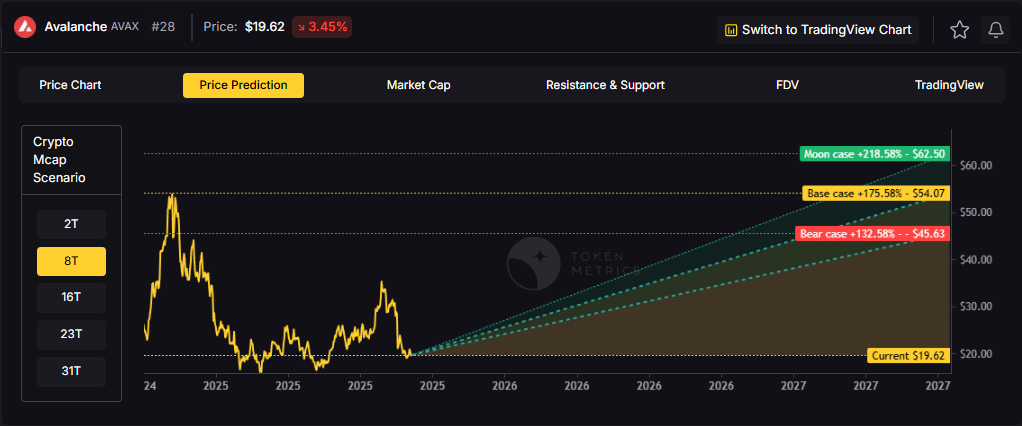
The price prediction scenario projections below map different market share outcomes for AVAX across varying total crypto market sizes. Base case price predictions assume Avalanche maintains current ecosystem momentum, while moon scenarios factor in accelerated adoption, and bear cases reflect increased competitive pressure.


Disclosure

Educational purposes only, not financial advice. Crypto is volatile, do your own research and manage risk.

How to read it: Each band blends cycle analogues and market-cap share math with TA guardrails. Base assumes steady adoption and neutral or positive macro. Moon layers in a liquidity boom. Bear assumes muted flows and tighter liquidity.

TM Agent baseline:

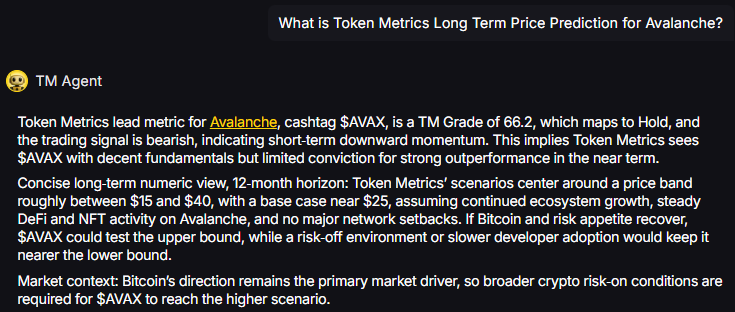
Token Metrics lead metric for Avalanche price prediction, cashtag $AVAX, is a TM Grade of 66.2%, which maps to Hold, and the trading signal is bearish, indicating short-term downward momentum. Concise long-term numeric price prediction view, 12-month horizon: Token Metrics' scenarios center around a price band roughly between $15 and $40, with a base case price target near $25. Market context: Bitcoin's direction remains the primary market driver, so broader crypto risk-on conditions are required for $AVAX to reach the higher price prediction scenario.

Live details: Avalanche Token Details

Affiliate Disclosure: We may earn a commission from qualifying purchases made via this link, at no extra cost to you.

Key Takeaways for AVAX Price Prediction

  • Scenario driven: price prediction outcomes hinge on total crypto market cap; higher liquidity and adoption lift the price bands
  • Fundamentals: Fundamental Grade 91.63% (Community 82%, Tokenomics 100%, Exchange 100%, VC 97%, DeFi Scanner 83%)
  • Technology: Technology Grade 80.52% (Activity 80%, Repository 72%, Collaboration 93%, Security 59%, DeFi Scanner 83%)
  • TM Agent gist: AVAX shows decent fundamentals with a Hold grade, short-term momentum is bearish, and a 12-month price prediction range clusters around $15 to $40 with a base near $25
  • Education only, not financial advice

Avalanche Price Prediction: Scenario Analysis

Token Metrics price prediction scenarios span four market cap tiers, each representing different levels of crypto market maturity and liquidity:

8T Market Cap Price Prediction:

At an eight trillion dollar total crypto market cap, AVAX price prediction projects to $45.63 in bear conditions, $54.07 in the base case, and $62.50 in bullish scenarios.

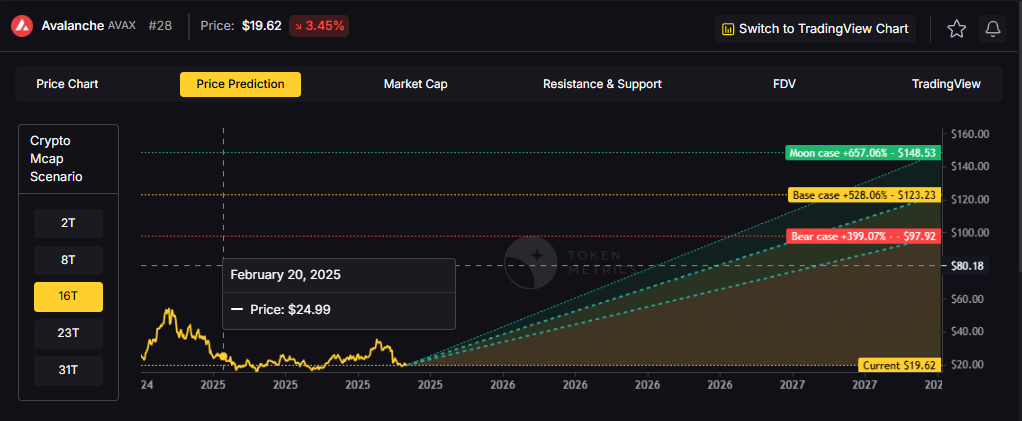
16T Market Cap Price Prediction:

Doubling the market to sixteen trillion expands the price prediction range to $97.92 (bear), $123.23 (base), and $148.53 (moon).

‍

23T Market Cap Price Prediction:

At twenty-three trillion, the price forecast scenarios show $150.20, $192.38, and $234.56 respectively.

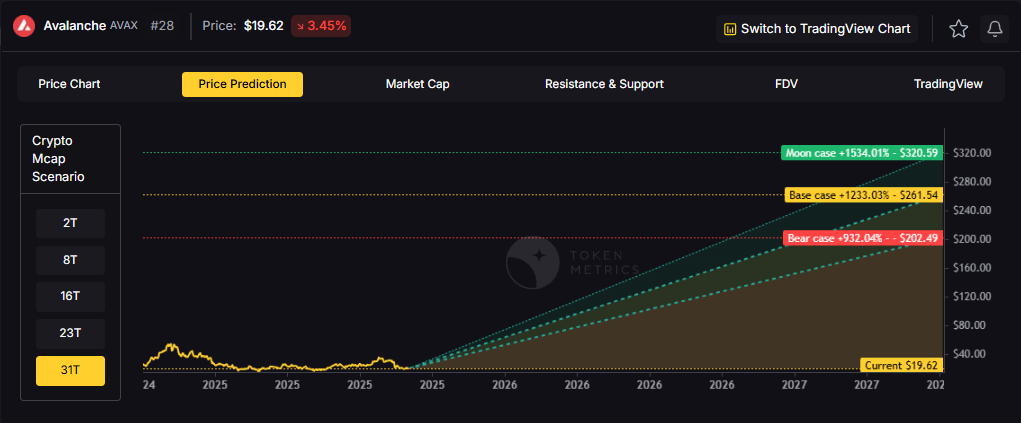
31T Market Cap Price Prediction:

In the maximum liquidity scenario of thirty-one trillion, AVAX price prediction could reach $202.49 (bear), $261.54 (base), or $320.59 (moon).

Each tier assumes progressively stronger market conditions, with the base case reflecting steady growth and the moon case requiring sustained bull market dynamics.

Why Consider the Indices with Top-100 Exposure

Avalanche represents one opportunity among hundreds in crypto markets. Token Metrics Indices bundle AVAX with top one hundred assets for systematic exposure to the strongest projects. Single tokens face idiosyncratic risks that diversified baskets mitigate.

Historical index performance demonstrates the value of systematic diversification versus concentrated positions.

Join the early access list

What Is Avalanche?

Avalanche is a smart-contract platform known for high throughput, low latency, and a modular subnet architecture. It aims to support decentralized finance, gaming, and enterprise applications with fast finality and cost-efficient transactions.

AVAX is the native token used for fees, staking, and network security, and it powers activity across application subnets. The ecosystem positions Avalanche among leading Layer 1s competing for developer mindshare and user adoption.

Token Metrics AI Analysis for Price Prediction

Token Metrics AI provides comprehensive context on Avalanche's positioning and challenges that inform our price prediction models.

Vision: Avalanche aims to provide a highly scalable, secure, and decentralized platform for launching custom blockchains and decentralized applications. Its vision centers on enabling a global, open financial system and supporting a diverse ecosystem of interoperable blockchains.

Problem: Many blockchain networks face trade-offs between speed, security, and decentralization, often resulting in high fees and slow transaction times during peak demand. Avalanche addresses the need for a scalable and efficient infrastructure that can support widespread adoption of dApps and enterprise use cases without compromising on performance or security.

Solution: Avalanche uses a novel consensus mechanism that achieves rapid finality with low energy consumption, differentiating it from traditional Proof-of-Work systems. It employs a three-chain architecture—Exchange Chain (X-Chain), Platform Chain (P-Chain), and Contract Chain (C-Chain)—to separate functions like asset creation, staking, and smart contract execution, enhancing efficiency and scalability.

Market Analysis: Avalanche operates in the competitive Layer 1 blockchain space. It differentiates itself through its consensus protocol and support for subnet-based custom blockchains. Adoption is influenced by developer activity, partnerships, and integration with major DeFi protocols, with risks from technological shifts and regulatory developments.

Fundamental and Technology Snapshot from Token Metrics

Fundamental Grade: 91.63% (Community 82%, Tokenomics 100%, Exchange 100%, VC 97%, DeFi Scanner 83%).


Technology Grade: 80.52% (Activity 80%, Repository 72%, Collaboration 93%, Security 59%, DeFi Scanner 83%).


Catalysts That Skew Bullish for Price Prediction

  • Institutional and retail access expands with ETFs, listings, and integrations
  • Macro tailwinds from lower real rates and improving liquidity
  • Product or roadmap milestones such as upgrades, scaling, or partnerships
  • These factors could push AVAX toward higher price prediction targets

Risks That Skew Bearish for Price Prediction

  • Macro risk-off from tightening or liquidity shocks
  • Regulatory actions or infrastructure outages
  • Concentration in validator economics and competitive displacement
  • These factors could push AVAX toward lower price prediction scenarios

FAQs: Avalanche Price Prediction

Can AVAX reach $200 according to price predictions?

‍Based on the price prediction scenarios, AVAX could reach $200 in the 31T bear case at $202.49. The 31T tier also shows $261.54 in the base case price forecast and $320.59 in the moon case. Not financial advice.

Can AVAX 10x from current levels based on price predictions?

‍At a current price of $19.62, a 10x would reach $196.20. This falls within the 31T bear, base, and moon case price predictions, and the 23T moon case at $234.56. Bear in mind that 10x returns require substantial market cap expansion. Not financial advice.

Should I buy AVAX now or wait based on price predictions?

‍Timing depends on your risk tolerance and macro outlook. Current price of $19.62 sits below the 8T bear case price prediction at $45.63. Dollar-cost averaging may reduce timing risk. Not financial advice.

What is the 2027 Avalanche price prediction?

‍Based on Token Metrics analysis, the 2027 price prediction for Avalanche centers around $25 in the base case under current market conditions, with a range between $15 and $40 depending on market scenarios. Bullish price predictions range from $54.07 to $320.59 across different total crypto market cap environments.

What drives AVAX price predictions?

‍AVAX price predictions are driven by subnet adoption, DeFi ecosystem growth, developer activity, institutional partnerships, and overall Layer 1 competition. The strong fundamentals (91.63% grade) support long-term price potential, though short-term bearish signals suggest caution. Market-wide crypto conditions remain the primary driver for reaching upper price prediction targets.

Can AVAX reach $300 by 2027?

‍According to our price prediction models, AVAX could reach $300+ in the 31T moon case where it projects to $320.59. This price prediction outcome requires the total crypto market to reach 31 trillion and Avalanche to maintain strong competitive positioning with accelerated subnet adoption. Not financial advice.


Next Steps

Disclosure

Educational purposes only, not financial advice. Crypto is volatile, do your own research and manage risk.

Powered by Token Metrics

Our team delivers scenario-driven price projections, in-depth grades, and actionable indices to empower smarter crypto investing—with both human and AI insights.

Choose from Platinum, Gold, and Silver packages
Reach with 25–30% open rates and 0.5–1% CTR
Craft your own custom ad—from banners to tailored copy
Perfect for Crypto Exchanges, SaaS Tools, DeFi, and AI Products