Back to blog
Research

Crypto Market Cap Index 2025: Automatic Top 100 Tracking with Stablecoin Safety Net

Explore the innovative crypto market cap index of 2025, leveraging AI and risk management tools for disciplined, systematic digital asset exposure and stability.
Token Metrics Team
17 min read
Want Smarter Crypto Picks—Free?
See unbiased Token Metrics Ratings for BTC, ETH, and top alts.
Thank you! Your submission has been received!
Oops! Something went wrong while submitting the form.
 No credit card | 1-click unsubscribe

In the rapidly evolving cryptocurrency market, investors face unprecedented challenges in tracking and managing their digital asset portfolios. Cryptocurrency market capitalization, representing the total value of all cryptocurrencies combined, serves as a crucial metric for assessing overall market performance and investor sentiment, with its fluctuations providing key insights for market analysis. With prices fluctuating wildly and market narratives shifting weekly rather than quarterly, staying ahead requires more than just luck—it demands smart, systematic approaches. The crypto market cap index 2025 ushers in a new era of investment strategy by combining comprehensive Top 100 tracking with automatic risk management through a stablecoin safety net. This innovative approach offers investors broad market exposure while preserving capital during downturns, addressing many of the traditional pitfalls of crypto investing, and significantly improving efficiency in portfolio management and risk mitigation.

The Problem with Traditional Crypto Investing

The cryptocurrency market has expanded dramatically, now boasting a total market capitalization exceeding $4 trillion and encompassing over 20,000 distinct tokens worldwide. The cryptocurrency market cap is calculated by multiplying the price of each coin by its circulating supply, providing a key metric for ranking and assessing the overall market value. This explosive growth has made the investment landscape incredibly complex and volatile. Trading volume in the market often reaches billions of dollars daily, with BTC/USD pairs leading in liquidity and fair price discovery.

Past market cycles, such as the ICO boom of 2017 or the DeFi and NFT surges of 2020-2021, lasted for months, allowing investors some predictability. However, the 2024-2025 period is defined by rapid narrative rotations measured in weeks, not quarters.

For example, the market might see AI agent tokens surge 100-300% in the first three weeks of a quarter following major OpenAI announcements. Shortly after, attention shifts to blockchain gaming as industry giants announce integrations. Then, decentralized physical infrastructure networks (DePIN) gain traction with enterprise partnerships, followed by a focus on Real World Assets as regulatory clarity improves. This relentless pace renders traditional buy-and-hold strategies inadequate. Investors must either spend countless hours tracking over 100 tokens across multiple exchanges or risk missing the next major opportunity. In such a volatile environment, millions of dollars can be gained or lost in a matter of hours due to sudden price swings and market sentiment shifts.

Moreover, conventional crypto indices focusing on the top 10 assets offer limited diversification. Bitcoin and Ethereum typically dominate these portfolios, comprising 60-75% of holdings, which means these indices largely move in tandem with just two assets. This concentration misses the asymmetric returns and innovation emerging from mid-cap and emerging tokens. According to Token Metrics data analyzing over 6,000 cryptocurrencies, the top 100 tokens by market capitalization—calculated by multiplying each token's price by its circulating supply—outperformed the top-10 concentrated portfolios by an average of 34% in 2024, with this gap widening during periods of rapid narrative shifts. Volume and liquidity are also critical factors in the ranking and performance of these tokens, as higher trading volume often signals stronger market legitimacy and fairer pricing.

Introducing Automatic Top 100 Tracking

A smarter solution is to adopt systematic Top 100 market cap tracking, a methodology designed to capture the full breadth of the cryptocurrency market while maintaining disciplined, rules-based execution. This approach addresses several key challenges simultaneously. The index also serves as a measure of overall market performance and investor sentiment.

  • First, it provides comprehensive market coverage. Tracking the Top 100 cryptocurrencies by market capitalization offers exposure to Bitcoin and Ethereum for stability (around 40% of holdings), established large-cap tokens like Solana, XRP, and Cardano for proven track records, and mid-cap innovators in sectors such as AI, gaming, DeFi, and blockchain infrastructure where asymmetric returns often emerge. The platform provides tools for tracking and analyzing a wider range of assets, and it also captures emerging narratives before they reach mainstream attention.
  • Second, this strategy incorporates automatic rebalancing. The crypto market operates 24/7, and portfolios must adapt accordingly. Weekly automatic rebalancing ensures that as token values shift and rankings fluctuate, investors maintain alignment with current market dynamics. If a promising mid-cap token enters the Top 100, exposure is gained automatically. Conversely, if a token falls below the threshold, it is exited without emotional bias. Users also have the ability to customize certain settings or preferences within the platform.
  • Third, elimination of selection bias is a major benefit. Market cap weighting removes subjective decision-making—investors no longer need to predict which narrative will dominate next quarter. Instead, they hold a diversified basket weighted by market capitalization, allowing capital to flow naturally toward tokens gaining market significance. This systematic approach attracts a wider range of investors, including retail investors seeking systematic exposure, and prevents costly mistakes such as holding onto underperforming assets too long or missing out on emerging winners.

Token Metrics TM Global 100: Setting the Standard

While Top 100 tracking is not a new concept, Token Metrics has pioneered its optimal implementation through the TM Global 100 Index, blending institutional-grade execution with retail accessibility. The TM Global 100 Index was created to address the need for systematic, transparent crypto investing, and has attracted growing interest from financial institutions seeking exposure to digital assets. Token Metrics is a cryptocurrency investment research firm that leverages AI, machine learning, and crypto-native analysts to analyze over 6,000 projects, providing unparalleled depth in index construction.

The TM Global 100 Index employs weekly rebalancing every Monday at 00:00 UTC, striking the ideal balance between capturing sustained market moves and avoiding overreaction to daily volatility. Each rebalancing cycle follows a transparent, well-defined process: querying current market cap data for all cryptocurrencies, determining the Top 100 rankings using proprietary data feeds, calculating weights based on market capitalization proportions, identifying required trades with full transaction logs, and executing these trades via optimized smart contract batching. The process used to create the index involves rigorous data sourcing and selection criteria, ensuring only the most relevant and compliant assets are included. The issuance of new digital assets is also considered in the index's methodology to maintain regulatory compliance and reflect the evolving market landscape.

What sets Token Metrics apart is its commitment to radical transparency. Users receive notifications 12 hours before rebalancing, detailed transaction logs explaining each portfolio adjustment, and, for every adjustment, detailed transaction data is provided to ensure full traceability. Real-time updates are available through interactive charts and tables, and comprehensive documentation of the index’s methodology is provided. Unlike traditional index providers that only show current holdings, Token Metrics exposes every change and the rationale behind it.

Additionally, Token Metrics enhances basic market cap weighting with intelligent filtering. Each token is assigned a Trader Grade reflecting short-term momentum and technical strength, and an Investor Grade assessing long-term fundamentals and viability. This dual-rating system ensures that constituents of the Top 100 are not just large by market cap but also quality projects with solid fundamentals, reducing exposure to pure speculation. To view premium data and manage subscriptions, users are required to create an account, ensuring secure access to advanced features.

The Game-Changer: Stablecoin Safety Net

The most innovative aspect of the crypto market cap index 2025 is its integration of regime-switching logic with automatic defensive positioning via a stablecoin safety net. The TM Global 100 Index doesn’t merely track the Top 100 tokens—it actively manages risk by knowing when to step aside.

The index continuously analyzes proprietary market signals to classify conditions as either “bullish” or “bearish.” During bullish regimes, the portfolio holds the full Top 100 crypto basket, capturing upside potential across the cryptocurrency market. When signals indicate a bearish environment, the index automatically shifts entirely into stablecoins such as USDC, preserving capital during downturns. Stablecoins are often used as a store of value during market downturns, allowing investors to protect their wealth. Once bullish conditions return, the portfolio redeploys into the Top 100 basket at more attractive prices.

This approach addresses crypto’s hallmark extreme volatility and frequent market corrections exceeding 80%. No matter how promising a cryptocurrency’s technology or network, participating in severe drawdowns erodes both financial and psychological capital, hindering long-term profit and compounding. By moving into stablecoins during downturns, investors maintain liquidity and purchasing power, ready to capitalize on recoveries. The movement into and out of stablecoins involves financial transactions that require secure execution and compliance.

For instance, a hypothetical $100,000 portfolio might grow to $150,000 during a bullish period in early 2025 by participating in a 50% gain across the Top 100. When bearish signals trigger in April, the portfolio shifts to stablecoins, preserving $150,000 in USDC while the broader crypto market declines by 35%. Upon re-entry in June, the portfolio redeploys at lower prices, now controlling approximately $230,000 in crypto assets with the same original capital. During defensive positioning, the assets held may include both digital coins and tokens, which are securely stored on the blockchain or digital ledger.

The explosive growth of the stablecoin market in 2025—surpassing $232 billion in market cap with USDT processing over $1 trillion in monthly transactions—provides deep liquidity and security for these transitions. Major financial institutions like JPMorgan and PayPal have integrated stablecoins into their payment infrastructure, reinforcing their role as legitimate cash equivalents in the digital asset ecosystem. To ensure the security of the index, a majority of network nodes is required to validate transactions and maintain the integrity of the blockchain. It is also essential to verify the legitimacy of transactions and the identity of participants to comply with regulatory standards and prevent fraud.

Why Weekly Rebalancing Hits the Sweet Spot

Rebalancing frequency profoundly affects returns, costs, and risk management in crypto portfolios. Token Metrics’ choice of weekly rebalancing is the result of careful analysis balancing these factors.

  • Daily rebalancing captures more immediate price action but incurs excessive transaction costs, including blockchain gas fees, bid-ask spreads, and potential tax events, with minimal net performance gains over weekly schedules. Additionally, frequent trading can generate taxable income that must be accurately tracked and reported for regulatory compliance, adding complexity to portfolio management.
  • Monthly rebalancing reduces costs but allows significant allocation drift, potentially missing 20-30% moves in fast-growing tokens.
  • Quarterly rebalancing is too slow for crypto’s rapid narrative shifts and can cause portfolios to lag market changes substantially.

Weekly rebalancing captures meaningful sustained moves without reacting to daily noise that often mean-reverts. It remains efficient through automation and prevents emotional decision-making by enforcing discipline. In 2025’s fast-moving crypto market, where mid-cap tokens can surge 100-300% in weeks, weekly adjustments enable investors to participate in these moves while avoiding the whipsaw of daily changes.

Integrated Execution: From Research to Trade

Token Metrics has further streamlined crypto investing by integrating research and execution into a single platform. Prior to March 2025, investors had to research tokens on one website, then manually execute trades across multiple exchanges, leading to delays, errors, and fatigue. Now, Token Metrics provides an end-to-end solution: AI-powered algorithms process crypto market data 24/7, continuously update market cap rankings, and execute the TM Global 100’s weekly rebalancing automatically. Regime-switching signals trigger defensive stablecoin positioning seamlessly, all within a unified interface.

Users benefit from full transparency on estimated gas costs, platform fees, maximum slippage, and minimum expected portfolio value before confirming any transaction. This eliminates surprises and hidden costs, providing institutional-grade rigor with retail-friendly access.

Security and Safety Measures for Index Investors

In the fast-paced world of the crypto market, security is a top priority for investors looking to protect their crypto assets and investment portfolios. As the cryptocurrency market continues to grow, so do the risks associated with digital assets, making it essential for investors to adopt robust safety measures. Diversification remains a key strategy—by spreading investments across a variety of cryptocurrencies, including bitcoin, ethereum, and promising altcoins, investors can reduce exposure to the volatility of any single asset.

Choosing reputable exchanges and wallets is equally important. Leading platforms implement advanced security protocols such as two-factor authentication, multi-signature wallets, and cold storage solutions to safeguard assets from unauthorized access and cyber threats. Investors should also remain vigilant against phishing attempts and hacking incidents by regularly updating passwords and enabling security alerts. Staying informed about the latest developments in the cryptocurrency market and potential security threats empowers investors to make proactive decisions. By combining diversification, secure storage, and ongoing vigilance, investors can confidently navigate the crypto market and protect their assets against evolving risks.

Regulatory Environment and Compliance in 2025

The regulatory landscape for cryptocurrency is rapidly evolving, and 2025 is shaping up to be a pivotal year for compliance in the market. Regulatory authorities worldwide are intensifying their focus on anti-money laundering (AML) and know-your-customer (KYC) requirements, ensuring that every coin, token, and transaction adheres to strict security and transparency standards. This heightened scrutiny extends to new cryptocurrency offerings, with initial coin offerings (ICOs) and security token offerings (STOs) facing more rigorous oversight to protect investors and maintain market integrity.

For investors, staying compliant means keeping up with the latest regulations, understanding the legal status of their investments, and ensuring that all transactions are properly documented and reported. This includes being aware of the tax implications of trading and holding crypto assets, as well as adhering to local and international laws governing digital assets. By prioritizing regulatory compliance, investors not only safeguard their investments but also contribute to the legitimacy and long-term stability of the cryptocurrency market.

Taxation and Accounting Considerations

Navigating the tax landscape is a crucial aspect of successful crypto investing. In most countries, crypto assets are classified as property or assets rather than traditional currencies, making them subject to capital gains tax when bought, sold, or traded. Investors must keep meticulous records of all cryptocurrency transactions, including dates, prices, trading volumes, and the value of assets at the time of each transaction, to accurately calculate tax liabilities.

Proper accounting ensures that investors remain compliant with local tax authorities and avoid costly penalties or fines. As the cryptocurrency market matures, tax agencies in various countries are increasing their scrutiny of crypto transactions, making transparency and accuracy more important than ever. By understanding the tax implications of their investments and maintaining detailed records, investors can optimize their capital gains, minimize liabilities, and maximize returns from their crypto portfolios.

Education and Research: Empowering Smarter Crypto Investing

In the ever-changing cryptocurrency market, education and research are the foundation of smart investing. Investors who stay informed about the latest market trends, price movements, and technological advancements are better equipped to assess risk and identify high-potential opportunities. Understanding the fundamentals of blockchain technology, the mechanics of digital assets, and the factors influencing cryptocurrency prices—such as supply, demand, and network activity—enables investors to make data-driven decisions.

Access to reliable information is key. Investors can leverage a wide range of resources, including webinars, tutorials, market analysis, and online forums, to deepen their knowledge and stay ahead of market developments. By committing to continuous learning and thorough research, investors can navigate the complexities of the crypto market, manage risk effectively, and build resilient investment strategies for long-term success.

Who Benefits Most from Automatic Top 100 Tracking?

The automatic Top 100 tracking approach with a stablecoin safety net serves a broad spectrum of investors:

  • Hands-Off Allocators gain broad crypto market exposure without daily management headaches, thanks to systematic portfolio construction and automatic rebalancing.
  • Active Traders use the TM Global 100 as a disciplined core holding, allowing them to place satellite bets on specific narratives while benefiting from the index’s defensive positioning during uncertain periods.
  • New to Crypto Investors appreciate the embedded wallet, clear fee structures, and transparent transaction logs, which reduce operational complexity and risk.
  • Institutional Investors value the rules-based methodology, comprehensive documentation, and regime-switching risk management that align with professional mandates and compliance requirements.

Community and Networking: Building the Future of Index Investing

The strength of the crypto market lies not only in its technology but also in its vibrant community. Investors who actively engage with the broader cryptocurrency network gain access to a wealth of knowledge, insights, and opportunities. Participating in online forums, attending industry conferences, and joining social media groups dedicated to crypto investment allows investors to connect with peers, share experiences, and stay informed about emerging trends.

Networking within the cryptocurrency community fosters collaboration and innovation, helping investors discover new projects, assess market sentiment, and refine their investment strategies. By building relationships with other investors, developers, and thought leaders, individuals can position themselves at the forefront of the market, ready to capitalize on the next wave of digital asset growth. In the world of index investing, community engagement is a powerful tool for staying informed, inspired, and ahead of the curve.

The Broader Context: Crypto Indices in 2025

Token Metrics is part of a broader industry movement toward intelligent, automated crypto investing. As one recent analysis noted, “One of the top crypto indices in 2025 is the Token Metrics AI Indices. This actively managed index uses AI-driven technology with over 80 data points per token… Token Metrics has pioneered a new generation of crypto indices that actively trade based on AI insights.” Different regions have varying regulations and demand for crypto indices and ETFs, influencing how these products are created and adopted globally.

The market now offers a range of index products—from Bitwise’s Top 10 funds to CoinShares’ quarterly-rebalanced offerings and various AI-powered alternatives. The introduction of cryptocurrency ETFs has contributed to mainstream adoption, allowing investors to gain exposure to digital assets through traditional brokerage accounts. Each ETF is identified by a unique ticker, making it accessible to a broad range of investors on exchanges such as the NYSE. However, critical differentiators separate leaders from followers: rebalancing frequency (weekly vs monthly vs quarterly), universe breadth (Top 10 vs Top 100), quality filtering (market cap only vs fundamental screening), defensive positioning (always invested vs regime switching), and execution transparency (black box vs full documentation).

Token Metrics excels across all these dimensions, delivering the most comprehensive, transparent, and intelligent Top 100 tracking available in 2025.

Conclusion: The Future of Disciplined Crypto Exposure

In 2025, the challenge for crypto investors is not whether to diversify, but how to do so systematically while managing downside risk. Automatic Top 100 tracking combined with a stablecoin safety net addresses both challenges with sophistication. The idea behind the crypto market cap index 2025 is rooted in the principles of transparency, decentralization, and broad market access, reflecting the foundational philosophies that have created a new paradigm in digital asset investing.

By providing broad market exposure through Top 100 market cap weighting, capturing narrative rotations with weekly rebalancing, ensuring quality through AI-enhanced fundamental filtering, and preserving capital during downturns via regime-switching into stablecoins, investors gain a powerful tool impossible to replicate manually.

Token Metrics’s TM Global 100 Index represents years of platform development, bringing institutional-grade infrastructure to retail users. In a market where Bitcoin flirts with new highs and mid-caps rotate through explosive growth phases, systematic exposure to the entire crypto opportunity set—with built-in risk management—is not just convenient; it’s essential.

Ultimately, the best trade in crypto is not always a single transaction. Sometimes, it’s building a system that makes optimal trades automatically. That is the promise of the crypto market cap index 2025: automatic Top 100 tracking with a stablecoin safety net, empowering investors to navigate the digital asset world with confidence and discipline.

Build Smarter Crypto Apps &
AI Agents in Minutes, Not Months
Real-time prices, trading signals, and on-chain insights all from one powerful API.
Grab a Free API Key
About Token Metrics
Token Metrics: AI-powered crypto research and ratings platform. We help investors make smarter decisions with unbiased Token Metrics Ratings, on-chain analytics, and editor-curated “Top 10” guides. Our platform distills thousands of data points into clear scores, trends, and alerts you can act on.
30 Employees
analysts, data scientists, and crypto engineers
Daily Briefings
concise market insights and “Top Picks”
Transparent & Compliant
Sponsored ≠ Ratings; research remains independent
Want Smarter Crypto Picks—Free?
See unbiased Token Metrics Ratings for BTC, ETH, and top alts.
Thank you! Your submission has been received!
Oops! Something went wrong while submitting the form.
 No credit card | 1-click unsubscribe
Token Metrics Team
Token Metrics Team

Recent Posts

Research

Hedera Price Prediction 2027: $0.10-$1.42 Target Analysis

Token Metrics Team
8 min read

Hedera Price Prediction: Portfolio Context for HBAR in the 2027 Landscape

Layer 1 tokens like Hedera represent bets on specific blockchain architectures winning developer and user mindshare. HBAR carries both systematic crypto risk and unsystematic risk from Hedera's technical roadmap execution and ecosystem growth. Multi-chain thesis suggests diversifying across several L1s rather than concentrating in one, since predicting which chains will dominate remains difficult.

The price prediction projections below show how HBAR might perform under different market cap scenarios. While Hedera may have strong fundamentals, prudent portfolio construction balances L1 exposure across Ethereum, competing smart contract platforms, and Bitcoin to capture the sector without overexposure to any single chain's fate.


Disclosure

Educational purposes only, not financial advice. Crypto is volatile, do your own research and manage risk.

How to read this price prediction:

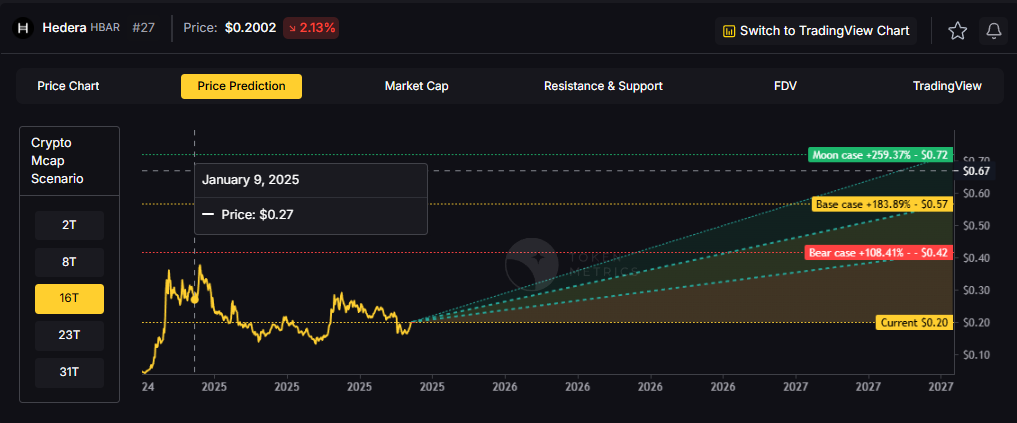
Each band blends cycle analogues and market-cap share math with TA guardrails. Base assumes steady adoption and neutral or positive macro. Moon layers in a liquidity boom. Bear assumes muted flows and tighter liquidity.

TM Agent baseline:

Token Metrics lead metric for Hedera price prediction, cashtag $HBAR, is a TM Grade of 61.8%, which maps to Hold, and the trading signal is bearish, indicating short-term downward momentum. This means Token Metrics views $HBAR as having reasonably solid fundamentals but limited conviction for strong outperformance in the near term.

A concise long-term numeric price prediction view for a 12-month horizon: Token Metrics scenarios center around a range of about $0.06 to $0.18, with a base case price target near $0.10, reflecting steady ecosystem growth, moderate adoption of Hedera services, and continued enterprise partnerships. Implication: if Bitcoin and broader crypto risk appetite improve, $HBAR could revisit the higher end of the price prediction range, while a risk-off market or slower-than-expected developer traction would keep it toward the lower bound.

Token Details

Key Takeaways

  • Scenario driven, outcomes hinge on total crypto market cap, higher liquidity and adoption lift the bands.
  • Single-asset concentration amplifies both upside and downside versus diversified approaches.
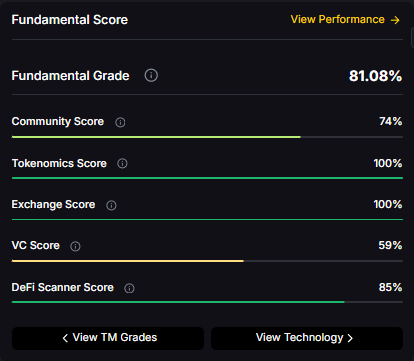
  • Fundamentals: Fundamental Grade 81.08% (Community 74%, Tokenomics 100%, Exchange 100%, VC 59%, DeFi Scanner 85%).
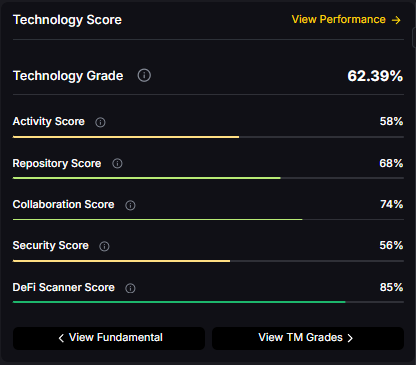
  • Technology: Technology Grade 62.39% (Activity 58%, Repository 68%, Collaboration 74%, Security 56%, DeFi Scanner 85%).
  • TM Agent gist: bearish short term, range view with upside if crypto risk appetite improves.
  • Education only, not financial advice.

Hedera Price Prediction: Scenario Analysis

Token Metrics price prediction scenarios span four market cap tiers, each representing different levels of crypto market maturity and liquidity:

8T Market Cap Price Prediction:

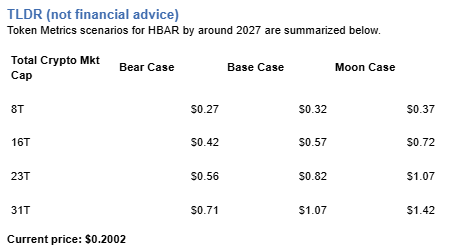
At an 8 trillion dollar total crypto market cap, HBAR price prediction projects to $0.27 in bear conditions, $0.32 in the base case, and $0.37 in bullish scenarios.

16T Market Cap Price Prediction:

Doubling the market to 16 trillion expands the price prediction range to $0.42 (bear), $0.57 (base), and $0.72 (moon).

23T Market Cap Price Prediction:

At 23 trillion, the price forecast scenarios show $0.56, $0.82, and $1.07 respectively.

31T Market Cap Price Prediction:

In the maximum liquidity scenario of 31 trillion, HBAR price prediction could reach $0.71 (bear), $1.07 (base), or $1.42 (moon).

These price prediction ranges illustrate potential outcomes for concentrated HBAR positions, but investors should weigh whether single-asset exposure matches their risk tolerance or whether diversified strategies better suit their objectives.

The Case for Diversified Index Exposure

Professional investors across asset classes prefer diversified exposure over concentrated bets for good reason. Hedera faces numerous risks - technical vulnerabilities, competitive pressure, regulatory targeting, team execution failure - any of which could derail HBAR performance independent of broader market conditions. Token Metrics Indices spread this risk across one hundred tokens, ensuring no single failure destroys your crypto portfolio.

Diversification becomes especially critical in crypto given the sector's nascency and rapid evolution. Technologies and narratives that dominate today may be obsolete within years as the space matures. By holding HBAR exclusively, you're betting not only on crypto succeeding but on Hedera specifically remaining relevant. Index approaches hedge against picking the wrong horse while maintaining full crypto exposure.

Tax efficiency and rebalancing challenges also favor indices over managing concentrated positions. Token Metrics Indices handle portfolio construction, rebalancing, and position sizing systematically, eliminating the emotional and logistical burden of doing this manually with multiple tokens.

Early access to Token Metrics Indices 

What Is Hedera?

Hedera is a high-performance public ledger that emphasizes speed, low fees, and energy efficiency, positioning itself for enterprise and decentralized applications. It uses a unique Hashgraph consensus that enables fast finality and high throughput, paired with a council-governed model that targets real-world use cases like payments, tokenization, and decentralized identity.

HBAR is the native token used for fees, staking, and network security, and it supports smart contracts and decentralized file storage. Adoption draws from partnerships and integrations, though decentralization levels and reliance on institutional demand are often discussed in the community.

Token Metrics AI Analysis for Price Prediction

Token Metrics AI provides comprehensive context on Hedera's positioning and challenges that inform our price prediction models.

  • Vision: Hedera's vision is to provide a secure, fair, and scalable distributed ledger technology platform that supports decentralized applications and enterprise use cases globally. It emphasizes governed decentralization, aiming to combine the benefits of distributed systems with responsible oversight through its council-based governance model.
  • Problem: Many blockchain networks face trade-offs between scalability, security, and decentralization, often resulting in high transaction fees, slow processing times, or environmental concerns. Hedera aims to address these limitations by offering a system that supports high throughput and fast finality without sacrificing security or incurring significant energy costs, making it suitable for both enterprise and decentralized applications.
  • Solution: Hedera uses the Hashgraph consensus algorithm, a directed acyclic graph (DAG)-based approach that achieves asynchronous Byzantine fault tolerance, enabling fast, secure, and fair transaction processing. The network supports smart contracts, tokenization, and decentralized file storage, with HBAR serving as the native token for fees, staking, and network security. Its council-governed model aims to ensure stability and trust, particularly for institutional and enterprise users.
  • Market Analysis: Hedera operates in the Layer 1 blockchain space, competing with high-throughput platforms like Solana, Avalanche, and Algorand, while differentiating through its Hashgraph consensus and governed governance model. It targets enterprise adoption, focusing on use cases in supply chain, payments, and asset tokenization, which sets it apart from more community-driven or DeFi-centric networks. Adoption is influenced by strategic partnerships, developer engagement, and real-world integrations rather than speculative activity. Key risks include competition from established and emerging blockchains, regulatory scrutiny around governance tokens, and challenges in achieving broad decentralization.

Fundamental and Technology Snapshot from Token Metrics

Fundamental Grade: 81.08% (Community 74%, Tokenomics 100%, Exchange 100%, VC 59%, DeFi Scanner 85%).


Technology Grade: 62.39% (Activity 58%, Repository 68%, Collaboration 74%, Security 56%, DeFi Scanner 85%).


Catalysts That Skew Bullish for Price Prediction

  • Institutional and retail access expands with ETFs, listings, and integrations
  • Macro tailwinds from lower real rates and improving liquidity
  • Product or roadmap milestones such as upgrades, scaling, or partnerships
  • These factors could push HBAR toward higher price prediction targets

Risks That Skew Bearish for Price Prediction

  • Macro risk-off from tightening or liquidity shocks
  • Regulatory actions or infrastructure outages
  • Concentration in validator economics and competitive displacement
  • Protocol-specific execution risk and competitive pressure from alternatives
  • These factors could push HBAR toward lower price prediction scenarios

FAQs: Hedera Price Prediction

Can HBAR reach $1.00 according to price predictions?

Yes. Based on the price prediction scenarios, HBAR could reach $1.00 or above in the higher tiers. The 23T tier projects $1.07 in the moon case price forecast and the 31T tier projects $1.42 in the moon case. Achieving this price prediction requires broad market cap expansion and Hedera maintaining competitive position. Not financial advice.

What price could HBAR reach in the moon case price prediction?

Moon case price predictions range from $0.37 at 8T to $1.42 at 31T total crypto market cap. These price prediction scenarios assume maximum liquidity expansion and strong Hedera adoption. Diversified strategies aim to capture upside across multiple tokens rather than betting exclusively on any single moon scenario. Not financial advice.

What's the risk/reward profile for HBAR price prediction?

Risk and reward in our price prediction model span from $0.27 in the lowest bear case to $1.42 in the highest moon case. Downside risks include regulatory or infrastructure setbacks and competitive pressure, while upside drivers include improved liquidity and enterprise adoption. Concentrated positions amplify both tails, while diversified strategies smooth outcomes.

What is the 2027 Hedera price prediction?

Based on Token Metrics analysis, the 2027 price prediction for Hedera centers around $0.10 in the base case under current market conditions, with a range between $0.06 and $0.18 depending on market scenarios. Bullish price predictions range from $0.32 to $1.42 across different total crypto market cap environments.

What drives HBAR price predictions?

HBAR price predictions are driven by enterprise adoption of Hashgraph technology, institutional partnerships (Google Cloud, IBM, Boeing), council governance decisions, and competition from other Layer 1 platforms. The strong fundamentals (81.08% grade) support long-term price potential, though short-term bearish signals suggest caution. Enterprise use case development remains the primary driver for reaching upper price prediction targets.

Can HBAR reach $0.50 by 2027?

According to our price prediction models, HBAR could reach $0.50+ in multiple scenarios: the 16T base case ($0.57), 16T moon case ($0.72), and all higher market cap tiers. This price prediction outcome requires steady crypto market growth (16T+ total market cap) and Hedera maintaining strong enterprise partnerships. Not financial advice.


Next Steps

Disclosure

Educational purposes only, not financial advice. Crypto is volatile, concentration amplifies risk, and diversification is a fundamental principle of prudent portfolio construction. Do your own research and manage risk appropriately.

Research

LEO Token Price Prediction: Comprehensive Market Cap Scenario Analysis

Token Metrics Team
5 min read

LEO Token Price Prediction Framework: Market Cap Scenarios

Exchange tokens derive value from trading volume and platform revenue, creating linkage between crypto market activity and LEO price action. LEO Token delivers utility through reduced trading fees and enhanced platform services on Bitfinex and iFinex across Ethereum and EOS. Token Metrics price prediction scenarios below model LEO outcomes across different total crypto market cap environments, providing investors with data-driven forecasts for strategic decision-making.


Disclosure

Educational purposes only, not financial advice. Crypto is volatile, do your own research and manage risk.

How to Read This LEO Price Prediction

Each band blends cycle analogues and market-cap share math with TA guardrails. Base assumes steady adoption and neutral or positive macro. Moon layers in a liquidity boom. Bear assumes muted flows and tighter liquidity.

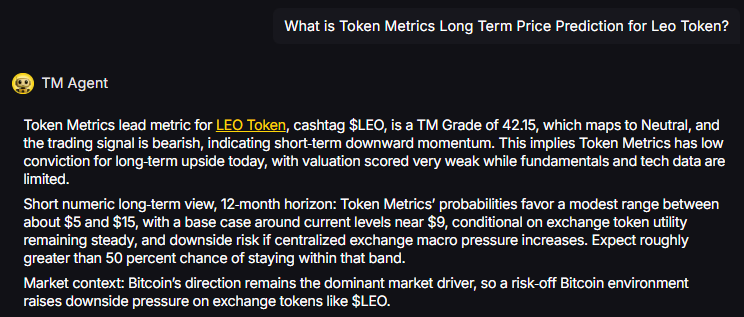
TM Agent baseline: Token Metrics price prediction probabilities favor a modest range between about $5 and $15, with a base case around current levels near $9, conditional on exchange token utility remaining steady, and downside risk if centralized exchange macro pressure increases.

Live details: Token Details 

Key Takeaways

  • Scenario driven, outcomes hinge on total crypto market cap, higher liquidity and adoption lift the bands.
  • TM Agent gist: 12-month horizon favors $5 to $15 range with base case near $9, contingent on stable exchange utility.
  • Education only, not financial advice.

LEO Token Price Prediction Scenario Analysis

Token Metrics price prediction scenarios span four market cap tiers reflecting different crypto market maturity levels:

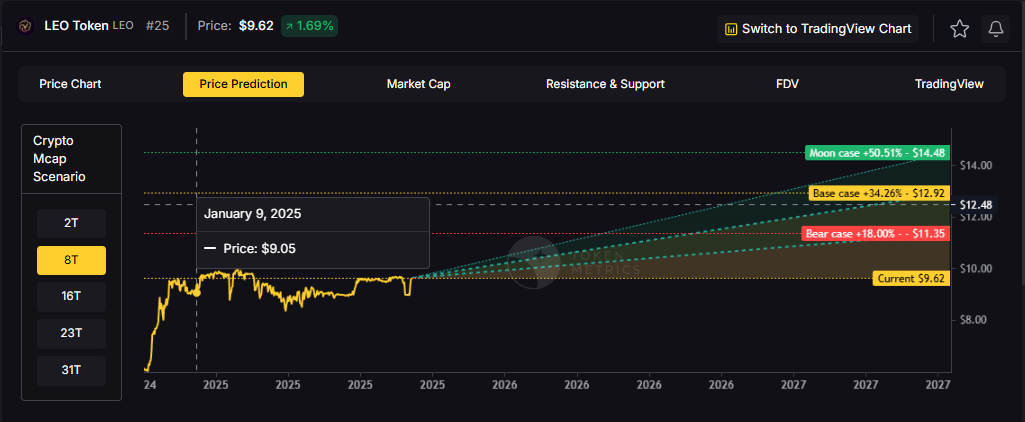
8T Market Cap - LEO Price Prediction:

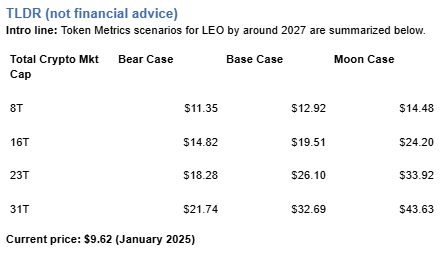
At 8 trillion total crypto market cap, LEO price prediction projects to $11.35 in bear conditions, $12.92 in the base case, and $14.48 in bullish scenarios.

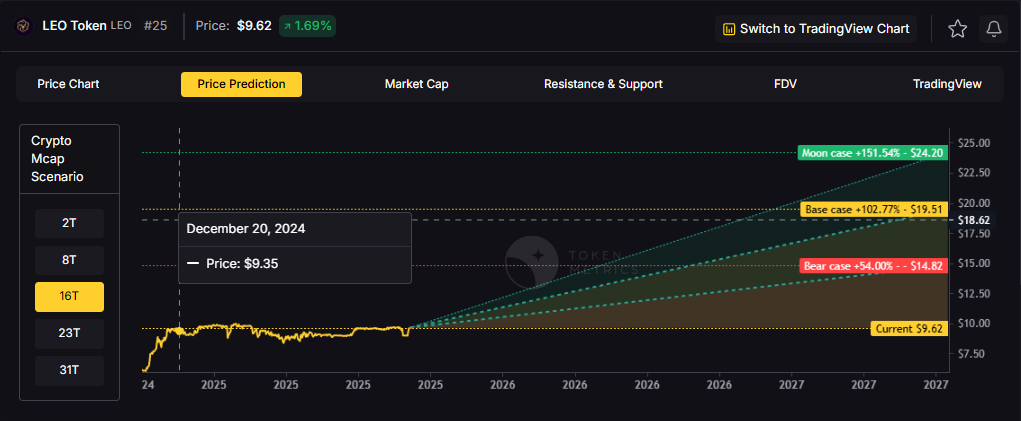
16T Market Cap - LEO Price Prediction:

At 16 trillion total crypto market cap, LEO price prediction projects to $14.82 in bear conditions, $19.51 in the base case, and $24.20 in bullish scenarios.

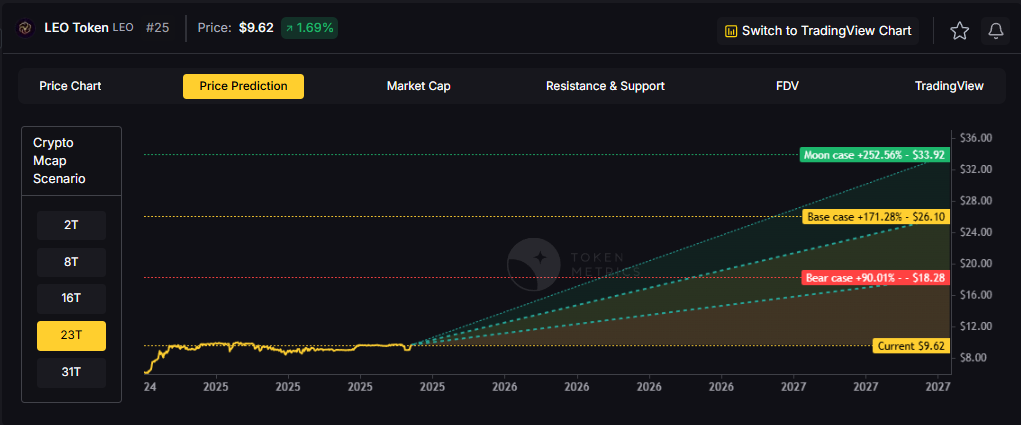
23T Market Cap - LEO Price Prediction:

At 23 trillion total crypto market cap, LEO price prediction projects to $18.28 in bear conditions, $26.10 in the base case, and $33.92 in bullish scenarios.

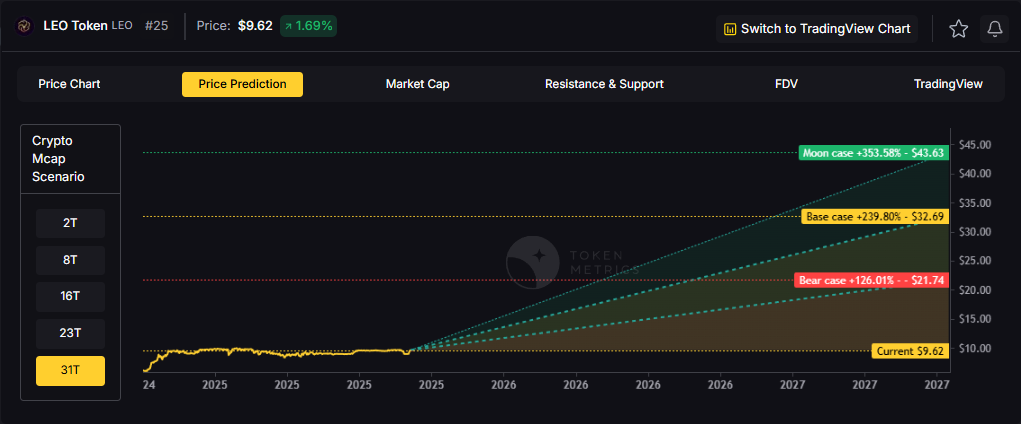
31T Market Cap - LEO Price Prediction:

At 31 trillion total crypto market cap, LEO price prediction projects to $21.74 in bear conditions, $32.69 in the base case, and $43.63 in bullish scenarios.

Each tier in our price prediction framework assumes progressively stronger market conditions, with base scenarios reflecting steady exchange growth and moon cases requiring sustained bull market dynamics.

What Is LEO Token?

LEO Token is the native utility token of the Bitfinex and iFinex ecosystem, designed to provide benefits like reduced trading fees, enhanced lending and borrowing terms, and access to exclusive features on the platform. It operates on both Ethereum (ERC-20) and EOS blockchains, offering flexibility for users.

The primary role of LEO is to serve as a utility token within the exchange ecosystem, enabling fee discounts, participation in token sales, and other platform-specific advantages. Common usage patterns include holding LEO to reduce trading costs and utilizing it for enhanced platform services, positioning it primarily within the exchange token sector.

Catalysts That Skew LEO Price Predictions Bullish

  • Institutional and retail access expands with ETFs, listings, and integrations
  • Macro tailwinds from lower real rates and improving liquidity
  • Product or roadmap milestones such as upgrades, scaling, or partnerships
  • Increased Bitfinex trading volume and platform adoption
  • Strategic token burns and buyback programs

Risks That Skew LEO Price Predictions Bearish

  • Macro risk-off from tightening or liquidity shocks
  • Regulatory actions targeting centralized exchanges or infrastructure outages
  • Concentration risk or competitive displacement from rival exchange tokens
  • Declining exchange market share or trading volume
  • Negative sentiment around centralized exchange tokens

LEO Token Price Prediction FAQs

What gives LEO value?

LEO accrues value through reduced trading fees and enhanced platform services within the Bitfinex and iFinex ecosystem. Demand drivers include exchange usage and access to platform features, while supply dynamics follow the token's exchange utility design. Value realization depends on platform activity and user adoption—key factors in our price prediction methodology.

What price could LEO reach in the moon case?

Our moon case price predictions range from $14.48 at 8T to $43.63 at 31T total crypto market cap. These scenarios require maximum market cap expansion and strong exchange activity. Not financial advice.

What is the LEO Token price prediction for 2025-2027?

Our comprehensive price prediction framework suggests LEO could trade between $5 and $43.63 depending on market conditions and total crypto market capitalization. The base case price prediction scenario clusters around $9 to $32.69 across different market cap environments over the next 12-24 months. Not financial advice.

Can LEO Token reach $20?

Yes. Based on our price prediction scenarios, LEO could reach $19.51 in the 16T base case and surpass $20 in higher market cap scenarios (23T and 31T tiers). The 23T base case projects $26.10, making $20 an achievable target under favorable market conditions. Not financial advice.

Can LEO Token reach $50?

LEO reaching $50 would exceed our current price prediction models' highest scenario of $43.63 (31T moon case). This would require extraordinary market conditions beyond the 31T total crypto market cap tier and exceptional Bitfinex platform growth. Not financial advice.

Is LEO Token a good investment based on price predictions?

LEO's price prediction is tied to Bitfinex exchange performance and utility value. The token offers fee discounts and platform benefits, with moderate growth potential in our base scenarios. However, exchange token valuations carry platform-specific risks. Always conduct your own research and consult financial advisors. Not financial advice.

How accurate are LEO Token price predictions?

Our LEO price predictions use scenario-based modeling across multiple market cap tiers, combining cycle analogues, market-cap share math, and technical analysis guardrails. While this methodology provides structured forecasts, cryptocurrency markets remain highly volatile and unpredictable. Use these price predictions as educational frameworks, not guarantees. Not financial advice.


Next Steps

Curious how these forecasts are made? Token Metrics delivers LEO on-chain grades, forecasts, and deep research on 6,000+ tokens. Instantly compare fundamentals, on-chain scores, and AI-powered predictions.

Disclosure

Educational purposes only, not financial advice. Crypto is volatile, do your own research and manage risk.

Why Use Token Metrics for LEO Price Predictions?

  • Data-driven forecasts: Scenario-based price prediction models across multiple market cap tiers
  • Comprehensive analysis: On-chain metrics, fundamental grades, and technical guardrails
  • AI-powered insights: Advanced algorithms analyze 6,000+ tokens for comparative analysis
  • Regular updates: Real-time price predictions and signals based on market conditions
  • Risk management: Multiple scenarios (bear, base, moon) for informed decision-making
Research

SUI Price Prediction 2027: Layer-1 Portfolio Diversification Analysis

Token Metrics Team
8 min read

Portfolio Context for Sui Price Prediction: Diversification in the 2027 Landscape

Layer 1 tokens like Sui represent bets on specific blockchain architectures winning developer and user mindshare. SUI carries both systematic crypto risk and unsystematic risk from Sui's technical roadmap execution and ecosystem growth. Multi-chain thesis suggests diversifying across several L1s rather than concentrating in one, since predicting which chains will dominate remains difficult.

The SUI price prediction projections below show how SUI might perform under different market cap scenarios. While Sui may have strong fundamentals, prudent portfolio construction balances L1 exposure across Ethereum, competing smart contract platforms, and Bitcoin to capture the sector without overexposure to any single chain's fate.


Disclosure

Educational purposes only, not financial advice. Crypto is volatile, do your own research and manage risk.

How to Read This SUI Price Prediction Framework

Each band blends cycle analogues and market-cap share math with TA guardrails. Base assumes steady adoption and neutral or positive macro. Moon layers in a liquidity boom. Bear assumes muted flows and tighter liquidity.

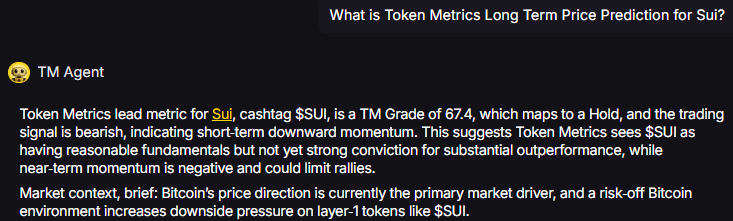
TM Agent baseline: Token Metrics lead metric for Sui, cashtag $SUI, is a TM Grade of 67.4%, which maps to a Hold, and the trading signal is bearish, indicating short-term downward momentum. This suggests Token Metrics sees $SUI as having reasonable fundamentals but not yet strong conviction for substantial outperformance in our price prediction models, while near-term momentum is negative and could limit rallies. Market context, brief: Bitcoin's price direction is currently the primary market driver, and a risk-off Bitcoin environment increases downside pressure on layer-1 tokens like $SUI.

Token Details 

The Case for Diversified Index Exposure

Professional investors across asset classes prefer diversified exposure over concentrated bets for good reason. Sui faces numerous risks—technical vulnerabilities, competitive pressure, regulatory targeting, team execution failure—any of which could derail SUI price prediction performance independent of broader market conditions. Token Metrics Indices spread this risk across one hundred tokens, ensuring no single failure destroys your crypto portfolio.

Diversification becomes especially critical in crypto given the sector's nascency and rapid evolution. Technologies and narratives that dominate today may be obsolete within years as the space matures. By holding SUI exclusively, you're betting not only on crypto succeeding but on Sui specifically remaining relevant. Index approaches hedge against picking the wrong horse while maintaining full crypto exposure.

Early access to Token Metrics Indices

Key Takeaways: SUI Price Prediction Summary

  • Scenario driven: Price prediction outcomes hinge on total crypto market cap; higher liquidity and adoption lift the bands
  • Single-asset concentration: Amplifies both upside and downside versus diversified approaches
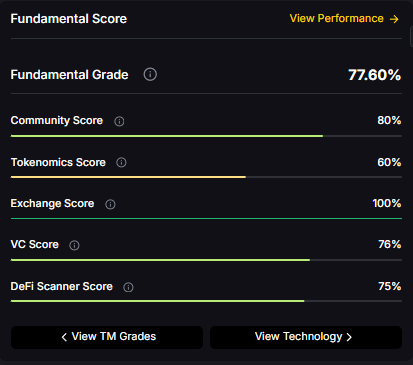
  • Fundamentals: Fundamental Grade 77.60% (Community 80%, Tokenomics 60%, Exchange 100%, VC 76%, DeFi Scanner 75%)
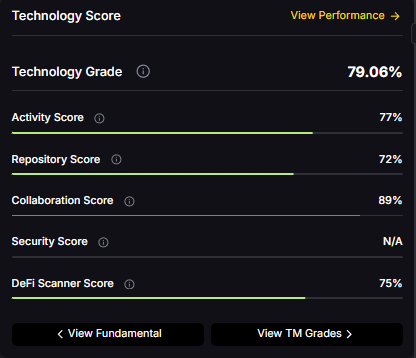
  • Technology: Technology Grade 79.06% (Activity 77%, Repository 72%, Collaboration 89%, Security N/A, DeFi Scanner 75%)
  • TM Agent gist: Hold grade, bearish trading signal, near-term negative momentum in price prediction models
  • Education only, not financial advice

SUI Price Prediction Scenario Analysis

Token Metrics price prediction scenarios span four market cap tiers, each representing different levels of crypto market maturity and liquidity:

8T Market Cap - SUI Price Prediction:

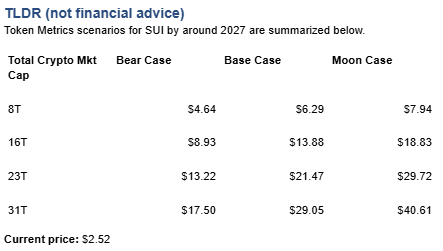
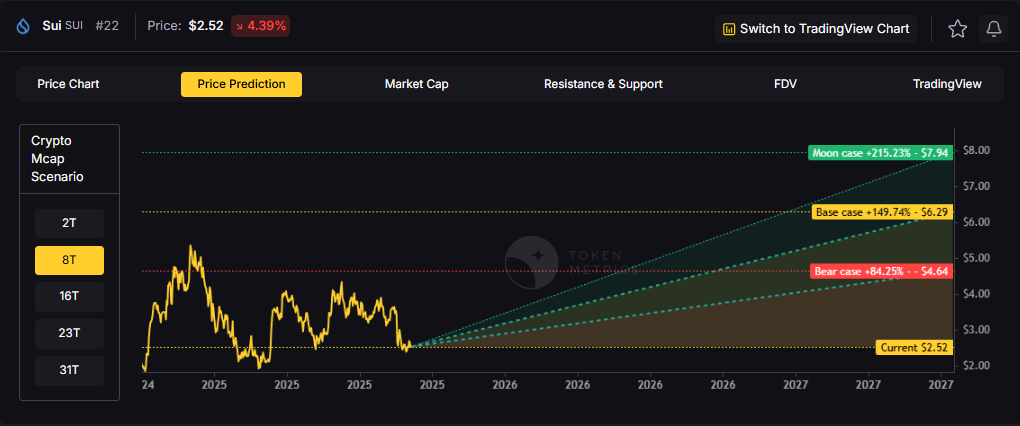
At an 8 trillion total crypto market cap, SUI price prediction projects to $4.64 in bear conditions, $6.29 in the base case, and $7.94 in bullish scenarios.

16T Market Cap - SUI Price Prediction:

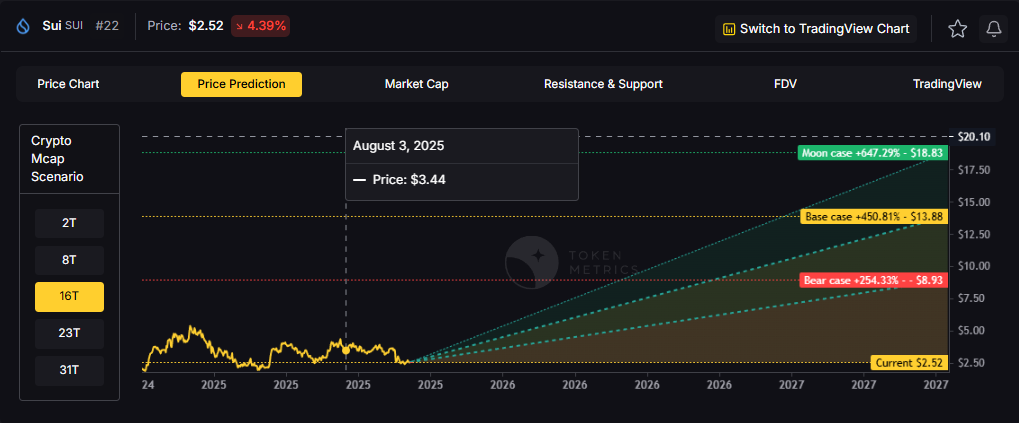
At a 16 trillion total crypto market cap, SUI price prediction projects to $8.93 in bear conditions, $13.88 in the base case, and $18.83 in bullish scenarios.

23T Market Cap - SUI Price Prediction:

At a 23 trillion total crypto market cap, SUI price prediction projects to $13.22 in bear conditions, $21.47 in the base case, and $29.72 in bullish scenarios.

31T Market Cap - SUI Price Prediction:

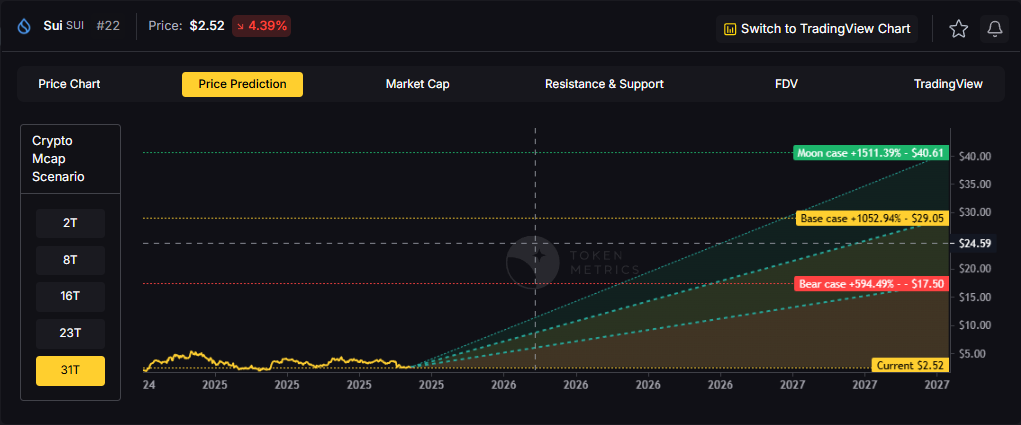
At a 31 trillion total crypto market cap, SUI price prediction projects to $17.50 in bear conditions, $29.05 in the base case, and $40.61 in bullish scenarios.

These price prediction ranges illustrate potential outcomes for concentrated SUI positions, but investors should weigh whether single-asset exposure matches their risk tolerance or whether diversified strategies better suit their objectives.

What Is Sui?

Sui is a layer-1 blockchain network designed for general-purpose smart contracts and scalable user experiences. It targets high throughput and fast settlement, aiming to support applications that need low-latency interactions and horizontal scaling.

SUI is the native token used for transaction fees and staking, aligning validator incentives and securing the network. It underpins activity across common crypto sectors such as NFTs and DeFi while the ecosystem builds developer tooling and integrations.

Token Metrics AI Analysis

Token Metrics AI provides comprehensive context informing our SUI price prediction models:

Vision: Sui aims to create a highly scalable and low-latency blockchain platform that enables seamless user experiences for decentralized applications. Its vision centers on making blockchain technology accessible and efficient for mainstream applications by removing traditional bottlenecks in transaction speed and cost.

Problem: Many existing blockchains face trade-offs between scalability, security, and decentralization, often resulting in high fees and slow transaction finality during peak usage. This limits their effectiveness for applications requiring instant settlement, frequent interactions, or large user bases, such as games or social platforms. Sui addresses the need for a network that can scale horizontally without sacrificing speed or cost-efficiency.

Solution: Sui uses a unique object-centric blockchain model and the Move programming language to enable parallel transaction processing, allowing high throughput and instant finality for many operations. Its consensus mechanism, Narwhal and Tusk, is optimized for speed and scalability by decoupling transaction dissemination from ordering. The network supports smart contracts, NFTs, and decentralized applications, with an emphasis on developer ease and user experience. Staking is available for network security, aligning with common proof-of-stake utility patterns.

Market Analysis: Sui competes in the layer-1 blockchain space with platforms like Solana, Avalanche, and Aptos, all targeting high-performance decentralized applications. It differentiates itself through its object-based data model and parallel execution, aiming for superior scalability in specific workloads. Adoption drivers include developer tooling, ecosystem incentives, and integration with wallets and decentralized exchanges. The broader market for high-throughput blockchains is driven by demand for scalable Web3 applications, though it faces risks from technical complexity, regulatory uncertainty, and intense competition—all critical factors in our price prediction analysis.

Fundamental and Technology Snapshot from Token Metrics

Fundamental Grade: 77.60% (Community 80%, Tokenomics 60%, Exchange 100%, VC 76%, DeFi Scanner 75%).


Technology Grade: 79.06% (Activity 77%, Repository 72%, Collaboration 89%, Security N/A, DeFi Scanner 75%).


Catalysts That Skew SUI Price Predictions Bullish

  • Institutional and retail access expands with ETFs, listings, and integrations
  • Macro tailwinds from lower real rates and improving liquidity
  • Product or roadmap milestones such as upgrades, scaling, or partnerships
  • Growing developer ecosystem and dApp adoption
  • Strategic partnerships with major Web3 platforms

Risks That Skew SUI Price Predictions Bearish

  • Macro risk-off from tightening or liquidity shocks
  • Regulatory actions or infrastructure outages
  • Concentration or validator economics and competitive displacement
  • Protocol-specific execution risk and competitive pressure from alternatives
  • Technical vulnerabilities or smart contract exploits

How Token Metrics Can Help

Token Metrics empowers you to analyze Sui and hundreds of digital assets with AI-driven ratings, on-chain and fundamental data, and index solutions to manage portfolio risk smartly in a rapidly evolving crypto market. Our price prediction frameworks provide scenario-based analysis to inform your investment decisions.

SUI Price Prediction FAQs

What price could SUI reach in the moon case?

Our moon case price predictions range from $7.94 at 8T to $40.61 at 31T total crypto market cap. These scenarios assume maximum liquidity expansion and strong Sui adoption. Diversified strategies aim to capture upside across multiple tokens rather than betting exclusively on any single moon scenario. Not financial advice.

What is the SUI price prediction for 2025-2027?

Our comprehensive SUI price prediction framework suggests SUI could trade between $4.64 and $40.61 depending on market conditions and total crypto market capitalization. The base case price prediction scenario clusters around $6.29 to $29.05 across different market cap environments. Current TM Grade of 67.4% indicates a Hold rating with bearish near-term momentum. Not financial advice.

Can SUI reach $20?

Yes. Based on our price prediction scenarios, SUI could reach $21.47 in the 23T base case and $18.83 in the 16T moon case. The price target of $20 becomes achievable in moderate to high market cap environments with steady ecosystem growth. Not financial advice.

Can SUI reach $50?

SUI reaching $50 would exceed our current price prediction models' highest scenario of $40.61 (31T moon case). This would require extraordinary market conditions beyond the 31T total crypto market cap tier, exceptional ecosystem adoption, and SUI capturing significant market share from competing L1s. Not financial advice.

What's the risk/reward profile for SUI?

Our SUI price prediction risk/reward spans from $4.64 to $40.61 across all scenarios. Downside risks include regulatory pressure and competitive displacement, while upside drivers include ecosystem growth and favorable liquidity. Concentrated positions amplify both tails, while diversified strategies smooth outcomes and reduce single-asset risk.

What are the biggest risks to SUI price predictions?

Key risks that could impact SUI price predictions include regulatory actions, technical issues, competitive pressure from other L1s (Solana, Avalanche, Aptos), adverse market liquidity, validator centralization concerns, and execution challenges. Concentrated SUI positions magnify exposure to these risks. Diversified strategies spread risk across tokens with different profiles, reducing portfolio vulnerability to any single failure point.

Is SUI a good investment based on price predictions?

SUI shows solid fundamentals (77.60% grade) and technology scores (79.06% grade), but currently has a Hold rating (67.4% TM Grade) with bearish near-term trading signals. While our price prediction models show potential upside in favorable market conditions, the bearish momentum and L1 competition suggest a cautious approach. Consider diversified exposure rather than concentrated positions. Not financial advice.

How does SUI compare to other L1 price predictions?

SUI competes with Solana, Avalanche, and Aptos in the high-performance L1 space. Our price prediction framework suggests SUI's performance will correlate with broader L1 adoption trends while facing differentiation challenges. Diversified L1 exposure through indices may offer better risk-adjusted returns than concentrated SUI positions, as predicting which specific L1 will dominate remains uncertain.


Next Steps

Disclosure
Educational purposes only, not financial advice. Crypto is volatile, concentration amplifies risk, and diversification is a fundamental principle of prudent portfolio construction. Do your own research and manage risk appropriately.

Why Use Token Metrics for SUI Price Predictions?

  • Scenario-based modeling: Multiple market cap tiers for comprehensive price prediction analysis
  • AI-driven analysis: Fundamental (77.60%) and technology (79.06%) grades for informed decisions
  • Risk management tools: Index solutions to diversify L1 exposure beyond single-asset concentration
  • Real-time signals: Trading signals and TM Grades updated regularly
  • Comparative analysis: Analyze SUI against 6,000+ tokens for portfolio optimization
Choose from Platinum, Gold, and Silver packages
Reach with 25–30% open rates and 0.5–1% CTR
Craft your own custom ad—from banners to tailored copy
Perfect for Crypto Exchanges, SaaS Tools, DeFi, and AI Products