Back to blog
Research

Cryptocurrency Price Predictions and Forecasts for 2025: A Deep Dive with Token Metrics AI 📈

Explore BTC, ETH, XRP, ADA, and DOGE price predictions for 2025–2026. Learn how Token Metrics’ AI-driven tools help you forecast, trade, and reduce risk with unmatched precision.
Token Metrics Team
8 min
Want Smarter Crypto Picks—Free?
See unbiased Token Metrics Ratings for BTC, ETH, and top alts.
Thank you! Your submission has been received!
Oops! Something went wrong while submitting the form.
 No credit card | 1-click unsubscribe

In mid‑2025, the crypto market is surging. Bitcoin (BTC) has blasted past $118,000, Ethereum (ETH) is over $3,000, and altcoins like XRP, ADA, and DOGE are back in focus. There’s one source powering many traders’ forecasts: Token Metrics, a leading AI‑driven crypto research and prediction platform. This extensive 1500‑word guide takes you through price forecasts, key drivers, risks, and how Token Metrics helps you stay ahead.

🌕 Why the 2025 Bull Market Is Different

Before the altcoin specifics, it’s crucial to note that many digital assets are moving in tandem with Bitcoin. Token Metrics issued a bullish signal on Bitcoin on June 28, which quickly propelled BTC past the $110,000 resistance—a breakthrough that underscores fresh institutional momentum and on‑chain supply dynamics.

🔥 Bitcoin Price Prediction: $150,000–$230,000 Range

Key Drivers

  • Institutional inflows: Billions pouring into spot Bitcoin ETFs; BlackRock, Fidelity, and others now hold substantial crypto exposure.
  • Policy support: U.S. lawmakers are openly discussing Bitcoin as a reserve asset.
  • Supply squeeze: Exchange‑wallet BTC reserves fell from 3.25 million to 2.55 million.
  • Macroeconomic tailwinds: Weakening U.S. dollar, escalating trade tensions, and rising geopolitical uncertainty.
  • On‑chain momentum: Token Metrics’ data shows continued accumulation, confirmed by the bullish signal.

Risks

  • Geopolitical shocks: Israel–Iran tensions remain volatile.
  • Climate concerns: PoW energy debate resurfaces, especially with Bitcoin’s carbon footprint.
  • Regulation risk: Varying crypto frameworks globally could dampen institutional participation.

Forecast

Token Metrics predicts $150,000–$230,000 range by 2026, averaging around $190,000, based on its AI model factoring in ETF flows, macro sentiment, and supply‑side trends.

🌐 Ethereum Price Prediction: $5,000–$10,000

Key Growth Levers

  1. Pectra upgrade: Targets scalability improvements and L2 ecosystems.
  2. ETH ETF AUM: Reached $12 billion, showing institutional appetite.
  3. DeFi ecosystem strength: TVL remains high at $72.64 billion.
  4. Layer‑2 adoption: Optimism, Arbitrum, Base, and zkSync are expanding, reducing fees and increasing usage.

Risks

  • Competition: High‑performance chains like Solana are drawing developer interest.
  • Gas spikes: Usage surges may spike transaction fees, limiting adoption.
  • Regulatory clarity: Ongoing debates over securities definitions could incite volatility.

Forecast

If Bitcoin stays strong, Token Metrics forecasts ETH testing $5,000 to $10,000 by year‑end.

  • Breakout level: Above $4,000 confirms bullish cycle.
  • Support to watch: A drop below $2,500 could signal correction.

💧 XRP Price Prediction: $5–$10

Catalysts

  • SEC settlement: XRP cleared a landmark lawsuit (paid $50M), restoring regulatory confidence.
  • RLUSD stablecoin launch: Strengthens institutional appeal and liquidity.
  • High ETF odds: 90%+ probability of XRP ETF approval by 2025.
  • Global use: Ripple’s network includes 300+ institutions (e.g., Santander); Wormhole integration adds cross‑chain utility.

Risks

  • Regulatory grayness: Other regions, like EU and UK, still establish XRP rulings.
  • Stablecoin competition: USDT, USDC, and SWIFT‑like networks remain XRP competitors.

Forecast

Bullish scenario: $5–$7 before year‑end, boosting to $10 if Bitcoin remains strong and the bullish momentum holds.

  • Key breakout: Above $3.40 signals new ATH;
  • Support level: $2.10 pivotal for pullbacks.

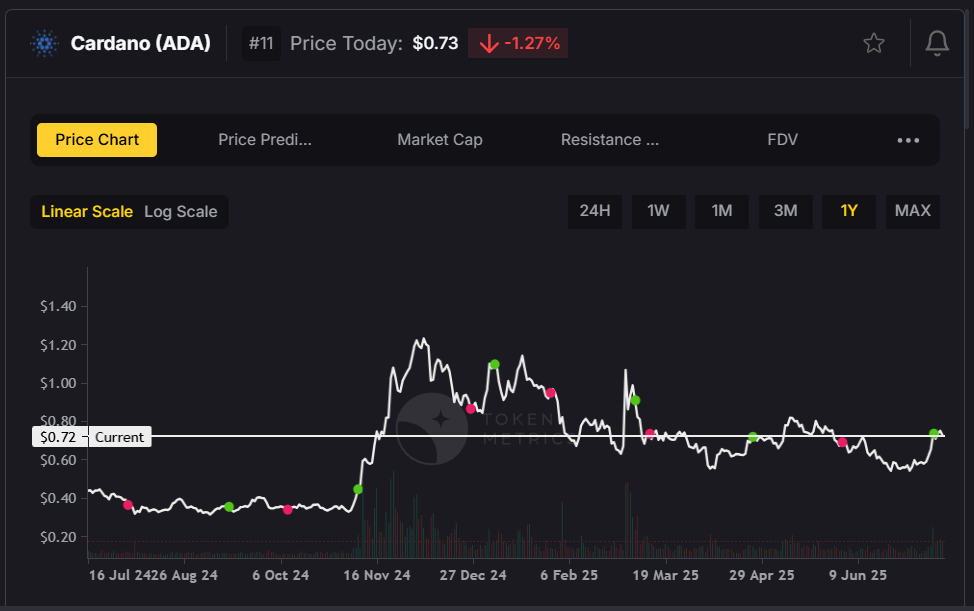
⛓️ Cardano (ADA) Price Prediction: $1.10–$1.65
Catalysts

  1. Plomin Hard Fork (Q1 2025): Boosted on‑chain governance and network evolution.
  2. DeFi TVL: Up 21% since April due to growth in Minswap, Indigo, Liqwid.
  3. Stablecoin integration: RLUSD project could pave the way for more stablecoin‑based protocols on ADA.
  4. Institutional inflows: ~$73M flowed into ADA YTD.
  5. ETF potential: Analysts give ADA a 75% chance of ETF approval.

Risks

  • Low network activity: Only ~30,000 daily users vs high user chains.
  • Steep competition: Ethereum and Solana dominate developers and liquidity.

Forecast

If ADA breaks $0.80, Token Metrics predicts $1.10–$1.65 by year‑end. Key zones:

  • Breakout: $0.80
  • Support: $0.62–$0.50

🐕 Dogecoin (DOGE) Price Prediction: $0.55–$1.25

Catalysts

  1. $0.20 resistance test: Strong on‑chain technical pattern, including golden cross.
  2. Merchant adoption: DOGE accepted by Tesla (Musk’s online store), SpaceX merch, and others via the America Party.
  3. Elon Musk tweets: His social momentum drives new cycles.
  4. ETF speculation: Analysts foresee a 65%+ chance of a DOGE ETF in 2025.
  5. Whale builds: Major accumulation since March, exchange reserves declining.

Risks

  • Infinite supply: Annual inflation compresses long‑term value.
  • Meme volatility: Highly sentiment‑driven and prone to sharp crashes, especially if Bitcoin corrects.

Forecast

  • Conservative: $0.55
  • Moderate: $1.07
  • Bullish if ETF buzz peaks: $1.25, especially if Bitcoin holds $150K.
  • Critical support: $0.15
  • Sell‑off trigger: Failure at $0.20.

🧠 The Token Metrics AI Advantage

With predictions like this, it’s essential to choose a research tool that delivers accuracy, objectivity, and automation. Token Metrics ticks every box:

1. Signal-Driven Forecasts

  • AI detected BTC signal on June 28 instead of endlessly lagging on charts.
  • Real-time ETH, XRP, ADA, DOGE buy/sell signals help traders time entries precisely.

2. Accuracy-Ranked Grades

  • Each token is assigned a Trader Grade (short‑term outlook) and an Investor Grade (long‑term fundamentals), using 80+ metrics.
  • Daily updates keep grades current and aligned with market shifts.

3. AI-Powered Price Predictions

  • Models incorporate on‑chain indicators, macro factors, whale activity, and ETF flows to generate multi‑year forecasts grounded in data.
  • Multi-currency, multi-metric predictive modeling is unlikely replicated in any other platform.

4. Moonshots & Altcoin Discoveries

  • Token Metrics highlights low‑cap picks ready to capture momentum during bull runs.
  • Includes live ROI tracking and swap integration for execution directly from the platform.

5. Data Visualization & Alerts

  • Custom dashboards show price, grade, TVL, exchange flow, whale builds, and social volume.
  • Alerts via Telegram, Slack, Discord, or email ensure you never miss critical moves or signals.

6. API & MCP Server

  • Developers can use Token Metrics’ Multi‑Client Protocol to integrate into OpenAI Agents, IDEs, slide tools, and backtesting bots—all with consistent data across platforms.

🔒 Strategy Guide for Institutional & Retail Investors

▶️ Entry Criteria

  • Watch Token Metrics signals: If crypto1 go bullish, adjacently pump patterns follow.

  • Confirm breakouts at critical resistance levels:

    • BTC: >$118K
    • ETH: >$4K
    • XRP: >$3.40
    • ADA: >$0.80
    • DOGE: >$0.20

📌 Holding Strategy

  • Use Trader Grades to decide short-term holding periods.
  • Switch to Investor Grades for swing or long-term positions.
  • Track DeFi TVL, staking, and bullish fundamentals.

📉 Risk Management

  • Set alerts for bearish signals or grade downgrades.
  • Use stop‑losses near key support:

    • BTC: $90K
    • ETH: $2.5K
    • XRP: $2.10
    • ADA: $0.62
    • DOGE: $0.15

📈 Scaling Approach

  • If forecasts hit 50% of target, take partial profits.
  • Let the rest ride on break‑out confirmation signals.

🔁 Summary Table: 2025 Price Predictions

✅ The Takeaway: Trade Smarter with AI, Not Emotion

We're witnessing one of the most powerful crypto bull cycles since 2021. Institutional capital, macro turbulence, and smart contract expansion are fueling gains across the board.

But this isn't about blind optimism—it's about precision entry, objective signals, and dynamic portfolio management.

That’s why Token Metrics stands out. Its AI forecasting platform offers tools that help investors:

  • Navigate evolving market cycles
  • Forecast realistic price targets
  • Catch altcoin breakouts
  • Mitigate risk with data‑driven signals
  • Stay long-term aligned through governance, DeFi, and macro roots

Get Started with Token Metrics Today

Whether you're trading Bitcoin, Ethereum, or altcoins, Token Metrics equips you with tools to stay ahead. From real‑time signals, AI-predicted price targets, and custom alerts, to developer‑grade APIs, Token Metrics delivers a comprehensive crypto edge.

👉 Sign up now and level‑up your crypto portfolio strategy: tokenmetrics.com

Build Smarter Crypto Apps &
AI Agents in Minutes, Not Months
Real-time prices, trading signals, and on-chain insights all from one powerful API.
Grab a Free API Key
About Token Metrics
Token Metrics: AI-powered crypto research and ratings platform. We help investors make smarter decisions with unbiased Token Metrics Ratings, on-chain analytics, and editor-curated “Top 10” guides. Our platform distills thousands of data points into clear scores, trends, and alerts you can act on.
30 Employees
analysts, data scientists, and crypto engineers
Daily Briefings
concise market insights and “Top Picks”
Transparent & Compliant
Sponsored ≠ Ratings; research remains independent
Want Smarter Crypto Picks—Free?
See unbiased Token Metrics Ratings for BTC, ETH, and top alts.
Thank you! Your submission has been received!
Oops! Something went wrong while submitting the form.
 No credit card | 1-click unsubscribe
Token Metrics Team
Token Metrics Team

Recent Posts

Research

Choosing the Best API for Institutional Crypto Analytics

Token Metrics Team
6

In today’s rapidly evolving digital asset landscape, institutions require access to secure, fast, and reliable analytics. The right application programming interface (API) can determine how effectively asset managers, risk teams, and research desks process vast volumes of crypto data. While hundreds of APIs claim to deliver comprehensive analytics, only a select few offer the depth, infrastructure, and granularity needed for institutional decision-making. So, how do you identify which API is best for institutional-level crypto analytics?

Key Institutional Requirements for Crypto Analytics APIs

Institutions face unique analytics needs compared to retail participants. Core requirements cut across:


The ideal API brings together standardized endpoints, dedicated support, and tooling to enable advanced research, risk, and portfolio management functions.

Overview of Leading APIs for Institutional Crypto Analytics

Let’s explore some of the leading contenders in the market based on institutional needs:


While each API has unique strengths, the best fit depends on the institution’s specific research and operational objectives.

Framework for Comparing Crypto Analytics APIs

Given the diversity of provider offerings, institutions benefit from a structured evaluation approach:


Using this checklist, decision makers can align their analytics strategy and tooling to their mandate—be it portfolio monitoring, alpha research, or risk mitigation.

AI’s Impact on Institutional Crypto Analytics APIs

Recent advances in AI and machine learning have transformed how institutions derive insights from crypto markets:


For institutional users, the fusion of traditional data feeds with AI-driven signals accelerates research cycles, strengthens automation, and supports more granular risk monitoring.

Practical Steps for Integrating Institutional Crypto Analytics APIs

Once the API shortlist is narrowed, institutions should:


Thoughtful integration enables institutions to maximize analytical rigor, improve operational efficiency, and streamline research and trading workflows.

Build Smarter Crypto Apps & AI Agents with Token Metrics

Token Metrics provides real-time prices, trading signals, and on-chain insights all from one powerful API. Grab a Free API Key

FAQ: Institutional Crypto Analytics APIs

What distinguishes a top-tier crypto analytics API for institutions?

Top APIs offer comprehensive high-frequency data, robust uptime, on-chain analytics, and customizable endpoints. They support integration with institutional systems and provide enterprise-level security and support.

Why are on-chain analytics important for institutional investors?

On-chain analytics reveal trends in wallet activity, fund flows, and network health. These insights can help with compliance monitoring, risk assessment, and understanding macro shifts in crypto markets.

How does AI enhance the value of a crypto analytics API?

AI-driven APIs can automate data aggregation, deliver predictive signals, analyze sentiment, and help institutions uncover hidden patterns—enhancing research speed and accuracy.

What sets the Token Metrics API apart from competitors?

The Token Metrics API blends multi-source price, on-chain, and sentiment data with AI-powered analytics for actionable signals, supporting sophisticated institutional workflows.

What challenges might institutions face when integrating crypto analytics APIs?

Key challenges may include harmonizing data formats, managing API limits, ensuring security compliance, and aligning external feeds with internal data pipelines and tools.

Disclaimer

This blog is for informational and educational purposes only. It does not constitute financial, investment, or legal advice. No warranties or endorsements of any API provider, platform, or service, including Token Metrics, are implied. Always conduct your own due diligence before integrating any data tool or service.

Research

Integrating Crypto APIs with Google Sheets and Excel: A Complete Guide

Token Metrics Team
7

Staying on top of cryptocurrency markets often means harnessing real-time data and powerful analytics. For anyone seeking transparency and automation in tracking digital assets, connecting a crypto API directly to Google Sheets or Excel can transform your workflow. But how does the process actually work, and what are the best practices? Let’s break down the essential steps and considerations for integrating crypto APIs with your favorite spreadsheets, optimizing your data analysis, and ensuring reliability and security.

Choosing the Right Crypto API

The first step is selecting a crypto API suited to your needs. APIs are digital interfaces that let apps and platforms request data from cryptocurrency exchanges or analytics providers. Popular APIs deliver live prices, on-chain data, market caps, historical charts, and blockchain analytics.

  • Open vs. Restricted APIs: Some APIs are public and free; others require API keys and may have rate or usage limits.
  • Data Types: Consider if you need real-time price feeds, historical OHLCV data, on-chain analytics, or sentiment analysis.
  • Reliability & Security: Well-established APIs should offer robust documentation, strong uptime records, and clear usage policies.
  • Compliance: Ensure you use APIs that are legally authorized to distribute the type of crypto data you seek.

Examples of reputable APIs include Token Metrics, CoinGecko, CoinMarketCap, Binance, and CryptoCompare. Some, like Token Metrics, also offer AI-driven insights and advanced analytics for deeper research.

How to Connect a Crypto API to Google Sheets

Google Sheets offers flexibility for live crypto data tracking, especially with tools like Apps Script and the IMPORTDATA or IMPORTJSON custom functions. Here’s a general approach:

  1. Obtain Your API Endpoint and Key: Sign up for your preferred API (such as Token Metrics) and copy your endpoint URL and API key credentials.
  2. Install or Set Up Importer: For public APIs returning CSV data, use =IMPORTDATA(“URL”) directly in a cell. For JSON APIs (the vast majority), you’ll likely need to add a custom Apps Script function like IMPORTJSON or use third-party add-ons such as API Connector.
  3. Write the Script or Formula: In Apps Script, create a function that fetches and parses the JSON data, handling your API key in the request headers if needed.
  4. Display and Format: Run your script or enter your formula (e.g., =IMPORTJSON("https://api.tokenmetrics.com/v1/prices?symbol=BTC", "/price", "noHeaders")). Crypto data will update automatically based on your refresh schedule or script triggers.
  5. Automation & Limits: Be aware of Google’s rate limits and your API plan’s quota; set triggers thoughtfully to avoid errors or blocking.

Sample Apps Script for a GET request might look like:

function GETCRYPTO(url) {
  var response = UrlFetchApp.fetch(url);
  var json = response.getContentText();
  var data = JSON.parse(json);
  return data.price;
}

Change the URL as needed for your API endpoint and required parameters.

How to Connect a Crypto API to Excel

Microsoft Excel supports API integrations using built-in tools like Power Query (Get & Transform) and VBA scripting. Here is how you can set up a connection:

  1. Fetch the API Endpoint and Key: Obtain the endpoint and authorize via headers or parameters as your API documentation describes.
  2. Use Power Query: In Excel, go to Data > Get Data > From Other Sources > From Web. Enter the API URL, set HTTP method (typically GET), and configure authentication, if needed.
  3. Parse JSON/CSV: Power Query will ingest the JSON or CSV. Use its UI to navigate, transform, and load only the fields or tables you need (like price, symbol, or market cap).
  4. Refresh Data: When finished, click Load to bring dynamic crypto data into your spreadsheet. Setup refresh schedules as needed for real-time or periodic updates.
  5. Advanced Automation: For customized workflows (like triggered refreshes or response handling), leverage Excel’s scripting tools or Office Scripts in cloud-based Excel.

Note that Excel’s query limits and performance may vary depending on frequency, the amount of retrieved data, and your version (cloud vs desktop).

Best Practices and Use Cases for Crypto API Data in Spreadsheets

Why use a crypto API in your spreadsheet at all? Here are common scenarios and tips you should consider:

  • Portfolio Tracking: Dynamically update positions, track P/L, and rebalance based on real-time prices.
  • Market & Sentiment Analysis: Import on-chain or social sentiment metrics for enhanced research (available from providers like Token Metrics).
  • Historical Analysis: Pull historical OHLCV for custom charting and volatility tracking.
  • Custom Alerts or Dashboarding: Build automated alerts using conditional formatting or macros if price triggers or portfolio thresholds are breached.
  • Audit and Compliance: Keep timestamped logs or export data snapshots for reporting/transparency needs.

Security Tip: Always keep API keys secure and avoid sharing spreadsheet templates publicly if they contain credentials. Use environment variables or Google Apps Script’s Properties Service for added safety.

Troubleshooting, Rate Limits, and Common Pitfalls

Although spreadsheet integration is powerful, some challenges are common:

  • Rate Limits: Both Google Sheets/Excel and your crypto API will have tiered usage limits—avoid setting updates more frequently than permitted to prevent service interruptions.
  • Parsing Errors: Double-check API documentation for exact JSON/CSV field names required by your formulas or scripts.
  • Data Freshness: Sheet refreshes may lag a few minutes, so always verify the update interval matches your analysis needs.
  • Authentication Issues: If data fails to load, ensure API keys and headers are handled correctly and privileges have not recently changed.
  • Spreadsheet Bloat: Very large data pulls can slow down your spreadsheet—filter or limit queries to only what you truly need.

When in doubt, consult your API provider’s resource or developer documentation for troubleshooting tips and best practices.

Build Smarter Crypto Apps & AI Agents with Token Metrics

Token Metrics provides real-time prices, trading signals, and on-chain insights all from one powerful API. Grab a Free API Key

FAQ: Connecting Crypto APIs to Google Sheets or Excel

Do I need programming knowledge to connect a crypto API?

Basic integrations, like using APIs that return CSV files, can often work without code via built-in data import features. For JSON APIs or custom data endpoints, familiarity with Apps Script (Google Sheets) or Power Query (Excel) is helpful but not strictly required, especially if you use add-ons like API Connector or plug-and-play solutions.

What types of crypto data can I import into spreadsheets?

Supported APIs offer a variety of data: live spot prices, historical price series, market capitalization, volume, on-chain metrics, sentiment scores, and more. The exact data fields depend on each API’s offering and the available endpoints.

How should I keep my API key secure in a spreadsheet?

Never embed plain text API keys in shared or public spreadsheets. In Google Sheets, use script properties or protected ranges; in Excel, store keys locally or use encrypted variables if automating. Always follow your provider’s credential management guidelines.

How frequently does spreadsheet crypto data refresh with APIs?

Refresh frequency depends on your integration setup. Google Sheets custom scripts or add-ons can update as often as every few minutes, subject to service and API rate limits. Excel’s Power Query typically updates manually or based on scheduled refresh intervals you define.

What’s the best crypto API for Google Sheets or Excel?

Choice depends on use case and data depth. Token Metrics is notable for real-time prices, AI-powered analytics, and robust developer support. Other popular choices are CoinGecko, CoinMarketCap, and exchange-specific APIs. Always compare data coverage, reliability, security, and documentation.

Disclaimer

This article is for educational and informational purposes only. It does not constitute financial, legal, or investment advice. Always follow best practices for security and usage when working with APIs and spreadsheets.

Research

How Crypto APIs Power NFT and DeFi Data for Developers

Token Metrics Team
6

The explosion of NFT and DeFi applications has dramatically increased demand for reliable blockchain data. Developers and analysts seeking to build innovative crypto projects often ask: do crypto APIs provide data for NFTs and DeFi protocols—and if so, how can this fuel smarter apps and insights?

What Are Crypto APIs and Why Are They Important?

A crypto API (Application Programming Interface) is a set of endpoints and protocols that connect applications to blockchain networks or data aggregators. Instead of directly querying nodes or parsing blocks, developers can access a stream of blockchain-related data in real time via these APIs.

APIs abstract away the technical complexity of on-chain data, providing accessible methods for retrieving token prices, wallet balances, transaction histories, smart contract events, NFT metadata, and DeFi protocol information. This simplifies everything from price tracking to building sophisticated crypto apps and analytics dashboards.

Accurate, up-to-date blockchain data is the foundation for researching NFT projects, assessing DeFi protocol health, and even powering AI agents tasked with blockchain tasks. Leading crypto APIs provide developers with high-level access, so they can focus on building features instead of managing blockchain infrastructure.

NFT Data Accessible Through Crypto APIs

Non-fungible tokens (NFTs) have unique data structures, including metadata, ownership history, royalty rules, and underlying assets. Many modern crypto APIs cater to NFT-specific data retrieval, facilitating applications like NFT wallets, galleries, marketplaces, and analytics platforms.

  • Ownership & provenance: APIs can fetch real-time and historical information about who owns a given NFT, how ownership has changed, and related on-chain transactions.
  • Metadata and imagery: Developers retrieve NFT metadata (e.g., images, attributes) directly from smart contracts or token URIs, often with additional caching for speed.
  • Marketplace integration: Some APIs aggregate current and past prices, listing details, and sales volumes from top NFT marketplaces.
  • Activity monitoring: Event endpoints allow tracking of NFT mints, transfers, and burns across chains.

Popular NFT API providers—such as OpenSea API, Alchemy, Moralis, and Token Metrics—differ in their supported blockchains, rate limits, and depth of metadata. When selecting a crypto API for NFTs, compare which standards are supported (ERC-721, ERC-1155, etc.), ease of integration, and the richness of returned data.

How Crypto APIs Handle DeFi Protocol and Market Data

Decentralized finance (DeFi) relies on composable smart contracts driving lending, trading, yield farming, liquid staking, and more. Accessing accurate, real-time DeFi data—such as TVL (total value locked), pool balances, lending/borrowing rates, or DEX trade history—is critical for both app builders and researchers.

Leading crypto APIs now offer endpoints dedicated to:

  • Protocol statistics: TVL figures, liquidity pool compositions, APYs, token emissions, and reward calculations.
  • Real-time DeFi prices: AMM pool prices, slippage estimates, and historical trade data across major DEXes and aggregators.
  • On-chain governance: Information about DeFi protocol proposals, votes, and upgrade histories.
  • User positions: Individual wallet interactions with DeFi protocols (e.g., collateral, borrowings, farming positions).

APIs such as DeFi Llama, Covalent, and Token Metrics provide advanced DeFi analytics and are popular among platforms that track yields, compare protocols, or automate investment analyses (without providing investment advice). Evaluate the update frequency, supported chains, and the granularity of metrics before integrating a DeFi data API.

Key Benefits and Limitations of Using APIs for NFT and DeFi Data

APIs offer significant advantages for NFT and DeFi development:

  • Rapid access to up-to-date blockchain information
  • Abstraction from blockchain-specific quirks and node maintenance
  • Ready-to-integrate endpoints for user-facing dashboards or backend analytics
  • Support for multi-chain or cross-standard data in a unified interface

However, there are trade-offs:

  • Rate limiting can throttle large-scale data pulls.
  • Data freshness may lag behind direct node access on some platforms.
  • APIs sometimes lack coverage for emerging standards or new protocols.

Choosing the right API for NFTs or DeFi often means balancing coverage, performance, cost, and community support. For applications that require the most recent or comprehensive data, combining multiple APIs or supplementing with direct on-chain queries might be needed. Developers should review documentation and test endpoints with sample queries before full integration.

Real-World Use Cases: NFT and DeFi Applications Powered by APIs

Several innovative crypto products rely on powerful APIs to fetch and process NFT and DeFi data:

  • Portfolio dashboards: Aggregating NFT holdings, DeFi investments, token balances, and performance metrics into a single user interface.
  • Market analytics tools: Analyzing trends in NFT sales, DeFi protocol growth, or liquidity volatility across multiple chains and protocols.
  • AI-driven agents: Enabling bots that track NFT listings, monitor DeFi yields, or automate position rebalancing using real-time data streams (without human input).
  • Compliance and reporting systems: Automatically tracking on-chain ownership, yields, or trade histories for tax and regulatory requirements.

Whether for wallet apps, analytical dashboards, or next-gen AI-driven crypto agents, high-quality data APIs serve as the backbone for reliable and scalable blockchain solutions.

Build Smarter Crypto Apps & AI Agents with Token Metrics

Token Metrics provides real-time prices, trading signals, and on-chain insights all from one powerful API. Grab a Free API Key

FAQ

Can I get NFT metadata using crypto APIs?

Yes, most reputable crypto APIs allow you to retrieve NFT metadata, including images, attributes, and collection information, typically by querying token contract addresses and token IDs.

Which DeFi protocols are supported by mainstream APIs?

Coverage varies, but leading APIs often support Uniswap, Aave, Compound, Curve, MakerDAO, and other top DeFi protocols on Ethereum and other blockchains. Always check API documentation for a full, updated list.

Do crypto APIs support multichain NFT and DeFi data?

Many APIs now offer multi-chain support, enabling data retrieval across Ethereum, Polygon, BNB Chain, Avalanche, and other major ecosystems for both NFTs and DeFi activity.

What should I consider when choosing an NFT or DeFi API?

Key factors include supported blockchains and standards, data freshness, endpoint reliability, documentation quality, pricing, and limits on API calls. Community trust and support are also important.

How do APIs differ from blockchain node access?

APIs abstract away protocol complexity, offering simplified data endpoints, caching, and error handling, while direct node access requires technical setup but can provide lower-latency data and broader customization.

Disclaimer

This article is for informational and educational purposes only. It does not constitute investment advice, an offer, recommendation, or solicitation. Please conduct your own research and seek professional advice where appropriate.

Choose from Platinum, Gold, and Silver packages
Reach with 25–30% open rates and 0.5–1% CTR
Craft your own custom ad—from banners to tailored copy
Perfect for Crypto Exchanges, SaaS Tools, DeFi, and AI Products