Back to blog
Research

Dogecoin Price Prediction 2026: Meme Coin Bull Market Analysis

Actionable Dogecoin price prediction with scenario math, on-chain grades, and a clear TLDR for investors looking at 2027.
Token Metrics Team
6 min read
Want Smarter Crypto Picks—Free?
See unbiased Token Metrics Ratings for BTC, ETH, and top alts.
Thank you! Your submission has been received!
Oops! Something went wrong while submitting the form.
 No credit card | 1-click unsubscribe

Why 2026 Looks Bullish for Dogecoin Price Prediction: Market Context

Crypto is transitioning into a broadly bullish regime into 2026 as liquidity improves and adoption deepens.

Regulatory clarity is reshaping the classic four-year cycle, flows can arrive earlier and persist longer as institutions gain confidence. Access and infrastructure continue to mature with ETFs, qualified custody, and faster L2 scaling that reduce frictions for new capital. Real-world integrations expand the surface area for crypto utility, which supports sustained participation across market phases.

This bullish backdrop frames our Dogecoin price prediction scenario work for DOGE. The bands below reflect different total market sizes and DOGE's share dynamics across varying liquidity conditions, providing comprehensive price prediction analysis for investors.


How to Read This DOGE Price Prediction

Each band blends cycle analogues and market-cap share math with TA guardrails. Base assumes steady adoption and neutral or positive macro. Moon layers in a liquidity boom. Bear assumes muted flows and tighter liquidity.

TM Agent baseline: Token Metrics lead metric, TM Grade, is 22.65 (Sell), and the trading signal is bearish, indicating short-term downward momentum. Price context: $DOGE is trading around $0.193, rank #9, down about 3.1% in 24 hours and roughly 16% over 30 days. Implication: upside in our price prediction models likely requires a broader risk-on environment and renewed retail or celebrity-driven interest.

Live details: Dogecoin Token Details → https://app.tokenmetrics.com/en/dogecoin

Buy DOGE

Key Takeaways: Dogecoin Price Prediction Summary

  • Scenario driven: Price prediction outcomes hinge on total crypto market cap; higher liquidity and adoption lift the bands
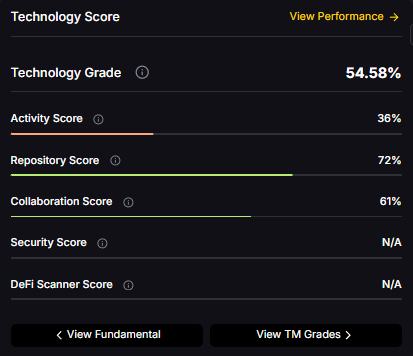
  • Technology: Technology Grade 54.58% (Activity 36%, Repository 72%, Collaboration 61%, Security N/A, DeFi Scanner N/A)
  • TM Agent gist: Cautious long-term stance in price prediction models until grades and momentum improve
  • Current rating: Sell (22.65) despite bullish 2026 macro backdrop
  • Meme coin dynamics: Celebrity influence and retail sentiment drive price prediction volatility
  • Education only, not financial advice

Dogecoin Price Prediction Scenario Analysis

Token Metrics price prediction scenarios span four market cap tiers, each representing different levels of crypto market maturity and liquidity:

8T Market Cap - DOGE Price Prediction:

At an 8 trillion dollar total crypto market cap, our DOGE price prediction framework projects specific targets in bear, base, and bullish scenarios. The 8T tier reflects conservative market conditions with modest meme coin participation.

16T Market Cap - DOGE Price Prediction:

Doubling the market to 16 trillion expands the DOGE price prediction range significantly, reflecting increased retail participation and potential celebrity-driven catalysts that historically benefit Dogecoin.
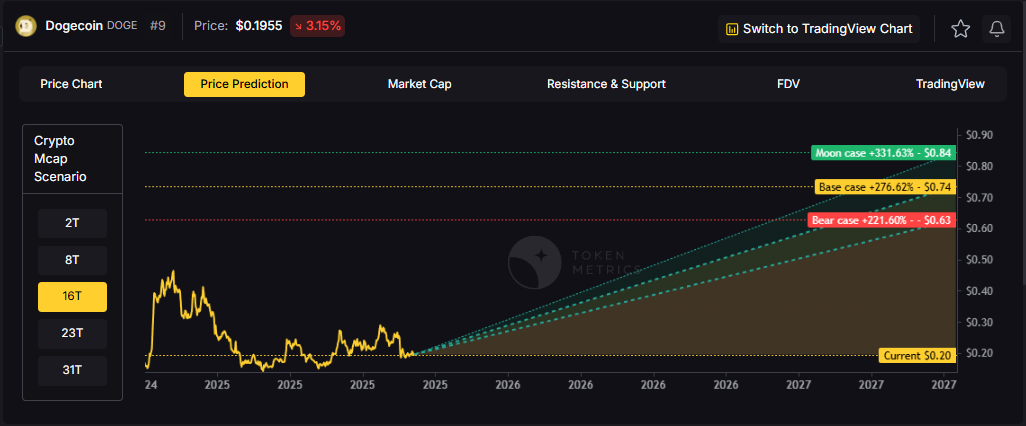
16T Market Cap - DOGE Price Prediction:

Doubling the market to 16 trillion expands the DOGE price prediction range significantly, reflecting increased retail participation and potential celebrity-driven catalysts that historically benefit Dogecoin.
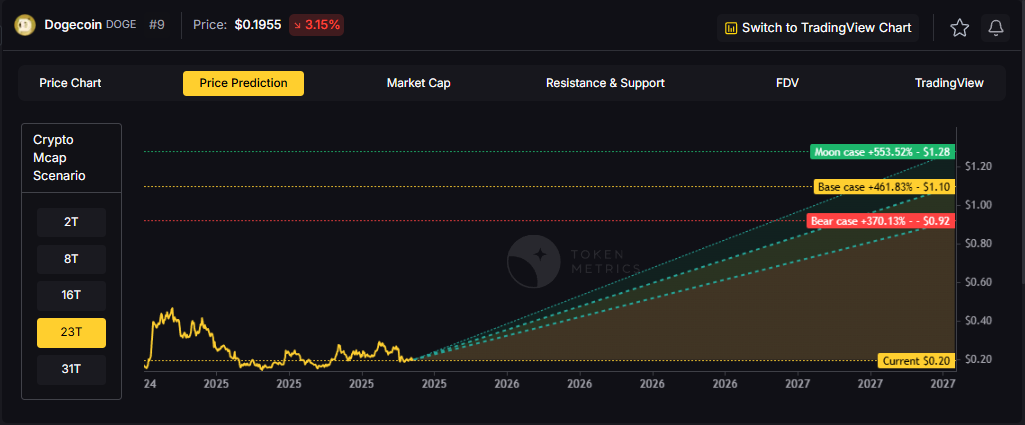
 31T Market Cap - DOGE Price Prediction:

In the maximum liquidity scenario of 31 trillion, DOGE price predictions reach their highest potential across all scenarios (bear, base, and moon), with all three bands projecting levels above $1.00 according to our framework.

 Each tier in our price prediction framework assumes progressively stronger market conditions, with particular emphasis on retail-driven liquidity and social media sentiment that uniquely impacts meme coin valuations.

Why Consider the Indices with Top-100 Exposure

Diversification matters. Dogecoin is compelling, yet concentrated bets can be volatile—especially for meme coins where price predictions are heavily influenced by sentiment. Token Metrics Indices hold DOGE alongside the top one hundred tokens for broad exposure to leaders and emerging winners.

Our backtests indicate that owning the full market with diversified indices has historically outperformed both the total market and Bitcoin in many regimes due to diversification and rotation benefits, reducing single-asset risk inherent in meme coin price predictions.

Get early access

What Is Dogecoin?

Dogecoin is a peer-to-peer cryptocurrency that began as a meme but has evolved into a widely recognized digital asset used for tipping, payments, and community-driven initiatives. It runs on its own blockchain with inflationary supply mechanics. The token's liquidity and brand awareness create periodic speculative cycles, especially during broad risk-on phases—all critical factors influencing DOGE price predictions.

Technology Snapshot from Token Metrics

Technology Grade: 54.58% (Activity 36%, Repository 72%, Collaboration 61%, Security N/A, DeFi Scanner N/A).
 

Catalysts That Skew DOGE Price Predictions Bullish

  • Institutional and retail access expands with ETFs, listings, and integrations
  • Macro tailwinds from lower real rates and improving liquidity expected in 2026
  • Product or roadmap milestones such as upgrades, scaling, or partnerships
  • Celebrity endorsements or social media viral moments (Elon Musk effect)
  • Retail FOMO during bull market phases
  • Payment adoption and merchant acceptance expansion
  • Meme coin narrative strength during risk-on sentiment

Risks That Skew DOGE Price Predictions Bearish

  • Macro risk-off from tightening or liquidity shocks
  • Regulatory actions targeting meme coins or infrastructure outages
  • Current Sell rating (22.65) indicating weak fundamentals
  • Low technology grade (54.58%) and minimal development activity (36%)
  • Lack of utility compared to smart contract platforms
  • Inflationary supply mechanics creating selling pressure
  • Celebrity sentiment shifts or negative social media attention
  • Competition from newer meme coins capturing retail interest

Special Offer — Token Metrics Advanced Plan with 20% Off

Unlock platform-wide intelligence on every major crypto asset. Use code ADVANCED20 at checkout for twenty percent off.

  • AI powered ratings on thousands of tokens for traders and investors
  • Interactive TM AI Agent to ask any crypto question
  • Indices explorer to surface promising tokens and diversified baskets
  • Signal dashboards, backtests, and historical performance views
  • Watchlists, alerts, and portfolio tools to track what matters
  • Early feature access and enhanced research coverage

Start with Advanced today

Dogecoin Price Prediction FAQs

Can DOGE reach $1.00?

Yes. Multiple tiers in our price prediction framework imply levels above $1.00 by the 2027 horizon, including the 23T Base case and all 31T scenarios (bear, base, and moon). However, achieving this requires the bullish 2026 thesis materializing with strong retail participation and favorable macro conditions. Despite the Sell rating (22.65), the $1 psychological level remains achievable in higher liquidity environments. Not financial advice.

Is DOGE a good long-term investment?

DOGE presents a high-risk, high-volatility investment case with a Sell rating (22.65) and modest technology grade (54.58%). Our price prediction models show potential upside in bullish scenarios, but the outcome depends heavily on adoption, liquidity regime, celebrity influence, retail sentiment, and supply dynamics. Meme coins lack fundamental utility of smart contract platforms, making them speculative plays. Diversify and size positions responsibly. Not financial advice.

What is the Dogecoin price prediction for 2026-2027?

Our comprehensive DOGE price prediction framework for 2026-2027 suggests Dogecoin could reach significant levels depending on total crypto market capitalization, with the 23T and 31T scenarios projecting above $1.00 across multiple bands. Current price of $0.193 implies substantial upside potential (400%+ gains to $1) if bullish 2026 conditions materialize. However, the Sell rating (22.65) reflects concerns about fundamentals and current bearish momentum. Not financial advice.

Can DOGE reach $10?

DOGE reaching $10 would require extraordinary market conditions and market capitalization exceeding most realistic scenarios in our price prediction models. At current supply levels, $10 DOGE would imply a market cap surpassing major corporations. While our 31T moon scenarios show substantial upside, $10 appears beyond rational price prediction frameworks without significant supply changes or unprecedented retail mania. Not financial advice.

Should I buy DOGE now or wait?

DOGE has a Sell rating (22.65) indicating Token Metrics does not currently endorse Dogecoin at these levels, despite bullish 2026 macro thesis. Current price of $0.193 is down 16% over 30 days with bearish trading signals. However, if you believe in the 2026 bull market thesis and meme coin comeback, dollar-cost averaging may reduce timing risk. Meme coins are highly speculative—size positions accordingly and consider diversified exposure through indices. Not financial advice.

Why does DOGE have a Sell rating despite bullish 2026 outlook?

DOGE receives a Sell rating (22.65) due to weak fundamentals, modest technology grade (54.58%), low development activity (36%), and current bearish momentum—despite the broader bullish 2026 macro thesis. Our price prediction framework shows potential upside in favorable liquidity scenarios, but ratings reflect current conditions and fundamental quality rather than just market sentiment. The rating suggests caution even in bullish environments. Not financial advice.

How does DOGE compare to other meme coin price predictions?

Dogecoin remains the original and most established meme coin with superior liquidity, exchange listings, and brand recognition versus competitors like Shiba Inu or PEPE. Our price prediction framework suggests DOGE could exceed $1.00 in 23T+ scenarios. However, the Sell rating (22.65) reflects that even among meme coins, DOGE's low technology grade (54.58%) and minimal development activity create concerns. First-mover advantage matters, but newer meme coins may offer higher risk-adjusted returns.

What role do celebrities play in DOGE price predictions?

Celebrity influence—particularly from Elon Musk—significantly impacts Dogecoin price predictions and has historically driven major rallies. Our bullish 2026 scenarios assume potential for renewed celebrity-driven interest during risk-on phases. However, this creates unpredictable volatility that price prediction models struggle to capture. The Sell rating (22.65) reflects concerns that celebrity sentiment alone cannot sustain long-term value without fundamental improvements. Not financial advice.

Can DOGE benefit from the 2026 bull market?

Yes. Our price prediction scenarios are specifically framed around the bullish 2026 thesis, where improving liquidity, institutional participation, and retail FOMO create favorable conditions for meme coins. DOGE's brand recognition and top-10 ranking position it to capture bull market momentum. However, the Sell rating (22.65) and low technology grade (54.58%) suggest DOGE may underperform versus utility tokens. Meme coins tend to outperform in late-stage bull markets driven by retail speculation. Not financial advice.

What are the biggest risks to DOGE price predictions?

Key risks that could derail Dogecoin price predictions include: current Sell rating (22.65) indicating weak fundamentals, low technology grade (54.58%) and minimal development activity (36%), inflationary supply creating perpetual selling pressure, lack of utility versus smart contract platforms, regulatory targeting of meme coins, negative celebrity sentiment shifts, competition from newer meme coins, macro liquidity shocks ending the 2026 bull thesis, and excessive speculation leading to retail exhaustion. Not financial advice.

Will DOGE hit $1 in 2026?

Our price prediction framework suggests DOGE reaching $1.00 is achievable in the 23T base case and all 31T scenarios (bear, base, moon), which could materialize in the bullish 2026-2027 environment. From current price of $0.193, this represents approximately 400%+ gains. However, achieving this requires sustained macro liquidity, retail participation, positive celebrity sentiment, and overcoming the current Sell rating (22.65) concerns. Possible but not guaranteed—manage expectations accordingly. Not financial advice.

How accurate are Dogecoin price predictions?

Dogecoin price predictions are particularly challenging due to meme coin volatility, celebrity influence unpredictability, and sentiment-driven price action that doesn't follow traditional fundamental analysis. Our scenario-based framework provides structured projections across multiple market cap tiers, but actual outcomes may vary significantly. The Sell rating (22.65) and low technology grade (54.58%) suggest fundamental weaknesses that could limit upside regardless of market conditions. Use price predictions as educational frameworks, not guarantees. Not financial advice.

‍

Next Steps

• Track live grades and signals: Token Details
• Join Indices Early Access
• Want exposure Buy DOGE on MEXC

Disclosure

Educational purposes only, not financial advice. Crypto is volatile, do your own research and manage risk.

Why Use Token Metrics for DOGE Price Predictions?

  • Bullish 2026 framework: Specialized analysis of improving macro conditions favoring meme coins
  • Scenario-based modeling: Four market cap tiers for comprehensive price prediction analysis
  • Honest ratings: Sell (22.65) transparency despite bullish market thesis
  • Meme coin specialization: Understanding sentiment-driven price action and celebrity influence
  • Risk management: Indices for diversified exposure beyond single meme coin concentration
  • Real-time signals: Trading signals and TM Grades updated regularly
  • Comparative analysis: Analyze DOGE against SHIB, PEPE, and 6,000+ tokens
Build Smarter Crypto Apps &
AI Agents in Minutes, Not Months
Real-time prices, trading signals, and on-chain insights all from one powerful API.
Grab a Free API Key
About Token Metrics
Token Metrics: AI-powered crypto research and ratings platform. We help investors make smarter decisions with unbiased Token Metrics Ratings, on-chain analytics, and editor-curated “Top 10” guides. Our platform distills thousands of data points into clear scores, trends, and alerts you can act on.
30 Employees
analysts, data scientists, and crypto engineers
Daily Briefings
concise market insights and “Top Picks”
Transparent & Compliant
Sponsored ≠ Ratings; research remains independent
Want Smarter Crypto Picks—Free?
See unbiased Token Metrics Ratings for BTC, ETH, and top alts.
Thank you! Your submission has been received!
Oops! Something went wrong while submitting the form.
 No credit card | 1-click unsubscribe
Token Metrics Team
Token Metrics Team

Recent Posts

Research

What's the Future of Tokenized Real Estate? Market Analysis & Predictions (2025)

Token Metrics Team
10 min read

The real estate industry is on the cusp of a transformative revolution, arguably the most significant since the advent of Real Estate Investment Trusts (REITs). At the heart of this change is tokenized real estate—an innovative approach that converts physical property ownership into blockchain-based digital tokens. This breakthrough is reshaping how investors access, trade, and profit from one of the largest asset classes globally. With projections indicating that the tokenized real estate market could surge from $3.5 billion in 2024 to an astounding $4 trillion by 2035, understanding what's the future of tokenized real estate is essential for investors seeking to stay ahead in the evolving landscape of property investment.

The Explosive Growth Trajectory

The growth trajectory of tokenized real estate is nothing short of remarkable. Industry analyses forecast that the global real estate tokenization market will expand at a compound annual growth rate (CAGR) of 21% from 2024 through 2033, climbing from $3.5 billion to $19.4 billion within that period. Even more optimistic projections by Deloitte suggest this market could reach $4 trillion by 2035, reflecting a CAGR of 27%. By 2030, tokenized real estate is expected to account for approximately 15% of all real estate assets under management worldwide. Far from being a niche experiment, tokenized real estate is rapidly becoming a mainstream investment vehicle. This growth is democratizing access to real estate—a sector traditionally dominated by high net worth individuals and institutional investors—by enabling broader participation through digital tokens and fractional ownership.

Why Tokenization Is Reshaping Real Estate Investment

Breaking Down Barriers to Entry

Traditional real estate investment has long been characterized by substantial capital requirements, illiquidity, and complex transaction processes. These factors have often excluded retail investors and smaller participants from meaningful property ownership. However, real estate tokenization platforms are radically altering this dynamic by enabling investors to buy fractional ownership in rental properties and commercial space with minimal capital—sometimes as low as $50.

This fractional ownership model empowers investors to diversify their real estate portfolios across multiple properties, geographic regions, and asset classes without the traditional burden of substantial minimum investment requirements. Instead of concentrating substantial capital in one or two physical assets, investors can now build balanced real estate portfolios, mitigating risk and enhancing potential returns.

Solving the Liquidity Problem

One of the most significant challenges in traditional property investment has been illiquidity. Selling physical property often involves lengthy processes, high transaction costs, and regulatory hurdles, making real estate a relatively illiquid asset class. Tokenized real estate addresses this by transforming property ownership into digital tokens that can be traded on secondary markets.

Though liquidity in tokenized real estate is still maturing compared to traditional financial instruments, platforms such as RealT and Lofty have pioneered 24/7 secondary market trading for tokenized properties. This development provides investors with unprecedented flexibility, allowing them to buy and sell fractional real estate interests more efficiently and with reduced transaction costs.

Operational Efficiency and Cost Reduction

Tokenization leverages blockchain technology and smart contracts to streamline the operational aspects of real estate investing. By automating processes such as dividend distributions, ownership transfers, and compliance checks, tokenization reduces reliance on intermediaries like brokers and escrow agents. This automation not only cuts administrative expenses but also expedites settlement times, enhancing overall market efficiency.

Smart contracts—self-executing agreements encoded on the blockchain—play a critical role in this transformation. They ensure transparency, enforce contractual terms automatically, and minimize human error, thereby fostering greater trust and reducing the risk of disputes in property transactions.

Institutional Adoption Drives Mainstream Acceptance

The transition of tokenized real estate from an experimental concept to mainstream investment is being propelled by significant institutional adoption. As of mid-2024, approximately 12% of real estate firms globally have integrated tokenization solutions into their operations, while another 46% are actively piloting such programs. This widespread interest signals a growing commitment by major financial institutions, asset managers, and real estate firms to embrace tokenization infrastructure.

Investor sentiment further underscores this trend, with projections indicating that institutional investors may allocate between 7% and 9% of their portfolios to tokenized assets by 2027. Notable initiatives, such as Kin Capital’s $100 million real estate debt fund launched on blockchain platforms, demonstrate that tokenized real estate is expanding beyond residential properties into commercial real estate and sophisticated financial instruments.

The Technology Infrastructure Evolving Rapidly

Platform Proliferation

The technological backbone supporting tokenized real estate is evolving at a rapid pace. In 2023 alone, the number of real estate tokenization platforms worldwide surged by 75%, reflecting growing demand and innovation. Various blockchain networks—including Ethereum, Solana, Tezos, and specialized real estate blockchains—are competing to become the preferred infrastructure for asset tokenization.

These platforms not only facilitate the creation and management of digital tokens representing real estate assets but also provide tools for investor onboarding, compliance, and secondary market trading, enhancing both accessibility and security.

Regulatory Frameworks Maturing

A critical factor influencing the future of tokenized real estate is the maturation of the regulatory landscape. Historically, regulatory uncertainty has hindered widespread adoption, as jurisdictions grappled with classifying digital tokens and defining legal frameworks for asset tokenization. However, 2025 marks a turning point. The European Union’s Markets in Crypto-Assets (MiCA) regulation offers clear guidelines for tokenized assets, providing a more predictable environment for investors and issuers. Similarly, jurisdictions such as Dubai, Singapore, and Luxembourg are establishing dedicated regulatory frameworks tailored to real estate tokenization, balancing investor protection with innovation. These regulatory advances are essential for fostering investor confidence, ensuring market integrity, and enabling institutional investors to participate more fully in tokenized real estate investments.

Navigating the Challenges Ahead

Liquidity Still Developing

While tokenized real estate improves liquidity relative to traditional property investment, secondary markets remain fragmented. Tokens are often traded primarily within the platforms where they were issued, limiting liquidity and investor reach. Additionally, bid-ask spreads can be wide for less popular tokenized properties, affecting pricing efficiency.

Efforts to enhance token interoperability across different blockchains and integrate tokenized assets with traditional financial systems are underway but have yet to achieve mainstream adoption.

Regulatory Complexity

The evolving legal landscape presents compliance challenges, especially for platforms operating across multiple jurisdictions with varying rules regarding blockchain, securities, and property ownership. This regulatory patchwork can restrict the geographic availability of tokenized real estate offerings and complicate cross-border transactions.

Technology and Security Risks

Tokenized real estate relies heavily on blockchain technology and smart contracts, which are not immune to vulnerabilities. Smart contract bugs, network outages, and cybersecurity threats pose risks to investor capital and market confidence. Robust security measures, comprehensive insurance products, and diligent due diligence are vital to mitigate these risks.

Valuation Challenges

Accurately valuing tokenized real estate assets remains complex, particularly in volatile markets. The real-time pricing enabled by tokenization introduces new dynamics that differ from traditional real estate valuation methods. Investors must adapt their risk management and investment strategies to account for these fluctuations.

Discover Crypto Gems with Token Metrics AI

Token Metrics uses AI-powered analysis to help you uncover profitable opportunities in the crypto market. Get Started For Free

The Future Landscape: What to Expect

Integration with DeFi Ecosystems

The future of tokenized real estate includes deeper integration with decentralized finance (DeFi) protocols. Property tokens will increasingly serve as collateral for loans, be incorporated into yield-generating strategies, or be bundled into structured financial products. This composability unlocks new investment possibilities and enhances capital efficiency.

Sustainability and ESG Tracking

Blockchain’s transparency enables real-time monitoring of environmental, social, and governance (ESG) metrics for properties. Investors focused on sustainable and socially responsible investments can verify ESG claims on-chain, directing capital toward green buildings and socially beneficial developments.

Global Market Access

Tokenized real estate dissolves geographic barriers, allowing investors from Tokyo to own fractions of properties in New York, London, or Dubai simultaneously. This global access facilitates diversification across markets and currencies, previously unattainable for many retail investors.

NFT Integration

Non-fungible tokens (NFTs) are expanding beyond digital art into real estate applications. Properties linked with digital NFTs have experienced a 30% increase in customer inquiries, and by 2025, it is estimated that 20% of real estate transactions may involve NFTs. This integration creates innovative engagement models and novel investment opportunities.

Positioning for the Tokenization Wave

The future of tokenized real estate is not a distant speculation—it is unfolding now. With market sizes projected to range from $3 trillion to $13 trillion over the next decade, this represents one of the most significant wealth creation opportunities in modern financial history.

To position oneself successfully in this emerging asset class, investors should focus on:

  • Education: Gaining a solid understanding of blockchain technology, smart contracts, and the mechanics of real estate tokenization.
  • Platform Selection: Choosing reputable, compliant real estate tokenization platforms with proven track records.
  • Analytics: Leveraging advanced tools like Token Metrics to evaluate investment opportunities and manage risk effectively.
  • Diversification: Building balanced portfolios that blend traditional property investments with tokenized assets.
  • Patience: Recognizing that while growth is rapid, infrastructure, regulatory frameworks, and market maturity continue to evolve.

For investors ready to embrace this technological shift, tokenized real estate offers unparalleled access to the stability and income potential of physical property combined with the innovation, accessibility, and efficiency of blockchain technology. The future of tokenized real estate is bright, promising to redefine property investment and open the doors to a broader, more inclusive financial ecosystem.

Research

What is Tokenization of Real-World Assets? The $30 Trillion Revolution Explained

Token Metrics Team
7 min read

The financial world is undergoing a historic transformation as real-world assets migrate onto blockchain networks at an unprecedented pace. What began as experimental pilots has rapidly expanded into a $30 billion market in 2025, with projections soaring to $30 trillion by 2034. This groundbreaking shift, known as real-world asset tokenization, is fundamentally changing how investors trade, own, and manage valuable assets. Platforms like Token Metrics are at the forefront, empowering investors to capitalize on this massive evolution in the financial landscape.

Understanding RWA Tokenization

So, what is tokenization of real world assets? At its core, real-world asset tokenization is the process of creating a digital representation of ownership rights in physical and traditional financial assets by issuing digital tokens on a blockchain. These assets encompass a broad spectrum—from real estate, corporate bonds, and private credit to commodities, art, and other traditionally illiquid assets. Instead of relying on paper certificates, complex legal frameworks, and intermediaries, tokenization uses blockchain technology to simplify ownership and enable seamless trading.

Imagine a high-value asset like a $10 million real estate property. Through the tokenization process, this property can be divided into 10,000 digital tokens, each representing fractional ownership worth $1,000. Investors can purchase any number of these tokens, gaining fractional ownership in assets that were previously accessible only to wealthy individuals or large institutions. This innovation democratizes access to markets, allowing retail investors to participe alongside institutional investors in asset classes that were once out of reach.

By converting traditional assets into tokenized assets, asset owners and issuers can unlock liquidity, reduce costs, and streamline asset management. The token not only represents fractional ownership but can also encode rights such as interest payments or dividends, all managed efficiently through smart contracts on the blockchain.

The Explosive Growth of RWA Markets

The growth of the real world asset tokenization market has been nothing short of spectacular. From a modest $8.6 billion at the start of 2025, the market ballooned to over $30 billion by mid-year—an astonishing 400% increase in just three years and roughly 260% growth in the first half of 2025 alone. This rapid expansion signals that financial institutions have moved beyond pilot projects to large-scale implementation.

Looking ahead, market forecasts vary but all suggest massive growth. McKinsey predicts the market will reach $2 trillion by 2030, Boston Consulting Group estimates $16 trillion, and Standard Chartered projects up to $30 trillion by 2034. Even the most conservative projections indicate that asset tokenization will reshape the global financial markets, creating opportunities larger than many national economies.

This surge is fueled by several factors, including clearer regulatory frameworks in key jurisdictions like the United States. As regulators provide guidelines for legal compliance, institutional investors gain the confidence to participate in blockchain-based financial products. The convergence of technology, regulation, and market demand is propelling the tokenization revolution forward.

Major Asset Classes Being Tokenized

Tokenization spans a diverse array of asset classes, reflecting its broad applicability across traditional financial assets and physical assets alike. Among the most prominent:

  • Private credit dominates with 58% of the market, approximately $14 billion in tokenized value. Tokenizing private credit reduces operational costs and opens up investment opportunities in lending markets previously reserved for specialized funds and asset managers. The creation of secondary markets enhances liquidity and investor access.
  • US Treasuries hold the second-largest share at 34% ($8.2 billion). These tokenized real-world assets appeal to institutions seeking yield-bearing, blockchain-native securities with around-the-clock trading capabilities. The tokenized treasury market has seen a remarkable 539% growth between January 2024 and April 2025.
  • Real estate tokenization accounts for about 6% of the market. This includes tokenizing real estate assets such as residential buildings and commercial real estate, enabling fractional ownership and easier transfer of property interests through digital tokens.
  • Other asset classes include commodities like gold (3%), equity tokens, and carbon credits (each about 1%). This diversity highlights that tokenization technology adapts well to a broad range of traditional asset classes and tangible assets.

By converting these assets into digital assets on blockchains, investors gain access to previously inaccessible or illiquid markets, benefiting from enhanced transparency and operational efficiency.

Wall Street Embraces Blockchain

The endorsement of blockchain technology by major financial players marks a pivotal moment in the adoption of tokenized real-world assets. Industry giants such as BlackRock, Goldman Sachs, JPMorgan, Franklin Templeton, and Apollo have transitioned from pilot programs to full-scale deployment.

For example, BlackRock’s $2.9 billion BUIDL fund and Franklin Templeton’s $420 million tokenized money market fund demonstrate serious institutional capital embracing blockchain infrastructure. Larry Fink, CEO of BlackRock—the world’s largest asset manager—has publicly declared that tokenization represents the next evolution in financial markets.

When institutions managing trillions of dollars commit to real-world asset tokenization, it signals that this innovation is not speculative hype but a fundamental transformation of traditional finance and capital markets. Their involvement accelerates the development of regulatory compliance standards and fosters broader market acceptance.

Key Benefits Driving Adoption

  • Enabling fractional ownership: Tokenization breaks down high-value assets into smaller, affordable units. This lowers entry barriers, allowing retail investors to participate in markets like tokenized real estate or private equity with minimal capital.
  • Enhanced liquidity: By transforming traditionally illiquid assets into tradable tokens, tokenization facilitates quicker asset transfers. Real estate or private credit investments that once took months to exit can now be sold in minutes on secondary markets.
  • 24/7 global trading: Unlike traditional markets limited by banking hours and geographic boundaries, tokenized assets trade continuously across global markets. Investors anywhere can transact at any time, increasing market efficiency.
  • Transparency and security: Blockchain’s immutable ledger records every transaction and ownership change, offering unprecedented visibility and reducing fraud risk. This transparency builds investor confidence and simplifies asset servicing.
  • Reduced costs and operational efficiency: By consolidating functions such as distribution, clearing, settlement, and custody into blockchain-based protocols, tokenization lowers fees and counterparty risk. This streamlining benefits both asset issuers and owners.

Together, these advantages are reshaping how financial assets are issued, managed, and traded, opening new frontiers for institutional investors and retail participants alike.

As the tokenization of real world assets accelerates, investors face a complex landscape with hundreds of projects and platforms. This complexity underscores the need for sophisticated tools to analyze opportunities and manage risk effectively. Token Metrics, a leading crypto trading and analytics platform, plays a crucial role in this space. It offers comprehensive analysis of tokenized assets, tracking the performance of various RWA protocols and providing data-driven insights. Investors can evaluate the fundamentals of projects, assess regulatory requirements, and compare tokenomics with confidence.

The platform’s AI-driven ratings and indices enable users to benchmark tokenized real estate, private credit, and treasury tokenization initiatives against each other using consistent methodologies. Real-time market data and alerts keep investors informed about key developments, such as new institutional partnerships or changes in securities laws impacting tokenized assets.

For those building diversified portfolios that include both native crypto assets and tokenized real-world assets, Token Metrics offers a unified infrastructure to optimize allocation, understand correlations, and navigate the evolving financial landscape.

Challenges and Considerations

Despite its promise, the tokenization revolution faces several challenges:

  • Regulatory uncertainty remains a major hurdle. Jurisdictions differ in how they define securities, tax tokenized assets, and enforce disclosures, complicating global transactions and legal compliance.
  • Technical standardization is still evolving. Multiple blockchains host tokenized assets, but interoperability is limited, potentially locking assets within specific networks.
  • Legal frameworks and blockchain links: The connection between blockchain records and legal systems requires further development. Practical questions—such as responsibility for property maintenance or tax obligations on tokenized real estate—need clear legal frameworks.
  • Balancing regulation and innovation: Ensuring regulatory frameworks support innovation without hindering growth is a delicate task for regulators and industry participants.

Addressing these issues is critical to unlocking the full potential of asset tokenization and expanding its adoption across traditional markets.

The Road Ahead

The tokenization of real-world assets is no longer a question of if but when and how fast. Industry leaders like Larry Fink of BlackRock and Jamie Dimon of JPMorgan have openly endorsed this transformation, signaling that blockchain-based asset ownership is the future of finance.

The year 2025 marks a tipping point where regulatory clarity, institutional participation, and technological maturity converge to enable widespread adoption. The era of pilots is ending; production-scale deployments are underway. Over the next decade, tokenization will likely encompass nearly every asset class, fundamentally altering how ownership is recorded, transferred, and managed.

For investors eager to participate in this revolution, leveraging platforms like Token Metrics is essential to navigate the rapidly evolving market. As the market grows from billions to trillions, those equipped with superior data, analysis, and insights will be best positioned to benefit from one of the most significant wealth creation opportunities in financial history.

The future of asset ownership is being written in code and deployed on blockchains. Understanding what is tokenization of real world assets today is your first step toward engaging with the financial system of tomorrow.

Research

How Do Stablecoins Maintain Their Value? A 2025 Guide

Token Metrics Team
7 min read

In the volatile world of cryptocurrency, stablecoins have emerged as a crucial bridge between the traditional financial system and the rapidly evolving digital asset ecosystem. As of October 2025, the stablecoin market has surpassed a staggering $255 billion in market capitalization, reflecting their growing importance. Understanding how do stablecoins maintain their value is essential for investors, traders, and anyone interested in the future of digital currency. This guide explores the mechanisms behind stablecoins’ price stability, their real-world applications, associated risks, and the outlook for this pivotal segment of the crypto industry.

What Are Stablecoins?

Stablecoins are a class of cryptocurrencies specifically designed to maintain a stable value relative to a reference asset, most commonly the U.S. dollar. Unlike highly volatile crypto assets such as Bitcoin or Ethereum, stablecoins aim to combine the benefits of blockchain technology—such as decentralization, transparency, and programmability—with the stability of traditional fiat currency. This unique combination makes stablecoins a reliable medium of exchange and a store of value within the digital economy.

At their core, stablecoins are pegged assets that target a stable price by tracking a specific asset one-to-one. For example, a dollar-pegged stablecoin should consistently hold a value close to one U.S. dollar. This stability has fueled their rapid adoption for everyday transactions, international transfers, trading on crypto exchanges, and as collateral in decentralized finance (DeFi) applications. In 2025 alone, the total supply of stablecoins has grown by approximately 28%, while transaction volumes have surged by nearly 50%, underscoring their expanding role in the broader financial system.

The Main Mechanisms: How Stablecoins Maintain Value

Stablecoins maintain their value through different mechanisms, each designed to mitigate risks associated with price fluctuations and inherent volatility in the crypto market. The primary types include fiat-collateralized stablecoins, crypto-backed stablecoins, and algorithmic stablecoins. Each approach has its own strengths and challenges.

Fiat-Collateralized Stablecoins

The most prevalent type of stablecoins are fiat-backed stablecoins, also known as fiat collateralized or backed stablecoins. These stablecoins are supported by reserves of traditional fiat currency, typically held in bank accounts or low-risk reserve assets such as bank deposits, short term treasuries, or other liquid instruments. Leading examples like Tether (USDT) and USD Coin (USDC) dominate this category and represent the bulk of the stablecoin market cap.

When a user purchases one fiat-backed stablecoin, the stablecoin issuer holds an equivalent amount of fiat currency in reserve, ensuring that the stablecoin can be redeemed at a 1:1 ratio. This direct backing mechanism helps stablecoins hold steady against price volatility and gives holders confidence that their digital currency is fully collateralized by real-world assets.

Recent regulatory developments, such as the GENIUS Act enacted in July 2025, have reinforced reserve requirements for fiat-collateralized stablecoins. Under this framework, issuers must maintain reserves that at least equal the total stablecoin supply and be ready to redeem tokens on demand. This regulatory oversight enhances transparency and stability, further integrating stablecoins into the traditional financial system.

Crypto-Collateralized Stablecoins

Another category, known as crypto backed stablecoins, leverage other cryptocurrencies as collateral rather than fiat currency. For instance, DAI—issued by MakerDAO—is backed by a diversified pool of crypto assets locked in smart contracts on the blockchain. Due to the high volatility of crypto collateral, these stablecoins are typically overcollateralized, meaning they hold more crypto assets in reserve than the stablecoins issued, often at a ratio of 2:1 or higher.

Smart contracts play a crucial role here, automatically managing collateral levels and liquidating positions if the value of the underlying crypto assets falls below a predefined threshold. This automated mechanism helps maintain the peg and protects the stablecoin from devaluation caused by sudden market downturns. However, the decentralized nature of these stablecoins exposes them to risks from smart contract vulnerabilities and rapid market movements.

Algorithmic Stablecoins

Algorithmic stablecoins represent a more experimental approach to maintaining a stable value without relying on collateral. Instead, they use smart contracts and automated protocols to dynamically adjust the stablecoin’s supply based on market demand. When the stablecoin’s price rises above its peg, the algorithm mints additional tokens to increase supply and reduce the price. Conversely, when the price dips below the peg, the protocol burns tokens to decrease supply and push the price back up.

While this mechanism aims to maintain price stability through supply-demand equilibrium, algorithmic stablecoins have historically struggled to maintain their peg during periods of extreme market stress. Consequently, they remain less popular in 2025 compared to collateralized stablecoins, as their stability is more susceptible to market conditions and speculative pressures.

Real-World Applications and Growth

Stablecoins have transcended their initial role as mere trading tools to become integral components of the global financial ecosystem. They facilitate international transfers by offering a stable medium that reduces remittance costs from an average of 6.6% to under 3%, benefiting millions of users worldwide. In countries experiencing hyperinflation, such as Argentina and Turkey, residents increasingly rely on dollar-pegged stablecoins to preserve purchasing power and hedge against local currency depreciation.

The stablecoin market’s rapid growth has attracted significant institutional interest. In 2025, major financial institutions like Standard Chartered Bank, PayPal, Bank of America, and Stripe have either launched their own stablecoins or announced intentions to enter the market. This trend highlights the crucial role that stablecoins play in bridging the gap between traditional assets and digital assets, enabling seamless integration with existing financial products and services.

Moreover, stablecoins have become foundational to decentralized finance (DeFi), powering lending platforms, decentralized exchanges, and yield farming protocols. Their ability to maintain a stable value makes them indispensable for users seeking to avoid the inherent volatility of other cryptocurrencies while still benefiting from blockchain technology.

The Critical Role of Analytics in Stablecoin Trading

As stablecoins become a cornerstone of the crypto market, advanced analytics and trading platforms have become essential for navigating this complex landscape. Platforms like Token Metrics exemplify the next generation of AI-powered crypto analytics tools that help traders understand market dynamics and optimize their investment strategies.

Build Smarter Crypto Apps & AI Agents with Token Metrics

Token Metrics provides real-time prices, trading signals, and on-chain insights all from one powerful API. Grab a Free API Key

Token Metrics offers a comprehensive suite of features, including AI-driven ratings that assign both short-term Trader Grades and long-term Investor Grades to various tokens, including stablecoins. This dual grading system helps users decide when to allocate funds to stablecoins to maintain a stable portfolio during periods of high volatility.

Since integrating direct trading capabilities in early 2025, Token Metrics has evolved into a full-service platform where users can conduct research, execute trades, and deploy automated trading bots. Its sentiment analysis tools monitor social media trends and institutional flows, providing timely insights into market sentiment that can impact stablecoin demand and price stability.

For investors managing diversified portfolios, Token Metrics offers AI-managed indices that dynamically rebalance holdings based on market conditions and interest rates, ensuring exposure to stable assets while capitalizing on growth opportunities in the broader crypto industry.

Risks and Considerations

Despite their design to maintain price stability, stablecoins carry inherent risks that users should carefully consider. Fiat-backed stablecoins face centralization risks since issuers control the reserve assets and have the authority to freeze accounts or restrict redemptions. Transparency concerns have historically affected some issuers; for example, Tether was fined $41 million by the U.S. Commodity Futures Trading Commission (CFTC) for misrepresenting its reserves between 2016 and 2018.

Regulatory frameworks remain in flux globally. While the United States has enacted the GENIUS Act to provide clear guidelines, the European Union’s Markets in Crypto-Assets (MiCA) regulation imposes stringent rules on stablecoin issuers, treating them similarly to banks. Hong Kong’s Stablecoins Bill, passed in May 2025, is expected to introduce licensing requirements by early 2026, emphasizing the growing regulatory oversight of stablecoin activities.

For crypto collateralized and algorithmic stablecoins, vulnerabilities in smart contracts pose significant risks. Bugs or exploits could disrupt the mechanisms designed to maintain a stable value, potentially leading to depegging events with severe market consequences.

The Future of Stablecoins

Looking ahead, stablecoins are poised for continued expansion, with market forecasts estimating a potential growth to $500-750 billion in the near future. Their ability to serve as a reliable medium for cross-border payments, provide financial access to the unbanked, and underpin decentralized financial products ensures their crucial role in the evolving financial ecosystem.

Understanding how do stablecoins maintain their value is fundamental for anyone engaging with the crypto market. With enhanced regulatory clarity, institutional adoption, and sophisticated analytics tools like Token Metrics, stablecoins are increasingly integrated into both the traditional financial system and the emerging digital economy.

Whether used for trading, payments, or wealth preservation, stablecoins continue to bridge the gap between fiat currency and digital assets, making them an indispensable part of the future of money and finance worldwide.

Choose from Platinum, Gold, and Silver packages
Reach with 25–30% open rates and 0.5–1% CTR
Craft your own custom ad—from banners to tailored copy
Perfect for Crypto Exchanges, SaaS Tools, DeFi, and AI Products