Back to blog
Crypto Basics

What is Ethereum 2.0? - Complete Analysis of Future Roadmap

Dive into the details of Ethereum 2.0, its transformative upgrades, and its future path. A comprehensive analysis of this groundbreaking upgrade awaits.
Marcus K
8 Minutes
Want Smarter Crypto Picks—Free?
See unbiased Token Metrics Ratings for BTC, ETH, and top alts.
Thank you! Your submission has been received!
Oops! Something went wrong while submitting the form.
 No credit card | 1-click unsubscribe

Cryptocurrency enthusiasts and investors alike have been eagerly watching the development of Ethereum 2.0, also known as Eth2 or "Serenity." 

This major update to the Ethereum blockchain promises to deliver a faster, more secure, and more scalable platform that can address the growing demand for decentralized applications (dApps) and services. 

But what exactly is Ethereum 2.0, and what changes will it bring? Let's delve into it!

Ethereum's Journey So Far

Before we dive into Ethereum 2.0, it's crucial to understand where Ethereum comes from. Launched in 2015 by Vitalik Buterin, Ethereum introduced a new way of leveraging blockchain technology. 

Unlike Bitcoin, which mainly serves as digital money, Ethereum brought about the concept of smart contracts, which are self-executing contracts with the terms of the agreement directly written into lines of code.

These smart contracts powered the rise of decentralized applications (dApps), leading to Ethereum's popularity. 

However, as the network started to grow, it became evident that it would face issues with scalability, security, and energy efficiency, which Ethereum 2.0 aims to address.

What is Ethereum 2.0?

Ethereum 2.0, is an upgrade to the existing Ethereum blockchain. This upgrade is significant because it's not just a few tweaks here and there - it's a complete overhaul of the network, aiming to improve its speed, efficiency, and scalability while maintaining decentralization and security.

Key to the Ethereum 2.0 upgrade are two main technical changes:

Proof-of-Stake (PoS): Ethereum 2.0 is switching its consensus mechanism from Proof-of-Work (PoW), where miners solve complex mathematical problems to validate transactions and create new blocks, to Proof-of-Stake (PoS). 

In PoS, validators are chosen to create new blocks based on the amount of Ethereum they hold and are willing to 'stake' as collateral.

Sharding: To address scalability issues, Ethereum 2.0 will introduce shard chains. Instead of having every transaction processed on the main Ethereum chain, sharding will create 64 new chains to process transactions and smart contracts parallelly, significantly increasing network capacity.

Why Move to Ethereum 2.0?

The primary motivators for transitioning to Ethereum 2.0 stem from the limitations that have emerged as Ethereum has grown. 

High transaction fees and slow processing times are two significant challenges facing the Ethereum network. These are mainly due to its existing consensus mechanism, Proof-of-Work (PoW), which demands significant computational power and energy, making it less efficient and scalable. 

The current Ethereum network (Layer 1) is capable of processing only about 15 transactions per second (TPS), which is insufficient considering the rising demand for its platform. 

Ethereum 2.0, with its shift to Proof-of-Stake (PoS) and the implementation of shard chains, will significantly increase its transaction speed and capacity, reduce costs, and improve energy efficiency, making the network more scalable and sustainable in the long term.

Also Read - Is Ethereum Dead?

Ethereum vs Ethereum 2.0

While the original Ethereum has been groundbreaking, introducing the world to smart contracts and dApps, Ethereum 2.0 is set to take it to a new level. 

In Ethereum, all transactions rely on the same single chain, which can lead to congestion and high transaction fees. On the other hand, Ethereum 2.0 will implement shard chains, dividing the network into 64 smaller chains that can process transactions and smart contracts parallelly, greatly improving the network's performance.

Moreover, Ethereum 2.0 will shift from the energy-intensive PoW consensus mechanism to PoS. In the PoS model, validators are selected to create new blocks based on their stake in the network, which is less energy-intensive and more secure, as it discourages malicious activity by making it expensive and counterproductive.

The Roadmap to Ethereum 2.0

The Ethereum 2.0 upgrade is not happening overnight. It's a multi-year journey divided into several phases:

Phase 0 - Beacon Chain: Launched in December 2020, the Beacon Chain introduced the PoS consensus mechanism. The Beacon Chain is running parallel to the existing Ethereum network, preparing it for the next phase.

Phase 1 - Shard Chains: Expected in 2023, this phase will see the introduction of 64 shard chains. This won't yet support accounts or smart contracts but will allow the storage of data.

Phase 1.5 - Merging: The existing Ethereum network (ETH1) and Beacon Chain (ETH2) are expected to merge, signaling the end of Proof-of-Work for Ethereum. This phase is expected to be in late 2023 or early 2024.

Phase 2 - Execution Environments: This final stage will make shard chains fully functional, enabling them to process transactions and smart contracts. The exact timeline is unclear but may happen in 2024 or later.

The Impact of Ethereum 2.0

The move to Ethereum 2.0 has massive implications for the Ethereum network and the broader crypto ecosystem:

Increased Scalability: With the implementation of shard chains, Ethereum's ability to handle transactions will increase drastically, reducing fees and improving user experience.

Energy Efficiency: The switch from PoW to PoS is a significant step towards energy efficiency, addressing one of the biggest criticisms of blockchain technology.

Security Enhancements: Ethereum 2.0 introduces several security enhancements like the slashing mechanism where dishonest validators lose their staked Ether.

Impact on Ether's Value: The upgrade could impact Ether's value. Staking encourages holding, potentially driving up demand for Ether. However, this is speculative and many factors could influence Ether's price.

Future Outlook of Ethereum Ecosystem

With Ethereum 2.0 on the horizon, the future of the Ethereum ecosystem seems promising. Ethereum 2.0's improved scalability, speed, and security could further solidify Ethereum's position as the go-to platform for dApps and smart contracts, making it even more appealing for developers. 

Moreover, the PoS consensus mechanism introduces an element of passive income generation for Ethereum holders who choose to stake their Ether, which could attract more users and investors to the ecosystem.

However, it's essential to note that the successful implementation of Ethereum 2.0 is not without challenges. The upgrade is a complex process, and potential technical difficulties or delays could impact Ethereum's price and its user base's confidence. 

Also, competitors like Cardano and Polkadot, which already operate on a PoS consensus mechanism, are eyeing to capture a share of Ethereum's market.

Therefore, while the future of Ethereum seems promising, it is not devoid of challenges and uncertainties. As we inch closer to the complete rollout of Ethereum 2.0, staying updated and adapting to changes will be crucial for users, developers, and investors alike.

Frequently Asked Questions

Q1. When will Ethereum 2.0 be fully launched?

The exact timeline for Ethereum 2.0's full launch is uncertain, with the final phase expected to be implemented around 2024 or later. However, this is subject to change depending on development progress and unforeseen challenges.

Q2. Can I still use my Ether (ETH) during the transition to Ethereum 2.0?

Yes, you can still use your Ether as usual. The transition to Ethereum 2.0 is designed to be smooth, allowing users to continue their activities without disruption.

Q3. How can I become a validator on Ethereum 2.0?

To become a validator on Ethereum 2.0, you'll need to stake a minimum of 32 Ether. Remember, staking involves risks, including the potential loss of your staked Ether if you fail to validate transactions correctly.

Q4. What are the benefits of staking in Ethereum 2.0?

By staking in Ethereum 2.0, you have an opportunity to earn rewards for participating in the network's operation. This could provide a source of passive income. However, it's crucial to understand the risks and responsibilities associated with being a validator.

Q5. Will Ethereum 2.0 be more energy-efficient than the current Ethereum network?

Yes, one of the main advantages of Ethereum 2.0 is its improved energy efficiency. The shift from Proof-of-Work to Proof-of-Stake eliminates the energy-intensive mining process, reducing Ethereum's energy consumption significantly.

Q6. What is the impact of Ethereum 2.0 on DeFi and dApps?

Ethereum 2.0 is expected to significantly enhance the performance of decentralized applications (dApps) and DeFi protocols. With increased scalability, lower transaction fees, and faster speeds, dApps and DeFi on Ethereum will become more efficient, potentially attracting even more developers and users to the ecosystem.

Conclusion

Ethereum 2.0 is undoubtedly one of the most anticipated developments in the blockchain space. This upgrade aims to take Ethereum to the next level, addressing issues of scalability, security, and sustainability that have long plagued the platform. 

However, it's important to remember that Ethereum 2.0 is a complex, multi-year project, and patience will be crucial. 

For investors and developers, the transition to Ethereum 2.0 will bring new opportunities but also potential challenges. As always in the crypto world, it's essential to do your research, stay informed, and adapt to changes as they come.

Remember that investing in crypto, like any investment, involves risk. It's always advisable to understand the technology behind it, consider your financial situation, investment goals, and if necessary, seek advice from financial advisors.

Stay tuned to Token Metrics for more updates on Ethereum 2.0 and the crypto industry's latest happenings.

Disclaimer

The information provided on this website does not constitute investment advice, financial advice, trading advice, or any other sort of advice and you should not treat any of the website's content as such.

Token Metrics does not recommend that any cryptocurrency should be bought, sold, or held by you. Do conduct your own due diligence and consult your financial advisor before making any investment decisions.

Build Smarter Crypto Apps &
AI Agents in Minutes, Not Months
Real-time prices, trading signals, and on-chain insights all from one powerful API.
Grab a Free API Key
About Token Metrics
Token Metrics: AI-powered crypto research and ratings platform. We help investors make smarter decisions with unbiased Token Metrics Ratings, on-chain analytics, and editor-curated “Top 10” guides. Our platform distills thousands of data points into clear scores, trends, and alerts you can act on.
30 Employees
analysts, data scientists, and crypto engineers
Daily Briefings
concise market insights and “Top Picks”
Transparent & Compliant
Sponsored ≠ Ratings; research remains independent
Want Smarter Crypto Picks—Free?
See unbiased Token Metrics Ratings for BTC, ETH, and top alts.
Thank you! Your submission has been received!
Oops! Something went wrong while submitting the form.
 No credit card | 1-click unsubscribe
Token Metrics Team
Token Metrics Team

Recent Posts

Crypto Basics

Polygon (MATIC) Price Prediction 2025, 2030 - Forecast Analysis

Marcus K
6 Minutes

Polygon (MATIC) has gained significant attention in the cryptocurrency market due to its innovative approach to solving the scalability issues faced by the Ethereum network. 

As the second-largest cryptocurrency by market capitalization, Ethereum's popularity has led to rising gas fees and congestion on its blockchain. 

Polygon aims to address these challenges by providing a layer-2 scaling solution that offers lower gas fees, higher throughput, and interoperability with various blockchains. But what is the future of Polygon, and as an investor, what you should know?

In this article, we will explore the Polygon (MATIC) price prediction for 2025 and 2030, exploring the factors that may influence its future growth and evaluating whether Polygon (MATIC) is a good investment.

Historical Data of Polygon (MATIC)

Before delving into the future predictions for Polygon, let's look at its historical performance. Since its launch in April 2019, the price of MATIC has experienced significant fluctuations.

Polygon MATIC Price Chart

It started trading at around $0.00263 and reached an all-time high of $2.92 in December 2021. However, the market crash in 2022 led to a sharp decline in price, with MATIC dropping to a low of $0.3228.

In 2023, MATIC showed signs of recovery, reaching a high of $1.56 in January and maintaining a relatively stable price range. 

As of the first week of November 2023, MATIC was trading around $0.76. These historical price movements provide valuable context for analyzing future price predictions.

Polygon (MATIC) Current Fundamentals

Polygon, formerly Matic Network, was founded in 2017 by former Ethereum employees. It aims to create a full-fledged multi-chain system that addresses the scalability and congestion issues faced by Ethereum. 

By utilizing layer-2 solutions such as Plasma and sidechains, Polygon enhances transaction throughput and reduces gas fees.

Polygon MATIC Tokenomics
Start Your Free Trial Today and Uncover Your Token's Price Prediction and Forecast on Token Metrics.

The native cryptocurrency of Polygon is MATIC, which serves multiple purposes within the network. It is used for paying transaction fees, participating in the proof-of-stake consensus process, and as a governance token for voting on network upgrades. 

As of November 2023, there are approximately 9.2 billion MATIC tokens in circulation out of a total supply of 10 billion.

Polygon (MATIC) Price Prediction: Scenario Analysis

Predicting the future price of any cryptocurrency is a challenging task due to the volatility and unpredictability of the market. 

However, by analyzing various factors such as historical performance, market trends, and expert opinions, we can gain insights into potential price scenarios for Polygon (MATIC).

To provide a comprehensive analysis, consider different scenarios for Polygon's future price based on historical trends and market conditions.

Polygon (MATIC) Price Prediction: Bullish Scenario

In a bullish scenario where Polygon continues to gain traction and adoption, MATIC could experience significant price growth.

If the crypto market cap hits $3 Trillion, and if MATIC retains its current 0.5% dominance, its price could ascend to $1.63

In a more bullish scenario of the crypto market surging to $10 Trillion, MATIC's price could soar to a staggering $5.44, resulting in a potential 7x return for investors.

Polygon MATIC Price Prediction
Start Your Free Trial Today and Uncover Your Token's Price Prediction and Forecast on Token Metrics.

Polygon (MATIC) Price Prediction: Bearish Scenario

In a bearish scenario, where market conditions are unfavorable or there is increased competition, the price of MATIC may face downward pressure with decreased dominance of 0.25%.

In this scenario, MATIC could trade around $0.81 in the short term and struggle to surpass $2.72 by 2030 even if the total crypto market cap surpasses the $10 Trillion mark.

It is essential to note that these scenarios are speculative and should not be considered financial advice. The cryptocurrency market is highly volatile, and prices can fluctuate rapidly.

Polygon (MATIC) Price Prediction - Industry Expert Opinion

Coincodex.com platform predicts MATIC could reach $ 1.79 to $ 4.24 by 2030, and experts from Changelly predict it could reach minimum and maximum prices of $10.28 and $12.56 by the end of 2030.

Other industry analysts have varying opinions on the future price of Polygon (MATIC). DigitalCoinPrice predicts that MATIC could reach $2.43 in 2023 and $3.91 in 2025. 

Their long-term projection for 2030 is $11.45. This optimistic outlook is based on the belief that Polygon's scalability solutions and growing adoption will drive its value.

Note - Start Your Free Trial Today and Uncover Your Token's Price Prediction and Forecast on Token Metrics.

Is Polygon a Good Investment?

The decision to invest in Polygon (MATIC) should be based on thorough research and an understanding of the risks and rewards associated with cryptocurrency investments. 

Polygon's innovative solutions and growing ecosystem make it an attractive investment opportunity for those who believe in its long-term potential.

However, it is crucial to consider the risks inherent in the cryptocurrency market, such as price volatility, regulatory uncertainties, and technological challenges. 

Diversification and careful portfolio management are key strategies to mitigate risks and maximize potential returns.

Also Read - XRP Price Prediction

Polygon Current Developments and Future Potential

Polygon continues to make significant advancements in its technology and partnerships. The introduction of zkEVM, an Ethereum Virtual Machine-compatible program, enhances Polygon's compatibility with existing Ethereum-based applications and tools. 

This interoperability strengthens Polygon's position as a leading layer-2 scaling solution.

Additionally, Polygon's collaboration with industry giants like Robinhood and Meta (formerly Facebook) demonstrates its growing adoption and recognition in the mainstream market. 

These partnerships open up new opportunities for Polygon's ecosystem and increase its visibility and usage.

Conclusion

Polygon (MATIC) has emerged as a promising layer-2 scaling solution in the cryptocurrency market. Its innovative approach to addressing Ethereum's scalability challenges and growing ecosystem make it an attractive investment opportunity. 

However, investing in cryptocurrencies comes with inherent risks, and thorough research and careful consideration of market conditions is essential.

As with any investment, it is crucial to diversify your portfolio and consult with a financial advisor before making any investment decisions.

Frequently Asked Questions

Q1. What is the purpose of Polygon (MATIC)?

Polygon aims to provide a layer-2 scaling solution for Ethereum, offering lower gas fees, higher throughput, and interoperability with various blockchains.

Q2. What are the future price predictions for Polygon (MATIC)?

Future price predictions for Polygon vary, with some experts projecting prices as high as $11.45 by 2030. However, it is essential to consider these predictions with caution, as the cryptocurrency market is highly volatile.

Q3. Is Polygon a good investment?

Polygon's innovative solutions and growing ecosystem make it an attractive investment opportunity. However, investors should conduct thorough research and consider the risks associated with cryptocurrency investments.

Q4. How can I invest in Polygon (MATIC)?

To invest in Polygon, you can purchase MATIC tokens on various cryptocurrency exchanges. It is essential to choose a reputable exchange and consider factors such as security, fees, and liquidity.

Q5. What factors should I consider before investing in Polygon (MATIC)?

Before investing in Polygon, consider factors such as market conditions, project fundamentals, team expertise, partnerships, and technological advancements. Conduct thorough research and consult with a financial advisor if needed.

Q6. What are the potential rewards of investing in Polygon (MATIC)?

Investing in Polygon offers the potential for significant returns, especially if the project continues to gain adoption and its ecosystem expands. However, it is crucial to consider the risks and conduct due diligence before making any investment decisions.

Q7. What are the potential risks of investing in Polygon (MATIC)?

Investing in Polygon carries risks, including price volatility, regulatory uncertainties, competition from other projects, and technological challenges. It is essential to assess these risks and invest only what you can afford to lose.

Disclaimer

The information provided on this website does not constitute investment advice, financial advice, trading advice, or any other advice, and you should not treat any of the website's content as such.

Token Metrics does not recommend that any cryptocurrency should be bought, sold, or held by you. Conduct your due diligence and consult your financial advisor before making investment decisions.

Crypto Basics

What are the Types of Cryptocurrency and How Do They Work?

S. Vishwa
8 Minutes

Cryptocurrencies have taken the financial world by storm, offering a decentralized and secure means of transacting in the digital economy. 

Since Bitcoin emerged in 2009, the crypto space has witnessed an explosion of new digital assets, each with unique features and use cases.

In this comprehensive guide, we will delve into the various types of cryptocurrency, shedding light on the differences between coins and tokens, exploring the concept of altcoins, and providing insights into the top 10 cryptocurrencies in 2023. So, let's embark on this exciting journey through digital assets.

What is Cryptocurrency?

Cryptocurrency is a digital or virtual currency that utilizes cryptographic technology to secure transactions and control the creation of new units. 

Unlike traditional fiat currencies issued by central banks, cryptocurrencies operate on decentralized networks called blockchains. These blockchains serve as public ledgers, recording every transaction and ensuring transparency and immutability.

How Many Cryptocurrencies are There?

The cryptocurrency market has experienced exponential growth since the introduction of Bitcoin in 2009. 

As of today, there are approximately 22,932 cryptocurrencies in existence, with a total market capitalization of around $1.3 trillion. This diverse range of digital assets offers investors a wide array of options.

Types of Cryptocurrencies

Cryptocurrencies can be broadly categorized into two main types: crypto coins and tokens. While both coins and tokens are digital assets, they differ in their underlying infrastructure and functionality.

Crypto Coins

Crypto coins, also known as cryptocurrencies, are digital currencies that operate on their independent blockchains. The most well-known example of a crypto coin is Bitcoin (BTC), the first cryptocurrency to be created.

Coins like Bitcoin are designed to function as a medium of exchange and store of value. They can be used for peer-to-peer transactions as well as for investment purposes.

Other popular coins include Litecoin (LTC), Ethereum (ETH), and Bitcoin Cash (BCH). Each of these coins has unique features and use cases, contributing to the diversity of the cryptocurrency landscape.

Crypto Tokens

Tokens, on the other hand, are digital assets that are built on existing blockchains, such as Ethereum. Unlike coins, tokens do not have their independent blockchain. Instead, they leverage the infrastructure of an existing blockchain to enable various functionalities.

Tokens can serve various purposes, including granting access to a specific application or platform, representing ownership of an asset, or facilitating transactions within a decentralized ecosystem. Examples of tokens include ERC-20 tokens on the Ethereum network, such as Tether (USDT) and Chainlink (LINK).

Crypto Coins vs Tokens

The distinction between crypto coins and tokens lies in their infrastructure and functionality. While both coins and tokens are digital assets, coins like Bitcoin operate on their independent blockchains, while tokens are built on existing blockchains.

Crypto coins, such as Bitcoin, are primarily used as a medium of exchange and store of value. They are designed to function as standalone currencies, allowing users to transact directly with one another without the need for intermediaries.

Tokens, on the other hand, have a broader range of use cases. They can represent ownership of assets, grant access to specific applications or services, or facilitate transactions within decentralized ecosystems. 

Tokens leverage the security and infrastructure provided by existing blockchains, enabling developers to build innovative decentralized applications.

What are Altcoins?

Altcoins, short for alternative coins, refer to any cryptocurrency other than Bitcoin. Initially, altcoins emerged as alternatives to Bitcoin, seeking to address certain limitations or introduce new features. However, the term "altcoin" has evolved to encompass a wide range of digital assets, each with its own unique characteristics and use cases.

The world of altcoins is vast and diverse, with thousands of cryptocurrencies vying for attention. Some of the most prominent altcoins include Ethereum (ETH), Ripple (XRP), Cardano (ADA), and Binance Coin (BNB). These altcoins have gained popularity due to their unique features, such as smart contract functionality, fast transaction speeds, and enhanced privacy.

Top 10 Cryptocurrencies in 2023

The cryptocurrency market is highly dynamic, with the rankings of cryptocurrencies constantly changing. However, as of 2023, the top 10 cryptocurrencies by market capitalization include:

  • Bitcoin (BTC): The pioneer and most widely recognized cryptocurrency, Bitcoin continues to dominate the market with its large user base and robust infrastructure.
  • Ethereum (ETH): Known for its smart contract functionality, Ethereum has established itself as a leading platform for decentralized applications (DApps) with a vibrant ecosystem of developers and users.
  • Tether (USDT): Tether is a stablecoin designed to maintain a value pegged to the U.S. dollar. It provides stability in the volatile cryptocurrency market, enabling users to transact with a digital asset that closely mirrors the value of fiat currency.
  • Binance Coin (BNB): Binance Coin is the native cryptocurrency of the Binance exchange, offering utility within the platform and serving as a means of reducing transaction fees for users.
  • USD Coin (USDC): USD Coin is another stable coin that provides a digital representation of the U.S. dollar. It offers the benefits of digital assets while maintaining a stable value.
  • Ripple (XRP): Ripple aims to revolutionize cross-border payments by facilitating fast and low-cost transactions. It has partnered with numerous financial institutions, making it a prominent player in the remittance industry.
  • Cardano (ADA): Cardano is a blockchain platform that aims to provide a secure and scalable infrastructure for the development of decentralized applications and smart contracts.
  • Solana (SOL): Solana is a high-performance blockchain platform designed for decentralized applications and cryptocurrency trading. It boasts fast transaction speeds and low fees, making it attractive to developers and users.
  • Terra (LUNA): Terra is a blockchain platform focusing on stablecoins and decentralized finance (DeFi) applications. It aims to provide a stable and scalable infrastructure for global payments and financial services.
  • Avalanche (AVAX): Avalanche is a platform that enables the creation of decentralized applications and the issuance of digital assets. It focuses on scalability, security, and interoperability, making it a promising player in the blockchain ecosystem.

Frequently Asked Questions

Q1. What are some popular tokens built on the Ethereum blockchain?

Some popular tokens built on the Ethereum blockchain include Tether (USDT), Chainlink (LINK), and Uniswap (UNI). These tokens leverage the infrastructure provided by Ethereum to enable various functionalities, such as facilitating transactions, granting access to applications, and representing ownership of assets.

Q2. What sets Bitcoin apart from other cryptocurrencies?

Bitcoin, as the first cryptocurrency, has established itself as the most widely recognized and valuable digital asset. It operates on its blockchain and has a large and active user base.

Bitcoin's decentralized and transparent nature, along with its limited supply and scarcity, contributes to its unique position in the cryptocurrency market.

Q3. How do cryptocurrencies work?

Cryptocurrencies utilize cryptographic technology to secure transactions and control the creation of new units. Transactions are recorded on a decentralized public ledger called a blockchain, ensuring transparency and immutability.

Users can transact directly with one another without the need for intermediaries, thanks to the decentralized nature of cryptocurrencies.

Q4. Can cryptocurrencies be used for everyday transactions?

Yes, cryptocurrencies can be used for everyday transactions, although their adoption as a mainstream medium of exchange is still limited. Some merchants and online platforms accept cryptocurrencies as payment.

However, factors such as transaction fees, scalability, and regulatory considerations currently pose challenges to widespread cryptocurrency adoption for everyday transactions.

Q5. What is the future of cryptocurrencies?

The future of cryptocurrencies is highly speculative and subject to various factors, including regulatory developments, technological advancements, and market dynamics.

While cryptocurrencies have gained significant attention and adoption, their long-term viability and impact on the global financial system remain uncertain.

Continued innovation, regulatory clarity, and increased mainstream acceptance could shape the future of cryptocurrencies.

Q6. How are new cryptocurrencies created?

New cryptocurrencies can be created through a process called cryptocurrency mining or through initial coin offerings (ICOs) or token sales. Cryptocurrency mining involves using computational power to solve complex mathematical problems, validating transactions, and adding them to the blockchain.

ICOs and token sales, on the other hand, involve the issuance and sale of new digital tokens to raise funds for specific projects or platforms.

Q7. Are cryptocurrencies anonymous?

While cryptocurrencies offer pseudonymity, meaning that transactions are linked to cryptographic addresses rather than real-world identities, they are not entirely anonymous.

Blockchain analysis techniques can be used to track and analyze transactions, linking them to individuals or entities. Privacy-focused cryptocurrencies, such as Monero and Zcash, offer enhanced privacy features, but they are not entirely anonymous.

Q8. What is the role of blockchain technology in cryptocurrencies?

Blockchain technology forms the foundation of cryptocurrencies. It is a decentralized and distributed ledger that records all transactions in a transparent and immutable manner.

Blockchain technology enables trustless transactions, eliminates the need for intermediaries, and ensures the security and integrity of cryptocurrency networks.

Q9. How can I safely store cryptocurrencies?

Cryptocurrencies are stored in digital wallets, which can be software-based (online or offline) or hardware-based (physical devices). 

It is essential to choose a reputable wallet provider and follow best security practices, such as using strong passwords, enabling two-factor authentication, and keeping backups of your wallet's private keys. Hardware wallets, such as Ledger and Trezor, offer enhanced security by storing private keys offline.

Conclusion

The world of cryptocurrencies is vast and diverse, offering many options for investors and users alike. From coins to tokens and altcoins, each type of cryptocurrency brings its unique features and use cases to the table. 

As the market continues to evolve, it is essential to stay informed, conduct thorough research, and exercise caution when investing in cryptocurrencies. 

By understanding the different types of cryptocurrencies and their underlying technologies, you can navigate this exciting digital landscape with confidence.

Disclaimer

The information provided on this website does not constitute investment advice, financial advice, trading advice, or any other advice, and you should not treat any of the website's content as such.

Token Metrics does not recommend that any cryptocurrency should be bought, sold, or held by you. Conduct your due diligence and consult your financial advisor before making investment decisions.

Crypto Basics

Filecoin Price Prediction - Is It Good to Invest or Avoid?

Marcus K
7 Minutes

Amidst the ever-shifting landscape of cryptocurrencies, Filecoin (FIL) emerges as a formidable player, drawing the attention and admiration of investors and traders. FIL's distinct features and capabilities have propelled it into the limelight.

Now, as speculation surrounding Filecoin's future performance intensifies, many are eager to ascertain whether its value will persist in its upward trajectory.

This article delves deep into the myriad factors that may sway Filecoin's price and furnishes a comprehensive analysis of its future price predictions in the years to come.

Filecoin Overview

Filecoin emerges as a decentralized data storage marvel, drawing immense recognition in the ever-shifting terrain of cryptocurrencies. As we embark on our journey through the crypto-verse, unraveling the core of Filecoin takes center stage. 

This piece ventures into a deep understanding of Filecoin's past performance, dissects its contemporary fundamentals and maps out its horizons for potential long-term investments.

Furthermore, it delves deep into the insights from industry connoisseurs, meticulously weighing the inherent risks and rich rewards entwined with investing in this ingenious creation.

FIL Historical Data

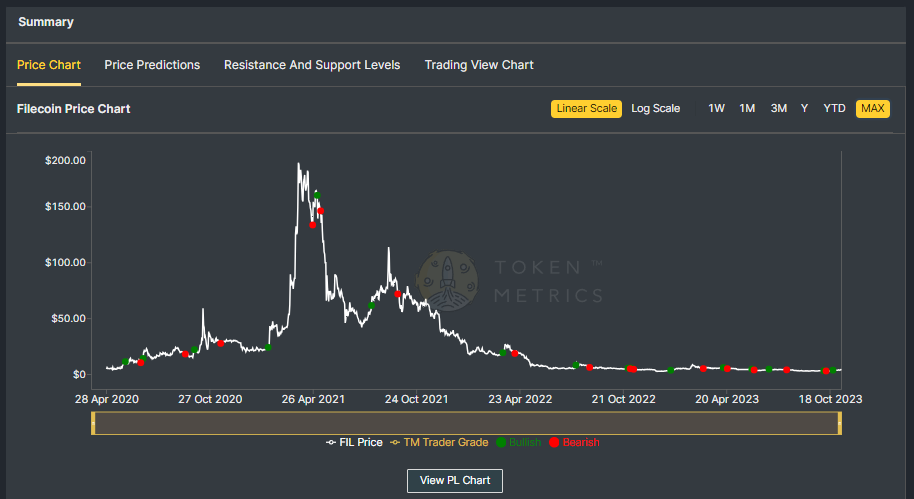
Filecoin's journey has been nothing short of remarkable. Since its inception, Filecoin has consistently adapted and expanded, redefining the landscape of decentralized data storage.

Its historical data showcases impressive growth and resilience, drawing the attention of both institutional and retail investors.

Filecoin Price Chart
Start Your Free Trial Today and Uncover Your Token's Price Prediction and Forecast on Token Metrics.

Filecoin Fundamentals

Filecoin's journey has indeed been an awe-inspiring odyssey. Since its inception, it has continuously evolved, reshaping the world of decentralized data storage.

The historical records paint a vivid picture of remarkable growth and unwavering resilience, captivating the interest of both institutional and retail investors.

Exploring Filecoin's Current Fundamentals

At the heart of Filecoin's fundamental strength lies its pioneering approach to data storage. It has firmly positioned itself as a frontrunner in decentralized data storage, providing a platform for users to transact storage space.

This ingenious fusion of blockchain technology with data storage solutions has propelled its significance to new heights.

Key Fundamentals 

  • Decentralized data storage: Filecoin delivers a secure, decentralized means of storing and retrieving data, offering immense value across various applications.
  • Market dynamics: Its marketplace for storage providers and users fosters a competitive environment, molding pricing and service quality.
  • Diverse applications: From data archiving to content delivery, Filecoin accommodates a broad array of data storage requirements.
Filecoin Tokenomics

Filecoin's Long-Term Price Projection - Insights from Industry Experts: Distinguished cryptocurrency analysts and authorities envision a bright future for Filecoin. 

Their optimism stems from Filecoin's distinctive role within the data storage sector, serving as an alternative to traditional centralized storage methods. 

While prudence dictates caution in price projections, these experts suggest that Filecoin holds the potential for substantial long-term appreciation.

Now, let's embark on a comprehensive exploration of diverse forecasts for Filecoin's price in 2023, 2025, and 2030.

Filecoin Price Prediction: Scenario Analysis

To make accurate price predictions, it is crucial to consider different scenarios that can impact Filecoin's price. Let's analyze two scenarios - a bullish and a bearish scenario - to get a better understanding of the potential price movements of Filecoin.

Filecoin Price Prediction - Bullish Scenario

If the crypto market cap hits $3 Trillion, and if Filecoin retains its current 0.14% dominance, its price could ascend to $9.35

In a more bullish scenario of the crypto market surging to $10 Trillion, Filecoin's price could soar to a staggering $31.18, resulting in a potential 7x return for investors.

Filecoin Price Prediction - Scenario Analysis
Start Your Free Trial Today and Uncover Your Token's Price Prediction and Forecast on Token Metrics.

Filecoin Price Prediction - Bearish Scenario

In a bearish scenario, where market conditions are unfavorable, or there is increased competition, the price of Filecoin may face downward pressure with a decreased dominance of 0.07%.

In this scenario, If the crypto market cap hits $3 Trillion, Filecoin could trade around $4.67 in the short term and struggle to surpass $15.59 by 2030 even if the total crypto market cap surpasses the $10 Trillion mark.

It is essential to note that these scenarios are speculative and should not be considered financial advice. The cryptocurrency market is highly volatile, and prices can fluctuate rapidly.

Filecoin Price Predictions - Industry Expert Opinion

  • CryptoPredictions: The Crypto Predictions platform predicts that Filecoin's price in 2023 could reach an average of $2.802.
  • CoinCodex: Forecasts that the price of Filecoin may fluctuate between $3.07 (minimum) and $25.56 (maximum) in 2024.
  • Bitnation: Suggests a maximum potential price of $8.84, an average of $7.90, and a minimum of $6.95 for Filecoin by the end of 2024.
  • OvenAdd: Estimates a potential yearly low for Filecoin at $16.47 and a potential high of $17.56 in 2024.
  • CryptoPredictions: Suggests an average price of $5.643 for Filecoin in 2025, and by 2030, the average price of Filecoin may reach $28.

Please remember that these are predictions, and actual outcomes may vary. It's advisable to conduct thorough research before making any investment decisions.

Note - Start Your Free Trial Today and Uncover Your Token's Price Prediction and Forecast on Token Metrics.

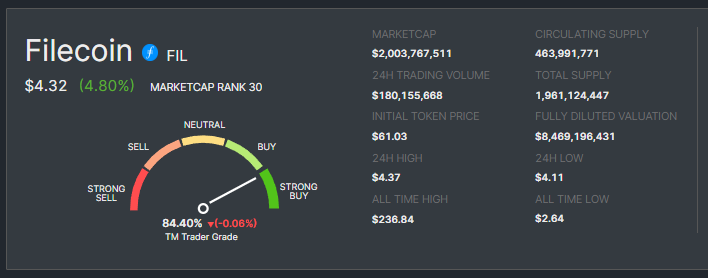
Filecoin Price Prediction

Is Filecoin Good to Invest or Avoid?

The answer depends on your investment goals and risk tolerance. Filecoin continues to disrupt the data storage industry by providing a decentralized and secure solution. It has a unique market positioning, which may appeal to investors looking to diversify their portfolios.

Reasons to Invest in Filecoin:

  • Growing demand: The need for secure and decentralized data storage is rising, making Filecoin's services increasingly relevant.
  • Innovation: Filecoin represents a novel approach to data storage, which could lead to further adoption.
  • Competitive advantage: Its decentralized marketplace differentiates Filecoin from traditional data storage solutions.

Risks and Considerations:

  • Market competition: Filecoin faces competition from both traditional data storage providers and other blockchain-based solutions.
  • Regulatory environment: Regulatory changes and compliance issues could impact Filecoin's operations.
  • Volatility: As with all cryptocurrencies, Filecoin's price is subject to market volatility.

Future Potential of Filecoin

The future potential of Filecoin is grounded in its unique approach to decentralized data storage. As the demand for secure data storage continues to grow, Filecoin is well-positioned to be a significant player.

Its roadmap includes plans for enhancing scalability, security, and performance, ensuring its place at the forefront of the decentralized data storage sector.

Also Read - XRP Price Prediction

Expert Insights

Crypto experts and analysts from the industry share their thoughts on Filecoin's long-term potential:

Frequently Asked Questions

Q1. What makes Filecoin different from traditional data storage solutions? 

Filecoin distinguishes itself by offering decentralized, blockchain-based data storage, which provides enhanced security and ownership control.

Q2. How can I invest in Filecoin?
You can invest in Filecoin by purchasing FIL tokens on cryptocurrency exchanges. Be sure to store them securely in a compatible wallet.

Q3. What factors should I consider before investing in Filecoin? 

Before investing, consider your risk tolerance, the competitive landscape, regulatory developments, and the long-term potential of Filecoin in the data storage sector.

Q4. Can I mine Filecoin? 

Yes, Filecoin offers a mining opportunity where users can earn FIL tokens by providing storage and retrieval services.

Q5. Where can I find more information about Filecoin's technology and roadmap?
For a deeper understanding of Filecoin's technology and future plans, consult the official Filecoin documentation and stay updated with their development updates.

Conclusion

Filecoin has demonstrated remarkable growth and innovation in the dynamic field of decentralized data storage. 

While the potential for long-term growth is promising, investors must conduct thorough research, evaluate risks, and consider expert opinions when deciding if Filecoin aligns with their investment objectives. The crypto world is ever-evolving, and vigilance is essential when considering any investment.

Disclaimer

The information provided on this website does not constitute investment advice, financial advice, trading advice, or any other advice, and you should not treat any of the website's content as such.

Token Metrics does not recommend that any cryptocurrency should be bought, sold, or held by you. Conduct your due diligence and consult your financial advisor before making investment decisions.

Choose from Platinum, Gold, and Silver packages
Reach with 25–30% open rates and 0.5–1% CTR
Craft your own custom ad—from banners to tailored copy
Perfect for Crypto Exchanges, SaaS Tools, DeFi, and AI Products