Back to blog
Crypto Basics

What is Ethereum Triple Halving and its Impact on ETH?

Discover the significance of Ethereum halving and its potential impact on ETH. Gain insights into this key event in the world of cryptocurrency.
S. Vishwa
9 Minutes
Want Smarter Crypto Picks—Free?
See unbiased Token Metrics Ratings for BTC, ETH, and top alts.
Thank you! Your submission has been received!
Oops! Something went wrong while submitting the form.
 No credit card | 1-click unsubscribe

In the fast-paced world of cryptocurrencies, Ethereum has always been at the forefront of innovation. While "halving" is commonly associated with Bitcoin, Ethereum has its unique approach to this concept. 

The Ethereum halving, often referred to as the "Triple Halving," is a multifaceted process that has profound implications for the future of this popular cryptocurrency. 

In this article, we will delve deep into the Ethereum halving phenomenon, exploring its significance in the ever-evolving crypto market.

The Basics of Ethereum Halving

To understand the Ethereum halving, it's important first to grasp the fundamentals of Ethereum's underlying technology. Ethereum operates on a consensus mechanism known as Proof of Work (PoW), similar to Bitcoin. 

Miners solve complex mathematical problems in this system to validate transactions and create new blocks. As a reward for their efforts, miners are given Ethereum coins.

However, Ethereum has been undergoing a significant transformation with the introduction of the Ethereum 2.0 upgrade. This upgrade involves transitioning from the PoW consensus mechanism to a more energy-efficient and scalable model called Proof of Stake (PoS). 

Unlike PoW, where miners compete to validate transactions, PoS relies on validators who lock up a certain amount of Ethereum as a stake. These validators are then chosen to create new blocks based on factors such as the amount they stake.

This transition to PoS brings about several significant changes to the Ethereum ecosystem. It eliminates the energy-intensive process of mining and reduces the daily issuance rate of Ethereum tokens. 

Additionally, the Ethereum Improvement Proposal (EIP) 1559 introduces a new fee structure that burns a portion of the transaction fees, further reducing the overall supply of Ethereum.

Staking: A Shift in the Ethereum Landscape

One of the key components of the Ethereum halving is the shift from mining to staking. Under the PoS model, validators are chosen to create new blocks based on the amount of Ethereum they have staked.

This means that the more Ethereum a validator holds, the higher their chances of being selected to validate transactions.

Staking Ethereum has several advantages over traditional mining. First and foremost, it is more energy-efficient, as it does not require the use of powerful computational hardware. 

This shift to a more sustainable consensus mechanism aligns with Ethereum's commitment to environmental sustainability.

Secondly, staking Ethereum helps to reduce the overall supply of Ethereum in circulation. When Ethereum is staked, it is effectively locked up for a certain period of time, making it temporarily unavailable for trading or selling. 

This reduction in circulating supply creates scarcity, which can potentially drive up the price of Ethereum over time.

Moreover, staking Ethereum allows validators to earn staking rewards. These rewards are proportional to the amount of Ethereum staked, providing an additional incentive for users to participate in the network and contribute to its security and stability.

ETH Gas Fee Burning: A Deflationary Mechanism

Another crucial aspect of the Ethereum halving is the implementation of EIP-1559, which introduces a new fee structure for transactions on the Ethereum network.

Under the previous fee model, users would bid for transaction priority by suggesting a gas fee. This often resulted in bidding wars during periods of network congestion.

EIP-1559 sets a base fee for transactions, which adjusts dynamically based on network demand. Crucially, this base fee is burned or permanently removed from circulation rather than being given to miners or validators. 

By burning a portion of the transaction fees, Ethereum's overall supply can decrease during times of high network usage. This deflationary pressure can offset the inflationary issuance of new coins, potentially leading to Ethereum becoming a deflationary asset over time.

The introduction of fee burning has several implications for the Ethereum ecosystem. First, it improves the predictability and stability of transaction fees, making it easier for users to estimate the cost of their transactions. 

This is particularly beneficial for developers and users of decentralized applications (dApps), as it creates a more user-friendly experience and reduces the barriers to entry.

Second, fee burning helps to align the incentives of miners and validators with the long-term success of the Ethereum network. In the PoW model, miners are primarily motivated by the block rewards they receive for validating transactions. 

However, as the issuance of new coins decreases over time, transaction fees become a more significant source of income for miners. By burning some of these fees, Ethereum ensures miners are vested in the network's sustainability and efficiency.

Reduced Token Issuance: Limiting the Supply of Ethereum

In addition to the shift to PoS and the burning of transaction fees, the Ethereum halving also involves a significant reduction in the daily issuance rate of Ethereum tokens. 

Under the PoW model, miners were rewarded with newly issued Ethereum tokens for validating transactions and securing the network.

However, with the transition to PoS and the phasing out of traditional mining, the daily issuance rate of Ethereum tokens has been significantly reduced. 

This reduction in token issuance limits the supply of new Ethereum entering the market, creating scarcity. When combined with the burning of transaction fees, this reduction in supply can exert upward pressure on the price of Ethereum.

The reduced token issuance has several implications for Ethereum as an investment. First, it helps to mitigate the potential impact of inflation on the value of Ethereum.

As the issuance of new coins decreases, the inflation rate decreases as well, making Ethereum a more attractive asset for long-term holders.

Second, the reduction in token issuance aligns with the principles of scarcity and supply and demand economics. With a limited supply of new coins entering the market, the value of existing coins can increase, assuming continued demand for Ethereum.

The Impact of Halving on Ethereum

The Ethereum halving, or the "Triple Halving," has profound implications for the Ethereum network, its participants, and the broader crypto ecosystem. Here's an in-depth exploration of its impact across various aspects:

Reward System Changes for Validators

With the transition to PoS, the Ethereum halving represents a shift in the reward system for validators. Instead of relying on mining rewards, validators are rewarded with staking rewards based on the amount of Ethereum they stake. 

These rewards are proportional to the stake and other factors, incentivizing validators to actively participate in the network and secure its operations.

Transaction Fees: A More Efficient and Predictable System

The introduction of EIP-1559 and the burning of transaction fees have significant implications for users of the Ethereum network.

Ethereum has created a more efficient and predictable fee system by setting a base fee for transactions and burning a portion of these fees. This benefits users by reducing the volatility of transaction fees and creating a more user-friendly experience.

Deflationary Pressure and Scarcity

The Ethereum halving introduces deflationary pressure on the Ethereum supply through a combination of reduced token issuance and the burning of transaction fees. This deflationary nature can create scarcity, potentially leading to upward pressure on the price of Ethereum. 

It aligns with supply and demand economics principles, where a limited supply combined with continued demand can drive price appreciation.

Impact on Stakeholder Dynamics

The Ethereum halving has implications for various stakeholders within the Ethereum ecosystem:

  • Miners: The transition from PoW to PoS renders traditional mining obsolete. Miners will need to adapt by either transitioning to staking or focusing on mining other PoW cryptocurrencies.
  • Investors: Understanding the Ethereum halving is crucial for investors. The potential deflationary nature of Ethereum, combined with its position as a leading smart contract platform, can influence investment strategies and long-term outlook.
  • Developers and Dapp Creators: The reduction in gas fees and enhanced transaction efficiency resulting from the Ethereum halving can attract more developers and users to the Ethereum ecosystem. This fosters innovation and growth within the network, creating new opportunities for developers and dApp creators.

Ethereum Halving and Its Relation to Bitcoin

Ethereum and Bitcoin, as leading cryptocurrencies, both have mechanisms in place to control inflation and ensure the longevity of their respective networks. 

While they share similar goals, the methods and implications of their halving events are distinct. Let's delve deeper into the comparison between the Ethereum halving and the Bitcoin halving:

Definition of Halving

The Ethereum halving, or the "Triple Halving," is a continuous process without a fixed date. It encompasses the shift to PoS, the burning of transaction fees, and the reduction in token issuance.

In contrast, the Bitcoin halving is a predetermined event that occurs approximately every four years. During the Bitcoin halving, the block rewards for miners are reduced by 50%, decreasing the rate of new Bitcoin issuance.

Purpose and Impact on Mining

The Ethereum halving aims to transition to a more energy-efficient consensus mechanism (PoS) and potentially make Ethereum deflationary over time. As a result, traditional mining becomes obsolete, and miners must adapt by either transitioning to staking or mining other PoW cryptocurrencies.

On the other hand, the Bitcoin halving aims to control inflation by reducing the rate at which new Bitcoins are introduced into circulation. The reduction in block rewards puts downward pressure on mining profitability, leading to a potential reduction in the number of miners or a consolidation of mining power.

Effect on Supply and Price Implications

The Ethereum halving, through the combination of reduced token issuance and the burning of transaction fees, limits the supply of new Ethereum entering the market. This reduction in supply, coupled with continued demand, can exert upward pressure on Ethereum's price over time.

Historically, the Bitcoin halving has been associated with price surges in the months following the event. However, it's important to note that various factors, including market sentiment, regulatory changes, and macroeconomic conditions influence price dynamics.

Network Security and Historical Context

The Ethereum halving introduces PoS as a more energy-efficient and secure consensus mechanism. Validators are incentivized to act honestly, as they have Ethereum at stake. Misbehaving validators risk losing their staked Ethereum, ensuring the security and integrity of the network.

On the other hand, Bitcoin relies on PoW and miners' computational power to validate transactions. As block rewards decrease, transaction fees become a more significant incentive for miners, ensuring continued network security.

In terms of historical context, Ethereum's journey has been marked by continuous evolution and various upgrades, such as the introduction of EIP-1559 and the Ethereum Merge. 

These milestones contribute to Ethereum's position as a leading smart contract platform and highlight the importance of innovation and adaptability in the blockchain and crypto space.

Conclusion

The Ethereum halving, or the "Triple Halving," is a testament to Ethereum's adaptability, resilience, and vision for the future. It aims to enhance Ethereum's efficiency, sustainability, and value proposition through the transition to PoS, burning of transaction fees, and reduction in token issuance. 

This sets a precedent for other cryptocurrencies, emphasizing scalability, security, and user-centric design. The Ethereum halving creates new opportunities for investors, developers, and users, fostering growth and innovation within the ecosystem.

Disclaimer

The information provided on this website does not constitute investment advice, financial advice, trading advice, or any other advice, and you should not treat any of the website's content as such.

Token Metrics does not recommend buying, selling, or holding any cryptocurrency. Conduct your due diligence and consult your financial advisor before making investment decisions.

Build Smarter Crypto Apps &
AI Agents in Minutes, Not Months
Real-time prices, trading signals, and on-chain insights all from one powerful API.
Grab a Free API Key
About Token Metrics
Token Metrics: AI-powered crypto research and ratings platform. We help investors make smarter decisions with unbiased Token Metrics Ratings, on-chain analytics, and editor-curated “Top 10” guides. Our platform distills thousands of data points into clear scores, trends, and alerts you can act on.
30 Employees
analysts, data scientists, and crypto engineers
Daily Briefings
concise market insights and “Top Picks”
Transparent & Compliant
Sponsored ≠ Ratings; research remains independent
Want Smarter Crypto Picks—Free?
See unbiased Token Metrics Ratings for BTC, ETH, and top alts.
Thank you! Your submission has been received!
Oops! Something went wrong while submitting the form.
 No credit card | 1-click unsubscribe
Token Metrics Team
Token Metrics Team

Recent Posts

Research

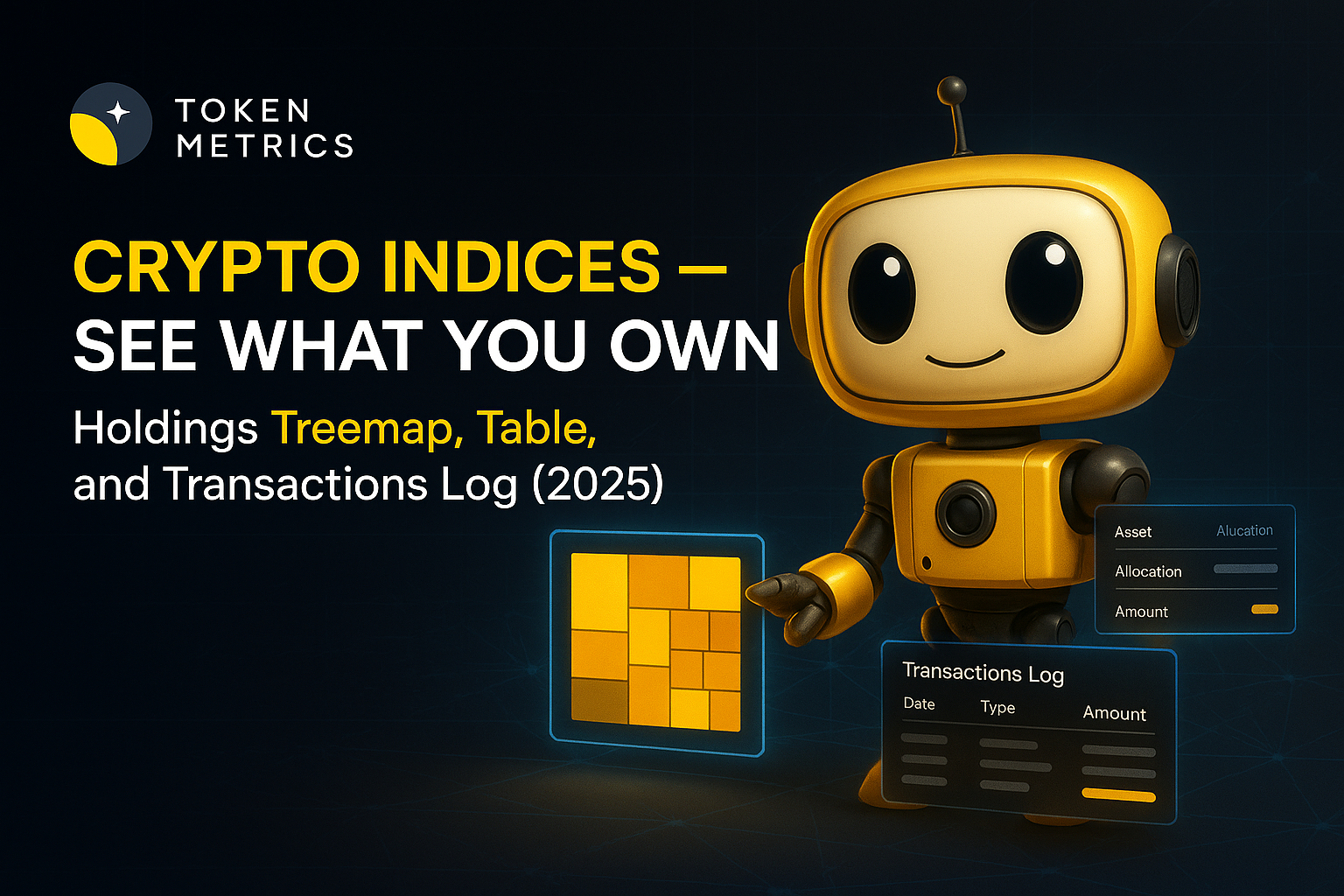
Crypto Indices - See What You Own: Holdings Treemap, Table, and Transactions Log (2025)

Token Metrics Team
5

If you’ve ever bought a “basket” of coins and then wondered what you actually hold, you’re not alone. The Token Metrics Global 100 solves that by pairing a rules-based strategy with radical visibility: an interactive holdings treemap, sortable table, and a real-time transactions log—so you can see what you own at all times. This transparency sits on top of a simple idea: a top-100 crypto index when markets are bullish and stablecoins when they’re not, with weekly rebalancing and one-click buy at launch. The result is clarity for hands-off allocators and discipline for active traders—without spreadsheets or manual rebalances.

→ Join the waitlist to be first to trade TM Global 100.

Why Transparency Matters in October 2025

Today’s crypto investor expects more than a chart and a headline weight. You want to audit your index: which coins, what size, and what changed after each rebalance. That’s exactly why we ship three visibility layers on day one: Gauge → Treemap → Transactions Log—plus a classic holdings table for power users.

In practical terms, a holdings treemap shows proportional weights at a glance, a table lets you sort and export details, and a transactions log chronicles every add/trim/exit during rebalances and regime switches. Together, they answer the search intent behind “crypto index holdings” and “weekly rebalancing” with an immediately scannable source of truth.

How the TM Global 100 Index Works (Plain English)

  • Regime switching: When our market signal is bullish, the index holds the top 100 assets by market cap. When bearish, it exits to stablecoins and waits for a re-entry signal.
  • Weekly rebalancing: We adjust constituents and weights weekly to reflect updated rankings—so the index stays aligned with the market.
  • Transparency: You’ll see a Strategy modal (rules at a glance), a market signal gauge, an interactive Holdings treemap & table, and a Transactions log that records rebalances and regime shifts.

What you’ll see on launch: A price tile, “tokens: 100,” “rebalances weekly,” and a Buy Index flow that can complete in about 90 seconds, end-to-end.

See the strategy and rules. (TM Global 100 strategy)

Benefits at a Glance (Why This Beats DIY)

  • Time saved: Skip ranking lists, manual screeners, and cross-exchange rebalances.
  • Lower execution drag: A single indexed flow helps reduce the slippage and fees you’d pay hopping between many tokens.
  • No missed cycles: Weekly rebalances help capture changes in the top-100 while the regime switch avoids guesswork when markets turn.
  • Full visibility: Treemap + table + transactions let you see exactly what changed and why—no black boxes.
  • Rules over vibes: A consistent methodology can reduce emotional decisions during drawdowns and market euphoria.

Step-by-Step: How to Get Early Access (Waitlist)

  1. Open the Indices hub and select TM Global 100. (Token Metrics Indices hub)
  2. Join the waitlist with your email to get launch-day access and updates.
  3. (Optional) Connect your wallet so you’re ready to buy at launch.
  4. On launch: Open TM Global 100, review the Gauge → Treemap → Transactions, and tap Buy Index.
  5. Confirm the buy: You’ll see estimates for fees/slippage and the current token mix.
  6. Track your position: Your holdings and every rebalance appear in My Indices and the Transactions Log.

→ Join the waitlist to be first to trade TM Global 100.

Decision Guide: Is This Right for You?

  • Hands-Off Allocator: Want “own the market” exposure and automatic upkeep. Consider if you dislike micromanaging.
  • Active Trader: Want a disciplined core that moves to stablecoins in bears while you take satellite bets elsewhere.
  • TM Member/Prospect: Already trust Token Metrics research and want rules-based execution with full visibility.
  • Starter Portfolio Builder: Prefer a single decision over 20+ token buys and periodic DIY reweights.
  • Transparency Seeker: You won’t tolerate black-box products; you want a real transactions log and holdings you can audit.
  • Tax-Aware Rebalancer: You’d rather not run frequent piecemeal trades yourself.
  • Mobile-First User: Want a fast, on-page buy flow instead of tab-hopping across venues.
  • Analytics Fan: Enjoy comparing weights and changes in the treemap after each weekly rebalance.

FAQs

What is a crypto index with a holdings treemap?

It’s a rules-based basket of cryptocurrencies where you can visually inspect weights via an interactive treemap, alongside a sortable table and a transactions log that records every rebalance and regime switch.

It’s a rules-based basket of cryptocurrencies where you can visually inspect weights via an interactive treemap, alongside a sortable table and a transactions log that records every rebalance and regime switch.

Weekly. Rebalances update constituents/weights to reflect current top-100 rankings; separate regime switches can also move the portfolio between tokens and stablecoins when the market signal changes.

What triggers the move to stablecoins?

A proprietary market signal. When bearish, the index exits tokens to stablecoins; when bullish resumes, it re-enters the top-100 basket.

Can I fund with USDC or fiat?

At launch, funding/settlement options surface based on your connected wallet and supported chains. USDC payout is supported on selling; fiat on-ramps may be added later.

Is the wallet custodial?

No. The embedded wallet is self-custodial—you control your funds.

How are fees shown?

Before you confirm, the buy flow surfaces estimated gas, platform fee, max slippage, and min expected value.

How do I join the waitlist?

Open the Indices hub, navigate to TM Global 100, and add your email. You’ll be notified on launch with a direct link to buy.

Security, Risk & Transparency

  • Self-custody: Embedded smart wallet with user control.
  • Operational clarity: Weekly rebalances; regime logic documented in the Strategy modal.
  • Fee & slippage preview: All surfaced before you confirm a trade.
  • Data integrity: Holdings treemap + table and transactions log reflect each executed change.

Regional notes: Availability and on-ramps can vary by jurisdiction. Crypto is volatile and can lose value. Past performance is not indicative of future results. This article is for research/education, not financial advice.

Conclusion

Token Metrics Global 100 is built for investors who want broad market exposure and the receipts to prove what they hold—treemap, table, and transactions on every rebalance. If you value rules, discipline, and transparency, join the waitlist and be ready on launch day.

Click here to get early access to Token Metrics indices.

Research

Crypto Index vs DIY Basket: Time, Slippage, and Missed Rebalances (2025)

Token Metrics Team
5

Building your own crypto basket sounds simple—until you’re juggling 10–50 tickers, spreadsheets, rebalance rules, spreads across chains, and the constant fear of missing regime turns. A crypto index removes that manual grind: TM Global 100 holds the top 100 assets when the market is bullish and moves fully to stablecoins when it’s not, with weekly rebalancing and full transparency of holdings and transactions. One click to buy, zero maintenance to keep up.

→ Join the waitlist to be first to trade TM Global 100.

Why Indices Matters in October 2025

In 2025, time and execution quality are alpha. Manually maintaining a DIY basket multiplies complexity: fragmented liquidity, multiple wallets, chain fees, and coordination across exchanges—all while markets move. A rules-based index compresses that overhead into a single, auditable product with pre-declared logic and scheduled upkeep.

Definition (snippet-ready): A crypto index is a rules-based basket of digital assets that rebalances on a set schedule and/or when market conditions change, so you don’t have to micromanage individual coins.

Traders searching “DIY crypto basket,” “regime switching,” or “weekly rebalancing” usually want one thing: broad exposure without the constant maintenance and the regret of missed rebalances. That’s the exact problem Token Metrics Global 100 addresses with weekly updates and regime switching to stablecoins when signals turn bearish.

How the TM Global 100 Index Works (Plain English)

  • Regime switching: When signals are bullish, the index holds the top 100 by market cap; when bearish, it exits fully to stablecoins to wait for re-entry.
  • Weekly rebalancing: Aligns weights and constituents with updated rankings; regime changes can also trigger full portfolio shifts.
  • Transparency: Strategy modal explains selection & rebalancing rules; Holdings show a treemap/table; Index Transactions log all changes.

What you’ll see on launch: Price tile, signal gauge, tokens=100, “rebalances weekly,” contract address, and a Buy Index button with a ~90-second live demo flow showcased in launch content.

→ See the strategy and rules. (TM Global 100 strategy)

Benefits at a Glance (Why This Beats DIY)

  • Time saved: Replace multi-exchange shopping, wallet hops, and manual allocations with one click.
  • Fewer missed rebalances: Weekly cadence + visible transactions log reduce the cost of “I’ll do it tomorrow.”
  • Slippage discipline: Centralized execution with declared slippage/fee previews helps contain surprises vs piecemeal orders.
  • Regime switching: Codified “risk-off” behavior into stablecoins during bears, so you don’t have to white-knuckle exits. (No performance promises.)
  • Transparency: Strategy modal → Holdings treemap/table → Transactions log—see exactly what you hold and when it changed.

Proof cues (What you’ll see): Gauge (market signal) → Treemap (allocations) → Transactions Log → ~90-second Buy flow.

Step-by-Step: How to Get Early Access (Waitlist)

  1. Open the Token Metrics Indices hub and select TM Global 100.
  2. Add your email to the waitlist so you’re first in line at launch.
  3. (Optional) Connect your wallet—our embedded, self-custodial smart wallet supports major chains.
  4. On launch day, you’ll see the price tile, signal gauge, and “Buy Index.”
  5. Review the strategy, expected fees/slippage, and holdings; confirm to purchase.
  6. Track your position in My Indices; rebalances and any regime switches will appear in the transactions log.
→ Join the waitlist to be first to trade TM Global 100.

Decision Guide: Is This Right for You?

  • Hands-Off Allocator: Want broad exposure without micromanaging? Consider a rules-based core that updates weekly.
  • Active Trader: Keep your bets, but use an index core that may step to stablecoins during bears.
  • TM Member/Prospect: Prefer transparent holdings, logs, and a simple buy/sell flow.
  • Time-Strapped Professional: Reduce ops work (wallets, slippage math, spreadsheets) to nearly zero.
  • New to Crypto: Learn with training wheels—strategy modal, tooltips, and clear risk language.
  • DIY Purist: If you enjoy tinkering with weights daily, DIY could still fit—just know weekly index upkeep is handled for you.

FAQs

What is a crypto index?

A rules-based basket of assets with scheduled rebalancing and, in TM Global 100’s case, a regime switch between top-100 exposure and stablecoins.

How often does the index rebalance?

Weekly, with additional full-portfolio switches when the market regime changes.

What triggers the move to stablecoins?

A proprietary market signal. When bearish, the index exits tokens into stablecoins and waits for a bullish re-entry.

Can I fund with USDC or fiat?

Funding options surface based on your connected wallet and supported chains; USDC payouts are supported on selling. (Stablecoin entry may come later.)

Is the wallet custodial?

No. The embedded wallet is self-custodial; you control funds.

How are fees shown?

The Buy flow shows estimated gas, platform fee, max slippage, and minimum expected value before you confirm.

How do I join the waitlist?

Visit the Indices hub → TM Global 100 → enter your email to get notified and first access at launch.

Security, Risk & Transparency

  • Self-custody: You transact via an embedded, self-custodial smart wallet.
  • Visibility: Strategy modal, Holdings treemap/table, and Transactions log make changes auditable.
  • Fee & slippage preview: See estimated gas, platform fee, max slippage, and minimum expected value before confirming.
  • Regime logic limits: Signals can be wrong; markets can gap; weekly rebalances can’t eliminate risk.
  • Region/chain notes: Supported chains surface in-product; availability and options may vary.

Crypto is volatile and can lose value. Past performance is not indicative of future results. This article is for research/education, not financial advice.

Conclusion

If you’ve ever missed a rebalance or watched slippage eat into returns, Token Metrics Global 100 can help standardize the work: rules-based logic, weekly updates, and a visible log of everything that changed. Join the waitlist to be first to trade, and make a disciplined index your core.

→ Join the waitlist to be first to trade TM Global 100.
Research

Regime Switching in Crypto: Participate in Upside, Sit Out Drawdowns (2025)

Token Metrics Team
5

Timing crypto cycles is inherently challenging. Volatility in the crypto markets can lead to sharp swings—either capturing gains during bull runs or avoiding deep drawdowns during unfavorable trends. A regime switching crypto index offers a systematic way to adapt to changing market conditions, using rules-based allocations that switch between risk-on assets and stablecoins accordingly. Token Metrics offers tools to help analyze these strategies with transparency and real-time insights.

Why Indices Matter in October 2025

Crypto markets tend to operate in distinct regimes—periods of momentum followed by corrections that can reverse gains quickly. Investors and analysts seeking to implement regime switching or weekly rebalancing frameworks value simplicity and clarity. These approaches help in maintaining discipline, managing risks, and capturing market trends effectively.

Definition of Regime Switching in Crypto

Regime switching in crypto refers to a rules-based investment method that adjusts portfolio exposure based on prevailing market conditions. Typically, this involves rotating into a diversified basket of tokens in bullish phases and shifting into stablecoins during bearish trends, thus managing risk while seeking to ride upward trends.

Why Now: The Rationale for Regime Switching

  • Cycle Asymmetry: Capturing upward trends while limiting downside drawdowns can influence long-term outcomes positively.
  • Operational Efficiency: Automated, rules-based rebalancing reduces errors and slippage tied to manual adjustments across multiple tokens or exchanges.
  • Transparency: Real-time insight into holdings, rebalancing rationale, and transaction history fosters trust and clarity.

How the TM Global 100 Index Works (Plain English)

This index employs regime switching principles: during bullish periods, it holds the top 100 crypto assets by market cap; during bearish times, it exits into stablecoins and waits for buy signals. The index performs weekly rebalancing based on updated rankings, liquidity, and supply metrics. Transparency is maintained through clear strategy rules, gauges, Treemap views, and detailed transaction logs.

Benefits at a Glance (Why This Beats DIY)

  • Rules, not vibes: Automated logic minimizes emotional decision-making.
  • Fewer operational mistakes: Single, streamlined flows replace manual multi-step trades.
  • Discipline in switching: Full rotation into stablecoins at bearish signals reduces hesitation and second-guessing.
  • Cost visibility: Estimated gas, platform fees, and expected minimum value are shown upfront.
  • Full transparency: Holdings treemaps and transaction histories keep you informed.
  • Consistent cadence: Weekly updates ensure alignment with market trends.

Step-by-Step: How to Get Early Access (Waitlist)

  1. Visit the Token Metrics Indices hub.
  2. Find the TM Global 100 index card and tap “Join Waitlist”.
  3. Add your email to receive launch notifications.
  4. Optionally, connect your wallet in advance to streamline onboarding on launch day.
  5. On launch day, you will receive an email when the index opens for trading. The interface features gauges, strategy details, and holdings for instant review.
  6. Complete the purchase of the index in about 90 seconds by confirming your wallet, reviewing potential fees, and confirming the buy.
  7. Track your position within “My Indices” once active.

Join the waitlist to be first to trade TM Global 100.

Decision Guide: Is This Right for You?

  • Hands-Off Allocator: Ideal for those seeking broad market exposure with minimal management.
  • Active Trader: Useful as a core strategy with rules-based rebalancing, supporting satellite bets.
  • Token Metrics Member/Prospect: For users who value transparent, research-backed rules over discretionary choices.
  • Crypto Newcomer: Simplifies entry with one-button buy, weekly updates, and clear rules.
  • Time-Constrained Pro: Reduces operational overhead while maintaining clarity and predictability.
  • Skeptical of Forecasts: Prefers systematic processes over relying on predictions or forecasts.

FAQs

What is a regime switching crypto index?

A rules-based portfolio that allocates to a diversified token basket during bullish phases and switches to stablecoins during bearish conditions, based on predefined signals. Token Metrics implements this with a top-100 universe and full stablecoin rotation in downturns.

How often does the index rebalance?

It rebalances weekly to reflect changes in rankings and liquidity. Significant regime changes can occur outside the schedule when market signals trigger a switch.

What triggers the move to stablecoins?

A proprietary market signal prompts the index to exit token positions and move into stablecoins during bearish phases, waiting for a bullish signal to re-enter.

Can I fund with USDC or fiat?

Funding occurs via an embedded, self-custodial wallet supporting major chains. USDC payouts are supported when selling. Funding options depend on your wallet and region.

Is the wallet custodial?

No. It is self-custodial, giving you control of keys and funds.

How are fees shown?

Before confirming a trade, estimated gas, platform fee, slippage, and expected minimum value are displayed.

How do I join the waitlist?

Visit the Token Metrics Indices hub, open TM Global 100, and tap “Join Waitlist”. You will be notified at launch.

Security, Risk & Transparency

  • Self-custody is prioritized: You control your keys and funds.
  • Transparency is built into the process: Fees, holdings, and transaction logs are visible before and after trades.
  • Market signals are based on rules; sudden gaps and spreads can impact outcomes.
  • Supported regions and asset options may vary due to geography.

Crypto markets are volatile and can fluctuate rapidly. Past performance does not predict future results. This article aims to educate and inform, not provide financial advice.

Conclusion

For a disciplined, transparent approach to broad crypto exposure that adapts to market regimes, the TM Global 100 index offers a rules-based platform with weekly rebalancing and full visibility. It enables investors to focus on allocation without the stress of micromanagement.

Join the waitlist to be first to trade TM Global 100.

Choose from Platinum, Gold, and Silver packages
Reach with 25–30% open rates and 0.5–1% CTR
Craft your own custom ad—from banners to tailored copy
Perfect for Crypto Exchanges, SaaS Tools, DeFi, and AI Products