Research

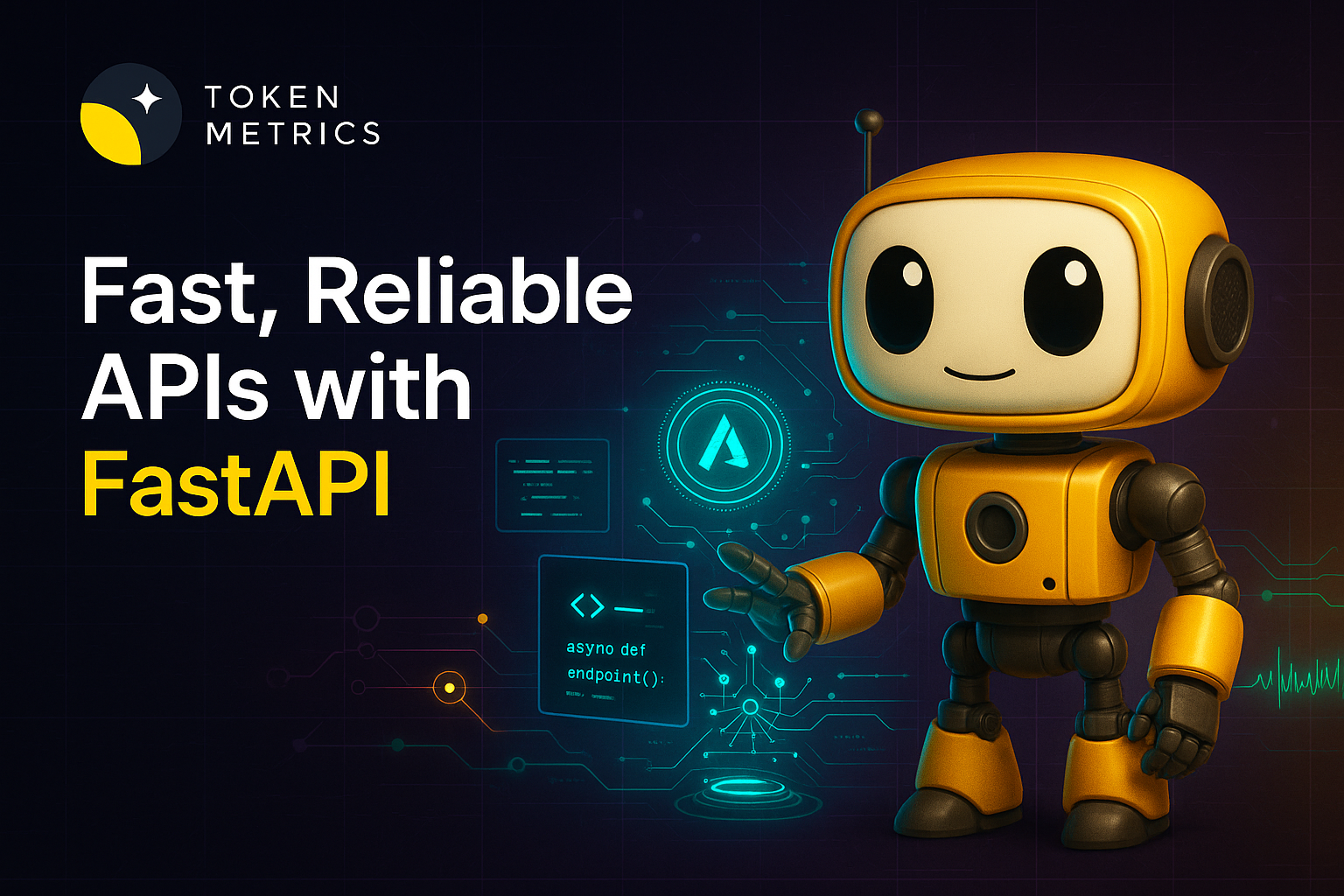
Fast, Reliable APIs with FastAPI

Learn practical FastAPI patterns: async performance, validation with Pydantic, deployment best practices, and how to integrate AI services and external APIs for scalable, maintainable endpoints.
Token Metrics Team
5
MIN

Fast API design is no longer just about response time — it’s about developer ergonomics, safety, observability, and the ability to integrate modern AI services. FastAPI (commonly referenced by the search phrase "fast api") has become a favored framework in Python for building high-performance, async-ready APIs with built-in validation. This article explains the core concepts, best practices, and deployment patterns to help engineering teams build reliable, maintainable APIs that scale.

Overview: What makes FastAPI distinct?

FastAPI is a Python web framework built on top of ASGI standards (like Starlette and Uvicorn) that emphasizes developer speed and runtime performance. Key differentiators include automatic request validation via Pydantic, type-driven documentation (OpenAPI/Swagger UI generated automatically), and first-class async support. Practically, that means less boilerplate, clearer contracts between clients and servers, and competitive throughput for I/O-bound workloads.

Async model and performance considerations

At the heart of FastAPI’s performance is asynchronous concurrency. By leveraging async/await, FastAPI handles many simultaneous connections efficiently, especially when endpoints perform non-blocking I/O such as database queries, HTTP calls to third-party services, or interactions with AI models. Important performance factors to evaluate:

  • ASGI server choice: Uvicorn and Hypercorn are common; tuning workers and loop settings affects latency and throughput.
  • Blocking calls: Avoid CPU-bound work inside async endpoints; offload heavy computation to worker processes or task queues.
  • Connection pooling: Use async database drivers and HTTP clients (e.g., asyncpg, httpx) with pooled connections to reduce latency.
  • Metrics and profiling: Collect request duration, error rates, and concurrency metrics to identify hotspots.

Design patterns: validation, schemas, and dependency injection

FastAPI’s integration with Pydantic makes data validation explicit and type-driven. Use Pydantic models for request and response schemas to ensure inputs are sanitized and outputs are predictable. Recommended patterns:

  • Separate DTOs and domain models: Keep Pydantic models for I/O distinct from internal database or business models to avoid tight coupling.
  • Dependencies: FastAPI’s dependency injection simplifies authentication, database sessions, and configuration handling while keeping endpoints concise.
  • Versioning and contracts: Expose clear OpenAPI contracts and consider semantic versioning for breaking changes.

Integration with AI services and external APIs

Many modern APIs act as orchestrators for AI models or third-party data services. FastAPI’s async-first design pairs well with calling model inference endpoints or streaming responses. Practical tips when integrating AI services:

  • Use async clients to call external inference or data APIs to prevent blocking the event loop.
  • Implement robust timeouts, retries with backoff, and circuit breakers to handle intermittent failures gracefully.
  • Cache deterministic responses where appropriate, and use paginated or streaming responses for large outputs to reduce memory pressure.

Deployment, scaling, and observability

Deploying FastAPI to production typically involves containerized ASGI servers, an API gateway, and autoscaling infrastructure. Core operational considerations include:

  • Process model: Run multiple Uvicorn workers per host for CPU-bound workloads or use worker pools for synchronous tasks.
  • Autoscaling: Configure horizontal scaling based on request latency and queue length rather than CPU alone for I/O-bound services.
  • Logging and tracing: Integrate structured logs, distributed tracing (OpenTelemetry), and request/response sampling to diagnose issues.
  • Security: Enforce input validation, rate limiting, authentication layers, and secure secrets management.

Build Smarter Crypto Apps & AI Agents with Token Metrics

Token Metrics provides real-time prices, trading signals, and on-chain insights all from one powerful API. Grab a Free API Key

What is the difference between FastAPI and Flask?

FastAPI is built for the async ASGI ecosystem and emphasizes type-driven validation and automatic OpenAPI documentation. Flask is a synchronous WSGI framework that is lightweight and flexible but requires more manual setup for async support, validation, and schema generation. Choose based on concurrency needs, existing ecosystem, and developer preference.

When should I use async endpoints in FastAPI?

Use async endpoints when your handler performs non-blocking I/O such as database queries with async drivers, external HTTP requests, or calls to async message brokers. For CPU-heavy tasks, prefer background workers or separate services to avoid blocking the event loop.

How do Pydantic models help with API reliability?

Pydantic enforces input types and constraints at the boundary of your application, reducing runtime errors and making APIs self-documenting. It also provides clear error messages, supports complex nested structures, and integrates tightly with FastAPI’s automatic documentation.

What are common deployment pitfalls for FastAPI?

Common issues include running blocking code in async endpoints, inadequate connection pooling, missing rate limiting, and insufficient observability. Ensure proper worker/process models, async drivers, and graceful shutdown handling when deploying to production.

How can I test FastAPI applications effectively?

Use FastAPI’s TestClient (based on Starlette’s testing utilities) for endpoint tests and pytest for unit and integration tests. Mock external services and use testing databases or fixtures for repeatable test runs. Also include load testing to validate performance under expected concurrency.

Is FastAPI suitable for production-grade microservices?

Yes. When combined with proper patterns—type-driven design, async-safe libraries, containerization, observability, and scalable deployment—FastAPI is well-suited for production microservices focused on I/O-bound workloads and integrations with AI or external APIs.

Disclaimer

This article is for educational and informational purposes only. It does not constitute professional, legal, or investment advice. Evaluate tools and architectures according to your organization’s requirements and consult qualified professionals when needed.

Build Smarter Crypto Apps &
AI Agents in Minutes, Not Months
Real-time prices, trading signals, and on-chain insights all from one powerful API.
Grab a Free API Key
Token Metrics Team
Token Metrics Team

Recent Posts

Research

Why Is Web3 User Experience Still Lagging Behind Web2?

Token Metrics Team
4
MIN

Introduction to Web3 UX

The evolution from Web2 to Web3 marks a significant paradigm shift in how we interact with digital services. While Web2 platforms have delivered intuitive and seamless user experiences, Web3—the decentralized internet leveraging blockchain technology—still faces considerable user experience (UX) challenges. This article explores the reasons behind the comparatively poor UX in Web3 and the technical, design, and infrastructural hurdles contributing to this gap.

Contextual Understanding: Web2 vs Web3

Web2 represents the current mainstream internet experience characterized by centralized servers, interactive social platforms, and streamlined services. Its UX benefits from consistent standards, mature design patterns, and direct control over data.

In contrast, Web3 aims at decentralization, enabling peer-to-peer interactions through blockchain protocols, decentralized applications (dApps), and user-owned data ecosystems. While promising increased privacy and autonomy, Web3 inherently introduces complexity in UX design.

Technical Complexities Affecting Web3 UX

Several intrinsic technical barriers impact the Web3 user experience:

  • Decentralization and Interoperability: Decentralized networks operate without centralized control, making transaction speed and reliability variable compared to Web2's central servers.
  • Blockchain Transaction Latency: Block confirmation times, network congestion, and gas fees create delays and unpredictability in user interactions.
  • Wallet and Key Management: Users must manage private keys and wallets, which can be confusing and risky for non-technical audiences.
  • User Onboarding Frictions: Requirements like acquiring cryptocurrency tokens for transaction fees create an additional barrier unique to Web3.

Design and Usability Issues in Web3

The nascent nature of Web3 results in inconsistent and sometimes opaque design standards:

  • Complex Terminology and Concepts: Terms like gas, smart contracts, staking, and cryptographic signatures are unfamiliar to average users.
  • Poorly Standardized UI Components: Unlike Web2, where UI/UX libraries and guidelines are well-established, Web3 lacks uniform design principles, leading to fragmented experiences.
  • Minimal User Feedback: Web3 apps sometimes provide limited real-time feedback during transactions, causing uncertainty.
  • Security and Trust Indicators: The responsibility to confirm transaction legitimacy often falls on users, which can be overwhelming.

Ecosystem Maturity and Resource Constraints

Web2 giants have invested billions over decades fostering developer communities, design systems, and customer support infrastructure. In contrast, Web3 is still an emerging ecosystem characterized by:

  • Smaller Development Teams: Many dApps are developed by startups or hobbyists with limited UX expertise or resources.
  • Rapidly Evolving Protocols: Frequent changes impact stability and user familiarity.
  • Limited Educational Resources: Users often lack accessible tutorials and support channels.

Such factors contribute to a user experience that feels fragmented and inaccessible to mainstream audiences.

Leveraging AI and Analytics to Improve Web3 UX

Emerging tools powered by artificial intelligence and data analytics can help mitigate some UX challenges in Web3 by:

  • Analyzing User Interaction Data: Identifying pain points and optimizing workflows in dApps.
  • Automated Risk Assessment: Platforms like Token Metrics offer AI-driven analysis to help users understand token metrics and project fundamentals, supporting better-informed user decisions without direct financial advice.
  • Personalized User Guidance: Contextual prompts and chatbot assistants could help users navigate complex steps.

Integrating such AI-driven research and analytic tools enables developers and users to progressively enhance Web3 usability.

Practical Tips for Users and Developers

For users trying to adapt to Web3 environments, the following tips may help:

  • Engage with Educational Content: Prioritize learning foundational blockchain concepts to reduce confusion.
  • Use Trusted Tools: Platforms providing in-depth analytics and ratings, such as Token Metrics, can offer valuable insights into projects.
  • Start with Simple dApps: Experiment with established, user-friendly applications before engaging in more complex services.

For developers, focusing on the following can improve UX outcomes:

  • Adopt Consistent UI/UX Patterns: Align interfaces with familiar Web2 standards where possible to flatten the learning curve.
  • Enhance Feedback and Transparency: Clearly communicate transaction statuses and risks.
  • Streamline Onboarding: Reduce or abstract away wallet configurations and gas fee complexities.
  • Prioritize Accessibility: Make interfaces usable for non-technical and diverse user groups.

Conclusion: Web3 UX Future Outlook

The current disparity between Web3 and Web2 user experience primarily stems from decentralization complexities, immature design ecosystems, and educational gaps. However, ongoing innovation in AI-driven analytics, comprehensive rating platforms like Token Metrics, and community-driven UX improvements are promising. Over time, these efforts could bridge the UX divide to make Web3 more accessible and user-friendly for mainstream adoption.

Disclaimer

This article is for educational and informational purposes only and does not constitute financial advice or an endorsement. Users should conduct their own research and consider risks before engaging in any blockchain or cryptocurrency activities.

Research

Exploring the Languages Used for Smart Contract Development

Token Metrics Team
5
MIN

Introduction

Smart contracts have become an integral part of blockchain technology, enabling automated, trustless agreements across various platforms. Understanding what languages are used for smart contract development is essential for developers entering this dynamic field, as well as for analysts and enthusiasts who want to deepen their grasp of blockchain ecosystems. This article offers an analytical and educational overview of popular programming languages for smart contract development, discusses their characteristics, and provides insights on how analytical tools like Token Metrics can assist in evaluating smart contract projects.

Smart contract languages are specialized programming languages designed to create logic that runs on blockchains. The most prominent blockchain for smart contracts currently is Ethereum, but other blockchains have their languages as well. The following section outlines some of the most widely-used smart contract languages.

  • Solidity: Often considered the standard language for Ethereum smart contracts, Solidity is a high-level, contract-oriented language similar in syntax to JavaScript and influenced by C++ and Python. It is statically typed and supports inheritance, libraries, and complex user-defined types. Solidity is compiled into EVM (Ethereum Virtual Machine) bytecode executable on Ethereum and compatible blockchains.
  • Vyper: Developed as an alternative to Solidity, Vyper emphasizes simplicity, auditability, and security. With a syntax inspired by Python, it is designed to be more readable and to reduce the potential for errors in contract code, though it currently has fewer features than Solidity.
  • Rust: Rust is gaining popularity especially on blockchains like Solana, Near, and Polkadot. It is a systems programming language known for safety and performance. Rust smart contracts tend to be compiled to WebAssembly (Wasm) bytecode, enabling cross-chain compatibility and faster execution on supported platforms.
  • Michelson: Michelson is a low-level stack-based language used to write smart contracts on Tezos blockchain. It is designed for formal verification, allowing high-security guarantees which is important for mission-critical applications.
  • Move: Move is a language developed by Facebook's Diem project and adapted by blockchains like Aptos and Sui. It offers resource-oriented programming to handle digital assets safely and efficiently.
  • Clarity: Used primarily on the Stacks blockchain, Clarity is a decidable language, which means actions of the contract can be predicted and verified before execution. It favors safety and transparency.

Criteria for Language Selection

Developers evaluate smart contract languages based on various factors such as security, expressiveness, ease of use, and compatibility with blockchain platforms. Below are some important criteria:

  1. Security Features: Languages like Vyper and Michelson prioritize simplicity and formal verification to minimize vulnerabilities.
  2. Community and Ecosystem: Solidity benefits from a large developer community, extensive documentation, and extensive tooling which facilitates easier development and auditing.
  3. Performance Efficiency: Languages compiled to Wasm such as Rust-based smart contracts can offer superior speed and reduced resource consumption.
  4. Formal Verification and Auditing: Languages that support rigorous mathematical verification methods help ensure contract correctness and prevent exploits.
  5. Interoperability: The ability of a smart contract to work across multiple blockchains enhances its utility and adoption.

Overview of Leading Smart Contract Languages

Solidity remains the dominant language due to Ethereum's market position and is well-suited for developers familiar with JavaScript or object-oriented paradigms. It continuously evolves with community input and protocol upgrades.

Vyper has a smaller user base but appeals to projects requiring stricter security standards, as its design deliberately omits complex features that increase vulnerabilities.

Rust is leveraged by newer chains that aim to combine blockchain decentralization with high throughput and low latency. Developers familiar with systems programming find Rust a robust choice.

Michelson’s niche is in formal verification-heavy projects where security is paramount, such as financial contracts and governance mechanisms on Tezos.

Move and Clarity represent innovative approaches to contract safety and complexity management, focusing on deterministic execution and resource constraints.

How AI Research Tools Support Smart Contract Analysis

Artificial Intelligence (AI) and machine learning have become increasingly valuable in analyzing and researching blockchain projects, including smart contracts. Platforms such as Token Metrics provide AI-driven ratings and insights by analyzing codebases, developer activity, and on-chain data.

Such tools facilitate the identification of patterns that might indicate strong development practices or potential security risks. While they do not replace manual code audits or thorough research, they support investors and developers by presenting data-driven evaluations that help in filtering through numerous projects.

Practical Considerations for Developers and Analysts

Developers choosing a smart contract language should consider the blockchain platform’s restrictions and the nature of the application. Those focused on DeFi might prefer Solidity or Vyper for Ethereum, while teams aiming for cross-chain applications might lean toward Rust or Move.

Analysts seeking to understand a project’s robustness can utilize resources like Token Metrics for AI-powered insights combined with manual research, including code reviews and community engagement.

Security should remain a priority as vulnerabilities in smart contract code can lead to significant issues. Therefore, familiarizing oneself with languages that encourage safer programming paradigms contributes to better outcomes.

Conclusion

Understanding what languages are used for smart contract development is key to grasping the broader blockchain ecosystem. Solidity leads the field due to Ethereum’s prominence, but alternative languages like Vyper, Rust, Michelson, Move, and Clarity offer different trade-offs in security, performance, and usability. Advances in AI-driven research platforms such as Token Metrics play a supportive role in evaluating the quality and safety of smart contract projects.

Disclaimer

This article is intended for educational purposes only and does not constitute financial or investment advice. Readers should conduct their own research and consult professionals before making decisions related to blockchain technologies and smart contract development.

Research

Exploring Trusted Crypto Exchanges: A Comprehensive Guide

Token Metrics Team
4
MIN

Introduction

With the increasing popularity of cryptocurrencies, selecting a trusted crypto exchange is an essential step for anyone interested in participating safely in the market. Crypto exchanges serve as platforms that facilitate the buying, selling, and trading of digital assets. However, the diversity and complexity of available exchanges make the selection process imperative yet challenging. This article delves into some trusted crypto exchanges, alongside guidance on how to evaluate them, all while emphasizing the role of analytical tools like Token Metrics in supporting well-informed decisions.

Understanding Crypto Exchanges

Crypto exchanges can broadly be categorized into centralized and decentralized platforms. Centralized exchanges (CEXs) act as intermediaries holding users’ assets and facilitating trades within their systems, while decentralized exchanges (DEXs) allow peer-to-peer transactions without a central authority. Each type offers distinct advantages and considerations regarding security, liquidity, control, and regulatory compliance.

When assessing trusted crypto exchanges, several fundamental factors come into focus, including security protocols, regulatory adherence, liquidity, range of supported assets, user interface, fees, and customer support. Thorough evaluation of these criteria assists in identifying exchanges that prioritize user protection and operational integrity.

Key Factors in Evaluating Exchanges

Security Measures: Robust security is critical to safeguarding digital assets. Trusted exchanges implement multi-factor authentication (MFA), cold storage for the majority of funds, and regular security audits. Transparency about security incidents and response strategies further reflects an exchange’s commitment to protection.

Regulatory Compliance: Exchanges operating within clear regulatory frameworks demonstrate credibility. Registration with financial authorities, adherence to Anti-Money Laundering (AML) and Know Your Customer (KYC) policies are important markers of legitimacy.

Liquidity and Volume: High liquidity ensures competitive pricing and smooth order execution. Volume trends can be analyzed via publicly available data or through analytics platforms such as Token Metrics to gauge an exchange’s activeness.

Range of Cryptocurrencies: The diversity of supported digital assets allows users flexibility in managing their portfolios. Trusted exchanges often list major cryptocurrencies alongside promising altcoins, with transparent listing criteria.

User Experience and Customer Support: A user-friendly interface and responsive support contribute to efficient trading and problem resolution, enhancing overall trust.

Overview of Some Trusted Crypto Exchanges

While numerous crypto exchanges exist, a few have earned reputations for trustworthiness based on their operational history and general acceptance in the crypto community. Below is an educational overview without endorsement.

  • Exchange A: Known for advanced security protocols and regulatory compliance, this platform supports a broad range of assets and offers an intuitive interface suitable for various experience levels.
  • Exchange B: Distinguished by high liquidity and extensive global reach, it incorporates transparent fees and educational resources designed to assist users in understanding market dynamics.
  • Exchange C: Offers both centralized and decentralized trading options, catering to users interested in flexible trading environments, with robust customer support channels.

These examples illustrate the diversity of trusted exchanges, highlighting the importance of matching exchange characteristics to individual cybersecurity preferences and trading needs.

Leveraging AI and Analytics for Exchange Assessment

The rapid evolution of the crypto landscape underscores the value of AI-driven research tools in navigating exchange assessment. Platforms like Token Metrics provide data-backed analytics, including exchange ratings, volume analysis, security insights, and user sentiment evaluation. Such tools equip users with comprehensive perspectives that supplement foundational research.

Integrating these insights allows users to monitor exchange performance trends, identify emerging risks, and evaluate service quality over time, fostering a proactive and informed approach.

Practical Steps for Researching a Crypto Exchange

  1. Verify Regulatory Status: Check official financial authority websites to confirm the exchange's registration and compliance status.
  2. Review Security Practices: Investigate the exchange’s implementation of security measures such as cold storage percentages, MFA, and incident history.
  3. Analyze Market Data: Utilize platforms like Token Metrics to explore trading volumes, liquidity, and user ratings.
  4. Examine Asset Listings: Assess the exchange’s supported cryptocurrencies and token listing policies to ensure transparency.
  5. Evaluate User Feedback: Search for community reviews and support responsiveness to detect potential red flags.
  6. Test User Interface: Navigate the platform’s interface, testing ease of use and access to necessary functionalities.

Common Risk Factors and Mitigation

Despite due diligence, crypto trading inherently involves risks. Common concerns linked to exchanges encompass hacking incidents, withdrawal delays, regulatory actions, and operational failures. Reducing exposure includes diversifying asset holdings, using hardware wallets for storage, and continuously monitoring exchange announcements.

Educational tools such as Token Metrics contribute to ongoing awareness by highlighting risk factors and providing updates that reflect evolving market and regulatory conditions.

Conclusion

Choosing a trusted crypto exchange requires comprehensive evaluation across security, regulatory compliance, liquidity, asset diversity, and user experience dimensions. Leveraging AI-based analytics platforms such as Token Metrics enriches the decision-making process by delivering data-driven insights. Ultimately, informed research and cautious engagement are key components of navigating the crypto exchange landscape responsibly.

Disclaimer

This article is for educational purposes only and does not constitute financial, investment, or legal advice. Readers should conduct independent research and consult professionals before making decisions related to cryptocurrency trading or exchange selection.

Choose from Platinum, Gold, and Silver packages
Reach with 25–30% open rates and 0.5–1% CTR
Craft your own custom ad—from banners to tailored copy
Perfect for Crypto Exchanges, SaaS Tools, DeFi, and AI Products