Crypto Basics

Filecoin Price Prediction - Is It Good to Invest or Avoid?

Explore the detailed analysis of Filecoin price prediction and forecast for 2023, 2025, and 2030 to make informed investment decisions in the crypto market.
Marcus K
7 Minutes
MIN

Amidst the ever-shifting landscape of cryptocurrencies, Filecoin (FIL) emerges as a formidable player, drawing the attention and admiration of investors and traders. FIL's distinct features and capabilities have propelled it into the limelight.

Now, as speculation surrounding Filecoin's future performance intensifies, many are eager to ascertain whether its value will persist in its upward trajectory.

This article delves deep into the myriad factors that may sway Filecoin's price and furnishes a comprehensive analysis of its future price predictions in the years to come.

Filecoin Overview

Filecoin emerges as a decentralized data storage marvel, drawing immense recognition in the ever-shifting terrain of cryptocurrencies. As we embark on our journey through the crypto-verse, unraveling the core of Filecoin takes center stage. 

This piece ventures into a deep understanding of Filecoin's past performance, dissects its contemporary fundamentals and maps out its horizons for potential long-term investments.

Furthermore, it delves deep into the insights from industry connoisseurs, meticulously weighing the inherent risks and rich rewards entwined with investing in this ingenious creation.

FIL Historical Data

Filecoin's journey has been nothing short of remarkable. Since its inception, Filecoin has consistently adapted and expanded, redefining the landscape of decentralized data storage.

Its historical data showcases impressive growth and resilience, drawing the attention of both institutional and retail investors.
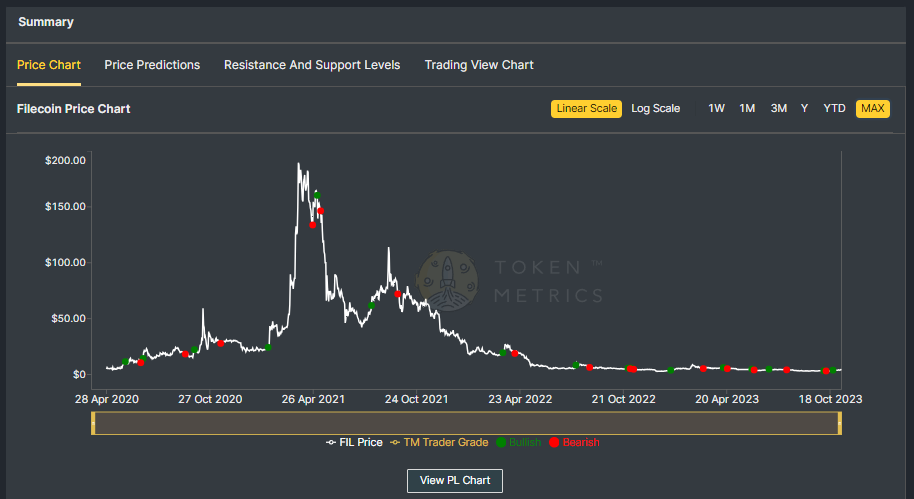
Filecoin Price Chart
Start Your Free Trial Today and Uncover Your Token's Price Prediction and Forecast on Token Metrics.

Filecoin Fundamentals

Filecoin's journey has indeed been an awe-inspiring odyssey. Since its inception, it has continuously evolved, reshaping the world of decentralized data storage.

The historical records paint a vivid picture of remarkable growth and unwavering resilience, captivating the interest of both institutional and retail investors.

Exploring Filecoin's Current Fundamentals

At the heart of Filecoin's fundamental strength lies its pioneering approach to data storage. It has firmly positioned itself as a frontrunner in decentralized data storage, providing a platform for users to transact storage space.

This ingenious fusion of blockchain technology with data storage solutions has propelled its significance to new heights.

Key Fundamentals 

  • Decentralized data storage: Filecoin delivers a secure, decentralized means of storing and retrieving data, offering immense value across various applications.
  • Market dynamics: Its marketplace for storage providers and users fosters a competitive environment, molding pricing and service quality.
  • Diverse applications: From data archiving to content delivery, Filecoin accommodates a broad array of data storage requirements.
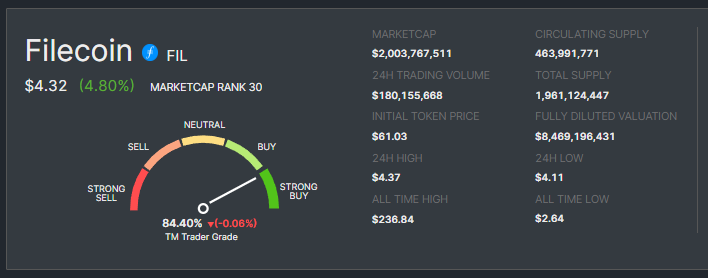
Filecoin Tokenomics

Filecoin's Long-Term Price Projection - Insights from Industry Experts: Distinguished cryptocurrency analysts and authorities envision a bright future for Filecoin. 

Their optimism stems from Filecoin's distinctive role within the data storage sector, serving as an alternative to traditional centralized storage methods. 

While prudence dictates caution in price projections, these experts suggest that Filecoin holds the potential for substantial long-term appreciation.

Now, let's embark on a comprehensive exploration of diverse forecasts for Filecoin's price in 2023, 2025, and 2030.

Filecoin Price Prediction: Scenario Analysis

To make accurate price predictions, it is crucial to consider different scenarios that can impact Filecoin's price. Let's analyze two scenarios - a bullish and a bearish scenario - to get a better understanding of the potential price movements of Filecoin.

Filecoin Price Prediction - Bullish Scenario

If the crypto market cap hits $3 Trillion, and if Filecoin retains its current 0.14% dominance, its price could ascend to $9.35

In a more bullish scenario of the crypto market surging to $10 Trillion, Filecoin's price could soar to a staggering $31.18, resulting in a potential 7x return for investors.

Filecoin Price Prediction - Scenario Analysis
Start Your Free Trial Today and Uncover Your Token's Price Prediction and Forecast on Token Metrics.

Filecoin Price Prediction - Bearish Scenario

In a bearish scenario, where market conditions are unfavorable, or there is increased competition, the price of Filecoin may face downward pressure with a decreased dominance of 0.07%.

In this scenario, If the crypto market cap hits $3 Trillion, Filecoin could trade around $4.67 in the short term and struggle to surpass $15.59 by 2030 even if the total crypto market cap surpasses the $10 Trillion mark.

It is essential to note that these scenarios are speculative and should not be considered financial advice. The cryptocurrency market is highly volatile, and prices can fluctuate rapidly.

Filecoin Price Predictions - Industry Expert Opinion

  • CryptoPredictions: The Crypto Predictions platform predicts that Filecoin's price in 2023 could reach an average of $2.802.
  • CoinCodex: Forecasts that the price of Filecoin may fluctuate between $3.07 (minimum) and $25.56 (maximum) in 2024.
  • Bitnation: Suggests a maximum potential price of $8.84, an average of $7.90, and a minimum of $6.95 for Filecoin by the end of 2024.
  • OvenAdd: Estimates a potential yearly low for Filecoin at $16.47 and a potential high of $17.56 in 2024.
  • CryptoPredictions: Suggests an average price of $5.643 for Filecoin in 2025, and by 2030, the average price of Filecoin may reach $28.

Please remember that these are predictions, and actual outcomes may vary. It's advisable to conduct thorough research before making any investment decisions.

Note - Start Your Free Trial Today and Uncover Your Token's Price Prediction and Forecast on Token Metrics.

Filecoin Price Prediction

Is Filecoin Good to Invest or Avoid?

The answer depends on your investment goals and risk tolerance. Filecoin continues to disrupt the data storage industry by providing a decentralized and secure solution. It has a unique market positioning, which may appeal to investors looking to diversify their portfolios.

Reasons to Invest in Filecoin:

  • Growing demand: The need for secure and decentralized data storage is rising, making Filecoin's services increasingly relevant.
  • Innovation: Filecoin represents a novel approach to data storage, which could lead to further adoption.
  • Competitive advantage: Its decentralized marketplace differentiates Filecoin from traditional data storage solutions.

Risks and Considerations:

  • Market competition: Filecoin faces competition from both traditional data storage providers and other blockchain-based solutions.
  • Regulatory environment: Regulatory changes and compliance issues could impact Filecoin's operations.
  • Volatility: As with all cryptocurrencies, Filecoin's price is subject to market volatility.

Future Potential of Filecoin

The future potential of Filecoin is grounded in its unique approach to decentralized data storage. As the demand for secure data storage continues to grow, Filecoin is well-positioned to be a significant player.

Its roadmap includes plans for enhancing scalability, security, and performance, ensuring its place at the forefront of the decentralized data storage sector.

Also Read - XRP Price Prediction

Expert Insights

Crypto experts and analysts from the industry share their thoughts on Filecoin's long-term potential:

Frequently Asked Questions

Q1. What makes Filecoin different from traditional data storage solutions? 

Filecoin distinguishes itself by offering decentralized, blockchain-based data storage, which provides enhanced security and ownership control.

Q2. How can I invest in Filecoin?
You can invest in Filecoin by purchasing FIL tokens on cryptocurrency exchanges. Be sure to store them securely in a compatible wallet.

Q3. What factors should I consider before investing in Filecoin? 

Before investing, consider your risk tolerance, the competitive landscape, regulatory developments, and the long-term potential of Filecoin in the data storage sector.

Q4. Can I mine Filecoin? 

Yes, Filecoin offers a mining opportunity where users can earn FIL tokens by providing storage and retrieval services.

Q5. Where can I find more information about Filecoin's technology and roadmap?
For a deeper understanding of Filecoin's technology and future plans, consult the official Filecoin documentation and stay updated with their development updates.

Conclusion

Filecoin has demonstrated remarkable growth and innovation in the dynamic field of decentralized data storage. 

While the potential for long-term growth is promising, investors must conduct thorough research, evaluate risks, and consider expert opinions when deciding if Filecoin aligns with their investment objectives. The crypto world is ever-evolving, and vigilance is essential when considering any investment.

Disclaimer

The information provided on this website does not constitute investment advice, financial advice, trading advice, or any other advice, and you should not treat any of the website's content as such.

Token Metrics does not recommend that any cryptocurrency should be bought, sold, or held by you. Conduct your due diligence and consult your financial advisor before making investment decisions.

Build Smarter Crypto Apps &
AI Agents in Minutes, Not Months
Real-time prices, trading signals, and on-chain insights all from one powerful API.
Grab a Free API Key
Token Metrics Team
Token Metrics Team

Recent Posts

Crypto Basics

How Do Taxes Work for Crypto Trading?

Token Metrics Team
5 min
MIN

Cryptocurrency trading can be exciting and profitable, but one thing many traders overlook is taxation. Whether you’re buying Bitcoin, trading altcoins, or earning staking rewards, your activities can create taxable events—and failure to report them properly can lead to hefty penalties.

If you’ve been wondering, “How do taxes work for crypto trading?”, this guide breaks it all down. We’ll explain how crypto taxes work, the most common taxable events, and how Token Metrics can help you make smarter, tax-conscious trading decisions.

Are Cryptocurrencies Taxed?

Yes. In most countries, cryptocurrencies are treated as property, not currency, for tax purposes. This means:

  • Buying crypto with fiat (e.g., USD → BTC) is not taxable by itself.

  • Selling, swapping, or spending crypto is a taxable event.

  • Earning crypto (through staking, mining, or airdrops) is taxable income.

While tax laws vary by country, the principle is the same: any gain or income from crypto is subject to taxation.

Common Taxable Events in Crypto

To manage your taxes effectively, you need to know what counts as a taxable event.

1. Selling Crypto for Fiat

If you sell Bitcoin, Ethereum, or any other crypto for fiat currency, you must report capital gains or losses.

Example:

  • You bought 1 BTC for $20,000 and sold it for $40,000.

  • Your capital gain is $20,000—which is taxable.

2. Trading One Crypto for Another

Swapping one crypto for another (e.g., BTC → ETH) is also a taxable event.

Why?

  • You’re considered to have “sold” BTC at its fair market value and “bought” ETH.

3. Spending Crypto on Goods or Services

Using crypto to buy a car, laptop, or coffee? That’s a taxable event too.

Example:

  • You bought 1 ETH at $1,000.

  • You used it to buy goods when ETH was worth $2,000.

  • The $1,000 gain is taxable.

4. Earning Crypto

  • Staking & Mining Rewards: Counted as ordinary income at the time you receive them.

  • Airdrops & Hard Forks: The value at the time you receive them is taxable income.

5. DeFi & NFT Transactions

DeFi activities like yield farming, lending, or NFT trading may also trigger complex taxable events depending on jurisdiction.

Capital Gains: Short-Term vs. Long-Term

When you sell crypto, your profit is classified as a capital gain—either short-term or long-term.

  • Short-Term Gains:


    • Assets held less than 12 months.

    • Taxed at your ordinary income tax rate (higher).

  • Long-Term Gains:


    • Assets held more than 12 months.

    • Taxed at reduced capital gains rates (in many jurisdictions).

Pro Tip: Holding crypto for at least a year can significantly lower your tax burden.

How to Calculate Your Crypto Taxes

Step 1: Track Every Transaction

Record:

  • Date & time of the trade.

  • Type of transaction (buy, sell, swap).

  • Amount & value in fiat currency.

  • Fees paid.

Step 2: Determine Cost Basis

Your cost basis is how much you paid for the asset (including fees).

Step 3: Calculate Gains/Losses

Subtract your cost basis from the selling price:

  • Profit = Taxable gain

  • Loss = Tax-deductible (in some countries).

Step 4: Report Income

Report staking, mining, and airdrop rewards as ordinary income at their market value when received.

How Token Metrics Helps with Tax-Efficient Trading

Staying compliant doesn’t just mean reporting correctly—it means trading smartly to reduce your tax burden. That’s where Token Metrics can help.

1. AI-Powered Portfolio Tracking

Track all your crypto holdings across exchanges and wallets, making tax reporting easier.

2. Long-Term vs. Short-Term Insights

Use Investor Grades to identify cryptos worth holding long-term, reducing your tax liability on gains.

3. Strategic Trade Timing

Get AI-powered trading signals to make smarter decisions on when to sell—balancing profits and taxes.

4. Narrative Tracking

Spot emerging narratives (AI tokens, DeFi trends) early, allowing you to plan tax-friendly entries and exits.

Strategies to Minimize Crypto Taxes

  1. Hold for Over a Year: Qualify for long-term capital gains rates.

  2. Harvest Losses: Sell underperforming assets to offset taxable gains.

  3. Use Tax-Friendly Accounts: Some countries allow crypto investments in tax-advantaged accounts.

  4. Gift Crypto: In certain jurisdictions, gifting crypto can reduce tax exposure.

  5. Use AI for Smart Exits: Token Metrics can help you plan trades strategically to minimize taxable events.

Common Mistakes to Avoid

  • Not tracking transactions: Without records, you can’t calculate accurate gains/losses.

  • Ignoring swaps: Trading crypto-to-crypto is still taxable.

  • Forgetting airdrops/staking rewards: These are considered income at receipt.

  • Panic-selling without strategy: Leads to high taxes and missed opportunities.

Global Variations in Crypto Taxes

Tax treatment varies by country:

  • U.S.: IRS treats crypto as property.

  • UK: HMRC applies Capital Gains Tax on disposals.

  • Australia: ATO taxes crypto as property.

  • EU: Policies vary by member state but generally treat crypto as assets.

Always consult a crypto tax professional for advice in your jurisdiction.

Practical Example

Let’s say you:

  • Bought 2 ETH at $1,500 each ($3,000 total).

  • Sold 1 ETH at $3,000.

  • Your gain: $1,500 (minus fees).

  • If you held for over a year, you pay long-term capital gains tax. If not, it’s short-term at a higher rate.

With Token Metrics, you could track purchase dates and AI signals to time your exit strategically—potentially saving on taxes.

Final Thoughts

So, how do taxes work for crypto trading?

  • Selling, swapping, and spending crypto are taxable events.

  • Staking, mining, and airdrops are taxed as income.

  • Holding for over a year often reduces your tax bill.

The key to staying compliant and minimizing taxes is tracking transactions, planning trades strategically, and using the right tools.

That’s where Token Metrics helps. With AI-driven portfolio tracking, tax-efficient trading insights, and market analytics, Token Metrics empowers you to trade smarter, reduce taxable events, and keep more of your profits.

Don’t just trade crypto—trade tax-smart.

Research

What Are Limit Orders vs. Market Orders?

Token Metrics Team
8 min
MIN

When you trade cryptocurrency, you’ll come across different types of orders—market orders and limit orders being the two most common. Understanding how they work is essential for controlling your entry and exit points, minimizing slippage, and making better trading decisions.

If you’ve ever wondered, “What’s the difference between limit orders and market orders?”, you’re in the right place. This guide will break it down in detail, explain when to use each, and show how Token Metrics helps you execute smarter trades with AI-powered insights.

What Is a Market Order?

A market order is the simplest type of trade. It tells an exchange:

“Buy or sell this cryptocurrency at the best available price right now.”

How It Works:

  • When you place a market order to buy, the system instantly matches you with sellers at the lowest available price.

  • When you place a market order to sell, it instantly matches you with buyers at the highest available price.

Advantages of Market Orders:

  1. Instant Execution: Your trade goes through immediately.

  2. Simplicity: Perfect for beginners who want fast transactions.

  3. Useful in High-Volatility Conditions: If you need to enter or exit a trade quickly, market orders are your best bet.

Disadvantages of Market Orders:

  1. Slippage: If liquidity is low or the market moves quickly, you might pay more (or receive less) than expected.

  2. No Price Control: You accept whatever price the market offers at that moment.

Example:
If Bitcoin is trading at $40,000 and you place a market order for 1 BTC, you may end up paying $40,050 if the price moves up in the milliseconds it takes to execute your trade.

What Is a Limit Order?

A limit order gives you more control. It tells an exchange:

“Buy or sell this cryptocurrency at this specific price (or better).”

How It Works:

  • When you place a buy limit order, you set the maximum price you’re willing to pay.

  • When you place a sell limit order, you set the minimum price you’re willing to accept.

  • The order stays open until the market reaches your price—or until you cancel it.

Advantages of Limit Orders:

  1. Price Control: You won’t pay more (or sell for less) than your chosen price.

  2. Better for Planning: Ideal for setting up trades without constantly watching the market.

  3. Lower Fees: Some exchanges offer lower “maker” fees for limit orders since they add liquidity.

Disadvantages of Limit Orders:

  1. No Guarantee of Execution: If the market doesn’t reach your price, your order won’t go through.

  2. Slower Execution: Not suitable for urgent trades in fast-moving markets.

Example:
If Bitcoin is trading at $40,000, you could set a buy limit order at $39,500. If the price dips to that level, your order fills. If it doesn’t, you won’t buy.

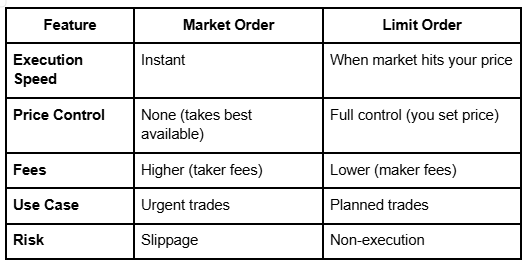
Limit Orders vs. Market Orders: Key Differences

When Should You Use Market Orders?

Market orders are best when:

  • You need speed: Entering or exiting a trade quickly.

  • The market is highly liquid: For large-cap coins like Bitcoin and Ethereum, slippage is minimal.

  • News-based trading: When reacting to breaking news or sudden price surges.

When Should You Use Limit Orders?

Limit orders are best when:

  • You want price control: Setting entries at discount levels or selling at specific profit targets.

  • You’re trading low-liquidity coins: Prevents overpaying due to slippage.

  • You’re building a strategy: Setting multiple entries and exits without active monitoring.

How Token Metrics Helps You Use Market & Limit Orders Effectively

Placing orders is one thing—placing them at the right time is what makes you profitable. That’s where Token Metrics helps.

1. AI-Powered Trading Signals

Get real-time bullish and bearish alerts based on 80+ technical indicators, helping you know when to execute market or limit orders for maximum efficiency.

2. Trader & Investor Grades

Use Trader Grades for short-term trading opportunities (perfect for market orders) and Investor Grades for long-term accumulation (ideal for limit orders).

3. Narrative Tracking

Our AI identifies emerging narratives—like AI tokens or DeFi plays—so you can strategically place limit orders before trends take off.

4. AI-Managed Indices

Don’t want to place manual orders? Token Metrics’ AI-managed portfolios automatically rebalance based on market conditions, helping you avoid constant order management.

Practical Example: Combining Both Orders

Imagine you’re trading Ethereum (ETH):

  • Step 1: Token Metrics issues a bullish signal at $2,400, projecting a potential breakout.

  • Step 2: You place a market order to enter quickly at $2,400 to catch the momentum.

  • Step 3: You set a limit sell order at $2,700 to automatically secure profits without monitoring the chart.

This combination allows you to enter fast and exit smart—with less emotional stress.

Advanced Tips for Using Limit & Market Orders

  1. Use Stop-Limit Orders: Combine stop-loss and limit functions to protect against big losses.

  2. Layer Your Limit Orders: Place multiple buy/sell limits at different price levels for better cost averaging.

  3. Avoid Market Orders on Illiquid Coins: Slippage can cost you significantly.

  4. Use AI for Timing: Token Metrics helps you time entries and exits—so you’re not just placing random orders.

Final Thoughts

So, what’s the difference between limit orders and market orders?

  • Market orders are for speed—you get the trade done instantly at the best available price.

  • Limit orders are for control—you set the exact price you want to buy or sell.

The key is knowing when to use each—and using data-driven insights to make those decisions.

That’s where Token Metrics gives you an edge. With AI-powered trading signals, narrative tracking, and automated portfolio tools, Token Metrics helps you decide when to use market vs. limit orders, so you can trade confidently and profitably.

In crypto trading, timing is everything—and Token Metrics makes timing smarter.

Research

How Do I Manage Risk in Crypto Trading?

Token Metrics Team
8 min
MIN

Cryptocurrency trading can be highly profitable—but it’s also one of the riskiest markets in the world. Prices can swing wildly in seconds, projects can collapse overnight, and emotional decisions often lead to costly mistakes.

If you want to survive (and thrive) in crypto trading, you must learn how to manage risk effectively. In this guide, we’ll break down why risk management is critical, the top strategies to protect your capital, and how Token Metrics can help you trade smarter, safer, and with more confidence using AI-driven insights.

Why Risk Management Is Non-Negotiable in Crypto

In traditional markets, a 5% price movement is big news. In crypto? Daily moves of 10–20% are normal.

  • High volatility: Crypto is more speculative than stocks or forex.
  • Unregulated space: Scams and market manipulation are more common.
  • Emotional trading: Fear and FOMO lead to poor decisions.

Without a solid risk management plan, even experienced traders can lose everything.

Top Risk Management Strategies for Crypto Trading

1. Only Invest What You Can Afford to Lose

This is rule number one.

  • Never invest rent, emergency savings, or money you can’t afford to lose.
  • Treat crypto like a high-risk asset class—because it is.

2. Diversify Your Portfolio

Don’t put all your funds into one token.

  • Spread across different coins & sectors: Bitcoin, Ethereum, AI tokens, DeFi, etc.
  • Balance risk levels: Mix large-cap coins with small-cap moonshots.

How Token Metrics Helps:
Use AI-driven indices to build a diversified, auto-rebalanced portfolio aligned with your risk tolerance.

3. Use Stop-Loss Orders

Set stop-loss levels to automatically sell if prices fall below a certain threshold.

  • Prevents small losses from becoming catastrophic.
  • Helps maintain discipline during market dips.

Pro Tip: Place stops at strategic support levels, not random round numbers.

4. Size Your Positions Properly

Don’t go “all-in” on one trade.

  • Position sizing ensures no single trade wipes out your portfolio.
  • A common rule: risk 1–2% of your capital per trade.

5. Avoid Overleveraging

Leverage amplifies gains—but also losses.

  • Start with low or no leverage until you’re experienced.
  • High leverage trading can lead to instant liquidation in volatile markets.

6. Keep Emotions in Check

Fear, greed, and FOMO (fear of missing out) destroy portfolios.

  • Stick to your strategy.
  • Don’t chase pumps or panic-sell during dips.

How Token Metrics Helps:
Our AI-powered bullish and bearish signals take emotions out of trading by giving you data-backed entry and exit points.

7. Stay Informed

Markets move on news—regulations, partnerships, or even tweets.

  • Follow credible sources for updates.
  • Use narrative tracking to spot market-shifting trends early.

How Token Metrics Helps:
Our AI tracks emerging narratives (e.g., AI tokens, DeFi, RWAs), so you can adjust positions before the crowd reacts.

8. Use Risk/Reward Ratios

Before entering a trade, ask:

  • Is the potential reward worth the risk?
  • Aim for at least a 2:1 or 3:1 reward-to-risk ratio.

9. Practice Secure Asset Storage

Risk management isn’t just about trades—it’s also about keeping your crypto safe.

  • Use hardware wallets for long-term holdings.
  • Enable 2FA on exchanges.

10. Review & Adjust Your Strategy

Markets evolve—your plan should too.

  • Track your wins and losses.
  • Optimize your strategy using performance data.

How Token Metrics Helps You Manage Risk

Token Metrics isn’t just a research platform—it’s an AI-powered risk management assistant.

1. AI-Powered Trade Insights

Get real-time bullish and bearish signals to time entries and exits more effectively—reducing impulsive trades.

2. Trader & Investor Grades

Quickly assess tokens for short-term trading potential (Trader Grade) or long-term viability (Investor Grade)—helping you avoid high-risk projects.

3. AI-Managed Indices

Use auto-rebalanced AI indices to maintain diversification and reduce risk exposure.

4. Moonshot Finder

Interested in high-risk, high-reward tokens? Our Moonshot Finder filters low-cap projects using AI, helping you avoid scams and rug pulls.

5. Narrative Detection

Our AI tracks emerging narratives so you can anticipate market movements early—reducing exposure to collapsing trends.

Example: Risk Management Using Token Metrics

Imagine you want to invest $5,000 in crypto:

  • Without Token Metrics: You randomly choose 3 coins based on hype and YouTube videos. Two collapse, and your portfolio drops 50%.

  • With Token Metrics: You build a diversified AI-managed index of large-cap and promising small-cap tokens, use stop-loss levels, and set alerts for bullish/bearish signals. Your portfolio drops only 10% in a downturn—saving thousands.

This is how data-driven trading transforms risk into opportunity.

Practical Risk Management Checklist

  1. Never invest more than you can afford to lose.

  2. Diversify across coins and sectors.

  3. Use stop-loss orders to cap losses.

  4. Avoid overleveraging at all costs.

  5. Set realistic reward-to-risk ratios (2:1 or better).

  6. Use AI-powered tools like Token Metrics for smarter trades.

  7. Stay informed about news and emerging narratives.

  8. Secure your assets with hardware wallets and 2FA.

  9. Track and adjust your trading strategy regularly.

  10. Trade with logic, not emotions.

Final Thoughts

So, how do you manage risk in crypto trading? It’s about balancing your portfolio, using smart tools, and staying disciplined.

While volatility is unavoidable, you can control how much you’re exposed to it. With Token Metrics, you gain AI-powered insights, trade signals, and portfolio tools that help you reduce risks while maximizing opportunities.

In crypto, it’s not just about making profits—it’s about keeping them.

Choose from Platinum, Gold, and Silver packages
Reach with 25–30% open rates and 0.5–1% CTR
Craft your own custom ad—from banners to tailored copy
Perfect for Crypto Exchanges, SaaS Tools, DeFi, and AI Products