





From Traditional Index Funds to Crypto: Why Token Metrics AI Indices Are the Smart Choice for Digital Asset Investors
%201.svg)
%201.svg)
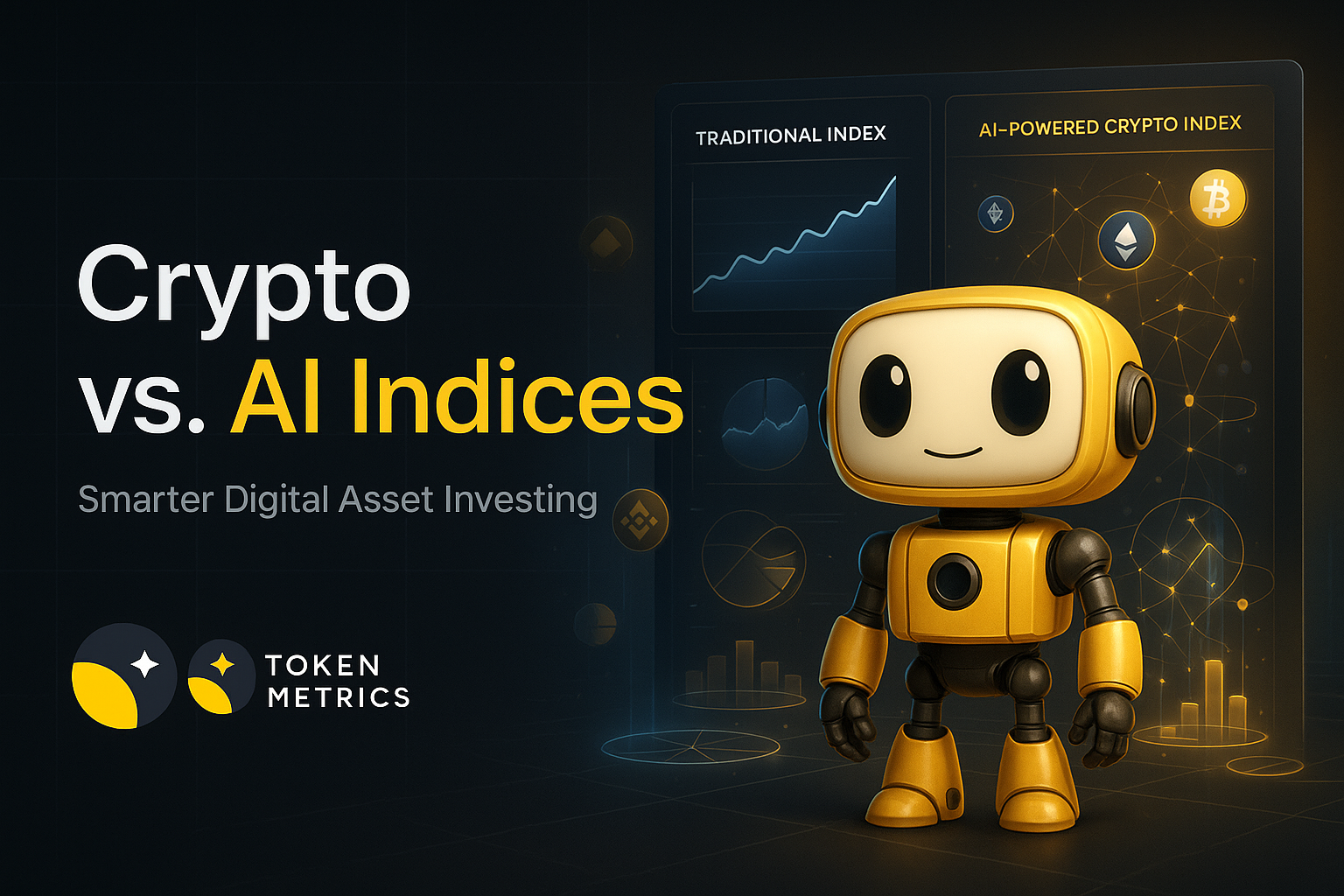

The Index Fund Revolution Comes to Cryptocurrency
When John Bogle founded Vanguard and introduced the first index mutual fund in 1975, Wall Street laughed. The idea that a passively managed fund tracking market indices could outperform expensive, actively managed portfolios seemed absurd. Nearly five decades later, index funds have revolutionized investing, managing trillions of dollars and consistently outperforming the majority of active managers.
Today, a similar revolution is unfolding in cryptocurrency markets. Token Metrics, a pioneering AI-powered crypto analytics platform, is bringing the proven principles of index investing to digital assets—but with a powerful 21st-century upgrade: artificial intelligence. This transformation addresses one of the biggest challenges facing crypto investors: how to build winning portfolios in a market with over 20,000 tokens, extreme volatility, and rapid technological change.
Why Traditional Crypto Investing Methods Fall Short
The Information Overload Problem
The average cryptocurrency investor faces an overwhelming challenge. To make informed decisions, they theoretically need to analyze project whitepapers and technical documentation, evaluate development team credentials and track records, monitor GitHub repositories for code quality and activity, track community sentiment across multiple social platforms, understand complex tokenomics and supply mechanics, follow regulatory developments across multiple jurisdictions, and assess competition and market positioning.
Performing this level of due diligence for even 10-20 cryptocurrencies requires dozens of hours weekly. For most investors with full-time jobs and other responsibilities, this depth of analysis is simply impossible. The result? Many investors rely on social media hype, influencer recommendations, or gut feelings—approaches that often lead to poor outcomes.
The Emotional Trading Trap
Cryptocurrency markets operate 24/7, with price movements that can exceed 20-30% in a single day. This constant volatility triggers powerful emotional responses. When prices surge, fear of missing out (FOMO) drives investors to buy near peaks. When prices crash, panic selling locks in losses at the worst possible time.
Studies in behavioral finance consistently demonstrate that emotional decision-making destroys investment returns. Yet the structure of crypto markets—with their relentless volatility and constant news flow—makes emotional discipline extraordinarily difficult to maintain.
The Scam and Fraud Risk
The decentralized, largely unregulated nature of cryptocurrency markets creates opportunities for fraudulent projects. Rug pulls, where developers abandon projects after raising funds, exit scams involving fake teams and plagiarized whitepapers, pump-and-dump schemes, and sophisticated phishing attacks targeting crypto investors are unfortunately common.
Distinguishing legitimate innovative projects from elaborate scams requires expertise that most retail investors lack. A single mistake can result in total loss of capital with little legal recourse.
The Rebalancing Challenge
Even investors who successfully build diversified crypto portfolios face the ongoing challenge of rebalancing. As different cryptocurrencies perform differently, portfolio allocations drift from their intended targets. Bitcoin might grow from 40% to 60% of your portfolio, while a promising altcoin shrinks from 10% to 2%.
Deciding when and how to rebalance involves complex tradeoffs. Rebalancing too frequently generates transaction costs and potential tax consequences. Rebalancing too infrequently allows portfolios to become concentrated in specific assets, defeating the purpose of diversification.
The Token Metrics Solution: AI-Powered Index Investing
What Makes Token Metrics Different
Token Metrics has developed cryptocurrency indices that combine the proven benefits of traditional index investing with cutting-edge artificial intelligence. Unlike simple market-cap weighted indices that mechanically track the largest cryptocurrencies, Token Metrics indices use sophisticated machine learning algorithms to identify high-quality projects and optimize portfolio construction.
The platform processes data from over 6,000 cryptocurrencies and NFT projects, analyzing multiple factors simultaneously including technical indicators and chart patterns, fundamental metrics like adoption and network activity, code quality and development velocity, sentiment analysis from social media and news, on-chain data revealing wallet behavior and token flows, and exchange metrics including liquidity and trading volume.
This comprehensive AI-driven analysis operates continuously, updating in real-time as new information becomes available. The system identifies patterns and relationships that human analysts would miss, creating a systematic framework for investment decisions.
The AI Advantage: Processing Power Meets Market Intelligence
Artificial intelligence excels at exactly the tasks that overwhelm human investors. Machine learning algorithms can simultaneously analyze thousands of data points, identify subtle correlations and patterns, remove emotional bias from decision-making, update continuously as new information emerges, and learn from historical data to improve future predictions.
Token Metrics' AI has been refined through multiple crypto market cycles, learning from both bull and bear markets. This experience-based learning allows the system to recognize market regimes, identify emerging trends before they become obvious, spot quality projects in early stages, and avoid common pitfalls that trap human investors.
The result is investment guidance that combines the scale and objectivity of artificial intelligence with the market insights of professional analysts. Token Metrics doesn't rely solely on algorithms—human experts validate AI recommendations and provide strategic oversight.
Model Portfolios Built for Different Investment Styles
Token Metrics recognizes that investors have different goals, risk tolerances, and time horizons. Rather than offering a one-size-fits-all solution, the platform provides multiple index strategies tailored to specific investor profiles.
Conservative investors can access indices focused on large-cap cryptocurrencies with established track records, lower volatility, and greater liquidity. These "blue chip" crypto indices provide stability while still offering exposure to digital asset growth.
Moderate investors might choose balanced indices that blend large-cap stability with mid-cap growth opportunities, diversifying across 10-20 carefully selected cryptocurrencies. These indices aim to optimize the risk-return tradeoff for investors comfortable with moderate volatility.
Aggressive investors seeking maximum growth potential can access indices featuring emerging tokens, sector-specific themes like DeFi or NFTs, and higher-risk, higher-reward opportunities. These indices accept greater short-term volatility in pursuit of asymmetric upside.
Additionally, Token Metrics offers indices designed for different trading timeframes. Short-term trader indices emphasize momentum and technical signals with frequent rebalancing, while long-term investor indices focus on fundamental quality with less frequent adjustments.
Transparent Methodology and Performance Tracking
Unlike some crypto investment products where holdings and strategies remain opaque, Token Metrics provides complete transparency. Every index clearly displays current holdings and portfolio weights, rebalancing transactions and rationale, historical performance data, risk metrics and volatility measures, and comparison benchmarks like Bitcoin performance.
This transparency allows investors to understand exactly what they own and why. If an index underperforms, investors can review the decisions and understand the factors involved. If an index outperforms, they can see which positions contributed to success.
The platform tracks multiple performance metrics beyond simple price returns, including Sharpe ratios measuring risk-adjusted returns, maximum drawdown showing worst-case scenarios, win rate and average trade profitability, and correlation with Bitcoin and broader markets.
Get Started For Free
Comparing Approaches: DIY vs. Token Metrics AI Indices
Time Investment Required
Consider the time commitment for different approaches to crypto investing. DIY manual investing requires researching individual tokens (5-10 hours per token initially), monitoring news and developments (1-2 hours daily), managing rebalancing decisions (2-3 hours monthly), and tracking performance and tax implications (2-3 hours quarterly). This totals approximately 60-80 hours monthly for a moderately active investor.
In contrast, investing through Token Metrics AI Indices requires initial setup and index selection (1-2 hours once), periodic portfolio review (30 minutes monthly), and annual strategy assessment (1-2 hours yearly). Total time commitment: approximately 1-2 hours monthly.
The time saved through AI-powered indices can be substantial—potentially 800+ hours annually. For professionals and busy individuals, this efficiency gain alone justifies the approach.
Decision Quality and Consistency
Human decision-making suffers from numerous cognitive biases that harm investment returns. Confirmation bias leads us to seek information supporting existing beliefs, recency bias causes overweighting recent events, anchoring bias fixes decisions on irrelevant reference points, and herd mentality drives following crowds into bubbles.
Token Metrics' AI doesn't suffer from these psychological weaknesses. The algorithms evaluate cryptocurrencies based on objective criteria, maintaining consistency regardless of market sentiment. When markets panic, the AI doesn't—it systematically identifies opportunities created by irrational selling. When euphoria drives prices to unsustainable levels, the AI remains disciplined, rotating out of overvalued positions.
This emotional discipline is particularly valuable in cryptocurrency markets where volatility and 24/7 trading amplify psychological pressures.
Click here to signup for free trial account!
Risk Management and Diversification
DIY crypto investors often make diversification mistakes including over-concentration in favorite tokens, insufficient exposure to emerging sectors, poor correlation understanding, and inadequate risk controls.
Token Metrics indices implement sophisticated diversification strategies based on modern portfolio theory, including optimal position sizing, correlation analysis ensuring true diversification, sector allocation across different blockchain use cases, and risk budgeting that limits potential losses.
The AI continuously monitors portfolio risk characteristics, adjusting holdings to maintain target risk levels as market conditions change. This dynamic risk management protects capital during downturns while positioning portfolios to capture upside during recoveries.
Access to Professional Analytics
Individual investors typically lack access to institutional-grade research and analytics. Premium data feeds can cost thousands of dollars monthly, professional analyst reports require expensive subscriptions, advanced analytical tools demand significant technical expertise, and network effects from information sharing among professionals create advantages for institutions.
Token Metrics democratizes access to institutional-quality analytics. Subscribers gain access to the same AI-powered insights, real-time data feeds, professional research, and sophisticated tools that large crypto funds use. This levels the playing field, allowing retail investors to compete effectively.
Real-World Applications: Who Benefits from Token Metrics AI Indices
Crypto Newcomers Building First Positions
For investors new to cryptocurrency, Token Metrics indices provide an ideal entry point. Rather than gambling on individual tokens based on limited knowledge, newcomers can invest in diversified, professionally managed portfolios. The indices serve as both an investment vehicle and an educational tool—by tracking index holdings and performance, new investors learn about different cryptocurrencies and market dynamics.
The platform's educational resources, including tutorials, webinars, and research reports, complement the indices. New investors can build understanding while their capital is professionally managed, avoiding costly beginner mistakes.
Busy Professionals Lacking Time for Research
Many professionals recognize cryptocurrency's potential but lack time for comprehensive research. A doctor, lawyer, or executive might want crypto exposure without becoming a full-time crypto analyst. Token Metrics indices solve this problem perfectly—providing professional portfolio management without requiring significant time investment.
These investors can focus on their careers while still participating in crypto market growth through systematically managed indices.
Active Traders Seeking Complementary Strategies
Even experienced crypto traders benefit from Token Metrics indices. Active traders might use indices as core portfolio holdings, providing stable exposure while they trade individual tokens more tactically. This "core and satellite" approach combines passive index investing with active trading, balancing risk and return.
Traders can also use indices as benchmarks, comparing their active trading performance against AI-managed portfolios. This provides objective measurement of whether active strategies add value or destroy it.
Institutional Investors and Advisors
Family offices, registered investment advisors, and institutional investors seeking crypto exposure face unique challenges. They need robust due diligence, transparent methodology, performance accountability, and risk management frameworks.
Token Metrics indices meet these institutional requirements. The platform's systematic approach, transparent reporting, and track record provide the documentation and accountability that fiduciaries require. Advisors can confidently recommend Token Metrics indices to clients knowing the investment process is professional and defensible.
Getting Started: Your Path to AI-Powered Crypto Investing
Step 1: Assess Your Investment Profile
Begin by honestly evaluating your investment goals, risk tolerance, time horizon, and current crypto knowledge. Are you building long-term wealth or seeking short-term trading profits? Can you tolerate 50%+ volatility or do you need more stability? Are you investing for retirement decades away or shorter-term goals?
Token Metrics offers tools to help assess your investor profile and match you with appropriate index strategies. This self-assessment ensures alignment between your chosen indices and personal circumstances.
Step 2: Explore Available Indices
Token Metrics provides detailed information about each index including investment strategy and objectives, historical performance and risk metrics, current holdings and sector allocations, and rebalancing frequency and methodology.
Review multiple indices to understand how they differ. Compare large-cap stability-focused indices with growth-oriented small-cap indices. Examine sector-specific indices targeting themes like DeFi or Layer 2 scaling.
Step 3: Start with Core Allocations
For most investors, a prudent approach involves starting with core indices that provide broad, diversified crypto exposure. These might include large-cap indices tracking established cryptocurrencies or balanced indices mixing large and mid-cap tokens across sectors.
Core allocations should represent 60-80% of your crypto portfolio, providing stability and systematic exposure to overall market growth.
Step 4: Add Satellite Positions for Enhanced Returns
After establishing core holdings, consider adding satellite positions in more specialized indices. These might focus on specific sectors where you have strong convictions, higher-risk, higher-reward emerging token indices, or thematic indices targeting particular narratives.
Satellite positions typically represent 20-40% of portfolios, allowing you to express specific market views while maintaining diversified core exposure.
Step 5: Monitor and Adjust Periodically
While Token Metrics indices require minimal ongoing management, periodic review remains important. Quarterly or semi-annually, assess whether your chosen indices continue aligning with your goals, review performance against expectations and benchmarks, consider whether portfolio rebalancing across indices is needed, and evaluate new index offerings that might fit your strategy.
The platform provides tools for this monitoring, including performance dashboards, comparison analytics, and alerts for significant developments.
The Future of Crypto Index Investing
Continued AI Innovation
Token Metrics continues advancing its AI technology, incorporating new data sources, refining algorithms based on market feedback, and developing more sophisticated predictive models. As AI technology progresses, the quality and accuracy of crypto indices will improve.
Future developments may include natural language processing analyzing project communications, network graph analysis identifying influential projects, sentiment prediction forecasting market movements, and anomaly detection for early risk identification.
Regulatory Clarity and Institutional Adoption
As cryptocurrency regulation becomes clearer globally, institutional adoption will accelerate. Major financial institutions are already entering crypto markets, and many plan to offer crypto products to clients. Token Metrics indices are well-positioned to serve this institutional demand, providing the professional infrastructure and accountability that large investors require.
Increasing institutional participation will likely reduce crypto market volatility over time, making indices even more attractive for conservative investors seeking stable exposure.
Integration with Traditional Finance
The boundary between traditional finance and cryptocurrency is blurring. Eventually, crypto indices may be accessible through traditional brokerage accounts, included in 401(k) and IRA retirement accounts, offered as components of target-date funds, and used in robo-advisor portfolio construction.
Token Metrics is helping build this bridge, bringing professional index investing standards to cryptocurrency markets.
Conclusion: Embracing the Future of Intelligent Investing
The cryptocurrency revolution is unstoppable. Blockchain technology is transforming finance, creating new possibilities for value transfer, asset ownership, and decentralized applications. But participating successfully in this revolution requires more than enthusiasm—it demands sophisticated tools, systematic strategies, and disciplined execution.
Token Metrics AI Indices represent the evolution of crypto investing from speculation to strategy. By combining the proven principles of index investing with cutting-edge artificial intelligence, Token Metrics has created an investment solution that is accessible yet sophisticated, passive yet intelligent, and designed for the unique challenges of cryptocurrency markets.
Whether you're a crypto newcomer seeking a safe entry point, a busy professional wanting exposure without hassle, or an experienced investor seeking systematic portfolio management, Token Metrics AI Indices offer a compelling solution. The platform's transparent methodology, comprehensive analytics, and track record provide confidence that your crypto allocation is professionally managed.
Get Started For Free
The choice facing crypto investors is clear: continue struggling with information overload, emotional decisions, and time-consuming research, or embrace AI-powered indices that do the heavy lifting while you focus on what matters most in your life. The future of investing is intelligent, systematic, and data-driven. Token Metrics is making that future accessible today.
Click here to signup for free trial account!
Transform your crypto investing experience. Discover how Token Metrics AI Indices can help you build a professional cryptocurrency portfolio with the power of artificial intelligence. Visit tokenmetrics.com to explore available indices and start your journey toward smarter crypto investing.
AI Agents in Minutes, Not Months

.svg)


%201.svg)


.png)







.svg)
No Credit Card Required


Online Payment


SSL Encrypted
.png)
Token Metrics Media LLC is a regular publication of information, analysis, and commentary focused especially on blockchain technology and business, cryptocurrency, blockchain-based tokens, market trends, and trading strategies.
Token Metrics Media LLC does not provide individually tailored investment advice and does not take a subscriber’s or anyone’s personal circumstances into consideration when discussing investments; nor is Token Metrics Advisers LLC registered as an investment adviser or broker-dealer in any jurisdiction.
Information contained herein is not an offer or solicitation to buy, hold, or sell any security. The Token Metrics team has advised and invested in many blockchain companies. A complete list of their advisory roles and current holdings can be viewed here: https://tokenmetrics.com/disclosures.html/
Token Metrics Media LLC relies on information from various sources believed to be reliable, including clients and third parties, but cannot guarantee the accuracy and completeness of that information. Additionally, Token Metrics Media LLC does not provide tax advice, and investors are encouraged to consult with their personal tax advisors.
All investing involves risk, including the possible loss of money you invest, and past performance does not guarantee future performance. Ratings and price predictions are provided for informational and illustrative purposes, and may not reflect actual future performance.