Research

Building High-Performance APIs with FastAPI

Learn how FastAPI delivers high-performance Python APIs: architecture, async best practices, deployment, monitoring, and integrating AI inference pipelines for scalable services.
Token Metrics Team
5
MIN

FastAPI has emerged as a go-to framework for building fast, scalable, and developer-friendly APIs in Python. Whether you are prototyping a machine learning inference endpoint, building internal microservices, or exposing realtime data to clients, understanding FastAPI’s design principles and best practices can save development time and operational costs. This guide walks through the technology fundamentals, pragmatic design patterns, deployment considerations, and how to integrate modern AI tools safely and efficiently.

Overview: What Makes FastAPI Fast?

FastAPI is built on Starlette for the web parts and Pydantic for data validation. It leverages Python’s async/await syntax and ASGI (Asynchronous Server Gateway Interface) to handle high concurrency with non-blocking I/O. Key features that contribute to its performance profile include:

  • Async-first architecture: Native support for asynchronous endpoints enables efficient multiplexing of I/O-bound tasks.
  • Automatic validation and docs: Pydantic-based validation reduces runtime errors and generates OpenAPI schemas and interactive docs out of the box.
  • Small, focused stack: Minimal middleware and lean core reduce overhead compared to some full-stack frameworks.

In practice, correctly using async patterns and avoiding blocking calls (e.g., heavy CPU-bound tasks or synchronous DB drivers) is critical to achieve the theoretical throughput FastAPI promises.

Design Patterns & Best Practices

Adopt these patterns to keep your FastAPI codebase maintainable and performant:

  1. Separate concerns: Keep routing, business logic, and data access in separate modules. Use dependency injection for database sessions, authentication, and configuration.
  2. Prefer async I/O: Use async database drivers (e.g., asyncpg for PostgreSQL), async HTTP clients (httpx), and async message brokers when possible. If you must call blocking code, run it in a thread pool via asyncio.to_thread or FastAPI’s background tasks.
  3. Schema-driven DTOs: Define request and response models with Pydantic to validate inputs and serialize outputs consistently. This reduces defensive coding and improves API contract clarity.
  4. Version your APIs: Use path or header-based versioning to avoid breaking consumers when iterating rapidly.
  5. Pagination and rate limiting: For endpoints that return large collections, implement pagination and consider rate-limiting to protect downstream systems.

Applying these patterns leads to clearer contracts, fewer runtime errors, and easier scaling.

Performance Tuning and Monitoring

Beyond using async endpoints, real-world performance tuning focuses on observability and identifying bottlenecks:

  • Profiling: Profile endpoints under representative load to find hotspots. Tools like py-spy or Scalene can reveal CPU vs. I/O contention.
  • Tracing and metrics: Integrate OpenTelemetry or Prometheus to gather latency, error rates, and resource metrics. Correlate traces across services to diagnose distributed latency.
  • Connection pooling: Ensure database and HTTP clients use connection pools tuned for your concurrency levels.
  • Caching: Use HTTP caching headers, in-memory caches (Redis, Memcached), or application-level caches for expensive or frequently requested data.
  • Async worker offloading: Offload CPU-heavy or long-running tasks to background workers (e.g., Celery, Dramatiq, or RQ) to keep request latency low.

Measure before and after changes. Small configuration tweaks (worker counts, keepalive settings) often deliver outsized latency improvements compared to code rewrites.

Deployment, Security, and Scaling

Productionizing FastAPI requires attention to hosting, process management, and security hardening:

  • ASGI server: Use a robust ASGI server such as Uvicorn or Hypercorn behind a process manager (systemd) or a supervisor like Gunicorn with Uvicorn workers.
  • Containerization: Containerize with multi-stage Dockerfiles to keep images small. Use environment variables and secrets management for configuration.
  • Load balancing: Place a reverse proxy (NGINX, Traefik) or cloud load balancer in front of your ASGI processes to manage TLS, routing, and retries.
  • Security: Validate and sanitize inputs, enforce strict CORS policies, and implement authentication and authorization (OAuth2, JWT) consistently. Keep dependencies updated and monitor for CVEs.
  • Autoscaling: In cloud environments, autoscale based on request latency and queue depth. For stateful workloads or in-memory caches, ensure sticky session or state replication strategies.

Combine operational best practices with continuous monitoring to keep services resilient as traffic grows.

Build Smarter Crypto Apps & AI Agents with Token Metrics

Token Metrics provides real-time prices, trading signals, and on-chain insights all from one powerful API. Grab a Free API Key

FAQ: How fast is FastAPI compared to Flask or Django?

FastAPI often outperforms traditional WSGI frameworks like Flask or Django for I/O-bound workloads because it leverages ASGI and async endpoints. Benchmarks depend heavily on endpoint logic, database drivers, and deployment configuration. For CPU-bound tasks, raw Python performance is similar; offload heavy computation to workers.

FAQ: Should I rewrite existing Flask endpoints to FastAPI?

Rewrite only if you need asynchronous I/O, better schema validation, or automatic OpenAPI docs. For many projects, incremental migration or adding new async services is a lower-risk approach than a full rewrite.

FAQ: How do I handle background tasks and long-running jobs?

Use background workers or task queues (Celery, Dramatiq) for long-running jobs. FastAPI provides BackgroundTasks for simple fire-and-forget operations, but distributed task systems are better for retries, scheduling, and scaling.

FAQ: What are common pitfalls when using async in FastAPI?

Common pitfalls include calling blocking I/O inside async endpoints (e.g., synchronous DB drivers), not using connection pools properly, and overusing threads. Always verify that third-party libraries are async-compatible or run them in a thread pool.

FAQ: How can FastAPI integrate with AI models and inference pipelines?

FastAPI is a good fit for serving model inference because it can handle concurrent requests and easily serialize inputs and outputs. For heavy inference workloads, serve models with dedicated inference servers (TorchServe, TensorFlow Serving) or containerized model endpoints and use FastAPI as a thin orchestration layer. Implement batching, request timeouts, and model versioning to manage performance and reliability.

Disclaimer

This article is educational and technical in nature. It does not provide investment, legal, or professional advice. Evaluate tools and design decisions according to your project requirements and compliance obligations.

Build Smarter Crypto Apps &
AI Agents in Minutes, Not Months
Real-time prices, trading signals, and on-chain insights all from one powerful API.
Grab a Free API Key
Token Metrics Team
Token Metrics Team

Recent Posts

Announcements

Inside the Dashboard: How to Monitor API Key Activity and Monthly Usage in Real Time

Token Metrics Team
5 min
MIN

The power of any great API isn’t just in the data it provides — it’s also in the control, visibility, and accountability it gives developers. That’s why the Token Metrics API Dashboard is more than just a place to generate keys — it’s your real-time command center for monitoring API key usage, managing access, and optimizing performance.

In this article, we’ll explore how to use the Token Metrics API Dashboard to stay in control of your app’s data usage, track request history, and ensure your integrations remain secure and efficient.

📍 Where to Find It

To access the dashboard:

  1. Log in to your Token Metrics account.
  2. Go to: https://app.tokenmetrics.com/en/api
  3. Navigate to the API Keys and API Usage sections.

🔐 View and Manage API Keys

The API Keys section gives you a complete overview of every active key associated with your account. For each key, you’ll see:

  • Key Name: Descriptive labels like "Bot A" or "Staging Server"
  • Created Date: When the key was generated
  • Last Used: Timestamp of the most recent request
  • Status: Active or inactive toggle
  • Actions: Trash icon to instantly delete a key

💡 Why It Matters:

  • Spot unused or stale keys that may pose a security risk
  • Instantly disable or delete a key if it’s compromised
  • Monitor which app or environment is making the most requests

📊 Monitor API Usage in Real-Time

In the Usage Dashboard, Token Metrics gives you deep insights into how your API credits are being used.

Key metrics include:

  • API Calls Graph
    A daily call volume chart so you can identify peaks in usage, anomalies, or unexpected surges.

  • Total Monthly API Calls
    Example:
    8,750 / 20,000
    See how much of your monthly quota you’ve used — and when it resets.

  • Remaining API Credits
    Know exactly how many calls you have left in your current cycle.

  • API Call Statistics Table
    Each row includes:

    • Endpoint accessed (e.g., /trader-grade)
    • Timestamp of the request
    • Status code (200 = success, 401 = unauthorized, etc.)
    • Originating IP address
    • Success/failure response

🔄 Debugging & Insights Made Easy

This dashboard doesn’t just monitor—it helps you debug and optimize.

  • Quickly identify if your integration is repeatedly hitting 400 or 403 errors
  • Check whether a specific key is being overused or underused
  • Pinpoint spikes in usage that may indicate unauthorized access
  • See which endpoints are called most often — and consider caching results

⚠️ Avoid Rate Limit Surprises

If you’re on a Basic or Advanced plan, you’ll have a rate limit (e.g., 1 req/min for free users, up to 600 req/min for VIPs). The dashboard helps ensure you stay within your limits — and scale appropriately when needed.

🚀 Build Better with Transparency

In a production environment, visibility into API activity is critical. With Token Metrics, you’re never flying blind. You always know:

  • Which app is using which key
  • How many credits you’re using
  • When to optimize or upgrade

From security to scaling, the Token Metrics API Dashboard gives you the insight you need to build with clarity and control.

👉 Launch Your API Dashboard Now → tokenmetrics.com/api

Research

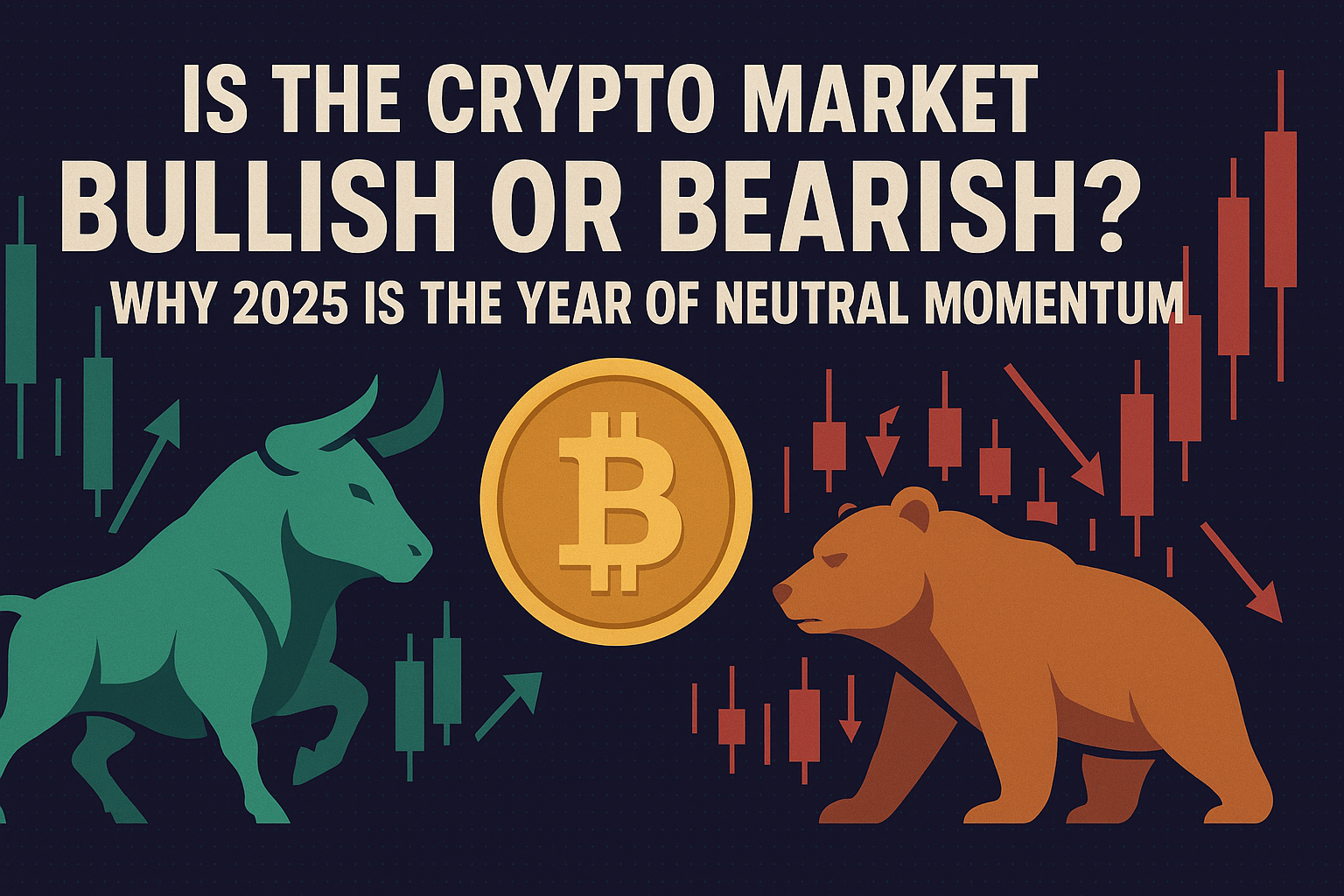
Is the Crypto Market Bullish or Bearish? Why 2025 Is the Year of Neutral Momentum

Token Metrics Team
3 min
MIN

The crypto market isn't clearly bullish or bearish in mid-2025 — it's neutral. This article explores why this 'in-between' momentum could signal a maturing market cycle, and what investors should watch for as signals normalize after a sharp $1T rebound in total market cap.

As we navigate through the midpoint of 2025, one question dominates trading desks and Telegram groups alike: Is the crypto market bullish or bearish? Surprisingly, the answer might be neither. Current indicators suggest that we are in a neutral zone — an ambiguous space where the market is no longer surging with euphoric gains but isn’t plunging into panic either.

From January through mid-May, the total crypto market cap has grown from $1 trillion to $2 trillion. This swift rebound signals recovery, but not full-blown optimism. Instead, many analysts — ourselves included — interpret this as a healthy correction and stabilization following intense early-year volatility.

This kind of environment often marks the early stages of a maturing cycle. Unlike the sharp swings we saw in previous bull and bear markets, 2025’s trend suggests more measured growth, driven by fundamentals rather than hype. In other words, the market might finally be learning from its past.

That doesn’t mean the space lacks activity. Sectors like DeFi lending and AI-related tokens continue to gain traction, with significant TVL inflows. Retail interest in meme coins also remains high in select regions. But overall, what we’re seeing is consolidation — not chaos.

In this neutral setting, strategy matters more than sentiment. It's no longer about jumping into trending narratives or panic-selling on dips. Instead, identifying projects with real use cases, sustainable economics, and strong communities has become the foundation of long-term success.

For traders and builders alike, the current landscape offers both challenges and opportunities. Risk-adjusted returns are key, and disciplined portfolio rebalancing could be one of the most underrated strategies right now.

As we continue monitoring market signals, we remain committed to surfacing actionable insights backed by real-time data, not just narratives. Whether the next breakout is weeks or months away, staying informed — and unemotional — may prove to be your best edge.

How Token Metrics Helps in a Neutral Market Environment:

In times of neutral momentum, making profitable crypto decisions becomes more complex — and that's where Token Metrics shines:

  1. Actionable AI Signals:
    Token Metrics scans thousands of tokens daily, using over 80 data points to identify bullish and bearish trends even when market sentiment is flat. This helps users cut through noise and act on real opportunities.
  2. Investor & Trader Grades:
    When hype fades, fundamentals matter. Our proprietary grades evaluate both short-term momentum and long-term viability, helping users discover tokens with staying power — not just temporary pumps.
  3. Smart Rebalancing Alerts:
    In a consolidating market, maintaining the right portfolio mix is crucial. Token Metrics' indices and alerts help users rebalance regularly to lock in gains and minimize downside risks.
  4. Sector-Based Insights:
    With DeFi, AI, and meme coins behaving differently, Token Metrics allows users to dive deep into sector-specific analytics — so you can position ahead of capital flows.
  5. Sentiment & Volume Monitoring:
    Our platform tracks shifts in on-chain activity, social sentiment, and volume trends to spot early signs of market reversals — especially useful when traditional signals stall.

In a market where being early beats being emotional, Token Metrics equips you with the clarity and tools to trade with confidence.

Announcements

🚀 Announcing the Launch of the Token Metrics API & SDK — Powered by $TMAI

Token Metrics Team
5 min
MIN

Introducing the Token Metrics API: Power Your Crypto Tools with AI-Driven Intelligence

We’re thrilled to announce one of our most important product launches to date: the Token Metrics API is now live.

This powerful crypto API gives developers, quant traders, and crypto startups direct access to the core AI infrastructure that powers the Token Metrics platform. Whether you’re building trading agents, investor dashboards, research tools, or mobile apps, our API and SDKs provide everything you need to build with real-time crypto data and intelligence—right out of the box.

For the first time, you can plug into the same AI API that drives our ratings, signals, and predictions—and embed it directly into your products, tools, or internal systems.

🔍 What’s Inside the Token Metrics API?

Our crypto API is designed to give you high-performance access to the exact data models we use in-house:

✅ AI Trading Signals

Access bullish and bearish calls across thousands of tokens. These API endpoints are powered by machine learning models trained on historical price action, sentiment data, and blockchain activity.

✅ Investor & Trader Grades

Through our API, you can pull dynamic 0–100 grades on any token. Designed for long-term or short-term views, these scores factor in volatility, momentum, market cap trends, and our proprietary AI predictions.

✅ AI Reports & Conversation Crypto Agent

Query the API to generate custom reports and insights using our smart crypto assistant. Analyze market trends, token health, and investment opportunities—without writing your own models.

✅ Token Performance Data

Retrieve token-level analytics like ROI, predictive volatility, and asset rankings. Perfect for powering dashboards, investor tools, or internal models.

✅ Market Sentiment Models

Use the API to access our AI-modeled sentiment engine, built from social media, news data, and trend signals—ideal for gauging crowd psychology.

All Token Metrics API endpoints are RESTful, fast, and easy to integrate. SDKs for Python, Node.js, and other environments help developers onboard quickly.

🛠️ What You Can Build With the Token Metrics API

Our users are already building next-gen tools and automation using the Token Metrics API:

  • 🤖 CEX Trading Agents — Automate entries and exits with real-time signals and token grades
  • ⛓️ DEX Arbitrage Engines — Scan price differences across DeFi and act instantly
  • 📊 Analytics Dashboards — Build data-driven tools with predictive metrics and visualizations
  • 💬 Alert Bots for Telegram & Discord — Deliver actionable alerts using our signal API
  • 📱 Web & Mobile Crypto Apps — Enhance portfolios and research apps with AI intelligence

With just a few lines of code and an API key, you can turn static crypto apps into dynamic, intelligent systems.

💸 Affordable Pricing & $TMAI Utility

We’ve designed our crypto API pricing to be flexible and accessible:

  • Plans start at $99/month, with high usage limits
  • Save up to 35% when you pay with our native token, $TMAI
  • All tiers include access to powerful AI tools and real-time crypto data

Whether you're a solo dev or scaling a trading startup, there’s a plan built for you. Paying with $TMAI also deepens your utility in the Token Metrics ecosystem—this is just the beginning of native token perks.

🧪 Try the Token Metrics API for Free

Not ready to commit? Try our free API tier with:

  • Limited endpoints to explore
  • Access to live documentation and test queries
  • Sample code and SDKs for instant implementation

Start exploring at tokenmetrics.com/api

🌐 Why We Built This Crypto API

Token Metrics has always been focused on empowering smarter investing. But as the market evolves, we believe the future lies in infrastructure, automation, and open access.

That’s why we built the Token Metrics API—to give developers access to the exact AI systems we use ourselves. Our models have been fine-tuned over years, and now, that same intelligence can power your platform, tools, or trading agents.

Whether you're building research platforms, signal-based apps, or automated execution tools—this API is your edge.

⚡ Start Building with Token Metrics API for FREE→ tokenmetrics.com/api

The crypto market never sleeps—and with the Token Metrics API, neither do your tools.

Choose from Platinum, Gold, and Silver packages
Reach with 25–30% open rates and 0.5–1% CTR
Craft your own custom ad—from banners to tailored copy
Perfect for Crypto Exchanges, SaaS Tools, DeFi, and AI Products