Research

A Practical Guide to HMAC Authentication for REST API Endpoints

Learn how to implement HMAC authentication for secure REST API endpoints. Discover practical steps, best practices, and how crypto APIs like Token Metrics safeguard your applications.
Token Metrics Team
6
MIN

Securing REST API endpoints has become a fundamental concern for developers, especially as sensitive data and critical operations traverse the web. Choosing the right authentication process is vital, and one approach—HMAC (Hash-Based Message Authentication Code)—provides a robust mechanism to ensure secure and tamper-proof communications. But how exactly do you implement HMAC authentication for a REST API endpoint in practice?

What is HMAC Authentication?

HMAC, or Hash-Based Message Authentication Code, is a cryptographic technique that combines a secret key with a message (such as an HTTP request) and then hashes the combination using a secure hash algorithm (like SHA-256). The output hash, called the HMAC signature, is sent along with the API request. On the server side, the same process is repeated to confirm the authenticity and integrity of the request.

This approach protects against request tampering and eavesdropping because only someone with the shared secret key can generate a valid HMAC signature. Unlike basic authentication, which sends credentials with every request, HMAC signatures help defend APIs against replay attacks and man-in-the-middle threats. Additionally, as requested data is included in the signature, any changes during transit will invalidate the signature and trigger security alerts.

Why Use HMAC for REST API Authentication?

REST APIs are widely adopted due to their scalability, simplicity, and statelessness. However, such characteristics make them attractive targets for unauthorized actors. The benefits of using HMAC authentication for REST APIs include:

  • Integrity & Authenticity: Every request is verified using a unique signature, ensuring that data has not been altered in transit.
  • Replay Attack Protection: HMAC implementations often incorporate timestamps or unique nonces, preventing reuse of intercepted requests.
  • Credential Privacy: With HMAC, the secret key is never transmitted over the network, reducing exposure risk.
  • Lightweight Security: HMAC is computationally efficient compared to more resource-intensive methods like asymmetric cryptography, making it suitable for high-throughput applications or microservices.

Financial institutions, crypto APIs, and enterprise SaaS solutions often favor HMAC as a standard defense mechanism for their public endpoints.

Step-by-Step: Implementing HMAC Authentication

Below is a practical workflow to implement HMAC authentication on your REST API endpoint:

  1. Generate and Distribute API Keys: Each client receives a unique API key and secret. The secret must be safely stored on the client and never exposed.
  2. Prepare HTTP Request Data: Define the data included in the signature, typically a combination of HTTP method, endpoint, query string, body, timestamp, and sometimes a nonce for uniqueness.
  3. Create the HMAC Signature: The client concatenates the necessary request elements in a specific order, hashes them with the secret key using an algorithm like HMAC-SHA-256, and produces a signature.
  4. Send the Request with Signature: The client places the resulting HMAC signature and related headers (API key, timestamp, nonce) into each API request—commonly within HTTP headers or the Authorization field.
  5. Server-Side Verification: Upon receiving the request, the server retrieves the API secret (based on the provided API key), reconstructs the signing string, computes its own HMAC signature, and compares it to the one sent by the client.
  6. Grant or Deny Access: If the signatures and provided timestamps match and the request falls within an acceptable window, the request is processed. Otherwise, it is rejected as unauthorized.

An example Authorization header might look like:

Authorization: HMAC apiKey="abc123", signature="d41d8cd98f00b204e9800998ecf8427e", timestamp="1660000000", nonce="fGh8Kl"

Always use time-based mechanisms and nonces to prevent replay. For REST APIs built in Python, Node.js, or Java, popular libraries are available to generate and validate HMAC signatures. Ensure secure storage of all secrets and keys—never hard-code them in source files or share them over email.

HMAC Implementation Best Practices

Even well-designed authentication processes can be vulnerable if not properly managed. To maximize HMAC's security benefits, follow these best practices:

  • Rotate Keys Regularly: Implement a lifecycle for API secrets and automate rotation policies to mitigate risks from key compromise.
  • Use Secure Algorithms: Stick to industry standards like SHA-256; avoid outdated hash functions such as MD5 or SHA-1.
  • HTTPS Only: Transmit all API traffic over HTTPS to further protect against network-level attacks—even though the secret is never sent directly.
  • Implement Rate Limiting: Guard against brute-force attempts or webhook floods by capping request rates per user or IP.
  • Comprehensive Logging & Monitoring: Track failed authentication attempts and alert on anomalies for early incident response.

Furthermore, document the required signature format and header structure for your API consumers to minimize implementation errors.

HMAC in the Crypto API Landscape

HMAC authentication is standard in the world of cryptocurrency APIs, where secure and rapid access to on-chain data and market signals is paramount. Leading blockchain data providers, crypto trading platforms, and analytic tools incorporate some variant of HMAC to manage authentication and authorization.

For developers building trading bots, portfolio trackers, or AI-driven analysis platforms, HMAC-protected REST endpoints are both flexible and secure. They allow granular control of permissions and can support high-frequency interactions without the heavy computational load of asymmetric encryption systems.

As the crypto ecosystem evolves, API authentication standards must adapt. Devs should look for providers and platforms—like Token Metrics—that offer transparent, HMAC-secured endpoints and clear implementation guidelines.

Build Smarter Crypto Apps & AI Agents with Token Metrics

Token Metrics provides real-time prices, trading signals, and on-chain insights all from one powerful API. Grab a Free API Key

Frequently Asked Questions

What different algorithms can I use for HMAC?

The most common algorithms are HMAC-SHA-256 and HMAC-SHA-512, both providing strong security. Avoid using outdated algorithms like MD5 or SHA-1 due to known vulnerabilities. HMAC's flexibility allows other hash functions, but always prioritize well-supported, secure industry standards.

How are HMAC secrets shared and stored?

API secrets are typically generated and securely shared out-of-band (e.g., within a secure dashboard or encrypted email during onboarding). On the client, store secrets in environment variables or encrypted secrets managers; on the server, keep secrets in secure databases and never log them.

Is HMAC better than OAuth or JWT for APIs?

HMAC and OAuth/JWT are different approaches. HMAC is simpler, faster, and well-suited for service-to-service API authentication. OAuth and JWT, meanwhile, support more sophisticated user-based access or delegated authorization. The best choice depends on your use case and security goals.

Can HMAC protect against all types of API attacks?

HMAC is excellent for ensuring integrity and authenticity, but is not a complete solution against all attacks. Use it in combination with HTTPS, strict input validation, throttle policies, and regular security reviews. Comprehensive threat protection requires defense in depth.

How do I test my HMAC implementation?

Test both client and server components by intentionally altering requests to ensure invalid signatures are rejected. Use available unit tests, API mocking tools, and logging to confirm signatures are computed and validated as expected. Rotate secrets during testing to check for proper handling.

Disclaimer

This content is for informational and educational purposes only. It does not constitute security advice or endorse any provider. Implementation details may vary by project and threat model. Always consult with professional security experts to ensure compliance and best practices.

Build Smarter Crypto Apps &
AI Agents in Minutes, Not Months
Real-time prices, trading signals, and on-chain insights all from one powerful API.
Grab a Free API Key
Token Metrics Team
Token Metrics Team

Recent Posts

Crypto Basics

Can AI or Data Tools Help Identify Moonshots?

Token Metrics Team
8 min
MIN

From Hype to Science — The Role of AI in Finding Moonshots

In the past, finding a 100x moonshot often meant trolling crypto Twitter threads, scanning Discord servers, or jumping into Telegram groups filled with bots and hype. But times have changed. In 2025, the smartest investors use AI and data analytics tools to uncover hidden gems before they explode.

This blog explores how AI and crypto-specific data platforms like Token Metrics are transforming moonshot discovery into a science — removing the guesswork and helping investors spot massive opportunities early.

Why Human-Only Research Isn’t Enough Anymore

With over 2 million crypto tokens and hundreds launching weekly, it’s virtually impossible to manually research everything. Retail traders are often overwhelmed, relying on gut feelings or influencer tweets.

AI levels the playing field by:

  • Analyzing massive datasets at scale
  • Spotting hidden patterns in price, volume, and sentiment
  • Scoring tokens based on fundamentals, momentum, and risk
  • Filtering out noise, scams, and pump-and-dumps

Simply put, AI sees what the human eye misses.

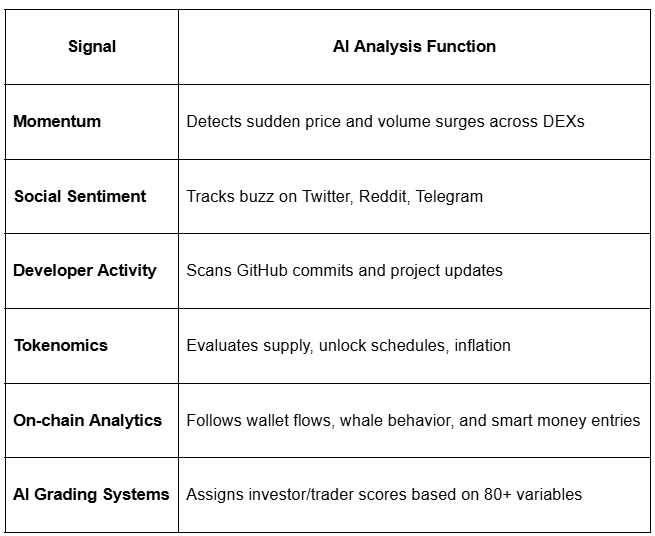
How AI Tools Detect Moonshots

AI models trained on crypto data can identify early-stage projects by analyzing:

These insights allow you to rank tokens and prioritize research efforts.

How Token Metrics AI Grades Work

Token Metrics, a pioneer in AI-driven crypto analytics, uses machine learning to generate Investor Grades, Trader Grades, and Bullish/Bearish Signals for thousands of tokens.

Here's how:

  • Investor Grade – Long-term potential based on fundamentals, community, tech
  • Trader Grade – Short-term potential based on price action, momentum, liquidity
  • Bullish Signal – Triggered when AI detects high-probability upside within 7–14 days
  • Bearish Signal – Warns of likely downturns or profit-taking zones

Moonshots that rank highly across these metrics are often early movers with breakout potential.

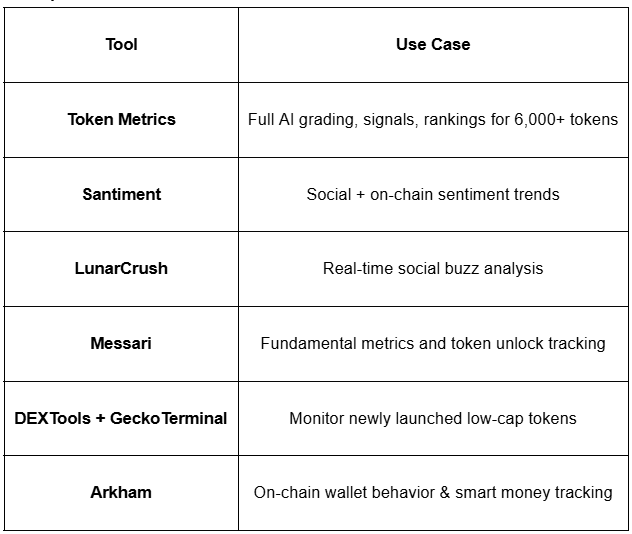
Top Tools to Find Moonshots with AI & Data

Use these tools together to spot patterns others miss.

Case Study: AI Spotting a Moonshot Early

Let’s say a low-cap AI token called NeuroLink AI launches. It’s not yet on CEXs but shows:

  • Spike in GitHub commits
  • Surge in Telegram growth
  • 24h price up 18%, volume 400%
  • Mentioned in 3 Token Metrics Bullish Signals in one week
  • AI Trader Grade: 91/100

That’s a prime moonshot candidate worth further analysis — and most retail traders wouldn’t catch it until it’s up 5x.

Human + AI = The Winning Formula

AI doesn't replace human judgment — it enhances it. The best approach is:

  1. Use AI to scan, sort, and filter top candidates
  2. Manually research the top 5–10 picks
  3. Evaluate community, product, team, and roadmap
  4. Use risk metrics and technicals for entry/exit planning

This hybrid approach minimizes FOMO and maximizes precision.

Moonshot AI Checklist

Before diving in, check:

✅ High AI Trader or Investor Grade (85+)
✅ Momentum score surging
✅ Early-stage narrative (AI, DePIN, RWA, etc.)
✅ Community growth across socials
✅ Smart money inflows on-chain
✅ No major unlocks in next 30 days

If all boxes are ticked, you may have found your next 10x.

Final Thoughts: AI is the Ultimate Edge in 2025

Crypto moonshots are no longer found in meme threads and TikTok videos alone. In 2025, the best investors use AI-powered research to systematically uncover explosive opportunities before they go viral.

By leveraging platforms like Token Metrics, you turn chaos into clarity — and emotion into execution.

Announcements

How to Build On-Chain Crypto Trading Bots Using Token Metrics Crypto API and Chainlink Functions

Token Metrics Team
8 min
MIN

In the evolving world of Web3 development, the need for real-time, reliable, and institutional-grade crypto data has never been greater. Whether you’re building decentralized trading bots, DeFi apps, or smart contract platforms, accessing powerful off-chain data is key to creating intelligent and profitable on-chain systems.

That’s where the Token Metrics Crypto API comes in.

In this guide, we’ll walk you through how to integrate the Token Metrics API with Chainlink Functions, enabling you to deploy live smart contracts that interact with real-time crypto signals, token prices, and trader grades. You’ll learn how to use more than 20 API endpoints and smart contract adapters to power decentralized apps with actionable data.

If you’re searching for the best crypto API for smart contract development, or you need a free crypto API to start testing on testnets, this article is your ultimate resource.

What Is the Token Metrics Crypto API?

The Token Metrics API is an advanced data interface designed for traders, developers, and Web3 builders. It provides access to over 20 endpoints covering everything from:

  • Token prices
  • AI-powered trading signals (bullish/bearish)
  • Trader and Investor Grades (0–100 scoring system)
  • Quant metrics
  • Support and resistance levels
  • Sentiment analysis

Built by a team of quant analysts, machine learning engineers, and crypto-native researchers, the Token Metrics Crypto API brings hedge-fund-grade intelligence into the hands of everyday builders.

Why Use the Token Metrics API with Chainlink Functions?

Chainlink Functions enable smart contracts to securely retrieve off-chain data from any API. By integrating with the Token Metrics Crypto API, you can bridge institutional-grade analytics into fully decentralized apps—something not possible with basic or unreliable data sources.

Here’s why this combo is so powerful:

  • 🔗 Chainlink decentralizes your execution
  • 🧠 Token Metrics powers your logic with predictive analytics
  • ⚙️ Smart contracts can now act on real market intelligence

This integration enables the creation of intelligent trading bots, dynamic token allocations, and governance proposals backed by hard data—not speculation.

Step-by-Step: How to Integrate Token Metrics API with Chainlink Functions

Let’s walk through how to connect the best crypto API—Token Metrics—with Chainlink Functions to build and deploy a live smart contract.

1. Clone the GitHub Repo

Start by cloning the GitHub repository that contains the full codebase. This includes:

  • A set of ~20 pre-built smart contracts
  • API adapter logic
  • Sample scripts to interact with the contracts
  • A detailed README with setup instructions

Each smart contract is tailored to one Token Metrics API endpoint—meaning you can plug and play any dataset, from prices to sentiment scores.

2. Set Up Your Environment

The README provides a full list of recommended environment variables, including:

  • API_KEY for Token Metrics
  • LINK_TOKEN_ADDRESS
  • CHAINLINK_SUBSCRIPTION_ID
  • ORACLE_ADDRESS

Once your .env is ready, you can start compiling and deploying.

3. Build and Deploy a Sample Trading Bot Smart Contract

In this walkthrough, the developer built a Solidity smart contract that:

  • Pulls live data from Token Metrics (price, signal, grade)
  • Evaluates the signal (e.g., bullish)
  • Executes a buy trade if the signal is positive

The contract is compiled in Remix IDE, connected via MetaMask (on testnet), and deployed using testnet ETH and LINK tokens.

After deployment, you’ll receive a contract address that can be added to your Chainlink subscription.

4. Create a Chainlink Subscription

To fund your contract for data requests:

  1. Go to the Chainlink portal
  2. Create a new subscription (testnet or mainnet)
  3. Fund it with some LINK
  4. Add your deployed smart contract as a consumer

This allows your contract to make external data calls using Chainlink’s decentralized oracle network.

5. Run a Script to Invoke Real-Time Token Metrics Data

Using the provided JavaScript scripts, you can interact with the smart contract and test data flow:

  • Check the bot’s active status
  • Retrieve token price, trading signal, and grade
  • See how the smart contract responds to live market conditions

In the demo, the bot received a bullish signal, saw that the grade was high, and executed a buy trade accordingly. This logic can be expanded into full-scale trading strategies, rebalancing rules, or even on-chain governance triggers.

Why Token Metrics API Is the Best Crypto API for Smart Contracts

Here’s what makes the Token Metrics Crypto API the best crypto API for building advanced, data-driven dApps:

✅ Institutional-Grade Signals

Get access to proprietary AI trading signals, used by hedge funds and institutional desks.

✅ 20+ Endpoints for Every Use Case

Whether you need sentiment data, grades, price trends, or quant models, it’s all there.

✅ Real-Time and Back-Tested

The data is not just live—it’s tested. Token Metrics backtests every signal against market conditions.

✅ Easy to Integrate

Pre-built smart contract adapters make it easy to use the API in Chainlink, Remix, or any EVM-compatible environment.

✅ Free Crypto API Tier Available

Start testing on testnets with a free crypto API key. Upgrade later for full production access.

Real-World Use Cases for Token Metrics + Chainlink Functions

Here are some examples of what you can build using this integration:

  • On-Chain Trading Bots: React to bullish or bearish signals in real time
  • Decentralized Rebalancing Strategies: Adjust token allocations based on trader grades
  • Token Governance: Trigger proposal alerts when sentiment crosses a threshold
  • Risk Management Contracts: Move funds to stablecoins when volatility spikes
  • NFT Floor Price Triggers: Use sentiment and price data for automated mint/pass logic

Final Thoughts: The Future of Crypto Intelligence Is On-Chain

As Web3 matures, the ability to combine decentralized execution with centralized intelligence will define the next generation of dApps. The integration of Token Metrics Crypto API with Chainlink Functions is a major step in that direction.

Developers can now build on-chain applications that make smarter, faster, and more profitable decisions—powered by data that was once out of reach.

Whether you're a DeFi developer, a DAO engineer, or just exploring your first smart contract, this setup gives you a free crypto API to experiment with and the power of the best crypto API when you're ready to scale.

🚀 Ready to Get Started?

  • Get your free Token Metrics API key
  • ✅ Clone the GitHub repo and install the smart contracts
  • ✅ Join the Token Metrics Dev Telegram community
  • ✅ Start building intelligent, AI-powered crypto applications today

Your next-generation crypto trading bot starts here.

Crypto Basics

How Risky Are Moonshot Investments?

Token Metrics Team
8 min
MIN

 Introduction: The High Stakes of Moonshot Crypto

Moonshot investing in crypto is a double-edged sword. On one side, you have tokens that can 10x, 50x, or even 100x your portfolio. On the other side? Complete capital loss. While these asymmetric bets can lead to explosive profits, they also carry extreme risk—especially for uninformed or impulsive investors.

This guide will break down the risk landscape of moonshots: what makes them so volatile, common pitfalls to avoid, risk management strategies, and how tools like Token Metrics help reduce blind spots when betting on the next big thing.

What Makes Moonshot Investments So Risky?

Moonshots live in the outer rim of the crypto market. They are typically:

  • Low market cap (<$20M)
  • Light on liquidity
  • Not listed on major exchanges
  • Lacking product-market fit
  • Speculative or narrative-driven

These factors create an environment where price moves fast—but fundamentals are often thin. You're betting more on potential than proof.

Common Risks in Moonshot Investing

You must assume every moonshot has some of these risk factors — and plan accordingly.

Risk Profile: Moonshots vs. Blue Chips

Moonshots = high variance. Don’t treat them like stable assets.

🛡️ How to Manage Moonshot Risk (and Stay Sane)

  1. Use Proper Position Sizing
    Never allocate more than 1–3% of your total portfolio to a single moonshot.

  2. Diversify Your Moonshots
    Build a “moonshot basket” of 5–10 different bets across categories (AI, DePIN, L1s, Meme, etc).

  3. Set Clear Entry and Exit Plans
    Know your take-profit and stop-loss targets before entering.

  4. Track Vesting & Unlock Schedules
    Use tools like Token Unlocks to avoid buying before big token dumps.

  5. Don’t Fall in Love With Your Bags
    Stay objective. Exit when the narrative fades or fundamentals change.

🧪 Risk Evaluation Checklist

If you answer “no” to 2 or more of these, tread cautiously.

How Token Metrics Minimizes Risk Exposure

Token Metrics helps de-risk moonshots by analyzing over 80+ data points using AI and quant models:

  • Risk-adjusted momentum scores
  • Tokenomics evaluations
  • On-chain behavior analysis
  • Contract audit status
  • Community health signals
  • Bullish/Bearish alerts based on AI

You get a comprehensive view of upside and downside before making a decision.

Mental Models for Risky Investing

  • “Play with house money” – Take profits early and only risk profits.
  • “Barbell strategy” – Majority in stable assets, small % in high-risk/high-reward.
  • “Expected Value (EV)” – Even if 8/10 fail, 1 big win covers losses.
  • “Don’t chase losses” – Accept failures quickly and move on.

Moonshot investing is mental warfare. Stick to frameworks, not FOMO.

Final Thoughts: Risk is Inevitable — Manage It, Don’t Fear It

The path to 100x gains in crypto will always be riddled with landmines. But risk isn’t inherently bad — it’s the price of asymmetric upside. The real danger is unmanaged risk, impulsive decisions, and poor research.

With the right approach, the right tools, and a clear head, moonshot investing can be one of the most rewarding strategies in crypto.

Just remember: You only need to be right once.

Choose from Platinum, Gold, and Silver packages
Reach with 25–30% open rates and 0.5–1% CTR
Craft your own custom ad—from banners to tailored copy
Perfect for Crypto Exchanges, SaaS Tools, DeFi, and AI Products